Showing posts with label Troy. Show all posts

Sunday, December 9, 2018

Harriet Butler and Sarah Sackett in Troy, 1824

via Dennis Holzman Antiques
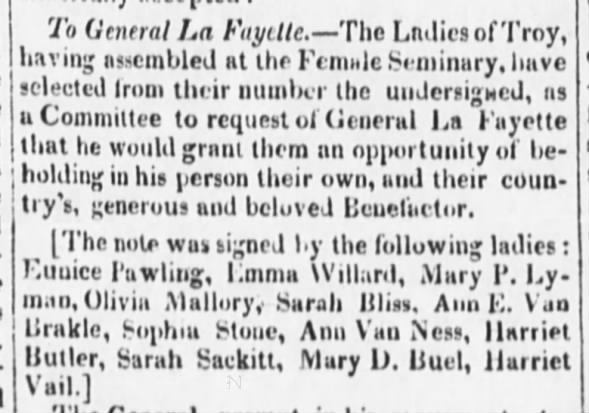
In 1824 Harriet Butler and Sarah Sackitt (Sackett) both signed a petition from the "Ladies of Troy" requesting the Marquis de Lafayette to honor the Troy Female Seminary with a visit during his triumphal U. S. tour.

Thu, Sep 23, 1824 – Page 1 · The Evening Post (New York, New York, New York) · Newspapers.com
This "Sarah Sackitt" is probably Sarah Sackett, the former Sarah H. Pardee and wife of Troy merchant Daniel Sackett (1788-1845). At the time Sarah Sackett belonged to the First Presbyterian Church of Troy; she would join the Second Presbyterian Church in 1827 as a charter member. Harriet Butler is the daughter of the Rev. David Butler, Rector of St. Paul's Episcopal Church. In later sources, both women are named independently in connection with the first publication of "A Visit from St. Nicholas" in the Troy Sentinel on December 23, 1823. Harriet Butler copied the poem while visiting the family of Clement C. Moore in New York City, as reported by John T. Parker in the Troy Daily Times on December 23, 1871 ("The 'Visit of St. Nicholas’—Moore's Poem—Some Account of Its History."). Mrs. Sackett brought a copy to editor Orville L. Holley, according to the 1844 letter from publisher Norman Tuttle to Moore, now held by the Museum of the City of New York (54.331.17b).

The reported involvement of these two ladies of Troy as intermediaries is consistent with the 1862 account of the poem's earliest transmission in which T. W. C. Moore describes two stages of copying, first "by a relative of Dr Moores in her Album" and second, "by a friend of hers, from Troy." But until now (so far as I know), Harriet Butler and Sarah Sackett were not linked by name in any known contemporary record. This item nicely confirms their acquaintance and active collaboration with other civic-minded women on a project of mutual interest. Great to have, especially since some published versions of Lafayette's visit to Troy omit the bracketed list of signatories included in the New York Evening Post account.
[The note was signed by the following ladies: Eunice Pawling, Emma Willard, Mary P. Lyman, Olivia Mallory, Sarah Bliss, Ann E. Van Brakle, Sophia Stone, Ann Van Ness, Harriet Butler, Sarah Sackitt, Mary D. Buel, Harriet Vail.]
The most famous name on the 1824 list is that of Emma Willard, founder of the Troy Female Seminary.


General Lafayette accepted the invitation signed by Harriet Butler and Sarah Sackitt or Sackett along with other members of the hastily organized Arrangements Committee. At the Troy Female Seminary Lafayette received a gift copy of Emma Willard's treatise on Improving Female Education and heard two students recite Willard's poem, "La Fayette's Welcome."
The town, he said, seemed to have sprung up by enchantment. And how must this astonishment have increased when he visited this Female University, and beheld so great a collection of young ladies, drinking from the pure fountain of knowledge, whose bright eyes, and healthy countenances, and cheerful demeanor, bespoke them "as sweet as innocent; as innocent as gay; as gay as happy." The visit of the General, to Troy, short as it was, afforded him great satisfaction. He talked much about it, and frequently spoke of his visit to the Seminary, as one of the most interesting and delightful moments of his life.  --New York Evening Post, September 23, 1824. Reprinted in Poulson's American Daily Advertiser (Philadelphia, PA) on September 23, 1824; the New York Spectator on September 24, 1824; and the Richmond Enquirer ("Domestic. Journey of the Nation's Guest--in Continuation. Reception at Albany") on October 1, 1824.
Lafayette lingered so long in Troy that he had to cancel scheduled stops in Lansingburgh and Waterford.

Thu, Sep 23, 1824 – Page 1 · The Evening Post (New York, New York, New York) · Newspapers.com
Related post:

Monday, November 26, 2018

The Trial Before Christmas


In this 2014 mock trial, attorney Jack Casey opened for the Livingston side with splendid readings from Frost, Chaucer, and Bob Dylan.

Moore's lawyer E. Stewart Jones Jr. said many fine things as well, including this at 21:30:
"Mr Casey has spent so much time in his legal career, in Albany with the state legislature, that he's mastered the art of historical revision."
Elvis showed up, and Santas with saxes. Alas, the evidence of Moore's published letter to the editor of the New York American (March 1, 1844) was not available at the time of this trial. (Found in January 2017, in microfilm of the New-York American at NYPL: *ZY 86-140 Reel 17, Mar 1-Dec 28, 1844). In this 1844 letter Moore reveals that he personally gave "A Visit from St Nicholas" with several other poems to the publisher of The New-York Book of Poetry in 1837. Here it is again, for the record.

New York American - March 1, 1844
LINES TO ST. NICHOLAS.--The following note from our friend C. C. Moore, the author of those lines which every child among us delights to hear, about Christmas, and which parents with not less delight recite, brings to our notice, one of the boldest acts of plagiarism of which we have any recollection. We ask the National Intelligencer to have the goodness to insert Mr. Moore's note--and if possible to elucidate the mistake, if such it be, or fraud attempted in respect of such well known lines. 
New York, Feb. 27, 1844 
Dear Sir--My attention was, a few days ago, directed to the following communication, which appears in the National Intelligencer of the 25th of December last.
"Washington, Dec. 22d, 1843.

Gentlemen--
The enclosed lines were written by Joseph Wood, artist, for the National Intelligencer, and published in that paper in 1827 or 1828, as you may perceive from your files. By republishing them, as the composition of Mr. Wood you will gratify one who has now few sources of pleasure left. Perhaps you may comply with this request, if it be only for 'auld lang syne.'" 
The above is printed immediately over some lines, describing a visit from St. Nicholas, which I wrote many years ago, I think somewhere between 1823 and 1824, not for publication, but to amuse my children. They, however, found their way, to my great surprise, in the Troy Sentinel: nor did I know, until lately, how they got there. When "The New York Book" was about to be published, I was applied to for some contribution to the work. Accordingly, I gave the publisher several pieces, among which was the "Visit from St. Nicholas." It was printed under my name, and has frequently since been republished, in your paper among others, with my name attached to it.  
Under these circumstances, I feel it incumbent on me not to remain silent, while so bold a claim, as the above quoted, is laid to my literary property, however small the intrinsic value of that property may be. 
The New York Book was published in 1827 [1837]. 
Yours, truly and respectfully,   
CLEMENT C. MOORE
Chas. King, Esq.
Related posts:

Tuesday, February 28, 2017

Arrowhead in January


Last month I had the pleasure of visiting Troy, New York. I drove there from Albany (Rensselaer, technically) after a gorgeous ride along the Hudson on Amtrak from Penn Station in New York City. Spent a lot of my time at the Troy Public Library, looking at old newspapers on microfilm in the Troy Room.

For a break I drove to Pittsfield in western Massachusetts and (of course) stopped by Arrowhead.


After parking my rented SUV (unsolicited upgrade, thanks enterprise!) I walked on over to the front of Herman Melville's old home. Check out the reconstructed front porch, something added they say by Herman's brother Allan Melville around 1870, when he owned the place...


I proceeded on around for a look at the famous Piazza, also a reconstruction...


and then walked a little ways up The Melville Trail before heading back in a light snowfall.

It's a beautiful place to be, still.


Tuesday, November 22, 2016

Sarah Sackett, Clement C. Moore, and the Greek Fund

Le Massacre de Scio - Eugène Delacroix, Public domain, via Wikimedia Commons
From the New York Commercial Advertiser, April 18, 1827, under the heading "Greek Fund"; reprinted in the New York Spectator, April 24, 1827:

Troy, April 11th, 1827.

Sir--You will receive per steamboat New London, Capt. Fitch, Merchandize, valued at $55, for the Greeks--twenty dollars of which, is a donation from the Female Industrious Society of the First Presbyterian Church, and the remaining thirty-five dollars, from individual ladies of this city. Though our offering be small, we hope it may contribute something to the current of benevolence which is setting to the relief of the oppressed and destitute people. Your's respectfully, in behalf of the donors.

SARAH SACKETT.

Stephen Allen, Esq. Ch'mn. Greek Com.
This Sarah Sackett of Troy is the former Sarah H. Pardee, wife of Daniel Sackett, a crockery and glassware merchant in Troy, New York. Norman Tuttle, publisher of the Troy Sentinel, identified Sarah Sackett as the person who had given a copy of Clement C. Moore's poem "A Visit from St. Nicholas" to editor Orville L. Holley, back in December 1823. Other accounts involve Harriet Butler, daughter of Episcopal clergyman David Butler. As related for example in Troy's One Hundred Years, Harriet supposedly copied out the poem while visiting the Moore family and brought it back to Troy. Any sequence of transmission involving the Butlers, Sacketts, and Holley seems plausible. The families of Clement C. Moore and the Rev. David Butler were connected through longstanding ties of friendship and religion. Rev. Butler was then rector of St. Paul's Episcopal Church in Troy (consecrated in 1806 by Moore's father, the Bishop). Butler in turn was socially and politically connected with Daniel Sackett and Orville Holley as leading citizens of Troy, and prominent Whigs. All three were founding members of the Troy Colonization Society.

Sarah Sackett's published letter to the Greek Committee in 1827 reveals another connection to Clement C. Moore in their mutual support for the cause of Greek independence. Sarah Sackett organized for the charitable relief of "oppressed and destitute" Greeks. Moore, too, actively supported the Greek Fund. In verse, Moore honored the Greek spirit of rebellion in "To the Nymphs of Mount Harmony," allegorizing the plight of defeated Greeks as the overthrow and enforced captivity of an Arcadian sprite or fairy. Sarah Sackett and Clement C. Moore were both philhellenists, like Edward Everett, Daniel Webster, and Henry Clay. And Byron:
Henceforth there could be little question of the strength of Philhellenism in the United States; in America as elsewhere Byron’s dramatic self-sacrifice rendered the cause of Greek independence services which never can be repaid. The autumn and winter of 1823-1824 were a period in which sentiment for Greek independence reached a high point, strenuous efforts were put forth to render active assistance to the revolutionary forces, and serious consideration was given to a possible recognition of Greek belligerency and independence by the government of the United States.
--Edward Mead Earle, American Interest in the Greek Cause, 1821-1827
Coincidentally, contributions to the Greek Fund were being passionately solicited and publicized during the same holiday season of 1823-4 in which Clement C. Moore's "A Visit from St. Nicholas" made is first appearance in the Troy Sentinel. December 1823 marked the start of the Greek Fund as well as "The Night Before Christmas" tradition. The first meeting of Troy citizens on behalf of the oppressed Greeks generated $710 for the Greek Fund, as reported in a published letter from Esaias Warren:

New York American - January 31, 1824
Troy, January 23, 1824.  
Dear Sir--In compliance with a resolution, passed at a meeting of the citizens of this place, I have the pleasure of transmitting you, the annexed draft for $710, the amount contributed by them towards aiding the Greeks in their struggle against Turkish oppression. 

I am, sir, respectfully.
Your obedient servant,
ESAIAS WARREN. 
Wm. Bayard, Esq. Chairman of Greek Committee.
Esaias Warren was then mayor of Troy, president of the Troy Bank, and a warden of the Butlers' church, St. Paul's Episcopal. Warren's mother Phebe and father Eliakim had been instrumental in establishing St. Paul's in Troy. Indeed, at first the Warrens and Lemuel Hawley were the church. Esaias Warren became "senior warden" after his father's death in 1824, according to Hudson-Mohawk Genealogical and Family Memoirs.

In New York City on Tuesday, December 2, 1823 Moore's old friend John Duer addressed a large and distinguished gathering at the Tontine Coffee House. Speaking after John Pintard and S. R. Hurd, Duer emphasized "the degraded condition of the Greeks" in "contrast with their ancient splendor and renown." Duer
"spoke of the contest as one in which religion, knowledge and liberty, were staked against infidelity, ignorance and slavery--as one in which refinement and cultivation were opposed to brutal sensuality--as one in which all that is valuable in civilization was opposed by all that is degraded in barbarism."  --New York American, December 6, 1823
Meeting on Tuesday night, December 30, 1823 at Creigier's Tavern with his 9th ward neighbors, Clement C. Moore endorsed the resolution of support and volunteered for the fundraising committee.
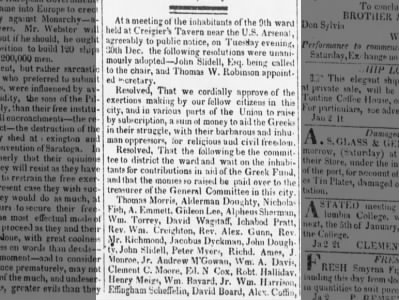
New York Evening Post - January 2, 1824
 Resolved, That we cordially approve of the exertions making by our fellow citizens in this city, and in various parts of the Union to raise by subscription, a sum of money to aid the Greeks in their struggle, with their barbarous and inhuman oppressors, for religious and civil freedom.

Resolved, That the following be the committee to district the ward and wait on the inhabitants in aid of the Greek Fund....
The best known American poets contributed heroic verses in support of Greek independence:
"In imitation of Byron, poets and literary men like William Cullen Bryant and Fitz-Greene Halleck wielded their pens in stout defense of the Greeks, in whom they saw heroic descendants of classic forefathers." --Edward Mead Earle, American Interest in the Greek Cause, 1821-1827
In 1826, Herman Melville's older brother Gansevoort recited Halleck's pro-Greek "Marco Bozzaris" at the New York High School. Around 1827 or 1828 (my best guess for now), Clement C. Moore composed "To the Nymphs of Mount Harmony." Moore's allegory of Ottoman tyranny and Greek suffering unfolds as the tale of a captive elf, whispered in the "wond'ring ear" of an Arcadian shepherd. Though drenched in the conventions and mythology of pastoral poetry, Moore's manner of describing the shepherd's "wond'ring ear" nicely harmonizes with the speaker's famously "wondering eyes" in "The Night Before Christmas." Transcribed below from the only known printing in Moore's 1844 Poems.

TO THE NYMPHS OF MOUNT HARMONY.

An idle swain late chanc'd to roam
Beneath a grove's leaf-lattic'd dome,
That near a verdant mount was plac'd
Whose brow no title e'er had grac'd
Till nymphs declared the mount should claim
Sweet Harmony's inspiring name.
Here, as the swain at even strayed,
Wooed by the grove's sequester'd shade,
With thoughts unfix'd, and vacant eye,
And idly sad, he scarce knew why;
A mournful spirit of the wood,
Touch'd haply, by his kindred mood,
Soft-sighing from a hawthorn near,
Thus whisper'd in his wond'ring ear.

"A sprite I was, in happier times,
Disporting in the favor'd climes
Of early Greece; when freedom's ray
Bade mirth through all her regions play;
When wood-nymphs with their huntress-queen,
The muses and the loves were seen
To sport, like fauns, beside each rill,
And deck, like flow'rets, every hill,
'Twas then I serv'd the lighter joys
Of rural nymphs and sylvan boys;
And, sportive as the summer airs,
Exulted in my frolic cares.

" Oft, to a playful zephyr chang'd.
Along the reedy banks I rang'd;
Or, sighing o'er the oaten field,
I tried the note each stalk would yield,
In quest of dulcet tones to suit
Some favor'd fawn's or shepherd's flute.  
"Oft, in a fleecy vapor's guise,
The zephyrs bore me to the skies:
Where, 'midst the clouds with thunder fraught,
The rainbow's brightest tints I caught;
Then, melting into finest dews,
Distributed the lovely hues
To opening buds, or full-blown flowers,
Round naiad's couch, or wood-nymph's bowers.

"Oft, in a virgin lily's bell,
I caught the purest dews that fell,
With chaste suffusion to supply
Some weeping Muse's languid eye.
For, tears that from the Muses flow.
Unlike the drops of vulgar wo,
Emit the dew's inconstant gleam,
And soon are chas'd by pleasure's beam —  
"Dear airy partners in delight!
Who skimm'd, like mists, the mountain's height,
Or danc'd along the limpid stream
Illum'd by freedom's golden beam!
Ye perish'd in the floods and gales
That ruin'd all our smiling vales,
And chill'd and wither'd every bloom
In tyranny's detested gloom!

"A fiend that in the tempest flew
On wing still wet with stygian dew
Rapt me in a hurling blast
Athwart the ocean's dreary vast;
And set me, with infernal spell,
In this sequester'd grove to dwell.
Here, in my lonely prison bound,
Beset with dire enchantments round,
I've seen whole ages ling'ring go.
With scarce a solace for my wo;
Till late, beneath the neighb'ring shades,
Methought a band of Tempe's maids,
With all their wonted mirth elate,
Came, destin'd by relenting fate,
Their long, long rovings here to cease,
And charm my anguish into peace.
For, as they gambol'd o'er the green,
Once more I saw Arcadia's scene;
Again I heard each well-lov'd voice
That bade the Aonian hills rejoice.
But soon the lovely vision pass'd.
Through lonely shades now sweeps the blast,
Where, late, the fairy-footed throng
Prolong'd the dance, or pour'd the song.
If e'er thy bosom, gentle swain,
Was touch'd with sympathetic pain.
Hie thee to where the nymphs now dwell,
And all my sorrows kindly tell.
And say, if e'er this lone retreat
Their lovely band again shall greet,
I'll wake my long-neglected powers;
Refine the dews, new-tint the flowers.
I'll fringe the trees with speckled moss.
And give their leaves a finer gloss.
The painted fly shall learn to fling
Sweet odors from his gaudy wing.
I'll winnow, with my silken sails,
Each noxious breath that taints the gales;
With sweeter strains the birds inspire,
And lead, myself, the tuneful choir.  --Clement C. Moore
Moore's 1844 collection Poems is also available online courtesy of HathiTrust Digital Library.
Related posts:
Lines written after a snow-storm, 1824 and 1844 versions
https://melvilliana.blogspot.com/2019/04/lines-written-after-snow-storm-by.html

Tuesday, October 6, 2015

More on Charles Whitney (1815-1885)

From the 1894 Biographical Review of Broome County, New York via Whitney Research Group:
CHARLES WHITNEY, dramatic reader and author of wide celebrity, was born at Chenango Point, now Binghamton, N.Y., April 1, 1815, a son of General Joshua Whitney, of whom see the very interesting biographical sketch on another page. The Whitney family is one of the best known in the annals of this city.

The subject of this brief memoir, who died suddenly, April 17, 1885, at his home, No. 7 North Street, Binghamton, received a good education, attending some of the best institutions of learning in the State of New York at the time of his school-days in the early part of the century. He held first rank as a dramatic reader, and was especially versed in Shakespearean literature, to which he was so devoted that every room in his house had some appropriate quotation from the bard of Avon painted on the walls. He was a man of great ability as a writer, and was a correspondent for various New York papers for many years.

At the age of forty he married Miss Emily Clark, a most gifted and intelligent lady, who was born in Halifax, Nova Scotia. She died March 10, 1892, on the home farm in the town of Conklin, N.Y., where she and the family had lived since the death of her husband. They had a family of five children, of whom only two are now living, Mary E. and Jennie J. Mary E. was born in Boston, Mass., and is an artist of rare merit, and also a well-known author. She and her sister are graduated of St. Agnes Church School at Albany, N.Y., and are brilliantly educated young women. They managed the farm in the town of Conklin, where they reside, and which consists of one hundred and sixty acres of excellent and productive land. Miss Mary devoted herself principally to her paintings, for which she receives many valuable orders; and her literary work appears in the best magazines of the day.

Mr. and Mrs. Whitney were communicants of the Episcopal church, and in politics he voted with the Democratic party.
In February 1859, Herman Melville opened for Professor Whitney in Chicago. Or put it this way: Whitney closed out Melville's Chicago lecture on The South Seas. In Melville as Lecturer, Merton M. Sealts, Jr. cited Whitney's performance as evidence of the unrefined "western" appetite for popular entertainment:
Here the atmosphere was quite different from that of the eastern lecture halls, for after Melville had finished speaking, "Professor Charles Whitney...announced his entertainment to take place this evening...and gave an admirable impersonation of the eccentric John Randolph, closing with a rendition of Boker's fine ballad of Sir John Franklin."  --Melville as Lecturer, 81-2
Hershel Parker adds:
"Melville was most likely trapped on the stage for this quintessentially academic self-promotion." --Herman Melville: A Biography, v2.393
Despite Whitney's self-promoting title of "Professor," his career as dramatic speaker or "elocutionist" now looks more theatrical than academic. Possibly Melville enjoyed the show, if he stayed. And if, say, Whitney did his celebrated imitation of Red-Jacket. And I'm wondering, too--would Melville have known of Whitney already, before encountering him live in Chicago? In August 1838, a few months after Melville's family moved from Albany to Lansingburgh, Whitney lectured in Troy.


Troy Daily Whig, Monday Evening, August 6, 1838

As advertised in the Daily Whig, Whitney would
"deliver a Lecture on the Art of Speaking, explanatory of his mode of teaching this science, and illustrate its principles, by appropriate reading and recitations--exhibit a natural and easy mode of acquiring the beautiful falsetto, and the Vocal Echo,--Mr. Whitney will also, explain the amusing art of Ventriloquism, or Vocal Modulation."

Notice and ad both found at Fulton History.

In March and early April 1840, Whitney lectured at the Apollo Saloon in Albany. His advertised "third Lecture" included thrilling selections from mostly English authors, starting with scenes from Shakespeare's Merchant of Venice, Lear, and Richard III:
--from the American Masonic Register and Literary Companion (March 14, 1840).
 Charles Whitney's fifth Albany lecture received this rave advance review in the Albany Argus (dated Thursday Morning, April 2, 1840), signed "H.":
Mr. WHITNEY delivers his fifth lecture on Oratory, this evening at the Apollo Saloon, Green street. Among the compositions selected in illustration of his subject, are Milton’s Apostrophe to Light, and the Female Maniac, by Lewis—both admirable subjects—the former as portraying in sublime yet touching language, the loss of those “orbs” for which the lofty conceptions of the poet, could scarcely compensate, and the latter exhibiting a fine mind gradually sinking beneath a weight of injustice and misery into madness.— Mr. W’s delineation is perfect. These two pieces are alone worth the whole price of admission, and no doubt a goodly portion of our citizens will avail themselves of this truly intellectual entertainment. H.
Later in his career as a dramatic speaker Whitney won a reputation for
"celebrated impersonations of orators and imitations of American and Indian speeches."  --Washington Daily Union, February 7, 1851
Related melvilliana post: Melville's lecture on The South Seas 

Sunday, April 5, 2015

Lansingburgh old-timer remembers the Melvilles, praises Typee and Omoo in June 1914

Troy [New York] Daily Times, June 8, 1914
via Fulton History
... Another interesting fact occurs to me. At the time my people occupied the Spafford house, the dwelling just north of it, still standing, was occupied by the Melvilles. A young son, Hermon Melville, went to sea and subsequently wrote his experiences in those two fascinating tales of the sea, "Typee" and "Omoo." They are as fine as anything from the pen of Cooper or Stevenson.
As "M. T." informs the editor of the Troy Daily Times, his grandparents lived in the brick home on First Avenue formerly occupied by Horatio Gates Spafford (1828-1888). In 1838 Herman Melville's mother Maria rented the place "just north" of the brick one that locals long called the "Spafford House." The first Spafford there was the elder Horatio Gates Spafford (1778-1832), author of the influential Gazetteer of the State of New York. As Frances D. Broderick reported for the Troy, NY Times Record ("Spafford Highly Regarded by All," July 17, 1971), the elder Horatio Gates Spafford
"was sincerely mourned when he died of cholera on August 7, 1832, at his beautiful home at 524-526 River St (First Avenue, Lansingburgh, located next to and south of the Melville home)."
Troy, N. Y. Times Record, May 26, 1971

View of Troy, N. Y.
1845, Edwin Whitefield / Albany Institute of History & Art