Showing posts with label New York American. Show all posts

Wednesday, November 13, 2024

Early praise for Clement C. Moore's 1825 lecture on the Hebrew Bible


The professor shows that he has entered intimately into the spirit of Hebrew poetry....

With "Philo-Hebrœus," as the Christian contributor of this forgotten letter to the editors of the New York American subscribed himself--alluding perhaps to the Jewish philosopher Philo of Alexandria, sometimes called Philo Judaeus (Philo the Jew) or Philo Hebraeus, and self-identifying more generally as a friend or lover of the Hebrew language and people--I would heartily recommend Clement C. Moore's wonderful Lecture introductory to the course of Hebrew instruction as, among its many virtues, a strong inducement "to the study of Hebrew poesy." Although two centuries now have passed, the pseudonymous writer's insight that Professor Moore had "entered intimately into the spirit of Hebrew poetry" remains suggestive and potentially valuable I think for a better understanding of Moore's own poetry, including the world-famous rhymes describing A Visit from St. Nicholas.

The lecture so warmly endorsed by "Philo-Hebrœus" was delivered by Clement C. Moore at Christ Church in New York City on November 14, 1825, nearly three years after he wrote "Visit" aka "'Twas the Night Before Christmas" to entertain his kids.

New York Evening Post - November 14, 1825

In 1798 Clement C. Moore graduated from Columbia College, first in his class. In 1809 he published his important two-volume work, A compendious lexicon of the Hebrew language, duly honored as the "first work of the kind in America" in Allibone's Critical Dictionary of English Literature and British and American Authors Volume 2 (Philadelphia: J. B. Lippincott & Co., 1874) page 1351. In 1813 "Clem" married Catherine Elizabeth Taylor, called "Eliza" in the family circle, after a courtship that Moore allegorized in a seven-page manuscript poem, 
The bride's version may be found in verses she wrote titled 
Upon receiving his honorary degree of L. L. D. from Columbia College in 1829, Moore was identified in at least one newspaper listing as "Clement C. Moore, Professor of Hebrew literature in the General Protestant Episcopal Theological Seminary, New-York" (Middlebury, Vermont American, August 19, 1829). When first appointed his formal title was "Professor of Biblical Learning." Later on, "Professor of Oriental and Greek Literature."

Here then is the full text of the published endorsement by "Philo-Hebrœus," transcribed below from the New-York American, for the country of Friday, December 16, 1825; found on genealogybank.com. At this time the editors being addressed were David Johnston Verplanck and Charles King, Moore's good friend and later president of Columbia College.

TO THE EDITORS OF THE AMERICAN.

Messrs. Editors— As I observe that you often appropriate a column of the first page of your paper to subjects connected with literature, and am persuaded that this contributes to make the American acceptable to a large class of your readers, I beg the favor of an insertion of the following remarks, if they should meet your approbation. If the object of them be not strictly and exclusively literary, it is however so closely associated with the best interests of learning, as to merit the attention of our enlightened and discriminating citizens.

The cause of literature and science is evidently gaining ground among us, and taking a stand somewhat proportioned to its elevated character and intrinsic value. The style of education in the more common schools is improving, and Columbia College is becoming better known, and consequently more highly appreciated, not only for the ability of its professors, but for the practical efficiency of its course of instruction; which, to say the least, in classical literature, yields the palm to none of her sister colleges in the United States. And there is in our city another institution which in time will have no little influence on its literary character—I mean the Episcopal Theological Seminary. I have silently, Messrs. Editors, watched the origin and progress of this school with no little interest; and although I freely acknowledge that the direct effect which it must produce upon the interests of the Episcopal church (of which I am a member,) in raising the literary and religious character generally of our clergy, constitutes in my mind its highest value, yet I beg leave to express the opinion that in a literary view merely, it is deserving of consideration. I have attended all its public exercises, and seldom have I come away without satisfaction, mingled however, (let me add without offence,) with no small portion of regret when I saw so few comparatively of the learned men of our city giving to those exercises the sanction of their presence. It is to me a gratifying circumstance that the necessary effect of the establishment of this Theological College will be to lessen the facilities of admission into the ministry to the unworthy, and to give the friendly hand of encouragement to the destitute and pious youth who is willing to pursue a laborious course of study, alike honourable to its projectors, and to those whose diligence and perseverance enable them to surmount its difficulties. I am glad to see that the faculty of this institution require, in addition to testimonials of moral and religious character, that the applicant for admission shall be able to read and analyze Latin and Greek classics, and possess a general knowledge of the principles of rhetoric and of natural and moral philosophy. This is as it should be. I hope they will never diminish their terms of admission; for in proportion to the requisitions not only demanded ostensibly, and on paper, but really secured by a careful and rigid examination in our higher schools, will be the attainments actually made in the lower. If this remark needed any illustration, it were easy to prove its truth by comparing the present state of our grammar schools with what it was some years ago, and tracing the difference to the increased requisitions of admission into Columbia College.

My attention has been directed to the subject of the Theological Seminary, from having lately read a "Lecture introductory to the course of Hebrew instruction," given in it by Professor Moore. In the present day, when so few of the middle-aged clergy of all denominations are well skilled in the language of the Old Testament, it is a circumstance both of surprise and gratification, that a layman of wealth, and family, and character, induced by no other considerations than the love of learning and of the Bible, should have acquired such accurate and extensive acquaintance with this most venerable and ancient tongue, as we know to be the case with this gentleman. Nor is it in Hebrew literature only that Mr. Moore's attainments are of the most respectable character. The purity and elegance of his composition, the soundness of his views, and the practical good sense of his reflections, mark the man of classical taste, of discriminating mind, and of sober judgment; and it is hoped that the example of one who can appreciate the excellencies of Greek tragedians and orators, and enjoy in his own language the author who is distinguished by a judge altogether competent, as "the greatest of all Italian and of all Christian poets,"🞷 will excite to the study of Hebrew poesy, not only the candidates for the ministry among us, but young gentlemen of leisure and literary taste.

It is with the view of promoting this object, that I beg leave to invite attention to the professor's lecture. It will abundantly repay the trouble of perusal. He examines some of the objections which are frequently urged against the study of Hebrew, makes some remarks on the origin and nature of the language, and notices the characteristics of its prose and poetry.

To every Christian who is persuaded of the divinity and inspiration of the scriptures, it must be undoubtedly a source of great satisfaction, that those sacred records are receiving increased attention in our country. The whole genius and character of the authors respectively, taken in connexion with their public and private history, as far as the imperfect remains of olden times will permit it to be investigated, and with the vast world of contemporary antiquity, is becoming more and more developed, opening before the inquirer a new scene of variegated attraction of splendid sublimity, which no one can enjoy but the indefatigable traveller who has mounted to the summit of this, to most men, new and glorious creation. As curious and interesting records of antiquity, the various works which the Old Testament contains are worthy of attention by the student, even if his object is confined to literary fame and mental improvement, "the volume of Hebrew Scriptures," as the lecturer well remarks in his introduction, "is a book, whose antiquity surpassing that of all others, should alone be a powerful title to the respect of mankind; a book, which has for ages excited the liveliest interest and keenest curiosity among the profane as well as the religious; among its opponents as well as its defenders; which affords to the curious rich treasures in various departments of literature, and which, even under all the disadvantages of translation, calls forth the admiration of the orator and the poet." And if this is the case, under the acknowledged disadvantages of a version, however excellent as a whole, our own confessedly is,✝ "what must have been the enjoyment of those to whom the lofty effusions of Isaiah, the divine strains of the royal Psalmist, and the unrivalled imagery of the book of Job, were addressed in their native language!" The professor shows that he has entered intimately into the spirit of Hebrew poetry, when he tells us, that its "blaze of magnificence arises not from the selection of words or arrangement of phrases, but is due to the subjects treated of, to the imagery employed, to the feelings which are expressed and awakened, to the boldness of its flights, the awfulness of the idea it presents, and to the immensity of its range, 'as high as heaven'—'deeper than hell.' The effect of this poetry upon the mind, resembles that produced by the view of the great works of nature; it is irregular, but with an irregularity which could not be changed without destroying its effect. It is the voice of the thunder or of the whirlwind which strikes our ear; it is the expanse of the firmament which meets our eye: all creation rises before us; it is the voice of nature inspired by nature's God."

The few specimens from professor Moore's Lecture which I have given, will I trust, excite sufficient interest in your readers to peruse the whole of it, and at the same time awaken an attention to Hebrew literature. While the poets of Italy receive from an enlightened community that attention which is due to the models of elegance and taste; while the range of German literature, as splendid as it is immense, is beginning to be traversed; while the monuments of Greek and Roman composition are advancing daily to that honorable station among us, which their unrivalled excellence demands, let us not pass unnoticed the less known and less eulogized but not less meritorious Hebrew poet. He will astonish by the grandeur of his conception and the splendour of his imagery; he will awaken feeling by the tenderness and resignation with which he opens the depths of his grief; and what must ever raise his value in the estimation of every one who thinks it important to mingle the utile with the dulce, he will communicate that instruction which will elsewhere be sought in vain; that wisdom which "is the brightness of the everlasting light, the unspotted mirror of the power of God, and the image of his goodness."
 

PHILO-HEBRŒUS.

🞷 This is Schlegel's eulogy of Dante. See Lect. IX.

✝ On this point Mr. Moore has expressed himself with feeling and strength; and his remark cannot but give satisfaction to the mere English writer. 

New-York American for the country
December 16, 1825

Related posts: 

Monday, November 26, 2018

The Trial Before Christmas


In this 2014 mock trial, attorney Jack Casey opened for the Livingston side with splendid readings from Frost, Chaucer, and Bob Dylan.

Moore's lawyer E. Stewart Jones Jr. said many fine things as well, including this at 21:30:
"Mr Casey has spent so much time in his legal career, in Albany with the state legislature, that he's mastered the art of historical revision."
Elvis showed up, and Santas with saxes. Alas, the evidence of Moore's published letter to the editor of the New York American (March 1, 1844) was not available at the time of this trial. (Found in January 2017, in microfilm of the New-York American at NYPL: *ZY 86-140 Reel 17, Mar 1-Dec 28, 1844). In this 1844 letter Moore reveals that he personally gave "A Visit from St Nicholas" with several other poems to the publisher of The New-York Book of Poetry in 1837. Here it is again, for the record.

New York American - March 1, 1844
LINES TO ST. NICHOLAS.--The following note from our friend C. C. Moore, the author of those lines which every child among us delights to hear, about Christmas, and which parents with not less delight recite, brings to our notice, one of the boldest acts of plagiarism of which we have any recollection. We ask the National Intelligencer to have the goodness to insert Mr. Moore's note--and if possible to elucidate the mistake, if such it be, or fraud attempted in respect of such well known lines. 
New York, Feb. 27, 1844 
Dear Sir--My attention was, a few days ago, directed to the following communication, which appears in the National Intelligencer of the 25th of December last.
"Washington, Dec. 22d, 1843.

Gentlemen--
The enclosed lines were written by Joseph Wood, artist, for the National Intelligencer, and published in that paper in 1827 or 1828, as you may perceive from your files. By republishing them, as the composition of Mr. Wood you will gratify one who has now few sources of pleasure left. Perhaps you may comply with this request, if it be only for 'auld lang syne.'" 
The above is printed immediately over some lines, describing a visit from St. Nicholas, which I wrote many years ago, I think somewhere between 1823 and 1824, not for publication, but to amuse my children. They, however, found their way, to my great surprise, in the Troy Sentinel: nor did I know, until lately, how they got there. When "The New York Book" was about to be published, I was applied to for some contribution to the work. Accordingly, I gave the publisher several pieces, among which was the "Visit from St. Nicholas." It was printed under my name, and has frequently since been republished, in your paper among others, with my name attached to it.  
Under these circumstances, I feel it incumbent on me not to remain silent, while so bold a claim, as the above quoted, is laid to my literary property, however small the intrinsic value of that property may be. 
The New York Book was published in 1827 [1837]. 
Yours, truly and respectfully,   
CLEMENT C. MOORE
Chas. King, Esq.
Related posts:

Wednesday, August 8, 2018

Pre-1844 attributions of "A Visit from St Nicholas" to Clement C. Moore

Washington Daily National Intelligencer - December 28, 1843
via GenealogyBank
Clement C. Moore contributed four poems to The New-York Book of Poetry (New York: George Dearborn, 1837), one of which was A Visit from St Nicholas.


Moore's authorship of the beloved Christmas poem (aka "The Night Before Christmas") was already established when he affirmed his prior claim in a letter to the editor of the New York American, published March 1, 1844.

Moore-New York American-1March1844
Clement C. Moore, letter dated February 27, 1844 to Charles King, editor of the New York American
New York American (March 1, 1844) via Wikimedia Commons
LINES TO ST. NICHOLAS.— The following note from our friend C. C. Moore, the author of those lines which every child among us delights to hear, about Christmas, and which parents with not less delight recite, brings to our notice, one of the boldest acts of plagiarism of which we have any recollection. We ask the National Intelligencer to have the goodness to insert Mr. Moore's noteand if possible to elucidate the mistake, if such it be, or fraud attempted in respect of such well known lines.
New York, Feb. 27, 1844 
Dear Sir—My attention was, a few days ago, directed to the following communication, which appears in the National Intelligencer of the 25th of December last.
"Washington, Dec. 22d, 1843.
Gentlemen—The enclosed lines were written by Joseph Wood, artist, for the National Intelligencer, and published in that paper in 1827 or 1828, as you may perceive from your files. By republishing them, as the composition of Mr. Wood you will gratify one who has now few sources of pleasure left. Perhaps you may comply with this request, if it be only for 'auld lang syne.'" 
The above is printed immediately over some lines, describing a visit from St. Nicholas, which I wrote many years ago, I think somewhere between 1823 and 1824, not for publication, but to amuse my children. They, however, found their way, to my great surprise, in the Troy Sentinel: nor did I know, until lately, how they got there. When "The New York Book" was about to be published, I was applied to for some contribution to the work. Accordingly, I gave the publisher several pieces, among which was the "Visit from St. Nicholas." It was printed under my name, and has frequently since been republished, in your paper among others, with my name attached to it.  
Under these circumstances, I feel it incumbent on me not to remain silent, while so bold a claim, as the above quoted, is laid to my literary property, however small the intrinsic value of that property may be. 
The New York Book was published in 1827 [1837]. 
Yours, truly and respectfully,   
CLEMENT C. MOORE
Chas. King, Esq.
As stated in this 1844 letter, transcribed above, Moore was prompted to reassert his claim by a false attribution in the Washington National Intelligencer. When he wrote Charles King of the American on February 27, 1844, Moore did not know that the National Intelligencer had already corrected the error, as pointed out by the Washington editor on March 6, 1844. Moore subsequently included "A Visit from St. Nicholas" in his 1844 volume, Poems.

Below are listed some of the earliest known attributions of "A Visit from St. Nicholas" to Clement C. Moore, all made before Moore published his 1844 book of Poems with "A Visit from St. Nicholas" on pages 124-7.

1829
"A few days since the editors of the New York Courier, at the request of a lady, inserted some lines descriptive of one of the Christmas visits of that good old Dutch saint, St. Nicholas, and at the same time applied to our Albany neighbors for information as to the author. That information, we apprehend, the Albany editors cannot give. The lines were first published in this paper. They came to us from a manuscript in possession of a lady in this city. We have been given to understand that the author of them belongs by birth and residence to the city of New York, and that he is a gentleman of more merit as a scholar and a writer than many of more noisy pretensions. We republish the lines in a preceding column just as they originally appeared, because we still think of them as at first, and for the satisfaction of our brethren of the Courier, one of whom, at least, is an Arcadian."  --Troy Sentinel, January 20, 1829; as quoted by Arthur James Weise in Troy's One Hundred Years (Troy, NY, 1891).
Deaths and Bereavement 1828-1830
Clement C. Moore's daughter Emily died in 1828, just six years old. In the year 1830 Moore lost his wife Eliza (d. 4 April 1830) and daughter Charity Elizabeth (d. 14 December 1830). Moore gave heartfelt poetic expression to his grief in a poem titled, To Southey. Any later recollection of Christmas joys experienced in 1822 when "A Visit from St. Nicholas" was originally composed would have been tempered by remembrance of lost loved ones.

New York American for the Country - April 9, 1830
DIED—
On Sunday evening, after a long illness, which she endured with Christian resignation and fortitude, Catherine Eliza, wife of Clement C. Moore.

The friends and relations of the deceased, and of her husband, are respectfully invited to attend the funeral to-morrow afternoon, at 5 o'clock, from No. 1 Charlton-street. --New York American, Monday, April 5, 1830; reprinted in New York American for the Country on Friday, April 9, 1830.
New York Evening Post - December 15, 1830
DIED.
On Tuesday, the 14th instant, Charity Elizabeth, second daughter of Clement C. Moore. The friends of the family are respectfully invited to attend her funeral on Thursday, at 1 o'clock, P. M., from No. 1 Charlton street.

1834 New Year's Eve

Francis P. Lee Papers; Francis P. Lee Diary, 1833-1835
Special Collections Research Center, William & Mary Libraries
Francis Prioleau Lee was a student in Clement C. Moore's Hebrew course at General Theological Seminary in New York City. On New Year's Eve in 1834, Lee attended a holiday fair and Church fundraiser in Morristown, New Jersey featuring
"a figure called St. Nicholas who was robed in fur, and dressed according to the description of Prof. Moore in his poem." 
🎅 Francis P. Lee Diary, 1833-1835 quoted by Stephen Nissenbaum in The Battle For Christmas (Alfred A. Knopf, 1996) fn 85, page 345. There's more about it on Melvilliana, here

1836
SANTA CLAUS, WITH HIS CHRISTMAS GIFTS.  
The following lines appeared in print for the first time—though very often copied since—in the Troy Sentinel of Dec. 23d, 1823, which paper we then conducted. They were introduced, on that occasion, with the following remarks; which, as they continue to be a true expression of our opinion of the charming simplicity and cordiality of the lines, as well as of our unchanged feelings toward the little people to whom they are addressed, we repeat them, only observing that although when we first published them, we did not know who wrote them, yet, not many months afterwards we learnt that they came from the pen of a most accomplished scholar and and estimable man, a professor in one of our colleges....--Ontario Repository and Freeman - December 28, 1836; reprinted the following week in the Auburn Journal and Advertiser on Wednesday, January 4, 1837.  http://melvilliana.blogspot.com/2016/02/more-testimony-from-orville-l-holley.html
New York American - Saturday, December 31, 1836
"As appropriate to the season, and because it has long circulated without a name, we also copy A Visit from St. Nicholas.--By Clement C. Moore." --New York American, December 31, 1836.
1837
The lines which follow have been much admired, and have appeared in a variety of publications, but never, we believe, before under the name of the real author--CLEMENT C. MOORE. --The American Monthly Magazine for January 1837.
Vermont Mercury - December 22, 1837
 Alexandria Gazette (Alexandria, Virginia), December 25, 1837:

Alexandria Gazette (Alexandria, VA) Monday, December 25, 1837
"Our Juvenile readers will thank us for furnishing them, at this season, with the following clever lines.

A VISIT FROM ST. NICHOLAS.
BY CLEMENT C. MOORE."
Washington National Intelligencer, December 25, 1837:
Found on Newspaperarchive.com

We present each of you, therefore, with a copy of the following beautiful little poem, every word of which is as true as anything you can find in Philip Quarle, the Arabian Knights, or those most authentick of all historical narratives, the Fairy Tales of John Smith. It is written by Professor Clement C. Moore, who, in stealing leisure from the gravest and most important studies, for so light and graceful a production, has set an example which austere wisdom should oftener imitate among its solemn disciples:

A VISIT FROM ST. NICHOLAS  --The New-York Mirror, December 23, 1837
1838

Fri, Jan 5, 1838 – Page 2 · The Tennessean (Nashville, Tennessee) · Newspapers.com
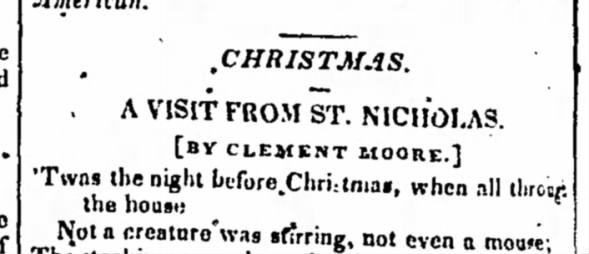
"CHRISTMAS. / A VISIT FROM ST. NICHOLAS. / [BY CLEMENT MOORE.]" --Nashville, Tennessee Republican Banner, January 5, 1838.
Columbia Democrat (Bloomsburg, Pennsylvania) -  January 6, 1838
via GenealogyBank


"Poetry / A Visit from St Nicholas / By Professor Moore." --Columbia Democrat (Bloomsburg, Pennsylvania), January 6, 1838.
<http://chroniclingamerica.loc.gov/lccn/sn85025180/1838-01-06/ed-1/seq-4/

Boston Weekly Messenger - September 26, 1838

WEIR'S PICTURE OF ST. NICHOLAS.

MR. EDITOR:--Having noticed strictures on this excellent picture in some of the public prints, which convince me that the authors were not acquainted with the particular attributes and offices of the Dutch Saint, I have obtained a copy of the lines written by Clement Moore, of New York, which may have suggested, and certainly served in some sort as a guide to the painter in his performance. Nothing can be more mirth-exciting than the look of the venerable dona-ferens;--all the incidents of the scene are introduced with accuracy and effect, and the story is told in language not to be misunderstood. I send you Mr. Moore's verses for publication.
Yours,
P.  --Boston Weekly Messenger, September 26, 1838.
From the Morning Courier and New-York Enquirer on Christmas Day, December 25, 1838:

CHRISTMAS.

This being Christmas day, and Santa Claus (St. Nicholas,) the patron Saint of our Knickerbockers having filled the stockings of all the good little girls and boys of our city with appropriate Christmas presents; we cannot do them a more acceptable service, than by re-publishing for their especial benefit the following beautiful lines by Professor MOORE, descriptive of the little gentleman who is so deservedly a favorite with our youthful readers:--
Morning Courier and New-York Enquirer - December 25, 1838
The Vision of Rubeta by Laughton Osborn criticizes "the nursery rhymes of Prof. Moore" as "nonsense" and "trash."
Natchez Weekly Courier (Natchez, Mississippi), December 28, 1838:
Fri, Dec 28, 1838 – Page 4 · The Natchez Weekly Courier (Natchez, Mississippi) · Newspapers.com

1839

New York Commercial Advertiser - December 19, 1839
"THE POETS OF AMERICA, Illustrated by one of her Painters, designed as an Annual for 1840. The selections are entire pieces from the best authors.--...The Culprit Fay, by Drake; Song, from Fanny, by Halleck...A Visit from St. Nicholas, by Clement C. Moore...."  --New York Commercial Advertiser, December 19, 1839. 
Daily National Intelligencer (Washington, D. C.)
December 25, 1839

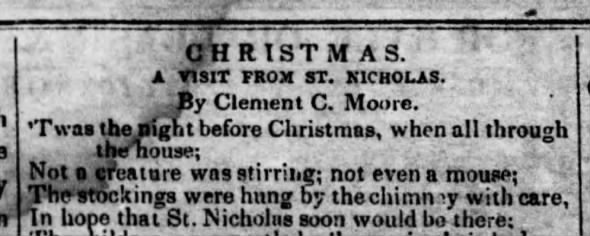
CHRISTMAS.

A VISIT FROM ST. NICHOLAS.

[BY CLEMENT C. MOORE.] 


Alexandria Gazette - December 31, 1839

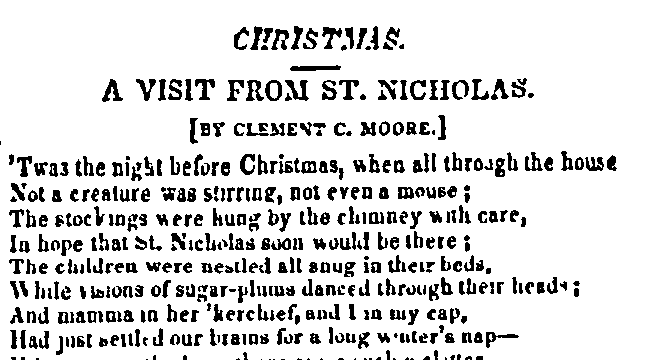
CHRISTMAS.

A VISIT FROM ST. NICHOLAS.

[BY CLEMENT C. MOORE.] 

1840
New York Weekly Whig - January 2, 1840
Kentucky Gazette (Lexington, KY), January 16, 1840:

Kentucky Gazette (Lexington, KY) - January 16, 1840
via Fulton History
Two 1840 anthologies correctly attribute "A Visit from St. Nicholas" to Clement C. Moore.
The Poets of America, edited by John Keese, credits "C. C. Moore" with authorship of "A Visit form St. Nicholas."


Another 1840 anthology, Selections from the American Poets (edited by William Cullen Bryant) reprinted "A Visit from St Nicholas" under the name of "Clement C. Moore."


From the Daily Cleveland Herald of December 24, 1840; reprinted in the Cleveland Herald and Gazette, December 30, 1840:


1841
"This number contains two engravings. About the first, "St. Nicholas," designed by Mr. Ingham and beautifully engraved on wood by Mr. Roberts, so much has already been said by our worthy associate, Mr. Fanshaw, that nothing remains for us to add more than is contained in the following lines, written by C. C. Moore:
'Twas the night before New-Year, when all through the house
Not a creature was stirring, not even a mouse...."
--The New-York Mirror, January 2, 1841

Newark Daily Advertiser - January 2, 1841
 "The Brother Jonathan of this week is embellished, truly embellished with a capital engraving from Ingham's picture of Santa Claus, or St. Nicholas, in the act of descending a chimney from his sleigh, loaded with presents for the children's stockings--as graphically described in Professor Moore's Christmas poem. The mammoth sheet is well stored with a great variety of choice things. The picture alone is worth double the price of the paper."  --Newark Daily Advertiser, January 2, 1841


Martinsburg VA Gazette - January 7, 1841

The following sprightly and popular effusion is the production of an American poet: 
 
A VISIT FROM ST. NICHOLAS.

By C. C. MOORE.

'Twas the night before Christmas, when all through the house....    

--Martinsburg Gazette (Martinsburg, Virginia) January 7, 1841.

* * * 

"A Visit from St. Nicolas" reprinted with credit to "Clement C. Moore" in The Constitutionalist [Bath, New York], December 22, 1841.
The Pennsylvanian (Philadelphia, PA) - December 21, 1841
"KRISS KRINGLE'S BOOK.-- ... This is precisely the book for the young folks, stories, pictures and all, not forgetting the spirited lines by C. C. Moore, entitled "A Visit from St. Nicholas," which have been appropriately incorporated in this pretty and seasonable production."  --Philadelphia Pennsylvanian, December 21, 1841.

We add below the following sprightly and popular effusion of an American poet: A VISIT FROM ST. NICHOLAS. / By C. C. MOORE. -- Leesburg Genius of Liberty (Leesburg, Virginia), December 25, 1841 via NewspaperArchive.

1842

POETRY.

For the Maryland Republican.

MESSRS. EDITORS:--Every child has heard of St. Nicholas, and has kept awake many an hour to get a peep at him; but strange to tell, the little Dutchman persists in travelling only in the night, and always manages to fill the stockings of his good little children after their eyes are fast closed in sleep; thus it happens that very few can boast of having made his acquaintance. It seems, however, that one gentleman once had this good fortune. Children and parents are much indebted to that distinguished gentleman, (Prof. CLEMENT MORE, L. L. D. of New York,) for having given to the world such a beautiful and (as we may well suppose,) faithful description of a personage so universally clever, and of such eccentric modesty. We need not remind any one, old or young that this is the season when we may expect his annual visit. We wish him a prosperous voyage hither, and should be right glad if he would land first in our ancient and beautiful city. We have many large chimnies here, very convenient for him, with many a long stocking, the filling of which will materially lighten his pack. And in the mean time Messrs. Editors, let the children have, by way of antepast, the 199th edition of Prof. More's description of a visit from St. Nicholas, and oblige W....
--Maryland Republican (Annapolis, Maryland), December 17, 1842
1843

Tarboro [North Carolina] Press, January 7, 1843
 
The Rover: A Weekly Magazine of Tales, Poetry, and Engravings vol. 2 - October 15, 1843

MERRY CHRISTMAS!

ANNUAL VISIT OF ST. NICHOLAS.
By PROFESSOR MOORE.

 -- Saturday Courier [Philadelphia, PA] December 23, 1843. 

Philadelphia Courier - Saturday, December 23, 1843

Published in the Washington Daily National Intelligencer on December 28, 1843 (three days after the mistaken attribution of "A Visit from St. Nicholas" to Joseph Wood):

Washington Daily National Intelligencer - December 28, 1843
via GenealogyBank
Messrs. EDITORS: I perceive in your paper of the 25th instant that an extract from the beautiful little poem entitled "A Visit from St. Nicholas" is given to the pen of Jos. Wood. This is a mistake. It is well known to be the production of CLEMENT C. MOORE, of the city of New York, and is published as his in the volume of American Poems edited by John Keese.
Very respectfully, &c.
C.

Related posts

Tuesday, January 2, 2018

Clement C. Moore on wine in the Bible

I won't believe in a Temperance Heaven. --Herman Melville
In August 1835 Clement C. Moore wrote a rebuttal of arguments by some Temperance reformers that only non-alcoholic "wine" was approved in scripture. Moore's invited commentary on biblical references to yayin, "wine" and tirosh, "new wine" appeared in The Churchman and was reprinted in The New York American on July 29, 1836 and other newspapers as well, for example the Newark Daily Advertiser (also on July 29, 1836).

Newark [New Jersey] Daily Advertiser - July 29, 1836
 "We publish an essay to-day from the pen of Professor Moore of the Hebrew department of the Episcopal Seminary in New York, on a mooted question of some public interest."
As it turned out, Moore's published rebuttal did not really end the "tirosh and yayin controversy." On September 9, 1836 New York American for the Country duly printed a long reply to Moore by Edwin James, then an editor of the Temperance Recorder. For now I'm most interested in retrieving Moore's essay for the enlarged view it offers of Moore as a moderate advocate for temperance, and for potential illumination on Moore's verse diptych "The Wine Drinker" and "The Water Drinker." These two pieces were published together in Moore's 1844 volume Poems. Manuscript copies of both poems are extant in the collections of the New-York Historical Society.


Below is the text of Moore's scholarly examination of wine in the Bible, transcribed from the New York American. I like this version for the editorial preface that introduces Moore as "the truly amiable, learned and liberal Professor of Hebrew in the Episcopal Theological Seminary." Indenting has been modified in places, hopefully to clarify when Moore is quoting from the Temperance Recorder = TR.
THE TEMPERANCE CAUSE has been injured—it is useless to dissemble the truth—by the misjudging fanaticism of a few zealots, who would push it beyond its legitimate aims. Among the efforts of these intemperate friends of temperance, was the remarkable one of attempting to prove by an ostensibly learned appeal to Hebrew etymologies and synonimies, that fermented wine was every where in the Bible denounced as a curse, and that the only wine recommended or permitted, either in sacrifice or for use, was unfermented, or new, wine.

We have seldom seen more cool, but more complete, demolition inflicted upon elaborate and seemingly erudite error, than in the letter we copy today from the Churchman, written by the truly amiable, learned and liberal Professor of Hebrew in the Episcopal Theological Seminary, C. C. Moore. We think the tirosh and yayin controversy is pretty effectually killed by this excellent compound of common sense and true learning.

[From the Churchman.]

Opinion of Professor Moore on the meaning of the words translated "wine" and "new wine."

New York, Aug.—, 1835.

DEAR SIR,— I have examined, with the aid of Taylor's Hebrew Concordance, not only the texts which you asked me to look at, but every place in the Hebrew Bible where the word yayin or tirosh occurs; and send you the accompanying references, by which you may examine for yourself each passage in which either of the above words is found.

With regard to the assertions made in the essay contained in the number of the Temperance Recorder which you put into my hands, the following remarks are suggested by the investigation which I have made.

I shall make some quotations from the essay in question.
"By habitual we mean the occasional or common use, as a drink—the medicinal and sacred use being wholly out of the question." [TR]
Now, I wish to know why the sacred use is wholly out of the question. The drink-offerings prescribed in the Levitical law are of yayin; and it would be most extraordinary if that should be directed to be used on holy occasions, when the best of every thing should be selected, which is "a subtle, insidious, and most dangerous poison," the habitual use of which "is a sin."
"We would gladly believe that the Scriptures nowhere speak with allowance or approbation of the habitual use of that which chemistry and experience have alike proved to be a poison." [TR]
Philosophical investigation finds out many things with which common use and common sense have no concern. Poison has been discovered in potatoes: phosphorous in every bone; fire in the atmosphere which we breathe; animalculae in the water which we drink, &c., &c., and common sense, without the aid of chemistry, knows that any thing may be rendered noxious by the improper and unrestrained use of it. Nothing, in certain circumstances, is more dangerous, or has produced more violent effects, than cold water. If the assertion, that fermented wine is "a poison," be true, it must be an inconceivably slow one; for we see multitudes living to a good old age, and some to a very advanced period of life, in the constant use of it. Such assertions are really too absurd to deserve serious notice.
"We do not like to suppose that the Bible calls the same substance in one place 'a blessing,' and in another place 'a mocker.'" [TR]
The same "substance," (yayin,) if used in moderation, is among the blessings of Providence, but if used intemperately, may not only be a "mocker," but a curse and a destroyer, like every other blessing which is abused. As well might it be urged that the use of fire is unlawful, because it is a dangerous element, which oftentimes proves very destructive, and is represented in Scripture as an instrument of punishment and token of wrath, employed by the Almighty. As well might all our natural passions be considered sinful. Nothing is more apt to make a man do wrong than anger; and yet God himself is frequently said to be angry.

But let us examine whether no positive evidence appear, that this "mocker" is sometimes considered in the Bible as a blessing. Isaiah lv. 1, the prophet exclaims, "Come, buy wine (yayin) and milk, without money and without price." However figurative that language may be, the prophet surely cannot be supposed to offer an invitation to come and get that which is "a poison," "a mocker," &c. &c. Isa. xxiv. the consequences of the curse that was to come, "The new wine (tirosh) mourneth," verse 9, "They shall not drink wine (yayin) with a song." The one who uttered the prediction could not have deemed either "substance" as noxious, since the being deprived of them was among the threatened evils. Micah vi. in God's controversy with his people it is said, verse 15, "Thou shalt sow, but thou shalt not reap; thou shalt tread the olives, but thou shalt not anoint thee with oil; and sweet wine (tirosh,) but shall not drink wine, (yayin.)" That is to say, although the must (tirosh) be trodden out, it shall not be used in the state of wine, (yayin.) and this was a curse. Zech. x. 6,7, "And I will strengthen the house of Judah," &c. &c. "and they of Ephraim shall be like a mighty man, and their heart shall rejoice as though wine, (yayin.)" The speaker, who is God, certainly does not consider yayin in this place as "a poison."
Among the curses in the 28th of Deuteronomy is the following in verse 39, "Thou shalt plant vineyards, and dress them, but shalt neither drink of the wine, (yayin,) nor gather the grapes."

Psalms civ. 15, among the blessings bestowed by God, is "wine, (yayin,) that maketh glad the heart of man."

Genesis xlix.11, Jacob, on his death-bed, says of Judah, "He washed his garments in wine; (yayin;)" and verse 12 "His eyes shall be red with wine, (yayin,) and his teeth white with milk."

Cant. i.4. "We will remember thy love more than wine, (yayin;)" "the upright love thee;" verse 2, "for thy love is better than wine (yayin.)"

Cant. iv. 10, "How much better is thy love than wine, (yayin.)"

Cant. v. 1, "I have drunk my wine, (yayin,) with my milk."

Cant. viii. 2, "I would cause thee to drink of spiced wine, (yayin.)"

Cant. vii. 9, "And the roof thy mouth like the best wine, (yayin.)"

Hosea xiv. 7, God says, I will be as the dew unto Israel, &c., &c. They that dwell under his shadow shall return; they shall revive as the corn, and grow as the vine; the scent thereof shall be as the wine (yayin) of Lebanon."

Prov. ix. 1, 2, "Wisdom hath builded her house, &c.; she hath mingled her wine, (yayin.)"

Amos ix. 14, the LORD saith, "I will bring again the captivity of my people of Israel, &c., and they shall plant vineyards, and drink the wine (yayin) thereof." And as the reverse of the above blessing, it is said in Zeph. i. 13, "They shall plant vineyards, but not drink the wine (yayin) thereof."

I think that the above passages sufficiently show the value of the following "opinion" of the same writer:—
"Our opinion is, that fermented wine is not spoken of in the Bible as a blessing."[TR]

"The word 'wine,' as used in our Bibles, means sometimes grapes, the fruit of the vine, either recent or dried." "That it sometimes means the fruit of the vine eaten as food, is probable from Deut. xii. 17, 'Thou mayest not eat the tithe of thy corn, of the wine, or thy oil,'" &c. [TR]
A very weak reason. The word אכל is used very frequently and extensively for to eat, devour, consume, &c.— As well might we infer from the text quoted, that "oil" means olives. See also Deut. xiv. 26, which might, equally well be adduced to prove that yayin and "strong drink" (shikar) were something eatable. Nonsense!
"The wine here spoken of (Gen. xxvii. 28) was a blessing. Could it be made to appear that it contained one particle of alcohol, we would relinquish the whole temperance reformation, as an impious and fanatical attempt to take away from men that which the Creator gave them as a blessing." [TR]
In Hosea iv. 11, we find these words, "Whoredom and wine, (yayin,) and new wine, (tirosh,) take away the heart." This looks as if there were a particle of alcohol in tirosh, as well as in yayin.
"The united voice of human science and human experience has declared fermented wine to be a subtle, insidious, and most dangerous poison." [TR]
A most bold and groundless assertion. It is "poison," in the use of which hundreds and thousands live to extreme old age; a "poison" which is commanded to be employed in the sacrifices to the Deity, which are enjoined in the Levitical law; a "poison," the use of which is expressly permitted to man in various parts of the Bible, and which is there enumerated among the blessings of Providence.
"Is the wine which Isaac, in his prophetic blessing, prayed to God to give in abundance to his younger son, the same wine which had already produced such disastrous effects in the families of Noah and of Lot?" &c. "We answer, without hesitation, it was not." [TR]
The word used on the occasion referred to (Gen. xxvii 28) is tirosh; but we have seen enough to show that no moral inference can be drawn from the selection of that word. And Isaac himself, just before uttering this prophetic blessing, drank the poisonous and wicked liquor, yayin, verse 25.

As to the Septuagint translators, whose authority is set aside by the writer from whom I have been quoting, it surely is probable that they knew the meaning of Hebrew words quite as well as any modern critics. But when people have a "bias," no authority is apt to be of much weight with them.
"If those learned disputants, who think there is impiety in contending against the use of fermented wine on any occasion, except for medicine, have higher authority than Gesenius for their belief, that the tirosh of the Bible was fermented, intoxicating, alcoholic wine, and that, notwithstanding this, it is every where spoken of as a blessing; while the fermented wine, 'yayin,' is called, as it well deserves to be, 'a mocker,' we beg them to come forward with their authorities and their proofs. We do not quote many authorities, because we are not men of learning; nor do we advance many proofs, because to our minds, a few, so they be unanswerable, are quite enough." [TR]
Now the writer of the above passage, if he be honest and impartial, must be soon convinced of his error, upon his own grounds. That the tirosh of the Bible was a word applied to fermented liquors, appears from Hosea iv. 11, already quoted; and that it is not "every where" spoken of as a blessing, appears from the same place.

The simple truth appears to be this; tirosh is the juice of the grape more recently expressed than yayin; though probably applied to the liquor soon after, as well as before, fermentation. This word tirosh is not unfrequently used when the harvest returns are mentioned, as if to designate new produce, a liquor not old enough to be accurately called yayin; wine not yet put into bottles; bottled wine being always expressed by yayin. And it appears, from the things with which it is enumerated, or from some other circumstance, to be a more recent produce of the grape than yayin. That tirosh was probably a newer liquor than yayin appears from Deut. xiv. 22-26. Here the tithe of wine is called tirosh; but if a long journey is to be performed before the tithes are eaten, the tirosh and other tithes are sold; and, after arriving at the destined place, yayin is to be purchased instead of tirosh. Here we may also observe, that the use of yayin is expressly permitted.

That yayin was in common use, is as evident from the whole tenor of Scripture as that water was drunk. That its use was permitted, is plain from the following passages, viz., Deut. xiv. 26, just referred to; Numb. vi. 26, "And after that, (his offering,) the Nazarite may drink wine, (yayin.)" The drink offerings in the sacrifices show that wine (yayin) is permitted. Amos ix. 14, "And I will bring again the captivity of my people of Israel"—"and they shall plant vineyards, and drink the wine (yayin) thereof." And all the passages above quoted to show that yayin was considered a blessing, prove that its use was permitted.
The intemperate use of yayin is reprehended in the Bible; and so is that of flesh, and oil, and sleep.

In none of the passages in which the word tirosh is employed, do I see any thing which points to what may be called its moral qualities, except Hos. Iv. 11; where it is evidently thought to be capable of doing harm like yayin.

The amount of the matter is this. Yayin, which occurs one hundred and forty times, was in common use, as appears from almost every place in which it occurs. Its use was expressly permitted, as is evident from passages above quoted. It is also manifest that it was enumerated among the blessings of Providence, if the plain language of Scripture may be admitted to prove anything contrary to the "bias" of the writer in the Temperance Recorder. And if yayin be a poison, it is most extraordinary that its poisonous quality should have been so lately discovered; as it has been in general use ever since the days of Noah.

Tirosh, which occurs thirty-eight times, is newer liquor than yayin. The word is applied to intoxicating liquor. There is no evidence of its moral qualities being superior to those of yayin; nor of its being permitted to be used in preference to yayin.

And now let me ask, what must be the effect upon the minds of those who are not inclined to respect religion, when they perceive that professors of Christianity make use of Scripture in this way to serve their own views, or to prove the truth of some individual "bias," with the whole current of Scripture authority, when fully examined, directly opposed to them? It is needless to dwell any longer upon this subject. I feel disgusted and offended by such wild attempts at subverting the common sense of mankind.

I examined the subject long ago; but absence from town and other hindrances have prevented me from sending you this communication sooner.

Yours respectfully,

CLEMENT C. MOORE.
New York American for the Country - July 29, 1836
via GenealogyBank

Tuesday, January 24, 2017

Clement C. Moore's published letter on his authorship of "Visit from St. Nicholas"

Good news at The New York Public Library! Yesterday on microfilm (*ZY 86-140 Reel 17 Mar 1-Dec 28, 1844) of the New York American (relocated now and accessible in the Milstein Microform Reading Room, First Floor Room 119--many thanks to the fine library staff there), I found the published letter from Clement C. Moore to editor Charles King in which Moore corrects a mistaken attribution of his poem "A Visit from St. Nicholas." Writing from New York on February 27, 1844, Moore responds to a December 25, 1843 item in the Washington National Intelligencer that falsely attributed the already well-known Christmas poem to the deceased artist Joseph Wood. Moore's chagrined friend Charles King published the letter on March 1, 1844 and requested the National Intelligencer to remedy the "plagiarism" by reprinting "Mr. Moore's note" of correction. The National Intelligencer reply on March 6, 1844 is what led me to look for Moore's published claim of authorship. In answer to Charles King's complaint, the editor of the Intelligencer pointed out that his newspaper had promptly published a correction, so there was no need to reprint Moore's letter.

From the New York American, March 1, 1844:

New York American - March 1, 1844
LINES TO ST. NICHOLAS.--The following note from our friend C. C. Moore, the author of those lines which every child among us delights to hear, about Christmas, and which parents with not less delight recite, brings to our notice, one of the boldest acts of plagiarism of which we have any recollection. We ask the National Intelligencer to have the goodness to insert Mr. Moore's note--and if possible to elucidate the mistake, if such it be, or fraud attempted in respect of such well known lines. 
New York, Feb. 27, 1844 
Dear Sir--My attention was, a few days ago, directed to the following communication, which appears in the National Intelligencer of the 25th of December last.
"Washington, Dec. 22d, 1843.

Gentlemen--
The enclosed lines were written by Joseph Wood, artist, for the National Intelligencer, and published in that paper in 1827 or 1828, as you may perceive from your files. By republishing them, as the composition of Mr. Wood you will gratify one who has now few sources of pleasure left. Perhaps you may comply with this request, if it be only for 'auld lang syne.'" 
The above is printed immediately over some lines, describing a visit from St. Nicholas, which I wrote many years ago, I think somewhere between 1823 and 1824, not for publication, but to amuse my children. They, however, found their way, to my great surprise, in the Troy Sentinel: nor did I know, until lately, how they got there. When "The New York Book" was about to be published, I was applied to for some contribution to the work. Accordingly, I gave the publisher several pieces, among which was the "Visit from St. Nicholas." It was printed under my name, and has frequently since been republished, in your paper among others, with my name attached to it.  
Under these circumstances, I feel it incumbent on me not to remain silent, while so bold a claim, as the above quoted, is laid to my literary property, however small the intrinsic value of that property may be. 
The New York Book was published in 1827 [1837]. 
Yours, truly and respectfully,   
CLEMENT C. MOORE
Chas. King, Esq.
The "New York Book" to which Moore refers is of course the 1837 New-York Book of Poetry, edited by Moore's friend (and some years later, Herman Melville's friend) Charles Fenno Hoffman. On microfilm the date of publication that Moore gives for the New York Book appears to read "1827," a typo for 1837.

Some related posts: