Non-obsessives I'm told genuinely love to recall 'Twas the night before Christmas and hear it recited in the family circle, year after year, no matter the author. Still, I have to believe that even the happiest and mentally healthiest of my fellow mortals will be pleased to know for sure which guy deserves credit for our present-day notion of Santa as a "right jolly old elf" who lands on lawns and flies to rooftops in a "sleigh full of toys" propelled by eight reindeer. Alright then, who described Santa Claus and his magical mystery "Visit" on Christmas Eve so memorably, going down the chimney "with a bound," then up again and away "like the down of a thistle"? Esteemed Bible scholar Clement C. Moore
 |
| Clement C. Moore (1779-1863) |
or Poughkeepsie farmer, surveyor, and local magistrate Henry Livingston Jr?
 |
| Henry Livingston Jr. (1748-1828) |
Before continuing, some necessary disclosures and disclaimers. Transparency here seems all the more desirable in view of Jerman's illuminating comparisons of participants in authorship debates to "corners" in a boxing match and (in a pleasing diversion from the controlling "prize fight" metaphor) "expert witnesses" called by opposing attorneys to testify in court. With respect to authorship of "The Night Before Christmas" I'm squarely in Moore's corner. You can check out my chief reasons in the 2017 post on
How we know Clement C. Moore wrote The Night Before Christmas.
I feel honored indeed to have been counted in Tom Jerman's book with Niels H. Sonne, Nancy H. Marshall, Stephen Nissenbaum, Pat Pflieger, Seth Kaller, and Joe Nickell as a public defender of Clement C. Moore and the merits of his longstanding claim to have written the beloved Christmas poem.
Lately, however (and independently of Jerman's
Fight) the claim for Henry Livingston, Jr. appears to have lost much of the traction it had in years past. Major Livingston's descendant and most dedicated advocate Mary Van Deusen declared victory in 2016 after the publication by
McFarland & Company of MacDonald P. Jackson's monograph,
Who Wrote "The Night Before Christmas"? But Van Deusen's
great Henry Livingston website has not been updated with fresh authorship-related content for a good while now. In the meantime, here on
Melvilliana I have documented a number of discoveries that support the traditional attribution to Clement C. Moore. On their
Red-Pilled America podcast, storytellers Patrick Courrielche and Adryana Cortez have incorporated some of my findings in highly entertaining Christmas episodes. Bloomberg Opinion columnist Justin Fox has convincingly defended Moore from the false charges of keeping enslaved persons and endorsing slavery. Link here to the Bloomberg site with his 2021 article
A Gift for America's Christmas Poet: Rehabilitation:
More than fittingly, Clement Clarke Moore will be inducted into the New York State Writers Hall of Fame on December 19, 2023. Ceremony to be held at Hoffman Hall of the General Theological Seminary of the Protestant Episcopal Church in the Chelsea neighborhood of Manhattan.
Amidst all this bicentennial buzz, it might be well to note that the "tale of the tape" with regard to the long-running authorship debate has not been fully presented anywhere in any format. Until now, that is. The Fight for "The Night" brings it, with easily the most complete and persuasive account in print of the contest for authorship credit. Of course I'm pleased by the good use made of findings originally posted on Melvilliana. Three prime examples would be
- the 1844 letter to the editor of the New York American in which Moore unambiguously claimed authorship of the Christmas verses "not for publication, but to amuse my children" (quoted and discussed by Jerman in Fight, pages 27-28);
- the previously overlooked fact that T. W. C. Moore (the fellow who obtained a manuscript copy of the poem for the New York Historical Society in 1862 after a personal interview with Clement C. Moore) was a first cousin of Henry Livingston, Jr (Fight, pages 216-219); and
- the anonymous publication in the Troy Sentinel of another poem by Moore, later titled Lines Written after a Snow-Storm on February 20, 1824, just 2 months after "The Night Before Christmas" (Fight, pages 19-20).
I'm very glad also to find my five Livingston "deal-breakers" inventoried on pages 314-316; and naturally gratified by the serious attention given on pages 316 and 351 to my
Eight Great favorite expressions of Clement C. Moore which turn out to be more useful than Jackson's relatively dreary set of six for the purpose of distinguishing Moore's verses from Livingston's.
As he did also in his previous book
Santa Claus Worldwide, Jerman not only provides a valuable synthesis of published work on his chosen subject, he makes original contributions of his own that significantly enrich our understanding of that subject. There, the history of St. Nicholas and other midwinter gift-bringers; here, authorship of "The Night Before Christmas." For one of many original insights here, check out Jerman's lawyerly explanation for Moore's much-discussed delay in publishing his Christmas poem (
Fight, pages 29-32). Jerman reasonably proposes that Moore took the most "prudent course" by waiting until William Gilley's copyright on
The Children's Friend (the "Old Santeclaus" poem therein being an obvious literary source for "The Night Before Christmas") expired in 1835 before authorizing its reprinting the following year in
The New-York Book of Poetry.
Another highlight for me is the full transcription of Moore's comical poem
The Pig and the Rooster, together with the excellent analysis thereof (
Fight, 257-265). Jerman takes Moore's lighthearted exercise as "a witty and enjoyable piece," contra haters for the last hundred years. In a fine appreciation of Moore's Seussian verve, Jerman concludes:
The closest analogy to "The Pig and the Rooster," however, is probably "The Big Brag," one of the "other stories" in Yertle the Turtle, about a rabbit and a bear who boast that they are the "best of the beasts" because of the range of their hearing and smelling abilities, respectively. In the course of their obviously bogus brags, they are interrupted by a worm who explains in an utterly condescending tone that he can see so well his vision actually circles the world, allowing him to see the backsides of the rabbit and bear, "the two biggest fools that have ever been seen." In both sound and sense, Moore's "The Pig and the Rooster" is comparable to "The Big Brag" and many other Dr. Seuss stories. (Fight, page 262)

Challenging naive acceptance of hearsay on the Livingston side (by Jackson, for example, in
Who Wrote "The Night Before Christmas"? pages 110-112) Jerman develops a strong argument against taking so-called "witness letters" from distant Livingston descendants as evidence of anything bearing on authorship of "The Night Before Christmas," other than beliefs (erroneous and conflicting, often) of the writers. See especially the sections in Chapter 10 of
Fight for "The Night" under sub-headings "The Unreliability of the Livingston Witness Letters" at pages 227-229 and "Witness Letters Are Second-, Third-, and Fourth-hand Hearsay" at pages 229-236).
Two punches late in this "literary prize fight" dropped Livingston cold. Delivered in chapters 10 and 11, these particular hits are so devastating to the contender's chances that a more compassionate reader-ref might have stopped the figurative
Fight then and there. The first blow exposed a known but insufficiently exploited weakness in the story of Henry Livingston's writing "The Night Before Christmas" years before its main sources were published. Livingston partisans who say their man wrote "The Night Before Christmas" sometime between 1807 and 1809 (roughly guesstimated) fail to account in any satisfactory way for the twin influences of Washington Irving's
A History of New-York (1812 ed. or later) and the
illustrated poem Old Santeclaus (1821). In
Fight for "The Night" Jerman persuasively frames these works as inescapable precedents and literary sources for specific details in "A Visit from St. Nicholas" (pages 209-212; 224-227; and 329).
Other investigators have pointed out the big problem of chronology (awfully hard to credit Livingston with writing a poem around 1808 that is demonstrably indebted to two different literary works not yet printed, hence inaccessible until 1812 and 1821) but none so effectively. Practically regarded, the need of Livingston supporters to make their candidate a time-traveler invalidates the claim. So effectively that I might want to appropriate it some day, if Tom Jerman would let me, for a sixth Livingston "deal breaker."
Same goes for the second heavy blow dealt to the contender in round-chapter 11, pages 273-280. This one also would make a devastating deal-breaker, perhaps the future #7 on my list. Simply put, Clement C. Moore's immediate family and church celebrated Christmas in high style, Livingston's did not. The contender's corner has failed to show that Henry Livingston, Jr. gave a fig for Christmas and related holiday festivities, apart from belatedly wishing his sweetheart and future wife "Happy Christmas" in a
letter to Sally Welles dated December 30, 1773. Surprisingly, the Poughkeepsie patriarch represented as the embodiment of pure Christmas joy has never been caught decking the halls, baking Christmas cookies, caroling with the family, or (most tellingly of all) even once acknowledging St. Nicholas, Santa Claus, or any other midwinter gift-giver. In Jerman's words, aptly channeling Theodor Geisel aka Dr. Seuss: "Like the Whos down in Whoville, the Livingston family had no presents, no ribbons, no wrappings, no tags, no tinsel, no trimmings, no trappings, no Christmas pudding, and no Who roast beef" (
Fight, page 278). As clarified on the back cover of
Fight for "The Night" "Livingston's religion, Dutch Reformed, prohibited celebration of Christmas or veneration of saints whereas Moore, a devout Episcopalian, celebrated in traditional English style and treated St. Nicholas as the Christmas gift-giver."
The middle rounds of Jerman's Fight, chapters 7 ("Basic Principles of Authorship Attribution" and 8 ("Best Practices for Authorship Attribution"), establish ground rules that could and ideally should have governed the contest--when conducted, that is, by highly trained academic "experts." These sections are a wonderful gift to anybody interested in all kinds of authorship questions, not only pertaining to "The Night Before Christmas." Jerman delves into the nitty-gritty of authorship attribution as a distinct field of scholarship. Chapter 7 summarizes important work by Samuel Schoenbaum, Harold Love, Janet Ainsworth, Carole E. Chaski, Patrick Juola, and other leading scholars. Traditional and non-traditional varieties of evidence are weighed and helpfully discussed, along with the virtue of "validity testing" your method. Reviewing best practices, chapter 8 further highlights the good advice of Patrick Juola that "experts in the field 'prevalidate' methods of authorship attribution through the establishment of appropriate, formal protocols" (as distilled by Jerman in Fight, page 173).
Fans of "English Professors Behaving Badly" can skip the ground rules and proceed straight to round-chapter 9 in
Fight for the Night, itemizing "Foster's and Jackson's Violations of the Best Practices." I know that Don Foster's meanest and nastiest attacks on the character of Clement C. Moore were convincingly rebutted long ago by Nissenbaum, Kaller, and Nickell. The trouble, as Jerman rightly perceives, was the attempted rescue of Foster's awful arguments by distinguished Shakespeare scholar and authorship expert MacDonald P. Jackson. In postmortems on the
Funeral Elegy fiasco, Foster's method of authorship attribution had just become a textbook example of high profile failure when Jackson backed him on the Livingston side. Jackson inadvertently revealed his bias for Livingston throughout
Who Wrote "The Night Before Christmas"? despite the posture of cool scientific objectivity that he tried to maintain. As Jerman demonstrates, Jackson like Foster before him employed a seriously flawed methodology. Each expert committed multiple violations of the "best practices" handbook according to Jerman, including failure to test for accuracy (
Fight, pages 175-176); use of inaccurate corpora (176-181); failure to use independent researchers (181-185); failure to provide a profile of the likely author (185-187); adopting the role of "hired gun" (187-192); and unacknowledged sources of scholarly bias (192-196).
I'm a little disappointed tbh that (unless I missed it?) Jerman did not mention my favorite exhibit of confirmation bias,
the place in Who Wrote where Jackson acknowledged eight instances of the Moore-word "like" then quickly discounted their significance.

Fortunately, however, my trivial loss is more than compensated in Jerman's 13th and final chapter (no more rounds, the "fight" metaphor is exhausted by this point). Don't be fooled by its boring title, "The Use of Nontraditional Analysis." Chapter 13 is way more than a stocking stuffer. It's more like a plain box or carelessly wrapped package that contains your dream-present, something fantastically grand you never really expected to get. Say a first edition of Herman Melville's epic religious poem
Clarel: A Poem and Pilgrimage in the Holy Land (New York: G. P. Putnam's Sons, 1876), both volumes; or the smart-remote-key-fob to a new Firecracker Red 2023
Jeep Wrangler Rubicon. Jerman's gift to me and every truth-seeker in the last section of the last chapter of
Fight for "The Night" involves "The Use of JGAAP in the Moore-Livingston Dispute." JGAAP stands for the
Java Graphical Authorship Attribution Program, described by EVL Labs on
evllabs.com as "a Java-based, modular, program for textual analysis, text categorization, and authorship attribution i.e. stylometry / textometry." Jerman really has two surprises in store for the patient and attentive reader. The first would be his discovery of previously unreported results from one earlier trial of Moore v. Livingston using JGAAP.
The second surprise is the good and equally unexpected news that "with some friendly advice from Juola," Tom Jerman was able to perform another series of 17 tests in JGAAP using the same bodies of texts or "corpora" as before. Jerman identifies the clear winner and his Endnotes list categories of specific tests for both trials. Relative numbers and percentages within each test are not provided, and not really needed I suppose by general readers. Here, then, a fine opportunity opens up for further research. Future investigations using JGAAP can confirm if Jerman's findings are repeatable. Even better, researchers could try the same battery of tests with more realistic corpora, minus unsubstantiated attributions to Livingston of some Carriers' Addresses and other poems that should have been rejected as incompatible with best practices.
This line of legitimate research makes a great gift for anybody in the Livingston corner. That would include me, too, since I never had anything against him, personally. Henry Livingston, Jr. did not and could not have written "The Night Before Christmas" but saying so does not make me Anti-Livingston or Anti-anything (excepting bad faith and worse arguments by College English Professors). With the Christmas business finally out of the way, I imagine it could be lots of fun in the coming New Year to tackle new and different authorship problems. For a start, maybe someone will try to determine if Major Livingston of Poughkeepsie ever wrote more than one New Year's Day "Carrier's Address." If he did, then which ones, and how exactly would we know (or even reasonably conjecture) that he wrote them? Until then, many thanks to Tom for the blessing of his excellent new book
The Fight for "The Night" and Happy Christmas to all!!!


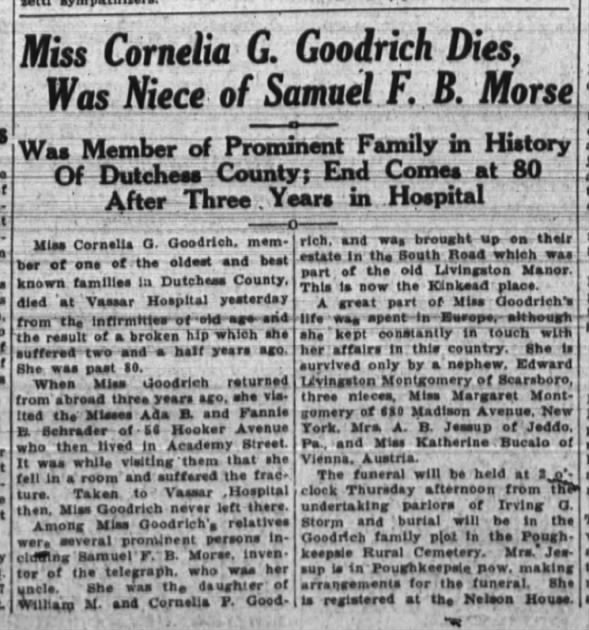 · Wed, Aug 17, 1927 – Page 1 · Poughkeepsie Eagle-News (Poughkeepsie, New York) · Newspapers.com
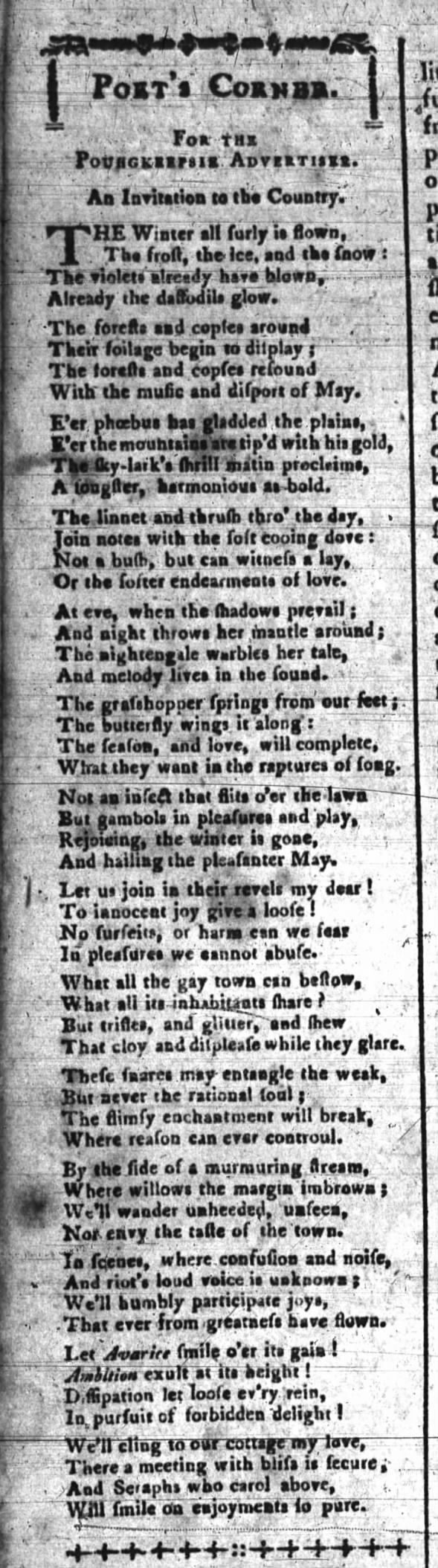 · Thu, Jan 19, 1786 – Page 4 · Poughkeepsie Journal (Poughkeepsie, New York) · Newspapers.com
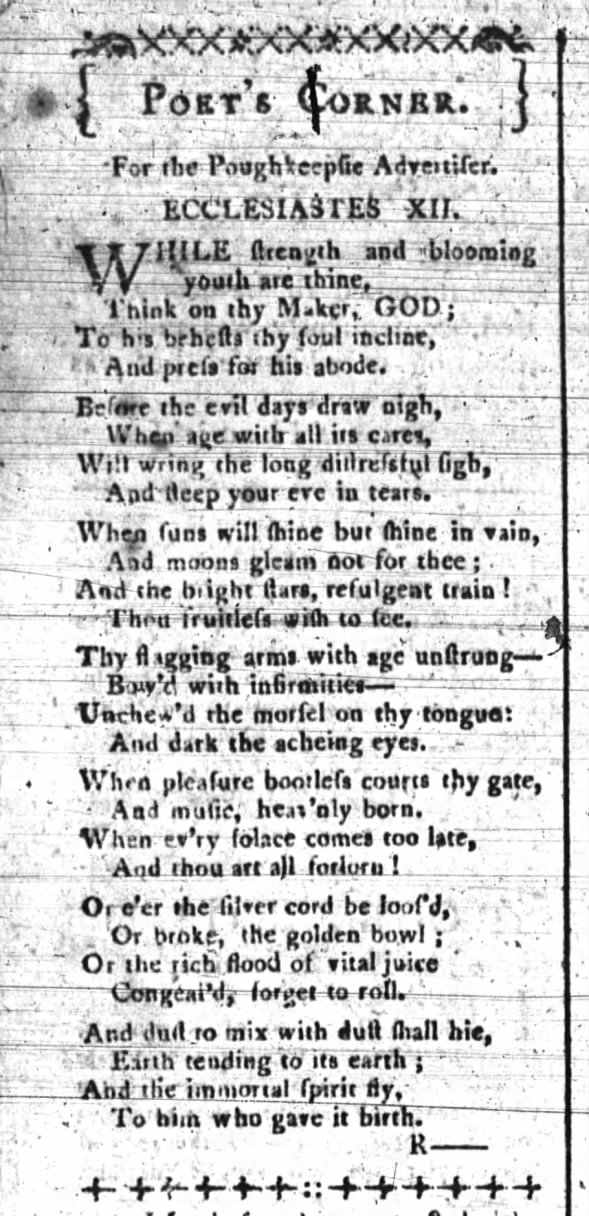 · Thu, Mar 23, 1786 – Page 4 · Poughkeepsie Journal (Poughkeepsie, New York) · Newspapers.com
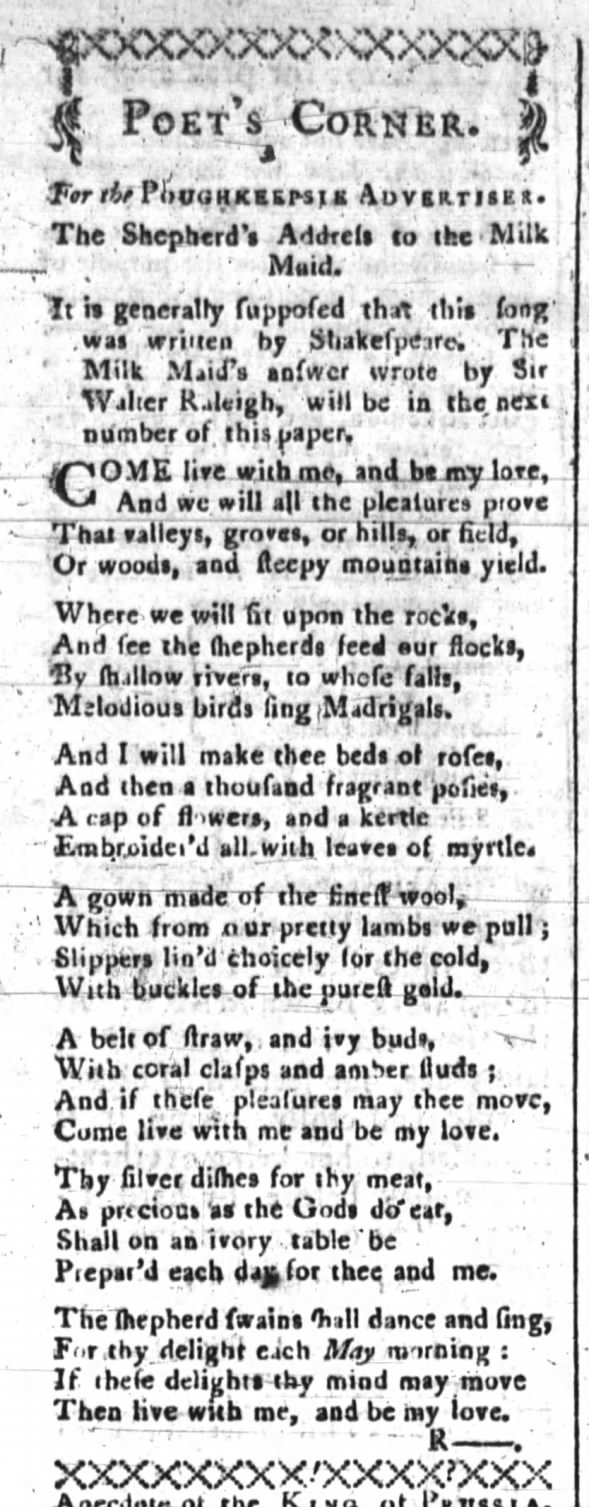 · Wed, Jan 24, 1787 – Page 4 · Poughkeepsie Journal (Poughkeepsie, New York) · Newspapers.com
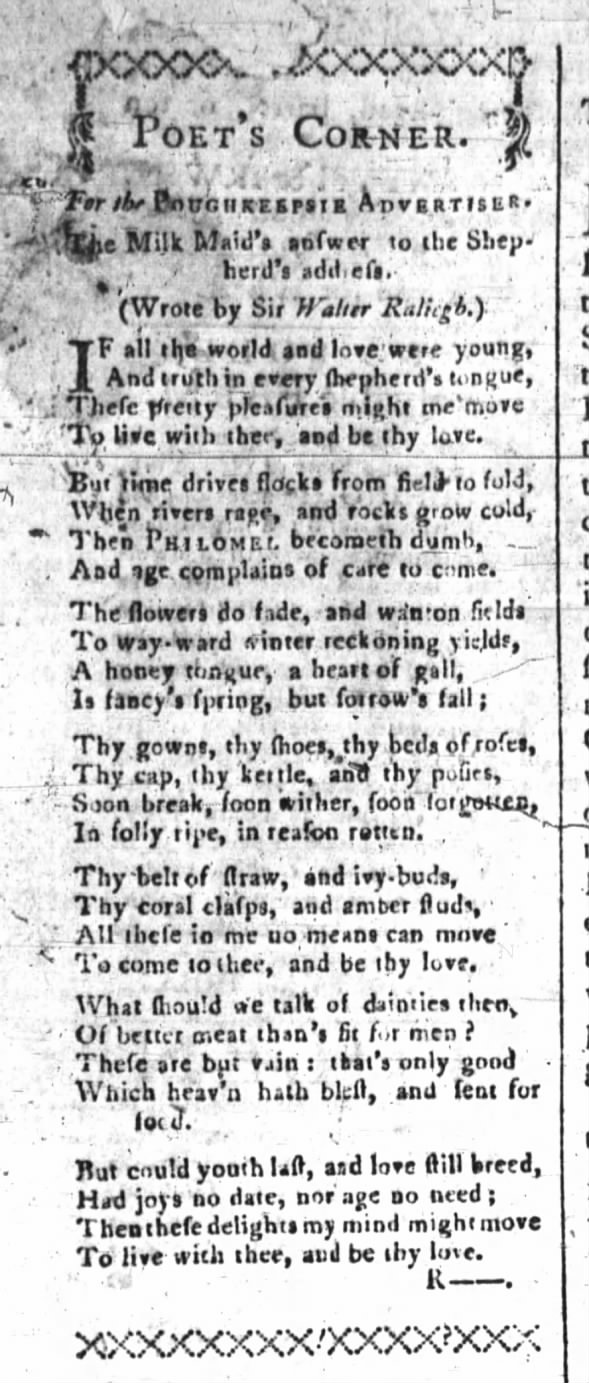 · Wed, Jan 31, 1787 – Page 4 · Poughkeepsie Journal (Poughkeepsie, New York) · Newspapers.com
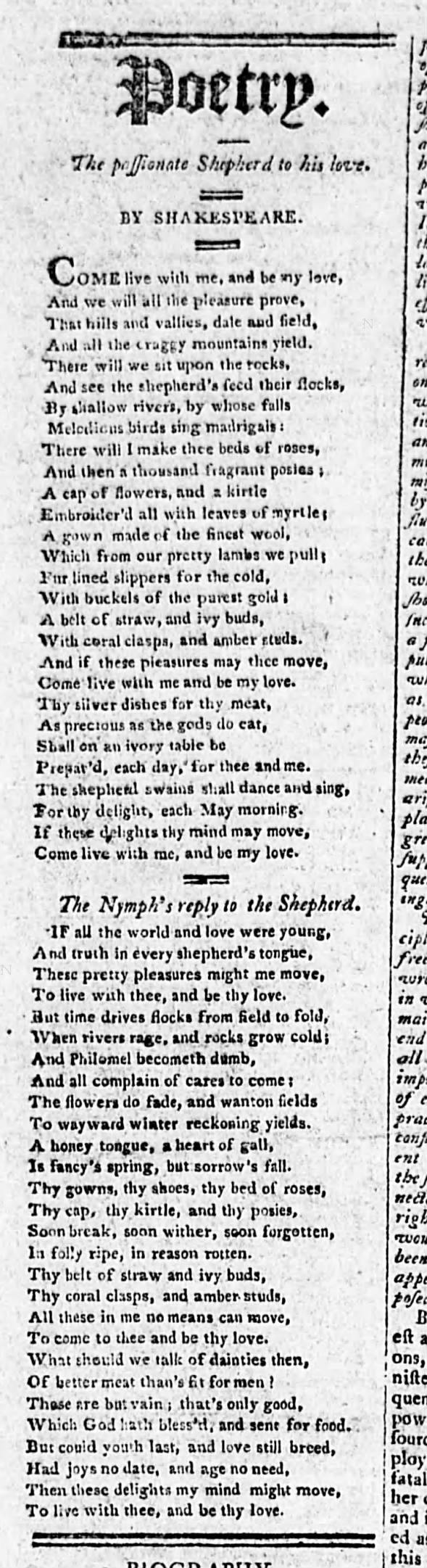 · Tue, Dec 6, 1803 – Page 4 · Poughkeepsie Journal (Poughkeepsie, New York) · Newspapers.com


