Showing posts with label Typee. Show all posts

Friday, October 9, 2026

Reviving Melville before the "Melville Revival"

Book-lover Frederick B. De Berard on the greatness of MOBY-DICK


Rediscovering De Berard’s condensed “Epic of the Whale,” Critical Synopsis, and Melville bio in Volume 2 of the “Classic Library” (1902) and “Classic Tales” (1905) anthologies 

Portrait of Frederick B. De Berard.
Source: Classic Tales by Famous Authors Vol. 1
(New York: The Bodleian Society, 1905)

👉 First published on Substack, reposted here since I am keen to put into the mix of accessible, searchable data the actual words used by anthologist and unabashed bibliophile Frederick Brigham De Berard in praise of Melville and Moby-Dick. Not that De Berard was alone in recording his high estimation of Melville's writings, only two years into the new 20th century. Edwin Monroe Bacon devoted five pages to Melville as one of the "Famous Makers of American Literature" profiled in Literary Pilgrimages in New England (Silver, Burdett & Company, 1902) on pages 451-456. Bacon creatively fashioned the section on Melville in Berkshire County, Mass. as a dialogue with local Pittsfield expert "Mrs. H. M. Plunkett" = Harriette Merrick Hodge Plunkett, the well-known health advocate and journalist.

" 'Moby Dick' has been called the most dramatic and imaginative of his works. In his later writings he was much given to speculative philosophy, and his popularity waned.... Notwithstanding his remarkable adventures and sea-faring life, there was nothing of the jovial, breezy air of the sailor about him. He had more the gentle carriage of the student, the manner of the man of books. He was more than Dana a pioneer of our sea-story writers, and in his best works set a pace not easy for his successors to follow. His picturesque style came through his excellent training in English composition, to which he showed an aptitude in his youth, and from his early reading of the masters of English literature."

-- Literary Pilgrimages, page 456 https://archive.org/details/literarypilgrima00bacorich/page/456/mode/2up

By 1905 numerous surveys of American Literature counted Moby Dick as an important work, in some way worthy of attention in this fresh field of study. Granted, some early efforts happily classified Melville with "lesser writers" or "minor writers." Necessarily, the elevation of Melville's status to Giant of American Letters would take time, and the concentrated efforts of exceptionally competent academics--at Columbia University during the 1920's "Melville Revival," and later at Yale, under the tutelage of Stanley T. Williams. Nevertheless, Moby-Dick got respectful attention in numerous textbooks published between 1891 and 1905, including the following titles:

  • Julian Hawthorne and Leonard Lemmon, American Literature: an Elementary Textbook for Use in High Schools and Academies (Boston: D. C. Heath & Co., 1891). At page 211 rates Moby-Dick "the most powerful of Melville's books." 
  • Alphonso G. Newcomer, American Literature (Chicago: Scott, Foresman and Company, 1901) page 128. Ranks Herman Melville as "the most important" of New York "writers of tales of adventure whose scenes were laid on shipboard or in remote quarters of the earth...." Melville "in his youth embarked upon a whaling vessel bound for the Pacific and spent several years, a portion of the time in captivity, among the South Sea Islands. The series of partly fanciful tales founded upon his experiences — Typee (1846 ), Оmоо (1847), Moby Dick, or the White Whale (1851), etc., — had a wide circulation, and an occasional admirer can still be found who will pronounce them superior to Cooper's."
  • Charles Noble, Studies in American Literature (New York: The Macmillan Company, 1898) at pages 287-288. Cites Melville as "our best novelist of travel and sea-life"; Moby-Dick (1851) listed with Mardi (1849), Battle-Pieces and Aspects of the War (1866), and Clarel (1876) as notable literary productions after Typee and Omoo. 
  • Henry S. Pancoast, An Introduction to American Literature (New York: Henry Holt and Company, 1898). While this volume contains no substantive discussion of Melville or his writings, Typee and Moby-Dick are duly listed in the Appendix, Table III charting the "Literature of the Republic" c. 1809-1897.

    The perceived slight motivated Albert H. Smyth to point out, as a mistake, "the omission of Herman Melville, in his best books—'Moby Dick', 'Typee', 'Omoo'—one of the best of American writers" in an otherwise favorable review of Pancoast's Introduction, published in the April 1898 issue of The Citizen. 
  • William P. Trent, A History of American Literature, 1607-1865 (New York: D. Appleton and Company, 1905). Placing Melville with "The Romancers" on pages 389-391, Trent recognizes Moby-Dick as a "masterpiece," flawed however by "inordinate length" and the bad influence of Carlye (a fault lamented by Melville's earliest critics, some more than fifty years before).

    "Melville's greatest achievement still awaited him, however, for after two other fair books of adventure he published, in 1851, his masterpiece, Moby Dick, or the White Whale. If it were not for its inordinate length, its frequently inartistic heaping up of details, and its obvious imitation of Carlylean tricks of style and construction, this narrative of tremendous power and wide knowledge might be perhaps pronounced the greatest sea story in literature. The breath of the sea is in it and much of the passion and charm of the most venturous of all the venturous callings plied upon the deep. It is a cool reader that does not become almost as eager as the terrible Captain Ahab in his demoniacal pursuit of Moby Dick, the invincible whale, a creation of the imagination not unworthy of a great poet. In this uneven , but on the whole genuine, work of genius, Melville probably overtasked himself...."
  • Mildred Cabell Watkins, American Literature (American Book Company, 1894) page 47. Commends Moby-Dick to young readers as one of Melville's "wildly exciting tales of adventure."
***
Packed with variously diverting tales of the sea, Volume 2 in the 20-volume Classic Library of Famous Literature (New York: The Bodleian Society, 1902) gives Moby-Dick its due, and then some. This particular volume offers a bold abridgement of Herman Melville’s 1851 masterpiece by series editor-arranger Frederick B. De Berard (1853-1927). The editorially condensed version unfolds in twenty-three sections that draw generously from narrative and Ahab-centered chapters of Moby-Dick, casting them collectively as “The Epic of the Whale.” [Fn 1; see below]

Six entertaining pieces by other writers follow the reader-friendly digest of Melville’s whaling “Epic.” Hennig Cohen, the outstanding old-school Melville scholar who (way back in the 1970’s) first discovered De Berard’s high regard for Melville and Moby-Dick, thus described the contents of Volume 2 in a little noticed bibliographical note:

Melville is clearly preëminent among a good and varied company. The other selections, in the order in which they appear, are a melodramatic excerpt on Malay pirates from Hard Cash by Charles Reade and Victor Hugo’s bravura description of the cannon that breaks loose on shipboard from Ninety-Three; two personal narratives, Richard Henry Dana on rounding Cape Horn, and an account of “A Real Shipwreck” in the South Seas in the 1870s by the Earl of Pembroke; and finally, two comic selections, William S. Sullivan’s [Gilbert’s] Bab ballad “The Yarn of the Nancy Bell” and Samuel Lover’s Sketch “Barny O’Reirdon, the Navigator.” [Fn 2]

All seven of the nautical stories in Volume 2, including the condensed “Epic of the Whale,” had previously been collected by De Berard in Famous Tales of the Sea (New York: International Book and Publishing Co., 1899; copyrighted by Isaac H. Blanchard Co.). 

Below are links to digitized texts of the “The Epic of the Whale” in three differently titled anthologies, each edited by Frederick Brigham De Berard and accessible via either Hathi Trust Digital Library 

or the Internet Archive:

As Cohen also found before me, the 1899 set of Famous Tales lacked the impressive editorial apparatus provided in the 1902 Classic Library and 1905 Classic Tales volumes produced in New York by the Bodleian Society (not affiliated with the renowned library in Oxford, England).

The 1902 and 1905 sets contain the same “General Preface” by Frederick B. De Berard and “General Introduction” by Rossiter Johnson, presented sequentially in the front of Volume 1 (featuring stories of “Battle, Camp and Siege”) together with dignified photographic portraits of De Berard and Johnson. Although Rossiter Johnson had personally known and corresponded with Herman Melville, the “General Introduction” that Johnson provided does not specifically mention or identify the author of Moby-Dick alongside other, named American writers including Irving, Poe, Hawthorne, Edward Everett Hale, and Bret Harte. [Fn 3]

De Berard likewise left Melville out of the “General Preface,” although it opens quoting Sir Thomas Browne (one of Melville’s favorite authors) on mutability (one of Melville’s favorite themes). As a good bibliophile should, De Berard fairly revels in the enjoyment of timeless “literature of imagination and fancy—the powerful imaginings of the great romancers and novelists, the beautiful fancies of great poets.” De Berard’s enthusiasm for books and authors, and for a shared culture of reading based on great works of literature, seems boundless. [Fn 4] His remarkably ardent “General Preface” begs for a closer look which I hope to give in a future post.

Here I want to focus on Volume 2 of the Classic Library and Classic Tales anthologies, where De Berard more than made up for the seeming neglect of Melville in Volume 1 by supplying a “Critical Synopsis” of the abridged Moby-Dick and short bio of its author. [Fn 5] Absent from most accounts of the legendary “Melville Revival,” the editorial contributions of Frederick Brigham De Berard deserve a wider circulation and appreciation. To that end, complete texts of the relevant “Critical Synopsis” and “Biographical” entry are given below, transcribed from digital images of Volume 2 in Classic Tales by Famous Authors (1905). Texts in Classic Tales are identical with those in the earlier Classic Library of Famous Literature (1902). For example, the typographical error of “Tmbiguities” for “Ambiguities” appears in both editions.

Enjoy!

CRITICAL SYNOPSIS OF SELECTIONS [ pages iii-iv ]

EPIC OF THE WHALE, THE : BY HERMAN MELVILLE

This is an abstract, or condensation, of the famous book, “Moby Dick; or, the White Whale,” which appeared in the ‘forties. It is one of the most powerful works ever written to depict the reality of a sailor’s life aboard a whaling ship. It is based upon the actual experience of the author, who, curiously enough, combined a taste for roving life of adventure with profound philosophic insight and remarkable literary power. The work is scarcely a story in the ordinary sense, having but a slight thread of plot.

In an encounter with an infuriated sperm whale, the captain of a New England whaling-ship had his leg bitten off and narrowly escaped with his life. Morbid regret was followed by melancholia and finally by monomania. Yearning for vengeance, he devoted his life to a search for the White Whale, “Moby Dick,” by which he had been maimed. For years he sailed in pursuit of his enemy, remaining at sea until his ship became crazy and weather-worn, and his crew were inspired with superstitious dread of the half-mythical monster, of whose very existence they were in doubt. The finding of the great whale, the attack upon it, and the destruction wrought upon boats, ship and crew, are related in the story. This slight and fanciful romance is the foundation for a series of intensely graphic descriptions of whaling life, of the sea and the creatures that dwell therein. The episodes descriptive of the whale and his life are classics of natural history. The accounts of the chase and capture of the mighty cetacean are unrivaled for their dramatic force and powerful diction. The present arrangement includes the narrative portions and those episodes relating directly to whale-life and whaling. 


BIOGRAPHICAL DICTIONARY OF AUTHORS [ x - xi ]

... MELVILLE, HERMAN: Born at New York, August 1, 1819; died in that city, September 28, 1891. This author, comparatively neglected during more than a generation, ranks among the most powerful and original American men-of-letters. He led a roving and adventurous life. As a boy, he “ran away,” to sea, shipping at New Bedford for a whaling voyage, which extended over several years. While ashore on the Marquesas Islands, he and his companion were abandoned by their ship, and were made captive by the natives — a wholly savage race of cannibals. The story of his life as a sailor, his captivity and escape, and his experience as a “beach-comber” in Tahiti, are told in “Typee” (1846), “Omoo” (1847), and “White Jacket, the World in a Man-of-War” (1850). These works are vivid pictures of sea life and adventure; but Melville’s chief title to fame is due to “Moby Dick; or, the White Whale” — a work of great literary distinction, one of the most forceful series of descriptive pictures in the language, and an account of sea life and the mysteries of the deep which stands wholly alone for vividness and actuality. Melville’s other writings are: “Mardi, Etc.’‘ (1849), “Redburn” (1849), “Pierre; or, the Tmbiguities” (1852), several volumes of poems and short stories. He gave public lectures in the years 1857 to 1860; and from 1866 to 1885 was an official in the New York Customs Office. He became morbid in his later years, rigidly secluded himself from the public and all but a few friends, and died a recluse.

CLASSIC TALES BY FAMOUS AUTHORS, ed. Frederick B. De Berard.
Twenty volumes, offered by Kubik Fine Books Ltd. of Dayton, Ohio.

Footnotes

  1. Editor Frederick B. De Berard compiled “The Epic of the Whale” from the following chapters in Moby-Dick; or, The Whale (1851), evidently using some version of the oft reprinted 1892 edition titled Moby Dick or the White Whale and copyrighted by Herman’s widow Elizabeth Shaw Melville: 

    1. The Monomaniac Captain [Chapter 36, The Quarter-Deck]
    2. Moby Dick [41]
    3. The Chase [Chapter 47, The Mat-Maker; and Chapter 48, The First 4. Lowering]
    4. The Line [60]
    5. Stubb Kills a Whale [61]
    6. The Dart [62]
    7. The Crotch [63]
    8. The Sharks [64, Stubb’s Supper]
    9. Cutting In [67]
    10. The Monkey-Rope [72]
    11. The Sperm Whale’s Head [74]
    12. The Battering-Ram [76]
    13. The Great Heidelburgh Tun [77]
    14. The Pequod Meets the Virgin [81]
    15. Pitchpoling [84]
    16. The Tail [86]
    17. The Grand Armada [87]
    18. The Try Works [96]
    19. Stowing Down and Clearing Up [98]
    20. Measurement of the Whale’s Skeleton [103]
    21. The Chase—First Day [133]
    22. The Chase—Second Day [134]
    23. The Chase—Third Day [135] 
  2. Hennig Cohen, “The Famous Tales Anthologies: Recognition of Melville, 1899” in Brodie, Alexander H., et al. “Bibliographical Notes.” The Papers of the Bibliographical Society of America, volume 68, number 2, 1974, pages 63–83. JSTOR, http://www.jstor.org/stable/24302066. Accessed 4 Oct. 2026. In the quoted passage, Cohen incorrectly attributes the “Yarn of Nancy Bell” to “William S. Sullivan,” apparently confusing William S. Gilbert with Gilbert’s composing partner Arthur Sullivan. De Berard’s Famous Tales of the Sea (1899); Classic Library (1902); and Classic Tales (1905) all credit the comic “Yarn” to Gilbert.

    Ignored in the Historical Note for the 1988 Northwestern-Newberry Edition of Moby-Dick, Hennig Cohen’s 1974 find is rarely mentioned in subsequent Melville scolarship. Michael Kearns broke the silence by citing Cohen’s discovery as more good evidence for the popular appeal of Moby-Dick before the academic “Melville Revival.” See Michael Kearns, Writing for the Street, Writing in the Garret: Melville, Dickinson, and Private Publication (The Ohio State University Press, 2010) page 127. Accessible via JSTOR, https://doi.org/10.2307/j.ctv16qk3jw.9 and Project MUSE, https://muse.jhu.edu/pub/30/oa_monograph/book/24310/pdf.

  3. For the content of known letters to Rossiter Johnson, see Herman Melville, Correspondence, edited by Lynn Horth (Northwestern University Press, 1993) pages 503-504. <https://books.google.com/books/about/Correspondence.html?id=nBeBBc3m4yYC>

  4. In the role of author F. B. De Berard contributed two pieces of his own to the Classic Library/Classic Tales anthology. Volume 3 includes De Berard’s How They Took the Kashmir Bastion with other “Tales of Heroism”; and Volume 17 places his account of Baldur the Beautiful with "Famous Tales of Gods and Heroes.” Brief as it is, De Berard’s modest author bio in Volume 3 may serve as a helpful starting point for further study: 

    "DE BERARD, FREDERICK B. : Born at Racine, Wis., 1853. A prolific writer during the past twenty-five years, but mainly upon technical subjects and topics of temporary interest. His strictly literary work has been confined to criticisms, reviews and a very few stories and poems. For a number of years he has been occupied with practical studies of economic questions, and particularly with investigations touching taxation and the municipal management of the city of New York."

    <https://archive.org/details/classictalesbyfa03debe/page/n33/mode/2up>

    Born October 4, 1853, Frederick B. De Berard was a son of Frances Julia Merrill and Fredrick William De Berard, a grocer in Racine, Wisconsin. Frederick B. married Anna Mary Collins (Annie) in Chicago on June 4, 1878 and the couple had two children. During the first three decades of the 20th century, De Berard worked for the Merchants’ Association of New York as a statistician and eventually chief researcher. He died of a sudden heart attack at the age of 73, as reported in the Brooklyn Eagle for August 12, 1927:

    "Frederick B. DeBerard of 544 E. 18th St., for 30 years connected with the Merchants Association of New York and regarded as one of the ablest investigators in this city, died Wednesday [August 10, 1927] at Lake Parlin, M[ain]e., where he had been spending the summer. Death was due to heart trouble.

    Mr. DeBerard, who was 73 years old, had been connected with the Merchants Association since it was founded and at the time of his death was director of research for the organization. He was in charge of all its important investigations. He was born in Racine, Wis., and is survived by his widow, Mrs. Annie M. DeBerard; a daughter, Miss Hazel DeBerard, and a son, Willard E. DeBerard. Services will be held in the Fairchild Chapel, 36 Lefferts pl., tomorrow afternoon at 1 o’clock. Interment will be in Kensico Cemetery."

  5. As previously noted by Cohen, two other volumes in the Classical Library and Classic Tales sets also contain writings by Melville: Volume 14 reprints Melville’s short fiction The Bell Tower as one of six “Famous Tales of Enchantment”; and Volume 16 collects “Famous Tales of Barbarians and Savages” including Captive among Cannibals, condensed from passages in the latter half of Melville’s first book, Typee, more specifically chapters 15-19, 30, 32, and 34. Four stories in Volume 16 headed “In the South Seas” are adapted from two collections by Louis Becke (not Typee as stated in Cohen’s 1974 “Note”). De Berard excerpted “Rangers of the Tia Kau” from Becke’s By Reef and Palm (London; T. Fisher Unwin, 1894); while “Ninia,” “At a Kava Drinking,” and “Feast at Pentecost” are from The Ebbing of the Tide: South Sea Stories by Louis Becke (J. B. Lippincott Company, 1896).

Related posts

  • Charles Goodrich Whiting, 1891 memorial article in the Springfield, Mass. Republican
    https://melvilliana.blogspot.com/2016/08/charles-goodrich-whiting-author-of.html

Wednesday, January 15, 2025

MOBY-DICK and other books by Herman Melville reviewed in the Charleston SOUTHERN CHRISTIAN ADVOCATE

Rev. W.M. Wightman D.D.
Ed. of the Southern Christian Advocate

Found just this morning in the ginormous newspaper archives on genealogybank.com among articles added within 1 month, assorted Melville mentions including this previously uncollected notice of Moby-Dick; Or the Whale in the Charleston, SC Southern Christian Advocate for December 12, 1851. Edited in 1840-1854 by William May Wightman, the Southern Christian Advocate was published in Charleston, South Carolina by designated clergy on behalf of the Methodist Episcopal Church, South. 

The notice of Moby-Dick in the Southern Christian Advocate of December 12, 1851 offers three sentences of admirably balanced and original commentary, followed by a paragraph copied (with a few omissions) from the favorable review by George Ripley in Harper's New Monthly Magazine Volume 4 (December 1851) page 137.

Southern Christian Advocate - December 12, 1851
via genealogybank.com

RECENT PUBLICATIONS. 

MOBY-DICK; Or the Whale. By Herman Melville, Author of Typee, etc. New York: Harper & Brothers, 1851. 

This last book of Melville's is a curiosity. At times playful as a kitten, then solemn as a preacher; now a touch of transcendental philosophy, then a dash of bold, thrilling narrative; by turns picturesque, poetical, sportive, and stern in the iron grip of deep reflection;--this sea-story seems to puzzle the critics. Some pronounce it a failure, others consider it the most successful of the author's productions. We copy a paragraph from the notice given in Harper's Magazine:--In the course of the narrative the habits of the whale are fully and ably described. Frequent graphic and instructive sketches of the fishery, of sea-life in a whaling vessel, and of the manners and customs of strange nations are interspersed with excellent effect among the thrilling scenes of the story. The various processes of procuring oil are explained with the minute, painstaking fidelity of a statistical record, contrasting strangely with the weird, phantom-like character of the plot, and of some of the leading personages who present a no less unearthly appearance than the witches in Macbeth. These sudden and decided transitions form a striking feature of the volume. To a less gifted author, they would inevitably have proved fatal. He has not only deftly avoided their dangers, but made them an element of great power. --For sale by J. W. Stoy, Agent.

Where the review in Harper's magazine printed "with excellent artistic effect" the Southern Christian Advocate has "with excellent effect," omitting the word artistic. Also omitted, one sentence that came before the last one quoted in the Charleston notice: "Difficult of management in the highest degree, they are wrought with consummate skill." One result of these particular omissions could be to slight or subtly undermine the original emphasis on Melville's craftsmanship as a writer. On the other hand, the point may have been regarded as redundant and the omitted words cut mainly to save space. 

As a "bold, thrilling narrative" Melville's book evidently made a lasting impression on the editor, Rev. W. M. Wightman. In June of the following year, the Charleston Southern Christian Advocate reprinted the popular excerpt from Moby-Dick Chapter 61: Stubb Kills a Whale under the heading, "THE DEATH OF A WHALE." Correctly attributed at the end of the excerpt, in italics, to "— Herman Melville." 

Charleston, SC Southern Christian Advocate
June 11, 1852
Of the 20+ newspaper excerpts from chapter 61 that we know about, only this one in the Charleston, SC Southern Christian Advocate printed "...grinning furies" where the English and American first editions both had Stubb saying, "...grinning devils." In imagination, you could join the chase with Stubb and Tashtego, and even witness the horrible slaughter of the whale at the end of it, but you would not be exposed in the Southern Christian Advocate to the word devils as Melville used it in Stubb's exhortation to the crew of his whaleboat--too close to swearing, apparently. This was, after all, an official publication of the Methodist Episcopal Church, South. Still, although this version loses the alliteration between death and devils, grinning furies will do.

Early in September 1852, the Southern Christian Advocate weighed Melville's next book after Moby-Dick and found it wanting. 

Charleston, SC Southern Christian Advocate
September 3, 1852
PIERRE: Or the Ambiguities. By Herman Melville. New York: Harper & Brothers. 1852.

Whatever else may be ambiguous, it is clear enough that every reader of this last book of Mr. Melville, will vote it perfect trash. 

Previously on Wightman's watch, Melville had received much friendlier mentions in the Charleston Southern Christian Advocate, including mostly positive notices of Omoo on May 28, 1847; and White-Jacket on April 12, 1850.

***
OMOO: A narrative of adventures in the South Seas. By Herman Melville, Author of "Typee." Complete in two parts. New York: Harper & Brothers. 1847. 

This work is the production of no ordinary mind. The narrative is as deeply interesting as the style is brilliant. We are sorry the author gives so unfavourable an account upon the whole, of the South Sea Island missions. Yet there is a tone of exaggeration, an air of romance pervading the book, which induces the reader to take, with many grains of allowance, what is said respecting missionary operations. The author's account of Tahiti, and of Queen Pomaree, possesses singular interest. His sea-scenes are sketched with the precision and force of Cooper, and an Irving-like charm pervades his descriptions of Island life. For sale by J. W. Stoy, 50cts. a volume. 

-- Charleston, SC Southern Christian Advocate for May 28, 1847.

*** 

Charleston, SC Southern Christian Advocate 
April 12, 1850 via genealogybank.com
WHITE-JACKET: Or the world in a Man-of-War. By Herman Melville, Author of Typee, etc. New York: Harper & Brothers. 1850.

Mr. Melville is getting to be a voluminous writer. In this work he gives us his man-of-war experiences and observations during a year's service on board of a United States frigate as an ordinary seaman. Life in the naval service was never more graphically drawn; nor ever, we may add, has the romance been more completely cut out of the thing. Talk of slavery! the articles of war will tell you what it is:--of despotism! and "Capt. Claret" is its personification. Distant seems the day when nations shall have no use for the war-ship. Heaven speed the time:--but really the work of the world's conversion to the peaceable principles and spirit of the gospel, appears to be hardly begun.

-- Charleston Southern Christian Advocate for April 12, 1850. 

As best I can tell, the four book notices identified herein (of Omoo, White-Jacket, Moby-Dick, and Pierre) are all new finds; none is collected in Herman Melville: The Contemporary Reviews, edited by Brian Higgins and Hershel Parker (Cambridge University Press, 1995; paperback 2009). Now I have to add the Southern Christian Advocate notice to the inventory of Moby-Dick reviews in 1851-1852. Favorable or Mixed? The choice to quote from the laudatory Harper's review accentuates the positive, for sure. However, Rev. Wightman's notice begins with such an explicit recognition of dramatically different critical responses, it practically begs to be counted with the honorable undecideds. 

So be it! 👍👎

Related post

Wednesday, January 24, 2024

Melville's "Athenian admirer" quoted in Cincinnati


On the day of Herman Melville's lecture on "Statues in Rome" (Tuesday, February 2, 1858) the Cincinnati Daily Commercial promoted it with a column mostly devoted to effusive praise for Melville's books, including Moby-Dick, by an unidentified "Athenian admirer." By "Athenian" I take the Cincinnati editor to mean a fellow newspaper editor, journalist, or correspondent from Athens, Ohio. The article was excerpted by Jay Leyda in The Melville Log, Volume 2, leaving out some good parts about Fayaway, Omoo, and Mardi. Found on NewspaperArchive and transcribed in full below, the original event teaser as it appeared in the Cincinnati Daily Commercial on February 2, 1858: 

Cincinnati Daily Commercial
February 2, 1858

"STATUES IN ROME." -- Herman Melville, "who," said an enthusiastic Athenian admirer of his beautiful writings-- "entranced the American public by the freshness and mellow style of his South Sea adventures in the coral islanded world; who made the name of Fayaway a synonyme for native grace; who roamed and sailed and laughed with Doctor Long Ghost of Omoo memory; who drew his moonlit, mystic picture of Mardi, through which as through a mist-like atmosphere float the forms of Yillah, the shadowy maiden, Yoomy the equally shadowy poet, Babbalanja the dreaming philosopher with his flexible cloud-wreath pipe, 'and others more'--very nomines umbra--shadows of a shade; who dazed us still more with the white gleam of Moby Dick, through whose five hundred weird pages 'all thoughts, all passions, feelings and delights,' chase each other 'like shadows o'er the plain'--and in whom we have the wildest and strangest mysticism, mingled with the frankest and freshest common sense and practical knowledge of the world and its ways, and the truest, most genuine American Democratic feeling"--will appear to-night before a Cincinnati audience to discourse in the lectorium (Smith & Nixon's Hall,) of the Young Men's Mercantile Library Association upon the Statuary of Rome. Mr. Melville's lectures are said to be admirably written, but none of our exchanges discourse upon the style of his delivery. If he would avoid the objection usually urged against our lecturers, he will speak distinctly, and with animation, that all may hear. The public is extremely desirous to see and hear Mr. Melville, and anticipate a rich literary repast this evening. 

https://newspaperarchive.com/cincinnati-daily-commercial-feb-02-1858-p-2/

In commending Moby-Dick the Athenian quotes from the opening stanza of Love by Samuel Taylor Coleridge, alternatively titled Love; or, Genevieve

All thoughts, all passions, all delights,
Whatever stirs this mortal frame,
All are but ministers of Love,
And feed his sacred flame.

and Psalm 39 Part 2 as given in a popular hymn by Isaac Watts: 

See the vain race of mortals move
Like shadows o'er the plain,
They rage and strive, desire and love,
But all their noise is vain. -- Psalms and Hymns of Dr. Watts

Thursday, April 7, 2022

Merrily as a woodpecker

Photo by Prasad Chatterji
"But the artist, with a heart as callous as that of an army surgeon, continued his performance, enlivening his labours with a wild chant, tapping away the while as merrily as a woodpecker."

-- Typee, Professor of Tattooing

Sunday, January 16, 2022

Sunday Dispatch, super friendly notices of TYPEE and OMOO

Highly favorable, previously unrecorded notices of Herman Melville's first two books appeared in the New York Sunday Dispatch, a weekly newspaper founded late in 1845 by Amor J. Williamson (1823–1867) and William Burns (1818–1850). As noted over at The Walt Whitman Archive, the Sunday Dispatch "published human-interest stories, serials, fiction, poetry, reviews of books and the theater, as well as local and national news items." Certain items transcribed herein reflect a closer than usual personal connection to the author of Typee: A Peep at Polynesian Life and Omoo: A Narrative of Adventures in the South Seas. For instance, the reviewer of Omoo on March 27, 1847 claims to have read both Typee and Omoo in advance of their publication. 

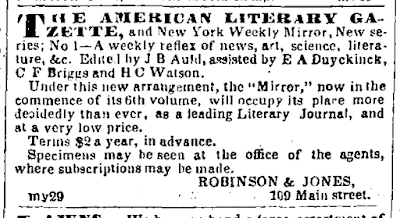
Insider knowledge is evidenced also by commentary in the Dispatch of May 23, 1847 on the first number of the weekly American Literary Gazette and New York Evening Mirror. Early advertisements for the "weekly reflex of news, art, science, literature, &c." listed Jedediah B. Auld as editor, assisted by Evert A. Duyckinck, Charles F. Briggs, and Henry Cood Watson. 

Cincinnati Commercial Tribune - May 29, 1847

Approving the sympathetic review of Omoo in the inaugural issue of May 21, 1847 along with the sharper focus on literary matters in this ambitious new weekly, the Dispatch positively identified the "independant" and "bold" reviewer as editor Evert A. Duyckinck (spelled "Duykinck"), who had recently left the Literary World. Without naming him, Hershel Parker in Herman Melville: A Biography volume 1, 1819-1851 (Johns Hopkins University Press, 1996) page 518 accurately describes the author of this unsigned, "brilliantly written" piece in the Evening Mirror as "someone high up in the journalistic establishment with a special zeal to defend Melville."

Found on genealogybank.com among digitized pages added within the past week; now accessible also via the Library of Congress on Chronicling America.

New York Sunday Dispatch - April 5, 1846
via GenealogyBank

TYPEE ; a Residence in the Marquesas, by Herman Melville, New York, and London —Wiley and Putnam.— This is not a work to be dismissed within the limits of an ordinary book notice, and, as we have not room for more extended remarks, this week, we will defer what we have to say to our next, when we will enrich our columns with extracts from Mr Melville's strange and delightful narrative. Meantime we advise all who have the leisure to read it through, to purchase the book.
<https://chroniclingamerica.loc.gov/lccn/sn83030362/1846-04-05/ed-1/seq-2/>

Somewhat curtailed, the promised extracts appeared the following week.

New York Sunday Dispatch - April 12, 1846

Typee.

A RESIDENCE IN THE MARQUESAS.

We did intend to make numerous extracts from this charming book, which we commended to our readers in a brief notice last Sunday.— But our contemporaries have drawn so largely on its pages, as to leave us hardly the share of a gleaner. We, however, transfer to our columns, a portion of the chapter, which, in glancing at the influence exercised by the missionaries in the Sandwich Islands, makes some disclosures, which, we apprehend, will occasion no little surprize among the pious sewing circles of our country. The author of Typee is a bold man, to to tell even the truth concerning the Sandwich Island Mission, for he may be sure of having the mad dog cry of infidel set up against him, at home. We cannot dismiss our readers to the extract, without again commending the whole of Mr. Melville's narrative to their perusal. [Extracts that follow are from the first American edition of Typee chapter 26.]

"Look at Honolulu, the metropolis of the Sandwich Islands!  — A community of disinterested merchants, and devoted self-exiled heralds of the Cross, located on the very spot that twenty years ago was defiled by the presence of idolatry. What a subject for an eloquent Bible-meeting orator! Nor has such an opportunity for a display of missionary rhetoric been allowed to pass by unimproved ! — But when these philanthropists send us such glowing accounts of one half of their labors, why does their modesty restrain them from publishing the other half of the good they have wrought? Not until I visited Honolulu was I aware of the fact that the small remnant of the natives had been civilized into draught-horses, and evangelized into beasts of burden. But so it is. They have been literally broken into the traces, and are harnessed to the vehicles of their spiritual instructors like so many dumb brutes!

"Among a multitude of similar exhibitions that I saw, I shall never forget a robust, red-faced, and very lady-like personage, a missionary's spouse, who day after day, for months together, took her regular airings in a little go-cart drawn by two of the islanders, one an old grey-headed man, and the other a rogueish stripling, both being, with the exception of the fig-leaf, as naked us when they were born. Over a level piece of ground this pair of draught bipeds would go with a shambling, unsightly trot, the youngster hanging back all the time like a knowing horse, while the old hack plodded on and did all the work. 

"Rattling along through the streets of the town in this stylish equipage, the lady looks about her as magnificently as any queen driven in state to her coronation. A sudden elevation, and a sandy road, however, soon disturb her serenity. The small wheels become imbedded in the loose soil, — the old stager stands tugging and sweating, while the young one frisks about and does nothing—not an inch does the chariot budge. Will the tender-hearted lady, who has left friends and home for the good of the souls of the poor heathen, will she think a little about their bodies and get out, and ease the wretched old man until the ascent is mounted ? Not she; she could not dream of it. To be sure, she used to think nothing of driving the cows to pasture on the old farm in New England; but times have changed since then. So she retains her seat and bawls out, “ Hookee ! hookee !" —pull, pull. The old gentleman, frightened at the sound, labors away harder than ever; and the younger one makes a great show of straining himself, but takes care to keep one eye on his mistress, in order to know when to dodge out of harm's way. At last the good lady loses all patience: “Hookee! hookee!” and rap goes the heavy handle of her huge fan over the naked skull of the old savage; while the young one shies to one side and keeps beyond its range. 'Hookee ! hookee!' again she cries — “ Hookee tata knnaka!”—pull strong, men—but all in vain, and she is obliged in the end to dismount and, sad necessity, actually to walk to the top of the hill.

At the town where this paragon of humility resides, is a spacious and elegant American chapel, where divine service is regularly performed. Twice every Sabbath towards the close of the exercises may be seen a score or two of little wagons ranged along the railing in front of the edifice, with two squalid native footmen in the livery of nakedness standing by each, and waiting for the dismissal of the congregation to draw their superiors home.
"Lest the slightest misconception should arise from anything thrown out in this chapter, or indeed in any other part of the volume, let me here observe, that against the cause of missions in the abstract no Christian can possibly be opposed: it is in truth a just and holy cause. But if the great end proposed by it be spiritual, the agency employed to accomplish that end is purely earthly; and, although the object in view be the achievement of much good, that agency may nevertheless be productive of evil. In short, missionary undertaking, however it may be blessed of Heaven, is in itself but human ; and subject, like everything else, to errors and abuses. And have not errors and abuses crept into the most sacred places, and may there not be unworthy or incapable missionaries abroad, as well as ecclesiastics of a similar character at home? May not the unworthiness or incapacity of those who assume apostolic functions upon the remote islands of the sea more easily escape detection by the world at large than if it were displayed in the heart of a city? An unwarranted confidence in the sanctity of its apostles—a proneness to regard them as incapable of guile—and an impatience of the least suspicion as to their rectitude as men or Christians have ever been prevailing faults in the Church. Nor is this to be wondered at: for subject as Christianity is to the assaults of unprincipled foes, we are naturally disposed to regard everything like an exposure of ecclesiastical misconduct as the offspring of malevolence or irreligious feeling. Not even this last consideration, however, shall deter me from the honest expression of my sentiments.
There is something apparently wrong in the practical operations of the Sandwich Island Mission. Those who from pure religions motives contribute to the support of this enterprise, should take care to ascertain that their donations flowing through many devious channels, at last effect their legitimate object, the conversion of the Hawaiians. I urge this, not because I doubt the moral probity of those who disburse these funds, but because I know that they are not rightly applied. To read pathetic accounts of missionary hardships, and glowing descriptions of conversions, and baptisms taking place beneath palm-trees, is one thing; and to go to the Sandwich Islands and see the missionaries dwelling in picturesque and prettily-furnished coral-rock villas, whilst the miserable natives are committing all sorts of immoralitiy around them, is quite another.

In justice to the missionaries, however, I will willingly admit, that whatever evils may have resulted from their collective mismanagement of the business of the mission, and from the want of vital piety evinced by some of their number, still the present deplorable condition of the Sandwich Islands is by no means wholly chargeable against them. The demoralizing influence of a dissolute foreign population, and the frequent visits of all descriptions of vessels, have tended not a little to increase the evils alluded to. In a word, here, as in every case where civilisation has in any way been introduced among those whom we call savages, she has scattered her vices, and withheld her blessings. 
As wise a man as Shakspere has said, that the bearer of evil tidings hath but a losing office; and so I suppose will it prove with me, in communicating to the trusting friends of the Hawaiian Mission what has been disclosed in various portions of this narrative. I am persuaded, however, that as these disclosures will by their very nature attract attention, so they will lead to something which will not be without ultimate benefit to the cause of Christianity in the Sandwich Islands.

I have but one thing more to add in connection with this subject — those things which I have stated as facts will remain facts, in spite of whatever the bigoted or credulous may say or write against them. My reflections, however, on those facts may not be free from error. If such be the case, I claim no further indulgence than should be conceded to every man whose object is to do good."

 -- New York Sunday Dispatch, April 12, 1846. 

<https://chroniclingamerica.loc.gov/lccn/sn83030362/1846-04-12/ed-1/seq-3/>

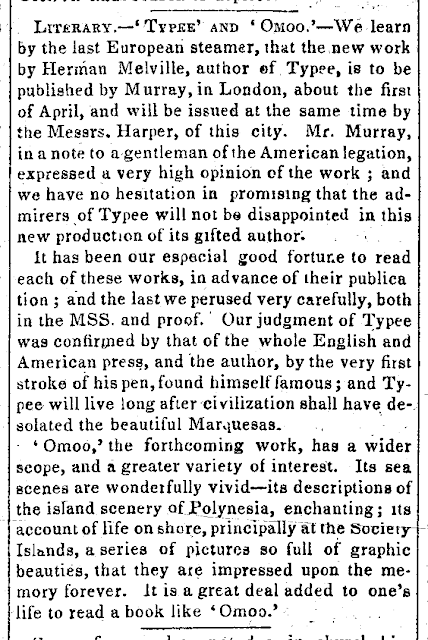
The Dispatch editor who supplied the flattering advance notice of Omoo, transcribed below, claimed an exceptionally close tie with the author in being privileged to examine Melville's second book before publication, in manuscript as well as printed proof sheets.

New York Sunday Dispatch - March 28, 1847

LITERARY. — 'TYPEE' AND 'OMOO.' — We learn by the last European steamer, that the new work by Herman Melville, author of Typee, is to be published by Murray, in London, about the first of April, and will be issued at the same time by the Messrs. Harper, of this city. Mr. Murray, in a note to a gentleman of the American legation, expressed a very high opinion of the work; and we have no hesitation in promising that the admirers of Typee will not be disappointed in this new production of its gifted author. 

It has been our especial good fortune to read each of these works, in advance of their publication; and the last we perused very carefully, both in the MSS. and proof. Our judgment of Typee was confirmed by that of the whole English and American press, and the author, by the very first stroke of his pen, found himself famous; and Typee will live long after civilization shall have desolated the beautiful Marquesas.

'Omoo,' the forthcoming work, has a wider scope, and a greater variety of interest. Its sea scenes are wonderfully vivid—its descriptions of the island scenery of Polynesia, enchanting; its account of life on shore, principally at the Society Islands, a series of pictures so full of graphic beauties, that they are impressed upon the memory forever. It is a great deal added to one's life to read a book like 'Omoo.'

--New York Sunday Dispatch, March 28, 1847 

<https://chroniclingamerica.loc.gov/lccn/sn83030362/1847-03-28/ed-1/seq-2/>

New York Sunday Dispatch - May 9, 1847

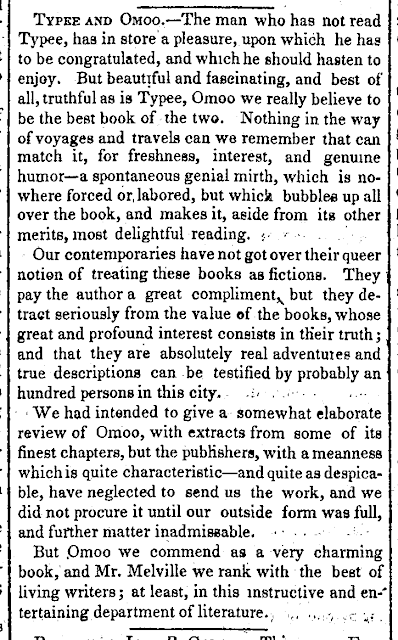
TYPEE AND OMOO. — The man who has not read Typee, has in store a pleasure, upon which he has to be congratulated, and which he should hasten to enjoy. But beautiful and fascinating, and best of all, truthful as is Typee, Omoo we really believe to be the best book of the two. Nothing in the way of voyages and travels can we remember that can match it, for freshness, interest, and genuine humor—a spontaneous genial mirth, which is nowhere forced or labored, but which bubbles up all over the book, and makes it, aside from its other merits, most delightful reading.

Our contemporaries have not got over their queer notion of treating these books as fictions. They pay the author a great compliment, but they detract seriously from the value of the books, whose great and profound interest consists in their truth; and that they are absolutely real adventures and true descriptions can be testified by probably an hundred persons in this city.

We had intended to give a somewhat elaborate review of Omoo, with extracts from some of its finest chapters, but the publishers, with a meanness which is quite characteristic—and quite as despicable, have neglected to send us the work, and we did not procure it until our outside form was full, and further matter inadmissable.

But Omoo we commend as a very charming book, and Mr. Melville we rank with the best of living writers; at least, in this instructive and entertaining department of literature.

-- New York Sunday Dispatch, May 9, 1847  

The next item from the Sunday Dispatch of May 23, 1845 names editor Evert A. Duyckinck as the writer of the highly favorable review of Omoo in the first number of the American Literary Gazette and New York Weekly Mirror (May 21, 1847). Direct quotations establish this as the same unsigned review of Omoo published in the Evening Mirror on May 21, 1847; collected in Herman Melville: The Contemporary Reviews, edited by Brian Higgins and Hershel Parker (Cambridge University Press, 1995; paperback 2009) and transcribed there on pages 108-111. Duyckinck had already resigned when the Literary World reviewed Omoo on May 8, 1847. The review there is probably by his temporary replacement Charles Fenno Hoffman, as Parker suggests in the first volume of Herman Melville: A Biography, page 512.

New York Sunday Dispatch - May 23, 1847
THE AMERICAN LITERARY GAZETTE, is the new prefix title of the New York Weekly Mirror, which paper is placed under the editorial charge of Mr. Evert A. Duykinck, late editor of the Literary World—and now it occurs to us as highly probable, that this may be intended as a rival publication. It is to be devoted more to books and literary criticisms than heretofore, and it promises to be independant. This promise, in the very first number of the series is to a certain extent redeemed; for we have seldom seen a more fearless and decided condemnation of the Missionary enterprize and operations than occurs in the following passage, from a notice of the brilliant works of Herman Melville; Typee and Omoo. Mr. Duyckinck says:— "In sober truth these deluded philanthropists (the missionaries) have, by deluding others, built up an immense institution, requiring annually several hundred thousand dollars to support it; and now they are deluding the natives, with the idea that it is all for their good. This talk about glorious revivals among the heathens, is the veriest nonsense that every emanated from the muddled brains of madmen. A few ignorant islanders are harrangued into a state of mere animal phrenzy, frightened into the grossest absurdities, and finally reduced to a state of slavery—and all this is heralded as a grand triumph of religion!" 
 
He is certainly a bold writer, who in a community like this, dares avow such sentiments; and we begin to think that there is much truth in the report that he was too independant a writer to suit the views of the Booksellers, who publish the Literary World.

-- New York Sunday Dispatch, May 23, 1847 

<https://chroniclingamerica.loc.gov/lccn/sn83030362/1847-05-23/ed-1/seq-2/>

New York Sunday Dispatch - July 18, 1847

A new play is now being performed at one of the theatres of Paris, founded on "Typee;" the author of which they call the Rev Herman Melville. If the "whig reviewer" see this, he will feel worse than ever. --New York Sunday Dispatch, July 18, 1847.

<https://chroniclingamerica.loc.gov/lccn/sn83030362/1847-07-18/ed-1/seq-2/>

Somehow the Sunday Dispatch knew that Herman Melville was one of four brothers. That is, besides Herman's deceased brother Gansevoort Melville, the Dispatch also had information concerning his younger brothers Allan and Tom.

New York Sunday Dispatch - June 27, 1847

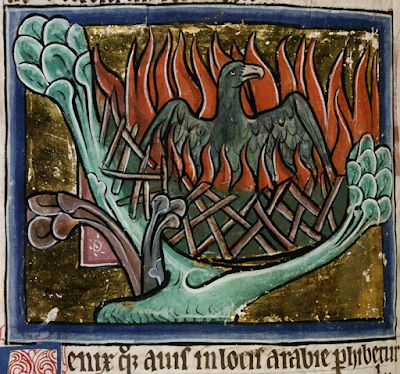
TYPEE AND OMOO.— Blackwood's for June has a review of the last of these extraordinary books, extending to fourteen pages, in the best style of that world renowned magazine, in which Herman Melville is called "the phœnix of modern voyagers, sprung, it would seem, from the mingled ashes of Captain Cook and Robinson Crusoe." Yet, while Blackwood's admits the full extent of the merit of these works, and of the general truthfulness of their narratives, it doubts that the author was a sailor before the mast, doubts that his real name is Herman Melville, or that he really has an uncle Gansevoort, of Saratoga County, to whom Omoo is dedicated.

To us this is amusing. Mr. Melville, the author of Typee and Omoo, is one of four brothers. The eldest, the late Gansevoort Melville, Esq., died Secretary of the American Legation near the Court of St. James. Herman Melville is apparently twenty eight years old, and has been a sailor before the mast in the Pacific; another brother, younger, if we mistake not, Allan Melville, Esq., is a lawyer and examiner in chancery, in Wall street; and the younger brother of the four, is now, if we mistake not, on a whaling voyage in the Indian Ocean; and may live to write books of voyages which will rival Omoo.

We state these facts thus particularly, because, when there is so much misapprehension abroad, there is likely to be some at home. 

-- New York Sunday Dispatch, June 27, 1847

<https://chroniclingamerica.loc.gov/lccn/sn83030362/1847-06-27/ed-1/seq-2/>

On the same page of the Dispatch for June 27, 1847, the brief notice of Blackwood's magazine for June mentions only the article 

on our latest and freshest author, Herman Melville, the writer of "Typee" and "Omoo," two works which have taken and will hold rank, and to which reference is made in another column of this paper.

Strong affinity for the "strange and delightful" charms of Typee and the "spontaneous genial mirth" pervading Omoo did not stop the New York Sunday Dispatch from disliking Melville's third book Mardi, and saying so. More on that next time, hopefully.

Related posts:

Saturday, January 1, 2022

Melville in Kingston, Ontario

Kingston, Ontario Daily British Whig 
April 27, 1850

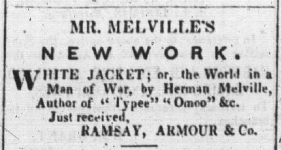
Later editions of Melville's first two books were reviewed in the Daily British Whig (Kingston, Ontario, Canada) on December 3, 1850. Not previously collected, this item offers an early instance of Melville's reception in Canada--almost one year before the favorable notice of Moby-Dick in the Toronto Globe on November 29, 1851. The Kingston newspaper gives the publisher of both Typee and Omoo as "Putam & Wily" although the American edition of Omoo (New York, 1847) was published by Harper & Brothers. In 1849 the Harpers had issued their Revised Edition of Typee, first published in America by Wiley & Putnam. By 1850 all five of Melville's published works through White-Jacket were available in Kingston, Ontario. For some reason unable to name Mardi, and a Voyage Thither the Canadian reviewer refers to Melville's third book as a "political romance." 


LITERARY NOTICES.  

TYPEE; OR A FOUR MONTHS RESIDENCE IN ONE OF THE MARQUESAS; By Herman Melville—Revised Edition Putnam & Wily, New York; Armour & Ramsay, Kingston.

OMOO; OR ADVENTURES IN THE SOUTH SEAS, being a sequel to Typee, by Herman Melville. Revised edition. Putnam & Wily, New York; Armour & Ramsay, Kingston. 

Mr. HERMAN MELVILLE is a writer whose productions bid fair to create for him a high literary reputation in the world of letters. The books before us have been before the public some few years, and have already passed through a variety of editions, being pirated both at home and abroad. The particular edition now before us seems to have received a considerable portion of the author's revision by the pruning knife, inasmuch as a great many vulgarisms and much tedious gurrulity are no longer to be complained of in the same degree. One or two very offensive expressions still remain and disfigure the edition. There is a great air of truth about these volumes which engages the reader's attention at once. If the events related are not genuine, they are certainly "ben trovati" as the Italians would say. The hero is a common Yankee sailor before the mast, not wholly devoid of education, but making no pretensions to literary acquirements; he is a graceless unmitigated scamp, (on his own shewing,) and commits actions that in a civilized country would lead him to the gallows; but of his own demerits he seems to have no idea and tells his tale throughout with an air of injured innocence that is highly amusing. Who he is, or what he is, the reader has no information, for his name or former occupation is never once mentioned or alluded to. Charity should induce us to believe, that Mr. Herman Melville is not the hero of his own stories; and yet some passages in these books, and also some others in his tale of "Redburn," would induce us to form a contrary opinion. This supposition does no honor to Mr. Herman Melville; for to be a deserter without cause, a mutineer without occasion, and a receiver of stolen goods without necessity, is a character unsuited to the author's present standing in society.

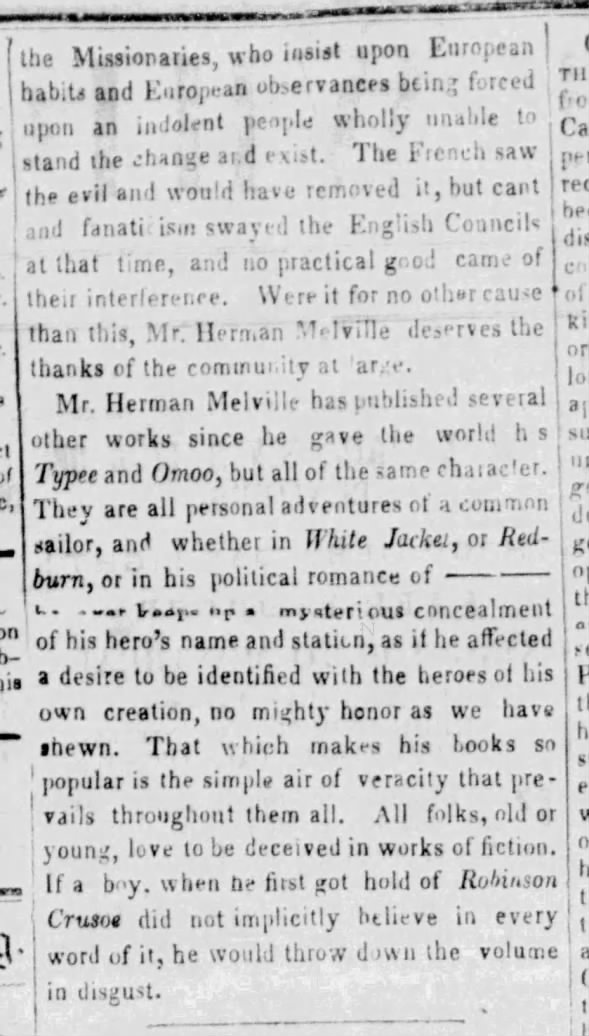
Many critics have likened Typee and Omoo to Robinson Crusoe; others again to Dana's Two Years before the Mast. They certainly have not the raciness of old Defoe, nor is the adventure sufficiently interesting to be compared to that of the immortal navigator; and as to Dana's book, they bear no nigher resemblance than in each being the autobiography of a sailor before the mast. The fact is, Mr. Herman Melville has a very pretty style of his own, to which, like Washington Irving, he owes a great portion of his fame. He tells his tales pleasantly and without labor, and tho' evidently well acquainted with nautical phrases, rarely inflicts them upon his readers. The total want of interest in his hero is a great drawback to his books as novels; but this defect is more than compensated by the vast amount of real knowledge of Polynesian life acquired in their attentive perusal. The Missionaries, those cruel pests in Tahiti, are cleverly handled; for without offering any opinion, he places plain facts before the world, which have already had a salutary effect in checking the mischievous tyranny of priestcraft in the South Seas. The American public affected to discredit the statements of the Russian Kotzebue in 1832, but now that one of their own countrymen repeats the tale, disbelief becomes preposterous and ridiculous. This plain fact speaks whole libraries. Capt. Cook estimated the population of the Society Islands at 200,000; when Kotzebue visited the islands, in 1832, "80,000 miserable wretches (we quote the Captain's words) were all that remained of Capt. Cook's numerous and happy Islanders." This was a sad decrease indeed, but nothing comparable to the present actual de-population of these once flourishing islands; for Mr. Herman Melville in 1844 estimates the whole population at less than 8,000 souls, and fearlessly prognosticates the total disappearance of the race—unless the Missionaries are driven from the Islands. Our readers must not misunderstand us—it is not the introduction of Christianity in the Society Islands which has depopulated them, it is the wilful and perverse misgovernment of the Missionaries, who insist upon European habits and European observances being forced upon an indolent people wholly unable to stand the change and exist. The French saw the evil and would have removed it, but cant and fanaticism swayed the English Councils at that time, and no practical good came of their interference. Were it for no other cause than this, Mr. Herman Melville deserves the thanks of the community at large.

Mr. Herman Melville has published several other works since he gave the world his Typee and Omoo, but all of the same character. They are all personal adventures of a common sailor, and whether in White Jacket, or Redburn, or in his political romance of — — he ever keeps up a mysterious concealment of his hero's name and station, as if he affected a desire to be identified with the heroes of his own creation, no mighty honor as we have shewn. That which makes his books so popular is the simple air of veracity that prevails throughout them all. All folks, old or young, love to be deceived in works of fiction. If a boy, when he first got hold of Robinson Crusoe did not implicitly believe in every word of it, he would throw down the volume in disgust. 

-- The Daily British Whig (Kingston, Ontario, Canada) December 3, 1850. 

Belatedly, with suitable apologies, the Kingston editor offered a wonderfully substantial and highly favorable assessment of White-Jacket a year after it was published in New York by Harper & Brothers. Found this New Year's Day 2022 on newspapers.com, the glowing Canadian notice of White-Jacket is transcribed below from the Daily British Whig of March 25, 1851.

25 Mar 1851, Tue The Kingston Whig-Standard (Kingston, Ontario, Canada) Newspapers.com

LITERARY NOTICES.  

WHITE JACKET, or the World in a Man of War. By Herman Melville, author of Typee, Omoo, &c. Harper's 12mo Edition — pp. 466. Price $1. E. W. Palmer, Kingston.

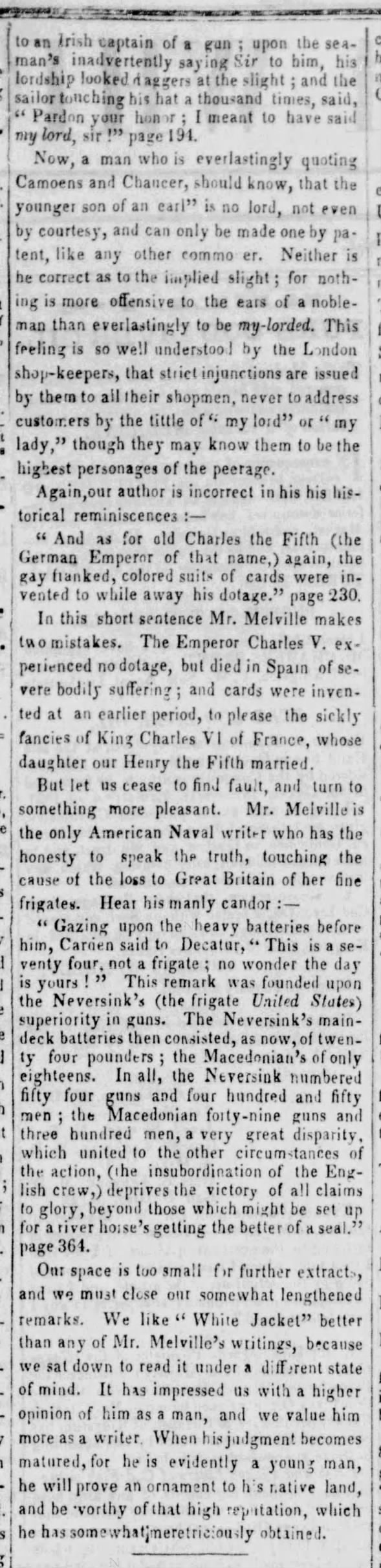
Few modern writers of eminence have disappointed us more than Mr. Melville; this is not so much his fault, as our own; for hearing so much said in his praise by the literary world of Europe and America, we believed him to be another Washington Irving, and took up his "Typee" and "Omoo" with the same eagerness that thirty years ago, we snatched at a novel of Walter Scott's. Had we stumbled on the works of our author with the same careless indifference with which Dana's "Two Years before the Mast" first fell into our hands, we might have paid them that deference which their merits deserve; but being greatly over rated and much over praised, (in our estimation,) we rose from their perusal soured, annoyed and disappointed. This accounts for "White Jacket," Mr. Melville's latest publication, although more than a year before the public, not having excited our curiosity to read it, until Saturday last, when Mr. Palmer, the Bookseller, kindly placed it at our disposal. That Mr. Melville has been a common sailor, a very common sailor, the text of all his works clearly proves. That he is a man of strong common sense, good feeling, and possessed of much information, they also clearly make manifest. But, that he is an educated man, despite his ceaseless quotations from dead and living writers, we very much doubt. There is a mystery about him—something of the George Borrow, which the reader would gladly solve; though perhaps no two men are more dissimilar than the Yankee Sailor and the Gipsy Philologist. Still there is a mystery, and in that consists half the notoriety of his books, and more than half their interest.

"White Jacket" is what its second title describes, the picture of life on board a man-of-war. The writer ships at Valparaiso as an ordinary seaman (that is, a common sailor of the second class) on board the U. S. Frigate United States, (called in the book Neversink) and makes in her the homeward voyage. He is upwards of a year on board of her, and his observing eye and ready pen are busy at work during the whole of that period. The scenes he describes are highly characteristic, vastly descriptive, and greatly entertaining. All his pictures are graphic and all his characters are painted to the life. The abuses in the American Navy are pointed out, and the grossness of its tyranny fully exposed. The stupid Commodore, the brutal Captain, the ignorant Doctor, and the obsequious Master-at-arms, cum multis aliis, all fare alike, and if the incidents portrayed are facts, and they bear an air of truthfulness about them, these officers richly deserve the impaling they receive. One part of the book is written with much spirit and zeal, that which treats of corporal punishment. Mr. Melville shews it to be cruel, wanton, unnecessary, and worse than useless; and it is a happiness for him to know, that since the publication of "White Jacket," the United States Legislature has abolished that species of unmanly torture throughout the Naval and Mercantile Services. Should the same practice be discontinued in the British Navy, and discontinued soon it must be, if the British Fleet expect to be manned without impressment, Mr. Melville will have the grand satisfaction of feeling, that he has achieved more for his fellow man, than any other human being since the days of John Howard. To have abolished "Flogging" is more than Nelson and Collingwood dared to do, though they both wished it done!

We hinted a doubt as to Mr. Melville, who certainly writes with the air and ease of an Oxonian, being a man of education. Although his syntax and prosody are generally correct, still he occasionally makes queer confusion with the words "lying" and "laying." These may be printer's errors, and so far he is excusable. But in the following extract no such excuse can avail him.

"There happened to be a lord on board of this ship—the younger son of an earl, they told me. He was a fine looking fellow. I chanced to stand by when he put a question to an Irish captain of a gun; upon the seaman's inadvertently saying Sir to him, his lordship looked daggers at the slight; and the sailor touching his hat a thousand times, said, "Pardon your honor; I meant to have said my lord, sir!" page 194.

Now, a man who is everlastingly quoting Camoens and Chaucer, should know, that "the younger son of an earl" is no lord, not even by courtesy, and can only be made one by patent, like any other commoner. Neither is he correct as to the implied slight; for nothing is more offensive to the ears of a nobleman than everlastingly to be my-lorded. This feeling is so well understood by the London shop-keepers, that strict injunctions are issued by them to all their shopmen, never to address customers by the tittle of "my lord" or "my lady," though they may know them to be the highest personages of the peerage.

Again, our author is incorrect in his his historical reminiscences:—

"And as for old Charles the Fifth (the German Emperor of that name,) again, the gay franked, colored suits of cards were invented to while away his dotage." page 230.

In this short sentence Mr. Melville makes two mistakes. The Emperor Charles V. experienced no dotage, but died in Spain of severe bodily suffering; and cards were invented at an earlier period, to please the sickly fancies of King Charles VI of France, whose daughter our Henry the Fifth married.

But let us cease to find fault, and turn to something more pleasant. Mr. Melville is the only American Naval writer who has the honesty to speak the truth, touching the cause of the loss to Great Britain of her fine frigates. Hear his manly candor:—

"Gazing upon the heavy batteries before him, Cardan said to Decatur, “This is a seventy-four, not a frigate; no wonder the day is yours!” This remark was founded upon the Neversink's (the frigate United States) superiority in guns. The Neversink's main-deck batteries then consisted, as now, of twenty-four pounders; the Macedonian's of only eighteens. In all, the Neversink numbered fifty four guns and four hundred and fifty men; the Macedonian forty-nine guns and three hundred men, a very great disparity, which united to the other circumstances of the action, (the insubordination of the English crew,) deprives the victory of all claims to glory, beyond those that might be set up for a river horse's getting the better of a seal." page 364.
Our space is too small for further extracts, and we must close our somewhat lengthened remarks. We like "White Jacket" better than any of Mr. Melville's writings, because we sat down to read it under a different state of mind. It has impressed us with a higher opinion of him as a man, and we value him more as a writer. When his judgment becomes matured, for he is evidently a young man, he will prove an ornament to his native land, and be worthy of that high reputation, which he has somewhat meretriciously obtained.
-- The Daily British Whig (Kingston, Ontario, Canada) March 25, 1851. 
20 Nov 1851, Thu The Kingston Whig-Standard (Kingston, Ontario, Canada) Newspapers.com
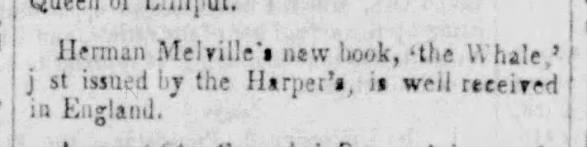
"Herman Melville's new book, 'the Whale,' just issued by the Harper's, is well received in England."  -- Daily British Whig (Kingston, Ontario, Canada) November 20, 1851.