Did you hear of the _______? by Scott Norsworthy
A shared 5-gram in "Scenes Beyond the Western Border" and Herman Melville's "The Lightning-Rod Man"
Read on Substack

Original research and riffs on Herman Melville, authorship, and nineteenth-century American literature.
 |
| Bonhomme Richard and Serapis via The New York Public Library Digital Collections |
"... Melville often, with a few words, selected with marvelous aptness, gives us a finer and more life-like description than most men create out of long chapters and thick books ..."
 |
| New York Daily Times - April 30, 1855 via genealogybank.com |
The New York Times was then edited by co-founder Henry J. Raymond.ISRAEL POTTER—HIS FIFTY YEARS OF EXILE.
By Herman Melville. New-York: G. P. PUTNAM & CO.
Publishing a book of this sort in the successive numbers of a monthly, is like carrying to one a rose leaf by leaf—where fragrance in such small installments can scarcely be appreciated. These Chapters of Mr. POTTER's experience, written down by the facile pen of MELVILLE, were among the chief attractions of Putnam's Monthly during the last year, but we were by no means impressed so pleasantly with them while they were the fragments of a serial, as now that the severed petals are regathered upon their proper stem, and bound handsomely, as it were, in a fitting sepal. It is a book to begin reading at night, when work is done, and to finish the next night. The meditations on it during the intervening day are pleasant. and the night's dreams will wander over a new track.
Israel Potter was a Yankee boy, who loved too young and ran away from his father because the old gentleman headed him off from the intended marriage. He was a private, and an effective one, at Bunker's Hill; and afterwards, while on board a brigantine appointed to intercept supplies going to the British quarters in Boston, is captured and carried to England. Then follow crowds of incidents, escapes from the hulks and from guard-rooms, wanderings over the land, and driftings hither and thither, new arrests and new escapes. He gets into all sorts of positions in his desire to escape detection in the enemy's country. He is lackey to mean men, the confidant of great ones, and at one time private gardener to the King, whom he called "Mister," and respectfully addressed as "Sir." These interviews of his with famous men furnish opportunities for episodes that are the finest portions of the book. The narration of his imprisonment in the private room of BENJAMIN FRANKLIN in Paris, gives us some pages of wholesome and homsespun philosophy not unlike or unworthy of Poor RICHARD. Another scene introduces us to the famous author of the Diversions of Parley.
Another chapter shows us old ETHAN TICONDEROGA ALLEN, as he bore it to be manacled and insulted by cowardly captors. Israel, by the fortunes of war, was a long time under the command of that buccaneering hero and American Naval officer PAUL JONES, and was in the Bonhomme Richard when he fought the great battle with the Serapis. This deadly encounter is sketched briefly, and with few lines. But MELVILLE often, with a few words, selected with marvelous aptness, gives us a finer and more life-like description than most men create out of long chapters and thick books; as one with a single crayon who knows how to handle it, sketches a better portrait than many dainty painters make out of their collection of finest colors, and after very tedious sittings.
The author is so brief about the forty years that roll over and almost crush the inborn Yankee cheerfulness out of his hero, that we wonder whether he really lacked the MSS. that contained the outlines of his story while he was sinking from the damp basement to the mouldy cellar, and from that to the muddy sewer, or whether the engagement with the publisher was "for only so many pages," of which the heroic took the lion's share. Then it grieved us at first that the tired old man could not have found one friend at least in the Housatonic country to sit down and chat with as his sun was sinking. But we remember that out of the magazines and in the world, wanderers, after fifty years of exile, seldom find a warm hearth or a familiar face to cheer them. So we must take it out in grieving that it is so, or be reconciled to authors that so make it.
 |
| Photo by Prasad Chatterji |
"And there is a Catskill eagle in some souls that can alike dive down into the blackest gorges, and soar out of them again and become invisible in the sunny spaces." -- Moby-Dick, The Try-Works.
 |
| via The New York Public Library Digital Collections |
Derived from nob meaning "nobleman" or other "superior sort of person," the adjective nobby means "stylish; elegant; swell" according to Webster.
An early announcement of Herman Melville's death in the Chicago Tribune mistakenly referred to him as the author of "Nobby Dick," prompting this sarcastic comment in the New York Sun:
 |
| New York Sun - October 5, 1891 |
The Chicago Tribune editorially informs its readers that the late HERMAN MELVILLE was the author of the charming and well-known romance, "Nobby Dick." This novelette, as we understand, has long enjoyed a deserved popularity in Chicago's highest literary circles. The announcement of the authorship of "Nobby Dick" will clear up what has been a perplexing mystery to thousands of cultivated minds. --New York Sun, October 5, 1891
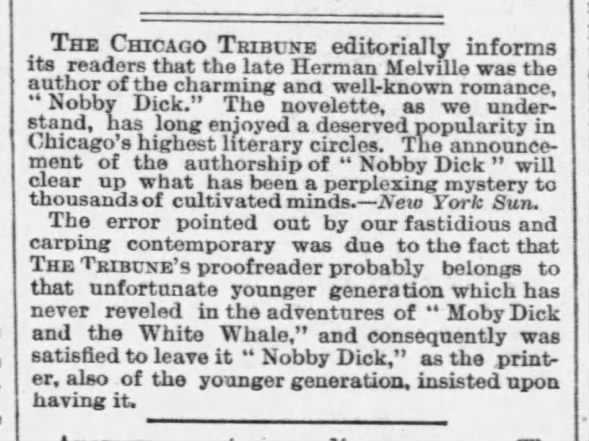 09 Oct 1891, Fri Chicago Tribune (Chicago, Illinois) Newspapers.com
The error pointed out by our fastidious and carping contemporary was due to the fact that THE TRIBUNE's proofreader probably belongs to that unfortunate younger generation which has never reveled in the adventures of "Moby Dick and the White Whale," and consequently was satisfied to leave it "Nobby Dick," as the printer, also of the younger generation, insisted upon having it. -- Chicago Tribune, October 9, 1891
 |
| via The New York Public Library Digital Collections |
"Mr. Herman Melville, in his new sea-story, describes a marvellous chase by a whaling monomaniac after the "Moby Dick," the fabulous leviathan of the sailors, during which he probably lets us into the realities of actual whaling as minutely and faithfully as any sea-author has ever done. We shall give a couple of passages, hoping they will put the reader on the look out for the book itself...."
 |
| Grand River Times - January 6, 1852 via GenealogyBank |
 |
| Grand River Times - January 6, 1852 |
It was obvious now that the whale had at length become aware of his pursuers.-- All silence or cautiousness was, therefore, no longer of use. Paddles were dropped, and oars came loudly into play. And still puffing at his pipe, Stubb cheered on his crew to the assault.
Obviously this excerpt does not describe the violent White Whale insurrection, which happens later. For the rest of the story, grab your favorite edition of Moby-Dick and read along....it's that time again!Yes, a mighty change had come over the fish. All alive to his jeopardy, he was going "head out;" that part obliquely projecting from the mad yeast which he brewed.

Franz Fanon in Black Skin, White Mask (1967) stated,
Sometimes people hold a core belief that is very strong. When they are presented with evidence that works against this belief, the new evidence cannot be accepted. It would create a feeling that is extremely uncomfortable, called cognitive dissonance. And because it is so important to protect the core belief, they will rationalize, ignore and even deny anything that doesn't fit in with the core belief. (Fanon 1967: 194).
--Introduction, War on Terror and American Film: 9/11 Frames Per Second (Edinburgh University Press, 2014, 2016).McSweeney cites a London edition of Fanon's 1952 book Peau noire, masques blancs, published by Pluto Press. Evidently this is the 1986 reissue of the Charles Lam Markmann translation, first published in 1967 by Grove Press. Another edition by Grove Press appeared in 2008, with a new translation from the French by Richard Philcox.
In the course of our conversation she explained why. She told me that sometimes people hold a core belief that is very strong. When they are presented with evidence that works against that belief, the new evidence cannot be accepted. It would create a feeling that is extremely uncomfortable, called cognitive dissonance. And because it is so important to protect the core belief, they will rationalize, ignore and even deny anything that doesn't fit in with the core belief.
https://www.huffpost.com/entry/why-some-smart-women-thin_b_137416
"... the continued belief that this quote is from Frantz Fanon is a prime example of cognitive dissonance."
http://underthetree63.blogspot.com/2013/03/revisiting-frantz-farnon.html
Nakuma, Constancio. “COGNITIVE DISSONANCE REDUCTION STRATEGIES BY BLACK INTELLECTUALS IN THE DIASPORA: A PSYCHOLINGUISTIC EXPLORATION OF NEGRITUDE AND AFROCENTRISM.” CLA Journal 43, no. 2 (1999): 167–180 at 169. http://www.jstor.org/stable/44323286.
"I am not a prisoner of history."
But how to account for the birth and surging popularity of Fake Fanon? In alphabetized book indexes and bibliographies the surname Festinger follows Fanon, immediately in some cases. Sometime after the turbulent 1960's and early 1970's, perhaps, on a quiet university campus in the blissful calm of a graduate student's library carrel, a sleepy research assistant may have mistakenly tracked a textbook paraphrase of cognitive dissonance to Fanon instead of the name just below Fanon. Otherwise it's hard to say exactly how or where the mistaken attribution first occurred.
The rapid proliferation of pseudo-Fanon in the internet age resembles the worldwide re-assignment of Rev. Henry Melvill's fine image of moral accountability as a network of "sympathetic threads" and "fibres" to Herman Melville. As with pseudo-Melville, pseudo-Fanon peculiarly suits the advancement of leftist political agendas. In the service of politicians and academic activists, both pseudo-Melville and Fake-Fanon have been usefully employed as prophets of Woke utopia.
We cannot live for ourselves alone. Our lives are connected by a thousand invisible threads, and along these sympathetic fibers, our actions run as causes and return to us as results.
HERMAN MELVILLE
Hillary's husband blithely ascribed the "sympathetic fibers" quote to Herman Melville at the 1997 Memorial Service for Albert Shanker, president of the American Federation of Teachers. Then-President Clinton misappropriated Melville for the purpose of honoring Shanker as a teacher and social justice advocate, while eliding Shanker's-- Hillary Rodham Clinton, It Takes a Village (Simon & Schuster, 2006).
"lifelong hatred of Soviet-style communism." --Jack Schierenbeck, Class struggles: The UFT story
Here in Minnesota, our once-beloved prairie moralist and Moby-Dick hater Garrison Keillor (before he got canned by MPR) loved to spout pseudo-Melville, as he did in Good Poems for Hard Times (Penguin Books, 2006).
Minnesota middle-schoolers probably don't get to read Typee or Redburn, but twenty years ago some of them got spoon-fed pseudo-Melville as part of their indoctrination in utopian ideology and ethics.
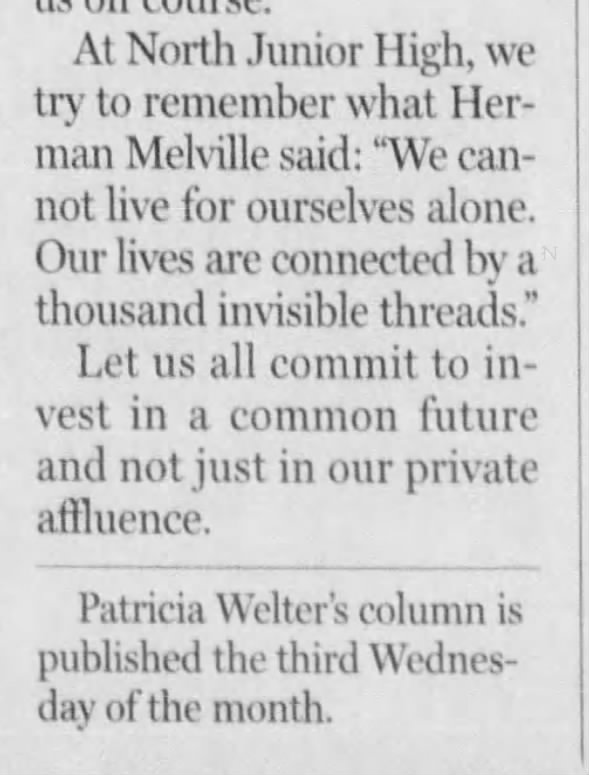
"At North Junior High, we try to remember what Herman Melville said: 'We cannot live for ourselves alone. Our lives are connected by a thousand invisible threads.' Let us all commit to invest in a common future and not just in our private affluence." -- Patricia Welter, St. Cloud Times, May 16, 2001.
Pat Welter later co-founded Partner For Student Success or PFSS, largely devoted to data collection and the promotion of Social-Emotional Learning and other dubious, usually harmful ideologies.
 |
| https://twitter.com/ConceptualJames |
Early in the present century, corporate media enlisted pseudo-Melville to help teachers promote the virtues of "diversity" and social "harmony" in a lesson on The Building Blocks of Character Education. Connecticut kids had to explain in writing why Herman Melville, in reality the type of guy who would just say NO! in Thunder, would agree with establishment dictates to "live in harmony." The stated focus of this particular activity, the fourth of ten in the series on character-building, was "Acceptance."
In a well-organized paragraph, discuss the following quote by Herman Melville: "We cannot live for ourselves alone. Our lives are connected by a thousand invisible threads, and along these sympathetic fibers, our actions run as causes and return to us as results." Explain why Melville would agree that by learning about differences, we allow ourselves to appreciate diversity and begin to live in harmony by respecting the views of others. Stamford CT Daily Advocate - December 3, 2001 via genealogybank.com

a managed state of racial equity that will eventually produce a post-racial utopia in which “racial justice” finally exists. The revolution and administered (socialist, “equity”) state will be led by a Dictatorship of the Antiracists (DOA?), comprised of awakened (Woke) Critical Race Theorists with the right critical consciousness of race.
-- Critical Race Theory's Dictatorship of the Antiracists.
Pseudo-Melville and Fake-Fanon have been adopted as prophets in the new religion of Wokeness. The repurposed scriptures of these prophets serve to implant and cultivate the ethos of communitarian supermorality. For strong "reasons why a code of communitarian supermorality is unlikely to work," see the extended paraphrase of John Mackie by Richard A. Posner in The Problems of Jurisprudence (Harvard University Press, 1990) pages 416-418. In practice, such utopian ideals require "high levels of coercion" to maintain, resulting in all kinds of wickedness and abuse. In education, the praxis of critical theory has methodically enabled the psychological and sexual abuse of children in schools run by Woke teachers and administrators, as shown by James Lindsay on New Discourses.
Along with American schools, groomers have also hijacked the "ETHICS" department at Boy Scouts of America. Fake-Fanon is this day being employed there in the worst conceivable way, as an approved text designed to create doubt about commonly understood standards of ethical behavior.
Prominently introduced with "Troop Leader Resources," fake-Fanon specifically helps to teach kids "The Value of Ethical Controversies":
"there are two sides to most questions and that the gray area between right and wrong is sometimes difficult to define."
In some cases, the theory of cognitive dissonance according to Festinger required evaluating the factual basis of "core beliefs" in order to distinguish valid beliefs from invalid ones. Granted, that distinction has seemed less important to later analysts who tend to emphasize the supposed discomfort or dissonance produced by conflicting ideas, regardless of their empirical merit. Human psychology is complicated, after all. This aint the Boy Scouts. Wait, this IS the Boy Scouts. Here we are, almost in 2022, and Woke Troop Leaders at Boy Scouts of America can't tell right from wrong, or pretend they can't, and make a virtue of teaching ethical indeterminacy to other people's children. And their best authority for this exercise in moral relativism is Fake-Frantz-Fanon. Reality check: confusing kids with lessons about "gray areas between right and wrong" is a very bad practice, conducive to further abuse.
"Sometimes people hold a core belief that is very strong. When they are presented with information that works against that belief, the new evidence cannot be accepted. It would create a feeling that is extremely uncomfortable, called cognitive dissonance. And because it is so important to protect the core belief, they will rationalize, ignore and even deny anything that does not fit in with the core belief."
We may not go about our daily lives thinking of the term “cognitive dissonance,” but we’ve all seen this theory materialized. We’ve seen presidential poll numbers that don’t change regardless of the policies some candidates bring forth. We’ve seen studies in newspapers or sometimes comical takes of the data on television proving that people will agree or disagree with the same policy based merely upon whose idea they believe it is. We can probably also think of instances of it in our own communities and within the work we do. For example, one of our nonprofit members recently talked to me about this theory and how cognitive dissonance is a major obstacle in their work for economic equity.
-- Keeping an Open Mind about the Education Reform Debate, September 23, 2015.
"And in a tribute to my grandmother’s defiance of cultural norms, I have built a career reshaping workplace cultures through equity and inclusion." Fake-Fanon supplies an imposing epigraph for this 2017 Call for Courage in the Workplace by Daisy Auger-Dominguez.
https://www.daisyauger-dominguez.com/perspectives/2019/3/20/a-call-for-courage-in-the-workplace
"Daisy is an advisor to startups and social impact organizations, and serves on the board of directors of Planned Parenthood Federation of America as Vice-Chair, the Brooklyn Children’s Museum, the Robert Sterling Clark Foundation as Chair of the Governance Committee, St. Ann’s Warehouse, and on the advisory board of Facing History and Ourselves." https://www.daisyauger-dominguez.com/about-daisy
 |
| "ye cannot live for yourselves; a thousand fibres connect you with your fellow-men...." The Rev. Henry Melvill, 1855 sermon on Partaking in Other Men's Sins |
... they will rationalize, ignore and even deny anything that doesn't fit in with the core belief.What's that called again?
Herman Melville's calling card, this one left for his uncle Herman Gansevoort...
 |
| Calling card of Herman Melville via NYPL Digital Collections |
"... it was like a scene from Moby-Dick."
--Bruce Rogers on Prince at the Halftime of Super Bowl XLI

... The day was also observed by the Young Mens' Association in this city. The exercises were in the Second Presbyterian church. The Declaration of Independence was read, and well read, by Mr. G. MELVILLE. The oration which we learn was a production creditable as well to the author as to the choice of the Association, was pronounced by JOHN DAVIS, esq. The members were out in great numbers with their badges and banner, and of themselves formed a large procession, exclusive of its citizens, with whom the Association continues to be, as it deserves, a favorite as it is a flourishing and valuable institution. --Albany Argus, July 8, 1836; found at GenealogyBankWriting in 1849, Gansevoort's brother Herman Melville imagined the literary freedom Shakespeare might have enjoyed as a great American truth-teller, asserting that "the Declaration of Independence makes a difference."

For I hold it a verity, that even Shakespeare, was not a frank man to the uttermost. And, indeed, who in this intolerant Universe is, or can be? But the Declaration of Independence makes a difference. --letter to Evert A. Duyckinck, March 3, 1849
Citation:
Manuscripts and Archives Division, The New York Public Library. "1846-1849" New York Public Library Digital Collections. Accessed July 4, 2020. http://digitalcollections.nypl.org/items/df49f430-16c2-0133-5bcc-58d385a7bbd0This liberating power in the Declaration of Independence would somehow give Melville the creative freedom he needed to write Moby-Dick (1851).
We will proclaim the ideals of the Declaration of Independence, and we will never surrender the spirit and the courage and the cause of July 4th, 1776.
Upon this ground, we will stand firm and unwavering. In the face of lies meant to divide us, demoralize us, and diminish us, we will show that the story of America unites us, inspires us, includes us all, and makes everyone free.
We must demand that our children are taught once again to see America as did Reverend Martin Luther King, when he said that the Founders had signed “a promissory note” to every future generation. Dr. King saw that the mission of justice required us to fully embrace our founding ideals. Those ideals are so important to us — the founding ideals. He called on his fellow citizens not to rip down their heritage, but to live up to their heritage. (Applause.)
Above all, our children, from every community, must be taught that to be American is to inherit the spirit of the most adventurous and confident people ever to walk the face of the Earth.
Americans are the people who pursued our Manifest Destiny across the ocean, into the uncharted wilderness, over the tallest mountains, and then into the skies and even into the stars.
We are the country of Andrew Jackson, Ulysses S. Grant, and Frederick Douglass. We are the land of Wild Bill Hickock and Buffalo Bill Cody. (Applause.) We are the nation that gave rise to the Wright Brothers, the Tuskegee Airmen — (applause) — Harriet Tubman, Clara Barton, Jesse Owens, George Patton — General George Patton — the great Louie Armstrong, Alan Shepard, Elvis Presley, and Mohammad Ali. (Applause.) And only America could have produced them all. (Applause.) No other place.
-- Remarks by President Trump
<https://trumpwhitehouse.archives.gov/briefings-statements/remarks-president-trump-south-dakotas-2020-mount-rushmore-fireworks-celebration-keystone-south-dakota/>
Somewhere Trump also exalted Mark Twain as the preeminent American story-teller. Wrongly there, as any real Melville aficionado can tell you. Nevertheless, the author of Israel Potter (originally presented in Putnam's magazine as A Fourth of July Story) would have felt the fitness of tributes to western legends like Wild Bill Hickock and Buffalo Bill Cody. According to Melville, "the Western spirit is, or will yet be (for not other is, or can be) the true American one."
| Israel Potter, magazine version |
Here's hoping the proposed National Garden of American Heroes will make room for a statue honoring the author of Moby-Dick and Israel Potter, The Confidence-Man and Clarel. Put him next to Buffalo Bill, or Louis Armstrong."Though born in New England, he exhibited no trace of her character. He was frank, bluff, companionable as a Pagan, convivial, a Roman, hearty as a harvest. His spirit was essentially Western; and herein is his peculiar Americanism; for the Western spirit is, or will yet be (for no other is, or can be), the true American one." --Ethan Allen as described in Herman Melville's Israel Potter: His Fifty Years of Exile (1854-5)
Israel Potter, book version
 |
| via Library of Congress |