
Original research and riffs on Herman Melville, authorship, and nineteenth-century American literature.
Thursday, May 1, 2025


Wednesday, May 24, 2023
Augusta Melville, letter to Allan Melville, May 16th 1851
Here below is my transcription of Augusta Melville's letter to her brother Allan Melville in New York City, written on May 16, 1851 at the Van Rensselaer Manor House
in Albany, New York. As she informs Allan, Augusta had been there for at least two weeks ("a long fortnight"), visiting and
socializing with Albany relatives--2nd cousin Catherine "Kate" Van
Rensselaer, for one, a younger sister of Augusta's close friend Cornelia
"Nilly" Van Rensselaer Thayer.
Augusta's own home at the time was her brother Herman Melville's Arrowhead farm in Berkshire County, Massachusetts. While she was away in the month of May 1851, Herman was busy doing or supervising repairs and improvements to the farmhouse.
"The whole place will have been so much improved by the time of my return, that I expect hardly to recognize it."
Before she left to rejuvenate in Albany, Augusta had been working hard as Herman's copyist, tasked with turning her brother's scribblings into a legible manuscript for the printer. To Allan, in passing, Augusta made what has to be the earliest comment on record by any reader of Moby-Dick, five months in advance of its publication in England as The Whale:
"So you had a flying visit from Herman? When does he make the longer one? That book of his, will create a great interest, I think. It is very fine. By the way, have you seen Willis' Hurry-Graphs?"
Believing Herman's new book to be nearly finished and ready for the press, Augusta predicted it would "create a great interest." After praising the Whale in manuscript as "very fine," Augusta went on to commend Hurry-Graphs; Or, Sketches of Scenery, Celebrities and Society by Nathaniel Parker Willis (where "Herman Melville, with his cigar and his Spanish eyes" is mentioned at the start of the chapter on Lieut. Wise, Author of Los Gringos); and in a postscript, Jane Bouverie by Catherine Sinclair.
Augusta Melville's letter to Allan Melville on May 16, 1851 is now at Arrowhead, donated by Anna Waller Morewood (1905-1994). Hershel Parker quoted it for the first time in "New Melville Documents and Sub-Intentioned Death," Chapter 17 in Suicidology: Essays in Honor of Edwin Shneidman (Jason Aronson Inc., 1993) pages 289-298 at 291. Generous excerpts are given in Parker's Herman Melville: A Biography Volume 1, 1819-1851 (Johns Hopkins University Press, 1996) on pages 840 and 867. However, a complete transcription has not been published before now.
Dave Laczak, senior technician with the Local History Department of the Berkshire Athenaeum, helpfully directed me to the present location of Augusta's letter. At the Berkshire County Historical Society at Herman Melville's Arrowhead, assistance with obtaining scanned images was kindly provided by Lesley Herzberg, Executive Director; and Erin Hunt, Curator. I am sincerely grateful for their guidance. Mistakes are all mine.
 |
| Van Rensselaer Manor-House via NYPL Digital Collections |
May 16th 1851
My dearest brother,
The letter you promised, has not yet made its appearance — & here I have been a long fortnight. But it is not too late yet, do not imagine that I have given up now all thoughts of receiving it, by no manner of means. I shall continue to expect it by each morning's mail, just as I have been doing ever since I came. I have only heard from home once, but I hope to have a letter tomorrow. They are all so busy there, that I suppose they dont feel as if they could spare the time to write often. The whole place will have been so much improved by the time of my return, that I expect hardly to recognize it. No doubt you have had letters since the date of mine & know just how far they have progressed. How I long to have everything in beautiful order, & you & Sophia & the children there enjoying the country air. Give my very warmest love to Sophia, & try to impress upon her mind the fact, that the receipt of a few lines from her, would afford me the highest satisfaction. I hope to hear that she feels stronger, & is no longer troubled with that wearisome pain in the back. Those arms, I trust, measure a little more in circumference, & those poor wrists are not quite so thin. I can imagine what a delicately slender appearance they present draped in the fashionable undersleeve. How much I should like to see that little Florence, & my darling little Maria. They will have grown almost out of my remembrance. Kisses by the dozen for them both; & a speedy transportation of them to Arrowhead.
[page 2:]
And now I must try to gather all the Albany news for you, & tell you something of my visit thus far. The first week I was here, the weather was exceedingly unpleasant. Nothing but a succession of violent showers, so we were kept almost prisoners, I believe I was only out of the house twice. For the past six or seven days, however, it has been very delightful, just cool enough to be pleasant with the exception of one sultry day, when the thermometer stood at 80. We have been out driving a good deal, & had a good deal of company to dinner. I have only passed one day out, and that was at Aunt Susan's, yesterday. They are all very polite there — Uncle, excessively so. What will you say to his calling to see me with Aunt Susan last week, & then to his inviting me to drive with him to Troy to call upon General & Mrs Wool, to whom, it would give him much pleasure to introduce me! —he said.
 |
| General John Ellis Wool Photo portrait by Matthew Brady via Library of Congress |
[page 3:]
land for the Reservoirs, the city have paid him 150 000 dollars. That has enabled him to pay up those heavy debts, & remove many of his anxieties arising from the anti-rent troubles. Then too, he has been engaged for some time in filling up the his low lands bordering on the river & converting them into lumber yards & docks — which rent to such advantage, that this past year, they brought him in $30,000. All these little particulars, I have treasured up in my memory, thinking they might interest you. Such things generally pass immediately out of my mind. They are making preparations to alter the patroon's bridge, so as to place it more on a direct line with the Troy road.—
 |
| Albany Evening Journal - May 7, 1851 via Genealogy Bank |
[page 4:]
has almost entirely lost the use of her right hand (I never knew that,) & is very much depressed. You must go there very soon then & let us know how she is. Uncle Peter, did not even know that she had been ill, until the day I passed there. Henry & Kitty have both grown very much — Henry wants only an inch or two of Uncle's heighth. By the way, they have lost one of their neighbors—Judge Bronson who has removed to New York. Mr Thayer has just been passing a couple of days with us, he brought me an invitation to return with him to Boston, & make Cornelia a visit — but I shall defer that to some other time. We are expecting Justine home from Baltimore this afternoon. Her father went for her on Monday. She has been suffering from a most alarming cough, & the physicians recommended her taking a little trip to the South — so she availed herself of that opportunity to visit Margaret in her new home. Bayard returns from Scotland some time next month. He has finished at the University, & is now to go in business. They speak of putting him with Mr Thayer.
 |
| Detail, page 4 of 4. Augusta Melville, letter to Allan Melville, 16 May 1851. Courtesy of the Berkshire County Historical Society, Pittsfield, MA |
My love to Mrs Thurston & every member of the family. Remember me to both of the Elizas. Has Sophia, read "Jane Bouverie" — It is beautifully written. Miss Sinclair is the author. Remember me kindly to Mr & Mrs Duyckinck. Mr J. R. wanted me to go with him to Baltimore. How pleasant it must be in New York now. Tell Sophia Mrs Bigelow (Miss Poultney) has a little son, a month old. But perhaps she knows it. Now I believe I have told you everything that I can think of. Cousin Maggie Wynkoop sent her love. The Taylors asked about you all.
- General and gentle readers
https://melvilliana.blogspot.com/2023/05/general-and-gentle-readers.html
- Mid-to-late May maybe
https://melvilliana.blogspot.com/2023/10/mid-to-late-may-maybe.html
- Robert Craighead's third-story rooms on Fulton street
https://melvilliana.blogspot.com/2023/10/robert-craigheads-third-story-rooms-on.html
Thursday, January 13, 2022
Melville in the Middle: two wives, fine paintings, fake antiques, Frost's daughter and THE GRAND DAME at Arrowhead

Hardcore Melvilliana fans might remember Leonora O' Herron, the respected Pittsfield antiques dealer who conducted the estate sale at Arrowhead in the summer of 1927, after Herman Melville's nieces sold it to Robert E. Kimball. Along with all the usual household furnishings, the 1927 sale featured unspecified "books from the library of Herman Melville," as previously shown on Melvilliana:
https://melvilliana.blogspot.com/2019/08/friend-of-bessie-remembers-herman.html
Before the sale, Miss O'Herron had been working on the appraisal of more unique and valuable items, among which was a portrait in oil known locally as "The Grand Dame." A shady New York dealer named Wilbur J. Cooke tried to buy the alluring work when a friend of Miss O'Herron was minding the shop. The well-meaning friend who mistakenly sold The Grand Dame to Cooke for fifty dollars was Robert Frost's daughter Lesley W. Frost, then proprietor of the Open Book Shop in Pittsfield. For her part Miss Frost was innocent of any fraud, and too good to wonder why Mr. Cooke had to borrow the down payment of $5.
When she found out what had happened, Miss O'Herron promptly returned the five bucks, whereupon Cooke took her to court. Verdict: No Sale. A few years later the New York dealer was exposed as a crook after selling a lot of fake Lowestoft china to a Boston collector. The gifted swindler dealt in fake paintings too, and sold at least one phony portrait of George Washington as the work of Gilbert Stuart. Acknowledged in the papers as "one of the cleverest art racketeers on record" (New York Daily News, April 2, 1933) Wilbur J. Cooke sought refuge in various mental hospitals in New York State.
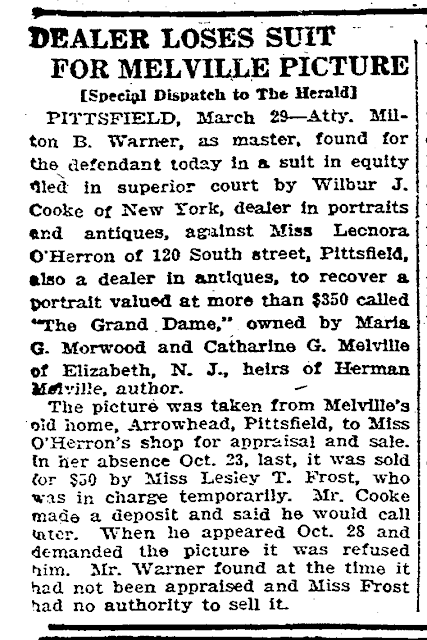
DEALER LOSES SUIT FOR MELVILLE'S PICTURE[Special Dispatch to The Herald]PITTSFIELD, March 29 -- Atty. Milton B. Warner, as master, found for the defendant today in a suit in equity filed in superior court by Wilbur J. Cooke of New York, dealer in portraits and antiques, against Miss Leonora O'Herron of 120 South street, Pittsfield, also a dealer in antiques, to recover a portrait valued at more than $350 called "The Grand Dame," owned by Maria G. Morewood and Catharine G. Melville of Elizabeth, N. J., heirs of Herman Melville, author.
The picture was taken from Melville's old home, Arrowhead, Pittsfield, to Miss O'Herron's shop for appraisal and sale. In her absence Oct. 23, last, it was sold for $50 by Miss Lesley T. Frost, who was in charge temporarily. Mr. Cooke made a deposit and said he would call later. When he appeared Oct. 28 and demanded the picture it was refused him. Mr. Warner found at the time it had not been appraised and Miss Frost had no authority to sell it.
--Boston Herald, March 30, 1927.
A recap in the Berkshire Evening Eagle of March 2, 1933 stated that Allan Melville's daughters "had refused offers of $500" for the painting. Adjusting just for inflation that's $8,000 today, at least, irrespective of fluctuations in the market for rare art. Who was the woman portrayed as "The Grand Dame" in this unusual and pricey work? Berkshire journalists dubiously identified the subject as "the step mother of one of Herman Melville's wives."
"As a matter of interest, Attorney Warner asked about the history of the portrait in question. Herman Melville, the author of "Moby Dick," who lived at Arrowhead, was twice married and the portrait depicts a stepmother of one of his wives. On account of its having always hung in the Melville, house, now owned by his nieces, Mrs. William Morewood and Miss Katherine Melville, it has a distinct Melville association, although not a portrait of a member of the Melville family." -- The Berkshire County Eagle, December 10, 1926.
"The painting was of the step mother of one of Herman Melville's wives and was taken from "Arrowhead," home of the famous writer of sea stories on Holmes road."
-- Berkshire County Eagle, April 6, 1927
More generously, if not accurately or helpfully, a later report in the same newspaper gave Herman Melville three wives:
"The portrait was of the stepmother of one of Melville's three wives, and the painting is believed to have been executed abroad." -- Berkshire County Eagle, July 14, 1927.
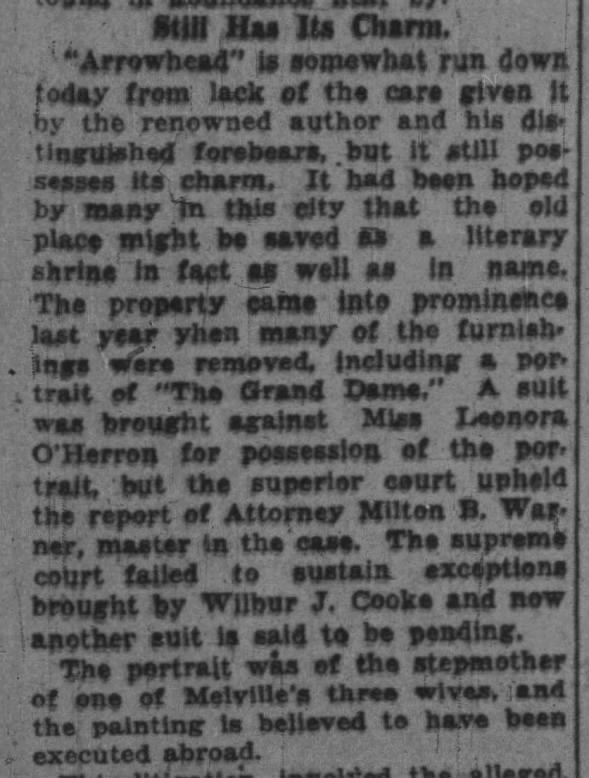 14 Jul 1927, Thu The Berkshire Eagle (Pittsfield, Massachusetts) Newspapers.com
Not counting Fayaway in Typee
 |
| Augustus Burnham Shute, Public domain, via Wikimedia Commons |
 |
| Ezra Ames, Public domain, via Wikimedia Commons |
Here's another more promising angle. Besides Herman's younger brother Allan, another Melville with multiple wives was their uncle Thomas Melvill, Jr. The first wife of Major Thomas Melvill Jr was "Fanny" Fleury aka Françoise Raymonde Eulogue Marie des Doulouers "Fanny" Lamé-Fleury. Aka Françoise Lamé-Fleury. Call her Fanny. Thomas Jr. and Fanny got married in 1802, in Paris. As avowed in writing by Charlotte Hoadley (Herman Melville's niece), the Melville family steadfastly regarded this Fanny as "an adopted daughter of Madame Recamier" and held "that she was married to Thomas Melville from Madame Recamier's salon.""believed to have been executed abroad."
 |
| Madame Récamier Antoine-Jean Gros, Public domain, via Wikimedia Commons |
<Madam Recamier by Gerard-costume of Consulate-bare feet and neck on a Roman chair in a niche beneath a pillared arch-Same by David represents her leaning back on a rustic seat>
In a footnote Sealts points out that Elizabeth Melville's entry on images of "Madam Recamier" has been canceled in pencil. The crossed-out listing could mean these items were sold or bequeathed after Herman Melville's death in 1891, as John Bryant guesses in the first volume of Herman Melville: A Half Known Life (Wiley-Blackwell, 2021). Not that either of these items is THE Grand Dame, necessarily. They seem to be prints, whereas contemporary newspaper accounts specifically describe The Grand Dame as an oil painting. Nevertheless, the references to well-known paintings by Gerard and David in Elizabeth Melville's memoranda certainly attest to her familiarity with popular images of Madame Récamier. And her husband's, presumably.
Because Supreme Court Justice Graham Witschief could find no evidence that gray-haired, dreamy-eyed Wilbur J. Cooke, alleged swindler and fugitive from Massachusetts' justice, is insane, he refused to grant appointment of a lunacy commission when application was made before him in a special term at Newburgh yesterday.Cooke, who was brought into court on a writ of habeus corpus, was remanded to the Goshen County jail until next Friday, when his attorney, Charles A. White, hopes to present evidence to warrant the appointment of a commission.Cooke has been a patient at Interpines Sanitarium in Goshen for a year, unknown to Massachusetts police, who have been on his trail. -- Newburgh, NY Beacon News, March 11, 1933; found on fultonhistory.com
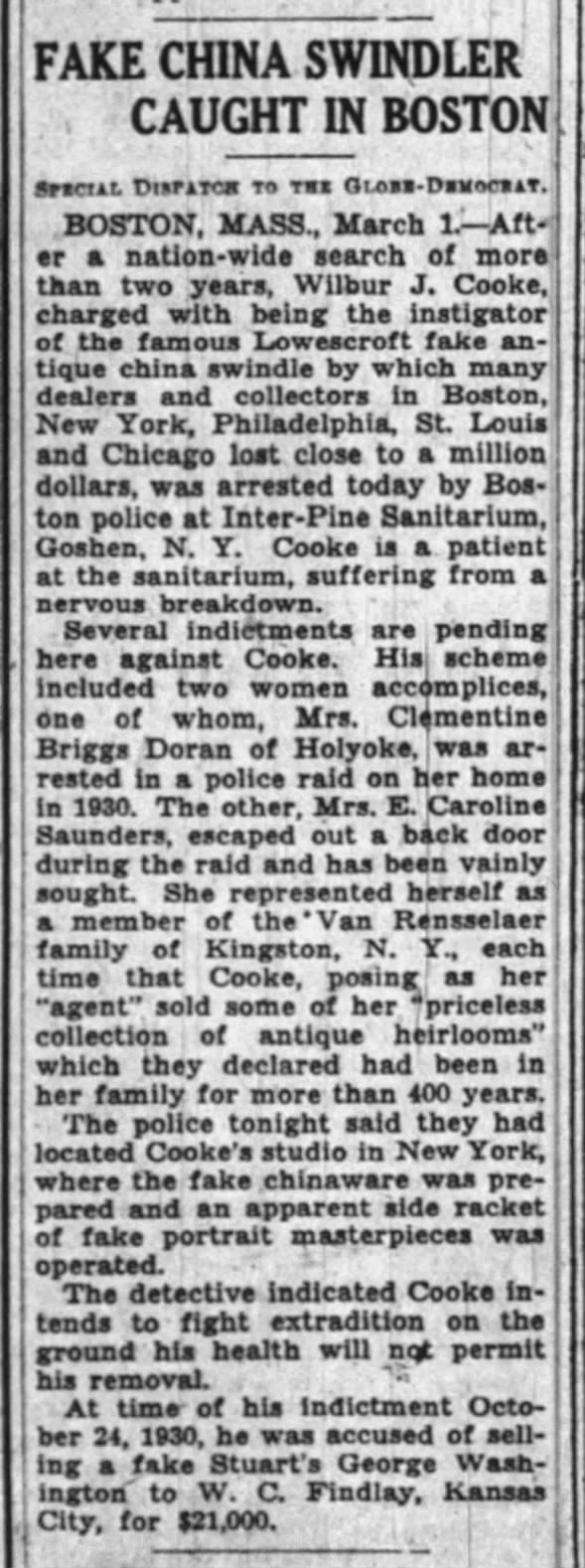
Incredible as it seems, Cooke managed to avoid criminal charges and extradition to Massachusetts.
GOSHEN -- Wilbur J. Cooke, arrested at Interpines here yesterday as a fugitive from justice at request of the Boston Police Department sat in a hospital cell in the county jail today attired in pajamas and a lounging robe and working a jig saw puzzle while all concerned awaited the next move....
... The prisoner has been talkative in jail and has seemed to prefer religion as a topic of conversation. Pajamas, a lounging robe, and slippers were brought to the jail by an attendant at the sanatorium. -- Middletown Times Herald, March 3, 1933.
In the last hour, literally, an influential sister, Emma Cooke Chase of Monticello, helped persuade a judge to find him insane after all. Wilbur Cooke's official medical diagnosis, made by two sanitarium doctors (Frederick W. Seward Jr. and Clarence A. Porter), was dementia praecox, premature or "precocious madness." Instead of enduring a trial and serious prison time for larceny, he got legally committed to the State Homeopathic Hospital at Middletown, New York.
In yet another twist, it turned out that Wilbur J. Cooke's second wife was a very wealthy lady.
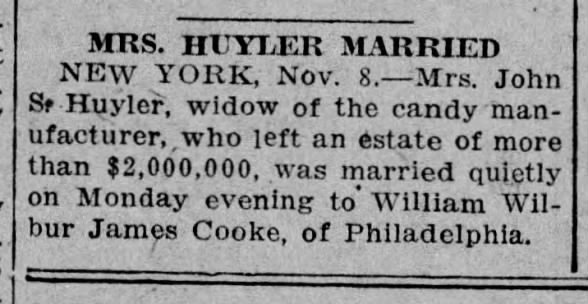
The second wife of William Wilbur James Cooke died in late November 1933. Mrs. Rosa F. Huyler Cooke willed her estate to husband Wilbur and two sons from her previous marriage to candy maker John S. Huyler. Years later, a New York jury awarded a portion of Wilbur's inheritance, $50,000 plus $20,000 interest, to Clinton I. Nash, one of the Boston art collectors whom Cooke had defrauded (Middletown Times Herald, April 9, 1937). Wilbur still resided at the State Hospital in Middletown.
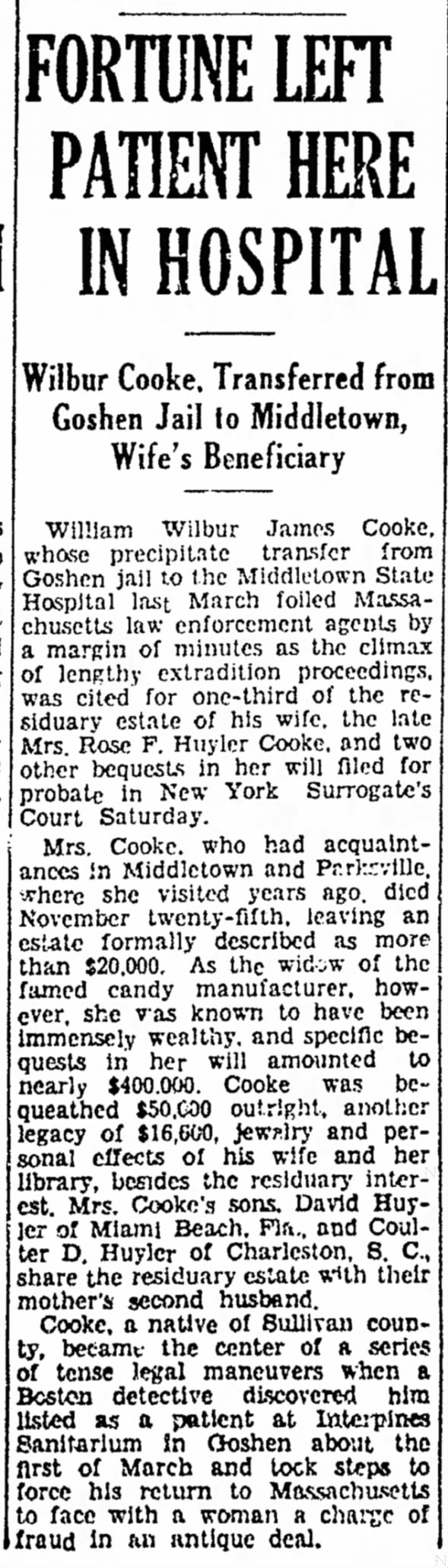
In case you're wondering, Cooke had married suspiciously well the first time around, too. Born in 1842, Jane F. Levick Jackson, daughter of Quaker diarist and abolitionist Samuel J. Levick, was actually 68 when she rather unexpectedly married young and good-looking William W. J. Cooke, then described as "an artist's model, big, broad-shouldered, and 25" (Washington Post, October 19, 1910; reprinting an article in the Philadelphia North American in which Cooke's bride was alleged to be 77 years old). Jane L. Jackson Cooke died four years later in 1914; and two years after that Cooke wedded the former Mrs. John S. Huyler.
Cooke is remembered in Pittsfield for his suit against Miss Leonora O'Herron, proprietor of an antique shop on South Street. In Miss O'Herron's absence, a portrait was sold, by mistake, to his agent by a volunteer assistant, Mrs. Leslie Frost Francis. She was unaware of the fact that the picture had been left by the owners who had refused offers of $500 for it.
The picture had belonged to the late Herman Melville, the author, and was owned by his heirs. Cooke's agents bought the picture for $50 and paid $5 down, getting a receipt but leaving the picture pending payment in full. When Miss O'Herron returned his deposit and refused to sell the picture, Cooke brought suit, the case being tried by attorney Milton B. Warner as master. Mrs. Doran was one of Cooke's witnesses at the trial. Cooke lost and appealed to the superior court, but the case was dropped before coming to trial.
The Morewood family in New York, owners of the picture, decided to keep it and still have it in their possession. -- Berkshire Evening Eagle, March 2, 1933
Who got the Morewoods' Grand Dame and where is she now?
Tuesday, December 21, 2021
Smoking and talking metaphysics
 |
| Dr. Theodore F. Wolfe Cabinet Photo, Co. H, 11th NJ Civil War via Ancestorville |
I'm posting it here now so I don't forget the bit about Hawthorne and Melville at Arrowhead in March 1851, "smoking and talking metaphysics in the barn." Nobody smokes anymore, obviously.
Farther away is a little farm-house, with a “huge, corpulent, old Harry VIII. of a chimney,” to which Hawthorne was a frequent visitor,—the “Arrow-Head” of Herman Melville. "Godfrey Graylock” says the friendship between Hawthorne and Melville originated in their taking refuge together, during an electric shower, in a narrow cleft of Monument Mountain. They had been coy of each other on account of Melville's review of the “Scarlet Letter” in Duyckinck's Literary World, but during some hours of enforced intercourse and propinquity in very contracted quarters they discovered in each other a correlation of thought and feeling which made them fast friends for life. Thereafter Melville was often at the little red house, where the children knew him as “Mr. Omoo,” and less often Hawthorne came to chat with the racy romancer and philosopher by the great chimney.
Once he was accompanied by little Una—“Onion” he sometimes called her—and remained a whole week. This visit—certainly unique in the life of the shy Hawthorne—was the topic when, not so long agone, we last looked upon the living face of Melville in his city home. March weather prevented walks abroad, so the pair spent most of the week in smoking and talking metaphysics in the barn,—Hawthorne usually lounging upon a carpenter's bench. When he was leaving, he jocosely declared he would write a report of their psychological discussions for publication in a volume to be called “A Week on a Work-Bench in a Barn,” the title being a travesty upon that of Thoreau's then recent book, “A Week on Concord River,” etc.
Sitting upon the north piazza, of “Piazza Tales,” at Arrow-Head, where Hawthorne and his friend lingered in summer days, we look away to Graylock and enjoy "the calm prospect of things from a fair piazza” which Melville so whimsically describes. At Arrow-Head, too, we find the astonishing chimney which suggested the essay, still occupying the centre of the house and leaving only the odd holes and corners" to Melville's nieces, who now inhabit the place in summer; the study where Hawthorne and Melville discussed the plot of the “White Whale” and other tales; the great fireplace, with its inscriptions from “I and my Chimney;” the window-view of Melville's “ October Mountain,”—beloved of Longfellow,—whose autumn glories inspired that superb word-picture and metaphysical sketch.
-- Theodore F. Wolfe, Literary Shrines: The Haunts of Some Famous American Authors (Philadelphia: J. B. Lippincott, 1895) pages 191-192.
Thursday, July 22, 2021
Definitely Destiny
Progress report... Today I received from the incomparable NYPL images of John C. Hoadley's manuscript poem "Destiny" in the
Gansevoort-Lansing Collection. Manuscripts and Archives Division. The New York Public Library. Astor, Lenox and Tilden Foundation.
Fortunately the handwriting is crystal clear and will be much easier to transcribe than Hoadley's honeymoon letter from Niagara Falls to Augusta Melville. Hoadley failed to get it published, but not for lack of neatness. Length, verse form, and content all match Evert Duyckinck's description of the patriotic poem that Herman Melville read aloud, with gusto, in August 1851.
- "stout" in manuscript indicating many hundreds of lines? Check, 648 lines of verse.
- composed in heroic measure, meaning "sounding lines" of mostly iambic pentameter? Check. In rhymed couplets, as guessed on Melvilliana.
- glorification of the United States with polite slanging at other countries? Check and check!
Hmmm. Only a sentence but I will ask for permission before giving it. Stay tuned!
Related posts
- Destiny: a poem by John C Hoadley 648 lines plus endnotes, transcribed here
https://melvilliana.blogspot.com/2021/07/destiny-poem-by-john-c-hoadley.html
- Hoadley's national poem cheered by Melville
https://melvilliana.blogspot.com/2021/07/hoadleys-national-poem-cheered-by.html
- Refresher on heroic measure
https://melvilliana.blogspot.com/2021/07/refresher-on-heroic-measure.html
- Why it can't be On Onota's Golden Shore
https://melvilliana.blogspot.com/2024/05/why-on-onotas-graceful-shore-cant-be.html
- Examples of polite slanging
https://melvilliana.blogspot.com/2024/05/examples-of-polite-slanging-in-hoadleys.html
Wednesday, April 14, 2021
Bay Area Black Quake
 |
| San Francisco Chronicle - September 6, 1972 via Genealogy Bank |
“The underlying theme of the poetry presented was strongly anti-white and expressive of black rebellion.”
And Gordon Parks, director of Shaft, got heckled at the film festival by militants from Los Angeles (William Zakariasen, "Militants Shout Down Gordon Parks," S.F. Examiner, 11 September 1972). In such "polarized times," business and organization exhibits demonstrated wonderful diversity:
There’s a Marine booth AND a Black Muslim booth (selling bean pies) AND a Bank of America booth AND a booth where they sell coloring books aimed at black children.
-- San Francisco Chronicle, 10 September 1972.
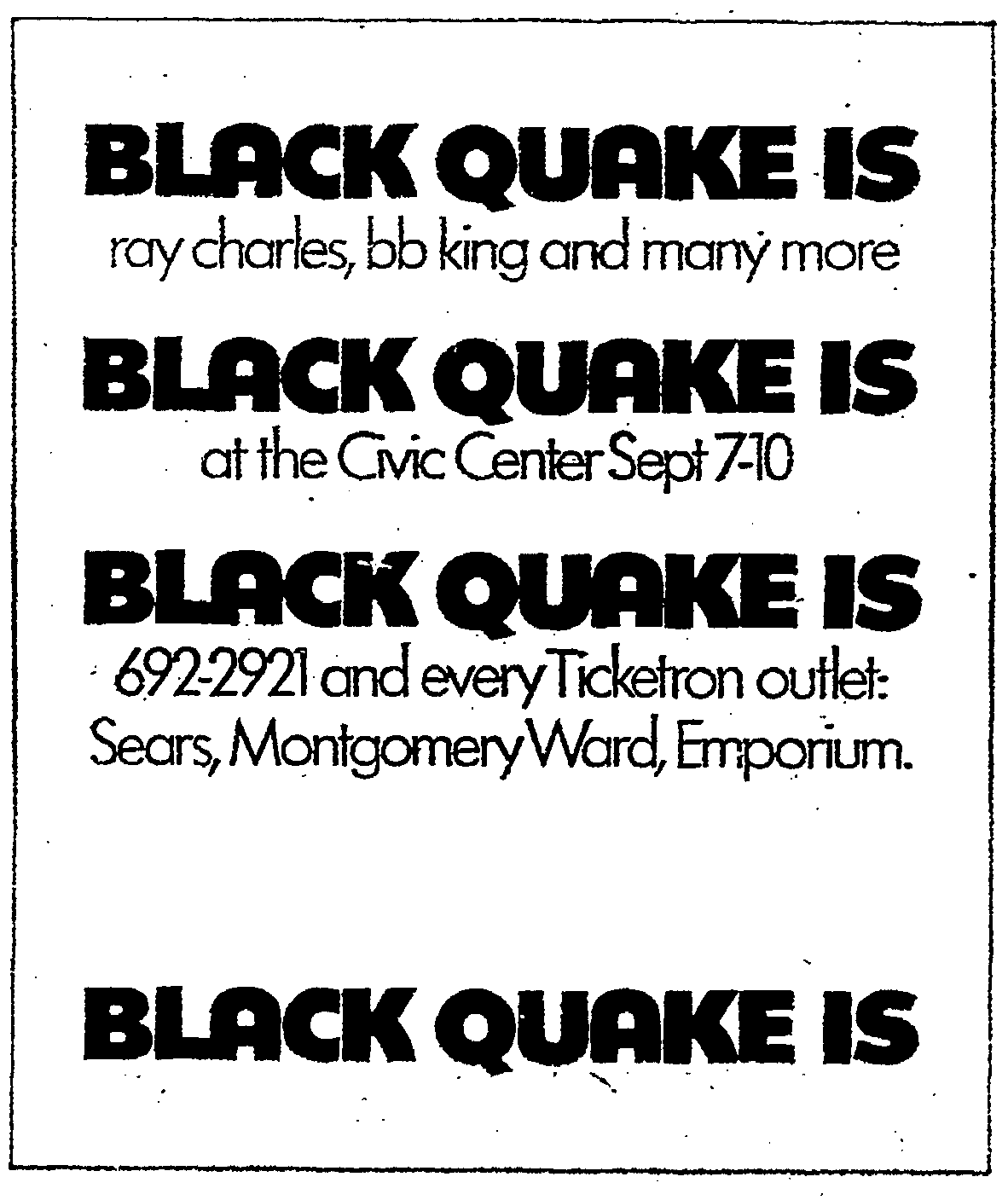
Black Quake returned the next year when headliners included Buddy Miles, Barry White, and Richard Pryor. Founder Ray Taliaferro called the 1973 event "An infusion of positivism for the whole Bay Area" (Chronicle, 2 November 1973). But attendance in the second year was disappointing, especially for a jazz program featuring Donald Byrd that "should have sold out the Civic" (Examiner, 10 November 1973).
Perhaps misreading Augusta Melville's handwriting, Hershel Parker in Herman Melville: A Biography Volume 1 gave the name Black Quake to Sarah Morewood's unfortunate horse--that "fine young colt" injured in a railway accident, as Herman Melville reported from Arrowhead farm in a December 1850 letter to Evert Duyckinck. It's not really a name you would give a horse back then, if ever. More likely, as suggested previously on Melvilliana, the colt's name was "Black Snake." There's a real horse's name!
 |
Greenleaf's New York Journal and Patriotic Register - March 21, 1795 via Genealogy Bank |
Looking further into this interesting and influential misnomer, I see both of the Bay Area Black Quakes happened when Hershel Parker was Professor of English at USC, 1970-1979. I'm guessing Parker would have been way too busy prepping for fall classes to travel so far north. The sacrifices of tenured college professors--who can tell? I mean, think of missing Ray Charles, B. B. King, Sonny Rollins, Bobby Womack and all at the '72 Black Quake. And yet, I can't help wondering if a tremor or two from that glorious California expo snuck into Parker's later transcription "Black Quake" from Augusta Melville's letter of December 21, 1850 to her and Herman's sister Helen. The letter in question is part of the Augusta Melville papers, only discovered in 1983 and now accessible online courtesy of The New York Public Library Digital Collections.
Manuscripts and Archives Division, The New York Public Library. "Letters sent, notebooks and keepsakes" The New York Public Library Digital Collections. 1841 - 1854. https://digitalcollections.nypl.org/items/752fe150-5889-0136-238d-3dcc24fb54fc
In Melville in Love (HarperCollins, 2016) Michael Shelden took Parker's re-christening for gospel and ran with it. Shelden painted Black Quake as "a rambunctious horse with a name that suggested the thudding force of its galloping speed." A missed opportunity there, if the horse's true name could somehow have been implicated in the romance of Melville's involvement with his vivacious neighbor.
 |
| Missiskoui Standard [Frelighsburg, Québec, Canada] - March 21, 1837 |
Through the magic of YouTube, here's The Genius Ray Charles in Copenhagen only a month after the first Bay Area Black Quake. (A commenter has corrected the Denmark concert date to October 10, 1972.)
Related posts
- Black Snake not Quake
https://melvilliana.blogspot.com/2020/04/black-snake.html
- George Doolittle and Doolittle's Express
https://melvilliana.blogspot.com/2020/04/george-doolittle-and-doolittles-express.html
Friday, April 3, 2020
Black Snake not Quake
 |
Greenleaf's New York Journal and Patriotic Register - March 21, 1795 via Genealogy Bank |
Black Quake? or Black Snake?
Below is a detail from the letter of December 21, 1850 that Augusta wrote to Helen, now digitized and accessible online courtesy of The New York Public Library Digital Collections. Does other evidence exist for the name Black Quake? Here it looks to me like Black Snake. And farriers (that is, more than one horse doctor) not farmers.

Poor "Black Snake" is dead. -- All the farriers could not save him. What will Mrs Morewood say.Enlarged:

Citation:
Manuscripts and Archives Division, The New York Public Library. "Letters sent, notebooks and keepsakes" The New York Public Library Digital Collections. 1841 - 1854. http://digitalcollections.nypl.org/items/752fe150-5889-0136-238d-3dcc24fb54fcThe second letter seems formed like the "n" in "not." The first letter looks close enough to Augusta's uppercase letter "S" elsewhere, for example in "Says Sophia"

<https://digitalcollections.nypl.org/items/76289b60-5889-0136-f362-3554d5606ebf>and "Sam Savage."

<https://digitalcollections.nypl.org/items/77799750-5889-0136-d69f-5d9c6b561b38>Was another horse (anywhere) ever named Black Quake? Horses named Black Snake may be found with circus animals, celebrated running horses, and registered Morgans. Barnum's Menagerie and Circus had a "black horse" named "Black Snake," one of a hundred and twenty horses sold at auction in 1854.
 Mon, Oct 30, 1854 – Page 2 · Pittsburgh Daily Post (Pittsburgh, Pennsylvania) · Newspapers.com
Another black horse named "Black Snake" was a "Celebrated American Running Horse" = C. A. R. H., listed thus in the American Race-turf Register:
BLACK SNAKE,
C. R. H. A high formed black horse, bred by Hugh Snelling, (a colored man,) residing in Granville County, State of N. C. foaled about the year 1788 —
Got by the I. H. Obscurity, his dam the running mare Harlot, by the R. H. Old Bacchus —
As noted under "Addenda and Errata" at the end of the 1833 volume of the American Race-Turf Register quoted above:
"Page 116, pedigree of the C.A.R.H. Black Snake, the capital letter A should be inserted before the R. as above...."
Elsewhere "Black Snake" and son "Van Antwerp's Black Snake" are listed in The Morgan Horse and Register with Descendants of Sherman Morgan.
In the absence of evidence that any horse anywhere was ever called "Black Quake," I'm calling Sarah Morewood's unfortunate horse by his real name, Black Snake.
 |
| Missiskoui Standard [Frelighsburg, Québec, Canada] - March 21, 1837 |
Related posts
- George Doolittle and Doolittle's Express
https://melvilliana.blogspot.com/2020/04/george-doolittle-and-doolittles-express.html
- Bay Area Black Quake
https://melvilliana.blogspot.com/2021/04/bay-area-black-quake.html
Thursday, April 2, 2020
George Doolittle and Doolittle's Express
"And some relatives have been left total mysteries--for example, cousin Doolittle, the Lenox expressman." --Jay Leyda, "The Endless Study." Postscript to The Melville Log (New York: Harcourt, Brace and Company, 1951) Volume 2, page 859.Leyda seems to mean the "Mr. Doolittle" that Herman Melville called "my cousin" and implicated in the sad accident that injured one of Sarah Morewood's horses. Where Leyda got the phrase "Lenox expressman" is not clear to me, but the tag would certainly apply to George Doolittle, resident of Lee in Berkshire County, Massachusetts and owner-operator in 1850 of "Doolittle's Express."
 |
| Pittsfield Culturist and Gazette - June 12, 1850 via GenealogyBank |
Doolittle's Express.
LEE via. Lenox to Pittsfield: every day Sundays excepted, in season for the trains of cars and Express Lines. All orders and errands entrusted to my care will receive prompt attention, with moderate charges.
GEORGE DOOLITTLE.
Lee, Feb. 1850.The reference to "cousin" Doolittle occurs in Melville's chatty letter of December 13, 1850 to Evert Duyckinck. The Melville Log partly transcribes this letter in Volume 1 on page 401 but omits the relevant passage about Doolittle and Mrs. Morewood's horses. As Melville relates, this "Mr. Doolittle" was on the railroad track in his sleigh and just missed colliding with an oncoming train. The train hit three horses belonging to Melville's then absent neighbor, Sarah Morewood. One of the three eventually died after suffering a broken leg in the accident. Melville's letter is reprinted on pages 172-175 in the 1993 Northwestern-Newberry Edition of Melville's Correspondence, edited by Lynn Horth. The same 1850 letter is accessible online via the Internet Archive in The Letters of Herman Melville, edited by Merrell R. Davis and William H. Gilman (Yale University Press, 1960) pages 115-118. Here is an image from the original document, now accessible courtesy of the New York Public Library Digital Collections:
 |
| Manuscripts and Archives Division, The New York Public Library. "1850-1851" The New York Public Library Digital Collections 1850-1851. http://digitalcollections.nypl.org/items/ae98a990-1793-0133-e826-58d385a7bbd0 |
... one of my neighbors has really met with a bad accident in the loss of a fine young colt. That neighbor is our friend Mrs Morewood. Mr Doolittle — my cousin — was crossing the R.R. track yesterday (where it runs thro the wooded part of the farm.) in his slay — sleigh I mean — and was followed by all three of Mrs Morewood’s horses (they running at large for the sake of the air & exercise). Well: just as Doolittle got on the track with his vehicle, along comes the Locomotive — whereupon Doolittle whips up like mad & steers clear; but the frightened horses following him, they scamper off full before the engine, which hitting them right & left, tumbles one into a ditch, pitches another into a snow-bank, & chases the luckless third so hard as to come into direct contact with him, & break his leg clean into two peices. — With his leg “in splints” that is done up by the surgeon, the poor colt now lies in his straw, & the prayers of all good Christians are earnestly solicited in his behalf. Certainly, considering the bounding spirit and full- blooded life in that colt— how it might for many a summer have sported in pastures of red clover & gone cantering merrily along the "Gulf Road” with a sprightly Mrs Morewood on his back, patting his neck & lovingly talking to him — considering all this, I say, I really think that a broken leg for him is not one jot less bad than it would be for me — tho’ I grant you, even as it is with him, he has one more leg than I have now.Davis and Gilman were unable to identify Doolittle beyond the surname:
In what way Mr. Doolittle of the following story was Melville's cousin remains a mystery, upon which neither genealogies, local histories, nor family reminiscences have yet thrown any light.
<https://archive.org/details/in.ernet.dli.2015.84865/page/n155/mode/2up>The Northwestern-Newberry Edition of Melville's Correspondence credits Hershel Parker with the identification of "Doolittle" as Robert Melvill. This explanation of "Doolittle" as a joking code-name for Herman's "hapless cousin" Robert previously appeared in Parker's article,"Moby-Dick and Domesticity," in Critical Essays on Herman Melville's Moby-Dick, ed. Brian Higgins and Hershel Parker (New York: G.K. Hall and Co., 1992) pages 545-562 at page 552. So identified in both volumes of Herman Melville: A Biography Volume 1, 1819-1851 page 798; and Volume 2, 1851-1891 page 626.
<https://books.google.com/books?id=OrTOQR4QyKIC&pg=PA798&lpg#v=onepage&q&f=false>
It would be good to learn the exact source of Jay Leyda's information about a "Lenox expressman" linked to "cousin Doolittle." Was it one of the 1850 ads in the Pittsfield Culturist and Gazette, shown and transcribed above?
No information has turned up yet about this George Doolittle's parents. Census and other records on Ancestry.com indicate that George Doolittle (1808-1894) lived most of his life in Berkshire County, Massachusetts. He was born in 1808 in Hancock; and died in Lee at the age of 86.
 |
| Pittsfield Sun - October 13, 1831 |
George but not Electra Doolittle lived to enjoy the birth of Rolfe, their second grandson, on June 2, 1876. The next day, G. P. Putnam's Sons published Herman Melville's epic religious poem, Clarel: A Poem and Pilgrimage in the Holy Land. In Clarel, coincidentally, the most Melville-like pilgrim of all was named Rolfe.
Like his grandfather George, Rolfe Doolittle (1876-1940) found employment in Lee as an Expressman.
 Thu, Feb 11, 1909 – 11 · The Berkshire Eagle (Pittsfield, Massachusetts) · Newspapers.com
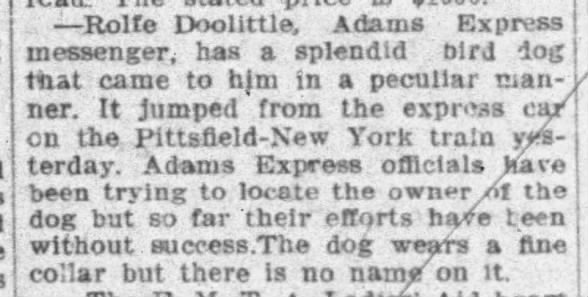
— Rolfe Doolittle, Adams Express messenger, has a splendid bird dog that came to him in a peculiar manner. It jumped from the express car on the Pittsfield-New York train yesterday. Adams Express officials have been trying to locate the owner of the dog but so far their efforts have been without success. The dog wears a fine collar but there is no name on it. --The Berkshire Eagle, February 11, 1909.
Related posts
- Black Snake not Quake
https://melvilliana.blogspot.com/2020/04/black-snake.html
- Bay Area Black Quake
https://melvilliana.blogspot.com/2021/04/bay-area-black-quake.html
- Robert Melville obits
https://melvilliana.blogspot.com/2020/07/robert-melville-obits.html
- Doolittle the Lenox expressman
https://melvilliana.blogspot.com/2024/04/doolittle-lenox-expressman-in-leydas.html
Friday, August 2, 2019
Friend of Bessie remembers Herman Melville, his "dignified" figure and "wonderful library"
 |
| William Lyon Phelps via NYPL Digital Collections |
Books to the right of you, books to the left of you, books all above you....The June 1929 issue of Scribner's Magazine with the second installment of Hemingway's "A Farewell to Arms" also contains a rare reminiscence of Herman Melville, attributed to an unnamed, presumably female friend of Melville's daughter Elizabeth "Bessie" Melville (1853-1908). The "personal recollection" by Bessie Melville's "most intimate friend" was provided, apparently in writing, to Yale professor of English William Lyon Phelps who quoted it in his monthly column, "As I Like It":
Happening to mention the name of Herman Melville in a lecture in Brooklyn, a member of the audience gave me this personal recollection, which seems to me of general interest.
The mention of his name revived memories. His daughter, Elizabeth Melville, was my most intimate friend during my school days and until her death, several years ago, I was a frequent guest in the home. Although a little in awe of his dignified presence, I found him always kindly and most cordial. Bessie so often referred to their ancestral home at Pittsfield, Mass., where the children were born. The home "Arrow Head" is still in possession of some of the family, I think the daughter of Capt. Thomas Melville, who was a well-known Captain, living at Governor's Island, or at Staten Island, in the early seventies. I visited "Arrow Head" a few summers ago and saw with deep interest Herman Melville's library, and his old desk, with books everywhere. His city home, then in 26th St., near Fourth Ave., contained a wonderful library, at which I gazed with wonder and respect. Books to the right of you, books to the left of you, books all above you, and on the long table. I can see him now, in memory's picture, sitting in his big arm chair, a fine specimen of manhood. He was quite a well-known figure on the avenue, as he walked to and fro from business, cane in hand, withal tall, stately, and dignified. My father who admired Mr. Melville greatly, often spoke of "Omoo," and "Moby Dick." At that time Mr. Melville's books were appreciated in England-- "A prophet is not without honor."
His contemporaries, extending over some years, Hawthorne, Holmes, Longfellow, Emerson, Thoreau, Alcott, were often topics of conversation in his home to which I enjoyed listening, for in our studies at school we were studying the same in literature.
--Scribner's Magazine Vol. 85 No. 6 (June 1929), page 711.On April 28, 1929, Phelps lectured for the Brooklyn Institute on "Contemporary Books Worth Reading," including the new biography of Herman Melville by Lewis Mumford. Possibly the friend of Elizabeth "Bessie" Melville heard Professor Phelps and his mention of Melville then.
<https://archive.org/details/scribnersmag85editmiss/page/710>
 |
| Letter to "Aunt Augusta" from "Bessie" Melville, May 26, 1862. Page 2. Manuscripts and Archives Division, The New York Public Library The New York Public Library Digital Collections, 1862 - 1863. http://digitalcollections.nypl.org/items/518e2520-4711-0136-c2ba-4f36b4d67c3e |
 |
| New York Evening Post - November 12, 1906 via Fulton History |
The family of the late Herman Melville, author of "Typee," "Moby Dick," etc., are collecting materials for a memoir and would be grateful if any persons having letters by him would lend them to Miss Elizabeth Melville, "The Florence," Fourth Avenue and Eighteenth Street, New York. Such letters will be carefully kept and promptly copied and returned.and the Springfield Republican on November 19, 1906:
Herman Melville, the original of all romancers of the South seas,--none of whom, Loti, Stevenson, Becke, each in his several fashion, have equaled him,--is to have a biography at last. He was emphatically a man; and his writings are of a merit so extraordinary that it seems amazing that little stories, without a bit of life or character in them, can be sold by hundred thousand, while "Typee," "Omoo" and the great "Moby Dick" are passed by when some editor and publisher undertakes to present them once more to the public. Any one who has material in the shape of letters or reminiscences is asked to lend the letters or write out the reminiscences, for Miss Elizabeth Melville, the Florence, Fourth avenue and Eighteenth street, New York city.Also The Dial, December 16, 1906, reported by George Monteiro in "Herman Melville: Fugitive References (1845-1922)," Resources for American Literary Study Vol. 33 (2008; AMS Press, 2010), pages 19-93 at 77;
the New York Herald on December 8, 1906; and the Boston Herald on December 22, 1906:
 |
| "Week-End Book Notes" - Boston Herald - December 22, 1906 via GenealogyBank |
"Elizabeth Melville, the daughter of Herman Melville, is preparing a biography of her father, and asks for the use of letters and reminiscences. As the friend of Hawthorne, and the best of the South sea romancers, Melville deserves such a memorial as his daughter contemplates."Elizabeth "Bessie" Melville died on May 26, 1908. In the 1929 text presented by Phelps, her friend's expression "cane in hand" verbally echoes the longer reminiscence by Melville's granddaughter Eleanor Melville Metcalf, as quoted by Raymond Weaver in Herman Melville, Mariner and Mystic.
Arrowhead remained in the family of Herman's brother Allan Melville (not Tom, Third Governor of Sailors' Snug Harbor) until 1927. Allan's surviving daughters Mrs. Maria G. Morewood and Katherine G. Melville sold the home to paper company executive Robert E. Kimball. Bessie's friend associated Arrowhead with the wrong younger brother. But she was evidently right about the books of his there (as well as that "wonderful library" in Melville's home on E. 26th Street in New York City). The change of ownership in the summer of 1927 occasioned an estate sale at Arrowhead that offered books purportedly from the library of Herman Melville.
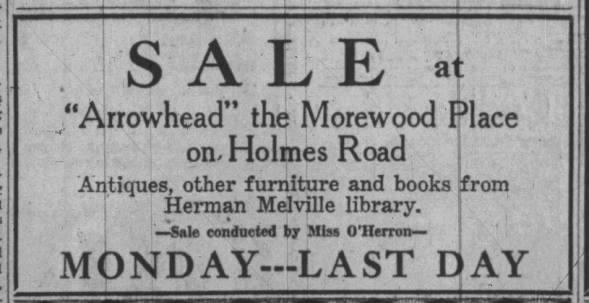
Also as advertised in the Berkshire Eagle, the last day of the sale took place on Monday, August 1, 1927. Coincidentally, Herman Melville's 108th birthday.Antiques
other household furniture, glass, china, and books from Herman Melville library, now being sold at "Arrowhead," the Morewood place on Holmes road. (1/4 mile below Miss Hall's school). Sale to continue Saturday and Monday.
 Sat, Jul 30, 1927 – 5 · The Berkshire Eagle (Pittsfield, Massachusetts) · Newspapers.com
SALE at
"Arrowhead" the Morewood Placeon Holmes Road
Antiques, other furniture and books fromHerman Melville library.
--Sale conducted by Miss O'Herron--
MONDAY --- LAST DAY