Showing posts with label Omoo. Show all posts

Wednesday, January 15, 2025

MOBY-DICK and other books by Herman Melville reviewed in the Charleston SOUTHERN CHRISTIAN ADVOCATE

Rev. W.M. Wightman D.D.
Ed. of the Southern Christian Advocate

Found just this morning in the ginormous newspaper archives on genealogybank.com among articles added within 1 month, assorted Melville mentions including this previously uncollected notice of Moby-Dick; Or the Whale in the Charleston, SC Southern Christian Advocate for December 12, 1851. Edited in 1840-1854 by William May Wightman, the Southern Christian Advocate was published in Charleston, South Carolina by designated clergy on behalf of the Methodist Episcopal Church, South

The notice of Moby-Dick in the Southern Christian Advocate of December 12, 1851 offers three sentences of admirably balanced and original commentary, followed by a paragraph copied (with a few omissions) from the favorable review by George Ripley in Harper's New Monthly Magazine Volume 4 (December 1851) page 137.

Southern Christian Advocate - December 12, 1851
via genealogybank.com

RECENT PUBLICATIONS. 

MOBY-DICK; Or the Whale. By Herman Melville, Author of Typee, etc. New York: Harper & Brothers, 1851. 

This last book of Melville's is a curiosity. At times playful as a kitten, then solemn as a preacher; now a touch of transcendental philosophy, then a dash of bold, thrilling narrative; by turns picturesque, poetical, sportive, and stern in the iron grip of deep reflection;--this sea-story seems to puzzle the critics. Some pronounce it a failure, others consider it the most successful of the author's productions. We copy a paragraph from the notice given in Harper's Magazine:--In the course of the narrative the habits of the whale are fully and ably described. Frequent graphic and instructive sketches of the fishery, of sea-life in a whaling vessel, and of the manners and customs of strange nations are interspersed with excellent effect among the thrilling scenes of the story. The various processes of procuring oil are explained with the minute, painstaking fidelity of a statistical record, contrasting strangely with the weird, phantom-like character of the plot, and of some of the leading personages who present a no less unearthly appearance than the witches in Macbeth. These sudden and decided transitions form a striking feature of the volume. To a less gifted author, they would inevitably have proved fatal. He has not only deftly avoided their dangers, but made them an element of great power. --For sale by J. W. Stoy, Agent.

Where the review in Harper's magazine printed "with excellent artistic effect" the Southern Christian Advocate has "with excellent effect," omitting the word artistic. Also omitted, one sentence that came before the last one quoted in the Charleston notice: "Difficult of management in the highest degree, they are wrought with consummate skill." One result of these particular omissions could be to slight or subtly undermine the original emphasis on Melville's craftsmanship as a writer. On the other hand, the point may have been regarded as redundant and the omitted words cut mainly to save space. 

As a "bold, thrilling narrative" Melville's book evidently made a lasting impression on the editor, Rev. W. M. Wightman. In June of the following year, the Charleston Southern Christian Advocate reprinted the popular excerpt from Moby-Dick Chapter 61: Stubb Kills a Whale under the heading, "THE DEATH OF A WHALE." Correctly attributed at the end of the excerpt, in italics, to "— Herman Melville." 

Charleston, SC Southern Christian Advocate
June 11, 1852
Of the 20+ newspaper excerpts from chapter 61 that we know about, only this one in the Charleston, SC Southern Christian Advocate printed "...grinning furies" where the English and American first editions both had Stubb saying, "...grinning devils." In imagination, you could join the chase with Stubb and Tashtego, and even witness the horrible slaughter of the whale at the end of it, but you would not be exposed in the Southern Christian Advocate to the word devils as Melville used it in Stubb's exhortation to the crew of his whaleboat--too close to swearing, apparently. This was, after all, an official publication of the Methodist Episcopal Church, South. Still, although this version loses the alliteration between death and devils, grinning furies will do.

Early in September 1852, the Southern Christian Advocate weighed Melville's next book after Moby-Dick and found it wanting. 

Charleston, SC Southern Christian Advocate
September 3, 1852
PIERRE: Or the Ambiguities. By Herman Melville. New York: Harper & Brothers. 1852.

Whatever else may be ambiguous, it is clear enough that every reader of this last book of Mr. Melville, will vote it perfect trash

Previously on Wightman's watch, Melville had received much friendlier mentions in the Charleston Southern Christian Advocate, including mostly positive notices of Omoo on May 28, 1847; and White-Jacket on April 12, 1850.

***
OMOO: A narrative of adventures in the South Seas. By Herman Melville, Author of "Typee." Complete in two parts. New York: Harper & Brothers. 1847. 

This work is the production of no ordinary mind. The narrative is as deeply interesting as the style is brilliant. We are sorry the author gives so unfavourable an account upon the whole, of the South Sea Island missions. Yet there is a tone of exaggeration, an air of romance pervading the book, which induces the reader to take, with many grains of allowance, what is said respecting missionary operations. The author's account of Tahiti, and of Queen Pomaree, possesses singular interest. His sea-scenes are sketched with the precision and force of Cooper, and an Irving-like charm pervades his descriptions of Island life. For sale by J. W. Stoy, 50cts. a volume

-- Charleston, SC Southern Christian Advocate for May 28, 1847.

*** 

Charleston, SC Southern Christian Advocate 
April 12, 1850 via genealogybank.com
WHITE-JACKET: Or the world in a Man-of-War. By Herman Melville, Author of Typee, etc. New York: Harper & Brothers. 1850.

Mr. Melville is getting to be a voluminous writer. In this work he gives us his man-of-war experiences and observations during a year's service on board of a United States frigate as an ordinary seaman. Life in the naval service was never more graphically drawn; nor ever, we may add, has the romance been more completely cut out of the thing. Talk of slavery! the articles of war will tell you what it is:--of despotism! and "Capt. Claret" is its personification. Distant seems the day when nations shall have no use for the war-ship. Heaven speed the time:--but really the work of the world's conversion to the peaceable principles and spirit of the gospel, appears to be hardly begun.

-- Charleston Southern Christian Advocate for April 12, 1850. 

As best I can tell, the four book notices identified herein (of Omoo, White-Jacket, Moby-Dick, and Pierre) are all new finds; none is collected in Herman Melville: The Contemporary Reviews, edited by Brian Higgins and Hershel Parker (Cambridge University Press, 1995; paperback 2009). Now I have to add the Southern Christian Advocate notice to the inventory of Moby-Dick reviews in 1851-1852. Favorable or Mixed? The choice to quote from the laudatory Harper's review accentuates the positive, for sure. However, Rev. Wightman's notice begins with such an explicit recognition of dramatically different critical responses, it practically begs to be counted with the honorable undecideds. 

So be it! 👍👎

Related post

Wednesday, January 24, 2024

Melville's "Athenian admirer" quoted in Cincinnati


On the day of Herman Melville's lecture on "Statues in Rome" (Tuesday, February 2, 1858) the Cincinnati Daily Commercial promoted it with a column mostly devoted to effusive praise for Melville's books, including Moby-Dick, by an unidentified "Athenian admirer." By "Athenian" I take the Cincinnati editor to mean a fellow newspaper editor, journalist, or correspondent from Athens, Ohio. The article was excerpted by Jay Leyda in The Melville Log, Volume 2, leaving out some good parts about Fayaway, Omoo, and Mardi. Found on NewspaperArchive and transcribed in full below, the original event teaser as it appeared in the Cincinnati Daily Commercial on February 2, 1858: 

Cincinnati Daily Commercial
February 2, 1858

"STATUES IN ROME." -- Herman Melville, "who," said an enthusiastic Athenian admirer of his beautiful writings-- "entranced the American public by the freshness and mellow style of his South Sea adventures in the coral islanded world; who made the name of Fayaway a synonyme for native grace; who roamed and sailed and laughed with Doctor Long Ghost of Omoo memory; who drew his moonlit, mystic picture of Mardi, through which as through a mist-like atmosphere float the forms of Yillah, the shadowy maiden, Yoomy the equally shadowy poet, Babbalanja the dreaming philosopher with his flexible cloud-wreath pipe, 'and others more'--very nomines umbra--shadows of a shade; who dazed us still more with the white gleam of Moby Dick, through whose five hundred weird pages 'all thoughts, all passions, feelings and delights,' chase each other 'like shadows o'er the plain'--and in whom we have the wildest and strangest mysticism, mingled with the frankest and freshest common sense and practical knowledge of the world and its ways, and the truest, most genuine American Democratic feeling"--will appear to-night before a Cincinnati audience to discourse in the lectorium (Smith & Nixon's Hall,) of the Young Men's Mercantile Library Association upon the Statuary of Rome. Mr. Melville's lectures are said to be admirably written, but none of our exchanges discourse upon the style of his delivery. If he would avoid the objection usually urged against our lecturers, he will speak distinctly, and with animation, that all may hear. The public is extremely desirous to see and hear Mr. Melville, and anticipate a rich literary repast this evening. 

https://newspaperarchive.com/cincinnati-daily-commercial-feb-02-1858-p-2/

In commending Moby-Dick the Athenian quotes from the opening stanza of Love by Samuel Taylor Coleridge, alternatively titled Love; or, Genevieve

All thoughts, all passions, all delights,
Whatever stirs this mortal frame,
All are but ministers of Love,
And feed his sacred flame.

and Psalm 39 Part 2 as given in a popular hymn by Isaac Watts: 

See the vain race of mortals move
Like shadows o'er the plain,
They rage and strive, desire and love,
But all their noise is vain. -- Psalms and Hymns of Dr. Watts

Tuesday, January 18, 2022

IYKYK OMOO

© Jérémie Silvestro / Wikimedia Commons
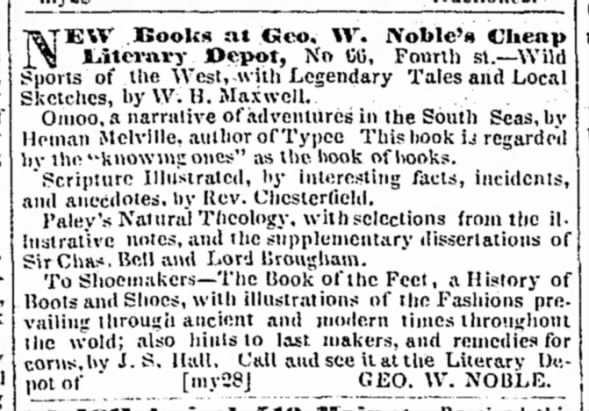
Advertised in the Louisville Morning Courier, May 29, 1847:

NEW Books at Geo. W. Noble's Cheap Literary Depot, No 66, Fourth st.

"... Omoo, a narrative of adventures in the South Seas, by Herman Melville, author of Typee. This book is regarded by the "knowing ones" as the book of books."
29 May 1847, Sat The Louisville Daily Courier (Louisville, Kentucky) Newspapers.com
In 1849, the same Louisville bookseller would tout Melville's Mardi and a voyage thither as the Greatest work of the age.


Sunday, January 16, 2022

Sunday Dispatch, super friendly notices of TYPEE and OMOO

Highly favorable, previously unrecorded notices of Herman Melville's first two books appeared in the New York Sunday Dispatch, a weekly newspaper founded late in 1845 by Amor J. Williamson (1823–1867) and William Burns (1818–1850). As noted over at The Walt Whitman Archive, the Sunday Dispatch "published human-interest stories, serials, fiction, poetry, reviews of books and the theater, as well as local and national news items." Certain items transcribed herein reflect a closer than usual personal connection to the author of Typee: A Peep at Polynesian Life and Omoo: A Narrative of Adventures in the South Seas. For instance, the reviewer of Omoo on March 27, 1847 claims to have read both Typee and Omoo in advance of their publication. 

Insider knowledge is evidenced also by commentary in the Dispatch of May 23, 1847 on the first number of the weekly American Literary Gazette and New York Evening Mirror. Early advertisements for the "weekly reflex of news, art, science, literature, &c." listed Jedediah B. Auld as editor, assisted by Evert A. Duyckinck, Charles F. Briggs, and Henry Cood Watson. 
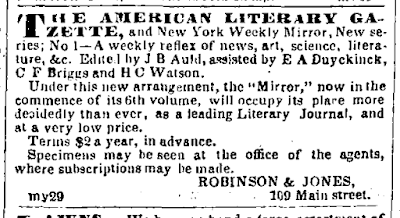
Cincinnati Commercial Tribune - May 29, 1847

Approving the sympathetic review of Omoo in the inaugural issue of May 21, 1847 along with the sharper focus on literary matters in this ambitious new weekly, the Dispatch positively identified the "independant" and "bold" reviewer as editor Evert A. Duyckinck (spelled "Duykinck"), who had recently left the Literary World. Without naming him, Hershel Parker in Herman Melville: A Biography volume 1, 1819-1851 (Johns Hopkins University Press, 1996) page 518 accurately describes the author of this unsigned, "brilliantly written" piece in the Evening Mirror as "someone high up in the journalistic establishment with a special zeal to defend Melville."

Found on genealogybank.com among digitized pages added within the past week; now accessible also via the Library of Congress on Chronicling America.

New York Sunday Dispatch - April 5, 1846
via GenealogyBank

TYPEE ; a Residence in the Marquesas, by Herman Melville, New York, and London Wiley and Putnam.— This is not a work to be dismissed within the limits of an ordinary book notice, and, as we have not room for more extended remarks, this week, we will defer what we have to say to our next, when we will enrich our columns with extracts from Mr Melville's strange and delightful narrative. Meantime we advise all who have the leisure to read it through, to purchase the book.
<https://chroniclingamerica.loc.gov/lccn/sn83030362/1846-04-05/ed-1/seq-2/>

Somewhat curtailed, the promised extracts appeared the following week.

New York Sunday Dispatch - April 12, 1846

Typee.

A RESIDENCE IN THE MARQUESAS.

We did intend to make numerous extracts from this charming book, which we commended to our readers in a brief notice last Sunday.— But our contemporaries have drawn so largely on its pages, as to leave us hardly the share of a gleaner. We, however, transfer to our columns, a portion of the chapter, which, in glancing at the influence exercised by the missionaries in the Sandwich Islands, makes some disclosures, which, we apprehend, will occasion no little surprize among the pious sewing circles of our country. The author of Typee is a bold man, to to tell even the truth concerning the Sandwich Island Mission, for he may be sure of having the mad dog cry of infidel set up against him, at home. We cannot dismiss our readers to the extract, without again commending the whole of Mr. Melville's narrative to their perusal. [Extracts that follow are from the first American edition of Typee chapter 26.]

"Look at Honolulu, the metropolis of the Sandwich Islands!  — A community of disinterested merchants, and devoted self-exiled heralds of the Cross, located on the very spot that twenty years ago was defiled by the presence of idolatry. What a subject for an eloquent Bible-meeting orator! Nor has such an opportunity for a display of missionary rhetoric been allowed to pass by unimproved ! — But when these philanthropists send us such glowing accounts of one half of their labors, why does their modesty restrain them from publishing the other half of the good they have wrought? Not until I visited Honolulu was I aware of the fact that the small remnant of the natives had been civilized into draught-horses, and evangelized into beasts of burden. But so it is. They have been literally broken into the traces, and are harnessed to the vehicles of their spiritual instructors like so many dumb brutes!

"Among a multitude of similar exhibitions that I saw, I shall never forget a robust, red-faced, and very lady-like personage, a missionary's spouse, who day after day, for months together, took her regular airings in a little go-cart drawn by two of the islanders, one an old grey-headed man, and the other a rogueish stripling, both being, with the exception of the fig-leaf, as naked us when they were born. Over a level piece of ground this pair of draught bipeds would go with a shambling, unsightly trot, the youngster hanging back all the time like a knowing horse, while the old hack plodded on and did all the work. 

"Rattling along through the streets of the town in this stylish equipage, the lady looks about her as magnificently as any queen driven in state to her coronation. A sudden elevation, and a sandy road, however, soon disturb her serenity. The small wheels become imbedded in the loose soil, — the old stager stands tugging and sweating, while the young one frisks about and does nothing—not an inch does the chariot budge. Will the tender-hearted lady, who has left friends and home for the good of the souls of the poor heathen, will she think a little about their bodies and get out, and ease the wretched old man until the ascent is mounted ? Not she; she could not dream of it. To be sure, she used to think nothing of driving the cows to pasture on the old farm in New England; but times have changed since then. So she retains her seat and bawls out, “ Hookee ! hookee !" —pull, pull. The old gentleman, frightened at the sound, labors away harder than ever; and the younger one makes a great show of straining himself, but takes care to keep one eye on his mistress, in order to know when to dodge out of harm's way. At last the good lady loses all patience: “Hookee! hookee!” and rap goes the heavy handle of her huge fan over the naked skull of the old savage; while the young one shies to one side and keeps beyond its range. 'Hookee ! hookee!' again she cries — “ Hookee tata knnaka!”—pull strong, men—but all in vain, and she is obliged in the end to dismount and, sad necessity, actually to walk to the top of the hill.

At the town where this paragon of humility resides, is a spacious and elegant American chapel, where divine service is regularly performed. Twice every Sabbath towards the close of the exercises may be seen a score or two of little wagons ranged along the railing in front of the edifice, with two squalid native footmen in the livery of nakedness standing by each, and waiting for the dismissal of the congregation to draw their superiors home.
"Lest the slightest misconception should arise from anything thrown out in this chapter, or indeed in any other part of the volume, let me here observe, that against the cause of missions in the abstract no Christian can possibly be opposed: it is in truth a just and holy cause. But if the great end proposed by it be spiritual, the agency employed to accomplish that end is purely earthly; and, although the object in view be the achievement of much good, that agency may nevertheless be productive of evil. In short, missionary undertaking, however it may be blessed of Heaven, is in itself but human ; and subject, like everything else, to errors and abuses. And have not errors and abuses crept into the most sacred places, and may there not be unworthy or incapable missionaries abroad, as well as ecclesiastics of a similar character at home? May not the unworthiness or incapacity of those who assume apostolic functions upon the remote islands of the sea more easily escape detection by the world at large than if it were displayed in the heart of a city? An unwarranted confidence in the sanctity of its apostles—a proneness to regard them as incapable of guile—and an impatience of the least suspicion as to their rectitude as men or Christians have ever been prevailing faults in the Church. Nor is this to be wondered at: for subject as Christianity is to the assaults of unprincipled foes, we are naturally disposed to regard everything like an exposure of ecclesiastical misconduct as the offspring of malevolence or irreligious feeling. Not even this last consideration, however, shall deter me from the honest expression of my sentiments.
There is something apparently wrong in the practical operations of the Sandwich Island Mission. Those who from pure religions motives contribute to the support of this enterprise, should take care to ascertain that their donations flowing through many devious channels, at last effect their legitimate object, the conversion of the Hawaiians. I urge this, not because I doubt the moral probity of those who disburse these funds, but because I know that they are not rightly applied. To read pathetic accounts of missionary hardships, and glowing descriptions of conversions, and baptisms taking place beneath palm-trees, is one thing; and to go to the Sandwich Islands and see the missionaries dwelling in picturesque and prettily-furnished coral-rock villas, whilst the miserable natives are committing all sorts of immoralitiy around them, is quite another.

In justice to the missionaries, however, I will willingly admit, that whatever evils may have resulted from their collective mismanagement of the business of the mission, and from the want of vital piety evinced by some of their number, still the present deplorable condition of the Sandwich Islands is by no means wholly chargeable against them. The demoralizing influence of a dissolute foreign population, and the frequent visits of all descriptions of vessels, have tended not a little to increase the evils alluded to. In a word, here, as in every case where civilisation has in any way been introduced among those whom we call savages, she has scattered her vices, and withheld her blessings. 
As wise a man as Shakspere has said, that the bearer of evil tidings hath but a losing office; and so I suppose will it prove with me, in communicating to the trusting friends of the Hawaiian Mission what has been disclosed in various portions of this narrative. I am persuaded, however, that as these disclosures will by their very nature attract attention, so they will lead to something which will not be without ultimate benefit to the cause of Christianity in the Sandwich Islands.

I have but one thing more to add in connection with this subject — those things which I have stated as facts will remain facts, in spite of whatever the bigoted or credulous may say or write against them. My reflections, however, on those facts may not be free from error. If such be the case, I claim no further indulgence than should be conceded to every man whose object is to do good."

 -- New York Sunday Dispatch, April 12, 1846. 

<https://chroniclingamerica.loc.gov/lccn/sn83030362/1846-04-12/ed-1/seq-3/>

The Dispatch editor who supplied the flattering advance notice of Omoo, transcribed below, claimed an exceptionally close tie with the author in being privileged to examine Melville's second book before publication, in manuscript as well as printed proof sheets.
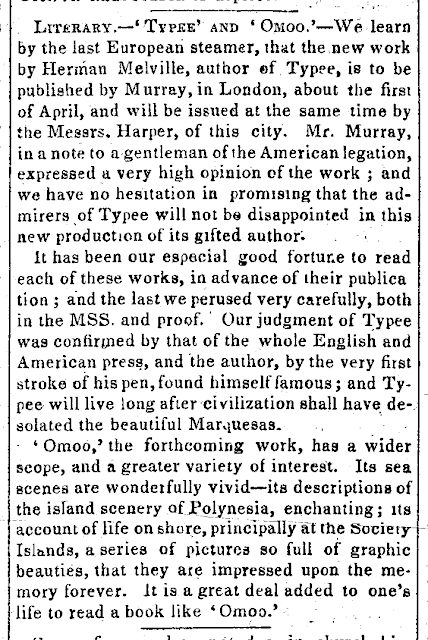
New York Sunday Dispatch - March 28, 1847

LITERARY. — 'TYPEE' AND 'OMOO.' — We learn by the last European steamer, that the new work by Herman Melville, author of Typee, is to be published by Murray, in London, about the first of April, and will be issued at the same time by the Messrs. Harper, of this city. Mr. Murray, in a note to a gentleman of the American legation, expressed a very high opinion of the work; and we have no hesitation in promising that the admirers of Typee will not be disappointed in this new production of its gifted author. 

It has been our especial good fortune to read each of these works, in advance of their publication; and the last we perused very carefully, both in the MSS. and proof. Our judgment of Typee was confirmed by that of the whole English and American press, and the author, by the very first stroke of his pen, found himself famous; and Typee will live long after civilization shall have desolated the beautiful Marquesas.

'Omoo,' the forthcoming work, has a wider scope, and a greater variety of interest. Its sea scenes are wonderfully vivid—its descriptions of the island scenery of Polynesia, enchanting; its account of life on shore, principally at the Society Islands, a series of pictures so full of graphic beauties, that they are impressed upon the memory forever. It is a great deal added to one's life to read a book like 'Omoo.'

--New York Sunday Dispatch, March 28, 1847 

<https://chroniclingamerica.loc.gov/lccn/sn83030362/1847-03-28/ed-1/seq-2/>
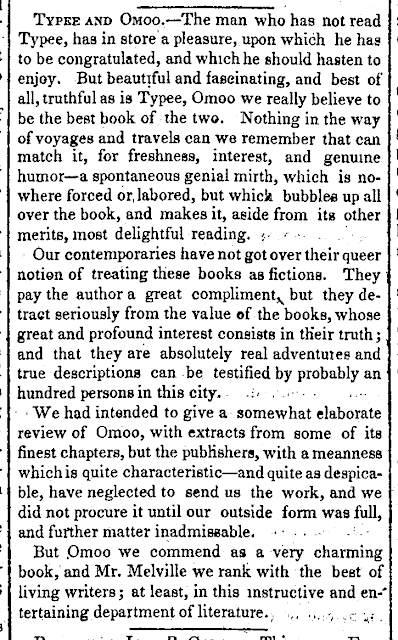
New York Sunday Dispatch - May 9, 1847

TYPEE AND OMOO. — The man who has not read Typee, has in store a pleasure, upon which he has to be congratulated, and which he should hasten to enjoy. But beautiful and fascinating, and best of all, truthful as is Typee, Omoo we really believe to be the best book of the two. Nothing in the way of voyages and travels can we remember that can match it, for freshness, interest, and genuine humor—a spontaneous genial mirth, which is nowhere forced or labored, but which bubbles up all over the book, and makes it, aside from its other merits, most delightful reading.

Our contemporaries have not got over their queer notion of treating these books as fictions. They pay the author a great compliment, but they detract seriously from the value of the books, whose great and profound interest consists in their truth; and that they are absolutely real adventures and true descriptions can be testified by probably an hundred persons in this city.

We had intended to give a somewhat elaborate review of Omoo, with extracts from some of its finest chapters, but the publishers, with a meanness which is quite characteristic—and quite as despicable, have neglected to send us the work, and we did not procure it until our outside form was full, and further matter inadmissable.

But Omoo we commend as a very charming book, and Mr. Melville we rank with the best of living writers; at least, in this instructive and entertaining department of literature.

-- New York Sunday Dispatch, May 9, 1847  

The next item from the Sunday Dispatch of May 23, 1845 names editor Evert A. Duyckinck as the writer of the highly favorable review of Omoo in the first number of the American Literary Gazette and New York Weekly Mirror (May 21, 1847). Direct quotations establish this as the same unsigned review of Omoo published in the Evening Mirror on May 21, 1847; collected in Herman Melville: The Contemporary Reviews, edited by Brian Higgins and Hershel Parker (Cambridge University Press, 1995; paperback 2009) and transcribed there on pages 108-111. Duyckinck had already resigned when the Literary World reviewed Omoo on May 8, 1847. The review there is probably by his temporary replacement Charles Fenno Hoffman, as Parker suggests in the first volume of Herman Melville: A Biography, page 512.

New York Sunday Dispatch - May 23, 1847
THE AMERICAN LITERARY GAZETTE, is the new prefix title of the New York Weekly Mirror, which paper is placed under the editorial charge of Mr. Evert A. Duykinck, late editor of the Literary World—and now it occurs to us as highly probable, that this may be intended as a rival publication. It is to be devoted more to books and literary criticisms than heretofore, and it promises to be independant. This promise, in the very first number of the series is to a certain extent redeemed; for we have seldom seen a more fearless and decided condemnation of the Missionary enterprize and operations than occurs in the following passage, from a notice of the brilliant works of Herman Melville; Typee and Omoo. Mr. Duyckinck says:— "In sober truth these deluded philanthropists (the missionaries) have, by deluding others, built up an immense institution, requiring annually several hundred thousand dollars to support it; and now they are deluding the natives, with the idea that it is all for their good. This talk about glorious revivals among the heathens, is the veriest nonsense that every emanated from the muddled brains of madmen. A few ignorant islanders are harrangued into a state of mere animal phrenzy, frightened into the grossest absurdities, and finally reduced to a state of slavery—and all this is heralded as a grand triumph of religion!" 
 
He is certainly a bold writer, who in a community like this, dares avow such sentiments; and we begin to think that there is much truth in the report that he was too independant a writer to suit the views of the Booksellers, who publish the Literary World.

-- New York Sunday Dispatch, May 23, 1847 

<https://chroniclingamerica.loc.gov/lccn/sn83030362/1847-05-23/ed-1/seq-2/>

New York Sunday Dispatch - July 18, 1847

A new play is now being performed at one of the theatres of Paris, founded on "Typee;" the author of which they call the Rev Herman Melville. If the "whig reviewer" see this, he will feel worse than ever. --New York Sunday Dispatch, July 18, 1847.

<https://chroniclingamerica.loc.gov/lccn/sn83030362/1847-07-18/ed-1/seq-2/>

Somehow the Sunday Dispatch knew that Herman Melville was one of four brothers. That is, besides Herman's deceased brother Gansevoort Melville, the Dispatch also had information concerning his younger brothers Allan and Tom.

New York Sunday Dispatch - June 27, 1847

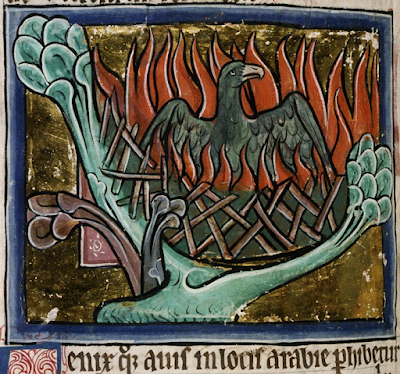
TYPEE AND OMOO.— Blackwood's for June has a review of the last of these extraordinary books, extending to fourteen pages, in the best style of that world renowned magazine, in which Herman Melville is called "the phœnix of modern voyagers, sprung, it would seem, from the mingled ashes of Captain Cook and Robinson Crusoe." Yet, while Blackwood's admits the full extent of the merit of these works, and of the general truthfulness of their narratives, it doubts that the author was a sailor before the mast, doubts that his real name is Herman Melville, or that he really has an uncle Gansevoort, of Saratoga County, to whom Omoo is dedicated.

To us this is amusing. Mr. Melville, the author of Typee and Omoo, is one of four brothers. The eldest, the late Gansevoort Melville, Esq., died Secretary of the American Legation near the Court of St. James. Herman Melville is apparently twenty eight years old, and has been a sailor before the mast in the Pacific; another brother, younger, if we mistake not, Allan Melville, Esq., is a lawyer and examiner in chancery, in Wall street; and the younger brother of the four, is now, if we mistake not, on a whaling voyage in the Indian Ocean; and may live to write books of voyages which will rival Omoo.

We state these facts thus particularly, because, when there is so much misapprehension abroad, there is likely to be some at home. 

-- New York Sunday Dispatch, June 27, 1847

<https://chroniclingamerica.loc.gov/lccn/sn83030362/1847-06-27/ed-1/seq-2/>

On the same page of the Dispatch for June 27, 1847, the brief notice of Blackwood's magazine for June mentions only the article 

on our latest and freshest author, Herman Melville, the writer of "Typee" and "Omoo," two works which have taken and will hold rank, and to which reference is made in another column of this paper.

Strong affinity for the "strange and delightful" charms of Typee and the "spontaneous genial mirth" pervading Omoo did not stop the New York Sunday Dispatch from disliking Melville's third book Mardi, and saying so. More on that next time, hopefully.

Related posts:

Saturday, January 1, 2022

Melville in Kingston, Ontario

Kingston, Ontario Daily British Whig 
April 27, 1850

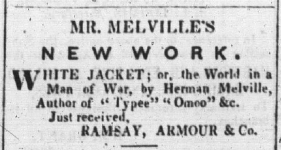
Later editions of Melville's first two books were reviewed in the Daily British Whig (Kingston, Ontario, Canada) on December 3, 1850. Not previously collected, this item offers an early instance of Melville's reception in Canada--almost one year before the favorable notice of Moby-Dick in the Toronto Globe on November 29, 1851. The Kingston newspaper gives the publisher of both Typee and Omoo as "Putam & Wily" although the American edition of Omoo (New York, 1847) was published by Harper & Brothers. In 1849 the Harpers had issued their Revised Edition of Typee, first published in America by Wiley & Putnam. By 1850 all five of Melville's published works through White-Jacket were available in Kingston, Ontario. For some reason unable to name Mardi, and a Voyage Thither the Canadian reviewer refers to Melville's third book as a "political romance." 


LITERARY NOTICES.  

TYPEE; OR A FOUR MONTHS RESIDENCE IN ONE OF THE MARQUESAS; By Herman Melville—Revised Edition Putnam & Wily, New York; Armour & Ramsay, Kingston.

OMOO; OR ADVENTURES IN THE SOUTH SEAS, being a sequel to Typee, by Herman Melville. Revised edition. Putnam & Wily, New York; Armour & Ramsay, Kingston. 

Mr. HERMAN MELVILLE is a writer whose productions bid fair to create for him a high literary reputation in the world of letters. The books before us have been before the public some few years, and have already passed through a variety of editions, being pirated both at home and abroad. The particular edition now before us seems to have received a considerable portion of the author's revision by the pruning knife, inasmuch as a great many vulgarisms and much tedious gurrulity are no longer to be complained of in the same degree. One or two very offensive expressions still remain and disfigure the edition. There is a great air of truth about these volumes which engages the reader's attention at once. If the events related are not genuine, they are certainly "ben trovati" as the Italians would say. The hero is a common Yankee sailor before the mast, not wholly devoid of education, but making no pretensions to literary acquirements; he is a graceless unmitigated scamp, (on his own shewing,) and commits actions that in a civilized country would lead him to the gallows; but of his own demerits he seems to have no idea and tells his tale throughout with an air of injured innocence that is highly amusing. Who he is, or what he is, the reader has no information, for his name or former occupation is never once mentioned or alluded to. Charity should induce us to believe, that Mr. Herman Melville is not the hero of his own stories; and yet some passages in these books, and also some others in his tale of "Redburn," would induce us to form a contrary opinion. This supposition does no honor to Mr. Herman Melville; for to be a deserter without cause, a mutineer without occasion, and a receiver of stolen goods without necessity, is a character unsuited to the author's present standing in society.

Many critics have likened Typee and Omoo to Robinson Crusoe; others again to Dana's Two Years before the Mast. They certainly have not the raciness of old Defoe, nor is the adventure sufficiently interesting to be compared to that of the immortal navigator; and as to Dana's book, they bear no nigher resemblance than in each being the autobiography of a sailor before the mast. The fact is, Mr. Herman Melville has a very pretty style of his own, to which, like Washington Irving, he owes a great portion of his fame. He tells his tales pleasantly and without labor, and tho' evidently well acquainted with nautical phrases, rarely inflicts them upon his readers. The total want of interest in his hero is a great drawback to his books as novels; but this defect is more than compensated by the vast amount of real knowledge of Polynesian life acquired in their attentive perusal. The Missionaries, those cruel pests in Tahiti, are cleverly handled; for without offering any opinion, he places plain facts before the world, which have already had a salutary effect in checking the mischievous tyranny of priestcraft in the South Seas. The American public affected to discredit the statements of the Russian Kotzebue in 1832, but now that one of their own countrymen repeats the tale, disbelief becomes preposterous and ridiculous. This plain fact speaks whole libraries. Capt. Cook estimated the population of the Society Islands at 200,000; when Kotzebue visited the islands, in 1832, "80,000 miserable wretches (we quote the Captain's words) were all that remained of Capt. Cook's numerous and happy Islanders." This was a sad decrease indeed, but nothing comparable to the present actual de-population of these once flourishing islands; for Mr. Herman Melville in 1844 estimates the whole population at less than 8,000 souls, and fearlessly prognosticates the total disappearance of the race—unless the Missionaries are driven from the Islands. Our readers must not misunderstand us—it is not the introduction of Christianity in the Society Islands which has depopulated them, it is the wilful and perverse misgovernment of the Missionaries, who insist upon European habits and European observances being forced upon an indolent people wholly unable to stand the change and exist. The French saw the evil and would have removed it, but cant and fanaticism swayed the English Councils at that time, and no practical good came of their interference. Were it for no other cause than this, Mr. Herman Melville deserves the thanks of the community at large.

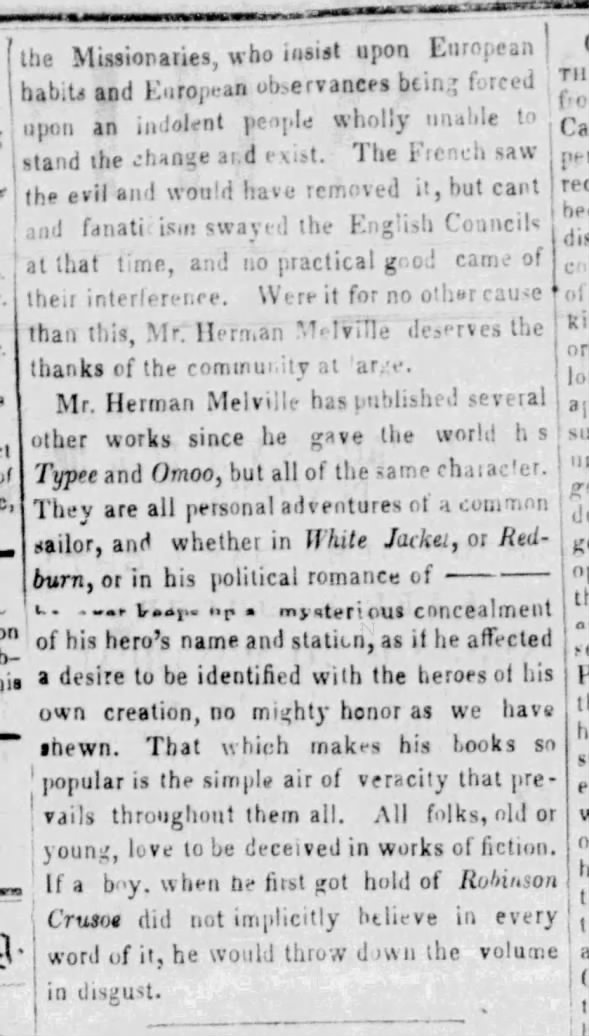
Mr. Herman Melville has published several other works since he gave the world his Typee and Omoo, but all of the same character. They are all personal adventures of a common sailor, and whether in White Jacket, or Redburn, or in his political romance of — — he ever keeps up a mysterious concealment of his hero's name and station, as if he affected a desire to be identified with the heroes of his own creation, no mighty honor as we have shewn. That which makes his books so popular is the simple air of veracity that prevails throughout them all. All folks, old or young, love to be deceived in works of fiction. If a boy, when he first got hold of Robinson Crusoe did not implicitly believe in every word of it, he would throw down the volume in disgust. 

-- The Daily British Whig (Kingston, Ontario, Canada) December 3, 1850. 

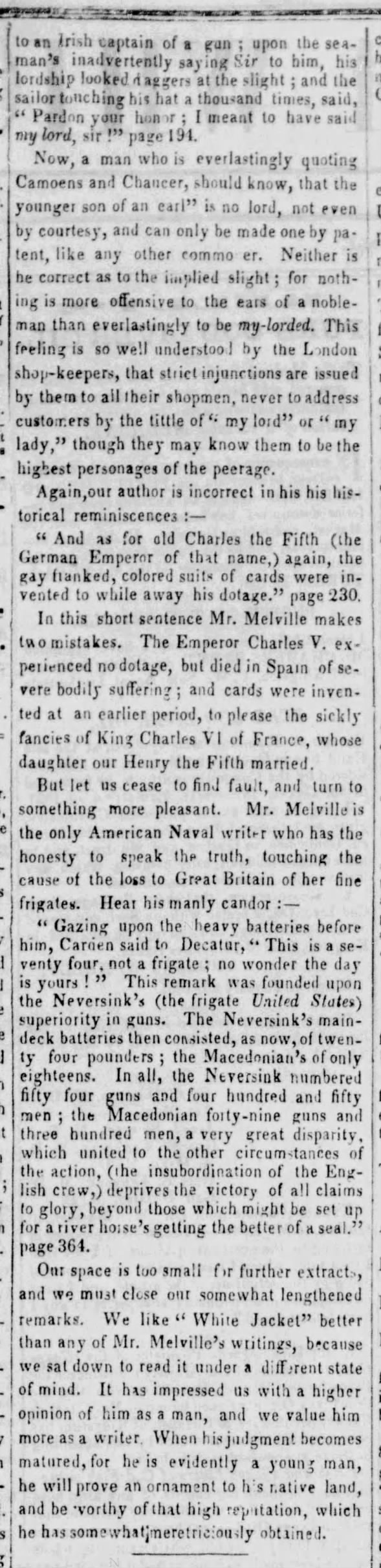
Belatedly, with suitable apologies, the Kingston editor offered a wonderfully substantial and highly favorable assessment of White-Jacket a year after it was published in New York by Harper & Brothers. Found this New Year's Day 2022 on newspapers.com, the glowing Canadian notice of White-Jacket is transcribed below from the Daily British Whig of March 25, 1851.

25 Mar 1851, Tue The Kingston Whig-Standard (Kingston, Ontario, Canada) Newspapers.com

LITERARY NOTICES.  

WHITE JACKET, or the World in a Man of War. By Herman Melville, author of Typee, Omoo, &c. Harper's 12mo Edition — pp. 466. Price $1. E. W. Palmer, Kingston.

Few modern writers of eminence have disappointed us more than Mr. Melville; this is not so much his fault, as our own; for hearing so much said in his praise by the literary world of Europe and America, we believed him to be another Washington Irving, and took up his "Typee" and "Omoo" with the same eagerness that thirty years ago, we snatched at a novel of Walter Scott's. Had we stumbled on the works of our author with the same careless indifference with which Dana's "Two Years before the Mast" first fell into our hands, we might have paid them that deference which their merits deserve; but being greatly over rated and much over praised, (in our estimation,) we rose from their perusal soured, annoyed and disappointed. This accounts for "White Jacket," Mr. Melville's latest publication, although more than a year before the public, not having excited our curiosity to read it, until Saturday last, when Mr. Palmer, the Bookseller, kindly placed it at our disposal. That Mr. Melville has been a common sailor, a very common sailor, the text of all his works clearly proves. That he is a man of strong common sense, good feeling, and possessed of much information, they also clearly make manifest. But, that he is an educated man, despite his ceaseless quotations from dead and living writers, we very much doubt. There is a mystery about him—something of the George Borrow, which the reader would gladly solve; though perhaps no two men are more dissimilar than the Yankee Sailor and the Gipsy Philologist. Still there is a mystery, and in that consists half the notoriety of his books, and more than half their interest.

"White Jacket" is what its second title describes, the picture of life on board a man-of-war. The writer ships at Valparaiso as an ordinary seaman (that is, a common sailor of the second class) on board the U. S. Frigate United States, (called in the book Neversink) and makes in her the homeward voyage. He is upwards of a year on board of her, and his observing eye and ready pen are busy at work during the whole of that period. The scenes he describes are highly characteristic, vastly descriptive, and greatly entertaining. All his pictures are graphic and all his characters are painted to the life. The abuses in the American Navy are pointed out, and the grossness of its tyranny fully exposed. The stupid Commodore, the brutal Captain, the ignorant Doctor, and the obsequious Master-at-arms, cum multis aliis, all fare alike, and if the incidents portrayed are facts, and they bear an air of truthfulness about them, these officers richly deserve the impaling they receive. One part of the book is written with much spirit and zeal, that which treats of corporal punishment. Mr. Melville shews it to be cruel, wanton, unnecessary, and worse than useless; and it is a happiness for him to know, that since the publication of "White Jacket," the United States Legislature has abolished that species of unmanly torture throughout the Naval and Mercantile Services. Should the same practice be discontinued in the British Navy, and discontinued soon it must be, if the British Fleet expect to be manned without impressment, Mr. Melville will have the grand satisfaction of feeling, that he has achieved more for his fellow man, than any other human being since the days of John Howard. To have abolished "Flogging" is more than Nelson and Collingwood dared to do, though they both wished it done!

We hinted a doubt as to Mr. Melville, who certainly writes with the air and ease of an Oxonian, being a man of education. Although his syntax and prosody are generally correct, still he occasionally makes queer confusion with the words "lying" and "laying." These may be printer's errors, and so far he is excusable. But in the following extract no such excuse can avail him.

"There happened to be a lord on board of this ship—the younger son of an earl, they told me. He was a fine looking fellow. I chanced to stand by when he put a question to an Irish captain of a gun; upon the seaman's inadvertently saying Sir to him, his lordship looked daggers at the slight; and the sailor touching his hat a thousand times, said, "Pardon your honor; I meant to have said my lord, sir!" page 194.

Now, a man who is everlastingly quoting Camoens and Chaucer, should know, that "the younger son of an earl" is no lord, not even by courtesy, and can only be made one by patent, like any other commoner. Neither is he correct as to the implied slight; for nothing is more offensive to the ears of a nobleman than everlastingly to be my-lorded. This feeling is so well understood by the London shop-keepers, that strict injunctions are issued by them to all their shopmen, never to address customers by the tittle of "my lord" or "my lady," though they may know them to be the highest personages of the peerage.

Again, our author is incorrect in his his historical reminiscences:—

"And as for old Charles the Fifth (the German Emperor of that name,) again, the gay franked, colored suits of cards were invented to while away his dotage." page 230.

In this short sentence Mr. Melville makes two mistakes. The Emperor Charles V. experienced no dotage, but died in Spain of severe bodily suffering; and cards were invented at an earlier period, to please the sickly fancies of King Charles VI of France, whose daughter our Henry the Fifth married.

But let us cease to find fault, and turn to something more pleasant. Mr. Melville is the only American Naval writer who has the honesty to speak the truth, touching the cause of the loss to Great Britain of her fine frigates. Hear his manly candor:—

"Gazing upon the heavy batteries before him, Cardan said to Decatur, “This is a seventy-four, not a frigate; no wonder the day is yours!” This remark was founded upon the Neversink's (the frigate United States) superiority in guns. The Neversink's main-deck batteries then consisted, as now, of twenty-four pounders; the Macedonian's of only eighteens. In all, the Neversink numbered fifty four guns and four hundred and fifty men; the Macedonian forty-nine guns and three hundred men, a very great disparity, which united to the other circumstances of the action, (the insubordination of the English crew,) deprives the victory of all claims to glory, beyond those that might be set up for a river horse's getting the better of a seal." page 364.
Our space is too small for further extracts, and we must close our somewhat lengthened remarks. We like "White Jacket" better than any of Mr. Melville's writings, because we sat down to read it under a different state of mind. It has impressed us with a higher opinion of him as a man, and we value him more as a writer. When his judgment becomes matured, for he is evidently a young man, he will prove an ornament to his native land, and be worthy of that high reputation, which he has somewhat meretriciously obtained.
-- The Daily British Whig (Kingston, Ontario, Canada) March 25, 1851. 
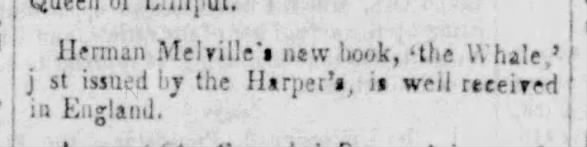
20 Nov 1851, Thu The Kingston Whig-Standard (Kingston, Ontario, Canada) Newspapers.com
"Herman Melville's new book, 'the Whale,' just issued by the Harper's, is well received in England."  -- Daily British Whig (Kingston, Ontario, Canada) November 20, 1851.

Saturday, August 28, 2021

Phantom Yankee found

 "Typee" proved the most successful hit in book-making, since the publication of Stephens's first book of Travels. An English critic said it was "Yankee all over." By which he meant that it was entirely new, fresh, and devil-may-care; free from the dry, stale, and wearisome conventionalities of trained literature. It was a book of itself, not made up of pickings from other books, but from the personal observations and individualities of the author.... 
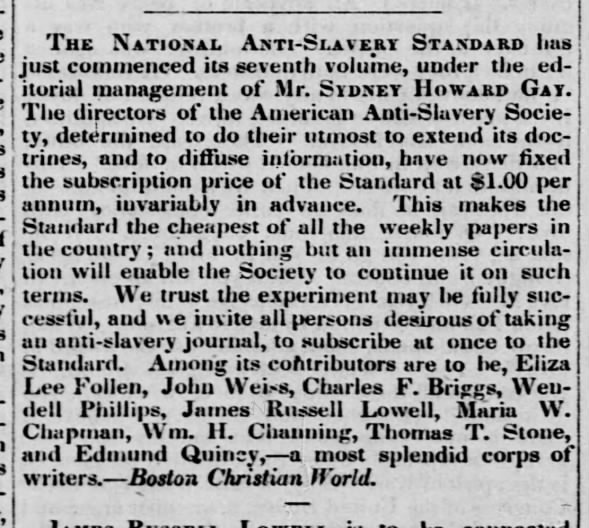
--Charles Frederick Briggs, review of Omoo in the National Anti-Slavery Standard for May 27, 1847.

A footnote in the third Norton Critical Edition of Moby-Dick calls attention to the quoted expression "Yankee all over" in remarks by "B." on Melville's first two books in the New York National Anti-Slavery Standard. As first identified by Robert K. Wallace in Douglass and Melville: Anchored Together in Neighborly Style (Spinner, 2005), this "B." who then reviewed books for the Anti-Slavery Standard was Charles Frederick Briggs

03 Jul 1846, Fri The Liberator (Boston, Massachusetts) Newspapers.com
According to Briggs, an unnamed "English critic" had characterized Typee as "Yankee all over," meaning "new, fresh, and devil-may-care." Norton editor Hershel Parker thinks "this reference may yet be discovered" and so it will be, herein. 

In the review-hunting game, searching for stray quotes most definitely can yield new, that is, previously unidentified or unlocated reviews from whence they came. Blurb-searching works. The trick is to search for different combinations of key terms in the blurb or stray quote. I call it the Mrs. Bennett play, in honor of the “luckiest and most ingenious benefactress” of MOBY-DICK as Doubloon (W. W. Norton, 1970). As acknowledged by the editors of that landmark compendium of criticism on Melville’s masterpiece, the enterprising Mrs. David Bennett (aka Lee Bennett) located a marvelous and previously unknown review of The Whale in the London Morning Advertiser (October 24, 1851) after seeing it quoted in an advertisement in the Morning Post (14 November 1851). The Morning Post ad that Mrs. Bennett found at the British Library quoted six different reviews of The Whale. Of those six, two were then unknown to Melville scholars. Mrs. Bennett found the one in the Morning Advertiser and kindly left the other for me to find, fifty years later. As announced on Melvilliana, the other unidentified quote came from a paragraph of early and uniquely colorful praise in the London Globe and Traveller
and before that, in the London Morning Herald
Here on Melvilliana, the Mrs. Bennett play also resulted in discovery of a longer, highly favorable and previously unknown review of The Whale in the London Morning Herald

Back to our missing Yank. Outside of the National Anti-Slavery Standard, "Yankee all over" does not appear in any review of Typee, British or American. To find this one you have to do a reverse-Mrs-Bennett, by re-examining previously known reviews. No Yankee there either. What to do? Leave him alone and focus on the "all over" part. 

Voilà! Melville's style in Typee is "New World all over" according to the London Athenaeum. Most likely, Briggs substituted "Yankee" for "New World," either misquoting from memory or paraphrasing. In context, either term means "American." The London critic's view of Typee as "New World all over" was prominently featured in Harper & Brothers ads for Omoo, for example this one in the New York Literary World on April 17, 1846:
A book full of fresh and richly coloured matter. Mr. Melville's manner is New World all over.

Briggs could have found Typee described as "New World all over" in numerous places:

  1. The original review of Typee in the London Athenaeum


  2. Reprints of the London review in the New York Anglo American on April 4, 1846; and  Littell's Living Age volume 9 on April 11, 1846. 

  3. With excerpts of favorable "NOTICES OF THE ENGLISH PRESS" bound into copies of Omoo (1847). 

    https://hdl.handle.net/2027/uc2.ark:/13960/t3kw57w1s?urlappend=%3Bseq=407 

  4. Harper & Brothers advertisements in New York newspapers and journals.

Glossing the "epithet" New World as a synonym for American, the English critic referenced "Stephens, the foremost among American pilgrims." In the National Anti-Slavery Standard, Charles F. Briggs similarly compares Melville's debut to that of John Lloyd Stephens, calling Typee "the most successful hit in book-making, since the publication of Stephens's first book of Travels." 

Stephens's first big hit was the 1837 book Incidents of Travel in Egypt, Arabia Petraea, and the Holy Land

BY AN AMERICAN.

Thursday, August 26, 2021

More hooting at Blackwood on Omoo

The "most talked about" and "much hooted-at" review of Omoo in Blackwood's Edinburgh Magazine, as Hershel Parker frames it in Herman Melville: A Biography Volume 1, 1819-1851 (Johns Hopkins University Press, 1996) at pages 520 and 533, elicited more editorial hooting in the New York True Sun for June 30, 1847. The True Sun, founded by rebellious exiles from the New York Sun, had favorably noticed Omoo on May 1, 1847; this earlier notice of Omoo is reprinted in Herman Melville: The Contemporary Reviews, edited by Brian Higgins and Hershel Parker (Cambridge University Press, 1995) at page 98. Transcribed below, the later commentary in The True Sun on the "book-worm sagacity" and British "superciliousness" exemplified in Blackwood's review of Omoo is not previously recorded in Melville scholarship. 

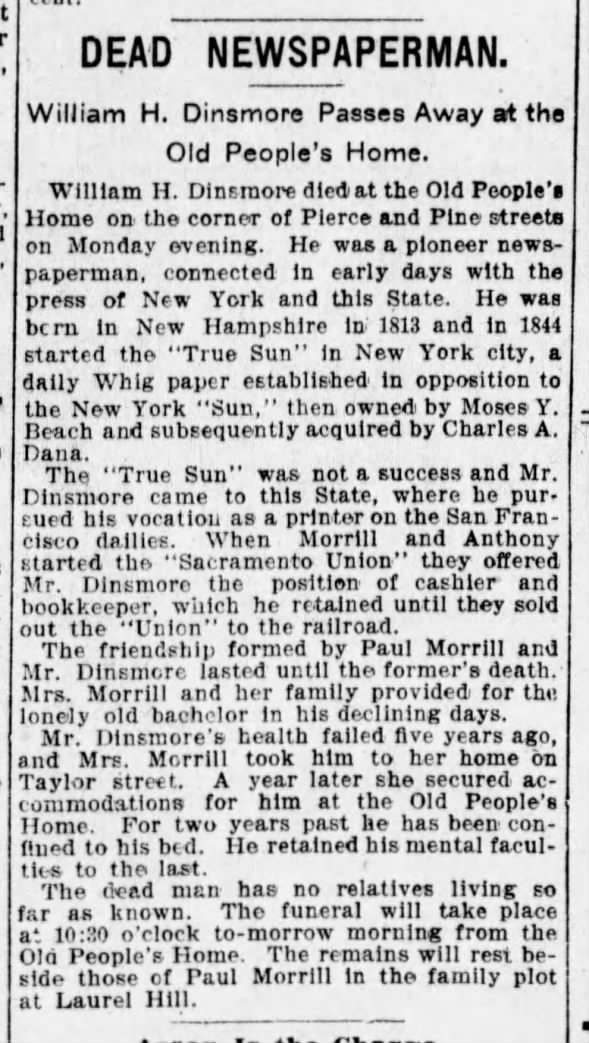
The True Sun was then owned and edited by William H. Dinsmore and Paul Morrill. What most amused these and other journalists in New York State (along with family and friends of the author) was the British reviewer's suspicion that "Herman Melville" might be a fake name. 

YANKEE BOOKS AND ENGLISH CRITICS.— The question “who reads an American book?” seems to have been solved of late, and even Blackwood confesses the “soft impeachment.” The last number of that celebrated periodical has not only condescended to notice favorably the two books of Herman Melville, Esq., Typee and Omoo, but to give its readers some extracts. The venerable Reviewer is, however, evidently puzzled to account for the fact that what it calls an “excellent” book, “quite first rate,” should have been written by an American, and that American a sailor. The first difficulty encountered in the matter, seems to be to understand what a sailor is. It is assumed off hand, that the hands in an American vessel are on a par with the miserable outcasts that the state of society in England exudes into the forecastles of English vessels. If such were the case, Mr. Ricardo would never have asked for a Parliamentary committee to inquire into the causes of the superiority of American over English shipping, nor would that committee have elicited evidence to the fact that it was owing to the “superior class of men in American ships.” A large portion of the young seamen in United States vessels, are well educated and “gentlemanly” youths, whose interest, enterprise, and love of adventure carry them to sea. We remember some years since, a young gentleman in an eastern city, guilty of some youthful folly, was, on a consultation of friends, to be sent to sea as a punishment. His employer, an old and experienced merchant, objected: “It is,” said he, “with the utmost difficulty that our sons can now be kept out of the forecastle, and if their desires are to be gratified in consequence of misdemeanors, not a clerk will be left in the computing houses. Send him rather on a farm.” This was wisdom. There are very few wealthy merchants and eminent men, who have not, at some period of their lives, experienced
"—How hard it is to climb
Up a slushed topmast, in the summer time.”
All this is utterly incomprehensible to English aristocratic notions; and Mr. Melville was one of them it appears, and his adventures resulted in the volumes, the excellence of which throw doubt in English minds upon the identity of the author. The wonderful book-worm sagacity of Blackwood stumbles over the name “Herman Melville,” and the more readily, that an old novel fans the suspicion:
“Our misgivings begin with the title page, ‘Lovel or Belville,’ says the laird of Monkbarns, "are just the names which youngsters are apt to assume on such occasions, and Herman Melville sounds to us vastly like the harmonious and carefully selected appellation of an imaginary hero of romance.”

“Of the existence of ‘Uncle Gansevoort of Gansevoort, Saratoga county,’ we are wholly incredulous,” “until certificates of his corporality shall set down the gentleman with the Dutch patronymic as a member of an imaginary clan."
This is a specimon of what is called “knowing too much.” John Bull is not to be “done” by any such humbug as calling sailors “Herman Melville.” We wonder, however, that such an astonishing acuteness did not stumble over the name of “Gansevoort Melville,” United States Secretary of Legation to the Court of St. James, and as Eddie O’Chiltreee remarked of Monkbarns, “put that and that together,” and “smell a rat.” Considering the usual superciliousness of English writers in regard to American affairs, it is not to be wondered that the acute critic should be surprised at a “Dutch patronymic” among a people exclusively Dutch descendants, nor that the fame of Herman Gansevoort, Esq. Should not have penetrated into the obscurity of an English editorial sanctum. The facts are, however, calculated to increase the astonishment of bewildered Blackwood. Herman Gansevoort, Esq. Has clearly divided his name between his nephews, the brothers Melville, of whom Gansevoort represented his country at the Court of Victoria. The other, while pursuing his adventures as a sailor, earned that literary reputation which has led to the question of his identity.

In all this the English reviewers, when they have studied out the facts so as to comprehend them, will have a most practical lesson upon American character and the working of republican institutions. All ranks and grades of society are open to the resistless enterprise and untiring genius of the American character, and it is very unsafe when a boy is seen going into the forecastle of an American vessel as a “green hand,” to predict anything in relation to him. In the case of an English boy under similar circumstances in England, you may safely assert that he is taking up his abode for life—that he is to live a miserable and oppressed being and die in poverty and want. Of the American you may feel confident that he is only seeking an outlet for the fire within, and that because he begins by “slushing a topmast,” “furling a royal” or “taking in the slack of the topsail halyard,” it is by no means safe to aver that he will not speedily astonish the literati of Europe in the line of their own occupations; that he will not revolutionize the first country he lands in, or suddenly turn up member of Congress from some western State. All these practical effects of republican energy and genius, English writers and politicians have yet to “get through their hair.”

-- The True Sun (New York, NY) June 30, 1847; found on Genealogy Bank

Titled "Pacific Rovings" the review of Omoo appeared in Blackwood's Edinburgh Magazine for June 1847 at pages 754-767; reprinted in Littell's Living Age on July 24, 1847.


07 Mar 1900, Wed The San Francisco Examiner (San Francisco, California) Newspapers.com