Did you hear of the _______? by Scott Norsworthy
A shared 5-gram in "Scenes Beyond the Western Border" and Herman Melville's "The Lightning-Rod Man"
Read on Substack

Original research and riffs on Herman Melville, authorship, and nineteenth-century American literature.

 |
| Clement C. Moore (1779-1863) |
 |
| Henry Livingston Jr. (1748-1828) |
The closest analogy to "The Pig and the Rooster," however, is probably "The Big Brag," one of the "other stories" in Yertle the Turtle, about a rabbit and a bear who boast that they are the "best of the beasts" because of the range of their hearing and smelling abilities, respectively. In the course of their obviously bogus brags, they are interrupted by a worm who explains in an utterly condescending tone that he can see so well his vision actually circles the world, allowing him to see the backsides of the rabbit and bear, "the two biggest fools that have ever been seen." In both sound and sense, Moore's "The Pig and the Rooster" is comparable to "The Big Brag" and many other Dr. Seuss stories. (Fight, page 262)


Inspired by recent encounters with Hawthorne, in particular by their heady and hearty barn-talk that March, Melville might have found a way to get the gist of their stimulating conversations into print. Echoes of Melville’s letters in the opening installment of “Scenes Beyond the Western Border” lead me to suspect it may be haunted by Hawthorne. At any rate, coincidence or no, the narrator of “Scenes Beyond the Western Border” talks to the reader like Melville talked in letters to Hawthorne. Here’s one example from the first of Melville’s Agatha letters to Hawthorne dated August 13, 1852.24
In this example, wording and structure of the Captain’s pledge to do most of the talking for his singular reader match the “and if / why I” construction in Melville's 1852 letter to Hawthorne (emphasis mine):“… and if you are absolutely dumb, why I will sometimes answer for you.”
“And if I thought I could do it well as you, why, I should not let you have it.”
https://archive.org/details/in.ernet.dli.2015.84865/page/n197/mode/2up
Introducing likely topics of conversation, the Captain sounds quite like Melville when promising a good time to his invited guest:
MELVILLE
“Hark— There is some excellent Montado Sherry awaiting you & some most potent Port. We will have mulled wine with wisdom, & buttered toast with story-telling & crack jokes & bottles from morning till night.”
— Letter to Nathaniel Hawthorne, 29 January? 1851; emphasis mine.CAPTAIN
“We will talk on all subjects, from the shape of a horse-shoe to that of the slipper of the last favorite—say the 'divine Fanny,’ from great battles, or Napier's splendid pictures of such, down to the obscurest point of the squad drill—from buffalo bulls to elfin sprites.”
—Scenes Beyond the Western Border, June 185125These elaborate invites are similarly themed and structured. Each presents an inventory of delightful activities in store for the recipient, each inventory being divided in three main parts. Melville’s three groupings of promised events are separated by three ampersands; the Captain’s by the word from, used thrice. The invitation in each case extends to just one person: Melville to Hawthorne, the Captain to his Imaginary Friend the reader. The plural “We” brings together speaker and singular reader as joint enjoyers of good times ahead, chiefly to be spent in stimulating conversation....
What better way to celebrate the 199th Birthday of Santa Claus as we know and love him than this?! Check out the true history of Santa, Sr. as beautifully told on Red Pilled America with Patrick Courrielche and Adryana Cortez.
https://redpilledamerica.com/episodes/ep-114-santa-sr/

Franz Fanon in Black Skin, White Mask (1967) stated,
Sometimes people hold a core belief that is very strong. When they are presented with evidence that works against this belief, the new evidence cannot be accepted. It would create a feeling that is extremely uncomfortable, called cognitive dissonance. And because it is so important to protect the core belief, they will rationalize, ignore and even deny anything that doesn't fit in with the core belief. (Fanon 1967: 194).
--Introduction, War on Terror and American Film: 9/11 Frames Per Second (Edinburgh University Press, 2014, 2016).McSweeney cites a London edition of Fanon's 1952 book Peau noire, masques blancs, published by Pluto Press. Evidently this is the 1986 reissue of the Charles Lam Markmann translation, first published in 1967 by Grove Press. Another edition by Grove Press appeared in 2008, with a new translation from the French by Richard Philcox.
In the course of our conversation she explained why. She told me that sometimes people hold a core belief that is very strong. When they are presented with evidence that works against that belief, the new evidence cannot be accepted. It would create a feeling that is extremely uncomfortable, called cognitive dissonance. And because it is so important to protect the core belief, they will rationalize, ignore and even deny anything that doesn't fit in with the core belief.
https://www.huffpost.com/entry/why-some-smart-women-thin_b_137416
"... the continued belief that this quote is from Frantz Fanon is a prime example of cognitive dissonance."
http://underthetree63.blogspot.com/2013/03/revisiting-frantz-farnon.html
Nakuma, Constancio. “COGNITIVE DISSONANCE REDUCTION STRATEGIES BY BLACK INTELLECTUALS IN THE DIASPORA: A PSYCHOLINGUISTIC EXPLORATION OF NEGRITUDE AND AFROCENTRISM.” CLA Journal 43, no. 2 (1999): 167–180 at 169. http://www.jstor.org/stable/44323286.
"I am not a prisoner of history."
But how to account for the birth and surging popularity of Fake Fanon? In alphabetized book indexes and bibliographies the surname Festinger follows Fanon, immediately in some cases. Sometime after the turbulent 1960's and early 1970's, perhaps, on a quiet university campus in the blissful calm of a graduate student's library carrel, a sleepy research assistant may have mistakenly tracked a textbook paraphrase of cognitive dissonance to Fanon instead of the name just below Fanon. Otherwise it's hard to say exactly how or where the mistaken attribution first occurred.
The rapid proliferation of pseudo-Fanon in the internet age resembles the worldwide re-assignment of Rev. Henry Melvill's fine image of moral accountability as a network of "sympathetic threads" and "fibres" to Herman Melville. As with pseudo-Melville, pseudo-Fanon peculiarly suits the advancement of leftist political agendas. In the service of politicians and academic activists, both pseudo-Melville and Fake-Fanon have been usefully employed as prophets of Woke utopia.
We cannot live for ourselves alone. Our lives are connected by a thousand invisible threads, and along these sympathetic fibers, our actions run as causes and return to us as results.
HERMAN MELVILLE
Hillary's husband blithely ascribed the "sympathetic fibers" quote to Herman Melville at the 1997 Memorial Service for Albert Shanker, president of the American Federation of Teachers. Then-President Clinton misappropriated Melville for the purpose of honoring Shanker as a teacher and social justice advocate, while eliding Shanker's-- Hillary Rodham Clinton, It Takes a Village (Simon & Schuster, 2006).
"lifelong hatred of Soviet-style communism." --Jack Schierenbeck, Class struggles: The UFT story
Here in Minnesota, our once-beloved prairie moralist and Moby-Dick hater Garrison Keillor (before he got canned by MPR) loved to spout pseudo-Melville, as he did in Good Poems for Hard Times (Penguin Books, 2006).
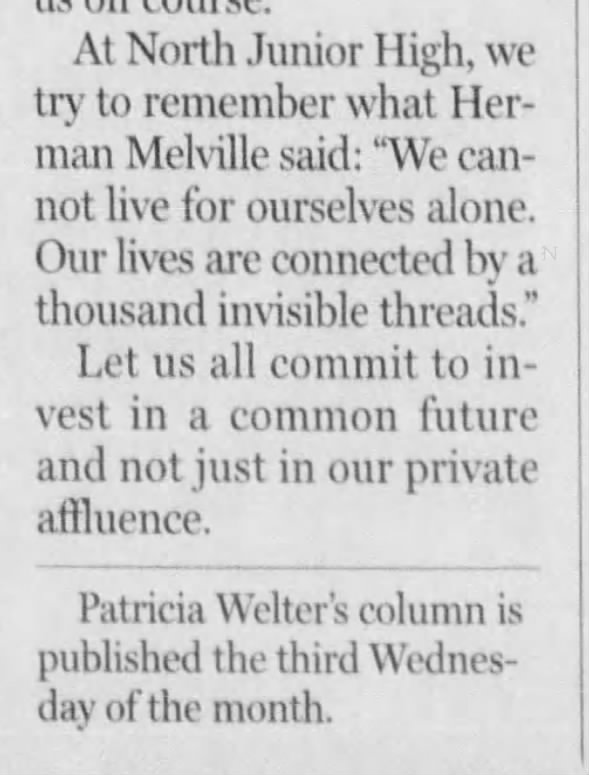
Minnesota middle-schoolers probably don't get to read Typee or Redburn, but twenty years ago some of them got spoon-fed pseudo-Melville as part of their indoctrination in utopian ideology and ethics.
"At North Junior High, we try to remember what Herman Melville said: 'We cannot live for ourselves alone. Our lives are connected by a thousand invisible threads.' Let us all commit to invest in a common future and not just in our private affluence." -- Patricia Welter, St. Cloud Times, May 16, 2001.
Pat Welter later co-founded Partner For Student Success or PFSS, largely devoted to data collection and the promotion of Social-Emotional Learning and other dubious, usually harmful ideologies.
 |
| https://twitter.com/ConceptualJames |
Early in the present century, corporate media enlisted pseudo-Melville to help teachers promote the virtues of "diversity" and social "harmony" in a lesson on The Building Blocks of Character Education. Connecticut kids had to explain in writing why Herman Melville, in reality the type of guy who would just say NO! in Thunder, would agree with establishment dictates to "live in harmony." The stated focus of this particular activity, the fourth of ten in the series on character-building, was "Acceptance."
In a well-organized paragraph, discuss the following quote by Herman Melville: "We cannot live for ourselves alone. Our lives are connected by a thousand invisible threads, and along these sympathetic fibers, our actions run as causes and return to us as results." Explain why Melville would agree that by learning about differences, we allow ourselves to appreciate diversity and begin to live in harmony by respecting the views of others. Stamford CT Daily Advocate - December 3, 2001 via genealogybank.com

a managed state of racial equity that will eventually produce a post-racial utopia in which “racial justice” finally exists. The revolution and administered (socialist, “equity”) state will be led by a Dictatorship of the Antiracists (DOA?), comprised of awakened (Woke) Critical Race Theorists with the right critical consciousness of race.
-- Critical Race Theory's Dictatorship of the Antiracists.
Pseudo-Melville and Fake-Fanon have been adopted as prophets in the new religion of Wokeness. The repurposed scriptures of these prophets serve to implant and cultivate the ethos of communitarian supermorality. For strong "reasons why a code of communitarian supermorality is unlikely to work," see the extended paraphrase of John Mackie by Richard A. Posner in The Problems of Jurisprudence (Harvard University Press, 1990) pages 416-418. In practice, such utopian ideals require "high levels of coercion" to maintain, resulting in all kinds of wickedness and abuse. In education, the praxis of critical theory has methodically enabled the psychological and sexual abuse of children in schools run by Woke teachers and administrators, as shown by James Lindsay on New Discourses.
Along with American schools, groomers have also hijacked the "ETHICS" department at Boy Scouts of America. Fake-Fanon is this day being employed there in the worst conceivable way, as an approved text designed to create doubt about commonly understood standards of ethical behavior.
Prominently introduced with "Troop Leader Resources," fake-Fanon specifically helps to teach kids "The Value of Ethical Controversies":
"there are two sides to most questions and that the gray area between right and wrong is sometimes difficult to define."
In some cases, the theory of cognitive dissonance according to Festinger required evaluating the factual basis of "core beliefs" in order to distinguish valid beliefs from invalid ones. Granted, that distinction has seemed less important to later analysts who tend to emphasize the supposed discomfort or dissonance produced by conflicting ideas, regardless of their empirical merit. Human psychology is complicated, after all. This aint the Boy Scouts. Wait, this IS the Boy Scouts. Here we are, almost in 2022, and Woke Troop Leaders at Boy Scouts of America can't tell right from wrong, or pretend they can't, and make a virtue of teaching ethical indeterminacy to other people's children. And their best authority for this exercise in moral relativism is Fake-Frantz-Fanon. Reality check: confusing kids with lessons about "gray areas between right and wrong" is a very bad practice, conducive to further abuse.
"Sometimes people hold a core belief that is very strong. When they are presented with information that works against that belief, the new evidence cannot be accepted. It would create a feeling that is extremely uncomfortable, called cognitive dissonance. And because it is so important to protect the core belief, they will rationalize, ignore and even deny anything that does not fit in with the core belief."
We may not go about our daily lives thinking of the term “cognitive dissonance,” but we’ve all seen this theory materialized. We’ve seen presidential poll numbers that don’t change regardless of the policies some candidates bring forth. We’ve seen studies in newspapers or sometimes comical takes of the data on television proving that people will agree or disagree with the same policy based merely upon whose idea they believe it is. We can probably also think of instances of it in our own communities and within the work we do. For example, one of our nonprofit members recently talked to me about this theory and how cognitive dissonance is a major obstacle in their work for economic equity.
-- Keeping an Open Mind about the Education Reform Debate, September 23, 2015.
"And in a tribute to my grandmother’s defiance of cultural norms, I have built a career reshaping workplace cultures through equity and inclusion." Fake-Fanon supplies an imposing epigraph for this 2017 Call for Courage in the Workplace by Daisy Auger-Dominguez.
https://www.daisyauger-dominguez.com/perspectives/2019/3/20/a-call-for-courage-in-the-workplace
"Daisy is an advisor to startups and social impact organizations, and serves on the board of directors of Planned Parenthood Federation of America as Vice-Chair, the Brooklyn Children’s Museum, the Robert Sterling Clark Foundation as Chair of the Governance Committee, St. Ann’s Warehouse, and on the advisory board of Facing History and Ourselves." https://www.daisyauger-dominguez.com/about-daisy
 |
| "ye cannot live for yourselves; a thousand fibres connect you with your fellow-men...." The Rev. Henry Melvill, 1855 sermon on Partaking in Other Men's Sins |
... they will rationalize, ignore and even deny anything that doesn't fit in with the core belief.What's that called again?
 |
| Mardi: and a Voyage Thither (1849). PS2384 .M3 1849 v1 from the Rare Books and Manuscripts Library of The Ohio State University Libraries |
 |
| Frederic S. Cozzens, detail from Elliott and his Friends (1857) by Junius Brutus Stearns Image Credit: Graphic Arts Collection, Special Collections, Firestone Library, Princeton University |
 |
| Frederic S. Cozzens via The New York Public Library Digital Collections |
"Melville & Cozzens have not passed muster." -- quoted in The Melville Log, ed. Jay Leyda (Harcourt, Brace, and Company, 1951), volume 2, page 502. Houghton Library, Harvard has the original with correspondence of Dix, Edwards & Company that also includes letters from Frederick S. Cozzens in February and March 1856.
Curtis meant Melville's "The Bell-Tower," and maybe a sketch in Cozzens's "Living in the Country" series, neither of which appeared in the July 1855 issue. But Curtis changed his mind about "The Bell-Tower," as Hershel Parker points out in the second volume of Herman Melville: A Biography (Johns Hopkins University Press, 1996), page 259. "Living in the Country" resumed with further rural adventures of Mr. and Mrs. Sparrowgrass in the August 1855 issue of Putnam's, where The Bell-Tower also shows up on pages 123-130. In the December 1855 number of Putnam's, the third and final installment of Melville's short fiction Benito Cereno follows immediately after another episode of Living in the Country by Cozzens. ("Living in the Country" began in the December 1854 Putnam's; the same issue also featured three chapters of Melville's story Israel Potter, starting with John Paul Jones and his gallant call on the Countess of Selkirk.) By May 1856, both writers had book versions of their Putnam's sketches ready for sale: Melville's The Piazza Tales, published by Dix & Edwards; and Cozzens's The Sparrowgrass Papers, published by Derby & Jackson.CURTIS, George William ALS to: J. A. Dix Providence, R.I. June 18, 1855, 1855. Dix, Edwards & Company letters and agreements, MS Am 800.13, (58). Houghton Library, Harvard College Library. https://id.lib.harvard.edu/ead/c/hou00666c00059/catalog Accessed October 24, 2019
 |
| "New Books" for sale by P. Allen & Son in Pittsfield, MA Pittsfield Sun - January 15, 1857 via GenealogyBank |
Clark thought it so beneath contempt as not to deserve notice, and gave his copy to Cozzens, who in Graham's, under his pseudonym of "Richard Haywarde," found some particles of gold in a network of affectation. (248-9)Miller did not cite his source for the gift of Mardi to Cozzens. More generally, Miller did acknowledge reliance on The Melville Log, 2 vols. (Harcourt, Brace and Company, 1951), where Jay Leyda had recorded that on April 27, 1849 "Lewis Gaylord Clark, editor of The Knickerbocker, presents a copy of Mardi to Frederick S. Cozzens" (Volume 1, page 301).
But the reaction of Frederick S. Cozzens (under the pseudonym Richard Haywarde) in a column in the August Graham's Magazine was mixed and exasperated: "Confound the book! there are such beautiful Aurora-flashes of light in it that you can almost forgive the puerilities — it is a great net-work of affectation, with some genuine gold shining through the interstices . . ." (Cozzens was the Knickerbocker set's authority on wine).
https://hdl.handle.net/2027/mdp.39015004756162?urlappend=%3Bseq=142
http://www.questia.com/read/3574589/melville-s-reviewers-british-and-american-1846-1891.In The Melville Log (vol. 1, page 375) Jay Leyda proposed Cozzens as also the author, possibly, of the unsigned review of White-Jacket in The Knickerbocker for May 1850. Leyda's conjecture is reported in The Recognition of Herman Melville, edited by Hershel Parker (University of Michigan Press, 1967). There Parker notes also that Perry Miller attributed the White-Jacket review to Lewis Gaylord Clark. The Knickerbocker review of White-Jacket is ascribed to Frederick Swartwout Cozzens without Leyda's qualifying question mark by Watson G. Branch in Herman Melville: The Critical Heritage (Routledge, 1974), page 235.
https://books.google.com/books?id=LsdGAQAAMAAJ&pg=PA448&lpg#v=onepage&q&f=falseThe Knickerbocker review of White-Jacket is accepted as Cozzens's and reprinted in Bloom's Classic Critical Views: Herman Melville, ed. Harold Bloom and Tony McGowan (Chelsea House Publications, 2008), pages 62-63. However, no external documentary evidence has yet been adduced for Cozzens's authorship of the White-Jacket review. Perry Miller may have been right, again, in assuming that Clark wrote it.
https://www.digitalcommonwealth.org/search/commonwealth:6h443r81gClark forwarded the letter to Rufus W. Griswold who adapted the information for a page on Cozzens in the updated Poets and Poetry of America (Philadelphia, 1856).
https://library.ohio-state.edu/record=b1712450~S7OSU also has the 1849 British edition of Mardi, published in three volumes by Richard Bentley. To date, however, only the first volume of the American edition is Google-digitized and accessible online courtesy of HathiTrust Digital Library.
https://catalog.hathitrust.org/Record/100587543The Mardi that Cozzens used bears the bookplate of esteemed collector Carroll Atwood Wilson. The set was well described in Atwood's posthumously published work, Thirteen Author Collections of the Nineteenth Century, 2 vols., ed. Jean C. S. Wilson and David A. Randall (Privately printed for Charles Scribner's Sons, 1950).
... 2 Vols. New York, 1849. Of considerable association interest, the end-paper of Vol. I bearing a presentation inscription from Lewis Gaylord Clark, the editor of the Knickerbocker Magazine, to F. S. Cozzens, author of the Sparrowgrass Papers, etc. The end-paper of Vol. II has the same inscription, with initials only, but a railway man named Ruben McGrath has added pencil inscriptions therein, alleging that he was born in 1492 and other like matter. The inscription is dated April 27, 1849, the book having been published April 14.
https://archive.org/details/thirteenauthorco000417mbp/page/n324
 |
| Inscription in Mardi: and a Voyage Thither (1849). PS2384 .M3 1849 v1 from the Rare Books and Manuscripts Library of The Ohio State University Libraries |
"the gift of my warm-hearted friend, L. G. C. of the Knickerbocker"and the OSU Mardi is inscribed in the first volume to "F. S. Cozzens / With kind regards of / His Friend / L. Gaylord Clark." As Wilson noted, the inscription from Clark to Cozzens is dated April 27, 1849.
https://books.google.com/books?id=DdVEAQAAMAAJ&pg=PP3&lpg#v=onepage&q&f=falseAs shown below, all but one of Richard Haywarde's quotations from Mardi are marked in the OSU copy inscribed to F. S. Cozzens. Turning to chapter 50, Yillah in Ardair, Haywarde recasts Melville's first prose sentence as poetry. The hexameter form and romantic content of the resulting verses remind Haywarde of Longfellow's Evangeline, a tale of Acadie (1847). Haywarde's comparison is matched in the marginalia on this page of Cozzens's Mardi. In the left margin, Melville's first sentence in chapter 50 is marked with a vertical pencil line. Next to the penciled line is the added word "Evangeline," apparently in the handwriting of Ferderic S. Cozzens. To compare handwriting, see the autograph letter from Cozzens to Lewis Gaylord Clark in the Griswold Collection, accessible in Massachusetts Collections Online via Digital Commonwealth:
Cozzens, Frederic S. (Frederic Swartwout), and Lewis Gaylord Clark. Frederick Swartwout Cozzens, Yonkers, NY., autograph letter signed to [Lewis Gaylord?] Clark, 23 June 1855. 23 Jun 1855. Web. 21 Oct 2019. <https://ark.digitalcommonwealth.org/ark:/50959/6h443r81g>.Herman Melville's copy of Evangeline, the 1848 Ticknor edition, was given to him by Hope Savage Shaw and is now at Harvard, Houghton Library, GEN *AC85 M4977 Zz848ℓ . Melville's Evangeline is Sealts Number 332 in the Online Catalog at Melville's Marginalia Online. Cozzens would pen his own "Evangeliad" in Acadia, or, A Month with the Blue Noses (1859).
LENDERS BOOKS. — NO. II.
By my right hand, Graham: by my right hand, which for odd years hath traveled and travailed over much foolscap, (and under much fool's-cap quoth the fiend,) I am more and more convinced of the truth of the words of the preacher, “Vanity of vanities: all is vanity." I have just laid aside “Mardi,” (the gift of my warm-hearted friend, L. G. C. of the Knickerbocker,) it lies atop of old Du Bartas and some withered budlets of forget-me-not, and in like manner I sit with a few fragmentaries of old literature at bottom for my primiter, some tender remembrances for my secondary, and for the alluvial stratum of my pericranicks (as gentle Charles hath it) these fripperies by the Author of Typee. Confound the book! there are such beautiful Aurora-flashes of light in it that you can almost forgive the puerilities—it is a great net-work of affectation, with some genuine gold shining through the interstices.
Let us turn over the leaves a little–hear ye now—
“And what to me thus pining for some one to page me a quotation from Burton on Blue-Devils.” V. I. p. 15. [marked]
What is paging a quotation ?
“Anoint the ropes and they will travel deftly through the subtle windings of the blocks.” p 33. [marked]
Why not say—“apply some oleaginous substance to the ambulatory cords, and prevent the inarticulate dissonance caused by the inharmonious attrition of the flaxen fibres against the ligneous particles?”
But this passage I especially commend:
“Good old Arcturion: Maternal craft, that rocked me so often in thy heart of oak, I grieve to tell how I deserted thee on the broad deep. (‘Maternal craft—maternal old oaken-hearted craft—maternal old oaken-cradle hearted craft' is good!) So far from home, with such a motley crew, so many islands, whose heathen babble echoing through thy Christian hull must have grated harshly on every carline.” p. 38.
 |
| Mardi: and a Voyage Thither (1849) volume 1, page 38. PS2384 .M3 1849 v.1 from the Rare Books and Manuscripts Library of The Ohio State University Libraries |
“Many there are who can fall,” says Martinus Scriblerius, “but few can arrive at the felicity of falling gracefully.
How beautifully he embellishes the most commonplace ideas:
“Among savages, severe personal injuries are, for the most part, accounted but trifles. When a European would be taking to his couch in despair the savage would disdain to recline.” p. 96. [marked]
“At Ravavai I had stepped ashore some few months previous; and now was embarked on a cruise for the whale, whose brain enlightens the world!” p. 1. [not marked]
Jarl steals a keg of tobacco —
“From the Arcturion he had brought along with him a small half keg, at bottom impacted with a solitary layer of sable Negrohead, fossil-marked, like the primary stratum of the geologists.” (Ahem! primary stratum fossil marked !) p. 68. [marked]
He surmiseth that Samoa likes to get swipesy—
“Nor did I doubt but that the Upoluan, like all Polynesians, much loved getting high of head; and in that state would be more intractable than a Black Forest boar.” [page 130, marked]
Sometimes he breaks into hexameter:
“In the verdant glen of Ardair, far in the silent interior of Amma,
Shut in by hoar old cliffs, Yillah the maiden abode.”
This reminds one of Evangeline —
"In the Acadian land, on the shores of the basin of Minos,
Distant, secluded, still, the little village of Grand Pré
Lay in the fruitful valley.”
 |
| Mardi: and a Voyage Thither (1849) volume 1, page 183. PS2384 .M3 1849 v.1 from the Rare Books and Manuscripts Library of The Ohio State University Libraries |
Let us hexametrize another passage, and we will have done with these fopperies:
“ 'Tis no great valor to perish sword in hand, and bravado
On lip; cased all in panoply complete. For even the alli-
Gator dies in his mail, and the sword-fish never surrenders.
To expire, mild-eyed, in one's bed, transcends the death [of Epam-
Inondas."p.46. [marked]
I have done with Mardi—one is reminded in reading it (after Typee) that "there is as much skill in making dikes as in raising mounts—there is an art of diving as well as flying,” [Pope, on the Art of Bathos] and who knows but what the author, after attaining a comfortable elevation by his former works, may not have made this plunge on purpose, as men do who climb to the top of a high mast that they may dive the deeper.
. . . . . . . . . .
Now do those crushed, withered budlets of forget-me-not, peeping from under the book covers, remind me of those beautiful hope-flowers that opened their pale blue eyes in the morning of my life, and bloomed and drooped— and passed away—
“How fair was then the flower— the tree :Alas! alas! young life, and young hopes are not perennials; even in the lofty conservatories and crystal hothouses of wealth and station they flush into a sickly existence, and then perish like the meanest flower by the wayside. Did it ever strike you how much we are alike in this particular? Every one looking back upon his past life as the shipwrecked merchant looks upon the broad sea that hath swallowed up irretrievable treasures. Do you believe that if one had the power of investing his new created babes with a course of life, that he would say, “Do as I have done—pass through my joys and my afflictions, and in the experience of my experience you will be happy!” Do you believe that any one—even the wisest, the purest, the best could say this? By my faith, I do not! And the great focal-glass of a common destiny brings down prismatic, many-hued humanity to a point hue, as a convex lens gathers and concentrates prism-bundles of light and heat from the broad disk of the sun. Human suffering is the chord universal that swells from the vibration of numberless strings.
How silver-sweet the fountain's fall !
The soulless had a soul to me !
My life its own life lent to all!
The universe of things seemed swelling
The panting heart to burst its bound,
And wandering fancy found a dwelling
In every shape, thought, deed and sound.
Germed in the mystic buds, reposing,
A whole creation slumbered mute;
Alas! when from the buds unclosing,
How scant and blighted sprung the fruit!’’
“Thou seest we are not all alone unhappy;
This vast and universal theatre
Contains more woful pageants than the scene
Whereon we play—”
But, “Mardi” and forget-me-nots have spoiled three good sheets of foolscap, and I fear that I am too much is the sentimental vein; let me therefore conclude with quoting a sweet little piece of philosophy, and lay aside these lender’s books for a period.
“A swallow in the spring
Came to our granary, and 'neath the eaves
Essayed to make a nest, and then did bring
Wet earth, and straw, and leaves.
Day after day she toiled
With patient heart; but ere her work was crowned
Some sad mishap the tiny fabric spoiled,
And dashed it to the ground.
She found the ruin wrought
But, not cast down, forth from the place she flew,
And, with her mate, fresh earth and grasses brought,
And built her nest anew.
But scarcely had she placed
The last soft feather on its ample floor,
When wicked hand, or chance, again laid waste,
And wrought the ruin o’er.
But still her heart she kept,
And toiled again; and last night, hearing calls,
I looked, and lo! three little swallows slept
Within the earth-made walls.
What truth is here, O man!
Hath hope been smitten in its early dawn!
Have clouds o'ercast thy purpose, trust or plan?
Have FAITH and struggle on!" [Richard Salter Storrs Andros]
Here endeth the second fith.
RICHARD HAYWARDE. [Frederic Swartwout Cozzens]
https://books.google.com/books?id=QNYRAAAAYAAJ&pg=PA130&lpg=PA130&dq#v=onepage&q&f=falseGraham's American Monthly Magazine had already published a formal review of Mardi in the June 1849 issue. Author unknown.
Mardi, and a Voyage Thither. By Herman Melville. New York : Harper & Brothers. 2 vols. 12mo.
Mr. Melville has given us here an acknowledged romance, and those who doubted the veracity of “Typee” and “Omoo,” may now have an opportunity of noticing the difference between Mr. Melville recording what he has observed, and Mr. Melville recording what he has imagined. It appears to us that the two processes in the author’s mind have little in common, and the best evidence of the truthfulness of his former books is the decidedly romantic character of much of the present.
“Mardi” is altogether the most striking work which Mr. Melville has produced, exhibiting a range of learning, a fluency of fancy, and an originality of thought and diction, of which “Typee,” with all its distinctness and luxuriance of description, gave little evidence. At the same time it has defects indicating that the author has not yet reached the limits of his capacity, and that we may hope from him works better even than the present. “Mardi” is of the composite order of mental architecture, and the various rich materials which constitute it are not sufficiently harmonized to produce unity of effect. It has chapters of description, sketches of character, flashes of fanciful exaggeration, and capital audacities of satire, which are inimitable, but confusion, rather than fusion, characterizes the book as a whole. Of the two volumes the first is by far the best, but both contain abundant evidence of the richness, strength and independence of the author's mind, and are full of those magical touches which indicate original genius.
https://books.google.com/books?id=TKQ2AQAAMAAJ&pg=PA385&dq#v=onepage&q&f=false