calls attention to a largely forgotten poem that appeared in the Troy NY Sentinel on December 2, 1823 under the heading "Faithful Love," three weeks before the first printing of the immortal Visit from St. Nicholas.
As McColl observes, the earlier verses were submitted to editor Orville L. Holley by an unnamed female reader who stated she had copied them "from the manuscript of one of our most distinguished American bards."
MR. HOLLEY--
The following lines were copied from the manuscript of one of our most distinguished American bards, who composed them in 1822, in New York, while the yellow fever was [raging?] here. I believe they have never been published, and it would give me much pleasure to see them in the Sentinel. They exhibit a picture of devoted and faithful and courageous love, in my estimation well drawn and tenderly interesting.
One of your Female Readers.
FAITHFUL LOVE.
She sat beside her lover, and her hand Rested upon his clay-cold forehead. Death Was camly stealing o'er him, and his life Went out by silent flickerings, ... --Troy Sentinel, December 2, 1823.
As McColl also points out, the female reader who submitted this verse "picture of devoted and faithful and courageous love" remains unknown. The unidentified reader's idea that the manuscript lines "have never been published" was wrong, since the poem had already appeared in the New York Commercial Advertiser in December of the previous year. Reprinted without any title in a number of newspapers including the Vermont Gazette on December 10, 1822; and the Boston Christian Register on December 27, 1822. Pamela McColl thinks the author of "Faithful Love" likewise remains "unknown," which is kind of true in the sense that nobody remembers James Gates Percival. Well, almost nobody remembers James Gates Percival...
Oblivionated now, James G. Percival was well known and highly regarded by his contemporaries. The poem headed "Faithful Love" in the Troy Sentinel was collected in Poems by James G. Percival (New York, 1823) where it appeared under the title, "Night Watching." We learn in Julius H. Ward's The Life and Letters of James Gates Percival (Boston, 1866) that multiple early readers had urged Percival to include "Night Watching" in the 1823 volume. Chauncey A. Goodrich was so moved that he wrote Percival in praise of his pathetic verse "sketch of the maid watching over the pillow of her dying lover." In a footnote to Goodrich's letter of November 30, 1822, Ward also quotes the following editorial "preface" from an unidentified Virginia newspaper that reprinted the poem in February 1823:
The lines which follow, from the pen of Mr. Percival, an American poet, seem to have been composed with a distinct allusion to the awful calamity that spread a gloom over the most busy part of the city of New York during the last summer. That the picture is drawn with a pathos and a feeling true of nature, every heart must own; and many can bear witness to a mournful exemplification of a portion of it in our humble village. Those who saw the tender assiduities, the heart thrilling grief, of the agonized wife, over the couch of her departing husband, or heard her sorrow-moving accents, as she took a “last, last look' at 'him she loved,' must admit that the poet has not indulged a mere fiction of the brain, but has portrayed the feelings of humanity with a sentiment and a tenderness inspired by the noblest and best affections of the heart.
Transcribed below, the poem as it appeared in the Troy Sentinel under the heading, "Faithful Love":
FAITHFUL LOVE.
She sat beside her lover, and her hand Rested upon his clay-cold forehead. Death Was camly stealing o'er him, and his life [*calmly] Went out by silent flickerings, when his eye Woke up from its dim lethargy, and cast Bright looks of fondness on her. He was weak, Too weak to utter all his heart—His eye Was now his only language, and it spake How much he felt her kindness, and the love That sat, when all had fled, beside him. Night Was far upon its watches, and the voice Of nature had no sound. The pure blue sky Was fair and lovely, and the many stars Look'd down in tranquil beauty on an earth That smil'd in sweetest summer. She look'd out Thro' the rais'd window, and the sheeted bay Lay in a quiet sleep below, and shone With the pale beam of midnight: air was still, And the white sail, that o'er the distant stream Mov'd with so slow a pace, it seemed at rest, Fix'd in the glassy water, and with care Shun'd the dark den of pestilence, and stole Fearfully from the tainted gale that breath'd Softly along the crisping wave. The sail Hung loosely on its yard, and as it flapped, Caught moving undulations from the light, That silently came down, and gave the hills, And spires, and walls, and roofs, a tint so pale, Death seem'd on all the landscape; but so still, Who would have thought that any thing but peace And beauty had a dwelling there! The world Had gone, and life was not within those walls— Only a few, who linger'd faintly on, Waiting the moment of departure, or Sat tending at their pillows, with a love So strong it master'd fear. But they were few, And she was one—and in a lonely house, Far from all sight, and sound of living thing, She watch'd the couch of him she lov'd, and drew Contagion from the lips that were to her Still beautiful as roses, tho' so pale They seemed like a thin snow curl. All was still, And even so deeply hush'd, the low faint breath That trembling gasp'd away, came thro' the night As a loud sound of awe. She pass'd her hand Over those quivering lips, that ever grew Paler and colder, as the only sign To tell her life still linger'd. It went out! And her heart sank within her, when the last Weak sigh of life was over, and the room Seem'd like a vaulted sepulchre, so lone She dar'd not look around; and the light wind That play'd among the leaves & flow'rs that grew Still freshly at her window, and wav'd back The curtain with a rustling sound, to her, In her intense abstraction, seem'd the voice Of a departed spirit. Then she heard, At least in fancy heard, a whisper breathe, Close at her ear, and tell her all was done, And her fond loves were ended. She had watch'd Until her love grew manly, and she check'd The tears that came to flow, and nerv'd her heart To the last solemn duty. With a hand That trembled not, she clos'd the fallen lid, And press'd the lips, and gave them one long kiss; Then decently spread over all a shroud, And sitting with a look of lingering love, Intense in tearless passion, rose at length, And pressing both her hands upon her brow, Gave loose to all her gushing grief in showers, Which, as a fountain seal'd till it had swell'd To its last fulness, now gave way and flow'd In a deep stream of sorrow! She grew calm, And parting back the curtains look'd abroad Upon the moonlight loveliness. All sank In one unbroken silence, save the moan From the lone room of death, or the dull sound Of the slow-moving hearse. The homes of men Were now all desolate, and darkness there And solitude and silence took their seat In the deserted streets, as if the wing Of a destroying angel had gone by, And blasted all existence, and had chang'd The gay, the busy, and the crowded mart To one cold, speechless city of the dead.
Transcribed above from the Troy Sentinel of December 2, 1823; accessible online courtesy of the great Troy Public Library via NYS Historic Newspapers.
E-text of "Night Watching" by the American poet James Gates Percival (1795-1856) is conveniently accessible online at https://www.bartleby.com/96/332.html.
What better way to celebrate the 199th Birthday of Santa Claus as we know and love him than this?! Check out the true history of Santa, Sr. as beautifully told on Red Pilled America with Patrick Courrielche and Adryana Cortez.
Just found this previously unrecorded item in the great collection of newspaper archives at genealogybank.com, a very early reprinting in Poulson's American Daily Advertiser (Philadelphia, PA) of Clement C. Moore's immortal Christmas poem "A Visit from St. Nicholas" from the Troy Sentinel where it first appeared in print, anonymously published, on December 23, 1823. On the following Tuesday (exactly one week later), and duly credited to the "Troy Sentinel," the complete "Account of a Visit from St. Nicholas" appeared in Poulson's American Daily Advertiser for December 30, 1823 along with Troy editor Orville L. Holley's original introduction. Melville aficionados may be interested to know that the now-classic Christmas rhymes appeared on page 2, immediately above an advertisement by J. W. Corlies for "Sperm. Oil, Candles, Cheese, Mackerel, &c."
Honored as the first daily newspaper in the United States, Poulson's American Daily Advertiser was edited and published in Philadelphia, Pennsylvania by Zachariah Poulson.
Zachariah Poulson of Philadelphia James Peale, Public domain, via Wikimedia Commons
On New Year's Day 1824 the New-York Spectator copied "A Visit from St. Nicholas" and commended it to readers as fine fanciful poetry. That January 1, 1824 Spectator version has long been considered the earliest known reprinting of "Visit" from the Troy Sentinel. Nancy H. Marshall listed the Spectator reprinting as number 2 in her magnificent Descriptive Bibliography of The Night Before Christmas (Oak Knoll Press, 2002). Now, however, we need to make room for the earlier Philadelphia item, first copied from the Troy Sentinel by Zachariah Poulson. Let's call it 1a: the reprinting of "A Visit from St. Nicholas" in Poulson's American Daily Advertiser on Tuesday, December 30, 1823.
Poulson's American Daily Advertiser December 23, 1830
Poulson's American Daily Advertiser December 23, 1830
Poulson's American Daily Advertiser December 23, 1830
Headed "Christmas Times," a slightly different version of "A Visit from St. Nicholas" appeared in Poulson's American Daily Advertiser on December 24, 1828. This later copy has the children being "nested" instead of "nestled" and gives the last two reindeer names as "Dunder and Blixen" where the earlier reprinting on December 30, 1823 had followed the Troy Sentinel reading "Dunder and Blixem." As previously noted on Melvilliana
the "Christmas Times" version of "A Visit from St. Nicholas" aka 'Twas the Night Before Christmas enjoyed a wide circulation in the later 1820's and 1830's, with distinctive textual variants that may derive from the Charleston Mercury.
Neither reprinting of "A Visit from St. Nicholas" in Poulson's American Daily Advertiser is listed in Nancy H. Marshall's bibliography or the online inventory of "Some early printings" at merrycoz.org, compiled by Pat Pflieger.
On New Year's Day 1824 the New-York Spectator reprinted "A Visit from St. Nicholas" from the Troy Sentinel where Clement C. Moore's immortal rhymes had lately made their first appearance in print, on December 23, 1823. Long considered the earliest known reprinting, the 1824 Spectator version is listed number 2 in Nancy H. Marshall's Descriptive Bibliography of The Night Before Christmas.
The still-anonymous Christmas poem graced the front page of the New York Spectator for January 1, 1824. On the second page there was something else, not previously recorded. For a genuine nineteenth-century stocking stuffer this Christmas Eve, Melvilliana presents a Manhattan editor's long-forgotten commendation of "A Visit from St. Nicholas" aka The Night Before Christmas:
The reader will find a number of interesting articles on the first page of this paper. We mention in particular, the fine fanciful poetry from the Troy Sentinel, describing the Christmas visit of that old inflexible and kind-hearted friend to dutiful children, SAINTE CLAUS.
-- New York Spectator, January 1, 1824.
New York Spectator - January 1, 1824
From the Troy Sentinel.
We know not to whom we are indebted for the following description of that unwearied patron of children—that homely, but delightful personification of parental kindness—SANTE CLAUS, his costume and his equipage, as he goes about visiting the fire-sides of this happy land, laden with Christmas bounties; but, from whomsoever it may have come, we give thanks for it. There is, to our apprehension, a spirit of cordial goodness in it, a playfulness of fancy, and a benevolent alacrity to enter into the feelings and promote the simple pleasures of children, which are altogether charming. We hope our little patrons, both lads and lasses, will accept it as proof of our unfeigned good will toward them—as a token of our warmest wish that they may have many a merry Christmas; that they may long retain their beautiful relish for those unbought, homebred joys, which derive their flavor from filial piety and fraternal love, and which they may be assured are the least alloyed that time can furnish them; and that they may never part with that simplicity of character, which is their own fairest ornament, and for the sake of which they have been pronounced, by authority which none can gainsay, the types of such as shall inherit the Kingdom of Heaven.
ACCOUNT OF A VISIT FROM ST. NICHOLAS.
’Twas the night before Christmas, when all thro’ the house, Not a creature was stirring, not even a mouse; The stockings were hung by the chimney with care, In hopes that St. Nicholas soon would be there; The children were nestled all snug in their beds, While visions of sugar plums danc’d in their heads, And Mama in her ’kerchief, and I in my cap, Had just settled our brains for a long winter’s nap— When out on the lawn there arose such a clatter, I sprung from the bed to see what was the matter, Away to the window I flew like a flash, Tore open the shutters, and threw up the sash. The moon on the breast of the new fallen snow, Gave the lustre of mid-day to objects below; When, what to my wondering eyes should appear, But a miniature sleigh, and eight tiny rein-deer, With a little old driver, so lively and quick, I knew in a moment it must be St. Nick. More rapid than eagles his coursers they came, And he whistled, and shouted, and call’d them by name: “Now! Dasher, now! Dancer, now Prancer and Vixen, “On! Comet, on! Cupid, on! Dunder and Blixem; “To the top of the porch! to the top of the wall! “Now dash away! dash away! dash away all!” As dry leaves before the wild hurricane fly, When they meet with an obstacle, mount to the sky; So up to the house-top the coursers they flew, With the sleigh full of Toys—and St. Nicholas too: And then in a twinkling, I heard on the roof The prancing and pawing of each little hoof, As I drew in my head and was turning around, Down the chimney St. Nicholas came with a bound. He was dress’d all in fur, from his head to his foot, And his clothes were all tarnish’d with ashes and soot; A bundle of toys was flung on his back, And he look’d like a pedlar just opening his pack: His eyes—how they twinkled! his dimples how merry, His cheeks were like roses, his nose like a cherry; His droll little mouth was drawn up like a bow, And the beard of his chin was as white as the snow: The stump of a pipe he held tight in his teeth, And the smoke it encircled his head like a wreath. He had a broad face, and a little round belly That shook when he laugh’d like a bowl full of jelly. He was chubby and plump, a right jolly old elf, And I laugh’d when I saw him in spite of myself; A wink of his eye and a twist of his head Soon gave me to know I had nothing to dread. He spoke not a word, but went straight to his work, And fill’d all the stockings; then turn’d with a jirk, And laying his finger aside of his nose And giving a nod, up the chimney he rose. He sprung to his sleigh, to his team gave a whistle, And away they all flew like the down of a thistle: But I heard him exclaim, ere he drove out of sight— Happy Christmas to all, and to all a good night.
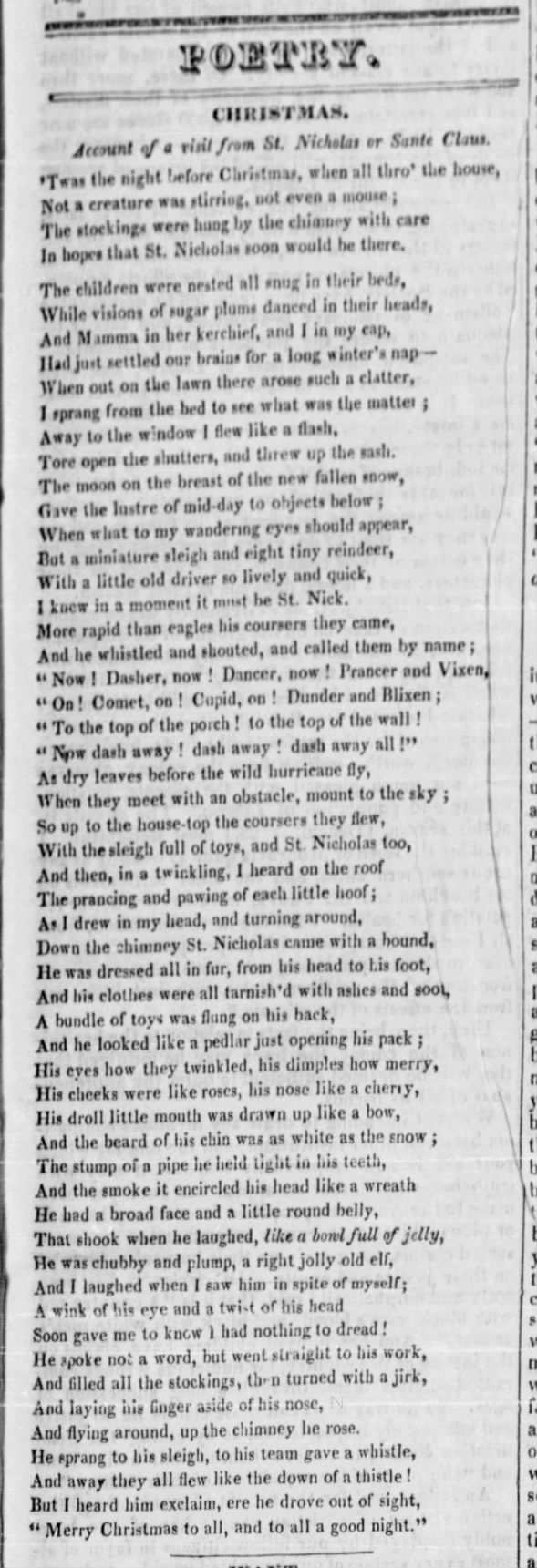
Here are two very early instances from nineteenth-century American newspapers of "Merry Christmas to all" in the last verse of "A Visit from St. Nicholas" aka The Night Before Christmas. The first one appeared in the Boston Patriot & Mercantile Advertiser on Christmas Day 1829; the second in the Long-Island Star on December 22, 1830.
Both versions of The Night Before Christmas appeared under the heading, CHRISTMAS / Account of a visit from St. Nicholas or Sante Claus. Both usages of "Merry Christmas" instead of "Happy Christmas" predate the "earliest" known example from the Schenectady Whig of December 25, 1832, documented by Nancy H. Marshall in her indispensable bibliography of The Night Before Christmas (Oak Knoll Press, 2002).
The Boston Patriot was published by Davis C. Ballard and Edmund Wright. The Long-Island Star was published in Brooklyn, New York by Alden Spooner.
The 1829 and 1830 texts kind of follow the first printing in the Troy Sentinel, with numerous interesting changes. The Boston, MA and Brooklyn, NY reprintings both describe the speaker's children as snugly "nested" rather than "nestled" in their beds. Santa's eighth reindeer is named "Blixen," not Blixem or Blitzen. Two occurrences of the preterit form sprung in the Troy Sentinel printing on December 23, 1823 have been revised or corrected to "sprang." Contractions are mostly eliminated by spelling out words like danced, dressed, and laughed where the Sentinel had printed "danc'd"; "dress'd"; and "laugh'd."
Boston Patriot and Mercantile Advertiser December 25, 1829
One deviation in the Brooklyn reprinting, transcribed below, concerns the way Santa Claus goes back up the chimney after delivering his gifts. Losing the familiar "nod" that Santa usually gives prior to departing, the Long Island Star has him "flying around" before takeoff.
Account of a visit from St. Nicholas or Sante Claus
’Twas the night before Christmas, when all thro’ the house, Not a creature was stirring, not even a mouse; The stockings were hung by the chimney with care In hopes that St. Nicholas soon would be there. The children were nested all snug in their beds, While visions of sugar plums danced in their heads, And Mamma in her ’kerchief, and I in my cap, Had just settled our brains for a long winter’s nap— When out on the lawn there arose such a clatter, I sprang from the bed to see what was the matter; Away to the window I flew like a flash, Tore open the shutters, and threw up the sash. The moon on the breast of the new fallen snow, Gave the lustre of mid-day to objects below; When what to my wondering eyes should appear, But a miniature sleigh and eight tiny rein-deer, With a little old driver so lively and quick, I knew in a moment it must be St. Nick. More rapid than eagles his coursers they came, And he whistled and shouted, and called them by name; “Now! Dasher, now! Dancer, now! Prancer and Vixen, “On! Comet, on! Cupid, on! Dunder and Blixen; “To the top of the porch! to the top of the wall! “Now dash away! dash away! dash away all!” As dry leaves before the wild hurricane fly, When they meet with an obstacle, mount to the sky; So up to the house-top the coursers they flew, With the sleigh full of toys, and St. Nicholas too, And then, in a twinkling, I heard on the roof The prancing and pawing of each little hoof; As I drew in my head, and was turning around, Down the chimney St. Nicholas came with a bound, He was dressed all in fur, from his head to his foot, And his clothes were all tarnish’d with ashes and soot, A bundle of toys was flung on his back, And he looked like a pedlar just opening his pack; His eyes how they twinkled, his dimples how merry, His cheeks were like roses, his nose like a cherry, His droll little mouth was drawn up like a bow, And the beard of his chin was as white as the snow; The stump of a pipe he held tight in his teeth, And the smoke it encircled his head like a wreath He had a broad face, and a little round belly, That shook when he laughed, like a bowl full of jelly, He was chubby and plump, a right jolly old elf, And I laughed when I saw him in spite of myself; A wink of his eye and a twist of his head Soon gave me to know I had nothing to dread! He spoke not a word, but went straight to his work, And filled all the stockings, then turned with a jirk, And laying his finger aside of his nose, And flying around, up the chimney he rose. He sprang to his sleigh, to his team gave a whistle, And away they all flew like the down of a thistle! But I heard him exclaim, ere he drove out of sight, "Merry Christmas to all, and to all a good night."
-- Long-Island Star, December 22, 1830.
Other early versions of The Night Before Christmas where "Merry Christmas" replaces "Happy Christmas" in Santa's parting benediction:
Charleston Courier, December 25, 1829.
Long-Island Farmer, and Queens County Advertiser, January 2, 1833.
Gloucester, Massachusetts Telegraph, January 8, 1834 (also prints "flying around" instead of "giving a nod," as in the Long-Island Star).
Trumansburg Advertiser (Trumansburg, New York) December 23, 1835.
In 1855 Mary C. Ogden made an illustrated manuscript copy of A Visit from St. Nicholas and gave it to her husband for Christmas. Mary Clarke Moore Ogden (1819-1893) was then the oldest surviving daughter of Clement C. Moore, author of the beloved holiday poem universally known as "The Night Before Christmas." In December 1951 LIFE Magazine issued a photo reproduction of Mary Ogden's beautifully calligraphed and "illuminated" version of her father's poem. Published in New York by Time Inc., the December 10, 1951 issue of LIFE with
MOORE'S CLASSIC IN EDITION PAINTED BY HIS DAUGHTER
In the Moore household the poem continued to be a favorite long after the children had grown up, and in 1855 Moore's daughter Mary made a little book of it as a special Christmas present for her husband, John Ogden. In an ornate "Gothic" script she carefully inscribed the verses and decorated the pages with scenes of the old house in the Chelsea section of New York where she and her eight brothers and sisters heard the poem recited by their father every Christmas. -- LIFE Magazine (New York: Time Inc.) December 10, 1951, page 96.
As Niels Henry Sonne pointed out in 1972, "Life named Clement Moore Ogden as the owner" of the original 1855 document. Whereabouts unknown in the early 1970's, according to Dr. Sonne, distinguished librarian of the General Theological Seminary in Manhattan.
Sonne, Niels H. “‘The Night Before Christmas’: Who Wrote It?” Historical Magazine of the Protestant Episcopal Church 41, no. 4 (1972): 373–80 at 377. http://www.jstor.org/stable/42973358.
Update: the original illustrated manuscript was donated by the David D. Ogden family to the Morgan Library & Museum in 2024.
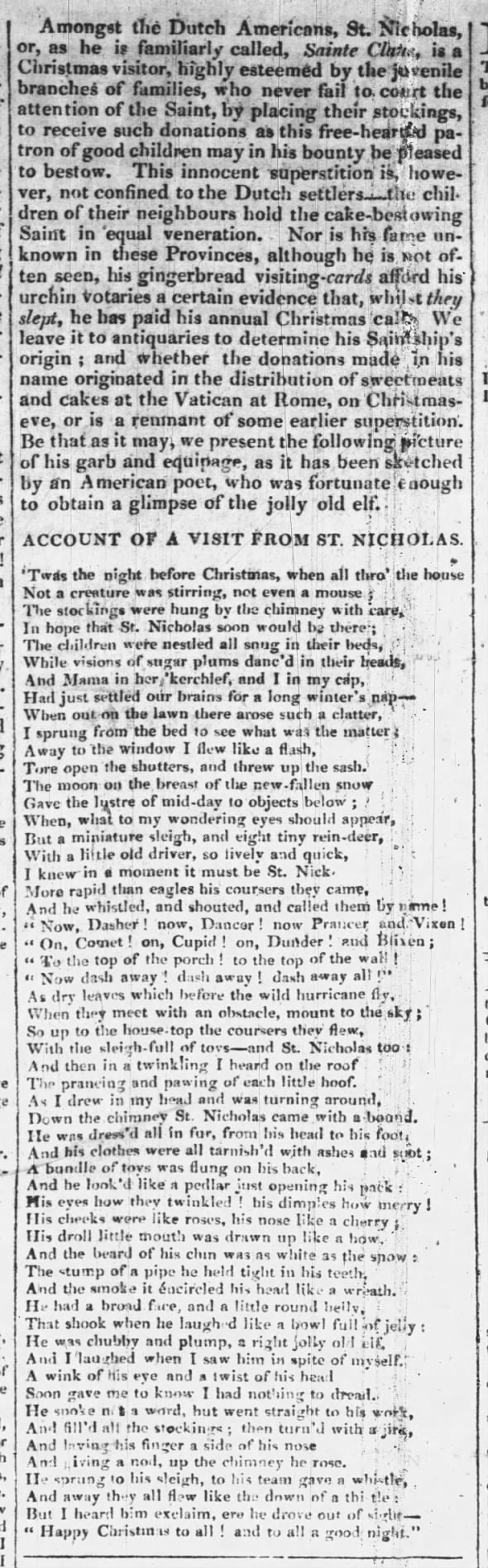
"A Visit from St. Nicholas" was reprinted in the Montreal Gazette on January 4, 1826, with a helpful preface explaining the American Santa Claus to Canadians.
Amongst the Dutch Americans, St. Nicholas, or, as he is familiarly called, Sainte Claus, is a Christmas visitor, highly esteemed by the juvenile branches of families, who never fail to court the attention of the Saint, by placing their stockings, to receive such donations as this free-hearted patron of good children may in his bounty be pleased to bestow. This innocent superstition is, however, not confined to the Dutch settlers--the children of their neighbours hold the cake-bestowing Saint in equal veneration. Nor is his fame unknown in these Provinces, although he is not often seen, his gingerbread visiting-cards afford his urchin votaries a certain evidence that, whilst they slept, he has paid his annual Christmas call. We leave it to antiquaries to determine his Saintship's origin; and whether the donations made in his name originated in the distribution of sweetmeats and cakes at the Vatican at Rome, on Christmas-eve, or is a remnant of some earlier superstition. Be that as it may, we present the following picture of his garb and equipage, as it has been sketched by an American poet, who was fortunate enough to obtain a glimpse of the jolly old elf.
This item is not listed in Nancy H. Marshall, The Night Before Christmas, A Descriptive Bibliography of Clement Clarke Moore's Immortal Poem (Oak Knoll Press, 2002). With interesting exceptions, the text of the still-anonymous poem mostly follows the first printing in the Troy Sentinel on December 23, 1823. Dunder remains Dunder, for example, but Blixem has been re-christened Blixen. Also, the whole roll of reindeer names has been metrically improved by rearranging commas and exclamation marks:
“Now, Dasher! now, Dancer! now Prancer and Vixen! “On, Comet! on, Cupid! on, Dunder! and Blixen...."
Extending to Comet and company in the second line of the couplet, the revisions to punctuation marks around reindeer names in the Montreal Gazette are even more thorough than similar changes in the Charleston Mercury and other 1826 versions. For more on those, check out the earlier post
Another interesting difference is the addition of "which" as a relative pronoun in the distinctive heroic simile that here in this early Canadian version begins
As dry leaves which before the wild hurricane fly.
The 1823 Troy Sentinel version did not supply any word between "leaves" and "before":
As dry leaves before the wild hurricane fly.
Adding "which" makes a regular anapest "which before" in the second metrical foot. In the same line as corrected or revised in the 1844 collection Poems by Clement C. Moore, "that" replaces "which":
As dry leaves that before the wild hurricane fly.
Santa smokes like a chimney wherever he goes, obviously. But here the é with the acute accent, unique to the Montreal Gazette version, tells readers how to say
’Twas the night before Christmas, when all thro’ the house Not a creature was stirring, not even a mouse; The stockings were hung by the chimney with care, In hope that St. Nicholas soon would be there; The children were nestled all snug in their beds, While visions of sugar plums danc’d in their heads, And Mama in her ’kerchief, and I in my cap, Had just settled our brains for a long winter’s nap— When out on the lawn there arose such a clatter, I sprung from the bed to see what was the matter; Away to the window I flew like a flash, Tore open the shutters, and threw up the sash. The moon on the breast of the new-fallen snow Gave the lustre of mid-day to objects below; When, what to my wondering eyes should appear, But a miniature sleigh, and eight tiny rein-deer, With a little old driver, so lively and quick, I knew in a moment it must be St. Nick. More rapid than eagles his coursers they came, And he whistled, and shouted, and called them by name! “Now, Dasher! now, Dancer! now Prancer and Vixen! “On, Comet! on, Cupid! on, Dunder! and Blixen; “To the top of the porch! to the top of the wall! “Now dash away! dash away! dash away all!” As dry leaves which before the wild hurricane fly, When they meet with an obstacle, mount to the sky; So up to the house-top the coursers they flew, With the sleigh full of toys—and St. Nicholas too: And then in a twinkling I heard on the roof The prancing and pawing of each little hoof. As I drew in my head, and was turning around, Down the chimney St. Nicholas came with a bound. He was dress’d all in fur, from his head to his foot, And his clothes were all tarnish’d with ashes and soot; A bundle of toys was flung on his back, And he look’d like a pedlar just opening his pack: His eyes how they twinkled! his dimples how merry! His cheeks were like roses, his nose like a cherry; His droll little mouth was drawn up like a bow, And the beard of his chin was as white as the snow; The stump of a pipe he held tight in his teeth, And the smoke it éncircled his head like a wreath. He had a broad face, and a little round belly That shook when he laughed like a bowl full of jelly: He was chubby and plump, a right jolly old elf, And I laughed when I saw him in spite of myself. A wink of his eye and a twist of his head Soon gave me to know I had nothing to dread. He spoke not a word, but went straight to his work, And fill’d all the stockings; then turn’d with a jirk, And laying his finger a side of his nose And giving a nod, up the chimney he rose. He sprung to his sleigh, to his team gave a whistle, And away they all flew like the down of a thistle: But I heard him exclaim, ere he drove out of sight— "Happy Christmas to all ! and to all a good night."
Mrs. Stephens' Illustrated New Monthly Vol. 2 - January 1857
The image above is from a bound volume of Mrs. Stephens' Illustrated New Monthly in my personal collection, recently acquired from Avenue Victor Hugo Books. Google-digitized versions of 'Twas the Night before Christmas in the January 1857 issue, Volume 2 pages 22 and 23, are accessible online courtesy of HathiTrust Digital Library.
A Visit from St. Nicholas, the beloved poem best known as "The Night Before Christmas," was first published anonymously on December 23, 1823 in the Troy NY Sentinel. The author, seminary professor and poet Clement C. Moore, lived in New York City. For a long time the esteemed Hebrew teacher did not know how his holiday poem wound up in Troy. To him it was strictly a home-made Christmas gift for his kids. Specifically, for the two oldest kids of Clement and Catherine Eliza Moore, daughters Margaret (age 7 in 1822) and Charity Elizabeth (age 6). As Moore later recollected in a published letter to his friend Charles King, then editor of the New York American, he originally wrote the lines describing "a right jolly old elf" and his magical visit on Christmas Eve "somewhere between 1822 and 1824, not for publication, but to amuse my children."
Rumor has it the good professor was initially displeased with the unauthorized publication of his goofy nursery rhymes. Eventually yielding to popular demand, Moore submitted "A Visit from St Nicholas" along with three other poems for publication under his name in The New-York Book of Poetry (1837). A few years later he included "Visit" in the 1844 collection, Poems by Clement C. Moore.
Transmission history
How did Moore's lively lines get from his Chelsea estate in Manhattan to Troy? Along with Orville L. Holley, editor of the Troy Sentinel, two women from Troy, New York deserve credit and our everlasting thanks for immortalizing The Night Before Christmas. This post therefore is dedicated to the memory of Harriet Butler and Sarah Sackett, the ladies who launched Santa Claus from Troy to the universe.
Three nineteenth-century accounts dated 1844, 1862, and 1871 give important information about the transmission of "A Visit from St Nicholas" from manuscript into print. The earliest of these reports is contained in the surviving letter from Norman Tuttle, former owner of the Troy Sentinel, to Clement C. Moore dated Troy, February 26, 1844. Responding to a lost inquiry from Moore "concerning the publication of 'A Visit from St Nicholas' " Tuttle informed him that
The piece was first published in the Troy Sentinel, on December 23, 1823, with an introductory notice by the Editor, Orville L. Holley, Esq., and again two or three years after that. At the time of its first publication I did not know who the Author was — but have since been informed that you were the author. I understood from Mr. Holley that he received it from Mrs. Sackett, the wife of Mr. Daniel Sackett who was then a merchant in this city. It was twice published in the Troy Sentinel; and being much admired and sought after by the younger class, I produced the engraving which you will find on the other side of this sheet, and have published several editions of it.
According to Tuttle, Sentinel editor Orville L. Holley got his copy of "Visit" from Sarah Sackett (1793-1867), wife of Troy merchant Daniel Sackett (1788-1845). How did Sarah Sackett get it? Two stages of copying, at least, are described in the 1862 account that T. W. C. Moore submitted to the New-York Historical Society.
Without naming names, this inveterate antiquarian (a wealthy and well-connected cousin of Henry Livingston Jr., as previously shown on Melvilliana) carefully recorded the crucial roles of two women in copying and transmitting Professor Moore's sprightly verses:
These lines were composed for his two daughters, as a Christmas present, about 40 years ago.—They were copied by a relative of Dr. Moores in her Album, from which a copy was made by a friend of hers, from Troy, and, much to the surprise of the Author, were published (for the first time) in a Newspaper of that city.—
-- Letter from T. W. C. Moore to the Librarian of the New-York Historical Society, dated March 15, 1862 and first published in The New York Historical Society Quarterly Bulletin 2.4 (January 1919) pages 111-115.
Most likely Sarah Sackett was the second copyist, the Troy "friend" of the visiting "relative" who first copied the lines into her "Album" or commonplace book from the author's manuscript. The identity of the first copyist was revealed, maybe for the first time, in the account that "Colonel" John Tappan Parker supplied to the Troy Daily Times where it was printed on December 23, 1871. Transcribed below, the published 1871 testimony from John T. Parker, a well-informed and well-respected citizen of Troy NY, has received comparatively little attention from commentators on the authorship of The Night Before Christmas.
THE "VISIT OF ST NICHOLAS"—MOORE'S POEM—SOME ACCOUNT OF ITS HISTORY—
There is scarcely a boy or girl in the land who has not read the poem entitled "A Visit of St. Nicholas," commencing with the familiar lines:
" 'Twas the night before Christmas, when all through the house
Not a creature was stirring, not even a mouse."
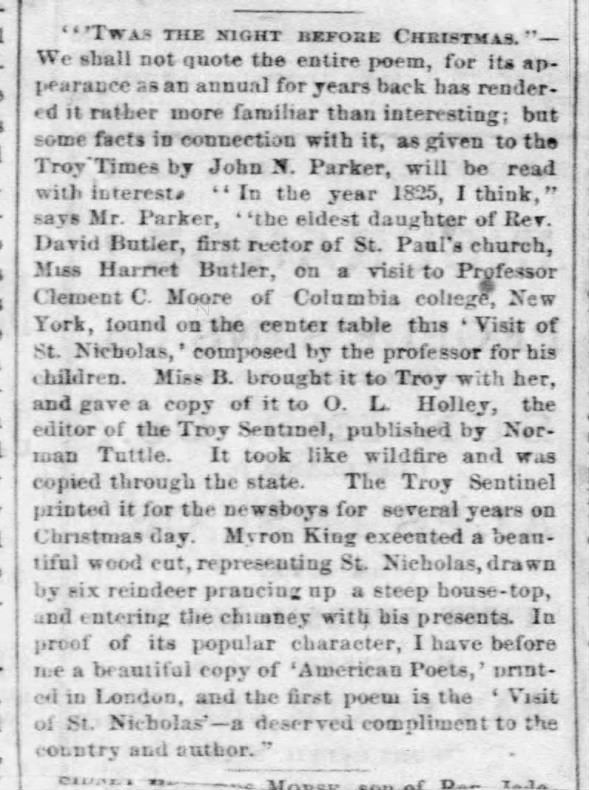
and there are many who even know the poem by heart. It has preserved the author's name from oblivion; and it is an interesting fact to know that Mr. Moore was indebted to a Troy lady for first bringing it to the notice of the public. Indeed, the poem seems to have had something of a Trojan origin; the circumstances of which our well known fellow-citizen John N. Parker [typo for John T. Parker, T for Tappan], thus recounts in a letter to the Times:
Presuming you will publish, as usual, the "Visit of St. Nicholas," quoted above, I send you the enclosed history of it for the benefit of the young Trojans who sleep with one eye open on the night before Christmas. As it has a Trojan birth, it may interest even the editor to hear its narrative as related by me. In the year 1825 I think [1822, actually], the eldest daughter of Rev. David Butler, first rector of St. Paul's church, Miss Harriet Butler, on a visit to Prof. Clement C. Moore of Columbia College, New York, found on the centre table this 'Visit of St. Nicholas,' composed by the Professor for his children. Miss B. brought it to Troy with her, and gave a copy of it to O. L. Holley, the editor of the Troy Sentinel, published by Norman Tuttle. It took like wildfire, and was copied through the state. The Troy Sentinel printed it for the news boys for several years on Christmas day. Myron King executed a beautiful wood cut, representing St. Nicholas on his sleigh, drawn by six reindeer prancing up a steep house-top, and entering the chimney with his presents. In proof of its popular character, I have before me a beautiful copy of "American Poets," printed in London, and the first poem is the "Visit of St. Nicholas"—a deserved compliment to the country and author. Wishing you and yours a right merry Christmas, Mr. Editor, I remain yours,
JOHN T. PARKER.
-- Troy Daily Times. December 23, 1871: 3 col 1.
Reprinted in the Rochester Democrat and Chronicle on Christmas Day 1871:
A longtime resident of Troy, John T. Parker (1803-1874) must have known Miss Harriet Butler (1791-1865), the Troy lady he credits by name with copying "Visit" and supplying it to Orville L. Holley. And Harriet's younger brother, Clement Moore Butler. Parker's 1871 narrative is informed by personal knowledge of Troy and its leading citizens including their father, the well-regarded pastor of St. Paul's Episcopal Church. Indeed, Harriet's father David Butler officiated in 1834 at the wedding of John T. Parker and Martha Lasell.
MARRIED. On Wednesday afternoon, at St. Paul’s Church, by the Rev. David Butler, Mr John T Parker to Miss Martha Lasell, daughter of Mr Elias Lasell, all of this city.
-- Troy Budget, January 10, 1834.
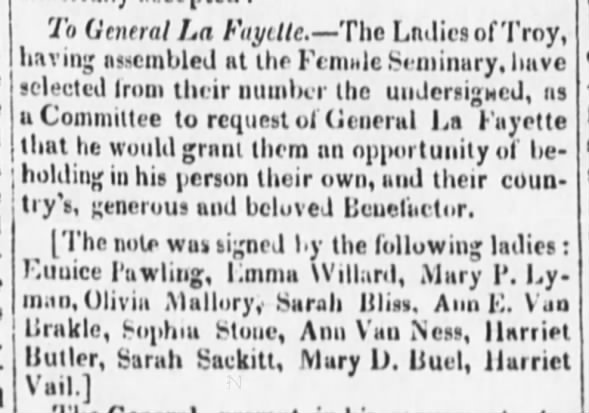
John's wife Martha Lasell Parker (1810-1903) attended the Troy Female Seminary, as the Emma Willard School was then called. Fourteen-year-old Martha Lasell was still a pupil there in September 1824 when the ladies of Troy welcomed the Marquis de Lafayette during his triumphant tour of the United States. As reported previously on Melvilliana, Lafayette was persuaded to visit the Female Seminary after receiving a formal invitation signed by Emma Willard and eleven leading women on the Committee of Arrangements including Harriet Butler and Sarah Sackett. The names of the two ladies who introduced Santa Claus to Troy in December 1823 appeared together on the signed note to General Lafayette from the Committee of Arrangements.
To General La Fayette.— The Ladies of Troy, having assembled at the Female Seminary, have selected from their number the undersigned, as a Committee to request of General La Fayette that he would grant them an opportunity of beholding in his person thier own, and their country's, generous and beloved Benefactor.
[The note was signed by the following ladies: Eunice Pawling, Emma Willard, Mary P. Lyman, Olivia Mallory, Sarah Bliss, Ann E. Van Brakle, Sophia Stone, Ann Van Ness, Harriet Butler, Sarah Sackitt, Mary D. Buel, Harriet Vail.] --New York Evening Post, September 23, 1824.
As a schoolgirl, John T. Parker's future wife Martha Lasell Parker may already have known both Harriet Butler and Sarah Sackett. Near the close of the 19th century, Martha recalled the visit of Lafayette as a highlight of her time at the Troy Female Seminary:
When La Fayette visited the school in 1824, Miss Lassell was still at the Seminary, and participated in the ovation paid to him. The young girls were dressed in white frocks and gay ribbons. A bower of evergreen was erected across the Park to the Seminary building.
Mrs. Willard, attended by her teachers, met General La Fayette at the north gate, while the scholars followed in line, singing an ode of welcome which Mrs. Willard had written for the occasion. --Emma Willard and Her Pupils, edited by Mrs. A. W. Fairbanks (New York: Mrs. Russell Sage, 1898) page 74.
Harriet Butler was 32 years old in 1823; Sarah Sackett just 30 when she reportedly handed Orville Holley a copy of "A Visit from St Nicholas" for publication in the Troy Sentinel. Ten months later they collaborated with Emma Willard and others on the reception of Lafayette. Perhaps other civic and charitable projects brought them together as well, although they worshipped in different places--Harriet of course at St. Paul's Episcopal Church, Sarah at the First Presbyterian Church. Were Miss Butler and Mrs. Sackett ever employed by Mrs. Willard as teachers or assistants at the Troy Female Seminary?
Harriet Butler died in 1865, on the day after Christmas.
Troy Daily Times - December 29, 1865
Sarah Sackett was born Sarah Hammond Pardee on February 9, 1793, in Stephentown, New York. As noted above, when she delivered A Visit from St Nicholas to Orville Holley, Mrs. Sackett belonged to the the First Presbyterian Church of Troy. A few years later she joined the Second Presbyterian Church as a charter member. Contemporary records link Sarah Sackett to a variety of worthy causes including Greek independence, distribution of religious tracts, and donations to the library of the Troy Young Men's Association. After the death of her husband Daniel in 1845, Sarah H. Sackett lived with relatives in Troy and Lansingburgh, New York.
... In Lansingburgh, at the residence of her nephew, Wm S. Hawley, June 23d, Mrs SARAH H., relict of Daniel Sackett, late of Troy, aged 74 years. --Troy Weekly Times, June 29, 1867
The perfunctory announcement of Sarah Sackett's death in the Times prompted this heartfelt tribute signed "E. D." and published in the Troy Daily Times on July 6, 1867.
When an aged saint whose Christian course for more than two score of years has been one of untiring faithfulness and well-doing in the church of Christ, a life-long exhibition of kindness and good will to all around; I say when such a one departs this earthly tabernacle, the occasion seems to demand something more than a passing notice in a daily journal. Such a one has recently been suddenly stricken down in the midst of continued usefulness in the church and the world. All who were familiar with the dear expressive face, the gentle, graceful Christian manners and conversation of the late Mrs. Daniel Sackett, were pained when they read in the Times a few days since, the words which told them of her demise. Though Mrs. S. had not been a constant resident of Troy for a few years past, yet she retained her connection in the communion of the Second Presbyterian Church, Fifth street. Only two weeks previous to her death she came back to the city to spend a Sabbath of sacramental privileges with the church of her earlier love. Though the old church building, dear to the memory of all hearts who once worshipped there, had been swept away by the "destruction that wasted at noonday" and a more beautiful and commodious one erected, yet to her heart, a more thrilling and heart-touching memory must have come, when she remembered that of all that goodly company with whom she united more than forty years by-gone, in the original organization of that same church, probably but one with herself was spared by the hand of death or change to sit down on that occasion at the table of the Lord.
But her work is done, she has gone to her rest quietly, peacefully--gone to the fellowship of Heaven--to a blessed re-union with one, to her, "not lost, but gone before," and to whose memory, her widowed life ever paid a beautiful tribute of devotion.
E. D.
In Fredericton, New Brunswick, Canada, Mary Odell made an early handwritten copy of The Night Before Christmas that stayed in the frozen north. At Hyde Park on the Hudson the family of William Bard allegedly heard " 'Twas the Night Before Christmas" recited by Bard's good friend Clement Moore who
"was very intimate in the family at Hyde Park, and he read to the children his much beloved poem “The Night Before Christmas” from the manuscript before it ever was published."
As far as we know, however, not one of those lucky Bards was bold enough to copy Moore's poem and share it with others via the local newspaper.
Think of it! Moore's classic lines and the fantastic moonlit lustre, the twinkling, the flash of magic they bring to Christmas might never have reached us without the inspired interventions of Harriet Butler and Sarah Sackett. And now, if you please, allow me to refill that glass for this closing
Holiday Toast from Melvilliana
[Nineteenth-century style, to be drunk standing.]
Here's to the ladies of Troy who launched Santa Claus and fêted Lafayette... true in heart and soul, they knew what to do with a "generous and beloved Benefactor."
"As, in the human countenance, more may, oftentimes, be conveyed by a flash of expression than by the most laboured words; so, in the Bible, a whole train of ideas is frequently awakened, or a most powerful effect produced, by some brief phrase or sudden exclamation." -- Clement C. Moore, Lecture Introductory to the Course of Hebrew Instruction (New York, 1825) page 17.
More from C. C. Moore's Lecture Introductory to the course of Hebrew Instruction in the General Theological Seminary of the Protestant Episcopal Church, pages 16-17:
“Those parts of the Hebrew Scriptures which are written in prose, are remarkable for the ease and clearness of their style, and their entire freedom from any thing like ambitious or unnecessary ornament. The descriptions to be found in them are like paintings whose lights and shades are in masses, and whose touches are few and bold. The effect produced by the Hebrew manner of relating is, to place the objects and actions described immediately before the eye of the mind. The leading facts are seized by the author, and all attendant circumstances neglected. Thus a life and vigour are imparted to the descriptions and to the speeches, quite peculiar to the Scripture compositions. As in the human countenance, more may oftentimes be conveyed by a flash of expression than by the most laboured words; so, in the Bible, a whole train of ideas is frequently awakened, or a most powerful effect produced, by some brief phrase or sudden exclamation. These writings possess a wonderful and unrivalled union of pathos and strength. In them everything appears natural and unsought. And, with regard to the character and conduct of persons therein portrayed, the most perfect candour and impartiality are manifest; their vices and crimes are related in as simple and unqualified a manner as their virtues and good actions. No false colouring appears to be thought necessary; all bears the stamp of truth and reality.”
As indicated by the added subtitle in this 1841 reprinting of "A Visit from St. Nicholas," German immigrants in Baltimore would have recognized the fur-clad elf in Clement C. Moore's classic Christmas poem as an Americanized Pelznickel aka Belsnickle, the furry Nicholas. As explained by Phyllis Siefker in Santa Claus, Last of the Wild Men (McFarland, 1997 and 2006):
"Santa's forefather was the very unsaintlike Furry Nicholas, a major player in winter festivals that have been transplanted from Europe to the rugged backwoods of Pennsylvania."
And Maryland, as shown by the expanded title for the poem as reprinted in the Baltimore Clipper on Christmas Day 1841: "A Visit from Saint Nicholas, or Old Belsnickle."
More recently, Tom A. Jerman in Santa Claus Worldwide (McFarland, 2020) describes Pelznickel as "one of the faux Nicholases created following the Reformation." As furry Nicholas displaced the banned Catholic saint, Pelznickel and similar figures
"assumed the role of a secular gift-giver and disciplinarian whereas the virtuous saint performed only good works and required a satanic assistant to do his dirty work."(Jerman, Santa Claus Worldwide, pages 29-30).
Baltimore Clipper (Baltimore, Maryland) December 25, 1841
via GenealogyBank
A VISIT FROM SAINT NICHOLAS,
OR
OLD BELSNICKLE.
'Twas the night before Christmas, when all through the house
Not a creature was stirring, not even a mouse.
The STOCKINGS were hung by the chimney with care,
In hopes that St. NICHOLAS soon would be there;
The children were nestled all snug in their beds,
While visions of sugar-plums danced through their heads;
And Mamma in her 'kerchief, and I in my cap,
Had just settled our brains for a long winter's nap:
When out on the lawn there arose such a clatter,
I sprang from the bed to see what was the matter:
Away to the window I flew like a flash,
Tore open the shutters and threw up the sash.
The moon, on the breast of the new-fallen snow,
Gave the lustre of mid-day to objects below.
When, what to my wondering eyes should appear,
But a miniature sleigh and eight tiny reindeer,
With a little old driver, so lively and quick,
I knew in a moment it must be St. Nick.
More rapid than eagles his coursers they came,
And he whistled, and shouted, and call'd them by name:
"Now, Dasher! now, Dancer! Now, Prancer! Now, Vixen!
On! Comet, on! Cupid, on! Donder and Blixen--
To the top of the porch! to the top of the wall!
Now, dash away, dash away, dash away all!"
As leaves that before the wild hurricane fly,
When they meet with an obstacle, mount to the sky,
So up to the house-top the coursers they flew,
With the sleigh full of toys--and St. Nicholas too.
And then in a twinkling I heard on the roof
The prancing and pawing of each little hoof.
As I drew in my head, and was turning around,
Down the chimney St. Nicholas came with a bound.
He was dressed all in fur from his head to his foot,
And his clothes were all tarnished with ashes and soot;
A bundle of toys he had flung on his back,
And he look'd like a pedlar just opening his pack.
His eyes, how they twinkled! his dimples, how merry!
His cheeks were like roses, his nose like a cherry;
His droll little mouth was drawn up like a bow,
And the beard on his chin was as white as the snow.
The stump of a pipe he held tight in his teeth,
And the smoke it encircled his head like a wreath.
He had a broad face, and a little round belly,
That shook, when he laugh'd, like a bowl full of jelly.
He was chubby and plump; a right jolly old elf:
And I laugh'd, when I saw him, in spite of myself.
A wink of his eye, and a twist of his head,
Soon gave me to know I had nothing to dread.
He spoke not a word, but went straight to his work,
And fill'd all the stockings; then turn'd with a jerk,
And, laying his finger aside of his nose,
And giving a nod, up the chimney he rose.
He sprang to his sleigh, to his team gave a whistle,
And away they all flew like the down of a thistle;
But I heard him exclaim, ere he drove out of sight,
"Happy Christmas to all, and to all a good night!"