Showing posts with label Gansevoort Melville. Show all posts

Saturday, June 8, 2024

Charles Cromwell Ingham, "the portrait painter" Herman's sister Helen Melville met in Lenox

Ingham not Inman was "the portrait painter" Helen Melville met in September 1841, socializing with Lemuel Shaw and family in Lenox, Berkshire County MA. Her and Herman's brother Gansevoort was there too. I liked to imagine Herman somewhere Off Tahiti at the time, but in truth he would not really get there until 1842. In September 1841 when his sister Helen and brother Gansevoort were at Lenox enjoying the company of Sedgwicks, Shaws, and Charles Ingham the portrait painter, Herman was whaling away on the Acushnet, near the equator. Still broad upon the waters of the Pacific Ocean, with a month and more to pass before his ship would reach the Galápagos Islands. 

Charles Cromwell Ingham, ca. 1860.
Macbeth Gallery records, 1947-1948. Archives of American Art,
Smithsonian Institution

Herman's sister Helen Melville, writing from Lansingburgh, New York to Augusta Melville (then in Bath, a town in Steuben County, New York) on October 10, 1841:
"... Here is almost the end of my third page, and not a word has been said about my weeks visit to the East, the only thing that has broken in upon the monotony of my existence since the early Spring. We had a delightful time. Miss Sedgwick was staying there too, and then at ... hotel were all the Judges, (it being court week) all of ... most delightful companions. Judge Shaw & his dear lady wife, were most affectionate indeed to me. I could scarcely credit that persons comparatively strangers should take such a warm interest in Gan. & myself. Gan staid at the Hotel, but spent all his evenings with us, and made all together a most delightful coterie, what with the judges, judges ladies, Miss S. & Mr. Ingham the portrait painter, who was on a professional visit there. Mrs Shaw insists upon my making her a long visit this winter in Boston; both herself & husband gave me the most pressing & earnest invitations, & Mama says I may go, if there is any way for me to reach there short of Gan's taking me, which of course should not be thought of."

Citation

Manuscripts and Archives Division, The New York Public Library. "Melville (Griggs), Helen" The New York Public Library Digital Collections. 1835 - 1863. https://digitalcollections.nypl.org/items/5398c3b0-4711-0136-d653-7d8db716e78a

Detail


Helen Melville would have stayed and socialized with Charles Sedgwick and his wife Elizabeth Sedgwick, Helen's former teacher. I suppose "Miss Sedgwick" must be Catharine Maria Sedgwick the famous novelist who definitely was in Lenox at that time, September 1841. Charles Ingham had painted the portrait of C. M. Sedgwick many years before. 


Who then is "Miss S."? Melville biographers have a bit too readily identified her as Miss Elizabeth Knapp Shaw, Helen's future sister-in-law. Other candidates worth considering would be the aforementioned authoress Catharine Maria Sedgwick; or Helen's then-unmarried friend Kate aka "Kitty," Katharine Sedgwick Minot (daughter of Charles Sedgwick and Elizabeth Buckminster Dwight Sedgwick); or another, evidently older "Miss Shaw" in the Shaw household, mentioned twice in Helen's letter to Augusta from Boston dated November 27, 1843. 

Hershel Parker gives the fullest treatment of Helen Melville's 1841 interactions with the Shaw family in Herman Melville: A Biography Volume 1, 1819-1851 (Johns Hopkins University Press, 1996). Parker's excerpt from Helen's letter of October 10, 1841 to Augusta appears on page 301. As can be seen above in the image from Helen's letter in the Augusta Melville papers, now accessible via NYPL Digital Collections, Charles Ingham not Henry Inman was "the portrait painter" then making "a professional visit" to the Sedgwicks in Lenox. Attending closely to Helen's experience of Boston theatricals and tableaux vivants during her extended visits to Boston in 1842-3, John Bryant makes good use of Helen's later letters to Augusta in the second volume of Herman Melville: A Half Known Life (Wiley Blackwell, 2021) at pages 1135-1144. 

Related posts:

  • Pantomime with mock pier mirrors seen by Helen Melville at the Boston Museum
    https://melvilliana.blogspot.com/2024/06/pantomime-with-mock-pier-mirrors-seen.html

Tuesday, April 23, 2024

Sunday, February 12, 2023

Whiskered, powdered and dandyfied Gansevoort

Gansevoort Melville
The New York Public Library Digital Collections

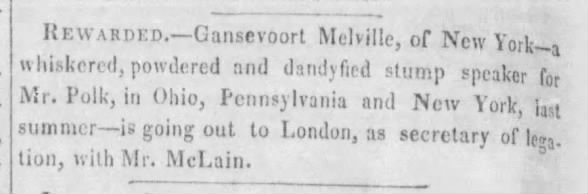
Before and after the 1844 presidential election, some political opponents of Gansevoort Melville (Herman's older lawyer-brother) called him a Broadway exquisite or dandy, mocking his supposedly over-the-top devotion to fashionable clothing and personal appearance. Gansevoort's success as a popular democratic orator eventually won him a respectable diplomatic post in London. Down in Hinds County, Mississippi, editor George W. Harper, age 21, could not resist the chance to depict the newly appointed Secretary of Legation as "a whiskered, powdered and dandyfied stump speaker."

08 Aug 1845, Fri Hinds County Gazette (Raymond, Mississippi) Newspapers.com

"REWARDED.-- Gansevoort Melville, of New York--a whiskered, powdered and dandyfied stump speaker for Mr. Polk, in Ohio, Pennsylvania and New York, last summer--is going out to London, as secretary of legation, with Mr. McLain." -- Raymond Gazette, August 8, 1845.


A dandified hair-dresser in his salon arranging a woman's wi Wellcome V0019828 

Related posts:

Wednesday, July 6, 2022

Four real presidents of the Albany YMA, and one really fake president

In 1830, Herman Melville's father Allan lost his business and moved with the wife and kids from Manhattan to Albany, New York. Allan Melville (often spelled Melvill) died in 1832. When the family could afford tuition, Herman went to the Albany Classical School and Albany Academy. For a while in 1835-7, Herman and his older brother Gansevoort also belonged to the recently established Young Men's Association of Albany. The Albany YMA had been founded in December 1833, with a constitution "signed by about seven hundred and fifty names" as recalled in one 1888 retrospective.

via The New York Public Library Digital Collections
The first real president of the Albany YMA was Albany lawyer Amos Dean (1803-1868), a native of Vermont and later the first president of the University of Iowa
J. T. M. “Amos Dean.” The American Law Register (1852-1891) 16, no. 5 (1868): 257–60. https://doi.org/10.2307/3303185.
After Amos Dean, Robert E. Ward became the second real president of the Albany YMA. Formerly 1st Vice President, Ward succeeded Dean in February 1835. 

As it happened, Ward only served a few months of his presidential term. Suddenly westward bound "for the Territory of Michigan," Ward resigned his position in April 1835 and moved to the village of Berrien, later Berrien Springs. Ward's unexpected departure for Michigan was acknowledged by the executive committee with "thanks for the able, faithful, and impartial manner in which he has discharged the duties of his office as President of the Young Men's Association" (Albany Argus, April 10, 1835). Ward eventually settled in Detroit where he died in 1847.

After Robert E. Ward, the third real president of the Albany Young Men's Association was Charles A. Hopkins (1802? - 1864). As announced in the Albany Argus, the former 2nd Vice President was elected President at a special "meeting of the Executive Committee of the Young Men's Association, held April 11th, 1835."

Albany Argus - April 17, 1835
via GenealogyBank

The following year, Charles A. Hopkins was elected to a regular one-year term of office. The election or more precisely re-election of Hopkins as president of the Young Men's Association was announced in the Albany Argus on February 5, 1836.

Albany Argus - February 5, 1836

When his presidency ended, Hopkins (like Ward before him) headed out for Michigan (Albany Argus, April 18, 1837), though he would relocate to Buffalo NY. "General" Hopkins died there in September 1864, remembered as a distinguished militia officer and model citizen:
"one of our prominent dock merchants, highly honored on account of his  integrity, and greatly esteemed for his many estimable social qualities." -- Buffalo Morning Express, September 30, 1864
In February 1837 John Davis (1807-1847) became the fourth president of the Albany Young Men's Association.

Albany Argus - February 7, 1837

All past presidents of the Albany Young Men's Association to 1886, including the first four, are named in the Bi-centennial history of Albany (New York, 1886) conveniently accessible via Google Books:

https://books.google.com/books?id=WVnVDwAAQBAJ&pg=PA690&dq#v=onepage&q&f=false


There then are your four real presidents. Now for the fake one....

Gansevoort Melville 
via The New York Public Library Digital Collections

As John Bryant tells it 5x in the first volume of Herman Melville: A Half Known Life (Wiley Blackwell, 2021), Herman's brother Gansevoort Melville experienced a meteoric rise to the presidency of the Albany YMA:
"For a three-year period ending with the Panic of 1837, Gansevoort continued his networking at Albany's Young Men's Association, rising swiftly to become the group's president, probably its youngest to date. He was on track to become a paragon of Albany's youth."  (page 247)

"Gansevoort worked on his networking skills in the fur trade and moved up in the YMA's governing structure: he was listed as part of the executive committee that fall; and in January 1836, following in the footsteps of John Bleecker Van Schaick, he was elected president of the organization." (251)

"At 20, his election to the presidency of the Young Men's Association in January came with the honor of his public oration of the Declaration of Independence during Albany's Fourth of July celebrations." (324)

"Gansevoort had completed his term as president of the YMA in December 1836, had overseen the induction of Herman into the association, and had remained on the executive committee; but given the failure of his business, he had withdrawn in 1837. (360) 

"Two years earlier, he had had the honor of reciting the Declaration of Independence as a representative of the Young Men's Association. Once its president, he had now resigned from the group. In his place, Albany's paragon of young manhood, his distant cousin and the scion of a great Albany family, John Bleecker Van Schaick, would step to the podium to read the Declaration."  (384)

Bryant claims that Gansevoort Melville was elected president of the Albany YMA in January 1836. But Gansevoort was never really president of the entire Albany Young Men's Association. In October 1835 Gansevoort did manage to get elected second vice-president of the Debating Society (Always known as the "Young Men's Debating Society," and not to be confused with the upstart Philo Logos Society whose presidents included Charles Van Loon and his later famous rival, Herman Melville.) 

Albany Journal - October 30, 1835
via GenealogyBank
Gansevoort had joined the Debating Society in 1834, introduced by his good friend Alexander W. Bradford. On January 23, 1836, according to meeting minutes reported by Jay Leyda in The Melville Log (volume 1, page 66), Gansevoort was elected "President of the Debating Society in the Young Men's Association." Evidently, Bryant has confused the Debating Society of the YMA with the institution as a whole. Gansevoort's position on the Executive Committee of the YMA in 1835-7 was only held by virtue of his involvement in the Debating Society--where the officers were often the only persons in attendance, according to "Juvinis" in December 1837, writing to the editor of the Albany Evening Journal. Previously transcribed on Melvilliana:
In early 1835 Gansevoort had tried and failed to get elected to the office of Recording Secretary. Just two days after Herman's admission to the YMA on January 29, 1835, his big brother chaired a Saturday night meeting and got himself nominated for Recording Secretary, as announced in the Albany Evening Journal on February 3, 1835:

Albany Journal - February 3, 1835
When the annual election was held on February 3rd, Gansevoort lost out to Daniel Fry,  as reported in the Albany Argus on February 10, 1835: 

Albany Argus - February 10, 1835
via GenealogyBank
Gansevoort Melville's public reading of the Declaration of Independence on July 4, 1836 was indeed well received, as Bryant like every biographer after Leyda indicates. The distinction might seem a little diminished, however, if you admit (Bryant does not) that the annual 4th of July reading of the Declaration traditionally preceded a longer speech, formally delivered by another, preferably more distinguished orator. Thus, at the public celebration by the Young Men's Association of Albany in 1836, Gansevoort merely opened for future YMA President John Davis whose 4th of July oration "was a production creditable as well to the author as to the choice of the Association" (Albany Argus, July 8, 1836).

Albany Argus - July 8, 1836
via GenealogyBank

Moreover, by the time Gansevoort spoke, the good citizens of Albany had already heard the Declaration of Independence read earlier in the day by W. H. Fondey, "in an appropriate and effective manner." Fondey's reading took place during the "numerously attended" main event, "customary exercises at the Pearl-street Methodist Church." Fondey opened for a genuine "pulpit orator" in the Rev. Edward Norris Kirk, whose 4th of July speech was duly praised as "vigorous in style and thought, and eloquent and impressive in the delivery." 


Not only that, it rained all day "with little intermission" (Albany Argus, July 8, 1836). As previously reported on Melvilliana:
After the event the arrangements committee of the Young Men's Association published customary resolutions expressing thanks to all concerned, starting with John Davis:
Resolved, That the members of this committee in behalf of the Association, tender to J. Davis Esq., their thanks for his eloquent and patriotic oration, delivered before the Association.

Resolved, That the thanks of the Association be also tendered to Mr. G. Melville, for the prompt and pleasing manner in which he discharged his duty as reader.

Resolved, That the members of the Albany Sacred Music Fund Society for the deep interest manifested by them, in the prosperity of the Association, and for the skill and taste displayed in their performance, deserve and we heartily tender the sincere thanks and appreciation of the committee. 
Resolved, That the soldier-like and gentlemanly bearing of the Albany Union Guards, was highly creditable to themselves and gratifying to the committee.

Resolved, That the committee are under great obligation to Mr. W. R. Bush, for his active and efficient discharge of the duty of Marshal of the day.

J. H. WILDER, Cha'n.  --Albany Evening Journal, July 6, 1836

Featured speaker John Davis would be elected president of the Albany YMA before their next Fourth of July celebration.  

In spite of his meaningful yet modest success as designated "reader" on Independence Day 1836, Gansevoort Melville could never get elected Recording Secretary of the Young Men's Association in Albany. Not even with brother Herman's help in a possibly rigged election. 

PRESIDENT??? FAKE NEWS!!!!


Friday, January 14, 2022

Remembering Gansevoort Melville

Gansevoort Melville
The New York Public Library Digital Collections

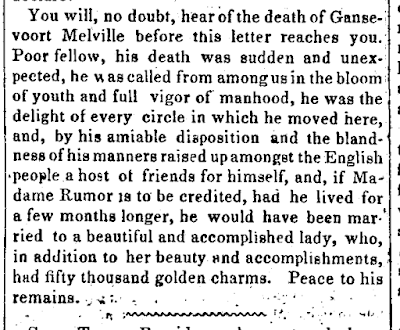
Portions of an "Interesting Letter / From London" dated June 18, 1846 appeared in the New York Sunday Dispatch on July 19, 1846. In one extract the writer, identified only as "an American gentleman," reveals that he knew Gansevoort Melville in London and laments his recent death. The rumor of Gansevoort's engagement there "to a beautiful and accomplished lady" is news to me.


You will, no doubt, hear of the death of Gansevoort Melville before this letter reaches you. Poor fellow, his death was sudden and unexpected, he was called from among us in the bloom of youth and full vigor of manhood, he was the delight of every circle in which he moved here, and, by his amiable disposition and the blandness of his manners raised up amongst the English people a host of friends for himself, and, if Madame Rumor is to be credited, had he lived for a few months longer, he would have been married to a beautiful and accomplished lady, who, in addition to her beauty and accomplishments, had fifty thousand golden charms. Peace to his remains.  

-- "Interesting Letter from London," New York Sunday Dispatch, July 19, 1846; found on genealogybank.com.

As will be shown, hopefully, in subsequent posts, the Sunday Dispatch warmly endorsed the first two books of Gansevoort's younger brother Herman Melville. 

Related posts:

Tuesday, October 19, 2021

Another Mrs. Tomlinson

Daily Albany Argus - January 4, 1847
 found on Fultonhistory.com

Herman Melville gave one very early copy of his first book to a "Mrs. Tomlinson." Before now, this Mrs. Tomlinson has been identified in Melville scholarship as the wife of Gansevoort Melville's friend and fellow lawyer Theodore Edwin Tomlinson (1817-1887). As Hershel Parker noticed, Mrs. Tomlinson was privileged to receive her signed copy of Typee before close family members and other friends got theirs:
"On 18 March, in the excitement of being an author, Herman inscribed a copy of Typee to the wife of Gansevoort's friend Theodore Tomlinson, rather than saving all the first copies for older acquaintances and family." -- Herman Melville: A Biography Volume 1, 1819-1851 (Johns Hopkins University Press, 1996) pages 406-7.
In The Melville Log, Jay Leyda cited "Martin" for the gift of Typee to "Mrs. [Theodore E.?] Tomlinson" on March 18, 1846, referencing the "Collection of H. Bradley Martin, Jr, New York." In January 1990 this item was sold at auction by Sotheby's along with other Melville rarities from Martin's extraordinary collection, as Lynn Horth reported in Melville Society Extracts Number 80 (February 1990) pages 10-11. Lot 2141, the first American edition of Typee inscribed to Mrs. Tomlinson, was acquired by the Nineteenth Century Shop.

The full inscription as described in an earlier sale catalog:
... PRESENTATION COPY FROM THE AUTHOR, inscribed on the front end-leaf: "Mrs. Tomlinson from the author March 18, 1846."  -- Sales - Parke-Bernet Galleries

Abby E. Tomlinson (1820-1907)


New York Spectator - December 21, 1844

As a young attorney in New York City during the early 1840's, Gansevoort Melville shared the law office of Albany friends and mentors Alexander W. Bradford and Theodore Edwin Tomlinson. Both Bradford and Tomlinson were committed Whigs, while Gansevoort passionately sided with Democrats and would become a celebrity orator on behalf of Polk in the 1844 presidential campaign. Theodore did not get married until after the election. His new wife was the former Abigail Esther Walden (1820-1907), aka "Abby." Abby E. Walden married Theodore E. Tomlinson on December 11, 1844, just two months after Herman Melville returned home on the frigate United States. (Did Herman Melville or his brother Gansevoort attend their wedding at the Church of the Ascension in NYC?) Abby was the youngest daughter of Thomas Treadwell Walden (1779-1825) and Esther Franklin (1789-1874).

As noted in Gansevoort Melville's 1846 London Journal, edited by Hershel Parker (The New York Public Library, 1966), pages 46 and 53, Gansevoort mailed newspapers to "Mrs Tomlinson" but not (why not?) her husband, Gansevoort's old friend Theodore E. Tomlinson. In 1846 Theodore and his new wife Abby lived in New York City. Gansevoort, age 30, was in London sending letters and newspapers to family and friends in the United States, and by March Herman was autographing copies of his first book. Theodore's wife, being 26 years old in 1846, does not really fit the pattern observed by Hershel Parker regarding Gansevoort's attentiveness to 
"women married to powerful men, women somewhat older than he."
In Lansingburgh, NY Herman Melville did not fail to inscribe and mail one copy of Typee to its distinguished dedicatee, Lemuel Shaw in Boston. Other known recipients of Typee from the author himself in March 1846 lived nearby in Albany and Troy, NY: aunt Susan L. Gansevoort (Albany), cousin Maria Peebles (Troy), and William E. Cramer, assistant editor of the Albany Argus

Anna Staples Tomlinson (1806-1873)


Another, older Mrs. Tomlinson also lived in Albany, New York where she had moved in 1834 with her husband and children. This was Anna Staples Tomlinson (1806-1873), wife of Theodore's cousin Oliver Mead Tomlinson (1796? -1867). Let's restore the question mark that Jay Leyda attached in volume one of The Melville Log, page 207, to his tentative identification of 
"Mrs [Theodore E.?] Tomlinson"
as the person whom Melville generously blessed with a signed copy of Typee on March 18, 1846. 

?


Done! Now then... was Mrs. Anna S. Tomlinson in Albany the real correspondent of Gansevoort and fortunate recipient of Herman Melville's first book? Anna (age 40) and Oliver M. Tomlinson (about 50?) had been married more than twenty years when Gansevoort was writing to "Mrs. Tomlinson" from London. When Gansevoort was appointed Secretary of Legation, O. M. co-managed the Stanwix Hall Hotel in Albany. Stanwix Hall was the magnificent marble building at Broadway and Maiden Lane, constructed in 1833 by Gansevoort and Herman Melville's Dutch-descended uncles, Herman Gansevoort and Peter Gansevoort.

O. M. and Gansevoort's friend Theodore E. Tomlinson were Connecticut cousins; their fathers were sons of Joseph Tomlinson (1741-1813).

In Albany O. M. Tomlinson previously operated a line of packet boats on the Erie Canal. He owned or co-owned the Western Navigation Company, then an important company of canal "forwarders."
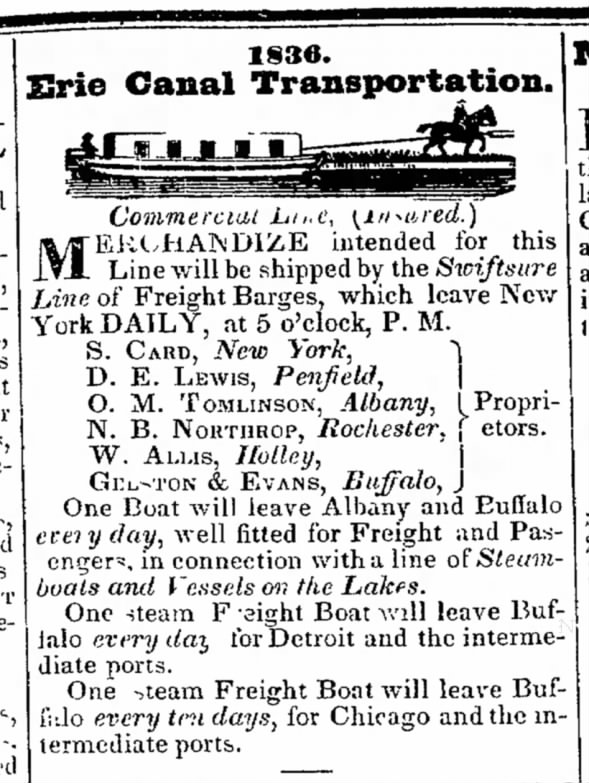
Thu, Nov 3, 1836 – Page 4 · The Weekly Wisconsin (Milwaukee, Wisconsin) · Newspapers.com
In 1844-5 O. M. Tomlinson lived at 24 Dallius according to the Albany City Directory

In March 1845, celebrating St. Patrick's Day at Stanwix Hall, O. M. Tomlinson gave the following toast:

Irishmen, the readiness with which they adapt themselves to the laws of freemen in America, the active lead and steadfast manner in which they maintained the cause of Temperance, the peaceable and orderly manner free discussion has been conducted on political subjects in large assemblages, clearly shows that the Irish people are capable of self-government, and that Ireland of right ought to have a Parliament of her own.

 --Albany Evening Journal, April 1, 1845; reprinted in the Albany Argus on April 7, 1845.

During the fall of 1845, O. M. Tomlinson ran Stanwix Hall in partnership with Daniel Comstock.

Albany Argus - September 30, 1845
 STANWIX HALL.-- This favorite Hotel has recently been still farther improved and enlarged by the annexation of the new four story building in Broadway, adjoining, which gives it forty feet more front on that fine avenue. The addition comprises some twelve parlors, with bed-rooms adjoining, peculiarly well adapted for winter boarding. The present proprietors of Stanwix Hall are Messrs. TOMLINSON and COMSTOCK, who with the energy of new lessees, are constantly making additional efforts to render their fine House more worthy of the patronage of the traveling public.
During the coming winter, Albany will present an array of Public Houses that would do credit to any city in the Union, not even excepting New York.  --Albany Argus, September 30, 1845.
The Schenectady Cabinet - September 30, 1845 via NYS Historic Newspapers

The brief partnership between O. M. Tomlinson and Daniel Comstock was formally dissolved in late November 1845.
THE Copartnership heretofore existing between the subscribers is this day dissolved by mutual consent, all debts of the firm of Tomlinson & Comstock will be paid by the said Comstock, and all debts due the said firm will be paid to the said Comstock, at Stanwix Hall in the city of Albany. Dated Albany, November 26, 1845.

O. M. TOMLINSON
DANIEL COMSTOCK

The business of STANWIX HALL will be conducted hereafter by Daniel Comstock and Charles H. Comstock under the firm of D. COMSTOCK 7 SON, who will settle all unsettled business of Tomlinson & Comstock.-- A share of public patronage is respectfully solicited. D. COMSTOCK & SON.

The Albany City Directory for 1845/6 lists Wheeler and Tomlinson as "proprietors of Stanwix Hall." 

Afterwards Mrs. Tomlinson was associated by that name with the operation of a hotel or boarding house at 21 Hamilton street in Albany. State legislators reported to be staying in Albany with "Mrs. Tomlinson" in January 1847 were Senators Thomas J. Wheeler, Enoch B. Talcott, and Henry J. Sedgwick.  

Daily Albany Argus - January 4, 1847
via Fultonhistory.com

As announced in the Albany Evening Journal, proprietorship of the boarding house at 21 Hamilton street "lately occupied by O. M. Tomlinson, Esq." was assumed by a "Miss Ball" in May 1848. 

Albany Evening Journal - May 2, 1848
"BOARDING. Miss Ball has taken House No. 21 Hamilton street, lately occupied by O. M. Tomlinson, Esq., where she will be pleased to accommodate a select number of Boarders from the 1st of May...."

Bill Poray gives an entertaining account of "The Amazing Life and Times of Oliver Mead Tomlinson" in the Perinton Historical Society Historigram, Vol. 44 No. 8, May 2012.

"In the spring of 1825, Mr. Tomlinson married Ann Staples, daughter of Olney and Susannah Staples, the proprietors of Staples Tavern in Egypt. The Tomlinsons had three children, Ann Eliza, born in 1828, a son, Victory, born in 1830, and a second daughter, Statira, born in 1834. Not long after the birth of Statira, her father's business pursuits took him to Albany, and later, to the western frontier."

In 1854, the Tomlinsons' daughter Statira Tomlinson (1834-1925) married New Yorker William Maltman in Nevada City, California. William died there in 1870. 

O. M. Tomlinson is the subject of another article by Bill Poray, "The ingenuity and incarceration of a Perinton Pioneer" in the May 2019 Historigram

After his adventures out west, Oliver Mead Tomlinson left California and returned to Albany NY where in 1863 he lectured at Tweddle Hall on "How to Silence Southern Guns."

Albany Evening Journal - March 14, 1863
via Genealogy Bank

O. M. Tomlinson died in Cheektowaga, Erie County, New York on September 30, 1867.

A letter was received yesterday by William Mattman, notifying him of the death of his father in law, Oliver M. Tomlinson. He died near Buffalo, on the 30th of September, aged seventy years. Mr. Tomlinson resided in Nevada for Many years, and carried on an extenstive mining operation at Mansanita Hill. He returned East in 1862, and has since resided near Buffalo.  --Marysville CA Daily Appeal, October 26, 1867.
Oliver's widow Anna Staples Tomlinson died in Fairport, New York on November 20, 1873 according to her obituary in the Buffalo Express. The "late Mrs. A. R. Cobb" refers to Mrs. Tomlinson's daughter Ann Eliza or Eliza Anna Tomlinson (1828-1862) who married Ansel R. Cobb (1806-1884) in Buffalo, NY on September 19. 1849.
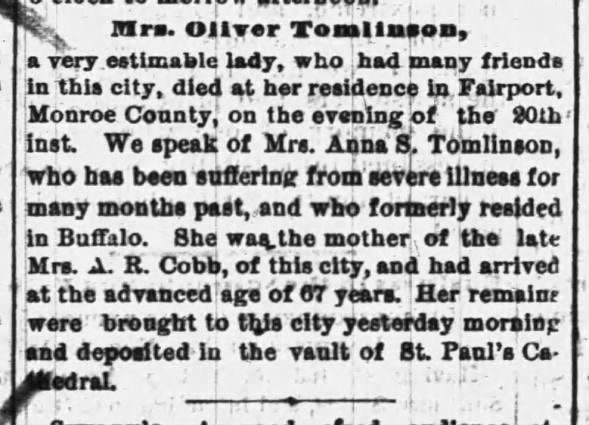
25 Nov 1873, Tue Buffalo Morning Express and Illustrated Buffalo Express (Buffalo, New York) Newspapers.com

Mrs. Oliver Tomlinson, 

a very estimable lady, who had many friends in this city, died at her residence in Fairport, Monroe County, on the evening of the 20th inst. We speak of Mrs. Anna S. Tomlinson, who has been suffering from severe illness for many months past, and who formerly resided in Buffalo. She was the mother of the late Mrs. A. R. Cobb, of this city, and had arrived at the advanced age of 67 years. Her remains were brought to this city yesterday morning and deposited in the vault of St. Paul's Cathedral.  
--Buffalo Express, November 25, 1873.

Saturday, July 4, 2020

Declaration of Independence makes a difference

It rained on the Fourth of July in 1836, but the patriotic citizens of Albany, New York "celebrated with an ardor which nothing could dampen" (Albany Argus, July 8, 1836). Festivities back then included traditional readings of the Declaration of Independence. At the Methodist church on Pearl Street, William Hun Fondey recited the Declaration "in an appropriate and effective manner." At the Second Presbyterian church, Gansevoort Melville, age 20, showed off his oratorical prowess for the Albany Young Men's Association.

... The day was also observed by the Young Mens' Association in this city. The exercises were in the Second Presbyterian church. The Declaration of Independence was read, and well read, by Mr. G. MELVILLE. The oration which we learn was a production creditable as well to the author as to the choice of the Association, was pronounced by JOHN DAVIS, esq. The members were out in great numbers with their badges and banner, and of themselves formed a large procession, exclusive of its citizens, with whom the Association continues to be, as it deserves, a favorite as it is a flourishing and valuable institution. --Albany Argus, July 8, 1836; found at GenealogyBank
Writing in 1849, Gansevoort's brother Herman Melville imagined the literary freedom Shakespeare might have enjoyed as a great American truth-teller, asserting that "the Declaration of Independence makes a difference."

For I hold it a verity, that even Shakespeare, was not a frank man to the uttermost. And, indeed, who in this intolerant Universe is, or can be? But the Declaration of Independence makes a difference. --letter to Evert A. Duyckinck, March 3, 1849
Citation:
Manuscripts and Archives Division, The New York Public Library. "1846-1849" New York Public Library Digital Collections. Accessed July 4, 2020. http://digitalcollections.nypl.org/items/df49f430-16c2-0133-5bcc-58d385a7bbd0
This liberating power in the Declaration of Independence would somehow give Melville the creative freedom he needed to write Moby-Dick (1851).

President Trump in his important July 3rd 2020 speech at Mount Rushmore rightly honored the "founding ideals" proclaimed and symbolized by the Declaration of Independence.
We will proclaim the ideals of the Declaration of Independence, and we will never surrender the spirit and the courage and the cause of July 4th, 1776. 
Upon this ground, we will stand firm and unwavering. In the face of lies meant to divide us, demoralize us, and diminish us, we will show that the story of America unites us, inspires us, includes us all, and makes everyone free. 
We must demand that our children are taught once again to see America as did Reverend Martin Luther King, when he said that the Founders had signed “a promissory note” to every future generation. Dr. King saw that the mission of justice required us to fully embrace our founding ideals. Those ideals are so important to us — the founding ideals. He called on his fellow citizens not to rip down their heritage, but to live up to their heritage. (Applause.)
Above all, our children, from every community, must be taught that to be American is to inherit the spirit of the most adventurous and confident people ever to walk the face of the Earth. 
Americans are the people who pursued our Manifest Destiny across the ocean, into the uncharted wilderness, over the tallest mountains, and then into the skies and even into the stars. 
We are the country of Andrew Jackson, Ulysses S. Grant, and Frederick Douglass. We are the land of Wild Bill Hickock and Buffalo Bill Cody. (Applause.) We are the nation that gave rise to the Wright Brothers, the Tuskegee Airmen — (applause) — Harriet Tubman, Clara Barton, Jesse Owens, George Patton — General George Patton — the great Louie Armstrong, Alan Shepard, Elvis Presley, and Mohammad Ali. (Applause.) And only America could have produced them all. (Applause.) No other place. 
-- Remarks by President Trump
<https://trumpwhitehouse.archives.gov/briefings-statements/remarks-president-trump-south-dakotas-2020-mount-rushmore-fireworks-celebration-keystone-south-dakota/>

Somewhere Trump also exalted Mark Twain as the preeminent American story-teller. Wrongly there, as any real Melville aficionado can tell you. Nevertheless, the author of Israel Potter (originally presented in Putnam's magazine as A Fourth of July Story) would have felt the fitness of tributes to western legends like Wild Bill Hickock and Buffalo Bill Cody. According to Melville, "the Western spirit is, or will yet be (for not other is, or can be) the true American one."

Israel Potter, magazine version
Israel Potter, book version
"Though born in New England, he exhibited no trace of her character. He was frank, bluff, companionable as a Pagan, convivial, a Roman, hearty as a harvest. His spirit was essentially Western; and herein is his peculiar Americanism; for the Western spirit is, or will yet be (for no other is, or can be), the true American one."  --Ethan Allen as described in Herman Melville's Israel Potter: His Fifty Years of Exile (1854-5)
Here's hoping the proposed National Garden of American Heroes will make room for a statue honoring the author of Moby-Dick and Israel Potter, The Confidence-Man and Clarel. Put him next to Buffalo Bill, or Louis Armstrong

via Library of Congress

Related posts

Sunday, September 29, 2019

London news from Gansevoort Melville

Portrait of Sir Robert Peel
Henry William Pickersgill, Public domain, via Wikimedia Commons
As revealed in Gansevoort Melville's 1846 London Journal, edited by Hershel Parker (New York Public Library, 1966), Herman Melville's older brother wrote many letters home to family members and friends including Edwin Croswell, editor of the Albany Argus. Gansevoort Melville's letters to Croswell evidently supplied material for at least one article of London news in the Argus during the first months of 1846.

On March 24, 1846, the Albany Argus published "extracts from a letter from an American gentleman, in London, whose position and character, give weight to his opinions." Although unnamed in print, the "American gentleman" was surely editor Croswell's friend Gansevoort Melville, then employed in the authoritative "position" of Secretary to the American Legation in London. The letter excerpted in the Argus is dated March 2, 1846. On March 4th Gansevoort had sent 13 letters by steamer including one to Croswell (1846 London Journal page 63, 45-46 in Parker's edition).

As noted in his journal (February 3, 1846), Gansevoort had sent Lemuel Shaw and others printed copies of the prime minister's speech on repeal of the Corn Laws, which Gansevoort called "Sir Robt Peel's great speech on his scheme of commercial policy." (On the same day, Gansevoort also sent one "long letter," now lost, to his brother Herman Melville, and others to New York friends about Typee.) Gansevoort's journal entry for February 9th records his witnessing the House of Commons debate on "Sir Robert Peel's scheme of commercial policy." Gansevoort's repeated phrase, "scheme of commercial policy," is also used by Edwin Croswell's "American gentleman" in connection with ongoing debates that Gansevoort had personally witnessed in visits to both Houses of the British Parliament.

Gansevoort often saw Louis McClane, the American Minister to Great Britain, when McLane was ill and bedridden. On February 19th Gansevoort observed that "Mr. McLane sat up to-day for the first time in 9 or 10 days." Gansevoort found him "gradually improving in health" on February 24th, but "still feeble" on March 2, 1846, the date of the letter from Croswell's "American gentleman" describing McLane as "now better, but much enfeebled."

Like Gansevoort Melville, the American gentleman in London had been "recently at Court." Gansevoort's journal entry for January 22nd depicts Queen Victoria as "very short fat & bloated in the face & neck." Gansevoort's private impression or something to that effect is implied in the superficially kinder assurance by Croswell's London correspondent that "The Queen is much flattered by all the pictures of her which I have seen." (Parker notes that "Victoria's appearance probably owed something to her being several months pregnant.") The cleverly worded, implied comparison of the Queen's actual appearance to flattering portraits was deleted when the Argus column was reprinted in the Washington Daily Union on March 25, 1846.

The final paragraph in the quoted letter from Croswell's "American gentleman" conveys the essential matter of Gansevoort's journal entry on February 16, 1846:

AMERICAN GENTLEMAN
 "Mr. WHEATON has been here. He will return to the U. S. in May, and expects to be succeeded by Major DONELSON, who is a sound, judicious man."
GANSEVOORT MELVILLE
9-- about 9 we left. I saw Mr Wheaton home--bade him good bye. He tells me that he will return home in May. A J Donelson is to succeed him -- a good appointment.
--Gansevoort Melville's 1846 London Journal, page 39 in Hershel Parker's edition.
Elsewhere in the 1846 journal Gansevoort describes Henry Wheaton, the retiring U. S. minister to Prussia, as "a cold selfish, and somewhat sordid man." Wheaton's better-liked successor is the subject of a recent biography by Richard Douglas Spence, Andrew Jackson Donelson: Jacksonian and Unionist (Vanderbilt University Press, 2017).

Albany Argus - March 24, 1846 via GenealogyBank


FROM LONDON -- REPEAL OF THE CORN LAWS, &c.

The following are extracts from a letter from an American gentleman, in London, whose position and character, give weight to his opinions:

LONDON, March 2, 1846.

"The intense interest felt in the fate of Sir ROBERT PEEL'S great scheme of commercial policy, has for the last few weeks overshadowed the Oregon question in the attention of the public; but now that the triumphant majority of 97 in the Commons has declared itself in favor of the measure as submitted, it is generally conceded that the Lords will not dare to offer serious opposition to its passage through the House, and the large number who take this view of the case consider the Corn Laws virtually repealed by the heavy majority in favor of their demolition in the more popular and powerful branch of the national legislature. I have been present frequently during the debate, and have had the advantage of hearing, on a great topic, nearly all the first political names of England. The successful accomplishment of this great revolutionary movement, is, in my humble view, more a tribute to the power of popular agitation and a concession to the necessity of the case, than a homage to the principles of Free Trade.

"Sir ROBERT PEEL looks pale and careworn.-- He and the Home Secretary, Sir JAMES GRAHAM, were compelled, during a protracted debate of twelve nights, to endure a kind of political martyrdom. Their speeches, their pledges, the promises on which they obtained office, were all cast into their teeth. HANSARD [reports] was ransacked to delectate their ears with their own staunch arguments for the validity of principles, which are now sought to be overturned, not temporarily but for ever, by the very men who rode into power, as all believed, for the express purpose of maintaining inviolate that which they now will themselves destroy. 
"Mr. McLANE has been very sick, and for 10 or 11 days was confined to his bed. He is now better, but much enfeebled in body by the severity of the attack to which he has been exposed. I was recently at Court. The Queen is much flattered by all the pictures of her which I have seen. As a spectacle, the coup d'oell [coup d'oeil] was magnificent.  
"Mr. WHEATON has been here. He will return to the U. S. in May, and expects to be succeeded by Major DONELSON, who is a sound, judicious man."
-- Albany Argus, March 24, 1846. Reprinted in the Madison Observer (Morrisville, New York) on March 25, 1846; and the Washington Daily Union, also on March 25, 1846.
The Washington Daily Union censored Gansevoort's impolite allusion to the Queen's personal appearance:

Washington [D. C.] Daily Union - March 25, 1846
"Mr. McLane has been very sick, and for ten or eleven days was confined to his bed. He is now better, but much enfeebled in body by the severity of the attack to which he has been exposed. I was recently at Court. As a spectacle, the coup d'oeil was magnificent."
Alongside the latest from London, the March 24, 1846 issue of the Albany Argus printed news of the recent "Great Battle in India" with two different narratives by Sir Hugh Gough as Commander-in-Chief, India. Most likely, these accounts were also supplied by Gansevoort Melville. On February 24, 1846 Gansevoort
"wrote Mr Croswell a short letter on the war with the Sikhs accompanying papers contg the late intelligence of Sir Hugh Gough's two battles this side the Sutlej."
 --Gansevoort Melville's 1846 London Journal, page 42 in Parker's edition.
Edwin Croswell
Brady-Handy photograph collection, Library of Congress

Friday, September 20, 2019

Gansevoort Melville, speeches and more on Melvilliana

The New York Public Library Digital Collections
For anyone looking into the life and times of Herman Melville's brilliant older brother Gansevoort Melville (1815-1846), here are links to relevant posts on Melvilliana, starting with those containing transcriptions (partial, mostly) of Gansevoort's political speeches.

Speeches by Gansevoort Melville

Letters

More on Gansevoort Melville

Published scholarship:
  • Hershel Parker, Herman Melville: A Biography, Volume 1, 1819-1851 (Johns Hopkins University Press, 1996). See especially chapter 5, In the Shadow of the Young Furrier (pages 84-103); and chapter 16, The Sailor, the Orator, and the Grand Contested Election: 1844 (pages 316-338).