Showing posts with label The South Seas. Show all posts

Saturday, May 25, 2019

Author of Typee and Moby-Dick, 1858 mention in the Brooklyn Daily Times


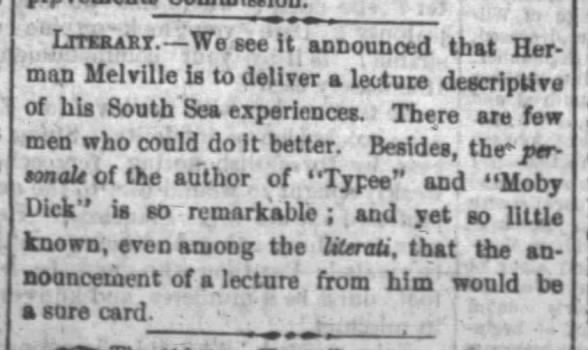
From the Brooklyn Daily Times, September 21, 1858; found at Newspapers.com among items "Added in the past 1 month":
LITERARY.-- We see it announced that Herman Melville is to deliver a lecture descriptive of his South Sea experiences. There are few men who could do it better. Besides, the personale of the author of "Typee" and "Moby Dick" is so remarkable; and yet so little known, even among the literati, that the announcement of a lecture from him would be a sure card.
A Brooklyn journalist thinks Melville a "remarkable" looking person, and along with Typee (1846) remembers Moby-Dick (1851) instead of a more recent work like Israel Potter (1855) or The Piazza Tales (1856) or The Confidence-Man (1857).

Here the italicized word personale refers I guess to personal appearance and manner, to bodily attributes expressive of one's individual personality. So New York literati might know a great deal about Melville's literary personae (Tommo and Ishmael, for example), without having seen the writer himself, up close and in person.

The association of Melville with Moby-Dick, and the focus on his physical appearance apart from his reputation among the literati, are original and distinctive elements, added to the received announcement of Melville's determination to lecture on his South Sea adventures. The Brooklyn journalist (Call him Walt?) was commenting on some version of this item:

Troy Daily Times (Troy, NY) - September 21, 1858 via Fulton History
"Herman Melville has prepared a lecture descriptive of his adventures in the South Sea, which he intends to deliver this winter."
The Brooklyn Daily Times was then published by owner and founder George C. Bennett. I don't know if Walt Whitman wrote the 1858 Melville notice, but it coincides nicely with the period in which Whitman
"returned to full-time editing in 1857 for the Brooklyn Daily Times, after an interim of nine years." --Walt Whitman: An Encyclopedia, ed. J. R. LeMaster and Donald D. Kummings (Routledge, 1998), page 81.
Tenure confirmed by Douglas A. Noverr in "Journalism," A Companion to Walt Whitman, ed. Donald D. Kummings (Wiley-Blackwell, 2009), page 36:
"Whitman's last significant connection with a Brooklyn newspaper was with the Daily Times in the period of early 1857 until the spring of 1859." 
The phrase "sure card" appears in Brooklyniana, No. 8, unsigned but attributed to Walt Whitman:
"These circus exhibitions, by the way, have always been a sure card in Brooklyn."
Whitman, Walt [unsigned]. "Brooklyniana, No. 8." Brooklyn Standard, 25 January 1862. The Walt Whitman Archive. Gen. ed. Ed Folsom and Kenneth M. Price. Accessed 25 May 2019. <http://www.whitmanarchive.org>.
Leaves of Grass - Boston, 1860
To a Pupil.

1.   IS reform needed? Is it through you?
The greater the reform needed, the greater the PER-
SONALITY
you need to accomplish it.

2.   You! do you not see how it would serve to have eyes,
blood, complexion, clean and sweet?
Do you not see how it would serve to have such a
body and Soul, that when you enter the crowd,
an atmosphere of desire and command enters
with you, and every one is impressed with your
personality?

3.   O the magnet! the flesh over and over!
Go, mon cher! if need be, give up all else, and com-
mence to-day to inure yourself to pluck, reality,
self-esteem, definiteness, elevatedness,
Rest not, till you rivet and publish yourself of your
own personality. 
Whitman, Walt. "To a Pupil." Leaves of Grass. 1860. The Walt Whitman Archive. Gen. ed. Ed Folsom and Kenneth M. Price. Accessed 25 May 2019. <http://www.whitmanarchive.org>

Friday, April 26, 2019

Boston lecture on The South Seas, advertised as "South Sea Adventures"

In December 1857 Melville lectured on Statues in Rome at The Tremont Temple in Boston. At the end of January 1859 he was back with a different lecture--on "South Sea Adventures," according to the Boston Courier on January 31, 1859.

Found at GenealogyBank among items added "within 1 week":

Boston Courier - January 31, 1859

MECHANIC APPRENTICES' LECTURES.

The Ninth Lecture of this course will be delivered 
in TREMONT TEMPLE, MONDAY EVENING, Jan. 31st, by
HERMAN MELVILLE, Esq., of Pittsfield.
  Subject--"South Sea Adventures."
  Single tickets 25 cents each, for sale at the door.
  Doors open at 6 1/2 o'clock. Lecture commences at 7 1/2 o'clock.
SYLVANUS COBB, Jr. delivers the tenth lecture.
 Reviewed the next day in the Boston Traveler:

Boston Daily Traveler - February 1, 1859
MECHANIC APPRENTICES' LECTURES.--The ninth lecture of the Mechanic Apprentices' course was delivered last evening by Herman Melville, Esq., of Pittsfield. He announced as his subject "The South Seas," and commenced by giving an extended account of the origin of the name, South Seas, which was but another name for the Pacific. He felt, in lecturing upon the South Seas, like one embarking on an exploring expedition. He might confine his lecture to the fish of those seas--the sword-fish, unlike the fish of that name in our waters, after stabbing vessels and leaving his sword broken off in the ship, or at other times withdrawing it, leaving an open wound, to the infinite terror of the seamen--the devil-fish--or he might occupy whole hours about the birds, or the whaling voyages of those seas or the Polynesian Islands.

The lecturer dwelt at some length upon the great beauty of these, in many respects, superior to any yet discovered in the world. He wondered why Englishmen, who went yachting in various waters in Europe, did not sail among the Polynesian islands of the South Seas. He then went on to speak of the vast extent of the Pacific, covering, it was estimated, over a hundred millions of square miles, and said that the modern explorations had not dispelled the mystery which had hung about it. Various matters connected with his own experience in those waters were given, and the lecture abounded with numerous anecdotes and facts of great interest.

The hall was not more than half full. It was announced that Sylvanus Cobb, Esq., would deliver the next lecture.
Fuller reconstructions of Melville's South Seas lecture are available in Melville as Lecturer by Merton M. Sealts, Jr.; and the Northwestern-Newberrry Edition of The Piazza Tales and Other Prose Pieces, 1839-1860.

Related posts:

Saturday, December 9, 2017

Autograph note signed

Here you go, the perfect stocking-stuffer for that eccentric and hard-to-please Melville obsessive on your Christmas shopping list. A guest pass signed by Herman Melville is offered in Sotheby's upcoming auction of Fine Books & Manuscripts.

Catalogue Note


This pass was presumably issued for a lecture Melville delivered to the Mechanic Apprentices’ Library Association in Boston in 1859, this being the only lecture he is known to have given on the last day of January. Titled "The South Seas," it explored the author's experiences there, which had served as the inspiration for his first two books, Typee and Omoo.
http://www.sothebys.com/en/auctions/ecatalogue/2017/fine-books-manuscripts-n09658/lot.236.html
This item was already known from catalogues of previous auctions. A transcription appears on page 333 in the 1993 Northwestern-Newberry edition of Melville's Correspondence, edited by Lynn Horth.

Monday, August 28, 2017

Paddling through The South Seas: Melville in Baltimore, February 1859

John Webber, Public domain, via Wikimedia Commons

Baltimore Sun - February 8, 1859

Herman Melville's Lecture.

Who has not read with delight the charming books of Life and Adventure in the South Seas, by Herman Melville? They first truly presented to the world men and manners in this enchanting region. The Mercantile Library Lecture this evening will present their author as a public speaker, and we know of no one half as well qualified as he to transport us, in fancy, to the ever clear sky and ever green shores of the Pacific Islands--to observe the strange life of a people to whom nature offers, without labor, a perpetual feast--or to lead us on the dashing adventures of whale fishing in the surrounding seas. --Baltimore Sun, February 8, 1859
Baltimore Daily Exchange - February 8, 1859

Melville's lecture on "The South Seas" at the Universalist Church in Baltimore was favorably reviewed the next day in the Baltimore Sun. Edited versions by Merton M. Sealts, Jr. in Melville as Lecturer (Harvard University Press, 1957) and the 1987 Northwestern-Newberry edition of The Piazza Tales and Other Prose Pieces, edited by G. Thomas Tanselle, Harrison Hayford and Hershel Parker, give fuller reconstructions of all Melville's lectures, based on extant newspaper accounts. 

But I like this one for the picture of Melville paddling through his subject:
"He would not repeat old sayings, or summon back the memories of old voyagers, but would paddle along among its aspects at large, whether personal or otherwise."
Although banished to endnotes in twentieth-century editions, as a variant, the paddling image sounds like Melville's (rather than the reviewer's) and recalls the way Taji and company canoed from isle to isle in Mardi.

When Melville lectured there in early 1859, the old Universalist Church at Calvert and Pleasant had long served as a public meeting place. Five years later the building was dedicated for worship by the congregation of  St. Francis Xavier Roman Catholic Church, "the first African American Catholic Church in the United States."
St. Francis Xavier Catholic Church - Calvert & Pleasant Streets, Baltimore
via Library of Congress


From the front page of the Baltimore Sun on Wednesday, February 9, 1859:
MERCANTILE LIBRARY LECTURES.-- Herman Melville, Esq., of Pittsfield, Mass, delivered the tenth lecture of the course before the Mercantile Library Association last night, at the Universalist Church, Calvert street. His subject was "The South Seas," being a narrative of personal experiences among the Archipelagoes, and the Polynesian isles that lie scattered through that ocean, like stars in the heavens. His subject, the lecturer said, was literally an expansive one, and embraced an arena he would not dare say how much. He would not repeat old sayings, or summon back the memories of old voyagers, but would paddle along among its aspects at large, whether personal or otherwise.

The name South Seas, generally applied to this body of water, is synonymous with Pacific ocean, which was afterwards applied to it because of the tranquility of its waters. Little was known of the "South Seas" by Americans until 1848-- The discovery of gold in California, in that memorable year, first opened the Pacific and made its waters a thoroughfare for American ships. Much might be said of the finny inhabitants of this waste of waters--of the sword-fish, and the tilts he runs with ships; of the devil-fish, and the weird yarns of the sailors concerning him. The lecturer only wondered the great naturalist, Agazzis [Agassiz], did not pack his carpet bag and betake him to Nantucket, and from thence to the South Seas--the argosy of wonders. The birds, also, in their variety and strange plumage--birds never seen elsewhere--were a study.

The South Seas, or Pacific Ocean, is reckoned to embrace one-half of the earth's surface, or an expanse of one hundred millions of square miles. Explorations have failed to rend away the veil of its mysteries, and every expedition thither has brought discoveries of new islands until on our maps the ink of one is run into another. A lone inhabitant on one of these islands would be as effectually separated from his fellow man as the inhabitant of another world. They would be good asylums, the lecturer said, for the free lovers and Mormons to rear their pest houses in--provided the natives, degraded as they are, did not object.

The lecturer spoke of several adventurers who went in search of mystical spots, said to be embosomed somewhere in these seas. They were like those who went to Paradise--they probably found the good they sought, for they never returned more. There were only two places where adventurers can most effectually disappear, and they are London and the South Seas.

The lecturer spoke of the "beach hovers," class of adventurers, or those cast by accident or chance upon the Polynesian Isles. This cognomen was derived from the fact that they always hovered upon the shores, and seemed every moment on the point of embarking or disembarking. He also alluded to the natives and their modes of tattooing. Unless a man submits to be tattooed, he is looked upon as damned, which was the case with the speaker, as he frequently resisted the importunities of the native artists to sit. The tattooing, like the uniform of a soldier, is here symbolical of the Isle, or class to which the person belongs. The lecture abounded in interesting personal narratives, and held the interest of the audience to the close. 
Baltimore Sun - February 9, 1859
Found on newspapers.com

Related posts

Tuesday, October 6, 2015

More on Charles Whitney (1815-1885)

From the 1894 Biographical Review of Broome County, New York via Whitney Research Group:
CHARLES WHITNEY, dramatic reader and author of wide celebrity, was born at Chenango Point, now Binghamton, N.Y., April 1, 1815, a son of General Joshua Whitney, of whom see the very interesting biographical sketch on another page. The Whitney family is one of the best known in the annals of this city.

The subject of this brief memoir, who died suddenly, April 17, 1885, at his home, No. 7 North Street, Binghamton, received a good education, attending some of the best institutions of learning in the State of New York at the time of his school-days in the early part of the century. He held first rank as a dramatic reader, and was especially versed in Shakespearean literature, to which he was so devoted that every room in his house had some appropriate quotation from the bard of Avon painted on the walls. He was a man of great ability as a writer, and was a correspondent for various New York papers for many years.

At the age of forty he married Miss Emily Clark, a most gifted and intelligent lady, who was born in Halifax, Nova Scotia. She died March 10, 1892, on the home farm in the town of Conklin, N.Y., where she and the family had lived since the death of her husband. They had a family of five children, of whom only two are now living, Mary E. and Jennie J. Mary E. was born in Boston, Mass., and is an artist of rare merit, and also a well-known author. She and her sister are graduated of St. Agnes Church School at Albany, N.Y., and are brilliantly educated young women. They managed the farm in the town of Conklin, where they reside, and which consists of one hundred and sixty acres of excellent and productive land. Miss Mary devoted herself principally to her paintings, for which she receives many valuable orders; and her literary work appears in the best magazines of the day.

Mr. and Mrs. Whitney were communicants of the Episcopal church, and in politics he voted with the Democratic party.
In February 1859, Herman Melville opened for Professor Whitney in Chicago. Or put it this way: Whitney closed out Melville's Chicago lecture on The South Seas. In Melville as Lecturer, Merton M. Sealts, Jr. cited Whitney's performance as evidence of the unrefined "western" appetite for popular entertainment:
Here the atmosphere was quite different from that of the eastern lecture halls, for after Melville had finished speaking, "Professor Charles Whitney...announced his entertainment to take place this evening...and gave an admirable impersonation of the eccentric John Randolph, closing with a rendition of Boker's fine ballad of Sir John Franklin."  --Melville as Lecturer, 81-2
Hershel Parker adds:
"Melville was most likely trapped on the stage for this quintessentially academic self-promotion." --Herman Melville: A Biography, v2.393
Despite Whitney's self-promoting title of "Professor," his career as dramatic speaker or "elocutionist" now looks more theatrical than academic. Possibly Melville enjoyed the show, if he stayed. And if, say, Whitney did his celebrated imitation of Red-Jacket. And I'm wondering, too--would Melville have known of Whitney already, before encountering him live in Chicago? In August 1838, a few months after Melville's family moved from Albany to Lansingburgh, Whitney lectured in Troy.


Troy Daily Whig, Monday Evening, August 6, 1838

As advertised in the Daily Whig, Whitney would
"deliver a Lecture on the Art of Speaking, explanatory of his mode of teaching this science, and illustrate its principles, by appropriate reading and recitations--exhibit a natural and easy mode of acquiring the beautiful falsetto, and the Vocal Echo,--Mr. Whitney will also, explain the amusing art of Ventriloquism, or Vocal Modulation."

Notice and ad both found at Fulton History.

In March and early April 1840, Whitney lectured at the Apollo Saloon in Albany. His advertised "third Lecture" included thrilling selections from mostly English authors, starting with scenes from Shakespeare's Merchant of Venice, Lear, and Richard III:
--from the American Masonic Register and Literary Companion (March 14, 1840).
 Charles Whitney's fifth Albany lecture received this rave advance review in the Albany Argus (dated Thursday Morning, April 2, 1840), signed "H.":
Mr. WHITNEY delivers his fifth lecture on Oratory, this evening at the Apollo Saloon, Green street. Among the compositions selected in illustration of his subject, are Milton’s Apostrophe to Light, and the Female Maniac, by Lewis—both admirable subjects—the former as portraying in sublime yet touching language, the loss of those “orbs” for which the lofty conceptions of the poet, could scarcely compensate, and the latter exhibiting a fine mind gradually sinking beneath a weight of injustice and misery into madness.— Mr. W’s delineation is perfect. These two pieces are alone worth the whole price of admission, and no doubt a goodly portion of our citizens will avail themselves of this truly intellectual entertainment. H.
Later in his career as a dramatic speaker Whitney won a reputation for
"celebrated impersonations of orators and imitations of American and Indian speeches."  --Washington Daily Union, February 7, 1851
Related melvilliana post: Melville's lecture on The South Seas 

Monday, October 5, 2015

Melville's lecture on The South Seas--Chicago, February 24, 1859

THE YOUNG MEN’S ASSOCIATION LECTURE TONIGHT. 

— Most of our readers have doubtless heard of, if they have not read, those most delightful volumes anent Pacific ocean and island life, entitled "Typee" and "Omoo," which were so highly praised, at the date of their publication, by the pen of this country and Great Britain. The author of them, Herman Mellville, Esq., delivers a lecture before the Young Men's Association, this evening, in Metropolitan Hall. Subject, “The South Seas." Prof. Whitney will, on the conclusion of the lecture, give a number of his inimitable impersonations. Admittance twenty five cents. We trust there will be a full house. --Chicago Daily Press and Tribune, Thursday Morning, February 24, 1859.
The next day Melville's South Sea lecture received this extensive review in the Chicago Tribune:

Found on Newspapers.com

More on the performance of Professor Whitney:
EVENINGS WITH THE ORATORS.—Prof. Charles Whitney’s entertainment of impersonations, readings and recitations, should not be forgotten by the lovers of elocution and good reading. The specimen of his style at the close of Mr. Melville’s lecture on Thursday evening, was received with much applause.

He was to have made his appearance before an audience in his first entertainment in this city, at Mechanics’ Institute Hall, last evening, but generously yielded the use of the Hall for the Republican Ratification meeting. He will make his first appearance on Monday evening next, and deserves a full house. He stands confessedly among he foremost in his art of impersonating those who have in their day moved listening Senates, and swayed the people by the magic power of eloquence.  --Chicago Daily Press and Tribune, Saturday Morning, February 26, 1859.
This Whitney was a well-traveled speaker and showman. Almost twenty years before he closed Melville's "South Seas" lecture in Chicago, "Charles Whitney, Professor of Elocution" was giving lectures in Albany and Schenectady “upon the art of speaking." Whitney's performances back then featured illustrative imitations of "distinguished orators and tragedians" including scenes from Shakespeare declaimed in the manner of celebrated actors like Vandenhoff, Forest, Booth, Garrick, McCready, Kean. Whitney in 1840 also did impressions of politicians, specifically "McDuffie, Clay, Wise, Hayne, Preston, &c.” (Schenectady Cabinet, Tuesday, February 25, 1840)

On February 7, 1851, the Washington Daily Union announced Whitney's return from a tour of England and Ireland:
Professor Charles Whitney has arrived in this city, and purposes to give lectures, as well as his celebrated impersonations of orators and imitations of American and Indian speeches. The English papers were full of complimentary paragraphs upon his exhibitions when he was in England and Ireland. He returned to this country about six weeks ago. The Dublin Freeman’s Journal speaks of his depicting with effect “the finest and tenderest feelings.” Messers. Clay, Webster, John Randolph, Wirt, Calhoun, McDuffie, and Preston, are among the orators whom he impersonates. He is the person whose repetition of Patrick Henry’s speech on liberty in Dublin, whilst Ireland was so much excited, called down upon him the surveillance of the government. His first night’s lecture in Washington will be announced hereafter.
Wait, Indian speeches? Yes, Whitney could do Red Jacket as well as Hamlet. From the Albany Atlas and Argus, Saturday Morning, April 12, 1856:
So delighted were the large and fashionable audience at the marvelous transformation of Mr. Charles Whitney into Hayne and Webster, Shiel and John Randolph, Hamlet and Red Jacket, that they have requested him to appear once more, on Monday evening, 14th inst.

What can be more enchanting than the play and strife of intellect as portrayed in the Senatorial conflict between Hayne and Webster, Clay and Randolph, McDuffie and Tristram Burgess? Or, the passage in the British Parliament,—Shiel’s scathing invective against Lord Lyndhurst; or the Indian Council fire, where Red Jacket portrays the usurpations of the white man; or, the ridiculous appearance of Counsellor Scolper? Mr. Whitney’s voice is both full and majestic, and its low tones search every thread and fibre of the heart. We are sure Association Hall will again be crowded with the beauty and fashion of the town.
A brief notice in New York Evening Post, February 11, 1868, finds Whitney still doing "remarkably good imitations of famous orators" at Dodworth Hall.

For more of Melville's lecturing, see the related Melvilliana post on Melville's Statues in Rome lecture. Scholarly reconstructions of Melville's three known lectures on "Statues in Rome," "The South Seas," and "Traveling: Its Pleasures, Pains, and Profits" are available in Melville as Lecturer by Merton M. Sealts, Jr. and the Northwestern-Newberry edition of The Piazza Tales and Other Prose Pieces, 1839-1860.

Related posts: