Showing posts with label T. W. C. Moore. Show all posts

Sunday, December 9, 2018

Harriet Butler and Sarah Sackett in Troy, 1824

via Dennis Holzman Antiques
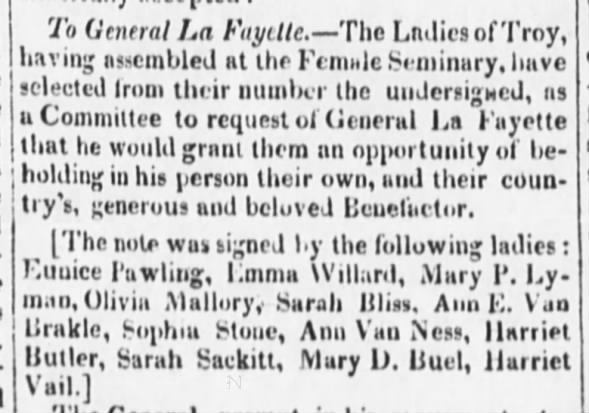
In 1824 Harriet Butler and Sarah Sackitt (Sackett) both signed a petition from the "Ladies of Troy" requesting the Marquis de Lafayette to honor the Troy Female Seminary with a visit during his triumphal U. S. tour.

Thu, Sep 23, 1824 – Page 1 · The Evening Post (New York, New York, New York) · Newspapers.com
This "Sarah Sackitt" is probably Sarah Sackett, the former Sarah H. Pardee and wife of Troy merchant Daniel Sackett (1788-1845). At the time Sarah Sackett belonged to the First Presbyterian Church of Troy; she would join the Second Presbyterian Church in 1827 as a charter member. Harriet Butler is the daughter of the Rev. David Butler, Rector of St. Paul's Episcopal Church. In later sources, both women are named independently in connection with the first publication of "A Visit from St. Nicholas" in the Troy Sentinel on December 23, 1823. Harriet Butler copied the poem while visiting the family of Clement C. Moore in New York City, as reported by John T. Parker in the Troy Daily Times on December 23, 1871 ("The 'Visit of St. Nicholas’—Moore's Poem—Some Account of Its History."). Mrs. Sackett brought a copy to editor Orville L. Holley, according to the 1844 letter from publisher Norman Tuttle to Moore, now held by the Museum of the City of New York (54.331.17b).

The reported involvement of these two ladies of Troy as intermediaries is consistent with the 1862 account of the poem's earliest transmission in which T. W. C. Moore describes two stages of copying, first "by a relative of Dr Moores in her Album" and second, "by a friend of hers, from Troy." But until now (so far as I know), Harriet Butler and Sarah Sackett were not linked by name in any known contemporary record. This item nicely confirms their acquaintance and active collaboration with other civic-minded women on a project of mutual interest. Great to have, especially since some published versions of Lafayette's visit to Troy omit the bracketed list of signatories included in the New York Evening Post account.
[The note was signed by the following ladies: Eunice Pawling, Emma Willard, Mary P. Lyman, Olivia Mallory, Sarah Bliss, Ann E. Van Brakle, Sophia Stone, Ann Van Ness, Harriet Butler, Sarah Sackitt, Mary D. Buel, Harriet Vail.]
The most famous name on the 1824 list is that of Emma Willard, founder of the Troy Female Seminary.


General Lafayette accepted the invitation signed by Harriet Butler and Sarah Sackitt or Sackett along with other members of the hastily organized Arrangements Committee. At the Troy Female Seminary Lafayette received a gift copy of Emma Willard's treatise on Improving Female Education and heard two students recite Willard's poem, "La Fayette's Welcome."
The town, he said, seemed to have sprung up by enchantment. And how must this astonishment have increased when he visited this Female University, and beheld so great a collection of young ladies, drinking from the pure fountain of knowledge, whose bright eyes, and healthy countenances, and cheerful demeanor, bespoke them "as sweet as innocent; as innocent as gay; as gay as happy." The visit of the General, to Troy, short as it was, afforded him great satisfaction. He talked much about it, and frequently spoke of his visit to the Seminary, as one of the most interesting and delightful moments of his life.  --New York Evening Post, September 23, 1824. Reprinted in Poulson's American Daily Advertiser (Philadelphia, PA) on September 23, 1824; the New York Spectator on September 24, 1824; and the Richmond Enquirer ("Domestic. Journey of the Nation's Guest--in Continuation. Reception at Albany") on October 1, 1824.
Lafayette lingered so long in Troy that he had to cancel scheduled stops in Lansingburgh and Waterford.

Thu, Sep 23, 1824 – Page 1 · The Evening Post (New York, New York, New York) · Newspapers.com
Related post:

Friday, December 7, 2018

Livingston cousin T. W. C. Moore

T. W. C. Moore (1794-1872)
Detail from New York, the interior of the Park Theatre, 1822 by John Searle
 via The New York Public Library Digital Collections
In Who Wrote "The Night Before Christmas"? (page 184, footnote 5) MacDonald P. Jackson backs up his sympathetic treatment of Livingston lore in chapter 20 by quoting Mary Van Deusen on the family tie between Henry Livingston, Jr. and his first cousin Judith Livingston, wife of John Moore.
"Having a connection of both families traveling south to act as a governess in a Moore-connected household isn't that absurd. Henry Livingston's first cousin and next door neighbor was Judith Livingston, who was married to John Moore, the brother of Clement Moore's uncle. In 1815, their daughter Lydia was married to a student of Moore's, Rev. William Henry Hart, and the couple moved to Virginia."
--Mary Van Deusen, "The Livingstons' Governess Story"; quoted by MacDonald P. Jackson in Who Wrote, page 184.
  • http://www.henrylivingston.com/xmas/arguments.htm
On a "Timeline" of authorship findings, Ms. Van Deusen has placed her discovery of the connection to the Moore family in the year 2001
  •  http://www.henrylivingston.com/xmas/summary.htm
 and elsewhere explains:
"I knew that Henry's first cousin, Judith Livingston, lived near Henry and was married to John Moore. I just had no idea who John Moore was."
http://www.henrylivingston.com/slideshow/epilog/epilog-6stevespainting.htm
No idea who John Moore was? Melvilliana can help with that: father of T. W. C. Moore (1794-1872), as previously disclosed in the Key witness letter post:
  • http://melvilliana.blogspot.com/2018/02/key-witness-letter-by-livingston-cousin.html
Here I'm repeating the main point of that earlier and rather roundabout post. Besides being the parents of Lydia (mother of Frances Livingston Hart Butler), John Moore and Judith (Livingston) Moore were also parents of Thomas William Channing Moore: the same T. W. C. Moore who personally interviewed Clement C. Moore in 1862 and got the retired seminary professor and poet, age 82, to write out "The Night Before Christmas" one more time for The New-York Historical Society and posterity.

T. W. C. Moore was a first cousin, once removed of Henry Livingston Jr., since Henry and TWC's mother Judith were first cousins (their fathers Henry Sr. and James were brothers). Livingston cousin T. W. C. Moore maintained close ties with his nieces including Lydia's daughter Frances, who married Rev. Butler's son Clement Moore Butler. (Frances's sister-in-law was Troy resident Harriet Butler, named in later reports as copyist of "A Visit from St Nicholas.") In his 1858 will, T. W. C. Moore thoughtfully and generously remembered many nephews and nieces including four "daughters of my late sister Lydia" whom he appointed as "residuary Legatees." To Frances he gave two thousand dollars and
"all my Italian books & pamphlets - all my loose engravings & prints - also a Landscape (No. 8.) by Dan Huntington." --Will of T. W. C. Moore via Ancestry.com [Wills, Vol 0212-0213, 1872-1873 in New York, Wills and Probate Records, 1659-1999].

The will reveals also that T. W. C. Moore owned a copy by Daniel Huntington of his mother Judith's 1812 portrait, which he gave to another niece, Elizabeth Elliot Hart Coleman. The original portrait of Judith Livingston Moore was then in the possession of TWC's younger brother Francis Childs Moore, aka F. C. Moore.

As a serious art collector and "genuine antiquarian" (so described in Martha J. Lamb's History of the City of New York), Thomas W. C. Moore made it his business to learn about the provenance of valuable artifacts and to pass along relevant information to archivists. Gifts from T. W. C. Moore to family members, libraries, and museums were typically accompanied by manuscript notes in which he had carefully recorded relevant facts for the historical record.


He made a project of accurately identifying himself and other New Yorkers portrayed in John Searle's painting New York, the interior of the Park Theatre, 1822.


To support another effort of archival preservation, TWC Moore told what he knew about the authorship of "The Night Before Christmas" in his 1862 cover letter to the Librarian of the New-York Historical Society, forwarded with Clement C. Moore's holograph copy. The manuscript Christmas poem and TWC's letter are both extant in the collections of The New-York Historical Society.
  • http://bobcat.library.nyu.edu/primo-explore/fulldisplay?docid=nyu_aleph000690235&context=L&vid=NYHS&search_scope=nyhs&tab=nyhs&lang=en_US
Considering T. W. C. Moore's demonstrably close relationship with his niece Frances Livingston Hart Butler, it seems reasonable to suppose that he knew Frances's unmarried sister-in-law Harriet Butler and learned either directly from Harriet or indirectly from Frances exactly how Clement C. Moore's "A Visit from St. Nicholas" got from Moore's home in Chelsea to Troy. Writing in 1862, Frances's uncle T. W. C. Moore gave credit for copying the poem to two women, without identifying either by name. Later reports name Harriet Butler as one of the original copyists, possibly reflecting unrecoverable oral testimony. The other may have been Sarah Sackett, named by Norman Tuttle, publisher of the Troy Sentinel, as the person who gave a copy of "Visit' in 1823 to editor Orville L. Holley. In 1862, T. W. C. Moore communicated his personal knowledge of the poem's transmission--gained independently of the author, most likely through the family connection he loyally maintained with his niece Frances. For information about the poem's original composition, T. W. C. Moore talked directly with the author.

English majors have no excuse, but some partisans in the Livingston camp will always believe that Henry Livingston, Jr. composed "The Night Before Christmas." For Livingston descendants who might want a more historically grounded holiday hero, I give you "Old Cousin Tom," Thomas William Channing Moore.
"Old Cousin Tom," we were wont to call him. What a stream of memories, sweet childish memories, his name evokes! Can we forget him who never forgot his juvenile kindred, but made glad their hearts, not once but always, when his travels brought him to old Virginia. His portrait appears in the picture of the interior of the Park Theatre in the History of New York City, in the library of the Penn. Hist. Society. He spent much time in genealogical research and was a steadfast friend of Fitz-Greene HALLECK. Peace to his ashes! --David Moore Hall, Six centuries of the Moores of Fawley, Berkshire, England and their descendants amid the titled and untitled aristocracy of Great Britain and America (Richmond, Virginia, 1904) via RootsWeb
Your Cousin Tom not only coaxed one more holograph copy of "The Night Before Christmas" from its author Clement C. Moore, he also solved the longstanding mystery of its transmission. Cousin Tom bequeathed to all of us the inside story of how "The Night Before Christmas" found its way to the Troy Sentinel, sharing details personally known to him through close ties to the family of his beloved niece Frances Livingston Hart Butler. Thus, no need for the "Livingston Governess" theory of transmission, whereby a hypothetical governess supposedly brought a hypothetical manuscript copy of "A Visit from St. Nicholas" from Poughkeepsie to Richmond. Cousin Tom himself made frequent trips south to visit kinfolk in Old Virginia. With intimate connections to Poughkeepsie (where his cousin Cornelia Billings had married Randall S. Street, a close friend of Henry Livingston, Jr; their son William I. Street formally witnessed T. W. C. Moore's 1858 will) and Manhattan, Cousin Tom could have told his adoring Richmond relatives all about "The Night Before Christmas" and who wrote it.

Here again is the earliest known Livingston witness letter, decisively affirming Clement C. Moore's authorship of "A Visit from St. Nicholas" aka "The Night Before Christmas." Addressed to the Librarian of the Historical Society, the letter from T. W. C. Moore was first published in The New York Historical Society Quarterly Bulletin 2.4 (January 1919) pages 111-115.


73 East 12th St.
New York, March 15th 1862.
Geo. H. Moore Esqr
Librarian of The New-York Historical Society:
Dear Sir:
I have the pleasure to inform you that Doctor Clement C. Moore has been so kind as to comply with my request (made at your suggestion) to furnish, for the Archives of our Society, an Autograph Copy of his justly celebrated "Visit from St. Nicholas." I now enclose it to you.—

I hardly need call your attention to the distinctness and beauty of his hand writing:—very remarkable, considering his advanced age, (he completed his 82d year in July last) and his much impaired eye sight.

These lines were composed for his two daughters, as a Christmas present, about 40 years ago.—They were copied by a relative of Dr. Moores in her Album, from which a copy was made by a friend of hers, from Troy, and, much to the surprise of the Author, were published (for the first time) in a Newspaper of that city.—

In an interview that I had yesterday with Dr. Moore, he told me that a portly, rubicund, Dutchman, living in the neighbourhood of his fathers country seat, Chelsea, suggested to him the idea of making St. Nicholas the hero of this "Christmas piece" for his children.
I remain, very resp[ectfull]y Your ob[edien]t s[ervan]t

T. W. C. Moore


Listed in WorldCat from the library catalog of the New-York Historical Society as A Visit from St. Nicholas: Holograph; currently held in Mss Collection, BV Moore, Clement, Non-circulating.
Holograph manuscript, dated March 13, 1862, of Clement C. Moore's "A visit from St. Nicholas," originally composed ca. 1822 and written out by the author on this occasion at the suggestion of librarian George H. Moore of the New-York Historical who wished to add a holograph copy of the poem to the Society's library collection. The three page manuscript is accompanied by a cover letter addressed to George Moore by Thomas W. C. Moore presenting the enclosed manuscript and briefly discussing the circumstances of the poem's original composition forty years earlier. --New-York Historical Society, catalog summary via BobCat
https://library.nyu.edu/persistent/lcn/nyu_aleph000690235?institution=NYU&persistent 
Fitz-Greene Halleck (1790-1867) by Henry Inman
New-York Historical Society - Bequest of Thomas W. C. Moore
Related posts:
  • Key witness letter
    http://melvilliana.blogspot.com/2018/02/key-witness-letter-by-livingston-cousin.html

Monday, May 14, 2018

Which John and Henry Livingston were in the Social Club with John Jay

via The New York Public Library Digital Collections
As mentioned in a previous post on T. W. C. Moore, his father John Moore (1746-1828) made a list of men who belonged to the elite "Social Club" in New York City before the American Revolution. In the 1919 Yearbook of the Dutchess County Historical Society, William S. Thomas mistakenly identifies "John Livingston and his brother Henry" on Moore's list as the Reformed Dutch minister John Henry Livingston and his younger brother Henry Livingston, Jr. of Poughkeepsie.


On Saturday nights in wintertime members of the Social Club would party at Queen's Head Tavern, operated after 1770 by Samuel Fraunces. In the summer they met at a private clubhouse on Kip's Bay. Rev. John H. Livingston, whose "piety was all-pervading," I'm guessing would have devoted Saturday nights to preparing his sermon for the next day. He definitely hated theaters, and presumably avoided taverns and tavern sins when he could. As a distinguished clergyman, and the husband of Sarah Livingston (daughter of Philip Livingston, a signer of the Declaration of Independence), Dr. John H. Livingston did make it onto Mrs. Jay's Dinner and Supper List for 1787 and 1788. As James Grant Wilson remarks,
"The doctor's tall and dignified figure and high breeding would make him a notable addition to any company…."  --The Memorial History of the City of New York
John Henry Livingston belonged to that larger group of notables by virtue of his high status in the Dutch Reformed Church, and marriage to Sarah Livingston his second cousin. According to Walter Stahr,
Sarah's dinner and supper list suggests that they hosted more than two hundred different people in 1787 and 1788.  --John Jay: Founding Father
But William S. Thomas in his 1919 article misrepresents the more exclusive membership list of the Social Club as John Moore recollected it decades later. Moore named loyalists and "disaffected" rebels together on his list of Social Club members.
During his early manhood he was a frequent sojourner in New York City and, with his brother, the Rev. John H. Livingston, pastor of the Middle Dutch Church there, belonged to the Social Club. Their names appear in a list of its members who were dropped by the ruling Loyalist majority at the outbreak of the Revolution. Opposite the names of the Livingston brothers appears the entry, "Disaffected, but of no political importance." A Tory social club was no place for Henry Livingston.... --William S. Thomas on "Henry Livingston," 1919 Yearbook Dutchess County Historical Society; also available on the Henry Livingston by Dr. William S. Thomas page of Mary S. Van Deusen's personal website.
Contrary to the claim by Thomas that patriots like Henry Livingston "were dropped by the ruling Loyalist majority," the whole Social Club had to disband after 1775. Nobody was purged from the Social Club for his politics in the tyrannical manner that Thomas imagines. Their winter meeting-place was well known as "the resort of both Whig and Loyalist." Indeed, Fraunces Tavern served the best Madeira to "some of the most active and distinguished men of the revolution." Those "disaffected" Whigs were the Social Club, which could not exist without them.
As a tavern it was the most noted in New-York, and was the resort of the bloods of that day who formed themselves into social clubs, and among whom were some of the most active and distinguished men of the revolution.... During the troubles which preceded the Revolution, Fraunces' Tavern seems to have been the resort of both Whig and Loyalist, political affairs not having sufficient power to sever the social ties of those whose custom it was to assemble there and discuss his Madeira, a wine, the excellent quality of which Sam's cellar stood proverbial. It must not be presumed that Sam was an idle spectator of the events then passing around him, his sympathies were with the Whigs, and he became one of Washington's most faithful friends and followers. New York Daily Tribune, 20 July 1854.
 <http://chroniclingamerica.loc.gov/lccn/sn83030213/1854-07-20/ed-1/seq-3/>
Henry Livingston, Jr. of Poughkeepsie was a country cousin of the more privileged landowners, merchants, and lawyers in John Jay's Social Club. As a (relatively) humble Poughkeepsie farmer descended from Gilbert Livingston, the youngest and least fortunate son of Robert Livingston, this Henry was never really one of the "bloods" who gathered at Fraunces's Tavern. Thomas helpfully distinguishes his Henry, Major Henry Livingston Jr., from Henry Alexander Livingston (the Major's better-remembered nephew, only child of Dr. John Henry Livingston and Sarah) and Henry Beekman Livingston. But in his eagerness to magnify Henry Jr. of Poughkeepsie and make him author of The Night Before Christmas, William S. Thomas overlooked the lordly Livingstons of Livingston Manor, in particular John and Henry.
via The Livingstons of Livingston Manor
As Cynthia A. Kierner relates in Traders and Gentlefolk: The Livingstons of New York, 1675-1790 (Cornell University Press, 1992), the John and Henry Livingston named as members of the elite Social Club in New York City were in fact sons of Robert Livingston, Jr. the 3rd Lord of upper Livingston Manor:
Another group, the Social Club, gathered many of the city's leading me for evenings of drinking and conversation. In 1751, after he took up residence at the Manor, Robert Livingston, Jr. joined the Social Club so that when he visited New York City he could enjoy "a Gentle Bacchanalion Engagement" with the friends he had left behind there. Later, the Social Club's membership also included Robert's two youngest sons, as well as their Clermont kinsman, Robert R. Livingston, Jr.  --Traders and Gentlefolk
Citing Kierner, John L. Brooke in Columbia Rising also identifies John and Henry of the NYC Social Club as "Upper Manor" Livingstons. Likewise, footnotes in The Selected Papers of John Jay 1760-1779 edited by Elizabeth Miles Nuxoll, Mary A. Y. Gallagher, and Jennifer E. Steenshorne (University of Virginia Press, 2010) explain the entries for "John Livingston and his brother Henry" on Moore's list of Social Club members as references to
"John Livingston (1749-1822), son of Robert Livingston, third proprietor of Livingston Manor."
and
"Henry Livingston (1752-1823), son of Robert Livingston, third proprietor of Livingston Manor."
The admirably progressive editors of Selected Papers of John Jay say "proprietor of Livingston Manor," preferring not to call any fellow mortal "Lord." Titles aside, they agree here with Richard B. Morris in John Jay: The Making of A Revolutionary (Harper and Row, 1975) who identifies John and Henry as Livingstons of Livingston Manor:
John Livingston (1749-1822) and his brother Hendrick (1752-1823) were sons of Robert Livingston (1708-90), third lord of Livingston Manor.
On the Henry Livingston, Jr website, Mary S. Van Deusen makes Henry Jr. and his brother the Rev. John H. Livingston members of the Social Club, following William S. Thomas and repeating some of his errors:
Besides making Rev. John Henry Livingston and Henry Jr. of Poughkeepsie members of the New York City Social Club, William Sturges Thomas and Mary S. Van Deusen have Henry Livingston, Jr. of Poughkeepsie serving in October 1774 as co-manager of the New York Dancing Assembly with John Jay and John Watts, Jr.

New-York Gazette and Weekly Mercury - October 24, 1774
via GenealogyBank
Henry Livingston, JUNIOR (whose father Henry Livingston was alive and well, age 60, in Poughkeepsie) was a farmer in 1774, married in May to Sarah "Sally" Welles of Stamford, Connecticut.

The "Henry Livingston" named in 1774 as co-manager of the Dancing Assembly in New York City must have been a different Henry, not the farmer from Poughkeepsie. A more likely Henry is again Henry Livingston of Livingston Manor, ever a bachelor. Or could this Henry Livingston be Princeton grad, teen-aged Henry Brockholst Livingston, before he dropped the "Henry"? This Henry was the brother of Jay's wife Sarah Van Brugh Livingston. Henry Brockholst Livingston went to Spain with his sister and brother-in-law, serving a troublesome stint there as Jay's secretary. In December 1783, Henry Brockholst Livingston joined a controversial effort to revive the Dancing Assembly, meeting with A. V. Cortlandt, Nicholas Fish, and Lewis A. Scott at Cape's City Tavern.

Rivington's New-York Gazette - December 3, 1783
via GenealogyBank
As revealed in one extant letter from John Jay to Egbert Benson, Jay admired Henry Livingston Jr.'s first wife Sarah (Sally) Welles as "an excellent woman" and "rara avis in terra":
Harry Livingston, I imagine, lives in the neighbourhood. His wife is an excellent woman, and in my opinion a rara avis in terra. I believe they both wish me well, and would not refuse to oblige me by taking my son to live with them and treating him as they do their own. In that family he would neither see nor be indulged in immoralities, and he might every day or two spend some hours with his grandfather, and go to school with Harry’s children; or otherwise as you may think proper. At any rate he must not live with his grandfather, to whom he would in that case be as much trouble as satisfaction. This is a point on which I am decided, and therefore write in very express and positive terms. Unless objections strike you that I neither know or think of, be so kind as to speak to Mr. and Mrs. Livingston about it. I will cheerfully pay them whatever you may think proper, and I would rather that you should agree to a generous allowance than a mere adequate compensation.... --John Jay, The Correspondence and Public Papers of John Jay, ed. Henry P. Johnston, A.M. (New York: G.P. Putnam’s Sons, 1890-93). Vol. 2 (1781-1782). 5/14/2018. http://oll.libertyfund.org/titles/2328#Jay_1530-02_633
From Madrid in 1781 Jay seems to have regarded Harry and Sally of Poughkeepsie as good folks whom he could pay to care for his son Peter while he was serving as ambassador to Spain. Jay fancied his son might attend school with Harry's children. After his wife Sally's death in 1783, Henry Livingston, Jr. boarded his own children elsewhere, according to Day-Book entries in 1784, transcribed by Mary S. Van Deusen on the Henry Livingston website. Jay's father moved from Fishkill to Poughkeepsie before his death in 1782 but
Where the Jays lived while in Poughkeepsie does not transpire. --J. Wilson Poucher, Yearbook of the Dutchess County Historical Society
 Below, the 1823 obituary for Henry Livingston of upper Livingston Manor, the bachelor "General":

 New York National Advocate - June 5, 1823
DIED,
Gen HENRY LIVINGSTON, was born Jan. 19, 1752, and died, at his residence in the manor of Livingston, Monday, May 26, 1823. On the Wednesday following, his remains were deposited in the family vault, in the village churchyard, attended by a numerous concourse of mourning relatives and friends. Gen. L joined his country in her struggle for liberty; was with a detachment of militia from his native county, and acted as Lieut. Col. at the capture of Burgoyne. Of his benevolence and liberality, the industrious, the poor and needy can bear ample testimony. He was a friend to the people, because he had an eye more to the security of their rights and liberties, than to popular applause.  

-- New York National Advocate (June 5, 1823)

Tuesday, April 3, 2018

T. W. C. Moore and William I. Street, son of Henry Livingston's "good friend" Randall S. Street

In 1862 Livingston cousin T. W. C. Moore wrote a key witness letter attesting to Clement C. Moore's authorship of "A Visit from St Nicholas" aka The Night Before Christmas. T. W.C. Moore testified in writing to Clement C. Moore's authorship of the Christmas poem after a personal "interview" with the author himself. Addressed to the Librarian of the Historical Society, the 1862 letter from T. W. C. Moore accompanied a manuscript copy of "Visit" in Clement C. Moore's distinctive handwriting. T. W. C. Moore's letter was published in The New York Historical Society Quarterly Bulletin 2.4 (January 1919) pages 111-115, along with a reproduction of the manuscript copy made by Clement C. Moore.

This T. W. C. or Thomas William Channing Moore was a son of John Moore and Judith Livingston Moore. His mother Judith was a first cousin and former neighbor of Henry Livingston, Jr. of Poughkeepsie. So T. W. C. Moore and Henry Livingston, Jr. were first cousins, once removed.

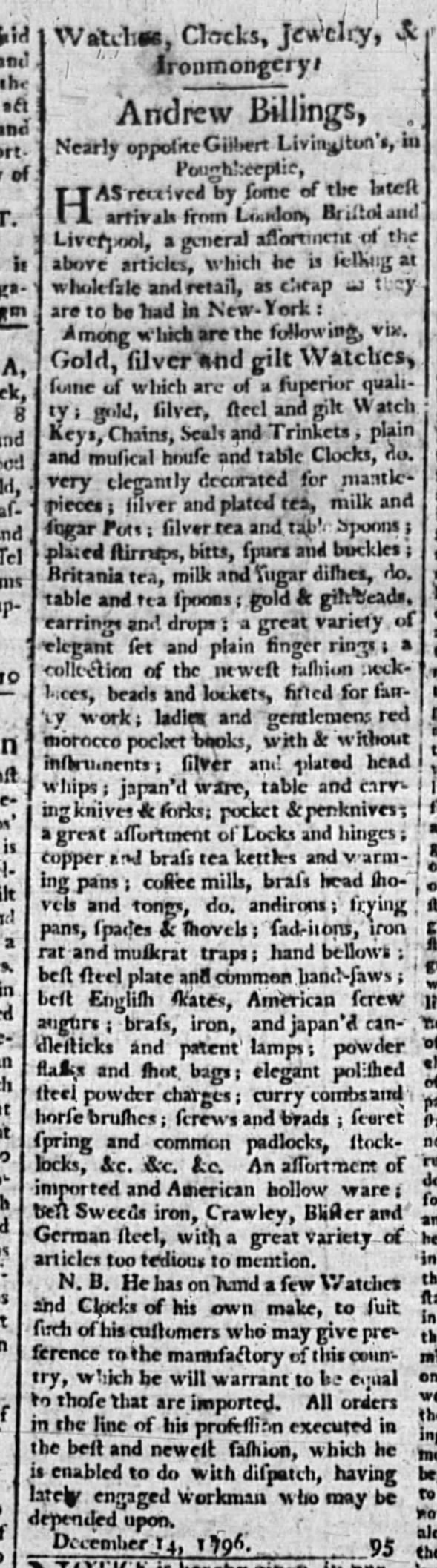
In addition to the family tie through his mother Judith Livingston Moore, T. W. C. Moore was also connected to Henry Livingston, Jr. through Moore's aunt, Cornelia Livingston (1751-1820)--his mother's sister, another daughter of James Livingston and Judith Newcomb Livingston. T. W. C. Moore's widowed aunt Cornelia Livingston married Andrew Billings, veteran of the Revolutionary War and later a well-regarded jeweler and silversmith in Poughkeepsie.

· Wed, Mar 15, 1797 – Page 4 · Poughkeepsie Journal (Poughkeepsie, New York) · Newspapers.com
Esteemed as "a man of genius," Andrew Billings reportedly invented a pair of wings that worked for him but not his father-in-law James Livingston:
Major Billings was no ordinary man: nay more, he was a man of genius. Independent of his talents as a soldier and writer, he possessed great mechanical invention. He constructed a pair of wings, and, being a small man, actually succeeded with them in flying short distances. Relative to this matter a story is told by B. Davis Noxen, Esq., the celebrated lawyer of Syracuse, and formerly a resident of Poughkeepsie. Major Billings gave notice that he intended trying his wings at a certain hour in the market place of the village. The inhabitants assembled; he mounted a low pillar, extended his wings, and, to the amusement of the village, flew to a considerable distance. Sheriff Livingston, thinking to "follow in the footsteps" of his son-in-law, then mounted the pillar, fitted the wings and sprang. Being, however, a heavy man, and not knowing the trick of waving his pinions, he tumbled ingloriously to the dust, amid the laughter of his townsmen.  --Albany Evening Journal, May 25, 1864
Daughter Cornelia Billings married Randall Sanford Street (1780-1839). Remembered in William Hunt's American Biographical Panorama as "an eminent lawyer and accomplished gentleman," Randall S. Street was Henry Livingston's "good friend" and for a while the employer of Livingston's son Edwin.

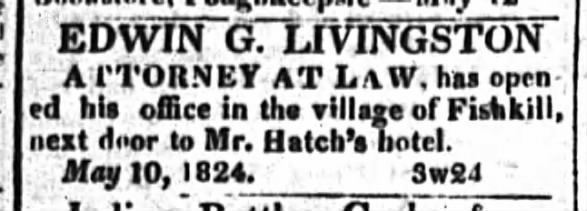
Edwin George Livingston (1798-1863) studied law with Randall S. Street. In 1821 Edwin was formally admitted as attorney in 1821, as announced in the New York Evening Post on November 7, 1821. In 1824 he began practicing law in Fishkill.

· Wed, May 26, 1824 – Page 4 · Poughkeepsie Journal (Poughkeepsie, New York) · Newspapers.com
After the death of Henry Livingston, Jr. in 1828, Edwin and his brother Sidney were able to serve as executors for the estate. Henry's "good friend" Randall Sanford Street had also been named in the will as one of the executors:
"I name and appoint as executors of this my last Will and Testament my beloved wife, Jane, my 3 sons Charles, Sidney & Edwin and my good friend Randal S. Street Esq."
--Will of Henry Livingston Jr, transcript via Mary S. Van Deusen's Henry Livingston site
T. W. C. Moore stayed in touch with grown children of his cousin Cornelia Billings and Randall S. Street, as revealed in a note Moore wrote about a curious gift he got from one of Cornelia's sons, William Ingraham Street (1807-1863). After Street gave Moore souvenir locks of George Washington's (and Martha's) hair, T. W. C. meticulously recorded the provenance in a written statement made in New York City, dated March 24, 1857:

WASHINGTON AND WIFE'S HAIR, JUNE, 1783.
The locks of hair below is part of that which was sent to Major Billings of Poughkeepsie, inclosed in a letter, of which the following is an exact copy. The original is in possession of the Major's grandson, W. J. Street, counselor at law, of this city, who gave me the hair.
Inveterate antiquarian that he was, T. W. C. Moore also took the trouble to make "an exact copy" of the authenticating letter from George Washington to Andrew Billings, at the time still owned by William I. Street (whose middle initial "I" for Ingraham or Ingram was sometimes misprinted as "J"). Transcribing Moore's 1857 note in The Century Magazine for May 1890, Edith Robertson Cleveland calls it "an odd affidavit of the present of two locks of hair from the heads of Mr. and Mrs. Washington, with the hair itself curiously preserved."

Speaking of Poughkeepsie Streets, William I. Street's brother Alfred became a poet of considerable repute in Herman Melville's time. In the 1840's, Alfred Billings Street had a law office in Albany. Somehow he knew Herman's sisters. Once in Pittsfield, Alfred B. Street felt hurt when Herman did not ask him over to Arrowhead for a social visit. Hershel Parker tells all about it in the second volume of Herman Melville: A Biography (Baltimore: Johns Hopkins University Press, 2002), page 139. That was in late September 1852. Twenty-five years later Melville highly complemented one of Street's poems, in a letter to his cousin Kate and her husband Abraham Lansing:
... I have just been reading in a copy of Frank Leslie's Illustrated paper "The Old Garden" by Mr Street. How beautiful, and poetically true to nature it is! It is like a flower-and- fruit piece by some mellow old Fleming.  --Herman Melville, August 14, 1877 letter to Catherine Gansevoort Lansing and Abraham Lansing; reprinted in the Northwestern-Newberry Edition of Melville's Correspondence, pages 459-463.
Melville's comparative view of the poet as painter, "some mellow old Fleming," echoed the tribute by Henry T. Tuckerman thirty years before. In a friendly review of the 1845 volume The Poems of Alfred B. Street, Tuckerman had praised Street as "a true Flemish painter":
We have wandered with him on a summer's afternoon, in the neighborhood of his present residence, and stretched ourselves upon the greensward beneath the leafy trees, and can therefore testify that he observes con amore, the play of shadows, the twinkle of swaying herbage in the sunshine, and all the phenomena that makes the outward world so rich in meaning to the attentive gaze. He is a true Flemish painter, seizing upon objects in all their versimilitude. As we read him, wild flowers peer up from among brown leaves; the łoń. the partridge, the ripple of waters, the flickering of autumn light, the sting of sleety prow, the cry of the panther, the roar of the winds, the melody of birds, and the odor of crushed pine-boughs, are present to our senses. In a foreign land, his poems would transport us at once to home. He is no second-hand limmer, content to furnish insipid copies, but draws from reality. His pictures have the freshness of originals. They are graphic, detailed, never untrue, and often vigorous; he is essentially an American poet. --Unsigned notice of The Poems of Alfred B. Street [by Henry T. Tuckerman] in The United States Magazine and Democratic Review for January 1846.
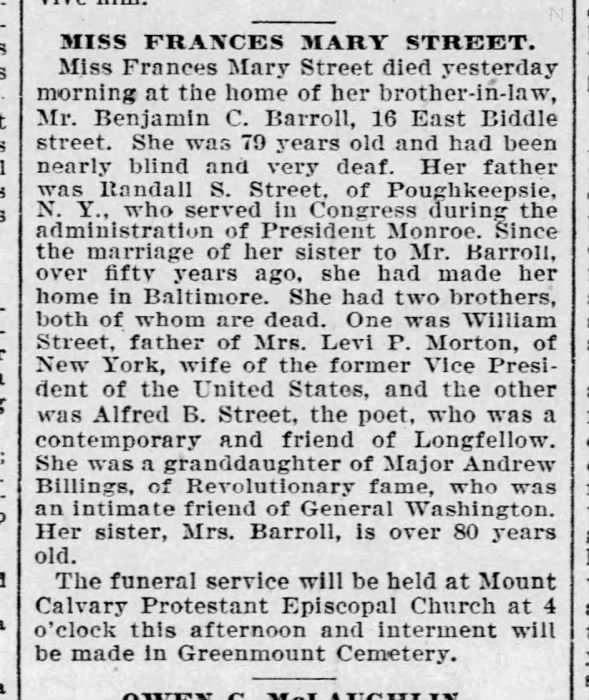
In this 1901 obituary of Alfred's sister Frances Mary Street, the highest honor the writer could think to bestow on her late brother the poet was to make him "a contemporary and friend of Longfellow."

· Sat, Mar 30, 1901 – 7 · The Baltimore Sun (Baltimore, Maryland) · Newspapers.com
From the Memoir of Alfred B. Street as published in Bentley's Miscellany (London, 1849):
The Hon. Randall S. Street, father of the author of " Frontenac," was the lineal descendant of these two eminent clergymen. He removed, with his father, in early life, into the State of New York, and this branch of the family has continued to reside there ever since; the other branch continued in Connecticut, and is still represented by Augustus Russell Street, Esq., who resides at Newhaven. Randall S. Street studied law at Poughkeepsie, married Miss Cornelia Billings, and settled there for the succeeding thirty years of his life. Such was his standing at the bar, that whilst still young, he was appointed attorney of the district composed of the counties of Wayne, Ulster, Dutchess, Delaware and Sullivan, under the old organisation of districts, and subsequently he represented the county of Dutchess in Congress. He was an eminent lawyer and accomplished gentleman, and among the recollections of the writer, is one of a day spent more than thirty years ago at the residence of General Street, when it was the home of hospitality and elegance. In 1824, General Street removed to Monticello, Sullivan county, New York, where he died in 1839.

The maternal grandfather of our author was Major Andrew Billings, who married Cornelia, daughter of James Livingston, of the well known family of that name in New York. Cornelia, the daughter by this marriage, who became the wife of General Street, was the mother of the poet....


Related posts:

Friday, February 9, 2018

Thomas W. C. Moore in 1822

Thomas W. C. Moore in 1822
Detail from Interior of Park Theatre by John Searle
Here's the 1822 portrait of New York merchant and antiquarian T. W. C. Moore (1794-1872), as featured with other "representative New Yorkers" in the well-known watercolor painting by John Searle, Interior of the Park Theatre. Eventually donated to The New-York Historical Society Searle's painting illustrated, as described in the caption of one 20th century reproduction, "New York Notables at the Play." I cropped Searle's portrait of T. W. C. Moore from a digital image in the public domain, available online courtesy of The New York Public Library Digital Collections.
One of our illustrations shows the kind of audience which turned out to witness his triumph at the Park in Moncrieffe's farce of "Monsieur Tonson." This painting of John Searle's represents a scene on the opening night of November 7, when cold weather had permitted New York to return to its business, homes and amusements; Mathews is on the stage as "Monsieur Morbleau," and Miss Johnston as "Madame Bellgarde." Through an inspiration of Thomas W. C. Moore, forty-five years later (who prepared a key to the painting then owned by Mrs. William Bayard), we know the names of some eighty odd of the representative New Yorkers whom the artist portrayed as witnessing this important appearance. They are all here. Bayards, and Coldens and de Peysters and Livingstons, Crugers. Van Wycks, Clintons, Beekmans, Lenoxes, Brevoorts and the rest; not to mention the prodigious Doctor Mitchell, Doctor Hosack, Doctor Francis, James K. Paulding, Mrs. Daniel Webster and many another of the outstanding figures in the financial and social life of the period. --A Century of Banking in New York


We know who's who because in 1868, T. W. C. Moore himself took the trouble to identify the persons depicted in a helpful "key" to Searle's painting. Historian Martha Joanna Lamb gives the fascinating details of Moore's contribution as a "genuine antiquarian":
The history of the water-color painting, now in possession of the New York Historical Society, is scarcely less interesting than the picture itself. The original drawing was made for William Bayard by John Searle, a clever amateur artist, and the picture when completed was hung upon the wall of Mr. Bayard's country residence. Some years since Thomas W. Channing Moore became much interested in it while visiting Mr. Bayard, and with the instinct of a genuine antiquarian resolved that such a treasure should not be entirely lost to New York. He accordingly obtained permission to bring it to the city for the purpose of showing it to Mr. Elias Dexter. Six of the gentlemen whose portraits appear in the painting were then living — Francis Barretto, Robert G. L. De Peyster, Gouverneur S. Bibby, William Bayard, Jr., William Maxwell, and James W. Gerard — and were invited to an interview for its examination. Mr. Barretto and Mr. Bibby remembered and were able to recognize nearly every person represented upon the canvas. All the gentlemen pronounced the portraits striking; and many reminiscences were related in connection with those supposed to be present on that memorable evening when Matthews first appeared in the farce of Monsieur Tonson. A key was made to the painting, and it was photographed by Dexter; it was then returned to its owner. Upon the death of Mr. Bayard it descended to his daughter, Mrs. Harriet Bayard Van Rensselaer, and was subsequently presented by her heirs to the New York Historical Society. The key furnishes the names, in addition to those already mentioned, of Herman Le Roy, William Le Roy, Alexander Hosack, Stephen Price, Edward Price, Captain J. Richardson, Mrs. Eliza Talbot, Robert Dyson, Herman Le Roy, Jr., D. P. Campbell, Mrs. Clinton, Maltby Geltson, and Mr. Charaud, in the first and second tier of boxes; and in the pit, Nicholas C. Rutgers, Dr. John W. Francis, Walter Livingston, Henry W. Cruger, Dr. John Watts, Pierre C. Van Wyck, Edmund Wilkes, Hamilton Wilkes, John Searle, the artist, Thomas F. Livingston, Dr. John Neilson, Thomas Bibby, the ancestor of the Bibby family in New York, whose descendants now represent the Van Cortlandts of Yonkers, Gouverneur S. Bibby, Robert G. L. De Peyster, Hugh Maxwell, William Maxwell, James Seaton, Andrew Drew, William Wilkes, Charles Farquhar, John Berry, Robert Gillespie, Mordecai M. Noah, William Bell, John Lang, editor of the New York Gazette, James McKay, James Alport, James Farquhar, Thomas W. Moore, Francis Barretto, Joseph Fowler, John J. Boyd, William H. Robinson, and Robert Watts. The last named, sitting in the immediate foreground, close by the orchestra, may be recognized by his light coat. He was the one mentioned on page 650 as the handsomest man in New York. Many of the gentlemen wore their hats for protection against the draughts of cold wind sweeping through the house.  --History of the City of New York Volume 2 (New York, 1880) pages 685-6.
Another try at cropping to show the portrait of Thomas William Channing Moore--this version is slightly taller:
Thomas W. C. Moore in 1822
Detail from Interior of Park Theatre by John Searle
Related posts:

Wednesday, February 7, 2018

Key witness letter by Livingston cousin and "genuine antiquarian" TWC Moore

New York, the interior of the Park Theatre, 1822.
 John Searle (1783-1834), Public domain, via Wikimedia Commons

In the "Witnesses" section of the main page for the Henry Livingston, Jr. website, Mary S. Van Deusen points out that
"Henry's 1st cousin Judith Livingston, who lived next door to him, was married to John Moore, a relative of Clement Moore's father's family."  --Mary S. Van Deusen
1st cousin is absolutely right since Judith's father James Livingston (1728-1790) and Henry Livingston, Jr.'s father Henry Livingston Sr (1714-1799 ) were brothers. For the relationship between Henry and one of cousin Judith's children in the next generation I need some help. Looking it up on the Cousins Chart, I see "your parent's first cousin is your first cousin, once removed." Once removed means a difference of one generation. In the next generation Van Deusen here only names Lydia, the daughter of Judith Livingston (1753-1813) and John Moore (1746-1828), important because "Lydia's daughter Frances married Rev. Clement Moore Butler, the brother of Harriet Butler." Harriet Butler reportedly gave a copy of "A Visit from St. Nicholas" to newspaper editor Orville Holley who published it for the first time, anonymously, on December 23, 1823 in the Troy Sentinel. In floating this particular family connection, Van Deusen and advocates for Henry Livingston Jr.'s authorship of "Visit" aka The Night Before Christmas want to suggest the plausibility of an imaginary sequence of transmission from Poughkeepsie to Troy by way of New York City and perhaps another, unspecified household somewhere "in the south."

Henry Noble MacCracken in Blithe Dutchess (pages 388-390) introduced Judith Moore, formerly "Judith Livingston," for the same purpose, first emphasizing her kinship with Major Livingston and the proximity of their residences in Poughkeepsie:
Judith Livingston, was a first cousin and next-door neighbor of Major Henry Livingston, Jr. --Blithe Dutchess by Henry Noble MacCracken
In less than three pages MacCracken's narrative goes from mostly conjecture to "some degree of probability," and it all starts with Major Livingston's first cousin and her children (in other words his first cousins, once removed):
"From Locust Grove to Judith Livingston Moore's children is the first step."
MacDonald P. Jackson rightly characterizes MacCracken's scenario as "pure speculation," but only after carefully and almost too closely paraphrasing the whole thing:
"The first step is from Livingston's homestead, Locust Grove, to Judith Livingston Moore's children."  --Who Wrote The Night Before Christmas, page 119
Hypothetically then, according to MacCracken and Van Deusen and Jackson, these children of Judith Livingston Moore might have mediated transmission of the now world-renowned Christmas poem to Troy via Clement C. Moore's home in New York City. They or nobody, it would seem, could testify to the facts of its original authorship and transmission.

Well if that's the case, authorship investigators should be looking hard for witness statements by one of Judith Livingston Moore's children. Too bad none of Judith Livingston Moore's children bothered to leave a letter for the historical record, telling the world who really wrote "A Visit from St. Nicholas." Wait a minute...


https://library.nyu.edu/persistent/lcn/nyu_aleph000690235?institution=NYU&persistent
MacCracken and Jackson after him only seem to know and talk about daughters. Lydia and Maria. Lydia Hubbard Moore Hart (1790-1831); and her sister Maria Seabury Moore Moore (1788-1812). But John Moore and his wife Judith Livingston Moore had more than two children. Van Deusen names eight of them on another page of her great website, quoting genealogist J. Wilson Poucher on "James Livingston, and Some of His Descendants":
They had eight children: Elizabeth Channing Moore, who died in infancy; Eliza Elliot Moore who married Alfred Livingston, Esq.; Townsend Moore who died unmarried; John; Maria Seabury Moore who died in infancy; a second Maria Seabury Moore who married the Rev. David Moore, D.D.; Lydia Hubbard Moore who married the Rev. William Henry Hart; and Thomas William Channing Moore who died unmarried.
--Dutchess County Historical Society Yearbook, Vol. 28 (1943) page 72 via Mary S. Van Deusen
Townsend Moore and Thomas William Channing Moore? Ah, forgotten brothers. How soon the most industrious family historian will drop a brother "who died unmarried." Not to mention a younger brother who emigrates west, although in Illinois, just about "everybody from Calhoun County to Rock Island used to know" ex-New Yorker Francis Childs Moore (1796-1874), Frank C. Moore to his friends. Before lighting out for Hillsboro and Quincy, Francis named his first child with his first wife John Moore III, aka John Livingston Moore III. Townsend Moore died in April 1833 "at the house of his brother-in-law" Rev. Hart in Walden, Orange County. Evidently one brother at least remained close to the family of his sister Lydia after her death in 1831, and presumably before. Then there's Thomas William Channing Moore (1794-1872), born four years after Lydia Hubbard Moore so her younger brother (if 1790 at WikiTree is closer to right than 1796 at Find A Grave for Lydia's date of birth). Call him T. W. C. Moore. Better yet, call him Cuz: first cousin once removed of Henry Livingston, Jr.

T. W. C. traveled often in South America and Europe but like his brother and fellow bachelor Townsend, T. W. C. Moore managed to stay connected with his sisters and their families. Under oath, niece Frances Livingston Hart Butler (Mrs. Clement Moore Butler) mentioned having conversed with him on a highly personal and delicate matter, something she would not fully disclose even to her own father. As Mrs. Butler testified in December 1844, the visit took place "early last spring" (so 1843), just before uncle T.W.C. sailed for Buenos Aires.


Frances told the court that she also made a confidante of her "sister-in-law, Miss Harriet Butler, of Troy." Obviously nobody involved in the sensational trial of Bishop Onderdonk for sexual misconduct cared too deeply about the authorship of "A Visit from St. Nicholas." Nevertheless, as a matter of documented history this one page of sworn testimony by Frances Livingston Hart Butler brings T. W. C. Moore, the brother of her deceased mother Lydia, into a small family circle that included Harriet Butler and few others, only her closest and most trusted friends and family members. Along with her husband Clement and her best friend Catherine, and maybe her father, T. W. C. Moore and Harriet Butler were practically the only people alive that Frances Livingston Butler could speak with about her experience of being molested by the Bishop, Benjamin T. Onderdonk.

Another sister of T. W. C., Maria Seabury Moore, died in 1812, and T. W. C. owned a profile portrait painting of her in tintype that in 1866 he inscribed to a relative.


And here is the back of the tintype, where the inscription by T. W.C. Moore shows his abiding interest in preserving historical artifacts, along with his characteristic and very antiquarian attention to relevant circumstantial details and facts. (Acquired from James Cummins Bookseller in February 2018, this item is now in the collection of Scott Norsworthy.)


Considering the ties he maintained over many years with family of his deceased sisters including his Livingston niece Frances and her husband, this Livingston cousin T. W. C. Moore must have known a good deal about his niece's confidante Harriet Butler, the unmarried sister of her husband. Next to Harriet of Troy herself, few persons could have been better equipped to hear the story of how those marvelous lines about St. Nicholas got copied and re-copied and eventually transmitted to editor Orville Holley for publication in the Troy Sentinel. With Townsend's death in 1833, and Francis's move west in 1834, two children of Judith Livingston and John Moore were left in New York State, T. W. C. and his older sister Eliza Elliot Moore Livingston of Poughkeepsie (1776-1847). Or possibly three children, if John Moore II survived and stayed in New York. At any rate, nobody then was in a better position than T. W. C. Moore, the living son of Major Henry Livingston's first cousin Judith, to know all about it if the Major himself had anything to do with "A Visit from St. Nicholas." If Henry Livingston, Jr. had written The Night Before Christmas as alleged by some Livingston descendants, T. W. C. Moore would have known it, and for the honor of his dear mother Judith Livingston Moore and her native town of Poughkeepsie and her worthy cousin Henry Livingston, Jr. he would happily have told the world. Not even the most persistent advocates for Livingston's authorship of The Night Before Christmas allege any conspiracy of silence. Their assumption has always been that printed attributions to Clement C. Moore astonished Livingston family members who only belatedly learned of the "mistake" made in giving credit to the wealthy New York seminary professor.  Before now, however, it has not been recognized that the person who forwarded the holograph manuscript to the librarian of the New-York Historical Society in 1862 was (in spite of the forwarder's surname) no "nephew" or any blood relation of Clement C. Moore's, but rather a Livingston cousin--blood kin, and perfectly situated to know the history of its authorship and earliest transmission.

So in the spring of 1843 T. W. C. Moore conversed with his niece Frances, whose most intimate friends included her sister-in-law Harriet Butler. Uncle T. W. C. and Frances talked more or less confidentially at the home of Frances and her husband (when they lived in New York City?). Writing from New York City on February 27th of the following year, Clement C. Moore tells editor Charles King of the New York American a surprising thing, that he only recently discovered how his verses about the Christmas Eve visit of St. Nicholas wound up in a Troy newspaper. Avowing that he originally wrote the Christmas poem "not for publication, but to amuse my children," Clement C. Moore revealed not only his "great surprise" upon learning of its publication in the Troy Sentinel, but something else, a little mystery that remained unsolved "until lately." About his "lines, describing a visit from St. Nicholas," Moore states for the record that he wrote them "many years ago" but only "lately" learned the method of their transmission or "how they got there":
... some lines, describing a visit from St. Nicholas, which I wrote many years ago, I think somewhere between 1823 and 1824, not for publication, but to amuse my children. They, however, found their way, to my great surprise, in the Troy Sentinel: nor did I know, until lately, how they got there.--Clement C. Moore, published letter to Charles King
Moore's innocent, frankly admitted uncertainty about the exact date he composed "A Visit from St Nicholas" ("I think somewhere between 1823 [the last number in the printed date appears smudged and hard to decipher on microfilm; possibly it reads "1822" instead] and 1824") shows that he has not yet received the extant letter from Norman Tuttle in which the former proprietor of the Troy Sentinel writes in reply to a query from Moore with additional details of the poem's transmission (to the extent that Tuttle can remember what Orville Holley told him). I don't offer this reading as a complicated hypothesis, but rather as the simplest and most logical inference from the details that Moore gives in this important published letter. If Moore had already received and read Tuttle's reply, he would have known exactly when his poem appeared on December 23, 1823 and would have adjusted the time frame of its composition accordingly, knowing for a fact that he could not possibly have written the lines in 1824, one year after they were first printed.

This point bears repeating: with Tuttle's letter in front of him, Moore would have known exactly when his poem was published in the Troy Sentinel. Hypothetically, the imputed motive of verifying that "the coast was clear" should have made him especially careful to date his composition of the poem before the date of its first publication. But Moore was not so guilty, or careful. He did not need to be so careful and without help, could not be more careful and precise than memory allowed. In the first place, Moore simply and most understandably could not remember the exact year he wrote it (more than 20 years before!). In the second place, he could not give the exact date of its first publication because he had not yet learned it. Evidently Norman Tuttle's response to his inquiry had not yet arrived from Troy. On this point the date of Moore's letter is crucial. Moore's letter to Charles King appeared in the New York American of March 1, 1844 but he wrote it three days before, on February 27, 1844 as the un-smudged heading of his printed letter clearly indicates. Three not two days before, since February in the leap year 1844 had 29 days.

The first Response by MacDonald P. Jackson to my blog-review of his Christmas book acknowledged the significance of Moore's published 1844 letter and generously credited the find as the product of "admirable scholarly diligence." More recently, in print, Jackson has again referenced Moore's published letter in the New York American in the last paragraph of his 2017 essay for the academic journal, Style showing exemplary scholarly generosity by crediting Melvilliana. Citation:

Jackson, MacDonald P. "Style and Authorship in a Classic of Popular Culture: Henry Livingston and “The Night Before Christmas”." Style, vol. 51 no. 4, 2017, p. 482-505 at 491. Project MUSE, https://dx.doi.org/10.1353/sty.2017.0037.

Unfortunately, however, the case for Livingston's authorship demands a sinister reading of Moore's motives that, besides being grossly unfair and even slanderous, here turns on Jackson's error in mistaking the published date of Moore's letter (March 1, 1844) for the date he actually wrote it (February 27, 1844, three days earlier than Jackson supposes). In his online Response and more recent article in Style, Jackson takes an obvious typo ("1827" for 1837) as ground for "suspicion" of Moore's integrity, while failing to recognize the importance of Moore's plain statement that he "gave" the publishers of The New-York Book of Poetry four poems for their 1837 anthology, including "A Visit from St. Nicholas." Since Moore himself contributed all four poems that appeared under his name, The New-York Book of Poetry provides rock-solid bibliographic evidence that Moore had already claimed the Christmas poem with three other pieces in 1837, seven years before the false attribution to Joseph Wood spurred him to write Norman Tuttle and Charles King.

From Troy in upstate New York Norman Tuttle dated his reply to Moore February 26, 1844. And Tuttle wants Professor Moore to know he has wasted no time in responding:
Yours of 23d inst. making inquiry concerning the publication of "A Visit from St. Nicholas" is just received. --Letter from Norman Tuttle to C. C. Moore, February 26, 1844
On Monday, February 26th Tuttle states plainly that he "just received" Moore's inquiry dated February 23, 1844, which was Friday. Literally interpreted, Tuttle's expression "just received" probably means "today" if not "five minutes ago." Tuttle just today, Monday, got Moore's inquiry written from New York City on Friday. Possibly it arrived over the weekend; it's hard to be certain. Obviously though, it takes some time to travel 152 miles from Troy to Chelsea, even today. The known facts are, Tuttle replies to Moore from Troy on Monday the 26th of February; and Moore writes Charles King from Manhattan on Tuesday, the 27th. Another fact that Tuttle communicates right away, and in wonderfully clear, legible script, is the all-significant date of December 23, 1823 when "Visit" "was first published in the Troy Sentinel." The contents of Moore's published letter in the New York American do not reflect knowledge of the particulars in Tuttle's letter of the day before. And the one-day window between Tuttle's letter to Moore and Moore's letter to Charles King makes it all the more likely that Moore had not yet received Tuttle's reply when he wrote the published letter to Charles King--a letter that is most immediately and directly motivated, as Moore clearly states at the outset, by new knowledge of the published claim for Joseph Wood in a very respectable newspaper, the Washington, D. C. National Intelligencer.

Moore could not have written Norman Tuttle in the first place without already knowing something about the publication of his verses on St. Nicholas in the Troy Sentinel. While Moore reveals that he never knew "until lately, how they got there," he does not identify the source of his information. That unnamed source may well have been Livingston cousin T. W. C. Moore, who in fact did know essential details about the earliest transmission of Moore's verses on the visit of St. Nicholas. In his key 1862 witness letter, ironically overlooked or unreasonably discounted by advocates for authorship of the Christmas poem by Major Henry Livingston, Jr., Major Livingston's cousin T. W. C. Moore relates exactly what he knows about how Moore's verses got to Troy.

Turns out, Livingston cousin T. W. C. Moore wrote the earliest and best witness letter of all, fortunately still extant in the collection of the New-York Historical Society. As he states in the 1862 letter, T. W. C. Moore was responding a request from Society librarian George H. Moore (no relation to Clement C. but a friend of Melville's friend Evert A. Duyckinck and eminently worth further attention, another day). On behalf of the Historical Society, T. W. C. Moore got Clement C. Moore, in spite of his "advanced age" and "much impaired eye sight" to write out those famous lines one more time for posterity. T. W. C. Moore forwarded the requested manuscript copy of "A Visit from St Nicholas" along with his letter to George H. Moore.

Dated March 15, 1862, this crucial witness letter from Livingston cousin T. W. C. Moore begins with the good news of Moore's compliance. After declaring victory and complementing "the distinctness and beauty" of Professor Moore's handwriting at age 82, T. W. C. Moore continues with details of the poem's composition and transmission, presented--significantly, I think--in successive but separate paragraphs. First T. W. C. Moore relates what he knows about the date and original circumstances of composition:
These lines were composed for his two daughters, as a Christmas present, about 40 years ago.—They were copied by a relative of Dr. Moores in her Album, from which a copy was made by a friend of hers, from Troy, and, much to the surprise of the Author, were published (for the first time) in a Newspaper of that city.—
Here I wish to highlight the statement by T. W. C. Moore that Moore's lines on St. Nicholas "were copied by a relative of Dr. Moores in her Album, from which a copy was made by a friend of hers, from Troy." As a veteran collector of art and historical artifacts, T. W. C. Moore knows the value of careful and accurate written descriptions. In just the same spirit, T. W. C. Moore donated valuable papers of his father John Moore (his account of the Social Club, for example) to the New-York Historical Society. With gifts of historical artifacts and art, T. W. C. Moore habitually supplied annotations of his own, giving dates and pertinent facts, as shown in the 1873 Catalogue of the Museum and Gallery of Art of the New York Historical Society.


When William I. Street, grandson of Major Andrew Billings of Poughkeepsie, gave T. W. C. Moore souvenir locks of George Washington's hair (and Martha's, too!), T. W. C. meticulously recorded the provenance in a letter from New York City dated March 24, 1857.


One more example will suffice for now to illustrate T. W. C. Moore's characteristic interest in supplying accurate descriptions for valuable works of art.

Interior of the Park Theatre, New York
via The New York Public Library Digital Collections
In 1868, six years after writing the 1862 cover letter that accompanied Clement C. Moore's holograph manuscript of "A Visit from St Nicholas," T. W. C. Moore took the trouble to assemble a helpful "key" for identifying the subjects of a treasured water-color by John Searle titled "Interior of the Park Theatre, New York City, November 1822."
The painting is accompanied by a key added to a photograph from the original published by Mr. Elias Dexter in 1868. This key was prepared by the late Thomas W. C. Moore, a well known and highly esteemed member of this Society, and a liberal contributor to its Collection of Paintings. Mr. Moore had himself obtained the loan of the picture, at that time in the possession of Mrs. William Bayard, for the purpose of its reproduction, and took great pains to identify the persons represented....--The Iconography of Manhattan Island
via The New York Public Library Digital Collections
As Martha Joanna Lamb explains to the same effect, in his enlistment of knowledgeable persons to get the figures in Searle's Park Theater painting identified correctly, T. W. C. Moore displayed
"the instinct of a genuine antiquarian." --History of the City of New York
A reproduction of the painting by Searle appears in the New-York Historical Society Quarterly 54.2 (April 1970), right alongside the "Key" to persons shown. In the Quarterly these reproductions of the Park Theatre painting and Key nicely illustrate the article by Edward Pessen titled "The Wealthiest New Yorkers of the Jacksonian Era: A New List." Thomas W. C. Moore appears in the foreground--age 28 in 1822, identified by the Key he helped produce over forty years later as number 14.

Thomas W. C. Moore (1794-1872)
Detail from Interior of Park Theatre by John Searle
via The New York Public Library Digital Collections
This painting of John Searle's represents a scene on the opening night of November 7, when cold weather had permitted New York to return to its business, homes and amusements; Mathews is on the stage as "Monsieur Morbleau," and Miss Johnston as "Madame Bellgarde." Through an inspiration of Thomas W. C. Moore, forty-five years later (who prepared a key to the painting then owned by Mrs. William Bayard), we know the names of some eighty odd of the representative New Yorkers whom the artist portrayed as witnessing this important appearance. They are all here, Bayards, and Coldens and de Peysters and Livingstons, Crugers, Van Wycks, Clintons, Beekmans, Lenoxes, Brevoorts and the rest; not to mention the prodigious Doctor Mitchell, Doctor Hosack, Doctor Francis, James K. Paulding, Mrs. Daniel Webster and many another of the outstanding figures in the financial and social life of the period. --Henry Wysham Lanier, A Century of Banking in New York, 1822-1922 (New York: George H. Doran Company, 1922) page 62.
Not that T. W. C. always prevailed with popular icons of art and literature. Washington Irving in 1859 was less obliging than Clement C. Moore proved to be in 1862, as Wayne R. Kime details in Pierre M. Irving and Washington Irving (Wilfred Laurier University Press, 1977), page 159. Irving rebuffed aggressive attempts by T. W. C. to obtain Irving's photograph for a promotion to finance the restoration of Mount Vernon.

But Clement C. Moore obliged with his holograph manuscript, and  T. W. C. Moore with the habitual "instinct of a genuine antiquarian" was more than glad to add an appropriate cover letter. Since manuscript and letter are both for the historical record, T. W. C. means exactly what he says. In this part of his March 1862 letter to the Librarian of the New-York Historical Society, T. W. C. Moore calls attention to two stages of copying in manuscript, not counting authorial drafts. In the first stage "a relative of Dr Moores" copied his poem "in her Album." In another stage, "a friend of hers, from Troy" copied the copy. T. W. C. Moore does not name either person. However, the writer's discretion here does not necessarily signify that he is unable to identify one or both individuals, both women. Rather, he chooses not to identify them in this particular document. Later sources name Harriet Butler as one of the copyists--often without specifying clearly whether Harriet was the visiting "relative" or the Troy "friend." Nevertheless, given T. W. C.'s close ties to the family of his niece Frances, including her husband and sister-in-law Harriet, it seems plausible that T. W. C. Moore was the authority behind later identifications of Harriet Butler.

The copying is what T. W. C. Moore attests to from personal knowledge, perhaps derived from his documented conversation in 1843 with Frances Livingston Butler, or maybe long before that. In the next paragraph, T. W. C. relates what he learned during a personal "interview" with Clement C. Moore the day before, on March 14, 1862:
he told me that a portly, rubicund, Dutchman, living in the neighbourhood of his fathers country seat, Chelsea, suggested to him the idea of making St. Nicholas the hero of this "Christmas piece" for his children.
The identity of that Chelsea "Dutchman" remains a mystery. I can't do everything around here.

Transcribed in full below, the earliest known Livingston witness letter, fully and decisively affirming Clement C. Moore's authorship of "A Visit from St. Nicholas" aka "The Night Before Christmas." Addressed to the Librarian of the Historical Society, the letter from T. W. C. Moore was first published in The New York Historical Society Quarterly Bulletin 2.4 (January 1919) pages 111-115.


73 East 12th St.
New York, March 15th 1862.
Geo. H. Moore Esqr
Librarian of The New-York Historical Society:
Dear Sir:
I have the pleasure to inform you that Doctor Clement C. Moore has been so kind as to comply with my request (made at your suggestion) to furnish, for the Archives of our Society, an Autograph Copy of his justly celebrated "Visit from St. Nicholas." I now enclose it to you.—

I hardly need call your attention to the distinctness and beauty of his hand writing:—very remarkable, considering his advanced age, (he completed his 82d year in July last) and his much impaired eye sight.

These lines were composed for his two daughters, as a Christmas present, about 40 years ago.—They were copied by a relative of Dr. Moores in her Album, from which a copy was made by a friend of hers, from Troy, and, much to the surprise of the Author, were published (for the first time) in a Newspaper of that city.—

In an interview that I had yesterday with Dr. Moore, he told me that a portly, rubicund, Dutchman, living in the neighbourhood of his fathers country seat, Chelsea, suggested to him the idea of making St. Nicholas the hero of this "Christmas piece" for his children.
I remain, very respy. Your obt. st.

T. W. C. Moore

Listed in WorldCat from the library catalog of the New-York Historical Society as A Visit from St. Nicholas: Holograph; currently held in Mss Collection, BV Moore, Clement, Non-circulating.
Holograph manuscript, dated March 13, 1862, of Clement C. Moore's "A visit from St. Nicholas," originally composed ca. 1822 and written out by the author on this occasion at the suggestion of librarian George H. Moore of the New-York Historical who wished to add a holograph copy of the poem to the Society's library collection. The three page manuscript is accompanied by a cover letter addressed to George Moore by Thomas W.C. Moore presenting the enclosed manuscript and briefly discussing the circumstances of the poem's original composition forty years earlier.  --New-York Historical Society, catalog summary via BobCat
https://library.nyu.edu/persistent/lcn/nyu_aleph000690235?institution=NYU&persistent

More about TWC MOORE


The will of Thomas W. C. Moore confirms that he remembered many nieces including Frances Livingston Butler, and his Illinois connections, too. In his 1858 will (accessible via Ancestry.com, as I found with expert help from The Frick Collection, Center for the History of Collecting), T. W. C. names his brother Francis Childs Moore as one of the executors along with his friend Stephen Cambreling and nephew-in-law Joseph D. Evans. A codicil revokes the nomination of Cambreling due to his "impaired health of late." To his niece "Mrs. Frances L. Butler" Moore bequeathed "all my Italian books & pamphlets - all my loose engravings & prints - also a Landscape (No. 8.) by Dan Huntington"; these gifts were in addition to the legacy of two thousand dollars each that T. W. C. Moore bestowed on all four "daughters of my late sister Lydia."

T. W. C. Moore and Clement. C. Moore were both Original Members of the Union Club of the City of New York, founded in June 1836. Both belonged to the New York Society Library (whose 1764 copy of Seneca's Morals and 1754 edition of the Dictionnaire des monogrammes were both donated by TWC Moore).


The chapter on "Commercial History" in volume 4 of The Memorial History of the City of New York features a portrait of T. W. C.'s father John Moore. The footnote by editor James Grant Wilson relates that T. W. C. Moore "shared his father's love for literature, wrote society verses, and was an intimate friend of Fitz-Greene Halleck."
John Moore was deputy collector and receiver- general of his majesty's customs in New-York while occupied by the British forces during the Revolution, and for ten years previous. He was a favorite in society, a writer of pleasant satires on the men and women of the city, gay and convivial. Some of his writings yet survive in manuscript. and throw light on the manners of the time. His son, Thomas W. C. Moore, shared his father's love for literature, wrote society verses, and was an intimate friend of Fitz-Greene Halleck, as their fathers had been before them. The son's portrait appears in the picture of the interior of the Park Theater, in Volume III. Editor.  --James Grant Wilson, The Memorial History of the City of New York, Volume4 - page 517.

T. W. C. was fondly remembered in Virginia, too. After his death in 1872, a niece inherited two letters concerning portraits of George Washington, as documented in the Pennsylvania Magazine of History and Biography 18.1 (1894) on page 81. This niece was (like her sister Frances Livingston Hart, Mrs. Butler) another daughter of T. W. C.'s sister Lydia Hubbard Hart: Mrs. Elizabeth E. Coleman, widow of the Rev. Reuben Lindsay Coleman, of Albemarle County, Virginia. In Richmond T. W. C. may have visited Moore cousins as well, family of his father's brother Richard Channing Moore. Here's a vivid reminiscence from "old Virginia":
"Old Cousin Tom," we were wont to call him. What a stream of memories, sweet childish memories, his name evokes! Can we forget him who never forgot his juvenile kindred, but made glad their hearts, not once but always, when his travels brought him to old Virginia. His portrait appears in the picture of the interior of the Park Theatre in the History of New York City, in the library of the Penn. Hist. Society. He spent much time in genealogical research and was a steadfast friend of Fitz-Greene HALLECK. Peace to his ashes!  --Six centuries of the Moores of Fawley, Berkshire, England and their descendants amid the titled and untitled aristocracy of Great Britain and America (Richmond, VA, 1904) via RootsWeb
From Buenos Aires in 1824, T. W. C. wrote a letter to his father John Moore that is reproduced and transcribed on Spared & Shared 4, with this bit of biography:
Thomas W. C. Moore transcribed his father’s memoirs in 1851, was one of the promoters of the Academy of Fine Arts, and travelled through the art galleries of Europe with Washington Irving and Sir David Wilkie. He died unmarried. --Spared & Shared 4
MacDonald P. Jackson discusses the letter from T. W. C. Moore without recognizing Moore's kinship with Henry Livingston, Jr. as the son of Livingston's first cousin and Poughkeepsie neighbor Judith Livingston Moore. As Jackson does explain (Who Wrote, page 102), "T. W. C. Moore and Clement, though not related by blood, were both nephews of the same aunt and uncle." Edifying particulars may be found on the Stephen Moore of Mount Tirzah Family blog of David Jeffreys:
TWC Moore's uncle, Rev. Thomas Lambert Moore was married to Judith Moore, the aunt of Clement Clarke Moore, the author of the poem. The two Moore families are not otherwise related.  --Teri Bradshaw O'Neill
So T. W. C. Moore was related to Clement by marriage. But as discussed herein, the closer blood relation was to his mother's first cousin: Henry Livingston, Jr.

Disambiguation

  • Livingston cousin Thomas William Channing Moore (1794-1872), New York merchant and banker, art collector, antiquarian, and active member of the New-York Historical Society most definitely is not the Canadian diplomat T. W. C.( Thomas William CHARLES?) Moore (1794-1873).

  • And let's not confuse our T. W. C. Moore with his younger relative of the same name, Thomas William Channing Moore (1834-1881). The grandfather of that TWC Moore, the Rev Richard Channing Moore, was a brother of John Moore, our antiquarian TWC Moore's father. Young TWC Moore served in the U. S. Civil War with the Wisconsin volunteers; most famously an aide-de-camp of Philip Sheridan. Enlisted in Company B, Wisconsin 24th Infantry Regiment on 13 Aug 1862; mustered out 1866 and promoted to Brevet Lt Col in 1867. Staten Island TWCM is honorably remembered in Morris's Memorial History of Staten Island, New York as "Colonel Thomas W. C. Moore, Military Secretary on the staff of General Sheridan, during the Civil War, was born at Richmond; he was a son of Rev. Dr. David Moore, rector of St. Andrew's Church, and a brother of Richard Channing Moore."

Related posts