Showing posts with label Sarah Sackett. Show all posts

Friday, November 12, 2021

The ladies who launched Santa Claus


A Visit from St. Nicholas, the beloved poem best known as "The Night Before Christmas," was first published anonymously on December 23, 1823 in the Troy NY Sentinel. The author, seminary professor and poet Clement C. Moore, lived in New York City. For a long time the esteemed Hebrew teacher did not know how his holiday poem wound up in Troy. To him it was strictly a home-made Christmas gift for his kids. Specifically, for the two oldest kids of Clement and Catherine Eliza Moore, daughters Margaret (age 7 in 1822) and Charity Elizabeth (age 6). As Moore later recollected in a published letter to his friend Charles King, then editor of the New York American, he originally wrote the lines describing "a right jolly old elf" and his magical visit on Christmas Eve "somewhere between 1822 and 1824, not for publication, but to amuse my children."
Rumor has it the good professor was initially displeased with the unauthorized publication of his goofy nursery rhymes. Eventually yielding to popular demand, Moore submitted "A Visit from St Nicholas" along with three other poems for publication under his name in The New-York Book of Poetry (1837). A few years later he included "Visit" in the 1844 collection, Poems by Clement C. Moore

Transmission history


How did Moore's lively lines get from his Chelsea estate in Manhattan to Troy? Along with Orville L. Holley, editor of the Troy Sentinel, two women from Troy, New York deserve credit and our everlasting thanks for immortalizing The Night Before Christmas. This post therefore is dedicated to the memory of Harriet Butler and Sarah Sackett, the ladies who launched Santa Claus from Troy to the universe.  

Three nineteenth-century accounts dated 1844, 1862, and 1871 give important information about the transmission of "A Visit from St Nicholas" from manuscript into print. The earliest of these reports is contained in the surviving letter from Norman Tuttle, former owner of the Troy Sentinel, to Clement C. Moore dated Troy, February 26, 1844.  Responding to a lost inquiry from Moore "concerning the publication of 'A Visit from St Nicholas' " Tuttle informed him that
The piece was first published in the Troy Sentinel, on December 23, 1823, with an introductory notice by the Editor, Orville L. Holley, Esq., and again two or three years after that. At the time of its first publication I did not know who the Author was — but have since been informed that you were the author. I understood from Mr. Holley that he received it from Mrs. Sackett, the wife of Mr. Daniel Sackett who was then a merchant in this city. It was twice published in the Troy Sentinel; and being much admired and sought after by the younger class, I produced the engraving which you will find on the other side of this sheet, and have published several editions of it.  
--Accessible via the Museum of the City of New York
https://www.mcny.org/story/clement-clarke-moore-and-santa-city
According to Tuttle, Sentinel editor Orville L. Holley got his copy of "Visit" from Sarah Sackett (1793-1867), wife of Troy merchant Daniel Sackett (1788-1845). How did Sarah Sackett get it? Two stages of copying, at least, are described in the 1862 account that T. W. C. Moore submitted to the New-York Historical Society. 
Without naming names, this inveterate antiquarian (a wealthy and well-connected cousin of Henry Livingston Jr., as previously shown on Melvilliana) carefully recorded the crucial roles of two women in copying and transmitting Professor Moore's sprightly verses:
These lines were composed for his two daughters, as a Christmas present, about 40 years ago.—They were copied by a relative of Dr. Moores in her Album, from which a copy was made by a friend of hers, from Troy, and, much to the surprise of the Author, were published (for the first time) in a Newspaper of that city.— 
-- Letter from T. W. C. Moore to the Librarian of the New-York Historical Society, dated March 15, 1862 and first published in The New York Historical Society Quarterly Bulletin 2.4 (January 1919) pages 111-115.

Most likely Sarah Sackett was the second copyist, the Troy "friend" of the visiting "relative" who first copied the lines into her "Album" or commonplace book from the author's manuscript. The identity of the first copyist was revealed, maybe for the first time, in the account that "Colonel" John Tappan Parker supplied to the Troy Daily Times where it was printed on December 23, 1871. Transcribed below, the published 1871 testimony from John T. Parker, a well-informed and well-respected citizen of Troy NY, has received comparatively little attention from commentators on the authorship of The Night Before Christmas. 


THE "VISIT OF ST NICHOLAS"—MOORE'S POEM—SOME ACCOUNT OF ITS HISTORY—

There is scarcely a boy or girl in the land who has not read the poem entitled "A Visit of St. Nicholas," commencing with the familiar lines:  
" 'Twas the night before Christmas, when all through the house
Not a creature was stirring, not even a mouse."
and there are many who even know the poem by heart. It has preserved the author's name from oblivion; and it is an interesting fact to know that Mr. Moore was indebted to a Troy lady for first bringing it to the notice of the public. Indeed, the poem seems to have had something of a Trojan origin; the circumstances of which our well known fellow-citizen John N. Parker [typo for John T. Parker, T for Tappan], thus recounts in a letter to the Times:

Presuming you will publish, as usual, the "Visit of St. Nicholas," quoted above, I send you the enclosed history of it for the benefit of the young Trojans who sleep with one eye open on the night before Christmas. As it has a Trojan birth, it may interest even the editor to hear its narrative as related by me. In the year 1825 I think [1822, actually], the eldest daughter of Rev. David Butler, first rector of St. Paul's church, Miss Harriet Butler, on a visit to Prof. Clement C. Moore of Columbia College, New York, found on the centre table this 'Visit of St. Nicholas,' composed by the Professor for his children. Miss B. brought it to Troy with her, and gave a copy of it to O. L. Holley, the editor of the Troy Sentinel, published by Norman Tuttle. It took like wildfire, and was copied through the state. The Troy Sentinel printed it for the news boys for several years on Christmas day. Myron King executed a beautiful wood cut, representing St. Nicholas on his sleigh, drawn by six reindeer prancing up a steep house-top, and entering the chimney with his presents. In proof of its popular character, I have before me a beautiful copy of "American Poets," printed in London, and the first poem is the "Visit of St. Nicholas"—a deserved compliment to the country and author. Wishing you and yours a right merry Christmas, Mr. Editor, I remain yours,  
 
JOHN T. PARKER. 
 
-- Troy Daily Times. December 23, 1871: 3 col 1.

Reprinted in the Rochester Democrat and Chronicle on Christmas Day 1871: 
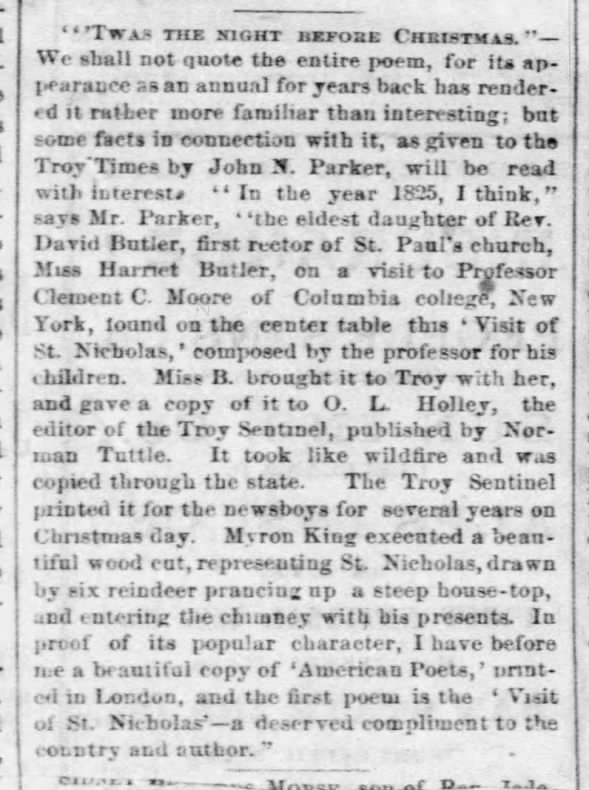
25 Dec 1871, Mon Democrat and Chronicle (Rochester, New York) Newspapers.com

A longtime resident of Troy, John T. Parker (1803-1874) must have known Miss Harriet Butler (1791-1865), the Troy lady he credits by name with copying "Visit" and supplying it to Orville L. Holley. And Harriet's younger brother, Clement Moore Butler. Parker's 1871 narrative is informed by personal knowledge of Troy and its leading citizens including their father, the well-regarded pastor of St. Paul's Episcopal Church. Indeed, Harriet's father David Butler officiated in 1834 at the wedding of John T. Parker and Martha Lasell. 

MARRIED. On Wednesday afternoon, at St. Paul’s Church, by the Rev. David Butler, Mr John T Parker to Miss Martha Lasell, daughter of Mr Elias Lasell, all of this city. 
-- Troy Budget, January 10, 1834.

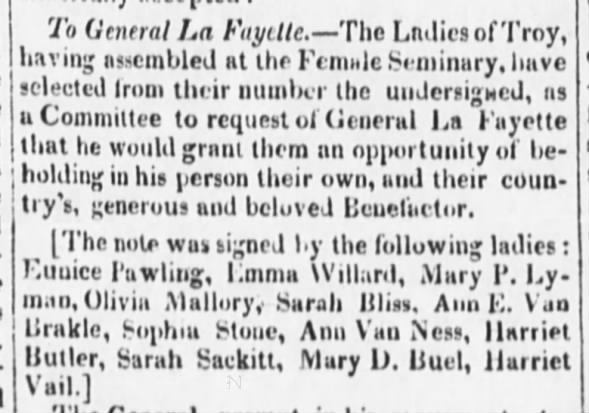
John's wife Martha Lasell Parker (1810-1903) attended the Troy Female Seminary, as the Emma Willard School was then called. Fourteen-year-old Martha Lasell was still a pupil there in September 1824 when the ladies of Troy welcomed the Marquis de Lafayette during his triumphant tour of the United States. As reported previously on Melvilliana, Lafayette was persuaded to visit the Female Seminary after receiving a formal invitation signed by Emma Willard and eleven leading women on the Committee of Arrangements including Harriet Butler and Sarah Sackett. The names of the two ladies who introduced Santa Claus to Troy in December 1823 appeared together on the signed note to General Lafayette from the Committee of Arrangements.
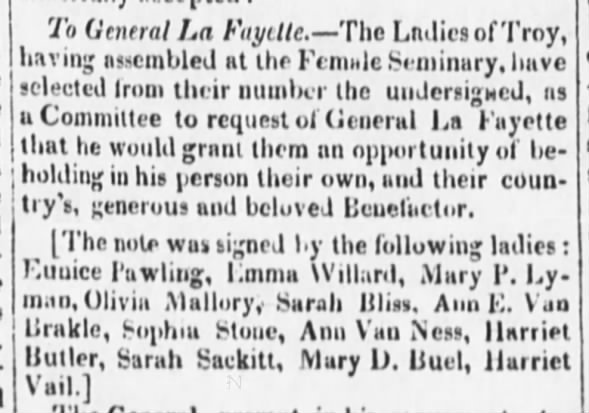
23 Sep 1824, Thu The Evening Post (New York, New York) Newspapers.com

To General La Fayette.— The Ladies of Troy, having assembled at the Female Seminary, have selected from their number the undersigned, as a Committee to request of General La Fayette that he would grant them an opportunity of beholding in his person thier own, and their country's, generous and beloved Benefactor.

[The note was signed by the following ladies: Eunice Pawling, Emma Willard, Mary P. Lyman, Olivia Mallory, Sarah Bliss, Ann E. Van Brakle, Sophia Stone, Ann Van Ness, Harriet Butler, Sarah Sackitt, Mary D. Buel, Harriet Vail.]  --New York Evening Post, September 23, 1824. 

As a schoolgirl, John T. Parker's future wife Martha Lasell Parker may already have known both Harriet Butler and Sarah Sackett. Near the close of the 19th century, Martha recalled the visit of Lafayette as a highlight of her time at the Troy Female Seminary:

When La Fayette visited the school in 1824, Miss Lassell was still at the Seminary, and participated in the ovation paid to him. The young girls were dressed in white frocks and gay ribbons. A bower of evergreen was erected across the Park to the Seminary building.

Mrs. Willard, attended by her teachers, met General La Fayette at the north gate, while the scholars followed in line, singing an ode of welcome which Mrs. Willard had written for the occasion. --Emma Willard and Her Pupils, edited by Mrs. A. W. Fairbanks (New York: Mrs. Russell Sage, 1898) page 74.

Harriet Butler was 32 years old in 1823; Sarah Sackett just 30 when she reportedly handed Orville Holley a copy of "A Visit from St Nicholas" for publication in the Troy Sentinel. Ten months later they collaborated with Emma Willard and others on the reception of Lafayette. Perhaps other civic and charitable projects brought them together as well, although they worshipped in different places--Harriet of course at St. Paul's Episcopal Church, Sarah at the First Presbyterian Church. Were Miss Butler and Mrs. Sackett ever employed by Mrs. Willard as teachers or assistants at the Troy Female Seminary? 

Harriet Butler died in 1865, on the day after Christmas.

Troy Daily Times - December 29, 1865

Sarah Sackett was born Sarah Hammond Pardee on February 9, 1793, in Stephentown, New York. As noted above, when she delivered A Visit from St Nicholas to Orville Holley, Mrs. Sackett belonged to the the First Presbyterian Church of Troy. A few years later she joined the Second Presbyterian Church as a charter member. Contemporary records link Sarah Sackett to a variety of worthy causes including Greek independence, distribution of religious tracts, and donations to the library of the Troy Young Men's Association. After the death of her husband Daniel in 1845, Sarah H. Sackett lived with relatives in Troy and Lansingburgh, New York. 

Troy Sentinel - April 27, 1827
via NYS Historic Newspapers

Sarah H. Sackett died in Lansingburgh on June 23, 1867, eighteen months after the passing of her Troy friend Harriet Butler. 

Troy Weekly Times - June 29, 1867
via NYS Historic Newspapers

DIED.

... In Lansingburgh, at the residence of her nephew, Wm S. Hawley, June 23d, Mrs SARAH H., relict of Daniel Sackett, late of Troy, aged 74 years. --Troy Weekly Times, June 29, 1867

The perfunctory announcement of Sarah Sackett's death in the Times prompted this heartfelt tribute signed "E. D." and published in the Troy Daily Times on July 6, 1867.

Troy Daily Times - July 6, 1867 via fultonhisotry.com

Obituary.

When an aged saint whose Christian course for more than two score of years has been one of untiring faithfulness and well-doing in the church of Christ, a life-long exhibition of kindness and good will to all around; I say when such a one departs this earthly tabernacle, the occasion seems to demand something more than a passing notice in a daily journal. Such a one has recently been suddenly stricken down in the midst of continued usefulness in the church and the world. All who were familiar with the dear expressive face, the gentle, graceful Christian manners and conversation of the late Mrs. Daniel Sackett, were pained when they read in the Times a few days since, the words which told them of her demise. Though Mrs. S. had not been a constant resident of Troy for a few years past, yet she retained her connection in the communion of the Second Presbyterian Church, Fifth street. Only two weeks previous to her death she came back to the city to spend a Sabbath of sacramental privileges with the church of her earlier love. Though the old church building, dear to the memory of all hearts who once worshipped there, had been swept away by the "destruction that wasted at noonday" and a more beautiful and commodious one erected, yet to her heart, a more thrilling and heart-touching memory must have come, when she remembered that of all that goodly company with whom she united more than forty years by-gone, in the original organization of that same church, probably but one with herself was spared by the hand of death or change to sit down on that occasion at the table of the Lord.

But her work is done, she has gone to her rest quietly, peacefully--gone to the fellowship of Heaven--to a blessed re-union with one, to her, "not lost, but gone before," and to whose memory, her widowed life ever paid a beautiful tribute of devotion.

E. D.

In Fredericton, New Brunswick, Canada, Mary Odell made an early handwritten copy of The Night Before Christmas that stayed in the frozen north. At Hyde Park on the Hudson the family of William Bard allegedly heard " 'Twas the Night Before Christmas" recited by Bard's good friend Clement Moore who
"was very intimate in the family at Hyde Park, and he read to the children his much beloved poem “The Night Before Christmas” from the manuscript before it ever was published."
-- Historical Notes of St James Parish, Hyde Park-on-Hudson, New York (Poughkeepsie, 1913) page 38.

As far as we know, however, not one of those lucky Bards was bold enough to copy Moore's poem and share it with others via the local newspaper.

Think of it! Moore's classic lines and the fantastic moonlit lustre, the twinkling, the flash of magic they bring to Christmas might never have reached us without the inspired interventions of Harriet Butler and Sarah Sackett. And now, if you please, allow me to refill that glass for this closing

Holiday Toast from Melvilliana


[Nineteenth-century style, to be drunk standing.] 
Here's to the ladies of Troy who launched Santa Claus and fĂȘted Lafayette... true in heart and soul, they knew what to do with a "generous and beloved Benefactor." 
via Library of Congress
Related posts:

Sunday, December 9, 2018

Harriet Butler and Sarah Sackett in Troy, 1824

via Dennis Holzman Antiques
In 1824 Harriet Butler and Sarah Sackitt (Sackett) both signed a petition from the "Ladies of Troy" requesting the Marquis de Lafayette to honor the Troy Female Seminary with a visit during his triumphal U. S. tour.

Thu, Sep 23, 1824 – Page 1 · The Evening Post (New York, New York, New York) · Newspapers.com
This "Sarah Sackitt" is probably Sarah Sackett, the former Sarah H. Pardee and wife of Troy merchant Daniel Sackett (1788-1845). At the time Sarah Sackett belonged to the First Presbyterian Church of Troy; she would join the Second Presbyterian Church in 1827 as a charter member. Harriet Butler is the daughter of the Rev. David Butler, Rector of St. Paul's Episcopal Church. In later sources, both women are named independently in connection with the first publication of "A Visit from St. Nicholas" in the Troy Sentinel on December 23, 1823. Harriet Butler copied the poem while visiting the family of Clement C. Moore in New York City, as reported by John T. Parker in the Troy Daily Times on December 23, 1871 ("The 'Visit of St. Nicholas’—Moore's Poem—Some Account of Its History."). Mrs. Sackett brought a copy to editor Orville L. Holley, according to the 1844 letter from publisher Norman Tuttle to Moore, now held by the Museum of the City of New York (54.331.17b).

The reported involvement of these two ladies of Troy as intermediaries is consistent with the 1862 account of the poem's earliest transmission in which T. W. C. Moore describes two stages of copying, first "by a relative of Dr Moores in her Album" and second, "by a friend of hers, from Troy." But until now (so far as I know), Harriet Butler and Sarah Sackett were not linked by name in any known contemporary record. This item nicely confirms their acquaintance and active collaboration with other civic-minded women on a project of mutual interest. Great to have, especially since some published versions of Lafayette's visit to Troy omit the bracketed list of signatories included in the New York Evening Post account.
[The note was signed by the following ladies: Eunice Pawling, Emma Willard, Mary P. Lyman, Olivia Mallory, Sarah Bliss, Ann E. Van Brakle, Sophia Stone, Ann Van Ness, Harriet Butler, Sarah Sackitt, Mary D. Buel, Harriet Vail.]
The most famous name on the 1824 list is that of Emma Willard, founder of the Troy Female Seminary.


General Lafayette accepted the invitation signed by Harriet Butler and Sarah Sackitt or Sackett along with other members of the hastily organized Arrangements Committee. At the Troy Female Seminary Lafayette received a gift copy of Emma Willard's treatise on Improving Female Education and heard two students recite Willard's poem, "La Fayette's Welcome."
The town, he said, seemed to have sprung up by enchantment. And how must this astonishment have increased when he visited this Female University, and beheld so great a collection of young ladies, drinking from the pure fountain of knowledge, whose bright eyes, and healthy countenances, and cheerful demeanor, bespoke them "as sweet as innocent; as innocent as gay; as gay as happy." The visit of the General, to Troy, short as it was, afforded him great satisfaction. He talked much about it, and frequently spoke of his visit to the Seminary, as one of the most interesting and delightful moments of his life.  --New York Evening Post, September 23, 1824. Reprinted in Poulson's American Daily Advertiser (Philadelphia, PA) on September 23, 1824; the New York Spectator on September 24, 1824; and the Richmond Enquirer ("Domestic. Journey of the Nation's Guest--in Continuation. Reception at Albany") on October 1, 1824.
Lafayette lingered so long in Troy that he had to cancel scheduled stops in Lansingburgh and Waterford.

Thu, Sep 23, 1824 – Page 1 · The Evening Post (New York, New York, New York) · Newspapers.com
Related post:

Monday, February 6, 2017

Clement C. Moore's snow poem in the Troy Sentinel

At the Troy Public Library I looked for and found the other anonymously published poem by Clement C. Moore in the Troy Sentinel. As related in the earlier Melvilliana post on Moore's Lines Written after a Snow-storm, these untitled and uncredited lines were reprinted "From the Troy Sentinel" in the Rhode-Island American on Tuesday, March 2, 1824. Presumably in Troy the verses were supplied by the same person or persons (Harriet Butler and/or Sarah Sackett) who, two months before, had passed along Moore's "A Visit from St. Nicholas" to editor Orville L. Holley. Clement C. Moore included a revised version in his 1844 Poems, printed there under the title Lines / Written after a Snow-storm. For expert assistance in the Troy Room I am indebted to the fine staff of the Troy Public Library. Thank you! 

Lines by Clement C. Moore, first published anonymously in 
The Troy Sentinel - Friday, February 20, 1824
Come dearest children [1844: children dear, and] look around;
    And see [1844: Behold] how soft and light
The silent snow has clad the ground, [1844: end comma deleted]
    In robes of purest white.

The trees are [1844: seem] deck'd by fairy hands [1844: hand],
    Nor need their native green;
And every breeze now seems [1844: appears] to stand,
    All hush'd, to view the scene.

You wonder how these [1844: the] snows were made
    That dance upon the air; [1844: end comma]
As if from purer worlds they stray'd,
    So lovely [1844: lightly] and so fair.

Perhaps they are the summer flowers, [1844: end comma deleted]
    In northern stars that bloom; [1844: end comma]
Wafted away from ivy bowers [1844: icy bowers], [1844: end comma deleted]
    To cheer our winter's gloom.  

Perhaps they are [1844: they're] feathers of a race
    Of birds, [1844: comma deleted] that live away,
In some cold wintry place, [1844: cold dreary wintry place,]
    Far from the sun's warm ray.

And clouds perhaps are downy beds, [1844: And clouds, perhaps, are downy beds]
    On which the winds repose;
Who, when they move [1844: rouse] their slumbering heads [1844: slumb'ring heads],
    Shake down the feathery [1844: feath'ry] snows.
But see, my dearlings [1844: darlings], while we stay
   And gaze with such [1844: fond] delight,
The fairy scene now [1844: soon] fades away,
   And mocks our raptur'd sight.

And let this fleeting vision teach
    A truth you soon must know —
That all the joys we here can reach, [1844: end comma deleted]
   Are transient as the snow.


Related posts:

Tuesday, November 22, 2016

Sarah Sackett, Clement C. Moore, and the Greek Fund

Le Massacre de Scio - EugĂšne Delacroix, Public domain, via Wikimedia Commons
From the New York Commercial Advertiser, April 18, 1827, under the heading "Greek Fund"; reprinted in the New York Spectator, April 24, 1827:

Troy, April 11th, 1827.

Sir--You will receive per steamboat New London, Capt. Fitch, Merchandize, valued at $55, for the Greeks--twenty dollars of which, is a donation from the Female Industrious Society of the First Presbyterian Church, and the remaining thirty-five dollars, from individual ladies of this city. Though our offering be small, we hope it may contribute something to the current of benevolence which is setting to the relief of the oppressed and destitute people. Your's respectfully, in behalf of the donors.

SARAH SACKETT.

Stephen Allen, Esq. Ch'mn. Greek Com.
This Sarah Sackett of Troy is the former Sarah H. Pardee, wife of Daniel Sackett, a crockery and glassware merchant in Troy, New York. Norman Tuttle, publisher of the Troy Sentinel, identified Sarah Sackett as the person who had given a copy of Clement C. Moore's poem "A Visit from St. Nicholas" to editor Orville L. Holley, back in December 1823. Other accounts involve Harriet Butler, daughter of Episcopal clergyman David Butler. As related for example in Troy's One Hundred Years, Harriet supposedly copied out the poem while visiting the Moore family and brought it back to Troy. Any sequence of transmission involving the Butlers, Sacketts, and Holley seems plausible. The families of Clement C. Moore and the Rev. David Butler were connected through longstanding ties of friendship and religion. Rev. Butler was then rector of St. Paul's Episcopal Church in Troy (consecrated in 1806 by Moore's father, the Bishop). Butler in turn was socially and politically connected with Daniel Sackett and Orville Holley as leading citizens of Troy, and prominent Whigs. All three were founding members of the Troy Colonization Society.

Sarah Sackett's published letter to the Greek Committee in 1827 reveals another connection to Clement C. Moore in their mutual support for the cause of Greek independence. Sarah Sackett organized for the charitable relief of "oppressed and destitute" Greeks. Moore, too, actively supported the Greek Fund. In verse, Moore honored the Greek spirit of rebellion in "To the Nymphs of Mount Harmony," allegorizing the plight of defeated Greeks as the overthrow and enforced captivity of an Arcadian sprite or fairy. Sarah Sackett and Clement C. Moore were both philhellenists, like Edward Everett, Daniel Webster, and Henry Clay. And Byron:
Henceforth there could be little question of the strength of Philhellenism in the United States; in America as elsewhere Byron’s dramatic self-sacrifice rendered the cause of Greek independence services which never can be repaid. The autumn and winter of 1823-1824 were a period in which sentiment for Greek independence reached a high point, strenuous efforts were put forth to render active assistance to the revolutionary forces, and serious consideration was given to a possible recognition of Greek belligerency and independence by the government of the United States.
--Edward Mead Earle, American Interest in the Greek Cause, 1821-1827
Coincidentally, contributions to the Greek Fund were being passionately solicited and publicized during the same holiday season of 1823-4 in which Clement C. Moore's "A Visit from St. Nicholas" made is first appearance in the Troy Sentinel. December 1823 marked the start of the Greek Fund as well as "The Night Before Christmas" tradition. The first meeting of Troy citizens on behalf of the oppressed Greeks generated $710 for the Greek Fund, as reported in a published letter from Esaias Warren:

New York American - January 31, 1824
Troy, January 23, 1824.  
Dear Sir--In compliance with a resolution, passed at a meeting of the citizens of this place, I have the pleasure of transmitting you, the annexed draft for $710, the amount contributed by them towards aiding the Greeks in their struggle against Turkish oppression. 

I am, sir, respectfully.
Your obedient servant,
ESAIAS WARREN. 
Wm. Bayard, Esq. Chairman of Greek Committee.
Esaias Warren was then mayor of Troy, president of the Troy Bank, and a warden of the Butlers' church, St. Paul's Episcopal. Warren's mother Phebe and father Eliakim had been instrumental in establishing St. Paul's in Troy. Indeed, at first the Warrens and Lemuel Hawley were the church. Esaias Warren became "senior warden" after his father's death in 1824, according to Hudson-Mohawk Genealogical and Family Memoirs.

In New York City on Tuesday, December 2, 1823 Moore's old friend John Duer addressed a large and distinguished gathering at the Tontine Coffee House. Speaking after John Pintard and S. R. Hurd, Duer emphasized "the degraded condition of the Greeks" in "contrast with their ancient splendor and renown." Duer
"spoke of the contest as one in which religion, knowledge and liberty, were staked against infidelity, ignorance and slavery--as one in which refinement and cultivation were opposed to brutal sensuality--as one in which all that is valuable in civilization was opposed by all that is degraded in barbarism."  --New York American, December 6, 1823
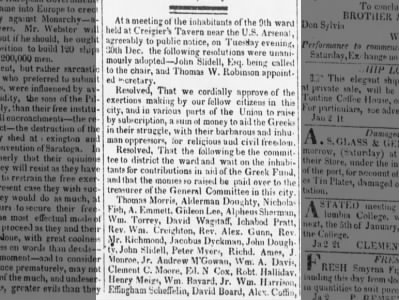
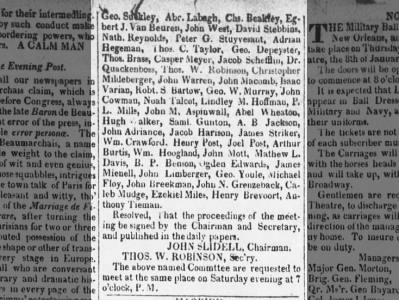
Meeting on Tuesday night, December 30, 1823 at Creigier's Tavern with his 9th ward neighbors, Clement C. Moore endorsed the resolution of support and volunteered for the fundraising committee.

New York Evening Post - January 2, 1824
 Resolved, That we cordially approve of the exertions making by our fellow citizens in this city, and in various parts of the Union to raise by subscription, a sum of money to aid the Greeks in their struggle, with their barbarous and inhuman oppressors, for religious and civil freedom.

Resolved, That the following be the committee to district the ward and wait on the inhabitants in aid of the Greek Fund....
The best known American poets contributed heroic verses in support of Greek independence:
"In imitation of Byron, poets and literary men like William Cullen Bryant and Fitz-Greene Halleck wielded their pens in stout defense of the Greeks, in whom they saw heroic descendants of classic forefathers." --Edward Mead Earle, American Interest in the Greek Cause, 1821-1827
In 1826, Herman Melville's older brother Gansevoort recited Halleck's pro-Greek "Marco Bozzaris" at the New York High School. Around 1827 or 1828 (my best guess for now), Clement C. Moore composed "To the Nymphs of Mount Harmony." Moore's allegory of Ottoman tyranny and Greek suffering unfolds as the tale of a captive elf, whispered in the "wond'ring ear" of an Arcadian shepherd. Though drenched in the conventions and mythology of pastoral poetry, Moore's manner of describing the shepherd's "wond'ring ear" nicely harmonizes with the speaker's famously "wondering eyes" in "The Night Before Christmas." Transcribed below from the only known printing in Moore's 1844 Poems.

TO THE NYMPHS OF MOUNT HARMONY.

An idle swain late chanc'd to roam
Beneath a grove's leaf-lattic'd dome,
That near a verdant mount was plac'd
Whose brow no title e'er had grac'd
Till nymphs declared the mount should claim
Sweet Harmony's inspiring name.
Here, as the swain at even strayed,
Wooed by the grove's sequester'd shade,
With thoughts unfix'd, and vacant eye,
And idly sad, he scarce knew why;
A mournful spirit of the wood,
Touch'd haply, by his kindred mood,
Soft-sighing from a hawthorn near,
Thus whisper'd in his wond'ring ear.

"A sprite I was, in happier times,
Disporting in the favor'd climes
Of early Greece; when freedom's ray
Bade mirth through all her regions play;
When wood-nymphs with their huntress-queen,
The muses and the loves were seen
To sport, like fauns, beside each rill,
And deck, like flow'rets, every hill,
'Twas then I serv'd the lighter joys
Of rural nymphs and sylvan boys;
And, sportive as the summer airs,
Exulted in my frolic cares.

" Oft, to a playful zephyr chang'd.
Along the reedy banks I rang'd;
Or, sighing o'er the oaten field,
I tried the note each stalk would yield,
In quest of dulcet tones to suit
Some favor'd fawn's or shepherd's flute.  
"Oft, in a fleecy vapor's guise,
The zephyrs bore me to the skies:
Where, 'midst the clouds with thunder fraught,
The rainbow's brightest tints I caught;
Then, melting into finest dews,
Distributed the lovely hues
To opening buds, or full-blown flowers,
Round naiad's couch, or wood-nymph's bowers.

"Oft, in a virgin lily's bell,
I caught the purest dews that fell,
With chaste suffusion to supply
Some weeping Muse's languid eye.
For, tears that from the Muses flow.
Unlike the drops of vulgar wo,
Emit the dew's inconstant gleam,
And soon are chas'd by pleasure's beam —  
"Dear airy partners in delight!
Who skimm'd, like mists, the mountain's height,
Or danc'd along the limpid stream
Illum'd by freedom's golden beam!
Ye perish'd in the floods and gales
That ruin'd all our smiling vales,
And chill'd and wither'd every bloom
In tyranny's detested gloom!

"A fiend that in the tempest flew
On wing still wet with stygian dew
Rapt me in a hurling blast
Athwart the ocean's dreary vast;
And set me, with infernal spell,
In this sequester'd grove to dwell.
Here, in my lonely prison bound,
Beset with dire enchantments round,
I've seen whole ages ling'ring go.
With scarce a solace for my wo;
Till late, beneath the neighb'ring shades,
Methought a band of Tempe's maids,
With all their wonted mirth elate,
Came, destin'd by relenting fate,
Their long, long rovings here to cease,
And charm my anguish into peace.
For, as they gambol'd o'er the green,
Once more I saw Arcadia's scene;
Again I heard each well-lov'd voice
That bade the Aonian hills rejoice.
But soon the lovely vision pass'd.
Through lonely shades now sweeps the blast,
Where, late, the fairy-footed throng
Prolong'd the dance, or pour'd the song.
If e'er thy bosom, gentle swain,
Was touch'd with sympathetic pain.
Hie thee to where the nymphs now dwell,
And all my sorrows kindly tell.
And say, if e'er this lone retreat
Their lovely band again shall greet,
I'll wake my long-neglected powers;
Refine the dews, new-tint the flowers.
I'll fringe the trees with speckled moss.
And give their leaves a finer gloss.
The painted fly shall learn to fling
Sweet odors from his gaudy wing.
I'll winnow, with my silken sails,
Each noxious breath that taints the gales;
With sweeter strains the birds inspire,
And lead, myself, the tuneful choir.  --Clement C. Moore
Moore's 1844 collection Poems is also available online courtesy of HathiTrust Digital Library.
Related posts:
Lines written after a snow-storm, 1824 and 1844 versions
https://melvilliana.blogspot.com/2019/04/lines-written-after-snow-storm-by.html