Showing posts with label Redburn. Show all posts

Saturday, January 11, 2025

Mr. Whipple, the Reviewer for GRAHAM'S MAGAZINE, 1849-1853


Graham's Magazine
for April 1853 offered a long and extremely favorable tribute to Edwin Percy Whipple, highly esteemed at the time as a leading American critic, essayist, and lecturer. 
Signed "J.G.D." (who's that?), the article is so full of extravagant praise, I could not help wondering if some of it was meant to be understood as satire. Reading again, allowing plenty of room for hyperbole, I take the writer to be fairly and squarely in Mr. Whipple's corner. Nonetheless, the style of writing displays a Melvillean delight in the play of language and use of literary and rhetorical devices (assonance and alliteration, bathos, antithesis, puns, innumerable allusions) for ironic or comic effects. However you regard the lionizing of E. P. Whipple in the April 1853 issue of Graham's, HERMAN MELVILLE is already in the house--thanks to "J. G. D." the author, who prefaces the article with an epigraph borrowed from the "Pleasant Shady Talk" of Melville's devil-possessed philosopher Babbalanja in the second volume of Mardi: and a Voyage Thither (1849):


EDWIN PERCY WHIPPLE.  

"The [True] critics are more rare than true poets. A great critic is a sultan among satraps; but pretenders are thick as ants striving to scale a palm after its aerial sweetness." — HERMAN MELVILLE.

From the jump then, "J. G. D." self-identifies as a genuine Melville aficionado. A fan even of Mardi❣ ❣❣ With this rarest of quotes for an epigraph, the claim for the greatness of Mr. Whipple as a literary critic will be argued in light of Melville's pronouncement on the scarcity of sultanic "true critics," as opposed to the plenitude of pretenders. This, in Melville's lofty palm of a book which the pretentious ant-critics had striven mightily to scale, and hate on. Outside of Mardi itself, the chosen quotation appears nowhere else in the gigantic digitized collection of searchable works at HathiTrust Digital Library until 1921, when Raymond M. Weaver used it in the landmark biography Herman Melville, Mariner and Mystic (New York: George H. Doran Company). 

Now for a sample of the author's entertaining prose style, at once bluff yet abundantly expressive, being rich in creative word choices, metaphors and conceits: 

  • Mr. Whipple "is all free from the supple superciliousness and the common cant, strut, swagger, twaddle, and conceit of reviewing." (page 448)
  • Interesting military metaphor here--bordering on astronomy, as in Dupont's Round Fight, one of Melville's Civil War poems in Battle-Pieces: "None of his faculties ever sally out foraging or frolicking on their own account, but are all marshaled in orderly array, and move together in unity." (448)
  • "Between the motion of Mr. Whipple's thoughts and those of most men, there is about the same difference as between the movements of a catamount and a caterpillar." (449)
  • Whipple's brand of criticism "gives no quarter to vapid and pithless pretension, overweening fatuity, genteel immorality, saint-seeming hypocrisy, or silly slim flimsiness; he especially whips all vulgar elegant idlers and foul fools, all wanton literary aggressors--whether they carry a pike against a man, or only a pique--" (450)
  • "neat as a nut" (450)
  • "to stir a saint... or tickle a cultivated sinner" (451)
  • "He is neither a mystic nor a worldling...." (451)
  • "earnest as an ancient prophet, and sharp as a pick-pocket.” (451)
  • "True genius is the transfiguration of common sense, and not the annihilation of it." (452)

Late in the article, "J.G.D." scorns the "intense inanity" exhibited in the patronizing London Athenæum review (November 22, 1851) of Whipple's collected lectures on Literature and Life (Boston, 1850):

"It is very questionable whether blind noodles, boobies and snobs are the fit persons to judge of works of genius;--and the London Athenæum, if that be a fair sample of its literary verdicts, may safely be set down as a remarkably owly concern."

This deliciously worded dismissal of "literary verdicts," plural, handed down by transatlantic "noodles,  boobies and snobs," also plural, might easily be applied to the influentially bad review of The Whale as "an ill-compounded mixture of romance and matter-of-fact," published the month before in the same English journal.

To be sure, the excessive, zestful, over-the-top style adopted by "J. G. D." is not suited to everybody's taste. One fellow-journalist in Philadelphia complained of the "rhapsody of adjectives" loosed in the "High Falutin" tribute to Mr. Whipple. 

Pennsylvania Freeman - April 7, 1853
"HIGH FALUTIN." -- A writer in the last number of Graham's Magazine, goes into a rhapsody of adjectives, over the merits of Mr. Edwin P. Whipple. Here are specimens: 
"His integral character, the vast but facile and benign power of his nature," has hitherto received but a "slim appreciation." He has an "ethereal, colossal, and commanding intellect,--a sturdy, circumspective, foresightful, spirit-piercing sagacity;" and as a "lucid and reliable, racy and candid and decisive" "interpretative critic," he is "the most obviously excellent and most widely known." His style is "most affluent, clear, terse, plastic, pictorial, philologically perfect, and correct to a comma."

There; that is enough for our readers at once. We pity those who have to take the whole at one dose.  -- Philadelphia, Pennsylvania Freeman, April 7, 1853
But hold up. Can it really be, that this sultan of 19th century lit crit never said a mumbling word in public about any work by Herman Melville? Come to think about it, how in the world could "J. G. D." have endorsed Mr. Whipple so effusively and exclusively, indulging in such a "rhapsody of adjectives," if said Mr. Whipple had never stooped to review Melville's Mardi, that portentous allegory from which the singularly rare epigraph to the article on "Edwin Percy Whipple" derives? 

As Hugh Hetherington harrumphed in a footnote to Melville's Reviewers: British and American, 1846-1891 (University of North Carolina Press, 1961), with explicit reference to the praise for Whipple's superior "intellect" in the 1853 article in Graham's,
"This great mind does not seem to have shown any awareness of the existence of Melville." (Melville's Reviewers, page 9)

In stark contrast to the seemingly indifferent Mr. Whipple of Boston with his presumed neglect of Melville's genius, Hetherington proposes Bayard Taylor as the "real Melville enthusiast" who penned the remarkably sympathetic reviews in Graham's Magazine of Mardi (June 1849) and Redburn (January 1850).

Hetherington's conjectural assignment of these two reviews in Graham's to Bayard Taylor would not be adopted in subsequent collections of Melville reviews. Although Bayard Taylor did serve briefly as nominal editor of Graham's and continued to submit occasional pieces, the contributions of Taylor and other big-name authors were credited to attract more readers and hopefully increase sales of the magazine. Hetherington's chief authority for information about Graham's is Frank Luther Mott, A History of American Magazines, 1741-1850 (New York, 1930). The first volume of Mott's History incorporates findings published in his earlier study, A Brief History of 'Graham's Magazine'.

  • Mott, Frank Luther. “A Brief History of ‘Graham’s Magazine.’” Studies in Philology, vol. 25, no. 3, 1928, pp. 362–74. JSTOR, http://www.jstor.org/stable/4172007. Accessed 10 Jan. 2025.

Mott emphasized the limited role of Taylor who even in 1848 "was never more than a contributing editor." Also in the earlier study, Mott placed Mr. Whipple in the corps of regular contributors to Graham's, as reorganized in 1849-1850: "Edwin P. Whipple wrote articles and reviews." 

Boston Evening Transcript - August 20, 1850
via newspapers.com
Whipple's role as "the Reviewer" for Graham's magazine in this period was openly acknowledged in a newspaper article first published in the Oswego NY Commercial Times and reprinted in several Massachusetts newspapers. (Published in Oswego, New York by James N. Brown, the Commercial Times on November 26, 1851 plugged Moby-Dick as a "welcome" new book, "written with considerable spirit" and loaded with "wit and humor.") The earliest reprinting of "MR WHIPPLE, THE REVIEWER" I have found so far appeared under that heading in the Boston Evening Transcript of August 20, 1850. 

Boston Emancipator & Republican - August 29, 1850
via genealogybank.com
Possibly Whipple himself had supplied a good deal of useful information about his life and literary career to the anonymous writer of "Mr. Whipple, the Reviewer." Some of the same biographical details are disclosed in extant letters from Whipple to Rufus W. Griswold, accessible online via Digital Commonwealth. As stated in the unsigned newspaper article, the recent two-volume collection of Whipple's Essays and Reviews (New York: D. Appleton, 1850) reprinted many pieces that had originally appeared in the prestigious Boston quarterly, the North American Review. Also just out at the time, the aforementioned volume of Whipple's Lectures on Subjects Connected with Literature and Life (Boston: Ticknor, Reed, and Fields, 1850), the English reprint of which would get ridiculously undervalued according to "J.G.D." by condescending twits ("blind noodles, boobies and snobs") at the London Athenæum

Salem, Mass. Register - September 15, 1850
via genealogybank.com
What's new, and crucial for the investigation now underway, is the public acknowledgement of Mr. Whipple's generally unheralded work for George Rex Graham of Philadelphia:
"For several years past, the Critical Notices in Graham's Magazine, have been written by Mr. Whipple. He despatches this description of writing with astonishing facility, entire faithfulness, and unerring judgment."
A bit more casually, the National Era listed the unsigned "critical Notices by Mr. Whipple" among "especially commendable" highlights in the August 1850 issue of Graham's Magazine, alongside credited contributions of a poem by Bayard Taylor and a short story by Caroline Chesebro. In this issue Whipple had also contributed the long essay on Wordsworth over the initial "P." for his middle name, Percy. Presumably when speaking of unspecified, plural "critical notices" the Washington, D.C. National Era editor refers to the section near the end of each monthly installment in Graham's, usually titled "Review of New Books."
Washington, D. C. National Era - August 8, 1850
By 1850, according to the promotional newspaper item featuring "Mr. Whipple the Reviewer," Whipple had obtained at least two years of experience in the role of reviewer at Graham's, having "for several years past" been responsible for producing "the Critical Notices in Graham's Magazine." 

Writing from Boston on April 26, 1847 about his slot in the proposed volume on the Prose Writers of America, Whipple modestly instructed editor Rufus W. Griswold to 

"leave out of your notice of me, all biographical matter except the time when and the place where I was born, and the fact that I am engaged in Commercial pursuits. Cut out likewise the tremendous puff about my style being Milton and Addison fused together."
I'm guessing Griswold had little time to oblige these requests even if he wanted to. At any rate, Whipple still comes last in the published arrangement of authors, against his wishes. And Griswold's fulsome intro still includes the biographical tidbits and this "tremendous puff" that Whipple asked to be dropped:

"Though he is no copyist, some of his articles suggest a fusion of the strength of the Aeropagitica with the ease and liveliness of the Spectator."

At the close of the same letter Whipple chastised Griswold for his "shabby genteel damnation" of Cornelius Mathews. Good heavens! too bad Perry Miller did not have this passage to enrich his classic study The Raven and the Whale (New York: Harcourt, Brace and Company, 1956):

I am glad to hear that you are well. I am sorry that Duyckinck published that article in the World. It is very one-sided and harsh. However you drew down the lightning on your own head by your shabby genteel damnation of Mathews. I always make it a rule never to join in when there is a cry of condemnation against a fellow creature and author. Mathews has not had justice done him, and therefore he is to be tenderly touched. You may depend upon it that his influence across the water will be against you if you do not modify your criticism upon him. I wish you would take out some of the eulogy on me and put it on to Cornelius. You would not, in that case, increase the aggregate of your praise. 

-- Edwin Percy Whipple, Boston, MA., autograph letter signed to R. W. Griswold, 26 April 1847. < >

Besides the 1850 newspaper item already cited herein, additional evidence of Whipple's role as the Reviewer for Graham's can be found in his extant letter to R. W. Griswold of January 6, 1849 (misdated 1848 by Whipple, writing early in the first month of the New Year 1849).

"I have not yet had time to scrutinise your last books, Sacred and American. They look very well, and the Female Poets, especially, has amazed me by its research. I shall notice both in Graham's.

I am glad you like the Essays and Reviews. I see that they are beginning to blackguard me in New-York; and in Phila. I have been treated very shabbily. They seem to be apprehensive that the book will prove interesting to the public." 
-- Edwin Percy Whipple, Boston, MA., autograph letter signed to R. W. Griswold, 6 January 1849. Boston Public Library, Rufus W. Griswold Papers, 1834-1857. Accessible online via <>

Whipple refers here in a kind of shorthand form to just-published anthologies edited by Griswold, The Sacred Poets of England and America and The Female Poets of America. Fulfilling Whipple's written promise to Griswold in January, the Review of New Books department in the March 1849 issue of Graham's (now going as Graham's American Monthly Magazine of Literature and Art) included substantial, favorable notices of both new books. 

Graham's American Monthly Magazine - March 1849

🎆🎇

Strongly confirming the identity of Mr. Whipple as the author of anonymous critical notices in Graham's, only three months before the appreciative take on Melville's third book Mardi: and a Voyage Thither graced page 385 of the June 1849 issue.  

🎇🎆

Graham's American Monthly Magazine - June 1849

Therefore, the Graham's reviewer of Mardi (and Redburn, too) who impressed Hugh W. Hetherington as a "real Melville enthusiast" was not Bayard Taylor, but Edwin Percy Whipple.

Mopping up, we may as well credit Mr. Whipple, verified reviewer at Graham's Magazine, with subsequent notices there of Mobby-Dick; or the Whale (with Moby misspelled Mobby in February 1852) and Pierre; or the Ambiguities (October 1852). Well, it's not so much of a stretch, after all. As long known in Hawthorne scholarship, Edwin Percy Whipple also wrote friendly reviews of Hawthorne's works in Graham's: of The Scarlet Letter in May 1850; The House of the Seven Gables in June 1851; The Snow Image in April 1852; The Blithedale Romance in September 1852; and Tanglewood Tales in September 1853. These items are all inventoried by Gary Scharnhorst in Nathaniel Hawthorne: An Annotated Bibliography of Comment and Criticism before 1900 (Metuchen, N. J., & London: The Scarecrow Press, 1988) and ascribed there to Edwin Percy Whipple.

Whipple's tenure at Graham's extended from 1849 to 1853, according to William Charvat in The Profession of Authorship in America, 1800-1870, edited by Matthew J. Broccoli (Ohio State University Press, 1968). Focused mainly on the genial influence of Whipple's old friend James T. Fields, Charvat portrays the Graham's reviewer as
"...an irresistible object of the celebrated charms of James Fields. who saw to it that Whipple met, and remained in permanent social relations with, as many Ticknor and Fields authors as possible. It is not surprising that these were the subject of a majority of Whipple's unsigned reviews in Graham's between 1849 and 1853" (Profession of Authorship, page 177).
More work remains to be done, of course. I don't automatically suppose Whipple wrote the positive notice of Typee in the May 1846 number of Graham's. Then again, our man allegedly began contributing to newspapers and magazines at the age of fourteen, so who knows? Born March 8, 1819 (five months before the birth of Herman Melville on August 1st of the same year), Edwin Percy Whipple turned 15 in 1834. By the time Melville published his first book. Whipple had already made a name for himself as a reviewer to be reckoned with. Positive identification of Mr. Whipple as sympathetic reviewer of Mardi, Redburn, Moby-Dick, and--recognizing exceptional "force and subtlety of thinking and unity of purpose" in scenes "wrought out with great splendor and vigor"--of Pierre as well, invites further study of Whipple's writings. 
At first glance a number of Whipple's favorite subjects and themes emerge in the four Melville reviews published during his tenure as the writer of critical notices for Graham's Magazine, particularly his interest in revelations of a writer's mind or "mentality," of peculiar traits or signs of personal "individuality," and evidence of spirit and original genius.

Sad to say, I have yet to answer the question I started with. Who is "J. G. D."? Inquiring minds etc.

Links to some available bios of Edwin Percy Whipple


Monday, March 6, 2023

"King of the Oaks" in REDBURN and Amasa Delano's NARRATIVE

The borrowed description of teak wood as "the King of the Oaks" in Chapter 34 of Herman Melville's  Redburn indicates that by summer 1849 at the latest, Melville already owned or had access to a copy of the Narrative of Voyages and Travels by Amasa Delano. Melville got the purportedly oriental phrase "king of the oaks" from Delano's description of Bombay in chapter 12. Six years later, Melville would remake chapter 18 of Delano's Narrative into the 1855 thriller, Benito Cereno.

Arrived in Liverpool, Melville's narrator Wellingborough Redburn visits a large merchant ship from Bombay named the Irrawaddy.

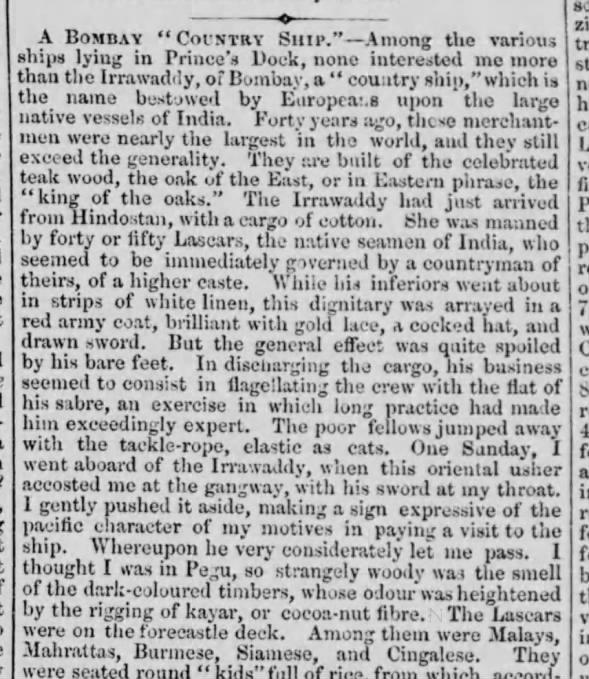
AMONG the various ships lying in Prince's Dock, none interested me more than the Irrawaddy, of Bombay, a "country ship," which is the name bestowed by Europeans upon the large native vessels of India. Forty years ago, these merchantmen were nearly the largest in the world ; and they still exceed the generality. They are built of the celebrated teak wood, the oak of the East, or in Eastern phrase, "the King of the Oaks." -- Redburn Chapter 34 - The Irrawaddy

For the factual substance of the Irrawaddy chapter, Melville creatively plagiarized from the Penny Cyclopaedia entry for Tectona, as Willard Thorp first discovered. 

Thorp's findings are summarized by Hershel Parker in the Historical Note for the 1969 Northwestern-Newberry edition of  Redburn. Mary K. Bercaw documents additional borrowings from the Penny Cyclopaedia in Redburn and other novels in "The Infusion of Useful Knowledge: Melville and The Penny Cyclopaedia," Melville Society Extracts 70 (September 1987) pages 9-13. 

TECTONA in the Penny Cyclopaedia supplied Melville's phrase "oak of the East"

https://books.google.com/books?id=GxwDAAAAYAAJ&pg=RA3-PA141&dq#v=onepage&q&f=false

but besides the narrator of Redburn, only Amasa Delano calls teak wood "the king of the oaks."

Amasa Delano, Narrative of Voyages and Travels (Boston, 1817) page 213.
The people of Bombay have many large ships of their own. The largest merchant ships in the world are built there, and belong to the commercial capitalists of the town. The ship builders are all natives, and are pre-eminent in their profession. They build many ships of the teak wood, which they call the king of the oaks, and which they procure from Pegu. It is as large as our largest oaks, the timber very straight, free from knots, and excellent for planks. I have seen it grow fifty feet before a limb shoots from the trunk. Some of them are three feet in diameter. There is another kind of tree, which is called there sissor-wood, and which is the best in the world for the crooked timber required in ships. It is extremely hard and durable. -- Amasa Delano, Narrative of Voyages and Travels (Boston, 1817). 

https://books.google.com/books?id=34QqAQAAIAAJ&pg=PA213&dq#v=onepage&q&f=false

Like Delano, Melville's narrator emphasizes the size of merchant ships built in India:

"these merchantmen were nearly the largest in the world" - REDBURN

"... largest merchant ships in the world" - DELANO

Delano also names Pegu as the place for getting teak...

"I thought I was in Pegu, so strangely woody was the smell of the dark-colored timbers...." (REDBURN)

"... which they procure from Pegu." (DELANO)

But Redburn's sensory experience of the "woody" odor seems, like the name of the Bombay vessel, to have been inspired by the "forests" of teak "along the banks of the Irrawady, especially in Pegu" as described in the Penny Cyclopaedia entry TECTONA. Same goes for the expression "oak of the east," also found in TECTONA, the Penny Cyclopaedia entry first identified by Willard Thorp as Melville's source for the Irrawaddy chapter in Redburn. Not "King of the Oaks" though. Searches on Google Books and HathiTrust Digital Library yield only two works containing the phrase "the king of the oaks" before 1850: Delano's Narrative and Melville's Redburn. In old British newspapers, teak as "king of the oaks" appears only in excerpts from Redburn Chapter 34, sometimes (as in the London Guardian for November 2, 1850 and Liverpool Mercury on November 5, 1850) headed

A BOMBAY "COUNTRY SHIP."


05 Nov 1850, Tue Liverpool Mercury, etc. (Liverpool, Merseyside, England) Newspapers.com

Delano's Narrative is Number 200 in Mary K. Bercaw's 1987 checklist of Melville's Sources. In previous Melville scholarship, possible literary debts to Delano outside of Benito Cereno have been identified in White-Jacket (1850) and The Encantadas (1854). And, more questionably, in Typee (1846). Hershel Parker speculates in the second volume of Herman Melville: A Biography (Johns Hopkins University Press, 2002) that Melville might have encountered Captain Amasa Delano's Narrative by 1847, in time for use in Mardi (1849). Listed as "Delano's Voyages and Travels" in the 1828 Catalogue of Books in the Albany Library, page 23

 and so indexed in the 1838 and 1850 Catalogue of the New York Society Library.

With further study, more traces of Melville's reading in Delano's Narrative may turn up in Redburn and elsewhere in Melville's published writings.

Pascoa (1816 ship)

 Further reading:

Related post:

Sunday, March 5, 2023

Lascars and Indian Ocean Seafaring, 1780-1860

Lascars and Indian Ocean Seafaring, 1780-1860: Cases of mutiny and other forms of protest are used to reveal full and interesting details of lascar shipboard life.Shortlisted for the Royal Historical Soci...

Thursday, September 9, 2021

Communism defined in 1849

IMAGE © THE BRITISH LIBRARY BOARD. ALL RIGHTS RESERVED.

COMMUNISM DEFINED.-- "The other day," says the Constitutionnel, "a workman was declaiming in the midst of a group against communism. One of the group said, 'You talk against communism, and you do not even know what it is.' The workman said nothing in reply at first, but taking off his blouse he tore it into fragments, and, after giving a portion to each of the persons present, he said, 'Communism, my friends, has for its object to make of what may be very useful to one person a collection of morsels which are useful to nobody.' "

Quoted from the French periodical Le Constitutionnel, this practical illustration of equity under communism appeared in the Liverpool Albion for October 15, 1849, on the same page with a long excerpt from chapter 33 of Melville's Redburn, headed "The Shipping of the Mersey." Found on The British Newspaper Archive. The Albion reprinted additional excerpts from Melville's latest novel on October 22 ("Scenes By the Dockside," from Redburn chapter 34); October 29 ("A Reminiscence" from Redburn chapter 36); November 5, 1849 ("Dockside Beggars" from Redburn chapter 38); November 12 ("Shipping a Dead Sailor" from Redburn chapter 47 and "Evading the Customs" from Redburn chapter 40); and November 19, 1849 ("Dockside Horses" also from Redburn chapter 40).


Monday, November 25, 2019

Swiftsure drawing by Samuel Ward Stanton

SWIFTSURE 1825, pencil drawing by Samuel Ward Stanton (1870-1912)
in American Steam Vessels series no. 5, Steamboats of the River Hudson
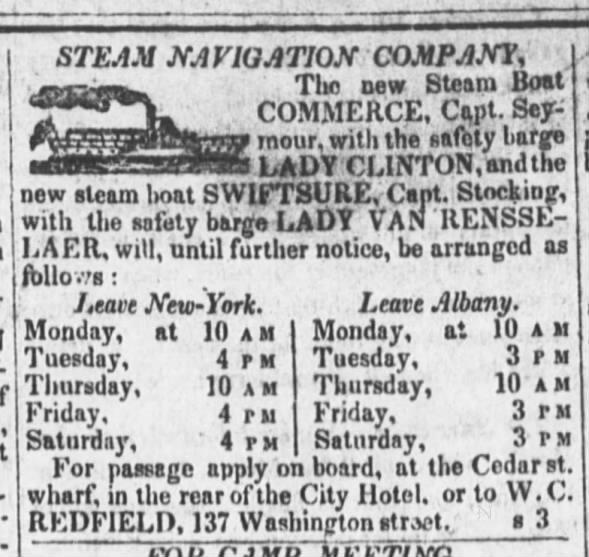
Number 5 in the American Steam Vessels series (Meriden Gravure Company, 1962-5) of drawings by marine artist and historian Samuel Ward Stanton (1870-1912) is titled Steamboats of the River Hudson. Published by Stanton's daughter Elizabeth Stanton Anderson, this pamphlet edition reproduces some early work not found in American Steam Vessels (New York, 1895), including the rare pencil drawing of the Swiftsure in 1825, towing the "safety barge" Lady Van Rensselaer.

Numbers 1-5 in the American Steam Vessels series of drawings by Samuel Ward Stanton are collected in one volume at the University of Michigan Library, now Google-digitized and accessible online courtesy of HathiTrust Digital Library.

Pertinent history of the Swiftsure is given under Stanton's picture of the "SWIFTSURE 1825 pulling safety barge LADY VAN RENSSELAER":
Built at Brooklyn, N. Y., wood, 265 tons, by C. Bergh for A. Van Santvoord's Steam Navigation Co. for route between New York and Albany. SWIFTSURE and COMMERCE usually had in tow, for those afraid of steamboats, so-called safety barges connected to them by swivelled platforms over which passengers could walk. Practice discontinued after 1829 due to resulting slowness, and barges converted for freight. SWIFTSURE abandoned in 1856. -- Steamboats of the River Hudson, American Steam Vessels series no. 5 (Meriden Gravure Company, 1965). 
Tue, Sep 6, 1825 – Page 1 · The Evening Post (New York, New York) · Newspapers.com
Samuel Ward Stanton died at sea on April 12, 1912 in the Titanic disaster. Stanton's early Swiftsure drawing did not appear in American Steam Vessels. His model is not identified exactly, but in the 1895 Preface Stanton avowed that his illustrations were all "drawn from reliable sources" such as "early prints, lithographs, drawings and paintings, mostly in the possession of private parties or steamboat companies." Also acknowledging his use of old newspapers and hand-bills, Stanton further specified that he had drawn
the United States from a wood cut that appeared in the New York Evening Post, of June 23, 1821; the Constitution from a wood cut on a hand-bill of 1826, and the Albany, 1839, is likewise from a wood cut.
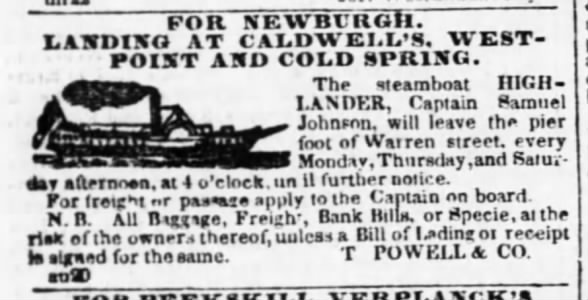
For representations of some early Hudson River steamboats including the CommerceDeWitt Clinton, and Highlander, Stanton credited "the pictures of Mr. James Bard, a gentleman who began this class of work before 1830."

Highlander (1835 steamboat)

Shown above via Wikimedia Commons, the image of the steamboat Highlander from American Steam Vessels by Samuel Ward Stanton is also accessible online courtesy of HathiTrust Digital Library
  • https://hdl.handle.net/2027/mdp.39015018442189?urlappend=%3Bseq=48
and Google Books
  • https://books.google.com/books?id=lQ8fAQAAMAAJ&pg=PA44&lpg=PA44&dq#v=onepage&q&f=false
Stanton describes the Highlander, built in 1835 for the Hudson River, as 
"one of the best boats on the river when she first came out, as well as one of the fastest. She ran on the Newburgh and New York line until the Thomas Powell appeared, 1846. She was then used as an excursion boat."  --American Steam Vessels
Wed, Oct 9, 1839 – Page 4 · The Evening Post (New York, New York) · Newspapers.com
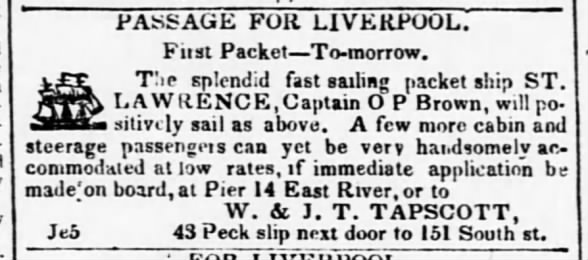
In Redburn (1849) Herman Melville gave the name "Highlander" to the merchant vessel that takes the green hero Wellingborough Redburn across the Atlantic and back. The Highlander in Redburn is a fictionalized version of the real St. Lawrence which did in fact sail to Liverpool in June 1839 with Herman Melville on board. Melville shipped as an inexperienced "boy," although he would celebrate his 20th birthday in Liverpool, waiting to sail home. As William H. Gilman reported in Melville's Liverpool TripModern Language Notes Vol. 61, No. 8 (December 1946) pages 543-547, the crew list of the St. Lawrence had Herman Melville enrolled under the name "Norman Melville."

Wed, Jun 5, 1839 – Page 3 · The Evening Post (New York, New York) · Newspapers.com
Related posts:

Tuesday, October 8, 2019

Redburn notice, Albany Argus

Daily Albany Argus - November 21, 1849 via GenealogyBank
This brief notice of Redburn in the Albany Argus (November 21, 1849) is listed but not transcribed in Herman Melville: The Contemporary Reviews, edited by Brian Higgins and Hershel Parker (Cambridge University Press, 1995; paperback 2009), at page 291. In the Argus, this item appears with other notices of  "New Publications" in a column signed, "W."  Found on GenealogyBank among articles added "within 1 week":
REDBURN: HIS FIRST VOYAGE. By Herman Melville.
We have looked into this book enough to see that it bears the characteristic marks of its author's genius, and has so much of the simplicity of nature, and so many bright and beautiful passages scattered through it, that it will not be likely to want for readers.
W.
The Albany Argus was then conducted by Edwin Croswell, in partnership with his cousin Sherman Croswell and Samuel M. Shaw, formerly a printer in Schenectady.

Thursday, August 15, 2019

Moby-Dick and Clarel in the library of Richard Garnett

"Printed Books" by Spy [Sir Leslie Ward].
Caricature of Dr Richard Garnett, CB in Vanity Fair, April 11, 1895.
Leslie Ward, Public domain, via Wikimedia Commons
Richard Garnett (1835-1906) succeeded his father at the British Museum, serving there as Assistant Keeper and eventually Keeper of Printed Books. The Times of London eulogized the son as "a scholar and literary man of much distinction and wide knowledge." Notable publications include The Relics of Shelley (1862) and The Twilight of the Gods, and Other Tales (1888). As revealed in the catalogue of his personal library, Richard Garnett owned two great works by Herman Melville: the verse masterpiece Clarel (1876) in two volumes; and in prose, the three-volume Bentley edition of Moby-Dick (1851).

Catalogue of the library of the late Dr. Richard Garnett, C. B. (London, 1906) p. 17
158 Melville (Herman) The Whale, 3 vol. FIRST EDITION, slightly
soiled, uncut, 1851 — Clarel, a Poem, etc. 2 vol. New York, 1876 (5)
Accessible online courtesy of HathiTrust Digital Library:
<https://hdl.handle.net/2027/uc2.ark:/13960/t4pk09j39?urlappend=%3Bseq=20>
and Google Books
< https://books.google.com/books?id=jV0-AAAAIAAJ&pg=PA17&lpg#v=onepage&q&f=false>
In the December 1929 Blackwoods Magazine article "Moby-Dick and Mocha-Dick," Richard Garnett's son Robert Singleton Garnett (1866-1932) recalled that his father had corresponded with Melville. Unlocated letters to and from Richard Garnett are assigned the uncertain date 1890? in the 1993 Northwestern-Newberry Edition of Melville's Correspondence, ed. Lynn Horth, pages 520 and 754.

Edward Garnett (1868-1937) was another of Richard's sons who "attained literary prominence," as noted by William Garnett Chisolm:
The other son, Edward Garnett, is an eminent critic and author, and first gave encouragement to Joseph Conrad, W. H. Hudson, John Galsworthy and Stephen Crane. He married Constance Black, whose translations of the novels of Turgeniev and other Russian writers, has gained her a wide reputation. Their son, David Garnett, is a writer of brilliant prose, and his latest novel, "Pocahontas", is a vivid and most interesting portrayal of that romantic Colonial figure. -- The Garnetts of Essex County, The Virginia Magazine of History and Biography Vol. 42, No. 1 (January 1934), pages 72-83 at 73.
The year after he married Constance, Edward Garnett wrote Melville about "remaking" Redburn, as Hershel Parker recounts:
"In July 1890 young Edward Garnett wrote Melville from the office of the publisher T. Fisher Unwin in London with an unusual proposal. For an adventure series, he hoped Melville would "recast Redburn, or preface it with an introduction, showing that whereas it was given to the world as a fiction remaking it from the class of fictitious to that of personal adventures." -- Herman Melville: A Biography Volume 2, 1851-1891 (Johns Hopkins University Press, 2002), page 901.
For more on the Garnetts, check out Helen Smith's The Uncommon Reader: A Life of Edward Garnett where 
"Beyond his connections to some of the greatest minds in literary history, we also come to know Edward as the husband of Constance Garnett—the prolific translator responsible for introducing Tolstoy, Dostoevsky, and Chekhov to an English language readership—and as the father of David “Bunny” Garnett, who would make a name for himself as a writer and publisher."  -- Macmillan publishers
I'm reading the Kindle version now, with delight. The Uncommon Reader is reviewed by Amitava Banerjee on The Victorian Web. In the Times Literary Supplement review ("Father in letters," November 8, 2017), Andrew Motion highlights Garnett's editorial preference for evidence-based matter, plainly narrated:
The framework of everything Garnett said and did as an editor was defined by his wish to see literature adopt a large cosmopolitan spirit, while clearing itself of stylistic verbiage and abstraction, and embracing “documentary evidence”, unique physical details and real­istic dialogue.
Edward Garnett's 1890 pitch for a remake of Redburn would seem to illustrate this editorial "framework," although Helen Smith does not mention it. And Sir Andrew has decided that "Garnett's life will not need to be written again." Too bad for Melville fanatics, since the author of Moby-Dick and Clarel (both listed in the catalogue of his father's library) gets only one un-indexed mention. In chapter 23, Smith quotes a 1927 letter from Garnett to T. E. Lawrence that honors Melville as one of "the great spirits" like Dostoevsky and Dante who "don't hesitate about expressing themselves frankly." Perhaps some future edition of The Uncommon Reader could squeeze in a word or two more about Edward Garnett's inherited interest in Herman Melville.


Related post:

Wednesday, August 7, 2019

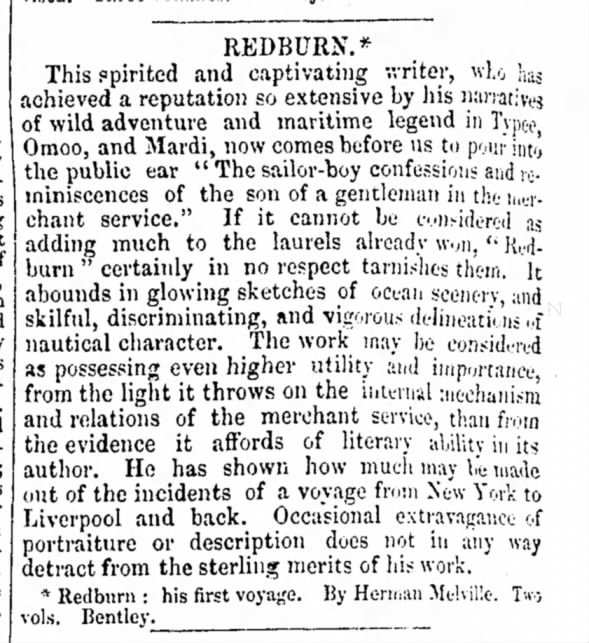
Redburn in the London Morning Chronicle

Wed, Nov 28, 1849 – 6 · The Morning Chronicle (London, Greater London, England) · Newspapers.com

From the London Morning Chronicle, November 28, 1849; found at Newspapers.com:

REDBURN.*

This spirited and captivating writer, who has achieved a reputation so extensive by his narratives of wild adventure and maritime legend in Typee, Omoo, and Mardi, now comes before us to pour into the public ear "The sailor-boy confessions and reminiscences of the son of a gentleman in the merchant service." If it cannot be considered as adding much to the laurels already won, "Redburn" certainly in no respect tarnishes them. It abounds in glowing sketches of ocean scenery, and skilful, discriminating, and vigorous delineations of nautical character. The work may be considered as possessing even higher utility and importance, from the light it throws on the internal mechanism and relations of the merchant service, than from the evidence it affords of literary ability in its author. He has shown how much may be made out of the incidents of a voyage from New York to Liverpool and back. Occasional extravagance of portraiture or description does not in any way detract from the sterling merits of his work. 
*Redburn: his first voyage. By Herman Melville. Two vols. Bentley.

Saturday, May 18, 2019

Redburn in Richards' Weekly Gazette

Here is another Melville review in Richards' Weekly Gazette, published and edited in Athens, GA by William Carey Richards. Found in the great online archive of Georgia Historic Newspapers.

Richards' Weekly Gazette - January 5, 1850
via Georgia Historic Newspapers
REDBURN; his first Voyage. Being the Sailor-Boy Confessions and Reminiscences of the Son of a Gentleman in the Merchant Service. By Herman Melville. In 2 vols. 12mo. New-York: Harper & Brothers 
“Redburn” is, to us, the most attractive of all Mr. Melville's books, not excepting even “Typee.” We have read it thoroughly, with a very pleasant impression, and have no hesitation in recommending others to read it. Its charm consists in its absolute naturalness, and its striking veri-similitude. The reader is willing to believe that every thing happened to “Redburn” just as the author narrates it. We say every tiling; perhaps, we should except the mysterious night in London, which is a little too fanciful for the harmony of the narrative. Very charming, indeed, is the simplicity of our hero, and very commendable the good humor and tact with which he demeans himself, under the many annoyances of his position, on board the Highlander. The book is not wanting in incident; affording opportunity for the display of Mr. Melville's descriptive powers. There are many vivid passages; and among them, the death of Jackson, a sort of human-devil, the spontaneous combustion of a dead body, shipped as a drunken sailor! the hero’s first essay at “going aloft,” will strike the reader. 
Mr. Melville's wit is admirably displayed in this work, and sparkles gracefully upon the surface of an under-current of strong feeling. The book deserves to have a wide popularity. --Richards' Weekly Gazette, January 5, 1850.

Related posts:

Friday, May 17, 2019

William Carey Richards on MARDI. And PIERRE?

From Richards' Weekly Gazette, May 12, 1849, published in Athens, GA and edited by William Carey Richards. Accessible online via Georgia Historic Newspapers; also Fulton History.

Richards' Weekly Gazette (Athens, Georgia)
May 12, 1849

Our Book Table.

[Publishers and Authors who desire to have their Books noticed in this Gazette, are requested to send copies to the Editor through Stringer & Townsend, New-York, or Carey & Hart, Phil.
MARDI, AND A VOYAGE THITHER. By Herman Melville. In two vols., 12mo., pp. 365-387. New York. Harper & Brothers. 1849. 
Verily, this book is a literary phenomenon. "Typee” and “ Omoo” are completely thrown into the shade by this latest effort of Mr. Melville's peculiar talent. The ostensible difference between Mardi and its predecessors is, that while they claimed to be fact, and were universally regarded as fiction, this is boldly set forth as a fiction, which the author thinks may possibly be received as a verity. If he has any hopes of this kind, he may as well dismiss them— for certainly a wilder or more incongruous mass of fiction was never brought forth, with christian rites, than is contained in these two volumes. To analyze them, is beyond our purpose. The story is not altogether unlike “ Typee” and “ Omoo," but, being a sublimation of their extravagances, the reader may judge to what extent his common sense will be taxed in its perusal. To do Mr. Melville justice, we must acknowledge at once his singular inventive faculty, and his rhetorical facility. There is a sparkle, a charm, a certain wild grace about his style, that would be quite irresistible, were it not for his decided and oppressive mannerisms, which almost everywhere disfigure it. 
With Mr. Melville’s description of the South Seas, and of their icthyological wonders — as also of the exquisite island scenery therein encountered—we should be stoics not to be charmed.
His escape from the ‘Arcturion,’ and the subsequent adventures of himself and his companion,“Old Jarl”— a poor substitute, by the way, for Toby of “Typee,” though not without his good points—for many days over the wonder-teeming waters of the Southern Seas, are very graphically narrated. 
Yillah, the heroine of the book, is a beautiful creation of the author's fancy; but we cannot help thinking that he might have managed his story better than to make her a phantom, vanishing from his very arms one night, and going no one knew whither. This trick of Mr. Melville’s, by the way, of creating such exquisite beings as Fayaway, of Typee memory, and Yillah, of Mardi, for his own especial and unlicensed enjoyment, is a striking commentary upon the morality of the book.  
The Island of “Mardi” is another “Typee,” where our author passes himself off under the name of Taji, a demi-god, and a visitor from the sun. He becomes the guest of Media, King of Odo, and, after Yillah so mysteriously disappears, he resolves to go in search of her; and Media, who is a very jolly, sociable and clever fellow, decides to accompany him. 
And now commences a series of travels and adventures almost unparalleled in romance. Feasts and frolics are plenty as blackberries; and so plenty are Kings, that five and twenty of them sit down to dinner together, “and a royal time they have.” 
In the further development of the story, the machinery of magic is employed, and we have an enchantress Hautia, with her singing maidens as heralds; and, at the very close of the book, Taji becomes a victim of Hautia, who reveals to him his lost Yillah, lying dead in a sea-cavern! Romantic enough, in all conscience. 
We liked “Typee” vastly well. It was fresh, racy and delightful, despite its somewhat sensuality. “ Omoo” tired us with its attenuation of the fine thread of the former work, and disgusted us with the author’s evident latitudinarianism in both morals and religion. In “Mardi,” we have a still further wire-drawing process, and, perhaps, even less disguised immorality and infidelity. These are hard words, but they must be uttered in justice to our position as a journalist. 
Without questioning Mr. Melville’s very clever talent at romancing, we must conscientiously condemn his too thinly veiled lasciviousness, and, moreover, deny his right to work an idea to death, as he has evidently done in Mardi.  We will not take leave of the book, without affording our readers as fair a specimen of the descriptive powers of our author as a single brief paragraph can present. It is a description of Yillah, at first sight. 
"Before me crouched a beautiful girl. Her hands were drooping. And, like a saint from a shrine, she looked sadly out from her fair, long hair. A low wail issued from her lips, and she trembled like a sound. There were tears on her cheek, and a rose-colored pearl on her bosom. Did I dream? A snow-white skin: blue firmament eyes: Golconda locks. For an instant, spell-bound I stood, while with a slow apprehensive movement, and still gazing fixedly, the captive gathered more closely about her a gauze-like robe.” 
In Antebellum Athens and Clarke County, Georgia (University of Georgia Press, 1974; paperback 2009), Earnest C. Hynds devotes a good part of chapter 6 to the southern literary career and influence of William Carey Richards. Richards' Weekly Gazette started out in Athens as Southern Literary Gazette.
"Richards moved the publication to Charleston in 1850 and sold one-half interest in it to Joseph Walker of that city. The name was changed back to Southern Literary Gazette, and it evidently retained that title after 1852 when Richards sold his interest in the publication and moved to New York."  --Antebellum Athens, page 98.

On December 8, 1849, Richards' Weekly Gazette reprinted "CAPT. RIGA IN PORT," explicitly crediting "Melville's 'Redburn: His First Voyage.'" The review of Redburn in the New York Literary World on November 17, 1849 had featured the same excerpt from chapter 3 of Melville's fourth book.

On August 31, 1850 Richards' Southern Literary Gazette reprinted the first part of  Melville's "Hawthorne and His Mosses" from The Literary World of August 17, 1850. As in the Literary World,  Melville's essay in the Gazette reprint is credited only to "A Virginian Spending July in Vermont."

"The Death of a Whale" excerpt from Moby-Dick chapter 61 was reprinted in the Southern Literary Gazette on January 3, 1852 (pages 5-6).

Richards published his Valedictory to readers of the Southern Literary Gazette on December 18, 1852. One week later, on December 25, 1852, the Gazette reprinted all of one section (vi) in Book VI of Pierre; Or, The Ambiguities, given as a specimen of the author's presumed insanity:

Southern Literary Gazette - December 25, 1852
via Georgia Historic Newspapers

 PIERRE OR THE AMBIGUITIES.

* * From this romance we copy the following extraordinary description of the simple music of the guitar. Melville has cer[t]ainly gone crazy, and is, we presume, by this time in some lunatic asylum. Think of seeing sounds in the shape of icicles! Think of hearing lightning! What ridiculousness and senselessness and unintelligibleness!
--
Southern Literary Gazette, December 25, 1852.
Richards the "Ex-Editor" openly acknowledged authorship of magazine reviews for the Christmas Day issue. So Richards was still contributing editorial matter at the close of 1852. In his December 18, 1852 "Valedictory," Richards named assistant editor Paul Hamilton Hayne as his replacement. But Richards also indicated in the published farewell that Hayne was then out of town. It's hard to say which editor to credit with the excerpt from and comment on Melville's Pierre. The long extract and short notice might have been among Richards' last contributions as ex-editor of the Southern Literary Gazette, or Hayne's first as chief editor. Something to look for in the Paul Hamilton Hayne papers, David M. Rubenstein Rare Book & Manuscript Library, Duke University.

Links to bios of William Carey Richards:
 Related posts:

Monday, August 7, 2017

Redburn in the Oneida Morning Herald

Time to tidy up. We already located favorable notices of Mardi (1849) and White-Jacket (1850) by editors Richard U. Sherman and Erastus Clark, so there pretty much has to be one of Redburn (1849), too, somewhere in the Morning Herald. Here:

Oneida Morning Herald [Utica, New York] - November 22, 1849
Herman Melville, the author of those exquisite creations Typee and Omoo has just published another work. "Redburn, His first voyage being the sailor boy Confession's of a Gentleman's Son in the Merchant service. We have not had time to peruse it yet we have no doubt that the same humor, clearness and minuteness of observation, the same fancy at all times pleasant and oftentimes highly exalted, and a like chaste style which mark his first productions are the properties of "Redburn." 
This work can be had at TRACY's.
Related posts:

Friday, February 17, 2017

Notice of Moby-Dick in the Louisville Daily Journal

Sat, Dec 13, 1851 – 2 · () · Newspapers.com
From the Louisville Daily Journal, December 13, 1851:
NEW WORKS.—Moby-Dick, or the Whale.— By Herman Melville. New York: Harper & Brothers, publishers.— This is a strange, wild book, in which there are many features of extraordinary interest and many others that might have been profitably omitted. It is a singular compound of what is true in relation to whaling and what is utterly false, and yet the volume will be eagerly read, as all the volumes of Mr. Melville have been. We hope that Mr. Melville, as he has attained to great perfection in mingling fact and fiction together, will now be satisfied with his achievements in that direction, and give us books in some other departments of literature, such as his great and various talents eminently qualify him to produce.
Earlier Melville notices in the same newspaper, edited by George Denison Prentice:
Louisville Weekly Journal - July 25, 1849 via GenealogyBank
TypeeA Peep at Polynesian Life.— This is a new and revised edition of Melville's first and eminently successful work. Typee has been greatly praised both in Europe and this country, and is certainly one of the most fascinating books in the language. If any of our readers have not become acquainted with Mr. Melville's works, let them read Typee, and they cannot afterwards resist the temptation to read those charming books, Omoo and Mardi. --Louisville Daily Journal, July 19, 1849; reprinted in the Louisville Weekly Journal on July 25, 1849. 
Update 02/21/2020, adding notice of Omoo in the Louisville Weekly Journal on June 16, 1847:
NEW WORKS.-- Omoo, a Narrative of Adventures in the South Seas, by Herman Mellville. Mr. Mellville's former work, Typee, met with extraordinary favor. It was universally pronounced one of the most interesting books of adventures ever given to the public. The present work relates the adventures which afterwards befel the author in the South seas. It is a most pleasant book, and contains a great deal of information in regard to the Polynesian islands which cannot be elsewhere procured. It will doubtless be eagerly sought for by all those who have read the author's former work, and we advise our readers generally to do likewise. The title has a strange and foreign sound. Omoo is a word, as the author tells us, borrowed from the dialect of the Marquesas islands, where it signifies a rover, or rather a person who wanders from one island to another.
It is for sale by Mr. G. W. Noble, at the Literary Depot.  --Louisville Weekly Journal, June 16, 1847; found on GenealogyBank.
RedburnHis First Voyage.—Herman Mellville, the author of this book attained great popularity by the production of his first work, "Typee." Since then, each book that he has written has been eagerly sought for by a very large circle of admirers. Redburn, though inferior in interest to Typee, is yet very decidedly interesting, and will amply repay perusal. --Louisville Daily Journal, December 5, 1849 
 Update 02/16/2020, adding the notice of White-Jacket on April 13, 1850:
Sat, Apr 13, 1850 – 2 · () · Newspapers.com 
White-Jacket, or the World in a Man-of-War. By Herman Melville.-- Mr. Melville states that in the year 1843 he shipped as "ordinary seaman" on board of a United States frigate, in which he remained for more than a year, and that this volume contains his man-of-war experiences and observations. We need not say that it is an exceedingly interesting book. It is full of life-like scenes. We have before us a full picture of the man-of-war as it appeared to one of the people, as the common sailors are called by the officers. Many an officer will be surprised to see in what light his conduct is viewed by those under his command. This book may be a mirror in which he can see himself "as others see" him. The remarks on flogging and other abuses must produce a good effect.
These works are for sale at the bookstore of Messrs. Morton & Griswold.
 --Louisville Daily Journal, April 13, 1850.
Related post: