Literature on the Little Arkansas by Scott Norsworthy
DRAGOONED: Writing, talking, and rewriting like Herman Melville in "Scenes Beyond the Western Border" (1851-1853). Number 6.
Read on Substack

Original research and riffs on Herman Melville, authorship, and nineteenth-century American literature.
“At breakfast the other day, a mountain girl, a cousin of mine, who for the last two weeks has every morning helped me to strawberries and raspberries, which, like the roses and pearls in the fairy tale, seemed to fall into the saucer from those strawberry-beds, her cheeks—this… pic.twitter.com/WPLVqPYsxP
— Scott Norsworthy 🇺🇸 (@Melvilliana) January 16, 2026

As collected in 1896, JEA Smith's poem "On Onota's Graceful Shore." Jay Leyda misidentified it in The Melville Log as the one Herman Melville read from aloud, with gusto, in a Berkshire barn on August 7, 1851. Can't have been Smith's OOGS which does not match Evert Duyckinck's eye and ear-witness description…
— Scott Norsworthy 🇺🇸 (@Melvilliana) May 6, 2024
 |
| Jay Leyda, The Melville Log Vol. 1 (Harcourt, Brace and Company, 1951) page 420 |
A digitized version of J. E. A. Smith's "On Onota's Graceful Shore" in the 1896 volume Souvenir Verse and Story is accessible via the Library of Congress. Image 30 of Souvenir verse and story : memorial of fifty years | Library of Congress
 |
Destiny. A Poem By John C. Hoadley. 1851 Gansevoort-Lansing collection. Manuscripts and Archives Division. The New York Public Library. Astor, Lenox, and Tilden Foundations. |

Manuscripts and Archives Division, The New York Public Library. "Hoadley, John Chipman (1818-1886)" The New York Public Library Digital Collections. 1851. https://digitalcollections.nypl.org/items/d9236f50-693b-0133-a932-00505686d14e
If Melville's lost "love letters" to Nathaniel Hawthorne should ever turn up (in manuscript, I mean, the actual, physical documents we only know because family members transcribed them for publication in the 19th century), I would first run for the one written on "a rainy morning" in May 1851 to confirm or disprove my hunch that Melville charged Hawthorne with disturbing the peace of "gentle" not "general" readers. I'm talking about that great "Dollars damn me" letter formerly and tentatively dated June1? but assigned to early May 1851 by Hershel Parker in the first volume of Herman Melville: A Biography (Johns Hopkins University Press, 1996) pages 840-841.
In the 21st century Parker dared some prominent Melville critics either to accept or challenge his moving it ahead to early May; see Melville Biography: An Inside Narrative (Northwestern University Press, 2012) pages 239-240. Since then the bad influence of fact-averse "critics without information" has only gotten worse. In this particular case, however, the underlying problem was that Parker had never clearly or sufficiently explained his reasoning. Given the chance to nail it in the 2nd and 3rd Norton Critical Edition of Moby-Dick (page 566) he said it was "complicated" and mistakenly gave the wrong year ("May 16, 1850" instead of 1851) when footnoting the crucial letter from Augusta to Allan Melville that justified the earlier date. To make everybody happy (except Neo-Communists, obviously), I will belatedly attempt to do what Parker asked back in 2012, and re-scrutinize the evidence for his re-dating of the "dollars damn me" letter. To that end I hope to obtain a photocopy or scan of Augusta's letter, currently at Arrowhead. When/if successful I will transcribe what I can and report back.
Update: done
https://melvilliana.blogspot.com/2023/05/augusta-melville-letter-to-allan.htmlhttps://melvilliana.blogspot.com/2023/10/mid-to-late-may-maybe.html
Meanwhile, here is a possible emendation to mull over in the wonderful letter dated "[early May] 1851" in The Divine Magnet: Herman Melville's Letters to Nathaniel Hawthorne, edited by Mark Niemeyer (Orison Books, 2016). My proposed revision (also begun, like Melville's epistle, on a rainy morning in May): instead of " 'general readers' " make it " 'gentle readers' " but keep the phrase enclosed in quotation marks.
Granted, the difference might not be so compelling or meaningful as the universally accepted correction of "revere" to "reverse." Observing how the world laughs at truth and truth tellers (mocked in our time as conspiracy theorists), Melville flipped (reversed not revered) the legendary laughter-test of Lord Shaftesbury, wherein truth reveals itself by withstanding ridicule.
About a different subject, the disturbing effects of Hawthorne's darkest fictions on his audience, here is what Melville had to say as transcribed and first printed in 1884 by Julian Hawthorne:
By the way, in the last “ Dollar Magazine " I read “The Unpardonable Sin.” He was a sad fellow, that Ethan Brand. I have no doubt you are by this time responsible for many a shake and tremor of the tribe of “general readers.”
-- Hawthorne and His Wife (Boston, 1884) page 404.
Melville found "Ethan Brand" in the May 1851 issue of Holden's Dollar Magazine. The title character is one of Hawthorne's more devilish mad-scientist types, a psycho lime kiln operator who has abused others and made himself crazy in searching obsessively for "The Unpardonable Sin," instead of properly monitoring his own heart. With horror stories like that, Hawthorne stood accused by Melville of causing extreme discomfort in his readers.
The extent to which the figurative shakes and tremors alleged by Melville are also supposed to indicate real mental and physical distress remains unclear, at least to me. For a visual image of the darkness that might impart "many a shake and tremor," literally or metaphorically, to any kind of reader, general or gentle, you have only to look at the frightening 1851 illustration,
"a frontispiece by Darley representing a wild figure with up-stretched arms, silhouetted against a mighty flame on the brow of a precipice."
Unchallenged before now, the expression "general readers" has been taken to mean ordinary or common, often with express or implied disparagement of skimmers as opposed to divers. The former stick to familiar but deceptive surfaces while the latter, eagle-eyed readers like you, me, and Melville, brave unknown and often unknowable depths of things. Already in Mardi (1849) William Charvat found symptoms of Melville's downright hostility "to the general reader, and to the world."
Charvat, William. “Melville and the Common Reader.” Studies in Bibliography, vol. 12, 1959, pages 41–57 at page 49. JSTOR, http://www.jstor.org/stable/40371255.
Accessed 15 May 2023.
In Charvat's influential view the "tribe of general readers" means those "who would not tolerate the unpleasant truth" but might be tricked by disguised "profundities," artfully hidden "under a pleasant or sensational narrative surface" (page 52).
With more attention to context, as Charlene Avallone pointed out in the late 1980's, Melville's expression "general readers" may be understood to designate readers of magazines.
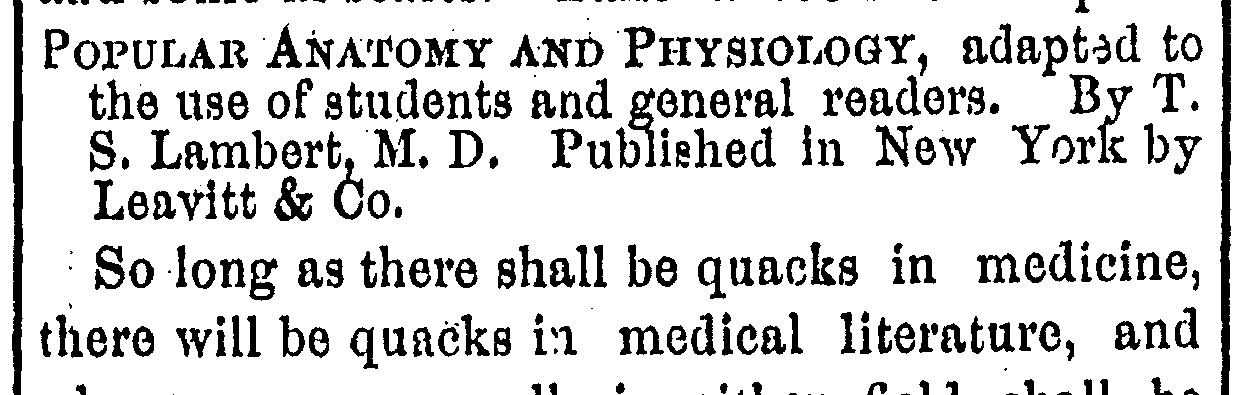 |
| Springfield, Mass. Republican - April 28, 1851 |

SOME years ago, Mr Bowles presented the public with a collection of sonnets and short poems. The reception it met with was not unfavourable, especially from that tribe of gentle readers to whom every running stream recals the memory of joys that are past, and every rustling leaf gives sad anticipation of coming sorrow.
https://hdl.handle.net/2027/inu.30000093204141?urlappend=%3Bseq=325%3Bownerid=13510798895677775-329
And second, from "Canons of Criticism" by "L." in The Monthly Magazine for November 1827:... Law, physic, divinity, and politics are precisely on the same footing; and so, too, are music, and painting, and coach-building, and tailoring (male and female), porter-brewing, and the manufacture of polonies and sausages. To betray these secrets would not only be treason to the craft, but would deprive the whole tribe of gentle readers of seven-eighths of their pleasure. What would they say to a Marplot who should come on the stage and tell the audience, “ these jewels are paste”—“this robe calico, and not silk”—and this terrible irruption nothing in the world but a pennyworth of gunpowder and nitrate of strontian?” I would never sit in the same boat (as Horace says) with such a man: so do not look for it at my hands.
The first-listed instance of the phrase tribe of gentle readers in the Edinburgh Review for July 1805 is most interesting for negative criticism of the attempt at epic poetry by William L. Bowles, satirized by Byron as "harmonious Bowles" in English Bards and Scotch Reviewers. A footnote in many editions of Byron's poem directs readers to the April 1805 notice of Strangford's Camoëns in same volume with the essay on Bowles. One way or another, Melville could have encountered the sonnet loving "tribe of gentle readers" in Volume 6 of the Edinburgh Review and remembered it when writing to Hawthorne in May 1851.
As printed in 1884 the phrase "general readers" in Melville's letter is enclosed in quotation marks. Melville could be quoting magazine advertisements there, but the comprehensive sense of "general readers" would seem to render the quotation marks gratuitous. Arguably, the class of gentle readers might be regarded as narrower, more exclusive or refined, and therefore more deserving of quotation marks--whether used straightforwardly, or ironically employed as scare quotes.
 |
| Hawthorne and his mosses - NYPL Digital Collections |
In Hawthorne and His Mosses Melville put the word gentle in quotation marks when comparing Hawthorne to Edmund Spenser, author of The Faerie Queene:
"when Spencer was alive, he was thought of very much as Hawthorne is now,--was generallyesteemedaccounted just such a "gentle" harmless man.
Generally accounted by general readers, presumably. Melville's phrasing as printed in the Literary World on August 24, 1850 nicely anticipates his epistolary reference in May of the following year to "general readers." Even so, in "Hawthorne and His Mosses" the word gentle is what got the scare quotes. In similar fashion, perhaps, when inditing the May 1851 letter Melville might have conflated general and gentle readers--in his head, whichever word his hand finally wrote. Well! If Hawthorne can be generally regarded as "gentle," then I guess his readers can, too.
Elizabeth Shaw Melville aka "Lizzie" was born on June 13, 1822, two hundred years ago today. In her handwriting, mostly, the 1850 manuscript of her husband's now famous endlessly-anthologized review essay Hawthorne and His Mosses is accessible online via NYPL Digital Collections.
Manuscripts and Archives Division, The New York Public Library. "“Hawthorne and his mosses”" New York Public Library Digital Collections. Accessed June 13, 2022.
https://digitalcollections.nypl.org/items/23ebb010-184f-0133-f66c-58d385a7bbd0
Happy Bicentennial Birthday, Elizabeth S. Melville!!!
Coincidentally, Herman Melville's devoted wife shared a birthday with cavalry officer Philip St. George Cooke, born in Loudoun County,Virginia on June 13, 1809.
 |
| Gen. Philip St. G. Cooke |
 |
| Scenes Beyond the Western Border Southern Literary Messenger - July 1852 |
June 13th.— Twenty-four miles to-day, over a desert! hills and river valley equally a desert! In this last, we have seen many large cotton-woods, seemingly the wrecks of a blasting tempest, mere limbless or distorted stems of trees; and others, the bleached and desolate drift of a flood.
We came over a lofty bluff almost overhanging the river, which commanded a view over vast and sternly sterile plains, breaking up at last into confused mountain spurs, and dim blue peaks beyond; but to this gloomy grandeur the river, far winding amid white sands and green islands, and the foot of many another precipitous bluff adorned with evergreens, lent an element of softening beauty.
I. F. What oppresses you? You seem in mournful harmony with these silent wastes !
C. “ Behold those spectral ruins of trees, strangely white and gleaming in the starlight ! —they are melancholy. But no—it is a day that ever, since it first gave me unhappy life, leaves its influences upon me.”
I. F. Such a mood should always be resisted. [1857: But better resist such a mood.] How do you succeed with your diary now? We are passing remarkable scenery; most wildly picturesque; and there is always some incident.
C. “What is written, may always chance to be printed, if not read: how charming then to the busy denizens of the world, whose very brains have received an artificial mould, to read such incident! Now if I could only introduce the word 'dollar,'—good heavens! it was never heard here before ! tis enough to disturb the ghosts of the grim old warriors, who, I dare say, have fallen here in defence of this narrow pass: fighting for what? at Ambition's call? not, I hope, of intriguing diplomatist—better for Love, or mere excitement sake.
"Whom then shall I address ? —the mock sentimentalist? and begin the day: 'Our slumbers this morning were gently and pleasantly dissolved by the cheerful martins, which sang a sweet reveille with the first blush of Aurora, at our uncurtained couches.' Or the statist? 'Not a sign of buffalo to-day; it were melancholy and easy to calculate how soon the Indians, deprived of this natural resource, and ignorant of agriculture'—but I should soon get too deep."
I. F. But this soil is devilish shallow.
C. “Few will follow me pleasantly or patiently through these solitudes, though sometimes 'pleasant places.' I care not at all, — but that I feel I may fail to awaken the sympathy of any, while, like an artist retouching with kindled affection his painted thought, I linger to answer the appeal of Wasted Beauty to so rare appreciation."
I. F. This profoundly silent Desert—like a world without life—awes and stills the senses : but the soul is excited to speculations on the origin, the history—if it have one—and the destiny of these boundless wastes.
C. “ Or surrounds itself with the airy creations of fantasy, —or, mournfully wanders back among the dim traces of joys and sorrows gone. I address not, then, the shallow or hurried worldling; but the friendly one, who in the calm intervals from worldly cares, grants me the aid of a quiet and thoughtful,—and if it may be,— a poetic mood !"
 |
| Scottsbluff and the old Oregon Trail, Nebraska Library of Congress |
 |
| Portrait of Nero. Marble, Roman artwork, 1st century CE. Jastrow, Public domain, via Wikimedia Commons |
Against all experience, communists dream of creating the new man. For Melville, transformations that radical must be accomplished in another world. This one requires due allowance for the "power of blackness" that Melville discerned in short stories by Nathaniel Hawthorne:
Certain it is, however, that this great power of blackness in him derives its force from its appeals to that Calvinistic sense of Innate Depravity and Original Sin, from whose visitations, in some shape or other, no deeply thinking mind is always and wholly free. For, in certain moods, no man can weigh this world without throwing in something, somehow like Original Sin, to strike the uneven balance. --Hawthorne and His Mosses part 1, The Literary World August 17, 1850, page 126.

This is why leftist critics which is to say most academic commentators hate Melville's 1857-8 lecture on Statues in Rome. There Melville marveled over the recognizable features and traits of "ancient" humans as portrayed in busts of famous figures he saw in the Vatican museum. Socrates looked to Melville like an Irish comedian; Seneca like a Wall Street broker; Nero like "one of our fast young men who drive spanking teams and abound on race-courses."
Worst of all for the collapsing future of woke Melville studies, the author of Moby-Dick expressed the inherent depravity of human beings here in the real physical world as a mathematical certainty:
"As 2 & 2 made 4 in Noah's time, as now, so man figures ever."
-- Marginal comment by Herman Melville in his copy of Shakespeare's All's Well That Ends Well; accessible via Melville's Marginalia Online.
As transcribed on melvillesmarginalia.org the word figures is conjectural. Whatever you put there will not alter the essential claim.http://melvillesmarginalia.org/Share.aspx?DocumentID=26&PageID=19033

Related posts:
 |
| John Dryden, Public domain, via Wikimedia Commons |
The principal character is that of the captain, an old weather-beaten whaler. The points in his peculiar disposition are strongly painted. He is afflicted with a species of monomania, and having lost one of his legs in a conflict with a white whale of enormous size and tremendous power, he registers a vow of vengeance against this particular fish, which thus
"Was doomed to death, but fated not to die."
In the pursuit of this absurd species of vengeance, the captain, Ahab, at length meets with his old antagonist, well known from its having “a milky white head and hump, all crows feet and wrinkles, and harpoons sticking in near his starboard fin.” He encounters this formidable enemy, and loses his life in the attack, and the whale, after staving in the bows of the ship, escapes, leaving the vessel to founder at sea with all hands.
Like Dryden's allegorical deer, Melville's immortal monster of a whale "Was doomed to death, but [though] fated not to die." For context, here is the longer passage via Bartleby.com:
A MILK-WHITE Hind, immortal and unchanged,
Fed on the lawns and in the forest ranged;
Without unspotted, innocent within,
She feared no danger, for she knew no sin.
Yet had she oft been chased with horns and hounds,
And Scythian shafts, and many wingèd wounds
Aimed at her heart; was often forced to fly,And doomed to death, though fated not to die.
Dryden's fable of true faith, all three parts of it, graced the compendium of Select British Poets, Or, New Elegant Extracts from Chaucer to the Present, edited by William Hazlitt (London, 1824).
As shown previously on Melvilliana, the 1837 Catalogue of Books in the Library of the Young Men's Association of the City of Albany listed "Hazlett's Select British Poets" on page 14, under "H." Hazlitt's 1824 volume supplemented the works of older poets like Dryden with new "extracts" by contemporary Romantic poets. This edition of Hazlitt's Select British Poets was available in Albany, New York bookstores by late 1826, four years before Herman Melville moved there from New York City with his family. In 1835-7 Melville belonged to the Albany Young Men's Association where Hazlitt's anthology was available in the library along with two different sets of "British Poets," numbered 1112 (12 vols.) and 1390 (11 vols.) in the 1837 Catalogue. The 1828 Catalogue of Books in the Albany Library lists a four-volume set of "Dryden's Poems" in addition to "Dryden's Virgil" in three volumes.
Dryden's "immortal" white doe ("She") represents the Roman Catholic Church; the panther stands for the protestant Church of England. That alliterative phrase "forced to fly" (or "forc'd to fly" in early versions) verbally links Dryden's doe to Melville's in the 1850 review essay Hawthorne and His Mosses. There Melville famously painted Truth as a shy white doe, sacred or just scared.
For in this world of lies, Truth is forced to fly like a scared white doe in the woodlands ; and only by cunning glimpses will she reveal herself, as in Shakspeare and other masters of the great Art of Telling the Truth, — even though it be covertly and by snatches.
-- "Hawthorne and His Mosses," Literary World vol. 7 - August 17, 1850 page 126.
Justifying his emendation to "sacred white doe," Hershel Parker cites Dryden's poem along with Wordsworth's White Doe of Rylstone as influential analogues:
Mrs. Melville wrote "scared." In Herman Melville: A Biography (1.756) Parker introduced the emendation of "sacred white doe" instead of "scared white doe" on the analogy of John Dryden's "milk-white Hind" in "The Hind and the Panther" (1687) and William Wordsworth's "White Doe of Rylstone" (1807).... --Third Norton Critical Edition of Moby-Dick, edited by Hershel Parker (W. W. Norton & Company, 2018) page 551 note 9.
In the same footnote Parker calls attention to the manuscript correction of "Truth is found," as the scribe Melville's wife Elizabeth Melville first wrote, to "Truth is forced." Let's look now since images of the manuscript version in Mrs. Melville's hand, mostly, are so easy to access courtesy of NYPL Digital Collections.

Manuscripts and Archives Division, The New York Public Library. "“Hawthorne and his mosses”" The New York Public Library Digital Collections. 1850. https://digitalcollections.nypl.org/items/23ebb010-184f-0133-f66c-58d385a7bbd0
Sure enough there's found, canceled and replaced by "forced" to give the correct reading
forced to fly.
In a wicked world, Melville's Truth-doe is "forced to fly" like Dryden's Church of Rome, allegorized as a hunted white hind or female deer. The glimpse of Dryden's sacred white doe in the Morning Herald shows that one London reviewer recognized Melville's white whale as equally elusive and immortal.
Related posts:
- Part 1: Literary World August 17, 1850
https://hdl.handle.net/2027/njp.32101064475088?urlappend=%3Bseq=135
- Part 2: Literary World August 24, 1850
https://hdl.handle.net/2027/njp.32101064475088?urlappend=%3Bseq=151

 |
Manuscripts and Archives Division, The New York Public Library. "“Hawthorne and his mosses”" The New York Public Library Digital Collections. 1850. http://digitalcollections.nypl.org/items/24fa15e0-184f-0133-8bf9-58d385a7bbd0 |
You must believe in Shakespeare or quit the country. But what sort of a belief is this for an American, a man who is bound to carry republican progressiveness into Literature, as well as into Life? Believe me, my friends, that Shakespeares are this day being born on the banks of the Ohio. And the day will come, when you shall say who reads a book by an Englishman?The Northwestern-Newberry text keeps one instance of toning down in Melville's added qualifier, "that is a modern." Specifying "modern" makes the assertion more reasonable (since well-educated world-citizens must always read Chaucer and Milton, for example) but softens the parody of Sydney Smith's query, "who reads an American book?" The rawest version of the passage would omit three qualifying clauses--all added in revision, all printed in the Literary World on August 17, 1850.
| Hawthorne and His Mosses Literary World - August 17, 1850 |
... men, not very much inferior to Shakespeare, are this day being born on the banks of the Ohio.Amped-up:
Shakespeares are this day being born on the banks of the Ohio.
 |
| Cincinnati in 1841 via NYPL Digital Collections |
"Melville Bibliography 1846-1897: A Sheaf of Uncollected Excerpts, Notices, and Reviews" continued from Number 74 in Melville Society Extracts 75 (November 1988), pages 3-8, item number 78 on page 4;one early extract from Melville's Hawthorne and His Mosses appeared in the New York Evening Post for August 21, 1850. Here another reprinting, this one with the complete text of the first part as originally published in The Literary World on August 17, 1850. (The second part of Melville's now famous review-essay appeared one week later in The Literary World on August 24, 1850.)
 |
| Southern Literary Gazette - August 31, 1850 via Georgia Historic Newspapers |
 |
| Richards' Weekly Gazette (Athens, Georgia) May 12, 1849 |
Our Book Table.
[Publishers and Authors who desire to have their Books noticed in this Gazette, are requested to send copies to the Editor through Stringer & Townsend, New-York, or Carey & Hart, Phil.
MARDI, AND A VOYAGE THITHER. By Herman Melville. In two vols., 12mo., pp. 365-387. New York. Harper & Brothers. 1849.
Verily, this book is a literary phenomenon. "Typee” and “ Omoo” are completely thrown into the shade by this latest effort of Mr. Melville's peculiar talent. The ostensible difference between Mardi and its predecessors is, that while they claimed to be fact, and were universally regarded as fiction, this is boldly set forth as a fiction, which the author thinks may possibly be received as a verity. If he has any hopes of this kind, he may as well dismiss them— for certainly a wilder or more incongruous mass of fiction was never brought forth, with christian rites, than is contained in these two volumes. To analyze them, is beyond our purpose. The story is not altogether unlike “ Typee” and “ Omoo," but, being a sublimation of their extravagances, the reader may judge to what extent his common sense will be taxed in its perusal. To do Mr. Melville justice, we must acknowledge at once his singular inventive faculty, and his rhetorical facility. There is a sparkle, a charm, a certain wild grace about his style, that would be quite irresistible, were it not for his decided and oppressive mannerisms, which almost everywhere disfigure it.
With Mr. Melville’s description of the South Seas, and of their icthyological wonders — as also of the exquisite island scenery therein encountered—we should be stoics not to be charmed.
His escape from the ‘Arcturion,’ and the subsequent adventures of himself and his companion,“Old Jarl”— a poor substitute, by the way, for Toby of “Typee,” though not without his good points—for many days over the wonder-teeming waters of the Southern Seas, are very graphically narrated.
Yillah, the heroine of the book, is a beautiful creation of the author's fancy; but we cannot help thinking that he might have managed his story better than to make her a phantom, vanishing from his very arms one night, and going no one knew whither. This trick of Mr. Melville’s, by the way, of creating such exquisite beings as Fayaway, of Typee memory, and Yillah, of Mardi, for his own especial and unlicensed enjoyment, is a striking commentary upon the morality of the book.
The Island of “Mardi” is another “Typee,” where our author passes himself off under the name of Taji, a demi-god, and a visitor from the sun. He becomes the guest of Media, King of Odo, and, after Yillah so mysteriously disappears, he resolves to go in search of her; and Media, who is a very jolly, sociable and clever fellow, decides to accompany him.
And now commences a series of travels and adventures almost unparalleled in romance. Feasts and frolics are plenty as blackberries; and so plenty are Kings, that five and twenty of them sit down to dinner together, “and a royal time they have.”
In the further development of the story, the machinery of magic is employed, and we have an enchantress Hautia, with her singing maidens as heralds; and, at the very close of the book, Taji becomes a victim of Hautia, who reveals to him his lost Yillah, lying dead in a sea-cavern! Romantic enough, in all conscience.
We liked “Typee” vastly well. It was fresh, racy and delightful, despite its somewhat sensuality. “ Omoo” tired us with its attenuation of the fine thread of the former work, and disgusted us with the author’s evident latitudinarianism in both morals and religion. In “Mardi,” we have a still further wire-drawing process, and, perhaps, even less disguised immorality and infidelity. These are hard words, but they must be uttered in justice to our position as a journalist.
Without questioning Mr. Melville’s very clever talent at romancing, we must conscientiously condemn his too thinly veiled lasciviousness, and, moreover, deny his right to work an idea to death, as he has evidently done in Mardi. We will not take leave of the book, without affording our readers as fair a specimen of the descriptive powers of our author as a single brief paragraph can present. It is a description of Yillah, at first sight.
"Before me crouched a beautiful girl. Her hands were drooping. And, like a saint from a shrine, she looked sadly out from her fair, long hair. A low wail issued from her lips, and she trembled like a sound. There were tears on her cheek, and a rose-colored pearl on her bosom. Did I dream? A snow-white skin: blue firmament eyes: Golconda locks. For an instant, spell-bound I stood, while with a slow apprehensive movement, and still gazing fixedly, the captive gathered more closely about her a gauze-like robe.”
"Richards moved the publication to Charleston in 1850 and sold one-half interest in it to Joseph Walker of that city. The name was changed back to Southern Literary Gazette, and it evidently retained that title after 1852 when Richards sold his interest in the publication and moved to New York." --Antebellum Athens, page 98.
On December 8, 1849, Richards' Weekly Gazette reprinted "CAPT. RIGA IN PORT," explicitly crediting "Melville's 'Redburn: His First Voyage.'" The review of Redburn in the New York Literary World on November 17, 1849 had featured the same excerpt from chapter 3 of Melville's fourth book.
On August 31, 1850 Richards' Southern Literary Gazette reprinted the first part of Melville's "Hawthorne and His Mosses" from The Literary World of August 17, 1850. As in the Literary World, Melville's essay in the Gazette reprint is credited only to "A Virginian Spending July in Vermont."
"The Death of a Whale" excerpt from Moby-Dick chapter 61 was reprinted in the Southern Literary Gazette on January 3, 1852 (pages 5-6).
Richards published his Valedictory to readers of the Southern Literary Gazette on December 18, 1852. One week later, on December 25, 1852, the Gazette reprinted all of one section (vi) in Book VI of Pierre; Or, The Ambiguities, given as a specimen of the author's presumed insanity:
 |
| Southern Literary Gazette - December 25, 1852 via Georgia Historic Newspapers |
PIERRE OR THE AMBIGUITIES.
* * From this romance we copy the following extraordinary description of the simple music of the guitar. Melville has cer[t]ainly gone crazy, and is, we presume, by this time in some lunatic asylum. Think of seeing sounds in the shape of icicles! Think of hearing lightning! What ridiculousness and senselessness and unintelligibleness!Richards the "Ex-Editor" openly acknowledged authorship of magazine reviews for the Christmas Day issue. So Richards was still contributing editorial matter at the close of 1852. In his December 18, 1852 "Valedictory," Richards named assistant editor Paul Hamilton Hayne as his replacement. But Richards also indicated in the published farewell that Hayne was then out of town. It's hard to say which editor to credit with the excerpt from and comment on Melville's Pierre. The long extract and short notice might have been among Richards' last contributions as ex-editor of the Southern Literary Gazette, or Hayne's first as chief editor. Something to look for in the Paul Hamilton Hayne papers, David M. Rubenstein Rare Book & Manuscript Library, Duke University.
--Southern Literary Gazette, December 25, 1852.


