Showing posts with label Louisville Daily Journal. Show all posts

Saturday, November 28, 2020

Benito Cereno in Louisville

Lord Brougham in training for the opening of Parliament.
via NYPL Digital Collections

From the Louisville Daily Journal (Louisville, Kentucky), October 3, 1855: 

PUTNAM’S MONTHLY FOR OCTOBER.—The October number of Putnam is a worthy representative of American periodical literature. Its contents are finely varied and are creditable specimens of substantial, instructive, and interesting literature…. 

... The story of “Benito Cereno” opens well, but rather hangs fire toward the close of its first part. But a lively denoument may redeem it.—There is interest ahead in it.
The expression hang fire is a military metaphor for delayed action, like delayed ignition of gunpowder in firearms. To "hang fire" means
"to be slow in communicating, as fire in the pan of a gun to the charge."

In the 1855 magazine version of "Benito Cereno," the first installment closes with Melville's Delano musing on the possibly treacherous intentions of Don Benito. Delano fears the Spanish captain might be a murderous pirate. The American wavers, but his generous and trusting nature overcomes suspicion of a sinister plot against his life. Melville's narrative powder finally fires in the third installment, after Benito Cereno jumps into Delano's boat.

Another Kentucky reviewer had no expectation of an exciting finish in store. From the Louisville Daily Democrat, October 4, 1855:

Louisville KY Daily Democrat
October 4, 1855
"Benito Cereno," a tale, begun in the present issue, is a fanciful production, not having any great interest--very little force--and rather prosy. Some of the sentences are almost Broughamic in their length, indistinctness, and general construction. 

Broughamic alludes to the discursive debating style of Henry Peter Brougham, the eminent Whig reformer and abolitionist who helped establish the Edinburgh Review. In 1828 Brougham delivered the longest speech ever in House of Commons, over six hours. 

Courtesy of Google Books, Melville's "Benito Cereno" as it originally appeared in Putnam's Monthly Magazine Volume 6:
  • October 1855
    https://books.google.com/books?id=i_FIAAAAcAAJ&pg=PA353&dq#v=onepage&q&f=false
  • November 1855
    https://books.google.com/books?id=i_FIAAAAcAAJ&pg=PA459&dq#v=onepage&q&f=false
  • December 1855
    https://books.google.com/books?id=i_FIAAAAcAAJ&pg=PA633&dq#v=onepage&q&f=false

Related post:

Saturday, February 15, 2020

Pierre in Louisville KY

George D. Prentice
via NYPL Digital Collections
Here is the one usable review of Melville's Pierre; or, The Ambiguities, later excerpted in publisher's ads that credited (by mistake?) the Philadelphia Evening Bulletin. I'm guessing this review of Pierre in the Louisville Daily Journal might have found its way into the Louisville Evening Bulletin, another daily and weekly newspaper commenced in November 1851 by Journal editor George D. Prentice. Hypothetically then, whoever supplied the Harpers with Louisville excerpts may have correctly attributed them to the "Evening Bulletin," resulting eventually in a mix-up with the better known Philadelphia newspaper, Cummings' Evening Bulletin. Alternatively, perhaps the Philadelphia Evening Bulletin reprinted it from the Louisville Journal.

The August 7, 1852 issue of Cummings' Evening Bulletin did contain an early review of Pierre, as Gary Scharnhorst reports in "More Nineteenth-Century Melville Reviews," Melville Society Extracts Number 89 (June 1992), pages 1-6 at page 2. However, as partially quoted by Scharnhorst the Evening Bulletin in Philadelphia had a different take on the "strange, wild romance" that opens "in a strain of rhapsodical and extravagant poetry" but "soon subsides to a mystical, dark tone of sober prose." The Philadelphia reviewer commented on Melville's "most unnatural characters and improbable scenes" and noted "the terrible catastrophe" with which the novel ends, unsuccessfully: "...the reader closes it with an unsatisfied feeling, for which the interest of the scenes and the evident talent of the author afford no compensation."

By contrast, the Louisville reviewer demonstrates a more poetic sensibility, finding Melville's language "beautiful, and wonderful" as well as "wild." This appreciative critic, maybe Journal editor and poet George Denison Prentice, not only perceives the influences of Dante and Shakespeare, but also finds value in the later authorship chapters as a kind of cautionary tale for ambitious writers. The New York advertisements cited below omit that part of the Louisville review, as well as the more ominous closing reference to the Rev. Charles Robert Maturin as mad Gothic playwright and novelist:
"Take it altogether, Pierre is a rare and singular book. But if Mr. Melville is in search of immortality, we commend him to the study of Maturin's kindred style, and the results."
The Louisville reviewer's attention to specific chapters on authorship starting with "Young America in Literature" is unique in early criticism of Melville's seventh book. As Brian Higgins and Hershel Parker note in Reading Melville's Pierre; or, The Ambiguities (Louisiana State University Press, 2006) at page 198, "reviewers almost unanimously ignored the section on Pierre as an author."

George D. Prentice was the "witty editor of the Louisville Journal" who, as Allan Melville informed Herman on October 17, 1844, had been "right down upon" their brother Gansevoort Melville, campaigning for the Democrats in the south and west. Allan's long (and still "unlocated"?) letter to Herman is transcribed in the 1993 Northwestern-Newberry Edition of Melville's Correspondence, edited by Lynn Horth, pages 565-571. To Allan's point about the abuse of Gansevoort by Prentice: on September 19, 1844 the Extra edition of the Louisville Journal claimed that Gansevoort "made the very poorest and most meagre speech, that we ever heard from a man of any pretension. He had neither logic nor facts nor eloquence nor plausibility nor sense nor even respectable declamation." 

Louisville Daily Journal - August 14, 1852
Found on newspapers.com
Pierre, or the Ambiguities. By Herman Melville. Harper & Brothers. 
Mr. Melville has cut the acquaintance of Polynesia, and has made a domestic story, as wild, wonderful, and tragical as he ever conjured from the tropical wilds of the coral islands of the Pacific. Pierre is a curious mixture of Dante's Inferno, and of Hamlet. It is worthy of its name--"the Ambiguities." Pierre, Lucy Tartan, Mrs. Glendenning, and Isabel are creations that could have come from no other source than Melville's mind. There is ambiguity from one end of the book to the other, but it is clothed with language singularly wild, beautiful, and wonderful. There are slips of the pen, though, at times, that should not disfigure the work of such a master as Melville. For instance, he makes Isabel say: "till some employ should offer."
Still, there may be a moral in this strange and singular work. The aspirant to the honors of magazine literature, and those who have ambition to use author-craft as a staff, may learn some useful lessons from the chapters entitled "Young America in Literature," "A Juvenile Author Reconsidered," "Immature Attempts at a Matured Book," and "The Flower-curtain Lifted from before a Tropical Author; with some remarks on the Transcendental Flesh-brush Philosophy." Take it altogether, Pierre is a rare and singular book. But if Mr. Melville is in search of immortality, we commend him to the study of Maturin's kindred style, and the results.
--Louisville Daily Journal (Louisville, Kentucky) August 14, 1852.
Excerpted in publisher's advertisements and attributed to the Philadelphia Evening Bulletin, for example in the New York Literary World on October 16, 1852


Mr. Melville has cut the acquaintance of Polynesia, and has made a domestic story, as wild, wonderful, and tragical as he ever conjured from the tropical wilds of the coral islands of the Pacific. Pierre is a curious mixture of Dante's Inferno and of Hamlet. Pierre, Lucy Tartan, Mrs. Glendenning, and Isabel, are creations that could have come from no other source than Melville's mind. * * * It is clothed with language singularly wild, beautiful, and wonderful.--Phila. Evening Bulletin. 
and the New York Morning Courier on October 21, 1852.

Morning Courier and New-York Enquirer - October 21, 1852
via FultonHistory
As in the Louisville Journal, the October 1852 Harper ads misspell "Glendinning" as "Glendenning."

Related posts:

Friday, February 17, 2017

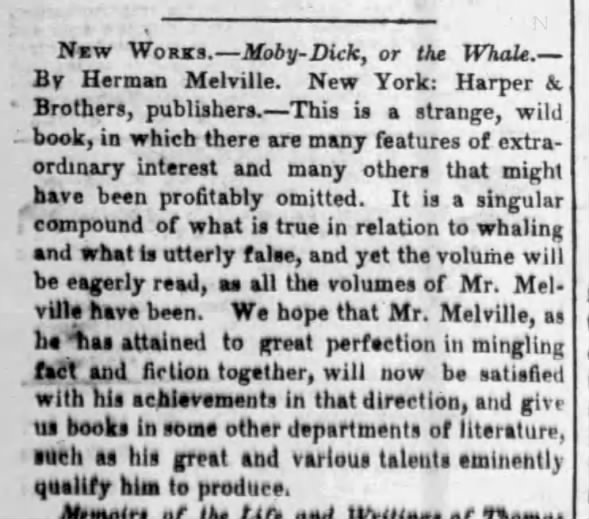
Notice of Moby-Dick in the Louisville Daily Journal

Sat, Dec 13, 1851 – 2 · () · Newspapers.com
From the Louisville Daily Journal, December 13, 1851:
NEW WORKS.—Moby-Dick, or the Whale.— By Herman Melville. New York: Harper & Brothers, publishers.— This is a strange, wild book, in which there are many features of extraordinary interest and many others that might have been profitably omitted. It is a singular compound of what is true in relation to whaling and what is utterly false, and yet the volume will be eagerly read, as all the volumes of Mr. Melville have been. We hope that Mr. Melville, as he has attained to great perfection in mingling fact and fiction together, will now be satisfied with his achievements in that direction, and give us books in some other departments of literature, such as his great and various talents eminently qualify him to produce.
Earlier Melville notices in the same newspaper, edited by George Denison Prentice:
Louisville Weekly Journal - July 25, 1849 via GenealogyBank
Typee—A Peep at Polynesian Life.— This is a new and revised edition of Melville's first and eminently successful work. Typee has been greatly praised both in Europe and this country, and is certainly one of the most fascinating books in the language. If any of our readers have not become acquainted with Mr. Melville's works, let them read Typee, and they cannot afterwards resist the temptation to read those charming books, Omoo and Mardi. --Louisville Daily Journal, July 19, 1849; reprinted in the Louisville Weekly Journal on July 25, 1849. 
Update 02/21/2020, adding notice of Omoo in the Louisville Weekly Journal on June 16, 1847:
NEW WORKS.-- Omoo, a Narrative of Adventures in the South Seas, by Herman Mellville. Mr. Mellville's former work, Typee, met with extraordinary favor. It was universally pronounced one of the most interesting books of adventures ever given to the public. The present work relates the adventures which afterwards befel the author in the South seas. It is a most pleasant book, and contains a great deal of information in regard to the Polynesian islands which cannot be elsewhere procured. It will doubtless be eagerly sought for by all those who have read the author's former work, and we advise our readers generally to do likewise. The title has a strange and foreign sound. Omoo is a word, as the author tells us, borrowed from the dialect of the Marquesas islands, where it signifies a rover, or rather a person who wanders from one island to another.
It is for sale by Mr. G. W. Noble, at the Literary Depot.  --Louisville Weekly Journal, June 16, 1847; found on GenealogyBank.
Redburn—His First Voyage.—Herman Mellville, the author of this book attained great popularity by the production of his first work, "Typee." Since then, each book that he has written has been eagerly sought for by a very large circle of admirers. Redburn, though inferior in interest to Typee, is yet very decidedly interesting, and will amply repay perusal. --Louisville Daily Journal, December 5, 1849 
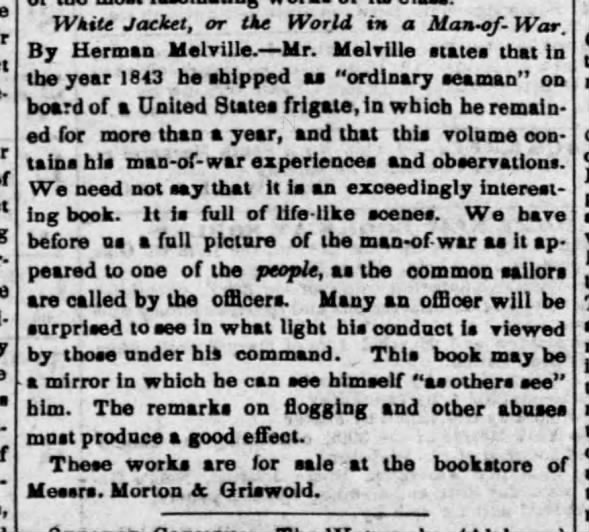
 Update 02/16/2020, adding the notice of White-Jacket on April 13, 1850:
Sat, Apr 13, 1850 – 2 · () · Newspapers.com 
White-Jacket, or the World in a Man-of-War. By Herman Melville.-- Mr. Melville states that in the year 1843 he shipped as "ordinary seaman" on board of a United States frigate, in which he remained for more than a year, and that this volume contains his man-of-war experiences and observations. We need not say that it is an exceedingly interesting book. It is full of life-like scenes. We have before us a full picture of the man-of-war as it appeared to one of the people, as the common sailors are called by the officers. Many an officer will be surprised to see in what light his conduct is viewed by those under his command. This book may be a mirror in which he can see himself "as others see" him. The remarks on flogging and other abuses must produce a good effect.
These works are for sale at the bookstore of Messrs. Morton & Griswold.
 --Louisville Daily Journal, April 13, 1850.
Related post: