Showing posts with label White-Jacket. Show all posts

Wednesday, January 15, 2025

MOBY-DICK and other books by Herman Melville reviewed in the Charleston SOUTHERN CHRISTIAN ADVOCATE

Rev. W.M. Wightman D.D.
Ed. of the Southern Christian Advocate

Found just this morning in the ginormous newspaper archives on genealogybank.com among articles added within 1 month, assorted Melville mentions including this previously uncollected notice of Moby-Dick; Or the Whale in the Charleston, SC Southern Christian Advocate for December 12, 1851. Edited in 1840-1854 by William May Wightman, the Southern Christian Advocate was published in Charleston, South Carolina by designated clergy on behalf of the Methodist Episcopal Church, South

The notice of Moby-Dick in the Southern Christian Advocate of December 12, 1851 offers three sentences of admirably balanced and original commentary, followed by a paragraph copied (with a few omissions) from the favorable review by George Ripley in Harper's New Monthly Magazine Volume 4 (December 1851) page 137.

Southern Christian Advocate - December 12, 1851
via genealogybank.com

RECENT PUBLICATIONS. 

MOBY-DICK; Or the Whale. By Herman Melville, Author of Typee, etc. New York: Harper & Brothers, 1851. 

This last book of Melville's is a curiosity. At times playful as a kitten, then solemn as a preacher; now a touch of transcendental philosophy, then a dash of bold, thrilling narrative; by turns picturesque, poetical, sportive, and stern in the iron grip of deep reflection;--this sea-story seems to puzzle the critics. Some pronounce it a failure, others consider it the most successful of the author's productions. We copy a paragraph from the notice given in Harper's Magazine:--In the course of the narrative the habits of the whale are fully and ably described. Frequent graphic and instructive sketches of the fishery, of sea-life in a whaling vessel, and of the manners and customs of strange nations are interspersed with excellent effect among the thrilling scenes of the story. The various processes of procuring oil are explained with the minute, painstaking fidelity of a statistical record, contrasting strangely with the weird, phantom-like character of the plot, and of some of the leading personages who present a no less unearthly appearance than the witches in Macbeth. These sudden and decided transitions form a striking feature of the volume. To a less gifted author, they would inevitably have proved fatal. He has not only deftly avoided their dangers, but made them an element of great power. --For sale by J. W. Stoy, Agent.

Where the review in Harper's magazine printed "with excellent artistic effect" the Southern Christian Advocate has "with excellent effect," omitting the word artistic. Also omitted, one sentence that came before the last one quoted in the Charleston notice: "Difficult of management in the highest degree, they are wrought with consummate skill." One result of these particular omissions could be to slight or subtly undermine the original emphasis on Melville's craftsmanship as a writer. On the other hand, the point may have been regarded as redundant and the omitted words cut mainly to save space. 

As a "bold, thrilling narrative" Melville's book evidently made a lasting impression on the editor, Rev. W. M. Wightman. In June of the following year, the Charleston Southern Christian Advocate reprinted the popular excerpt from Moby-Dick Chapter 61: Stubb Kills a Whale under the heading, "THE DEATH OF A WHALE." Correctly attributed at the end of the excerpt, in italics, to "— Herman Melville." 

Charleston, SC Southern Christian Advocate
June 11, 1852
Of the 20+ newspaper excerpts from chapter 61 that we know about, only this one in the Charleston, SC Southern Christian Advocate printed "...grinning furies" where the English and American first editions both had Stubb saying, "...grinning devils." In imagination, you could join the chase with Stubb and Tashtego, and even witness the horrible slaughter of the whale at the end of it, but you would not be exposed in the Southern Christian Advocate to the word devils as Melville used it in Stubb's exhortation to the crew of his whaleboat--too close to swearing, apparently. This was, after all, an official publication of the Methodist Episcopal Church, South. Still, although this version loses the alliteration between death and devils, grinning furies will do.

Early in September 1852, the Southern Christian Advocate weighed Melville's next book after Moby-Dick and found it wanting. 

Charleston, SC Southern Christian Advocate
September 3, 1852
PIERRE: Or the Ambiguities. By Herman Melville. New York: Harper & Brothers. 1852.

Whatever else may be ambiguous, it is clear enough that every reader of this last book of Mr. Melville, will vote it perfect trash

Previously on Wightman's watch, Melville had received much friendlier mentions in the Charleston Southern Christian Advocate, including mostly positive notices of Omoo on May 28, 1847; and White-Jacket on April 12, 1850.

***
OMOO: A narrative of adventures in the South Seas. By Herman Melville, Author of "Typee." Complete in two parts. New York: Harper & Brothers. 1847. 

This work is the production of no ordinary mind. The narrative is as deeply interesting as the style is brilliant. We are sorry the author gives so unfavourable an account upon the whole, of the South Sea Island missions. Yet there is a tone of exaggeration, an air of romance pervading the book, which induces the reader to take, with many grains of allowance, what is said respecting missionary operations. The author's account of Tahiti, and of Queen Pomaree, possesses singular interest. His sea-scenes are sketched with the precision and force of Cooper, and an Irving-like charm pervades his descriptions of Island life. For sale by J. W. Stoy, 50cts. a volume

-- Charleston, SC Southern Christian Advocate for May 28, 1847.

*** 

Charleston, SC Southern Christian Advocate 
April 12, 1850 via genealogybank.com
WHITE-JACKET: Or the world in a Man-of-War. By Herman Melville, Author of Typee, etc. New York: Harper & Brothers. 1850.

Mr. Melville is getting to be a voluminous writer. In this work he gives us his man-of-war experiences and observations during a year's service on board of a United States frigate as an ordinary seaman. Life in the naval service was never more graphically drawn; nor ever, we may add, has the romance been more completely cut out of the thing. Talk of slavery! the articles of war will tell you what it is:--of despotism! and "Capt. Claret" is its personification. Distant seems the day when nations shall have no use for the war-ship. Heaven speed the time:--but really the work of the world's conversion to the peaceable principles and spirit of the gospel, appears to be hardly begun.

-- Charleston Southern Christian Advocate for April 12, 1850. 

As best I can tell, the four book notices identified herein (of Omoo, White-Jacket, Moby-Dick, and Pierre) are all new finds; none is collected in Herman Melville: The Contemporary Reviews, edited by Brian Higgins and Hershel Parker (Cambridge University Press, 1995; paperback 2009). Now I have to add the Southern Christian Advocate notice to the inventory of Moby-Dick reviews in 1851-1852. Favorable or Mixed? The choice to quote from the laudatory Harper's review accentuates the positive, for sure. However, Rev. Wightman's notice begins with such an explicit recognition of dramatically different critical responses, it practically begs to be counted with the honorable undecideds. 

So be it! 👍👎

Related post

Saturday, June 18, 2022

Ulysses in WHITE-JACKET

Ulysses defying the Cyclops
via The New York Public Library Digital Collections

In White-Jacket (1850) and the poem In a Bye-Canal, Melville refers to Homer's Odysseus as Ulysses. In choosing to call him Ulysses, Melville was guided by then-standard English translations of the Iliad and Odyssey. In his own copy of Chapman's Homer (Sealts number 277), a gift from George Duyckinck in 1858, Melville's annotation to The Iliads of Homer Book 3 (page 69, lines 230-232) reads

"Ulysses sat tall."

-- Melville's Marginalia Online  

In March 1849 Melville bought the three-volume set of Alexander Pope's Homer in the Harpers Classical Library (Sealts number 275c). Melville's set is lost, but that Odyssey was also all about Ulysses, as Pope makes clear in his plot summary: 

"Ulysses also, after innumerable troubles by sea and land, at last returned to safety in Ithaca, which is the subject of Homer's Odyssey." 

Thanks in part to influential verse translations in English (by William Cowper, too, along with Pope and Chapman) Melville and his contemporaries knew Odysseus, the ingenious hero of Greek story and myth, as Ulysses.

More generally, William Cullen Bryant explained his use of Latin-based names as best practice when translating Greek into English:

I make no apology for employing in my version the names Jupiter, Juno, Venus, and others of Latin origin, for Zeus, Here, Aphrodite, and other Greek names of the deities of whom Homer speaks. The names which I have adopted have been naturalized in our language for centuries, and some of them, as Mercury, Vulcan, and Dian, have even been provided with English terminations. I was translating from Greek into English, and I therefore translated the names of the gods, as well as the other parts of the poem.  -- Preface, The Iliad of Homer, translated into English blank verse (Boston, 1870).
Academicians howled, apparently, but the old poet stuck to his guns

"The names of Latin origin are naturalized; the others are aliens and strangers."

and Homer's hero remains Ulysses all through Bryant's translation of The Odyssey.

Early in White-Jacket (1850), Ulysses is named with other exemplary heroes of literature familiar to Jack Chase, Melville's great-hearted captain of the maintop: 

Jack had read all the verses of Byron, and all the romances of Scott. He talked of Rob Roy, Don Juan, and Pelham; Macbeth and Ulysses; but, above all things, was an ardent admirer of Camoens. Parts of the Lusiad, he could recite in the original. -- White-Jacket chapter 4, Jack Chase 

In this initial survey of Jack Chase's impressive reading, Ulysses ranks with other leading literary characters whom Jack Chase knows familiarly, well enough to talk about as fellow men. Melville biographer Leon Howard definitely grasped that Melville here meant to designate men as much or more than the titles of works in which they appear:

"... [Melville's Jack Chase] was a master of languages who could recite long passages from Camoëns' sailors' epic, The Lusiad, in the original Portuguese, and talk in English of Rob Roy and Don Juan, Macbeth and Ulysses, and Bulwer's Pelham." -- Herman Melville: A Biography (University of California Press, 1951) page 74.

Howard's careful paraphrase of the passage from chapter 4 of White-Jacket gives only The Lusiad in italics. "Ulysses" to Howard plainly denotes the hero of Homer's Odyssey. Confirmed by looking for "Homer" in the Index:

"Homer, Odysseus, 74."

Paraphrasing the same passage as Howard, John Bryant wrongly puts Macbeth in italics and Ulysses in quotes to reinforce his bad take through punctuation. 

Melville describes Jack Chase as having read all of Byron, Scott, and Camoens's Lusiad (which he recites in the original Portuguese) as well as Macbeth and "Ulysses." Chase's recital of the last work is impossible because Tennyson's 1842 "Ulysses" had only just been published." -- Herman Melville: A Half Known Life volume 2 (Wiley Blackwell, 2021) page 1057.

Fear not! If you made the same mistake by reading the name "Ulysses" as Melville's ineptly managed reference to Tennyson's poem Ulysses, just keep reading. Our matchless Jack will set you straight in chapter 65, A Man-of-War Race

How many great men have been sailors, White Jacket! They say Homer himself was once a tar, even as his hero, Ulysses, was both a sailor and a shipwright. I'll swear Shakespeare was once a captain of the forecastle. Do you mind the first scene in The Tempest, White Jacket?  


Ulysses is Homer's hero. According to Jack Chase anyway, who thus rescues Melville from the false charge of perpetrating an anachronism with an "impossible" reference to Tennyson's version of the archetypal wanderer.

Not that you absolutely have to stay with Homer. Sympathetic readers (for whom Ulysses lives) might freely associate Jack Chase's Homeric hero with Virgil's, or Dante's, or Shakespeare's or Tennyson's or Joyce's version of Ulysses. Unlikely as it sounds, I'm convinced that at least one reference to Ulysses in White-Jacket alludes to George Clooney


Saturday, January 1, 2022

Melville in Kingston, Ontario

Kingston, Ontario Daily British Whig 
April 27, 1850

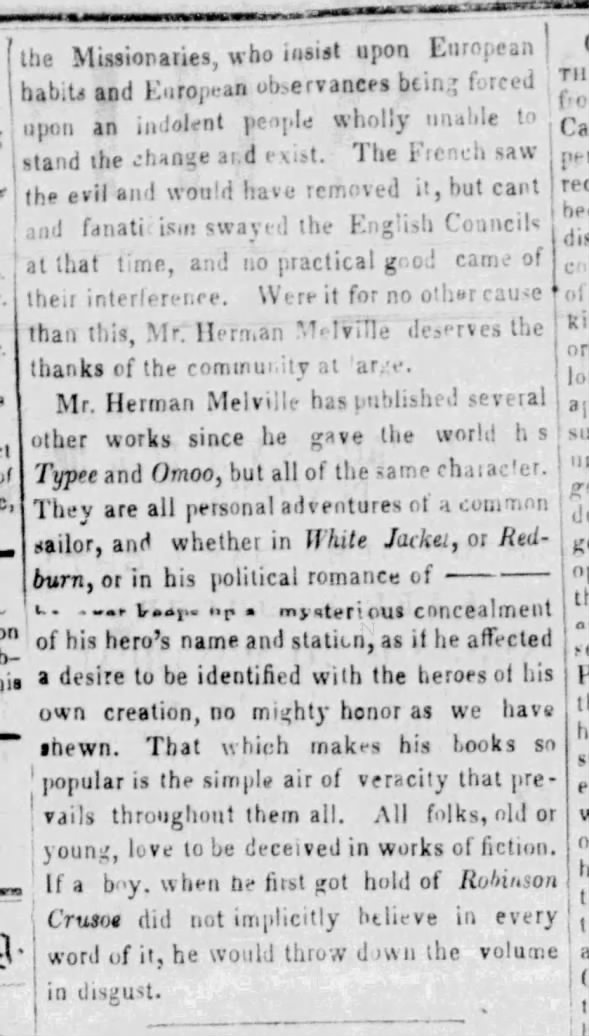
Later editions of Melville's first two books were reviewed in the Daily British Whig (Kingston, Ontario, Canada) on December 3, 1850. Not previously collected, this item offers an early instance of Melville's reception in Canada--almost one year before the favorable notice of Moby-Dick in the Toronto Globe on November 29, 1851. The Kingston newspaper gives the publisher of both Typee and Omoo as "Putam & Wily" although the American edition of Omoo (New York, 1847) was published by Harper & Brothers. In 1849 the Harpers had issued their Revised Edition of Typee, first published in America by Wiley & Putnam. By 1850 all five of Melville's published works through White-Jacket were available in Kingston, Ontario. For some reason unable to name Mardi, and a Voyage Thither the Canadian reviewer refers to Melville's third book as a "political romance." 


LITERARY NOTICES.  

TYPEE; OR A FOUR MONTHS RESIDENCE IN ONE OF THE MARQUESAS; By Herman Melville—Revised Edition Putnam & Wily, New York; Armour & Ramsay, Kingston.

OMOO; OR ADVENTURES IN THE SOUTH SEAS, being a sequel to Typee, by Herman Melville. Revised edition. Putnam & Wily, New York; Armour & Ramsay, Kingston. 

Mr. HERMAN MELVILLE is a writer whose productions bid fair to create for him a high literary reputation in the world of letters. The books before us have been before the public some few years, and have already passed through a variety of editions, being pirated both at home and abroad. The particular edition now before us seems to have received a considerable portion of the author's revision by the pruning knife, inasmuch as a great many vulgarisms and much tedious gurrulity are no longer to be complained of in the same degree. One or two very offensive expressions still remain and disfigure the edition. There is a great air of truth about these volumes which engages the reader's attention at once. If the events related are not genuine, they are certainly "ben trovati" as the Italians would say. The hero is a common Yankee sailor before the mast, not wholly devoid of education, but making no pretensions to literary acquirements; he is a graceless unmitigated scamp, (on his own shewing,) and commits actions that in a civilized country would lead him to the gallows; but of his own demerits he seems to have no idea and tells his tale throughout with an air of injured innocence that is highly amusing. Who he is, or what he is, the reader has no information, for his name or former occupation is never once mentioned or alluded to. Charity should induce us to believe, that Mr. Herman Melville is not the hero of his own stories; and yet some passages in these books, and also some others in his tale of "Redburn," would induce us to form a contrary opinion. This supposition does no honor to Mr. Herman Melville; for to be a deserter without cause, a mutineer without occasion, and a receiver of stolen goods without necessity, is a character unsuited to the author's present standing in society.

Many critics have likened Typee and Omoo to Robinson Crusoe; others again to Dana's Two Years before the Mast. They certainly have not the raciness of old Defoe, nor is the adventure sufficiently interesting to be compared to that of the immortal navigator; and as to Dana's book, they bear no nigher resemblance than in each being the autobiography of a sailor before the mast. The fact is, Mr. Herman Melville has a very pretty style of his own, to which, like Washington Irving, he owes a great portion of his fame. He tells his tales pleasantly and without labor, and tho' evidently well acquainted with nautical phrases, rarely inflicts them upon his readers. The total want of interest in his hero is a great drawback to his books as novels; but this defect is more than compensated by the vast amount of real knowledge of Polynesian life acquired in their attentive perusal. The Missionaries, those cruel pests in Tahiti, are cleverly handled; for without offering any opinion, he places plain facts before the world, which have already had a salutary effect in checking the mischievous tyranny of priestcraft in the South Seas. The American public affected to discredit the statements of the Russian Kotzebue in 1832, but now that one of their own countrymen repeats the tale, disbelief becomes preposterous and ridiculous. This plain fact speaks whole libraries. Capt. Cook estimated the population of the Society Islands at 200,000; when Kotzebue visited the islands, in 1832, "80,000 miserable wretches (we quote the Captain's words) were all that remained of Capt. Cook's numerous and happy Islanders." This was a sad decrease indeed, but nothing comparable to the present actual de-population of these once flourishing islands; for Mr. Herman Melville in 1844 estimates the whole population at less than 8,000 souls, and fearlessly prognosticates the total disappearance of the race—unless the Missionaries are driven from the Islands. Our readers must not misunderstand us—it is not the introduction of Christianity in the Society Islands which has depopulated them, it is the wilful and perverse misgovernment of the Missionaries, who insist upon European habits and European observances being forced upon an indolent people wholly unable to stand the change and exist. The French saw the evil and would have removed it, but cant and fanaticism swayed the English Councils at that time, and no practical good came of their interference. Were it for no other cause than this, Mr. Herman Melville deserves the thanks of the community at large.

Mr. Herman Melville has published several other works since he gave the world his Typee and Omoo, but all of the same character. They are all personal adventures of a common sailor, and whether in White Jacket, or Redburn, or in his political romance of — — he ever keeps up a mysterious concealment of his hero's name and station, as if he affected a desire to be identified with the heroes of his own creation, no mighty honor as we have shewn. That which makes his books so popular is the simple air of veracity that prevails throughout them all. All folks, old or young, love to be deceived in works of fiction. If a boy, when he first got hold of Robinson Crusoe did not implicitly believe in every word of it, he would throw down the volume in disgust. 

-- The Daily British Whig (Kingston, Ontario, Canada) December 3, 1850. 

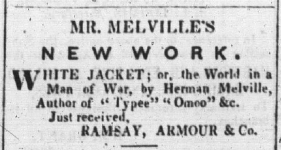
Belatedly, with suitable apologies, the Kingston editor offered a wonderfully substantial and highly favorable assessment of White-Jacket a year after it was published in New York by Harper & Brothers. Found this New Year's Day 2022 on newspapers.com, the glowing Canadian notice of White-Jacket is transcribed below from the Daily British Whig of March 25, 1851.

25 Mar 1851, Tue The Kingston Whig-Standard (Kingston, Ontario, Canada) Newspapers.com

LITERARY NOTICES.  

WHITE JACKET, or the World in a Man of War. By Herman Melville, author of Typee, Omoo, &c. Harper's 12mo Edition — pp. 466. Price $1. E. W. Palmer, Kingston.

Few modern writers of eminence have disappointed us more than Mr. Melville; this is not so much his fault, as our own; for hearing so much said in his praise by the literary world of Europe and America, we believed him to be another Washington Irving, and took up his "Typee" and "Omoo" with the same eagerness that thirty years ago, we snatched at a novel of Walter Scott's. Had we stumbled on the works of our author with the same careless indifference with which Dana's "Two Years before the Mast" first fell into our hands, we might have paid them that deference which their merits deserve; but being greatly over rated and much over praised, (in our estimation,) we rose from their perusal soured, annoyed and disappointed. This accounts for "White Jacket," Mr. Melville's latest publication, although more than a year before the public, not having excited our curiosity to read it, until Saturday last, when Mr. Palmer, the Bookseller, kindly placed it at our disposal. That Mr. Melville has been a common sailor, a very common sailor, the text of all his works clearly proves. That he is a man of strong common sense, good feeling, and possessed of much information, they also clearly make manifest. But, that he is an educated man, despite his ceaseless quotations from dead and living writers, we very much doubt. There is a mystery about him—something of the George Borrow, which the reader would gladly solve; though perhaps no two men are more dissimilar than the Yankee Sailor and the Gipsy Philologist. Still there is a mystery, and in that consists half the notoriety of his books, and more than half their interest.

"White Jacket" is what its second title describes, the picture of life on board a man-of-war. The writer ships at Valparaiso as an ordinary seaman (that is, a common sailor of the second class) on board the U. S. Frigate United States, (called in the book Neversink) and makes in her the homeward voyage. He is upwards of a year on board of her, and his observing eye and ready pen are busy at work during the whole of that period. The scenes he describes are highly characteristic, vastly descriptive, and greatly entertaining. All his pictures are graphic and all his characters are painted to the life. The abuses in the American Navy are pointed out, and the grossness of its tyranny fully exposed. The stupid Commodore, the brutal Captain, the ignorant Doctor, and the obsequious Master-at-arms, cum multis aliis, all fare alike, and if the incidents portrayed are facts, and they bear an air of truthfulness about them, these officers richly deserve the impaling they receive. One part of the book is written with much spirit and zeal, that which treats of corporal punishment. Mr. Melville shews it to be cruel, wanton, unnecessary, and worse than useless; and it is a happiness for him to know, that since the publication of "White Jacket," the United States Legislature has abolished that species of unmanly torture throughout the Naval and Mercantile Services. Should the same practice be discontinued in the British Navy, and discontinued soon it must be, if the British Fleet expect to be manned without impressment, Mr. Melville will have the grand satisfaction of feeling, that he has achieved more for his fellow man, than any other human being since the days of John Howard. To have abolished "Flogging" is more than Nelson and Collingwood dared to do, though they both wished it done!

We hinted a doubt as to Mr. Melville, who certainly writes with the air and ease of an Oxonian, being a man of education. Although his syntax and prosody are generally correct, still he occasionally makes queer confusion with the words "lying" and "laying." These may be printer's errors, and so far he is excusable. But in the following extract no such excuse can avail him.

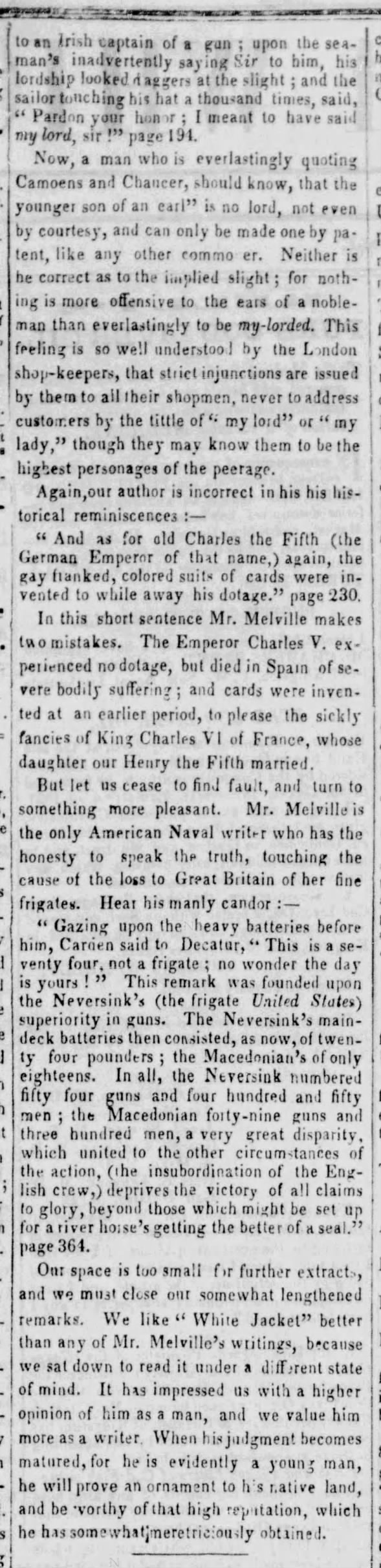
"There happened to be a lord on board of this ship—the younger son of an earl, they told me. He was a fine looking fellow. I chanced to stand by when he put a question to an Irish captain of a gun; upon the seaman's inadvertently saying Sir to him, his lordship looked daggers at the slight; and the sailor touching his hat a thousand times, said, "Pardon your honor; I meant to have said my lord, sir!" page 194.

Now, a man who is everlastingly quoting Camoens and Chaucer, should know, that "the younger son of an earl" is no lord, not even by courtesy, and can only be made one by patent, like any other commoner. Neither is he correct as to the implied slight; for nothing is more offensive to the ears of a nobleman than everlastingly to be my-lorded. This feeling is so well understood by the London shop-keepers, that strict injunctions are issued by them to all their shopmen, never to address customers by the tittle of "my lord" or "my lady," though they may know them to be the highest personages of the peerage.

Again, our author is incorrect in his his historical reminiscences:—

"And as for old Charles the Fifth (the German Emperor of that name,) again, the gay franked, colored suits of cards were invented to while away his dotage." page 230.

In this short sentence Mr. Melville makes two mistakes. The Emperor Charles V. experienced no dotage, but died in Spain of severe bodily suffering; and cards were invented at an earlier period, to please the sickly fancies of King Charles VI of France, whose daughter our Henry the Fifth married.

But let us cease to find fault, and turn to something more pleasant. Mr. Melville is the only American Naval writer who has the honesty to speak the truth, touching the cause of the loss to Great Britain of her fine frigates. Hear his manly candor:—

"Gazing upon the heavy batteries before him, Cardan said to Decatur, “This is a seventy-four, not a frigate; no wonder the day is yours!” This remark was founded upon the Neversink's (the frigate United States) superiority in guns. The Neversink's main-deck batteries then consisted, as now, of twenty-four pounders; the Macedonian's of only eighteens. In all, the Neversink numbered fifty four guns and four hundred and fifty men; the Macedonian forty-nine guns and three hundred men, a very great disparity, which united to the other circumstances of the action, (the insubordination of the English crew,) deprives the victory of all claims to glory, beyond those that might be set up for a river horse's getting the better of a seal." page 364.
Our space is too small for further extracts, and we must close our somewhat lengthened remarks. We like "White Jacket" better than any of Mr. Melville's writings, because we sat down to read it under a different state of mind. It has impressed us with a higher opinion of him as a man, and we value him more as a writer. When his judgment becomes matured, for he is evidently a young man, he will prove an ornament to his native land, and be worthy of that high reputation, which he has somewhat meretriciously obtained.
-- The Daily British Whig (Kingston, Ontario, Canada) March 25, 1851. 
20 Nov 1851, Thu The Kingston Whig-Standard (Kingston, Ontario, Canada) Newspapers.com
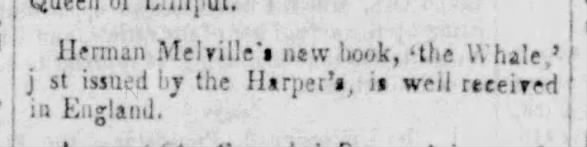
"Herman Melville's new book, 'the Whale,' just issued by the Harper's, is well received in England."  -- Daily British Whig (Kingston, Ontario, Canada) November 20, 1851.

Monday, June 21, 2021

London Morning Herald notice, White-Jacket

From the London Morning Herald of March 4, 1850; now accessible on The British Newspaper Archive with pages recently digitized in this very month of June 2021.  

LITERATURE.

 BOOKS RECENTLY PUBLISHED.

 ...

White Jacket; or, The World in a Man of War. By Herman Melville, Author of “Redburn,” “Typee,” &c. Two Vols. R. Bentley.— A cruise in an American man of war is the subject of this novel, which conveys a lively and, no doubt, accurate description of the mode of life on board vessels of that class. The author served as a common sailor in the American navy for more than a year, and his reflections arising from personal experience are incorporated in these volumes. He offers many suggestions for improving the internal economy of vessels of war and for bettering the condition of the sailor, without impairing the efficiency of the service. He expatiates particularly on the subject of flogging in the navy, which he conceives might be much abated, if not altogether relinquished. The novel is very entertaining, and full of such information as could only be afforded by one who has served before the mast.  
--London Morning Herald, 4 March 1850.


Related post:

Monday, February 24, 2020

Moby-Dick in Kurtz's Lutheran Observer

Lutheran Observer and Weekly Religious Visiter - November 28, 1851
via GenealogyBank

NEW PUBLICATIONS. 

MOBY DICK, OR THE WHALE, by Herman Melville, author of "Typee," "Omoo," &c. New York, published by Harper & Brothers; Baltimore, sold by Cushings & Bailey, 262 Baltimore street, opposite Hanover street.
This new work, by the author of "Typee," takes us back to the scenes where that wondrous and wonderful narrative had its origin, and makes us the companions of whales, those monsters of the deep, whose history is here dressed in all the enchantment of romance, and all the power of reality. The voyage of the writer from New Bedford to the whaling ground--if one may so call the waters in which the fishes live and have their sports--is full of events, interesting, instructive, and pleasant to read. We reach the Pacific, where the whales revel, and there we see how they live, how they are captured, and how they are 'boiled down' and made food for fire. It is a pleasant, agreeable, instructive, amusing work, and right glad will the reader be to take the voyage, in his "mind's eye," over which it carries him.  --Lutheran Observer and Weekly Religious Visiter (Baltimore, MD) November 28, 1851; found in online Newspaper Archives at genealogybank.com.
The Lutheran Observer was edited by Benjamin Kurtz (1795-1865) and published weekly in Baltimore, Maryland. The favorable notice of Moby-Dick may have been copied from another newspaper. [UPDATE: indeed, this favorable notice of Moby-Dick in the Lutheran Observer had previously appeared in the Baltimore Patriot and Commercial Gazette on November 15, 1851.]

In the Lutheran Observer for April 12, 1850 Kurtz reprinted the notice of Melville's White-Jacket that had appeared in New York Evangelist on March 28, 1850. The Evangelist notice of White-Jacket is transcribed in Herman Melville: The Contemporary Reviews, ed. Brian Higgins and Hershel Parker (Cambridge University Press, 1995; paperback 2009) on page 318.

Notice of Melville's White-Jacket via GenealogyBank
Lutheran Observer (Baltimore, MD) April 12, 1850
Notice of Melville's White-Jacket via GenealogyBank
Lutheran Observer (Baltimore, MD) April 12, 1850
On August 14, 1852 Kurtz's Lutheran Observer reprinted the positive notice of Pierre in the Batimore Sun (August 4, 1852). The Baltimore Sun notice of Pierre is logged and transcribed in George Monteiro, Herman Melville: Fugitive References (1845-1922), Resources for American Literary Study Volume 33 (2008; AMS Press, 2010) pages 19-93 at 28.

Sat, Dec 30, 1865 – 1 · The Baltimore Sun (Baltimore, Maryland) · Newspapers.com

Related posts 

Friday, February 14, 2020

White-Jacket in Sleeper's Boston Journal

The Boston Journal, then edited by John Sherburne Sleeper, published this brief, favorable notice of Melville's White-Jacket on March 25, 1850. Not included in Gary Scharnhorst's 1988 inventory of discoveries, "Melville Bibliography 1846-1897: A Sheaf of Uncollected Excerpts, Notices, and Reviews" in Melville Society Extracts 74 (October 1988) pages 8-12; and 75 (November 1988) pages 3-8. Not transcribed or listed in Herman Melville: The Contemporary Reviews, edited by Brian Higgins and Hershel Parker (Cambridge University Press, 1995; paperback 2009).

Boston Journal - March 25, 1850
Vol. 18 no. 5256, page 1, col. 4.

New Publications. 

... White-Jacket; or the World in a Man-of-War. By Herman Melville. New York: Harpers & Brothers.
The author in this volume gives a description of life on board a man of war, as seen from the forecastle. We have not yet had an opportunity to bestow more than a casual glance at the contents of this book, but judging from a perusal of one or two chapters and from the wide reputation which the author has acquired, we hazard little in predicting that the book will be read with great interest. In London, where the work was published some six or eight weeks since, it is very highly spoken of. The little which we have read in "White Jacket," has served to awaken a desire to read more, and we have laid the book aside for perusal at the earliest opportunity. It is for sale by Redding & Co.
Boston Daily Journal - May 23, 1850
Vol. 18 no. 5306, page 1, columns 4-5.
Two months later, a more substantial critique of White-Jacket appeared in the evening edition of Sleeper's Boston Journal over the pseudonym, "Johnny Raw." This item also is not counted in Scharnhorst's 1988 "Sheaf" or the 1995 edition of Contemporary Reviews. The pseudonymous reviewer in the Boston Journal argues that Melville's book is best regarded as fiction, taking pains to show specific ways that White-Jacket is unreliable as a "true narrative." According to "Johnny Raw," Melville actually belonged to the after-guard, never the maintop as claimed, "his duties seldom carrying him above the hammock netting." The writer takes pains to correct Melville on the legal basis for flogging in the U. S. Navy. Without saying how exactly, "Johnny Raw" appears to have some knowledge of the frigate United States during Melville's service, including what might be regarded as inside information about particular officers and crew members. 

Critique of Melville's White-Jacket by "Johnny Raw"
Boston Daily Journal - May 23, 1850
Melville's informed critic approves the portrayal of "Mad Jack" as "the most correct character in the book," but denies any factual basis for the caricatures of Selvagee and the amputation-crazy Dr. Cuticle. The critic exposes the real age of old Ushant ("about forty") and his lack of naval experience. Nevertheless, "Johnny Raw" acknowledges that Melville's Ushant had a real-life model whose "great peculiarity was his fondness for his bushy and Turk-like beard." In this case, the exercise of fact-checking nicely corroborates the main lines of the story as Melville told it in The Great Massacre of the Beards.

[For the Boston Journal]
WHITE JACKET--OR THE WORLD IN A MAN-OF-WAR
The title of this work would lead its readers, generally, to believe it a correct statement of the routine and discipline of a man-of-war; at least, they would expect a true narrative of occurrences in the vessel, on board which its author--pretending to be a maintop-man--was the literary man of that body of men termed the After-Guard; (who, in his own language, are composed chiefly of landsmen, the least robust, least hardy, and least sailor-like of the crew). Such, however, is far from being the case; much of this volume is fiction, composed, I should judge, in a great measure, of yarns gathered from sailors--having about the same claim to reality as "Sinbad the Sailor," or the "Baron Munchausen." When the author condescends to treat his readers to a bit of reality, his facts are so much distorted, and represented in so incorrect a light, as to render them, under the circumstances, more blameable than fiction. Tending, as they do, to mislead the public, (who generally being wholly unacquainted with the subject, are entirely at the mercy of an author,) such want of faith in portraying events, cannot be too severely censured. As a work of fiction, the book may have its merits; but deeming it the intention of its author that it should not be considered such, I will point out some few of these misrepresentations and attempt to place them in their true position.
Commencing with the author's statement of the truth and fidelity of his picture, we find, in Chap. 12th, in speaking of the topmen-- 
"The reason of their lofty-mindedness was, that they were high lifted above the petty tumults, carping cares, and paltriness of the decks below. And I feel persuaded, in my inmost soul, that it is to the fact of my having been a maintop-man, and especially my particular post being on the loftiest yard of the frigate, the main-royal-yard, that I am now enabled to give such a free, broad, off-hand, birds-eye and , more than all, impartial account of our man-of-war world; withholding nothing, inventing nothing, nor flattering, nor scandalizing any, but meting out to all--Commodore and messenger-boy alike--their precise description and deserts." 
There is no knowing but such might have been the case, had the author been a maintop-man, and his station on the giddy heighth of the main-royal-yard of the frigate; but stationed as he was, among the landsmen of the After-Guard, his duties seldom carrying him above the hammock netting; it may have been "the petty tumults, carping cares, and paltriness of the decks below," together with a want of sufficient knowledge of sea service, which has caused him to view every thing through so incorrect and distempered a medium.
The characters introduced into this work, are in a great measure those of the imagination, and are made to speak and act to suit the author's pleasure. Captain "Claret," or rather the Captain's Claret, (there being no mention made by the author of the Captain Claret to whom he alludes having, during the latter part of the cruise, relinquished the command of the frigate to a commander, himself taking command of the squadron, owing to the death of the Commodore,) are officers of high standing both in their profession and among their fellow citizens. "Mad Jack" is the most correct character in the book. "Selvagee" is most outrageously caricatured; in reality he is a neat, gentlemanly man, intelligent and much above mediocrity in ability and acquirement, with a knowledge of his profession, which renders him competent to discharge all its duties. The venerable "Old Ushant," "the ancient captain of the forecastle," the seaman whose "back had bowed at the guns of the Constitution when she captured the Guerriere." In fact, with all this high sounding decoration, the author's Ushant was a seaman on the forecastle, who, so far from having been in the Constitution at the time of the capture of the Guerriere, from his own admission, had never served in a man-of-war previous to the cruise of this frigate; neither was he the venerable man, "the Nestor of the crew," as described, but a seaman of about forty years of age, whose great peculiarity was his fondness for his bushy and Turk-like beard. 
A few words now on the subject of flogging. The first case mentioned by the author, in chapter 33d, for the edification of his readers, is that of four men guilty of fighting; the description itself is tolerably fair, but something more is required to convey a correct idea of punishment in the naval service to general readers.
By law of Congress, the punishment in the naval service is flogging; the instrument and its material being designated. No officer has power to punish but the commanding officer, and that in presence of the officers and crew. The following are the regulations under which punishment is made:
GENERAL ORDER. 
"The President of the United States, believing that greater formality in the infliction of such corporeal punishments as are authorized by law, may be adopted in the Navy with beneficial consequences, directs that no such punishment shall be inflicted on any person in the service without sentence of a court-martial, when required bylaw, or the written order of the captain or commanding officer of the vessel, or commandant of the navy yard to which he is attached, where the authority to cause it to be inflicted rests with the commanding officer; specifying the offence or offences, and the extent of the punishment to be inflicted; which order shall be read, and the punishment inflicted in presence of the officers and seamen belonging to the vessel or navy yard.
All such orders for punishment shall be entered on the log-book, and a quarterly return made to the Secretary of the Navy, stating the names of the persons punished, their offences, and the extent of the punishment inflicted, together with such explanations or remarks as the commanding officer may deem necessary to a proper understanding of the case, &c.
(Signed,)
J. K. PAULDING.
Navy Department, May 29th, 1840." 
A list of all punishments taking place on board of all vessels of the Navy, containing the offence and number of lashes inflicted, is required to be kept and forwarded to Congress through the Secretary of the Navy.
"And be it further enacted, that the Secretary of the Navy be, and he is hereby directed to report to Congress at the commencement of the next session, the number of persons in the naval service flogged in each of the years eighteen hundred and forty-six, and eighteen hundred and forty-seven; specifying the name of the ship, the offence, the sentence, and the number of lashes inflicted; and it shall be his duty to make a similar report for each year thereafter." (Approved August 3, 1848.)
The regulations for the government of the Navy are laws of Congress, specifying the offences, and the punishment for such offences, leaving it only discretionary with the captain of a vessel to limit the punishment for such offences as are not subject for a court-martial, from one to twelve lashes (twelve lashes being the extent of the law); strictly, in all offences against the law, the captain has no power to remit punishment altogether, the law reading, "shall be punished," &c.
Chapter 34. "Some of the evil effects of flogging."-- "One of the arguments advanced by officers of the navy in favor of corporeal punishment is this: it can be inflicted in a moment; it consumes no valuable time; and when the prisoner's shirt is put on, that is the last of it, whereas if another punishment were substituted it would probably occasion a great waste of time and trouble; besides thereby begetting in the sailor an undue idea of his importance." 
I say with the author, "absurd, or worse than absurd," but beyond this I cannot go, and agree with him, that "all this is true," but decidedly deny its truth. That any such argument is advanced by officers of the Navy is altogether a misstatement. Not being aware that the opinions of officers (were they asked) would make any difference in the law, they having no part in their framing, being in no manner responsible for them, but being obliged to execute them to the best of their ability, whatever they may be. I will mention none of the arguments made use of by those in favor or against corporeal punishment:
"For besides the formal administering of the 'cat' at the gangway for petty offences, he is liable to the 'colt,' or rope's end, a bit of ratlin stuff, indiscriminately applied."
By referring back, it will be found in General Order from the Hon. J. K. Paulding, then Secretary of the Navy, that all punishment except in presence of the officers and crew, was prohibited in 1840, some three years previous to the author's serving on board the "Never-sink." 
"Nor was it a thing unknown for a Lieutenant in a sudden outburst of passion, perhaps inflamed by brandy, or smarting under the sense of being disliked or hated by the seamen, to order a whole watch of two hundred and fifty men, at dead of night, to undergo the indignity of the colt." 
Here again the author deals in the marvelous; such a scene cannot be proved to have been ever enacted in the navy of the United States. The laws in the naval service bind equally on all to whom they refer, officers as well as crew. Would not common sense teach any one, that an officer is not going to risk his position (which he most certainly would do) by acting directly at variance with the law, for the sake of gratifying such a paltry feeling of revenge, as the author imagines.
I would also mention here, that for illegal punishment, inflicted at any time during a cruise, every officer is aware that he would not only subject himself to a court-martial for violation of military law, but also to heavy penalty, at the expiration of the vessel's cruise, were the circumstances brought to a civil court; and there are ever a class in our sea port cities on the look out for such cases, on the return of both government and merchant vessels. 
"Flogging not lawful." Such is the title of chapter 35th. Is it not indeed wonderful that this should not have been found out an an earlier period, that the judgment of our members of Congress and heads of Department should have been thus obscured! that Congress, when legislating on this subject, should labor under the delusion that their acts were law! that no member of Congress has been sufficiently acute, when advocating the abolishment of corporeal punishment, to perceive that such punishment was unlawful! and that at last this discovery should be made by one whose talent seems by far better adapted to fiction, than to unravelling the substantial intricacies of the law. The laws for the government of the Navy are in themselves a sufficient comment upon this chapter. 
Although the seamen themselves, generally, are of opinion that flogging should not be done away with--and the only petition which I have heard of their sending to Congress for years, was a request that such punishment should not be abolished. Still I would say, make the trial--let Congress make the experiment in a few vessels--should they not deem it prudent to do so altogether--and indeed can I say that for one out of very many, most sincerely should I rejoice to see that order and discipline can be maintained, (on the high sea), among such a number, composed of every description of men, without the lash.
"Flogging not necessary." Chapter 36. Whether necessary or not, I should not presume to discuss, (although one-half of my life has been spent in sea service,) until a fair trial had been made without its use. 
"And as in this matter we cannot go further back than to Blake, so we cannot advance further than to our own time, which shows Commodore Stockton, during the recent war with Mexico, governing the American squadron in the Pacific, without employing the scourge." 
Having for authority those who served on board the U. S. frigate Congress, the flag-ship of Commodore Stockton, I can state that in this also the author is mistaken, and that as elsewhere corporeal punishment was inflicted for violation of the law; I should judge that the author might be equally if not more likely, misinformed with regard to the opinions of Blake, Collingwood and Nelson, on this subject, than of those of his contemporary whom he has mentioned. 
"Old Ushant at the gangway." Chapter 77. I will close this subject with a correct story of this incident, of the genuineness of the author's "Old Ushant," I have before spoken. General orders from the Secretary of the Navy, sent by circular to the Commodores of Squadrons, and from them to the commanders of vessels, are regulations which officers are obliged to obey and enforce equally with the laws.
GENERAL ORDER.
"The hair of all persons belonging to the Navy, when in actual service, is to be kept short. No part of the beard is to be worn long excepting the whiskers; which shall not descend more than one inch below the tip of the ear, and thence in a line towards the corners of the mouth.
[Signed] BADGER."
In the instance before us, each order was given by Captain "Claret." The order being obeyed by the officers, it was passed among the crew, who, with the exception of some six to twelve, obeyed it--they being probably sufficiently acquainted with the naval service to be aware that such orders do not emanate from the Captain without authority. On being remonstrated with, all obeyed, with the exception of the author's venerable Ushant, and he, after being reasoned with by the Captain, and informed that he should be obliged to punish him, did he continue to set his authority at defiance--the Captain at the same time expressing his unwillingness to do so--still continued to defy the authority of a regulation of the naval service, which all his shipmates and officers had seen the necessity of complying with. For this, in accordance with the law, was he punished. Here I will leave it to the good sense of every individual to say how justly.
"A man-of-war's man shot at," Chapter 50th. Without quoting from the author in this chapter, it is sufficient to say that he relates as fact, that a top-man, a messmate of his own, having been prohibited going on shore at night, was fired upon by the sentry on post, and severely wounded in the right thigh. Strange to say! this occurrence, unusual as it is, and of such a serious nature, cannot be remembered by others who were on board; so far from it, they decidedly maintain that, neither did such a circumstance occur during the cruise of the frigate, nor did a man die from having a limb amputated, as related in the case of this imaginary man of the author, in Chap. 53d; and furthermore, that no amputation took place on board the "Neversink," during her cruise. 
Growing out of this creation of the fancy, the author presents to his readers three chapters equally devoid of fact; and at last destroys his phantom messmate, under the hands of the surgeon; the description of whom, in justice to an upright and estimable man, I cannot pass over. "The Surgeon of the Fleet," Chap. 51st.
"He was a small, withered man, nearly, perhaps quite, sixty years of age. His chest was shallow, his shoulders bent, his pantaloons hung round skeleton legs, and his face was singularly attenuated. In truth, the corporeal vitality of this man seemed, in a good degree, to have died out of him, &c.
Like most old physicians and surgeons who have seen much service, and have been promoted to high professional place for scientific attainments, this Cuticle was an enthusiast in his calling. In private, he had once been heard to say, confidentially, that he would rather cut off a man's arm than  dismember the wing of the most delicate pheasant, &c." 
What a walking study for an anatomist! what a hideously ugly looking varmint, has the author drawn in caricaturing you, "Cuticle,"--quite a demon, hardly possessing the form of humanity; how amazingly is the real appearance and disposition of "Cuticle" at variance with the author's picture. Slightly above the medium height, he is erect, and stout without being corpulent, of about forty-five years of age, his features fine and expressive of that mildness and benignity which characterizes him. I am told by those who have been under his treatment (in the sick bay,) several times during the cruise of the frigate, he was ever extremely kind and attentive, doing all that professional skill, aided by an excellent heart, could do to alleviate the suffering of those under his care.
Here I "wind up" for the present, what was only undertaken to show the public how much they have been imposed upon, if they have taken "White Jacket" for other than a work of fiction.
JOHNNY RAW. 
--Boston Daily Journal, Thursday Evening, May 23, 1850; vol. 18 no. 5306, page 1.
Boston Daily Journal - May 23, 1850
Related post:

Wednesday, October 23, 2019

Frederic Swartwout Cozzens on Mardi

Mardi: and a Voyage Thither (1849). PS2384 .M3 1849 v1
 from the Rare Books and Manuscripts Library of The Ohio State University Libraries
Nineteenth-century reviews and notices of Herman Melville's works usually appeared without a credit line. In print, even signed reviews would display initials only, or a pseudonym. More often than not, the author remains unknown. It's good and satisfying, therefore, whenever we can identify one of Melville's contemporary reviewers by name and thus augment our knowledge about the reception history of his writings. In some cases, scholars may have incautiously ascribed reviews by unknown editorial hands to chief editors of newspapers and magazines in which they appeared. Occasionally, as here, a correct identification in previous Melville scholarship can get overlooked or disregarded, and perhaps forgotten.

Frederic S. Cozzens, detail from Elliott and his Friends (1857) by Junius Brutus Stearns
Image Credit: Graphic Arts Collection, Special Collections, Firestone Library, Princeton University
Aptly tagged as an "American humorist" in his time and ours, the writer and wine-merchant Frederic Swartwout Cozzens (1818-1869) was credited in the 1950's and 1960's with commentary on Mardi that appeared over the pseudonym "Richard Haywarde" in the August 1849 issue of Graham's magazine. The scholarly attribution to Cozzens continued to receive at least tacit acceptance for several decades and informed, for example, the work of Daniel Ware Reagan in his 1984 doctoral dissertation on The Making of an American Author. However, Cozzens's authorship was not acknowledged in later collections including the biggest and best, Herman Melville: The Contemporary Reviews, edited by Brian Higgins and Hershel Parker (Cambridge University Press, 1995; paperback 2009). The rationale for omitting attributions deemed questionable was made explicit in the Checklist of Melville Reviews (Northwestern University Press, 1991), edited by Kevin J. Hayes and Hershel Parker. Introducing their revision of the 1975 Checklist of Melville Reviews, Hayes and Parker noted the lack of "conclusive" documentary evidence for some previous attributions (unspecified), and invited reconsideration of "the whole question of authorship of reviews so that someone else may make a responsible survey of the evidence for attributions (xii)."

Frederic S. Cozzens
via The New York Public Library Digital Collections
To that end, this post marshals proof that F. S. Cozzens read a good way into first volume of Melville's Mardi, and wrote about it for Graham's magazine. The old evidence of Cozzens's established pseudonym together with new, digitized evidence of marginalia in his copy of Mardi, should be more than sufficient to reclaim Frederic Swartwout Cozzens as one of Melville's known critics. In the guise of Richard Haywarde, Cozzens generously sampled the first volume of Mardi for readers of Graham's magazine, appreciating the "beautiful Aurora-flashes of light" while lamenting Melville's "fripperies" and "puerilities."

In 1847 and again ten years later, the literary career of F. S. Cozzens closely tracked that of Herman Melville. Both wrote for Yankee Doodle, the New York humor magazine, although Cozzens is not named as a contributor by Luther Stearns Mansfield in Melville's Comic Articles on Zahchary Taylor. In the posthumously published Autobiographic Sketch, Cozzens admitted to writing "a humorous imitation of Spenser" (the illustrated verse tale of Sir Clod his Undoinge, published in Yankee Doodle on March 13, 1847, page 242); and a "Mythological History of the Heavens" (published under the general heading of Celestial Intelligence on March 20, 1847, page 256). In the mid 1850's both Cozzens and Melville wrote for Putnam's magazine. Submissions from both were initially rejected by George William Curtis, who wrote to publisher Joshua Dix on June 18, 1855 that
"Melville & Cozzens have not passed muster." -- quoted in The Melville Log, ed. Jay Leyda (Harcourt, Brace, and Company, 1951), volume 2, page 502. Houghton Library, Harvard has the original with correspondence of Dix, Edwards & Company that also includes letters from Frederick S. Cozzens in February and March 1856.
Curtis meant Melville's "The Bell-Tower," and maybe a sketch in Cozzens's "Living in the Country" series, neither of which appeared in the July 1855 issue. But Curtis changed his mind about "The Bell-Tower," as Hershel Parker points out in the second volume of Herman Melville: A Biography (Johns Hopkins University Press, 1996), page 259. "Living in the Country" resumed with further rural adventures of Mr. and Mrs. Sparrowgrass in the August 1855 issue of Putnam's, where The Bell-Tower also shows up on pages 123-130. In the December 1855 number of Putnam's, the third and final installment of Melville's short fiction Benito Cereno follows immediately after another episode of Living in the Country by Cozzens. ("Living in the Country" began in the December 1854 Putnam's; the same issue also featured three chapters of Melville's story Israel Potter, starting with John Paul Jones and his gallant call on the Countess of Selkirk.) By May 1856, both writers had book versions of their Putnam's sketches ready for sale: Melville's The Piazza Tales, published by Dix & Edwards; and Cozzens's The Sparrowgrass Papers, published by Derby & Jackson.

"New Books" for sale by P. Allen & Son in Pittsfield, MA
Pittsfield Sun - January 15, 1857 via GenealogyBank
As owner and editor of Cozzens Wine Press (highly regarded by Frank Luther Mott in A History of American Magazines), Cozzens seems an ideal candidate for Melville's imaginary Burgundy Club--alternatively named "Falernian Old Fellows' Club" in one manuscript draft, Houghton Library, Harvard University MS Am 188 (386.C.I.5) as discussed in the Editorial Appendix for Parthenope in the 2017 Northwestern-Newberry Edition of Billy Budd, Sailor and Other Uncompleted Writings, pages 666-7.

In The Raven and The Whale (Johns Hopkins University Press, 1956), Perry Miller correctly identified Cozzens as the author of remarks on Mardi in Graham's. As Miller knew without saying exactly how, Cozzens had received his reading copy from Lewis Gaylord Clark, then editor of The Knickerbocker:
Clark thought it so beneath contempt as not to deserve notice, and gave his copy to Cozzens, who in Graham's, under his pseudonym of "Richard Haywarde," found some particles of gold in a network of affectation. (248-9)
Miller did not cite his source for the gift of Mardi to Cozzens. More generally, Miller did acknowledge reliance on The Melville Log, 2 vols. (Harcourt, Brace and Company, 1951), where Jay Leyda had recorded that on April 27, 1849 "Lewis Gaylord Clark, editor of The Knickerbocker, presents a copy of Mardi to Frederick S. Cozzens" (Volume 1, page 301).

Hugh Hetherington approved the attribution in Melville's Reviewers, British and American, 1846-1891 (University of North Carolina Press, 1961), page 124:
But the reaction of Frederick S. Cozzens (under the pseudonym Richard Haywarde) in a column in the August Graham's Magazine was mixed and exasperated: "Confound the book! there are such beautiful Aurora-flashes of light in it that you can almost forgive the puerilities — it is a great net-work of affectation, with some genuine gold shining through the interstices . . ." (Cozzens was the Knickerbocker set's authority on wine).
 https://hdl.handle.net/2027/mdp.39015004756162?urlappend=%3Bseq=142
 http://www.questia.com/read/3574589/melville-s-reviewers-british-and-american-1846-1891.
In The Melville Log (vol. 1, page 375) Jay Leyda proposed Cozzens as also the author, possibly, of the unsigned review of White-Jacket in The Knickerbocker for May 1850. Leyda's conjecture is reported in The Recognition of Herman Melville, edited by Hershel Parker (University of Michigan Press, 1967). There Parker notes also that Perry Miller attributed the White-Jacket review to Lewis Gaylord Clark. The Knickerbocker review of White-Jacket is ascribed to Frederick Swartwout Cozzens without Leyda's qualifying question mark by Watson G. Branch in Herman Melville: The Critical Heritage (Routledge, 1974), page 235.
https://books.google.com/books?id=LsdGAQAAMAAJ&pg=PA448&lpg#v=onepage&q&f=false
The Knickerbocker review of White-Jacket is accepted as Cozzens's and reprinted in Bloom's Classic Critical Views: Herman Melville, ed. Harold Bloom and Tony McGowan (Chelsea House Publications, 2008), pages 62-63. However, no external documentary evidence has yet been adduced for Cozzens's authorship of the White-Jacket review. Perry Miller may have been right, again, in assuming that Clark wrote it.

As Miller and Hetherington each observed, Cozzens's authorship of the bookish commentary on Mardi in Graham's magazine for August 1849 is established by the use of his known pseudonym, "Richard Haywarde." The closing signature, "Richard Haywarde" does not appear in Herman Melville: The Contemporary Reviews, where only the first half of the "Lender's Books" article, with matter directly pertaining to Melville and Mardi, is reprinted. Over the same pseudonym, Cozzens wrote articles for The Knickerbocker and other periodicals, some of which were collected in the 1853 volume, Prismatics by Richard Haywarde. The Literary World (April 23, 1853) classed Prismatics as a type of "genial, humorous, and warm-hearted" writing after the manner of Washington Irving. In the first paragraph, the reviewer openly called it "Frederick Cozzens's 'Prismatics' " (page 328).

The choice of pseudonyms honored one of Cozzens's ancestors. As Cozzens informed Lewis Gaylord Clark on June 23, 1855, "Richard Haywarde was my father's maternal great grandfather."
https://www.digitalcommonwealth.org/search/commonwealth:6h443r81g
Clark forwarded the letter to Rufus W. Griswold who adapted the information for a page on Cozzens in the updated Poets and Poetry of America (Philadelphia, 1856).

For anybody who still did not know who "Richard Haywarde" was, The Knickerbocker for May 1860 officially linked Cozzens to his nom de plume. With extreme admiration, the Editor's Table surveys past contributions by Cozzens, aka Richard Haywarde. The first was a poem titled Stanzas: Worship, printed over the humble initial "C." in the December 1847 issue of The Knickerbocker. Cozzens's second contribution to be published in The Knickerbocker was a prose sketch, Thoughts from the Top of Trinity, written under the pseudonym Richard Haywarde and published in the July 1848 issue.

Cozzens is duly identified as Richard Haywarde in William Cushing, Initials and Pseudonyms: A Dictionary of Literary Disguises, Volume 1 (New York, 1885), page 127.

Part of the Charvat Collection of American Fiction, Cozzens's Mardi is now held by The Ohio State University in the Rare Books & Manuscripts Library, catalog number PS2384 .M3 V1 and V2. Both volumes of the 1849 first American edition are listed in the OSU Library Catalog.
 https://library.ohio-state.edu/record=b1712450~S7
OSU also has the 1849 British edition of Mardi, published in three volumes by Richard Bentley. To date, however, only the first volume of the American edition is Google-digitized and accessible online courtesy of HathiTrust Digital Library.
 https://catalog.hathitrust.org/Record/100587543
The Mardi that Cozzens used bears the bookplate of esteemed collector Carroll Atwood Wilson. The set was well described in Atwood's posthumously published work, Thirteen Author Collections of the Nineteenth Century, 2 vols., ed. Jean C. S. Wilson and David A. Randall (Privately printed for Charles Scribner's Sons, 1950).
... 2 Vols. New York, 1849. Of considerable association interest, the end-paper of Vol. I bearing a presentation inscription from Lewis Gaylord Clark, the editor of the Knickerbocker Magazine, to F. S. Cozzens, author of the Sparrowgrass Papers, etc. The end-paper of Vol. II has the same inscription, with initials only, but a railway man named Ruben McGrath has added pencil inscriptions therein, alleging that he was born in 1492 and other like matter. The inscription is dated April 27, 1849, the book having been published April 14.
https://archive.org/details/thirteenauthorco000417mbp/page/n324
Inscription in Mardi: and a Voyage Thither (1849). PS2384 .M3 1849 v1
 from the Rare Books and Manuscripts Library of The Ohio State University Libraries

Cozzens plainly had this particular copy of Mardi, Volume 1 before him while writing the article, "Lender's Books--No. II" for the August 1849 issue of Graham's. In the persona of "Richard Haywarde" Cozzens acknowledges his review-copy as
"the gift of my warm-hearted friend, L. G. C. of the Knickerbocker"
and the OSU Mardi is inscribed in the first volume to "F. S. Cozzens / With kind regards of / His Friend / L. Gaylord Clark." As Wilson noted, the inscription from Clark to Cozzens is dated April 27, 1849.
https://books.google.com/books?id=DdVEAQAAMAAJ&pg=PP3&lpg#v=onepage&q&f=false
As shown below, all but one of Richard Haywarde's quotations from Mardi are marked in the OSU copy inscribed to F. S. Cozzens. Turning to chapter 50, Yillah in Ardair, Haywarde recasts Melville's first prose sentence as poetry. The hexameter form and romantic content of the resulting verses remind Haywarde of Longfellow's Evangeline, a tale of Acadie (1847). Haywarde's comparison is matched in the marginalia on this page of Cozzens's Mardi. In the left margin, Melville's first sentence in chapter 50 is marked with a vertical pencil line. Next to the penciled line is the added word "Evangeline," apparently in the handwriting of Ferderic S. Cozzens. To compare handwriting, see the autograph letter from Cozzens to Lewis Gaylord Clark in the Griswold Collection, accessible in Massachusetts Collections Online via Digital Commonwealth:
Cozzens, Frederic S. (Frederic Swartwout), and Lewis Gaylord Clark. Frederick Swartwout Cozzens, Yonkers, NY., autograph letter signed to [Lewis Gaylord?] Clark, 23 June 1855. 23 Jun 1855. Web. 21 Oct 2019. <https://ark.digitalcommonwealth.org/ark:/50959/6h443r81g>.
Herman Melville's copy of Evangeline, the 1848 Ticknor edition, was given to him by Hope Savage Shaw and is now at Harvard, Houghton Library, GEN *AC85 M4977 Zz848ℓ . Melville's Evangeline is Sealts Number 332 in the Online Catalog at Melville's Marginalia Online. Cozzens would pen his own "Evangeliad" in Acadia, or, A Month with the Blue Noses (1859).

The untitled first number of "Lender's Books" sampled poetry by Dante, Milton, Coleridge and Wordsworth among others, and was published in the form of a letter signed "Richard Haywarde" in the May 1849 issue of Graham's American Monthly Magazine, pages 333-4. Transcribed below, the second number of "Lender's Books" appeared in Graham's for August 1849. Images from Herman Melville's Mardi: and a Voyage Thither (1849) Vol. 1 are from the Rare Books and Manuscripts Library of The Ohio State University Libraries. For expert assistance with locating and reproducing these images for use on Melvilliana, I am grateful to Rebecca Jewett and Orville Martin at Thompson Library Special Collections.

LENDERS BOOKS. — NO. II.

By my right hand, Graham: by my right hand, which for odd years hath traveled and travailed over much foolscap, (and under much fool's-cap quoth the fiend,) I am more and more convinced of the truth of the words of the preacher, “Vanity of vanities: all is vanity." I have just laid aside “Mardi,” (the gift of my warm-hearted friend, L. G. C. of the Knickerbocker,) it lies atop of old Du Bartas and some withered budlets of forget-me-not, and in like manner I sit with a few fragmentaries of old literature at bottom for my primiter, some tender remembrances for my secondary, and for the alluvial stratum of my pericranicks (as gentle Charles hath it) these fripperies by the Author of Typee. Confound the book! there are such beautiful Aurora-flashes of light in it that you can almost forgive the puerilities—it is a great net-work of affectation, with some genuine gold shining through the interstices.
Let us turn over the leaves a little–hear ye now—
“And what to me thus pining for some one to page me a quotation from Burton on Blue-Devils.” V. I. p. 15. [marked]
 What is paging a quotation ?
“Anoint the ropes and they will travel deftly through the subtle windings of the blocks.” p 33. [marked]
Why not say—“apply some oleaginous substance to the ambulatory cords, and prevent the inarticulate dissonance caused by the inharmonious attrition of the flaxen fibres against the ligneous particles?”
But this passage I especially commend:
“Good old Arcturion: Maternal craft, that rocked me so often in thy heart of oak, I grieve to tell how I deserted thee on the broad deep. (‘Maternal craft—maternal old oaken-hearted craft—maternal old oaken-cradle hearted craft' is good!) So far from home, with such a motley crew, so many islands, whose heathen babble echoing through thy Christian hull must have grated harshly on every carline.” p. 38.
Mardi: and a Voyage Thither (1849) volume 1, page 38. PS2384 .M3 1849 v.1
from the Rare Books and Manuscripts Library of The Ohio State University Libraries
“Many there are who can fall,” says Martinus Scriblerius, “but few can arrive at the felicity of falling gracefully.
How beautifully he embellishes the most commonplace ideas:
“Among savages, severe personal injuries are, for the most part, accounted but trifles. When a European would be taking to his couch in despair the savage would disdain to recline.” p. 96. [marked]
“At Ravavai I had stepped ashore some few months previous; and now was embarked on a cruise for the whale, whose brain enlightens the world!” p. 1. [not marked]
Jarl steals a keg of tobacco —
“From the Arcturion he had brought along with him a small half keg, at bottom impacted with a solitary layer of sable Negrohead, fossil-marked, like the primary stratum of the geologists.” (Ahem! primary stratum fossil marked !) p. 68. [marked]
He surmiseth that Samoa likes to get swipesy—
“Nor did I doubt but that the Upoluan, like all Polynesians, much loved getting high of head; and in that state would be more intractable than a Black Forest boar.” [page 130, marked]
Sometimes he breaks into hexameter:
“In the verdant glen of Ardair, far in the silent interior of Amma,
Shut in by hoar old cliffs, Yillah the maiden abode.”
This reminds one of Evangeline —
"In the Acadian land, on the shores of the basin of Minos,
Distant, secluded, still, the little village of Grand Pré
Lay in the fruitful valley.”
Mardi: and a Voyage Thither (1849) volume 1, page 183. PS2384 .M3 1849 v.1
from the Rare Books and Manuscripts Library of The Ohio State University Libraries
Let us hexametrize another passage, and we will have done with these fopperies:
“ 'Tis no great valor to perish sword in hand, and bravado
On lip; cased all in panoply complete. For even the alli-
Gator dies in his mail, and the sword-fish never surrenders.
To expire, mild-eyed, in one's bed, transcends the death [of Epam-
Inondas."p.46. [marked]
I have done with Mardi—one is reminded in reading it (after Typee) that "there is as much skill in making dikes as in raising mounts—there is an art of diving as well as flying,” [Pope, on the Art of Bathos] and who knows but what the author, after attaining a comfortable elevation by his former works, may not have made this plunge on purpose, as men do who climb to the top of a high mast that they may dive the deeper.
 . . . . . . . . . .
Now do those crushed, withered budlets of forget-me-not, peeping from under the book covers, remind me of those beautiful hope-flowers that opened their pale blue eyes in the morning of my life, and bloomed and drooped— and passed away—
“How fair was then the flower— the tree :
How silver-sweet the fountain's fall !
The soulless had a soul to me !
My life its own life lent to all!

The universe of things seemed swelling
The panting heart to burst its bound,
And wandering fancy found a dwelling
In every shape, thought, deed and sound.
Germed in the mystic buds, reposing,
A whole creation slumbered mute;
Alas! when from the buds unclosing,
How scant and blighted sprung the fruit!’’
Alas! alas! young life, and young hopes are not perennials; even in the lofty conservatories and crystal hothouses of wealth and station they flush into a sickly existence, and then perish like the meanest flower by the wayside. Did it ever strike you how much we are alike in this particular? Every one looking back upon his past life as the shipwrecked merchant looks upon the broad sea that hath swallowed up irretrievable treasures. Do you believe that if one had the power of investing his new created babes with a course of life, that he would say, “Do as I have done—pass through my joys and my afflictions, and in the experience of my experience you will be happy!” Do you believe that any one—even the wisest, the purest, the best could say this? By my faith, I do not! And the great focal-glass of a common destiny brings down prismatic, many-hued humanity to a point hue, as a convex lens gathers and concentrates prism-bundles of light and heat from the broad disk of the sun. Human suffering is the chord universal that swells from the vibration of numberless strings.
“Thou seest we are not all alone unhappy;
This vast and universal theatre
Contains more woful pageants than the scene
Whereon we play—”
But, “Mardi” and forget-me-nots have spoiled three good sheets of foolscap, and I fear that I am too much is the sentimental vein; let me therefore conclude with quoting a sweet little piece of philosophy, and lay aside these lender’s books for a period.
“A swallow in the spring
Came to our granary, and 'neath the eaves
Essayed to make a nest, and then did bring
Wet earth, and straw, and leaves.

Day after day she toiled
With patient heart; but ere her work was crowned
Some sad mishap the tiny fabric spoiled,
And dashed it to the ground.

She found the ruin wrought
But, not cast down, forth from the place she flew,
And, with her mate, fresh earth and grasses brought,
And built her nest anew.

But scarcely had she placed
The last soft feather on its ample floor,
When wicked hand, or chance, again laid waste,
And wrought the ruin o’er. 
But still her heart she kept,
And toiled again; and last night, hearing calls,
I looked, and lo! three little swallows slept
Within the earth-made walls.

What truth is here, O man!
Hath hope been smitten in its early dawn!
Have clouds o'ercast thy purpose, trust or plan?
Have FAITH and struggle on!" [Richard Salter Storrs Andros]

Here endeth the second fith.
RICHARD HAYWARDE. [Frederic Swartwout Cozzens]

https://books.google.com/books?id=QNYRAAAAYAAJ&pg=PA130&lpg=PA130&dq#v=onepage&q&f=false
Graham's American Monthly Magazine had already published a formal review of Mardi in the June 1849 issue. Author unknown.
Mardi, and a Voyage Thither. By Herman Melville. New York : Harper & Brothers. 2 vols. 12mo.

Mr. Melville has given us here an acknowledged romance, and those who doubted the veracity of “Typee” and “Omoo,” may now have an opportunity of noticing the difference between Mr. Melville recording what he has observed, and Mr. Melville recording what he has imagined. It appears to us that the two processes in the author’s mind have little in common, and the best evidence of the truthfulness of his former books is the decidedly romantic character of much of the present.

“Mardi” is altogether the most striking work which Mr. Melville has produced, exhibiting a range of learning, a fluency of fancy, and an originality of thought and diction, of which “Typee,” with all its distinctness and luxuriance of description, gave little evidence. At the same time it has defects indicating that the author has not yet reached the limits of his capacity, and that we may hope from him works better even than the present. “Mardi” is of the composite order of mental architecture, and the various rich materials which constitute it are not sufficiently harmonized to produce unity of effect. It has chapters of description, sketches of character, flashes of fanciful exaggeration, and capital audacities of satire, which are inimitable, but confusion, rather than fusion, characterizes the book as a whole. Of the two volumes the first is by far the best, but both contain abundant evidence of the richness, strength and independence of the author's mind, and are full of those magical touches which indicate original genius.
https://books.google.com/books?id=TKQ2AQAAMAAJ&pg=PA385&dq#v=onepage&q&f=false