This favorable notice of The Confidence Man: His Masquerade in the Cincinnati Daily Enquirer for April 10, 1857 is not reprinted or listed in Herman Melville: The Contemporary Reviews, edited by Brian Higgins and Hershel Parker (Cambridge University Press, 1995; paperback 2009). Contemporary Reviews on page 506 does give the negative evaluation that appeared the next year in the Cincinnati Daily Enquirer (February 3, 1858) trashing Melville's Confidence-Man as "one of the dullest and most dismally monotonous books we remember to have read." Although the editors of Contemporary Reviews do not indicate where they got it, the dismissive treatment of the Confidence-Man as the worst of Melville's increasingly bad books after Typee and Omoo, forms a kind of editorial preface to a longer review of Melville's 1858 lecture on Statues in Rome.
The earlier, more positive notice in the Cincinnati Enquirer commends the Confidence-Man as a "graphic" display of the social "amusement and fun" to be had when travelling by steamboat "on the Western Rivers." Found on newspapers.com and transcribed below.
Cincinnati Daily Enquirer - April 10, 1857
Book Notice.
THE CONFIDENCE MAN. By Herman Melville, author of "Omoo," "Typee," &c. New York: Dix, Edwards & Co. For sale by L. Danforth. Cincinnati: Rickey, Mallory & Webb.
Mr. Melville is known by the sketches of travel and adventure among the islands of the Pacific, to which he owes his earliest fame. In the work before us he has selected a home scene. The volume opens at St. Louis, and describes the incidents of a voyage down the Mississippi River. The author exhibits, with graphic accuracy, the peculiarities of some of those eccentric originals so often encountered on that frequent route of travel, with whom confinement on board the same steamer for days makes more or less of social intercourse a necessity, if it were not commonly, as in fact it is, a source of very great amusement and fun. The truth of this will be readily assented to by those who are familiar with steamboat travel on the Western Rivers, and none can finish the perusal of this volume without craving a practical relish of the entertainment it affords.
Very likely the change from mild praise to outright disdain for Melville's Confidence-Man in the pages of the Cincinnati Daily Enquirer from April 1857 to February 1858 reflects the change of editors during the same period of time.
When the first notice of the Confidence-Man appeared on April 10, 1857, Virginia born lawyer and journalist Alexander Walker (1819-1893) aka "Judge" Walker had been editing the Cincinnati Daily Enquirer for two years. Walker was already the author of Jackson and New Orleans (New York: J. C. Derby, 1856). During the Civil War, the New York Times ("Affairs in New Orleans," September 11, 1862) would grudgingly acknowledge the ardent secessionist and influential editor of the New Orleans Delta as "one of the ablest writers and literary men the Southwest has produced." At that time, after the capture of New Orleans, Walker was still in prison, being held with other civilian detainees at Fort Massachusetts on West Ship Island, Mississippi.
New Orleans Daily Picayune - January 25, 1893
Near the end of August 1857, the Cincinnati Enqurier was jointly acquired by Washington McLean and former owner-editor James John Faran (1808-1892). Faran served as mayor of Cincinnati in 1855-1857, when Walker was editor of the Enquirer.
The masthead named James J. Faran as chief editor of the Cincinnati Daily Enquirer when the review of Melville's lecture on "Statues in Rome" appeared on February 3, 1858, prefaced by a survey of Melville's books which estimated his last work the Confidence-Man as "decidedly the worst."
The DUBUQUE at the Winona, Minnesota landing Image courtesy of Murphy Library Special Collections, University of Wisconsin-La Crosse
When Robert Melvill aka Robert Melville died in 1881, nobody in Davenport, Iowa knew or cared the "veteran steamboat man" was Herman Melville's first cousin.
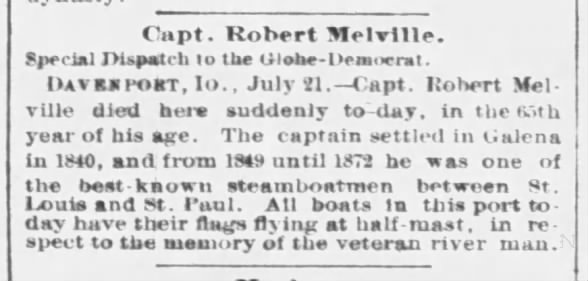
DAVENPORT, IO., July 21. --Capt. Robert Melville died here suddenly today, in the 65th year of his age. The captain settled in Galena in 1840, and from 1849 until 1872 he was one of the best-known steamboatmen between St. Louis and St. Paul. All boats in this port today have their flags flying at half-mast, in respect to the memory of the veteran river man.
Death of Captain Robert Melville--His Brief Illness--His Long Career on the River--His Position as a Citizen and Business Man
The business community was surprised and shocked this morning to learn of the death of the veteran steamboat man and agent, Captain Robert Melville, which occurred at half past four o'clock. On Saturday last Capt. Melville was overcome with the heat while at work in his warehouse, and was taken home. There inflammation of the brain, which had a marked tendency to paralysis of that organ, set in, and he continued to sink until paralysis of the heart brought death to his relief. The deceased has been so long identified with the commerce of the upper Mississippi, and was so well known in one capacity and another as steamboatman, that his departure from the busy scenes of life deserves more than formal notice.
Robert Melville was born in Pittsfield, Mass., in June, 1817, and so he had but just entered his 65th year when he died. His parents came to Galena, Ill., early in the 30's--they had been there several years in 1839, when acquaintances now residing in Davenport met them there. The captain, the eldest of several brothers, remained in New England to finish his education, and so he did not come to Galena until in the early 40's -- and then with the faithful wife who survives him. He entered upon a mercantile career soon after arriving at Galena, and became interested in steamboat traffic. Galena was then the largest business point in the northwest, with one exception possibly, on account of its lead mines and the commercial facilities afforded it by the Mississippi river--and before many years Mr. Melville became engaged in steamboating himself. He was book-keeper for a packet company at Galena, became first clerk of one of the steamers engaged in the Galena and St. Paul trade--and then for many years he spent the seasons of navigation on the Mississippi. He was clerk of the steamer New Boston, which plied in the Davenport and Fort Madison trade for a number of years, and then Captain of that steamer. During all this period his home was in Davenport. When that line hauled off he was appointed agent of the Northern Line at Dubuque, and then of the Galena, Dubuque & Minnesota packet company, remaining there several years. When Mr. Robert Prettyman died in 1873, Mr. Melville became his successor in the old steamboat agency here remaining such until the Northern and Northwestern Union lines were consolidated under the Davidson interest. After the latter event, Captain Melville became a produce and commission merchant, prosecuting the business until the day he was seized with the fatal disease. He engaged in the buying and shipment of potatoes and onions very extensively every fall season. Last spring he was appointed agent of the St. Louis and Dubuque line, in whose prosperity he took a deep interest.
Besides his wife, his two sons, Robert, who is a resident of Davenport, but is away from home as a commercial traveler, and Julien, who is in California, are left. His mother and two brothers are also living, one of whom, George, is a wealthy resident of Galena, but in the East at present.
Capt. Mellville bore a high character as a man, and in business life. He was gentlemanly in demeanor and very kind hearted, while he was prompt and upright in business affairs. All who knew him respected him. His home was at 111 West Thirteenth street.
The arrangements for the funeral have not been completed, nor will they be until the elder son and the brother George are heard from. It is probable that the remains will be taken to Galena for interment. --Davenport, Iowa Quad City Times, July 21, 1881
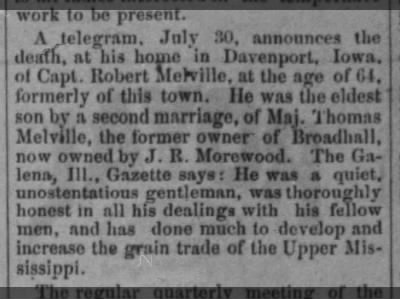
A telegram, July 30, announces the death, at his home in Davenport, Iowa, of Capt. Robert Melville, at the age of 64, formerly of this town. He was the eldest son by a second marriage, of Maj. Thomas Melville, the former owner of Broadhall, now owned by J. R. Morewood. The Galena, Ill., Gazette says: He was a quiet, unostentatious gentleman, was thoroughly honest in all his dealings with his fellow men, and has done much to develop and increase the grain trade of the Upper Mississippi. --Berkshire County Eagle, August 4, 1881.
Another obit in the Davenport, Iowa Gazette (July 22, 1881), incompletely accessible on Find-A-Grave, reports that Robert Melville's first occupation in Galena was "newspaper work."
The steamboat Chancellor Livingston was under the command of popular river captain Joab Center (1777-1857) when Herman Melville, age 4, rode it to Albany on August 20, 1823:
Allan Melvill's diary:
Left New York with Mrs. Melvill, five children, Miss Adams & Nurse in the Steam Boat Chancellor Livingston at 4 P M -
August 21 Arrived at Albany at 11 A M --as quoted by Jay Leyda in The Melville Log, 2 vols. (New York: Harcourt, Brace and Company, 1951) volume 1, page 15.
Allan Melvill's actual diary is held with Correspondence and miscellaneous manuscripts in the Herman Melville Papers at Houghton Library, Harvard. Citation:
Melville, Allan, 1782-1832.Diary. A.Ms.s.(variously); [v.p.] 1800-1831., 1800-1831. Herman Melville papers, MS Am 188-188.6, MS Am 188, (118). Houghton Library, Harvard College Library. https://id.lib.harvard.edu/ead/c/hou00338c00127/catalog Accessed November 27, 2019
New York National Advocate - August 19, 1823 via GenealogyBank
In August 1823 the five children of Allan and Maria Gansevoort, were
Gansevoort, age 7 (b. December 6, 1815)
Helen, 6 (b. August 4, 1817)
Augusta, almost 2 (b. August 24, 1821)
Herman, 4 (b. August 1, 1819)
Allan, 4 months (b. April 7, 1823)
(Catherine/Kate was born on May 21, 1825; Frances Priscilla/Fanny on August 26, 1827; and Thomas/Tom on January 24, 1830.)
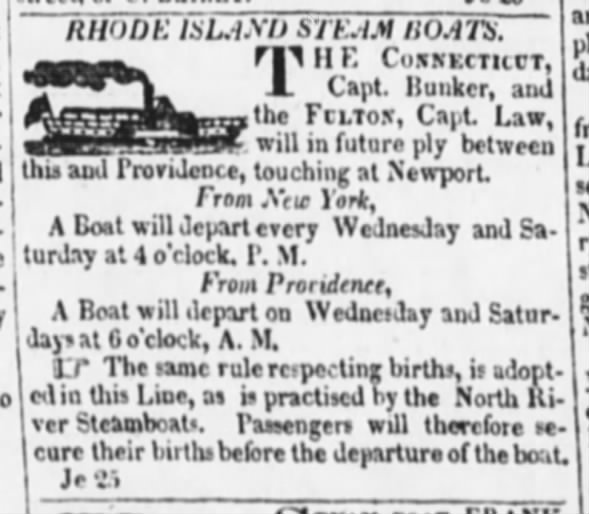
The summer before (August 7, 1822), Herman and family left New York for Providence on the steamboat Connecticut, then commanded by Captain Elihu S. Bunker (1772-1847).
What Allan Melvill called "Horton's Tavern" in his diary was formerly Chappotin's Tavern, refurbished and re-opened as the Globe Tavern in June 1822 by Sanford Horton.
Rhode Island American - June 28, 1822, page 2
via GenealogyBank
Rhode Island American - June 28, 1822, page 3
via GenealogyBank
On the 1823 trip to Albany, "Miss Adams" was the new family governess hired in late December 1822, as Hershel Parker recounts in Herman Melville: A Biography Volume 1, 1819-1851 (Johns Hopkins University Press, 1996) pages 26-27.
More facts about the steamboat Chancellor Livingstoncan be found with the drawing by Samuel Ward Stanton in American Steam Vessels (New York, 1895). Accessible online courtesy of HathiTrust Digital Library:
SWIFTSURE 1825, pencil drawing by Samuel Ward Stanton (1870-1912)
in American Steam Vessels series no. 5, Steamboats of the River Hudson
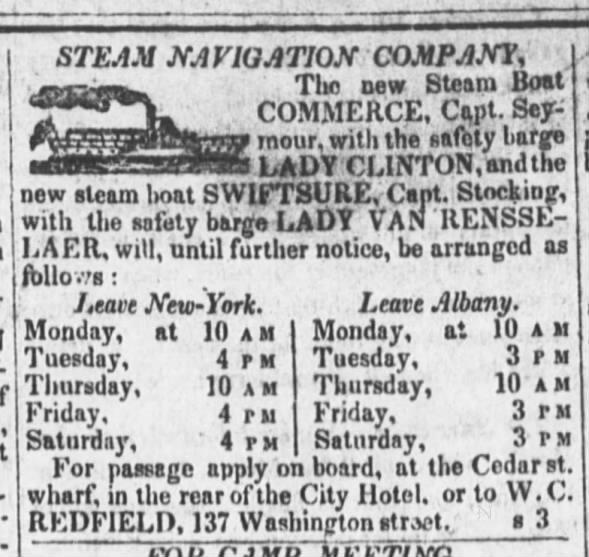
Number 5 in the American Steam Vessels series (Meriden Gravure Company, 1962-5) of drawings by marine artist and historian Samuel Ward Stanton (1870-1912) is titled Steamboats of the River Hudson. Published by Stanton's daughter Elizabeth Stanton Anderson, this pamphlet edition reproduces some early work not found in American Steam Vessels (New York, 1895), including the rare pencil drawing of the Swiftsure in 1825, towing the "safety barge" Lady Van Rensselaer.
Pertinent history of the Swiftsure is given under Stanton's picture of the "SWIFTSURE 1825 pulling safety barge LADY VAN RENSSELAER":
Built at Brooklyn, N. Y., wood, 265 tons, by C. Bergh for A. Van Santvoord's Steam Navigation Co. for route between New York and Albany. SWIFTSURE and COMMERCE usually had in tow, for those afraid of steamboats, so-called safety barges connected to them by swivelled platforms over which passengers could walk. Practice discontinued after 1829 due to resulting slowness, and barges converted for freight. SWIFTSURE abandoned in 1856. -- Steamboats of the River Hudson, American Steam Vessels series no. 5 (Meriden Gravure Company, 1965).
Tue, Sep 6, 1825 – Page 1 · The Evening Post (New York, New York) · Newspapers.com Samuel Ward Stanton died at sea on April 12, 1912 in the Titanic disaster. Stanton's early Swiftsure drawing did not appear in American Steam Vessels. His model is not identified exactly, but in the 1895 Preface Stanton avowed that his illustrations were all "drawn from reliable sources" such as "early prints, lithographs, drawings and paintings, mostly in the possession of private parties or steamboat companies." Also acknowledging his use of old newspapers and hand-bills, Stanton further specified that he had drawn
the United States from a wood cut that appeared in the New York Evening Post, of June 23, 1821; the Constitution from a wood cut on a hand-bill of 1826, and the Albany, 1839, is likewise from a wood cut.
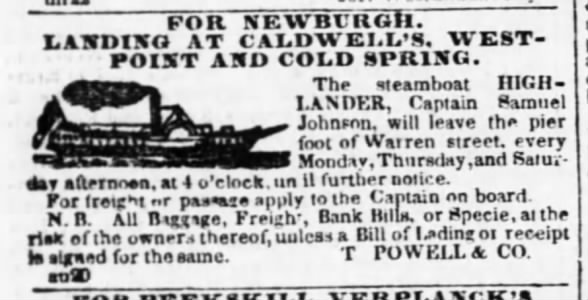
For representations of some early Hudson River steamboats including the Commerce, DeWitt Clinton, and Highlander, Stanton credited "the pictures of Mr. James Bard, a gentleman who began this class of work before 1830."
Stanton describes the Highlander, built in 1835 for the Hudson River, as
"one of the best boats on the river when she first came out, as well as one of the fastest. She ran on the Newburgh and New York line until the Thomas Powell appeared, 1846. She was then used as an excursion boat." --American Steam Vessels
Wed, Oct 9, 1839 – Page 4 · The Evening Post (New York, New York) · Newspapers.com
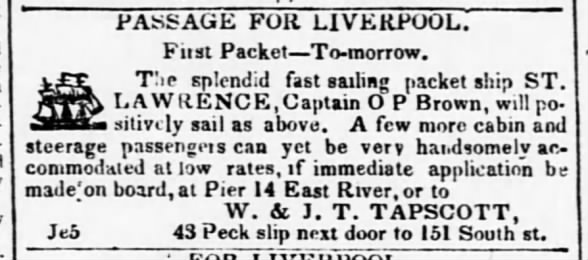
In Redburn (1849) Herman Melville gave the name "Highlander" to the merchant vessel that takes the green hero Wellingborough Redburn across the Atlantic and back. The Highlander in Redburn is a fictionalized version of the real St. Lawrence which did in fact sail to Liverpool in June 1839 with Herman Melville on board. Melville shipped as an inexperienced "boy," although he would celebrate his 20th birthday in Liverpool, waiting to sail home. As William H. Gilman reported in Melville's Liverpool Trip, Modern Language Notes Vol. 61, No. 8 (December 1946) pages 543-547, the crew list of the St. Lawrence had Herman Melville enrolled under the name "Norman Melville."
Wed, Jun 5, 1839 – Page 3 · The Evening Post (New York, New York) · Newspapers.com
Related posts:
Swiftsure Line in 1830 https://melvilliana.blogspot.com/2019/11/swiftsure-line-in-1830.html
Captain Hart L Murray https://melvilliana.blogspot.com/2019/11/captain-hart-l-murray.html
Here's more about Hart Leverett Murray (1798-1887), captain of the Swiftsure when that Hudson River steamboat brought Allan Melvill and his son Herman (age 11) up to Albany from NYC in October 1830. Towing the Melvill family's furniture on the freight barge Ontario, as demonstrated in the previous post on the Swiftsure Line in 1830.
Son of Jesse b 9 Nov. 1798 in Essex, Conn. d 7 May 1887 in Deep River, Middlesex Co. Conn. m 25 Sept. 1823 to Temperance H. Brockway b 19 Oct. 1798 d 26 May 1898. Lived in Essex, Conn. & Albany, N.Y.
Children
i Leverett Wendell b 1 June 1829 d 6 Apt 1889
ii Angenora Manuella b 24 Jan,1834 d 29 Oct. 1927 m John L. Brownell
Starting in 1824 as Capt of the Hudson River steamboat 'Swiftsure' he continued to be a popular captain of the Hudson River boats for 27 yrs, contemporaneous with Alfred Vantvoord, Isaac Newton and Dean Richmond. He was appointed Harbor Master of the Port of New York by Gov Morgan in 1860 and retired from active life in 1867. He was a resident of Albany for 28 yrs, and earnest anti-slavery man and a member of the Baptist church for more than 60 years; a devoted husband and valued citizen.
In Albany, Murray lived at 60 Westerlo Street. That's according to Joel Munsell's Albany Annual Register for 1849-50 where his name "Murray H L" appears in the alphabetized list of fifteen Albany "Skippers." Same address for "skipper" Murray in the 1853-4 Albany City Directory. In Brooklyn Hart L. Murray resided at 12 Cheever Place.
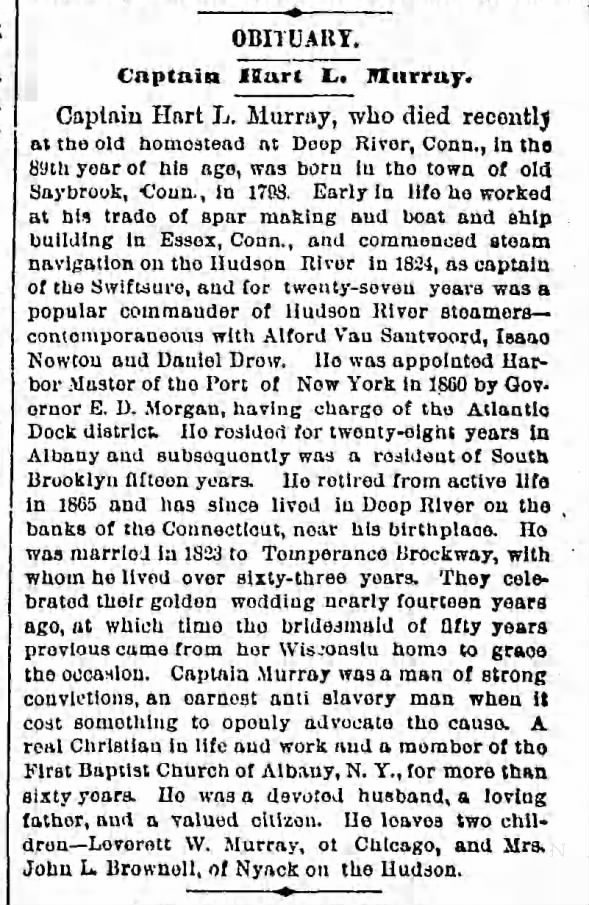
Captain Hart L. Murray, who died recently at the old homestead at Deep River, Conn., in the 89th year of his age, was born in the town of old Saybrook, Conn., in 1798. Early in life he worked at his trade of spar making and boat and ship building in Essex, Conn., and commenced steam navigation on the Hudson River in 1824, as captain of the Swiftsure, and for twenty-seven years was a popular commander of Hudson River steamers--contemporaneous with Alford Van Santvoord, Isaac Newton and Daniel Drew. He was appointed Harbor Master of the Port of New York in 1860 by Governor E. D. Morgan, having charge of the Atlantic Dock district. He resided for twenty-eight years in Albany and subsequently was a resident of South Brooklyn fifteen years. He retired from active life in 1865 and has since lived in Deep River on the banks of the Connecticut, near his birthplace. He was married in 1823 to Temperance Brockway, with whom he lived over sixty-three years. They celebrated their golden wedding nearly fourteen years ago, at which time the bridesmaid of fifty years previous came from her Wisconsin home to grace the occasion. Captain Murray was a man of strong convictions, an earnest anti slavery man when it cost something to openly advocate the cause. A real Christian in life and work and a member of the First Baptist Church of Albany, N. Y., for more than sixty years. He was a devoted husband, a loving father, and a valued citizen. He leaves two children--Leverett W. Murray, of Chicago, and Mrs. John L. Brownell, of Nyack on the Hudson. --Brooklyn Daily Eagle, May 17, 1887.
Related post:
Swiftsure Line in 1830 https://melvilliana.blogspot.com/2019/11/swiftsure-line-in-1830.html
As shown below, the Melvill family's furniture was on the freight barge Ontario, then part of the Swiftsure Line, and therefore must have gone to Albany on the same trip in October 1830 that Allan Melvill and his son Herman made together aboard the SWIFTSURE. The furniture went last with Herman and his father, not with Herman's brother Gansevoort and their mother, as biographers have mistakenly thought.
New York Commercial Advertiser - Saturday, October 9, 1830
via GenealogyBank
This Swiftsure was the Albany boat that Allan Melvill and his son Herman, age 11, took in October 1830 when the family had to leave New York City for good, after the failure of Allan's importing business. Household furniture went on the freight barge Ontario, as Herman's father recorded in his diary. For a transcription, see Jay Leyda, The Melville Log Vol. 1 (Harcourt, Brace and Company, 1951) page 45. From Leyda's Log, here are two relevant entries in the year 1830:
NEW YORK October 9 Allan Melville's diary:
Left New York with Herman in the Swiftsure (our Furniture being on board the Ontario Tow Boat, Mrs. Melvill & Gansevoort having gone up the preceding eve[nin]g) -- detained all night at Cortlandt St Dock by a severe Storm
October 10 at 7 A M left the Dock
Allan Melvill's actual diary is held with Correspondence and miscellaneous manuscripts in the Herman Melville Papers at Houghton Library, Harvard. Citation:
Melville, Allan, 1782-1832.Diary. A.Ms.s.(variously); [v.p.] 1800-1831., 1800-1831. Herman Melville papers, MS Am 188-188.6, MS Am 188, (118). Houghton Library, Harvard College Library. https://id.lib.harvard.edu/ead/c/hou00338c00127/catalog Accessed November 27, 2019
According to Allan Melvill, Herman's mother and brother Gansevoort had left for Albany the night before. As shown below, when Allan made note of "our Furniture being on board the Ontario" he meant now, with him and Herman, rather than the previous evening with his wife and oldest son. The Swiftsure was supposed to leave at 5 p.m. on Saturday, October 9th but a "severe storm" delayed its scheduled departure. So Herman and his father did not actually leave Cortlandt street until the next morning, as Hershel Parker relates in the great opening chapter of Herman Melville: A Biography Volume 1, 1819-1851 (Johns Hopkins University Press, 1996).
From the New York Commercial Advertiser for Saturday, October 9, 1830:
FOR ALBANY.
The steamboat SWIFTSURE, Captain Murray, will leave the foot of Courtlandt street, THIS AFTERNOON, at 5 o'clock.
For passage, apply on board, or to
W. C. REDFIELD, 82 Courtlandt st.
TOW-BOATS FOR ALBANY -- (Swiftsure Line.)
The freight barge Ontario, will leave the foot of Courtlandt-street, and the Atlantic, the foot of Broad-street This Afternoon at 5 o'clock.
For freight, apply on board, or to
A. VAN SANTVOORD, 82 Courtlandt st.
In Chapter 1 of Melville's Early Life and Redburn (New York University Press, 1951), William H. Gilman acknowledges the "violent storm" and "comfortless night at the Courtlandt Street dock" but still has Allan and son Herman moving "quickly up the Hudson" on October 9, the scheduled date of departure, instead of October 10, the actual date. Parker in his expansive treatment gives the correct departure date, October 10, 1830. Regular days of departure from New York City to Albany were then Wednesdays and Saturdays. From Albany, the Swiftsure regularly left for New York City on Tuesdays and Fridays.
As the ad below from the Commerical Advertiser of Friday, October 8, 1830 shows, the steamboat Swiftsure and barge Ontario both were scheduled to leave "Tomorrow Afternoon" (Saturday, October 9th) from "the foot of Courtlandt street." Together, necessarily.
New York Commercial Advertiser - Friday, October 8, 1830
The Swiftsure could not have left New York City on the 8th because it was still in Albany. Below, the ad in the Albany Argus on Friday, October 8th, showing the scheduled departure of the steamboat Swiftsure at 9 a.m., "from the foot of State st."
Albany Argus - Friday, October 8, 1830 via FultonHistory
SWIFTSURE LINE -- TOW-BOATS.
THE steambt SWIFTSURE, capt. H. L. Murray, will leave the Pier, from the foot of State-st. THIS MORNING, at 9 o'clock, with freight barges.
For freight or passage apply on board, or at the office of the subscriber.
CHARLES COATES, Agent.
Allan Melvill wrote in his diary that his wife and son Gansevoort had "gone up the preceding eve[nin]g" to Albany, which both Gilman and Parker take to mean by boat, with the furniture. But the particular barge that Melville's father referenced only left on Saturday. There was no departure of the Ontario or Swiftsure for Albany the preceding evening. (And Swiftsure Line freight barges that left New York for Albany on Wednesday, October 6th were named the Albany and Superior.) Possibly Allan was confused after the long delay. If so, then Maria Gansevoort Melvill and her son Gansevoort could have departed for Albany on the Swiftsure Line three evenings previous, on Wednesday, October 6, 1830. If Allan got their departure date right, however, then his wife and Gansevoort had "gone up" to Albany the night before on a different passenger line (not affiliated with the Ontario). For example, the Hudson River Line offered passenger trips from the Cortlandt Street dock to Albany every day at 5 p.m., and Sundays at 10 a.m.
Robert J. Vandewater, The Tourist, Or Pocket Manual for Travellers (New York, 1830)
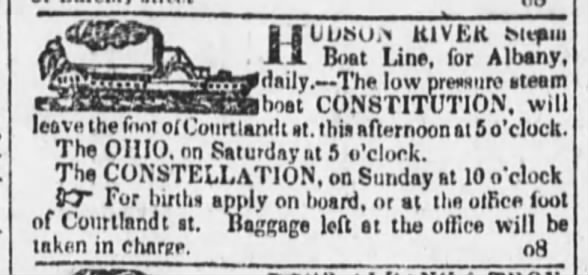
Maybe Herman's mother Maria and older brother Gansevoort took the "low pressure steamboat CONSTITUTION," which did leave for Albany at 5 p.m. on Friday, October 8, 1830.
In any case, the Melvill family's furniture was on the freight boat Ontario, then part of the Swiftsure Line, and therefore must have gone to Albany on the same trip that Allan Melvill and his son Herman made together, aboard the Swiftsure.
Albany Evening Journal - November 11, 1830 via FultonHistory
TRANSPORTATION.
THE SWIFTSURE LINE of TOW-BOATS will continue to receive property at Albany and New-York to forward on the river in other direction by the freight boats Atlantic, Superior, New-York, Albany, Ontario, Niagara, Detroit and Inspector; two of which, towed by a powerful Steam-boat, will leave New-York at 5 o'clock P. M. on Wednesday and Saturday, and two will leave Albany at 9 o' clock A. M. on Tuesday and Friday of each week, leaving at each place boats for the reception of property.
Merchandize, produce, carriages, horses, cattle, and almost every description of live stock, will be forwarded with safety and expedition.
For freight or passage apply to the Agents,
CHARLES COATES, at Albany, and
A. VAN SANTVOORD, 82 Cortland-st New York. -- Albany Evening Journal, November 11, 1830
In its earliest form, towing was done by lashing the barges to both sides of the steamer and proceeding as a unit. ... the earliest Hudson River tows were made up of only two barges specifically designed to accommodate the size, horse power, and turning ability of a specific steamboat--the Swiftsure and its stable of custom-built barges, for example...."
Under command of Captain Stocking, the new steamboat Swiftsure debuted on the Hudson in July 1826 as towing boat for the Lady Van Rensselaer, one of two new "safety barges." The Swiftsure operated under Captain Hart Leverett Murray at least until 1840 when a new boiler exploded. Four deaths were reported in the steamboat accident on October 5th, 1840, near Castleton.
Related posts:
Captain Hart L. Murray https://melvilliana.blogspot.com/2019/11/captain-hart-l-murray.html
Update: The Mohegan is definitely the new steamboat that some New York journalist originally wanted to christen "The Pequod." The New York Spectator gave the selected name in reviewing another new boat, the TROY:
Mr. Lighthall is the engineer of the boat, and the engines were built under his own directions. He was also the engineer who constructed the Mohegan, of which we gave some account last autumn.” (New York Spectator, "Public Opinion," August 26, 1840)
Think not only doomed to extinction like the Pequod Indians, but defiant like them to the end. O! the bravery of Tashtego, with that hammer and red flag!
In November 1839, one New York journalist thought "The Pequod" would make a great name for the newest steamboat on Long Island Sound. Quoted below from the Commercial Advertiser of Wednesday, November 6, 1839; and New York Spectator for Wednesday Evening, November 6, 1839 (reprinted November 11, 1839):
"A NEW STEAMBOAT.—A new steamer, built for the New York and Stonington line, under the direction of Captain William Comstock, with an engine constructed upon a new principle, was yesterday afternoon put upon trial in the waters of this harbor.—
* * *
... After ascending the North river above Greenwich, the boat put about, rounded the battery, and ran up the East river to Throgg’s Neck. In returning she made fifteen miles in an hour against the tide. The engine will succeed.
The boat has as yet no name; and as the owners intend to give it an Indian christening, inasmuch as most of the new England Indians have been “used up” in this way, we would suggest “THE PEQUOD”—or, “SASSACCUS,” the last and noblest of their chiefs. Not a Pequod would ever surrender. Every man of them fell in defence of their soil, and their last brave chief, flying to the Mohawks for protection, was treacherously murdered...."
New York Commercial AdvertiserNovember 6, 1839
Reprinted in the Army and Navy Chronicle (November 14, 1839) but WITHOUT the recommendation to name the new steamboat "The Pequod."
More work is needed, but I think the new steamboat eventually was called, not Pequod or Sassaccus, but the Mohegan. Newspaper advertisements in December 1839 name "Capt. Comstock" as skipper for both the Mohegan and Massachusetts. The Massachusetts was then commanded by Joseph J. Comstock.
In 1840 the steamer Mohegan carried another name now associated with Moby-Dick, when Edward Thompson Taylor, the "Sailor's Apostle" and one of the models for Melville's Father Mapple, was spotted on board. More on that, later.


.jpg)







.jpg)