Literature on the Little Arkansas by Scott Norsworthy
DRAGOONED: Writing, talking, and rewriting like Herman Melville in "Scenes Beyond the Western Border" (1851-1853). Number 6.
Read on Substack

Original research and riffs on Herman Melville, authorship, and nineteenth-century American literature.
Manuscripts and Archives Division, The New York Public Library. "Hudson, Henry Norman (1814-86)" The New York Public Library Digital Collections. 1845 - 1854. https://digitalcollections.nypl.org/items/9462eaa0-69fc-0133-794f-00505686a51c

Boston, March 27, 1847
My dear Sir;
I am altogether delighted with your paper. It has made Saturday quite a favorite day with me. I watch for its coming somewhat as a lover does for his appointed interview. I hope you will not make it necessary to me, and then withdraw it from me. It was my intention to have written something for its columns before this. Two weeks ago, indeed, I undertook to get up a few paragraphs with that view, but before I got through, I found my paper quite too long for your purpose. Besides, the matter was not exactly of the right stamp to appear in such a quarter; so I have sent it to Colton [George H. Colton, editor of the American Whig Review where Hudson's essay on the "Religious Union of Associationists" eventually did appear in the May 1847 issue]. It is on Mr. W. H. Channing and his "Church of Humanity." You will readily understand how, when I got engaged on such a theme, I found it difficult to stop. Whether Colton will publish the thing I do not know. The article is not very velvet-footed, though considerably milder than the one on "Festus." Our incontinent reformers are so conceited, that they can hardly be reached by any weapons but satire and ridicule. Their fanaticism of innovation seems proof against everything but the arrows of scorn. My article on the Philanthropists is not begun yet; though I have for some time kept up a thinking on the subject.
Many thanks for the civil things you have said of me. Much as these are calculated to make me like your paper, I think they have not produced so powerful an impression that way, as your notices of Somebody's Life of Taylor, of Griswold's late Sham [The Prose Writers of America, reviewed in the Literary World on March 20, 1847] and of Hazlitt's Napoleon [reviewed on March 27, 1847]. If with such papers as these the Literary World cannot go ahead, then the public is not worth writing for; that's all I have to say. It is high time Griswold's quackeries were exposed. I have long thought there was nothing too mean for him to do, provided he could make anything by it.
Have you seen the piece of softly, slobbering criticism on Emerson's Poems in the last Christian Examiner? If you want an example of precisely what criticism ought not to be, I advise you to read it. One would think the writer were made to die of a rose in aromatic pain. If criticism cannot speak out plainly, and call things by their right names, for heaven's sake let criticism hold its tongue. To be fit for the office of critic, and, indeed, for almost any office, it seems to me one must be a good hater; then his hatreds will serve to accredit his loves. These Boston authorlets, pretending to love everything and hate nothing, do not appear to have energy enough to do either. Always trying how finely and elegantly they can write, they seem alike affected in their censure and their praise. We are now having a very long drizzle of such criticisms in Mr. [George Stillman] Hillard's Lectures on Milton. Last evening I heard him on Paradise Lost. The first half of the lecture was taken up in puerile fault-finding, and the rest in straining after fine figures. It was very much as if a milliner should go to work, with lace, scissors and needle, to adorn the Falls of Niagara. Amid the sweet austerities of Milton's domestic scenes Mr. Hillard went whining along like some love-sick stripling. He has neither strength to feel Milton's delicacies, nor delicacy to feel his sublimities. He can cut very pretty ruffles out of the lace that others have woven; and that is about all he can do. Mr. Whipple seems to think people will be drawn to the study of Milton by these lectures. How any one that is weak enough to be moved by them is to stand up under Milton is beyond my comprehension.
However, the mutual admirers appear to think them very beautiful; and so I suppose the rest of us must submit. As for myself, I own it vexes me to see such a subject fall into such hands. I do not want people should be encouraged to suppose there is anything in Milton to countenance their amiable dulness and refined insipidity. I know not whether Mr. Hillard overrates him more as a man, or underrates more as a poet. Milton rebelled like a hero, and wrote poetry like a hero; in both he was more like his own Satan, than like his commentator. He was a good hater; as is evident from the fact, that "he hated everything that he was required to obey" [paraphrasing Samuel Johnson on Milton in Johnson's Lives of the Poets]. Whatever he did, there was a strength and vigor about him, which it strikes me these petty spinners of literary gossamer had better let alone. And yet it is rather amusing to see a spider weaving a web to catch a lion.
As soon as anything appears to me, worth printing, I shall try to indite you some paragraphs. I am told an edition of Mrs. Hutchinson's Memoirs of her husband is coming out soon. It is a very delightful book; and perhaps I will get you up a notice of it when it appears. Wiffen's Tasso is another book that I am meditating a notice of. You know I have not much facility in occasional writing. Generally I have to think long before I can write anything, and write long after I have got to thinking.
Please give my regards to Headley [Joel Tyler Headley] and Matthews [Cornelius Mathews]; read them this letter (if, indeed, you ever read it at all;) then hurry it into deepest night; and believe me
Sincerely your friend &c ;
H. N. Hudson
 |
| Boston Evening Transcript - March 25, 1847 via genealogybank.com |
 |
In an undated letter written at Arrowhead one rainy day in May 1851, Herman Melville told his friend Nathaniel Hawthorne where and how he intended to finish his "Whale" of a book--then still in manuscript, and not yet titled Moby-Dick:
In a week or so, I go to New York, to bury myself in a third-story room, and work and slave on my "Whale" while it is driving through the press. That is the only way I can finish it now, — I am so pulled hither and thither by circumstances. The calm, the coolness, the silent grass-growing mood in which a man ought always to compose, that, I fear, can seldom be mine. Dollars damn me; and the malicious Devil is forever grinning in upon me, holding the door ajar.
-- as transcribed and printed by Julian Hawthorne in Nathaniel Hawthorne and His Wife: A Biography Volume 1 (Boston, 1884)
Short on time and money, Melville felt he could only get his work-in-progress done in New York City, under pressure. There, added pressure (on top of whatever mental and physical stress he might have been experiencing in Pittsfield) would be externally imposed by the routines and machinery of book production in a busy Manhattan printer's office. Melville's plan was to crank out the final chapters while the completed ones were "driving through the press." Evidently Melville had already made arrangements for stereotyping of the completed portion of his "Whale" manuscript by Robert W. Craighead (employed in the making of Typee by Wiley and Putnam, and The Literary World by Evert A. Duyckinck). However, the end was yet to be written. Soon ("in a week or so") Melville would leave Pittsfield for New York City, there to enter what Hershel Parker describes in the Historical Note for the 1988 Northwestern-Newberry edition of Moby-Dick (page 629) as the "intense final phase of intermingled composition and proofreading."
As he told Hawthorne, Melville expected to "work and slave" at writing and correcting proof pages, right along with the typesetters. In figurative terms, writing under pressure that intense meant being hounded by "the malicious Devil" whom Melville imagined as "forever grinning in upon me, holding the door ajar." As generally recognized, the insatiable "Devil" of a doorman in the quoted passage is Melville's humorous way of designating the Printer's Devil. In other words, "not Satan but the printer's errand boy, waiting to carry new pages of manuscript to the compositor" (Historical Note, N-N Moby-Dick page 630).
In New York City Herman had somebody he could and usually did stay with, his lawyer-brother Allan Melville. The New York City Directory for 1851 gives Allan Melville's new home address as East 31st street at North Lexington Avenue. As also shown in the 1851 City Directory, Allan's office at 14 Wall street then functioned as Herman Melville's business address in Manhattan. In the Northwestern-Newberry edition of Moby-Dick (Historical Note, pages 629-30) Hershel Parker placed the "third-story room" where Melville intended to "work and slave" away on his Whale-book in the building on E. 31st where Melville presumably stayed, Allan's new and "inconveniently" situated residence uptown:
"In New York, where he planned to finish work, he would be in unfamiliar surroundings, at Allan's new house on Thirty-First Street near Lexington, much farther (and inconveniently) uptown, and in a room which by its location was almost sure to be stiflingly hot."
Melville experts since the late 1980's have followed Parker's lead, for example John Bryant in Melville and Repose: The Rhetoric of Humor in the American Renaissance (Oxford University Press, 1993) page 228:
"To facilitate productivity, he lodged with his brother in New York City, both to escape distractions of Arrowhead and to be closer to his printer."
and Kevin J. Hayes in Herman Melville (Resaktion Books, 2017) page 133:
"Herman settled into Allan's Manhattan home to finish Moby-Dick. When it was nearly complete, he returned to Craighead's print shop in late June, retrieved a bundle of proofs, and left New York for Pittsfield."
In Herman Melville: A Biography Volume 1, 1819-1851 (Johns Hopkins University Press, 1996) Parker envisions Melville "writing in Allan's third-story room, under the roof, on bad days an ovenlike cell, when he was not making the trip to and from the compositor's plant at the southern tip of the island" (page 844).
Until now, nobody has pointed out the more likely location of the "third-story room" where Melville intended to finish writing Moby-Dick, in the establishment of his hired stereotyper Robert Craighead. As revealed in newspaper accounts of the fire on January 23, 1852 that destroyed the whole building including his printing office, Craighead operated his printing business on the third-stories of adjacent properties, the large four-story brick building at 112 Fulton street, on the southwest corner of Fulton and Dutch, and the adjoining building at 114 Fulton.
"The third stories of the two buildings were occupied by Robert Craighead as a book-printing office, and every thing he had in the two rooms was destroyed." -- New York Times, January 24, 1852
 |
| NY Literary World - January 31, 1852 |
... The Literary World has been printed since its very commencement, by Robert Craighead, at 112 Fulton street, a large building with openings into the adjoining lofts, supplied with steam power, and filled by a numerous body of pressmen, compositors, and others, through the third floor, while on the fourth was extended the Bindery of E. Walker, one of the most active in the city. The extent of business going on upon these two stories alone of the premises, will be comprehended from a statement of part of the losses of editors, authors, publishers, &c., sustained by the destruction of Mr. Craighead's printing-office.
... Most of our printing-offices are insecure, confused, rickety-looking quarters, with narrow entrances, associated frequently with that huge paper box of combustibles, a Bindery--poorly arranged for light--with steam power on the premises, and badly ventilated, oppressive to health, opposed to the necessary neatness, and utterly insecure for property. -- "Marks and Remarks" in The Literary World No. 261, January 31, 1852, pages 87-88
Although contemporary reports of the fire in the New York Times (January 24, 1852) and The Literary World (January 31, 1852) are cited in the N-N edition of Moby-Dick, no mention is there made of the specific reference in the NY Times article to Craighead's place of business or "rooms" being on "the third-stories" of neighboring edifices.
 24 Jan 1852, Sat The New York Times (New York, New York) Newspapers.com
Transcribed below from the New York Times of January 24, 1852:
NEW-YORK CITY.
THE FIRE IN FULTON STREET. — The fire in Fulton street yesterday morning was more destructive of property than any conflagration we have had in this city in a long time. The fire originated in the bindery of E. Walker, in the fourth stories of the buildings Nos. 112 and 114 Fulton-street....
... The third stories of the two buildings were occupied by Robert Craighead as a book-printing office, and every thing he had in the two rooms was destroyed. He was engaged in printing a number of works, two of which were bound. Among them was a portion of Miss Cooper's new work, and of the "Tales and Traditions of Hungary" by Madame Pulszky. He had commenced printing for the Smithsonian Institute, a large Dictionary of the Dacotah language, by Rev. Mr. Riggs. Fortunately the manuscript had not yet been sent in, and hence it has escaped. We understand that the copying of the work for the printer, from the author's notes, occupied about one year, and to print it Mr. C. had to procure a number of letters of a peculiar character. A number of works were being printed in this office and of course the copy was destroyed, among them several manuscript works. Mr. Craighead's loss is about $25,000, and he is insured for but $14,000. Fortunately the plates of a number of standard works were in the vaults and are saved. Mr. Craighead has already made arrangements to continue his business, having hired rooms and procured type and presses.
And below, the account of the "Great Fire in Fulton Street" transcribed from the New York Evening Mirror of January 23, 1852.
 |
| New York Evening Mirror - January 23, 1852 via Genealogy Bank |
Great Fire in Fulton Street.
About two o'clock this morning a fire broke out in the large five story building, No. 112 Fulton, corner of Dutch streets. This building, with its entire contents, also No. 114 adjoining, was entirely destroyed. The next building, 116, was slightly injured. The buildings, 112 and 114, were occupied by Stilwell and Montrose, clothiers; Robert W. Craighead, the extensive printer; Edward Walker, the book-binder, and some other parties whose names we have not learned. Messrs. Stillwell and Montrose, and Craighead and Walker, were the principal sufferers. The two latter were insured to some extent.
The night being intensely cold, and the materials in the buildings highly inflammable, it was almost in vain, with freezing hose, to battle the fire. It raged with intense fury.
The two buildings were burned into the very cellars, and now present a scene of smoky desolation. The firemen worked bravely on the occasion. On the opposite corner of Dutch street, which leads from Fulton South, the building occupied by Wells & Webb, extensive dealers in printing materials, was considerably damaged by the falling walls of 112. One or two buildings on the opposite side of Fulton street were considerably damaged. The rear of the Home Journal publication office was badly scorched, files of papers, &c., being destroyed.
Building 114, owned by Gale & Son, was fully insured in the Eagle Company. Watkins, bootmaker, who occupied the lower floor, was insured for $5,000 in the North American Company.Building 112, owned by a Mr. Strong, was fully insured. Stillwell & Montrose, clothiers, who occupied a large portion of the building, lost their whole stock, valued at $40,000; insured in various offices $25,000.
The building 116, slightly injured, is owned by Gale & Son, and fully insured in the Bowery Insurance Company. The whole loss must be over $100,000.
In Mr. Craighead's department were destroyed a Dacotah Dictionary, in press for the Smithsonian Institute; a portion of the edition of Garrigue's Iconographic Encyclopaedia; the plates of Madame Pulzky's Tales and Traditions of Hungary, publishing by Redfield; next week's Literary World, which will not, however, prevent its prompt appearance.
 |
| New York Tribune - January 24, 1852 |
DESTRUCTIVE FIRE.— At 1 3/4 o'clock yesterday morning, a fire broke out in the upper part of the large four-story brick building corner of Fulton and Dutch-sts, occupied by Robert Craighead, book and job printing office, Walker's book bindery, and Stillman & Montrose, clothiers. When first discovered the flames were bursting forth from the windows of the bindery in the fourth-story, from whence it speedily communicated to the printing office in the stories below, and ere the lapse of many minutes the entire building was enveloped in flames, and soon after a mass of ruins. In consequence of the freezing up of the engines the firemen were considerably delayed in their operations, and while they were engaged thawing them out the flames gained considerable headway....
New-York daily tribune. [volume] (New-York [N.Y.]), 24 Jan. 1852. Chronicling America: Historic American Newspapers. Lib. of Congress. <https://chroniclingamerica.loc.gov/lccn/sn83030213/1852-01-24/ed-1/seq-7/>
The context of Herman Melville's reference to "a third-story room" in his May 1851 letter to Hawthorne is all about the dirty job of getting his Whale-book done. Sure, he might have stayed uptown with his brother Allan and (who knows?) might even have occupied himself with writing there. On June 10th his aunt Mary Ann Chandonette Gansevoort (Guert's mother) died, and Herman was supposed to attend her funeral in Brooklyn. In the earlier letter to Hawthorne, however, his only stated objective for going was to grind, to "work and slave" on his book with a leering printer's apprentice aka "Devil" for an attendant. Not a shred of domestic comfort seems implied in Melville's grim commitment to bury himself in a third-story room. There is no mention here of family connections, no anticipation of even minimal hospitality in NYC. After the fire on Fulton burned down Craighead's workplace, his regular customer Evert A. Duyckinck remembered it as "a large building with openings into adjoining lofts, supplied with steam power, and filled by a numerous body of pressmen, compositors, and others, through the third floor." There's no question Melville went there to work. Since we know which Manhattan printer he must have employed, let's go ahead and give Herman "a third-story room" connected with the printing-office instead of Allan's uptown residence. Herman Melville at least tried to finish writing THE WHALE there, while it was "driving through the press" of Robert Craighead.
* * *
Considering Duyckinck's dismal picture of a typical Manhattan printer's office, it can hardly be surprising that Melville would decide to quit town before his book was done. As Melville explains in his next letter to Hawthorne, this one dated June 29th:
Not entirely yet, though, am I without something to be urgent with. The "Whale" is only half through the press; for, wearied with the long delays of the printers, and disgusted with the heat and dust of the Babylonish brick-kiln of New York, I came back to the country to feel the grass, and end the book reclining on it, if I may. -- The Letters of Herman Melville, ed. Merrell R. Davis and William H. Gilman (Yale University Press, 1960) page 152It's a wonder the book ever got published that year but it did, by Richard Bentley in London, England as The Whale (October 1851); and by Harper & Brothers in New York as Moby-Dick or The Whale (November 1851). By the by, Evert Duyckinck's casual exposé of sorry working conditions in American printing-offices appeared in the January 31, 1852 issue of the New York Literary World:
Most of our printing-offices are insecure, confused, rickety-looking quarters, with narrow entrances, associated frequently with that huge paper box of combustibles, a Bindery--poorly arranged for light--with steam power on the premises, and badly ventilated, oppressive to health, opposed to the necessary neatness, and utterly insecure for property.
Around the same time, Herman Melville was back home in Pittsfield, belatedly finishing his next book Pierre, or The Ambiguities (1852). A later passage offers this equally depressing picture of Melville's enthusiast hero at work as a writer:
ON the third night following the arrival of the party in the city, Pierre sat at twilight by a lofty window in the rear building of the Apostles’. The chamber was meager even to meanness. No carpet on the floor, no picture on the wall; nothing but a low, long, and very curious-looking single bedstead, that might possibly serve for an indigent bachelor’s pallet, a large, blue, chintz-covered chest, a rickety, rheumatic, and most ancient mahogany chair, and a wide board of the toughest live-oak, about six feet long, laid upon two upright empty flour-barrels, and loaded with a large bottle of ink, an unfastened bundle of quills, a pen-knife, a folder, and a still unbound ream of foolscap paper, significantly stamped, “Ruled; Blue."
For Blues that bad there's only one cure. More Blues!
In this unfortunately forgotten "Song of the Communist," Episcopal clergyman Edward Abiel Washburn (1819-1881) satirized French communists as deluded believers in "a magic state Elysian" to be effected by the abolition of law, marriage, and property. Pierre-Joseph Proudhon is the false "Prophet" of these happy activists who vainly await a new age of "Social bliss."
 |
| Proudhon |
The Literary World - May 18, 1850
I.
PASS the flask, thou pleasant fellow,
Brimming from the choicest vat,
Kept for us, till ripe and mellow,
By some dead aristocrat:
Hail we here the newborn season
Of the grey and wrinkled earth,
Hail the day of fullblown reason,
Day of freedom, wine, and mirth.
II.
Chiliads of slavish ages
Ended are, a worthless host,
Iron lords and bearded sages
Given up at last the ghost;
Kings have wielded heavy sceptres,
And the luckless urchin, man,
Has been thwacked by his preceptors
Since the school of time began.
III.
Ah! what hapless, cringing masses
Bowed the neck in years of old,
Bending still, like foolish asses
Laden with their masters' gold :
Dreamy Platos built before us
Airy schemes of social laws,
But the world has laughed in chorus
At their weak, ideal saws.
IV.
Prophet of the new creation,
Proudhon with the fiery tongue,
Stand and pour the revelation
Such as seer has never sung.
Let the thoughts thy spirit speaking
Have volcanic utterance;
Now unveil the glory breaking
On regenerated France.
V.
What is law but contradiction
Of the sacred rights of man?
What is marriage but a fiction
Hallowed by the churchly ban?
What is property, O neighbor,
But the most unblushing stealth?
Who made me to live by labor,
Thee to pocket nature's wealth?
VI.
Look, where history commences,
Lord and ladyship were not:
Eden was not lined with fences,
Adam was a sansculotte;
Marriage yoked not drudging woman,
At the word of tithe-fed priests;
Acorns and all else were common,
Man was free as other beasts.
VII.
See, again, upon our vision,
Those primeval scenes arise,
Bursts a magic state Elysian,
Paris is a Paradise!
See phalansteries unfolding
All of social good and fair;
Princes meek, their napkins holding,
Wait behind the people's chair.
VIII.
Debtors dwell in bankers' houses,
Unbelief dons gown and stole,
Ouvriers, in unwashed blouses,
With gay ladies cheek by jowl;
Madame Sand is chief appointed,
Sue will grace the woolsack well,
And for Church, the Lord's anointed
Shall be good Abbé Chatel!
IX.
Happy age! and happy Paris!
Speed the cycle of thy fate,
Social bliss no longer tarries,
Proudhon speaks the word "Create."
Be the puny Godhead banished,
Who has ruled us hitherto,
The old-world régime is vanished,
Proudhon has made all things new.
Newburyport, Mass.
E. A. W.
After his death in 1881, E. A. Washburn was remembered as "a true poet" in the memorial sermon delivered by Thomas March Clark:
He was also a true poet, as the few verses from his pen which have been allowed to see the light sufficiently prove, while others remain behind, which we trust will not always be lost to the world. There was in his mind a singular union of the dry light of metaphysics with the moist, warm atmosphere of feeling, and while he sometimes talked like an old Grecian sage, at other times he would tune his harp to some sweet hymn of his own, or some rare translation of an ancient Latin lyric, so compact and beautiful as to make one doubt whether he could be anything more than a poet. When he sat down to write, you might say with Robert Burns:
"Perhaps it may turn out a sang,
Perhaps turn out a sermon."It may seem still more extraordinary to some persons that such a man should have been able to write the most exquisite humorous verses, although, indeed, the element of humor in some form belongs to almost all great men, and no one can have a well-rounded and complete intellect without it. If John Calvin had been capable of humor, it would have been a great relief to him, and to the world after him. No compend of Dr. Washburn's writings would be complete if it did not contain some specimens of his lighter verses, which are now for the most part in private hands. I think that no one ever charged him with frivolity; on the contrary, he was regarded as somewhat stern and imperious, and as a man who was desperately in earnest; and yet he could unbend and become as a child, and even seem to enjoy frivolity in others. But for this, with all the woes that he had to bear, he might have been taken from us even earlier than he was.
 |
| New York Herald - September 7, 1879 via Genealogy Bank |
E. A. Washburn long recognized the appeal of utopian schemes for reforming society. At the 1879 meeting of the Evangelical Alliance in Basel, Switzerland
"Rev. Dr. Washburn, of New York, spoke at some length on the nature and dangers of Socialism. He regarded Christianity as the only source of relief for socialistic vagaries and disorders."
-- New York Herald, September 7, 1879.
As reported in The Methodist Quarterly Review, volume 62 (April 1880) on page 273, Washburn offered practical alternatives to the destructive embrace of Socialism:
As printed in the Literary World, the subscribed initials "E. A. W." in connection with "Newburyport" sufficiently identify Edward Abiel Washburn (then rector of St. Paul’s Episcopal Church in Newburyport, Massachusetts) as author of "Song of the Communist." Belatedly I checked the Index to Volume 6, and found "E. A. Washburne" twice credited under the heading POETRY, for "Song of the Communist" on May 18 and Thorwaldsen's Mercury on February 9, 1850. Re-titled "Thorwaldsen's Christ," the earlier poem was first collected in the 1859 volume Gifts of Genius: A Miscellany of Prose and Poetry; and later in Voices from a Busy Life. Nevertheless, it is gratifying to find positive confirmation of Washburn's authorship, as well as fascinating context, in the Duyckinck Family Papers at NYPL. "Song of the Communist" is specifically referenced in the following letter from E. A. Washburn to editor Evert A. Duyckinck, written at Newburyport in September 1850:
Dear Sir
I had the pleasure some months ago of reading a note from you to my friend, Mr. Gideon Nye in which you spoke very highly of some lines sent by me-- the Song of the Communist, -- and expressed a wish for further acquaintance. Let me thank you for the courtesy, and say in reply that I shall be very happy to contribute my poor scraps of prose and verse for your columns. I send you today a sonnet on Wordsworth, & some lines on Keats.
If published, I will thank you to place both together as written. The verses on Wordsworth may have somewhat more of interest since the poet's recent death.
I am
Very truly Yours,
E. A. Washburn
Citation:
Manuscripts and Archives Division, The New York Public Library. "Washburn, Edward Abiel (1819-1881)" The New York Public Library Digital Collections. 1851 - 1855. https://digitalcollections.nypl.org/items/35f62d20-efb0-0133-2df0-00505686a51c
 |
| E. A. Washburn, 1850 letter to Evert A. Duyckinck via NYPL Digital Collections |
 |
| Rural Traveler Resting under a Tree Color engraving from a work by Howard Pyle via Bridgeman Images |
Writing in April 1851, Herman Melville compared independent souls like his friend and then Berkshire neighbor Nathaniel Hawthorne to savvy travelers in Europe who pack light and may therefore cross all sorts of borders with enviable ease, carrying "nothing but a carpet-bag":
There is the grand truth about Nathaniel Hawthorne. He says NO! in thunder; but the Devil himself cannot make him say yes. For all men who say yes, lie; and all men who say no,— why, they are in the happy condition of judicious, unincumbered travellers in Europe; they cross the frontiers into Eternity with nothing but a carpet-bag, — that is to say, the Ego. Whereas those yes-gentry, they travel with heaps of baggage, and, damn them ! they will never get through the Custom House.
-- transcribed by Julian Hawthorne in Nathaniel Hawthorne and his Wife (Boston, 1884); this letter is tentatively dated April 16, 1851 in the Northwestern-Newberry edition of Melville's Correspondence, edited by Lynn Horth.
About the much-discussed "NO! in thunder" part, interested readers are invited to check out two previous Melvilliana posts
both cited in the fine 2019 essay by Jonathan A. Cook on religious motifs in the aforementioned letter and others from Melville to Hawthorne.
Cook, Jonathan A. “‘AN ENDLESS SERMON’: RELIGIOUS MOTIFS IN MELVILLE’S LETTERS TO HAWTHORNE.” Religion & Literature, vol. 51, no. 2, 2019, pp. 1–22. JSTOR, https://www.jstor.org/stable/27099109. Accessed 1 Apr. 2023.
Here I want to highlight a breezy newspaper piece, frequently reprinted in 1846-1851, that similarly exalts the humble carpet-bag not only for its practical virtues but also as a figure of rare "independence" and "unencumbered bachelorhood." Originally titled "The Philosophy of a Little Carpet-Bag," the piece first appeared in the Glasgow, Scotland Citizen and was influentially reprinted in Chambers's Edinburgh Journal for Saturday, July 18, 1846
https://books.google.com/books?id=QbYCAAAAIAAJ&pg=RA2-PA48&dq#v=onepage&q&f=false
and Littell's Living Age Vol. 11 No. 126 on October 10, 1846. Google-digitized images from Volume 11 of Littell's Living Age in multiple libraries including Rutgers University are accessible online courtesy of HathiTrust Digital Library:
Echoing the anonymous Scot, perhaps accidentally, Melville praised the "unencumbered" mode of
traveling light in Europe--only Melville spelled it "unincumbered" according to
Hawthorne's son Julian. The same spelling occurs in Melville's Journals, ed. Howard C. Horsford with Lynn Horth (Northwestern University Press and The Newberry Library, 1989). In December 1849 Melville had decided "to travel into Germany entirely unincumbered" and therefore checked his luggage in Brussels:
"I left my carpet bag -- or rather portmanteau at the hotel."
With no carpet-bag Melville traveled even lighter than Ishmael, as John M. J. Gretchko points out in Chapter 2 of his comprehensive and beautifully illustrated study of Moby-Dick as "a tale told in the stars," Piercing the Perceptual Threshold of Herman Melville: Moving-Dick, A Heavenly Metaphor of Creativity (Falk and Bright Publishers, 2022). According to Fraser's Magazine, "three pieces" were usual for gentlemen traveling abroad: "portmanteau, hat-case, and carpet-bag." I imagined that Melville could not do without the customary carpet-bag, but Gretchko is right about Melville's ultra-light style of travel. In November 1849 Melville only packed one "little portmanteau," the piece he had "bought in London" specifically "for travelling on the Continent" (Journals, Northwestern-Newberry Edition, page 30).
.png) |
| New York Evangelist- July 16, 1846 - page 4 via Genealogy Bank |
American newspapers were quick to grab the Glasgow article on Carpet-Bag Philosophy. It ran in the New York Evangelist on July 16, 1846 under the compressed heading, "The Little Carpet-bag," with one added sentence of editorial introduction:
"There is some poetry, some prose, and no little philosophy, in the idea and conveniences of a little carpet-bag."
The same issue of the New York Evangelist contained a second negative review of Melville's first book Typee, largely excerpted from William Oland Bourne's hit piece in the Christian Parlor Magazine. "Typee: the Traducers of Mission" appeared on page 2 of the Evangelist for July 16, 1846; "The Little Carpet-bag" on page 4.
 |
| New York Evangelist - July 16, 1846 - page 2 |
If he missed "Little Carpet-bag" there in the New York Evangelist, the author of Typee could have found it in a lot of other places, then or later.
American versions include reprintings in the Boston Evening Transcript on August 18 and December 14, 1846; Troy NY Daily Whig on August 21, 1846; and the Berkshire County Whig on September 30, 1847. A later run in New York periodicals happened a month or so before Melville's "nothing but a carpet-bag" letter to Hawthorne of April 16, 1851.
 l l |
| Philadelphia PA Sunday Dispatch - April 6, 1851 via Genealogy Bank |
Later appearances of "THE PHILOSOPHY OF A LITTLE CARPET-BAG" in several NY papers (and elsewhere, under various titles including "Carpet Bag Philosophy" in the Philadelphia Sunday Dispatch for April 6, 1851) may be indebted to the reprinting on February 22, 1851 in the New York Literary World:
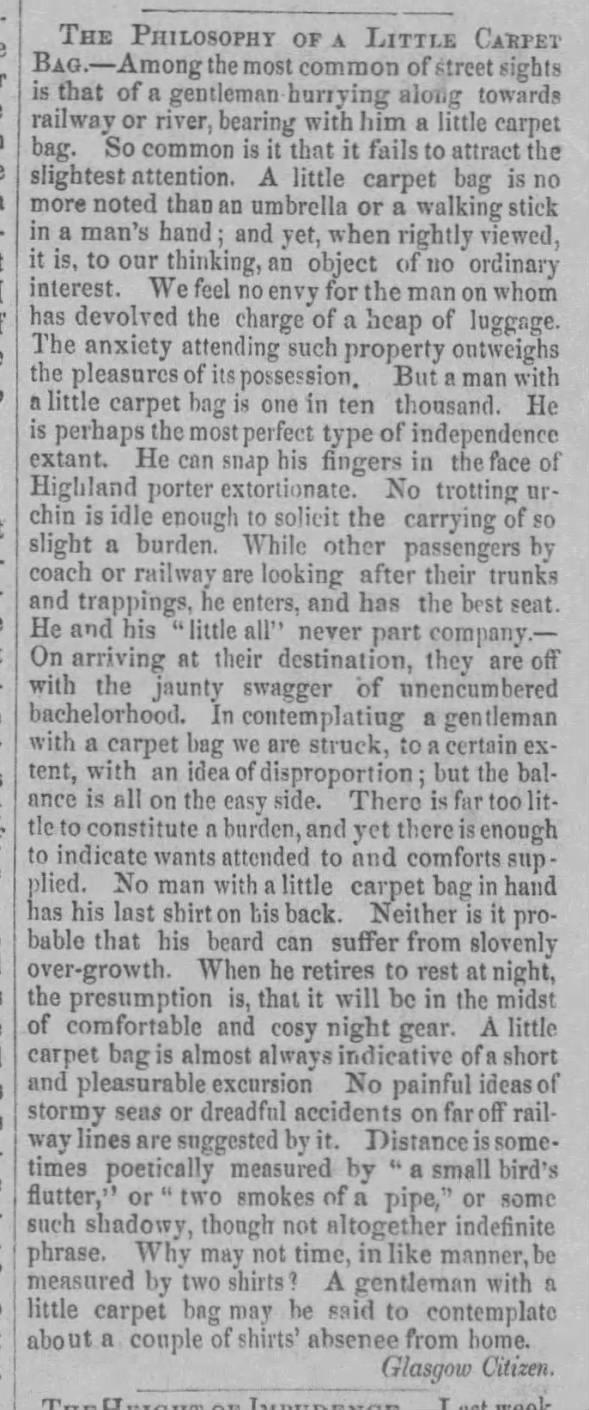 03 Apr 1851, Thu The Brattleboro' Eagle (Brattleboro, Vermont) Newspapers.com
"The Philosophy of a Little Carpet-Bag" is transcribed below from Chambers's Edinburgh Journal Volume 6 (July-December 1846); conveniently accessible online courtesy of HathiTrust Digital Library.
THE PHILOSOPHY OF A LITTLE CARPET-BAG.
Among the most common of street sights, is that of a gentleman hurrying along towards railway or river, bearing with him a little carpet-bag. So common it is, that it fails to attract the slightest attention. A little carpet-bag is no more noted than an umbrella or walking-stick in a man's hand; and yet, when rightly viewed, it is, to our thinking, an object of no ordinary interest. We feel no envy for the man on whom has devolved the charge of a heap of luggage. The anxiety attending such property outweighs the pleasure of its possession. But a man with a little carpet-bag is one in ten thousand. He is perhaps the most perfect type of independence extant. He can snap his fingers in the face of Highland porter extortionate. No trotting urchin is idle enough to solicit the carrying of so slight a burden. While other passengers, by coach or railway, are looking after their trunks and trappings, he enters, and has the best seat. He and his 'little all' never part company. On arriving at their destination, they are off with the jaunty swagger of unencumbered bachelorhood! In contemplating a gentleman with a carpet-bag, we are struck, to a certain extent, with an idea of disproportion; but the balance is all on the easy side. There is far too little to constitute a burden, and yet there is enough to indicate wants attended to, and comforts supplied. No man with a little carpet-bag in hand has his last shirt on his back. Neither is it probable that his beard can suffer from slovenly overgrowth. When he retires to rest at night, the presumption is, that it will be in the midst of comfortable and cozy night-gear. A little carpet-bag is almost always indicative of a short and pleasurable excursion. No painful ideas of stormy seas or dreadful accidents on far-off railway lines are suggested by it. Distance is sometimes poetically measured by 'a small bird's flutter,' or 'two smokes of a pipe,' or some such shadowy, though not altogether indefinite phrase. Why may not time, in like manner, be measured by two shirts? A gentleman with a little carpet-bag may be said to contemplate about a couple of shirts' absence from home. -- Glasgow Citizen.
-- Chambers's Edinburgh Journal for Saturday July 18, 1846.
The recycling of Carpet-Bag Philosophy in 1851 by American periodicals including the New York Literary World might explain why Melville had carpet-bags on his mind in that April 1851 letter to Hawthorne--and Moby-Dick, too. Melville did not finish writing his sixth book until summertime; the first American edition of Moby-Dick was available for sale in Albany bookstores by November 12, 1851.
Chapter 2: The Carpet-Bag starts with the news of Ishmael's comically light packing for a whaling voyage of 3-4 years:

"I stuffed a shirt or two into my old carpet-bag, tucked it under my arm, and started for Cape Horn and the Pacific."
Coincidentally or deliberately, the title and contents humorously recall "The Philosophy of a Little Carpet-Bag," reprinted in The Literary World back on February 22, 1851. Making a virtue of necessity, Ishmael faithfully adhered to the Scottish Carpet-Bag Philosophy, acting as if he expected "a short and pleasurable excursion" with "no painful ideas of stormy seas or dreadful accidents."
Obviously, our antebellum carpet-bag and easy-going philosophy thereof are not for low-minded Carpet-baggers. Reader, would you like a bag for your carpet-bag? Here you go...
https://hdl.handle.net/2027/umn.31951000734920k?urlappend=%3Bseq=13%3Bownerid=13510798902438398-19
Turns out
for the week ending March 29, 1851.

"a set of random quotations from various parts of the poem intermingled with pious, humbugging commonplaces."
-- Hershel Parker on Melville & The Berkshires: Emotion-Laden Terrain, "Reckless Sky-Assaulting Mood," and Encroaching Wordsworthianism in American Literature: The New England Heritage, ed. James Nagel and Richard Astro (Garland, 1981) pages 65-80 at page 68.
Considering Evert Duyckinck's editorial work on Melville's great Hawthorne essay, and the intensity of their summertime socializing in Berkshire, it would not be too surprising to find some trace of Melville's influence in the review of Wordsworth's The Prelude that appeared in The Literary World on the last day of August 1850.
 |
| Anonymous review of The Prelude, page 167 Literary World - August 31, 1850 |
 |
| Anonymous review of The Prelude, page 168 Literary World - August 31, 1850 |
Henry Reed's "Second Paper" on Wordsworth appeared in the Literary World on September 14, 1850. "Second Paper" does mean there was a "First Paper" on Wordsworth, but the anonymous review of The Prelude on August 31, 1850 was not it. On June 8, 1850 the Literary World announced the first one this way:
A paper on Wordsworth from Prof. Henry Reed, communicating passages from the Poet's Correspondence, in our next.
As promised, Reed's first paper on Wordsworth appeared in the next issue of the Literary World on June 15, 1850. Both papers were submitted from Philadelphia and subscribed, HENRY REED.
https://hdl.handle.net/2027/njp.32101064475088?urlappend=%3Bseq=173
Passages in Advance / from Wordsworth's New Poem "The Prelude" were printed from the forthcoming Appleton's edition in The Literary World for August 10, 1850. These passages were selected and sent from Pittsfield by Evert A. Duyckinck when he was much with Melville, as revealed in Duyckinck's letter to Margaret Panton Duyckinck dated August 4, 1850:
My dear wife:
I dropped you a line yesterday in a parcel to the office which Melville says I must have been tempted to make up by the Yankee atmosphere. I have the proof sheet of Appleton's edition of Wordsworth's posthumous poem "The Prelude" with me to read & use at leisure in the paper. [Cornelius] Mathews told me that [Rufus W.] Griswold was about to publish a whole book of it in his next week's magazine, so I concluded that my next week's paper should have its share & made up a parcel by mail with the necessary directions at once. So you see that the Literary World can be edited at a distance of 160 miles--so that need be no obstacle to our settling here if you choose.... --as transcribed in Steven Olsen-Smith, Melville in His Own Time (University of Iowa Press, 2015) page 34.
The issue of the New York Literary World with "Passages in Advance" mailed from Pittsfield also contains a review of Aesop's Fables that Herman Melville might have written.
- Part 1: Literary World August 17, 1850
https://hdl.handle.net/2027/njp.32101064475088?urlappend=%3Bseq=135
- Part 2: Literary World August 24, 1850
https://hdl.handle.net/2027/njp.32101064475088?urlappend=%3Bseq=151

 |
The Pillars of Hercules. By David Urquhart, M. P. Harper & Bros.
We shall not wonder at the learning of this book, if we reflect upon the antiquity of the author's family, which is clearly traced by his ancestor, Sir Thomas Urquhart, it is said, all the way down quite from its founder Adam. Antiquarian lore must have come to such a man as an inheritance; and the Hebrew and other roots been the daily fare of his childhood. The family, by all accounts, appear to have suffered little from the accidents of time, so unfortunate to the Cæsars and Plantagenets of modern days, and to have happily weathered the deluge without material damage. Escaping the difficulty which occurred at Babel, and luckily declining to join the party of ten tribes that left Judea with Shalmanezer on a visit to Assyria, and never have been heard of since, they continued safe through all the perils of the siege of Jerusalem, as they had formerly done in that of Troy. It is surprising that they should not have been crushed, as so many other ancient houses were, in the terrible Fall of the Roman Empire, or distracted by the uproar of the French Revolution; but the book before us is good evidence that they sustained no material hurt from either, but continue in existence still, as vigorous as ever.
The travels commemorated in the "Pillars of Hercules" will be discovered, on perusal, to differ considerably from ordinary ones. The unities of time and space are as severely preserved in them as in an ancient tragedy or epic. After musing upon its pages for many an hour, the reader is surprised, on coming to himself, to notice that so little ground has been gone over, and so few days spent. The truth is, that when he gets to the end of the volumes, he has been hardly anywhere after all, save to a dozen places or so, skirting the north and south shores of the Mediterranean Sea. How, then, is the reader cheated into thinking himself a traveller, when he has actually made little more advance in space during the whole time, than an Erie locomotive would carry him in four-and-twenty hours? In this way. He is introduced within a Louvre of reliquiæ, which have floated upon the stream of time, principally, the author thinks, from Phenicia or thereabouts, down to the parts of Spain and Morocco washed by the great Inland Sea. Their antiquities of dress, arts, names, and customs, he seizes and discourses on, as a professor does on specimens of minerals, both dug up alike from the overlying debris of ages.
There is an amusing play of the imagination among etymologists and antiquarian travellers, in running up the genealogies of speech and customs to their tiny sources among the shadows of the dim and distant past. Our traveller is, perhaps, not entirely exempt from a slight degree of quixotism, any more than the many others who have bestridden their Rosinantes before him. But though enthusiasts, deep-grounded in ethnology, are very serious themselves in their laborious excavations of long-interred knowledge, they nevertheless exhibit a smack of humor to lookers-on like us. Does not genuine wit, for instance, flow from the ingenious lucubrations of Horne Tooke, or the learned Noah Webster, when, with a flash of light, they reveal the dark relationship of obscure, forgotten etymologies, and tickle us by sudden shifts of phrase with unexpected surprises, which everybody knows to be the soul of wit?
To inquisitive people, of our traveller's turn of mind, the present is of little or no other consequence than as it reminds them of something that has existed a long while ago. Should an individual of this description happen to be an American, he does not make himself uncomfortable at home, till he has gone abroad, actually crossed the Atlantic, seen an English dwelling-house, and eaten a French roll. Not he. It would not be the object of such a person to witness the improvements of modern ingenuity, but to get as near as possible to the imperfect originals from which they sprang. Accordingly he stops not for anything by the way, but presses on his journey till he has attained the summit of his wishes, by sleeping in an Arab tent upon the desert, eating there his kus-couss-oo, and putting on the haik of Barbary. In these he recognises the primitive clothes, bread, and shelter--the three prime essentials of existence--in the unadulterated condition in which Abraham himself enjoyed them; and has the satisfaction at the same time of having turned his back upon the labors of more than a hundred generations that have succeeded.
The honorable member has learnt in Parliament, or elsewhere, to speak his mind quite frankly on all matters he encounters, from gunpowder and Gibraltar to a lady's fan and foot. At one time he compliments the Mediterranean Sea, as follows:--
"This is a spot which has influenced the destinies and formed the character, not of one but of many people.... The doubtful inquirer came hither to see if the sky met and rested upon the earth; if Atlas did indeed bear a starry burden; to discover what the world was; whether an interminable plain, or a ball launched in space, or floated on the water; whether the ocean was a portion of it, or supported it; whether beyond the 'Pillars' was the origin of present things, or the receptacle of departed ones; whether the road lay to Chaos, or to Hades.
"And something, too of these feelings crept over me, even although I came hither merely to ruminate on the past deeds of men.... The Mediterranean has made the world such as it is. Ancient history has been balanced on its bosom; and without the passage connecting it with the ocean, none of the events of recent history could have happened.
* * * *
"Let us suppose that the gap" (the gut of Gibraltar) "had been just wide enough to supply the water lost by evaporation, for which the thousandth part of the present passage would suffice, the Mediterranean would have been a salt-pan." [Pillars of Hercules volume 1 pages 8-9]
He afterwards speaks of this respectable piece of water in terms not so courteous--indeed, not a little blunt:--
"The Mediterranean," says he, "is like a bag with two necks, filling at both ends. The current through the Dardanelles presents exciting varieties, but no perplexing mysteries.... At Gibraltar all is disorder--the stream incessant--the level on both sides the same. The tide rises and falls, yet the current always runs out of the ocean, and into the Mediterranean..... What becomes of all this water? It cannot go to the Black Sea, from which the Mediterranean receives water; it cannot escape by a subterranean passage into the Red Sea, for the level of the Red Sea is higher by thirty feet. Then there is an under current discharging the water back again into the ocean."
But how is the extraordinary phenomenon of two opposing currents to be accounted for? Says Mr. Urquhart: "the solution is, an under current, produced by a difference of specific gravity between the water of the Mediterranean and the ocean. Sitting on Partridge Island (a small rock within the Straits), the question occurred to me, What became of the salt? If the water evaporates, the salt remains. Here then is the sluice of a mighty salt-pan--where is the produce?" As it is not deposited, his conclusion is, that by increasing the density of the surface and settling, a counter-current is produced, which returns to the ocean.
Though the rock of Gibraltar, by a rough calculation he has made, has cost his country upwards of 250 millions of dollars, he does not deem it after all a very valuable stone in the British diadem. On the contrary, "if any one were to do us the favor of taking it off our hands, we should save 150 millions more, for the interest of that sum is absorbed by its yearly outlay."
At times, there is something exceedingly refreshing in the positive tone of Mr. Urquhart upon controversial points, whether trivial or important. It steadies one's nerves very much to see a trembling balance of dubiety settled one way or the other with decision. This grace our traveller has in a conspicuous degree, and exhibits it on all questions, no matter whether they relate to the Stone of Hercules, or the discovery of soap. Assuming him to be a mere civilian, he certainly pronounces with admirable assurance upon the military capabilities of the works of Gibraltar, and their value to the British crown. He is convinced that, if not exchanged for Cuba, they ought unquestionably to be given up, being used at present only as an engine to irritate the Dons, for plundering the treasury, and encouraging and protecting a smuggling traffic into Spain. Everybody except a few English, that he has spoken to, he represents as being of the same opinion. If that celebrated rock reflects glory upon any people, it is upon the Moor, who made it what it is, and not on those who have obtained it by fraud or force.
In a short excursion in the vicinity of the Rock, the writer falls in with foul weather, and has a taste of the perilous want of harbors on the coast:--
"During three months I had seen nothing but clear skies and smooth seas. I could now feelingly revert to the words of a Spaniard, who, when Philip V. asked which were the principal harbors of Spain, answered-- 'June, July, and Cadiz.'"
Of Mr. Borrow, whose "Bible in Spain" was once much read in this country, the Spanish people are represented to entertain no favorable reminiscences:--
They imagined him to be a gipsy, he says, by his talking their language. I consequently, inquired about him as the English Gipsy. They did not comprehend me; but recollected a tall man, who was always writing; holding up their hands, they exclaimed, 'we thought he was writing some learned things, and not lies about poor people like us.'” .... "It is the misfortune of Spain to be misrepresented. She has been the subject of two standard and classical works—Don Quixote and Gil Blas. The former, by its sterling worth has made its way into the literature of other countries. Being a satire upon a particular temper and habit of mind, the scene and personages of which are Spanish, it is accepted as a description of Spain. As well might England be studied in 'Dr. Syntax.' Those peculiarities which it is intended to ridicule, and those extravagancies which are exaggerated in order that they may be exposed, are, to the stranger, the instructive portion of the work.
“Gil Blas is a romance by a Paris bookmaker, and owes its celebrity to an admirable sketch of a great minister, another of his successor, and an episode portraying Spanish manners. The barber Olivarez, the Count-Duke, and the story of the adventurer himself, in his retirement, are all taken from the Spanish, and give to the work its value. It is then dressed up with Spanish peculiarities, and Madrid or Paris morals, and passes from hand to hand as a mirror of the Spanish mind."
[Pillars of Hercules volume 1 pages 72-3.]
Mr. Urquhart visits a certain club.
"I was invited," says he, "in the evening to what I was told was a club. The place was an apothecary's shop. I was introduced into a sort of vault, and I found myself in a gambling establishment." This was at Tarifa in Spain. "Their cards were like those used by the Greeks; the club being represented not by the French trefoil, but by a club; the spade by a sword; the heart by a cup; and the diamond by a gold coin. The names being Bastones, Espados, Copas, Oros. The conversation having turned upon cards, I mentioned its supposed astronomical origin; the four seasons represented by the four suits; the fifty-two weeks by the number of the cards, and the thirteen lunar months by the thirteen tricks, proving whist to be the original game. I was here stopped. They had only twelve tricks and forty-eight cards; and 'of course,' said a Spanish Major (a Mr. Kennedy), 'our game is more scientific, because adapted to the Julian Calendar ! ”
So frail is the fabric of antiquarian theories. The grave politicians of this club
"could not recover from their astonishment at perceiving that there existed a human being who could question the wisdom, far less the sanity, of their imitating England and France.... 'England and France,' said they, 'are great and powerful; must we not imitate them and become so too?' I submitted, that imitation is more difficult than invention; that it requires a perfect knowledge of the thing imitated, in which case there could be no reason to copy; besides, it was impossible to copy institutions. 'In what particular,' I asked, 'would you copy us? Two things only have we to offer you as sanctioned by English consent—the Guelph Family, and Johnson's Dictionary! Will you have them in lieu of the Bourbons and the Castilian?'" [Pillars of Hercules volume 1 pages 76-7.]This view of imitation appears to us original.
"At Porta St. Maria, opposite Cadiz, I found a similar Moorish ruin. This is the point of embarkation of Xeres, or the Port of Sherry. It is the place for tasting wines; the Pacharete, Montillado, and most noble Mansanilla. The cellars are worth seeing; if spacious and lofty edifices can be so called.
"The people of Cadiz neither put their bodies in graves, nor their wines in cellars; the dead are built up in walls, resembling bins of a wine cellar; their wines are deposited in structures like cathedrals. The niches are like the dwellings of the living, some for ever and a day, others for a term of years; after which the fragments of the former tenant are ejected, and the place swept clean for another.
"I observed, on a placard, the two following signs of progress and civilization, in titles of new works— 'The Defender of the Fair Sex,' and 'The Ass, a beastly periodical.' The words were, “Il Burro, periodico bestial.'
"You may see a long row of boys, very small at one end and full grown at the other, dressed out in the sprucest and gayest uniforms—blue coat, single breasted, with standing collar and large flaps ; gold buttons and lace, white trousers mathematically cut, and strapped down on very camp-like boots; and, on inquiring what military institution this belongs to, you are answered, 'It is a boarding-school !'
"They have, in connection with schools, a practice which might suit 'Modern Athens.' I mean the hyperborean one. A person from each school goes the round of the town, calling for the boys in the morning, and dropping them in the evening; just as sheep, goats, or cows are collected by a common herd."
[Pillars of Hercules volume 1 page 131.]
The declension of Spain has been truly marvellous.
"Within a few months from the battle of Guadalete in Spain (which was decided in favor of the Mussulmans against the Christians), the Moorish troops had passed beyond the Pyrenees, and were encamped at Carcassone. There the tide of victory was arrested, not by the hammer of Martel, but by orders from Damascus. The empire established by this victory is the most remarkable instance of prosperity that the world has ever seen. The town of Corduba contained 200,000 houses; in its public library there were 600,000 volumes. It had 900 public baths. On the banks of the Guadalquivir there were 12,000 villages; and such were the fruits they drew from the soil, such the profits of their industry, which furnished to the East luxuries and arms, that the public revenue of Spain in the tenth century was equal to the collective revenues of all the other kings of Europe—twelve millions of dinars—a sum of gold which, calculating the dinar at 10 shillings, and multiplying by ten, to give the difference of the value of gold, is equal to sixty millions of pounds sterling of our present money!" [Pillars of Hercules vol 1 page 141.]
His learning in ladies' dresses is as conspicuous as in politics, antiquities, or war. What he says of the Montilla de Jiro and de Blonda, ought to be extracted, but there is no possibility of doing it on this occasion, without neglecting one or two other matters, which cannot be omitted. He must, however, be allowed to remark, that
"the mantilla is not spoken of as a piece of dress, that fits well or ill. Such a lady, they say, wears her mantilla well, just as if they were speaking of a ship carrying colors. The port of a Spanish lady is, indeed, like the bearing of a ship. The mantillas, reversing the effect of our costume—which is to impress the wearer with the feelings of a block — gives at once freedom and dexterity. The mantilla, fan, castanet, guitar, and dance—which last is not here the business of the legs only—keep the arms always busy. The head is disencumbered of bonnet, cap, ribands, and curls; hence that grace of the Spanish women, which all recognise and none can describe, for mere form or feature does not explain it.
"I need not say, that beneath a mantilla there are no curls; nor need I add, that where neither bonnets nor caps are worn, and the head is always exposed, the hair is well kept. A Spanish lady remarked to me, that what struck her principally when she travelled in other countries, was the want of cleanliness in the women's hair. It is (the Spanish lady's) always exposed, as hair was intended to be, to the air and wind, and it is every day in water, for they wet it before using the comb....
"A Spanish woman is no less attentive to her foot and shoe than to her hair; from below the saga comes forth the plump leg in its creaseless stocking.... The old Spanish shoe is very low, and scarcely held at all at the heel; like the slipper of the Easterns it requires the action of the toes to hold it on. The calf of the leg accordingly was full, because its muscles were called into play. So important is this to the grace and ease of the figure, that at Rome the models, male and female, lose their pension, if they wear a shoe with a thick sole. There still wants something to complete the Spanish costume, or, perhaps, I might say the Spanish woman—and that is THE FAN. Yet, how supply the want? at least, without herself—how convey her and it on paper? You might as well attempt to teach on paper how to roll a turban, make coffee, or hit the bull's-eye."
[Pillars of Hercules volume 1 page 148-154.]
The author's ardent attachment to Phœnicia and the Arabs, robs modern nations of the credit of many of the most splendid inventions, and readjusts the claims of some of the ancients to honors they have hitherto enjoyed, but are now in danger of forfeiting. The invention of glass is thus taken from the Tyrians or Egyptians, purely on the authority of Layard. The magnet, or stone of Hercules, the magnetic needle, and the compass, are, according to him, Arabian or Phœnician donations to mankind, driving the Celestials from the honor by a formidable attack from the heavy artillery of authors, arguments, and conjectures; scarcely conceding to them, and then not without great reluctance, the credit even of gunpowder itself. Dr. Franklin likewise will for aught we know, have to whistle for any reputation he will get hereafter for drawing lightning down from heaven, as Mr. Urquhart, we observe, has raised the ghosts of Salmoneus, Servius, and Sylvius Alladus, to call his claim in question. But the American philosopher, having, as is well known, given a large price for a whistle in his early days, will probably not lose his long worn honors, if whistling can prevent it. Besides all this, our traveller hints pretty strongly, that Americans should look upon the Phœnicians as the ancient discoverers of their country.
Much remains to be said even about the first volume of these interesting and learned travels, composed of a mosaic, where natural philosophy and imagination, archaeology, the arts, military and descriptive, ethnology, history, and political science, have each contributed a characteristic stone. But we cannot follow up the subject now. One thing we ought to notice--the argument or subject printed at the tops of all the pages. This, we believe, is by no means usual, but a very great convenience.
-- Literary World Volume 7 July 6, 1850 pages 5-7.
https://books.google.com/books?id=VTsZAAAAYAAJ&pg=PA5&dq#v=onepage&q&f=false
Related post:


