Showing posts with label Amasa Delano. Show all posts

Monday, March 6, 2023

"King of the Oaks" in REDBURN and Amasa Delano's NARRATIVE

The borrowed description of teak wood as "the King of the Oaks" in Chapter 34 of Herman Melville's  Redburn indicates that by summer 1849 at the latest, Melville already owned or had access to a copy of the Narrative of Voyages and Travels by Amasa Delano. Melville got the purportedly oriental phrase "king of the oaks" from Delano's description of Bombay in chapter 12. Six years later, Melville would remake chapter 18 of Delano's Narrative into the 1855 thriller, Benito Cereno.

Arrived in Liverpool, Melville's narrator Wellingborough Redburn visits a large merchant ship from Bombay named the Irrawaddy.

AMONG the various ships lying in Prince's Dock, none interested me more than the Irrawaddy, of Bombay, a "country ship," which is the name bestowed by Europeans upon the large native vessels of India. Forty years ago, these merchantmen were nearly the largest in the world ; and they still exceed the generality. They are built of the celebrated teak wood, the oak of the East, or in Eastern phrase, "the King of the Oaks." -- Redburn Chapter 34 - The Irrawaddy

For the factual substance of the Irrawaddy chapter, Melville creatively plagiarized from the Penny Cyclopaedia entry for Tectona, as Willard Thorp first discovered. 

Thorp's findings are summarized by Hershel Parker in the Historical Note for the 1969 Northwestern-Newberry edition of  Redburn. Mary K. Bercaw documents additional borrowings from the Penny Cyclopaedia in Redburn and other novels in "The Infusion of Useful Knowledge: Melville and The Penny Cyclopaedia," Melville Society Extracts 70 (September 1987) pages 9-13. 

TECTONA in the Penny Cyclopaedia supplied Melville's phrase "oak of the East"

https://books.google.com/books?id=GxwDAAAAYAAJ&pg=RA3-PA141&dq#v=onepage&q&f=false

but besides the narrator of Redburn, only Amasa Delano calls teak wood "the king of the oaks."

Amasa Delano, Narrative of Voyages and Travels (Boston, 1817) page 213.
The people of Bombay have many large ships of their own. The largest merchant ships in the world are built there, and belong to the commercial capitalists of the town. The ship builders are all natives, and are pre-eminent in their profession. They build many ships of the teak wood, which they call the king of the oaks, and which they procure from Pegu. It is as large as our largest oaks, the timber very straight, free from knots, and excellent for planks. I have seen it grow fifty feet before a limb shoots from the trunk. Some of them are three feet in diameter. There is another kind of tree, which is called there sissor-wood, and which is the best in the world for the crooked timber required in ships. It is extremely hard and durable. -- Amasa Delano, Narrative of Voyages and Travels (Boston, 1817). 

https://books.google.com/books?id=34QqAQAAIAAJ&pg=PA213&dq#v=onepage&q&f=false

Like Delano, Melville's narrator emphasizes the size of merchant ships built in India:

"these merchantmen were nearly the largest in the world" - REDBURN

"... largest merchant ships in the world" - DELANO

Delano also names Pegu as the place for getting teak...

"I thought I was in Pegu, so strangely woody was the smell of the dark-colored timbers...." (REDBURN)

"... which they procure from Pegu." (DELANO)

But Redburn's sensory experience of the "woody" odor seems, like the name of the Bombay vessel, to have been inspired by the "forests" of teak "along the banks of the Irrawady, especially in Pegu" as described in the Penny Cyclopaedia entry TECTONA. Same goes for the expression "oak of the east," also found in TECTONA, the Penny Cyclopaedia entry first identified by Willard Thorp as Melville's source for the Irrawaddy chapter in Redburn. Not "King of the Oaks" though. Searches on Google Books and HathiTrust Digital Library yield only two works containing the phrase "the king of the oaks" before 1850: Delano's Narrative and Melville's Redburn. In old British newspapers, teak as "king of the oaks" appears only in excerpts from Redburn Chapter 34, sometimes (as in the London Guardian for November 2, 1850 and Liverpool Mercury on November 5, 1850) headed

A BOMBAY "COUNTRY SHIP."
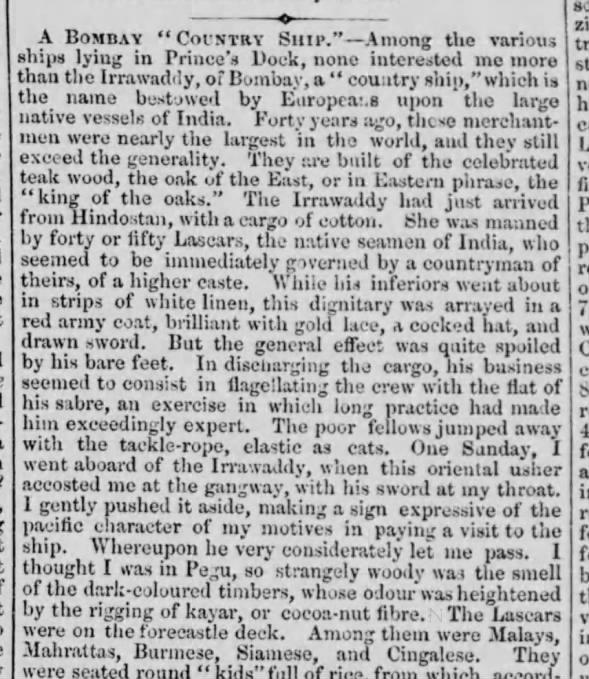

05 Nov 1850, Tue Liverpool Mercury, etc. (Liverpool, Merseyside, England) Newspapers.com

Delano's Narrative is Number 200 in Mary K. Bercaw's 1987 checklist of Melville's Sources. In previous Melville scholarship, possible literary debts to Delano outside of Benito Cereno have been identified in White-Jacket (1850) and The Encantadas (1854). And, more questionably, in Typee (1846). Hershel Parker speculates in the second volume of Herman Melville: A Biography (Johns Hopkins University Press, 2002) that Melville might have encountered Captain Amasa Delano's Narrative by 1847, in time for use in Mardi (1849). Listed as "Delano's Voyages and Travels" in the 1828 Catalogue of Books in the Albany Library, page 23

 and so indexed in the 1838 and 1850 Catalogue of the New York Society Library.

With further study, more traces of Melville's reading in Delano's Narrative may turn up in Redburn and elsewhere in Melville's published writings.

Ship Pascoa under sail, 1st August 1832, China Sea
Chinese School, 19th Century, Public domain, via Wikimedia Commons

 Further reading

Related post

Monday, January 28, 2019

Pretty truly


In Benito Cereno (1855) Melville introduced the words "pretty" and "truly" when transforming the narrative prose of his source into dialogue. Where Amasa Delano had called assault with a knife "rather serious sport" (not the child's play represented by Benito Cereno), Melville made his Delano say, "Pretty serious sport, truly."

DELANO

Amasa Delano, Narrative of Voyages and Travels (Boston, 1817)
"I told him it appeared to me to be rather serious sport, as the wound had caused the boy to lose about a quart of blood."
MELVILLE

Benito Cereno in Putnam's Monthly - October 1855
"Pretty serious sport, truly," rejoined Captain Delano.
 Look at what Melville keeps, and what else he adds in the rewrite:

DELANO:
I saw this and inquired what it meant.
MELVILLE:
In amazement, Captain Delano inquired what this meant.
DELANO:
The captain replied,
MELVILLE:
... the pale Benito dully muttered,
 DELANO:
 that it was merely the sport of the boys
 MELVILLE:
that it was merely the sport of the lad
Added by Melville to his source, just in this short bit: Delano's "amazement"; calling the Spanish captain by his first name, "Benito"; Benito's "pale" appearance and defeated manner of speaking when he "dully muttered" his reply; and the substitution of "lad" where Delano reported "boys."

So what? is the next question. In answering or say pre-answering, I don't automatically have to knock the work of Amasa Delano. Even the best old-school source studies have on occasion devalued source texts for no good reason, beyond perhaps a perceived need to absolve Melville from the sin of plagiarism. Writing on Melville the Poet, page 130 in The New Cambridge Companion to Herman Melville, edited by Robert S. Levine (Cambridge UP, 2014), Elizabeth Renker urges "a new approach" which at its best might helpfully check groundless discounting.

For a humble start, let's try this. So what? So the changes Melville made here in this small portion of his rewrite of Amasa Delano reveal, on closer scrutiny, not only certain mechanics of his plagiarism creative borrowing, but also certain creative aims. Melville's changes achieve interesting and possibly, arguably, characteristic results. Some notable effects of Melville's retouching here are
  • Dramatizing with dialogue.
  • Personalizing through names, thereby inviting more empathy.
  • Particularizing with descriptive details. Most obviously, added details help develop character and plot. Some embellishments also work to humanize dubious, possibly devilish characters. (Here, Benito Cereno the captain of a slave ship as "pale" and pitiable sufferer.) Melville's singular "lad" replaces Delano's undifferentiated grouping. No longer just one of the "boys," Melville (or Melville's Benito) particularizes and familiarizes the assailant, now a "lad."
  • Ennobling. As in Israel Potter, a similar project of rewriting, descriptive additions can work to ennoble the person described. Here the suffering Benito, elsewhere Delano and Babo. The ennobling effect applies to others, too, not only major players. 
  • Self-authenticating, truly.
Old-school or new, source study is more fun than ever, now that we have Melville's writings and many of his sources Google-digitized and conveniently accessible via institutional research libraries and amazing places like these:
Even with splendid digital resources and Melville's writings swelling the PUBLIC DOMAIN, it's a great blessing for scholars to have a haven in print--meaning in this case the 1987 Northwestern-Newberry Edition of Melville's Piazza Tales and Other Prose Pieces, 1839-1860. Amasa Delano's Chapter 18 is there for ballast in the back, reproduced with handy marginal cross-references to the main text of "Benito Cereno."

Related posts:

Wednesday, January 16, 2019

Amasa Delano, news and views

Portrait of Amasa Delano
Public domain, via Wikimedia Commons

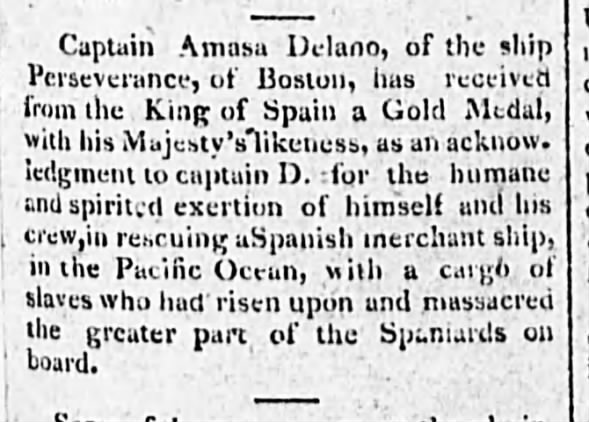
Wed, Sep 2, 1807 – Page 3 · Poughkeepsie Journal (Poughkeepsie, Dutchess, New York, United States of America) · Newspapers.com
Captain Amasa Delano, of the ship Perseverance, of Boston, has received from the King of Spain a Gold Medal, with his Majesty's likeness, as an acknowledgment to captain D. for the humane and spirited exertion of himself and his crew, in rescuing a Spanish merchant ship, in the Pacific Ocean, with a cargo of slaves who had risen upon and massacred the greater part of the Spaniards on board.  --Poughkeepsie Journal, September 2, 1807.
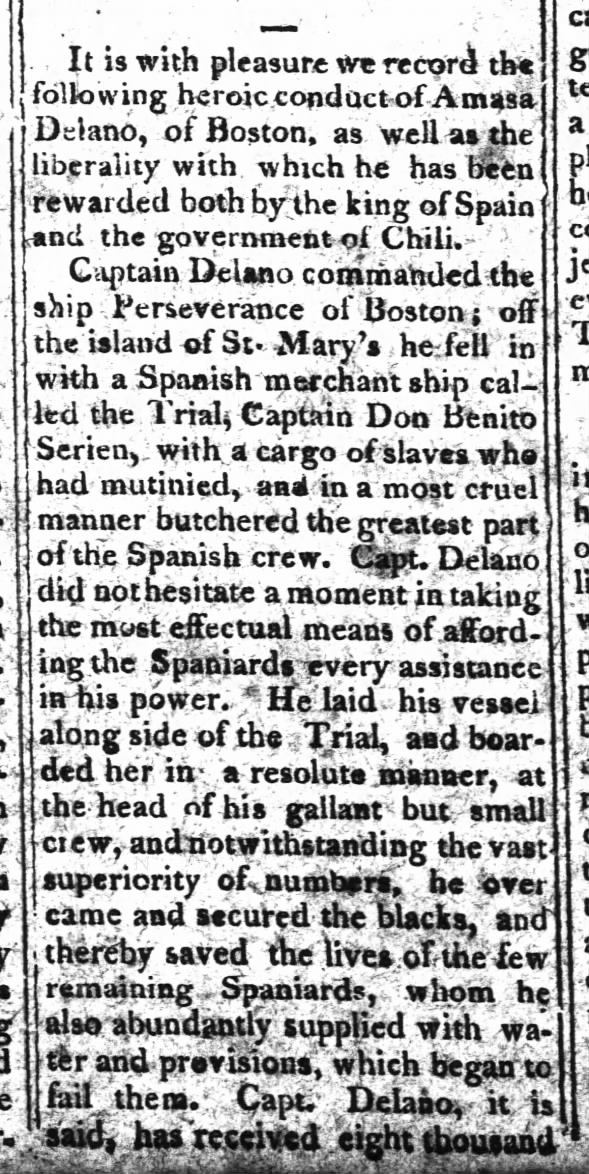
Mon, May 19, 1806 – Page 3 · Weekly Raleigh Register (Raleigh, Wake, North Carolina) · Newspapers.com

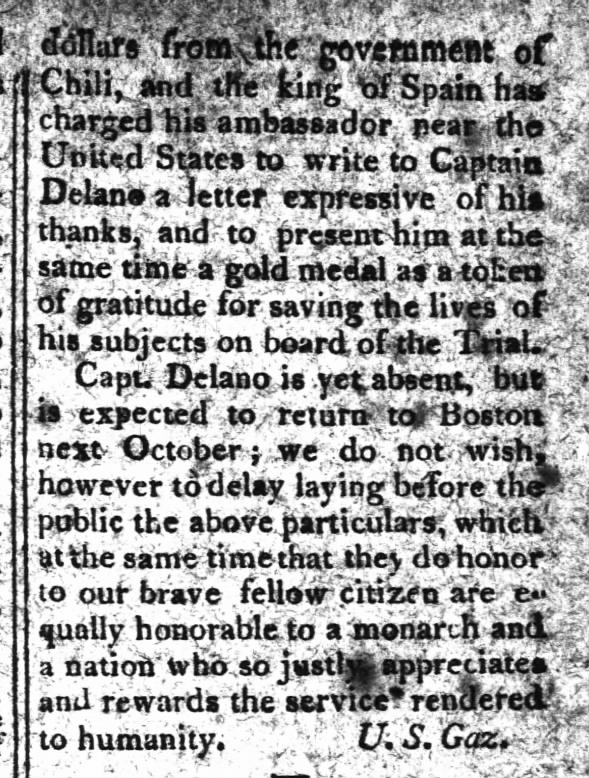
Mon, May 19, 1806 – Page 3 · Weekly Raleigh Register (Raleigh, Wake, North Carolina) · Newspapers.com
From The United States Gazette, reprinted in the Baltimore, Maryland Telegraphe and Daily Advertiser, April 24, 1806; and the Weekly Raleigh Register, May 19, 1806.
It is with pleasure we record the following heroic conduct of Amasa Delano, of Boston, as well as the liberality with which he has been rewarded by the king of Spain and the government of Chili. 
Captain Delano commanded the ship Perseverance of Boston; off the island of St. Mary's he fell in with a Spanish merchant ship called the Trial, Captain Don Benito Serien, with a cargo of slaves who had mutinied, and in a most cruel manner butchered the greatest part of the Spanish crew. Capt. Delano did not hesitate a moment in taking the most effectual means of affording the Spaniards every assistance in his power. He laid his vessel along side of the Trial, and boarded her in a resolute manner, at the head of his gallant but small crew, and notwithstanding the vast superiority of numbers, he over came and secured the blacks, and thereby saved the lives of the few remaining Spaniards, whom he also abundantly supplied with water and provisions which began to fail them. Capt. Delano, it is said, has received eight thousand dollars from the government of Chill, and the king of Spain has charged his ambassador near the United States to write to Captain Delano a letter expressive of his thanks, and to present him at the same time a gold medal as a token of gratitude for saving the lives of his subjects on board of the Trial. 
Capt. Delano is yet absent, but is expected to return to Boston next October; we do not wish, however to delay laying before the public the above particulars, which at the same time that they do honor to our brave fellow citizen are equally honorable to a monarch and a nation who so justly appreciates and rewards the service rendered to humanity.
U. S. Gaz.  
The glorifying of Delano in the United States Gazette was protested by a correspondent of Poulson's American Daily Advertiser; transcribed below from the Baltimore Telegraphe and Daily Advertiser of April 28, 1806:
From the American Daily Advertiser.
MR. POULSON, 
A correspondent has observed, with surprise, your re-publication (from the Gazette of the United States) of an instance of American bravery, which is trumpeted forth as an act of "humanity," deserving of the "tribute of public gratitude."— What is the story? Stripped of those fascinating epithets, which contribute so much to blind even the eyes of the wise, with the dazzling lustre of heroic prowess. The poor Negroes, otherwise called "a Cargo of Slaves" (mark, no lustre here) on board of a Spanish Merchantman" (mark, again, no infamy here) had risen upon their Oppressors—what do I say—their Murderers: but the strife was yet undecided when a captain Delano, of the ship Perseverance, of Boston, falls in with them — boards the vessel — and reinsates the Spaniards in possession of their cargo of Human Live Stock. For this "gallant" action it is not sufficient that "the Government of Chili" have presented "our brave Fellow-citizen," with 8000 dollars; and that "the King of Spain" has directed his ambassador to honor him with "a gold medal," &c. &c. but the good people of the United States are called upon to join in the "tribute of gratitude" so justly due for this "service rendered to humanity." — 
For shame — let slave merchants reward their protectors and tyrants honor the bravery that is prostituted in their cause — but let free-born Americans reprobate the Quixotic valour that saved a handful of White Russians, at the expence of two or three hundred Victims of their insatiable avarice, whose only crime was that of rising upon their Oppressors, to regain that freedom with which God and Nature had endowed them. 
Delano's 1817 Narrative of Voyages and Travels included a chapter on "the Capture of the Spanish Ship Tryal, at the island of St. Maria; with the Documents relating to that affair."


Amasa Delano, A Narrative of Voyages and Travels via Google Books:
  • https://books.google.com/books?id=NxVMAAAAYAAJ&pg=PA316&dq#v=onepage&q&f=false
A narrative of Voyages and Travels courtesy of  HathiTrust Digital Library
  • https://hdl.handle.net/2027/hvd.hw3a6x?urlappend=%3Bseq=332
As documented in the Northwestern-Newberry Edition of The Piazza Tales and Other Prose Pieces, 1839-1860, Delano's Narrative is Melville's main source for Benito Cereno, originally published in Putnam's magazine and reprinted in The Piazza Tales.

Melville's Benito Cereno in Putnam's Monthly Magazine volume 6 (October-November-December 1855) courtesy of HathiTrust Digital Library:
  • https://hdl.handle.net/2027/hvd.32044092794429?urlappend=%3Bseq=360
  • https://hdl.handle.net/2027/hvd.32044092794429?urlappend=%3Bseq=466
  • https://hdl.handle.net/2027/hvd.32044092794429?urlappend=%3Bseq=608
Benito Cereno in Putnam's magazine via Google Books:

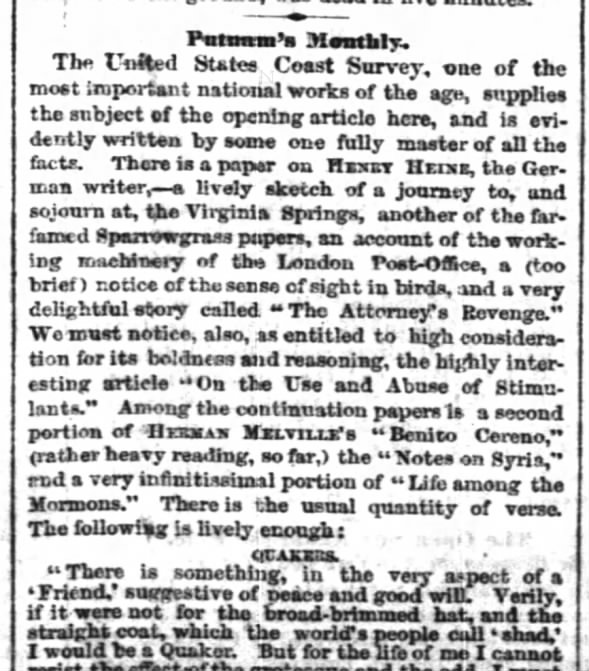
Tue, Oct 30, 1855 – Page 1 · The New York Times (New York, New York, New York, United States of America) · Newspapers.com
"Putnam's Monthly.... Among the continuation papers is a second portion of HERMAN MELVILLE'S "Benito Cereno," (rather heavy reading, so far,)…." --New York Daily Times, October 30, 1855.
Benito Cereno in The Piazza Tales (New York: Dix & Edwards, 1856) via Google Books:
https://books.google.com/books?id=4KYOAAAAIAAJ&pg=PA109&dq#v=onepage&q&f=false

The Piazza Tales courtesy of HathiTrust Digital Library:
  • https://hdl.handle.net/2027/uc2.ark:/13960/t5n873g00?urlappend=%3Bseq=116
<

E-texts
  • https://ebooks.adelaide.edu.au/m/melville/herman/benito-cereno/
  • https://www.gutenberg.org/files/15859/15859-h/15859-h.htm
Benito Cereno on Manifold Scholarship at CUNY
  • https://cuny.manifoldapp.org/projects/benito-cereno