Showing posts with label Mardi. Show all posts

Monday, April 20, 2026

Polysensuum in MARDI and the PENNY CYCLOPAEDIA


Sunday, April 19, 2026

Remaking OREGON, HO! in prose and dialogue

Remaking "Oregon, Ho!" in prose and dialogue by Scott Norsworthy

DRAGOONED: Writing, talking, and rewriting like Herman Melville in "Scenes Beyond the Western Border" (1851-1853). Number 9.

Read on Substack


Wednesday, February 25, 2026

Tuesday, June 10, 2025

Leicester tea merchant and social reformer J. W. Barrs on Herman Melville

Leicester Mercury (Leicester, Leicestershire, England)
August 8, 1882
Published in the London National Reformer (November 8, 1891) over the pseudonym "SIRIUS" about six weeks after the death of Herman Melville in New York City, the long-forgotten memorial tribute transcribed herein was evidently written by Melville's English admirer and correspondent John William Barrs (c1852-1922), a Leicester tea merchant and radical secularist. 

Unique details in the pseudonymous National Reformer article titled "HERMAN MELVILLE" have precise matches in the lengthy fan-letter dated January 13, 1890 that Barrs wrote Melville, now in the Melville collection at Houghton Library, Harvard and available in the "Letters Received" section of the 1993 Northwestern-Newberry Edition of Melville's Correspondence, edited by Lynn Horth, on pages 759-762. In 1890 J. W. Barrs told Melville himself exactly what "Sirius" tells readers of the National Reformer, specifically about his having read Mardi to the blind poet Philip Bourke Marston, about the ignorance concerning Melville's literary works allegedly displayed by Marston's American friend Louise Chandler Moulton, about Barrs' particular fondness for the character of Babbalanja, and his deep appreciation of Walt Whitman. Courtesy of James Billson, Barrs had received a copy of Melville's poetry and prose collection John Marr and Other Sailors, which explains how "Sirius" could know so much of so rare a volume, privately printed for the author in 1888. 

Barrs, a good friend of the poet James Thomson (Bysshe Vanolis), had given Melville the posthumously published volume A Voice from the Nile: and other poems (London: Reeves and Turner, 1884); Sealts Number 522, now at Princeton, as indicated in the "Catalog of Books and Documents Owned, Borrowed and Consulted by Herman Melville" at Melville's Marginalia Online

J. W. Barrs, presentation inscription to Herman Melville in
A voice from the Nile : and other poems / by the late James Thomson ("B. V.")
Princeton University Library
From the London National Reformer of November 8, 1891; digitized and first made available on the great British Newspaper Archive in April 2025: 

HERMAN MELVILLE. 

AMERICA has just lost one of her most original writers and her finest stylist. It is with deep regret that we learn of the death of Herman Melville, the author of two perfect narratives of adventure, “Omoo” and "Typee”, of one of the most brilliant of allegorical novels, "Mardi”, and of the most powerful and imaginative novel of seafaring life, “Moby Dick, or the Whale”, ever written by one of an English-speaking race. And, to the eternal disgrace of United States literature, he has died practically forgotten; indeed, for the last twenty years he has, as a writer, been utterly neglected by his countrymen. Some eight years ago I remember reading through a great part of Melville’s "Mardi" to Phillip Bourke Marston, who had not previously known any of Melville’s books. He expressed unbounded delight in Melville’s imagination, his prose style, and his subtlety of thought, and promised to learn something of him from his (Marston’s) intimate friend Mrs. Louise Chandler Moulton, and to acquaint me with anything of interest concerning Melville he might learn from her. In a letter to me shortly after he said he had asked Mrs. Moulton for some information about Melville, but all she said was that she "had heard of him, and believed if he was not dead that he lived in, or somewhere near to, New York”. This evidence of a general neglect (for Mrs. Moulton must, from her literary reputation, be credited with knowing something of all writers in the States whose works were in vogue, even if but among the innermost circles of American literature) received a further confirmation but a few days ago when I met a particularly well-read Americaine, who had just arrived here for the purpose of taking some Oxford degrees open to women. Her ignorance of Herman Melville and of his works was even deeper, if deeper it could be, than Mrs. Moulton’s. Indeed, so thoroughly oblivious had the Americans become of the man who to the day of his death was their richest prose writer, and so utterly was Melville himself without any hope of any recognition of his genius, that the issue of his last publication, a booklet (1888) entitled “John Marr and other Sailors, with some sea-pieces”, was restricted to twenty-five copies, and distributed among his friends and admirers—not surely a very wide circle, in Melville’s opinion, but I am fain to believe an altogether wider one than he knew of. The trinity of writers of this century produced by America who eventually shall be esteemed her highest names in literature will surely be made up of Poe, Whitman, and Melville. Concerning the two former there is a large consensus of opinion as to their lofty place in English and their highest place in American letters; and it is difficult to doubt that such works as “Moby Dick” and "Mardi”, together with “Omoo” and “Typee”, will eventually place Melville’s name on a level with Poe’s and Whitman’s. Melville’s insight into the problems of life was, I think, less sustained than Whitman’s; less positive, perhaps, also; but keener, more piercing, now and again boring the core of some mystery with a Meredithean swiftness, but with a sympathy more obvious than Meredith’s. Indeed Melville’s inmost self is as interwoven with his work as is Poe’s in his, and this personal note it is which gives a great and added charm to every book he has written. The narrative, novel, or allegory pulsates with Melville’s individuality; the artist, in fact, pervades the work—one might almost say, is the work—in almost every instance. 
If asked to describe Melville's religion, I should do so in the words Pessimistic-Pantheist or Pessimistic-Atheist. Full of democratic fire, yet with a fear which he could not shake off—so far as I can find in reading him—that the aristocrat would always get the best of it under one guise or another; lacking, unfortunately for himself —whether or not for truth—that overmastering faith in the future apotheosis of the average man to permeating and overfilling Whitman; he was not less sympathetic than the "Good Grey Poet”. Perhhaps, indeed, as he was less hopeful, so his sympathy was of even a greater depth. Melville had less than Whitman the gift of dealing in his thought with men in the mass. Whitman has created no characters in his poems: Melville has created many. His Ahab in “The Whale”, his Jackson in “Red Jacket" [Redburn], his Babbalanja in "Mardi ”, to note just three, are unequalled in American or any other fiction. There can be little hesitation, after perusal of his “John Marr”, written but three years ago, in concluding that Melville’s early antagonism to Supernaturalism had become his settled conviction; for in that booklet, the sad undertone of which is ever in the ear as one reads, there is a calm acquiescence in the facts of life and death as they present themselves undistorted by any chimæras of the fancy, a quiet acceptance of death as an end—oblivion, so far as we can know — and as an absolute and perfect anodyne for the suffering caused by all our "weakness and weariness and nameless woes”’. On the grave of one forgotten before he died, yet to be remembered by his countrymen long after he is dead, we Freethinkers may be permitted to lay a spray of laurel. In Herman Melville the world has lost a great writer, a noble teacher, and a brave and loving heart. On the other hand, America has added one more blot to her literary history by her neglect of one of her most manly minds, one of her most brilliant imaginations. 
SIRIUS.  
https://www.britishnewspaperarchive.co.uk/viewer/bl/0005488/18911108/028/0011

Other contributions signed "Sirius" in the London National Reformer are most likely by the genial atheist J. W. Barrs. Like his encomium of Herman Melville on November 8th, the following pieces all appeared in 1891. All but one are signed "SIRIUS." The business-minded letter against tariffs on imports ("Fair Trade v. Free Trade," published on November 1, 1891) is signed "JOHN W. BARRS." The earliest item listed here below, a letter to the editor dated April 18, 1891 and sent from Leicester, polemically quotes from a chapter in Mardi in order to expose the supposed "hollowness of the Christian dogma of eternal life."

  • From the London National Reformer, April 26, 1891:
"THE BROWNING HEAVEN" AND "THE CAT O' NINE TAILS." TO THE EDITOR OF THE "NATIONAL REFORMER".

Sir,—Some of the numberless difficulties with which the theory of the immortality of man bristles, and many of which are either stated or inferred in your able article of last week, are so well put by Herman Melville, that you may not be disinclined to print an extract from his "Mardi." Here it is:

"But if our dead fathers somewhere and somehow live, why not our unborn sons; for backward or forward eternity is the same; already have we been the nothing we dread to be"

The short chapter entitled "Babbalanja Solus" from which I quote, is well worth quoting entire, as probably by no one has the hollowness of the Christian dogma of eternal life been more poetically demolished. Touching the raising of Lazarus, who surely had some knowledge of heaven or hell, if only so much as the knowledge one gets of France, by going to Paris and back in twenty-four hours, Melville remarks: "But rubbed he not his eyes and stared he not most vacantly! Not one revelation did he make. Ye gods! to have been a bystander there!" A pity our interviewer was not then invented. 

A word, also, if  you have space, on the flogging of criminals. Marcus Clarke's "For the Term of His Natural Life", a story founded on the official Convict Prison Reports and others equally reliable—that is, equally reliable for not overstating the case against the use of the "cat"—exhausts the subject, and would, I think, leave your adverse critics as bitterly opposed to its use on any man (aye, even on a murderer and cannibal like the wretch Gabbett in Clarke's story) as you are yourself. The use of the "cat" may be justified by the passions; never, I think, by the intellect, after a full review of its effects on all brought within the sphere of its results.  
 
SIRIUS,
Leicester, April 18, 1891. 
 
P.S. Even where the use of the "cat" is confined to special classes of criminals and is inflicted only by order of a Judge, it must be borne in mind that verdicts are fallible, and one dreads to think how much of truth there is in the Frenchman's paradoxical saying that "There is only one thing more terrible than crime and that is——Justice".
https://www.britishnewspaperarchive.co.uk/viewer/bl/0005488/18910426/027/0013 
  • "Dr. Wace's Consolation." London National Reformer, May 24, 1891.
  • "Nonproof v. Disproof: or Dr. Wace's Consolation." London National Reformer, May 31, 1891.
  • "Nonproof v. Disproof." London National Reformer, June 14, 1891.
  • "John Jarvis /  Ejus Liber / 1799." London National Reformer, August 30, 1891.
  • "Health and Atheism." London National Reformer, September 20, 1891.
  • Signed "JOHN W. BARRS." "Fair Trade V. Free Trade." London National Reformer, November 1, 1891.
  • "Christianity in the Sandwich Islands," London National Reformer, November 15, 1891.
Leicester Mercury -  Saturday, July 15, 1922
via newspapers.com
From the Leicester Mercury (Leicestershire, England) of July 15, 1922:
The late Mr. John William Barrs, who died at the Chantry House, The Newarkes, on Thursday [July 13, 1922], at the age of 70 years, was the son of a former member of the Town Council and the old School Board, and a well-known tradesman.

Mr. Barrs, unlike his father, who was a Churchman and Tory of the old school, became an out-and-out Radical. He was a great reader, and his contributions to newspaper correspondence had a distinct literary flavour, marked perhaps by the keenness of his criticisms which, however, were never envenomed.

Saturday, January 11, 2025

Mr. Whipple, the Reviewer for GRAHAM'S MAGAZINE, 1849-1853


Graham's Magazine
for April 1853 offered a long and extremely favorable tribute to Edwin Percy Whipple, highly esteemed at the time as a leading American critic, essayist, and lecturer. 
Signed "J.G.D." (who's that?), the article is so full of extravagant praise, I could not help wondering if some of it was meant to be understood as satire. Reading again, allowing plenty of room for hyperbole, I take the writer to be fairly and squarely in Mr. Whipple's corner. Nonetheless, the style of writing displays a Melvillean delight in the play of language and use of literary and rhetorical devices (assonance and alliteration, bathos, antithesis, puns, innumerable allusions) for ironic or comic effects. However you regard the lionizing of E. P. Whipple in the April 1853 issue of Graham's, HERMAN MELVILLE is already in the house--thanks to "J. G. D." the author, who prefaces the article with an epigraph borrowed from the "Pleasant Shady Talk" of Melville's devil-possessed philosopher Babbalanja in the second volume of Mardi: and a Voyage Thither (1849):


EDWIN PERCY WHIPPLE.  

"The [True] critics are more rare than true poets. A great critic is a sultan among satraps; but pretenders are thick as ants striving to scale a palm after its aerial sweetness." — HERMAN MELVILLE.

From the jump then, "J. G. D." self-identifies as a genuine Melville aficionado. A fan even of Mardi❣ ❣❣ With this rarest of quotes for an epigraph, the claim for the greatness of Mr. Whipple as a literary critic will be argued in light of Melville's pronouncement on the scarcity of sultanic "true critics," as opposed to the plenitude of pretenders. This, in Melville's lofty palm of a book which the pretentious ant-critics had striven mightily to scale, and hate on. Outside of Mardi itself, the chosen quotation appears nowhere else in the gigantic digitized collection of searchable works at HathiTrust Digital Library until 1921, when Raymond M. Weaver used it in the landmark biography Herman Melville, Mariner and Mystic (New York: George H. Doran Company). 

Now for a sample of the author's entertaining prose style, at once bluff yet abundantly expressive, being rich in creative word choices, metaphors and conceits: 

  • Mr. Whipple "is all free from the supple superciliousness and the common cant, strut, swagger, twaddle, and conceit of reviewing." (page 448)
  • Interesting military metaphor here--bordering on astronomy, as in Dupont's Round Fight, one of Melville's Civil War poems in Battle-Pieces: "None of his faculties ever sally out foraging or frolicking on their own account, but are all marshaled in orderly array, and move together in unity." (448)
  • "Between the motion of Mr. Whipple's thoughts and those of most men, there is about the same difference as between the movements of a catamount and a caterpillar." (449)
  • Whipple's brand of criticism "gives no quarter to vapid and pithless pretension, overweening fatuity, genteel immorality, saint-seeming hypocrisy, or silly slim flimsiness; he especially whips all vulgar elegant idlers and foul fools, all wanton literary aggressors--whether they carry a pike against a man, or only a pique--" (450)
  • "neat as a nut" (450)
  • "to stir a saint... or tickle a cultivated sinner" (451)
  • "He is neither a mystic nor a worldling...." (451)
  • "earnest as an ancient prophet, and sharp as a pick-pocket.” (451)
  • "True genius is the transfiguration of common sense, and not the annihilation of it." (452)

Late in the article, "J.G.D." scorns the "intense inanity" exhibited in the patronizing London Athenæum review (November 22, 1851) of Whipple's collected lectures on Literature and Life (Boston, 1850):

"It is very questionable whether blind noodles, boobies and snobs are the fit persons to judge of works of genius;--and the London Athenæum, if that be a fair sample of its literary verdicts, may safely be set down as a remarkably owly concern."

This deliciously worded dismissal of "literary verdicts," plural, handed down by transatlantic "noodles,  boobies and snobs," also plural, might easily be applied to the influentially bad review of The Whale as "an ill-compounded mixture of romance and matter-of-fact," published the month before in the same English journal.

To be sure, the excessive, zestful, over-the-top style adopted by "J. G. D." is not suited to everybody's taste. One fellow-journalist in Philadelphia complained of the "rhapsody of adjectives" loosed in the "High Falutin" tribute to Mr. Whipple. 

Pennsylvania Freeman - April 7, 1853
"HIGH FALUTIN." -- A writer in the last number of Graham's Magazine, goes into a rhapsody of adjectives, over the merits of Mr. Edwin P. Whipple. Here are specimens: 
"His integral character, the vast but facile and benign power of his nature," has hitherto received but a "slim appreciation." He has an "ethereal, colossal, and commanding intellect,--a sturdy, circumspective, foresightful, spirit-piercing sagacity;" and as a "lucid and reliable, racy and candid and decisive" "interpretative critic," he is "the most obviously excellent and most widely known." His style is "most affluent, clear, terse, plastic, pictorial, philologically perfect, and correct to a comma."

There; that is enough for our readers at once. We pity those who have to take the whole at one dose.  -- Philadelphia, Pennsylvania Freeman, April 7, 1853
But hold up. Can it really be, that this sultan of 19th century lit crit never said a mumbling word in public about any work by Herman Melville? Come to think about it, how in the world could "J. G. D." have endorsed Mr. Whipple so effusively and exclusively, indulging in such a "rhapsody of adjectives," if said Mr. Whipple had never stooped to review Melville's Mardi, that portentous allegory from which the singularly rare epigraph to the article on "Edwin Percy Whipple" derives? 

As Hugh Hetherington harrumphed in a footnote to Melville's Reviewers: British and American, 1846-1891 (University of North Carolina Press, 1961), with explicit reference to the praise for Whipple's superior "intellect" in the 1853 article in Graham's,
"This great mind does not seem to have shown any awareness of the existence of Melville." (Melville's Reviewers, page 9)

In stark contrast to the seemingly indifferent Mr. Whipple of Boston with his presumed neglect of Melville's genius, Hetherington proposes Bayard Taylor as the "real Melville enthusiast" who penned the remarkably sympathetic reviews in Graham's Magazine of Mardi (June 1849) and Redburn (January 1850).

Hetherington's conjectural assignment of these two reviews in Graham's to Bayard Taylor would not be adopted in subsequent collections of Melville reviews. Although Bayard Taylor did serve briefly as nominal editor of Graham's and continued to submit occasional pieces, the contributions of Taylor and other big-name authors were credited to attract more readers and hopefully increase sales of the magazine. Hetherington's chief authority for information about Graham's is Frank Luther Mott, A History of American Magazines, 1741-1850 (New York, 1930). The first volume of Mott's History incorporates findings published in his earlier study, A Brief History of 'Graham's Magazine'.

  • Mott, Frank Luther. “A Brief History of ‘Graham’s Magazine.’” Studies in Philology, vol. 25, no. 3, 1928, pp. 362–74. JSTOR, http://www.jstor.org/stable/4172007. Accessed 10 Jan. 2025.

Mott emphasized the limited role of Taylor who even in 1848 "was never more than a contributing editor." Also in the earlier study, Mott placed Mr. Whipple in the corps of regular contributors to Graham's, as reorganized in 1849-1850: "Edwin P. Whipple wrote articles and reviews." 

Boston Evening Transcript - August 20, 1850
via newspapers.com
Whipple's role as "the Reviewer" for Graham's magazine in this period was openly acknowledged in a newspaper article first published in the Oswego NY Commercial Times and reprinted in several Massachusetts newspapers. (Published in Oswego, New York by James N. Brown, the Commercial Times on November 26, 1851 plugged Moby-Dick as a "welcome" new book, "written with considerable spirit" and loaded with "wit and humor.") The earliest reprinting of "MR WHIPPLE, THE REVIEWER" I have found so far appeared under that heading in the Boston Evening Transcript of August 20, 1850. 

Boston Emancipator & Republican - August 29, 1850
via genealogybank.com
Possibly Whipple himself had supplied a good deal of useful information about his life and literary career to the anonymous writer of "Mr. Whipple, the Reviewer." Some of the same biographical details are disclosed in extant letters from Whipple to Rufus W. Griswold, accessible online via Digital Commonwealth. As stated in the unsigned newspaper article, the recent two-volume collection of Whipple's Essays and Reviews (New York: D. Appleton, 1850) reprinted many pieces that had originally appeared in the prestigious Boston quarterly, the North American Review. Also just out at the time, the aforementioned volume of Whipple's Lectures on Subjects Connected with Literature and Life (Boston: Ticknor, Reed, and Fields, 1850), the English reprint of which would get ridiculously undervalued according to "J.G.D." by condescending twits ("blind noodles, boobies and snobs") at the London Athenæum

Salem, Mass. Register - September 15, 1850
via genealogybank.com
What's new, and crucial for the investigation now underway, is the public acknowledgement of Mr. Whipple's generally unheralded work for George Rex Graham of Philadelphia:
"For several years past, the Critical Notices in Graham's Magazine, have been written by Mr. Whipple. He despatches this description of writing with astonishing facility, entire faithfulness, and unerring judgment."
A bit more casually, the National Era listed the unsigned "critical Notices by Mr. Whipple" among "especially commendable" highlights in the August 1850 issue of Graham's Magazine, alongside credited contributions of a poem by Bayard Taylor and a short story by Caroline Chesebro. In this issue Whipple had also contributed the long essay on Wordsworth over the initial "P." for his middle name, Percy. Presumably when speaking of unspecified, plural "critical notices" the Washington, D.C. National Era editor refers to the section near the end of each monthly installment in Graham's, usually titled "Review of New Books."
Washington, D. C. National Era - August 8, 1850
By 1850, according to the promotional newspaper item featuring "Mr. Whipple the Reviewer," Whipple had obtained at least two years of experience in the role of reviewer at Graham's, having "for several years past" been responsible for producing "the Critical Notices in Graham's Magazine." 

Writing from Boston on April 26, 1847 about his slot in the proposed volume on the Prose Writers of America, Whipple modestly instructed editor Rufus W. Griswold to 

"leave out of your notice of me, all biographical matter except the time when and the place where I was born, and the fact that I am engaged in Commercial pursuits. Cut out likewise the tremendous puff about my style being Milton and Addison fused together."
I'm guessing Griswold had little time to oblige these requests even if he wanted to. At any rate, Whipple still comes last in the published arrangement of authors, against his wishes. And Griswold's fulsome intro still includes the biographical tidbits and this "tremendous puff" that Whipple asked to be dropped:

"Though he is no copyist, some of his articles suggest a fusion of the strength of the Aeropagitica with the ease and liveliness of the Spectator."

At the close of the same letter Whipple chastised Griswold for his "shabby genteel damnation" of Cornelius Mathews. Good heavens! too bad Perry Miller did not have this passage to enrich his classic study The Raven and the Whale (New York: Harcourt, Brace and Company, 1956):

I am glad to hear that you are well. I am sorry that Duyckinck published that article in the World. It is very one-sided and harsh. However you drew down the lightning on your own head by your shabby genteel damnation of Mathews. I always make it a rule never to join in when there is a cry of condemnation against a fellow creature and author. Mathews has not had justice done him, and therefore he is to be tenderly touched. You may depend upon it that his influence across the water will be against you if you do not modify your criticism upon him. I wish you would take out some of the eulogy on me and put it on to Cornelius. You would not, in that case, increase the aggregate of your praise. 

-- Edwin Percy Whipple, Boston, MA., autograph letter signed to R. W. Griswold, 26 April 1847. < >

Besides the 1850 newspaper item already cited herein, additional evidence of Whipple's role as the Reviewer for Graham's can be found in his extant letter to R. W. Griswold of January 6, 1849 (misdated 1848 by Whipple, writing early in the first month of the New Year 1849).

"I have not yet had time to scrutinise your last books, Sacred and American. They look very well, and the Female Poets, especially, has amazed me by its research. I shall notice both in Graham's.

I am glad you like the Essays and Reviews. I see that they are beginning to blackguard me in New-York; and in Phila. I have been treated very shabbily. They seem to be apprehensive that the book will prove interesting to the public." 
-- Edwin Percy Whipple, Boston, MA., autograph letter signed to R. W. Griswold, 6 January 1849. Boston Public Library, Rufus W. Griswold Papers, 1834-1857. Accessible online via <>

Whipple refers here in a kind of shorthand form to just-published anthologies edited by Griswold, The Sacred Poets of England and America and The Female Poets of America. Fulfilling Whipple's written promise to Griswold in January, the Review of New Books department in the March 1849 issue of Graham's (now going as Graham's American Monthly Magazine of Literature and Art) included substantial, favorable notices of both new books. 

Graham's American Monthly Magazine - March 1849

🎆🎇

Strongly confirming the identity of Mr. Whipple as the author of anonymous critical notices in Graham's, only three months before the appreciative take on Melville's third book Mardi: and a Voyage Thither graced page 385 of the June 1849 issue.  

🎇🎆

Graham's American Monthly Magazine - June 1849

Therefore, the Graham's reviewer of Mardi (and Redburn, too) who impressed Hugh W. Hetherington as a "real Melville enthusiast" was not Bayard Taylor, but Edwin Percy Whipple.

Mopping up, we may as well credit Mr. Whipple, verified reviewer at Graham's Magazine, with subsequent notices there of Mobby-Dick; or the Whale (with Moby misspelled Mobby in February 1852) and Pierre; or the Ambiguities (October 1852). Well, it's not so much of a stretch, after all. As long known in Hawthorne scholarship, Edwin Percy Whipple also wrote friendly reviews of Hawthorne's works in Graham's: of The Scarlet Letter in May 1850; The House of the Seven Gables in June 1851; The Snow Image in April 1852; The Blithedale Romance in September 1852; and Tanglewood Tales in September 1853. These items are all inventoried by Gary Scharnhorst in Nathaniel Hawthorne: An Annotated Bibliography of Comment and Criticism before 1900 (Metuchen, N. J., & London: The Scarecrow Press, 1988) and ascribed there to Edwin Percy Whipple.

Whipple's tenure at Graham's extended from 1849 to 1853, according to William Charvat in The Profession of Authorship in America, 1800-1870, edited by Matthew J. Broccoli (Ohio State University Press, 1968). Focused mainly on the genial influence of Whipple's old friend James T. Fields, Charvat portrays the Graham's reviewer as
"...an irresistible object of the celebrated charms of James Fields. who saw to it that Whipple met, and remained in permanent social relations with, as many Ticknor and Fields authors as possible. It is not surprising that these were the subject of a majority of Whipple's unsigned reviews in Graham's between 1849 and 1853" (Profession of Authorship, page 177).
More work remains to be done, of course. I don't automatically suppose Whipple wrote the positive notice of Typee in the May 1846 number of Graham's. Then again, our man allegedly began contributing to newspapers and magazines at the age of fourteen, so who knows? Born March 8, 1819 (five months before the birth of Herman Melville on August 1st of the same year), Edwin Percy Whipple turned 15 in 1834. By the time Melville published his first book. Whipple had already made a name for himself as a reviewer to be reckoned with. Positive identification of Mr. Whipple as sympathetic reviewer of Mardi, Redburn, Moby-Dick, and--recognizing exceptional "force and subtlety of thinking and unity of purpose" in scenes "wrought out with great splendor and vigor"--of Pierre as well, invites further study of Whipple's writings. 
At first glance a number of Whipple's favorite subjects and themes emerge in the four Melville reviews published during his tenure as the writer of critical notices for Graham's Magazine, particularly his interest in revelations of a writer's mind or "mentality," of peculiar traits or signs of personal "individuality," and evidence of spirit and original genius.

Sad to say, I have yet to answer the question I started with. Who is "J. G. D."? Inquiring minds etc.

Links to some available bios of Edwin Percy Whipple


Sunday, November 3, 2024

Meandering through the meads in MARDI and Bartram's TRAVELS


Sunday, April 21, 2024

Wednesday, January 24, 2024

Melville's "Athenian admirer" quoted in Cincinnati


On the day of Herman Melville's lecture on "Statues in Rome" (Tuesday, February 2, 1858) the Cincinnati Daily Commercial promoted it with a column mostly devoted to effusive praise for Melville's books, including Moby-Dick, by an unidentified "Athenian admirer." By "Athenian" I take the Cincinnati editor to mean a fellow newspaper editor, journalist, or correspondent from Athens, Ohio. The article was excerpted by Jay Leyda in The Melville Log, Volume 2, leaving out some good parts about Fayaway, Omoo, and Mardi. Found on NewspaperArchive and transcribed in full below, the original event teaser as it appeared in the Cincinnati Daily Commercial on February 2, 1858: 

Cincinnati Daily Commercial
February 2, 1858

"STATUES IN ROME." -- Herman Melville, "who," said an enthusiastic Athenian admirer of his beautiful writings-- "entranced the American public by the freshness and mellow style of his South Sea adventures in the coral islanded world; who made the name of Fayaway a synonyme for native grace; who roamed and sailed and laughed with Doctor Long Ghost of Omoo memory; who drew his moonlit, mystic picture of Mardi, through which as through a mist-like atmosphere float the forms of Yillah, the shadowy maiden, Yoomy the equally shadowy poet, Babbalanja the dreaming philosopher with his flexible cloud-wreath pipe, 'and others more'--very nomines umbra--shadows of a shade; who dazed us still more with the white gleam of Moby Dick, through whose five hundred weird pages 'all thoughts, all passions, feelings and delights,' chase each other 'like shadows o'er the plain'--and in whom we have the wildest and strangest mysticism, mingled with the frankest and freshest common sense and practical knowledge of the world and its ways, and the truest, most genuine American Democratic feeling"--will appear to-night before a Cincinnati audience to discourse in the lectorium (Smith & Nixon's Hall,) of the Young Men's Mercantile Library Association upon the Statuary of Rome. Mr. Melville's lectures are said to be admirably written, but none of our exchanges discourse upon the style of his delivery. If he would avoid the objection usually urged against our lecturers, he will speak distinctly, and with animation, that all may hear. The public is extremely desirous to see and hear Mr. Melville, and anticipate a rich literary repast this evening. 

https://newspaperarchive.com/cincinnati-daily-commercial-feb-02-1858-p-2/

In commending Moby-Dick the Athenian quotes from the opening stanza of Love by Samuel Taylor Coleridge, alternatively titled Love; or, Genevieve

All thoughts, all passions, all delights,
Whatever stirs this mortal frame,
All are but ministers of Love,
And feed his sacred flame.

and Psalm 39 Part 2 as given in a popular hymn by Isaac Watts: 

See the vain race of mortals move
Like shadows o'er the plain,
They rage and strive, desire and love,
But all their noise is vain. -- Psalms and Hymns of Dr. Watts

Sunday, May 28, 2023

Where is Melville?

A Man of the Sandwich Islands, with his Helmet
© National Maritime Museum, Greenwich, London

Disappointed with Kiana: A Tradition of Hawaii (1857) by James Jackson Jarves, one contemporary reviewer complained that "Romance plainly is not Mr. Jarves' forte" and wondered,

"Where is Melville?"

Surely the author of Typee, Omoo, and Mardi would have made a more entertaining story out of the same Polynesian material. 

A newspaper clipping of the 1857 Kiana review was kept by the Melville family and eventually deposited at Harvard. I'm guessing it's still there:

 Jay Leyda put it in The Melville Log Volume 2 on page [583]:

Cited in the back of Volume 2 as "clipping, HCL-M" = "Papers & library of the Melville family, Harvard College Library."

Leyda got the place (Boston) right, along with the correct month (September) and year (1857) of the newspaper clipping. For those who care about such things, I'm happy to supply the missing name and date of the newspaper in which this interesting query appeared. Transcribed below, from the Boston Daily Traveller of September 14, 1857:

Boston Daily Traveller - September 14, 1857
 
Mr. Jarves' well known books--Parisian and Italian Sights--led us to look with favor upon anything coming from his pen. We are sorry to be disappointed in KIANA, a Tradition of Hawaii, just published by Munroe & Co. Romance plainly is not Mr. Jarves' forte. He had a charming subject, susceptible of the highest style of treatment in this difficult province of fiction. There is a tradition among the people of the Sandwich Islands, that during the reign of Kiana, eighteen generations of kings previous to Kamehameha I., a white priest came among them with an idol and a new god, lived with them long, and dying, left a reputation for goodness that was green in the memories of the Hawaiians three centuries later. The date of this tradition synchronizes with that of the loss of two vessels sent by Cortez upon an exploring expedition to California. Mr. Jarves supposes the possible identity of the white strangers of Hawaii with the missing adventurers of Cortez, and from this fertile source derives the materials for his story. 
 
With such a beginning one might look for a romance equal to Mayo's Kaloolah or Melville's Omoo and Typee. The field is illimitable, the colors of every hue, and the license ample, only the skill of the romancer was wanting. It is a pity so good a piece of canvass should be spoiled. Where is Melville? Will he not leave the mazes of Pierre or the Ambiguities, and the eccentricities of the Confidence Man, and with some such charming tradition as this bring back the days and the delights of beautiful Fayaway, or take us voyaging to another Mardi. -- Boston Daily Traveller, September 14, 1857.
 
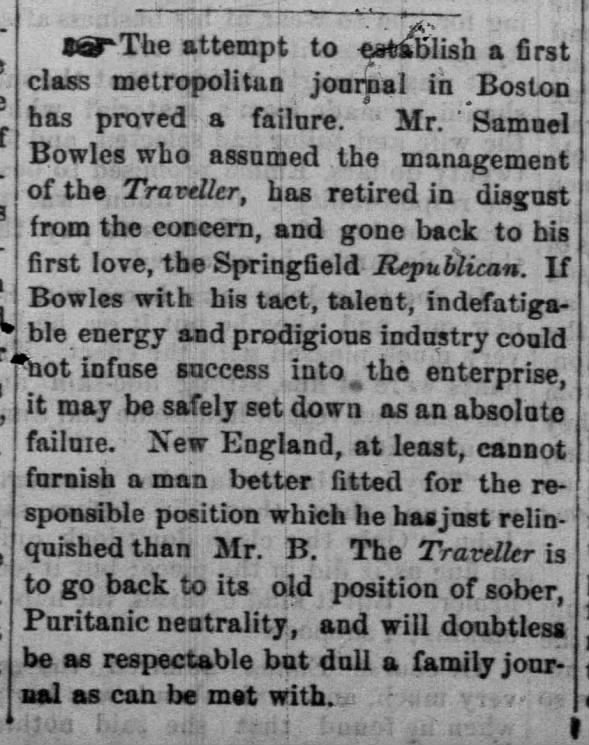
Emily Dickinson's friend Samuel Bowles of the Springfield, Mass. Republican had served as editor of the Boston Traveller since April 1857. In Springfield, Bowles was formerly assisted by Melville's "friendly critic" Josiah Gilbert Holland, so identified by Jay Leyda:
  • Leyda, Jay. “Another Friendly Critic for Melville.” The New England Quarterly, vol. 27, no. 2, 1954, pp. 243–49. JSTOR, https://doi.org/10.2307/362806. Accessed 28 May 2023.  
After a short tenure as editor of the Traveller, Bowles would reclaim his position as editor of the Springfield Republican.
 
The departure of Samuel Bowles as editor of the Traveller was announced on September 10th in the Boston Evening Transcript. Possibly the Kiana review on September 14, 1857 was one of the last literary pieces that Bowles contributed or supervised as editor of the Boston Traveller

Where is Melville?

In the Boston Traveller Bowles or somebody wondered, "Where is Melville?" We might be able to answer the question, now that we know the date on which it appeared in print. Where WAS Herman Melville on September 14, 1857? Back home in Pittsfield, Mass., brainstorming lecture topics, as he revealed the next day in a letter to George W. Curtis:

-- I have been trying to scratch my brains for a Lecture. What is a good, earnest subject? "Daily progress of man towards a state of intellectual & moral perfection, as evidenced in history of 5th Avenue & 5 Points."
Even better, brainstorming lecture topics and satirizing utopian schemes of famous communists after reading Robert Owen:
By the wondrous and, hitherto, mysterious organic construction of man and woman, the adults of the first generation that shall acquire a practical knowledge of their own powers to re-form the matured character of each individual, will be enabled, almost to re-create the character of succeeding generations; to re-create it by training each individual from birth, by a new and very superior arrangement of external circumstances, to have a sound physical constitution, to have superior dispositions, habits and manners, to have much valuable knowledge, and to make a daily progress towards physical, intellectual and moral perfection.

-- Robert Owen, The Book of the New Moral World (London, 1836) page 103.

Robert Owen, Esq. via NYPL Digital Collections
 
Melville's words and phrasing, specifically the stipulation of "daily progress" in the march "towards" a condition of "intellectual and moral perfection" are Robert Owen's in The Book of the New Moral World (London, 1836). "Subjects: Communism" as catalogued by HathiTrust Digital Library
 
As it turned out, the real lecture Melville composed on Statues in Rome was delivered in Boston on December 2, 1857 and reported the next evening in the Boston Evening Traveller. Traces of Melville's epistolary parody of Owen linger in his reference to the utopian "scheme of Fourier" that had yet to dissolve the need for a whole code of laws against criminal conduct. 

 Related posts:

Saturday, February 25, 2023

Balckwell's Books podcast on MARDI, "Melville's most imaginative novel"

Link below to Balckwell's Books podcast on Substack with splendid treatment of MARDI as a loosely structured book of conversations. As well and truly said around 15 minutes in, Melville "just wants to talk about a lot of different things."


Thursday, February 3, 2022

Next door to immortal

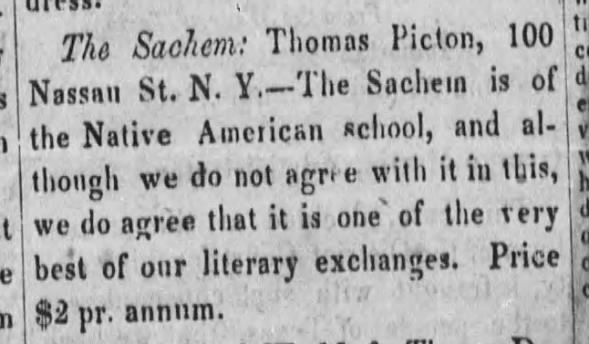
This item originally appeared in the New York Sachem, a weekly newspaper affiliated with the nativist Order of United Americans party. Founded in 1852 by Henry William Herbert aka Frank Forester (1807-1858) and his protégé Thomas Picton (1822-1891), The Sachem was edited by Picton with later assistance from George G. Foster, William North, and other talented New York journalists. 

Perhaps it was the chivalrous "Colonel" Tom Picton who regarded Mardi as "next door to immortal."


There is some hope for England! A lord has been sent for twelve months to the house of correction. Think of this, ye Britishers! a real live lord, one of the dii minores or demi-gods, as Herman Mellville hath it, in his next-door-to-immortal Mardi! The report is explicit; his hair was cut to the regulation felon clip; he was washed and shaved; we fear his cherished moustaches must have been sacrificed by the relentless fates, or rather by the adamantine turnkeys; furthermore, he was dressed in a suit of pepper and salt, and condemned to the--we speak the word with a slight nervous twitch of horror--TO THE MILL. Yes, reader, at this precise moment, the Noble Lord Frankfort is engaged in the remarkably monotonous employment of the perpetually walking up stairs, without ever getting any higher. If the reader has ever been on the treadmill--we do not mean professionally, but experimentally--he will understand and appreciate the sufferings of this fallen angel from the empyrean of British aristocracy. Lord F. was a great scamp; no doubt he was a[s] thoroughly debauched and degraded a specimen of a rowdy lord as one might hope to meet on a summer day. Nevertheless it is satisfactory to reflect that even this titled "ne'er do weel" can be made eminently useful to the cause of justice. This punishment is an example to his fellow nobles. It vindicates the majesty of the law and the equality of justice. 
N. Y. Sachem.

Reprinted in the Helena, Arkansas Southern Shield on February 26, 1853; and Cleveland OH Plain Dealer on March 7, 1853.

In Mardi, and a Voyage Thither, Melville's narrator masquerades as Taji, one of the "demi-gods" recalled so fondly by the New York Sachem editor. 

Samoa now gave me to understand, that from all he could learn, the Islanders regarded me as a superior being. They had inquired of him, whether I was not white Taji, a sort of half-and-half deity, now and then an Avatar among them, and ranking among their inferior ex-officio demi-gods. To this, Samoa had said ay; adding, moreover, all he could to encourage the idea. 

06 Nov 1852, Sat Santa Fe Weekly Post (Santa Fe, New Mexico) Newspapers.com

Tuesday, January 18, 2022

IYKYK OMOO

© Jérémie Silvestro / Wikimedia Commons
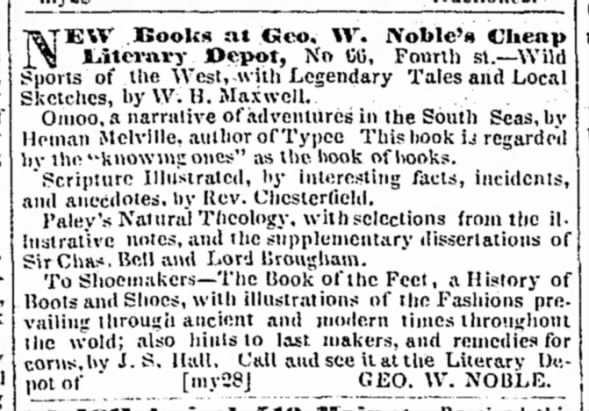
Advertised in the Louisville Morning Courier, May 29, 1847:

NEW Books at Geo. W. Noble's Cheap Literary Depot, No 66, Fourth st.

"... Omoo, a narrative of adventures in the South Seas, by Herman Melville, author of Typee. This book is regarded by the "knowing ones" as the book of books."
29 May 1847, Sat The Louisville Daily Courier (Louisville, Kentucky) Newspapers.com
In 1849, the same Louisville bookseller would tout Melville's Mardi and a voyage thither as the Greatest work of the age.


Monday, January 17, 2022

Sunday Dispatch review of MARDI

Tahitian double-hulled war canoes
Engraved by Fumagalli. Plate N° 86; after an earlier artist.
Public domain, via Wikimedia Commons
As previously shown here on Melvilliana

https://melvilliana.blogspot.com/2022/01/sunday-dispatch-super-friendly-notices.html

the New York Sunday Dispatch highly commended Herman Melville's first two books. The Dispatch praised Typee as "beautiful and fascinating, and best of all, truthful"; and loved Omoo even more for its "spontaneous genial mirth."  Mardi: and a Voyage Thither, not so much. 

In a word,

"Faugh!"

From the Sunday Dispatch of April 22, 1849; found on GenealogyBank among digitized pages added within the past week. Also accessible via the Library of Congress, Chronicling America

New York Sunday Dispatch - April 22, 1849
via GenealogyBank
New York Sunday Dispatch - April 22, 1849
via GenealogyBank

New Books.

MARDI AND A VOYAGE THITHER. By HERMAN MELVILLE.
Two Volumes. New York, Harper & Brothers.

Mr. Herman Melville is the most frank and obliging author of these latter days. He tells his readers at the outset, this is fact: this fiction. The most extraordinary yarn ever spun by an "old salt" to credulous mariners was Typee. That was Mr. Melville's first book and one of his facts. The second book, equally strange and improbable, but also a fact, was Omoo. Both these books took wonderfully well. The London critics said that there was a freshness about them which was delightful. We don't deny that for an old salt, Mr. Melville was and is marvelously fresh. The third work, that before us, Mr. Melville admits to be fiction. We are much obliged to him for saving us the trouble of proving it so. We have not read ten pages before we were entirely satisfied on that point.

Fancy, if you please, a sailor spinning off a yarn to a gaping crowd of green horns, after this fashion. I, Melville, and my shipmate Jarl, on board of an old tub of a whaler got tired of "chassezing across the Line, to and fro in search of prey"—worse and worse when the old man finding no luck, resolved to bob for the right whale on the northwest coast. Could'nt stand it, concluded to leave the ship. Got our traps in readiness, put in our stock of water and provisions, and one quiet night, the ship under sail, lowered one of the whale boats, cut the slings and were off, for Mardi. Lots of adventures. Fell in with a Sandwich Island craft—two persons on board—man and wife. More incident. Gale—craft goes down, wife lost. Take again to the whale boat—three persons in all—Melville, Jarl and Samoa. Put for Mardi. On the way fall in with a native canoe, an old man, a priest, on board, with his sons, and a beautiful white girl, who is to be sacrificed to the Mardi gods. Kill the old man, rescue the girl, with whom Melville falls in love (fact or fiction you must throw in a petticoat) and put for Mardi. Approaching one of the Islands of the group, the natives pull up their canoes and run into the grove. Melville dispatches Jarl and the Sandwich Islander to open communications with the natives and meanwhile lays off at safe distance from the shore, he and the beautiful girl Yillah. After a little time Jarl and Samoa come to the shore followed by the natives. Jarl calls to Melville to land without fear, that he has humbugged the natives into the belief that Melville is a god. Of course the runaway sailor pulls in, but ere his craft has touched ground, the natives rush into the water, lift the boat in their brawny arms, and bear it into the grove, where it finds a resting place "in a couple of twin-like trees some four paces apart and a little way from the ground conveniently crotched." Samoa the rascally Kanaka, now calls upon Melville to announce himself as the god Taji, and Melville, nothing loth, thereupon commences his speech. We quote:— [extract that follows is from the first volume of Mardi chapter 54, A Gentleman from the Sun]

Plucking up heart of grace, I crossed my cutlass on my chest, and reposing my hand on the hilt, addressed their High Mightinesses thus: “Men of Mardi, I come from the sun. When this morning it rose and touched the wave, I pushed my shallop from its golden beach, and hither sailed before its level rays. I am Taji." 
More would have been added, but I paused for the effect of my exordium.
Stepping back a pace or two, the chiefs eagerly conversed.
Emboldened, I returned to the charge, and labored hard to impress them with just such impressions of me and mine, as I deemed desirable. The gentle Yillah was a seraph from the sun; Samoa I had picked off a reef in my route from that orb; and as for the Shyeman [Skyeman], why, as his name imported, he came from above. In a word, we were all strolling divinities.
Advancing toward the Chamois, one of the kings, a calm old man, now addressed me as follows:— "Is this indeed Taji? he who according to a tradition, was to return to us after five thousand moons? But that period is yet unexpired. What bring'st thou hither, then, Taji, before thy time? Thou wast but a quarrelsome demi-god, say the legends, when thou dwelt among our sires. But wherefore comest thou, Taji? Truly thou wilt interfere with the worship of thy images, and we have plenty of gods besides thee. But comest thou to fight? We have plenty of spears, and desire not thine. Comest thou to dwell? Small are the houses of Mardi. Or comest thou to fish in the sea? Tell us, Taji.”'
Now, all this was a series of posers, hard to be answered; furnishing a curious example, moreover, of the reception given to strange demi-gods when they travel without their portmanteaus; and also of the familiar manner in which these kings address the immortals. Much I mourned that I had not previously studied better my part, and learned the precise nature of my previous existence in the land.
But nothing like carrying it bravely.
“ Attend. Taji comes, old man, because it pleases him to come. And Taji will depart when it suits him. Ask the shades of your sires whether Taji thus scurvily greeted them, when they came stalking into his presence in the land of spirits. No. Taji spread the banquet. He removed their mantles. He kindled a fire to drive away the damp. He said not, 'Come you to fight, you fogs and vapors? come you to dwell? or come you to fish in the sea?' Go to, then, kings of Mardi !"
Upon this, the old king fell back; and his place was supplied by a noble chief, of a free, frank bearing. Advancing quickly toward the boat, he exclaimed— “I am Media, the son of Media. Thrice welcome, Taji. On my island of Odo hadst thou an altar. I claim thee for my guest.” He then reminded the rest that the strangers had voyaged far, and needed repose. And, furthermore, that he proposed escorting them forthwith to his own dominions; where, next day, he would be happy to welcome all visitants.
And good as his word, he commanded his followers to range themselves under the Chamois. Springing out of our prow, the Upoluan was followed by Jarl; leaving Yillah and Taji to be borne therein toward the sea.
Soon we were once more afloat; by our side, Media sociably seated; six of the paddlers, perche[d] upon the gunwale, swiftly urging us over the lagoon. 
The transition from the grove to the sea was instantaneous. All seemed a dream.
The place to which we were hastening, being some distance away, as we rounded isle after isle, the extent of the Archipelago grew upon us greatly."

We have now got as far as the 199th page of the first volume. The remainder of the work is a stupid imitation of Voltaire's "Candid," Johnson's "Rasselass," and Swift's "Gulliver." Mr. Melville can spin a very good yarn—but as philosopher or satirist—faugh!

-- New York Sunday Dispatch, April 22, 1849. 

<https://chroniclingamerica.loc.gov/lccn/sn83030362/1849-04-22/ed-1/seq-1/>

Related post: