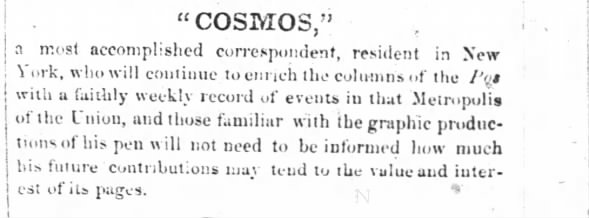
The book version of Israel Potter was briefly noticed by "Cosmos," the prolific New York correspondent of the Raleigh, North Carolina Southern Weekly Post. This item appeared in letter 87 dated March 17, 1855 and published on March 24, 1855 under the heading, "Metropolitan Correspondence." The Southern Weekly Post was owned by William Dewey Cooke, and co-edited by Cooke with James A. Waddell. That "Type" in "Type-Memory" is a pun on the title of Melville's first book Typee, or a typo for Typee, or both.
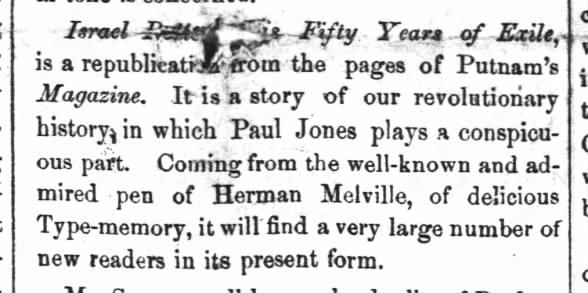
Israel Potter: His Fifty Years of Exile, is a republication from the pages of Putnam's Magazine. It is a story of our revolutionary history, in which Paul Jones plays a conspicuous part. Coming from the well-known and admired pen of Herman Melville, of delicious Type-memory, it will find a very large number of new readers in its present form.
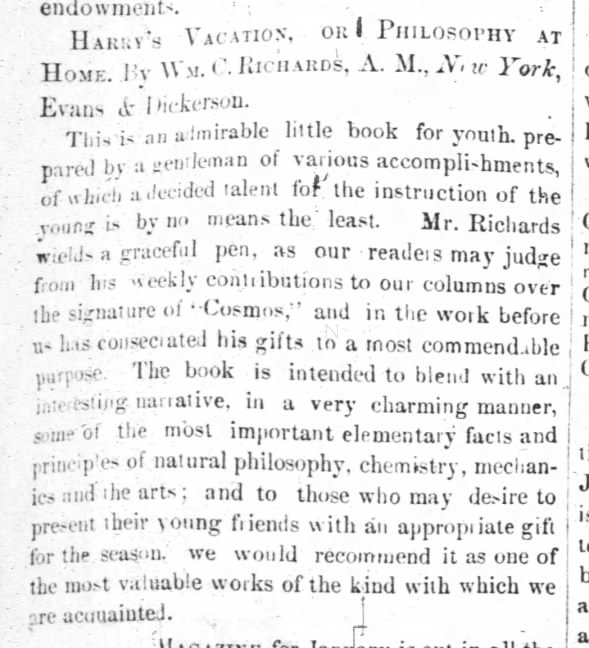
"This is an admirable little book for youth, prepared by a gentleman of various accomplishments, of which a decided talent for the instruction of youth is by no means the least. Mr. Richards wields a graceful pen, as our readers may judge from his weekly contributions to our columns over the signature of "Cosmos," and in the work before us has consecrated his gifts to a most commendable purpose...."
-- Southern Weekly Post, December 23, 1854.
10 Feb 1855, Sat Southern Weekly Post (Raleigh, North Carolina) Newspapers.com Born in London, William Carey Richards left England for the United States at the age of thirteen with his parents and siblings. The family resided in Hudson, New York for several years before moving south to Maryland and then further south to Georgia. As editor of Richards' Weekly Gazette, Richards favorably reviewed Mardi and Redburn. For the friendly reception of these and other of Melville's writings in Athens, Georgia and later Charleston, South Carolina, see the posts linked below:
In 1852 William Carey Richards moved back north to New York City. From there, starting in May 1853, he faithfully contributed more than 100 numbered letters of "Metropolitan Correspondence" to the Southern Weekly Post over the signature "Cosmos." (Many lost, it would seem, the run of the Post on newspapers.com being incomplete in every year except 1854.) Before the Raleigh newspaper folded in November 1855, Richards found employment as a Baptist minister like his father.
REDBURN; his first Voyage. Being the Sailor-Boy Confessions and Reminiscences of the Son of a Gentleman in the Merchant Service. By Herman Melville. In 2 vols. 12mo. New-York: Harper & Brothers
“Redburn” is, to us, the most attractive of all Mr. Melville's books, not excepting even “Typee.” We have read it thoroughly, with a very pleasant impression, and have no hesitation in recommending others to read it. Its charm consists in its absolute naturalness, and its striking veri-similitude. The reader is willing to believe that every thing happened to “Redburn” just as the author narrates it. We say every tiling; perhaps, we should except the mysterious night in London, which is a little too fanciful for the harmony of the narrative. Very charming, indeed, is the simplicity of our hero, and very commendable the good humor and tact with which he demeans himself, under the many annoyances of his position, on board the Highlander. The book is not wanting in incident; affording opportunity for the display of Mr. Melville's descriptive powers. There are many vivid passages; and among them, the death of Jackson, a sort of human-devil, the spontaneous combustion of a dead body, shipped as a drunken sailor! the hero’s first essay at “going aloft,” will strike the reader.
Mr. Melville's wit is admirably displayed in this work, and sparkles gracefully upon the surface of an under-current of strong feeling. The book deserves to have a wide popularity. --Richards' Weekly Gazette, January 5, 1850.
As first documented by Gary Scharnhorst in his 1988 article
"Melville Bibliography 1846-1897: A Sheaf of Uncollected Excerpts, Notices, and Reviews" continued from Number 74 in Melville Society Extracts 75 (November 1988), pages 3-8, item number 78 on page 4;
On August 31, 1850 the Southern Literary Gazette gave Part I of Melville's "Hawthorne and His Mosses" from The Literary World of August 17, 1850. Melville's pseudonymous review appears in the Gazette under the editorial heading, "The Essayist." As in the Literary World, Melville's contribution in the Gazette reprint is credited only to "A Virginian Spending July in Vermont." Part II of Melville's "Mosses" essay does not appear in the next issue of the Gazette and evidently was never reprinted there.
Richards' Weekly Gazette (Athens, Georgia)
May 12, 1849
Our Book Table.
[Publishers and Authors who desire to have their Books noticed in this Gazette, are requested to send copies to the Editor through Stringer & Townsend, New-York, or Carey & Hart, Phil.
MARDI, AND A VOYAGE THITHER. By Herman Melville. In two vols., 12mo., pp. 365-387. New York. Harper & Brothers. 1849.
Verily, this book is a literary phenomenon. "Typee” and “ Omoo” are completely thrown into the shade by this latest effort of Mr. Melville's peculiar talent. The ostensible difference between Mardi and its predecessors is, that while they claimed to be fact, and were universally regarded as fiction, this is boldly set forth as a fiction, which the author thinks may possibly be received as a verity. If he has any hopes of this kind, he may as well dismiss them— for certainly a wilder or more incongruous mass of fiction was never brought forth, with christian rites, than is contained in these two volumes. To analyze them, is beyond our purpose. The story is not altogether unlike “ Typee” and “ Omoo," but, being a sublimation of their extravagances, the reader may judge to what extent his common sense will be taxed in its perusal. To do Mr. Melville justice, we must acknowledge at once his singular inventive faculty, and his rhetorical facility. There is a sparkle, a charm, a certain wild grace about his style, that would be quite irresistible, were it not for his decided and oppressive mannerisms, which almost everywhere disfigure it.
With Mr. Melville’s description of the South Seas, and of their icthyological wonders — as also of the exquisite island scenery therein encountered—we should be stoics not to be charmed.
His escape from the ‘Arcturion,’ and the subsequent adventures of himself and his companion,“Old Jarl”— a poor substitute, by the way, for Toby of “Typee,” though not without his good points—for many days over the wonder-teeming waters of the Southern Seas, are very graphically narrated.
Yillah, the heroine of the book, is a beautiful creation of the author's fancy; but we cannot help thinking that he might have managed his story better than to make her a phantom, vanishing from his very arms one night, and going no one knew whither. This trick of Mr. Melville’s, by the way, of creating such exquisite beings as Fayaway, of Typee memory, and Yillah, of Mardi, for his own especial and unlicensed enjoyment, is a striking commentary upon the morality of the book.
The Island of “Mardi” is another “Typee,” where our author passes himself off under the name of Taji, a demi-god, and a visitor from the sun. He becomes the guest of Media, King of Odo, and, after Yillah so mysteriously disappears, he resolves to go in search of her; and Media, who is a very jolly, sociable and clever fellow, decides to accompany him.
And now commences a series of travels and adventures almost unparalleled in romance. Feasts and frolics are plenty as blackberries; and so plenty are Kings, that five and twenty of them sit down to dinner together, “and a royal time they have.”
In the further development of the story, the machinery of magic is employed, and we have an enchantress Hautia, with her singing maidens as heralds; and, at the very close of the book, Taji becomes a victim of Hautia, who reveals to him his lost Yillah, lying dead in a sea-cavern! Romantic enough, in all conscience.
We liked “Typee” vastly well. It was fresh, racy and delightful, despite its somewhat sensuality. “ Omoo” tired us with its attenuation of the fine thread of the former work, and disgusted us with the author’s evident latitudinarianism in both morals and religion. In “Mardi,” we have a still further wire-drawing process, and, perhaps, even less disguised immorality and infidelity. These are hard words, but they must be uttered in justice to our position as a journalist.
Without questioning Mr. Melville’s very clever talent at romancing, we must conscientiously condemn his too thinly veiled lasciviousness, and, moreover, deny his right to work an idea to death, as he has evidently done in Mardi. We will not take leave of the book, without affording our readers as fair a specimen of the descriptive powers of our author as a single brief paragraph can present. It is a description of Yillah, at first sight.
"Before me crouched a beautiful girl. Her hands were drooping. And, like a saint from a shrine, she looked sadly out from her fair, long hair. A low wail issued from her lips, and she trembled like a sound. There were tears on her cheek, and a rose-colored pearl on her bosom. Did I dream? A snow-white skin: blue firmament eyes: Golconda locks. For an instant, spell-bound I stood, while with a slow apprehensive movement, and still gazing fixedly, the captive gathered more closely about her a gauze-like robe.”
In Antebellum Athens and Clarke County, Georgia (University of Georgia Press, 1974; paperback 2009), Earnest C. Hynds devotes a good part of chapter 6 to the southern literary career and influence of William Carey Richards. Richards' Weekly Gazette started out in Athens as Southern Literary Gazette.
"Richards moved the publication to Charleston in 1850 and sold one-half interest in it to Joseph Walker of that city. The name was changed back to Southern Literary Gazette, and it evidently retained that title after 1852 when Richards sold his interest in the publication and moved to New York." --Antebellum Athens, page 98.
On August 31, 1850 Richards' Southern Literary Gazette reprinted the first part of Melville's "Hawthorne and His Mosses" from The Literary World of August 17, 1850. As in the Literary World, Melville's essay in the Gazette reprint is credited only to "A Virginian Spending July in Vermont."
Richards published his Valedictory to readers of the Southern Literary Gazette on December 18, 1852. One week later, on December 25, 1852, the Gazette reprinted all of one section (vi) in Book VI of Pierre; Or, The Ambiguities, given as a specimen of the author's presumed insanity:
* * From this romance we copy the following extraordinary description of the simple music of the guitar. Melville has cer[t]ainly gone crazy, and is, we presume, by this time in some lunatic asylum. Think of seeing sounds in the shape of icicles! Think of hearing lightning! What ridiculousness and senselessness and unintelligibleness! --Southern Literary Gazette, December 25, 1852.
Richards the "Ex-Editor" openly acknowledged authorship of magazine reviews for the Christmas Day issue. So Richards was still contributing editorial matter at the close of 1852. In his December 18, 1852 "Valedictory," Richards named assistant editor Paul Hamilton Hayne as his replacement. But Richards also indicated in the published farewell that Hayne was then out of town. It's hard to say which editor to credit with the excerpt from and comment on Melville's Pierre. The long extract and short notice might have been among Richards' last contributions as ex-editor of the Southern Literary Gazette, or Hayne's first as chief editor. Something to look for in the Paul Hamilton Hayne papers, David M. Rubenstein Rare Book & Manuscript Library, Duke University.

 23 Dec 1854, Sat Southern Weekly Post (Raleigh, North Carolina) Newspapers.com