Showing posts with label Clarel. Show all posts

Friday, May 29, 2026

Bookmarked for lyrical dialogue between personified trees and river waters: CLAREL Part 2 Canto 27


Sunday, April 19, 2026

Remaking OREGON, HO! in prose and dialogue

Remaking "Oregon, Ho!" in prose and dialogue by Scott Norsworthy

DRAGOONED: Writing, talking, and rewriting like Herman Melville in "Scenes Beyond the Western Border" (1851-1853). Number 9.

Read on Substack


Wednesday, May 15, 2024

W. H. Bartlett's FOOTSTEPS OF OUR LORD AND HIS APOSTLES from the library of Herman Melville

Footsteps of Our Lord & His Apostles, Title-page with
engraving, "The Holy Sycamore"  © The Trustees of the British Museum

Looks like another illustrated book of travel and adventure in the Middle East by William Henry Bartlett can be added to the three already listed in the catalog of books owned and borrowed by Herman Melville at Melville's Marginalia Online. Merton M. Sealts, Jr. included three of Bartlett's works in Melville's Reading: A Check-List of Books Owned and Borrowed (University of Wisconsin Press, 1966; Revised and Enlarged Edition, University of South Carolina Press, 1988):

  • Forty Days in the Desert, on the Track of the Israelites (Sealts Number 48)
  • The Nile-Boat; or, Glimpses of the Land of Egypt (Sealts Number 49)
  • Walks about the City and Environs of Jerusalem (Sealts Number 50)

Melville mined each of these works in the writing of his epic religious poem Clarel (1876) as demonstrated by Walter E. Bezanson in the 1960 Hendricks House edition of Clarel: A Poem and Pilgrimage in the Holy Land; and Dorothee Metlitsky Finkelstein in Melville's Orienda (Yale University Press, 1961). Bartlett's works and the groundbreaking scholarship on Melville's use of them by Bezanson and Metlitsky Finkelstein are duly registered by Mary  K. Bercaw in Melville's Sources (Northwestern University Press, 1987).

A fourth title by Bartlett, Footsteps of Our Lord and His Apostles in Syria, Greece, and Italy, was offered by rare book dealer Noah Farnham Morrison (1863-1950) of Elizabeth, New Jersey in his 1926 Catalog of Miscellaneous Literature No. 209, listed there on page 12. 

Noah Farnham Morrison, Catalog No. 209 - 1926

2257. BARTLETT (W. H.). Footsteps of our Lord and his apostles. 12mo, pp. 248, morocco, map and ills., gilt edges. N. Y., n. d. 3.50
From the library  of Herman Melville.

As indicated in Morrison's catalog description, this particular copy was a New York edition with no date given, acquired "From the library of Herman Melville." Price: $3.50, minus the 25% discount on all items in Catalog No. 209, as stipulated on the front cover. Morrison explained, 

"I am specializing in Americana and need the room for that stock."

The proprietor of "The Ark" aka "The Sign of the Ark" or "Noah's Ark" in Elizabeth, NJ had a longstanding interest in Melville's own writings, as shown by his advertisement in the Books Wanted section of Publishers' Weekly No. 1209, March 30, 1895. Based at that time in Newark, Noah Farnham Morrison was seeking 

"Herman Melville's Works, any, state publisher and date." (page 540)

Noah Farnham Morrison retired in 1943 and died on October 4, 1950 at the age of 87. From the notice of his passing in the Antiquarian Bookman:

"A specialist in Americana, he had opened his first book store in Newark in 1893. For over 40 years his Elizabeth store, Noah's Ark, was famous on West Jersey Street, until he retired in 1943. His stock of Americana was sold in six sessions by Swann's Auction Galleries in 1945-6."
Detail, front cover of Morrison's Catalog Number 216 - 1927

The full title of Bartlett's work is Footsteps of Our Lord and His apostles in Syria, Greece, and Italy: a succession of visits to the scenes of New Testament narrative. In his Catalog Number 209, Morrison gave the short title of Melville's copy as Footsteps of Our Lord and his apostles, without specifying the edition or publisher. However, Morrison did note the place of publication, N. Y. = New York, and the absence of a publication date on the title-page. Similarly, Melville's copies of Forty Days in the Desert (Sealts Number 48) and The Nile-Boat (Sealts Number 49) were also American editions, published in New York with no date indicated on the title-pages. Both volumes owned by Melville, Forty Days in the Desert and The Nile-Boat, were Fifth Editions published in New York by Charles Scribner and Company. Although Melville's copy of Bartlett's Footsteps of our Lord is now lost or (more hopefully) unlocated, it may have been Scribner's 5th edition. 

All three titles were advertised together by Scribner & Company. Bartlett's popular works headed the list of "SUPERBLY ILLUSTRATED ENGLISH BOOKS FOR THE HOLIDAYS, 1865-6" in the American Literary Gazette and Publishers' Circular (Philadelphia, PA) for November 1, 1865. Listed first: Footsteps of Our Lord and his Apostles in Syria, Greece, and Italy: a succession of visits to the scenes of New Testament Narrative featuring "47 exquisite Illustrations on steel and wood." 

As advertised in the Philadelphia American Literary Gazette, these holiday gift books were "Crown 8vo" in size which would make them smaller than the usual octavo--possibly close to the 12mo or duodecimo size of the book from Melville's library according to Noah Farnham Morrison. The advertised price of each volume in "Cloth extra, gilt" was $4, exactly one day's pay for a customs inspector at the Port of New York as Melville officially would become on December 5, 1866. As described in Morrison's 1926 catalog, Melville's copy of Footsteps of our Lord and His Apostles was bound in morocco leather which normally would have upped the purchase price by about two dollars.

Melville could have acquired the Footsteps volume when the 5th edition was issued for the holidays by Scribner and Company in 1865-6, or later. As indicated by Sealts in Melville's Reading, Melville's Forty Days in the Desert (like Footsteps in the 1865 ad shown above, a Fifth Edition published in New York by Scribner) was inscribed by Melville in New York City on January 31, 1870.

Melville's other copies of Bartlett's works are held by the New York Public Library in the Gansevoort-Lansing collection. Arranged by Sealts Number, the two Scribner editions, Forty Days in the Desert (Sealts 48) and The Nile-Boat (Sealts 49) are located in the Gansevoort-Lansing family library, box 329. As recorded in the relevant catalog entries at Melville's Marginalia Online, these two volumes were given by Melville's daughter Frances to Caroline W. Stewart. Sealts Number 50, the London edition of Bartlett's Walks about the City and Environs of Jerusalem, was a Christmas gift from Herman to his wife Elizabeth Melville. Also located in the New York Public Library, Manuscripts and Archives Division, Gansevoort-Lansing Box 329 according to the catalog entry at Melville's Marginalia Online.

Not Melville's actual book but still a boon to researchers, Scribner's undated Fifth Edition of Footsteps of our Lord and His Apostles by William Henry Bartlett is also at The New York Public Library, now located in the Schwarzman Building M2 - General Research Room 315. I checked, it has the same number of pages, 248, as the one at Noah's Ark. Google-digitized images from the physical volume at NYPL are available online courtesy of HathiTrust Digital Library:

Possibly Melville borrowed something in Clarel (and perhaps in other writings) from somewhere in Bartlett's Footsteps of Our Lord and His Apostles. What remains to be seen. 


Monday, September 26, 2022

Giorgia Meloni's electrifying speech at the World Congress of Families, ...

2019 speech in Verona, Italy at the World Congress of Families...

Defending the "unenlightened" Middle Ages around 6:30
"But they think everything we propose is crazy.  They think it's unenlightened, that we want to take away rights... the middle ages ... You know the middle ages was also the time of the cathedrals and the abbeys, the founding of the comuni, the universities, the parliament, the epoch of Dante, Petrarch, Boccaccio, Saint Francis, Saint Benedict ... People who don't know where Matera is, let's not expect them to have read history books."
Meloni sounded like Ungar debating Derwent in Melville's Clarel.


In Ungar's longer view of history and art, the great cathedrals of medieval Europe proclaim
A magnanimity which our time
Would envy, were it great enough
To comprehend.  -- Clarel Part 4 Canto 10 A Monument

Herman Melville, Clarel: A Poem and Pilgrimage in the Holy Land (New York, 1876). Edited by Walter E. Bezanson for Hendricks House, Inc. (New York, 1960).

Saturday, August 20, 2022

Herman Melville and the Bible

Herman Melville and the Bible: The Cambridge Companion to the Bible and Literature - March 2020

Ruth Blair has a fine chapter in The Bible and Literature, ed. Calum Carmichael (Cambridge University Press, 2020) with this to say about the "spiritual exercise" required by the demanding yet "often fluid and flexible" verse form of Clarel:
"... the poem engages the reader in a difficult journey, rather like the pilgrimage itself, on horseback--a mode of travel in which one cannot afford to lose concentration, and whose rhythm the tetrameter line echoes" (page 249).

Monday, January 31, 2022

Astonishing poem on the Holy Land forthcoming: premature notices of CLAREL aka CLARA

Convent of Santa Saba
via The New York Public Library Digital Collections

Herman Melville's religious epic Clarel was first published by G. P. Putnam's Sons in June 1876. Months before, the work had been announced in the New York press as forthcoming. As things turned out, however, the earliest notices of Melville's new "poem on the Holy Land" were premature. 

The Publishers' Weekly - January 15, 1876

G. P. PUTNAM'S SONS, New-York. 
 
... A Poem on the Holy Land, Narrative and Descriptive. By Herman Melville.

-- The Publishers' Weekly, January 15, 1876. 

The announcement in Publishers' Weekly on January 15, 1876 indicated a different working title, with no mention of "Clarel," the name of Melville's student-quester:

A Poem on the Holy Land, Narrative and Descriptive. By Herman Melville.

The earliest newspaper notices picked up on the interesting generic characterization of Melville's new poem as "narrative and descriptive":

New York Daily Tribune - January 12, 1876

LITERARY NOTES.

"A narrative and descriptive poem on the Holy Land, by Herman Melville, is in press by G. P. Putnam's Sons." -- New York Daily Tribune, January 12, 1876.
<https://chroniclingamerica.loc.gov/lccn/sn83030214/1876-01-12/ed-1/seq-6/>
"A narrative and descriptive poem on the Holy Land, by Herman Melville, is in press by G. P. Putnam's Sons."--  Syracuse NY Daily Journal, January 15, 1876. 


The Christian Union - January 19, 1876

"Herman Melville, who is best known in literature by his fascinating sea-stories, has astonished his many admirers by writing a poem on the Holy Land, which the Messrs. Putnam will shortly publish."  -- The Christian Union, January 19, 1876.

"A narrative and descriptive poem on the Holy Land, by Herman Melville, is in press by G. P. Putnam's Sons."--  Chicago Tribune, January 22, 1876

31 Jan 1876, Mon New York Daily Herald (New York, New York) Newspapers.com

Herman Mellville, the author of "Typee" and "Omoo," who has long been absent from book authorship, has a poem on the "Holy Land" in Putnam's press.

-- New York Herald, January 31, 1876. 

Portland Maine Daily Press - January 29, 1876

"... a narrative poem on The Holy Land, by Herman Melville, who has heretofore been known only by his audacious romances,--Typee, Omoo and Moby Dick...."  
-- Portland ME Daily Press, January 29, 1876. 
In The American Bookseller for March 1, 1876, Putnam's Sons announced the title as "The Holy Land. A Narrative Poem."

Later in March Melville's publisher got the eponymous title right:
Mr. Herman Melville's narrative poem of a pilgrimage in the Holy Land, called "Clarel," will introduce him afresh to a new generation of readers.

-- Publishers' Weekly, March 11, 1876. 

Nevertheless, in April another announcement, still pre-publication, gave the title of Melville's forthcoming work as "Clara":


Clara. A Pilgrimage in the Holy Land. A Narrative Poem. By HERMAN MELVILLE. 2 VOLS., 12mo, cloth, extra, $3.  --Publisher's Weekly, April 22, 1876.

Melville's verse epic Clarel, A Poem and Pilgrimage in the Holy Land was officially published on June 7, 1876 according to this advertisement in the New York Evening Post:


New York Evening Post - June 7, 1876
via Genealogy Bank
Related post:

Monday, January 3, 2022

Melvilliana: Lacordaire, the model for Melville's Dominican in ...

Melvilliana: Lacordaire, the model for Melville's Dominican in ...: "The people once elected me To be their spokesman. In this gown I sat in legislative hall A champion of true liberty-- God's l...

ICYMI check out this classic Melvilliana post from August 2011, on the real-life inspiration for the character of the Dominican monk in Herman Melville's great 1876 epic CLAREL: A POEM AND PILGRIMAGE IN THE HOLY LAND. Read and share if you please to dismay Marxists, disrupt Maoists, and dismantle AI.

Sunday, May 30, 2021

David Urquhart, eccentric ideologist

David Urquhart, 1805-1877. Diplomat
National Galleries Scotland
Deep into Melville's 1852 novel Pierre; Or, The Ambiguities, readers belatedly learn that the young hero Pierre Glendinning was a writer, and already famous as the author of popular verses on comically trivial themes. As disclosed in the satirical chapter on "Young America in Literature," Pierre had been invited to lecture before the ridiculously named
"Urquhartian Club for the Immediate Extension of the Limits of all Knowledge both Human and Divine."
The joke, in part, is on the vanity of philosophers for whom nothing could be deemed unknowable or beyond the grasp of human intellect. Melville specifically makes fun of Unitarian minister Orville Dewey, as Hershel Parker shows in Herman Melville: A Biography Volume 2, 1851-1891 (Johns Hopkins University Press, 2002). Dewey had recently delivered a popular series of lectures on The Problem of Human Destiny, a preposterously, almost blasphemously grandiose theme that Melville incorporates in a mock-formal letter of invitation from the local lecture committee in Zadockprattsville. Addressing Pierre as Author of the 'Tropical Summer,' &c., the chairman proposes "Human Destiny" as a suitable lecture subject for a teenaged maker of miscellaneous sentimental verses and fragments of prose. Another target of Melville's satire is transcendentalism, particularly as expounded by American disciples of Thomas Carlyle. The most obvious pointer to Carlyle and his influence appears in the super-Scottish name of the committee chairman, "Donald Dundonald." More broadly, as discussed by Tom F. Wright in Herman Melville in Context, edited by Kevin Hayes (Cambridge University Press, 2018) the fictional lecture-committee letter in Pierre finds humor in the rural pretensions of the lyceum movement in America. Beyond that, as remarked by C. S. Durer in Herman Melville, Romantic and Prophet (York Press, 1996), the lecture invitation burlesques "the ludicrousness of atheneums and, even more so, the general ludicrousness of what passes for the pursuit of knowledge" (164).

But why "Urquhartian?" 

When they bother to notice, Melville scholars usually gloss the name as a reference to seventeenth-century British writer and translator Thomas Urquhart. Thus explicated in the back of the Penguin Classics Pierre (page 377), edited by William C. Spengemann:
Urquhartian: after Sir Thomas Urquhart (1611-1660), English polymath and translator of Rabelais.
Similarly, the Norton Critical Edition (page 251 footnote 2) of Pierre detects
A reference to the Scottish author Sir Thomas Urquhart (1611-1660), celebrated for his translations of the French writer François Rabelais (ca. 1490 - ca.1553).
In his notes to the 1949 Hendricks House edition of Melville's Pierre, Henry A. Murray skipped over the letter from Zadockprattsville inviting Pierre to lecture there on Human Destiny, and made no mention of the Urquhartian Club. 

The perceived allusion to Thomas Urquhart in Melville's imaginary Urquhartian Club fits well enough as a play on the family name, and with reference to the reputation of Sir Thomas as one of the more notable Scottish Eccentrics. 

Sir Thomas Urquhart via NYPL Digital Collections

Particularly worthy of satire according to David Irving in the second volume of Lives of Scotish Writers (Edinburgh, 1850), the "extraordinary career of genealogy" in which Urquhart fantastically "traces his descent from Adam to Noah" and beyond. Understood as part of the satire, the association of Urquhart with François Rabelais might also evoke the outrageous comedy of Gargantua and Pantagruel, nominally enlarging the club's stated mission of extending knowledge while undercutting its seriousness. 

On the other hand, they don't call it the Rabelaisian Club. And Pierre has us laughing at the letter, not with its writer Dundonald, who sounds intensely serious, rather the opposite of jolly Rabelais. Melville seems to envision the Urquhartian Club as something like Philosophers-without-Borders. That limitless pursuit of knowledge might be overreaching, more Satanic than Rabelaisian, is signaled in the grasping for "Divine" as well as "Human" knowledge, and also in the proposed lecture subject of Human Destiny. Maybe we need a supplementary honoree. Happily, Thomas is not the only Urquhart implicated in Melville's Urquhartian Club. More immediately, for the author of Pierre and the novel's first readers in 1852, the term Urquhartian would have conjured up a living namesake: not Thomas but David Urquhart.  

In Melville's epic religious poem Clarel: A Poem and Pilgrimage in the Holy Land (1876), one of two unnamed speakers in an overheard conversation recalls David Urquhart as a vain, unreliable, and "Eccentric ideologist." By then Urquhart was out of vogue, "obsolete." In 1852, however, Melville and his contemporary readers had a direct and readily accessible point of access to the ideas of David Urquhart via the Harper edition of Urquhart's book The Pillars of Hercules, and in the review that appeared under the title "Urquhart's Pillars of Hercules" on pages 5-7 of The Literary World volume 7 for July 6, 1850. 

If he did not write it for the New York Literary World (a possibility worth following up, considering that Melville's pseudonymous review-essay Hawthorne and His Mosses would be published in two parts by the same journal in August 1850, only a month later), Melville as a reader might have been entertained by the light satire of the Urquhart family lineage that opens the anonymously published review:
We shall not wonder at the learning of this book, if we reflect upon the antiquity of the author's family, which is clearly traced by his ancestor, Sir Thomas Urquhart, it is said, all the way down quite from its founder Adam. Antiquarian lore must have come to such a man as an inheritance; and the Hebrew and other roots been the daily fare of his childhood.
The title of Urquhart's 1850 book of course alludes to the Strait of Gibraltar. Throughout, the reviewer takes a kind of amused pleasure in Urquhart's dubious yet entertaining displays of universal learning:
There is an amusing play of the imagination among etymologists and antiquarian travellers, in running up the genealogies of speech and customs to their tiny sources among the shadows of the dim and distant past. Our traveller is, perhaps, not entirely exempt from a slight degree of quixotism, any more than the many others who have bestridden their Rosinantes before him. But though enthusiasts, deep-grounded in ethnology, are very serious themselves in their laborious excavations of long-interred knowledge, they nevertheless exhibit a smack of humor to lookers-on like us. Does not genuine wit, for instance, flow from the ingenious lucubrations of Horne Tooke, or the learned Noah Webster, when, with a flash of light, they reveal the dark relationship of obscure, forgotten etymologies, and tickle us by sudden shifts of phrase with unexpected surprises, which everybody knows to be the soul of wit? 

One of several excerpts from Pillars of Hercules relates Urquhart's visit to a "gambling establishment" or "club" in Tarifa, Spain. Repeating Urquhart's word club, the reviewer highlights "antiquarian theories" suggested by the peculiar brand of Andalusian cards they used "in a certain club," and the earnest imitation of English and French models of government by "grave politicians of this club."

Urquhart's diction, adopted by the anonymous reviewer in the Literary World, may have inspired Melville to denominate the "Urquhartian" organization a "Club" rather than another term like "Society" or "Lyceum" or "Association." Wrapping up, the reviewer summarizes Urquhart's Pillars as a narrative reconstruction of

"interesting and learned travels, composed of a mosaic, where natural philosophy and imagination, archaeology, the arts, military and descriptive, ethnology, history, and political science, have each contributed a characteristic stone."

New York Spectator - June 10, 1850

The New York Spectator (June 10, 1850) treated Urquhart's characteristic "desultoriness" as a virtue since "in such moods he lets the reader into minor things which otherwise might have been overlooked, and their revelation adds greatly to the engrossing interest of the work."

The more substantial, and less cheerfully tolerant review in the London Spectator was reprinted in the March 2, 1850 issue of Littell's Living Age volume 24:

Mr. Urquhart takes an oriental bath; and thereupon writes a disquisition on bathing among the Romans, the Moors, and the Orientals, and non-bathing among some other peoples, ourselves included, with a passing touch on cheap bath-houses, and the Mosaic and Moslem notions of uncleanliness. The traveller went on a sporting excursion, though he seems to have killed nothing; but he ate of the national dish called kuscoussoo, and anon he favors the reader with the whole story of it; how it is made, which is practical information—how to eat it—what authors have said of it—bread compared with kuscoussoo; including a digression upon wheat and its original country, which is not known to Urquhart, but he makes up for it by describing the origin of the “damper” of New South Wales, says a word on Indian corn, pronounces “England in the art of cookery behind every other people,” informs the world that pilaf is never eatable “when made by a Christian,” and closes the topic with some remarks on teeth. In the course of his excursions Mr. Urquhart set eyes on the Moorish haik; which he traces to the garden of Eden, to father Abraham, to the Jews in the wilderness, to the Greeks, to the Romans. 
Delightfully or damnably digressive, with a passion for endless "extension of knowledge" (Pillars of Hercules volume 1, page 157), this Urquhart seems the true namesake of Melville's fictive "Urquhartian Club for the Immediate Extension of the Limits of all Knowledge both Human and Divine." 


A few years after Melville probably alluded to David Urquhart in Pierre (1852), Urquhart definitely and explicitly referenced Herman Melville in The Effect of the Misuse of Familiar Words on the Character of Men and the Fate of Nations (London, 1856). In support of his contrarian view of civilization, David Urquhart quotes this passage from chapter 17 of Typee, Melville's first book:
* "The fiend-like skill which we display in the invention of all manner of death-dealing engines — the vindictiveness with which we carry on our wars, and the misery and desolation which follow in their train, are enough of themselves to distinguish the white civilized man as the most ferocious animal on the face of the earth." — Herman Melville's Marquese Islands. 


https://hdl.handle.net/2027/mdp.39015020116904?urlappend=%3Bseq=32

Two decades later, Melville worked Urquhart into one of the dialogues in Clarel, where somebody labels him an "eccentric ideologist." Part 4 Canto 12 Of Pope and Turk gives part of a conversation between two unidentified speakers, overheard at breakfast by Rolfe. They argue in a friendly way about virtuous actions attributed to Muslims, and the nobility of support for Poland at different times by Ottoman Turks and Roman Catholics. One stranger respectfully acknowledges David Urquhart as a notable "commentator on the East" who "stands for God" when appealing to the Pope (though a Protestant) and supporting the Ottoman Sultan in the righteous cause of Polish independence. The other guy (secular minded and evidently more of a materialist, resolved to "stand by fact") considers Urquhart a vain and "very inexact / Eccentric ideologist." 

As pointed out by Dorothee Metlitsky Finkelstein in Melville's Orienda (Yale University Press, 1961; and Octagon Books, 1971) some of the published commentary to which Melville alludes in Clarel was available in David Urquhart's The Spirit of the East (London, 1838; #727 in Melville's Sources, ed. Mary K. Bercaw). 

Urquhart, a British diplomat, was known as an extravagant Turkophile whose enthusiasm clouded his judgment, and Melville's reference to him as an "eccentric ideologist" accurately reflects the view of his time. -- Melville's Orienda, pages 89-90

Even so, Melville made great use of enthusiasts and their crazy causes in prose and verse. For literary purposes, the more eccentric the ideologue, the better. That anonymous New York reviewer was on to something about the appeal of "quixotism" as displayed by David Urquhart in Pillars of Herclues:

But though enthusiasts, deep-grounded in ethnology, are very serious themselves in their laborious excavations of long-interred knowledge, they nevertheless exhibit a smack of humor to lookers-on like us.  -- Literary World, July 6, 1850 


Related post:

Tuesday, January 19, 2021

Crazy prophecy in Melville's CLAREL


From Melville's religious epic Clarel: A poem and pilgrimage in the Holy Land part 4 (Bethlehem), canto 21 (Ungar and Rolfe):
                                 "Know,
Whatever happen in the end,
Be sure 'twill yield to one and all
New confirmation of the fall
Of Adam. Sequel may ensue,
Indeed, whose germs one now may view:
Myriads playing pygmy parts —
Debased into equality:
In glut of all material arts
A civic barbarism may be:
Man disennobled—brutalized
By popular science—Atheized
Into a smatterer ——

                                “Oh, oh!”
 
“Yet knowing all self need to know
In self's base little fallacy;
Dead level of rank commonplace:
An Anglo-Saxon China, see,
May on your vast plains shame the race
In the Dark Ages of Democracy."
America!

 -- Clarel Part 4 Canto 21 

https://books.google.com/books?id=BvRDAQAAMAAJ&pg=PA526&dq#v=onepage&q&f=false


Friday, August 28, 2020

Saints as Syrens


Conference paper read June 19, 2009 at the École Biblique in Jerusalem, Israel for the Seventh International Melville Conference, Melville and the Mediterranean:

SAINTS AS SYRENS:

THE OLD FAITH AND MELVILLE’S NEW MYTHOPOEIA


When the saints go marching in Clarel (1876) they exemplify the bravery of unbounded, unsophisticated faith—a heroism of credulity, as it were—and affirm the catholicity of Melville’s aesthetic vision. The Roman Catholic bent is pronounced, as William Ellery Sedgwick found (213-17), and structural, in that the “poem-pilgrimage” happens, as Hilton Obenzinger has reminded us, in liturgical time (76). The favorable treatment of Catholicism is examined by William Potter as part of Melville’s larger fascination with “the intersympathy of creeds.” In a similar vein, Brian Yothers credits the sympathy for Catholicism, which for conservative Protestants in Melville’s day could still mean Sympathy for the Devil, as the impetus for the “broader consideration of religious pluralism” in Clarel. The high regard “for saints and icons” has been recognized by Vincent Kenny (140), and Joseph G. Knapp notices the “special fondness for Catholic saints” in Melville’s correspondence (99).

But no critic has elaborated Melville’s affinity for saints as charmers, most obvious in versified views of Saints Louis, Francis, and Cecilia, and warm praise for virgin martyrs. Nehemiah is a “saint” but no siren. Even granting his credentials as a venerable wanderer, his lonely evangelism converts nobody. Catholic saints are the dangerous ones. Their seductive charms for a wayward Protestant like Rolfe (or Melville) are cheerfully confessed when Derwent the Anglican priest compares virgin saints to the sirens of classical mythology. Through Derwent, Melville contemplates a bold project of mythopoeia or “myth-making” in recommending Catholic “legends” as “the poet’s second mine,” a new treasure trove (better than the old Greek myths) awaiting versifiers in the sweet, non-sectarian future.

The French Biblical School makes a fitting place to consider Melville in relation to what he appreciatively called “the Old Faith.” Here we are doubly indebted to Dominicans: first, for the hospitality of this important center of Catholic biblical scholarship; and second, for the example of Henri–Dominique Lacordaire (1802-1861), who in the early 1840’s revived the formerly banned Dominican order in France. Melville’s sympathetic portrait of the Dominican in Clarel as “A champion of true liberty” draws heavily on the life and times of Father Lacordaire, memorialized by one biographer as “the tried champion of popular liberty” (Greenwell 130). As Dennis Berthold has suggested, the Dominican’s confidence in Rome oddly defies new strictures on the political authority of the Pope in recently unified Italy (359-366). And yet, the historical incongruity nicely registers the influence of Lacordaire, who died nearly a decade before the 1870 annexation of Rome. Lacordaire’s earlier activism in the cause of religious freedom, his memorable election in 1848 to the French National Assembly, his eloquence in the pulpit of Notre Dame, and even his rumored “austerities” in the exercise of monastic self-discipline—all widely reported in contemporary sources—gave Melville ample material for his characterization of the “Disinterested, earnest, pure / And liberal” exponent of Roman Catholicism. 


What draws the Dominican into the narrative action of Clarel is a song, Ave maris stella, “Hail, thou Star of Ocean.” Rolfe leads off the Vespers hymn to Mary, in observance of a pilgrim rite at the Jordan River. Derwent and Vine join in. Hearing the hymn in three-part harmony, the Dominican strolls over for what Larry David would call a “stop and chat.” The French guest gets a canto (2.25) to make his case as a “staunch Catholic Democrat” for Roman orthodoxy: Catholicism appeals to the heart and offers supremely adaptable and enduring modes of consolation to suffering humans when protestant reform, scientific rationalism, and revolutionary politics fail to comfort.

After the “new St. Dominick” leaves, the long talk “Of Rome” (2.26) between Rolfe and Derwent elicits Derwent’s admiration for Catholic saints―especially “sainted virgin ones.” He pictures the virgin martyrs as temptresses, “syrens” more captivating than fabled sea nymphs like Parthenope whose sweet songs lured mariners to destruction (lines 71-72). But Derwent fears not the siren’s snare of Catholicism. Securely lashed to his liberal theology, the Anglican priest esteems miracle tales for their aesthetic merits, devoid of dogma:
Her [Rome’s] legends—some are sweet as May;
Ungarnered wealth no doubt is there....
When much that sours the sects is gone,
Like Dorian myths the bards shall own—
Yes, prove the poet’s second mine. (Clarel 2.26:86-93)
Although Derwent never precisely defines “legends,” the context suggests the genre of saints’ lives, conventionally termed legendaries. His enthusiasm for saints’ lives as a literary goldmine is Melville’s. Writing to his brother-in-law on “Saturday in Easter Week” 1877, Melville praised “legends of the Old Faith” as “really wonderful both from their multiplicity and their poetry” (Correspondence 452). To illustrate, he commended the biography of St. Elizabeth of Hungary by the Count of Montalembert, the same “book of the sainted queen” which he had presented in October 1875 to his cousin Kate.

Derwent’s notion of Catholic legends as the “second mine” of future poetry likely derives from this passage in the introduction, as translated by Mary Anne Sadlier:
With regard to poetry, it would be difficult to deny that [popular religious traditions] contain an inexhaustible mine….a source of poetry infinitely more pure, abundant, and original, than the worn-out mythology of Olympus. (Life of Saint Elizabeth, pages 88-89)
Along with the mine metaphor, Melville was impressed by the critique of “worn-out” Greek myths. Absent the scorn, Montalembert’s comment underlies Melville’s idea that for “multiplicity” and “poetry,” legendaries like the Life of St. Elizabeth “far surpasses the stories in the Greek mythologies” (Correspondence 452). Montalembert’s long introduction, an effusive overview of religion, politics, and art in the thirteenth-century, repeatedly extols the poetry in saints’ lives. By “poetry” he means chiefly the imaginative, romantic display of “charming incidents, illustrative of all that is freshest and purest in the human heart” (84). Replete with “ineffable sweetness” (90), tales of saintly bravery and piety reflect “the implicit faith” held by Christians of every class in medieval Europe. Nevertheless, the poetic charm of saints’ lives is also an inherent quality that exists “independent of their theological value” (88).

More debts to the Life of St. Elizabeth appear in the canto “Huts.” Melville’s main source, unidentified before now, for the ritual separation of lepers in the middle ages is chapter 24 on the heroine’s poverty and spiritual development. Elizabeth grew in humility and mercy through her irrepressible devotion to the poor and sick, lepers above all others. As Montalembert explains (296), believers in those days identified the leper with Christ on the authority of Isaiah 53:4: “…we have thought him as it were a leper, and as one struck by God and afflicted.” Melville adapts the verse and its medieval Christian exegesis in saying that Jesus “as a leper was foreshown” (1.25: 27).

From the solemn liturgy for the exile of lepers as described by Montalembert (294-298), Melville appropriated the Mass for the Dead, procession to the leper’s assigned dwelling place, ritual blessing of household utensils, and consecration of the hut with graveyard dirt. He borrowed the priest’s admonition, “Be thou dead to the world, living again to God,” as well as the closing benediction and provision of the leper’s hut with cross and alms-box. Melville’s “chance citation” (1.25: 79) of Sybella, sister to King Baldwin III of Jerusalem, again mimics Montalembert, who cited the Countess Sybella of Flanders as a medieval “heroine of charity” for her saintly ministrations to the lepers of Palestine (297).

In focused takes on saints, Clarel further explores the possibilities for poetry mined from Catholic legends. St. Louis and St. Francis receive the most significant attention. Louis IX (1214-1270) of France, thirteenth-century king and crusader, was legendary for lifelong piety. We might find more to mourn than praise in some deeds of the historical Louis, who oppressed Jews to war on Islam. His two crusades were both disasters in deserts. Ironically, however, the spectacular failures of Louis in Africa heighten his appeal for Melville as a figure of the hapless enthusiast. Rolfe, wanting the confidence to journey through the Judean wasteland, invokes St. Louis as an icon of blind faith in blank places: “King, who betwixt the cross and sword / On ashes died in cowl and cord … St. Louis! rise, / And teach us out of holy eyes / Whence came thy trust.” In ten lines Melville glosses the archetypal virtues of Louis: his humility, symbolized by the monastic garb of “cowl and cord”; his courageous heart, seemingly undaunted by suffering; and his childlike trust, baffling in the face of unrelieved misery (2.13: 1-10).

Francis of Assisi (1182-1226) combines the “simple faith” of Louis with charm and love. Devoted spouse of poverty and now patron saint of animals and ecology, Francis lived on alms and preached to the birds, yet somehow reformed his world. Two cantos in book 4 of Clarel focus on St. Francis. In canto 13, the saint illumines Salvaterra, the Franciscan guide in Bethlehem. The noble-looking novice reminds the pilgrims of the young St. Francis (4.13: 176), but his zeal alarms them. Rolfe is pained by visual evidence of Salvaterra’s ascetic lifestyle. That, or his too-fervent belief in miracles also bothers Derwent, who kindly hopes the lad will learn to relax.

In the next Bethlehem canto, Rolfe approves the role of Franciscans as custodians of Christian shrines, justified he argues by the uniquely Christ-like life of the original begging friar:
Through clouds of myth investing him--
Obscuring, yet attesting him,
He burns with the seraphic glow
And perfume of a holy flower.
Sweetness, simplicity, with power! (Clarel 4.14: 69-73)
Melville’s phrase seraphic glow alludes to the reception of the stigmata as related in Bonaventure’s early Life of St. Francis. As Francis prayed on a mountain side for a physical experience of the crucifixion, his devotions became so heated they produced a “seraphic glow of longing” that transported him skyward (Salter 138). The crucified Jesus appeared to Francis in the likeness of an angel who imprinted on his body the five wounds of Christ’s Passion.

“Perfume” like “seraphic glow” marks the saint. But positive proofs of sainthood may overwhelm the mundane subject in divine attributes, “obscuring” the historical person while “attesting” the saint. Myths are all we know, “clouds of myths” to which Melville through Rolfe contributes. In times of spiritual dearth, as Northrop Frye argued, “poets have to hammer out their own archetypes…. hence the whole tradition of recreated mythology” (91). Here, myths that hallow Francis blur his ordinary humanness but confirm his best and most exemplary charms as Melville recreated them: “Sweetness, simplicity, with power!”

Derwent perceives the sweet humility of Francis as a feminine weakness, unbecoming in a “manly” man. Rolfe exalts the supposedly feminine side of Francis as entirely Christ-like. Derwent’s objection to sweet St. Francis betrays a gender bias or double-standard that Rolfe does not share, and forces Rolfe to defend compassion, sensitivity, and yielding love as redeeming Christian virtues. Rolfe rightly fears his case for Christian charity will seem “too orthodox” in its assumption of sinful human nature (4.15: 108). Rather than hear Rolfe preach on innate depravity, Derwent changes the subject. Still, Rolfe’s tribute to the “sweetness” of St. Francis echoes Derwent’s springtime simile, “sweet as May,” even if its inventor meant exclusively to honor women saints.

Of the women Cecilia enjoys the status of a favorite in Melville’s private calendar of saints. In Italy he had seen Raphael’s St. Cecilia, and he read and marked high critical praise for the painting in travel narratives, as Douglas Robillard has shown. And, as Robert K. Wallace reports, Melville owned a print of Cecelia after Domenichino. In Clarel Melville glances twice at Cecilia. Her stamped image, enthroned “'Tween angels with a rosy crown,” graces the cover of Rolfe’s hymnal. Attributes of Cecilia also convey the allure of Vine, whose uncanny “charm of subtle virtue” operates like
…that perfumed spell
Of Paradise-flowers invisible
Which angels round Cecilia bred. (Clarel 1.29: 24-26)
Timothy Marr reads these fragrant paradise flowers as a sign of Melville's "islamicist imagination," particularly evoking the cultural fascination with peris as beautiful and otherworldly female spirits. Another source for the scent of unseen “Paradise-flowers” is the section on Cecilia in the second volume of Anna Jameson’s Sacred and Legendary Art. As Jameson relates, Cecilia made a secret vow of chastity before marrying a wealthy Roman named Valerian. After converting and receiving baptism, Valerian found the maiden sanctity of his bride divinely approved by the presence of “an angel, who was standing near her, and who held in his hand two crowns of roses gathered in Paradise, immortal in their freshness and perfume, but invisible to the eyes of unbelievers” (585; emphasis mine). Chaucer’s “Second Nun’s Tale,” another possible source, lacks two words used by Melville, perfume and invisible, that are to be found in Jameson’s prose sketch of Cecilia, the first of “Four Great Virgins of the Latin Church” (along with Agnes, Agatha, and Lucia). Holy fragrance links Cecilia and Francis as bona fide saints, and reveals more than we knew of Melville’s reading in hagiography and art history.

Jameson’s influential study of Christian iconography contains saints’ lives in abundance, with rich treatments of virgin martyrs. But Melville leaves them alone, mostly. “Arm ye, forearm!” warned Derwent, urging Rolfe to beware those virgins, lest their heroism convert him. The allure is real, the response ambiguous. Even Rolfe, the most catholically inclined of the non-Catholic pilgrims, stops short of acceptance. For one thing, outright conversion would terminate his job as philosophical rover, a seeker not a finder. And Rolfe like Melville is enamored of myths and rituals from many cultures and eras, not exclusively Roman Catholic ones. To follow the example of, say Cardinal Newman or Orestes Brownson would be to stop wandering, which truly Melvillean pilgrims never do. Had Melville gone Catholic and systematically devoted himself to writing sonnets on Jameson’s virgin saints he would not be Melville. He would be…

Commander William Gibson, United States Navy (1825-1887). In 1877, just one year after the publication of Clarel (1876), this unsung navy poet quietly turned out nine sonnets collectively titled “The Brides of Christ.” The whole sequence was first published in the Catholic World, and then reprinted with other verses on saints including Francis of Assisi in the 1881 collection, Poems of Many Years and Many Places. Gibson’s major source for sonnets on Dorothea, Cecilia, Agnes, Catherine, Margaret, Barbara, Agatha, Lucia, and Ursula was Jameson’s Sacred and Legendary Art. The cycle offers both the “multiplicity” and “poetry” that delighted Melville in “Legends of the Old Faith.” As Derwent preferred, Gibson keeps the legends “sweet as May,” and remarkably innocent of Church doctrine.

Sweetness, simplicity, with power. Fragrance and fire. These distinguishing features of Rolfe’s feminized aesthetic also distinguish Gibson’s virgin saints. Childlike simplicity defines Agnes and Margaret. The martyred Agnes inherits pastoral “meads of asphodel,” eternally preserving her employment as Christ’s shepherdess: “I lead his lambkins by my lily bell, / Where the pomegranates shade the softest sward.” No virgin saint, says Gibson, is “more meek and mild / Than sweet St. Margaret.” Sweet but strong, too: she’s a “Daisy” who overmastered the dragon Satan. Other “Brides of Christ” blaze, like Francis in Clarel, with fire and fragrance. Dorothea the “little martyr-maid” commissions an angel “with hair like odorous flame” to confound doubters with the fragrant testimony of flowers and fruit from Paradise. Barbara, though “soft as rosy May,” is also the “Christian Bellona,” as terrifying as the Roman goddess of battle. Proving her might, a cannon blast of “instant fire” incinerates her murderous father. Agatha’s power lives on in her veil, a relic strong enough to thwart the destruction of a convent by arresting molten lava in full flow from Mount Etna: “That Red Sea curdled by Saint Agatha!”

Fire and fragrance are again conjoined in “The Ecstasy of St. Theresa,” too daringly erotic perhaps for the Catholic World but appended to “The Brides of Christ” in Gibson’s 1881 volume. Theresa, the foremost of “unworldly yearners” in Clarel (3.1: 14-15), “swim[s] in flowers and flames,” overwhelmed in the sensuality of her longing for Christ as mystical lover. Inspired by the Bernini sculpture in Rome, the sonnet likens the “voluptuous agony” of Theresa’s desire to the yearning “of pagan maidens” for Apollo. Christ as Apollo, and St. Barbara as war goddess creatively associate Classical and Christian ideals, much in the same way that Melville’s Rolfe, as Walter E. Bezanson notes, habitually links Christian traditions with settings and motifs from Greek mythology (NN Clarel 817; 831).

As we have seen, the mythology of Olympus seemed a “worn-out” mine to Montalembert and Derwent after him. Earnestly working that first mine of Greek myths, William Gibson had published some fine longer poems in Harper’s magazine on Persephone, Apollo and the Sibyl, and Empedocles. In Jameson’s sainted virgins, however, he found a “second mine” of poetic inspiration. So Gibson proved Melville right about the literary gold in “Legends of the Old Faith.” When prophesied by Derwent, the new “Era” of verse-making from “the poet’s second mine” was surprisingly imminent. Versified saints’ lives by Commander William Gibson, USN, would triumphantly enact the catholic mythopoeia that Melville projected in Clarel but relinquished to unknown bards and better days.

Works Cited

Bercaw, Mary K. Melville’s Sources. Evanston, Illinois: Northwestern University Press, 1987.

Berthold, Dennis. “‘The Italian turn of thought’: Risorgimento Politics in Clarel.” Nineteenth-Century Literature 59 (December 2004): 340-371.

Frye, Northrop. Northrop Frye’s Notebooks on Romance. Ed. Michael Dolzani. Toronto: University of Toronto Press, 2004.

Gibson, William. “The Brides of Christ.” I. St. Dorothea; II. St. Cecelia; III. St. Agnes. The Catholic World 25 (June 1877): 420-421.

_____. “The Brides of Christ.” IV. St. Catherine; V. St. Margaret; VI. St. Barbara. The Catholic World Volume 25 (July 1877): 556-557.

_____. “The Brides of Christ.” VII. St. Agatha; VIII. St. Lucia; IX. St. Ursula. The Catholic World Volume 25 (August 1877): 701-702.  
_____. Poems of Many Years and Many Places. Boston: Lee and Shepard; and New York: C. T. Dillingham, 1881. 
Goldman, Stan. Melville’s Protest Theism: The Hidden and Silent God in Clarel. DeKalb: Northern Illinois University Press, 1993.

Greenwell, Dora. Lacordaire. Edinburgh: Edmonston and Douglas, 1867.

Jameson, Anna. Sacred and Legendary Art. Third Edition. 2 vols. London: Longman, Brown, Green, Longmans, & Roberts, 1857.

Kenny, Vincent S. Herman Melville’s Clarel: A Spiritual Autobiography. Hamden, Connecticut: Archon Books, 1973.

Knapp, Joseph G. Tortured Synthesis: The Meaning of Melville’s Clarel. New York: Philosophical Library, 1971.

Marr, Timothy. The Cultural Roots of American Islamicism. Cambridge University Press, 2006.

Melville, Herman. Clarel: A Poem and Pilgrimage in the Holy Land. Ed. Harrison Hayford, Hershel Parker, and G. Thomas Tanselle. Evanston and Chicago: Northwestern University Press and the Newberry Library, 1991.

_____. Correspondence. Ed. Lynn Horth. Evanston and Chicago: Northwestern University Press and the Newberry Library, 1993.

Montalembert, Charles Forbes René. The Life of St. Elizabeth, of Hungary. Translated by Mary Hackett. Introduction translated by Mrs. J. Sadlier. New York: Sadlier, 1870.

Obenzinger, Hilton. American Palestine: Melville, Twain, and the Holy Land Mania. Princeton: Princeton University Press, 1999.

Parker, Hershel. Herman Melville: A Biography. 2 vols. Baltimore: Johns Hopkins University Press, 1996 and 2002.

_____. Melville: The Making of the Poet. Evanston, Illinois: Northwestern University Press, 2008.

Potter, William. Melville’s Clarel and the Intersympathy of Creeds. Kent, Ohio: Kent State University Press, 2004.

Robillard, Douglas. Melville and the Visual Arts: Ionian Form, Venetian Tint. Kent, Ohio: Kent State University Press, 1997.

Salter, Emma Gurney, ed. Life of Saint Francis by Saint Bonaventura. London: J. M. Dent, 1904.

Sealts, Merton M. Jr. Melville's Reading: Revised and Enlarged Edition. Columbia: University of South Carolina Press, 1988.

Sedgwick, William Ellery. Herman Melville: The Tragedy of Mind. Cambridge: Harvard University Press, 1944. Reprinted, New York: Russell & Russell, 1962.

Wallace, Robert K. “Melville’s Prints and Engravings at the Berkshire Athenaeum.” Essays in Arts and Sciences 15 (June 1986): 59-90.

Yothers, Brian. “‘Remember Hospitable Rome’: The Allure of Democratic Catholicism in Herman Melville’s Clarel.” Unpublished paper, presented at the 18th Annual Conference of the American Literature Association (Boston, MA), 24 May 2007.

_____. The Romance of the Holy Land in American Travel Writing, 1790-1876. Aldershot, Hants, England and Burlington, Vermont: Ashgate, 2007.

 Related posts

  • Clarel's name
    https://melvilliana.blogspot.com/2019/11/clarels-name.html

Thursday, April 2, 2020

George Doolittle and Doolittle's Express

For the record, in 1850 there was a man named Doolittle in Berkshire County, Massachusetts who operated an express service from Lee to Pittsfield via Lenox. In the postscript for The Melville Log, Jay Leyda mentions an elusive "cousin Doolittle, the Lenox expressman":
"And some relatives have been left total mysteries--for example, cousin Doolittle, the Lenox expressman."  --Jay Leyda, "The Endless Study." Postscript to The Melville Log (New York: Harcourt, Brace and Company, 1951) Volume 2, page 859.
Leyda seems to mean the "Mr. Doolittle" that Herman Melville called "my cousin" and implicated in the sad accident that injured one of Sarah Morewood's horses. Where Leyda got the phrase "Lenox expressman" is not clear to me, but the tag would certainly apply to George Doolittle, resident of Lee in Berkshire County, Massachusetts and owner-operator in 1850 of "Doolittle's Express."

Pittsfield Culturist and Gazette - June 12, 1850
via GenealogyBank

Doolittle's Express.

LEE via. Lenox to Pittsfield: every day Sundays excepted, in season for the trains of cars and Express Lines. All orders and errands entrusted to my care will receive prompt attention, with moderate charges.
GEORGE DOOLITTLE.
Lee, Feb. 1850. 
The reference to "cousin" Doolittle occurs in Melville's chatty letter of December 13, 1850 to Evert Duyckinck. The Melville Log partly transcribes this letter in Volume 1 on page 401 but omits the relevant passage about Doolittle and Mrs. Morewood's horses. As Melville relates, this "Mr. Doolittle" was on the railroad track in his sleigh and just missed colliding with an oncoming train. The train hit three horses belonging to Melville's then absent neighbor, Sarah Morewood. One of the three eventually died after suffering a broken leg in the accident. Melville's letter is reprinted on pages 172-175 in the 1993 Northwestern-Newberry Edition of Melville's Correspondence, edited by Lynn Horth. The same 1850 letter is accessible online via the Internet Archive in The Letters of Herman Melville, edited by Merrell R. Davis and William H. Gilman (Yale University Press, 1960) pages 115-118. Here is an image from the original document, now accessible courtesy of the New York Public Library Digital Collections:

Manuscripts and Archives Division, The New York Public Library. "1850-1851"
The New York Public Library Digital Collections 1850-1851.
http://digitalcollections.nypl.org/items/ae98a990-1793-0133-e826-58d385a7bbd0
... one of my neighbors has really met with a bad accident in the loss of a fine young colt. That neighbor is our friend Mrs Morewood. Mr Doolittle — my cousin — was crossing the R.R. track yesterday (where it runs thro the wooded part of the farm.) in his slay — sleigh I mean — and was followed by all three of Mrs Morewood’s horses (they running at large for the sake of the air & exercise). Well: just as Doolittle got on the track with his vehicle, along comes the Locomotive — whereupon Doolittle whips up like mad & steers clear; but the frightened horses following him, they scamper off full before the engine, which hitting them right & left, tumbles one into a ditch, pitches another into a snow-bank, & chases the luckless third so hard as to come into direct contact with him, & break his leg clean into two peices. — With his leg “in splints” that is done up by the surgeon, the poor colt now lies in his straw, & the prayers of all good Christians are earnestly solicited in his behalf. Certainly, considering the bounding spirit and full- blooded life in that colt— how it might for many a summer have sported in pastures of red clover & gone cantering merrily along the "Gulf Road” with a sprightly Mrs Morewood on his back, patting his neck & lovingly talking to him — considering all this, I say, I really think that a broken leg for him is not one jot less bad than it would be for me — tho’ I grant you, even as it is with him, he has one more leg than I have now. 
Davis and Gilman were unable to identify Doolittle beyond the surname:
In what way Mr. Doolittle of the following story was Melville's cousin remains a mystery, upon which neither genealogies, local histories, nor family reminiscences have yet thrown any light. 
<https://archive.org/details/in.ernet.dli.2015.84865/page/n155/mode/2up>
The Northwestern-Newberry Edition of Melville's Correspondence credits Hershel Parker with the identification of "Doolittle" as Robert Melvill. This explanation of "Doolittle" as a joking code-name for Herman's "hapless cousin" Robert previously appeared in Parker's article,"Moby-Dick and Domesticity," in Critical Essays on Herman Melville's Moby-Dick, ed. Brian Higgins and Hershel Parker (New York: G.K. Hall and Co., 1992) pages 545-562 at page 552. So identified in both volumes of Herman Melville: A Biography Volume 1, 1819-1851 page 798; and Volume 2, 1851-1891 page 626.

<https://books.google.com/books?id=OrTOQR4QyKIC&pg=PA798&lpg#v=onepage&q&f=false>

It would be good to learn the exact source of Jay Leyda's information about a "Lenox expressman" linked to "cousin Doolittle." Was it one of the 1850 ads in the Pittsfield Culturist and Gazette, shown and transcribed above?

No information has turned up yet about this George Doolittle's parents. Census and other records on Ancestry.com indicate that George Doolittle (1808-1894) lived most of his life in Berkshire County, Massachusetts. He was born in 1808 in Hancock; and died in Lee at the age of 86.

Pittsfield Sun - October 13, 1831
This George Doolittle married Electra Miller Doolittle (1805-1873), aka Electa or Eleeta, on October 6, 1831, as announced in the Pittsfield Sun on October 13, 1831. Their son James Henry Doolittle (1836-1881) was born in Dalton, Massachusetts.

George but not Electra Doolittle lived to enjoy the birth of Rolfe, their second grandson, on June 2, 1876. The next day, G. P. Putnam's Sons published Herman Melville's epic religious poem, Clarel: A Poem and Pilgrimage in the Holy Land. In Clarel, coincidentally, the most Melville-like pilgrim of all was named Rolfe.

Like his grandfather George, Rolfe Doolittle (1876-1940) found employment in Lee as an Expressman.

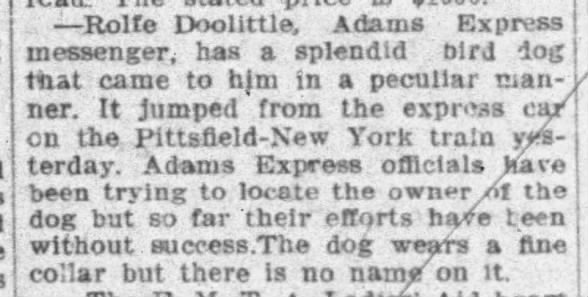
Thu, Feb 11, 1909 – 11 · The Berkshire Eagle (Pittsfield, Massachusetts) · Newspapers.com
— Rolfe Doolittle, Adams Express messenger, has a splendid bird dog that came to him in a peculiar manner. It jumped from the express car on the Pittsfield-New York train yesterday. Adams Express officials have been trying to locate the owner of the dog but so far their efforts have been without success. The dog wears a fine collar but there is no name on it.  --The Berkshire Eagle, February 11, 1909. 

Related posts