Showing posts with label Pierre. Show all posts

Tuesday, October 28, 2025

Melville's "Dilletante" reader of Dante in PIERRE

Likely inspired by negative mentions of "literary Dilettanti" and "Dilletantism" in the preface to John Aitken Carlyle's prose translation of Dante's INFERNO 

Illustration of Dante's Inferno Canto 6 by Giovanni Stradano, 1587.
Stradanus aka Jan van der Straet, Public Domain, via Wikimedia Commons
In Book IX of Pierre; Or, The Ambiguities (1852) Herman Melville alludes to "horrible allegorical meanings" in Dante's Inferno as something beyond the ken of a nameless hypothetical reader, clueless but happy, whom Melville or his narrator labels "the Dilletante in Literature": 
"Fortunately for the felicity of the Dilletante in Literature, the horrible allegorical meanings of the Inferno, lie not on the surface...."
In a similar contrast between naive and knowing readers, the "deeper significances" of Hamlet are said to elude "all but the rarest adepts." Melville fans will recognize in this section of Pierre a version of the contrast in Hawthorne and His Mosses between the "superficial skimmer" and a more discerning "eagle-eyed reader." In the "Mosses" essay, as here in Pierre, the thing supposedly missed by insufficiently attentive readers concerns the problem of evil. The "mystery of iniquity" is a major theme of Melville's later writings, too, especially his epic religious poem Clarel and the uncompleted novella, Billy Budd. 

The terrible truth, as Melville understands it, is the presence of evil in the very fabric of creation, which makes sin and misery ineradicable as well as universal. In this view, only by way of the darkest visions and doctrines--of Original Sin as conceived by Calvinists, of the creator as malicious demiurge according to Gnostics, of the Hindu goddess Kali, consort of Shiva the destroyer--may the truth about the elemental nature of evil be apprehended.

Otherwise, with respect to Dante's Inferno one would think the literal content is bad enough. It's literally Hell. What could possibly be more disturbing or "horrible" than graphic depictions of torture inflicted forever on the lost souls of human beings in nine successively worse Circles of Hell? In the most horrifying scene of all (Dante's Inferno Cantos 32-23), the shade of traitor Count Ugolino gnaws on the back of his betrayer's skull while both souls are hemmed in the same ice-hole. You have to wonder what business a dilettante would have with Dante in the first place. 

Tracing the influence of Dante in Mardi and Pierre, Dennis Berthold in American Risorgimento: Herman Melville and the Cultural Politics of Italy (Ohio State University Press, 2009) finds in Pierre a satire of the naive hero's "literary pretensions" and, more broadly, of the 19th century "Dante revival" in America, "which undoubtedly had its share of dilettantes" (page 138). Here Berthold called attention to cultural resonances evoked by "the Dilletante in literature," but the focus in American Risorgimento on Henry F. Cary's verse translation as Melville's source-text did not allow for consideration of any more precise borrowing. No form of dilettante occurs anywhere in Cary's Dante. More context, including previously unidentified textual prompts for Melville's dismissive handling of the literary "Dilletante," may help to explicate the main idea of this interesting passage.

Henry A. Murray in the 1949 Hendricks House edition at page 198 printed "Dilettante," correcting Melville's nonstandard spelling "Dilletante." Dr. Murray made no further editorial comment, except to observe in a professional way how deep-seated hostilities against the world may be interpreted as psychological "projections" by either the author or his fictional hero, or both (Introduction, xciii). Ignoring the emended form "Dilettante" adopted by Murray and others before him (in, for example, the 1923 Constable edition) the 1971 Northwestern-Newberry volume edited by Harrison Hayford, Hershel Parker, and G. Thomas Tanselle retained Melville's spelling "Dilletante" as an acceptable variant. 

Dilettante means "An admirer or lover of the fine arts" according to Noah Webster, An American Dictionary of the English Language (Harper & Brothers, 1848) page 295. The word occurs infrequently in Melville's writings. In the second volume of Mardi: And a Voyage Thither, the antiquary "Oh-Oh" is comically depicted as a “dilettante in things old and marvelous.” Oh-Oh's name reflects his irrepressible enthusiasm for the arts, and artifacts. As representative dilettante, however, his passion for great rarities is that of a collector who is merely a collector, having little knowledge or even interest in their real meanings, or expressions of truth and beauty. Keeping in character, he overvalues numerous pieces of trashy ephemera, but lets Babbalanja have a priceless manuscript on how to achieve "A Happy Life" (by the Polynesian Seneca, hence loaded with stoic wisdom) for nothing. 

To much the same effect, Melville's 1857-8 lecture on "Statues in Rome" began by contrasting the "technical" expertise of "the dilettante" with deeper, more personal and penetrating responses to great works of art:
"True, the dilettante may employ his technical terms; but ignorance of these prevents not due feeling for Art, in any mind naturally alive to beauty or grandeur."  
-- quoted here from the reconstructed text by Merton M. Sealts, Jr. in The Piazza Tales, and Other Prose Pieces, edited by Harrison Hayford, Alma A. MacDougall, G. Thomas Tanselle, and others (Northwestern University Press, 1987) page 398. 
Dilettante here is employed in the sense of "acknowledged expert," rather than "amateur" or "dabbler." Alternatively, "professional critic or connoisseur" as reported in several 19th century newspapers. A couple of published reviews have Melville using the plural form, dilettanti, still meaning something like "Art experts." 

In Mardi, Melville's comic portrayal of Oh-Oh as "an extraordinary old antiquary" draws on negative associations of dilettante with superficiality, frivolity, and indifference to marks of deep, enduring value. In Pierre Book IX the hypothetical "Dilletante" has an equally shallow understanding of great world literature, according to the narrator. Likely prompts for Melville's invocation of the literary "Dilletante" in Pierre may be found in the preface to a book Melville definitely owned or had access to, Dante’s Divine Comedy: The Inferno. A literal prose translation (New York: Harper & Brothers, 1849) by Dr. John Aitken Carlyle, younger brother of Thomas Carlyle. Digital versions are accessible online courtesy of HathiTrust Digital Library; and also via the Internet Archive: 
John A. Carlyle’s prose translation of Dante’s Divine Comedy: The Inferno is Sealts Number 173a in the searchable “Catalog of Books and Documents Owned, Borrowed and Consulted by Herman Melville” at Melville’s Marginalia Online. As there noted, we know Melville read at least part of it because he quoted “John Carlyle‘s version” of Canto 3, line 26 (“And sounds of hands among them”) in one of his annotations to Henry Francis Cary’s verse translation (Sealts Number 174). If Melville's ironic slight of "the Dilletante in literature" in Pierre were at all inspired by mentions of "literary Dilettanti" and "dilettantism" in Carlyle's preface, then Melville must have had either the 1849 first edition (English, by Chapman and Hall in London? or American, by the Harpers in New York?) or the 1851 reissue of Dante's Divine Comedy: The Inferno. A literal prose translation by John A. Carlyle, M.D. As in Melville's usage "Dilletante," occurrences of "Dilettanti" and "Dilettantism" capitalize the initial "D" in both the English and American editions. However, only Harper & Brothers give the spelling "Dilletantism" (page xxii). The closer parallel to Melville's spelling of the base word "Dilletante" would seem to favor the American edition as the one Melville consulted. 

Here below are four passages from the preface to John A. Carlyle's prose translation that individually or collectively might have influenced Melville's conception of "the Dilletante in Literature." Each example features a form of the base word dilettante. 

  1. "In the year 1831, being called to Italy by other duties, I first studied the Divina Commedia, under guidance of the most noted literary Dilettanti of Rome and other places. I heard them read it with wondrous gestures and declamation, and talk of it in the usual superlatives." -- John A. Carlyle, Preface to Dante's Divine Comedy: The Inferno, page iv

  2. "During the seven years which followed, I often studied it again, at leisure hours, along with the other works of Dante; and got intimately acquainted with various Italians of different ranks, who, without making any pretensions to literature, or troubling themselves with conflicting commentaries, knew all the best passages, and would recite them in a plain, sober, quiet tone—now rapid, now slow, but always with real warmth—like people who felt the meaning, and were sure of its effect. To them the Divina Commedia had become a kind of Bible, and given expression and expansion to what was highest in their minds. The difference between them and the Dilettanti seemed infinite, and was all the more impressive from the gradual way in which it had been remarked." Carlyle, Preface, v

  3. "But to return. Having thus acquired a clearer idea of the Poem, and got fairly beneath the thick encumbrances of Dilettantism and other encumbrances, which hide its meaning, I began to be convinced that the quantity of commentary, necessary to make the substance and texture of it intelligible, might be compressed into a much smaller space than had been anticipated." Carlyle, Preface, vii


  4. It is impossible to mention all the other commentaries of the 18th century. That of Lombardi, which appeared in 1791, is such as could be written by the honest effort of a whole life, amid the "dark wood" of Dilletantism produced by a host of idle writers; and one feels a real respect for the worthy Friar, though at times he is surprisingly naïve, or perhaps dull.... Most of the old commentaries on Dante are written with a kind of large complacency, and genuine though long-winded enthusiasm, which makes them very interesting at first sight ; but on closer inspection, they are found to contain a surprising quantity of worn-out rubbish, and extremely little real information.

    Preface, "Comments and Translations" pages xxi - xxii. As noted above, only the American edition by Harper & Brothers gives the spelling "Dilletantism" here. London editions in the same place (page xxx) make it "Dilettantism." 
The context in John A. Carlyle's preface could hardly be more relevant to Book IX of Pierre. Dr. Carlyle's concern with the problem of rightly interpreting Dante is nearly identical with that of Melville, or Melville's narrator. To be sure, Carlyle's "Dilettanti" do not come across as mere amateurs or dabblers of the type often implicated in usages that rely on negative connotations of the term dilettante. Rather, as Carlyle describes them, "literary Dilettanti" for the most part are Dante Experts of high repute. Their deficiency lies in attending more to boring minutia than meaning. Or in their enthusiasm for comparatively superficial matters of form, technique, and special poetic effects. According to Carlyle, readers with a deeper appreciation of Dante have zero literary expertise or "pretensions to literature." Along with a shared seriousness, the best readers of Dante take the Divine Comedy for "a kind of Bible." Such readers unaffectedly treasure Dante's great work as an expression of the highest classical values of truth, goodness, and beauty. 

With Dr. Carlyle, Melville in full truth-seeking mode presumably would prefer the interpretations of grounded, reality-based readers on the lookout for meaning and wisdom, and hopefully believing in the promise of salvation. Unfortunately, no fine insights into the true meaning of Dante avail the tragic hero of Melville's novel. Poor Pierre! He can't avoid his fate, once challenged to do right by Isabel Banford, allegedly his half-sister. Melville (as Berthold points out) withholds from his fictional hero any hope or even knowledge of Dante's journey through Purgatory to Paradise. Crusading for justice to Isabel, Pierre will abandon the Beatrice he already has in Lucy Tartan, his blonde-haired and blue-eyed sweetheart. (Lucy rebounds and heroically rejoins Pierre in the second half of Melville's novel, too late to save Pierre, his fake wife Isabel, or herself.) Back in Book IX, for now betrothed to Lucy but stuck between Dante's Hell and Shakespeare's Hamlet, Pierre experiences a psychic meltdown that leaves him "dabbling in the vomit of his loathed identity." 

More extensive debts to Dante in Pierre have been examined by G. Giovanni

 Giovannini, G. “Melville’s Pierre and Dante’s Inferno.” PMLA, vol. 64, no. 1, 1949, pp. 70–78. JSTOR, https://doi.org/10.2307/459670. Accessed 28 Oct. 2025.  

Giovannini, G. “Melville and Dante.” PMLA, vol. 65, no. 2, 1950, pp. 329–329. JSTOR, https://doi.org/10.2307/45947.

and Nathalia Wright 

Wright, Nathalia. “Pierre: Herman Melville’s Inferno.” American Literature, vol. 32, no. 2, 1960, pp. 167–81. JSTOR, https://doi.org/10.2307/2922675. 

G. Giovanni most helpfully connects the problem of interpreting Dante's profounder "allegorical meanings," as raised by the narrator in Book IX, with the "melodramatic violence" displayed by Pierre when "trampling on the torn pages of the Inferno." As Giovanni shows, the hero's behavioral and mental health crisis is precipitated by his new awareness of evil, beginning with the sins of his own father lately disclosed through Isabel's claim of shared paternity. 

Pierre's frustration on the sudden discovery of moral disorder is here roughly equated with Hamlet's; its ultimate source is the universalization of his father's moral lapse through "the horrible allegorical meanings of the Inferno." Limited in his experiential knowledge of the world, Pierre finds the form and generic significance of his particular perception of evil in the Inferno allegorically construed as a picture of life itself. The Inferno initiates Pierre into "that darker though truer aspect of things. 
"Melville's Pierre and Dante's Inferno," pages 75-76
... These references to the Inferno in first half of the novel, from the time when Pierre first sees Isabel to his pretended marriage and departure with her for the city, are closely coordinated with Pierre's development towards a realization of the ubiquity and universality of evil. Melville conceives Pierre's development within the sequence of his confrontations of the Inferno, and sees the poem metaphorically as an index of a naive idealism resentful of the existence of evil."  
"Melville's Pierre and Dante's Inferno," page 77

The effect of reading Dante and Shakespeare on poor Pierre, augmenting his new personal knowledge of worldly wickedness, is well summarized by Giovanni:

"...The fragments from the poets bring into focus a reality larger than Pierre's particular experience and central to the tragedy: evil is an integral part of existence, and the attempt to eradicate it must lead to tragic failure." 
"Melville's Pierre and Dante's Inferno," page 76

In Herman Melville: A Biography Volume 2, 1851-1891 (Johns Hopkins University Press, 2002) at page 435, Hershel Parker made reference to the "variant rendering of a line by John Carlyle" that Melville inscribed in his volume of Cary's Dante. Parker added, "in this case there is no other evidence that he had further knowledge of Carlyle's translation." Now, more than twenty years on, I am glad to offer multiple mentions of "Dilettanti" and "Dilettantism" or (as spelled on page xxii in the American edition by Harper & Brothers) "Dilletantism" as pretty good evidence that Melville read attentively in John Aitken Carlyle's preface--some time before the Harpers brought out Pierre in the summer of 1852. 

Worcester MA Spy - August 5, 1852

Wednesday, October 8, 2025

As a sailor might say

As a sailor might say by Scott Norsworthy

DRAGOONED: Writing, talking, and rewriting like Herman Melville in "Scenes Beyond the Western Border" (1851-1853). No. 3.

Read on Substack 


Thursday, March 27, 2025

PIERRE reviewed in Richmond WATCHMAN AND OBSERVER

As previously shown on Melvilliana
Moby-Dick received a perceptive though frequently negative review in the Richmond, Virginia Watchman and Observer (December 11, 1851), a Presbyterian weekly newspaper conducted by the Reverend Benjamin Gildersleeve. 

A similarly guarded but nonetheless insightful response to Melville's next book, Pierre; Or, The Ambiguities appeared in the Richmond Watchman and Observer on August 19, 1852. This item is not collected in Herman Melville: The Contemporary Reviews, edited by Brian Higgins and Hershel Parker (Cambridge University Press, 1995; paperback 2009). Found on genealogybank.com and accessible also via the Virginia Chronicle Digital Newspaper Archive. 

Richmond Watchman and Observer - August 19, 1852
via genealogybank.com
PIERRE, OR THE AMBIGUITIES—by Herman Melville. New York. Harper & Brothers. 1852. 12 Nos., pp. 495. Through Nash & Woodhouse.

If Mr. Melville had called his work the Ambiguities, it would have more nearly expressed our estimate of its character. It has the same cloudy, obscure aiming at something in the mist, and yet that mist often sunlit with crimson and gold, that characterises some of his recent works. There is a heated and unhealthy atmosphere pervading the book, that stifles and fevers the mind, and leaves an unpleasant impression upon it, even when there is nothing specially objectionable on which we can lay our fingers. On the whole, the book has made on us an unfavorable impression, in spite of the occasional passages of surpassing beauty that it contains, which have a dreamy loveliness that is peculiar to the pen of that strange child of genius.

Related post

Wednesday, January 15, 2025

MOBY-DICK and other books by Herman Melville reviewed in the Charleston SOUTHERN CHRISTIAN ADVOCATE

Rev. W.M. Wightman D.D.
Ed. of the Southern Christian Advocate

Found just this morning in the ginormous newspaper archives on genealogybank.com among articles added within 1 month, assorted Melville mentions including this previously uncollected notice of Moby-Dick; Or the Whale in the Charleston, SC Southern Christian Advocate for December 12, 1851. Edited in 1840-1854 by William May Wightman, the Southern Christian Advocate was published in Charleston, South Carolina by designated clergy on behalf of the Methodist Episcopal Church, South. 

The notice of Moby-Dick in the Southern Christian Advocate of December 12, 1851 offers three sentences of admirably balanced and original commentary, followed by a paragraph copied (with a few omissions) from the favorable review by George Ripley in Harper's New Monthly Magazine Volume 4 (December 1851) page 137.

Southern Christian Advocate - December 12, 1851
via genealogybank.com

RECENT PUBLICATIONS. 

MOBY-DICK; Or the Whale. By Herman Melville, Author of Typee, etc. New York: Harper & Brothers, 1851. 

This last book of Melville's is a curiosity. At times playful as a kitten, then solemn as a preacher; now a touch of transcendental philosophy, then a dash of bold, thrilling narrative; by turns picturesque, poetical, sportive, and stern in the iron grip of deep reflection;--this sea-story seems to puzzle the critics. Some pronounce it a failure, others consider it the most successful of the author's productions. We copy a paragraph from the notice given in Harper's Magazine:--In the course of the narrative the habits of the whale are fully and ably described. Frequent graphic and instructive sketches of the fishery, of sea-life in a whaling vessel, and of the manners and customs of strange nations are interspersed with excellent effect among the thrilling scenes of the story. The various processes of procuring oil are explained with the minute, painstaking fidelity of a statistical record, contrasting strangely with the weird, phantom-like character of the plot, and of some of the leading personages who present a no less unearthly appearance than the witches in Macbeth. These sudden and decided transitions form a striking feature of the volume. To a less gifted author, they would inevitably have proved fatal. He has not only deftly avoided their dangers, but made them an element of great power. --For sale by J. W. Stoy, Agent.

Where the review in Harper's magazine printed "with excellent artistic effect" the Southern Christian Advocate has "with excellent effect," omitting the word artistic. Also omitted, one sentence that came before the last one quoted in the Charleston notice: "Difficult of management in the highest degree, they are wrought with consummate skill." One result of these particular omissions could be to slight or subtly undermine the original emphasis on Melville's craftsmanship as a writer. On the other hand, the point may have been regarded as redundant and the omitted words cut mainly to save space. 

As a "bold, thrilling narrative" Melville's book evidently made a lasting impression on the editor, Rev. W. M. Wightman. In June of the following year, the Charleston Southern Christian Advocate reprinted the popular excerpt from Moby-Dick Chapter 61: Stubb Kills a Whale under the heading, "THE DEATH OF A WHALE." Correctly attributed at the end of the excerpt, in italics, to "— Herman Melville." 

Charleston, SC Southern Christian Advocate
June 11, 1852
Of the 20+ newspaper excerpts from chapter 61 that we know about, only this one in the Charleston, SC Southern Christian Advocate printed "...grinning furies" where the English and American first editions both had Stubb saying, "...grinning devils." In imagination, you could join the chase with Stubb and Tashtego, and even witness the horrible slaughter of the whale at the end of it, but you would not be exposed in the Southern Christian Advocate to the word devils as Melville used it in Stubb's exhortation to the crew of his whaleboat--too close to swearing, apparently. This was, after all, an official publication of the Methodist Episcopal Church, South. Still, although this version loses the alliteration between death and devils, grinning furies will do.

Early in September 1852, the Southern Christian Advocate weighed Melville's next book after Moby-Dick and found it wanting. 

Charleston, SC Southern Christian Advocate
September 3, 1852
PIERRE: Or the Ambiguities. By Herman Melville. New York: Harper & Brothers. 1852.

Whatever else may be ambiguous, it is clear enough that every reader of this last book of Mr. Melville, will vote it perfect trash. 

Previously on Wightman's watch, Melville had received much friendlier mentions in the Charleston Southern Christian Advocate, including mostly positive notices of Omoo on May 28, 1847; and White-Jacket on April 12, 1850.

***
OMOO: A narrative of adventures in the South Seas. By Herman Melville, Author of "Typee." Complete in two parts. New York: Harper & Brothers. 1847. 

This work is the production of no ordinary mind. The narrative is as deeply interesting as the style is brilliant. We are sorry the author gives so unfavourable an account upon the whole, of the South Sea Island missions. Yet there is a tone of exaggeration, an air of romance pervading the book, which induces the reader to take, with many grains of allowance, what is said respecting missionary operations. The author's account of Tahiti, and of Queen Pomaree, possesses singular interest. His sea-scenes are sketched with the precision and force of Cooper, and an Irving-like charm pervades his descriptions of Island life. For sale by J. W. Stoy, 50cts. a volume. 

-- Charleston, SC Southern Christian Advocate for May 28, 1847.

*** 

Charleston, SC Southern Christian Advocate 
April 12, 1850 via genealogybank.com
WHITE-JACKET: Or the world in a Man-of-War. By Herman Melville, Author of Typee, etc. New York: Harper & Brothers. 1850.

Mr. Melville is getting to be a voluminous writer. In this work he gives us his man-of-war experiences and observations during a year's service on board of a United States frigate as an ordinary seaman. Life in the naval service was never more graphically drawn; nor ever, we may add, has the romance been more completely cut out of the thing. Talk of slavery! the articles of war will tell you what it is:--of despotism! and "Capt. Claret" is its personification. Distant seems the day when nations shall have no use for the war-ship. Heaven speed the time:--but really the work of the world's conversion to the peaceable principles and spirit of the gospel, appears to be hardly begun.

-- Charleston Southern Christian Advocate for April 12, 1850. 

As best I can tell, the four book notices identified herein (of Omoo, White-Jacket, Moby-Dick, and Pierre) are all new finds; none is collected in Herman Melville: The Contemporary Reviews, edited by Brian Higgins and Hershel Parker (Cambridge University Press, 1995; paperback 2009). Now I have to add the Southern Christian Advocate notice to the inventory of Moby-Dick reviews in 1851-1852. Favorable or Mixed? The choice to quote from the laudatory Harper's review accentuates the positive, for sure. However, Rev. Wightman's notice begins with such an explicit recognition of dramatically different critical responses, it practically begs to be counted with the honorable undecideds. 

So be it! 👍👎

Related post

Saturday, January 11, 2025

Mr. Whipple, the Reviewer for GRAHAM'S MAGAZINE, 1849-1853


Graham's Magazine
for April 1853 offered a long and extremely favorable tribute to Edwin Percy Whipple, highly esteemed at the time as a leading American critic, essayist, and lecturer. 
Signed "J.G.D." (who's that?), the article is so full of extravagant praise, I could not help wondering if some of it was meant to be understood as satire. Reading again, allowing plenty of room for hyperbole, I take the writer to be fairly and squarely in Mr. Whipple's corner. Nonetheless, the style of writing displays a Melvillean delight in the play of language and use of literary and rhetorical devices (assonance and alliteration, bathos, antithesis, puns, innumerable allusions) for ironic or comic effects. However you regard the lionizing of E. P. Whipple in the April 1853 issue of Graham's, HERMAN MELVILLE is already in the house--thanks to "J. G. D." the author, who prefaces the article with an epigraph borrowed from the "Pleasant Shady Talk" of Melville's devil-possessed philosopher Babbalanja in the second volume of Mardi: and a Voyage Thither (1849):


EDWIN PERCY WHIPPLE.  

"The [True] critics are more rare than true poets. A great critic is a sultan among satraps; but pretenders are thick as ants striving to scale a palm after its aerial sweetness." — HERMAN MELVILLE.

From the jump then, "J. G. D." self-identifies as a genuine Melville aficionado. A fan even of Mardi❣ ❣❣ With this rarest of quotes for an epigraph, the claim for the greatness of Mr. Whipple as a literary critic will be argued in light of Melville's pronouncement on the scarcity of sultanic "true critics," as opposed to the plenitude of pretenders. This, in Melville's lofty palm of a book which the pretentious ant-critics had striven mightily to scale, and hate on. Outside of Mardi itself, the chosen quotation appears nowhere else in the gigantic digitized collection of searchable works at HathiTrust Digital Library until 1921, when Raymond M. Weaver used it in the landmark biography Herman Melville, Mariner and Mystic (New York: George H. Doran Company). 

Now for a sample of the author's entertaining prose style, at once bluff yet abundantly expressive, being rich in creative word choices, metaphors and conceits: 

  • Mr. Whipple "is all free from the supple superciliousness and the common cant, strut, swagger, twaddle, and conceit of reviewing." (page 448)
  • Interesting military metaphor here--bordering on astronomy, as in Dupont's Round Fight, one of Melville's Civil War poems in Battle-Pieces: "None of his faculties ever sally out foraging or frolicking on their own account, but are all marshaled in orderly array, and move together in unity." (448)
  • "Between the motion of Mr. Whipple's thoughts and those of most men, there is about the same difference as between the movements of a catamount and a caterpillar." (449)
  • Whipple's brand of criticism "gives no quarter to vapid and pithless pretension, overweening fatuity, genteel immorality, saint-seeming hypocrisy, or silly slim flimsiness; he especially whips all vulgar elegant idlers and foul fools, all wanton literary aggressors--whether they carry a pike against a man, or only a pique--" (450)
  • "neat as a nut" (450)
  • "to stir a saint... or tickle a cultivated sinner" (451)
  • "He is neither a mystic nor a worldling...." (451)
  • "earnest as an ancient prophet, and sharp as a pick-pocket.” (451)
  • "True genius is the transfiguration of common sense, and not the annihilation of it." (452)

Late in the article, "J.G.D." scorns the "intense inanity" exhibited in the patronizing London Athenæum review (November 22, 1851) of Whipple's collected lectures on Literature and Life (Boston, 1850):

"It is very questionable whether blind noodles, boobies and snobs are the fit persons to judge of works of genius;--and the London Athenæum, if that be a fair sample of its literary verdicts, may safely be set down as a remarkably owly concern."

This deliciously worded dismissal of "literary verdicts," plural, handed down by transatlantic "noodles,  boobies and snobs," also plural, might easily be applied to the influentially bad review of The Whale as "an ill-compounded mixture of romance and matter-of-fact," published the month before in the same English journal.

To be sure, the excessive, zestful, over-the-top style adopted by "J. G. D." is not suited to everybody's taste. One fellow-journalist in Philadelphia complained of the "rhapsody of adjectives" loosed in the "High Falutin" tribute to Mr. Whipple. 

Pennsylvania Freeman - April 7, 1853
"HIGH FALUTIN." -- A writer in the last number of Graham's Magazine, goes into a rhapsody of adjectives, over the merits of Mr. Edwin P. Whipple. Here are specimens: 
"His integral character, the vast but facile and benign power of his nature," has hitherto received but a "slim appreciation." He has an "ethereal, colossal, and commanding intellect,--a sturdy, circumspective, foresightful, spirit-piercing sagacity;" and as a "lucid and reliable, racy and candid and decisive" "interpretative critic," he is "the most obviously excellent and most widely known." His style is "most affluent, clear, terse, plastic, pictorial, philologically perfect, and correct to a comma."

There; that is enough for our readers at once. We pity those who have to take the whole at one dose.  -- Philadelphia, Pennsylvania Freeman, April 7, 1853
But hold up. Can it really be, that this sultan of 19th century lit crit never said a mumbling word in public about any work by Herman Melville? Come to think about it, how in the world could "J. G. D." have endorsed Mr. Whipple so effusively and exclusively, indulging in such a "rhapsody of adjectives," if said Mr. Whipple had never stooped to review Melville's Mardi, that portentous allegory from which the singularly rare epigraph to the article on "Edwin Percy Whipple" derives? 

As Hugh Hetherington harrumphed in a footnote to Melville's Reviewers: British and American, 1846-1891 (University of North Carolina Press, 1961), with explicit reference to the praise for Whipple's superior "intellect" in the 1853 article in Graham's,
"This great mind does not seem to have shown any awareness of the existence of Melville." (Melville's Reviewers, page 9)

In stark contrast to the seemingly indifferent Mr. Whipple of Boston with his presumed neglect of Melville's genius, Hetherington proposes Bayard Taylor as the "real Melville enthusiast" who penned the remarkably sympathetic reviews in Graham's Magazine of Mardi (June 1849) and Redburn (January 1850).

Hetherington's conjectural assignment of these two reviews in Graham's to Bayard Taylor would not be adopted in subsequent collections of Melville reviews. Although Bayard Taylor did serve briefly as nominal editor of Graham's and continued to submit occasional pieces, the contributions of Taylor and other big-name authors were credited to attract more readers and hopefully increase sales of the magazine. Hetherington's chief authority for information about Graham's is Frank Luther Mott, A History of American Magazines, 1741-1850 (New York, 1930). The first volume of Mott's History incorporates findings published in his earlier study, A Brief History of 'Graham's Magazine'.

  • Mott, Frank Luther. “A Brief History of ‘Graham’s Magazine.’” Studies in Philology, vol. 25, no. 3, 1928, pp. 362–74. JSTOR, http://www.jstor.org/stable/4172007. Accessed 10 Jan. 2025.

Mott emphasized the limited role of Taylor who even in 1848 "was never more than a contributing editor." Also in the earlier study, Mott placed Mr. Whipple in the corps of regular contributors to Graham's, as reorganized in 1849-1850: "Edwin P. Whipple wrote articles and reviews." 

Boston Evening Transcript - August 20, 1850
via newspapers.com
Whipple's role as "the Reviewer" for Graham's magazine in this period was openly acknowledged in a newspaper article first published in the Oswego NY Commercial Times and reprinted in several Massachusetts newspapers. (Published in Oswego, New York by James N. Brown, the Commercial Times on November 26, 1851 plugged Moby-Dick as a "welcome" new book, "written with considerable spirit" and loaded with "wit and humor.") The earliest reprinting of "MR WHIPPLE, THE REVIEWER" I have found so far appeared under that heading in the Boston Evening Transcript of August 20, 1850. 

Boston Emancipator & Republican - August 29, 1850
via genealogybank.com
Possibly Whipple himself had supplied a good deal of useful information about his life and literary career to the anonymous writer of "Mr. Whipple, the Reviewer." Some of the same biographical details are disclosed in extant letters from Whipple to Rufus W. Griswold, accessible online via Digital Commonwealth. As stated in the unsigned newspaper article, the recent two-volume collection of Whipple's Essays and Reviews (New York: D. Appleton, 1850) reprinted many pieces that had originally appeared in the prestigious Boston quarterly, the North American Review. Also just out at the time, the aforementioned volume of Whipple's Lectures on Subjects Connected with Literature and Life (Boston: Ticknor, Reed, and Fields, 1850), the English reprint of which would get ridiculously undervalued according to "J.G.D." by condescending twits ("blind noodles, boobies and snobs") at the London Athenæum. 

Salem, Mass. Register - September 15, 1850
via genealogybank.com
What's new, and crucial for the investigation now underway, is the public acknowledgement of Mr. Whipple's generally unheralded work for George Rex Graham of Philadelphia:
"For several years past, the Critical Notices in Graham's Magazine, have been written by Mr. Whipple. He despatches this description of writing with astonishing facility, entire faithfulness, and unerring judgment."
A bit more casually, the National Era listed the unsigned "critical Notices by Mr. Whipple" among "especially commendable" highlights in the August 1850 issue of Graham's Magazine, alongside credited contributions of a poem by Bayard Taylor and a short story by Caroline Chesebro. In this issue Whipple had also contributed the long essay on Wordsworth over the initial "P." for his middle name, Percy. Presumably when speaking of unspecified, plural "critical notices" the Washington, D.C. National Era editor refers to the section near the end of each monthly installment in Graham's, usually titled "Review of New Books."
Washington, D. C. National Era - August 8, 1850
By 1850, according to the promotional newspaper item featuring "Mr. Whipple the Reviewer," Whipple had obtained at least two years of experience in the role of reviewer at Graham's, having "for several years past" been responsible for producing "the Critical Notices in Graham's Magazine." 

Writing from Boston on April 26, 1847 about his slot in the proposed volume on the Prose Writers of America, Whipple modestly instructed editor Rufus W. Griswold to 

"leave out of your notice of me, all biographical matter except the time when and the place where I was born, and the fact that I am engaged in Commercial pursuits. Cut out likewise the tremendous puff about my style being Milton and Addison fused together."
I'm guessing Griswold had little time to oblige these requests even if he wanted to. At any rate, Whipple still comes last in the published arrangement of authors, against his wishes. And Griswold's fulsome intro still includes the biographical tidbits and this "tremendous puff" that Whipple asked to be dropped:

"Though he is no copyist, some of his articles suggest a fusion of the strength of the Aeropagitica with the ease and liveliness of the Spectator."

At the close of the same letter Whipple chastised Griswold for his "shabby genteel damnation" of Cornelius Mathews. Good heavens! too bad Perry Miller did not have this passage to enrich his classic study The Raven and the Whale (New York: Harcourt, Brace and Company, 1956):

I am glad to hear that you are well. I am sorry that Duyckinck published that article in the World. It is very one-sided and harsh. However you drew down the lightning on your own head by your shabby genteel damnation of Mathews. I always make it a rule never to join in when there is a cry of condemnation against a fellow creature and author. Mathews has not had justice done him, and therefore he is to be tenderly touched. You may depend upon it that his influence across the water will be against you if you do not modify your criticism upon him. I wish you would take out some of the eulogy on me and put it on to Cornelius. You would not, in that case, increase the aggregate of your praise. 

-- Edwin Percy Whipple, Boston, MA., autograph letter signed to R. W. Griswold, 26 April 1847. < >

Besides the 1850 newspaper item already cited herein, additional evidence of Whipple's role as the Reviewer for Graham's can be found in his extant letter to R. W. Griswold of January 6, 1849 (misdated 1848 by Whipple, writing early in the first month of the New Year 1849).

"I have not yet had time to scrutinise your last books, Sacred and American. They look very well, and the Female Poets, especially, has amazed me by its research. I shall notice both in Graham's.

I am glad you like the Essays and Reviews. I see that they are beginning to blackguard me in New-York; and in Phila. I have been treated very shabbily. They seem to be apprehensive that the book will prove interesting to the public." 
-- Edwin Percy Whipple, Boston, MA., autograph letter signed to R. W. Griswold, 6 January 1849. Boston Public Library, Rufus W. Griswold Papers, 1834-1857. Accessible online via <>

Whipple refers here in a kind of shorthand form to just-published anthologies edited by Griswold, The Sacred Poets of England and America and The Female Poets of America. Fulfilling Whipple's written promise to Griswold in January, the Review of New Books department in the March 1849 issue of Graham's (now going as Graham's American Monthly Magazine of Literature and Art) included substantial, favorable notices of both new books. 

Graham's American Monthly Magazine - March 1849

🎆🎇

Strongly confirming the identity of Mr. Whipple as the author of anonymous critical notices in Graham's, only three months before the appreciative take on Melville's third book Mardi: and a Voyage Thither graced page 385 of the June 1849 issue.  

🎇🎆

Graham's American Monthly Magazine - June 1849

Therefore, the Graham's reviewer of Mardi (and Redburn, too) who impressed Hugh W. Hetherington as a "real Melville enthusiast" was not Bayard Taylor, but Edwin Percy Whipple.

Mopping up, we may as well credit Mr. Whipple, verified reviewer at Graham's Magazine, with subsequent notices there of Mobby-Dick; or the Whale (with Moby misspelled Mobby in February 1852) and Pierre; or the Ambiguities (October 1852). Well, it's not so much of a stretch, after all. As long known in Hawthorne scholarship, Edwin Percy Whipple also wrote friendly reviews of Hawthorne's works in Graham's: of The Scarlet Letter in May 1850; The House of the Seven Gables in June 1851; The Snow Image in April 1852; The Blithedale Romance in September 1852; and Tanglewood Tales in September 1853. These items are all inventoried by Gary Scharnhorst in Nathaniel Hawthorne: An Annotated Bibliography of Comment and Criticism before 1900 (Metuchen, N. J., & London: The Scarecrow Press, 1988) and ascribed there to Edwin Percy Whipple.

Whipple's tenure at Graham's extended from 1849 to 1853, according to William Charvat in The Profession of Authorship in America, 1800-1870, edited by Matthew J. Broccoli (Ohio State University Press, 1968). Focused mainly on the genial influence of Whipple's old friend James T. Fields, Charvat portrays the Graham's reviewer as
"...an irresistible object of the celebrated charms of James Fields. who saw to it that Whipple met, and remained in permanent social relations with, as many Ticknor and Fields authors as possible. It is not surprising that these were the subject of a majority of Whipple's unsigned reviews in Graham's between 1849 and 1853" (Profession of Authorship, page 177).
More work remains to be done, of course. I don't automatically suppose Whipple wrote the positive notice of Typee in the May 1846 number of Graham's. Then again, our man allegedly began contributing to newspapers and magazines at the age of fourteen, so who knows? Born March 8, 1819 (five months before the birth of Herman Melville on August 1st of the same year), Edwin Percy Whipple turned 15 in 1834. By the time Melville published his first book. Whipple had already made a name for himself as a reviewer to be reckoned with. Positive identification of Mr. Whipple as sympathetic reviewer of Mardi, Redburn, Moby-Dick, and--recognizing exceptional "force and subtlety of thinking and unity of purpose" in scenes "wrought out with great splendor and vigor"--of Pierre as well, invites further study of Whipple's writings. 
At first glance a number of Whipple's favorite subjects and themes emerge in the four Melville reviews published during his tenure as the writer of critical notices for Graham's Magazine, particularly his interest in revelations of a writer's mind or "mentality," of peculiar traits or signs of personal "individuality," and evidence of spirit and original genius.

Sad to say, I have yet to answer the question I started with. Who is "J. G. D."? Inquiring minds etc.

Links to some available bios of Edwin Percy Whipple


Tuesday, March 5, 2024

Footnote on pelican-beach

'Tis barren as a pelican-beach.* 

* barren as a pelican-beach. The simile in the third line of In the Prison Pen compares the locale of a Southern prison to a remote hellscape or wasteland, figuring its forlorn captives as a penal colony of sorrowful-looking and probably starving pelicans. Evoking the biblical "pelican in the wilderness," as the afflicted, physically emaciated supplicant calls himself in Psalm 102.6, the imagery here draws also from a cluster of pelican associations in other writings by Melville, especially Pierre; Or, The Ambiguities (1852) and "The Encantadas, or Enchanted Isles" (1854). Typically Melville regards the appearance of pelicans as lugubrious = mournfully sad. To his eye their angular forms and frequently empty pouches make them look eternally lean and hungry. In Pierre Melville's narrator likens poor, miserably undernourished philosophers and social reformers (lined up on the curb outside a diner) to "lean rows of broken-hearted pelicans on a beach; their pockets loose, hanging down and flabby, like the pelican’s pouches when fish are hard to be caught." Pelicans in "The Encantadas" are depicted as sad, "penitential," oddly immobile and ghostly endurers of Job-like suffering in the Galápagos Islands:
But look, what are yon wobegone regiments drawn up on the next shelf above? what rank and file of large strange fowl? what sea Friars of Orders Gray? Pelicans. Their elongated bills, and heavy leathern pouches suspended thereto, give them the most lugubrious expression. A pensive race, they stand for hours together without motion. Their dull, ashy plumage imparts an aspect as if they had been powdered over with cinders. A penitential bird indeed, fitly haunting the shores of the clinkered Encantadas, whereon tormented Job himself might have well sat down and scraped himself with potsherds. -- The Encantadas, or Enchanted Isles - Sketch Third, Rock Rodondo in Putnam's Monthly for March 1854; reprinted in The Piazza Tales (1856) at page 309.
Thus represented in military and monastic metaphors as "wobegone regiments" of pitifully sad and abandoned creatures arranged in "rank and file," Melville's battle-worn and scourged penitents of pelicans seem the very emblem of suffering in captivity. Suggestive analogues can be found in published works by other writers, notably The Pelican Island (1827) by James Montgomery and Thomas Beale's The Natural History of the Sperm Whale (1839), both quoted (for different reasons, not directly connected with pelicans) in the Extracts section of Moby-Dick. 

Closer to home, geographically, lurks a possible local allusion. The depiction of Virginia's Belle Isle Prison in the James river across from Richmond as "a low, sandy, barren waste, exposed in summer to a burning sun, without the shadow of a single tree" in the 1864 report by the U. S. Sanitary Commission, Narrative of Privations and Sufferings of United States Officers and Soldiers while Prisoners of War in the Hands of the Rebel Authorities, may have reminded Melville of "Barren Island," mostly "a sand-bank known as Pelican beach." So described in multiple editions of Appleton's Dictionary of New York and Its Vicinity. 


Whatever else it may suggest, Melville's pelican imagery as adapted to "In the Prison Pen (1864)" figuratively represents the maltreated prisoner in his place of confinement. Through allusion to the "pelican of the wilderness" in Psalm 102, Melville's pelican-beach simile links the emaciated body of the psalmist to the emaciated bodies of Union soldiers released from Belle Isle and other Southern prisons, pictured in words and engraved images as "living skeletons" in the 1864 Narrative of Privations and Sufferings.


Related post

Sunday, May 28, 2023

Where is Melville?

A Man of the Sandwich Islands, with his Helmet
© National Maritime Museum, Greenwich, London

Disappointed with Kiana: A Tradition of Hawaii (1857) by James Jackson Jarves, one contemporary reviewer complained that "Romance plainly is not Mr. Jarves' forte" and wondered,

"Where is Melville?"

Surely the author of Typee, Omoo, and Mardi would have made a more entertaining story out of the same Polynesian material. 

A newspaper clipping of the 1857 Kiana review was kept by the Melville family and eventually deposited at Harvard. I'm guessing it's still there:

 Jay Leyda put it in The Melville Log Volume 2 on page [583]:

Cited in the back of Volume 2 as "clipping, HCL-M" = "Papers & library of the Melville family, Harvard College Library."

Leyda got the place (Boston) right, along with the correct month (September) and year (1857) of the newspaper clipping. For those who care about such things, I'm happy to supply the missing name and date of the newspaper in which this interesting query appeared. Transcribed below, from the Boston Daily Traveller of September 14, 1857:

Boston Daily Traveller - September 14, 1857
 
Mr. Jarves' well known books--Parisian and Italian Sights--led us to look with favor upon anything coming from his pen. We are sorry to be disappointed in KIANA, a Tradition of Hawaii, just published by Munroe & Co. Romance plainly is not Mr. Jarves' forte. He had a charming subject, susceptible of the highest style of treatment in this difficult province of fiction. There is a tradition among the people of the Sandwich Islands, that during the reign of Kiana, eighteen generations of kings previous to Kamehameha I., a white priest came among them with an idol and a new god, lived with them long, and dying, left a reputation for goodness that was green in the memories of the Hawaiians three centuries later. The date of this tradition synchronizes with that of the loss of two vessels sent by Cortez upon an exploring expedition to California. Mr. Jarves supposes the possible identity of the white strangers of Hawaii with the missing adventurers of Cortez, and from this fertile source derives the materials for his story. 
 
With such a beginning one might look for a romance equal to Mayo's Kaloolah or Melville's Omoo and Typee. The field is illimitable, the colors of every hue, and the license ample, only the skill of the romancer was wanting. It is a pity so good a piece of canvass should be spoiled. Where is Melville? Will he not leave the mazes of Pierre or the Ambiguities, and the eccentricities of the Confidence Man, and with some such charming tradition as this bring back the days and the delights of beautiful Fayaway, or take us voyaging to another Mardi. -- Boston Daily Traveller, September 14, 1857.
 
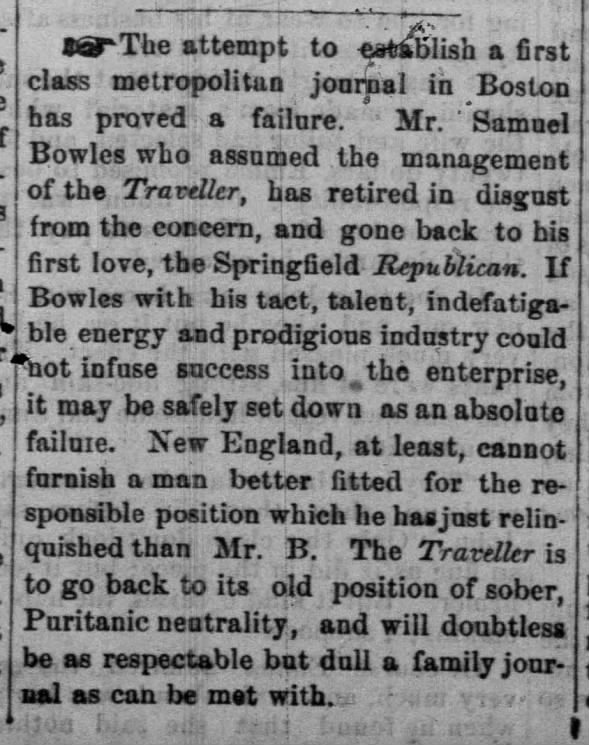
Emily Dickinson's friend Samuel Bowles of the Springfield, Mass. Republican had served as editor of the Boston Traveller since April 1857. In Springfield, Bowles was formerly assisted by Melville's "friendly critic" Josiah Gilbert Holland, so identified by Jay Leyda:
  • Leyda, Jay. “Another Friendly Critic for Melville.” The New England Quarterly, vol. 27, no. 2, 1954, pp. 243–49. JSTOR, https://doi.org/10.2307/362806. Accessed 28 May 2023.  
After a short tenure as editor of the Traveller, Bowles would reclaim his position as editor of the Springfield Republican.
 
The departure of Samuel Bowles as editor of the Traveller was announced on September 10th in the Boston Evening Transcript. Possibly the Kiana review on September 14, 1857 was one of the last literary pieces that Bowles contributed or supervised as editor of the Boston Traveller. 

Where is Melville?

In the Boston Traveller Bowles or somebody wondered, "Where is Melville?" We might be able to answer the question, now that we know the date on which it appeared in print. Where WAS Herman Melville on September 14, 1857? Back home in Pittsfield, Mass., brainstorming lecture topics, as he revealed the next day in a letter to George W. Curtis:

-- I have been trying to scratch my brains for a Lecture. What is a good, earnest subject? "Daily progress of man towards a state of intellectual & moral perfection, as evidenced in history of 5th Avenue & 5 Points."
Even better, brainstorming lecture topics and satirizing utopian schemes of famous communists after reading Robert Owen:
By the wondrous and, hitherto, mysterious organic construction of man and woman, the adults of the first generation that shall acquire a practical knowledge of their own powers to re-form the matured character of each individual, will be enabled, almost to re-create the character of succeeding generations; to re-create it by training each individual from birth, by a new and very superior arrangement of external circumstances, to have a sound physical constitution, to have superior dispositions, habits and manners, to have much valuable knowledge, and to make a daily progress towards physical, intellectual and moral perfection.

-- Robert Owen, The Book of the New Moral World (London, 1836) page 103.

Robert Owen, Esq. via NYPL Digital Collections
 
Melville's words and phrasing, specifically the stipulation of "daily progress" in the march "towards" a condition of "intellectual and moral perfection" are Robert Owen's in The Book of the New Moral World (London, 1836). "Subjects: Communism" as catalogued by HathiTrust Digital Library. 
 
As it turned out, the real lecture Melville composed on Statues in Rome was delivered in Boston on December 2, 1857 and reported the next evening in the Boston Evening Traveller. Traces of Melville's epistolary parody of Owen linger in his reference to the utopian "scheme of Fourier" that had yet to dissolve the need for a whole code of laws against criminal conduct. 

Related posts