Showing posts with label Liverpool. Show all posts

Monday, March 6, 2023

"King of the Oaks" in REDBURN and Amasa Delano's NARRATIVE

The borrowed description of teak wood as "the King of the Oaks" in Chapter 34 of Herman Melville's  Redburn indicates that by summer 1849 at the latest, Melville already owned or had access to a copy of the Narrative of Voyages and Travels by Amasa Delano. Melville got the purportedly oriental phrase "king of the oaks" from Delano's description of Bombay in chapter 12. Six years later, Melville would remake chapter 18 of Delano's Narrative into the 1855 thriller, Benito Cereno.

Arrived in Liverpool, Melville's narrator Wellingborough Redburn visits a large merchant ship from Bombay named the Irrawaddy.

AMONG the various ships lying in Prince's Dock, none interested me more than the Irrawaddy, of Bombay, a "country ship," which is the name bestowed by Europeans upon the large native vessels of India. Forty years ago, these merchantmen were nearly the largest in the world ; and they still exceed the generality. They are built of the celebrated teak wood, the oak of the East, or in Eastern phrase, "the King of the Oaks." -- Redburn Chapter 34 - The Irrawaddy

For the factual substance of the Irrawaddy chapter, Melville creatively plagiarized from the Penny Cyclopaedia entry for Tectona, as Willard Thorp first discovered. 

Thorp's findings are summarized by Hershel Parker in the Historical Note for the 1969 Northwestern-Newberry edition of  Redburn. Mary K. Bercaw documents additional borrowings from the Penny Cyclopaedia in Redburn and other novels in "The Infusion of Useful Knowledge: Melville and The Penny Cyclopaedia," Melville Society Extracts 70 (September 1987) pages 9-13. 

TECTONA in the Penny Cyclopaedia supplied Melville's phrase "oak of the East"

https://books.google.com/books?id=GxwDAAAAYAAJ&pg=RA3-PA141&dq#v=onepage&q&f=false

but besides the narrator of Redburn, only Amasa Delano calls teak wood "the king of the oaks."

Amasa Delano, Narrative of Voyages and Travels (Boston, 1817) page 213.
The people of Bombay have many large ships of their own. The largest merchant ships in the world are built there, and belong to the commercial capitalists of the town. The ship builders are all natives, and are pre-eminent in their profession. They build many ships of the teak wood, which they call the king of the oaks, and which they procure from Pegu. It is as large as our largest oaks, the timber very straight, free from knots, and excellent for planks. I have seen it grow fifty feet before a limb shoots from the trunk. Some of them are three feet in diameter. There is another kind of tree, which is called there sissor-wood, and which is the best in the world for the crooked timber required in ships. It is extremely hard and durable. -- Amasa Delano, Narrative of Voyages and Travels (Boston, 1817). 

https://books.google.com/books?id=34QqAQAAIAAJ&pg=PA213&dq#v=onepage&q&f=false

Like Delano, Melville's narrator emphasizes the size of merchant ships built in India:

"these merchantmen were nearly the largest in the world" - REDBURN

"... largest merchant ships in the world" - DELANO

Delano also names Pegu as the place for getting teak...

"I thought I was in Pegu, so strangely woody was the smell of the dark-colored timbers...." (REDBURN)

"... which they procure from Pegu." (DELANO)

But Redburn's sensory experience of the "woody" odor seems, like the name of the Bombay vessel, to have been inspired by the "forests" of teak "along the banks of the Irrawady, especially in Pegu" as described in the Penny Cyclopaedia entry TECTONA. Same goes for the expression "oak of the east," also found in TECTONA, the Penny Cyclopaedia entry first identified by Willard Thorp as Melville's source for the Irrawaddy chapter in Redburn. Not "King of the Oaks" though. Searches on Google Books and HathiTrust Digital Library yield only two works containing the phrase "the king of the oaks" before 1850: Delano's Narrative and Melville's Redburn. In old British newspapers, teak as "king of the oaks" appears only in excerpts from Redburn Chapter 34, sometimes (as in the London Guardian for November 2, 1850 and Liverpool Mercury on November 5, 1850) headed

A BOMBAY "COUNTRY SHIP."
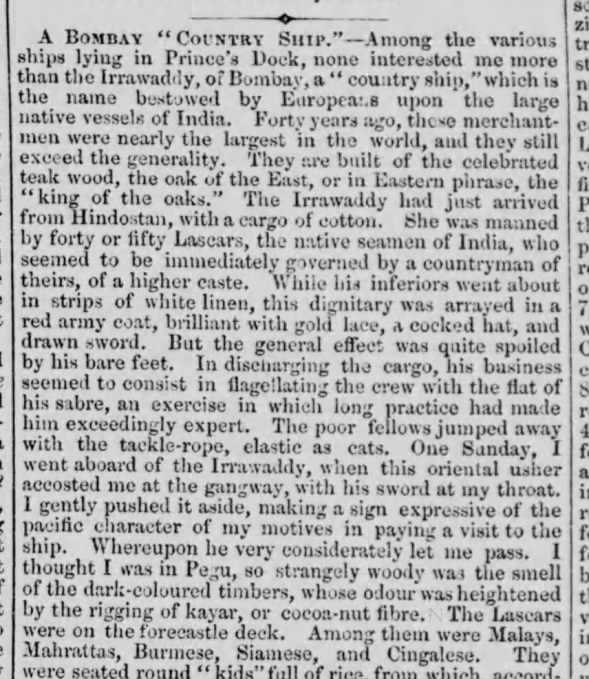

05 Nov 1850, Tue Liverpool Mercury, etc. (Liverpool, Merseyside, England) Newspapers.com

Delano's Narrative is Number 200 in Mary K. Bercaw's 1987 checklist of Melville's Sources. In previous Melville scholarship, possible literary debts to Delano outside of Benito Cereno have been identified in White-Jacket (1850) and The Encantadas (1854). And, more questionably, in Typee (1846). Hershel Parker speculates in the second volume of Herman Melville: A Biography (Johns Hopkins University Press, 2002) that Melville might have encountered Captain Amasa Delano's Narrative by 1847, in time for use in Mardi (1849). Listed as "Delano's Voyages and Travels" in the 1828 Catalogue of Books in the Albany Library, page 23

 and so indexed in the 1838 and 1850 Catalogue of the New York Society Library.

With further study, more traces of Melville's reading in Delano's Narrative may turn up in Redburn and elsewhere in Melville's published writings.

Ship Pascoa under sail, 1st August 1832, China Sea
Chinese School, 19th Century, Public domain, via Wikimedia Commons

 Further reading

Related post

Thursday, September 9, 2021

Communism defined in 1849

IMAGE © THE BRITISH LIBRARY BOARD. ALL RIGHTS RESERVED.

COMMUNISM DEFINED.-- "The other day," says the Constitutionnel, "a workman was declaiming in the midst of a group against communism. One of the group said, 'You talk against communism, and you do not even know what it is.' The workman said nothing in reply at first, but taking off his blouse he tore it into fragments, and, after giving a portion to each of the persons present, he said, 'Communism, my friends, has for its object to make of what may be very useful to one person a collection of morsels which are useful to nobody.' "

Quoted from the French periodical Le Constitutionnel, this practical illustration of equity under communism appeared in the Liverpool Albion for October 15, 1849, on the same page with a long excerpt from chapter 33 of Melville's Redburn, headed "The Shipping of the Mersey." Found on The British Newspaper Archive. The Albion reprinted additional excerpts from Melville's latest novel on October 22 ("Scenes By the Dockside," from Redburn chapter 34); October 29 ("A Reminiscence" from Redburn chapter 36); November 5, 1849 ("Dockside Beggars" from Redburn chapter 38); November 12 ("Shipping a Dead Sailor" from Redburn chapter 47 and "Evading the Customs" from Redburn chapter 40); and November 19, 1849 ("Dockside Horses" also from Redburn chapter 40).


Tuesday, July 16, 2019

Ebenezer Knight, 1811-1853

The First Voyage by H. C. K.
The Child's Paper - March 1854
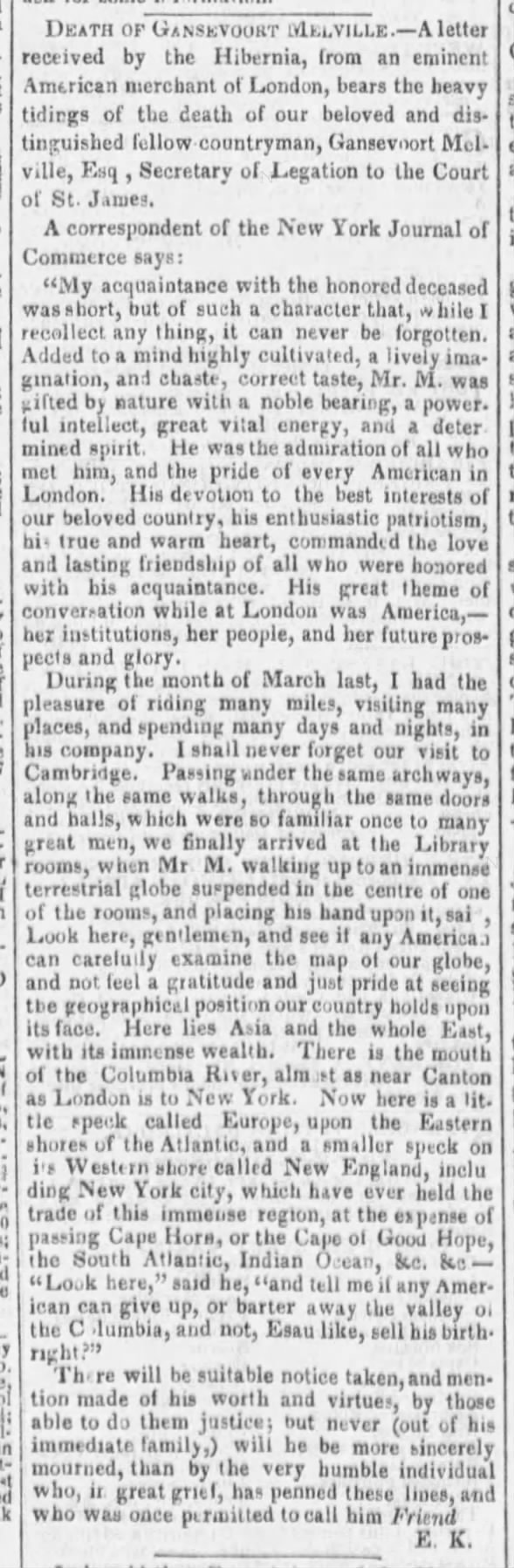
The 3rd Norton Critical Edition of Moby-Dick, edited by Hershel Parker, excerpts the vivid 1846 reminiscence of Gansevoort Melville by Captain E. Knight (page 464). Captain Knight had accompanied Gansevoort with two others on a visit to Cambridge, England. The entry for Saturday, March 14th in Gansevoort's 1846 London Journal, edited by Hershel Parker (The New York Public Library, 1966), records their trip by 2nd class rail which included a tour of Trinity College Library. No mention there of any globe, large or small. According to Knight, however, Gansevoort made dramatic use of "an immense terrestrial globe suspended in the centre of one of the rooms," invoking the biblical story of Jacob and Esau to claim Oregon and California as America's "birthright."

Reminiscence of Gansevoort Melville (Herman's older brother) in Cambridge, England.Reminiscence of Gansevoort Melville (Herman's older brother) in Cambridge, England. Fri, Jun 5, 1846 – 1 · The Baltimore Sun (Baltimore, Maryland) · Newspapers.com
DEATH OF GANSEVOORT MELVILLE.-- A letter received by the Hibernia, from an eminent American merchant of London, bears the heavy tidings of the death of our beloved and distinguished fellow countryman, Gansevoort Melville, Esq, Secretary of Legation to the Court of St. James.

A correspondent of the New York Journal of Commerce says :

"My acquaintance with the honored deceased was short, but of such a character that, while I recollect any thing, it can never be forgotten. Added to a mind highly cultivated, a lively imagination, and chaste, correct taste, Mr. M. was gifted by nature with a noble bearing, a powerful intellect, great vital energy, and a determined spirit. He was the admiration of all who met him, and the pride of every American in London. His devotion to the best interests of our beloved country, his enthusiastic patriotism, his true and warm heart, commanded the love and lasting friendship of all who were honored with his acquaintance. His great theme of conversation while at London was America,-- her institutions, her people, and her future prospects and glory. 
During the month of March last, I had the pleasure of riding many miles, visiting many places, and spending many days and nights, in his company. I shall never forget our visit to Cambridge. Passing under the same archways, along the same walks, through the same doors and halls, which were so familiar once to many great men, we finally arrived at the Library rooms, when Mr M. walking up to an immense terrestrial globe suspended in the centre of one of the rooms, and placing his hand upon it, said, Look here, gentlemen, and see if any American can carefully examine the map of our globe, and not feel a gratitude and just pride at seeing the geographical position our country holds upon its face. Here lies Asia and the whole East, with its immense wealth. There is the mouth of the Columbia River, almost as near Canton as London is to New York. Now here is a little speck called Europe, upon the Eastern shores of the Atlantic, and a smaller speck on its Western shore called New England, including New York city, which have ever held the trade of this immense region, at the expense of passing Cape Horn, or the Cape of Good Hope, the South Atlantic, Indian Ocean, &c. &c-- "Look here," said he, "and tell me if any American can give up, or barter away the valley of the Columbia, and not, Esau like, sell his birthright?" 
There will be suitable notice taken, and mention made of his worth and virtues, by those able to do them justice; but never (out of his immediate family,) will he be more sincerely mourned, than by the very humble individual who, in great grief, has penned these lines, and who was once permitted to call him Friend. 
E. K.
Originally signed "E. K." and published in the New York Journal of Commerce, Knight's tribute to Herman Melville's older brother Gansevoort was reprinted in the Albany Argus on June 4, 1846; and the day after that in the Baltimore Sun. A condensed version appeared in the Boston Evening Transcript on June 5, 1846.

Encountering the Baltimore Sun version, I wondered about that "immense terrestrial globe" (where is it now?) and Captain Knight's first name (E for Earnest? Edward? Evert?). I don't know about the globe, but Captain E. Knight is Ebenezer Knight,1811-1853. Sometimes spelled Ebinezer. Aka "Eben" Knight according to the online memorial at Find A Grave.
  •  https://www.findagrave.com/memorial/151674190
Ebenezer Knight was born on July 2, 1811 in Corinth, Vermont to Hannah Hale and Joseph Knight. As published in the Columbian Centinel on June 27, 1835, Captain Ebenezer Knight married Anzolette Hussey (1812-1895) in Portsmouth, NH.

Anzolette Hussey's Sampler
National Museum of American History - Smithsonian Institution 
The fullest family tree on Ancestry.com names five daughters of Eben and Ann: Mary Anzolette Knight (1836-1851); Ariadne (Annie) Knight (1838-1874); Hannah E. Knight (1842-1848); Sarah K. Knight (1846-1847); and Abby M. Knight (1850?-1918). Abby is Abigail Maria, later Abby Knight McLane. (In 1887 Abby married Allan McLane, widowed husband of her sister Ariadne.)
  • https://www.ancestry.com/family-tree/person/tree/3069096/person/24210140278//facts
  •  https://sites.rootsweb.com/~knight57/direct/knight/aqwg1385.htm
New York Herald - February 3, 1845
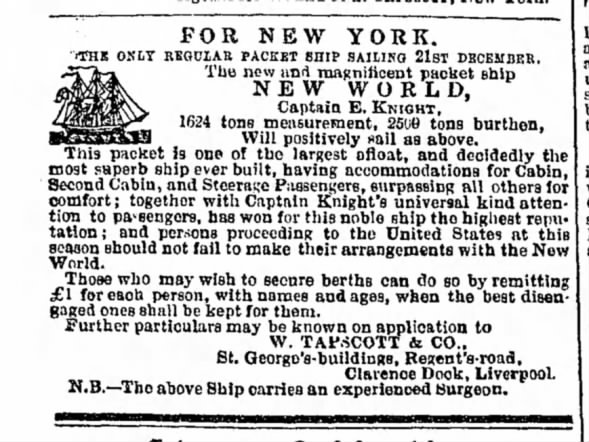
Known for his "gentlemanly" conduct, Knight was a popular captain of the Switzerland and other packet ships to London and Liverpool.

Fri, Dec 17, 1847 – 4 · Liverpool Mercury, etc. (Liverpool, Merseyside, England) · Newspapers.com

When his tribute to Gansevoort appeared in New York newspapers, Captain E. Knight's "Excellent" portrait (No. 238) by G. W. J. was on exhibit at the National Academy (New York Farmer and Mechanic, June 25, 1846).

In 1850-1851, Knight successfully agitated for repeal of the ban on fires and lights aboard ships in Liverpool docks (Honolulu Friend, July 2, 1852). In San Francisco he served for three years as agent of the Pacific Mail Steamship Company. Captain Eben Knight was long remembered by evangelical Christians for arranging that Pacific Mail steamers would not depart on the Sabbath.
No sooner had Captain Knight entered his office here, than he saw what havoc the sailing of steamers made of the Sabbath, when that happened to be the sailing-day. All early Californians know what "steamer-day" meant in those days. It put everybody to work. The steamship-office was besieged from morning till night. Express-offices were crowded, and their messengers and teams were running in hot haste all day. All banks were open, doing a rushing business, with merchants calling for bills of exchange, and miners depositing their bags of gold-dust and taking their certificates; passengers about leaving, hurrying to get their "last things" for the voyage, and going early aboard to receive there the " good-by calls" of friends; everybody writing letters home, and crowding them into the post-office up to the last moment; newsboys crying their "steamer papers" for sale all about the streets; while merchants and clerks were closing their final dispatches to go by Wells and Fargo; and then, at the hour of sailing, the crowd of passengers on the steamer's deck answer to the noisy farewells of the still larger crowds gathered on the wharf, and the great ship glides out into the bay, — and that "steamer day's" excitement is over. Captain Knight at once determined that "steamer day" should not occur on Sunday.  --Samuel Hopkins Willey, The History of the First Pastorate of the Howard Presbyterian Church, San Francisco (San Francisco: The Whitaker and Ray Company, 1900), pages 78-79.
"Eben" Knight died on October 11, 1853 at the age of 42. As also reported by Samuel H. Willey, Knight's eulogy by the business community of San Francisco highlights "noble" qualities of character like those that "E. K." appreciated from a brief acquaintance with Gansevoort Melville.
The high respect and honor in which he was held by the bankers and merchants is touchingly expressed in resolutions adopted at a meeting held by them soon after his death, one of which was as follows: —

"Resolved, That Captain Knight combined in his character in an eminent degree those noble, manly qualities which entitled him not only to the respect and confidence but to the affectionate regard of all who knew him best. 
"With a firm integrity of purpose which never faltered, with a keen sense of honor which scorned an evasion, with a straightforward honesty which resorted to no subterfuges, he combined with simplicity of heart a frankness of demeanor which commanded the respect whilst it secured the affectionate esteem of all with whom he was brought into contact. Scrupulously just in his business relations, generous almost to a fault when his sympathies were appealed to, gentle and confiding in his temper, always ready to forgive a fault in others, he judged harshly only of his own imperfections."

That characterization, be it remembered, was drawn by the business men of San Francisco, not especially his personal friends,— but who could have drawn his character more true to life? Knowing him well, I bear witness to its accuracy in every particular. 
-- The History of the First Pastorate of the Howard Presbyterian Church, San Francisco, page 81. <https://books.google.com/books?id=8XMUAAAAYAAJ&pg=PA81&dq#v=onepage&q&f=false>
Portsmouth Journal of Literature and Politics - December 3, 1853