Showing posts with label Henry T. Tuckerman. Show all posts

Tuesday, December 24, 2024

Author of THE NIGHT BEFORE CHRISTMAS glimpsed at Newport, 1855


"That mild, delicate-looking, elderly gentleman, benevolently gazing from his rocking chair, has rejoiced more children than PETER PARLEY; it is the venerable and benign author of The Night before Christmas, &c."

-- Henry Theodore Tuckerman writing "From Newport" to the New York Daily Times (August 6, 1855) over the pseudonym, CANONICUS. 


06 Aug 1855, Mon The New York Times (New York, New York) Newspapers.com

Clement C. Moore had been a summer resident in Newport, Rhode Island since 1850 when he retired from teaching Hebrew at the General Theological Seminary in New York City. "Canonicus," the Newport correspondent who espied the "venerable and benign author of The Night before Christmas" on his rocker, was Herman Melville's friend Henry Theodore Tuckerman. As stated in the Cyclopædia of American Literature Volume 2, edited by Evert A. Duyckinck and George L. Duyckinck (New York: Charles Scribner, 1856), Tuckerman often summered in Newport. In 1854-1855 Tuckerman contributed letters with news and gossip "From Newport" to the New York Times, printed there over the pseudonym,"Canonicus." This was one of several aliases Tuckerman used when writing for newspapers and magazines. As shown previously on Melvilliana, Henry T. Tuckerman was also "KNICK," the New York correspondent of the Boston Evening Transcript
Under another nom-de-plume, "Theodore Clarence," Tuckerman wrote for The Galaxy: A Magazine of Entertaining Reading, as he revealed in a letter to Evert A. Duyckinck dated May 12, 1868. The article on Essays and Essay Writing in the Galaxy for August 1866 is by Theodore Clarence =  Tuckerman.

Henry T. Tuckerman confided his secret identity as "Canonicus" to Evert A. Duyckinck in a letter from Newport dated August 13, 1855. 

"If you see the N. Y. Times you may have noticed some letters from here signed 'Canonicus'--by your humble servant--but this is strictly inter nos, remember."

Manuscripts and Archives Division, The New York Public Library. "Letters to E.A. Duyckinck and G. Duyckinck" The New York Public Library Digital Collections. 1845 - 1861. https://digitalcollections.nypl.org/items/d8454190-efa3-0133-7e83-00505686a51c 

Subsequently in the letter from Newport published in the New York Daily Times on August 15, 1855, the "old-fashioned courtesy" modeled by former newspaper editor Charles King (by then President of Columbia College) would prompt "Canonicus" to reminisce about

the palmy days of the New-York American, when CHARLIE HOFFMAN wrote letters from the West in its columns, and "Ianthe" impassioned poetry," and its editor was, indeed, a gentleman of the press.
Charles King was still editor when the New York American (March 1, 1844) published a letter from Clement C. Moore, affirming his already well-known authorship of "A Visit from St. Nicholas" aka "'Twas the Night Before Christmas." King was an old friend of Clement C. Moore, and also of Herman Melville's parents before 1830, when the family lived in New York City. 

Ianthe was the pseudonym of New York poet Emma C. Embury.


Charlie Hoffman is of course Charles Fenno Hoffman, another mutual friend (along with Dr. John Wakefield Francis) of Melville and Tuckerman. Hoffman edited the New-York Book of Poetry, the 1837 collection with the famous Christmas poem "A Visit from St. Nicholas" on pages 217-219, rightly attributed to Clement C. Moore. 

Saturday, March 12, 2022

Tuckerman notices "The Apple-Tree Table"


In the latter 1850's, under cover of the pseudonym "Knick," Herman Melville's friend Henry Theodore Tuckerman reported on the latest literary and cultural news from New York City as a valued correspondent of the Boston Evening Transcript. As shown previously on Melvilliana, Tuckerman aka "Knick" wrote favorable notices of Israel Potter (February 27, 1855) and The Confidence-Man (April 10, 1857).
Surveying the contents of Putnam's magazine for May 1856, Knick described The Apple-Tree Table (without naming Melville) as "a story of Hawthorne-like detail, illustrative of the "spirit rappings."

Boston Evening Transcript - May 7, 1856
NEW YORK, May 6, 1856.

LITERARY. Dear Transcript: With their accustomed punctuality, Dix & Edwards issued "Putnam's Monthly," with a freshness and variety of material that seems to indicate a seasonable revival of Magazine literature and May-day exuberance of wit and wisdom. Opening with a pleasant digest of the Kane Relief Expedition, which gives a relishing foretaste in Captain Heinstein's experience, of the Doctor's complete record, soon to appear. They follow up this appropriate tribute to he benevolent enterprise of the times, with a story of Hawthorne-like detail, illustrative of the "spirit rappings," called "The Apple Tree Table." Hale, the martyr spy of the Revolution, has justice done his brave sacrifice, in a biographical sketch of national interest. The claims of Ruskin, as an art-critic, are then discussed with an evident enthusiasm for his views and style. Kingsley's poems are next considered, and "Napoleon as a Family Man" is viewed as revealed in the letters to Joseph, his brother, lately published....

...We are all astonished at the fact that Hawthorne has made a dinner speech,--he who was only heard to speak once during his voyage to Liverpool. He addressed the company in reply to a toast in his honor, and what he said was appropriate, and manly and sensible. Bravo, silent Hawthorne! now you have found your tongue, resume your pen, too long idle... --"Knick" [Henry Theodore Tuckerman] Boston Evening Transcript, May 7, 1856.

Another newspaper mention, from the notice of "Putnam's Monthly for May" in the Boston Daily Atlas on April 30, 1856:

"The Apple Tree Table is an account of original spiritual manifestations, the mystery of which is more simple and satisfactory than such manifestations usually are." 

Related post:

Monday, July 22, 2019

Tuckerman aka Knick on Israel Potter

As shown in a previous post, Melville's friend Henry T. Tuckerman contributed literary letters from New York City to the Boston Evening Transcript, regularly published over the pseudonym "Knick." The letter from Tuckerman aka "Knick" dated February 23, 1855 features a friendly plug for the forthcoming book version of Israel Potter as "delectable reading." (The serial version concluded in the March 1855 issue of Putnam's Monthly.) Not in Herman Melville: The Contemporary Reviews, ed. Brian Higgins and Hershel Parker (Cambridge University Press, 1995; paperback 2009), where the earliest notice of the book version is from the New Bedford Mercury on March 12, 1855.
Melville's new story, which has appeared in Putnam's Magazine, "Israel Potter," will be published in one neat volume, this week. Consecutively it reads well, and has some highly spirited and adventurous scenes, with a genuine American flavor. Paul Jones and nautical romance, when treated by such a writer as Melville, cannot fail to make delectable reading.  --Boston Evening Transcript, February 27, 1855; found in digitized newspaper archives at GenealogyBank.
Boston Evening Transcript - February 27, 1855 via GenealogyBank

The letter from "Knick" published in the Boston Evening Transcript on November 30, 1855 alludes to "Benito Cereno" in a survey of the December Putnam's:
"Melville's story is continued...."
Melville's 1856 volume The Piazza Tales gets this advance notice by "Knick" in the Boston Evening Transcript of April 4, 1856:
"The same house [Dix & Edwards] will publish soon the 'Piazza Tales,' by Melville."
Related posts:

Tuesday, April 17, 2018

Charles Fenno Hoffman--on Francis Parkman, on the first meeting betwen Tuckerman and Poe

C. F. Hoffman
via Library of Congress

In March 1930 Columbia University Press published Charles Fenno Hoffman, a doctoral dissertation on the quintessential Knickerbocker by Homer F. Barnes. Hershel Parker credits Barnes for information on Hoffman's physical appearance and mock correspondence of Zachary Taylor in the first volume of Herman Melville: A Biography (Johns Hopkins University Press, 1996; 2005 in paperback). The bogus Old Zack letters by Hoffman are extant and accessible online via The New York Public Library Digital Collections:
Manuscripts and Archives Division, The New York Public Library. "Hoffman, Charles Fenno (1806-1884)" The New York Public Library Digital Collections. 1850 - 1868.
http://digitalcollections.nypl.org/items/e1facd90-693c-0133-c93c-00505686d14e
Barnes's valuable study is currently available online via the Internet Archive. Herman Melville shows up on pages 104 and 185. At 104 Barnes quotes from the "deeply impressed" Hoffman's "complimentary" review of Typee in the New York Gazette & Times (March 30, 1846). A few pages later Barnes gives Hoffman's letter to Evert A. Duyckinck, recommending publication in The Literary World of fresh western sketches by Francis Parkman.
Office Evening Gazette — Thursday 
My dear Sir, 
Allow me the pleasure of making you acquainted with my friend Mr Francis Parkman of Boston. Mr Parkman has lately returned from the Rocky Mountains whither he went to make some scientific enquiries relative to Indian languages usages etc, with reference to an elaborate work upon these subjects which he contemplates finishing at some distant day.
Meanwhile he has thrown off some easy sketches of his tour to make up a light volume for summer reading. The prevailing interest among all classes about the emigration and routes of emigrants to Oregon must necessarily command a hearing for him with the public. I have therefore my Dear Sir, had no hesitation in commending him to the Editor of "The Literary World" to introduce "The Oregon Trail — or A Summer out of Bounds’’ — to both Publisher & readers. You will find Parkman a clever fellow & a gentleman as well as a traveller & student worth knowing.
Truly yours 
C F Hoffman 
E A Duyckink, Esq 
N B I have just glanced at “the work” —Thank you for Copy — Nothing could look better
Duyckinck must have passed since The Literary World did not publish Parkman's well-recommended travel narrative--doubtless to his later regret, as Barnes observes:
The Literary World did not accept Parkman's "sketches" for publication. They soon appeared, however, in The Knickerbocker, and their popularity must have caused The Literary World to realize that it had missed an unusual opportunity.  --Homer F. Barnes on Charles Fenno Hoffman (New York: Columbia University Press, 1930) page 109.
Digital images of Hoffman's letter to Evert A. Duyckinck in manuscript are accessible online courtesy of the Manuscripts and Archives Division, The New York Public Library. "Hoffman, Charles Fenno (1806-1884)" The New York Public Library Digital Collections, 1850 - 1868:
  • http://digitalcollections.nypl.org/items/e1facd90-693c-0133-c93c-00505686d14e
Francis Parkman's sketches of his summer travel "out of bounds" were serialized in The Knickerbocker starting in February 1847.


Parkman's magazine sketches appeared in book form as The California and Oregon Trail, afterwards shortened to The Oregon Trail. Melville reviewed the book version for Duyckinck in The Literary World of March 31, 1849. The text of Melville's unsigned review of Parkman's Oregon Trail has been available online since 2012 in the Melvilliana post
Mr. Parkman's Tour
Digital images of Melville's Review of The California and Oregon Trail in manuscript are now also available online courtesy of the Archives Division, The New York Public Library. "Review of The California and Oregon trail," The New York Public Library Digital Collections, 1849:
  • http://digitalcollections.nypl.org/items/76003a20-1830-0133-c9a3-58d385a7b928
The Melville mention on page 185 of Barnes's 1930 book occurs in the context of Hoffman's struggle with mental illness. Barnes gives only part of the now well-known passage about "Poor Hoffman" from Melville's April 1849 letter to Evert Duyckinck. Adopting the abridged text as presented by Meade Minnigerode in Some Personal Letters of Herman Melville, Barnes omits Melville's more personally revealing remarks:
— I remember the shock I had when I first saw the mention of his madness. — But he was just the man to go mad—imaginative, voluptuously inclined, poor, unemployed, in the race of life distancd by his inferiors, unmarried,—without a port or haven in the universe to make. His present misfortune—rather blessing—is but the sequel to a long experience of morbid habits of thought.  --Herman Melville, Correspondence, ed. Lynn Horth (Northwestern University Press and The Newberry Library, 1993) page 128.
I'm highlighting the word "morbid" as transcribed in The Northwestern-Newberry edition of Melville's Correspondence. As applied by Melville to his friend Hoffman the word morbid does not sound or in manuscript look quite right. Checking, I see the N-N editor calls morbid a "conjectural reading." Some earlier editions make it unwhole as in "unwhole habits of thought." For a different conjectural reading let's try this: "monkish." Long experience of monkish habits of thought? The adjective monkish at least seems to fit with Melville's idea of Hoffman's "unmarried" state as one contributing factor to his emotional distress. In addition to his being imaginative and poor, Hoffman according to Melville was a "voluptuously inclined" bachelor.

As Barnes relates, Hoffman experienced a brief "change for the better." On April 21, 1849 the New York Tribune optimistically stated, "Mr. Hoffman's health is now almost entirely retrieved." In June 1849 he was in Washington, working (too hard, it seems) as a clerk in the State Department. However, by October 1849 he had to be hospitalized in Baltimore. Eventually Hoffman went to the State Hospital in Harrisburg, Pennsylvania "where he remained for over thirty years, until his death in 1884."

In the back of his 1930 book, Barnes offers a wonderful trove of Hoffman's letters, uncollected poems, and a bibliography that includes contributions to periodicals and some fugitive pieces.

One of Hoffman's letters to Rufus W. Griswold (now held by the Boston Public Library and accessible online via Digital Commonwealth) makes "a good joke" of the first meeting between Henry T. Tuckerman and Edgar Allen Poe. We don't know exactly when Melville first met Tuckerman, or if Melville ever met Poe in person. But thanks to Charles Fenno Hoffman (and his Columbia University biographer Homer F. Barnes) we do know when Henry met Edgar: the evening of July 10, 1845, in New York City at the Rutgers Female Institute. Both had been invited there to judge compositions by Rutgers students.

Charles Fenno Hoffman, letter to R. W. Griswold, 11 July 1845
Boston Public Library via Digital Commonwealth
Let me tell you a good joke. Poe & Tuckerman met for the first time last night — & how? They each upon invitation repaired to the Rutgers Institute where they sat alone together as a committee upon young Ladies compositions — Odd isnt it that the women who divide so many should bring these two together! --Hoffman to Griswold, July 11, 1845

via The New York Public Library Digital Collections
Presumably the prize-winning writers were honored at Commencement exercises the next day, on July 11, 1845. The distinguished Principal of Rutgers Institute was Charles E. West, Herman Melville's teacher at the Albany Classical School ten years before. In his published Address on retiring in 1851, West recalled early controversies over the aims and methods of public education for women.
Then the objection arose that our studies were of too elevated and difficult a range; that the rights of the colleges were invaded; that logic, metaphysics, and the higher mathematics did not belong as studies to young ladies; that they should be dealt with more gently by the selection of studies on a level with their capacities! Many a boding note was rung in the ear of the speaker, kindly warning him to beware lest the Institution founder upon this fatal rock. As though the domain of thought, and the vast stores of accumulated knowledge, belonged exclusively to man! As though no Somerville had mastered the profound mysteries of mathematical analysis, or no Mitchell could gaze out upon the heavens, and watch the silent movements of yon shining orbs, and discover what had escaped the telescopic gaze of all the Astronomical Observatories of Europe and America — a new comet!  --Charles E. West
Charles Fenno Hoffman's reference to "young Ladies" of Rutgers as "the women who divide so many" alludes I guess to these or similarly sexist objections. Hoffman's letter to Griswold with the anecdote about Poe and Tuckerman is listed with other 1845 items in The Poe Log, edited by Dwight Thomas and David K. Jackson and accessible online courtesy of The Edgar Allan Poe Society of Baltimore.
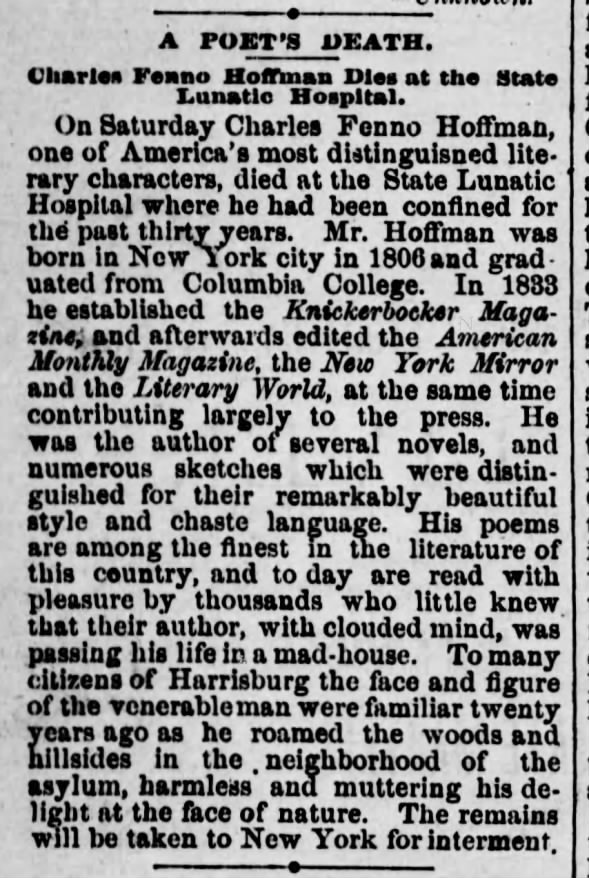
· Mon, Jun 9, 1884 – Page 4 · Harrisburg Telegraph (Harrisburg, Pennsylvania) · Newspapers.com

Related post:

Thursday, April 5, 2018

The Teniers of American poets

A pastoral landscape with a herdsman playing a pipe near a waterfall
David Teniers the Younger, Public domain, via Wikimedia Commons
Alfred Billings Street, again. Charles Fenno Hoffman called Albany's forgotten poet Alfred B. Street "the Teniers of American poets" in the short lived Excelsior. In the same vein, reviewing the same 1845 volume The Poems of Alfred B. Street, Henry T. Tuckerman in the United States Magazine and Democratic Review praised his Albany friend as "a true Flemish painter." So then: two friendly critics of Alfred B. Street's 1845 Poems, both of whom would become friends of Melville's, compared Street and his authentic verse descriptions of nature to Flemish painters and their style of genre painting --thirty years before Melville likened Street's poem The Old Garden to
"a flower-and-fruit piece by some mellow old Fleming." --Herman Melville's Correspondence, ed. Lynn Horth (Evanston and Chicago: Northwestern University Press and The Newberrry Library, 1993), page 463. 
Carstian Luyckx - Still Life Of A Basket Of Fruit, Flowers In A Gilt Vase, A Nautilus Shell And Other Objects On A Draped Table Near An Open Window
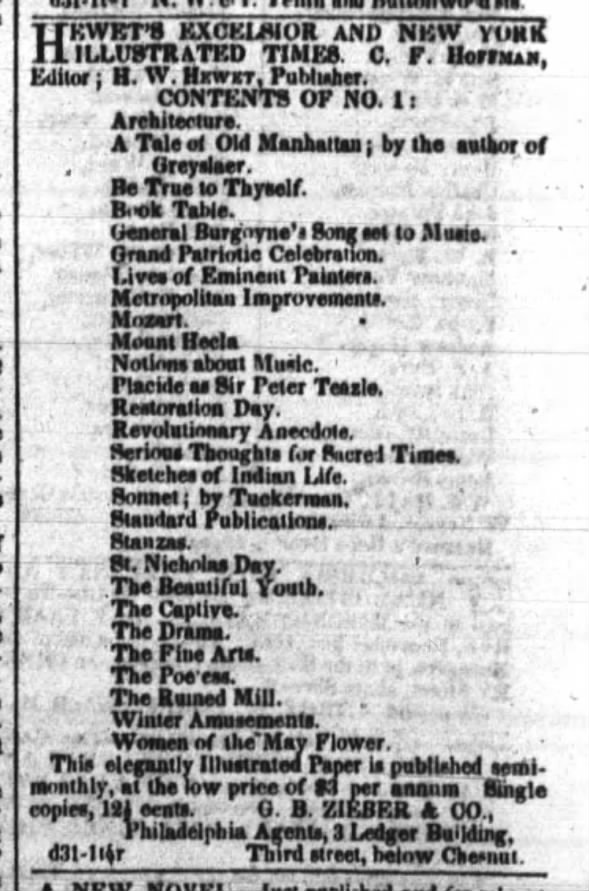
Hewet's Excelsior and New York Illustrated Times was conceived as an American version of the London Illustrated Times. Editor Charles Fenno Hoffman's generous (though qualified) estimation of Street's poetry was reprinted in the March 1846 Knickerbocker:
WE were about to indite a short review of our esteemed friend and correspondent's very beautiful volume, when the following notice of the same work, from the capable pen of Mr. C. F. Hoffman, in 'Excelsior,’ (a most gentlemanly journal, 'too early lost,') met our eye, and we at once decided that we could do nothing half so felicitous as to say 'ditto to Mr. BURKE,' and make the notice 'ours by adoption:'
Mr. STREET is the TENIERS of American poets. Perfect in his limited and peculiar range of art, as is LONGFELLOW in his more extended and higher sphere, STREET is the very daguerreotype of external nature. And yet his portraits are not mere mechanical copies of her features, so much feeling as well as truth is there in his microscopic delineations. He has not indeed the fervid minstrel power of WHITTIER ; the high meditative philosophy of BRYANT; the fine lyric inspiration of HALLECK; the beautiful and luminous sentiment of LONGFELLOW; nor is there the vivid creative power, the sparkling fancy and impassioned grace, which divided among some of our female poets, is as yet blended upon the page of neither sex, in our still nursing literature. Yet that characteristic still remains to him, without which all these others are as nothing; and which, possessed to the full degree in which it fills the soul of Street, makes him a true poet; namely, feeling—an intense feeling and appreciation of his subject; a devotion like that of a lover to his mistress; a love for nature unaffected, enthusiastic, unceasing; a love vigilant as a mother's for her offspring; reverential as that of a child for its parent. He watches her every look and feature, with no end save the tender delight of thus watching; he worships her every expression, with no motive save the gratification of his full feeling of homage. And if the issues of social life chance at times to blend with the accidents of his theme, the flow of inspiration from such sources is wholly subordinate to the natural tides of his song. With the pedantic or superficial reader, Street might still be left as the maker of mere descriptive verses, which had no merit save a kind of Chinese fidelity to purely physical realities; but he who, impelled by the true love of Nature, shall look more curiously into his song, will find STREET's poetry, like the face of the divinity herself, full of suggestiveness. As an instance of this, we may mention that we have before us an illustrated London publication, in which one of his poems (regarded by matter-of-fact people here as characteristically matter-of-fact,) has suggested to a spirited artist two of the most striking sketches that the season has produced."  --The Knickerbocker
Below, contents of the first number of Hewet's Excelsior and New York Illustrated Times, as advertised in the Philadelphia Public Ledger on New Year's Eve, 1845:

· Wed, Dec 31, 1845 – Page 2 · Public Ledger (Philadelphia, Pennsylvania) · Newspapers.com


Related post

Tuesday, April 3, 2018

T. W. C. Moore and William I. Street, son of Henry Livingston's "good friend" Randall S. Street

In 1862 Livingston cousin T. W. C. Moore wrote a key witness letter attesting to Clement C. Moore's authorship of "A Visit from St Nicholas" aka The Night Before Christmas. T. W.C. Moore testified in writing to Clement C. Moore's authorship of the Christmas poem after a personal "interview" with the author himself. Addressed to the Librarian of the Historical Society, the 1862 letter from T. W. C. Moore accompanied a manuscript copy of "Visit" in Clement C. Moore's distinctive handwriting. T. W. C. Moore's letter was published in The New York Historical Society Quarterly Bulletin 2.4 (January 1919) pages 111-115, along with a reproduction of the manuscript copy made by Clement C. Moore.

This T. W. C. or Thomas William Channing Moore was a son of John Moore and Judith Livingston Moore. His mother Judith was a first cousin and former neighbor of Henry Livingston, Jr. of Poughkeepsie. So T. W. C. Moore and Henry Livingston, Jr. were first cousins, once removed.

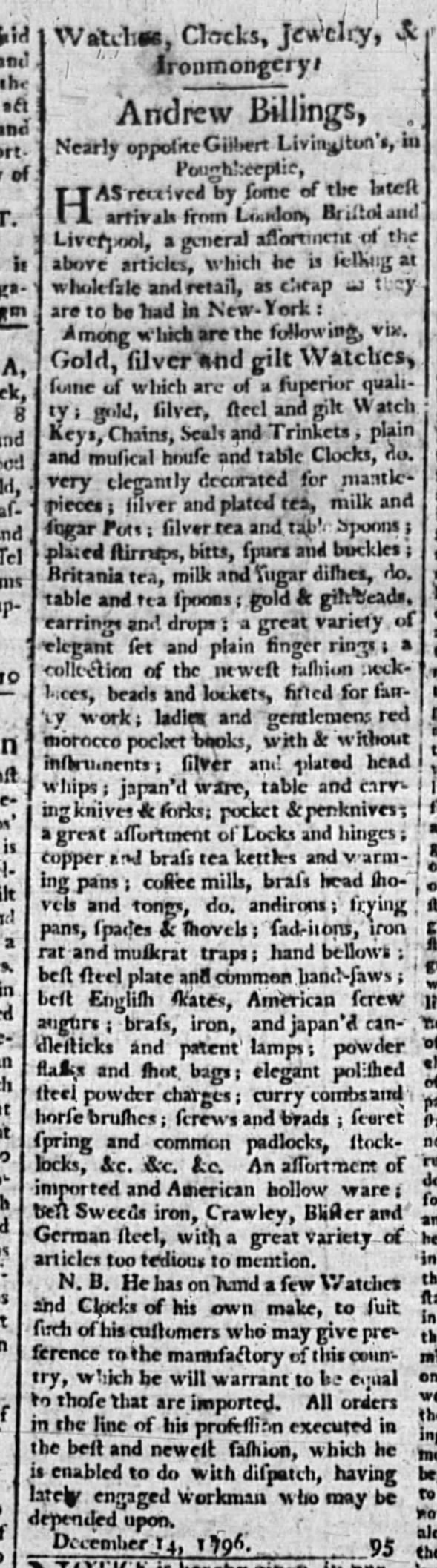
In addition to the family tie through his mother Judith Livingston Moore, T. W. C. Moore was also connected to Henry Livingston, Jr. through Moore's aunt, Cornelia Livingston (1751-1820)--his mother's sister, another daughter of James Livingston and Judith Newcomb Livingston. T. W. C. Moore's widowed aunt Cornelia Livingston married Andrew Billings, veteran of the Revolutionary War and later a well-regarded jeweler and silversmith in Poughkeepsie.

· Wed, Mar 15, 1797 – Page 4 · Poughkeepsie Journal (Poughkeepsie, New York) · Newspapers.com
Esteemed as "a man of genius," Andrew Billings reportedly invented a pair of wings that worked for him but not his father-in-law James Livingston:
Major Billings was no ordinary man: nay more, he was a man of genius. Independent of his talents as a soldier and writer, he possessed great mechanical invention. He constructed a pair of wings, and, being a small man, actually succeeded with them in flying short distances. Relative to this matter a story is told by B. Davis Noxen, Esq., the celebrated lawyer of Syracuse, and formerly a resident of Poughkeepsie. Major Billings gave notice that he intended trying his wings at a certain hour in the market place of the village. The inhabitants assembled; he mounted a low pillar, extended his wings, and, to the amusement of the village, flew to a considerable distance. Sheriff Livingston, thinking to "follow in the footsteps" of his son-in-law, then mounted the pillar, fitted the wings and sprang. Being, however, a heavy man, and not knowing the trick of waving his pinions, he tumbled ingloriously to the dust, amid the laughter of his townsmen.  --Albany Evening Journal, May 25, 1864
Daughter Cornelia Billings married Randall Sanford Street (1780-1839). Remembered in William Hunt's American Biographical Panorama as "an eminent lawyer and accomplished gentleman," Randall S. Street was Henry Livingston's "good friend" and for a while the employer of Livingston's son Edwin.

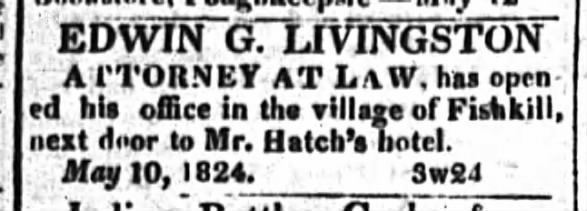
Edwin George Livingston (1798-1863) studied law with Randall S. Street. In 1821 Edwin was formally admitted as attorney in 1821, as announced in the New York Evening Post on November 7, 1821. In 1824 he began practicing law in Fishkill.

· Wed, May 26, 1824 – Page 4 · Poughkeepsie Journal (Poughkeepsie, New York) · Newspapers.com
After the death of Henry Livingston, Jr. in 1828, Edwin and his brother Sidney were able to serve as executors for the estate. Henry's "good friend" Randall Sanford Street had also been named in the will as one of the executors:
"I name and appoint as executors of this my last Will and Testament my beloved wife, Jane, my 3 sons Charles, Sidney & Edwin and my good friend Randal S. Street Esq."
--Will of Henry Livingston Jr, transcript via Mary S. Van Deusen's Henry Livingston site
T. W. C. Moore stayed in touch with grown children of his cousin Cornelia Billings and Randall S. Street, as revealed in a note Moore wrote about a curious gift he got from one of Cornelia's sons, William Ingraham Street (1807-1863). After Street gave Moore souvenir locks of George Washington's (and Martha's) hair, T. W. C. meticulously recorded the provenance in a written statement made in New York City, dated March 24, 1857:

WASHINGTON AND WIFE'S HAIR, JUNE, 1783.
The locks of hair below is part of that which was sent to Major Billings of Poughkeepsie, inclosed in a letter, of which the following is an exact copy. The original is in possession of the Major's grandson, W. J. Street, counselor at law, of this city, who gave me the hair.
Inveterate antiquarian that he was, T. W. C. Moore also took the trouble to make "an exact copy" of the authenticating letter from George Washington to Andrew Billings, at the time still owned by William I. Street (whose middle initial "I" for Ingraham or Ingram was sometimes misprinted as "J"). Transcribing Moore's 1857 note in The Century Magazine for May 1890, Edith Robertson Cleveland calls it "an odd affidavit of the present of two locks of hair from the heads of Mr. and Mrs. Washington, with the hair itself curiously preserved."

Speaking of Poughkeepsie Streets, William I. Street's brother Alfred became a poet of considerable repute in Herman Melville's time. In the 1840's, Alfred Billings Street had a law office in Albany. Somehow he knew Herman's sisters. Once in Pittsfield, Alfred B. Street felt hurt when Herman did not ask him over to Arrowhead for a social visit. Hershel Parker tells all about it in the second volume of Herman Melville: A Biography (Baltimore: Johns Hopkins University Press, 2002), page 139. That was in late September 1852. Twenty-five years later Melville highly complemented one of Street's poems, in a letter to his cousin Kate and her husband Abraham Lansing:
... I have just been reading in a copy of Frank Leslie's Illustrated paper "The Old Garden" by Mr Street. How beautiful, and poetically true to nature it is! It is like a flower-and- fruit piece by some mellow old Fleming.  --Herman Melville, August 14, 1877 letter to Catherine Gansevoort Lansing and Abraham Lansing; reprinted in the Northwestern-Newberry Edition of Melville's Correspondence, pages 459-463.
Melville's comparative view of the poet as painter, "some mellow old Fleming," echoed the tribute by Henry T. Tuckerman thirty years before. In a friendly review of the 1845 volume The Poems of Alfred B. Street, Tuckerman had praised Street as "a true Flemish painter":
We have wandered with him on a summer's afternoon, in the neighborhood of his present residence, and stretched ourselves upon the greensward beneath the leafy trees, and can therefore testify that he observes con amore, the play of shadows, the twinkle of swaying herbage in the sunshine, and all the phenomena that makes the outward world so rich in meaning to the attentive gaze. He is a true Flemish painter, seizing upon objects in all their versimilitude. As we read him, wild flowers peer up from among brown leaves; the łoń. the partridge, the ripple of waters, the flickering of autumn light, the sting of sleety prow, the cry of the panther, the roar of the winds, the melody of birds, and the odor of crushed pine-boughs, are present to our senses. In a foreign land, his poems would transport us at once to home. He is no second-hand limmer, content to furnish insipid copies, but draws from reality. His pictures have the freshness of originals. They are graphic, detailed, never untrue, and often vigorous; he is essentially an American poet. --Unsigned notice of The Poems of Alfred B. Street [by Henry T. Tuckerman] in The United States Magazine and Democratic Review for January 1846.
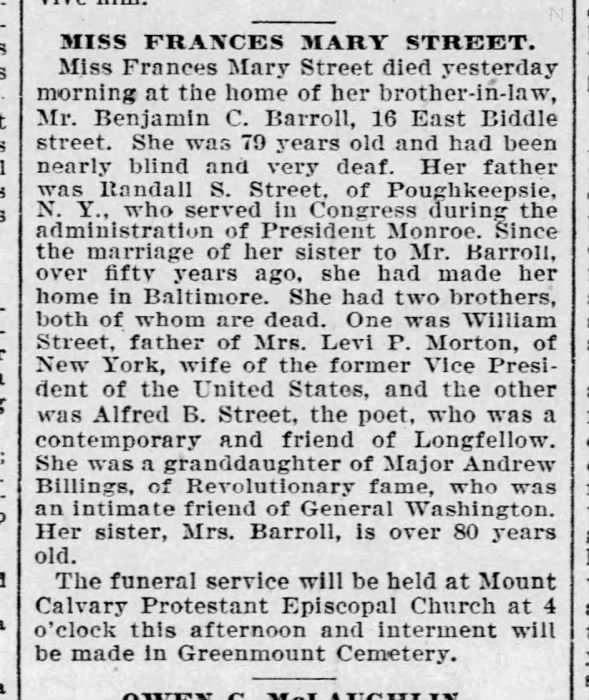
In this 1901 obituary of Alfred's sister Frances Mary Street, the highest honor the writer could think to bestow on her late brother the poet was to make him "a contemporary and friend of Longfellow."

· Sat, Mar 30, 1901 – 7 · The Baltimore Sun (Baltimore, Maryland) · Newspapers.com
From the Memoir of Alfred B. Street as published in Bentley's Miscellany (London, 1849):
The Hon. Randall S. Street, father of the author of " Frontenac," was the lineal descendant of these two eminent clergymen. He removed, with his father, in early life, into the State of New York, and this branch of the family has continued to reside there ever since; the other branch continued in Connecticut, and is still represented by Augustus Russell Street, Esq., who resides at Newhaven. Randall S. Street studied law at Poughkeepsie, married Miss Cornelia Billings, and settled there for the succeeding thirty years of his life. Such was his standing at the bar, that whilst still young, he was appointed attorney of the district composed of the counties of Wayne, Ulster, Dutchess, Delaware and Sullivan, under the old organisation of districts, and subsequently he represented the county of Dutchess in Congress. He was an eminent lawyer and accomplished gentleman, and among the recollections of the writer, is one of a day spent more than thirty years ago at the residence of General Street, when it was the home of hospitality and elegance. In 1824, General Street removed to Monticello, Sullivan county, New York, where he died in 1839.

The maternal grandfather of our author was Major Andrew Billings, who married Cornelia, daughter of James Livingston, of the well known family of that name in New York. Cornelia, the daughter by this marriage, who became the wife of General Street, was the mother of the poet....


Related posts:

Friday, June 30, 2017

Henry T. Tuckerman remembers the smiling face of "dear old Clement Moore"

Herman Melville's friends held Clement C. Moore in high regard. As shown in an earlier post, Evert A. Duyckinck honored the author of "A Visit from St. Nicholas" as
"one of the best of men" --Frank Leslie's Popular Monthly (June 1884).
Writing in 1866 for The Atlantic Monthly, Henry T. Tuckerman counted
"the benign smile of dear old Clement Moore"
among his most cherished reminiscences of Broadway in New York City. Other departed friends that Tuckerman remembered in the same class of "endeared figures and faces" were Dr. John W. Francis and Charles Fenno Hoffman. Melville knew them, too, when he lived in New York City.

And then, to the practised frequenter, how, one by one, endeared figures and faces disappear from that diurnal stage! It seems but yesterday since we met there Dr. Francis’s cheering salutation, or listened to Dr. Bethune’s and Fenno Hoffman's genial and John Stephens’s truthful talk,—watched General Scott‘s stalwart form, Dr. Kane’s lithe frame, Cooper’s self-reliant step, Peter Parley’s juvenile cheerfulness, — and grasped Henry Inman’s cordial hand, or listened to Irving’s humorous reminiscence, and met the benign smile of dear old Clement Moore. As to fairer faces and more delicate shapes,—to encounter which was the crowning joy of our promenade,—and “cheeks grown holy with the lapse of years,” memory holds them too sacred for comment. “Passing away” is the perpetual refrain in the chorus of humanity in this bustling thoroughfare, to the sober eye of maturity. The never-ending procession, to the sensitive and the observant, has also infinite degrees of language. Some faces seem to welcome, others to defy, some to lower, and some to brighten, many to ignore, a few to challenge or charm,—as we pass. And what lessons of fortune and of character are written thereon,—the blush of innocence and the hardihood of recklessness, the candid grace of honor and the mean deprecatory glance of knavery, intelligence and stupidity, soulfulness and vanity, the glad smile of friendship, the shrinking eye of fallen fortune, the dubious recognition of disgrace, the effrontery of the adventurer, and the calm, pleasant bearing of rectitude,—all that is beautiful and base in humanity, gleams, glances, and disappears as the crowd pass on.
--Henry T. Tuckerman, "Through Broadway" in The Atlantic, Volume 18
 Related posts:

Tuesday, February 28, 2017

John Keese

John Keese (1805-1856)
Frontispiece portrait in John Keese, Wit and Littérature (1883)
via The Edgar Allan Poe Society of Baltimore
the wittiest book auctioneer of his day in New York 
--
Evert A. Duyckinck on John Keese
Only a year before his death, Evert A. Duyckinck wrote a marvelous tribute to New York publisher, editor, and auctioneer-punster John Keese (1805-1856) titled "Keese-ana," published in The Magazine of American History Volume 1 for August 1877. Duyckink's piece was supplemented in the December 1877 issue by Keese's son, William Linn Keese.

On March 30, 1837 John Keese served as toast-master at the grand inaugural Bookseller's Dinner or "Festival" in New York City, honoring distinguished authors and, more generally, everybody who was anybody in the book trade. Publisher George Dearborn performed the duties of master of ceremonies. So then, Dearborn and Keese, two anthologists and early publishers of Clement C. Moore's "A Visit from St. Nicholas" officiated at the 1837 Bookseller's Festival. Also in attendance: Moore's close friends Charles King, Philip Hone, and John W. Francis--all of whom gave speeches before some 300 assembled guests. Irving, Paulding, Bryant, and Halleck were all there, along with other luminaries including Chancellor Kent, Albert Gallatin, Colonel John Trumbull, Columbia president William Alexander Duer and the professors of Columbia College. Here the enterprising co-host George Palmer Putnam first met Washington Irving, who glorified Halleck and warmly toasted:
 "Samuel Rogers—The friend of American genius."  --The American Monthly Magazine
Willis mailed in his pro-copyright toast to "The Republic of Letters—in which all who speak the same language are compatriots, and should reciprocate protection and kind feeling." Edgar A. Poe raised his glass to his closest colleagues: "The Monthlies of Gotham—Their distinguished Editors, and their vigorous Collaborateurs."

In his opening address, reprinted in the Evening Post and other New York newspapers, John Keese acknowledged substantial contributions by the book trade in the past, and challenged publishers to do even more for the cause of American letters:
"We desire still further to explore the mind where mental ore lies buried, to awaken slumbering genius, and to call into active exercise the dormant energy and shrinking talent of our young and much-loved land. Why sleeps the Muse of Drake's twin-brother bard? Why comes not he forth with fairy wand to silence the scribblers of the day? Who among us would not esteem it a high honor to be his publisher, and to issue his beautiful creations in a guise as beautiful as the taste of our best artisans can exhibit ?"
--John Keese, Wit and Littérateur
A few years later, Keese seemed to answer his own challenge by publishing the two-volume set, The Poets of America: Illustrated by One of Her Painters (1840-1842). However, the first volume would offer only the usual selections by Fitz-Greene Halleck ("Drake's twin-brother bard"): a lyric from "Fanny," "Alnwick Castle" and "Marco Bozzaris." A Visit from St. Nicholas also would grace Volume 1, attributed to "C. C. Moore" and illustrated with one drawing of St. Nicholas by another guest at the 1837 Bookseller's Dinner, John Gadsby Chapman. Another celebrity artist in attendance was Robert Walter Weir, who had just finished his own painting of St. Nicholas. The month before the Bookseller's Festival, Weir had offered his freshly painted St. Nicholas to Gulian Verplanck, rating it as "one of the best things I have done" (quoted in Lauretta Dimmick, Robert Weir's Saint Nicholas: A Knickerbocker Icon).

Keese recycled his 1837 speech at the 1850 Printer's Banquet and (probably) on similar occasions.

John Keese's son remembered Henry T. Tuckerman and Charles Fenno Hoffman as frequent visitors to their home "on the north side of Atlantic street." Like Duyckinck, Hoffman and Tuckerman later became good friends with Herman Melville.
"within the walls of that house, that evening and on many which followed, with and without the presence of the writer [Henry Morford], was gathered a literary circle which has rarely been equaled in America in numbers, and which has scarcely ever had its superior in the quality of persons composing it…"  --John Keese, Wit and Littérateur
Other members of Keese's literary circle around 1839-40 according to Henry Morford were Seba Smith and his wife Elizabeth Oakes Smith, Robert Balmanno and Mary Balmanno, Frances Sargent Osgood, Emma C. Embury, William Gilmore Simms, Rufus Wilmot Griswold, William H. C. Hosmer, Richard Grant White, and Nathaniel Parker Willis.

Considering Keese's intimacy with Duyckinck, Hoffman, and Tuckerman, Melville had to know of him. As Luther Stearns Mansfield notes in Melville's Comic Articles on Zachary Taylor, Duyckinck named John Keese among other occasional contributors to Yankee Doodle. The most likely time for Melville and Keese to have met or socialized would have been in New York City between say 1847 and 1850, before Melville moved himself and family to Berkshire County, Massachusetts.

Found on Newspapers.com powered by Newspapers.com
Here's a sample of John Keese at work, from Evert Duyckinck's 1877 memorial:
His deprecatory remark on the sacrifice of a copy of Bacon's Essays for twelve and a half cents was pathetic. “Really, that is too much pork for a shilling!" Selling, one evening, a book on German politics by Goetz, he hesitated over the catalogue, as if at the delicacy of the author’s name. “What is it?" asked one of the audience. “ Oh! something, I suppose, on the internal difficulties of the country." In a similar vein was his introduction of Gutzslaff's China with the observation, “This was the gentleman with a commotion in his bowels."

Sometimes his wit would be more pointed. “This," said he, holding up a volume of verse of a well known type, “is a book, by a poor and pious girl, of poor and pious poems." There was a heavy remainder of a certain volume, the “ Lives of the Shoemakers," which required all his ingenuity to dispose of. He would bring out a copy with the unfailing introduction, “This is the last copy. The book was awl the author wrote and was awl that his widow inherited from him, her sole reliance"—a jest which may have been stimulated by Shakespeare’s cobbler in Julius Caesar. Of some heavy folio, dragging at a feeble price, he would end his efforts—“ Going—going—cheap for a back-log!" Knocking down a “ Hand-book," he added, for the comfort of the purchaser, “You will see that it is pretty well fingered." “Damaged, you say, yes—a little wet on the outside—but you will find it dry enough within." On another occasion he parried this word "damaged" quite happily. A young son of a highly respectable Episcopal clergyman of this city, was a privileged attendant at the auction room. Keese offered a soiled or injured copy of the “Book of Common Prayer." “ Isn’t it damaged," exclaimed the youth; upon which Keese turned round to him slowly, and fixing his attention upon him with great gravity, in a tone of soberness and solemnity, addressed him, “ Has your father taught you to regard that as a damaged book ?" 
--Keese-ana by Evert A. Duyckinck

Monday, November 21, 2016

Dr. Francis and Clement C. Moore

via Find a Grave
Well, I don't suppose Herman Melville would have bumped into old Clement C. Moore at the New York Society Library, on Broadway at Leonard from 1840 to 1856. Moore served as Trustee in 1811-1815 and 1817-1823, so his tenure officially ended twenty five years before Melville first joined in 1848. Melville belonged off and on in 1848 and 1850, before he moved to Pittsfield. Unless maybe they crossed paths while Moore was working on his translation of the Life of George Castriot (published in 1850). 1850 is the year Dr. Moore retired from teaching at General Theological Seminary. Not long after, Moore himself relocated to 444 West 22nd Street between Ninth and Tenth Avenues. He summered in Newport.

One other place Herman Melville possibly could have seen Clement C. Moore in person was at No. 1 Bond Street, the home of their mutual friend Dr. Francis.

From Old New York
via The New York Public Library - Digital Collections
Dr. Francis attended the wedding of Herman's brother Allan Melville and Sophia Thurston on September 22, 1847. Herman Melville, as Augustus Kinsley Gardner reported in 1854, occasionally joined convivial gatherings of literati at the home of Dr. Francis. Hershel Parker observes that
"Melville considered Dr. Francis an intimate friend all through the 1850's, a time when Dr. Francis in public addresses and writing spoke admiringly of Melville and Tuckerman in the same breath."  --Historical Note - Published Poems
Melville's friend and sometime host was Clement C. Moore's very close friend and family physician, too. Henry T. Tuckerman testified to their long connection, and the wonderful, "cosmopolitan" breadth of the Doctor's associations, in his biographical introduction to Francis's Old New York:
But so large was the tolerance and so vivid the humanity of Dr. Francis, that while he was justly considered a thorough representative of the Knickerbocker character,—to whom the New Year's festival, as characteristic of his father's Nuremberg home as of Dutch hospitality, and his old friend Clement Moore's household rhymes of Santa Claus, with the annual schnapps and pipes of this local saint, brought such genial inspiration,—he yet thoroughly enjoyed the thrifty and intellectual example of the Yankee, welcomed the persecuted foreigner, and found delight in the spectacle of variety of race and customs, of excitements and phenomena which transformed, before his eyes, the town, where every one he met was an acquaintance, into the kaleidoscope of modern New York. Indeed, he recognized this expansive destiny in the natural advantages of the island, whose bay and climate Verazzano eulogized centuries ago, and whose noble river Hudson laid open to the Dutch West India Company, whence dates her commercial development. These divers associations only knit the bond of nativity in and identity with New York more strongly. To him, the Jay homestead at Bedford was as endeared because of its Huguenot as the Stuveysant estate for its Dutch traditions; the Tory families of Westchester, the old Episcopal exclusiveness, the wise Rabbis of the Synagogue, and the proscribed Unitarian from Boston, found their due historical and social consideration in his retrospective thought; and the arrival of a Japanese embassy or the Prince of Wales made him a holiday as well as the festivals of St. Nicholas; and loyal as he was to old New York, and proud of Motley's splendid vindication of the Dutch character, he none the less cheerfully grew cosmopolitan with the modern city; and only protested, with a magnetic zeal, alike individual and persuasive, that her Past should not be forgotten amid the absorbing claims of her Present, and the expanding promise of her Future.  --Old New York
Clement C. Moore was one of the pallbearers at the funeral of Lorenzo Da Ponte on August 20, 1838. Attending physician Dr Francis led the train of mourners, as noted in the 1868 article on Lorenzo Da Ponte by Henry T. Tuckerman.

Sunday, September 11, 2016

George J. Adler


In the last year of his life, George J. Adler (1821-1868) wrote from Bloomingdale Asylum to Henry Theodore Tuckerman. Adler and Tuckerman were both old friends of Herman Melville. Tuckerman mentioned his communications from Adler to another mutual friend, Evert A. Duyckinck:
"Poor Adler writes me incoherent notes--the last from Bloomingdale Asylum. His last trouble is the non-appearance of his notice of "Nathan the Wise" in Putnam & he seems to imagine you responsible for the neglect--says you have been kind in the past & he hopes you will do him justice in the future, attributing the non appearance of his article to a difference of theological opinion--you believing in the divinity of the Church & he in a Bhramanic [Brahmanic] theory! whereas, I believe, the notice was too long & Putnam curtailed or omitted it--after paying Adler $15. If, however, you can do, say or write anything to soothe the poor man--who is evidently very ill & tormented in mind--I hope you will do so. I called to say this, but finding you out, send this line."--Henry Theodore Tuckerman, letter to Evert A. Duyckinck dated May 12th [1868]; now in the Duyckinck family papers, Manuscript and Archives Division, The New York Public Library.
The September 1868 issue of Putnam's included Adler's unsigned article on Nathan the Wise, for which (as Tuckerman explained to Duyckinck) they had already paid fifteen dollars.

Adler's authorship of the unsigned article in Putnam's Magazine on Nathan the Wise is perhaps not so widely known as it should be. Herbert Rowland guesses it might have been written by Edmund Clarence Stedman (another friend of Melville's) in his article on "Laocoon, Nathan the Wise, and the Contexts of Their Critical Reception in Nineteenth-Century American Reviews" in Practicing Progress: The Promise and Limitations of Enlightenment.

In June 1868 Adler received the honorary Ph.D. from the University of the City of New York. Adler died August 24, 1868. Melville and Duyckinck both attended his funeral. The obituary notice in the New York Evening Post (August 24, 1868) ended with this tribute to his reputation:
"Professor Adler was much respected, both for his scholarly attainments and for his personal virtues."
The New York Tribune (August 25, 1868) stated also that Professor Adler
"numbered among his friends many of our most eminent citizens."
Dictionary of American Biography
 Adler's real and debilitating paranoia was on display in Letters of a Lunatic.

In 1860 Melville had joined with Tuckerman, Evert and George Duyckinck, and many other named subscribers to secure publication of Adler's translation of Fauriel's History of Provençal Poetry.

Sanford E. Marovitz examines the influence of Adler on Melville and his writing in More Chartless Voyaging: Melville and Adler at Sea. And again in the chapter on “Correspondences: Paranoiac Lexicographers and Melvillean Heroes” in Ungraspable Phantom: Essays on Moby-Dick.

Here's an item I have not seen before. One year before his death at the age of 47, Adler lectured before "a rather small audience" on a subject of probable interest to his old friend Herman Melville: 
LITERATURE OF THE MOSLEMS IN SPAIN. Prof. Adler, well known as a German lexicographer and classic scholar, delivered a lecture last evening in the small chapel of the New-York University, on the polite literature of the Moslems in Spain. The lecturer evinced an extensive acquaintance with the spirit and manner of Arabic literature, both in its earlier and later days, especially its poetry, which was illustrated with examples selected from different periods. It was listened to with satisfaction by a rather small audience.  --New York Tribune, Friday, March 29, 1867.
Adler's 1867 lecture was printed in a pamphlet titled "The Poetry of the Arabs in Spain," available online courtesy of the Hathi Trust Digital Library.


Many letters from George J. Adler to George Duyckinck and Evert A. Duyckinck are digitized and available online in the Duyckinck family papers, Manuscript and Archives Division, The New York Public Library. The image below shows the second page of Adler's February 16, 1850 letter to George Duyckinck:

George J. Adler, letter to George Duyckinck dated February 16, 1850
From The New York Public Library
“Our friend Mr. Melville has, I hope, long ago reached his home again safely, and you will have gained from him an account of our voyage and peregrinations in England and London. I regretted his departure very much; but all that I could do to check and fix his restless mind for a while at last was of no avail. His loyalty to his friends at home and the instinctive impulse of his imagination to assimilate and perhaps to work up into some beautiful chimaeras (which according to our eloquent lecturer on Plato here, constitute the essence of poetry and fiction) the materials he had already gathered in his travels, would not allow him to prolong his stay.”
On another page of the same letter near the close, Adler writes:
"I beg you to give my regards to your brother, Mr. Melville and any other friends that you may happen to meet."
Several of these letters from Paris to George Duyckinck also close with Adler's request, "my kind regards to your brother and Mr. Melville." Spelled in one letter, "Melleville."

Sunday, February 7, 2016

Melville in March 1866, socializing with The Wanderer's Club at the home of James Lorimer Graham, Jr.

Image Credit: Consulate General of the United States 
Note: this is the Wall Street broker JLG, NOT James Lorimer Graham, Jr. (1835-1876)

Monday evening, March 26, 1866 to be exact, according to the report published the next day in the New York Evening Post. The home address of James Lorimer Graham, Jr. (as listed in the 1867 Trow's New York City Directory) was his father's uncle's mansion at 21 Washington Square North.

UPDATE: Fold3 has the better source here, Trow's New York City Directory "For the Year Ending May 1, 1866." Now Trow's gives the address for James Lorimer Graham, jr. as "3 E. 17th." That's the address Bayard Taylor remembers in his 1876 obit. Most likely the March 26, 1866 gathering happened here, at 3 East Seventeenth Street. Also, James Lorimer Graham, Jr. is the NEPHEW of James Lorimer Graham. Graham, Jr.'s father is Nathan Burr Graham, as explained in the 1869 United States Insurance Gazette and Magazine of Useful Knowledge.

UPDATE #2:
If you thought the photo up top looks too late for the subject of our post, James Lorimer Graham, Jr. (1835-1876), you were right!  Naively I had thought the United States Consulate General would know one of their own in Florence, Italy. Alas, they and we had the wrong man. The sharp looking JLG above is of course the Wall Street broker, partner of S. F. Johnson and Charles W. Miller. 
S. F. JOHNSON & CO.. Bankers and Brokers, No. 18 Wall Street.— This well-known concern was founded originally in January, 1869, by Johnson & Day, who were succeeded by G wynne, Johnson & Day. and in 1879, Messrs. S. Fisher Johnson and Charles W. Miller formed a partnership under the present firm title. Both are thoroughly experienced men, and devote their close attention to the wants of their patrons. In 1892 Mr. James Lorimer Graham, who has been connected with the house ever since its inception, was admitted into the firm, with no change of title. They deal in all kinds of bonds, stocks, securities, etc., on commission only, for cash or on margin, and, as they are members of the New York Stock Exchange, all their transactions for patrons are governed by the strict rules controlling that honorable and reliable organization. They also do a general banking business.... --New York, 1894 Illustrated
So like the U. S. Consulate General in Florence, Italy, we're still in want of any photo of the real James Lorimer Graham, Jr. (1835-1876).

Well! Just the sort of enticements to draw out Melville as we know him in the second volume of Hershel Parker's biography: books, engravings, and heady talk with good fellows like Tuckerman, Duyckinck. and Darley. From the New York Evening Post, Tuesday, March 27, 1866; found in the online Newspaper Archives at Genealogy Bank.

New York Evening Post, Tuesday, March 27, 1866

The Wanderer's Club.

The members of the "Wanderer's Club," together with invited guests, were pleasantly entertained last evening at the residence of Mr. James Lorimer Graham, Jr. The gathering was of a social character, and allowed a free and agreeable interchange of thought among the guests. The many rare and curious books, old engravings, valuable autograph letters and articles of vertu, to be found in Mr. Graham's library, were a source of unfailing interest and enjoyment to every one present. Among the guests were Messrs. Bryant, Bancroft, Tuckerman, Herman Melville, Bayard Taylor, Ripley, Duyckinck, Stoddard, Savage, "Barry Gray," W. T. Blodgett, John Van Buren, Leutze, Kensett, Gifford, Bierstadt, Laing, H. P. Gray, Launt Thompson, Darley, Ehninger, Hunt, Key, Baron Osten Sacken, Gilman, and others.
First order of business will be to identify all concerned, if we can, starting in this post with the host: James Lorimer Graham, Jr. (1835-1876), familiarly known as "Lorrie" Graham. Below are links to the 1894 memorial and the catalog of his library, both published by the Century Association:

The Online Books Page has links to both items in the HathiTrust Digital Library.

Reading things like the passage below from the 1894 memorial, "Lorrie" Graham begins to look like a real-life model for Melville's imaginary Marquis de Grandvin:
One of the most distinguished of his literary friends, who is with us to-night, is reported, at a dinner of literary and kindred spirits not long ago, to have offered the following toast to the memory of Lorrie Graham:

"Here's to Graham! Let us keep his memory green; for when we poor fellows lived on hard tack all the week, we knew that there were always champagne and oysters for us at Graham's whenever we chose to go there."
In another passage from the 1894 memorial, Edmund Clarence Stedman recalled the dinner for Graham at Delmonico's on November 16, 1866 as a "unique and unforgettable" evening. The honorary "Supper" was
given to Lorimer Graham before his departure for Europe. This came off at Delmonico's, Fourteenth Street, on the 16th of November, 1866. From twenty to twenty-five gentlemen were there, nearly all of them Centurions, the Committee in charge being Messrs. William Bond, C. P. Cranch, Bayard Taylor, R. H. Stoddard, Launt Thompson, and the present speaker. In addition to the lyrics in hand, poems were also contributed by Cranch and Boker, but these were not so available for reproduction after the interval of twenty-eight years. Brief speeches in affectionate honor of Mr. Graham were made by the other guests. The evening was in some respects unique, and unforgetable.
The night before, J. Lorimer Graham had served as honorary President of one of the tables at the lavish banquet for Cyrus W. Field. Sponsored by the New York Chamber of Commerce, the Field affair took place in the great hall of the Metropolitan Hotel. The much more intimate dinner for Graham happened at Delmonico's, which provides the setting for At the Hostelry, one of Melville's Burgundy Club poems. Melville, however, is not named as one of the select twenty-five, most of whom belonged to the Century Club.

HathiTrust Digital Library has the 1963 re-issue by Russell & Russell of the 1922-24 Constable edition of Melville's works with The Marquis De Grandvin and Jack Gentian sketches in the thirteenth volume. Admittedly, there's no getting around the fact that Melville's Marquis de Grandvin is a Frenchman,
"a countryman of Lafayette and Frédéric Auguste Bartholdi."  --Herman Melville: A Biography, V2.833
But good lord! look what the American Consulate in Florence, Italy has to say about former U. S, Consul James Lorimer Graham, Jr. :
"During his sojourn abroad he became a proficient French scholar and retained his fluency and perfect accent all his life. As such, he was often mistaken for a Frenchman."  --U.S. Consulate - Florence
Likewise the Appleton's Encylcopedia entry offers a number of suggestive points of comparison with Melville's convivial de Grandvin, in particular his being "widely known through his taste for art and literature and his brilliant conversational talents." (Later note: the entry below is copied nearly verbatim from the obituary by Bayard Taylor in the New York Tribune, May 2, 1876.)

James Lorimer Graham

GRAHAM, James Lorimer, consul, born in New York City in January, 1835; died in Florence, Italy, 30 April, 1876. He was partly educated at Amiens, France, where, on account of his precocious literary talent, he was selected to deliver a poetical address of welcome to Lamartine when the latter visited the school in 1848. Mr. Graham lived for a time in Rio Janeiro, and, after returning to New York, was a passenger in the steamer '" San Francisco," which foundered in a gale off Cape Hatteras. His experience in this wreck injured his health and hastened his death. In 1856 he married and settled in New York, where he became widely known through his taste for art and literature and his brilliant conversational talents. As a member of the Century club, the Geographical society, and kindred institutions, he made the acquaintance of many artists and authors. He spent the years 1862-'3 in Europe, and after remaining in New York until 1866 again went abroad. Meantime he had been busily engaged in acquiring whatever curiosities he had found in his travels, until he had large collections of coins, autographs, drawings, and books. Some time after his return to Europe, Mr. Graham was appointed United States consul-general for Italy, and resided in Florence. When the capital was transferred to Rome, he preferred to accept the office of a simple consul rather than change his home. --Famous Americans - James Lorimer Graham
Graham's diplomatic service in Italy seems transferred in Melville's Burgundy Club material to Major Jack Gentian--a disciple of the Marquis de Grandvin whom Melville imagines as the appointed American consul in Naples.

Andrew M. Kavalecs writes informatively of Graham as "Fosterer of American-German Literary Relations" through his correspondence with Adolf Strodtmann.

A helpful biography by Jeffrey Begeal is available online at The Florin Website. The online biography lists a title by Mr. Begeal that would be lovely to have, if I could only find it:

  • Begeal, Jeffrey. James Lorimer Graham, Jr. c. 1832-1876. Biography of an American Savant. Villa de Bella Silva Press: Smithfield, NC. 2004.

How much of "Lorrie" Graham and the wonderful Wanderer's Club do we find memorialized in Melville's uncompleted writing about the Burgundy Club?

Related melvilliana post: