We have seldom or ever read the equal of this chapter [Benito Cereno] in point of profound cunning and deception....
Here's something new concerning the early reception of Herman Melville's short fiction in Canada. Published in the Liverpool, Nova Scotia Transcript on July 31, 1856, this favorable and unusually detailed Canadian review of The Piazza Tales is not collected in Herman Melville: The Contemporary Reviews, edited by Brian Higgins and Hershel Parker (Cambridge University Press, 1995; paperback 2009). As indicated on the masthead, the Liverpool Transcript was a weekly newspaper "devoted to moral, political and general intelligence and progress," then owned and edited by S. J. M. Allen.
Liverpool [Nova Scotia, Canada] Transcript July 31, 1856 via Nova Scotia Archives
NEW PUBLICATIONS.
THE PIAZZA TALES. From the pen of Herman Melville, author of "Typee," "Omoo," etc. Dix & Edwards, New York. E. G. Fuller, Halifax.
The first chapter is devoted to pleasant reminiscences in favor of piazzas, and an "inland voyage to fairyland. A true voyage; but, take it all in all, interesting as if invented."
The second chapter consists of passages in the life of Bartleby, "who was a scrivener, the strangest I ever saw, or heard of," with some mention of the author, his employees, his business, chambers and general surroundings, as a means of better understanding the chief character of this chapter. It will be found interesting--very.
The third chapter introduces to our notice the captain of an American Sealer, who displays stirling qualities in the capture of a Spanish slaver at the island of St. Maria, Chili. The slaves having risen, murder their owner and some of the officers and crew of the ship, take full command of the vessel, place the captain and the remainder of the crew under strict watchful guards to navigate and work the vessel. The ringleader Babo with his right hand man Atuful [Atufal] act, in the presence of the American captain a most conspicuous part in all the powers of deception and mock submission to the behests of the captain, who is completely tho' reluctantly compelled at the risk of his life to assist in carrying out their designs, so as to appear as the despotic commander and sole owner of ship and cargo. The whole story with Benito Cerino's [Cereno's] protest is admirably written, deleneating certain characters with an unmistakable hand. We have seldom or ever read the equal of this chapter in point of profound cunning and deception.
The fourth chapter gives a humorous memorandum of "The Lightning-Rod Man" endeavoring to sell, during a storm of rain accompanied with thunder and lightning, certain rods to attract the lightning and convey it from the building.
The fifth tale is divided into ten chapters and is romantically discriptive of the Encantadas or Enchanted Isles--Gallipagos, the land, its singular appearance--the rocks--the peaks of mountains, the queer birds, reptiles, tortoises, etc., which inhabit those sun burnt regions of the Equator. The lone widow and her rescue occupies the eighth chapter. In fact "the enchanted isles" is enchantingly written.
The last tale in this admirably written work is that of "The Bell-Tower, built by the mechanician, the unblest foundling, Baunadonna," [Bannadonna] in Italy three hundred feet in air will repay the reader for his pains.
Two weeks before the favorable notice of the Piazza Tales appeared in the Liverpool Transcript, the same Canadian newspaper dropped an odd reference to "the firm of Bartleby, Benito Cereno" into a notice of The Schoolfellow, a well-regarded magazine for children.
Liverpool Transcript - July 14, 1856
The School-fellow'sMagazine, for June, illustrated. This appears to be a commendable work for boys and girls, many of the best American writers being engaged upon it, among whom we may mention Bayard Taylor. It is from the firm of Bartleby, Benito Cereno.
Agents for the above works, E. G. Fuller, Halifax.
At this time both the Schoolfellow and Putnam's Monthly Magazine were published in New York City by Dix, Edwards & Co. The same "firm" had just issued Melville's new volume The Piazza Tales which of course contained the Putnam's stories "Bartleby" and "Benito Cereno." Evidently the phrasing of this 1856 reference to "the firm of Bartleby, Benito Cereno" in some way points to Joshua Augustus Dix and Arthur T. Edwards as publishers of the Schoolfellow and Putnam's. Dix and Edwards were then "very young and very green" as Justin Martin has observed in Genius of Place: The Life of Frederick Law Olmsted (Da Capo Press, 2011) page 109.
Prang's aids for object teaching. Printer. ca. 1876. Photograph. https://www.loc.gov/item/2003663928/.
Albert W. Whelpley (1831-1900) was head librarian of the Cincinnati Public Library when he commemorated "The Old-Time Printer" in a delightful and highly informative after-dinner speech, delivered January 17, 1898 at the annual meeting of the Cincinnati Typothetæ. Although long forgotten, Whelpley's talk is full of historical interest and value, being rich with details of his personal experience as a printer's devil and compositor in New York City from 1846 to 1856 or so. Melville aficionados will be especially interested in Whelpley's reminiscences about working at "the widely known printing office of Robert Craighead, on the corner of Fulton and Dutch streets." Whelpley quit with most of his coworkers during a labor strike, possibly in early May 1853 when journeymen book-printers went on strike in New York City.
New York Weekly Journal of Commerce - May 5, 1853
If Whelpley alludes to printers' strikes in April and May 1853, he would still have been working at Robert Craighead's former printing office on Fulton street in May 1851 when Melville hired Craighead to set his great Whale manuscript in type and have it plated. In that case young Whelpley might possibly have helped to produce Moby-Dick. Whelpley's boss William Henry Tinson, "the best-known foreman in New York" and Craighead's manager until May 1853, almost certainly did.
In 1853 or later, Whelpley rejoined his old boss at 24 Beekman Street, where Tinson operated his own printing office, "also a famed one." Working there for W. H. Tinson, Printer and Stereotyper, Whelpley became personally acquainted with George P. Putnam and numerous other literary celebrities. A. W. Whelpley never once name-drops Herman Melville during his 1898 talk before the Cincinnati Typothetae. However, Whelpley somehow managed to acquire one of Melville's letters to Putnam (9 November 1854) concerning the magazine version of "Israel Potter." Submitting the concluding chapters in manuscript, Melville thus explained why he did not number them:
“Having forgotten the number of the last chapter sent you, I leave the numbering of the following ones to the printer.”
By his own account, Whelpley seems to have been employed as a compositor for W. H. Tinson in 1854 through April 1855 when Tinson's printing office set all of Putnam's Monthly Magazine in type, including the magazine version of "Israel Potter" which concluded in the March 1855 issue. If so, Whelpley might have indirectly received Melville's note to Putnam via Tinson. In any case, Whelpley got it somehow or other and eventually gave it to the Cincinnati Historical Society, as helpfully indicated in the Northwestern-Newberry Edition of Melville’s Correspondence, edited by Lynn Horth (Northwestern University Press, 1993) at page 273. Whenever and however Whelpley first acquired it, Melville’s autograph letter of November 9, 1854 to George P. Putnam would have held personal significance as a memento of his youthful occupation in New York City, “working for W. H. Tinson, on Beekman Street.”
The complete text of A. W. Whelpley's encomium of "The Old-Time Printer"is transcribed below from The Printer & Bookmaker (July 1898) pages 230-234. Digital versions of the printed speech are accessible via Google Books
*An address delivered at the annual meeting of the Cincinnati Typothetæ.
BY A. W. WHELPLEY.
THE printer of the olden time! It is a theme so glorious that it should have been delegated to be handled by some one more practiced in the art of oratory and after-dinner speaking than he who is to address you. Some one whose well-rounded sentences and resonant voice should stir your natures to their very depths—one who might be able to paint glowing wordpictures of that glorious trinity of men who gave the art its birth! Of Gutenberg, Fust and Schoeffer, whose names have come down through the centuries laden with honors; whose triumphs have been sounded in every land and in every language! Gutenberg, inventing movable types, and constructing a rude printing press to take his impressions from them; Fust, inventing the ink with which to make this possible; and Schoeffer, who, conceiving the plan to make better and more effective types than those used, cut a set of matrices to cast them in, which so delighted his master, Fust, that he gave him his only daughter for a wife!
He might take a long leap, and come to the men who, in the early days of this country, gave such renown to the printer's art, William Bradford, who came to America with William Penn, and Benjamin Franklin—both grand types of the old-time printer. And if he was to "the manner born" he could discourse eloquently of three old-time printers whose names are inseparably linked with this "Queen City of the West," Joseph A. James, Ephraim Morgan, and Achilles Pugh.
But I am not equal to anything so lofty in conception, and propose to go back only half a century, to give you a few reminiscences, beginning with the business career of a slightly built, not over-strong, curly-headed youth, who, at the age of about thirteen years, thought the time had come for him to quit school and face the world to earn his own living.
A school-boy friend, who was already at work, secured him a position in the same office where he was employed, and in the autumn months of 1846 this boy, who had never been away from his home except in school hours, trudged gaily to the office in which he was to begin his career, to take the responsible situation of a printer's devil! This service consisted of various important duties, the most responsible of which was rolling a form for ten hours a day—from 7 to 12 A.M., from 1 to 6 P.M. When there was no form on the press, he was to busy himself as best he could. The other duties were to build the fires, make the lye with which to clean the forms, and wash the rollers; gather up the soiled towels to take home to his employer on certain nights of the week, and call for them on certain mornings; in fact, being a "general utility" for everybody about the place.
He can remember as well as if it were yesterday what a formidable undertaking it seemed to get through a day's rolling—and to count the tokens in his mind, as the sheets were "worked off," ten hours a day, ten tokens to be printed, to make a fair day's work. At the office at 6 to build the fire, and rarely getting home to his supper before 7:30 at night. Such was the life, and such were the duties of a boy in the 40's who was fortunate enough to secure a situation as a printer's devil. The pressman under whom he worked was a kind-hearted, phlegmatic Scotchman, named Archie Naughton—and he can call him to mind always—an old-time pressman who is deserving of a grand reward in the future life. He was very considerate of his devil, and always lightened his duties where possible—and never spoke a cross word.
The hours of service required would alarm a printer boy of this day, and would cause an eruption in the labor unions; but the young devil felt them no especial hardship; and he tumbled into bed at an early hour after supper, with his mother's blessing and a good conscience, and slept soundly the "sleep of the just," for, as he had not many temptations, he had few worries, as yet, to trouble his slumbers. He generally got his breakfast by 5:30, and in the dark hours of the winter mornings was well on his way to the office before 6 o'clock.
The boy was happy! and it was not long before he evinced some skill in setting type (which he learned in the noon hour, supposed to be devoted to dinner), and it was but a few months before he bade a not over-affectionate adieu to his rolling duties! It may be interesting to say that he was succeeded by an inking machine, which had just come into use.
This introduction to the printing business was in the office of John W. Oliver, on the corner of Ann and Nassau streets, New York, in the same building where the well-known Quaker printer, Daniel Fanshawe, ran his presses. A few months later this office of John W. Oliver was removed to the corner of Fulton and Nassau, in the old Sun building, and by that time the boy, who only a little while before had rolled forms, had now become quite a respectable job hand, and could run a job press very well. He preferred composition, however, and when opportunity offered would "stick type" on a weekly temperance paper called The Organ, published by Mr. Oliver, who was an ardent "Son of Temperance," an order then in its infancy.
Printer boys in those times were sturdy young fellows, that disdained to wear such undergarments as shirts and drawers, and some of whom would have discarded stockings, but for the interference of home folks. I can see this young boy, with his shirt sleeves rolled up to the full extent, his shirt front unbuttoned, with a paper cap on his head, to protect the luxuriant locks, that were his pride, from dirt and dust. When these conditions were fulfilled, the printer boy was in full uniform, and ready for business.
He soon made a change to an office managed by a literary Irishman, Dennis Hannegan, well known as the author of "The Orange Girl of Venice," a blood-curdling novel. Dennis was a clever and an honest man, and though he could not pay his hands their wages in cash, he gave them the equivalent in paper novels, all of which were read without death ensuing.
Dennis did a good thing for the subject of this sketch by kindly giving him a letter of introduction to W. H. Tinson, an excellent printer, at that time the best-known foreman in New York, and manager of the widely known printing office of Robert Craighead, on the corner of Fulton and Dutch streets. He was of a just nature, but a violent temper. Mr. Tinson honored the introduction, and took the boy, stipulating that he should serve his time at two-thirds men's wages, either working by piece or by the week. And it seemed a great piece of good fortune to drop so easily into such a situation.
This office literally swarmed with compositors of wonderful intelligence. It was an office in which slack times were seldom known. It had the cream of literature, as it had the pick of workmen. Here was a representative body of old-time printers that could discuss composition, rhetoric, punctuation; who were conscientious in spacing and leading; who would criticise bad work, and were intolerant of inferior workmen; who gave close attention to all the technicalities that go so far to improve the looks of the printed page. Men who would quarrel with the proofreader when they thought him wrong, and oftentimes carry their point. They were a representative set of old-time printers—middle-aged men—and younger dare-devils who could dance all night and work all day. It is doubtful if ever such another office existed, where there was so much wisdom and so much mirth combined, and so much good and conscientious work accomplished, with the pay so sure. All the grand English reviews, Blackwood's Magazine, the Literary World, the Medico-Chirurgical Quarterly, and scores of books from those reputable publishers, Wiley & Putnam, Scribner, Wood, Dodd, Carter Brothers, and others, were constantly in process of composing, stereotyping and printing.
Looking back through half a century, it is a gratification to call to mind the well-educated printers of that establishment. Many of them were Englishmen, who had served their apprenticeships in the old country, and were authority on every technical point of the printing business. How well they had studied their grammars, and how true were their ideas of the niceties of punctuation!
These printers of the olden time were always in the lead on affairs of the day. They could intelligently criticise the pulpit, the stage and the press. They could quote Scripture without limit, and were up in every current joke, and often very humorously repeated questionable stories—a custom not yet obsolete—which dates back, however, to Boccaccio—and in which art many of them were masters.
That office had a coterie of men (of which the boy of whom I am speaking was the youngest member) who by filling responsible positions as editors of prominent newspapers, writers of dramas, important military positions, have given good evidence of the value of the training of the printer of the olden time—one becoming a librarian, and one now bearing the best known name in the annals of printing in America, Theodore L. De Vinne.
These printers of the olden time, in this particular office, had prime opportunities to jostle against the men who were giving to America its literature; and the boy whose history I am giving you was particularly favored. He saw many celebrities, and was noticed by not a few. Here came James Fenimore Cooper, Charles Fenno Hoffman, George P. Morris, Nathaniel P. Willis, Rufus Griswold, Horace Greeley, Evert and George Duyckinck, and a host of others who are among the immortals in American literature.
One more change, and the boy, now grown to manhood, as far as his reminiscences in this city of his birth go, are completed.
There came a strike—we all know what strikes are—and every man and boy, except two, marched out from this home which had done so much for them for so many years. And the young man, true to his fellow workmen, but against his inclination, went with them, and bade adieu to the office of Robert Craighead forever. After forty years or more he pays the tribute to him which is deserved, and will never fail to cherish his name gratefully. The boy's career in New York closed with working for W. H. Tinson, on Beekman street. And this office was also a famed one. Here he made friends with the versatile publisher, George P. Putnam, and met and conversed with Bayard Taylor, Frederick Cozzens, author of the "Sparrowgrass Papers," John Brougham, Edward Stephens, author of "Jonathan Slick in New York," Tuckerman, the essayist, our Western poet, W. W. Fosdick, and Frederick Saunders, author of "Salad for the Solitary;" in this office was printed John Mitchel's Citizen, and here came daily those Irish patriots, John Mitchel, John Savage, Thomas Francis Meagher, and scores of others. These were the days when the author came to the printing office with his proofs, and often explained his corrections and the wherefores to the compositor.
These sometimes happy (sometimes otherwise) days came to end, as far as New York experiences are concerned, when this old-time printer came to Cincinnati for a brief visit. That visit has extended to over forty years; and while he oftentimes thinks of what a field he might have had in the city of his birth for growth, he in no wise lacks appreciation of the honors which his fellow citizens of Cincinnati have shown him, and of which he has always endeavored to be deserving! Nor does he in any wise lack appreciation of Cincinnati itself, in which community he feels that his life and his sympathies have so broadened, and in which for so many years he has lived so happily.
But Cincinnati was a new field for the young New Yorker. By force of filial duties he felt obligated to remain, though he was leaving all behind—birthplace, familiar scenes, friends and companions, yet he bravely accepted the new responsibilities, and for the third time was compelled to "seek a job." An introduction from a genial old-time printer of that day, Caleb Clark, sent him to the Franklin Type Foundry, where he received a welcome. There he remained (excepting a month or six weeks, when he was with dear old Mr. Thompson at the Methodist Book Concern), and in time came to have entire charge of the composing room. This business was then superintended by a gentleman who sits here to-night, Mr. Robert Allison, and I look back with pleasure to the period between 1857 and 1864. I think he parted with me with regret, when at the latter date I entered a new field of labor. During all the years that have passed his friendly interest in the young man—above I unconsciously dropped into the first person—has often been shown. He is to be congratulated on his long years of service in the profession, on his position as an employing printer, and on being one of the foremost citizens of Cincinnati.
The printer of the olden time! What memories are awakened—what thoughts will come of by-gone days and men who lived in them—heroes of the composing stick!
The printer of the olden time, and the printers of to-day, and all time, are and will be the greatest factors of our civilization. The preacher may touch our hearts with his glowing words; the actor may dazzle our eyes and charm our ears with the beauty of his scenic effects and the fervor of his declamation; the singer may enchant us with the rhapsody of his melody; the lecturer and statesman may make our minds captive by the force of their eloquent periods—but all their efforts would be as temporary and evanescent as were the lays which of yore the minstrels chanted in kingly courts, were it not for the Art of the Printer—the Art preservative of all the arts. His silent types and inks transfer to the printed sheet the words of the preacher, the lines of the actor, the song of the musician, and the speech of the statesman, and send them forever down the ages to an immortality which otherwise could not be.
Herman Melville's short story "The Fiddler" first appeared, uncredited as usual for magazine fiction of the time, in the September 1854 issue of Harper's New Monthly Magazine.
Melville's narrator in The Fiddler is Helmstone, a proud classicist and poet. Helmstone seems appealingly earnest though self-absorbed and over-ambitious, at first, of critical acclaim and "immortal fame." Distraught by bad reviews of his last poem, Helmstone bumps into a friend named Standard on Broadway. There they meet Standard's acquaintance Hautboy, happily on his way to the circus to see a renowned clown. Hautboy is a grown man, fortyish, but joys in the circus performance like a child. After the show they join "crowds of others" at the fabulous Taylor's Saloon, downing "stews and punches" while seated "at one of the small marble tables." Although moved by the "clear honest cheeriness" that Hautboy exhibited at the circus, Helmstone doubts his ability to do more than laugh and clap. Clearly he's no genius, this Hautboy. So thinks Helmstone before hearing Hautboy play his "dented old fiddle." And says out loud during Hautboy's absence from their table at Taylor's. In response, Standard mysteriously alludes to "Master Betty," the once-famous child actor William Henry West Betty. Helmstone is baffled by his friend's reference to the celebrated British virtuoso until he actually hears Hautboy (at Hautboy's home, off Broadway) doing "Yankee Doodle" and other popular tunes with "the bow of an enchanter," like "an Orpheus." Through Standard, the narrator learns Hautboy's true identity and humble occupation, teaching music "from house to house." Helmstone instantly recognizes the real name of Hautboy (whispered in his ear by Standard) as a favorite entertainer whom he had enthusiastically cheered and applauded "in the theater" as a boy. Thus chastened, the narrator ditches his poems in manuscript and buys a fiddle. Instead of writing, Helmstone will take lessons from Hautboy and let go his dreams of literary glory.
William H. Gilman in Melville's Early Life and Redburn (New York University Press and Oxford University Press, 1951) at page 316, note 148 identified Joseph Burke (1815-1902) as the likeliest real-life model for Melville's fictional fiddler, Hautboy. As a child in the early 1830's Melville could have seen "Master Burke" perform in Albany, New York and, like his narrator Helmstone in "The Fiddler," made himself "hoarse" from yelling and "applauding that name in the theatre."
Later in the last century, John M. J. Gretchko began a provocative essay on sexually suggestive wordplay and germane historical contexts in "The Fiddler" by calling attention to the anonymity that Melville might have expected and indeed preferred; see "Fiddling with Melville's 'Fiddler'" in Melville Society Extracts Number 104 (March 1996) pages 20-23 at page 20. Citing Merton M. Sealts, Jr., Did Melville Write "The Fiddler"?Harvard Library Bulletin 26 (January 1978) pages 77-80, Gretchko observed that the story's original anonymity in some measure appears to have encouraged the later, false attribution of "The Fiddler" to Fitz-James O'Brien. As demonstrated by Sealts, and duly affirmed in the 1987 Northwestern-Newberry Edition of The Piazza Tales and Other Prose Pieces, 1839-1860, edited by G. Thomas Tanselle, Harrison Hayford and Hershel Parker, strong external evidence for Melville's authorship of "The Fiddler" is supplied by Melville's wife Elizabeth Shaw Melville, who
listed "The Fiddler" in her memoranda of her husband's periodical pieces and kept a copy of it in her collection of his magazine stories. -- Northwestern-Newberry Piazza Tales and Other Prose Pieces, Editorial Appendix, Notes on "The Fiddler," page 692.
What's new on Melvilliana is my discovery of an early and explicit attribution of "The Fiddler" to Herman Melville in the New York Churchman of September 9, 1854, contemporary with the story's first, anonymous publication in Harper's magazine.
New York Churchman - September 9, 1854
Harper's Magazine for September opens with an illustrated paper on the old Dutch times of Manhattan from the competent resources of LOSSING; has a sketch, "The Fiddler," by MELVILLE, showing how an author, as the world goes, may be reconciled to the failure of his volume; and TAYLER LEWIS throws out some conservative suggestions on the topic of the Unity of the Human Race. -- The Churchman, September 9, 1854
"The Fiddler" was seldom referenced in newspaper roundups of periodical literature and, except in the Churchman, never linked to Herman Melville. Despite the rarity of any notice at all, the Churchman discloses Melville's authorship of "The Fiddler" positively and rather casually, not so much as breaking news but as a matter of fact, familiar to insiders in New York City. Accompanied by a line of plot summary, this so-far unique contemporary attribution of "The Fiddler" to Herman Melville appeared in the last issue of the Churchman to be edited by H. N. Hudson.
A Vermonter by birth, Henry Norman Hudson was already well known for his trenchant literary criticism and popular lectures on Shakespeare. As shown by Mark Bayer, "Hudson was a prolific scholar, editor, and educator" whose influence on Shakespeare studies in the United States deserves fuller appreciation and respect.
Bayer, Mark. “Henry Norman Hudson and the Origins of American Shakespeare Studies.” Shakespeare Quarterly 68, no. 3 (2017): 271–95. https://www.jstor.org/stable/48559742.
Hudson abruptly quit his position as editor of the Churchman, alleging undue interference from the owner, John Hecker:
Whether Hudson was too impractical or too temperamental, or whether the proprietor was a little impatient, we can not be sure. That friction arose is entirely certain and that Hudson was firmly determined to have no more of it is equally plain. He resigned, he announced in THE CHURCHMAN (September 9, 1854), because the proprietor was setting "the editorial department at strife and controversy with itself" by engaging outside writers without consulting the editor. -- Clifton H. Brewer on "The History of The Churchman: Some Old-Time Editors" in The Churchman Volume 132 (November 28, 1925) pages 10-11.
On Hudson's last day at work, September 9, 1854, the "Literature" department contained notices of two contributions by Melville in different magazines, "The Fiddler" in Harper's and several chapters of "Israel Potter" in Putnam's. In "Harper's Magazine for September" the Churchman acknowledges only three items. Ignored altogether are three new chapters from Thackeray's new novel, The Newcomes. Instead, the Churchman notices
a sketch, "The Fiddler," by MELVILLE, showing how an author, as the world goes, may be reconciled to the failure of his volume....
Brief as it is, this treatment of "The Fiddler" in the Churchman features a handy summary of the story's moral along with a remarkably casual attribution to Melville. Both the commentary and the attribution are unparalleled. In the selective survey of Harper's for September, the notice of "The Fiddler" appears in between mentions of an "illustrated paper on the old Dutch times of Manhattan" (uncredited in Harper's but knowingly associated here with "the competent resources" of Benson John Lossing) and Tayler Lewis on the "Unity of the Human Race" (sole topic of the unsigned essay taking up the whole "Editor's Table" that month, starting with the question, "IS THE HUMAN RACE ONE OR MANY?").
In the same column of the Churchman, surveying the contents of another prominent American journal, the reviewer went on to notice the latest installment of Melville's Israel Potter, as serialized in the September 1854 issue of Putnam's Monthly Magazine:
Putnam's Monthly has an elaborate article, clearly written, on the "Parties and Politics" of the country, past and present; several interesting descriptive papers of American nature; a continuation of Israel Potter's Fifty Years of Exile, the main incidents of which are founded on fact. POTTER was wounded at Bunker Hill, was captured by the British in an attempt to cut off their supplies in Boston harbour, and was carried to England. He was actually employed by FRANKLIN, as represented by MELVILLE in this embellished account of his career, the interest of which is well developed in the present number.
These remarkably well-informed and favorable notices of Herman Melville's contributions to Harper's and Putnam's coincided with the tenure of Melville's good friend Evert A. Duyckinck as literary editor of the Churchman. Duyckinck's role as head of the regular "Department of Literature" was formally announced by owner John Hecker and editor H. N. Hudson in the Prospectus for volume 24, reprinted in the Churchman on March 4, 1854.
"Arrangements have also been made for keeping up statedly a Department of Literature. This department is placed under the entire charge and control of EVERT A. DUYCKINCK, Esq., late Editor of the Literary World, whose name is deemed a sufficient guaranty of whatsoever attractions, both in matter and style, such a department is ordinarily capable of furnishing."
A "neat discriminating & appreciative" review of Thomas De Quincey's Essays on Philosophical Writers and Other Men of Letters in the Churchman, Vol. 23 (February 11, 1854) is ascribed to Duyckinck in a letter from William Gilmore Simms; collected in The Letters of William Gilmore Simms Volume 3, 1850-1857, edited by Mary C. Simms Oliphant and T. C. Duncan Eaves (University of South Carolina Press, 1954) page 280. In Volume 24 the new Literature department of the Churchman opened with a lavish two-part review (March 4 and 11, 1854) of The U. S. Grinnell Expedition in search of Sir John Franklin by Elisha Kent Kane (Harper & Brothers, 1854). I'm not sure why or how Evert A. Duyckinck decided to review that particular title, but he definitely knew a guy with expertise in the genre of nautical exploration and adventure. 🤔 Did he dare ask Herman Melville for help?
At present the online archive at Newspapers.com has digital images of The Churchman for two years only, 1854 (10 months, March through December) and 1855 (two months, January and February), generously furnished by the Brooklyn Public Library. Hopefully, future searches in other digital and print archives will uncover additional references to Herman Melville's magazine fiction. It would be wonderful to find some notice of Bartleby, for instance, in November or December 1853; or "COCK-A-DOODLE-DOO!" which first appeared in the December 1853 issue of Harper's New Monthly Magazine Magazine.
For now I can offer three additional Melville items that appeared in the "Literature" section of the New York Churchman when conducted by Evert A. Duyckinck. In the Churchman for March 11, 1854, Duyckinck favorably noticed the opening sketch of "The Encantadas" in Putnam's Monthly.
New York Churchman - March 11, 1854
Putnam's Monthly for March has the commencement of a series of papers by HERMAN MELVILLE, sketches of the barren islands of the Gallapagos, under the equator, on the Pacific. His opening sentence shows his graphic hand,-- "Take five-and-twenty heaps of cinders dumped here and there in an outside city lot; imagine some of them magnified into mountains, and the vacant lot the sea; and you will have a fit idea of the general aspect of the Encantadas or Enchanted Isles."
On April 22, 1854 Duyckinck observed that "Putnam's Monthly for April continues Mr. MELVILLE"S Encantadas...."
Also while "under the entire charge and control" of Evert Duyckinck, the Literature department of the Churchman (May 6, 1854) gave a shout-out to Melville in the long review of George W. Peck's Melbourne, and the Chincha Islands; with Sketches of Lima, and a Voyage round the World (New York: Charles Scribner, 1854).
New York Churchman - May 6, 1854
But we turn to more agreeable incidents. A sailor's dinner is a thing to be relished all the world over. Who does not remember, in Mr. MELVILLE'S capital book "Redburn," the achievements of that young gentleman on his first voyage when, at Liverpool, "he goes to supper at the sign of the 'Baltimore Clipper'," and the ardent company "wrapt themselves in hot jackets of beef-steaks." This is the kind of thing to give a wholesome shock to the dyspeptic. Would you know what appetite really is, of what this admirable structure is capable, flee Delmonico's and the St. Nicholas, the jaded tables of the Fifth avenue, and place yourself alongside of a potent skipper of the seas in DORAN's modest mansion, which rises amidst the incense of fiery oyster sacrifices in the very heart of the Fulton Market--or, for the same number of shillings, you may enjoy Mr. PECK's hardly less substantial feast at Melbourne.
As shown already, H. N. Hudson resigned his position as chief editor in September 1854. High quality book reviews, many concerned with non-fiction narratives of travel and exploration, continued to appear in the Churchman under the editorial watch of Hudson's successor, Thomas Ramsay. Apparently Evert Duyckinck stayed on for much if not all of 1855 as head of the Literature department.
The Churchman for June 5, 1856 featured a favorable review of The Piazza Tales; reprinted by Brian Higgins and Hershel Parker in their great collection Herman Melville: The Contemporary Reviews (Cambridge University Press, 1995; paperback 2009) at pages 475-476. The Contemporary Reviews volume (see page 500) also has the brief notice of The Confidence-Man: His Masquerade in the New York Churchman for April 30, 1857.
Also reprinted in Contemporary Reviews, at pages 394-395, the review of Moby-Dick; Or, The Whale that appeared in the Churchman for December 6, 1851. Back then, William Walton edited the Churchman. On Walton's watch, the Churchman had appreciated the "character of the monomaniac Captain Ahab" as "a novelty, and powerfully drawn," but found it "pitiable to see so much talent perverted to sneers at revealed religion and the burlesquing of sacred passages of Holy Writ."
New York Daily Times - November 13, 1852
Cleaning up now with the aim of good housekeeping, I would suggest that the otherwise unidentified "Mr. Hudson" on page 249 in the first volume of Jay Leyda's good old Melville Log (New York: Harcourt, Brace and Company, 1951) could well be Henry Norman Hudson, then a resident of Boston and well known for his lectures on Shakespeare. Leyda thus quotes Ida Russell in a letter dated July 8, 1847 to her cousin Richard Henry Dana, Jr.:
"Mr. Herman Melville is expected to take tea with us tomorrow which is Friday afternoon he would like to meet you . . . If you see Mr. Hudson will you be so kind as to extend the invitation to him.
I intend only to ask a few Dr. Vinton among others. If any other members of your family are in town I wish they would come."
Possibly Melville got to meet Dana and "Mr. Hudson" the next day on Friday, July 9, 1847, at tea with Ida Russell. In any event, Henry Norman Hudson's presence in Boston is definitely established by extant letters to Evert A. Duyckinck, accessible courtesy of the New York Public Library Digital Collections. Most relevant there is Hudson's newsy 3-page letter from Boston dated March 27, 1847. Citation:
Manuscripts and Archives Division, The New York Public Library. "Hudson, Henry Norman (1814-86)" New York Public Library Digital Collections. Accessed April 16, 2025. https://digitalcollections.nypl.org/items/9462eaa0-69fc-0133-794f-00505686a51c
Looking further into the identity of Ida Russell's "Mr. Hudson," I just learned that Roma Rosen nominated Henry Norman Hudson 63 years ago in Melville's Uses of Shakespeare's Plays (PhD dissertation, Northwestern University, 1962). As Rosen reasons,
"There is a possibility that the "Mr. Hudson" mentioned in Miss Russell's invitation was the Shakespearean critic and that Melville met him, too, on this occasion." (pages 183-184)
Rosen makes a great case for the influence of Hudson's negative view of Polonius in Lectures on Shakespeare Volume 2 (New York: Baker and Scribner, 1848) pages 119-121 on the equally salty commentary of Charlie in the Confidence-Man Chapter 30.
In the first two months of 1847, Henry Norman Hudson made a hit with his two-part review of Philip James Bailey's Festus, A Poem in the American Whig Review:
"This book has come to us, wafted on a perfect gale of puffery."
"Henry Norman Hudson thoroughly dissected P. J. Bailey's Festus for the Whig Review, objecting to its liberal and transcendental philosophy, its liberal and democratic politics.
At page 127 of the same book, Stafford pairs Hudson and George Washington Peck as New England "farm boys," both of whom became "conservative supporters of the Establishment party," more or less in opposition to democratic Young Americans and their Manhattan champion, Evert A. Duyckinck.
Hudson's two-volume work, Lectures on Shakespeare (Baker and Scribner, 1848) is Number 376 in Melville's Sources by Mary K. Bercaw (Northwestern University Press, 1987). Listed there on page 92, citing H. J. Lang who had proposed Hudson's 1848 Lectures on Shakespeare as a source for "Benito Cereno" and Billy Budd in "Poe in Melville's 'Benito Cereno,'" English Studies Today, Fifth Series (1973) pages 405-429.
From the obituary of Henry Norman Hudson, "the well known Shakespearian scholar," as published in the Boston Evening Transcript on January 18, 1886:
... Personally Mr. Hudson was said to be a man of marked peculiarities. He cared little for the opinions of others where they were at variance with his own, and would not have been troubled if he had had to stand against the world. He had the courage of his convictions almost more than any other man of his time. In appearance he was thought to resemble Carlyle. His life work had been primarily the study of the one great subject of Shakespeare, and his English text-books were a vigorous protest "against putting young students through a course of mere nibbles and snatches from a multitude of authors, where they cannot stay long enough with any one to develop any real taste for him or derive any solid benefit from him." In 1852 he married Emily S., the oldest daughter of the late Henry Bright of Northampton. His son is a merchant in Omaha.
Also published in the year of Hudson's death, Jeremiah Eames Rankin's public address The Shakespeare Interpreter (Middlebury, Vermont, 1886), concluding with a fine memorial tribute to Henry Norman Hudson on pages 29-42.
For more in the way of 19th century biography, see the entry for HENRY NORMAN HUDSON in the Cyclopædia of American Literature, Volume 2, edited by Evert A. Duyckinck and George L. Duyckinck (New York: Charles Scribner, 1856) pages 597-599. A later, more succinct treatment may be found in the New International Encyclopædia, Volume 9, edited by Daniel Coit Gilman, Harry Thurston Peck, and Frank Moore Colby (New York: Dodd, Mead and Company, 1903) at page 630.
HUDSON, HENRY NORMAN (1814-86). An American Shakespearean scholar and editor, born at Cornwall, Addison Co., Vt. In early life he worked as a baker and a wheelwright. He graduated from Middlebury College, Vermont, in 1840, and then taught school in Kentucky and Alabama. He presently became an authority of considerable note on Shakespeare, lectured widely on his works, and was appointed a professor in Boston University. Among his works in this field are: Lectures on Shakespeare ( 2 vols., 1848); a valuable annotated edition (11 vols.,1851-56); and Shakespeare: His Life, Art, and Characters (2 vols., 1872). Having entered the priesthood of the Protestant Episcopal Church, he was for some years editor of the Churchman; was rector at Litchfield, Conn., 1859-60, and served as chaplain in the Union Army during the Civil War. On his return he published A Chaplain's Campaign with General Butler (1865). He was author also of Sermons (1874); Studies in Wordsworth (1884); Essays in Education (1884); and other works.
In the latter 1850's, under cover of the pseudonym "Knick," Herman Melville's friend Henry Theodore Tuckerman reported on the latest literary and cultural news from New York City as a valued correspondent of the Boston Evening Transcript. As shown previously on Melvilliana, Tuckerman aka "Knick" wrote favorable notices of Israel Potter (February 27, 1855) and The Confidence-Man (April 10, 1857).
Surveying the contents of Putnam's magazine for May 1856, Knick described The Apple-Tree Table (without naming Melville) as "a story of Hawthorne-like detail, illustrative of the "spirit rappings."
Boston Evening Transcript - May 7, 1856
NEW YORK, May 6, 1856.
LITERARY. Dear Transcript: With their accustomed punctuality, Dix & Edwards issued "Putnam's Monthly," with a freshness and variety of material that seems to indicate a seasonable revival of Magazine literature and May-day exuberance of wit and wisdom. Opening with a pleasant digest of the Kane Relief Expedition, which gives a relishing foretaste in Captain Heinstein's experience, of the Doctor's complete record, soon to appear. They follow up this appropriate tribute to he benevolent enterprise of the times, with a story of Hawthorne-like detail, illustrative of the "spirit rappings," called "The Apple Tree Table." Hale, the martyr spy of the Revolution, has justice done his brave sacrifice, in a biographical sketch of national interest. The claims of Ruskin, as an art-critic, are then discussed with an evident enthusiasm for his views and style. Kingsley's poems are next considered, and "Napoleon as a Family Man" is viewed as revealed in the letters to Joseph, his brother, lately published....
...We are all astonished at the fact that Hawthorne has made a dinner speech,--he who was only heard to speak once during his voyage to Liverpool. He addressed the company in reply to a toast in his honor, and what he said was appropriate, and manly and sensible. Bravo, silent Hawthorne! now you have found your tongue, resume your pen, too long idle... --"Knick" [Henry Theodore Tuckerman] Boston Evening Transcript, May 7, 1856.
Another newspaper mention, from the notice of "Putnam's Monthly for May" in the Boston Daily Atlas on April 30, 1856:
"The Apple Tree Table is an account of original spiritual manifestations, the mystery of which is more simple and satisfactory than such manifestations usually are."
"Do I dream? Man avoid man? and in danger-time too?"
Putnam's Monthly Magazine - August 1854 - page 134
I seized it; I snapped it; I dashed it; I trod it; and dragging the dark lightning-king out of my door, flung his elbowed, copper sceptre after him.
But spite of my treatment, and spite of my dissuasive talk of him to my neighbors, the Lightning-rod man still dwells in the land; still travels in storm-time, and drives a brave trade with the fears of man.
From the Iowa State Gazette of December 7, 1853; found on NewspaperArchive:
Putnam's Monthly.
The December number of this valuable publication has been laid upon our table by a friend, and we are led to to the opinion after a hasty perusal of its contents, that its wide spread and rapidly increasing popularity, may be attributed to the superior reading matter contained in its pages. In this number is concluded "Bartleby, the Scrivener," which is a very interesting account of a strange being who occupied a corner in a Lawyer's office in the city of New York—and illustrates how strangely some strange men may live in the great city of Gotham. Bartleby always would "prefer not to"—and in this respect resembles some persons we know of not a thousand miles from here. "Wensley" is another interesting article concluded in this number, and to those who have read the former numbers the conclusion will be delightful. There are many other ably written and very interesting articles in this number, too numerous for us to name, but suffice for the present to say that this work is well worthy the liberal support of a reading people. It has not, like too many others, established its character with pictures, and only resorts to that fashion when science and art require an elegant illustration. When our January number arrives we will give it a more extensive review. --Burlington, Iowa State Gazette, December 7, 1853.
The Iowa State Gazette was at this time a Democratic weekly newspaper, published every Wednesday. Since 1851 the State Gazette had been edited by Dr. Harvey, remembered as "an eminent citizen of Burlington" and "a man of intelligence and convictions" in one early History of Des Moines County, Iowa.
As ID'd by Frank Luther Mott, Edmund Quincy wrote the serial novel Wensley. Subtitled A Story Without A Moral, Quincy's "Wensley" originally appeared in Volume 2 of Putnam's Monthly Magazine, fourteen chapters in six installments:
Found among recently digitized images of historic newspapers on The British Newspaper Archive and transcribed by me below, a review of Herman Melville's The Confidence-Man in the London Weekly Dispatch for Sunday, 26 April 1857. Previously unrecorded in Melville scholarship I think--pages from the Weekly Dispatch and SundayDispatch were not available on the British Newspaper Archive before October 2020.
THE CONFIDENCE-MAN: HIS MASQUERADE. BY HERMAN MELVILLE.—Longman and Co., Paternoster-row.— This volume may come very properly under the denomination of Psychological fiction (or any quite as vague or definite, which ever the reader pleases), but it is, in structure and style, in manner, as in matter, as distinct from any of those former magnificent productions of Herman Melville's gifted pen as it is possible to conceive. We confess ourselves puzzled by it, while all the time, a clear analysis of social cant, sham assent to philanthropic dogmas and maxims, which we all ignore (more or less) when put to the test, and a demonstration that selfishness is substituted for confidence in daily and mutual intercourse are fully perceptible. His agent is a masquerader of many parts, assumptions and pretensions, each one more protean and elusive than the other, but each, and every one, harping upon "confidence," the test being, asking frankly for a hundred dollars upon the basis of an unquestioning "confidence" in the representations made. The deduction is, that there is no great reliance placed, or to be placed, in the frank virtue of " confidence " but which, in the form of the expressive platitude "No Trust" (in theory or in practice), is not quite so clear a fact as may be thought. Hospitals, innumerable schools, asylums, places of repentance, of reformation, homes of health, of sanity, &c., without number, have been built, and are supported through "confidence." What means "supported by voluntary subscriptions" but "confidence"? How is it that so many thousand begging-letter impostors live, and live well, but upon the "letter of credit" drawn upon "confidence"? We have not quite lost confidence in each other, bad as the world may be, and "backward as we all may be in going forward." Is it astonishing to the author that his agent should meet with so many rebuffs, that a little solid basis for this "confidence" (value 100 dollars) should be required? If we have got hold of his purpose at all (and we may very easily have failed from the eccentric adumbra veiling his "masquerade") he has not proved his point. If we have not we cannot understand him. Besides, what is glorious rhapsody, almost poetry, in "Moby Dick," for instance, is in this volume, "prose" — that is to say, "prosy"—and we regret to say it. Flashes of the man's strong and striking originality appear not unfrequently; but these cast only a lambent glare upon the misty moorland of his hidden meaning. He may mean that which we cannot solve; and the Œdipus is, therefore, to be found—will be found without question, and questionless with ease. It is a book to read, however queer and quaint, tedious, yet oracular; and, as a specimen of what is to be met with in its pages, take the following: —
FRIENDS (WITH "CONFIDENCE") WANTED.
[excerpt from The Confidence-Man chapter 19] "My name is Thomas Fry. Until my 23rd year, I went by the nickname of Happy Tom—happy—ha, ha! They called me Happy Tom, d'ye see? because I was so good-natured and laughing all the time, just as I am now—ha, ha!" Upon this, the herb-doctor would, perhaps, have run, but once more the hyæna clawed him. Presently, sobering down, he continued:— "Well, I was born in New York, and there I lived a steady, hard-working man, a cooper by trade. One evening I went to a political meeting in the Park — for you must know, I was in those days a great patriot. As bad luck would have it, there was trouble near, between a gentleman who had been drinking wine and a pavior who was sober. The pavior chewed tobacco, and the gentleman said it was beastly in him, and pushed him, wanting to have his place. The pavior chewed on, and pushed back. Well, the gentleman carried a sword-cane, and presently the pavior was down—skewered." "How was that?" "Why you see the pavior undertook something above his strength." "The other must have been a Samson then. 'Strong as a pavior,' is a proverb." "So it is, and the gentleman was in body a rather weakly man, but for all that, I say again, the pavior undertook something above his strength." "What are you talking about'? He tried to maintain his rights, didn't he ?" "Yes; but for all that, I say again, he undertook something above his strength." "I don't understand you. But go on." "Along with the gentleman, I, with other witnesses, was taken to the Tombs. There was an examination, and, to appear at the trial, the gentleman and witnesses all gave bail—I mean all but me." "And why didn't you?" "Could'nt get it." "Steady, hard-working cooper like you; what was the reason you could'nt get bail?" "Steady, hard-working cooper hadn't no friends. Well, souse I went into a wet cell, like a canal-boat splashing into the lock; locked up in pickle, d'ye see? against the time of the trial." "But what had you done?" "Why, I hadn't got any friends, I tell ye. A worse crime than murder, as yell see afore long." "Murder? Did the wounded man die?" "Died the third night." "Then the gentleman's bail didn't help him. Imprisoned now, wasn't he?" "Had too many friends. No, it was I that was imprisoned.— But I was going on: They let me walk about the corridor day by day but at night I must into lock. There the wet and the damp struck into my bones. They doctored me, but no use. When the trial came, I was boosted up and said my say." "And what was that?" "My say was that I saw the steel go in, and saw it sticking in." "And that hung the gentleman?" "Hung him with a gold chain! His friends called a meeting in the Park, and presented him with a gold watch and chain upon his acquittal." "Acquittal?" "Didn't I say he had friends?" There was a pause, broken at last by the herb-doctor's saying:— "Well, there is a bright side to everything. If this speak prosaically for justice, it speaks romantically for friendship? But go on, my fine fellow." "My say being said, they told me I might go. I said I could not without help. So the constables helped me, asking where would I go? I told them back to the 'Tombs.' I knew no other place. 'But where are your friends?' said they. 'I have none.' So they put me into a hand-barrow with an awning to it, and wheeled me down to the dock and on board a boat, and away to Blackwell's Island to the Corporation Hospital. There I got worse—got pretty much as you see me now. Couldn't cure me. After three years, I grew sick of lying in a grated iron bed alongside of groaning thieves and mouldering burglars. They gave me five silver dollars, and these crutches, and I hobbled off. I had an only brother who went to Indiana, years ago. I begged about, to make up a sum to go to him; got to Indiana at last, and they directed me to his grave. It was on a great plain, in a log churchyard with a stump fence, the old gray roots sticking all ways like moose-antlers. The bier, set over the grave, it being the last dug, was of green hickory; bark on, and green twigs sprouting from it. Some one had planted a bunch of violets on the mound, but it was a poor soil (always choose the poorest soils for grave-yards), and they were all dried to tinder. I was going to sit and rest myself on the bier, and think about my brother in heaven, but the bier broke down, the legs being only tacked. So, after driving some hogs out of the yard that were rooting there, I came away, and, not to make too long a story of it, here I am, drifting down stream like any other bit of wreck."
Surveying Putnam's Monthly Magazine for July and August 1855, the same newspaper had noticed "a wild fiction called 'The Bell Tower'" in the August issue:
"... from the wild, fitful and deeply sculptured arabesque of the style (if we may be permitted so to designate it), we should at once point out Herman Melville as the author."
A NEW ROMANCE BY TYPEE MELVILLE.--
The July number of Putnam's Monthly contains the first part of an original American Romance, from the brilliant pen of Melville, called Israel Potter, a Fourth of July story.
According to the masthead the Atlas was then published by Herrick and Ropes, meaning founder Anson Herrick and John F. Ropes. Herrick and Ropes previously had owned the New York Aurora, edited for a month or so in 1842 by Walt Whitman.
As related in Melville's main source, the Life and Remarkable Adventures of Israel R. Potter, the real historical Israel Potter was born in Rhode Island. The first of many changes in Melville's rewrite is to make Berkshire, Massachusetts the birthplace of his revolutionary war hero. Melville himself was already planted there. Or transplanted, having bought an old farm house near Pittsfield and moved there from New York City with his family in late 1850. They called the place Arrowhead.
Digitized versions of the July 1854 volume of Putnam's Monthly Magazine with the first installment of Israel Potter are accessible online courtesy of HathiTrust Digital Library
The book version Israel Potter: His Fifty Years of Exile was published in 1855 by G. P. Putnam & Co. Digitized versions of the 1855 book are accessible online courtesy of HathiTrust Digital Library
Balli di Sfessania. Etching by Jacques Callot. Frontispiece, 1622
via RISD Museum
As George Monteiro discovered, the New York Times for March 7, 1856 depicted Herman Melville's magazine story "I and my Chimney" as "a Caliot-like extravaganza." This item is transcribed in Herman Melville: Fugitive References (1845-1922), Resources for American Literary Study Volume 33 (2008; AMS Press, 2010) pages 19-93 at 34.
New York Daily Times - March 7, 1856
What looks like "Caliot" in digital versions of the original article should read Callot, alluding to Jacques Callot the French graphic artist. Callot was famous for innovative "caprices" and "extravaganzas" featuring a comic and grotesque style of caricature.
"In Callot’s theatrical world of princes, paupers, dancers, and dwarves, virtue and evil coexist. Its inhabitants pursue peaceful or frivolous pleasures in one moment only to be confronted with — or perpetrate — torturous death in the next. Callot’s stage-like compositions might distance us from direct emotional confrontation, but they emphasize life as a performance: one in which humankind’s edifying qualities exist alongside the ridiculous and grotesque."
Callot's name had already appeared at least one time in Melville criticism, several years before the 1856 reference in the New York Times. While blasting Pierre (1852) in the American Whig Review, G. W. Peck described one of the scenes with Isabel and her guitar as a "night piece" presented "somewhat after the manner of Callot." It's interesting to think also of "Chimney" and other short fictions by Herman Melville as "stage-like compositions" after Jacques Callot.
Below are additional contemporary responses to "I and my Chimney" as first published in Putnam's Monthly Magazine for March 1856. These brief comments appear in favorable newspaper reviews of Putnam's for March 1856. None identifies Melville or any particular writer for Putnam's.
Without naming the author, the New York Evening Mirror (March 11, 1856) called Melville's contribution to the March 1856 issue
a quaint story, entitled "I and my Chimney," illustrating the inexorable spirit of conservatism.
New York Evening Mirror - March 11, 1856
via GenealogyBank
"Among the lighter articles" in the latest issue of Putnam's, the Hartford Religious Journal (March 6, 1856) praised "I and My Chimney" as "a quaint piece of humor."
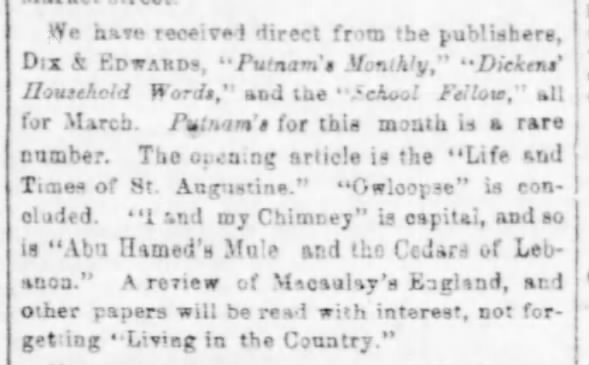
The Pittsburgh Gazette for March 4, 1856 praised "I and my Chimney" as a "capital" piece in "a rare number" of Putnam's.
We have received direct from the publishers, DIX & EDWARDS, "Putnam's Monthly," "Dickens' Household Words," and the "School Fellow," all for March. Putnam's for this month is a rare number. The opening article is the "Life and Times of St. Augustine." "Owlcopse" is concluded. "I and my Chimney" is capital, and so is "Abu Hamed's Mule and the Cedars of Lebanon." A review of Macaulay's England, and other papers will be read with interest, not forgetting "Living in the Country." --Pittsburgh Gazette, March 4, 1856.
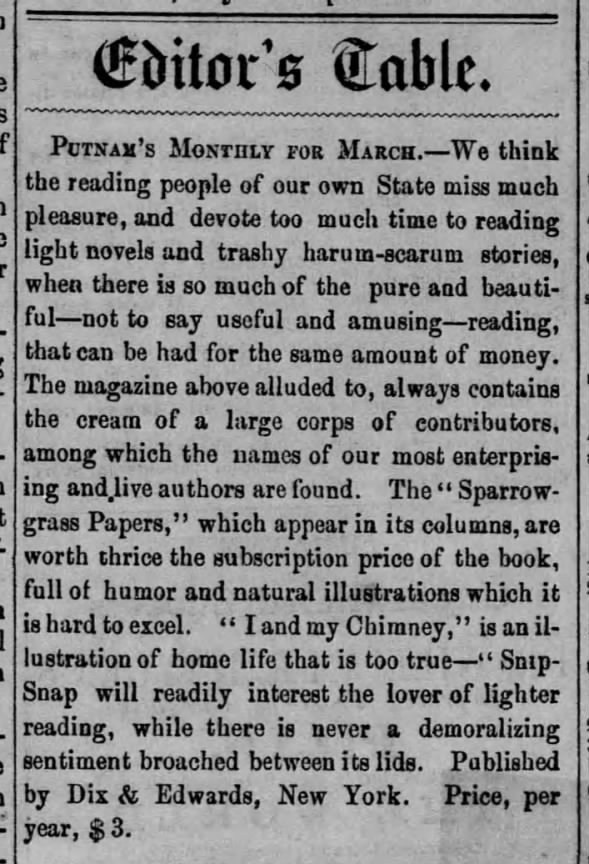
The Montpelier, Vermont Green Mountain Freeman commended Putnam's as a magazine that "always contains the cream of a large corps of contributors, among which the names of our most enterprising and live authors are found." In the March 1856 issue, "I and my Chimney" struck the new editor Sidney S. Boyce as
"an illustration of home life that is too true." --Montpelier, Vermont Green Mountain Freeman, March 6, 1856.
During the Civil War, Boyce served as Captain in the 77th U. S. Colored Infantry. As reported in the Army & Navy Official Gazette on April 25, 1865, Boyce was tried for illegal use of military property and dismissed.
The Criterion on March 8, 1856 contrasted the "meditative" sketch "I and my Chimney" with the instructively "moral" tale, "Snip-Snap."
"I and my Chimney," and "Snip Snap," are respectively meditative and moral. We should hesitate to pronounce the last a successful effort. --The Criterion, March 8, 1856
Despite the knock,"Snip-Snap" was popular at the time and frequently reprinted in other newspapers. The New York Times reviewer who thought of Melville's comedic "Chimney" in visual and dramatic terms as a "Callot-like extravaganza" also applauded "Snip-Snap" as "a "charming love-story."
"a New York critical weekly of high class, publishing really careful reviews, with notes on art, drama, and science. It was modeled on the London Athenaeum."
Another brief mention of "I and my Chimney" appeared in The Country Gentleman for March 13, 1856. This was a weekly agricultural newspaper published in Albany, New York by Luther Tucker. According to Frank Luther Mott in A History of American Magazines, Tucker's editorial assistants at the time were his son Luther H. Tucker and John J. Thomas. Surveying the new issue of Putnam's magazine, one or another editor of the Country Gentleman felt "I and my Chimney" had been narrated "somewhat lugubriously."
Putnam's Monthly for March contains, biographically, an article on the "Life and Character of St. Augustine ;" fictitiously, part third of "Owlcopse;" poetically, "Chester," " My Mission," the "Malakoff Marseillaise" &c.; historically, a review of Macaulay; orientally, the very Arabian tale of "Abu Hamood's Mules;" somewhat lugubriously, "I and my Chimney;" quite ludicrously, further details of Mr. Sparrowgrass' rural experience; very spiritedly, the story "Snip-Snap," and several other readable articles, besides the Editorial notes, criticisms, &c. Dix & Edwards, New-York.
In the Western Reserve Chronicle (Warren, Ohio) for March 12, 1856, editors Comfort A. Adams and George N. Hapgood gave the contents of the March 1856 number with this general endorsement:
"Putnam's Magazine is to the United States, what Blackwood's is to England. It is entirely original, and its articles are marked by independence and vigor of thought."