Showing posts with label Poughkeepsie. Show all posts

Friday, April 6, 2018

Henry Livingston Jr on hemp

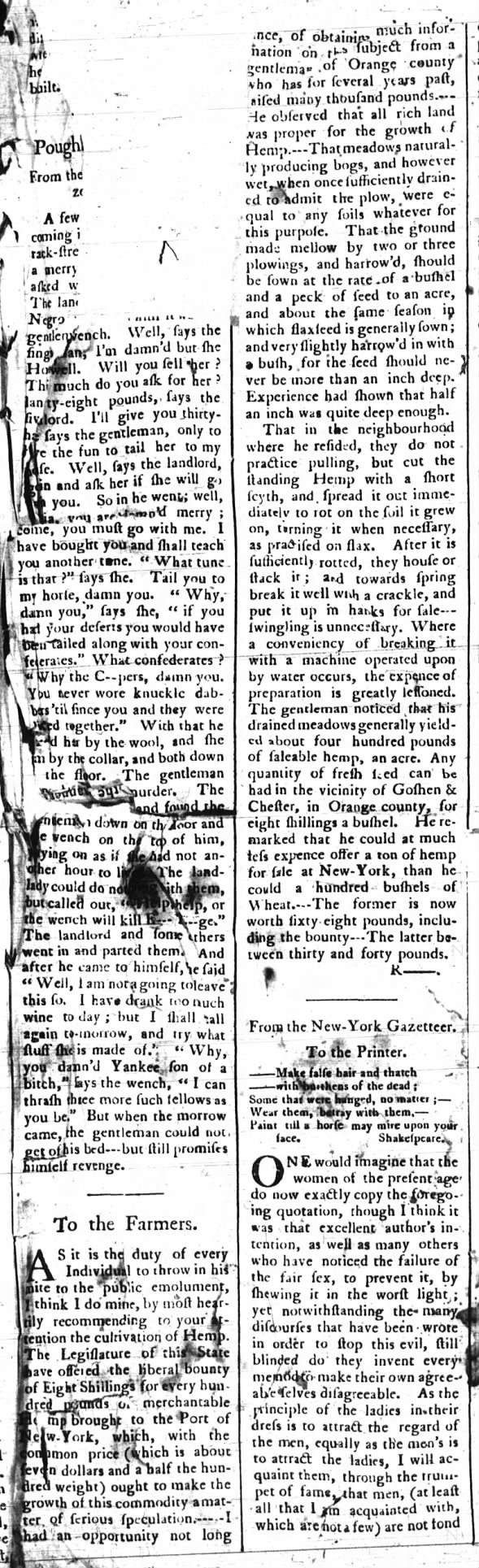
Signed "R——." and printed under the heading "To the Farmers," a letter commending the cultivation of hemp was published in The Country Journal and the Poughkeepsie Advertiser on October 13, 1785.

· Thu, Oct 13, 1785 – Page 3 · Poughkeepsie Journal (Poughkeepsie, New York) · Newspapers.com
The writer addresses area farmers with evident knowledge and experience of their concerns. Along with the farmer's perspective, the writer's style also resembles that of Henry Livingston, Jr. as demonstrated in extant letters to family members. For instance, in the first sentence the writer embraces "the duty of every Individual to throw in his mite to the public emolument." The figure of contributing, more specifically throwing one's "mite" occurs in Henry's January 1819 letter to his grandson Sidney Breese:
The day may come when the Breeses & the Livingstons would throw in no inconsiderable mite into the treasury of Occidental population.--Letters of Major Henry Livingston
Transcribed below from the The Country Journal and the Poughkeepsie Advertiser, October 13, 1785; found on Newspapers.com:

To the Farmers.


As it is the duty of every Individual to throw in his mite to the public emolument, I think I do mine, by most heartily recommending to your attention the cultivation of Hemp. The Legislature of this State have offered the liberal bounty of Eight Shillings for every hundred pounds of merchantable Hemp brought to the Port of New-York, which, with the common price (which is about seven dollars and a half the hundred weight) ought to make the growth of this commodity a matter of serious speculation.--- I had an opportunity not long since, of obtaining much information on the subject from a gentleman of Orange county who has for several years past, raised many thousand pounds.--- He observed that all rich land was proper for the growth of Hemp.---That meadows naturally producing bogs, and however wet, when once sufficiently drained to admit the plow, were equal to any soils whatever for this purpose. That the ground made mellow by two or three plowings, and harrow'd, should be sown at the rate of a bushel and a peck of seed to an acre, and about the same season in which flaxseed is generally sown; and very slightly harrow'd in with a bush, for the seed should never be more than an inch deep. Experience had shown that half an inch was quite deep enough.

That in the neighbourhood where he resided, they do not practice pulling, but cut the standing Hemp with a short scyth, and spread it out immediately to rot on the soil it grew on, turning it when necessary, as practised on flax. After it is sufficiently rotted, they house or stack it; and towards spring break it well with a crackle, and put it up in hanks for sale---swingling is unnecessary. Where a conveniency of breaking it with a machine operated upon by water occurs, the expence of preparation is greatly lessoned. The gentleman noticed that his drained meadows generally yielded about four hundred pounds of saleable hemp, an acre. Any quantity of fresh seed can be had in the vicinity of Goshen & Chester, in Orange county, for eight shillings a bushel. He remarked that he could at much less expence offer a ton of hemp for sale at New-York, than he could a hundred bushels of Wheat.--- The former is now worth sixty-eight pounds, including the bounty---The latter between thirty and forty pounds.
 R——.

Samuel Johnson on female happiness, plagiarized in Poughkeepsie

From The Rambler No. 128 - June 8, 1751
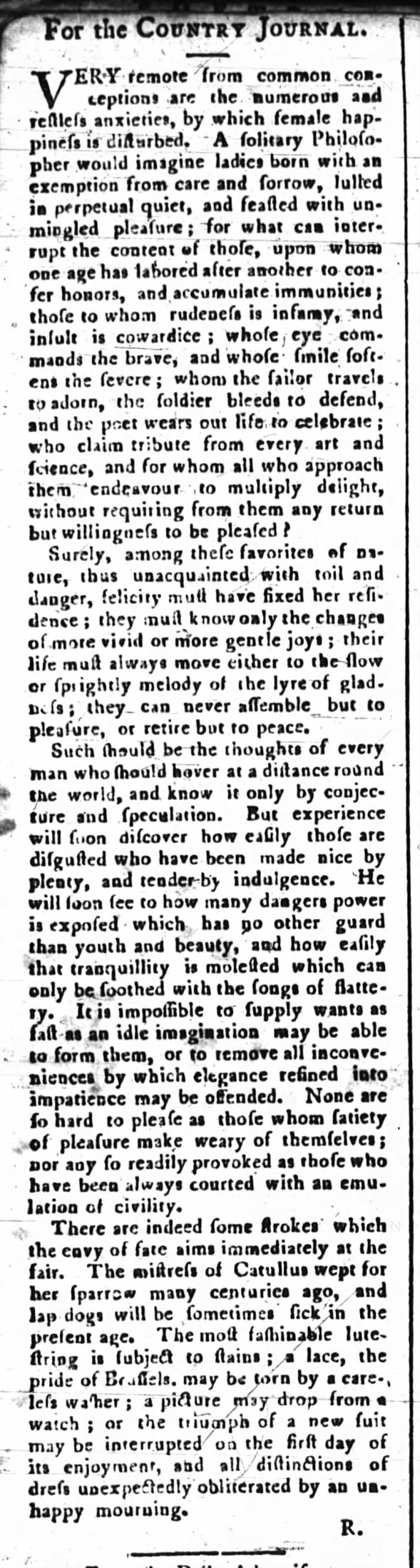
Rather, unhappiness. A long, only slightly modified excerpt from Samuel Johnson's essay in The Rambler No. 128 (June 8, 1751) was published over the signature "R." in the Poughkeepsie Country Journal and Dutchess and Ulster County Farmer's Register of October 14, 1788. Otherwise uncredited, the item from "R." appeared under the heading "For the Country Journal." The Poughkeepsie contributor omits the general, "universal" application of the moral argument that concluded Johnson's 1751 essay:
"Such is the state of every age, every sex, and every condition: all have their cares, either from nature or from folly: and whoever therefore finds himself inclined to envy another, should remember that he knows not the real condition which he desires to obtain, but is certain that, by indulging a vicious passion, he must lessen that happiness which he thinks already too sparingly bestowed."  --The Rambler No. 128. Anxiety universal

· Tue, Oct 14, 1788 – Page 2 · Poughkeepsie Journal (Poughkeepsie, New York) · Newspapers.com

By virtue of the signature "R." this item is listed with other prose writings attributed to Henry Livingston Jr on the Livingston website, there transcribed under the title, Female Happiness. In a footnote to the second chapter of Who Wrote "The Night Before Christmas"? (page 177 note 18), MacDonald P. Jackson quotes Livingston on Catullus without acknowledging the source in Samuel Jonson's Rambler.

Related post:

Tuesday, April 3, 2018

T. W. C. Moore and William I. Street, son of Henry Livingston's "good friend" Randall S. Street

In 1862 Livingston cousin T. W. C. Moore wrote a key witness letter attesting to Clement C. Moore's authorship of "A Visit from St Nicholas" aka The Night Before Christmas. T. W.C. Moore testified in writing to Clement C. Moore's authorship of the Christmas poem after a personal "interview" with the author himself. Addressed to the Librarian of the Historical Society, the 1862 letter from T. W. C. Moore accompanied a manuscript copy of "Visit" in Clement C. Moore's distinctive handwriting. T. W. C. Moore's letter was published in The New York Historical Society Quarterly Bulletin 2.4 (January 1919) pages 111-115, along with a reproduction of the manuscript copy made by Clement C. Moore.

This T. W. C. or Thomas William Channing Moore was a son of John Moore and Judith Livingston Moore. His mother Judith was a first cousin and former neighbor of Henry Livingston, Jr. of Poughkeepsie. So T. W. C. Moore and Henry Livingston, Jr. were first cousins, once removed.

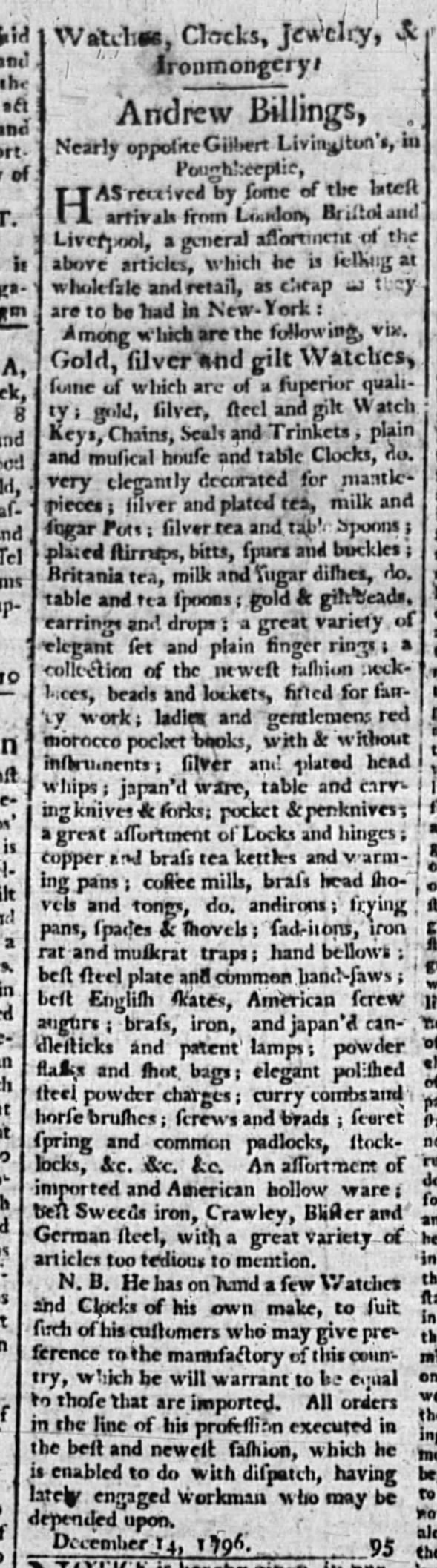
In addition to the family tie through his mother Judith Livingston Moore, T. W. C. Moore was also connected to Henry Livingston, Jr. through Moore's aunt, Cornelia Livingston (1751-1820)--his mother's sister, another daughter of James Livingston and Judith Newcomb Livingston. T. W. C. Moore's widowed aunt Cornelia Livingston married Andrew Billings, veteran of the Revolutionary War and later a well-regarded jeweler and silversmith in Poughkeepsie.

· Wed, Mar 15, 1797 – Page 4 · Poughkeepsie Journal (Poughkeepsie, New York) · Newspapers.com
Esteemed as "a man of genius," Andrew Billings reportedly invented a pair of wings that worked for him but not his father-in-law James Livingston:
Major Billings was no ordinary man: nay more, he was a man of genius. Independent of his talents as a soldier and writer, he possessed great mechanical invention. He constructed a pair of wings, and, being a small man, actually succeeded with them in flying short distances. Relative to this matter a story is told by B. Davis Noxen, Esq., the celebrated lawyer of Syracuse, and formerly a resident of Poughkeepsie. Major Billings gave notice that he intended trying his wings at a certain hour in the market place of the village. The inhabitants assembled; he mounted a low pillar, extended his wings, and, to the amusement of the village, flew to a considerable distance. Sheriff Livingston, thinking to "follow in the footsteps" of his son-in-law, then mounted the pillar, fitted the wings and sprang. Being, however, a heavy man, and not knowing the trick of waving his pinions, he tumbled ingloriously to the dust, amid the laughter of his townsmen.  --Albany Evening Journal, May 25, 1864
Daughter Cornelia Billings married Randall Sanford Street (1780-1839). Remembered in William Hunt's American Biographical Panorama as "an eminent lawyer and accomplished gentleman," Randall S. Street was Henry Livingston's "good friend" and for a while the employer of Livingston's son Edwin.

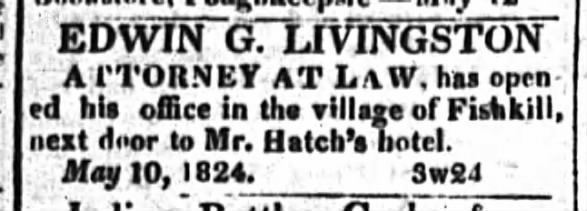
Edwin George Livingston (1798-1863) studied law with Randall S. Street. In 1821 Edwin was formally admitted as attorney in 1821, as announced in the New York Evening Post on November 7, 1821. In 1824 he began practicing law in Fishkill.

· Wed, May 26, 1824 – Page 4 · Poughkeepsie Journal (Poughkeepsie, New York) · Newspapers.com
After the death of Henry Livingston, Jr. in 1828, Edwin and his brother Sidney were able to serve as executors for the estate. Henry's "good friend" Randall Sanford Street had also been named in the will as one of the executors:
"I name and appoint as executors of this my last Will and Testament my beloved wife, Jane, my 3 sons Charles, Sidney & Edwin and my good friend Randal S. Street Esq."
--Will of Henry Livingston Jr, transcript via Mary S. Van Deusen's Henry Livingston site
T. W. C. Moore stayed in touch with grown children of his cousin Cornelia Billings and Randall S. Street, as revealed in a note Moore wrote about a curious gift he got from one of Cornelia's sons, William Ingraham Street (1807-1863). After Street gave Moore souvenir locks of George Washington's (and Martha's) hair, T. W. C. meticulously recorded the provenance in a written statement made in New York City, dated March 24, 1857:

WASHINGTON AND WIFE'S HAIR, JUNE, 1783.
The locks of hair below is part of that which was sent to Major Billings of Poughkeepsie, inclosed in a letter, of which the following is an exact copy. The original is in possession of the Major's grandson, W. J. Street, counselor at law, of this city, who gave me the hair.
Inveterate antiquarian that he was, T. W. C. Moore also took the trouble to make "an exact copy" of the authenticating letter from George Washington to Andrew Billings, at the time still owned by William I. Street (whose middle initial "I" for Ingraham or Ingram was sometimes misprinted as "J"). Transcribing Moore's 1857 note in The Century Magazine for May 1890, Edith Robertson Cleveland calls it "an odd affidavit of the present of two locks of hair from the heads of Mr. and Mrs. Washington, with the hair itself curiously preserved."

Speaking of Poughkeepsie Streets, William I. Street's brother Alfred became a poet of considerable repute in Herman Melville's time. In the 1840's, Alfred Billings Street had a law office in Albany. Somehow he knew Herman's sisters. Once in Pittsfield, Alfred B. Street felt hurt when Herman did not ask him over to Arrowhead for a social visit. Hershel Parker tells all about it in the second volume of Herman Melville: A Biography (Baltimore: Johns Hopkins University Press, 2002), page 139. That was in late September 1852. Twenty-five years later Melville highly complemented one of Street's poems, in a letter to his cousin Kate and her husband Abraham Lansing:
... I have just been reading in a copy of Frank Leslie's Illustrated paper "The Old Garden" by Mr Street. How beautiful, and poetically true to nature it is! It is like a flower-and- fruit piece by some mellow old Fleming.  --Herman Melville, August 14, 1877 letter to Catherine Gansevoort Lansing and Abraham Lansing; reprinted in the Northwestern-Newberry Edition of Melville's Correspondence, pages 459-463.
Melville's comparative view of the poet as painter, "some mellow old Fleming," echoed the tribute by Henry T. Tuckerman thirty years before. In a friendly review of the 1845 volume The Poems of Alfred B. Street, Tuckerman had praised Street as "a true Flemish painter":
We have wandered with him on a summer's afternoon, in the neighborhood of his present residence, and stretched ourselves upon the greensward beneath the leafy trees, and can therefore testify that he observes con amore, the play of shadows, the twinkle of swaying herbage in the sunshine, and all the phenomena that makes the outward world so rich in meaning to the attentive gaze. He is a true Flemish painter, seizing upon objects in all their versimilitude. As we read him, wild flowers peer up from among brown leaves; the łoń. the partridge, the ripple of waters, the flickering of autumn light, the sting of sleety prow, the cry of the panther, the roar of the winds, the melody of birds, and the odor of crushed pine-boughs, are present to our senses. In a foreign land, his poems would transport us at once to home. He is no second-hand limmer, content to furnish insipid copies, but draws from reality. His pictures have the freshness of originals. They are graphic, detailed, never untrue, and often vigorous; he is essentially an American poet. --Unsigned notice of The Poems of Alfred B. Street [by Henry T. Tuckerman] in The United States Magazine and Democratic Review for January 1846.
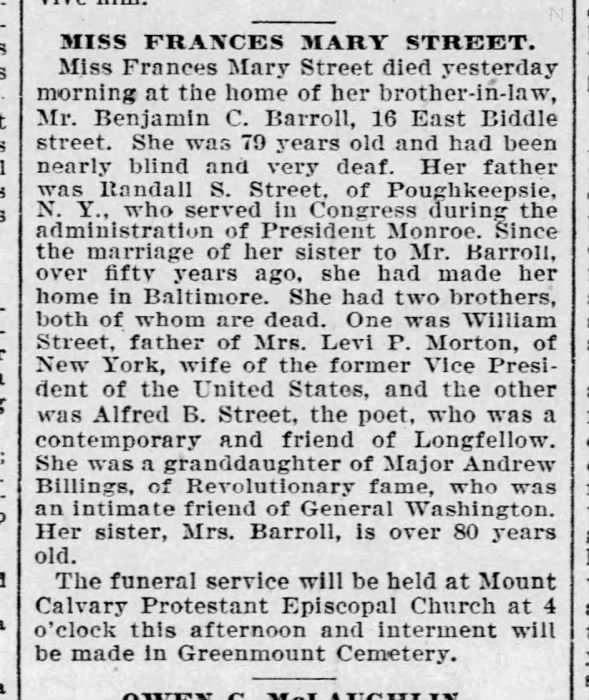
In this 1901 obituary of Alfred's sister Frances Mary Street, the highest honor the writer could think to bestow on her late brother the poet was to make him "a contemporary and friend of Longfellow."

· Sat, Mar 30, 1901 – 7 · The Baltimore Sun (Baltimore, Maryland) · Newspapers.com
From the Memoir of Alfred B. Street as published in Bentley's Miscellany (London, 1849):
The Hon. Randall S. Street, father of the author of " Frontenac," was the lineal descendant of these two eminent clergymen. He removed, with his father, in early life, into the State of New York, and this branch of the family has continued to reside there ever since; the other branch continued in Connecticut, and is still represented by Augustus Russell Street, Esq., who resides at Newhaven. Randall S. Street studied law at Poughkeepsie, married Miss Cornelia Billings, and settled there for the succeeding thirty years of his life. Such was his standing at the bar, that whilst still young, he was appointed attorney of the district composed of the counties of Wayne, Ulster, Dutchess, Delaware and Sullivan, under the old organisation of districts, and subsequently he represented the county of Dutchess in Congress. He was an eminent lawyer and accomplished gentleman, and among the recollections of the writer, is one of a day spent more than thirty years ago at the residence of General Street, when it was the home of hospitality and elegance. In 1824, General Street removed to Monticello, Sullivan county, New York, where he died in 1839.

The maternal grandfather of our author was Major Andrew Billings, who married Cornelia, daughter of James Livingston, of the well known family of that name in New York. Cornelia, the daughter by this marriage, who became the wife of General Street, was the mother of the poet....


Related posts:

Saturday, March 31, 2018

Fourth of July toasts in Poughkeepsie, 1826

 In Poughkeepsie, the day was celebrated with a zeal and hilarity which has never been exceeded. Col. H. A. Livingston read the Declaration. The oration was pronounced by Stephen Cleveland., esq. Col. Livingston presided at the feast, assisted by Clapp Raymond, Joseph Harris, John De La Veigne, John S. Myers and John W. Oakley, esqrs. --Albany Argus, July 18, 1826
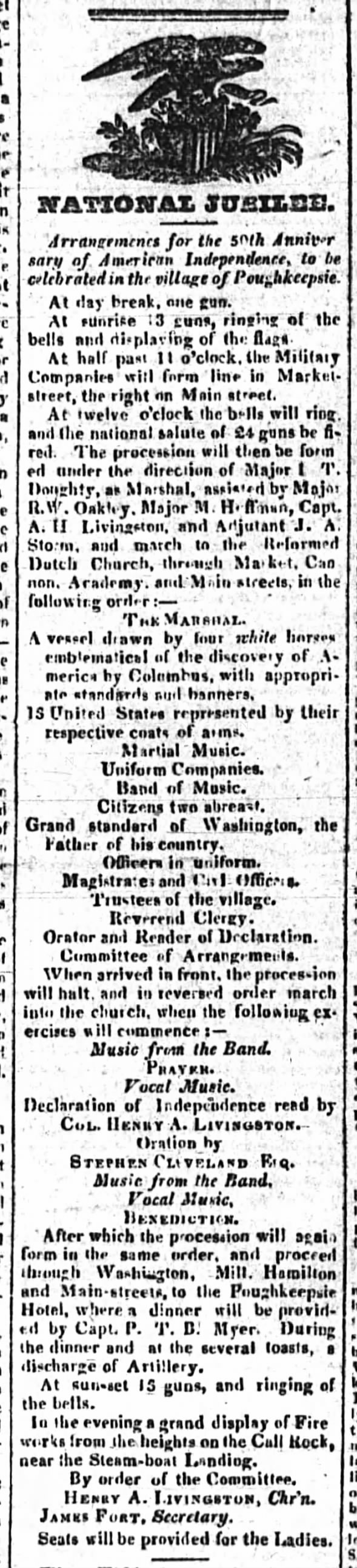
Henry Alexander Livingston (1776-1849) aka "Colonel Livingston" of Poughkeepsie was the son of Henry Livingston, Jr's older and much better known brother John Henry Livingston. Dutchess County historian Helen Wilkinson Reynolds well describes Henry A. Livingston as  "a leading citizen of Poughkeepsie for approximately half a century." If you needed a parade marshal or banquet host, Col. Livingston was your man. When Lafayette landed in Poughkeepsie, Col. Henry A. Livingston made the appropriate welcome speech. Colonel Livingston routinely officiated at Fourth of July celebrations. In 1824 the Poughkeepsie Journal (July 7, 1824) criticized the noise and fireworks that year as ridiculously and dangerously excessive. But two years later a notably grand celebration took place on July 4, 1826--the half-centennial anniversary of American independence. Colonel Henry A. Livingston naturally served as Chairman on the Committee of Arrangements. As in 1824, Col. Livingston had the honor of reading the Declaration of Independence. In between the parade and fireworks, Col. Livingston presided over the dinner and formal toasts which in this extra-special instance were "accompanied by the discharge of cannon, music from the band, and occasional songs."

Some of the toasts were evidently composed by Col. Livingston's uncle Henry Livingston Jr., then 77 years old. On the marvelous Henry Livingston website, Mary S. Van Deusen has transcribed some Scraps from 4th of July toasts which survive in manuscript (on "Livingston Microfilm" at the New York Public Library, exact location not specified). Van Deusen identifies the handwriting as that of Henry Livingston, Jr. Some years earlier, Col. Livingston's uncle Henry had expressed interest in regional 4th of July plans, in a letter to his son-in-law Sidney Breese dated July 2, 1820.
"It appears the 4th of July is to be celebrated in a novel stile in the land of your nativity. All the boats of the canal are to move in divisions from Utica, Whitesboro, Rome &ct finally, assembling at Salina, then display the Ensigns of festivity & Keep it up"
It's hard to tell from the images as reconfigured on the Henry Livingston Jr site, but the letter "R" that appears below many of the toasts in manuscript may be unrelated to Livingston's alleged pseudonym. Repeated assertions of authorship here do not seem necessary or even germane to the process of drafting suitable toasts. Presumably Uncle Henry had little reason to adopt a persona or disguise his identity, which would have been perfectly obvious to his own nephew and all concerned. In the context of toasts to be delivered at a formal dinner banquet, in this case for an unusually elaborate celebration of the "National Jubilee" in 1826, "R" might refer to a planned "Response" of some kind, either in the form of a brief speech, music, song, or--as indicated in the advertised program--a cannon blast.
"During the dinner and at the several toasts, a discharge of Artillery."  Poughkeepsie Journal, June 28, 1826.
If any surname absolutely had to be associated with the letter "R," we now have that of Clapp Raymond, Col. Livingston's first-named Vice President on the 1826 Committee of Arrangements.

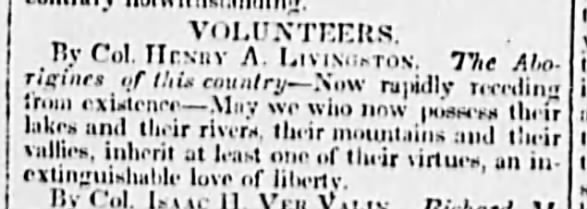
Henry's nephew Colonel Henry A. Livingston apparently did need help with the job of composing toasts with flair. In 1830 Col. Livingston recycled one of his uncle's compositions, the 1826 toast to Indians and their "inextinguishable love of liberty."

· Wed, Jul 7, 1830 – Page 2 · Poughkeepsie Journal (Poughkeepsie, New York) · Newspapers.com
VOLUNTEERS.
By Col. HENRY A. LIVINGSTON. The Aborigines of this country--Now rapidly receding from existence--May we who now possess their lakes and their rivers, their mountains and their vallies, inherit at least one of their virtues, an inextinguishable love of liberty.
 --Poughkeepsie Journal, July 7, 1830
The same toast to "Aborigines" had been proposed at the 4th of July dinner in 1826. Two of the seven manuscript toasts transcribed on the Henry Livingston site made it into the local newspaper: one to "The aborigines of this country" and the other to "The army & navy of the Union," reported in print as "The Army and Navy of the United States." From the Poughkeepsie Journal, July 12, 1826:

NATIONAL JUBILEE

POUGHKEEPSIE CELEBRATION.
The Fiftieth Anniversary of American Independence was celebrated in this village in the manner heretofore published by the Committee of Arrangements, and with a zeal and hilarity never exceeded. The dawn of day was announced by a discharge of cannon; at sunrise a national salute was fired and the bells rung. At noon the salute was repeated, and the grand procession was formed under the direction of the Marshalls of the day, escorted by all the uniform companies of the village, with the band from Freedom. The procession passed through our principal street to the Church, where the exercises of the day were performed accompanied by music from the choir and band. A fervent address to the throne of Grace was offered by the Rev. Mr. Cuyler. The Declaration of Independence was eloquently read by Col. Livingston. The appropriate and excellent oration delivered by Stephen Cleveland, Esq. obtained universal approbation, and awakened in the bosoms of the audience emotions congenial to the patriotic sentiments of an address, so ably and so elegantly adapted to the occasion and the theme. The concluding benediction was invoked by the Rev. Dr. Reed.
The procession then again formed and passing through several streets repaired to the Hotel where a dinner was provided by Capt. Myer.

Col. Livingston presided at the table assisted by Clapp Raymond, Joseph Harris, John Delavergne, John S. Myers and John W. Oakley, Esquires as Vice Presidents, and the following toasts were drank, accompanied by the discharge of cannon, music from the band, and occasional songs.

The Day--Half a century ago thousands hailed its birth, millions now join in celebrating the Jubilee and tens of millions in future ages, will plaudit its recurrence.

The Worthies--Who fifty years since signed the charter of our independence and for the support of their declaration pledged to each other their lives, their fortunes, and their sacred honour.

The Memory of Washington--Like the vast pyramids of Egypt, stands towering in the pages of history, uninjured by the waste and lapse of time.

The American Hercules--Fifty years ago, although an infant in the cradle, strangled the viper that assailed him; he is now in the vigor of youth, fond of peace, but will evade no honorable conflict.

The President and Vice President of the United States of America.

The Governor and Lieutenant Governor of the state of New York.

Our beloved country--May it continue to be the land of civil liberty and independence, until century on century shall roll away, and the last Archangel's trump shall sound.

The Militia--Success to that government which prefers armed citizens, to armed slaves.

The Army and Navy of the United States--When the occasion occurs, may the former never lack a Washington, a Fayette, or a Greene, nor the latter a Perry, McDonnough, or a Bainbridge. 
The Aborigines of this country now rapidly receding from existence--May we who possess their lakes, and their rivers, their mountains and their valleys, inherit at least one of their virtues--an inextinguishable love of liberty.

The river of our hearts--The magnificent Hudson has reently commingled embraces with the lakes of the west, and of the north, and at an early period, may she as cordially unite with her sister, the Delaware on the west.

May peace be within our gates, plenty within our dwellings, patriotism in our rulers, truth in our statesmen, piety in our preachers, virtue in our senators, and industry and honesty in the people, until time shall be no more.

The Fair Daughters of America.


Wednesday, March 8, 2017

More poetry by Isaac Mitchell in the Political Barometer

Of numerous Carrier Addresses indexed online by Mary S. Van Deusen, only one in 1787 seems definitely attributable to the Poughkeepsie poet Henry Livingston, Jr. Manuscript evidence exists only for the 1787 Address which is written out in Livingston's manuscript book.

Harry Croswell, the young Federalist editor of two newspapers in Hudson, New York (The Balance and The Wasp), criticized everything about his Jeffersonian nemesis Isaac Mitchell, including Mitchell's versified New Year's Addresses in the Political Barometer. Like the 1804 and 1805 Addresses that Croswell (most likely Croswell, rather than senior partner Ezra Sampson) slammed in the Balance, the 1803 Address in the Political Barometer was probably composed by Isaac Mitchell, who founded and co-edited the Barometer with Jesse Buel.

Among other of his enterprises in Poughkeepsie, Isaac Mitchell conducted the Dutchess County Academy.

Found on Newspapers.com powered by Newspapers.com

Mitchell introduced his fledgling newspaper in verse with the following "Proem," printed in the Political Barometer on June 8, 1802. Distinctively, Mitchell rhymes the French word "l'argent" with "wrong."
That to secure the prize, l'argent,
He'll choose the right side--or the wrong. 
Mitchell's l'argent/wrong rhyme anticipates the rhyme of l'argent with "song" in the 1803 News-boy's Address
For then, cockahoop with the magical song,
That charms from your purses the glittering l'argent,
The 1807 Carrier's New Year's Address in the Political Barometer also features l'argent as an end-rhyme, this year with long. (The correct l'argent is mistakenly transcribed "l'argeat" on the Henry Livingston website.)
Our merchants sell cheap if you'll bring the l'argent!
And our taverns deal nectar, boys, all the day long!


FORTH from the groaning, griping Press,
Array'd in typographic dress,
I to the world, am dragg'd along,
Prepar'd to hail you with a song.
"A song!" bawls out the man of news,
Is this the stuff you mean to use?
Plain, though the bait, the hook I see,
Catch birds with chaff--you'll not catch me."
Up starts young Frip--"I'll tell you plain,
I hate this newsing, nonsense strain;
We brawlie lads, all spunk and hearty,
Care not for war and Boonapartee;
Tell us of dress, that's first in ton,
And how the gay world dances on,
With fashions fresh brought o'er the sea,
Quite alamode de la Paris."
"This ne'er will do," replies old Lumpkins,
Point out some plan: increase our pumpkins;
Our corn to raise with easier toil,
Or, void of cost, to enrich our soil;
Or, with less pains our hogs to fatten,
And when for price good chances happen."
Up rose a puny-hearted fellow,
Of aspect sore, and visage sallow--
"Give us," says he, "some tales of love,
"The whispering vale and echoing grove,
The flowery fields, the garden's bloom,
And gales ting'd with their rich perfume-----."
"Hold!" bawls a wonder-hunting wight,
(Dole, death and danger his delight)
"No milk and water tales for me,
Give us loud storms which rock the sea;
Or earthquakes, swallowing towns of fame;
Or cities all enwrapt in flame;
Or thunders, shaking either pole;
(Far off, not near, I'd have them roll)
Tell us of pigmies, six feet high,
Or giants tow'ring through the sky;
Or thousands fall'n on battle's plain,
While we at home, in peace remain."
A lawyer and physician, next.
With him who twirls and twists a text,
Strait raise their voices, loud declaring,
What they've to say is worth the hearing:
One talks of writs, demurs, and pleadings,
And one of bolusses and bleedings,
While t'other tracks the bishop's gown,
Quite to the days of Peter, down.
"Zounds!" cries a grogman, o'er his bowl,
"You've he--he--hit it--on my soul!
Bishops and pumpkins--love and thunder!--
Physic and hogs--and--tales of wonder!--
What! print all this?--'tis a queer job!--
"Qu--queer, by Jove!--Landlord! More grog!"
Near, stands a politician, sly,
With sneering phiz, and leering eye,
Who not one word attempts to say;
He knows full well who'll win the day;
Full well he knows, before 'tis utter'd,
Which side the Printer's bread is butter'd--
That to secure the prize, l'argent,
He'll choose the right side--or the wrong,
And wheresoe'er he takes his stand,
He'll try, at politics, his hand.
On wings of speed I haste away.
Still hurried on by night and day:
Sometimes on post-horse, pack'd with care,
I'm hawk'd about, like pedlar's ware;
Sometimes in stage, at ease, I ride,
Gay belles and beaux attend my side;
To great men's tables oft admitted,
And with the straw-thatch'd cot I'm fitted;
East, west, and north, and south I fly,
And once a week I live and die.
Where'er I come, some praise I find,
Yet blame will oftimes sour my mind,
Miss Nan I bring some soothing strain,
Just form'd to hit her love-fraught brain,
And her, all night, in sheets, I rest with,
A bliss, gallants have ne'er been blest with.
Then next (ye stars!) old goody Blakes,
Me, roughly, by the foretop, takes,
While o'er her shoulder, grannum Jewks;
Through two large, google, glass eyes looks,
And while she thrice my name repeats,
Thus, to her crony husband, squeaks:
"O John! Dear John! What kind of cretur
Is that same thing call'd Barometer?"
"Barometer," roars surley John,
"I think 'tis call'd by neighbor Tom:
He says it feeds and lives on air,
Soars when it rains, and sinks when fair,
And warns you 'gainst the gossip's rules,
Lest you get duck'd with gadding fools;
It rises as your tempers do,
And falls, and settles with them too;
Frowns when you scold, laughs when you're mum
And ties the wrangling female's tongue*--"
"Stop there, good John," old Jewks replies,
"My tongue, till death, receives no ties;
If what you say be true, I sweer,
No Broomeater shall enter here."
This said, her fist is clench'd, and I
Think best, with post, away to fly,
Lest rattling storms around us roar,
And John sinks, sneaking, out of door.
Now here I'll close my vers'fication,
With one brief, pointed observation--
When on one plan the whole can fall,
I then will please my readers, all.
*John's description, here, of the powers of the Barometer, is a little inaccurate--in this, however, he is excusable, as the ignorant often believe what they wish to be true
The first installment of Mitchell's prose romance Albert and Eliza appeared on the same page with his "Proem." Using the pseudonym "Robert Rusticoat," Croswell of The Wasp subjected Mitchell's Proem to an elaborate "Critique":
MITCHELL, in the first number of the Barometer, bespattered a whole column, with what he called a "Proem;" and a sillier thing, perhaps, never appeared in print. Tho' it is, in fact, beneath criticism; yet I cannot refrain from troubling my readers with a few extracts and remarks.... Wasp, July 7, 1802
Glossing l'argent as "money," Croswell explicates the French word in its context as a "precious confession":
This, Mitchell, I believe is strictly true. I have no doubt, that you would, FOR MONEY, not only take "the right side--or the wrong"--but would FOR MONEY, do almost any thing, short of writing common sense.
Harry Croswell's relenteless mockery of Mitchell carried over to the July 17, 1802 issue of The Wasp
POET MITCHELL, is greatly enraged at my Critique on his proem, and I don't wonder--for it is said that he considered this same proem as one of the handsomest and prettiest pieces of verses that he ever penned. This I am not disposed to doubt, for though he has written a vast deal of poetry, his proem, in all probability, is the least exceptionable of the whole--He had vainly puffed himself up with an idea that he was one of the greatest geniuses of the age. Nay, he really believed, that impartial critics (not such as Robert Rusticoat) on reading his productions, would pronounce them far superior to Hudibras and M'Fingal. I should not have been surprised, after witnessing so much of Mitchell's vanity, if he had declared that his proem was a masterly performance--that the style was sublime--that the grammar was correct--that the rhymes were excellent, that "ting'd gales," were the most common things in the world; and that Robert Rusticoat was an ill-natured fellow, who could not distinguish good poetry from bad.
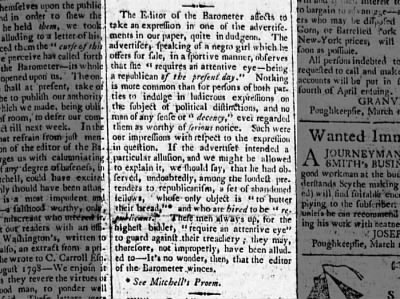
On March 15, 1803 the Poughkeepsie Journal cited "Mitchell's Proem" for the line about printers knowing which side their bread is buttered (butter = bribes from politicians). In the Barometer, Mitchell had complained about a gratuitous swipe at Republicans inserted in the Journal advertisement of a "Negro Girl" for sale. In reply, the Journal editor quoted Mitchell's former words against him--as had Croswell in his Wasp critique.


Also in 1803, Mitchell inaugurated another of his New York newspapers, the Kingston Plebian, with an introductory poem. Both productions again received sharp criticism in Hudson, this time by Croswell (most likely) in his role as co-editor of the Balance:
Mitchell imagines that we did not "relish the word Proem, which entitled his poetic address in the first number of the Barometer." He has therefore "given a different name to a similar production in the first number of the Plebian." --Mitchell certainly quite mistakes the matter. It was not the title of his first-born poetry that we disliked, for that same proem "by any other name, would be as bad." Of this we are convinced that "the Poet's Congee" (the name given to the Plebian production) is in no respect better than the Proem. We give the first couplet as a specimen, and leave the reader to judge.
"The world had long in darkness groan'd,
While man through wildering mazes roam'd." 
 --The Balance, and Columbian Repository, July 19, 1803
I'm still looking for "The Poet's Congee" by Isaac Mitchell, apparently published in the first number of The Plebian.

In January 1803 Croswell famously faced jail time after his first trial for criminal libel, so he might well have missed Mitchell's "Address" that year. Neither the Balance nor The Wasp notices the 1803 New Year's Address in the Political Barometer. However, as shown in the previous post, the next year Croswell got the idea to conduct a critical round-up of New Years Addresses. Thus, early in 1804 the Balance included Mitchell's "Political Barometer" in its critical survey, "New Year's Addresses Reviewed."


Every body knows, that it is much easier to make rhymes than to write poetry; but Mitchell, it seems, finds his powers unequal even to the former. He makes such unnatural matches in coupling his lines, that it would not be surprizing if three fourths of them should sue for bills of divorcement before the year is at an end….Mitchell is extremely apt, when hard pushed, to make metre at the expence of grammar and sense
--Balance and Columbian Repository - February 7, 1804
Three prose tales by Isaac Mitchell were serialized in the Political Barometer:
  • Albert and Eliza. Political Barometer, June 8, 1802 - July 13, 1802.
  • Melville and Phalez. Political Barometer, June 7, 1803 - July 26, 1803.
  • Alonzo and Melissa. Political Barometer, June 8, 1804 - October 30, 1804.
Related post:

New Year's Addresses in the Political Barometer by Isaac Mitchell

In the Hudson, New York Balance for January 8, 1805, editor Harry Croswell extensively criticized the 1805 "Address to the New Year" in the Kingston Plebian as "written, without any question, by that rare child of genius, Mitchell...."  Generous quotations by the reviewer make it clear the Plebian text is the same as that published in the Political Barometer, co-edited by Isaac Mitchell. Croswell's sarcastic review of the 1805 Address appears in the Balance under the heading, "Mitchell's Poetry":
The Balance, and Columbian Repository, Volume 4 - January 8, 1805
The year before, the Balance had mocked Mitchell's 1804 address in the Political Barometer, as part of Croswell's first annual round-up of "New Year's Addresses."
New-Year's Addresses Reviewed
in The Balance, and Columbian Repository, Volume 3 - February 7, 1804
The Balance, and Columbian Repository Vol. 3 - February 7, 1804

How many of the New Year's Addresses in the Political Barometer did editor Isaac Mitchell write? All of them? 

Related post: