Showing posts with label Evert Duyckinck. Show all posts

Sunday, July 11, 2021

Refresher on heroic measure

"Let America, then, prize and cherish her writers; yea, let her glorify them."
-- A Virginian Spending July in Vermont

While we wait around for scanned images of John Chipman Hoadley's manuscript poem "Destiny," now ordered from The New York Public Library, let me explain why I expect (before seeing any of it) to find that Hoadley composed the long unpublished work he called his "national poem" in iambic pentameter. What I don't know is if Hoadley developed his patriotic theme using rhymed couplets in the manner of Joel Barlow in The Vision of Columbus and The Columbiad and Richard Emmons in The Fredoniad, Americanizing British models by Dryden and Pope. My best guess is YES. But it would be wonderful to find Melville's future brother-in-law on a more daring and ambitious course, sounding off like Milton or Marlowe in mighty MAGA lines of blank verse. 

Rhymed elsewhere in the stanza or not, however arranged in couplets or triplets or quatrains, Hoadley's usual verse line in "Destiny" will contain five metrical feet, mostly iambs. The iamb as English majors recall without any help from Google consists of one unstressed syllable followed by a stressed one. Five iambs or iambuses = iambic pentameter. 
Manuscripts and Archives Division, The New York Public Library. "Hoadley, John Chipman (1818-1886)" The New York Public Library Digital Collections. 1851. https://digitalcollections.nypl.org/items/d9236f50-693b-0133-a932-00505686d14e
Cited above and transcribed in the Melvilliana post on Melville's hearty praises, John C. Hoadley's note of September 9, 1851 to Evert Duyckinck offers good evidence for supposing that Hoadley's pro-American "Destiny" (originally titled "The Union" and declaimed by the author on July 4, 1851 according to Jay Leyda in The Melville Log volume 1 page 416) is the versified "glorification of the United States" that Herman Melville read aloud in August 1851--with great gusto, and in the author's presence, according to Duyckinck. Previously unrecorded in Melville scholarship, this letter firmly links Hoadley to Duyckinck, Melville, and one or more of their Berkshire excursions during the previous month. Hoadley was already a prominent resident of Pittsfield, having moved there in 1848. Hoadley addressed Duyckinck formally as "Dear Sir," indicating a recent and not very close acquaintance. Hoadley thanked Duyckinck for sending him a copy of the Literary World with Duyckinck's account of a trip to Mt. Greylock. Hoadley regretted having to miss the Greylock outing, implying he had been invited as one of the group that included Duyckinck and Melville. Gratefully and casually, as something already known to Duyckinck, Hoadley acknowledged "Melville's hearty praises" for his unpublished "national poem." Since Hoadley had just unveiled his poem in Pittsfield, Mass. on the 4th of July 1851, that leaves only a month or two at most during which Herman Melville could have read it and responded so encouragingly. 


Here is the relevant passage from Duyckinck's letter to his wife dated August 8, 1851, describing how Melville entertained his audience of Berkshire excursionists with a dramatic reading of stirring patriotic verse. It happened in a barn during a summer shower. First, they had to kick out the chickens:
... The morning had been warm and the afternoon was showery, clouds and shadows being the moving scenery to the permanent stagery of the hills. We went on our way rejoicing till a dragging cloud bore down upon us when we turned to the shelter of a barn. Mr M[elville] spied out the loft and we boarded the rafters, dislodging the hens and were nestled here and there in the warm dry hay, the rain pattering its musical accompaniment on the roof. 
Mrs M [Sarah Morewood] had a poet in the company and his poem too a stout MSS of heroic measure, a glorification of the United States in particular with a polite slanging of all other nations in general. The English lady in the straw was not particularly complimented as to her native country in sounding lines which H M read with emphasis (interrupting the flattered author who sat thoughtful on a hay tuft--with such phrases as "great glorious" "By Jove that's tremendous" &c)--but perhaps the most noticeable incident was a gathering of the exiled fowls in a corner who cackled a series of noisy resolutions, levelled at the party. "Turn em out!" was the cry. The author impelled by the honor of his poem charged fearlessly, scattered the critics of the pit, clasping the most obstinate bodily and "rushing" her a rapid descent below." --as transcribed in Steven Olsen-Smith, Melville in His Own Time (University of Iowa Press, 2015) page 58.
About the poem that Melville read aloud in August 1851, certain defining features are revealed in the eye and ear-witness account that Evert A. Duyckinck gave his wife. As described by Duyckinck
  1. The poem was a long one, taking up "a stout MSS." The impressive size indicates a poem with hundreds of lines, maybe thousands.
  2. The poem was composed in iambic pentameter, as specified by Duyckinck's term "heroic measure." (More on that below.)
  3. The poem was extremely patriotic in theme, being "a glorification of the United States." The strong America-First argument of the poem involved "a polite slanging of all other nations in general." Despite whatever formal courtesies may be implied in Duyckinck's adjective "polite," the rhetorical "slanging" at Great Britain might well have offended one of Melville's listeners that showery afternoon in a Berkshire barn: Mrs. Pollack the "English lady in the straw" who according to Duyckinck "was not particularly complimented as to her native country." 
None of these qualities is shared by On Onota's Graceful Shore, the ballad by J. E. A. Smith that Leyda identified (wrongly) as the poem Melville honored by reading aloud, with dramatic "emphasis" and positive commentary. With only 11 stanzas, 88 lines in all, Smith's poem is too short. The subject is one particular Berkshire farmer-soldier and his heroic sacrifices as the American Revolution dawned--not the glory of these United States and Manifest Destiny. 

J. E. A. Smith, Souvenir Verse and Story
Springfield, Mass.: Clark W. Bryan Company, 1896

The meter of "Onota's Graceful Shore" is iambic but does not qualify as "heroic measure" since each line contains only four feet. According to standard 19th century textbooks of English grammar, the "heroic line" was understood to mean iambic pentameter, a line of verse "composed of five Iambuses." Iambic pentameter was considered the metrical form best "suited to solemn and sublime subjects" with "far more dignity" than other kinds of meter. 

§ 9. The Heroic line.
We now come to the eighth species of Iambic line. This is the heroic line composed of five Iambuses. This line is suited to solemn and sublime subjects, and it has far more dignity than any of the measures before mentioned. In long pieces it is frequently varied by the intermingling of secondary feet, but there are numerous in. stances of a succession of Iambuses through several lines.

It is employed in couplets, as in POPE's Essay on Man, PARNELL's Hermit, and GOLDSMITH's Deserted Village; it is employed in quatrains, as in GRAY's Elegy in a Country Churchyard; it is employed in the Spenserean stanza, as in the Faery Queen and Childe Harold; it is employed in blank verse, as in MILTON's Paradise Lost, THOMSON'S Seasons, ROGERS’ Italy, and COWPER's Task; lastly, it is employed in triplets, with an additional short line to complete the stanza. It is peculiarly suited to all subjects where dignity is required, and should never be employed when the subject is either trivial or gay. A specimen from GRAY's Elegy, showing the fitness of this measure for solemn subjects, will furnish the first example:
The curfew tolls, the knell of parting day,
   The lowing herd winds slowly o'er the lea,
The ploughman homeward plods his weary way
   And leaves the world to darkness and to me.

-- Erastus Everett, A System of English Versification (New York and Philadelphia, 1848) page 36.

Numerous editions of Lindley Murray's English Grammar uphold the definition of heroic measure as the conventional term for a line that specifically "consists of five Iambuses." 


5 The fifth species of English Iambic, consists of five Iambuses.
How lov'd, how valu'd once, avails thee not,
To whom related, or by whom begot,
A heap of dust alone remains of thee;
'Tis all thou art, and all the proud shall be. [Alexander Pope, Elegy to the Memory of an Unfortunate Lady
Be wise to-day, 'tis madness to defer:
Next day the fatal precedent will plead;
Thus on, till wisdom is pushed out of life. [Edward Young on procrastination, from Night Thoughts, Night 1]
This is called the Heroic measure. In its simplest form it consists of five Iambuses; but by the admission of other feet, as Trochees, Dactyls, Anapæsts, &c. it is capable of many varieties. Indeed, most of the English common measures may be varied in the same way, as well as by the different position of their pauses. 

Heroic Measure (Pentameter) is made up of five iambic feet. In its rhymed form it is the measure of Chaucer and Spenser, of Dryden and Pope, of Cowper, Campbell, and Byron; as, 
True ease in writing comes from art, not chance
As those move easiest who have learn'd to dance....
[Alexander Pope, An Essay on Criticism]
-- Charles William Bardeen, A System of Rhetoric (New York, 1884) page 639.
Unlike Smith's ballad, Hoadley's "Destiny" is a genuinely "stout" production taking up 53 manuscript sheets in the bound copy now held in the Gansevoort-Lansing collection of The New York Public Library. Both the original title "The Union" and the revised one, "Destiny," are consistent with a work devoted to glorifying the United States, as is Hoadley's own reference to his "national poem." How well the actual content matches Evert Duyckinck's description, including the "polite slanging" at other nations, remains to be seen. Likewise the number of feet or beats per line. "Onota's graceful shore" has only four. The one that Melville read and loved has five, if Duyckinck got the meter right. Obviously, I'm trusting that the veteran New York editor and literary critic knew heroic measure when he heard it. Confidence! Heroic measure means pentameter. Wherever you hear it, even in the rafters. 

Related posts

Monday, September 19, 2016

"Melville's hearty praises" for John C. Hoadley's poem on "The Union" - reported by the poet to Evert A. Duyckinck in September 1851

Digitized and available online From The New York Public Library:

John C. Hoadley, Letter to Evert A. Duyckinck - September 9, 1851
Duyckinck family papers, Manuscripts and Archives Division, NYPL
From The New York Public Library Digital Collections

Transcribed below. Hoadley quotes from Richard II, Act 1 Scene 3.
Pittsfield, Sept. 9th. 1851.
E. A. Duyckinck Esq.

Dear Sir,

I received a copy of the Literary World a few days since, containing an interesting account of your excursion to Grey Lock, for which I suppose I have to thank your kindness. I read it with lively pleasure though not without a twinge of selfish regret that I could not be of your party.— "Can a man hold fire in his hand by thinking on the frosty Caucasus?”

The Harpers, to whom I had sent my national poem for publication, decline it, and advise me to send it to D. Appleton & Co. which I have accordingly requested the Messers H. to do.— I can not but desire to have it printed, but have not much hope of it. Melville’s hearty praises give me more hope than anything else.

I am, My Dear Sir,
Very Respectfully,
Yours &c.  John C. Hoadley.
Hoadley refers to the account by Evert A. Duyckinck in the Literary World for August 30, 1851 headed  "NOTES OF EXCURSIONS—NO. I / AN ASCENT OF MOUNT SADDLEBACK." The Greylock climb by Herman Melville with his Berkshire friends and visiting literati took place on August 11, 1851, during what Hershel Parker describes as "a second idyll in the Berkshires, fit to rank with that of the previous August" (Herman Melville: A Biography V1.855).  Sarah Morewood also wrote of That Excursion to Greylock in a chapter she contributed to J. E. A. Smith's 1852 volume Taghconic.

I don't remember seeing this letter before now, anywhere. Google it?
 No results found for "melville's hearty praises"
"Melville" in a letter from Pittsfield to Evert A. Duyckinck has to be Herman. So Hoadley regrets not participating in the ascent of Greylock (he was invited?), reports the rejection of his "national poem" by the Harpers, but takes consolation in the "hearty praises" of his future brother-in-law, Herman Melville.

This John C. Hoadley also turned out to be one of the best friends Herman Melville ever had. Noticing that Herman's sister Augusta Melville listed one of Hoadley's poems ("A Man Should Never Weep?") in her commonplace book on October 7, 1850, Hershel Parker was already wondering:
"Is it possible that Herman Melville was never favored with a recital of it by its author?" "--Melville: The Making of the Poet
Not hardly. That is (to eliminate the negatives), the conjectured recital by Hoadley in the hearing of Melville seems likely enough in view of Hoadley's September 9, 1851 letter to Evert A. Duyckinck, which nicely corroborates the view of an early bonding over Hoadley's poetry as well as Hoadley's courtship of Herman's sister. Herman Melville did hear Hoadley's poem on "The Union." Probably on the Fourth of July.

As recorded in Jay Leyda's Melville Log, Melville's future brother-in-law had recited his poem in Pittsfield on July 4, 1851:
For the holiday, John C. Hoadley pronounces a newly composed poem, "The Union" [later retitled "Destiny"]  --The Melville Log Volume 1 - [416]
Hershel Parker:
"On that occasion, momentous for the entire family, Hoadley met Catherine Melville...." --Herman Melville: A Biography V1.850
 John and Kate were married on September 15, 1853.

Related posts:

Sunday, September 11, 2016

George J. Adler


In the last year of his life, George J. Adler (1821-1868) wrote from Bloomingdale Asylum to Henry Theodore Tuckerman. Adler and Tuckerman were both old friends of Herman Melville. Tuckerman mentioned his communications from Adler to another mutual friend, Evert A. Duyckinck:
"Poor Adler writes me incoherent notes--the last from Bloomingdale Asylum. His last trouble is the non-appearance of his notice of "Nathan the Wise" in Putnam & he seems to imagine you responsible for the neglect--says you have been kind in the past & he hopes you will do him justice in the future, attributing the non appearance of his article to a difference of theological opinion--you believing in the divinity of the Church & he in a Bhramanic [Brahmanic] theory! whereas, I believe, the notice was too long & Putnam curtailed or omitted it--after paying Adler $15. If, however, you can do, say or write anything to soothe the poor man--who is evidently very ill & tormented in mind--I hope you will do so. I called to say this, but finding you out, send this line."--Henry Theodore Tuckerman, letter to Evert A. Duyckinck dated May 12th [1868]; now in the Duyckinck family papers, Manuscript and Archives Division, The New York Public Library.
The September 1868 issue of Putnam's included Adler's unsigned article on Nathan the Wise, for which (as Tuckerman explained to Duyckinck) they had already paid fifteen dollars.

Adler's authorship of the unsigned article in Putnam's Magazine on Nathan the Wise is perhaps not so widely known as it should be. Herbert Rowland guesses it might have been written by Edmund Clarence Stedman (another friend of Melville's) in his article on "Laocoon, Nathan the Wise, and the Contexts of Their Critical Reception in Nineteenth-Century American Reviews" in Practicing Progress: The Promise and Limitations of Enlightenment.

In June 1868 Adler received the honorary Ph.D. from the University of the City of New York. Adler died August 24, 1868. Melville and Duyckinck both attended his funeral. The obituary notice in the New York Evening Post (August 24, 1868) ended with this tribute to his reputation:
"Professor Adler was much respected, both for his scholarly attainments and for his personal virtues."
The New York Tribune (August 25, 1868) stated also that Professor Adler
"numbered among his friends many of our most eminent citizens."
Dictionary of American Biography
 Adler's real and debilitating paranoia was on display in Letters of a Lunatic.

In 1860 Melville had joined with Tuckerman, Evert and George Duyckinck, and many other named subscribers to secure publication of Adler's translation of Fauriel's History of Provençal Poetry.

Sanford E. Marovitz examines the influence of Adler on Melville and his writing in More Chartless Voyaging: Melville and Adler at Sea. And again in the chapter on “Correspondences: Paranoiac Lexicographers and Melvillean Heroes” in Ungraspable Phantom: Essays on Moby-Dick.

Here's an item I have not seen before. One year before his death at the age of 47, Adler lectured before "a rather small audience" on a subject of probable interest to his old friend Herman Melville: 
LITERATURE OF THE MOSLEMS IN SPAIN. Prof. Adler, well known as a German lexicographer and classic scholar, delivered a lecture last evening in the small chapel of the New-York University, on the polite literature of the Moslems in Spain. The lecturer evinced an extensive acquaintance with the spirit and manner of Arabic literature, both in its earlier and later days, especially its poetry, which was illustrated with examples selected from different periods. It was listened to with satisfaction by a rather small audience.  --New York Tribune, Friday, March 29, 1867.
Adler's 1867 lecture was printed in a pamphlet titled "The Poetry of the Arabs in Spain," available online courtesy of the Hathi Trust Digital Library.


Many letters from George J. Adler to George Duyckinck and Evert A. Duyckinck are digitized and available online in the Duyckinck family papers, Manuscript and Archives Division, The New York Public Library. The image below shows the second page of Adler's February 16, 1850 letter to George Duyckinck:

George J. Adler, letter to George Duyckinck dated February 16, 1850
From The New York Public Library
“Our friend Mr. Melville has, I hope, long ago reached his home again safely, and you will have gained from him an account of our voyage and peregrinations in England and London. I regretted his departure very much; but all that I could do to check and fix his restless mind for a while at last was of no avail. His loyalty to his friends at home and the instinctive impulse of his imagination to assimilate and perhaps to work up into some beautiful chimaeras (which according to our eloquent lecturer on Plato here, constitute the essence of poetry and fiction) the materials he had already gathered in his travels, would not allow him to prolong his stay.”
On another page of the same letter near the close, Adler writes:
"I beg you to give my regards to your brother, Mr. Melville and any other friends that you may happen to meet."
Several of these letters from Paris to George Duyckinck also close with Adler's request, "my kind regards to your brother and Mr. Melville." Spelled in one letter, "Melleville."

Saturday, April 23, 2016

Letter from James Lorimer Graham, Jr. to Evert A. Duyckinck, asking for address of Herman Melville

Image Credit: Manuscripts and Archives Division, The New York Public Library, Astor, Lenox and Tilden Foundations
Used by permission.
This undated manuscript note from James Lorimer Graham, Jr. (1835-1876) is held at the New York Public Library in the Duyckinck Family Papers: Papers of Evert A. Duyckinck, General Correspondence, Undated and Unidentified (box 23). Published references to Graham's request for Herman Melville's address include the Northwestern-Newberry edition of Herman Melville's Correspondence, ed. Lynn Horth (766); and the second volume of Hershel Parker's biography: Herman Melville: A Biography - V2.484. (Both sources incorrectly identify the sender as "Sr." Graham's "J" does look like an "S," but the signature is definitely that of James Lorimer Graham, Jr.)

Graham's inherited wealth and fortunate alliance with Josephine Garner (daughter of cotton merchant Thomas Garner, sister of William T. Garner) justify the listing of his occupation in the 1860 U. S. Federal Census as "Gentleman." Later he found employment in business at 108 Broadway, serving as a Director and eventually as 2nd Vice President of the Metropolitan Insurance Company. While he resided in New York City, Graham belonged to the best associations, most notably the Century Club and Geographical Society. In New York and abroad, he befriended numerous authors and artists. Graham was known for "witty and brilliant conversation" in social gatherings and "was often mistaken for a Frenchman." As patron of the arts and convivial "prince of good fellows," James Lorimer Graham, Jr. ("Lorry" or "Lorrie" Graham, among friends) resembles the Marquis de Grandvin, sketched by Melville in manuscript as the charming personification of wine who inspirits conversation and poetry in the fictional "Burgundy Club." From 1869 until his death in 1876, Graham served as U. S. Consul General in Florence, Italy.

Although dated only "Wednesday," the letter to Melville's friend Evert Duyckinck must have been written before Graham and his wife left New York for Europe in December 1866. On Monday, March 26, 1866 (according to a newspaper report the next day) Melville socialized at Graham's home with distinguished members of "The Wanderer's Club."
New York Evening Post, Tuesday, March 27, 1866
Trow's New York City Directory "For the Year Ending May 1, 1866" gives the address for James Lorimer Graham, jr. as "3 E. 17th." That's the address his friend Bayard Taylor remembered as a "treasury of rare articles" from Graham's impressive  "collections of coins, autographs, drawings, and books" (1876 obituary - New York Tribune). Most likely the March 26, 1866 gathering took place at 3 East Seventeenth street. But as indicated in the transcription below, Graham wrote Duyckinck from "21 Washington Sq," The Washington Square mansion was the residence that James Lorimer Graham, Jr. shared with his uncle, James Lorimer Graham, in 1865 and earlier, according to Trow's and other New York City directories. According to the Tribune obituary by Bayard Taylor,  
"The years 1862 and ’63 he spent in Europe, and then returned to New-York until the close of 1866."  --New York Tribune obituary by Bayard Taylor
On January 18, 1862, Graham wrote Taylor a letter from London, the first of 96 letters from Graham now in the Bayard Taylor papers at Houghton Library, Harvard College Library, Harvard University. On November 29, 1861 Graham wrote to his uncle from Edinburgh, Scotland. In view of Graham's absence from New York in 1862-3 and 1867-76, his note to Evert Duyckinck can reasonably be dated around 1864-1866, probably no later than March 21, 1866--the Wednesday before the party that Melville reportedly attended for "Wanderer's Club" members and invited guests.

Transcription:
21 Washington Sq
Wednesday
Dear Sir 
You will greatly oblige me by giving the bearer the address of Mr Herman Melville, for me.  
I am on my back (and have been for several days) with the diphtheria, or I would have done myself the honor of looking in upon you personally. 
Very truly yours 
Ja[me]s Lorimer Graham Jr.
Related melvilliana posts:
Links to biographical resources:

Thursday, February 11, 2016

Letter about Melville to Evert Duyckinck is from James Lorimer Graham, Jr. (NOT "Sr.")

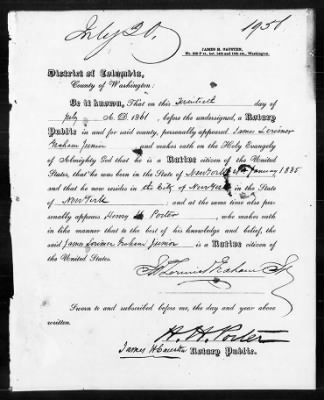
The Northwestern-Newberry edition of Herman Melville's Correspondence identifies Graham only as "an autograph collector" and miscalls him JLG "Sr." Looking at the signature on his 1861 passport application, you can see how easy it would be to misread "S" for Graham's "J."

Fold3: Military Records

As reported in the same editorial note in NN Correspondence, somewhere in the Duyckinck family papers at NYPL is a letter dated simply "Wednesday" from James Lorimer Graham, Jr. (not his uncle JLG) to Evert A. Duyckinck, asking for Melville's address:
"You will greatly oblige me by giving the bearer the address of Mr. Herman Melville, for me."  --quoted in NN Correspondence, p766.
Now that we know about one gathering of artists and literati that Melville attended at Graham's place in March 1866, we can confidently place the date before Wednesday, March 21, 1866 (the last Wednesday before the party on Monday evening, March 26, 1866). I'm guessing this must be the "undated" one of two letters in the literary correspondence of Evert A. Duyckinck at NYPL, now filed under "GRAHAM, JAMES G." The other, dated letter from Graham to EAD is from 1861:
b. 7 f. 4 Graham, James G
2 items
1861, undated
Later: Nope, those two items are in fact from James G. Graham. Still looking for the undated letter from JLG Jr. to Evert A. Duyckinck.

Graham's huge collection of autograph material included letters from Melville to publishers Dix and Edwards. For provenance, the Northwestern-Newberry edition of Melville's Correspondence cites
"Clara Louise Dentler, A Privately Owned Collection of Letters, Autographs, and Manuscripts with Many Association Items [Graham Family Collection] (Florence: Spinelli, 1947)." 
Link to WorldCat entry:
Where to go for it? Nearest library to me here on the prairie is literally "1000 miles" away:
Princeton University Library Princeton, NJ 08544 United States
Related melvilliana posts:

Sunday, February 7, 2016

Melville in March 1866, socializing with The Wanderer's Club at the home of James Lorimer Graham, Jr.

Image Credit: Consulate General of the United States 
Note: this is the Wall Street broker JLG, NOT James Lorimer Graham, Jr. (1835-1876)

Monday evening, March 26, 1866 to be exact, according to the report published the next day in the New York Evening Post. The home address of James Lorimer Graham, Jr. (as listed in the 1867 Trow's New York City Directory) was his father's uncle's mansion at 21 Washington Square North.

UPDATE: Fold3 has the better source here, Trow's New York City Directory "For the Year Ending May 1, 1866." Now Trow's gives the address for James Lorimer Graham, jr. as "3 E. 17th." That's the address Bayard Taylor remembers in his 1876 obit. Most likely the March 26, 1866 gathering happened here, at 3 East Seventeenth Street. Also, James Lorimer Graham, Jr. is the NEPHEW of James Lorimer Graham. Graham, Jr.'s father is Nathan Burr Graham, as explained in the 1869 United States Insurance Gazette and Magazine of Useful Knowledge.

UPDATE #2:
If you thought the photo up top looks too late for the subject of our post, James Lorimer Graham, Jr. (1835-1876), you were right!  Naively I had thought the United States Consulate General would know one of their own in Florence, Italy. Alas, they and we had the wrong man. The sharp looking JLG above is of course the Wall Street broker, partner of S. F. Johnson and Charles W. Miller. 
S. F. JOHNSON & CO.. Bankers and Brokers, No. 18 Wall Street.— This well-known concern was founded originally in January, 1869, by Johnson & Day, who were succeeded by G wynne, Johnson & Day. and in 1879, Messrs. S. Fisher Johnson and Charles W. Miller formed a partnership under the present firm title. Both are thoroughly experienced men, and devote their close attention to the wants of their patrons. In 1892 Mr. James Lorimer Graham, who has been connected with the house ever since its inception, was admitted into the firm, with no change of title. They deal in all kinds of bonds, stocks, securities, etc., on commission only, for cash or on margin, and, as they are members of the New York Stock Exchange, all their transactions for patrons are governed by the strict rules controlling that honorable and reliable organization. They also do a general banking business.... --New York, 1894 Illustrated
So like the U. S. Consulate General in Florence, Italy, we're still in want of any photo of the real James Lorimer Graham, Jr. (1835-1876).

Well! Just the sort of enticements to draw out Melville as we know him in the second volume of Hershel Parker's biography: books, engravings, and heady talk with good fellows like Tuckerman, Duyckinck. and Darley. From the New York Evening Post, Tuesday, March 27, 1866; found in the online Newspaper Archives at Genealogy Bank.

New York Evening Post, Tuesday, March 27, 1866

The Wanderer's Club.

The members of the "Wanderer's Club," together with invited guests, were pleasantly entertained last evening at the residence of Mr. James Lorimer Graham, Jr. The gathering was of a social character, and allowed a free and agreeable interchange of thought among the guests. The many rare and curious books, old engravings, valuable autograph letters and articles of vertu, to be found in Mr. Graham's library, were a source of unfailing interest and enjoyment to every one present. Among the guests were Messrs. Bryant, Bancroft, Tuckerman, Herman Melville, Bayard Taylor, Ripley, Duyckinck, Stoddard, Savage, "Barry Gray," W. T. Blodgett, John Van Buren, Leutze, Kensett, Gifford, Bierstadt, Laing, H. P. Gray, Launt Thompson, Darley, Ehninger, Hunt, Key, Baron Osten Sacken, Gilman, and others.
First order of business will be to identify all concerned, if we can, starting in this post with the host: James Lorimer Graham, Jr. (1835-1876), familiarly known as "Lorrie" Graham. Below are links to the 1894 memorial and the catalog of his library, both published by the Century Association:

The Online Books Page has links to both items in the HathiTrust Digital Library.

Reading things like the passage below from the 1894 memorial, "Lorrie" Graham begins to look like a real-life model for Melville's imaginary Marquis de Grandvin:
One of the most distinguished of his literary friends, who is with us to-night, is reported, at a dinner of literary and kindred spirits not long ago, to have offered the following toast to the memory of Lorrie Graham:

"Here's to Graham! Let us keep his memory green; for when we poor fellows lived on hard tack all the week, we knew that there were always champagne and oysters for us at Graham's whenever we chose to go there."
In another passage from the 1894 memorial, Edmund Clarence Stedman recalled the dinner for Graham at Delmonico's on November 16, 1866 as a "unique and unforgettable" evening. The honorary "Supper" was
given to Lorimer Graham before his departure for Europe. This came off at Delmonico's, Fourteenth Street, on the 16th of November, 1866. From twenty to twenty-five gentlemen were there, nearly all of them Centurions, the Committee in charge being Messrs. William Bond, C. P. Cranch, Bayard Taylor, R. H. Stoddard, Launt Thompson, and the present speaker. In addition to the lyrics in hand, poems were also contributed by Cranch and Boker, but these were not so available for reproduction after the interval of twenty-eight years. Brief speeches in affectionate honor of Mr. Graham were made by the other guests. The evening was in some respects unique, and unforgetable.
The night before, J. Lorimer Graham had served as honorary President of one of the tables at the lavish banquet for Cyrus W. Field. Sponsored by the New York Chamber of Commerce, the Field affair took place in the great hall of the Metropolitan Hotel. The much more intimate dinner for Graham happened at Delmonico's, which provides the setting for At the Hostelry, one of Melville's Burgundy Club poems. Melville, however, is not named as one of the select twenty-five, most of whom belonged to the Century Club.

HathiTrust Digital Library has the 1963 re-issue by Russell & Russell of the 1922-24 Constable edition of Melville's works with The Marquis De Grandvin and Jack Gentian sketches in the thirteenth volume. Admittedly, there's no getting around the fact that Melville's Marquis de Grandvin is a Frenchman,
"a countryman of Lafayette and Frédéric Auguste Bartholdi."  --Herman Melville: A Biography, V2.833
But good lord! look what the American Consulate in Florence, Italy has to say about former U. S, Consul James Lorimer Graham, Jr. :
"During his sojourn abroad he became a proficient French scholar and retained his fluency and perfect accent all his life. As such, he was often mistaken for a Frenchman."  --U.S. Consulate - Florence
Likewise the Appleton's Encylcopedia entry offers a number of suggestive points of comparison with Melville's convivial de Grandvin, in particular his being "widely known through his taste for art and literature and his brilliant conversational talents." (Later note: the entry below is copied nearly verbatim from the obituary by Bayard Taylor in the New York Tribune, May 2, 1876.)

James Lorimer Graham

GRAHAM, James Lorimer, consul, born in New York City in January, 1835; died in Florence, Italy, 30 April, 1876. He was partly educated at Amiens, France, where, on account of his precocious literary talent, he was selected to deliver a poetical address of welcome to Lamartine when the latter visited the school in 1848. Mr. Graham lived for a time in Rio Janeiro, and, after returning to New York, was a passenger in the steamer '" San Francisco," which foundered in a gale off Cape Hatteras. His experience in this wreck injured his health and hastened his death. In 1856 he married and settled in New York, where he became widely known through his taste for art and literature and his brilliant conversational talents. As a member of the Century club, the Geographical society, and kindred institutions, he made the acquaintance of many artists and authors. He spent the years 1862-'3 in Europe, and after remaining in New York until 1866 again went abroad. Meantime he had been busily engaged in acquiring whatever curiosities he had found in his travels, until he had large collections of coins, autographs, drawings, and books. Some time after his return to Europe, Mr. Graham was appointed United States consul-general for Italy, and resided in Florence. When the capital was transferred to Rome, he preferred to accept the office of a simple consul rather than change his home. --Famous Americans - James Lorimer Graham
Graham's diplomatic service in Italy seems transferred in Melville's Burgundy Club material to Major Jack Gentian--a disciple of the Marquis de Grandvin whom Melville imagines as the appointed American consul in Naples.

Andrew M. Kavalecs writes informatively of Graham as "Fosterer of American-German Literary Relations" through his correspondence with Adolf Strodtmann.

A helpful biography by Jeffrey Begeal is available online at The Florin Website. The online biography lists a title by Mr. Begeal that would be lovely to have, if I could only find it:

  • Begeal, Jeffrey. James Lorimer Graham, Jr. c. 1832-1876. Biography of an American Savant. Villa de Bella Silva Press: Smithfield, NC. 2004.

How much of "Lorrie" Graham and the wonderful Wanderer's Club do we find memorialized in Melville's uncompleted writing about the Burgundy Club?

Related melvilliana post:

Tuesday, December 22, 2015

1850 review of Æsop's Fables: by Herman Melville?

Image Credit: HubPages
Please don't try this at home. It's a dirty, thankless job trying to assign authorship on the basis of internal textual evidence. If some contrarian devil keeps you seeking to identify anonymous authors anyway, just remember that most of the time such arguments turn out to be wrong. Spectacularly wrong, on occasion: witness Donald Foster's once tempting, now demolished case for Shakespeare's authorship of "A Funeral Elegy"--written by John Ford, as demonstrated in 2002 studies by G. D. Monsarrat and Brian Vickers. Closer to home: in Melville studies the most prominent example of a fascinatingly mistaken attribution is the book-length argument by Jeanne Chretien Howes for Melville's authorship of the 1845 poem Redburn: or the Schoolmaster of a Morning. Howes herself discovered, but would not accept, solid evidence for the anonymous author's being Geneva poet George Megrath. Warren F. Broderick's more qualified and tentative case (Melville Society Extracts 92, March 1993, pages 13-16) for Melville's authorship of five poems in 1838-9 is breaking up, too, now that we know the true author of Pity's Tear. The fifth of Broderick's five newspaper poems appeared (with a fourth stanza) under the title, "I Shall Remember" in the December 1835 Ladies' Companion.

Of course one should always be wary of confirmation bias. What's worse, you can make yourself crazy (as I have good reason to know). After a while everything sounds like Moby-Dick.

To get ourselves properly grounded, let's consider some verifiable facts. Herman Melville certainly did review books anonymously for the Literary World We know of five reviews that Melville definitely wrote in 1847-1850 (four unsigned, and the one on Hawthorne under a pseudonym):
In his unpublished doctoral dissertation, "Melville as a Magazinist" (Duke University, 1960), Norman Hoyle suggests that Evert Duyckinck may have "considered Melville his Far West specialist" as well as his "Cooper specialist" (46). Hoyle proposed Melville's authorship of four additional reviews (besides the known review of Parkman's Oregon Trail) on books of western travel and adventure, including The Western Trail, an unsigned review of J. Quinn Thornton's Oregon and California in 1848. Besides the two known reviews by Melville of books by J. Fenimore Cooper, Hoyle suggests Melville may have written a third, the unsigned review of The Spy titled The New Edition of Cooper. Before Hoyle, Jay Leyda had already opened the door to further investigation:
"There is more published work by M[elville] than has been identified."  --The Melville Log, Volume 2 [860]
Long before Leyda, Meade Minnigerode had pointed out in parentheses:
(Note. Besides the reviews already mentioned, there are undoubtedly others by Melville in the Literary World, but as they were unsigned they can not now be identified with certainty.) --Some Personal Letters of Herman Melville (Brick Row Book Shop, 1922) page 192.
After Redburn, which Melville once called his "little nursery tale," I wonder if the Duyckincks might also have considered Melville their specialist in Children's Lit? Here is another unsigned review that might or might not be Herman Melville's work, titled "A New Version of Æsop's Fables."

The Literary World, August 10, 1850 - 111
The Literary World, August 10, 1850 - 112


NEW VERSION OF ÆSOP'S FABLES.

Æsop's Fables: a new version, chiefly from original sources. By the Rev. Thomas James, M.A. With more than fifty illustrations by John Tenniel. Robt B. Collins. 
We hope some of our readers remember the old edition of Æsop's Fables, that in vogue some quarter of a century ago. We hope so, because we should like to know that others besides ourselves are sharers in the pleasant recollections which the title of the work calls up; that others remember those small oval woodcuts with the beasts therein depicted, much after the style in which they are sculptured for a child's Noah's ark. Bad as they were, they were favorable specimens of the wood illustration of the day, and bore in their smirched faces unmistakable evidence of being in demand for frequent impressions by the public. 
Let the reader, with the old fresh in his memory, turn to the new. He will find that the old friend of our childhood, perennial Æsop, has doffed cocked hat and small-clothes for a dress of the latest cut and newest gloss. All the appliances of modern book-art are brought to bear: wily Reynard looks up from the foot of the page to the grapes gracefully pendent from a trellis at the head, the design framing a few lines of the text. The lazy maids, whom the old woman is toiling up stairs at the side of the page to chastise, are rubbing their eyes and stretching themselves in the most graceful of attitudes; and the tailpiece of the volume brings up its artistic claims triumphantly by a representation of the sad fate of the accommodating individual who, to please the public, tied his ass's legs to a pole and, with his son's aid, carried him, or essayed to do so, over the bridge, in the sight of the assembled public. The poor animal is tumbling into the water; and the astonished public, gazing at him from the whole length of the Bridge, are admirably rendered in all the varieties of stupid amazement. Lesson fresh as if old Æsop's stylus of Greece were Gold Pen of nowaday New York, and the ink not yet dry upon it. 
These illustrations are from English designs by John Tenniel. The animals are spirited, and we do not know any one who could have done them better, except that Æsop of painters, Edwin Landseer. We hope that some Maecenas of the Book Trade may some day or other immortalize himself by combining these two Æsops as author and artist in a volume.
Æsop has always been an illustrated book, and always will be. Look into any library of old books, and ten to one you will find a ponderous folio, with most " savagerous" of beasts ranging over its folio pages. Old Æsop, to be sure, is, nowadays, come down from a folio to be a book for children, but he has lost none of his wisdom by so doing. We are not sure but that ability to interest children by original books (we do not now refer to compilations of "history made easy," and such like) is the test of a great author; at any rate, were we disposed to argue it, we could bring many an influential witness into court on our side—to wit, besides our venerable friend now under discussion, Defoe, Scott, Southey, Goldsmith, Fielding, Miss Edgeworth, Hawthorne, et al.

The Juvenile readers of Æsop will be inclined to favor the present edition when we tell them that the new translator has cut down those prosy old morals, which even in the smaller type in which they were printed, well nigh preponderated over the text of the original fable, and might be likened to pills after sweetmeats (a reversal of all nursery rules— all allopathic ones at least)—that these "lengthy " morals are cut down to a line or two apiece.
For an excellent conversation starter (or stopper, as the case may be), here's some textual evidence for Melville's authorship of the 1850 review transcribed above.
  1. "Maecenas of the Book Trade." The reviewer wants an editor or publisher to back a new edition of Æsop illustrated by Landseer. This champion of Æsop and Landseer would ideally be a generous and large-minded patron of the arts like the Roman statesman Maecenas, the wealthy patron of Virgil and Horace. In White-Jacket (1850) Melville similarly honored Maecenas, comparing Jack Chase's patronage of the navy poet Lemsford to "Maecenas listening to Virgil."  
  2. "may some day or other immortalize himself...." Melville in Mardi and elsewhere refers to immortalizing oneself and others through published writing, just as the reviewer conceives that his editorial Maecenas would "immortalize himself" by publishing a new illustrated edition of Æsop with pictures by Landseer. Melville's Redburn desires to "immortalize" the "curious and remarkable" guidebook titled The Picture of Liverpool.
  3. "ten to one" occurs at least 14 times in Melville's known writings, most famously of all in the first chapter of Moby-Dick: "Take almost any path you please, and ten to one it carries you down in a dale, and leaves you there by a pool in the stream."
  4. "prosy old morals" verbally recalls the Prosy Old Guidebook in Melville's Redburn (1849). As in Redburn the reviewer associates a "prosy old" book with reading  by children, here "Juvenile readers." Moreover, the "prosy old guidebook" that Melville's young hero Wellingborough Redburn describes at length, expressly belonged to his father. The anonymous 1850 reviewer uses the term "prosy old morals" with reference to old editions with small type and long morals. Melville's father Allan Melvill in fact owned an 1787 edition of Æsop's Fables which survives in the New York Public Library. Here is the 1787 book (same edition, but not the actual volume owned by Allan Melvill) at the Internet Archive:

Allan Melville's copy of the Fabulæ Æsopi Selectæ, or, Select Fables of Æsop is Sealts No. 6, as shown in the catalog at Melville's Marginalia Online. Even the longest morals do not really dominate the fables themselves, however. (If the reviewer has this edition in mind, perhaps he exaggerates or mis-remembers the graphic reach of the morals.)
5. The conceit of a hypothetical legal argument with "influential witnesses" on the writer's side of the case anticipates Melville's lawyerly posture in Moby-Dick, for example throughout "The Advocate" chapter of Moby-Dick, and again in "The Hyena":
"Here then, from three impartial witnesses, I had a deliberate statement of the entire case."  --The Hyena
More generally, the reviewer's obvious and sustained interest in the illustrations, paying close attention to details of several different pictures, seems consistent with Melville's known devotion to the visual arts. The "cut" and "gloss" of the reviewer's clothing metaphor will reappear in Melville's Pierre (1852), in the letter from tailor-publishers Wonder & Wen to Pierre the juvenile author. Also associated with Pierre as writer: "ink not yet entirely dry," echoing the conceit of "ink not yet dry" in Æsop's timeless stories according to the 1850 reviewer. In Mardi, Melville mentions Landseer as an exemplary painter of animals. Near the end of his life, he gave his granddaughter a volume of Landseer's Dogs. In The Confidence-Man, Æsop is said by the cosmopolitan Frank Goodman to malign animals unfairly.

No manuscript or other external evidence for the authorship of this unsigned 1850 review of Æsop's Fables has yet been found, so far as I know. First place to look would be the Duyckinck family papers in the Manuscripts and Archives Division of The New York Public Library. Box 57 contains "Miscellaneous poems, articles, reviews written for the Literary World."  And who knows what's in Box 59 ("Miscellaneous papers")?

Thursday, December 17, 2015

August 5, 1850 as remembered by Cornelius Mathews

Cornelius Mathews via Library of Congress
So Melville and fellow guests of the Fields dined with Mary Rowly O'Sullivan. In his 2000 book on Young America, Edward L. Widmer points out John Louis O'Sullivan's close ties to Hawthorne and also Stockbridge, Massachusetts where
"he formed lifelong friendships with Thomas Wilson Dorr and several Stockbridge natives, including the lawyer David Dudley Field and members of the Sedgwick clan."
-- Young America
And Widmer goes on to identify John's mother Mary Rowly O'Sullivan or "Madame O'Sullivan" as a previously unidentified companion at the dinner party in Stockbridge--after the adventure up Monument Mountain, before the trek through Icy Glen:
Another guest at Field’s dinner, never before noticed, completed the sense of convergence felt in Stockbridge that day. The guest, whom Cornelius Mathews described only as “a most lady-like and agreeable conversationalist, mother of a distinguished democratic reviewer,” was almost certainly O’Sullivan’s mother, the celebrated Madame O’Sullivan. Not only was she a long-term Stockbridge visitor, and close to the Sedgwicks, but her presence makes sense when the overall composition of the group is considered. For Field, Duyckinck, Mathews, and Hawthorne had a common bond in their Review experience, and Melville was no stranger to their machinations. 
--Edward L. Widmer, Young America: The Flowering of Democracy in New York City
Brilliant! (Just for the record, Mathews's word as originally printed in the Literary World is the unusual form: "conversationist".) 

First serialized in The Literary World, the engaging three-part narrative of "Several Days in Berkshire" by Cornelius Mathews has recently been reprinted in Steven Olsen-Smith's valuable collection of 19th century biography, Melville in His Own Time. The transcription there of Part II (August 31, 1850) concerning "The Mountain Festival" of August 5, 1850 gives real names of participants within editorial brackets--for the most part helpfully. However, Melville in His Own Time does not reference Widmer's discovery about the "lady-like" presence of Mary Rowly O'Sullivan and her "agreeable" talk at the dinner table. Also host and hostess of the day are misidentified in one place as "John and Sarah Morewood" (page 46). Impossible, since the hikers have returned to "the Umbrage" for dinner, in Stockbridge. Sarah Morewood is Fairy Belt, but Host and Hostess here are still David Dudley Field II and his wife Harriet Davidson Field. (Confirmed by the narrator's bon voyage at the close, appropriate because the Field family were about to leave Stockbridge for Italy.)

David Dudley Field via Library of Congress

 "Humble Self" the correspondent (later "Behemoth") is Cornelius Mathews.
  • New Neptune = Herman Melville
  • Silver Pen = Evert A. Duyckinck
  • Town Wit  = Oliver Wendell Holmes
  • Mr. Noble Melancholy / Essayist = Nathaniel Hawthorne
  • Fairy Belt = Sarah Morewood
  • Harry Gallant = Henry Dwight Sedgwick II
  • Mr. Greenfield / Boston publisher = James T. Fields
  • Greenfield's new wife = Eliza Willard Fields 
  • Host = David Dudley Field II
  • Hostess = Harriet Davidson Field
  • Fair Daughter = Jenny Field
  • Amiable invalid son of a collegian = ?
  • "a most lady-like and agreeable conversationist, mother of a distinguished democratic reviewer" [so, editor or notable contributor to the United States Democratic Review] = Mary Rowly O'Sullivan, mother of editor John Louis O'Sullivan, as shown by Edward L. Widmer in Young America
  • New York Lawyer with "Channing blood in him" = is this Henry Dwight Sedgwick II again? (Harry Gallant)
  • Celebrated military author = Joel Tyler Headley  
From The Literary World, August 31, 1850

SEVERAL, DAYS IN BERKSHIRE,
(From an " Esteemed Correspondent.")
PART II.
THE MOUNTAIN FESTIVAL.

Destiny has appointed to all of us, in the course of our lives, a delay of five, ten, or fifteen minutes at a railway station; when we may rove about the platform, stroll through the waiting-rooms, contemplate the mystery of the shut-up ticket-hole, and dwell, with a sort of childish regard of wonder, on the silent ears, lingering on the track as if they belonged there, like houses in a row. Our destination from Pittsfield, remember, is to Stockbridge village, twelve miles down, and we are invited to a Feast of Quidnuncs, incidental to a visit to the Monument Mountain in that neighborhood. Loitering there, up and down and all around the premises, New Neptune, Silver Pen, and our Humble Self: a slight apparition presently appears with a glazed India-rubber bag in hand, another of our party, Mr. Town Wit.
We are in the cars, and with a hurrah to the neighborhood from the steam-whistle, we are away. Our stately inviter appears promptly at the other end, and conducts us at once, by horse-power, to his Umbrage in a hollow, in the skirts of Stockbridge, where we make acquaintance with a delightful lady, the mistress of the mansion, a fair daughter, and an amiable invalid son of a collegian. There are plenty of arm-chairs in the summer parlor, a bowery look-out, a sea of trees, in which the cottage seems to be swimming for dear life, a wonderful poodle, and just by way of a rehearsal, for the grand climb, we take a run to the top of Sacrifice Mount, not far off, where in the old time the Indians brought their sacrifices to the knife. 
On our return to the house we have the mountain party completed, with the addition of the charming sketcher of New England mystic life, Mr. Noble Melancholy, and, with a watchful eye on the fall crop, close at hand, his publisher, Mr. Greenfield, and the new wife, who is the violet of the season in Berkshire; a young gentleman also, a twig of a celebrated Stockbridge tree, Harry Gallant, is on horseback—and we set out in procession for the Mountain of the Monument, some three miles eastward. Passing, as we gallop along, the domicil of the late right-reverend Agrippa, formerly servant to that noted Polander, Kosciusko, we reach the foot of the mountain—of which we had, by the way, a chalky outline sketch, with its white cliffs, as we came along. Higher, higher up we go, stealing glances through the trees at the country underneath; rambling, scrambling, climbing, rhyming—puns flying off in every direction, like sparks among the bushes. 
Behold, now! the panorama spread out like a sea. At that height it occurs to us all, at once, that we have passed the previous parts of our lives in very small matters. What is Trade to us at that elevation! Business is referred to with disgust. Wall street and Washington (supposed to be of some importance down below) are mere alleys and dog-paths. Even the writing of Books and Poems is child's play—regarded from that watch-tower, so near up towards heaven. Somebody attempts a pun—we believe it's that rogue,Town Wit,— and is, righteously, near losing his foothold and tumbling straight down a thousand feet. As far as landsmen can, we have a glorious ocean-feeling, not diminished when a swift-sailing thunder cloud, like a black pirate-ship, goes scudding past directly alongside of us. New Neptune is certainly fancying himself among the whalers of the Pacific, for he perches himself astride a jutting rock,like a bowsprit, which is exceedingly painful to the feelings of Mr. Town Wit, who describes himself as epigastrically affected, and talks of the mountains as if they were so many thundering boluses. 
The tempest vindicates himself as superior to the mountains, and rising, spreads his cloudy wings, which he presently shakes upon us, and compels us to a retreat, which, honored as the harbor of two lovely women, shall be henceforth known as the Fairy Shelter. A couple of bottles are broached, we drink all round, and to the vast organ-bass of the rolling thunder, Humble Self reads Bryant's grand poem, dedicated to this very scene,—the Story of the Indian Girl, "a sad tradition of unhappy love." 
If silence and sighing are tributes of interest, the reader should have been well pleased with his endeavor. The storm had passed away, but there still lingered in the thoughts of the mountain-climbers a remembrance of the sad daughter who, in default of love, cast herself from this lonesome height, and perished on the rocks below. We walk about, in the new sun, upon the mountain top, as though we were the angels of the time, and as though these airy ridges were our natural promenade. We look on, to east and west, far, far away on either hand, and think meanly of our fellow creatures, the under-dwellers: the individual man on the peak is raised to a noble spirit, but man in general, occupying those little, paltry sheds and toy structures, is regarded with scorn,—he hardly rises to the dignity of contemptuous reference in the grand survey of hills, valleys, and wide-sweeping tracts of earth. But we must go back to that condition whether we will or no. Slowly descending a winding way, we seek out the little cairn or stone-heap which rises on the spot where the Indian maiden fell; a little way-side heap of stones, cast there by the tribes-people as they passed. Remembering Fairy Belt, who should never be forgotten, as never forgetting others, we pluck a brief memorial from the monument as a remembrancer of our visit; and with a cool gallop along the road, we are returned to the Umbrage. We will seat the company at the dinner table. 
Host and hostess at either end: right side from hostess, a most lady-like and agreeable conversationist, mother of a distinguished democratic reviewer; next, Noble Melancholy (as we name him), a delightful mystical essayist, a late "Letter" of whose is or would be a letter of introduction any man might be proud of presenting anywhere; the violet-bride, and next, her husband, a classical Boston publisher, whose name on a title-page is a pretty sure guarantee of the "better sort" of poetry. Thereabouts at the table a most companionable New York Lawyer, who has Channing blood in him to keep him from malpractice. The Host, rising like Babel in the confusion of tongues: Silver Pen, with whom the readers of the Literary World are particularly well acquainted: the fair daughter of the house; New Neptune (in our vocabulary), the sea-dog of our Berkshire homestead, whose tales—such is their wonderful growth—have reached to several ends of the earth; next to the Nautical, an earth-monster, a perfect Behemoth, the mention of whose name has before now driven three critics crazy and scared a number of small publishers out of a year's growth; a mighty shadow, whose name we dare not mention: next to him, sitting erect in his chair, bristling with eyes, collar, and ears attent, the Town Wit, whose clever verses and jeux d'esprit are on everybody's tongue. And now, with (or without) your leave, reader, we propose to shut the Dining-Room Doors. 
You are disappointed, we know—you would give the world to have an accurate account from so careful a pen as ours of what that picked company of wits and belles had to say to each other over the wine. But—we have sworn on oath—we have sealed a seal, never, never to divulge, no, never. We can only intimate, in the remotest way, that the Sea-Serpent and Mr. Payne were referred to; the Rochester Knockers not; that one of the gentlemen in company (we are not ashamed to connect this happy hypothesis with the name of Mr. Town Wit) gave it as his deliberate opinion and as the result of a most elaborate and searching scrutiny, that in less than twenty years it would be a common thing to grow in these United States men sixteen and seventeen feet high; and intellectual in proportion. There was no mention of molasses in the course of the dinner. Stephen Girard was not introduced personally as a topic; somebody or other spoke of a remarkable bullock at Great Barrington. The condition of American Poetry may or may not have been dwelt upon. But we are going a little too far; the oath—the oath! 
It's a long session, but dinner is at last concluded—a fillip having been imparted to the close of it, by the sudden appearance of a celebrated military author—when, military author and all, tumbling out into the road, we make three miles away for a mysterious defile—where you can have iced punches in their natural state—in the middle of August: the Icy Glen, by name. A dark and slippery region, with oozing rocks for stairways, and rotten logs for bridges; such face of melancholy we never in all our mortal life witnessed, as did our Boston Bibliopole put on when he saw his two prize-producers— now under way with a volume each—the Essayist and Town Wit, engage in the neck-endangering progress through the treacherous gully, dripping with anxiety and mournfully repining at his own fat, which kept him from sallying after. "Ten per cent more to your authors on your next book, and you'll have less fat to complain of," was quietly suggested to the struggling and perspiring book-man. We are out again upon the open air; try a pass or two with some scythes lying in the meadow —the Umbrage receives us again—coffee, conversation, Fay the Poodle taking an active part on his hind legs, and giving his opinion of the music in a jargonic howl equal to the most learned professor. 
Good-bye, friends, all round. Friends at the Umbrage, farewell—God speed you safely over the ocean in your new path of travel, and return you wisely and safely to the dear harborage of Stockbridge! Shake hands all round. Our kind and liberal entertainer sees us to the cars—away! 
And here be remembered that friendly Conklin, who, taking pity on three roving knights of the quill, did gently pause his train at the bridge, saving us there a foot-sore tramp at midnight. Be all conductors like him: and may every Berkshire Festival-Day, like this of ours, be provided with an Evening Star, like that, to rise upon the train and cheer us just when he is wanted. But there's another small bottle of Berkshire to be discussed—for which see our next!  --The Literary World No. 187, August 31, 1850
For a modern edition of "Several Days in Berkshire" in all three parts, get Melville in His Own Time, edited by Steven Olsen-Smith. Online, Google Books has digitized the 1850 volume of the Literary World which alas! lacks the September 7, 1850 number containing the third and final part,
For the fun of it, here below are images of Part III, scanned from authentic pages of the 1850 Literary World in the Melvilliana library of odd volumes: