The Starling. Engraving by Andrew Birrell after a drawing by Thomas Stothard. Source: Laurence Sterne, A Sentimental Journey through France and Italy, plate facing page 86 in the 1801 London edition owned by George L. Duyckinck.
About the contemporary reception of "I and My Chimney" there is little to record in the absence of printed commentary.
-- Merton M. Sealts, Jr., "Melville's Chimney, Reexamined" in Pursuing Melville, 1940-1980 (University of Wisconsin Press, 1982) page 172.
Here's something new, a rare contemporary take on "I and My Chimney." Without reference to authorship, this favorable and unusually substantive notice of Melville's short story (first published anonymously in the March 1856 issue of Putnam's Monthly Magazine) appeared in the Wilmington, North Carolina Daily Herald for March 11, 1856, in a survey of "Putnam's Monthly" for March contributed "For the Herald" by an unidentified reviewer. At this time the Herald was conducted by Talcottt Burr, Jr. (1819-1858), a talented and highly esteemed editor who died of typhoid fever less than two years later at the home of his father in Wilmington.
Of particular interest in the North Carolina notice of "I and My Chimney" is the mention of Laurence Sterne's A Sentimental Journey though France and Italy as a likely source or analogue for the narrator's comically affectionate treatment of his chimney as a close friend and confidante. Sterne's Tristram Shandy (Sealts Number 490 in the catalog of books owned and borrowed at Melville's Marginalia Online) had a major influence on the narrative style of Moby-Dick. As Armour Caldwell pointed out in a 1908 lecture at Tulane, Moby-Dick exhibits
"the same perverse disproportion, the same elaborate digressions and the same dramatic dialogue. It abounds with description and philosophizing, and this makes the story rather slow."
Shades of Sterne in the humorous parts of Melville's great whale book had previously been noted by James Clarke Welling in his long and laudatory review of Moby-Dick for the Washington National Intelligencer (December 16, 1851):
The humor of Mr. Melville is of that subdued yet unquenchable nature which spreads such a charm over the pages of Sterne. As illustrative of this quality in his style, we must refer our readers to the irresistibly comic passages scattered at irregular intervals through “Moby Dick."
In connection with "I and My Chimney," the North Carolina reviewer's specific reference to Sterne's Sentimental Journey alludes, I would guess, to the intensely personal lament for a Dead Ass by its grief-struck owner in "Nampont"; and the narrator Yorick's equally famous encounter in "The Captive" with a caged starling, treated as a speaking emblem of imprisonment who pathetically repeats, "I can't get out."
Previously unrecorded in Melville scholarship, the North Carolina notice of "I and My Chimney" is transcribed below from the Wilmington Daily Herald of March 11, 1856.
Wilmington NC Daily Herald - March 11, 1856 via newspapers.com
Putnam's valuable periodical for March is before us, freighted as usual with its rich store of mature thoughts....
"I and My Chimney," is a pleasant, lively, rather humorous sketch, in which one finds no little of "latent philosophy." One may read it and read it again, and still there is something worthy of notice. Like Sterne, in his sentimental journey, the author gravely speaks to and of his "pet chimney;" sympathises with it in all its afflictions and misfortunes, and often, doubtless, looking up to it with profoundest admiration; and then he glides off into a pleasant soliloquy as follows:
"Now, if this chimney of mine were for size a sort of belfry, for ding-donging at me about it--my wife and daughters were a sort of bells, always chiming together, or taking up each other's melodies at every pause, my wife the key-clapper of all, a very sweet ringing and pealing and chimney, I confess, but then the most silvery of bells may, sometimes, dismally toll, as well as merrily play," &c.
But such extracts will give but an imperfect idea of the good old gentleman's soliloquies over the chimney and its secret closets and odd corners. In reading it, one almost insensibly imagines himself in some of those spacious old half-acre houses, that stand far out in the country, with a perfect camp-meeting of a fire-place, with huge "hickory" or oaken logs, piled on with no sparing hand. And then there is the high old mantle-piece with its quaint old ornaments and elaborate carving, and grotesque figures, with all the primitive simplicity of our saintly progenitors.
We have seldom or ever read the equal of this chapter [Benito Cereno] in point of profound cunning and deception....
Here's something new concerning the early reception of Herman Melville's short fiction in Canada. Published in the Liverpool, Nova Scotia Transcript on July 31, 1856, this favorable and unusually detailed Canadian review of The Piazza Tales is not collected in Herman Melville: The Contemporary Reviews, edited by Brian Higgins and Hershel Parker (Cambridge University Press, 1995; paperback 2009). As indicated on the masthead, the Liverpool Transcript was a weekly newspaper "devoted to moral, political and general intelligence and progress," then owned and edited by S. J. M. Allen.
Liverpool [Nova Scotia, Canada] Transcript July 31, 1856 via Nova Scotia Archives
NEW PUBLICATIONS.
THE PIAZZA TALES. From the pen of Herman Melville, author of "Typee," "Omoo," etc. Dix & Edwards, New York. E. G. Fuller, Halifax.
The first chapter is devoted to pleasant reminiscences in favor of piazzas, and an "inland voyage to fairyland. A true voyage; but, take it all in all, interesting as if invented."
The second chapter consists of passages in the life of Bartleby, "who was a scrivener, the strangest I ever saw, or heard of," with some mention of the author, his employees, his business, chambers and general surroundings, as a means of better understanding the chief character of this chapter. It will be found interesting--very.
The third chapter introduces to our notice the captain of an American Sealer, who displays stirling qualities in the capture of a Spanish slaver at the island of St. Maria, Chili. The slaves having risen, murder their owner and some of the officers and crew of the ship, take full command of the vessel, place the captain and the remainder of the crew under strict watchful guards to navigate and work the vessel. The ringleader Babo with his right hand man Atuful [Atufal] act, in the presence of the American captain a most conspicuous part in all the powers of deception and mock submission to the behests of the captain, who is completely tho' reluctantly compelled at the risk of his life to assist in carrying out their designs, so as to appear as the despotic commander and sole owner of ship and cargo. The whole story with Benito Cerino's [Cereno's] protest is admirably written, deleneating certain characters with an unmistakable hand. We have seldom or ever read the equal of this chapter in point of profound cunning and deception.
The fourth chapter gives a humorous memorandum of "The Lightning-Rod Man" endeavoring to sell, during a storm of rain accompanied with thunder and lightning, certain rods to attract the lightning and convey it from the building.
The fifth tale is divided into ten chapters and is romantically discriptive of the Encantadas or Enchanted Isles--Gallipagos, the land, its singular appearance--the rocks--the peaks of mountains, the queer birds, reptiles, tortoises, etc., which inhabit those sun burnt regions of the Equator. The lone widow and her rescue occupies the eighth chapter. In fact "the enchanted isles" is enchantingly written.
The last tale in this admirably written work is that of "The Bell-Tower, built by the mechanician, the unblest foundling, Baunadonna," [Bannadonna] in Italy three hundred feet in air will repay the reader for his pains.
Two weeks before the favorable notice of the Piazza Tales appeared in the Liverpool Transcript, the same Canadian newspaper dropped an odd reference to "the firm of Bartleby, Benito Cereno" into a notice of The Schoolfellow, a well-regarded magazine for children.
Liverpool Transcript - July 14, 1856
The School-fellow'sMagazine, for June, illustrated. This appears to be a commendable work for boys and girls, many of the best American writers being engaged upon it, among whom we may mention Bayard Taylor. It is from the firm of Bartleby, Benito Cereno.
Agents for the above works, E. G. Fuller, Halifax.
At this time both the Schoolfellow and Putnam's Monthly Magazine were published in New York City by Dix, Edwards & Co. The same "firm" had just issued Melville's new volume The Piazza Tales which of course contained the Putnam's stories "Bartleby" and "Benito Cereno." Evidently the phrasing of this 1856 reference to "the firm of Bartleby, Benito Cereno" in some way points to Joshua Augustus Dix and Arthur T. Edwards as publishers of the Schoolfellow and Putnam's. Dix and Edwards were then "very young and very green" as Justin Martin has observed in Genius of Place: The Life of Frederick Law Olmsted (Da Capo Press, 2011) page 109.
Uncredited, Herman Melville's 1854 short story "The Fiddler" was reprinted (presumably from Harper's magazine) in the Columbus, Ohio Daily Dispatch and Daily Ohio Statesman on September 22, 1873. Edited version, mostly complete but strategically revised to eliminate the… pic.twitter.com/xAPUJ192qz
"Duyckinck wrote reviews for an Episcopal magazine, the Churchman , and in March of 1854 was officially announced its literary editor. But by May he was able to tell Simms that he and George had decided to devote themselves heart and soul to that other ambition of Evert’s life, a… https://t.co/fpuXbi7O8Apic.twitter.com/cmpRAhePS6
Herman Melville's short story "The Fiddler" first appeared, uncredited as usual for magazine fiction of the time, in the September 1854 issue of Harper's New Monthly Magazine.
Melville's narrator in The Fiddler is Helmstone, a proud classicist and poet. Helmstone seems appealingly earnest though self-absorbed and over-ambitious, at first, of critical acclaim and "immortal fame." Distraught by bad reviews of his last poem, Helmstone bumps into a friend named Standard on Broadway. There they meet Standard's acquaintance Hautboy, happily on his way to the circus to see a renowned clown. Hautboy is a grown man, fortyish, but joys in the circus performance like a child. After the show they join "crowds of others" at the fabulous Taylor's Saloon, downing "stews and punches" while seated "at one of the small marble tables." Although moved by the "clear honest cheeriness" that Hautboy exhibited at the circus, Helmstone doubts his ability to do more than laugh and clap. Clearly he's no genius, this Hautboy. So thinks Helmstone before hearing Hautboy play his "dented old fiddle." And says out loud during Hautboy's absence from their table at Taylor's. In response, Standard mysteriously alludes to "Master Betty," the once-famous child actor William Henry West Betty. Helmstone is baffled by his friend's reference to the celebrated British virtuoso until he actually hears Hautboy (at Hautboy's home, off Broadway) doing "Yankee Doodle" and other popular tunes with "the bow of an enchanter," like "an Orpheus." Through Standard, the narrator learns Hautboy's true identity and humble occupation, teaching music "from house to house." Helmstone instantly recognizes the real name of Hautboy (whispered in his ear by Standard) as a favorite entertainer whom he had enthusiastically cheered and applauded "in the theater" as a boy. Thus chastened, the narrator ditches his poems in manuscript and buys a fiddle. Instead of writing, Helmstone will take lessons from Hautboy and let go his dreams of literary glory.
William H. Gilman in Melville's Early Life and Redburn (New York University Press and Oxford University Press, 1951) at page 316, note 148 identified Joseph Burke (1815-1902) as the likeliest real-life model for Melville's fictional fiddler, Hautboy. As a child in the early 1830's Melville could have seen "Master Burke" perform in Albany, New York and, like his narrator Helmstone in "The Fiddler," made himself "hoarse" from yelling and "applauding that name in the theatre."
Later in the last century, John M. J. Gretchko began a provocative essay on sexually suggestive wordplay and germane historical contexts in "The Fiddler" by calling attention to the anonymity that Melville might have expected and indeed preferred; see "Fiddling with Melville's 'Fiddler'" in Melville Society Extracts Number 104 (March 1996) pages 20-23 at page 20. Citing Merton M. Sealts, Jr., Did Melville Write "The Fiddler"?Harvard Library Bulletin 26 (January 1978) pages 77-80, Gretchko observed that the story's original anonymity in some measure appears to have encouraged the later, false attribution of "The Fiddler" to Fitz-James O'Brien. As demonstrated by Sealts, and duly affirmed in the 1987 Northwestern-Newberry Edition of The Piazza Tales and Other Prose Pieces, 1839-1860, edited by G. Thomas Tanselle, Harrison Hayford and Hershel Parker, strong external evidence for Melville's authorship of "The Fiddler" is supplied by Melville's wife Elizabeth Shaw Melville, who
listed "The Fiddler" in her memoranda of her husband's periodical pieces and kept a copy of it in her collection of his magazine stories. -- Northwestern-Newberry Piazza Tales and Other Prose Pieces, Editorial Appendix, Notes on "The Fiddler," page 692.
What's new on Melvilliana is my discovery of an early and explicit attribution of "The Fiddler" to Herman Melville in the New York Churchman of September 9, 1854, contemporary with the story's first, anonymous publication in Harper's magazine.
New York Churchman - September 9, 1854
Harper's Magazine for September opens with an illustrated paper on the old Dutch times of Manhattan from the competent resources of LOSSING; has a sketch, "The Fiddler," by MELVILLE, showing how an author, as the world goes, may be reconciled to the failure of his volume; and TAYLER LEWIS throws out some conservative suggestions on the topic of the Unity of the Human Race. -- The Churchman, September 9, 1854
"The Fiddler" was seldom referenced in newspaper roundups of periodical literature and, except in the Churchman, never linked to Herman Melville. Despite the rarity of any notice at all, the Churchman discloses Melville's authorship of "The Fiddler" positively and rather casually, not so much as breaking news but as a matter of fact, familiar to insiders in New York City. Accompanied by a line of plot summary, this so-far unique contemporary attribution of "The Fiddler" to Herman Melville appeared in the last issue of the Churchman to be edited by H. N. Hudson.
A Vermonter by birth, Henry Norman Hudson was already well known for his trenchant literary criticism and popular lectures on Shakespeare. As shown by Mark Bayer, "Hudson was a prolific scholar, editor, and educator" whose influence on Shakespeare studies in the United States deserves fuller appreciation and respect.
Bayer, Mark. “Henry Norman Hudson and the Origins of American Shakespeare Studies.” Shakespeare Quarterly 68, no. 3 (2017): 271–95. https://www.jstor.org/stable/48559742.
Hudson abruptly quit his position as editor of the Churchman, alleging undue interference from the owner, John Hecker:
Whether Hudson was too impractical or too temperamental, or whether the proprietor was a little impatient, we can not be sure. That friction arose is entirely certain and that Hudson was firmly determined to have no more of it is equally plain. He resigned, he announced in THE CHURCHMAN (September 9, 1854), because the proprietor was setting "the editorial department at strife and controversy with itself" by engaging outside writers without consulting the editor. -- Clifton H. Brewer on "The History of The Churchman: Some Old-Time Editors" in The Churchman Volume 132 (November 28, 1925) pages 10-11.
On Hudson's last day at work, September 9, 1854, the "Literature" department contained notices of two contributions by Melville in different magazines, "The Fiddler" in Harper's and several chapters of "Israel Potter" in Putnam's. In "Harper's Magazine for September" the Churchman acknowledges only three items. Ignored altogether are three new chapters from Thackeray's new novel, The Newcomes. Instead, the Churchman notices
a sketch, "The Fiddler," by MELVILLE, showing how an author, as the world goes, may be reconciled to the failure of his volume....
Brief as it is, this treatment of "The Fiddler" in the Churchman features a handy summary of the story's moral along with a remarkably casual attribution to Melville. Both the commentary and the attribution are unparalleled. In the selective survey of Harper's for September, the notice of "The Fiddler" appears in between mentions of an "illustrated paper on the old Dutch times of Manhattan" (uncredited in Harper's but knowingly associated here with "the competent resources" of Benson John Lossing) and Tayler Lewis on the "Unity of the Human Race" (sole topic of the unsigned essay taking up the whole "Editor's Table" that month, starting with the question, "IS THE HUMAN RACE ONE OR MANY?").
In the same column of the Churchman, surveying the contents of another prominent American journal, the reviewer went on to notice the latest installment of Melville's Israel Potter, as serialized in the September 1854 issue of Putnam's Monthly Magazine:
Putnam's Monthly has an elaborate article, clearly written, on the "Parties and Politics" of the country, past and present; several interesting descriptive papers of American nature; a continuation of Israel Potter's Fifty Years of Exile, the main incidents of which are founded on fact. POTTER was wounded at Bunker Hill, was captured by the British in an attempt to cut off their supplies in Boston harbour, and was carried to England. He was actually employed by FRANKLIN, as represented by MELVILLE in this embellished account of his career, the interest of which is well developed in the present number.
These remarkably well-informed and favorable notices of Herman Melville's contributions to Harper's and Putnam's coincided with the tenure of Melville's good friend Evert A. Duyckinck as literary editor of the Churchman. Duyckinck's role as head of the regular "Department of Literature" was formally announced by owner John Hecker and editor H. N. Hudson in the Prospectus for volume 24, reprinted in the Churchman on March 4, 1854.
"Arrangements have also been made for keeping up statedly a Department of Literature. This department is placed under the entire charge and control of EVERT A. DUYCKINCK, Esq., late Editor of the Literary World, whose name is deemed a sufficient guaranty of whatsoever attractions, both in matter and style, such a department is ordinarily capable of furnishing."
A "neat discriminating & appreciative" review of Thomas De Quincey's Essays on Philosophical Writers and Other Men of Letters in the Churchman, Vol. 23 (February 11, 1854) is ascribed to Duyckinck in a letter from William Gilmore Simms; collected in The Letters of William Gilmore Simms Volume 3, 1850-1857, edited by Mary C. Simms Oliphant and T. C. Duncan Eaves (University of South Carolina Press, 1954) page 280. In Volume 24 the new Literature department of the Churchman opened with a lavish two-part review (March 4 and 11, 1854) of The U. S. Grinnell Expedition in search of Sir John Franklin by Elisha Kent Kane (Harper & Brothers, 1854). I'm not sure why or how Evert A. Duyckinck decided to review that particular title, but he definitely knew a guy with expertise in the genre of nautical exploration and adventure. 🤔 Did he dare ask Herman Melville for help?
At present the online archive at Newspapers.com has digital images of The Churchman for two years only, 1854 (10 months, March through December) and 1855 (two months, January and February), generously furnished by the Brooklyn Public Library. Hopefully, future searches in other digital and print archives will uncover additional references to Herman Melville's magazine fiction. It would be wonderful to find some notice of Bartleby, for instance, in November or December 1853; or "COCK-A-DOODLE-DOO!" which first appeared in the December 1853 issue of Harper's New Monthly Magazine Magazine.
For now I can offer three additional Melville items that appeared in the "Literature" section of the New York Churchman when conducted by Evert A. Duyckinck. In the Churchman for March 11, 1854, Duyckinck favorably noticed the opening sketch of "The Encantadas" in Putnam's Monthly.
New York Churchman - March 11, 1854
Putnam's Monthly for March has the commencement of a series of papers by HERMAN MELVILLE, sketches of the barren islands of the Gallapagos, under the equator, on the Pacific. His opening sentence shows his graphic hand,-- "Take five-and-twenty heaps of cinders dumped here and there in an outside city lot; imagine some of them magnified into mountains, and the vacant lot the sea; and you will have a fit idea of the general aspect of the Encantadas or Enchanted Isles."
On April 22, 1854 Duyckinck observed that "Putnam's Monthly for April continues Mr. MELVILLE"S Encantadas...."
Also while "under the entire charge and control" of Evert Duyckinck, the Literature department of the Churchman (May 6, 1854) gave a shout-out to Melville in the long review of George W. Peck's Melbourne, and the Chincha Islands; with Sketches of Lima, and a Voyage round the World (New York: Charles Scribner, 1854).
New York Churchman - May 6, 1854
But we turn to more agreeable incidents. A sailor's dinner is a thing to be relished all the world over. Who does not remember, in Mr. MELVILLE'S capital book "Redburn," the achievements of that young gentleman on his first voyage when, at Liverpool, "he goes to supper at the sign of the 'Baltimore Clipper'," and the ardent company "wrapt themselves in hot jackets of beef-steaks." This is the kind of thing to give a wholesome shock to the dyspeptic. Would you know what appetite really is, of what this admirable structure is capable, flee Delmonico's and the St. Nicholas, the jaded tables of the Fifth avenue, and place yourself alongside of a potent skipper of the seas in DORAN's modest mansion, which rises amidst the incense of fiery oyster sacrifices in the very heart of the Fulton Market--or, for the same number of shillings, you may enjoy Mr. PECK's hardly less substantial feast at Melbourne.
As shown already, H. N. Hudson resigned his position as chief editor in September 1854. High quality book reviews, many concerned with non-fiction narratives of travel and exploration, continued to appear in the Churchman under the editorial watch of Hudson's successor, Thomas Ramsay. Apparently Evert Duyckinck stayed on for much if not all of 1855 as head of the Literature department.
The Churchman for June 5, 1856 featured a favorable review of The Piazza Tales; reprinted by Brian Higgins and Hershel Parker in their great collection Herman Melville: The Contemporary Reviews (Cambridge University Press, 1995; paperback 2009) at pages 475-476. The Contemporary Reviews volume (see page 500) also has the brief notice of The Confidence-Man: His Masquerade in the New York Churchman for April 30, 1857.
Also reprinted in Contemporary Reviews, at pages 394-395, the review of Moby-Dick; Or, The Whale that appeared in the Churchman for December 6, 1851. Back then, William Walton edited the Churchman. On Walton's watch, the Churchman had appreciated the "character of the monomaniac Captain Ahab" as "a novelty, and powerfully drawn," but found it "pitiable to see so much talent perverted to sneers at revealed religion and the burlesquing of sacred passages of Holy Writ."
New York Daily Times - November 13, 1852
Cleaning up now with the aim of good housekeeping, I would suggest that the otherwise unidentified "Mr. Hudson" on page 249 in the first volume of Jay Leyda's good old Melville Log (New York: Harcourt, Brace and Company, 1951) could well be Henry Norman Hudson, then a resident of Boston and well known for his lectures on Shakespeare. Leyda thus quotes Ida Russell in a letter dated July 8, 1847 to her cousin Richard Henry Dana, Jr.:
"Mr. Herman Melville is expected to take tea with us tomorrow which is Friday afternoon he would like to meet you . . . If you see Mr. Hudson will you be so kind as to extend the invitation to him.
I intend only to ask a few Dr. Vinton among others. If any other members of your family are in town I wish they would come."
Possibly Melville got to meet Dana and "Mr. Hudson" the next day on Friday, July 9, 1847, at tea with Ida Russell. In any event, Henry Norman Hudson's presence in Boston is definitely established by extant letters to Evert A. Duyckinck, accessible courtesy of the New York Public Library Digital Collections. Most relevant there is Hudson's newsy 3-page letter from Boston dated March 27, 1847. Citation:
Manuscripts and Archives Division, The New York Public Library. "Hudson, Henry Norman (1814-86)" New York Public Library Digital Collections. Accessed April 16, 2025. https://digitalcollections.nypl.org/items/9462eaa0-69fc-0133-794f-00505686a51c
Looking further into the identity of Ida Russell's "Mr. Hudson," I just learned that Roma Rosen nominated Henry Norman Hudson 63 years ago in Melville's Uses of Shakespeare's Plays (PhD dissertation, Northwestern University, 1962). As Rosen reasons,
"There is a possibility that the "Mr. Hudson" mentioned in Miss Russell's invitation was the Shakespearean critic and that Melville met him, too, on this occasion." (pages 183-184)
Rosen makes a great case for the influence of Hudson's negative view of Polonius in Lectures on Shakespeare Volume 2 (New York: Baker and Scribner, 1848) pages 119-121 on the equally salty commentary of Charlie in the Confidence-Man Chapter 30.
In the first two months of 1847, Henry Norman Hudson made a hit with his two-part review of Philip James Bailey's Festus, A Poem in the American Whig Review:
"This book has come to us, wafted on a perfect gale of puffery."
"Henry Norman Hudson thoroughly dissected P. J. Bailey's Festus for the Whig Review, objecting to its liberal and transcendental philosophy, its liberal and democratic politics.
At page 127 of the same book, Stafford pairs Hudson and George Washington Peck as New England "farm boys," both of whom became "conservative supporters of the Establishment party," more or less in opposition to democratic Young Americans and their Manhattan champion, Evert A. Duyckinck.
Hudson's two-volume work, Lectures on Shakespeare (Baker and Scribner, 1848) is Number 376 in Melville's Sources by Mary K. Bercaw (Northwestern University Press, 1987). Listed there on page 92, citing H. J. Lang who had proposed Hudson's 1848 Lectures on Shakespeare as a source for "Benito Cereno" and Billy Budd in "Poe in Melville's 'Benito Cereno,'" English Studies Today, Fifth Series (1973) pages 405-429.
From the obituary of Henry Norman Hudson, "the well known Shakespearian scholar," as published in the Boston Evening Transcript on January 18, 1886:
... Personally Mr. Hudson was said to be a man of marked peculiarities. He cared little for the opinions of others where they were at variance with his own, and would not have been troubled if he had had to stand against the world. He had the courage of his convictions almost more than any other man of his time. In appearance he was thought to resemble Carlyle. His life work had been primarily the study of the one great subject of Shakespeare, and his English text-books were a vigorous protest "against putting young students through a course of mere nibbles and snatches from a multitude of authors, where they cannot stay long enough with any one to develop any real taste for him or derive any solid benefit from him." In 1852 he married Emily S., the oldest daughter of the late Henry Bright of Northampton. His son is a merchant in Omaha.
Also published in the year of Hudson's death, Jeremiah Eames Rankin's public address The Shakespeare Interpreter (Middlebury, Vermont, 1886), concluding with a fine memorial tribute to Henry Norman Hudson on pages 29-42.
For more in the way of 19th century biography, see the entry for HENRY NORMAN HUDSON in the Cyclopædia of American Literature, Volume 2, edited by Evert A. Duyckinck and George L. Duyckinck (New York: Charles Scribner, 1856) pages 597-599. A later, more succinct treatment may be found in the New International Encyclopædia, Volume 9, edited by Daniel Coit Gilman, Harry Thurston Peck, and Frank Moore Colby (New York: Dodd, Mead and Company, 1903) at page 630.
HUDSON, HENRY NORMAN (1814-86). An American Shakespearean scholar and editor, born at Cornwall, Addison Co., Vt. In early life he worked as a baker and a wheelwright. He graduated from Middlebury College, Vermont, in 1840, and then taught school in Kentucky and Alabama. He presently became an authority of considerable note on Shakespeare, lectured widely on his works, and was appointed a professor in Boston University. Among his works in this field are: Lectures on Shakespeare ( 2 vols., 1848); a valuable annotated edition (11 vols.,1851-56); and Shakespeare: His Life, Art, and Characters (2 vols., 1872). Having entered the priesthood of the Protestant Episcopal Church, he was for some years editor of the Churchman; was rector at Litchfield, Conn., 1859-60, and served as chaplain in the Union Army during the Civil War. On his return he published A Chaplain's Campaign with General Butler (1865). He was author also of Sermons (1874); Studies in Wordsworth (1884); Essays in Education (1884); and other works.
Story of the Week: The Fiddler: Herman Melville (1819–1891) From Herman Melville: Pierre, Israel Potter, The Piazza Tales, The Confidence-Man, Billy Budd, & Uncollected...
"Looking Back to Old New York City in Herman Melville’s “Bartleby”" by Shawn Thomson: Though “Bartleby, the Scrivener” takes place in the three-block area in and around the lawyer’s Wall Street offices, the uptown attitudes toward city life of the suburbs inform the lawyer’s relationships to his urban or downtown space. Wall Street stands as a central feature of the island city’s history, taking its name from a physical wall built to protect the Dutch from the British and the Indians. As a result, Wall Street served to differentiate the suburban from the urban confines of the city. Through the position of the lawyer in the Master Chancery office on Wall Street and his esteem of Jacob Astor, Herman Melville examines how the lawyer’s view of the city as hierarchical shapes the lawyer’s disaffection from the lives of his idiosyncratic office copyists. But as Bartleby disrupts the customs at the Chancery, Melville alludes to Benjamin Franklin’s own work as a pressman in the Watts Printing House in London. Franklin’s and Bartleby’s labors represent the vast distance between the craft culture of eighteenth-century London and the industrial democracy of antebellum New York City. I argue that Melville criticizes the spatial divide of the city wherein the uptown (private) anddowntown (public) faces of the lawyer never amalgamate into a singular conscience. In exploring contrasting accounts of workers trapped in the city, I examine how the lawyer forms a melancholic sympathy with Bartleby that pulls him into the Egyptian gloom of the city. When the lawyer visits Bartleby in the Tombs, he sees the stark and brutal Pharoah-like top-down power structure of the Whig city dissevered from its Whiggish time’s arrow of progress.
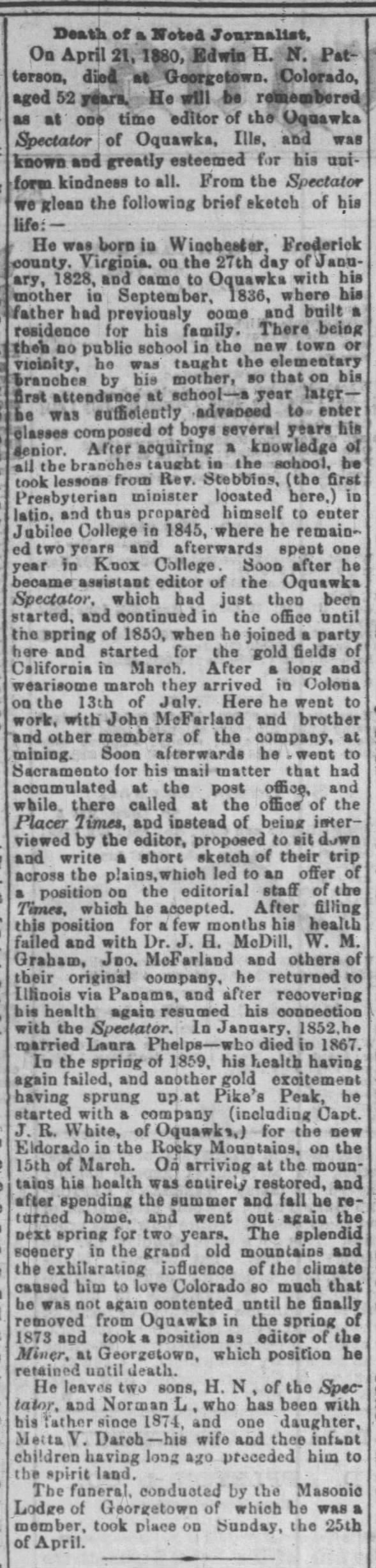
Edwin (called "Edward" in some sources, apparently in error) journeyed further west in 1850 looking for better health and California gold, but he was back in Illinois before the end of 1851. During his absence from Oquawka, the younger Patterson contributed first-hand sketches of the "Overland Route" to California and evidently retained his connection to the Spectator as Junior Editor. E. H. N. Patterson married the former Miss Laura Phelps in Oquawka on New Year's Day 1852, as reported in the Oquawka Spectator for January 7, 1852.
Both E. H. N. Patterson and his father J. B. Patterson were named on the masthead as co-editors of the Oquawka Spectator when Melville's short fiction "Benito Cereno" (just concluded in the December issue of Putnam's Monthly) was praised on December 7, 1855 as "the best tale we have read for a long time." "Benito Cereno" originally appeared in three installments, published in the October, November, and December 1855 issues of Putnam's magazine. Before the December review, the Oquawka Spectator of November 9, 1855 already had remarked "a continuation of that unique story of 'Benito Cereno'" in the November issue of Putnam's. Either editor might have contributed unsigned literary notices of Putnam's Monthly Magazine, including the one transcribed below. Tentative assignment to E. H. N. Patterson seems most appealing in view of the younger Patterson's known affinity for the writings of Edgar Allan Poe, with whom he had corresponded in high hopes of establishing a new literary magazine in western Illinois with his hero at the helm.
PUTNAM"S MONTHLY:— Dix & Edwards, N. Y. Terms: $3 per annum; the Monthly & Household Words $5; the Monthly or Household Words, with the School fellow $3.50; all three $5.50.
The December number of this leading Magazine is before us. The contents embrace nineteen choice articles, and copious Editorial Notes. As articles especially pleasing we may enumerate "How I came to be married," "The Virginia Springs," "Low Life in the Sahara," "The Green Lakes of Onondaga," and "Benito Cereno." The latter is concluded in this number; and is the best tale we have read for a long time—the style and manner of the lamented POE are closely imitated. The literature of Putnam is of the highest order, and has gained it a lofty position. For the coming year, the publishers promise an increasing excellence in every department, but we can assure the public that it is good enough now.
Later, the influence of Poe on the book version of "Benito Cereno" was suggested in a review of The Piazza Tales that appeared in the New York Dispatch on June 8, 1856. For the New York reviewer, "Benito Cereno"
"opens with a mysticism which reminds us of Edgar Poe's prose tales, and this mysticism is admirably preserved, even deepening in every character to the end, when all appears as clear as the sun at noon-day."
Accessible online via genealogybank.com, the New York Dispatch review of The Piazza Tales is helpfully transcribed in Herman Melville: the Contemporary Reviews, edited by Brian Higgins and Hershel Parker (Cambridge University Press, 1995) at page 477.
New York Dispatch - June 8, 1856
E. H. N. Patterson's "youthful" and "ardent" fascination with Poe is discussed by Mary E. Phillips in Edgar Allan Poe, the Man Volume 2 (John C. Winston Co., 1926) at page 1401:
September, 1835, J. B. Patterson, of Winchester, Va., settled at Oquawka, Ill. A year later, joined by his wife and son—Edward H. N. Patterson, a young man of literary taste and ability—the elder Patterson founded the weekly OquawkaSpectator. Prudently reared in all ways, and in constant touch with the best books and magazine literature, Edward H. N. Patterson came of age January, 1849. Then his father turned over to him the management of the Spectator and its job-printing office. Full of youthful confidence, he cherished the ambition of making a name in the world of letters. Among those who stood for conspicuous eminence in American literature of that time was Edgar Allan Poe, who, as a journalist, young Patterson had followed from Editor Poe's Southern Literary Messenger days to the passing on of his Broadway Journal, with fascinated admiration for the poet's genius. For Poe's endless and varied adversities, Patterson felt and expressed an ardent sympathy. Thereby and then, he was moved, December, 1848, to make to Poe a letter appeal to come West and join him in a new periodical venture.
For more on the younger Patterson's unrealized scheme to engage Edgar Allan Poe as editor of a new literary journal in Oquawka, check out
Reading the first page of this 2020 article by Daniel Avitzour in Partial Answers, I was impressed by the clear, jargon-free intro. Subscribed online to get the rest of it.
I'm very sorry to learn of the writer's "untimely death" shortly after the acceptance of his excellent article. David Fishelov at The Hebrew University of Jerusalem remembers him as
"a rare individual who combined a keen analytical mind – Avitzour held a PhD in mathematics and enjoyed a successful career as an engineer – with the sensitivity of a perceptive literary critic, attentive to the complexities of literary texts..."
Had I known of it then, I would have cited Avitzour's 2020 article in my 2021 post on Memory Holes in the Broadview Benito Cereno. Without trying to do more than state a known, easily verifiable fact, Avitzour in the first sentence provides a succinct correction to the myth-making attempted by editor Brian Yothers in his introduction to the Broadview student edition of Benito Cereno.
"Herman Melville's novella Benito Cereno has been held in high esteem ever since the 'Melville revival' of the 1920's."
Avitzour, Daniel. "Anatomy of an Interpretive Controversy: The Case of Benito Cereno." Partial Answers: Journal of Literature and the History of Ideas, vol. 18 no. 2, 2020, p. 191-212. Project MUSE, https://doi.org/10.1353/pan.2020.0020.
One cannot help thinking that whatever the fate of "The Isle of the Cross," Melville's "Agatha" writing may have been part of what became "The Encantadas; or, Enchanted Isles," published in Putnam's in March, April, and May 1854.... "Sketch Eighth" of "The Encantadas," "Norfolk Isle and the Chola Widow," is most easily imagined as part of "The Isle of the Cross" project in that the principal image for Norfolk Island is the "rude cross" (155) that the Chola Widow has put up as memorial for her dead husband Felipe.
... What the "Agatha" story suggests, and the "Norfolk Isle and the Chola Widow" enacts, is the theme that "uncomplaining submission" is the admirable human reaction to the horror of a world in which God is silent.
Today I way belatedly added Bergmann's discussion of "The Chola Widow" in Chapter 7 of his 1995 book to my Agatha-Hunilla bibliography. No excuse for neglecting it until now, but I'm thankful to have God in the Street handy for a couple of weeks, on loan from my local library in Cambridge MN via Alcuin Library at St. John's University.
Related posts:
Isle of the Crux https://melvilliana.blogspot.com/2020/03/isle-of-crux.html
Patient and attentive readers will find a long-lost poem "To Insensibility" by the eccentric and romantic deaf poet Sophia Hyatt, rescued on Melvilliana at the end of this 2021 post
Full disclosure: I never got to see Little Feat live but I heard the Nighthawks do "Teenage Nervous Breakdown" many times at various Atlanta venues, and once at Desperado's in Georgetown.
Here's a sample of my latest effort on Substack, documenting formerly unrecognized literary debts to some version of E. C. Brewer's pop-science guidebook in another 1854 short fiction by Herman Melville, Poor Man's Pudding and Rich Man's Crumbs. The borrowings identified so far all occur in "Poor Man's Pudding," the first of these paired sketches. Evidently Melville, having successfully ventriloquized Dr. Brewer on familiar science in "Poor Man's Pudding," kept his guidebook handy for the more extensive series of creative appropriations just uncovered in The Lightning-Rod Man.
As shown below, a closer look at the mechanics of Melville's rewriting reveals his penchant for parallelism. Further investigation, of the sort I hope to continue on Substack, may reveal other instances where Melville forges new parallel structures from the raw material of a source-text.
Near the close of “Poor Man’s Pudding,” the narrator records his observation of the oppressively “damp” and “heavy” air in the Coulters’ home, and then generalizes about the badly ventilated rooms that poor people too often inhabit, especially in winter. Invoking some imaginary abuser (maybe Malthus) of the poor and their alleged “instinct” for “ill-ventilation,” Melville’s narrator protests in their defense that stale indoor air has one great advantage “to any shiverer” in being warmer than air circulated and cooled through ventilation.
This ill-ventilation in winter of the rooms of the poor—a thing, too, so stubbornly persisted in—is usually charged upon them as their disgraceful neglect of the most simple means to health. But the instinct of the poor is wiser than we think. The air which ventilates, likewise cools. And to any shiverer, ill-ventilated warmth is better than well-ventilated cold.
Rather than evincing habitual neglect of good health, as ostensibly alleged by unnamed critics, the observed preference for bad ventilation in winter results from the natural human “instinct” to keep warm. Thus reasons Melville’s compassionate narrator, who takes his theme directly from Dr. Brewer’s section on “Animal Heat,” #1115 in Peterson’s Familiar Science. Image below reproduces the same Q-and-A as it appears on page 93 of A Guide to the Scientific Knowledge of Things Familiar (New York: C. S. Francis & Co. and Boston: Crosby, Nichols & Co., 1854).
Q. Why are very POOR PEOPLE instinctively AVERSE to VENTILATION ?
A. 1st–Because ventilation increases the oxygen of the air—the combustion of food and the cravings of appetite : and
2dly—Ventilation cools the air of our rooms : to poor people, therefore, who are ill-clad, the warmth of an ill-ventilated apartment is agreeable.
In paraphrasing his source-text near the end of “Poor Man’s Pudding,” Melville has disregarded the first part of Dr. Brewer’s answer. Instead of bothering about scientific processes of oxygenation and combustion, Melville keys on the second part, about ventilation. As the latter part of the answer in Familiar Science #1115 explains, “poor people” without adequate clothing to wear actually prefer rooms without good air circulation for their relative warmth, in contrast to rooms that are better ventilated and therefore colder.
FAMILIAR SCIENCE #1115 Ventilation cools the air of our rooms :
MELVILLE The air which ventilates, likewise cools.
Melville’s rewrite turns Brewer’s word ventilation into a verb, making the grammar of “ventilates” parallel to that of “cools.” Both the original and Melville’s rewrite have the word cools in italics.
The rest of the paraphrase features another parallelism created through revision of Melville’s source-text. Melville copied “ill-ventilated” from his source in Brewer’s Guide page 93 or Familiar Science #1115, and added “well-ventilated” to yield contrasting, parallel descriptors. He strengthened the parallelism through antithesis by copying the noun “warmth” and adding “cold” to sharpen the contrast in fresh, perfectly parallel phrases: “ill-ventilated warmth” vs. “well-ventilated cold.”
FAMILIAR SCIENCE #1115 … to poor people, therefore, who are ill-clad, the warmth of an ill-ventilated apartment is agreeable.
MELVILLE And to any shiverer, ill-ventilated warmth is better than well-ventilated cold.
Another addition is the figure of “any shiverer,” one of the best changes Melville made to his source-text in some version of Dr. Brewer’s handy guidebook of popular science. When creatively rewriting source material, Melville often gravitates to the concrete and personal. In this case, where his source generalized about the predicament of “ill-clad” poor people. Melville individualizes the point of view, changing the perspective from that of “poor people” in the abstract to that of “any shiverer.” At the same, the construction invites empathy by appealing to a relatable experience of common humanity. In the image of “any shiverer,” Melville has visualized how any person, not excluding any reader, might feel and act in a cold apartment, with no winter clothes.