Showing posts with label poetry. Show all posts

Sunday, July 11, 2021

Refresher on heroic measure

"Let America, then, prize and cherish her writers; yea, let her glorify them."
-- A Virginian Spending July in Vermont

While we wait around for scanned images of John Chipman Hoadley's manuscript poem "Destiny," now ordered from The New York Public Library, let me explain why I expect (before seeing any of it) to find that Hoadley composed the long unpublished work he called his "national poem" in iambic pentameter. What I don't know is if Hoadley developed his patriotic theme using rhymed couplets in the manner of Joel Barlow in The Vision of Columbus and The Columbiad and Richard Emmons in The Fredoniad, Americanizing British models by Dryden and Pope. My best guess is YES. But it would be wonderful to find Melville's future brother-in-law on a more daring and ambitious course, sounding off like Milton or Marlowe in mighty MAGA lines of blank verse. 

Rhymed elsewhere in the stanza or not, however arranged in couplets or triplets or quatrains, Hoadley's usual verse line in "Destiny" will contain five metrical feet, mostly iambs. The iamb as English majors recall without any help from Google consists of one unstressed syllable followed by a stressed one. Five iambs or iambuses = iambic pentameter. 
Manuscripts and Archives Division, The New York Public Library. "Hoadley, John Chipman (1818-1886)" The New York Public Library Digital Collections. 1851. https://digitalcollections.nypl.org/items/d9236f50-693b-0133-a932-00505686d14e
Cited above and transcribed in the Melvilliana post on Melville's hearty praises, John C. Hoadley's note of September 9, 1851 to Evert Duyckinck offers good evidence for supposing that Hoadley's pro-American "Destiny" (originally titled "The Union" and declaimed by the author on July 4, 1851 according to Jay Leyda in The Melville Log volume 1 page 416) is the versified "glorification of the United States" that Herman Melville read aloud in August 1851--with great gusto, and in the author's presence, according to Duyckinck. Previously unrecorded in Melville scholarship, this letter firmly links Hoadley to Duyckinck, Melville, and one or more of their Berkshire excursions during the previous month. Hoadley was already a prominent resident of Pittsfield, having moved there in 1848. Hoadley addressed Duyckinck formally as "Dear Sir," indicating a recent and not very close acquaintance. Hoadley thanked Duyckinck for sending him a copy of the Literary World with Duyckinck's account of a trip to Mt. Greylock. Hoadley regretted having to miss the Greylock outing, implying he had been invited as one of the group that included Duyckinck and Melville. Gratefully and casually, as something already known to Duyckinck, Hoadley acknowledged "Melville's hearty praises" for his unpublished "national poem." Since Hoadley had just unveiled his poem in Pittsfield, Mass. on the 4th of July 1851, that leaves only a month or two at most during which Herman Melville could have read it and responded so encouragingly. 


Here is the relevant passage from Duyckinck's letter to his wife dated August 8, 1851, describing how Melville entertained his audience of Berkshire excursionists with a dramatic reading of stirring patriotic verse. It happened in a barn during a summer shower. First, they had to kick out the chickens:
... The morning had been warm and the afternoon was showery, clouds and shadows being the moving scenery to the permanent stagery of the hills. We went on our way rejoicing till a dragging cloud bore down upon us when we turned to the shelter of a barn. Mr M[elville] spied out the loft and we boarded the rafters, dislodging the hens and were nestled here and there in the warm dry hay, the rain pattering its musical accompaniment on the roof. 
Mrs M [Sarah Morewood] had a poet in the company and his poem too a stout MSS of heroic measure, a glorification of the United States in particular with a polite slanging of all other nations in general. The English lady in the straw was not particularly complimented as to her native country in sounding lines which H M read with emphasis (interrupting the flattered author who sat thoughtful on a hay tuft--with such phrases as "great glorious" "By Jove that's tremendous" &c)--but perhaps the most noticeable incident was a gathering of the exiled fowls in a corner who cackled a series of noisy resolutions, levelled at the party. "Turn em out!" was the cry. The author impelled by the honor of his poem charged fearlessly, scattered the critics of the pit, clasping the most obstinate bodily and "rushing" her a rapid descent below." --as transcribed in Steven Olsen-Smith, Melville in His Own Time (University of Iowa Press, 2015) page 58.
About the poem that Melville read aloud in August 1851, certain defining features are revealed in the eye and ear-witness account that Evert A. Duyckinck gave his wife. As described by Duyckinck
  1. The poem was a long one, taking up "a stout MSS." The impressive size indicates a poem with hundreds of lines, maybe thousands.
  2. The poem was composed in iambic pentameter, as specified by Duyckinck's term "heroic measure." (More on that below.)
  3. The poem was extremely patriotic in theme, being "a glorification of the United States." The strong America-First argument of the poem involved "a polite slanging of all other nations in general." Despite whatever formal courtesies may be implied in Duyckinck's adjective "polite," the rhetorical "slanging" at Great Britain might well have offended one of Melville's listeners that showery afternoon in a Berkshire barn: Mrs. Pollack the "English lady in the straw" who according to Duyckinck "was not particularly complimented as to her native country." 
None of these qualities is shared by On Onota's Graceful Shore, the ballad by J. E. A. Smith that Leyda identified (wrongly) as the poem Melville honored by reading aloud, with dramatic "emphasis" and positive commentary. With only 11 stanzas, 88 lines in all, Smith's poem is too short. The subject is one particular Berkshire farmer-soldier and his heroic sacrifices as the American Revolution dawned--not the glory of these United States and Manifest Destiny. 

J. E. A. Smith, Souvenir Verse and Story
Springfield, Mass.: Clark W. Bryan Company, 1896

The meter of "Onota's Graceful Shore" is iambic but does not qualify as "heroic measure" since each line contains only four feet. According to standard 19th century textbooks of English grammar, the "heroic line" was understood to mean iambic pentameter, a line of verse "composed of five Iambuses." Iambic pentameter was considered the metrical form best "suited to solemn and sublime subjects" with "far more dignity" than other kinds of meter. 

§ 9. The Heroic line.
We now come to the eighth species of Iambic line. This is the heroic line composed of five Iambuses. This line is suited to solemn and sublime subjects, and it has far more dignity than any of the measures before mentioned. In long pieces it is frequently varied by the intermingling of secondary feet, but there are numerous in. stances of a succession of Iambuses through several lines.

It is employed in couplets, as in POPE's Essay on Man, PARNELL's Hermit, and GOLDSMITH's Deserted Village; it is employed in quatrains, as in GRAY's Elegy in a Country Churchyard; it is employed in the Spenserean stanza, as in the Faery Queen and Childe Harold; it is employed in blank verse, as in MILTON's Paradise Lost, THOMSON'S Seasons, ROGERS’ Italy, and COWPER's Task; lastly, it is employed in triplets, with an additional short line to complete the stanza. It is peculiarly suited to all subjects where dignity is required, and should never be employed when the subject is either trivial or gay. A specimen from GRAY's Elegy, showing the fitness of this measure for solemn subjects, will furnish the first example:
The curfew tolls, the knell of parting day,
   The lowing herd winds slowly o'er the lea,
The ploughman homeward plods his weary way
   And leaves the world to darkness and to me.

-- Erastus Everett, A System of English Versification (New York and Philadelphia, 1848) page 36.

Numerous editions of Lindley Murray's English Grammar uphold the definition of heroic measure as the conventional term for a line that specifically "consists of five Iambuses." 


5 The fifth species of English Iambic, consists of five Iambuses.
How lov'd, how valu'd once, avails thee not,
To whom related, or by whom begot,
A heap of dust alone remains of thee;
'Tis all thou art, and all the proud shall be. [Alexander Pope, Elegy to the Memory of an Unfortunate Lady
Be wise to-day, 'tis madness to defer:
Next day the fatal precedent will plead;
Thus on, till wisdom is pushed out of life. [Edward Young on procrastination, from Night Thoughts, Night 1]
This is called the Heroic measure. In its simplest form it consists of five Iambuses; but by the admission of other feet, as Trochees, Dactyls, Anapæsts, &c. it is capable of many varieties. Indeed, most of the English common measures may be varied in the same way, as well as by the different position of their pauses. 

Heroic Measure (Pentameter) is made up of five iambic feet. In its rhymed form it is the measure of Chaucer and Spenser, of Dryden and Pope, of Cowper, Campbell, and Byron; as, 
True ease in writing comes from art, not chance
As those move easiest who have learn'd to dance....
[Alexander Pope, An Essay on Criticism]
-- Charles William Bardeen, A System of Rhetoric (New York, 1884) page 639.
Unlike Smith's ballad, Hoadley's "Destiny" is a genuinely "stout" production taking up 53 manuscript sheets in the bound copy now held in the Gansevoort-Lansing collection of The New York Public Library. Both the original title "The Union" and the revised one, "Destiny," are consistent with a work devoted to glorifying the United States, as is Hoadley's own reference to his "national poem." How well the actual content matches Evert Duyckinck's description, including the "polite slanging" at other nations, remains to be seen. Likewise the number of feet or beats per line. "Onota's graceful shore" has only four. The one that Melville read and loved has five, if Duyckinck got the meter right. Obviously, I'm trusting that the veteran New York editor and literary critic knew heroic measure when he heard it. Confidence! Heroic measure means pentameter. Wherever you hear it, even in the rafters. 

Related posts

Thursday, July 1, 2021

Hoadley's national poem, cheered by Melville

Ashley Lake Loop Trail - Photo by Kimberly Kaigle
In the loft of a Berkshire barn one rainy afternoon in August 1851, Herman Melville entertained a group of fellow summer excursionists by reading somebody else's ultra-patriotic poem out loud, with enthusiasm:
interrupting the flattered author who sat thoughtful on a hay tuft—with such phrases as “great” “glorious” “by Jove that’s tremendous” &c. 
  --Evert A. Duyckinck, letter to his wife Margaret dated August 8, 1851; as quoted in Luther Stearns Mansfield, Glimpses of Herman Melville's Life in Pittsfield, American Literature (March 1937) pages 39-40.
Evert A. Duyckinck was there. The letter from Duyckinck giving the circumstances of Melville's performance the day before (Thursday, August 7th) is transcribed and conveniently available in Steven Olsen-Smith, Melville in His Own Time (University of Iowa Press, 2015) pages 57-8. In The Melville Log volume 1 (Harcourt, Brace and Company, 1951) pages 420-1), Jay Leyda identified the lucky poet as Joseph Edward Adams Smith and the poem as Smith's "On Onota's Graceful Shore," eventually published in Souvenir Verse and Story (Springfield, Mass., 1896). 

Somehow Leyda got the wrong poet and poem, as did Merton M. Sealts, Jr. after him and Hershel Parker after them--Sealts in The Early Lives of Melville (University of Wisconsin Press, 1974) pages 29-31; and Parker in the first volume of Herman Melville: A Biography Volume 1, 1819-1851 (Johns Hopkins University Press, 1996; paperback 2005) pages 855-6. On closer inspection, Smith's poem, subtitled "A Ballad of the Times that Tried Men's Souls," does not match up with any part of Duyckinck's eye and ear-witness description. "Onota's Graceful Shore" is a fairly short piece of eleven stanzas--octets, so 88 lines in all, by no means the stuff of a "stout" manuscript as Duyckinck described it. Smith's ballad is composed in sing-song couplets of rhyming iambic tetrameter, not what Duyckinck called "sounding lines" of more dignified pentameter to be expected of "heroic measure" or heroic verse in English; and it honors a particular Berkshire farmer-soldier named David Noble for decisive action as a militia leader, with no obvious aim or effect of exalting "the United States in particular with a polite slanging of all other nations in general." Instead of nationalist zeal, Smith's poem exhibits decidedly regional pride along with a kind of philosophical resignation over the absence of any tangible earthly reward for the local patriot's sacrifices:
"His memory on Onota's shore,
Only that, and nothing more!"  --Souvenir Verse and Story
Here below is more of the relevant passage from Duyckinck's letter to his wife as transcribed by Steven Olsen-Smith in the introduction to Melville in His Own Time:
Mrs M had a poet in the company and his poem too a stout MSS of heroic measure, a glorification of the United States in particular with a polite slanging of all other nations in general . . . which H M read with emphasis (interrupting the flattered author who sat thoughtful on a hay tuft--with such phrases as "great glorious" "By Jove, that's tremendous" &c)--but perhaps the most noticeable incident was a gathering of the exiled fowls in a corner who cackled a series of noisy resolutions, levelled at the party. "Turn em out!" was the cry. The author impelled by the honor of his poem charged fearlessly, scattered the critics of the pit, clasping the most obstinate bodily and "rushing" her a rapid descent below." (page xvii)
As a graduate student on a mission from Hershel Parker, Olsen-Smith re-examined the manuscript at NYPL and corrected one earlier misreading in the passage above. According to Duyckinck the unruly hens were really "critics of the pit" not "cuties of the pit" as Mansfield and Leyda erroneously had it. Duyckinck pictured those evicted chickens as noisy critics, jeering like the groundlings in Shakespeare's day. 

Leyda's misidentification of J. E. A. Smith in this case appears to have been influenced by Duyckinck's explicit reference to "one Smith known as 'the mad poet'" in another letter to his wife, dated August 9, 1851, enclosing Smith's pseudonymous newspaper article "A Petit Fancy Dress Party in Berkshire" (Boston Evening Transcript, August 7, 1851). (For the text of this later letter, see Melville in His Own Time, pages 58-60.) Signed "Miantonomah," the 1851 newspaper sketch by the "mad poet" J. E. A. Smith tattled about a recent masquerade hosted by the Morewoods at Broad Hall, one that Melville seems not to have attended.

But Evert Duyckinck did not name Smith or any poem title when telling his wife about Melville's energetic reading in the hayloft. Rather, as Duyckinck described him the "flattered author" turned out to be "a thoughtful sensible man" who afterward guided the party safely up steep mountain slopes to Ashley Pond aka "Washington Lake." Most likely the unnamed "Poet" in Sarah Morewood's train that rainy afternoon of August 7, 1851 was not "mad poet" Smith but Melville's future brother-in-law John C. Hoadley. Significantly, Hoadley had already been associated with Sarah Morewood in public readings of original verse around Pittsfield. As quoted from Smith's History of Pittsfield in Leyda's Melville Log page 394, the dedication of the new Pittsfield Cemetery on September 9, 1850 featured the choral performance of odes “by John C. Hoadley, Mrs. Emily P. Dodge and Mrs. J. R. Morewood." In Herman Melville: The Making of the Poet, Hershel Parker adds that “In 1851 Hoadley read his own poetry aloud in Pittsfield at the Fourth of July celebration (again with Melville’s neighbor, Sarah Morewood)." Same information appears in Parker's Historical Note for Herman Melville's Published Poems (Northwestern University Press, 2009) on page 347.

As the evidence of Hoadley's September 1851 letter to Duyckinck (transcribed below) suggests, Hoadley's patriotic "national poem" was probably the "stout" production "glorifying the United States" that Duyckinck had heard Melville read out loud in the hayloft on August 7, 1851--just over a month after Hoadley's own performance at the Independence Day festivities in Pittsfield. Length, meter, and content fairly disqualify Smith's poem "On Onota's Shore" from consideration. Duyckinck's description is far better fitted to Hoadley's poem, the one that Hoadley himself had recited in Pittsfield on July 4, 1851. In the Melville Log, Leyda reports the event, and also the original title of Hoadley's work: "The Union." Within editorial brackets Leyda reveals that Hoadley's 4th of July poem "The Union" was re-titled "Destiny."
For the holiday, John C. Hoadley pronounces a newly composed poem, "The Union" [later retitled "Destiny"] --The Melville Log Volume 1 - [416]

Leyda's source for this information, cited in volume 2 of the Melville Log, is a manuscript by Hoadley in the New York Public Library Gansevoort-Lansing collection. Looking specifically for Hoadley's 1851 poem "The Union," re-titled "Destiny" according to Jay Leyda, I have contacted NYPL to request more information about Hoadley manuscripts in the Gansevoort-Lansing collection, Box 351. If NYPL has Hoadley's poem THE UNION aka DESTINY and can provide scans, I hope to transcribe the text on Melvilliana.

Corroborative evidence for Melville's reading of John C. Hoadley's "Union" poem exists in the letter Hoadley wrote to Evert Duyckinck on September 9, 1851. I located this item years ago, as reported in the 2016 Melvilliana post

Back then I figured with Leyda and Sealts and Parker that Smith's "On Onota's Graceful Shore" must have been the poem Melville read aloud in August 1851. But after looking harder at Smith's poem, I see that can't be right. Hoadley's letter effectively documents his social and literary connections with Melville and Duyckinck just after the relevant Berkshire excursions of August 1851. Hoadley's confession of "a twinge of selfish regret that I could not be of your party" during one trip to Greylock implies that he was invited but for some reason had to miss the trip. He assumed Duyckinck had sent him the write-up of the Greylock adventure in the Literary World, another indication of their recent socializing. Hoadley then gives important details about the effort (evidently unsuccessful) to get his "national poem" published. The Harpers rejected it, so Hoadley asked them to pass it along to D. Appleton & Co. Apparently the manuscript of  Hoadley's "national poem" was stout enough on its own to make a printed book or pamphlet. Most explicitly, Hoadley reveals that "Melville's hearty praises" have given him "more hope than anything else." Herman Melville read Hoadley's "national poem" and loved it. 

Pittsfield, Sept. 9th. 1851.
E. A. Duyckinck Esq.

Dear Sir,

I received a copy of the Literary World a few days since, containing an interesting account of your excursion to Grey Lock, for which I suppose I have to thank your kindness. I read it with lively pleasure though not without a twinge of selfish regret that I could not be of your party.— "Can a man hold fire in his hand by thinking on the frosty Caucasus?”

The Harpers, to whom I had sent my national poem for publication, decline it, and advise me to send it to D. Appleton & Co. which I have accordingly requested the Messers H. to do.— I can not but desire to have it printed, but have not much hope of it. Melville’s hearty praises give me more hope than anything else.

I am, My Dear Sir,
Very Respectfully,
Yours &c. John C. Hoadley.

Citation: 

Manuscripts and Archives Division, The New York Public Library. "Hoadley, John Chipman (1818-1886)" The New York Public Library Digital Collections. 1851. https://digitalcollections.nypl.org/items/d9236f50-693b-0133-a932-00505686d14e
Hoadley refers to the account by Evert A. Duyckinck in the Literary World for August 30, 1851 headed "NOTES OF EXCURSIONS—NO. I / AN ASCENT OF MOUNT SADDLEBACK." The Greylock climb by Herman Melville with his Berkshire friends and visiting literati took place on Monday, August 11, 1851, during what Hershel Parker describes as "a second idyll in the Berkshires, fit to rank with that of the previous August" (Herman Melville: A Biography V1.855). Sarah Morewood also wrote of That Excursion to Greylock in a chapter she contributed to J. E. A. Smith's 1852 volume Taghconic

Like Sarah Morewood, Hoadley also contributed a chapter for Taghconic: Or, Letters and Legends about our Summer Home (Boston, 1852). Hoadley's sketch of Berry Pond takes the form of a letter dated March 22, 1852, signed "H." and evidently written to Smith from Lawrence, Massachusetts where Hoadley had relocated from Pittsfield. Smith aka Godfrey Greylock acknowledges Hoadley without naming him in a footnote to Chapter 6, "Berry Pond":
* I am indebted for this Chapter to the kindness of a much esteemed and very clever friend. -- Taghconic chapter 6, Berry Pond.
To wrap up for now, before the real fireworks start for our glorious 4th of July 2021 celebration, I would also note the particular fitness of Hoadley's role as "our pilot to the Ashley Pond" near the summit of Washington mountain, after the reading of his patriotic Union-Destiny verses in the barn. As related by Duyckinck, Hoadley first had to roust “a gathering of exiled fowls in a corner who cackled a series of noisy resolutions levelled at the party.”
The author impelled by the honor of his poem charged fearlessly, scattered the critics of the pit, clasping the most obstinate bodily and "rushing" her a rapid descent below. This was the ludicrous side. On the other, the Poet was a thoughtful sensible man and was our pilot to the Ashley Pond or Washington Lake which we reached at last after an endless ascent by the side of steep gorges, on the summit of the Hoosac, looking back to the distant sublimities of cloud & mountain of the Taghconic. -- Melville in His Own Time, page 58

The "Poet" turned "pilot" confidently guided Duyckinck and company to Ashley Pond, a location that Hoadley knew exceptionally well, for the best professional and civic reasons.

As an engineer and engaged citizen of Pittsfield, John C. Hoadley worked hard to bring good water to Pittsfield. Hoadley

was very active in all the efforts to acquire Ashley Lake for water supply and at a public meeting a vote was passed “thanking Messrs. McKay and Hoadley for their public spirited efforts in behalf of supplying the village with pure water."  -- Joseph Ward Lewis, quoting Smith's History of Pittsfield page 563 in "Berkshire Men of Worth," Berkshire County Eagle, September 18, 1935.
For Hoadley that work began the previous year with his formal report in September 1850 to the Pittsfield Library Association. Presumably the firm of McKay & Hoadley would have been of service in the manufacture and supply of necessary iron pipes. As the town expert, or one of them, Hoadley was assigned to the water-works committee. Coincidentally, the guided trip to Ashley Pond described by Duyckinck in August 1851 might have provided Hoadley with a great opportunity for obtaining another water sample. Regular samples were then being collected for testing by Hoadley's committee, expressly appointed "to make a thorough examination of the quantity and quality of the water of Lake Ashley."

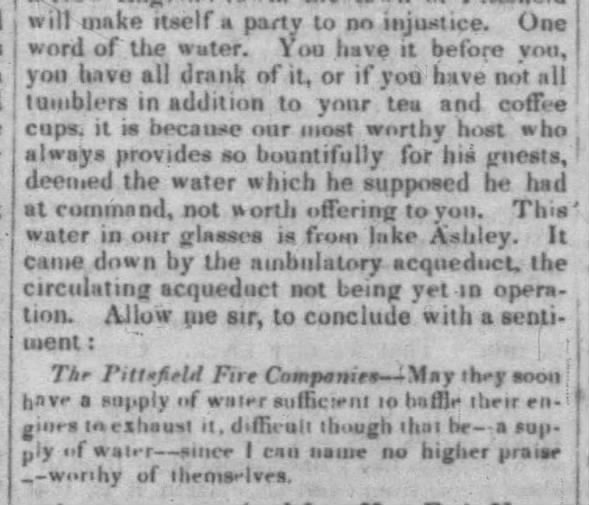
23 Jan 1851, Thu The Pittsfield Sun (Pittsfield, Massachusetts) Newspapers.com
At the big Firemen's banquet or supper or levee on January 15, 1851, reportedly attended by 200 guests, Hoadley spoke at some length on "the great subject of water," specifically the merits of Ashley water:

“The great subject of water, which is exciting a great deal of interest in town just now, is one upon which we have all to form opinions that shall guide us in immediate action, and it is important that we should form wise opinions. About the excellence of the water of Lake Ashley, about its desirableness in our village, I think sir there can be but one opinion.  --Pittsfield Sun, January 23, 1851

Knowing Hoadley and his hobby, some in the audience could not have been too surprised by his closing revelation:

"This water in our glasses is from lake Ashley. It came down by the ambulatory aqueduct, the circulating aqueduct not being yet in operation.

23 Jan 1851, Thu The Pittsfield Sun (Pittsfield, Massachusetts) Newspapers.com
Concerning the obvious desirableness of pure drinking water from Ashley, Franklin E. Taylor concurred in this toast To the Pontoosuc Engine Company, No. 2:

"May we all soon have the Ashley Pon-too-suc (Pond-to-suck)."

Related posts:

Wednesday, March 18, 2020

By a Vermonter

In a letter dated April 16, 1852 to London publisher Richard Bentley, Herman Melville offered to issue Pierre anonymously or under a pseudonym:
... it might not prove unadvisable to publish this present book anonymously, or under an assumed name:—* "By a Vermonter" say.... * or "By Guy Winthrop." --The Letters of Herman Melville, ed. Merrell R. Davis and William H. Gilman (Yale University Press, 1960) page 151.
Bentley and Melville could not agree on terms, as chronicled by Hershel Parker in Herman Melville: A Biography Volume 2, 1851-1891 (Johns Hopkins University Press, 2002; paperback 2005) pages 107-108. Pierre; or, The Ambiguities was published in New York by Harper & Brothers at the end of July 1852 with Melville's name on the title page.

One of the pen-names suggested by Melville in April 1852 might have been influenced by the popularity of "Pumpkin Pies," a poem that enjoyed a good run the year before in New York and New England newspapers. "Pumpkin Pies / BY A VERMONTER" was first published on July 8, 1851 in the New York Tribune. With the same credit line "By a Vermonter," the verse tribute to "Pumpkin Pies" was reprinted in the Boston Journal on November 18, 1851.

Boston Morning Journal - November 18, 1851

"Pumpkin Pies" appeared on page 2 of the Boston Morning Journal for November 18, 1851--the same issue that featured John S. Sleeper's favorable review of Moby-Dick on the front page.

Without crediting the Tribune, the Pittsfield Sun reprinted "Pumpkin Pies--By a Vermonter" on August 21, 1851.

Pittsfield Sun (Pittsfield, Massachusetts) August 21, 1851
via GenealogyBank

In the Pittsfield Sun, as in the New York Tribune, the poem was subscribed "Pavilion, N. Y., 1851," possibly giving the place and year of its composition. The part of the heading omitted in the Pittsfield Sun indicated an original contribution "For the Tribune." In the fourth stanza, first line, the New York Tribune printed "hight":
See, on yon melon-covered hight....

The spelling "hight" occurs frequently in Melville's Clarel: A Poem and Pilgrimage in the Holy Land (1876). Compare these instances of "hight" with "yonder" and "yon":

Of yonder Quarantanian hight --Clarel Part 2 Canto 18 
Mark'st thou the face of yon slabbed hight --  Clarel Part 2 Canto 30
But the spelling "hight" has been regularized to "height" in the Pittsfield Sun and Boston Journal, as in some (not all) other reprintings of "Pumpkin Pies."

New York Tribune - July 8, 1851
<https://chroniclingamerica.loc.gov/lccn/sn83030213/1851-07-08/ed-1/seq-8/>

PUMPKIN PIES . . . For The Tribune.  

BY A VERMONTER. 
LET some folks boast of spicy mince,
     Care not a fig for such do I;
Or largely talk of sweetened quince,
Fine as the luscious grapes of Lintz,
     Plums doubly dipped in Syrian dye--
I deem them tasteless all as flints,
     Compared with one good pumpkin pie.  
I know our pumpkins do not claim
     The honored growth of foreign soil;
They never felt the torrid flame,
And surely they are not to blame,
     Though reared not by the bondman's toil,
In climes where man, to burden tame,
     Unpaid consents to tug and broil.  
Talk not of vineyards breaking down,
     And fields that droop with oil and wine,
Where burning suns with ripeness crown
The sweets that man's best manhood drown,
     By lying poets sworn divine.
I rather have than all--don't frown--
     The product of my pumpkin vine.  
See, on yon melon-covered hight,
     My chosen fruit, like globes of gold,
Lies ripening in the sunbeam's light;
Ah, 'tis a stomach-staying sight,
     And soon, to house them from the cold,
Shall freemen with strong hands unite,
     Paid laborers and freemen bold.  
And then the girls who make our pies,
     Bless them! all other maids outshine,
Their raven locks, and hazel eyes,
And cheeks, whose ever-changing dyes
     The lily and the rose combine,
Make mad the hearts that lose the prize
     Of all this loveliness divine.  
Vermont! thou art a glorious State,
     Though small in acres and in skies;
But 'tis not length that makes one great,
     Nor breadth that gives a nation size.
Thy mountains and thy mountain air
     Have reared a noble race of men,
And women, fairest of the fair,
Their labors and their love to share.
     Where shall we see thy like again?
I love thee all, which most I shan't advise,
Thy mountains, maidens, or thy pumpkin pies.  
Pavilion, N. Y., 1851. 
More 1851-2 reprintings of "Pumpkin Pies / By a Vermonter"

Sat, Jul 26, 1851 – 4 · New England Farmer (Boston, Massachusetts) · Newspapers.com
  • Buffalo, NY Courier, July 12, 1851
  • Boston, MA New England Farmer, July 26, 1851
  • New Haven, CT Columbian Register, July 26, 1851 
  • Jamaica, NY Long-Island Farmer, July 29, 1851
  • The Clinton Republican (Wilmington, Ohio) August 1, 1851
  • Rockford Forum (Rockford, Illinois) August 6, 1851
  • Pittsfield, MA Culturalist and Gazette, August 20, 1851 
  • Norwalk, CT Gazette, October 28, 1851
  • Greenfield, MA Franklin Democrat, November 17, 1851
  • Albany, NY Evening Journal, November 26, 1851
  • Portland Transcript (Portland, Maine) November 29, 1851
  • Buffalo, NY Morning Express, December 1, 1851 
  • Cincinnati Liberty Hall and Weekly Gazette for December 4, 1851; this reprinting of "Pumpkin Pies" from the New York Tribune follows immediately after the first installment of The Town Ho's Story.
  • Milwaukee Weekly Wisconsin, December 10, 1851
  • Massachusetts Cataract (Worcester and Boston, MA) December 11, 1851
  • Poughkeepsie Journal, December 13, 1851 
  • Philadelphia Dollar Newspaper, December 17, 1851
  • Manchester, New Hampshire Granite State Farmer, January 7, 1852
  • Watertown Chronicle (Watertown, Wisconsin) January 14, 1852

Thursday, January 23, 2020

Poem by Olga Hampel Briggs

Of Moby Dick, of Ahab, and of Melville 

"Ahab never thinks; he only feels, feels, feels;
that's tingling enough for mortal man!"
THERE lived (you wrote) a Triton who forsook
Thinking for feeling, tingling; mortal man
He was not, who matched hate with none less than
The Great White Whale; no simpleton, who took
Such foe for wife, for child; yet who could love
(He said himself) tall ships as he loved men.
Though you were slow in speech and thought, your pen
Was held by an archangel when you strove
To tell this tale of terror, struggle, death;
Of puny man, of brittle ship, harpoon
That turned to putty when it struck; of sail
Rent, ribboned, by the gale . . . or by the breath
Of Ahab's enemy . . . whom all men soon
Must meet, must conquer: Moby Dick, White Whale! 
Citation
"Of Moby Dick, of Ahab, and of Melville." New York Herald Tribune [European Edition], 30 Aug. 1951, p. 4. International Herald Tribune Historical Archive, 1887-2013, https://link-gale-com.i.ezproxy.nypl.org/apps/doc/YABLKJ907171398/GDCS?u=nypl&sid=GDCS&xid=e15d2087. Accessed 23 Jan. 2020.

Reprinted in The Lookout for October 1951, page 13:
http://www.seamenschurch-archives.org/sci/archive/files/e02b8ef17b815d9cec04488853a4dae9.pdf

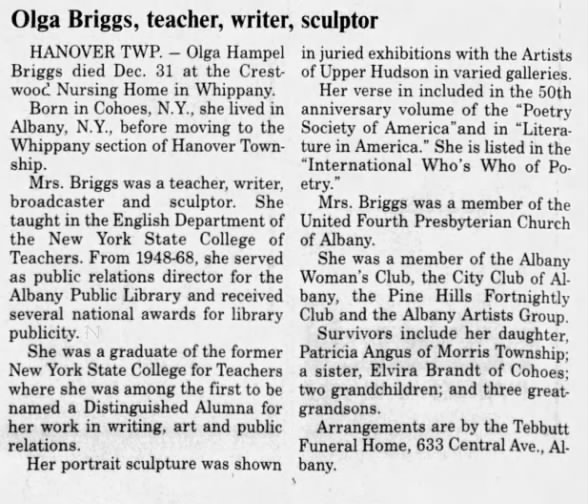
Obituary for Olga Hampel BriggsObituary for Olga Hampel Briggs Thu, Jan 9, 1997 – 6 · Daily Record (Morristown, New Jersey) · Newspapers.com

Saturday, August 3, 2019

Chicago bookman offers Thomson's Shelley from Meville's library

The October 1920 Catalogue of Miscellaneous Books (Catalogue 86) from Chicago bookseller Walter M. Hill lists Shelley: A Poem by James Thomson, "From Herman Melville's library."

435 SHELLEY: A Poem, with other Writings relating to Shelley, by the late James Thomson ('B. V.'), with Essay on the Poems of William Blake by the same Author. Tall 8vo, boards (breaking), uncut. (London), 1884. $7.50.

Only 190 copies printed on toned paper for private circulation by Whittingham & Co. at the Chiswick Press. From Herman Melville's library.
 <https://hdl.handle.net/2027/mdp.39015089588266?urlappend=%3Bseq=970>
Hill's Catalogue 86 presents books from the library of Joseph Very Quarles ("Judge Quarles") of Milwaukee, Wisconsin and two unspecified "private libraries."

At Melville's Marginalia Online, Thomson's Shelley is Number 520 in The Online Catalog of Books and Documents Owned, Borrowed and Consulted by Herman Melville. As stated there in the note, this volume most likely was a gift from James Billson. Melville found Thomson's essay on "The Poems of William Blake" particularly interesting and enlightening, as he wrote Billson on "The last day of 1888."

The Nation and the Athenaeum - August 13, 1921
  • Shelley, a  Poem via Google Books
    https://books.google.com/books?id=g6Xv96FjotcC&pg 
Related posts:

Thursday, April 5, 2018

The Teniers of American poets

A pastoral landscape with a herdsman playing a pipe near a waterfall
David Teniers the Younger, Public domain, via Wikimedia Commons
Alfred Billings Street, again. Charles Fenno Hoffman called Albany's forgotten poet Alfred B. Street "the Teniers of American poets" in the short lived Excelsior. In the same vein, reviewing the same 1845 volume The Poems of Alfred B. Street, Henry T. Tuckerman in the United States Magazine and Democratic Review praised his Albany friend as "a true Flemish painter." So then: two friendly critics of Alfred B. Street's 1845 Poems, both of whom would become friends of Melville's, compared Street and his authentic verse descriptions of nature to Flemish painters and their style of genre painting --thirty years before Melville likened Street's poem The Old Garden to
"a flower-and-fruit piece by some mellow old Fleming." --Herman Melville's Correspondence, ed. Lynn Horth (Evanston and Chicago: Northwestern University Press and The Newberrry Library, 1993), page 463. 
Carstian Luyckx - Still Life Of A Basket Of Fruit, Flowers In A Gilt Vase, A Nautilus Shell And Other Objects On A Draped Table Near An Open Window
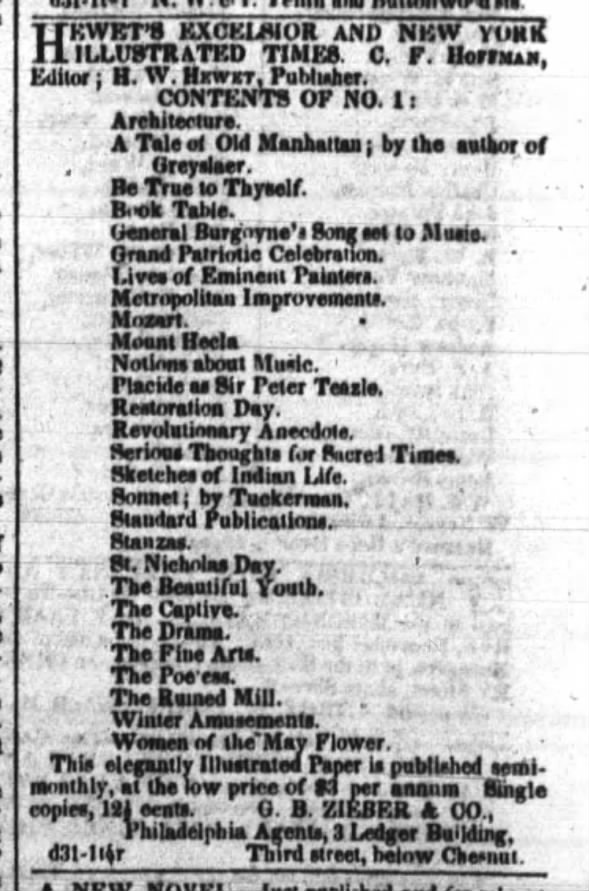
Hewet's Excelsior and New York Illustrated Times was conceived as an American version of the London Illustrated Times. Editor Charles Fenno Hoffman's generous (though qualified) estimation of Street's poetry was reprinted in the March 1846 Knickerbocker:
WE were about to indite a short review of our esteemed friend and correspondent's very beautiful volume, when the following notice of the same work, from the capable pen of Mr. C. F. Hoffman, in 'Excelsior,’ (a most gentlemanly journal, 'too early lost,') met our eye, and we at once decided that we could do nothing half so felicitous as to say 'ditto to Mr. BURKE,' and make the notice 'ours by adoption:'
Mr. STREET is the TENIERS of American poets. Perfect in his limited and peculiar range of art, as is LONGFELLOW in his more extended and higher sphere, STREET is the very daguerreotype of external nature. And yet his portraits are not mere mechanical copies of her features, so much feeling as well as truth is there in his microscopic delineations. He has not indeed the fervid minstrel power of WHITTIER ; the high meditative philosophy of BRYANT; the fine lyric inspiration of HALLECK; the beautiful and luminous sentiment of LONGFELLOW; nor is there the vivid creative power, the sparkling fancy and impassioned grace, which divided among some of our female poets, is as yet blended upon the page of neither sex, in our still nursing literature. Yet that characteristic still remains to him, without which all these others are as nothing; and which, possessed to the full degree in which it fills the soul of Street, makes him a true poet; namely, feeling—an intense feeling and appreciation of his subject; a devotion like that of a lover to his mistress; a love for nature unaffected, enthusiastic, unceasing; a love vigilant as a mother's for her offspring; reverential as that of a child for its parent. He watches her every look and feature, with no end save the tender delight of thus watching; he worships her every expression, with no motive save the gratification of his full feeling of homage. And if the issues of social life chance at times to blend with the accidents of his theme, the flow of inspiration from such sources is wholly subordinate to the natural tides of his song. With the pedantic or superficial reader, Street might still be left as the maker of mere descriptive verses, which had no merit save a kind of Chinese fidelity to purely physical realities; but he who, impelled by the true love of Nature, shall look more curiously into his song, will find STREET's poetry, like the face of the divinity herself, full of suggestiveness. As an instance of this, we may mention that we have before us an illustrated London publication, in which one of his poems (regarded by matter-of-fact people here as characteristically matter-of-fact,) has suggested to a spirited artist two of the most striking sketches that the season has produced."  --The Knickerbocker
Below, contents of the first number of Hewet's Excelsior and New York Illustrated Times, as advertised in the Philadelphia Public Ledger on New Year's Eve, 1845:

· Wed, Dec 31, 1845 – Page 2 · Public Ledger (Philadelphia, Pennsylvania) · Newspapers.com


Related post

Wednesday, March 1, 2017

Clement C. Moore on Hebrew Poetry and the Bible

Found on Newspapers.com powered by Newspapers.com
On November 14, 1825 Clement C. Moore gave a public lecture at Christ Church in New York City. Moore's discourse was published as A lecture Introductory to the Course of Hebrew Instruction in the General Theological Seminary of the Protestant Episcopal Church in the United States. 
Excerpts from the well-received lecture appeared in newspapers and religious magazines. For example, The Gospel Advocate for January 1826 published the following extract, headed "HEBREW POETRY."

HEBREW POETRY. 

We may observe, by the way, that much of what is generally styled poetry in the sacred writers, might, perhaps, with more propriety be classed under the head oratory. But, without discussing the accuracy or inaccuracy of terms, we may remark that what is generally comprehended under the head of poetry, is easily distinguished from those parts, such as the historical books, which are undoubtedly prose. What may strictly be termed Hebrew poetry, is marked by a regularity of division in its sentences which makes an approach to metre. The selection of words appears to be more choice than in prose, and the language is generally of a more lofty character. Some criticks also pretend to distinguish certain words which are peculiar to poetry. It may, however, be doubted whether we have enough of the language remaining to enable us to form any certain rules on this subject. But the blaze of magnificence displayed in the Hebrew poetry arises not from the selection of words or arrangement of phrases. It is due to the subjects treated of, to the imagery employed, to the feelings which are expressed and awakened, to the boldness of its flights, to the awfulness of the ideas it presents, and to the immensity of its range, “as high as heaven"— “deeper than hell." The effect of this poetry upon the mind resembles that produced by the view of the great works of nature; it is irregular, but with an irregularity which could not be changed without destroying its effect. It is composed of features too great to be submitted to the strict canons of criticism. It is the voice of the thunder or of the whirlwind which strikes our ear; it is the expanse of the firmament which meets our eye; all creation rises before us; it is the voice of nature inspired by nature’s God. Let not the cold-blooded critick, who sees nothing but through the medium of books, who weeps and laughs by rule, and who can feel no admiration but with the permission of Aristotle; let him not come within the verge of this sacred domain; here is no school for him. The study of these compositions teaches us to contemplate the material universe unchanged by art, and the native feelings, emotions, and passions of men, unsophisticated by the artificial bonds of society and refinement. In the works of nature we may, here and there, be struck with appearances of regularity which reminds us of the hand of man. So, in the poetry of the Hebrews passages occur which coincide with the rules of art. But, who that looks at a magnificent forest, planted by the hand of nature, would wish to see its trees growing in even rows and at equal distances? Who that beholds the starry firmament would desire to see the multitude of shining worlds, which now appear to be thrown into space without effort from the Creator's hand; who would desire to see them ranged in regular figures and disposed in parallel and equal lines? No! before that poetry criticism remains silent and abashed. We there walk abroad into the wide world, and view the mountains and the vallies, the stars of heaven, the flowers of the field, the desert wastes, and the peopled regions of the earth; and, as we proceed, a heavenly fire kindles all into life and motion; the mountains and the hills tremble; even hell from beneath is moved; the fir-trees and the cedars rejoice, and the desert blossoms as the rose; the morning stars sing together, and all the sons of God shout for joy.
Another long extract from Moore's 1825 lecture appears in the review published in the February 1826 issue of The Christian Journal, and Literary Register
The lecture is surely, in every view, a manifestation of superiour talents— of a nice discriminating judgment—extensive knowledge of the subject, and high devotional taste. The composition is pure and classical: the topics well arranged and ably illustrated: and there are some positions stated and maintained, fundamentally important to students of theology. The author's view of the Hebrew language is learned and judicious, equally remote from visionary theory and light criticism. His description of the Bible is unequalled.
"Such, my young friends, is the wonderful volume, to the study of which a large portion of the time to be passed by you in the seminary is allotted. When the difficulties of its language are surmounted, it opens an abundant store of treasures to the antiquary, the historian, the chronologer, the philologist, the grammarian, the orator, the poet, and the divine. Its entire freedom from every thing that makes the least approach to affectation; the unrivalled simplicity of its style; its admirable touches of pathos; the perfect picture of nature in its narratives and descriptions; the beautiful metaphors, allegories, and similies; the noble hymns of praise; the profound strains of penitence and prayer with which it abounds, added to its high and holy import, render it a work of a nature fitted, in every point of view, to excite the most intense interest, and to afford the most exquisite gratification. And I hope it is not presumptuous in a layman to dissuade you from being influenced by the practice of those bold critics who, by conjectural emendations of the original text, attempt to throw light upon such parts of it as the lapse of ages has rendered obscure. This volume is like a beautiful old picture which has come down to us in a state of extraordinary perfection. Some defects and blemishes, it is true, appear; but they materially hurt neither the design nor the colouring; and it is not for modern and obtrusive hands to attempt to repair the injuries done by time to such a venerable and matchless work."

Related posts:

Wednesday, February 15, 2017

Clement C. Moore's poem "To a Lady" in the Port Folio

Clement C. Moore was 26 years old, almost, when he published his "Verses, addressed to a lady" in the Philadelphia Port Folio (June 1, 1805) over the pseudonym "Simplicius." On December 21, 1805 The Port Folio published Moore's "Congratulatory lines addressed to the fashionable people of New-York" as "ORIGINAL POETRY," although these "Lines" ostensibly "By a Lady" had already appeared in the New York Evening Post, November 27, 1805. The following year, both Port Folio poems appeared with other of Moore's poems over the signature of "L.," in A new translation with notes of the Third Satire of Juvenal.

In 1837, Moore authorized publication of "To a Lady" (dated "1804") and three other poems including "A Visit From St. Nicholas" in The New-York Book of Poetry. In 1844, Moore included both 1805 Port Folio poems with his collected Poems, printed there under the title To a Lady and Lines....From a Veteran Belle.

Moore's 1844 volume deletes the original 1805 preface of "To a Lady" which explained the motive for the poem and identified its initial audience--not the poet's wife (Moore did not get married until 1813) but a young mother of his acquaintance. Among other interesting revisions (for example, deletion of "vermil cheek," revision of "tender mother" to "Fond Mother";  "rules the skies" changed to "thron'd above the skies"; and altering the surround/ground rhyme in the closing stanza to enshroud/cloud), Moore cut one whole stanza which does not appear in the 1837 New-York Book of Poetry and 1844 Poems:
Vain thought! the evening's firm resolve
We break, ere morning clouds dissolve;
   Then boast the life we'd lead,
Would heaven but infancy restore.
Thus o'er an idle dream we pore;
   But slight the waking deed.
In the sixth stanza, revision of the first verse eliminated the "'Twas...when" construction that Moore used in the famous first verse of "A Visit from St. Nicholas" ('Twas the night before Christmas, when...."). Before revision, the sixth stanza in the 1805 Portfolio version of "To A Lady" began
'Twas then, when evening call'd to rest,
I'd seek a father to request.... [1837 New York Book and 1844 Poems: "I sought my father, to request"]
The 1806 reprinting in A new translation with notes of the Third Satire of Juvenal preserves the original construction, before revision:

Revised in the 1837 and later versions to:
"Whene'er night's shadows called to rest, --The New-York Book of Poetry
The Port Folio, June 1, 1805
ORIGINAL POETRY.
FOR THE PORT FOLIO.

[Verses, addressed to a lady, who maintains, that the pleasures of childhood, are not to be desired in comparison of those, which we enjoy at a more advanced period of life.]

Thy dimpled girls, and rosy boys,
Rekindle in thy heart the joys,
   Which bless'd thy tender years.
Unheeded, fleet the hours away;
For while thy cherubs round thee play,
   New life thy bosom cheers.

Once more, thou tell'st me, I may taste,
Ere envious Time this frame shall waste,
   My infant pleasures flown--
Ah! there's a ray of lustre mild,
Illumes the bosom of a child,
   To age, alas! scarce known.

Not for my infant pleasures past
I mourn; those joys, which flew so fast,
   They too, had many a stain.
But for the mind so pure and light,
Which made these joys so fair, so bright,
   I sigh; and sigh in vain.

Well I remember you, blest hours!
Your sun-beams bright, your transient showers,
Thoughtless, I saw you fly;
For distant ills then caus'd no dread;
Nor cared I for the moments fled;
For memory call'd no sigh.

My parents dear then rul'd each thought;
No blame I fear'd, no praise I sought,
   But what their love bestow'd.
Full soon I learnt each meaning look;
Nor e'er the angry glance mistook
   For that where rapture glow'd.

'Twas then, when evening call'd to rest,
I'd seek a father, to request
   His benediction mild.
A mother's love more loud would speak;
With kiss on kiss she'd print my cheek,
   And bless her darling child.

Thy lightest mists and clouds, sweet sleep!
Thy purest opiates thou dost keep,
   On infancy to shed.
No guilt there checks thy soft embrace;
And not e'en tears and sobs can chace
   Thee from an infant's bed.

The trickling tears, which flow'd at night,
Oft' hast thou stayed, till morning light
   Dispell'd my little woes.
So fly before the sunbeam's power
The remnants of the evening shower,
   Which wet the early rose.

Farewel, bless'd hours! full fast ye flew;
And that which made your bliss so true,
   Ye would not leave behind.
The glow of youth ye could not leave;
But why, why cruelly bereave
   Me of my artless mind?

The fair unwrinkled front of youth,
The vermil cheek, the smile of truth
   Deep lines of care soon mark.
But can no power preserve the soul,
Unwarp'd by pleasure's soft controul;
   Unmov'd by passions dark?

These changes, which o'ertake our frame,
Alas! are emblems of the same,
   Which on the mind attend.
Yet, who reviews the course he's run,
But thinks, were life once more begun,
   Unspotted it should end?

Vain thought! the evening's firm resolve
We break, ere morning clouds dissolve;
   Then boast the life we'd lead,
Would heaven but infancy restore.
Thus o'er an idle dream we pore;
   But slight the waking deed.

Thou tender mother! hope thy bosom warms,
That on the pratler in thine arms
   Heaven's choicest gifts will flow.
Thus let thy prayer incessant rise;
Content, if he who rules the skies,
   But half the boon bestow.

"Oh thou! whose view is ne'er estrang'd
"From innocence; preserve unchang'd
   "Through life my darling's mind.
"Unchang'd its truth and purity;
"Still fearless of futurity;
   "Still artless, though refin'd.

"As oft' his anxious nurse hath caught,
"And sav'd his little hand that sought
   "The bright, but treach'rous blaze;
"So, may fair wisdom keep him sure
"From glittering vices, which allure
   "Through life's delusive maze!

"Oh! may the ills which man surround,
"Like passing shadows on the ground,
   "Obscure, not stain, my boy.
"Then, may he gently drop to rest,
"Calm as a child by sleep oppres'd;
   "And wake to endless joy!

SIMPLICIUS

Thursday, January 5, 2017

Biography of the heart of Clement C. Moore

Minerva Shielding a Sleeping Youth from the Arrow of Cupid
1797 - Attributed to Thomas Sully - The Walters Art Museum
Portions of this seven-page manuscript poem by Clement C. Moore appear on pages 61-64 of Samuel Patterson's 1956 biography The Poet of Christmas Eve. The entire "Biography of the heart of Clement C. Moore" has never been published. Presented below for the first time, the complete text is transcribed from a photocopy of the manuscript held at the New-York Historical Society Library (AHMC - Moore, Clement C.). I am grateful to the world-class librarians and staff there for expert assistance with locating and properly identifying this item. According to a later bibliographical note on the back of one manuscript page, Moore's "Biography" was
"Probably written in 1813 to commemorate his marriage to Catherine Elizabeth Taylor on November 20, 1813."
Moore's allegorical "Biography" unfolds in 152 lines of iambic tetrameter as a contest for mastery between Minerva the Goddess of Wisdom and Cupid the boy God of Love. The supposed speaker is not Moore himself but an invented female "auth'ress," perhaps a disappointed servant of Minerva or one of the Muses. The important thing is, Love wins.

Biography of the heart of Clement C. Moore


Minerva, o’er this western world
In vain her banners had unfurl’d;
No bosoms own’d a kindred cause;
No youths submitted to her laws:
For in a land so pure, so free
From all but Love’s sweet tyranny,
Content each guileless bosom bless’d;
Lull’d each ambitious wish to rest; 
And, if for wisdom rose a sigh,
Swift as the wind, Love made it fly;
His light wings o’er the student shook,
Soon chas’d the magic of a book!!
Indignant, this the goddess viewed,
And turn’d to leave a shore so rude,
To seek her native east again,
And, for the last time, cross the main.
Already were her pinions spread,
And rais’d in air her lofty head;
But one foot touch’d the unclassic ground;
When, as her bright eyes roll'd around,
To cast for e'er a farewell glance,
She saw a trembling youth advance;
"Oh! stay, most injur'd Goddess, stay,
"Nor let thy suppliant vainly pray.
Oh! stay; and if a nation’s crime
“Can be repair’d, the task be mine.
“For this, from other powers free,
“My heart, my life alone to thee
“I will devote. Oh! then, he cried,
“Be thou my tut’ress, friend and guide.
“Not only for myself I pray,
“But for my country, goddess, stay.
“Leave not fore’er this wretched land,
Wretched without thy guiding hand.”

A prayer so earnestly preferred,
In pity to the youth, was heard:
For ne’er Minerva turns aside
When she is sought for as a guide;
But lends to those a favouring ear
Whose love for wisdom is sincere.
She stay'd to lead the enraptur'd youth
Through every winding maze of truth:
And had the auth'ress of this rhyme
Some portion of her power, and time,
The inquiring eye should here have view'd
The plans she with the youth pursu’d.
Suffice it, years most swiftly ran;
And when the boy was lost in man,
French and Italian he could speak,
As well as Hebrew, Latin, Greek;
Whilst, treasur'd in his well-stored mind,
Was learning by good sense refin'd,
He shone not with the fire-fly's light,
Which shows itself in flashes bright,
But with the glow-worm's steady ray,
The constant lustre of the day.
Needless it is to say, that love
His breast with passion did not move.
Perhaps the God, with careless eye,
Forever might have pass'd him by;
Grown heedless by unbounded sway,
E'er left him with his guide to stray;
E'er left him with a harden'd heart
Fill'd with contempt for woman's art,
Had not Minerva's pointed quill
Arm'd him with all a poet's skill
Full many a brilliant page to swell
Against Love's officer—a Belle.
Well did the little God repay
The daring, the obtrusive lay;
Well did he make the traitor feel
That vain was e’en Minevera’s steel;
For now, to his rebellious heart
He sent by every belle a dart.
The angry Goddess vainly strove
To shield him from the shafts of Love.
She sought her empire to regain,
By filling him with thirst of fame,
By bringing to his mind the hour
When he swore but to own her power.
She tore him from that dangerous street
Where beaux & beauties daily meet;
She tore him from the giddy town,
That Nature's charms his breast might own,
Hoping that they would strength impart
To make him shun all those of art;
Hoping they would the mist dispel
That arm'd with charms a fluttering belle.
How little wisdom knows of love,
A step to wrong will surely prove.
For now the God triumphant view’d
His flames increas’d by solitude;
Whilst she, still more indignant grown,
The perjur’d man fore’er had flown,
Had not the diffidence she gave
Still cheer’d her with the hope to save,
And once more by her precepts guide
Her pupil, and till late, her pride:
For, with a beam of joy, she found
His tongue with chains of silence bound
Upon that subject which opprest
With grief and pain his troubled breast;
And whilst the wond’ring giddy crowd
Thought he to learning only bow’d,
With heart of flame and looks of snow,
With thoughts of love and studious brow,
Those fires which can the coldest melt,
Unheeded, he in secret felt;
For Cupid, to his eye, array'd
With every charm the worshipp'd maid,
Whilst Wisdom's handmaid, Modesty,
Whisper'd to him, not worthy he
Of daring to such charms aspire,
Daring to show his bosom's fire.
Now Pallas saw, with joy, that time
Had robb'd him of his youthful prime:
For she had hop'd that riper years
Would banish all her cares and fears;
Hop'd that in his maturer age
Again she should his heart engage.

A year, the God, with deepest guile,
Had left him to enjoy her smile
But that he might more fully prove
The sov'reign power of mighty Love:
For doubly painful is the dart
That enters the long sleeping heart.
Late from his guardian's favorite isle,
An ardent votary of style,
A youthful, giddy, flirting maid,
Had come, her Cupid's plans to aid
With sparkling eye, with rosy cheek,
With tongue that lov’d full well to speak
In ev'ry way that best could tell
She was a laughter-loving belle.
Ah! who could dream, this fluttering fair,
This outcast from Minerva's care
Could make her pupil heave a sigh,
And fill with love his thoughtful eye?
But, though it ne'er was dreamt nor thought,
Such was the wonder Cupid wrought.

The Goddess, fill'd with lasting hate,
Now left him to his dreadful fate;
Nor, ere she sought those of his nation
In whom he’d waken’d emulation,
Did she on him denounce a doom;
For well she saw that very soon
The fault its punishment would bring;
She saw that to the thoughtless thing,
When she withdrew her guardian care,
His passion he would then declare,
And that, soon settled as his wife,
The fluttering belle would rule for life.
--Clement C. Moore
Manuscript poem, The New-York Historical Society Library
(AHMC - Moore, Clement C.)
Related post: