Showing posts with label Boston Evening Transcript. Show all posts

Monday, May 4, 2026

Pip the Crown Jewel of MOBY-DICK


Saturday, March 12, 2022

Tuckerman notices "The Apple-Tree Table"


In the latter 1850's, under cover of the pseudonym "Knick," Herman Melville's friend Henry Theodore Tuckerman reported on the latest literary and cultural news from New York City as a valued correspondent of the Boston Evening Transcript. As shown previously on Melvilliana, Tuckerman aka "Knick" wrote favorable notices of Israel Potter (February 27, 1855) and The Confidence-Man (April 10, 1857).
Surveying the contents of Putnam's magazine for May 1856, Knick described The Apple-Tree Table (without naming Melville) as "a story of Hawthorne-like detail, illustrative of the "spirit rappings."

Boston Evening Transcript - May 7, 1856
NEW YORK, May 6, 1856.

LITERARY. Dear Transcript: With their accustomed punctuality, Dix & Edwards issued "Putnam's Monthly," with a freshness and variety of material that seems to indicate a seasonable revival of Magazine literature and May-day exuberance of wit and wisdom. Opening with a pleasant digest of the Kane Relief Expedition, which gives a relishing foretaste in Captain Heinstein's experience, of the Doctor's complete record, soon to appear. They follow up this appropriate tribute to he benevolent enterprise of the times, with a story of Hawthorne-like detail, illustrative of the "spirit rappings," called "The Apple Tree Table." Hale, the martyr spy of the Revolution, has justice done his brave sacrifice, in a biographical sketch of national interest. The claims of Ruskin, as an art-critic, are then discussed with an evident enthusiasm for his views and style. Kingsley's poems are next considered, and "Napoleon as a Family Man" is viewed as revealed in the letters to Joseph, his brother, lately published....

...We are all astonished at the fact that Hawthorne has made a dinner speech,--he who was only heard to speak once during his voyage to Liverpool. He addressed the company in reply to a toast in his honor, and what he said was appropriate, and manly and sensible. Bravo, silent Hawthorne! now you have found your tongue, resume your pen, too long idle... --"Knick" [Henry Theodore Tuckerman] Boston Evening Transcript, May 7, 1856.

Another newspaper mention, from the notice of "Putnam's Monthly for May" in the Boston Daily Atlas on April 30, 1856:

"The Apple Tree Table is an account of original spiritual manifestations, the mystery of which is more simple and satisfactory than such manifestations usually are." 

Related post:

Tuesday, June 15, 2021

Racy and entertaining

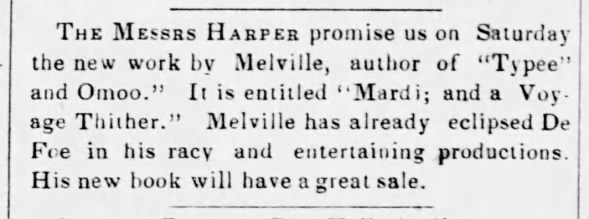
11 Apr 1849, Wed Boston Evening Transcript (Boston, Massachusetts) Newspapers.com
THE MESSRS HARPER promise us on Saturday the new work by Melville, author of "Typee" and Omoo." It is entitled "Mardi; and a Voyage Thither." Melville has already eclipsed De Foe in his racy and entertaining productions. His new book will have a great sale."  -- Boston Daily Evening Transcript, April 11, 1849

Both volumes of the first American edition (New York: Harper & Brothers, 1849) of Herman Melville's Mardi: and a Voyage Thither have been digitized by the great Internet Archive; the physical books are held by the University of Pittsburgh Library.


Monday, July 22, 2019

Tuckerman aka Knick on Israel Potter

As shown in a previous post, Melville's friend Henry T. Tuckerman contributed literary letters from New York City to the Boston Evening Transcript, regularly published over the pseudonym "Knick." The letter from Tuckerman aka "Knick" dated February 23, 1855 features a friendly plug for the forthcoming book version of Israel Potter as "delectable reading." (The serial version concluded in the March 1855 issue of Putnam's Monthly.) Not in Herman Melville: The Contemporary Reviews, ed. Brian Higgins and Hershel Parker (Cambridge University Press, 1995; paperback 2009), where the earliest notice of the book version is from the New Bedford Mercury on March 12, 1855.
Melville's new story, which has appeared in Putnam's Magazine, "Israel Potter," will be published in one neat volume, this week. Consecutively it reads well, and has some highly spirited and adventurous scenes, with a genuine American flavor. Paul Jones and nautical romance, when treated by such a writer as Melville, cannot fail to make delectable reading.  --Boston Evening Transcript, February 27, 1855; found in digitized newspaper archives at GenealogyBank.
Boston Evening Transcript - February 27, 1855 via GenealogyBank

The letter from "Knick" published in the Boston Evening Transcript on November 30, 1855 alludes to "Benito Cereno" in a survey of the December Putnam's:
"Melville's story is continued...."
Melville's 1856 volume The Piazza Tales gets this advance notice by "Knick" in the Boston Evening Transcript of April 4, 1856:
"The same house [Dix & Edwards] will publish soon the 'Piazza Tales,' by Melville."
Related posts:

Thursday, August 3, 2017

Fidelius on Melville and "the fowl mania"


Here's another mention of Herman Melville by "Fidelius," a New York correspondent of the Boston Evening Transcript. From the "Second Edition" of the Boston Evening Transcript, April 24, 1855; found in the online archives of Historical Newspapers at Genealogy Bank.
[Correspondence of the Transcript]
NEW YORK, April 23d, 1855.

Dear Transcript: Several of the principal hotels have raised their prices within a few days; and the discourse about New York expensiveness is revived. The sober fact is, that there is no city in the world where so much money is unsatisfactorily spent as here. I heard a gentleman fresh from Paris, say, the other day, that a parlor and bedroom, for a fortnight, at the Astor, cost him as much as four times the same amount of accommodation for his family at Maurice's. Strange that in a country where there is an abundance of space, an ample field to produce provisions, and few local monopolies, it costs so much to live in a most unsatisfactory manner!

Willis was in town a few days ago, with little trace of invalidism about him,--so much for keeping up a good heart, living in the country, and avoiding drugs!
…

At a dinner party last week, the conversation turned upon the fowl mania, recently developed in this country; one gentleman referred to the popular engravings of Shangai monstrosities, another to Burnham's book on the hen-fever, and a third to Melville's story in Harper, of "Cock-a-doodle;" "yes," observed another, better versed in cotton than literature, "the thing seems to be getting into books fast; I saw one advertised the other day, called 'Wolfert's Roost,' another Shanghai work, I suppose." The best of the joke was that Irving was at the table, and within ear-shot.

You will be glad to know that the accident which happened to Washington Irving last week is not so serious as at first reported. He remained unconscious only during a few moments after his fall, and now suffers only from the jar, having been able to correct his proof sheets, as usual, a day or two past. James Russell Lowell has been here, and looks all the better for his western trip. The National Magazine for May has some excellent wood cuts of statuary, an able article on "The Opium Trade in the East," and a timely one on Irving's last work; a "Sunbeam" is made to reveal its wonder-working power, and the "Pyramids" are described and pictured.... FIDELIUS
Boston Evening Transcript - April 24, 1855
Originating in correspondence of the Boston Evening Transcript, the anecdote of "fowl mania" and the merchant's gaffe at dinner with Washington Irving got to be a popular one in the spring of 1855. The "fowl mania" anecdote (including the reference to Melville's well-remembered story in the December 1853 issue of Harper's) was reprinted many times, for example:
  • Buffalo Daily Courier, April 27, 1855
Found on Newspapers.com
  • Buffalo Commercial Advertiser, April 30, 1855
  • Troy Daily Whig, April 28, 1855 
  • Albany Argus, May 3, 1855
  • Brooklyn Evening Star, May 16, 1855
  • Lafayette [Indiana] Daily Journal, May 17, 1855
  • Vermont Phoenix [Brattleboro, Vermont], May 12, 1855
  • Louisville Daily Courier, May 22, 1855
  • Springfield [Massachusetts] Republican, May 25, 1855
  • Weekly Racine [Wisconsin] Advocate, June 13, 1855
Wolfert's Roost (1855) - William Vinson via AbeBooks
Related post:

Monday, September 19, 2016

1856 Melville mention by "Fidelius" in the Boston Evening Transcript

“Hermann Melville, our clever nautical story teller, has gone abroad in search of health and new material for adventurous fiction.” --Boston Evening Transcript, October 21, 1856; New York correspondence from "Fidelius"
"Fidelius" wrote letters from New York to the Boston Evening Transcript in the mid 1850's, around the time that Melville's friend Henry T. Tuckerman was also supplying the Transcript with New York correspondence over a different pen name. Writing as "Knick," Tuckerman handled book reviews and literary news, while "Fidelius" wrote more generally about people and cultural events--in Gotham and around the world.

Saturday, September 10, 2016

Melville's specialty, "the weaving of sparkling fancies into a web of incident and fact"

This complimentary review of Melville's lecture on Statues in Rome is excerpted in the second volume of Jay Leyda's Melville Log at page [586]. But if you only have the old Melville Log, you won't know the Boston Evening Transcript called Melville "a pleasant bookmaker" whose forte is "the weaving of sparkling fancies into a web of incident and fact." Or that Melville's audience left persuaded of his "keen eye for the beautiful in art as well as in literature." Merton M. Sealts, Jr. cites the Boston Transcript review on page 23 of Melville as Lecturer, quoting the "pleasant bookmaker" bit without any mention of web-weaving.

Boston Evening Transcript - Thursday, December 3, 1857
MERCANTILE LIBRARY LECTURES. At the Tremont Temple, last evening, a large audience listened with evident satisfaction, to the description of the various sculptures of the Eternal City, by Herman Melville. The pleasant bookmaker proved himself as much at home in the lecture-room as in prosecuting his peculiar vocation, i.e., the weaving of sparkling fancies into a web of incident and fact—the result of extended observation and travel. The lecture contained many trenchant passages, similar to those which have made Mr. Melville’s works so highly prized by the large class whose literary appetite relishes only richly-flavored dishes. There was but one defect about the evening’s entertainment—the subject was too vast for an hour’s consideration; but enough was done, in the time allotted, to convince the auditory that the lecturer had a keen eye for the beautiful in art as well as in literature.

Mr. Melville will be succeeded, on Wednesday evening next, By George W. Curtis, Esq.
 Related melvilliana post:

Thursday, April 21, 2016

Masefield on Melville

John Edward Masefield in 1916
Public domain, via Wikimedia Commons
Part II of "The Sea Writers" offers a fine appreciation of Herman Melville by John Masefield (1878-1967). Transcribed below from the London Daily News - Saturday, 20 August 1904; found at The British Newspaper Archive. Also at Google News, as reprinted (without credit to Masefield) in the Boston Evening Transcript - August 29, 1904.

THE SEA WRITERS.

II.—HERMAN MELVILLE.
(By J. Masefield.)

Herman Melville, one of the two excellent writers that America has produced, was born in New York City on the 1st of August, 1819. The same year gave birth to Walt Whitman, the second of the aforementioned two, and to James Russell Lowell, author of the Biglow Papers. Melville’s father, Allan, was merchant of the Empire City, who passed his evenings with old books, chiefly metaphysical, in the library of his home, now long destroyed, in the suburb of Greenwich village, now a populous, noisy, and rather mean quarter of the city. He was a travelled man, this American merchant, and came of good stock, so that his little son grew among cultured people, and heard strange tales, throughout his childhood, of the sea and ships, and of the seaports far away, and of the sailors, bronzed and earringed, whom he saw by the West-street saloons. Especially did he hear tales of Liverpool, that most magical of seaports, for his father had been thither in a sailing ship, and had brought back one or two books, with engravings in them, representing the docks, or St. Nicholas Church, or Bidston Tower, which the young Herman would pore upon for hours. I do not know whether they determined him to go to sea, for a New York boy has many calls to salt water without looking for them in cheap engravings. But it is certain that they left a strange impression on him, as though, in some other life, he had lived amid those scenes, and known them as man knows his home. When he did go to sea (and that going had some elements of "running away" about it), it was a Liverpool-bound vessel, as "able" seaman (surely his biographers mean "ordinary ”), in the year 1837, when he was eighteen years of age. 

"Hungering for the Sea.”

On his return to America he stayed ashore for while, making precarious living as a school teacher, and subduing refractory pupils with his fists. In 1840 Dana published his "Two Years Before the Mast,” a book which set Melville hungering for the sea (it will seem strange to a landsman, but such was the effect it had), and led to his second voyage a year later. He sailed from "good old Nantucket" in a whale ship called the Acushnet, which name Melville has shortened into Dolly. Life on board a whale ship is at all times horrible, but off the Horn it must be more horrible than elsewhere. Melville was a forecastle hand, the Dolly was leaky old tub, and her captain a "Down-East Johnny-Cake.” They tumbled round the Horn together, in such ice and green water as one may picture, and arrived in time, short handed, ill found, and discontented, in the warm cruising grounds of the South Pacific. Here the Dolly visited the port, or haven, of Nukahiva, in the Marquesas Islands, in order to refit and to ship fruit and natives. Melville had had as much whaling as he needed at the time, and, therefore, took the opportunity of stealing ashore with a friend. With great difficulty they contrived to cross that part of the island in which they might have been discovered. They penetrated to a hidden valley, inhabited by cannibals, where dusky warriors made them captives, and guarded them, though kindly, for several months. Melville’s imprisonment was longer than that of Bob, his shipmate; but escaped at length, after a bloody fight, on board an Australian whaling barque, short-handed as usual, whose captain had heard of white prisoners among the natives, and had hoped to ship them.

A Charming Sea-Gipsy.

Melville did not stay very long with his deliverer, but seems to have "gone among the islands,” a charming sea-gipsy, for rather more than a year. Afterwards shipped as a top-man on board the American frigate United States, then an old ship, which 30 years before had taken H.M.S. Macedonian from the English. He sailed round the Horn in her, touching at Rio de Janeiro, and arrived at Boston in 1844. He spent a year or two ashore, writing “Typee,” the story of his life among the canibals, which was published in New York and London in 1846. It had a wide sale in both countries, so that he felt justified in devoting himself to a life of letters. He married a Miss Shaw, a Massachusetts lady, in 1847, and lived for a while at Boston, afterwards moving to New York, where he obtained employment in the Customs. He went round the Horn in his brother’s ship in 1860, in order to lecture at San Francisco. Being a married man, he took no part in the Civil War, saving the utterance of various poems. He lived to a happy, quiet, old age among his books and etchings and pleasant literary friends, and died at New York in 1891, aged a little over seventy-two.

His Books.

His writings are like nothing else in the language, for they express a nature strangely rare, which lived strangely, and came to strange flower. He has been compared to George Borrow, but it will not do to push the parallel too far, for Borrow’s prose, at its best, is like a picture by Crome—simple, manly, and full of broad light and blowing wind. Melville’s prose, at its best, is something which I cannot estimate, for it takes one from the common world to some rarer place, where strange seas are breaking, strange blossoms growing on the trees, and strange folk talking wisdom in the sun. His books may be divided into two classes—the reminiscent and the imaginative—and both classes have their admirers. In the one class are "Redburn,” the story of his boyish voyage to Liverpool; "Typee,” the story of his life among the cannibals; "Omoo,” the tale of his life in the islands; and "White Jacket,” his life in the American Navy. Of these, "Typee" and "Omoo" are the most charming, and I doubt if anyone has read them without longing to be on blue water, on some reeling fabric of a ship, swaying in, under white strained sails, to some sweet coral island’s haven. Personally, I am very fond of parts of "Redburn,” though one must know New York and the haunted sailor-town of Liverpool to appreciate that gentle story thoroughly. "White Jacket" is an excellent piece of work, telling of a strange kind of life, now extinct, as it was lived on a strange kind of ship, now gone. It is the best book on that old sailor life; and perhaps one should not read Marryat, nor Chamier, nor Lord Dundonald until one has "White Jacket" and a few pages Smollett at one’s fingers’ ends.

The Best Sea Book In English.

In the other class of his writings are his best book, "Moby Dick,” and his worst book, "Mardi,” which latter, I imagine, few have ever read through. It is written in a fantastic, fanciful, tentative manner which aims high, as one can see, but is too boyish and too wayward to be readable. When he wrote it he was playing with his material, trying to learn his art. It is written in exactly the inspired boy style, and has all the folly, but yet a little of the beauty, and much of the eagerness, of youth. "Moby Dick" shows us what the same writer could do when he had developed his instrument, and it is not too much to say that that noble story is the best sea book in the English language. Of its quality as prose I hope to speak elsewhere and greater length, but I cannot close this article without testifying, however briefly, to the lofty beauty of its story. In that wild, beautiful romance Herman Melville seems to have spoken the very secret of the sea, and to have drawn into his tale all the magic, all the sadness, all the wild joy of many waters. It stands quite alone; quite unlike any book known to me. It strikes a note which no other sea writer has ever struck. And when, in one unforgetable chapter, his crew of old sailors gathers on the fo’c’s’le to talk by the light of the moon of life, and man, and the sorrows of man’s making, he rises to a pitch of mournful beauty such as one might find in Webster, in Middleton, or some other Elizabethan, if not in Shakespeare himself. One may say of "Moby Dick" what Melville in that tale says of the ship which bears his characters. One may call it "A noble tale, but a most melancholy; all noble things are touched with that.” --London Daily News - Saturday, 20 August 1904
Examining the high regard for Melville in London, early in the 19th century (before the centennial year 1919), Hershel Parker observes of Masefield that
"Not all his early tributes to Melville have been located." --Melville Biography: An Inside Narrative
This is one of those early tributes. Masefield referred explicitly to his first Melville notices, claiming due credit for early promotion of Melville in England, in a 1921 letter to Florence Lamont:
As to have I read Moby Dick, if you were in range, I'd fling something at you for that.

I read Moby Dick before I was 18 years old. I wrote an article on it before I was 25, & had it printed. I was directly responsible for its (the book's) being reprinted in this country on one occasion, & I have twice or three times written about Melville so as to make him known here....--Masefield, Letters to Florence Lamont
Masefield dates the writing of his earliest tribute to Moby-Dick to some time "before I was 25"; that is, before his 25th birthday on June 1, 1903. The "Sea Writers" article transcribed above was published in the London Daily News on August 20, 1904, a few months after Masefield's 26th birthday. Nonetheless, Masefield writes in this 1904 Daily News article of his "hope to speak elsewhere and greater length" about Moby-Dick--so perhaps the article on Moby-Dick that he mentioned to Florence Lamont in 1921 had not yet been published.

The following notice (by Masefield?) appeared in the "Books and Booksellers" column in the London Daily News on Friday, 8 July 1904:
The "New Pocket Library" of Mr. John Lane is a very pleasant series of little volumes to which yet further additions are soon to be made. Two of the most interesting which have recently appeared are Herman Melville's "Typee" and "Omoo," books which are far too seldom read. It is to be hoped that Mr. Lane will add "Moby Dick" and some more of the sea romances of this great romancer. Four volumes of George Borrow, and several of Captain Marryat, go excellently with these.
 Moby Dick in Masefield's A Mainsail Haul

Friday, October 23, 2015

H. T. Tuckerman ("Knick") in the Boston Evening Transcript, on Melville's The Confidence-Man

Henry Theodore Tuckerman
Mathew Benjamin Brady, Public domain, via Wikimedia Commons
As mentioned in the previous post on newspaper correspondents, it's good to have the fuller listings of popular writers and their pseudonyms. In slightly different words, Boston Post and New York Evening Post articles both acknowledge Henry T. Tuckerman as the author of regular New York literary letters to the Boston Evening Transcript. The Boston Post presented Tuckerman's authorship of the New York letters as a "well known" fact:
"H. T. Tuckerman, the popular essayist and true poet, writes the New York letters to the Boston Transcript, as is well known. The man himself and his literary productions are above all praise. The Transcript is fortunate in having him for its friend." --Boston Post, September 12, 1859
The New York Evening Post dropped the praise but confirmed nevertheless that:
"Henry T. Tuckerman does up New York literature for the Boston Transcript."  --New York Evening Post, August 14, 1860
 New York letters in the Boston Evening Transcript during this period (1855-1860) were signed, "KNICK."

Corroborating Tuckerman's identity as "KNICK," Graham's Illustrated Magazine quoted extensively from one of Knick's published letters in the Evening Transcript but gave away the open secret in crediting Tuckerman as the writer of a tribute to Allibone's Dictionary of Authors:
......The following from a letter by H. T. Tuckerman, in the Boston Evening Transcript of April 2, is a well-merited tribute to a stupendous work, which is destined to be read wherever the English language is spoken, and to become a table-reference for scholars of every grade. 
“We enjoyed another opportunity, last week, of examining the evidence of Mr. Allibone's progress in his great ‘Dictionary of Authors.' Our admiration of his conscientious research and eclectic literary enthusiasm is increased. He leaves no source of information unexplored, no means of illustrating the traits of authorship unimproved. It bewilders one to think even of the range of his investigations and the minuteness of his inquiries..."
Tuckerman-as-Knick is verifiable online, since Google News has the April 2, 1858 issue of the Boston Evening Transcript with Knick's tribute to Allibone that Graham's credited to H. T. Tuckerman. As quoted in advertisements for the Evening Transcript, Willis's Home Journal alluded to the New York star of the Boston paper--however, without naming him:
"Its New York literary correspondent, "Knick," is one of the first essayists in America."
Herman Melville: The Contemporary Reviews, edited by Brian Higgins and Hershel Parker, at page 489 gives the notice of Melville's The Confidence-Man from the Boston Evening Transcript of April 10, 1857. But as shown below, this notice appears within one of those renowned New York letters from "Knick."

That's H. T. Tuckerman!

So Melville's friend Tuckerman, in one of his regular New York letters signed "Knick," wrote favorably of the "Melvillish" Confidence-Man in the Boston Evening Transcript. Knowing that makes you look twice at the neatly appreciative praise of Melville as "an author who deals equally well in the material description and the metaphysical insight of human life." And wouldn't you know it, Hershel Parker is right again:
"Tuckerman was a loyal man." --Herman Melville: A Biography V2.484
Boston Evening Transcript, April 10, 1857
 Found in the historical Newspaper Archives at Genealogy Bank
The Boston Evening Transcript for April 10, 1857 is also available in the archives at Google News.

Tuckerman was more than ready to say a good word for The Confidence-Man. Back on January 29, 1857 Tuckerman's "Knick" letter to the Boston Evening Transcript ended with a look ahead to Melville's next work, hopefully forthcoming:  "...Dix, Edwards & Co promise us very soon a new book by Melville, and another by J. Milton Mackie."

Related posts

Friday, June 5, 2015

1859 book by Kinahan Cornwallis "freely pillaged from Typee" and Tomes's The Americans in Japan

From the article headed LITERARY THEFTS in the Boston Evening Transcript, Wednesday, March 16, 1859:
The Century reports that a book has appeared in London entitled “Two Journeys to Japan, 1856-7, by Kinahan Cornwallis,” which is so freely pillaged from Herman Melville’s “Typee” and Dr. Tomes’s abridgement of Perry’s Japan Expedition, that doubts may very fairly be entertained of the writer’s having travelled to the scenes he pretends to describe, or, in fact, of there being any such author at all. The Spectator exposes the passages from Melville, in parallel columns, and is inclined to treat the writer with incredulity; the Athenaeum, on the contrary, is very respectful. It looks like a sheer publisher’s job, got up “to order.”  --Found in the online Newspaper Archives at Genealogy Bank 
Truth be told, it's hard to find something that is not plagiarized in Two Journeys to Japan. One source as revealed in the Boston item (paraphrasing an earlier review) is The Americans in Japan. Cornwallis's Two Journeys to Japan also features extensive copying from Typee which occurs in the concluding section of Volume 2, "The After Journey" (pp. 208-300). The Hathi Trust Digital Library has several sets of Two Journeys to Japan, 1856-7. This copy of Volume 2 is digitized from a volume in the library of the University of Michigan:


What Cornwallis made of Typee is the subject of my paper for the Melville conference in Tokyo, 25-29 June 2015. Titled "Copying Melville: Literary Theft and Romantic Anti-imperialism in Kinahan Cornwallis' Two Journeys to Japan, 1856-7," my paper relies on the scholarship of Joseph Koshimi Yamagiwa in
Cornwallis' Account of Japan: A Forgery and its Exposure, Monumenta Nipponica 4.1 (January 1941): 124-132.
Professor Yamagiwa is remembered at the University of Michigan with great affection and respect, as indicated in the appreciative memorial at the Faculty History Project. No longer available on the U of M website, unfortunately, but see the many appreciative mentions here:
Center for Japanese Studies, The University of Michigan, editor. Japan in the World, the World in Japan: Fifty Years of Japanese Studies at Michigan. University of Michigan Press, 2001. JSTOR, https://doi.org/10.3998/mpub.18507. 

Related post


Monday, January 21, 2013

Melville allegedly leaving Massachusetts after passage of 1852 "Maine Law"


Less than two months before the publication of Pierre, a Boston editorial semi-seriously linked Melville with G. P. R. James, Nathaniel Hawthorne, and other Berkshire authors.  Regrettably, according to the Evening Transcript, the high-living literary celebrities of Berkshire will have to leave the state, after passage by the Massachusetts legislature of a prohibitory "Maine Law."

The controversial liquor law was overturned a year later, thanks to Melville's father-in-law Chief Justice Shaw and the Massachusetts Supreme Court. 

It's good to recall the real influence of the temperance movement, not only in Melville's youth but into the 1850's as an important element of the background to Moby-Dick (1851) and Pierre (1852).  Prohibition was on the way in, at least temporarily, when Melville wrote Hawthorne in May 1851:

"I won't believe in a Temperance Heaven."

From the Boston Evening Transcript, Tuesday, June 15, 1852:

THE TEETOTAL REVOLUTION. [Quoting an item under that heading in the New York Herald:]  It is well known that a number of independent literary men have selected Stockbridge, and that picturesque neighborhood in Massachusetts, for their permanent residences, instead of paying the high rents of New York.  But now all this class of persons there, and throughout Massachusetts, are emigrating rapidly, in consequence of the teetotal tyranny of the legislation of that State.  Mr. James, the novelist, is about selling his property in Stockbridge, and removing from Massachusetts to New York, entirely on account of the arbitrary law recently passed—a law which is characterized as worse than any European despotism."
[To which, the Evening Transcript comments:]  The case of Mr. G. P. R. James is a lamentable one.  To think that the author of “Philip Augustus” and eighty other popular novels should, in the decline of life, be cut off from his glass of sherry, is enough to excite the sympathetic indignation of every romance reader in the country.  How can we tell how far we may have been indebted to that same sherry for the genial fancies, which lure us on in the pages of this most prolific writer?
... But if we may believe the intimation in the Herald, the other literary gentlemen, who cluster about the hills of Berkshire, like bees around Hybla, will follow Mr. James’s example, and abandon a region, where the Maine law is to be enforced.  Holmes will take up his lyre, and his microscope, and seek a more inspiring vicinity.  Melville will leave spinning his pleasant yarns about “Moby Dick,” and other wonders of the “deep, deep sea,” and strike a bee line for New York, where sumptuary laws are unknown.  Hawthorne will leave the unfinished sheets of some “golden legend,” and look out for some nook among the hills, where “mountain dew” is not proscribed.  The Sedgwicks will follow.  In short there will be a grand exodus of all the literary people, with books and portfolios under their arms—all driven off by this execrable liquor law—this foe to all good fellowship and genial inspiration.
We doubt if our legislators have ever duly considered the effects of this law in a literary point of view.  If our authors are obliged to seek their Helicon elsewhere than in Massachusetts, what will become of the glory of the Bay State?  We shall not only be “unwept,unhonored and unsung,” but we shall have their ill report while living which, in the words of Shakespeare, is worse than a bad epitaph.