Showing posts with label The Piazza Tales. Show all posts

Thursday, October 16, 2025

Noticed in Nova Scotia, Melville's PIAZZA TALES

We have seldom or ever read the equal of this chapter [Benito Cereno] in point of profound cunning and deception....

Here's something new concerning the early reception of Herman Melville's short fiction in Canada. Published in the Liverpool, Nova Scotia Transcript on July 31, 1856, this favorable and unusually detailed Canadian review of The Piazza Tales is not collected in Herman Melville: The Contemporary Reviews, edited by Brian Higgins and Hershel Parker (Cambridge University Press, 1995; paperback 2009). As indicated on the masthead, the Liverpool Transcript was a weekly newspaper "devoted to moral, political and general intelligence and progress," then owned and edited by S. J. M. Allen.

Liverpool [Nova Scotia, Canada] Transcript
July 31, 1856 via Nova Scotia Archives

NEW PUBLICATIONS.


THE PIAZZA TALES. From the pen of Herman Melville, author of "Typee," "Omoo," etc. Dix & Edwards, New York. E. G. Fuller, Halifax.
The first chapter is devoted to pleasant reminiscences in favor of piazzas, and an "inland voyage to fairyland. A true voyage; but, take it all in all, interesting as if invented."

The second chapter consists of passages in the life of Bartleby, "who was a scrivener, the strangest I ever saw, or heard of," with some mention of the author, his employees, his business, chambers and general surroundings, as a means of better understanding the chief character of this chapter. It will be found interesting--very.

The third chapter introduces to our notice the captain of an American Sealer, who displays stirling qualities in the capture of a Spanish slaver at the island of St. Maria, Chili. The slaves having risen, murder their owner and some of the officers and crew of the ship, take full command of the vessel, place the captain and the remainder of the crew under strict watchful guards to navigate and work the vessel. The ringleader Babo with his right hand man Atuful [Atufal] act, in the presence of the American captain a most conspicuous part in all the powers of deception and mock submission to the behests of the captain, who is completely tho' reluctantly compelled at the risk of his life to assist in carrying out their designs, so as to appear as the despotic commander and sole owner of ship and cargo. The whole story with Benito Cerino's [Cereno's] protest is admirably written, deleneating certain characters with an unmistakable hand. We have seldom or ever read the equal of this chapter in point of profound cunning and deception. 
The fourth chapter gives a humorous memorandum of "The Lightning-Rod Man" endeavoring to sell, during a storm of rain accompanied with thunder and lightning, certain rods to attract the lightning and convey it from the building.

The fifth tale is divided into ten chapters and is romantically discriptive of the Encantadas or Enchanted Isles--Gallipagos, the land, its singular appearance--the rocks--the peaks of mountains, the queer birds, reptiles, tortoises, etc., which inhabit those sun burnt regions of the Equator. The lone widow and her rescue occupies the eighth chapter. In fact "the enchanted isles" is enchantingly written.

The last tale in this admirably written work is that of "The Bell-Tower, built by the mechanician, the unblest foundling, Baunadonna," [Bannadonna] in Italy three hundred feet in air will repay the reader for his pains.

Two weeks before the favorable notice of the Piazza Tales appeared in the Liverpool Transcript, the same Canadian newspaper dropped an odd reference to "the firm of Bartleby, Benito Cereno" into a notice of The Schoolfellow, a well-regarded magazine for children. 

Liverpool Transcript - July 14, 1856
The School-fellow's Magazine, for June, illustrated. This appears to be a commendable work for boys and girls, many of the best American writers being engaged upon it, among whom we may mention Bayard Taylor. It is from the firm of Bartleby, Benito Cereno. 
Agents for the above works, E. G. Fuller, Halifax.

At this time both the Schoolfellow and Putnam's Monthly Magazine were published in New York City by Dix, Edwards & Co. The same "firm" had just issued Melville's new volume The Piazza Tales which of course contained the Putnam's stories "Bartleby" and "Benito Cereno." Evidently the phrasing of this 1856 reference to "the firm of Bartleby, Benito Cereno" in some way points to Joshua Augustus Dix and Arthur T. Edwards as publishers of the Schoolfellow and Putnam's. Dix and Edwards were then "very young and very green" as Justin Martin has observed in Genius of Place: The Life of Frederick Law Olmsted (Da Capo Press, 2011) page 109. 


The Old Glory: costume sketches for Benito Cereno, 1976
via The New York Public Library Digital Collections

Thursday, September 23, 2021

Newburyport Daily Herald, notice of THE PIAZZA TALES


Not collected in Herman Melville: The Contemporary Reviews, edited by Brian Higgins and Hershel Parker (Cambridge University Press, 1995; paperback 2009). Contemporary Reviews has one item from the Newburyport Daily Herald, the notice of The Confidence-Man transcribed on page 498.

From the Newburyport Daily Herald of June 2, 1856; found with recently added titles on NewspaperArchive. Also accessible in Digital Archives of the Newburyport Public Library: 
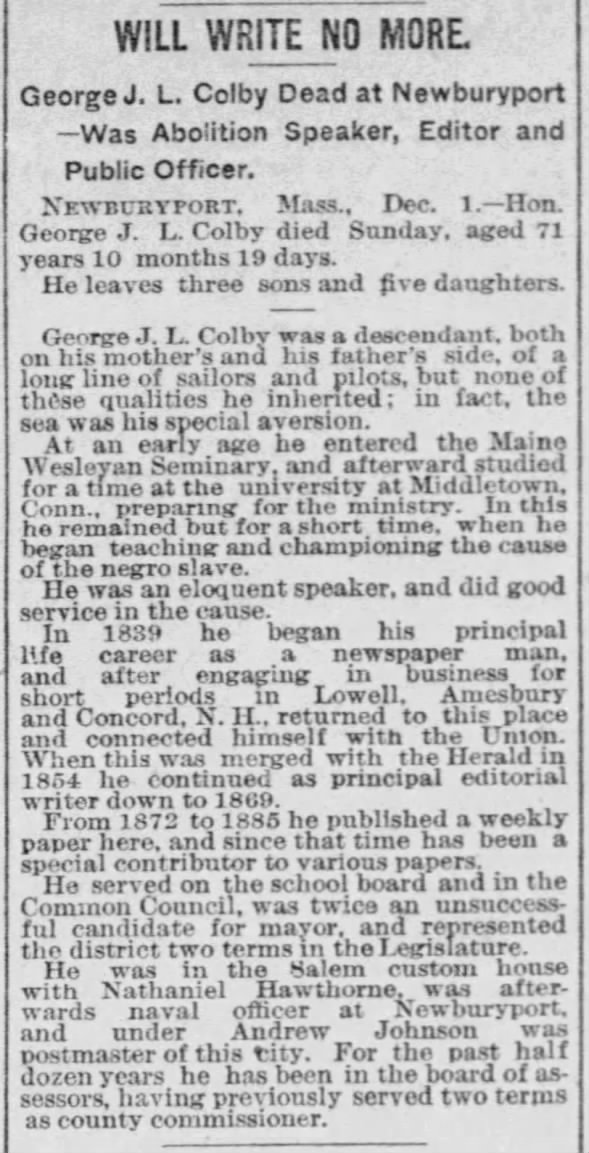
The Daily Herald was then edited in Newburyport, Massachusetts by George J. L. Colby and Joseph B. Morss. According to his obituary in the Boston Globe (December 1, 1890), Colby "was in the Salem custom house with Nathaniel Hawthorne." 


The Piazza Tales. By Herman Melville. New York Dix & Edwards. For sale by Moulton & Clark.
Mr Melville is a writer who never fails in giving his readers a good entertainment. In the present instance he has given us a series of magical sketches, which bear the marks of a skilful pencil. Among the pleasant characters in this group, the two first are most pleasing to us; and particularly do we admire that of Bartleby, so incomprehensibly mysterious, and so indefatigable in his attachments. The old Conveyancer has our gratitude for his forbearance, which so fully developed the characteristics of the scriviner. We know of no pleasanter way of spending a few hours, than in devoting them to a perusal of The Piazza Tales. 
-- Newburyport MA Daily Herald, June 2, 1856.

By "characters" the reviewer means something like "sketches," taking the word character in the old fashioned sense of 

An account, description, or representation of any thing, exhibiting its qualities and the circumstances affecting it.  -- Webster's American Dictionary of the English Language.

The "old Conveyancer" is the narrator of Bartleby, the "elderly" lawyer employed in better days as "a conveyancer and title hunter, and drawer-up of recondite documents of all sorts." 

01 Dec 1890, Mon The Boston Globe (Boston, Massachusetts) Newspapers.com
Related post:

Thursday, April 1, 2021

Benito Cereno - Broadview Press

Dropping soon on Melvilliana! "Memory Holes in the Broadview BENITO CERENO"
Benito Cereno - Broadview Press: “Benito Cereno,” a story of atmospheric Gothic horror and striking political resonance, represents Herman Melville’s most profound and unsettling engagement with the horrors of New World slavery. Narrating the story of a slave revolt using materials drawn from Amasa Delano’s non-fictional account of the Tryal Rebellion from earlier in the nineteenth century, Melville’s story probes…

Sunday, January 26, 2020

Piazza Tales in Chicago Prairie Farmer

The Prairie Farmer was edited by John A. Kennicott, Charles Betts, and C. D. Bragdon; and published in Chicago, Illinois by John S. Wright. Found via EBSCO in the American Antiquarian Society Historical Periodicals Collection, specialized database of Agricultural Periodicals from the Southern, Midwestern, and Western US, 1800-1878. Transcription is mine.
PIAZZA TALES, by Herman Melville, Author of "Typee," "Omoo," &c. Published by Dix, Edwards & Co., New York. McNally & Co., Chicago.  
This little volume consists of a number of short productions, some of which are efforts of pure fiction, while others border so closely upon facts, that they seem rather to be essays on certain interesting Geographical and Historical points, than "tales."

The writer's forte seems to lie in the faculty of painting horrors. Some fine passages illustrating his power in this respect, may be found in his description of the "Encantadas," or the "Enchanted Isles." These lava-crusted shores, however, are not washed by purely fictitious seas, as one might suspect from the name, but stand in the hoary old Pacific, being none other than the little specks which lumber the school-boy's memory under the title of Gallipagos.

Most of the tales pertain to the sea and its shores. Those who wish to see peculiar imagery combined in a peculiar manner, will do well to read the work. In purely rural scenery the author is not so happy. He handles his pen like a practical sailor, who finds it difficult to extract poetical fancies from landscapes which have never been bedewed with salt spray. He, therefore, like a wise being, sticks to his element.

The typography and mechanical execution of the work are in the usual elegant style of Messrs. Dix, Edwards & Co.  --The Prairie Farmer, June 26, 1856.
Citation
“Piazza Tales.” Prairie Farmer: Devoted to Western Agriculture, Mechanics & Education, vol. 16, no. 26, June 1856, p. 102. EBSCOhost < search.ebscohost.com/login.aspx?direct=true&db=apm&AN=67585012&site=ehost-live>

Tuesday, October 8, 2019

Bartleby in Syracuse

via The Century Association Archives Foundation
From the Syracuse Evening Chronicle, November 21, 1853; found on Fultonhistory.com:

Syracuse, New York Evening Chronicle - November 21, 1853
"Bartleby the Scrivener, is a new story, which opens curiously and excites considerable interest."
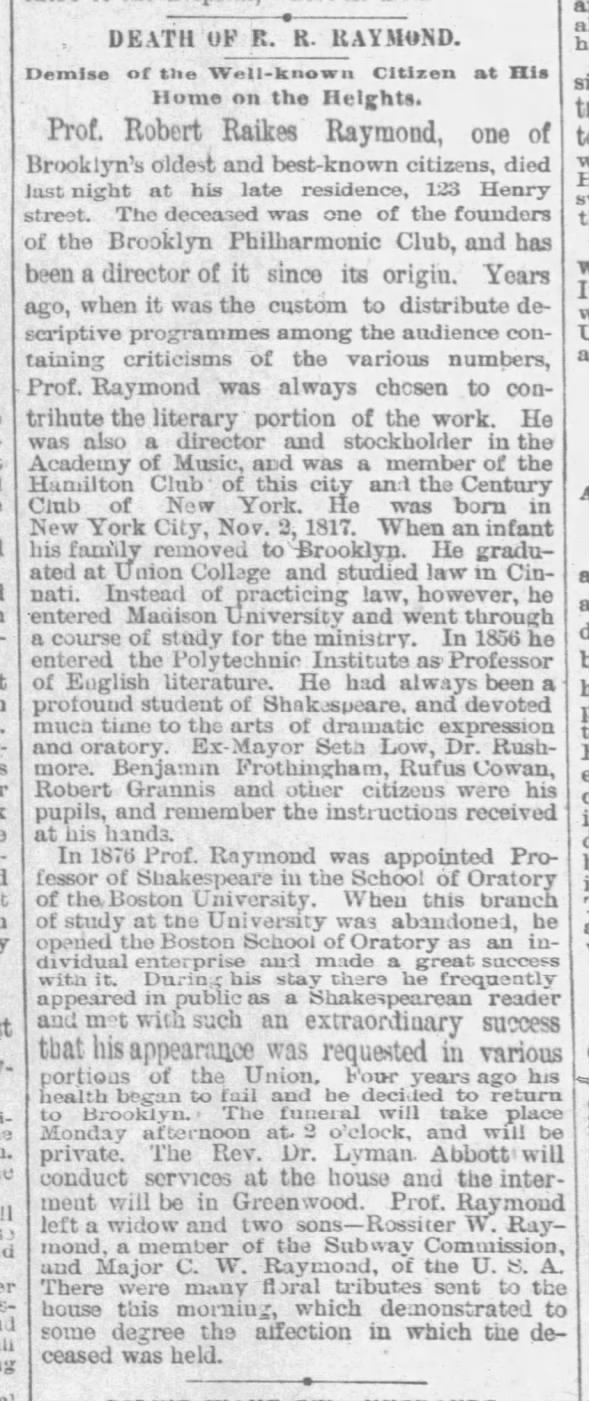
I'm guessing this late but favorable notice of Putnam's magazine for November 1853 is by editor Robert Raikes Raymond (1817-1888), who went on to become Professor of English at Brooklyn Collegiate and Polytechnic Institute.

The timelier notice of Putnam's for December 1853 (Syracuse Evening Chronicle, November 28, 1853) mentioned "Bartleby, the Scrivener" along with "Wensley" and "Reminiscences of an Ex-Jesuit" as "well-written sketches."

Here are links to Herman Melville's short fiction "Bartleby, The Scrivener" as it originally appeared in Putnam's Monthly Magazine, Vol. 2 (July-December 1853), via Google Books:
and again, courtesy of HathiTrust Digital Library:
Later included in The Piazza Tales (New York: Dix & Edwards, 1856), pages 31-107.

"Bartleby" appeared anonymously in Putnam's, and the Syracuse reviewer does not name Melville as the author. Earlier in 1853, the Evening Chronicle had favorably compared the narrative style of The History of an Adopted Child by Geraldine Endsor Jewsbury with the "verisimilitude and simplicity" of Typee.  There, however, the reviewer lamented the lack of those qualities in Melville's subsequent books, perhaps with Moby-Dick (1851) and Pierre (1852) in mind. From the Syracuse Evening Chronicle, February 22, 1853:
This little volume purports to be written to teach forbearance to those "grown-up aunts and elder sisters," who "are not fond of children." The story is interesting, and the style in which it is told partakes of that verisimilitude and simplicity of statement, which characterize the writings of De Foe, and the first work (and alas, only that) of our own writer Melville.-- "Our unrivalled corps of critics" round the editorial hearth pronounce it a book to be read at a single sitting, and read without skipping.  
On September 4, 1854, the Syracuse Evening Chronicle reprinted a long passage from Israel Potter, chapter 5 under the heading, "George the Third." Herman Melville had already been identified as the author of "Israel Potter" in the notice of the September 1854 Putnam's, published in the Evening Chronicle on August 23, 1854. The excerpt from Putnam's was introduced as
"A characteristic scene in which this famous monarch was an actor, is given in the interesting story of "Israel Potter, " now in course of publication in Putnam's Magazine."
-- Syracuse Evening Chronicle (Syracuse, New York), September 4, 1854.
Sat, Nov 17, 1888 – 1 · The Standard Union (Brooklyn, New York) · Newspapers.com

Monday, July 22, 2019

Tuckerman aka Knick on Israel Potter

As shown in a previous post, Melville's friend Henry T. Tuckerman contributed literary letters from New York City to the Boston Evening Transcript, regularly published over the pseudonym "Knick." The letter from Tuckerman aka "Knick" dated February 23, 1855 features a friendly plug for the forthcoming book version of Israel Potter as "delectable reading." (The serial version concluded in the March 1855 issue of Putnam's Monthly.) Not in Herman Melville: The Contemporary Reviews, ed. Brian Higgins and Hershel Parker (Cambridge University Press, 1995; paperback 2009), where the earliest notice of the book version is from the New Bedford Mercury on March 12, 1855.
Melville's new story, which has appeared in Putnam's Magazine, "Israel Potter," will be published in one neat volume, this week. Consecutively it reads well, and has some highly spirited and adventurous scenes, with a genuine American flavor. Paul Jones and nautical romance, when treated by such a writer as Melville, cannot fail to make delectable reading.  --Boston Evening Transcript, February 27, 1855; found in digitized newspaper archives at GenealogyBank.
Boston Evening Transcript - February 27, 1855 via GenealogyBank

The letter from "Knick" published in the Boston Evening Transcript on November 30, 1855 alludes to "Benito Cereno" in a survey of the December Putnam's:
"Melville's story is continued...."
Melville's 1856 volume The Piazza Tales gets this advance notice by "Knick" in the Boston Evening Transcript of April 4, 1856:
"The same house [Dix & Edwards] will publish soon the 'Piazza Tales,' by Melville."
Related posts:

Saturday, July 6, 2019

Un-named in revision

 Bartleby, this is a friend....
The 1856 book version of Bartleby makes a nameless "friend" of the "broad meat-like" grub-man, whom Melville originally called "Mr. Cutlets" in the December 1853 issue of Putnam's Monthly Magazine. In the magazine version, the narrator introduced the grub-man by name:
 "Bartleby, this is Mr. Cutlets; you will find him very useful to you."

After revision, Mr. Cutlets is just "a friend."
"Bartleby, this is a friend; you will find him very useful to you." --The Piazza Tales


Also deleted in revision, the invitation to dine privately with both Cutlets, Mr. and Mrs.
"May Mrs. Cutlets and I have the pleasure of your company to dinner, sir, in Mrs. Cutlets' private room?"
The un-naming of Mr. Cutlets and deletion of his dinner invitation have been noted before, of course. Dismissing the Cutlets business as "inappropriate slap-stick," Egbert S. Oliver in the 1948 Hendricks House edition of The Piazza Tales (page 230) gives its judicious "removal" as "one of the principal revisions that Melville made in this story in preparing it for book publication." The Cutlets are back in the text of the 1987 Northwestern-Newberry edition of The Piazza Tales and Other Prose Pieces, 1839-1860. As discussed there in the notes (page 579), the N-N editors reject this and other revisions as suspiciously inartful and un-Melvillean "instances of toning down."

For further study:

Thursday, April 4, 2019

Fogle on Melville's tortoise


Richard H. Fogle, The Unity of Melville's "The Encantadas" in Nineteenth-Century Fiction 10.1 (June 1955): 34-52 at 39:
"The tortoise is both black and bright," but one notes for what it is worth the entertaining implication that the bright side is not the right side; to see it you have to turn your tortoise upside down, and to maintain it you must keep him upside down.
<https://www.jstor.org/stable/304437>
Sketch First of The Encantadas, or Enchanted Isles
in Putnam's Monthly Magazine, March 1854

1856 book version of "The Encantadas" can be found in
Also accessible courtesy of the Internet Archive:

Tuesday, January 16, 2018

The Lightning-Rod Man, reprinted from Putnam's in the Albany Evening Journal and elsewhere


Cyclopædia of Wit and Humor
Originally published in the August 1854 issue of Putnam's Monthly Magazine, Melville's comic sketch "The Lightning-Rod Man" was reprinted in several contemporary newspapers, including the Albany Evening Journal (August 5, 1854). As customary, Putnam's magazine did not credit Melville for the story. Likewise the newspaper versions reprinted from Putnam's contain no byline or other identification of the author. Eventually the story would appear with "Benito Cereno" and other of Melville's magazine pieces in The Piazza Tales (New York: Dix & Edwards, 1856).

No newspaper printing of "The Lightning-Rod Man" is cited in the Northwestern-Newberry edition of The Piazza Tales and Other Prose Pieces, 1839-1860.

Albany Evening Journal - August 5, 1854
 "The Lightning-Rod Man" was also reprinted anonymously in these newspapers:
  •  Sandusky Commercial Register (in two parts), August 12, 1854 and August 14, 1854

"The Lightning-Rod Man" in Yates County Whig - August 17, 1854
via New York Historic Newspapers


  • "From Putnam's Monthly" in the Oneida [New York] Sachem, August 19, 1854
  • "FROM 'THE PIAZZA TALES.' BY HERMAN MELVILLE." in the Columbus Gazette (Columbus, Ohio) November 27, 1857.
  • Albany Atlas & Argus, May 14, 1859
  • Goshen Democrat (Goshen, Orange County, New York) May 27, 1859
  • Geneva Gazette (Geneva, New York) May 20, 1859.
  • New Orleans Republican, Sunday, September 6, 1874
  • Omaha Daily Bee, September 17 and 18, 1874
Links:


Related posts:

Thursday, June 29, 2017

Piazza Tales in Milwaukee

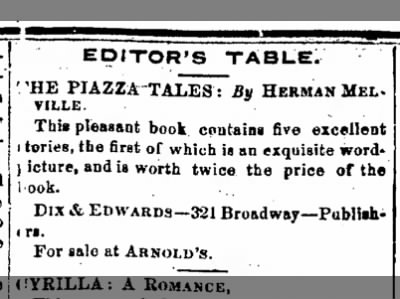
Milwaukee, Wisconsin Daily Free Democrat - June 5, 1856
The Milwaukee Daily Free Democrat was edited by Sherman M. Booth, a native of western New York State, Yale grad, and prominent abolitionist. The year before this notice of Melville's Piazza Tales appeared in the Daily Free Democrat, Booth had been sentenced in federal court to "a month's imprisonment and a fine of $1,000" for his role in the rescue of Joshua Glover.
THE PIAZZA TALES: By Herman Melville.

This pleasant book contains five excellent stories, the first of which is an exquisite word-picture, and is worth twice the price of the book.

DIX & EDWARDS—321 Broadway—Publishers.
For sale at ARNOLD'S

Notice of The Piazza Tales in the NY Evening Express

New York Evening Express - June 20, 1856
The "Piazza Tales," by Herman Melville, presents some half dozen attractive short stories originally published in Putnam's Magazine. Under the caption of "The Piazza" a pleasing introductory idyl is given, after which, the stories "Bartleby" "Benito Cereno" "The Lightning-rod Man" the "Encantadas," and the "Bell Flower" [Bell Tower] are supposed to be recited. It forms a very pretty parlor volume.  
--New York Evening Express, June 20, 1856

Sunday, January 1, 2017

Notice of Piazza Tales in the Chicago, Illinois Congregational Herald


From the Congregational Herald [Chicago, Illinois], July 3, 1856; found in the online Newspaper Archives at GenealogyBank.
The Piazza Tales. By Herman Melville, author of "Typee," "Omoo," &c. N. York: Dix & Edwards. Dubuque: Sold by L. A. Babcock & Co. 1 vol. 12mo.

These lively sketches have appeared in Putnam's Monthly, where we remember to have read some of them with interest, particularly "Benito Cereno." Mr. Melville is a very popular author.

Thursday, December 29, 2016

Salvator R. Tarnmoor outed in Indiana

From the Lafayette [Indiana] Daily Journal, March 9, 1854:
"The Encantadas, or Enchanted Isles" in Putnam, purporting to be written by Salvator R. Tarnmoor is unquestionably from the pen of Herman Melville, author of "Omoo," "Typee," &c. The story is in his best vein. 
The Encantadas, Sketch First in Putnam's Magazine - March 1854

Below, the digitized 1854 volume 3 of Putnam's Monthly Magazine courtesy of Hathi Trust Digital Library. Installments of Melville's "The Encantadas, or Enchanted Isles" appear in the March, April, and May issues.


Melville included "The Encantadas" in his 1856 book, the collection of magazine sketches titled The Piazza Tales. Here is how "Sketch First" looked there, from the California Digital Library via the Internet Archive, another great resource deserving of generous support:

Tuesday, September 6, 2016

Discarded by the Public Library in Watertown: Piazza Tales, with marginal comment on Melville as "a great humbug"

In this letter to Philip Hale as editor of the "As the World Wags" column, Boston reader "G. E." reports on his purchase of an ex-library copy of The Piazza Tales. From the Boston Herald, Friday, September 23, 1921; found in the online Newspaper Archives at Genealogy Bank. Note the spelling: Melvillians!


Boston Herald - September 23, 1921


BENIGHTED WATERTOWN.

As the World Wags:

It would be unkind, if not unjust, to deposit the whole blame at your doorstep: however, you’ll find enough there to stumble over, if you ever cross your threshold to face an angry mob of Melvillians! Your well-intentioned propaganda costs us dearly. Prices have gone up sky high.

One bookseller in Boston can’t get the “Piazza Tales” for love or money. Another had a copy offered to him (first and apparently only edition) at $4.50. I politely declined. At last by the merest chance I obtained through him a copy marked “discarded”—mind you—by the Watertown public library; price $2. I’m not kicking. On the contrary, now that I have read the book, I’ll confess that it is worth those two iron men; and more.

But I am moved to reflect on the fact that Watertown had no use for these stories, and upon this extraordinary thing: At the end of that wonderfully uncomfortably tale about the poor, demented Scrivener, once employed in the Dead Letter Office, one Watertown reader (perhaps the one that recommended the book for the dump-heap) has indulged in the following pencilled opinion: “This Herman Melville is a great humbug.” As one of the converted, I would urge you therefore, move on to Watertown, and smite the Waterstownsman with your ire.

G. E.
Boston

Are booksellers able to procure for you Melville’s “Israel Potter,” The Confidence Man,” “Pierre, or the Ambiguities?” If so, at what price. A contributor to the Nation and Athenaeum of London states that the British Museum is without a copy of the “Piazza Tales.” These stories worked their strange spell on us when years ago we read them in Putnam’s Magazine, that monument to the fine taste of George William Curtis, the editor. Reading the tales again and again, we are at a loss to say which is the best. “The Bell Tower” has been reprinted in collections of short stories, yet we prefer “Bartleby” and “Benito Cereno,” the account of Capt. Amasa Delano’s surprising adventures. Whenever a thunderstorm comes along, we think of “The Lightning Rod Man” and loathe the critic who, years ago, characterized it as “grotesque verbiage.” He probably came from Watertown. Ed. [Philip Hale]
In his reply, Hale references the June 11, 1921 issue of The Nation and The Athenaeum, where (after printing letters from Michael Sadleir and James Billson) the editor notes:
We believe that the British Museum has no copy of "The Piazza Tales." Verb. sap.
In 1881 The Watertown Free Public Library still boasted a first edition of The Piazza Tales.


As shown in the previous melvilliana post Forty Years of Philip Hale and Melville, Hale had been promoting Melville in the pages of the Boston Herald since 1904, not long after he moved there from the Boston Journal--where he had talked nonstop about Melville in "Talk of the Day." Doubtless Hale and his Boston reader are too hard on Watertown, Mass. According to the Librarian's Report for 1907, more than 700 volumes, many "among the most used and most popular books" in the library, had to be discarded as "worn out by constant and increasing usage." Moby-Dick and Typee are listed as 1907 additions to the 1881 catalog.

Saturday, February 6, 2016

Notice of The Piazza Tales, Lowell Daily Citizen and News


From the Lowell [Massachusetts] Daily Citizen and News, Tuesday, June 3, 1856:
THE PIAZZA TALES, by Herman Melville, author of "TYpe," "Omoo," &c. New York: Dix & Edwards. 
This neat volume contains five of Melville's tales, mostly nautical, written in his piazza in Berkshire--a piazza which astonished every old settler because it was on the north side of the house. The materials for these stories are mostly Spanish. (Sold by Joshua Merrill.)  --found in the online Newspaper Archives at Genealogy Bank

Wednesday, December 9, 2015

Fidelia Leybold and Frederika Schmidt

Detail showing "Fidelia Leybold" in the Melville household
Massachusetts Census, 1855 via Ancestry.com
"With fairest flowers,
Whilst summer lasts, and I live here, Fidele—" --epigraph from Cymbeline 4.2 for "The Piazza," the first story in Melville's The Piazza Tales (1856). 
At Ancestry back in 2014, North Adams genealogist rbass101 posted images 12-13 from the Massachusetts Archives of the state census for 1855 in Berkshire County. Here's image 12 which is accessible by subscription at Ancestry.com. The census of the Melville household (Dwelling #193; Family #201) begins at the bottom of the page:
Massachusetts Census, 1855 / Berkshire County / Pittsfield
via Ancestry.com
Images 12-13 together show who was living there at "Farmer" Melville's full house in Pittsfield: Herman (age 36), wife Elizabeth (age 33), children Malcolm (age 6), Stanwix (age 4), Bessie (age 2) and the baby Fanny (6 months). The 1855 state census of the Arrowhead household lists Herman's mother Maria Gansevoort Melville as "M. S. Melville" (not "Mrs. Melville"?) and gives her age as 63 (in September 1855 she was 64, born April 6, 1791). Herman's younger sisters Augusta Melville, then 33, and Fanny Melville, 29, were there, too.

The last person named in the Melville household:
Fidelia Leybold, 34, of Germany.
Employed in the Melville family around the time of The Piazza Tales, Fidelia Leybold apparently was gone by 1860. As indicated in the 1860 United States Federal Census, the Melvilles by then have a new German housekeeper or "Domestic," Frederika Schmidt of Württemberg. Ms. Schmidt in 1860 is 36 years old with a "Personal Estate" valued at $100. Herman Melville's "Personal Estate" in 1860 is valued at $3000; Real Estate $3500. His stated occupation is "Author."

Imogen in Boy's Clothes - Richard Westall