"Duyckinck wrote reviews for an Episcopal magazine, the Churchman , and in March of 1854 was officially announced its literary editor. But by May he was able to tell Simms that he and George had decided to devote themselves heart and soul to that other ambition of Evert’s life, a… https://t.co/fpuXbi7O8Apic.twitter.com/cmpRAhePS6
Prang's aids for object teaching. Printer. ca. 1876. Photograph. https://www.loc.gov/item/2003663928/.
Albert W. Whelpley (1831-1900) was head librarian of the Cincinnati Public Library when he commemorated "The Old-Time Printer" in a delightful and highly informative after-dinner speech, delivered January 17, 1898 at the annual meeting of the Cincinnati Typothetæ. Although long forgotten, Whelpley's talk is full of historical interest and value, being rich with details of his personal experience as a printer's devil and compositor in New York City from 1846 to 1856 or so. Melville aficionados will be especially interested in Whelpley's reminiscences about working at "the widely known printing office of Robert Craighead, on the corner of Fulton and Dutch streets." Whelpley quit with most of his coworkers during a labor strike, possibly in early May 1853 when journeymen book-printers went on strike in New York City.
New York Weekly Journal of Commerce - May 5, 1853
If Whelpley alludes to printers' strikes in April and May 1853, he would still have been working at Robert Craighead's former printing office on Fulton street in May 1851 when Melville hired Craighead to set his great Whale manuscript in type and have it plated. In that case young Whelpley might possibly have helped to produce Moby-Dick. Whelpley's boss William Henry Tinson, "the best-known foreman in New York" and Craighead's manager until May 1853, almost certainly did.
In 1853 or later, Whelpley rejoined his old boss at 24 Beekman Street, where Tinson operated his own printing office, "also a famed one." Working there for W. H. Tinson, Printer and Stereotyper, Whelpley became personally acquainted with George P. Putnam and numerous other literary celebrities. A. W. Whelpley never once name-drops Herman Melville during his 1898 talk before the Cincinnati Typothetae. However, Whelpley somehow managed to acquire one of Melville's letters to Putnam (9 November 1854) concerning the magazine version of "Israel Potter." Submitting the concluding chapters in manuscript, Melville thus explained why he did not number them:
“Having forgotten the number of the last chapter sent you, I leave the numbering of the following ones to the printer.”
By his own account, Whelpley seems to have been employed as a compositor for W. H. Tinson in 1854 through April 1855 when Tinson's printing office set all of Putnam's Monthly Magazine in type, including the magazine version of "Israel Potter" which concluded in the March 1855 issue. If so, Whelpley might have indirectly received Melville's note to Putnam via Tinson. In any case, Whelpley got it somehow or other and eventually gave it to the Cincinnati Historical Society, as helpfully indicated in the Northwestern-Newberry Edition of Melville’s Correspondence, edited by Lynn Horth (Northwestern University Press, 1993) at page 273. Whenever and however Whelpley first acquired it, Melville’s autograph letter of November 9, 1854 to George P. Putnam would have held personal significance as a memento of his youthful occupation in New York City, “working for W. H. Tinson, on Beekman Street.”
The complete text of A. W. Whelpley's encomium of "The Old-Time Printer"is transcribed below from The Printer & Bookmaker (July 1898) pages 230-234. Digital versions of the printed speech are accessible via Google Books
*An address delivered at the annual meeting of the Cincinnati Typothetæ.
BY A. W. WHELPLEY.
THE printer of the olden time! It is a theme so glorious that it should have been delegated to be handled by some one more practiced in the art of oratory and after-dinner speaking than he who is to address you. Some one whose well-rounded sentences and resonant voice should stir your natures to their very depths—one who might be able to paint glowing wordpictures of that glorious trinity of men who gave the art its birth! Of Gutenberg, Fust and Schoeffer, whose names have come down through the centuries laden with honors; whose triumphs have been sounded in every land and in every language! Gutenberg, inventing movable types, and constructing a rude printing press to take his impressions from them; Fust, inventing the ink with which to make this possible; and Schoeffer, who, conceiving the plan to make better and more effective types than those used, cut a set of matrices to cast them in, which so delighted his master, Fust, that he gave him his only daughter for a wife!
He might take a long leap, and come to the men who, in the early days of this country, gave such renown to the printer's art, William Bradford, who came to America with William Penn, and Benjamin Franklin—both grand types of the old-time printer. And if he was to "the manner born" he could discourse eloquently of three old-time printers whose names are inseparably linked with this "Queen City of the West," Joseph A. James, Ephraim Morgan, and Achilles Pugh.
But I am not equal to anything so lofty in conception, and propose to go back only half a century, to give you a few reminiscences, beginning with the business career of a slightly built, not over-strong, curly-headed youth, who, at the age of about thirteen years, thought the time had come for him to quit school and face the world to earn his own living.
A school-boy friend, who was already at work, secured him a position in the same office where he was employed, and in the autumn months of 1846 this boy, who had never been away from his home except in school hours, trudged gaily to the office in which he was to begin his career, to take the responsible situation of a printer's devil! This service consisted of various important duties, the most responsible of which was rolling a form for ten hours a day—from 7 to 12 A.M., from 1 to 6 P.M. When there was no form on the press, he was to busy himself as best he could. The other duties were to build the fires, make the lye with which to clean the forms, and wash the rollers; gather up the soiled towels to take home to his employer on certain nights of the week, and call for them on certain mornings; in fact, being a "general utility" for everybody about the place.
He can remember as well as if it were yesterday what a formidable undertaking it seemed to get through a day's rolling—and to count the tokens in his mind, as the sheets were "worked off," ten hours a day, ten tokens to be printed, to make a fair day's work. At the office at 6 to build the fire, and rarely getting home to his supper before 7:30 at night. Such was the life, and such were the duties of a boy in the 40's who was fortunate enough to secure a situation as a printer's devil. The pressman under whom he worked was a kind-hearted, phlegmatic Scotchman, named Archie Naughton—and he can call him to mind always—an old-time pressman who is deserving of a grand reward in the future life. He was very considerate of his devil, and always lightened his duties where possible—and never spoke a cross word.
The hours of service required would alarm a printer boy of this day, and would cause an eruption in the labor unions; but the young devil felt them no especial hardship; and he tumbled into bed at an early hour after supper, with his mother's blessing and a good conscience, and slept soundly the "sleep of the just," for, as he had not many temptations, he had few worries, as yet, to trouble his slumbers. He generally got his breakfast by 5:30, and in the dark hours of the winter mornings was well on his way to the office before 6 o'clock.
The boy was happy! and it was not long before he evinced some skill in setting type (which he learned in the noon hour, supposed to be devoted to dinner), and it was but a few months before he bade a not over-affectionate adieu to his rolling duties! It may be interesting to say that he was succeeded by an inking machine, which had just come into use.
This introduction to the printing business was in the office of John W. Oliver, on the corner of Ann and Nassau streets, New York, in the same building where the well-known Quaker printer, Daniel Fanshawe, ran his presses. A few months later this office of John W. Oliver was removed to the corner of Fulton and Nassau, in the old Sun building, and by that time the boy, who only a little while before had rolled forms, had now become quite a respectable job hand, and could run a job press very well. He preferred composition, however, and when opportunity offered would "stick type" on a weekly temperance paper called The Organ, published by Mr. Oliver, who was an ardent "Son of Temperance," an order then in its infancy.
Printer boys in those times were sturdy young fellows, that disdained to wear such undergarments as shirts and drawers, and some of whom would have discarded stockings, but for the interference of home folks. I can see this young boy, with his shirt sleeves rolled up to the full extent, his shirt front unbuttoned, with a paper cap on his head, to protect the luxuriant locks, that were his pride, from dirt and dust. When these conditions were fulfilled, the printer boy was in full uniform, and ready for business.
He soon made a change to an office managed by a literary Irishman, Dennis Hannegan, well known as the author of "The Orange Girl of Venice," a blood-curdling novel. Dennis was a clever and an honest man, and though he could not pay his hands their wages in cash, he gave them the equivalent in paper novels, all of which were read without death ensuing.
Dennis did a good thing for the subject of this sketch by kindly giving him a letter of introduction to W. H. Tinson, an excellent printer, at that time the best-known foreman in New York, and manager of the widely known printing office of Robert Craighead, on the corner of Fulton and Dutch streets. He was of a just nature, but a violent temper. Mr. Tinson honored the introduction, and took the boy, stipulating that he should serve his time at two-thirds men's wages, either working by piece or by the week. And it seemed a great piece of good fortune to drop so easily into such a situation.
This office literally swarmed with compositors of wonderful intelligence. It was an office in which slack times were seldom known. It had the cream of literature, as it had the pick of workmen. Here was a representative body of old-time printers that could discuss composition, rhetoric, punctuation; who were conscientious in spacing and leading; who would criticise bad work, and were intolerant of inferior workmen; who gave close attention to all the technicalities that go so far to improve the looks of the printed page. Men who would quarrel with the proofreader when they thought him wrong, and oftentimes carry their point. They were a representative set of old-time printers—middle-aged men—and younger dare-devils who could dance all night and work all day. It is doubtful if ever such another office existed, where there was so much wisdom and so much mirth combined, and so much good and conscientious work accomplished, with the pay so sure. All the grand English reviews, Blackwood's Magazine, the Literary World, the Medico-Chirurgical Quarterly, and scores of books from those reputable publishers, Wiley & Putnam, Scribner, Wood, Dodd, Carter Brothers, and others, were constantly in process of composing, stereotyping and printing.
Looking back through half a century, it is a gratification to call to mind the well-educated printers of that establishment. Many of them were Englishmen, who had served their apprenticeships in the old country, and were authority on every technical point of the printing business. How well they had studied their grammars, and how true were their ideas of the niceties of punctuation!
These printers of the olden time were always in the lead on affairs of the day. They could intelligently criticise the pulpit, the stage and the press. They could quote Scripture without limit, and were up in every current joke, and often very humorously repeated questionable stories—a custom not yet obsolete—which dates back, however, to Boccaccio—and in which art many of them were masters.
That office had a coterie of men (of which the boy of whom I am speaking was the youngest member) who by filling responsible positions as editors of prominent newspapers, writers of dramas, important military positions, have given good evidence of the value of the training of the printer of the olden time—one becoming a librarian, and one now bearing the best known name in the annals of printing in America, Theodore L. De Vinne.
These printers of the olden time, in this particular office, had prime opportunities to jostle against the men who were giving to America its literature; and the boy whose history I am giving you was particularly favored. He saw many celebrities, and was noticed by not a few. Here came James Fenimore Cooper, Charles Fenno Hoffman, George P. Morris, Nathaniel P. Willis, Rufus Griswold, Horace Greeley, Evert and George Duyckinck, and a host of others who are among the immortals in American literature.
One more change, and the boy, now grown to manhood, as far as his reminiscences in this city of his birth go, are completed.
There came a strike—we all know what strikes are—and every man and boy, except two, marched out from this home which had done so much for them for so many years. And the young man, true to his fellow workmen, but against his inclination, went with them, and bade adieu to the office of Robert Craighead forever. After forty years or more he pays the tribute to him which is deserved, and will never fail to cherish his name gratefully. The boy's career in New York closed with working for W. H. Tinson, on Beekman street. And this office was also a famed one. Here he made friends with the versatile publisher, George P. Putnam, and met and conversed with Bayard Taylor, Frederick Cozzens, author of the "Sparrowgrass Papers," John Brougham, Edward Stephens, author of "Jonathan Slick in New York," Tuckerman, the essayist, our Western poet, W. W. Fosdick, and Frederick Saunders, author of "Salad for the Solitary;" in this office was printed John Mitchel's Citizen, and here came daily those Irish patriots, John Mitchel, John Savage, Thomas Francis Meagher, and scores of others. These were the days when the author came to the printing office with his proofs, and often explained his corrections and the wherefores to the compositor.
These sometimes happy (sometimes otherwise) days came to end, as far as New York experiences are concerned, when this old-time printer came to Cincinnati for a brief visit. That visit has extended to over forty years; and while he oftentimes thinks of what a field he might have had in the city of his birth for growth, he in no wise lacks appreciation of the honors which his fellow citizens of Cincinnati have shown him, and of which he has always endeavored to be deserving! Nor does he in any wise lack appreciation of Cincinnati itself, in which community he feels that his life and his sympathies have so broadened, and in which for so many years he has lived so happily.
But Cincinnati was a new field for the young New Yorker. By force of filial duties he felt obligated to remain, though he was leaving all behind—birthplace, familiar scenes, friends and companions, yet he bravely accepted the new responsibilities, and for the third time was compelled to "seek a job." An introduction from a genial old-time printer of that day, Caleb Clark, sent him to the Franklin Type Foundry, where he received a welcome. There he remained (excepting a month or six weeks, when he was with dear old Mr. Thompson at the Methodist Book Concern), and in time came to have entire charge of the composing room. This business was then superintended by a gentleman who sits here to-night, Mr. Robert Allison, and I look back with pleasure to the period between 1857 and 1864. I think he parted with me with regret, when at the latter date I entered a new field of labor. During all the years that have passed his friendly interest in the young man—above I unconsciously dropped into the first person—has often been shown. He is to be congratulated on his long years of service in the profession, on his position as an employing printer, and on being one of the foremost citizens of Cincinnati.
The printer of the olden time! What memories are awakened—what thoughts will come of by-gone days and men who lived in them—heroes of the composing stick!
The printer of the olden time, and the printers of to-day, and all time, are and will be the greatest factors of our civilization. The preacher may touch our hearts with his glowing words; the actor may dazzle our eyes and charm our ears with the beauty of his scenic effects and the fervor of his declamation; the singer may enchant us with the rhapsody of his melody; the lecturer and statesman may make our minds captive by the force of their eloquent periods—but all their efforts would be as temporary and evanescent as were the lays which of yore the minstrels chanted in kingly courts, were it not for the Art of the Printer—the Art preservative of all the arts. His silent types and inks transfer to the printed sheet the words of the preacher, the lines of the actor, the song of the musician, and the speech of the statesman, and send them forever down the ages to an immortality which otherwise could not be.
Herman Melville's short story "The Fiddler" first appeared, uncredited as usual for magazine fiction of the time, in the September 1854 issue of Harper's New Monthly Magazine.
Melville's narrator in The Fiddler is Helmstone, a proud classicist and poet. Helmstone seems appealingly earnest though self-absorbed and over-ambitious, at first, of critical acclaim and "immortal fame." Distraught by bad reviews of his last poem, Helmstone bumps into a friend named Standard on Broadway. There they meet Standard's acquaintance Hautboy, happily on his way to the circus to see a renowned clown. Hautboy is a grown man, fortyish, but joys in the circus performance like a child. After the show they join "crowds of others" at the fabulous Taylor's Saloon, downing "stews and punches" while seated "at one of the small marble tables." Although moved by the "clear honest cheeriness" that Hautboy exhibited at the circus, Helmstone doubts his ability to do more than laugh and clap. Clearly he's no genius, this Hautboy. So thinks Helmstone before hearing Hautboy play his "dented old fiddle." And says out loud during Hautboy's absence from their table at Taylor's. In response, Standard mysteriously alludes to "Master Betty," the once-famous child actor William Henry West Betty. Helmstone is baffled by his friend's reference to the celebrated British virtuoso until he actually hears Hautboy (at Hautboy's home, off Broadway) doing "Yankee Doodle" and other popular tunes with "the bow of an enchanter," like "an Orpheus." Through Standard, the narrator learns Hautboy's true identity and humble occupation, teaching music "from house to house." Helmstone instantly recognizes the real name of Hautboy (whispered in his ear by Standard) as a favorite entertainer whom he had enthusiastically cheered and applauded "in the theater" as a boy. Thus chastened, the narrator ditches his poems in manuscript and buys a fiddle. Instead of writing, Helmstone will take lessons from Hautboy and let go his dreams of literary glory.
William H. Gilman in Melville's Early Life and Redburn (New York University Press and Oxford University Press, 1951) at page 316, note 148 identified Joseph Burke (1815-1902) as the likeliest real-life model for Melville's fictional fiddler, Hautboy. As a child in the early 1830's Melville could have seen "Master Burke" perform in Albany, New York and, like his narrator Helmstone in "The Fiddler," made himself "hoarse" from yelling and "applauding that name in the theatre."
Later in the last century, John M. J. Gretchko began a provocative essay on sexually suggestive wordplay and germane historical contexts in "The Fiddler" by calling attention to the anonymity that Melville might have expected and indeed preferred; see "Fiddling with Melville's 'Fiddler'" in Melville Society Extracts Number 104 (March 1996) pages 20-23 at page 20. Citing Merton M. Sealts, Jr., Did Melville Write "The Fiddler"?Harvard Library Bulletin 26 (January 1978) pages 77-80, Gretchko observed that the story's original anonymity in some measure appears to have encouraged the later, false attribution of "The Fiddler" to Fitz-James O'Brien. As demonstrated by Sealts, and duly affirmed in the 1987 Northwestern-Newberry Edition of The Piazza Tales and Other Prose Pieces, 1839-1860, edited by G. Thomas Tanselle, Harrison Hayford and Hershel Parker, strong external evidence for Melville's authorship of "The Fiddler" is supplied by Melville's wife Elizabeth Shaw Melville, who
listed "The Fiddler" in her memoranda of her husband's periodical pieces and kept a copy of it in her collection of his magazine stories. -- Northwestern-Newberry Piazza Tales and Other Prose Pieces, Editorial Appendix, Notes on "The Fiddler," page 692.
What's new on Melvilliana is my discovery of an early and explicit attribution of "The Fiddler" to Herman Melville in the New York Churchman of September 9, 1854, contemporary with the story's first, anonymous publication in Harper's magazine.
New York Churchman - September 9, 1854
Harper's Magazine for September opens with an illustrated paper on the old Dutch times of Manhattan from the competent resources of LOSSING; has a sketch, "The Fiddler," by MELVILLE, showing how an author, as the world goes, may be reconciled to the failure of his volume; and TAYLER LEWIS throws out some conservative suggestions on the topic of the Unity of the Human Race. -- The Churchman, September 9, 1854
"The Fiddler" was seldom referenced in newspaper roundups of periodical literature and, except in the Churchman, never linked to Herman Melville. Despite the rarity of any notice at all, the Churchman discloses Melville's authorship of "The Fiddler" positively and rather casually, not so much as breaking news but as a matter of fact, familiar to insiders in New York City. Accompanied by a line of plot summary, this so-far unique contemporary attribution of "The Fiddler" to Herman Melville appeared in the last issue of the Churchman to be edited by H. N. Hudson.
A Vermonter by birth, Henry Norman Hudson was already well known for his trenchant literary criticism and popular lectures on Shakespeare. As shown by Mark Bayer, "Hudson was a prolific scholar, editor, and educator" whose influence on Shakespeare studies in the United States deserves fuller appreciation and respect.
Bayer, Mark. “Henry Norman Hudson and the Origins of American Shakespeare Studies.” Shakespeare Quarterly 68, no. 3 (2017): 271–95. https://www.jstor.org/stable/48559742.
Hudson abruptly quit his position as editor of the Churchman, alleging undue interference from the owner, John Hecker:
Whether Hudson was too impractical or too temperamental, or whether the proprietor was a little impatient, we can not be sure. That friction arose is entirely certain and that Hudson was firmly determined to have no more of it is equally plain. He resigned, he announced in THE CHURCHMAN (September 9, 1854), because the proprietor was setting "the editorial department at strife and controversy with itself" by engaging outside writers without consulting the editor. -- Clifton H. Brewer on "The History of The Churchman: Some Old-Time Editors" in The Churchman Volume 132 (November 28, 1925) pages 10-11.
On Hudson's last day at work, September 9, 1854, the "Literature" department contained notices of two contributions by Melville in different magazines, "The Fiddler" in Harper's and several chapters of "Israel Potter" in Putnam's. In "Harper's Magazine for September" the Churchman acknowledges only three items. Ignored altogether are three new chapters from Thackeray's new novel, The Newcomes. Instead, the Churchman notices
a sketch, "The Fiddler," by MELVILLE, showing how an author, as the world goes, may be reconciled to the failure of his volume....
Brief as it is, this treatment of "The Fiddler" in the Churchman features a handy summary of the story's moral along with a remarkably casual attribution to Melville. Both the commentary and the attribution are unparalleled. In the selective survey of Harper's for September, the notice of "The Fiddler" appears in between mentions of an "illustrated paper on the old Dutch times of Manhattan" (uncredited in Harper's but knowingly associated here with "the competent resources" of Benson John Lossing) and Tayler Lewis on the "Unity of the Human Race" (sole topic of the unsigned essay taking up the whole "Editor's Table" that month, starting with the question, "IS THE HUMAN RACE ONE OR MANY?").
In the same column of the Churchman, surveying the contents of another prominent American journal, the reviewer went on to notice the latest installment of Melville's Israel Potter, as serialized in the September 1854 issue of Putnam's Monthly Magazine:
Putnam's Monthly has an elaborate article, clearly written, on the "Parties and Politics" of the country, past and present; several interesting descriptive papers of American nature; a continuation of Israel Potter's Fifty Years of Exile, the main incidents of which are founded on fact. POTTER was wounded at Bunker Hill, was captured by the British in an attempt to cut off their supplies in Boston harbour, and was carried to England. He was actually employed by FRANKLIN, as represented by MELVILLE in this embellished account of his career, the interest of which is well developed in the present number.
These remarkably well-informed and favorable notices of Herman Melville's contributions to Harper's and Putnam's coincided with the tenure of Melville's good friend Evert A. Duyckinck as literary editor of the Churchman. Duyckinck's role as head of the regular "Department of Literature" was formally announced by owner John Hecker and editor H. N. Hudson in the Prospectus for volume 24, reprinted in the Churchman on March 4, 1854.
"Arrangements have also been made for keeping up statedly a Department of Literature. This department is placed under the entire charge and control of EVERT A. DUYCKINCK, Esq., late Editor of the Literary World, whose name is deemed a sufficient guaranty of whatsoever attractions, both in matter and style, such a department is ordinarily capable of furnishing."
A "neat discriminating & appreciative" review of Thomas De Quincey's Essays on Philosophical Writers and Other Men of Letters in the Churchman, Vol. 23 (February 11, 1854) is ascribed to Duyckinck in a letter from William Gilmore Simms; collected in The Letters of William Gilmore Simms Volume 3, 1850-1857, edited by Mary C. Simms Oliphant and T. C. Duncan Eaves (University of South Carolina Press, 1954) page 280. In Volume 24 the new Literature department of the Churchman opened with a lavish two-part review (March 4 and 11, 1854) of The U. S. Grinnell Expedition in search of Sir John Franklin by Elisha Kent Kane (Harper & Brothers, 1854). I'm not sure why or how Evert A. Duyckinck decided to review that particular title, but he definitely knew a guy with expertise in the genre of nautical exploration and adventure. 🤔 Did he dare ask Herman Melville for help?
At present the online archive at Newspapers.com has digital images of The Churchman for two years only, 1854 (10 months, March through December) and 1855 (two months, January and February), generously furnished by the Brooklyn Public Library. Hopefully, future searches in other digital and print archives will uncover additional references to Herman Melville's magazine fiction. It would be wonderful to find some notice of Bartleby, for instance, in November or December 1853; or "COCK-A-DOODLE-DOO!" which first appeared in the December 1853 issue of Harper's New Monthly Magazine Magazine.
For now I can offer three additional Melville items that appeared in the "Literature" section of the New York Churchman when conducted by Evert A. Duyckinck. In the Churchman for March 11, 1854, Duyckinck favorably noticed the opening sketch of "The Encantadas" in Putnam's Monthly.
New York Churchman - March 11, 1854
Putnam's Monthly for March has the commencement of a series of papers by HERMAN MELVILLE, sketches of the barren islands of the Gallapagos, under the equator, on the Pacific. His opening sentence shows his graphic hand,-- "Take five-and-twenty heaps of cinders dumped here and there in an outside city lot; imagine some of them magnified into mountains, and the vacant lot the sea; and you will have a fit idea of the general aspect of the Encantadas or Enchanted Isles."
On April 22, 1854 Duyckinck observed that "Putnam's Monthly for April continues Mr. MELVILLE"S Encantadas...."
Also while "under the entire charge and control" of Evert Duyckinck, the Literature department of the Churchman (May 6, 1854) gave a shout-out to Melville in the long review of George W. Peck's Melbourne, and the Chincha Islands; with Sketches of Lima, and a Voyage round the World (New York: Charles Scribner, 1854).
New York Churchman - May 6, 1854
But we turn to more agreeable incidents. A sailor's dinner is a thing to be relished all the world over. Who does not remember, in Mr. MELVILLE'S capital book "Redburn," the achievements of that young gentleman on his first voyage when, at Liverpool, "he goes to supper at the sign of the 'Baltimore Clipper'," and the ardent company "wrapt themselves in hot jackets of beef-steaks." This is the kind of thing to give a wholesome shock to the dyspeptic. Would you know what appetite really is, of what this admirable structure is capable, flee Delmonico's and the St. Nicholas, the jaded tables of the Fifth avenue, and place yourself alongside of a potent skipper of the seas in DORAN's modest mansion, which rises amidst the incense of fiery oyster sacrifices in the very heart of the Fulton Market--or, for the same number of shillings, you may enjoy Mr. PECK's hardly less substantial feast at Melbourne.
As shown already, H. N. Hudson resigned his position as chief editor in September 1854. High quality book reviews, many concerned with non-fiction narratives of travel and exploration, continued to appear in the Churchman under the editorial watch of Hudson's successor, Thomas Ramsay. Apparently Evert Duyckinck stayed on for much if not all of 1855 as head of the Literature department.
The Churchman for June 5, 1856 featured a favorable review of The Piazza Tales; reprinted by Brian Higgins and Hershel Parker in their great collection Herman Melville: The Contemporary Reviews (Cambridge University Press, 1995; paperback 2009) at pages 475-476. The Contemporary Reviews volume (see page 500) also has the brief notice of The Confidence-Man: His Masquerade in the New York Churchman for April 30, 1857.
Also reprinted in Contemporary Reviews, at pages 394-395, the review of Moby-Dick; Or, The Whale that appeared in the Churchman for December 6, 1851. Back then, William Walton edited the Churchman. On Walton's watch, the Churchman had appreciated the "character of the monomaniac Captain Ahab" as "a novelty, and powerfully drawn," but found it "pitiable to see so much talent perverted to sneers at revealed religion and the burlesquing of sacred passages of Holy Writ."
New York Daily Times - November 13, 1852
Cleaning up now with the aim of good housekeeping, I would suggest that the otherwise unidentified "Mr. Hudson" on page 249 in the first volume of Jay Leyda's good old Melville Log (New York: Harcourt, Brace and Company, 1951) could well be Henry Norman Hudson, then a resident of Boston and well known for his lectures on Shakespeare. Leyda thus quotes Ida Russell in a letter dated July 8, 1847 to her cousin Richard Henry Dana, Jr.:
"Mr. Herman Melville is expected to take tea with us tomorrow which is Friday afternoon he would like to meet you . . . If you see Mr. Hudson will you be so kind as to extend the invitation to him.
I intend only to ask a few Dr. Vinton among others. If any other members of your family are in town I wish they would come."
Possibly Melville got to meet Dana and "Mr. Hudson" the next day on Friday, July 9, 1847, at tea with Ida Russell. In any event, Henry Norman Hudson's presence in Boston is definitely established by extant letters to Evert A. Duyckinck, accessible courtesy of the New York Public Library Digital Collections. Most relevant there is Hudson's newsy 3-page letter from Boston dated March 27, 1847. Citation:
Manuscripts and Archives Division, The New York Public Library. "Hudson, Henry Norman (1814-86)" New York Public Library Digital Collections. Accessed April 16, 2025. https://digitalcollections.nypl.org/items/9462eaa0-69fc-0133-794f-00505686a51c
Looking further into the identity of Ida Russell's "Mr. Hudson," I just learned that Roma Rosen nominated Henry Norman Hudson 63 years ago in Melville's Uses of Shakespeare's Plays (PhD dissertation, Northwestern University, 1962). As Rosen reasons,
"There is a possibility that the "Mr. Hudson" mentioned in Miss Russell's invitation was the Shakespearean critic and that Melville met him, too, on this occasion." (pages 183-184)
Rosen makes a great case for the influence of Hudson's negative view of Polonius in Lectures on Shakespeare Volume 2 (New York: Baker and Scribner, 1848) pages 119-121 on the equally salty commentary of Charlie in the Confidence-Man Chapter 30.
In the first two months of 1847, Henry Norman Hudson made a hit with his two-part review of Philip James Bailey's Festus, A Poem in the American Whig Review:
"This book has come to us, wafted on a perfect gale of puffery."
"Henry Norman Hudson thoroughly dissected P. J. Bailey's Festus for the Whig Review, objecting to its liberal and transcendental philosophy, its liberal and democratic politics.
At page 127 of the same book, Stafford pairs Hudson and George Washington Peck as New England "farm boys," both of whom became "conservative supporters of the Establishment party," more or less in opposition to democratic Young Americans and their Manhattan champion, Evert A. Duyckinck.
Hudson's two-volume work, Lectures on Shakespeare (Baker and Scribner, 1848) is Number 376 in Melville's Sources by Mary K. Bercaw (Northwestern University Press, 1987). Listed there on page 92, citing H. J. Lang who had proposed Hudson's 1848 Lectures on Shakespeare as a source for "Benito Cereno" and Billy Budd in "Poe in Melville's 'Benito Cereno,'" English Studies Today, Fifth Series (1973) pages 405-429.
From the obituary of Henry Norman Hudson, "the well known Shakespearian scholar," as published in the Boston Evening Transcript on January 18, 1886:
... Personally Mr. Hudson was said to be a man of marked peculiarities. He cared little for the opinions of others where they were at variance with his own, and would not have been troubled if he had had to stand against the world. He had the courage of his convictions almost more than any other man of his time. In appearance he was thought to resemble Carlyle. His life work had been primarily the study of the one great subject of Shakespeare, and his English text-books were a vigorous protest "against putting young students through a course of mere nibbles and snatches from a multitude of authors, where they cannot stay long enough with any one to develop any real taste for him or derive any solid benefit from him." In 1852 he married Emily S., the oldest daughter of the late Henry Bright of Northampton. His son is a merchant in Omaha.
Also published in the year of Hudson's death, Jeremiah Eames Rankin's public address The Shakespeare Interpreter (Middlebury, Vermont, 1886), concluding with a fine memorial tribute to Henry Norman Hudson on pages 29-42.
For more in the way of 19th century biography, see the entry for HENRY NORMAN HUDSON in the Cyclopædia of American Literature, Volume 2, edited by Evert A. Duyckinck and George L. Duyckinck (New York: Charles Scribner, 1856) pages 597-599. A later, more succinct treatment may be found in the New International Encyclopædia, Volume 9, edited by Daniel Coit Gilman, Harry Thurston Peck, and Frank Moore Colby (New York: Dodd, Mead and Company, 1903) at page 630.
HUDSON, HENRY NORMAN (1814-86). An American Shakespearean scholar and editor, born at Cornwall, Addison Co., Vt. In early life he worked as a baker and a wheelwright. He graduated from Middlebury College, Vermont, in 1840, and then taught school in Kentucky and Alabama. He presently became an authority of considerable note on Shakespeare, lectured widely on his works, and was appointed a professor in Boston University. Among his works in this field are: Lectures on Shakespeare ( 2 vols., 1848); a valuable annotated edition (11 vols.,1851-56); and Shakespeare: His Life, Art, and Characters (2 vols., 1872). Having entered the priesthood of the Protestant Episcopal Church, he was for some years editor of the Churchman; was rector at Litchfield, Conn., 1859-60, and served as chaplain in the Union Army during the Civil War. On his return he published A Chaplain's Campaign with General Butler (1865). He was author also of Sermons (1874); Studies in Wordsworth (1884); Essays in Education (1884); and other works.
The book version of Herman Melville's Israel Potter: His Fifty Years of Exile received an unusually long and lovely review in the New York Times on April 30, 1855, published there with other "Notices of New Books." Before now, only a snippet of this glowing notice was readily available to Melville fans and scholars, as briefly quoted by Jay Leyda in the good old Melville Log (Harcourt, Brace and Company, 1951) Volume 2, at page 501:
"... Melville often, with a few words, selected with marvelous aptness, gives us a finer and more life-like description than most men create out of long chapters and thick books ..."
Leyda's short excerpt, dated April 30, 1855 in the Melville Log, derives from an otherwise unidentified newspaper clipping saved in Albany by Herman's cousin "Kate" and now in the Gansevoort-Lansing collection of the New York Public Library. Located I would guess in Catherine Gansevoort Lansing's "Scrapbook of clippings about Herman Melville and other literary men."
This long-lost item is not collected or mentioned in Herman Melville: The Contemporary Reviews, edited by Brian Higgins and Hershel Parker (Cambridge University Press, 1995; paperback 2009). Transcribed in full below from the New York Daily Times of April 30, 1855.
Publishing a book of this sort in the successive numbers of a monthly, is like carrying to one a rose leaf by leaf—where fragrance in such small installments can scarcely be appreciated. These Chapters of Mr. POTTER's experience, written down by the facile pen of MELVILLE, were among the chief attractions of Putnam's Monthly during the last year, but we were by no means impressed so pleasantly with them while they were the fragments of a serial, as now that the severed petals are regathered upon their proper stem, and bound handsomely, as it were, in a fitting sepal. It is a book to begin reading at night, when work is done, and to finish the next night. The meditations on it during the intervening day are pleasant. and the night's dreams will wander over a new track.
Israel Potter was a Yankee boy, who loved too young and ran away from his father because the old gentleman headed him off from the intended marriage. He was a private, and an effective one, at Bunker's Hill; and afterwards, while on board a brigantine appointed to intercept supplies going to the British quarters in Boston, is captured and carried to England. Then follow crowds of incidents, escapes from the hulks and from guard-rooms, wanderings over the land, and driftings hither and thither, new arrests and new escapes. He gets into all sorts of positions in his desire to escape detection in the enemy's country. He is lackey to mean men, the confidant of great ones, and at one time private gardener to the King, whom he called "Mister," and respectfully addressed as "Sir." These interviews of his with famous men furnish opportunities for episodes that are the finest portions of the book. The narration of his imprisonment in the private room of BENJAMIN FRANKLIN in Paris, gives us some pages of wholesome and homsespun philosophy not unlike or unworthy of Poor RICHARD. Another scene introduces us to the famous author of the Diversions of Parley.
Another chapter shows us old ETHAN TICONDEROGA ALLEN, as he bore it to be manacled and insulted by cowardly captors. Israel, by the fortunes of war, was a long time under the command of that buccaneering hero and American Naval officer PAUL JONES, and was in the Bonhomme Richard when he fought the great battle with the Serapis. This deadly encounter is sketched briefly, and with few lines. But MELVILLE often, with a few words, selected with marvelous aptness, gives us a finer and more life-like description than most men create out of long chapters and thick books; as one with a single crayon who knows how to handle it, sketches a better portrait than many dainty painters make out of their collection of finest colors, and after very tedious sittings.
The author is so brief about the forty years that roll over and almost crush the inborn Yankee cheerfulness out of his hero, that we wonder whether he really lacked the MSS. that contained the outlines of his story while he was sinking from the damp basement to the mouldy cellar, and from that to the muddy sewer, or whether the engagement with the publisher was "for only so many pages," of which the heroic took the lion's share. Then it grieved us at first that the tired old man could not have found one friend at least in the Housatonic country to sit down and chat with as his sun was sinking. But we remember that out of the magazines and in the world, wanderers, after fifty years of exile, seldom find a warm hearth or a familiar face to cheer them. So we must take it out in grieving that it is so, or be reconciled to authors that so make it.
The New York Times was then edited by co-founder Henry J. Raymond.
This item is not collected in Herman Melville: The Contemporary Reviews, edited by Brian Higgins and Hershel Parker (Cambridge University Press, 1995; and 2009 in paperback). Contemporary Reviews gives two notices from the New York Dispatch, of The Piazza Tales on pages 477-8 and The Confidence-Man on pages 487-8.
"ISRAEL POTTER." -- His fifty years of Exile, by Herman Melville, Author of "Omoo" and "Typee," &c. New York: Putnam & Co., 10 Park Place.
This last production from the pen of the author of "Typee," has been published in serial form in "Putnam's Magazine," where its monthly appearance has been looked for anxiously by the readers of that excellent periodical. It is the fanciful autobiography of a revolutionary soldier who spent his life in the unrequited service of his country. The celebrated naval hero, Captain Paul Jones, figures almost as prominently in the novel as does the hero himself--also Benjamin Franklin and others of the men of the Revolution. The tale is well told, the dialogue lively, and the incidents well strung together. In some respects this is the best of Herman Melville's works. It is more artistically finished than his former romances, and does not deal quite so luxuriantly in the marvellous, although the adventures of the Exile are wonderful enough to satisfy the most eager lovers of excitement. But we miss in this work the charming freshness which pervades every chapter of Mr. Melville's tales of the Pacific Ocean. He deals here in stern reality more than poetic beauty. As a tale of the Revolution, however, "Israel Potter" is second only to Cooper's Revolutionary novels, and it far surpasses those which have since flooded the country. Herman Melville knows his ground, and hence a thorough unity pervades the work. All who have read "Fifty years of Exile," as it passed through the pages of Putnam, will be desirous to procure the book complete; and those who have not heretofore read it have a rich treat in store. The book is very neatly got up.
"With what rapture you behold, hovering over some vast hollow of the hills, or slowly drifting at an immense height over the far sunken Housatonic valley, some lordly eagle, who in unshared exaltation looks down equally upon plain and mountain." -- Chapter 1, Israel Potter (1854-5)
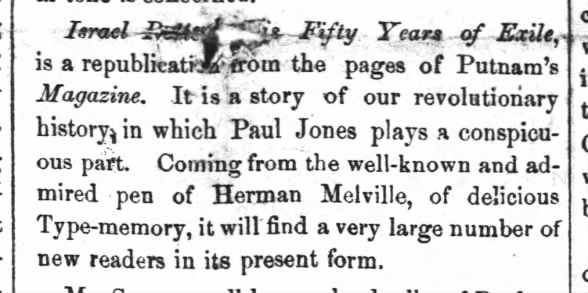
The book version of Israel Potter was briefly noticed by "Cosmos," the prolific New York correspondent of the Raleigh, North Carolina Southern Weekly Post. This item appeared in letter 87 dated March 17, 1855 and published on March 24, 1855 under the heading, "Metropolitan Correspondence." The Southern Weekly Post was owned by William Dewey Cooke, and co-edited by Cooke with James A. Waddell. That "Type" in "Type-Memory" is a pun on the title of Melville's first book Typee, or a typo for Typee, or both.
Israel Potter: His Fifty Years of Exile, is a republication from the pages of Putnam's Magazine. It is a story of our revolutionary history, in which Paul Jones plays a conspicuous part. Coming from the well-known and admired pen of Herman Melville, of delicious Type-memory, it will find a very large number of new readers in its present form.
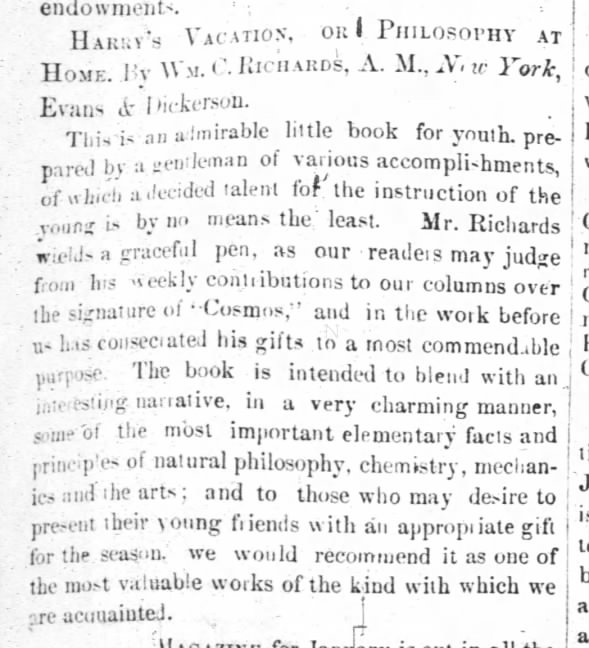
"This is an admirable little book for youth, prepared by a gentleman of various accomplishments, of which a decided talent for the instruction of youth is by no means the least. Mr. Richards wields a graceful pen, as our readers may judge from his weekly contributions to our columns over the signature of "Cosmos," and in the work before us has consecrated his gifts to a most commendable purpose...."
-- Southern Weekly Post, December 23, 1854.
10 Feb 1855, Sat Southern Weekly Post (Raleigh, North Carolina) Newspapers.com Born in London, William Carey Richards left England for the United States at the age of thirteen with his parents and siblings. The family resided in Hudson, New York for several years before moving south to Maryland and then further south to Georgia. As editor of Richards' Weekly Gazette, Richards favorably reviewed Mardi and Redburn. For the friendly reception of these and other of Melville's writings in Athens, Georgia and later Charleston, South Carolina, see the posts linked below:
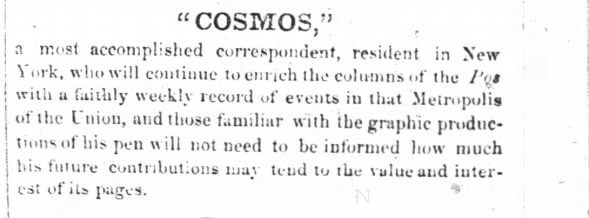
In 1852 William Carey Richards moved back north to New York City. From there, starting in May 1853, he faithfully contributed more than 100 numbered letters of "Metropolitan Correspondence" to the Southern Weekly Post over the signature "Cosmos." (Many lost, it would seem, the run of the Post on newspapers.com being incomplete in every year except 1854.) Before the Raleigh newspaper folded in November 1855, Richards found employment as a Baptist minister like his father.
Mid-1850's Melville riffs on "frank" as name and character-trait:
“Thank you for your frankness,” said Paul; “frank myself, I love to deal with a frank man. You, Doctor Franklin, are true and deep, and so you are frank.”
The sage sedately smiled, a queer incredulity just lurking in the corner of his mouth.
Paul's genuine frankness contrasts with the more calculating and ambiguous behavior displayed by Benjamin Franklin. Hennig Cohen has noted how Melville's wordplay on the "frank" in Franklin looks forward to the ironic naming of Frank Goodman, the confidence-man's confidence man:
99.9-11 frankness . . . frank man . . . Franklin . . . frank
Paul Jones appears to be nothing if not frank, though Franklin, who appears at times to be less so, listens to his words with a lurking "incredulity" (99.12). Melville is once more turning to account the suggestiveness of a personal name. He is also anticipating the significant name, Frank Goodman, of The Confidence-Man (Chap. 29) who at times seems less than frank.
In 1865 Philadelphia publisher T. B. Peterson reprinted Melville's historical romance of Israel Potter (1854-5) under a different title, The Refugee. Melville complained more than once about the unauthorized publication of his work. The author of Israel Potter formally and finally disavowed The Refugee in a letter to the editor of the New York World, published there on January 28, 1876. Zachary Turpin first located Melville's epistolary "Protest," as discussed in Turpin's March 2017 Leviathan article, Melville's Letter to the World.
Turpin cites relevant lists of Peterson titles including The Refugee that appeared in 1876 editions of novels by E.D.E.N. Southworth. Years before, in back of the 1857 edition of Southworth's Vivia; or, The Secret of Power, T. B. Peterson & Brothers advertised a forthcoming edition of Israel Potter with a different title: Fifty Years in Exile.
Similarly converting Melville's original subtitles to main titles, Peterson also promoted cheap editions of The Confidence-Man as "The Masquerade" and The Encantadas (recently collected in The Piazza Tales) as "The Enchanted Isles." All three apparently unauthorized titles were listed among "Works in Press by the Best Authors" in Peterson's edition of Vivia (Philadelphia, 1857) by Emma D. E. N. Southworth. None of these titles was actually published in 1857 or any other year, so far as I can tell.
Fifty years in Exile.
By Herman Melville, author of "Omoo," "Typee," etc. Complete in two volumes, paper cover, price $1.00; or in one volume, cloth, $1.25.
The Masquerade.
By Herman Melville, author "Typee," "Omoo," etc. Complete in two volumes, paper cover. Price $1.00; or in one vol., cloth, for $1.25.
The Enchanted Isles.
By Herman Melville, author of "Omoo," “Typee," etc. Complete in two volumes, paper cover. Price $1.00; or in one vol., cloth, for $1.25
It rained on the Fourth of July in 1836, but the patriotic citizens of Albany, New York "celebrated with an ardor which nothing could dampen" (Albany Argus, July 8, 1836). Festivities back then included traditional readings of the Declaration of Independence. At the Methodist church on Pearl Street, William Hun Fondey recited the Declaration "in an appropriate and effective manner." At the Second Presbyterian church, Gansevoort Melville, age 20, showed off his oratorical prowess for the Albany Young Men's Association.
... The day was also observed by the Young Mens' Association in this city. The exercises were in the Second Presbyterian church. The Declaration of Independence was read, and well read, by Mr. G. MELVILLE. The oration which we learn was a production creditable as well to the author as to the choice of the Association, was pronounced by JOHN DAVIS, esq. The members were out in great numbers with their badges and banner, and of themselves formed a large procession, exclusive of its citizens, with whom the Association continues to be, as it deserves, a favorite as it is a flourishing and valuable institution. --Albany Argus, July 8, 1836; found at GenealogyBank
Writing in 1849, Gansevoort's brother Herman Melville imagined the literary freedom Shakespeare might have enjoyed as a great American truth-teller, asserting that "the Declaration of Independence makes a difference."
For I hold it a verity, that even Shakespeare, was not a frank man to the uttermost. And, indeed, who in this intolerant Universe is, or can be? But the Declaration of Independence makes a difference. --letter to Evert A. Duyckinck, March 3, 1849
This liberating power in the Declaration of Independence would somehow give Melville the creative freedom he needed to write Moby-Dick (1851).
President Trump in his important July 3rd 2020 speech at Mount Rushmore rightly honored the "founding ideals" proclaimed and symbolized by the Declaration of Independence.
We will proclaim the ideals of the Declaration of Independence, and we will never surrender the spirit and the courage and the cause of July 4th, 1776.
Upon this ground, we will stand firm and unwavering. In the face of lies meant to divide us, demoralize us, and diminish us, we will show that the story of America unites us, inspires us, includes us all, and makes everyone free.
We must demand that our children are taught once again to see America as did Reverend Martin Luther King, when he said that the Founders had signed “a promissory note” to every future generation. Dr. King saw that the mission of justice required us to fully embrace our founding ideals. Those ideals are so important to us — the founding ideals. He called on his fellow citizens not to rip down their heritage, but to live up to their heritage. (Applause.)
Above all, our children, from every community, must be taught that to be American is to inherit the spirit of the most adventurous and confident people ever to walk the face of the Earth.
Americans are the people who pursued our Manifest Destiny across the ocean, into the uncharted wilderness, over the tallest mountains, and then into the skies and even into the stars.
We are the country of Andrew Jackson, Ulysses S. Grant, and Frederick Douglass. We are the land of Wild Bill Hickock and Buffalo Bill Cody. (Applause.) We are the nation that gave rise to the Wright Brothers, the Tuskegee Airmen — (applause) — Harriet Tubman, Clara Barton, Jesse Owens, George Patton — General George Patton — the great Louie Armstrong, Alan Shepard, Elvis Presley, and Mohammad Ali. (Applause.) And only America could have produced them all. (Applause.) No other place.
Somewhere Trump also exalted Mark Twain as the preeminent American story-teller. Wrongly there, as any real Melville aficionado can tell you. Nevertheless, the author of Israel Potter (originally presented in Putnam's magazine as A Fourth of July Story) would have felt the fitness of tributes to western legends like Wild Bill Hickock and Buffalo Bill Cody. According to Melville, "the Western spirit is, or will yet be (for not other is, or can be) the true American one."
Israel Potter, magazine version
Israel Potter, book version
"Though born in New England, he exhibited no trace of her character. He was frank, bluff, companionable as a Pagan, convivial, a Roman, hearty as a harvest. His spirit was essentially Western; and herein is his peculiar Americanism; for the Western spirit is, or will yet be (for no other is, or can be), the true American one." --Ethan Allen as described in Herman Melville's Israel Potter: His Fifty Years of Exile (1854-5)