Showing posts with label Melville and the Visual Arts. Show all posts

Saturday, February 3, 2024

The Arrotino, Knife-Grinder aka The Listening Slave, Melville's "carved Roman slave" in MOBY-DICK chapter 126

What famous classical sculpture does Herman Melville invoke in Moby-Dick Chapter 126, the Life-Buoy when he or his narrator Ishmael compares the rapt attentiveness displayed by startled sailors to that of "the carved Roman slave"?
At last, when the ship drew near to the outskirts, as it were, of the Equatorial fishing-ground, and in the deep darkness that goes before the dawn, was sailing by a cluster of rocky islets; the watch—then headed by Flask—was startled by a cry so plaintively wild and unearthly—like half-articulated wailings of the ghosts of all Herod’s murdered Innocents—that one and all, they started from their reveries, and for the space of some moments stood, or sat, or leaned all transfixedly listening, like the carved Roman slave, while that wild cry remained within hearing. 

-- Moby-Dick Chapter 126, The Life-Buoy

Melville's use here of the definite article (the not a) indicates one specific work, evidently a marble statue of some kind, or bust, although the object is not further particularized. I take this work of art to be real and pretty well-known, famous enough that Melville could expect readers to recognize it with minimal descriptive fussing on his part. The biggest clue to the thing he means is conveyed in the main point of comparison between sailors and the marble slave, their shared attitude as rapt listeners. As Ishmael relates, upon hearing an eerie cry in the dark, "plaintively wild and unearthly," the whale-men on watch froze like statues. For a time they remained stationary, "transfixedly listening, like the carved Roman slave." Via Ishmael's simile, Melville thus compares the crew's motionless bewitchment to that exhibited by an apparently familiar work of visual art. Although unnamed, whichever "carved Roman slave" Melville had in mind is introduced in the Life-Buoy chapter of Moby-Dick as a model of eternally attentive listening.

In his end-notes for the 1972 Penguin edition of Moby-Dick, Harold Beaver suggested that Melville's "carved Roman slave" might designate "the 'Dying Gaul' often called the 'Dying Gladiator.'" Online, the Melville Electronic Library offers a textual note that makes similarly tentative connections to the famous Dying Gaul or Dying Gladiator in the Capitoline Museum. In earlier writings (Mardi and White-Jacket) Melville had referred specifically to the Dying Gladiator, so clearly he knew of it. But the sculpture alluded to in Moby-Dick has a characteristic, fixed expression of listening (Melville's word) that the suffering figure of the Gaul manifestly lacks. Mortally wounded, the fallen warrior looks downward, however intently. In his sad condition the Dying Gaul or Gladiator is always dying, rather than listening. 

The far more likely candidate for Melville's "carved Roman slave" is the well-known sculpture at the Uffizi Galleries in Florence called the Arrotino or Knife-Grinder, also known as "The Scythian." Both the statue and a place Melville might have seen it in some form before writing Moby-Dick have been positively identified by Hershel Parker in a footnote to Chapter 126 for the 3rd Norton Critical Edition of Moby-Dick, on page 376:

"In London, Melville could have seen a cast of this famous statue, which is in the Tribune of the Uffizi Museum, in Florence, Italy."

Melville had visited London and the Continent in 1849-1850.

The sculpture is well described by Cristiana Barandoni on the Uffizi Galleries website:

The sculpture, sold by the Mignanelli family to Cardinal Ferdinando de’ Medici, and was bought to Florence in 1677 and placed on display in the Tribune, where it can still be seen. It is known as the “Arrotino” and shows a kneeling man who is sharpening a knife on a stone. The man, who has long eyebrows, recessed pupils and swollen eyelids, is looking upwards, his forehead marked with deep frown lines. The semi-naked figure, wearing a light cloak over his right shoulder, was initially thought to be a Scythian, or even a royal barber plotting against the state. In the 16th century, the idea was put forward that the sculpture could be part of a group depicting the flaying of Marsyas. The figure was therefore identified as a slave, preparing the blade used to torture the satyr. 

 https://www.uffizi.it/en/artworks/knife-grinder-tribune

Joseph Addison, in frequently reprinted Remarks on Several Parts of Italy, influentially described the Arrotino as "the Roman Slave whetting his Knife and listening." Then as now, the sculpture was exhibited in the Tribune, Uffizi Gallery with other world-famous works including the celebrated Medici Venus, Dancing Faun or Dancing Satyr, and Wrestlers:

In the same Chamber is the Roman Slave whetting his Knife and listening, which from the Shoulders upward is incomparable. The two Wrestlers are in the same Room.

Guidebooks of Melville's time noted that the Arrotino was 

"called also the Knife-grinder and the Listening Slave
-- Italy by Josiah Conder Volume 3 (London, 1834) page 373.

Melville and his contemporary readers took the sculpted Arrotino for a "Roman slave," as Addison had called him. In England and also America the carved figure was called "The Listening Slave." Considered together with "Roman slave," this formerly popular but now forgotten name for the Knife-Grinder perfectly explains Melville's choice of words in the Life-Buoy chapter, when Ishmael depicts startled sailors as "transfixedly listening" and then compares them in that regard to the statue of a Roman slave known as 

THE LISTENING SLAVE.

Shown below, the figure of "The Listening Slave" as illustrated on the front page of the Saturday Magazine Supplement in February 1842:

The Listening Slave 
(From the Antique Statue in the Royal Gallery of Florence.)

Architect James Hakewill noted the popularity of the "Listening Slave" title in England: 

... the Arrotino, or the Grinder, commonly known in England under the name of the Listening Slave, has been supposed by some to have been raised in honour of a slave who detected the secret machinations of the Catilinarian conspiracy. Nothing however is really known relative to the original design of the artist, but its taste and execution are such as seem worthy of the best sculptors of Greece.  -- A Picturesque Tour of Italy  

In New York City, the National Academy of Design owned a reproduction they called "The Listening Slave," listed as #166 in the 1846 Catalogue of Statues, Busts, Studies, Etc. Forming the Collection of the Antique School.

If he never saw a copy of "The Listening Slave" in Manhattan, or London, Melville eventually got to view the original in Florence. At the Uffizi on March 26, 1857 Melville was "not pleased with the Venus de Medici" but "very much astonished at the Wrestlers" he would have seen in the Tribune gallery. He must have examined the Arrotino there, too, one of numerous other works of art he regarded as "Idle to enumerate" after repeated tours of the Uffizi Galleries. Documented in Melville's Journal of a Visit to Europe and the Levant, edited by Howard C. Horsford (Princeton University Press, 1955) page 218; also the 1989 Northwestern-Newberry edition of Melville's Journals, edited by Horsford with Lynn Horth, page 115.

Tribuna uffizi
Whether or not Melville ever read John Thomas James on Italian sculpture, the effect of Ishmael's freezing sailors in a momentary state of "transfixedly listening" like the Listening Slave accords well with the aesthetic of "picturesqueness" as the Rev. James developed it in The Italian Schools of Painting; with Observations on the present State of the Art (London, 1820): 
"As to picturesqueness of character, or that quality which is best suited to a picture, there has been so much already written, and though not very conclusively, yet so well, on the subject, that it is a fearful matter to touch upon it again. One point, however, may be adverted to, as being that, which will be found in a great degree conducive to this end. If we investigate with attention the works of the ancient sculptors, we shall discover a peculiarity in their practice, which has not been generally noticed, and this regards the time of action selected by them as fittest for their purpose. It is never the middle of an action that is represented, but in every example a momentary pause, or suspension of motion: and this, it will be seen, may be so chosen, as to give the fullest perception of all that has immediately preceded, or, in other words, to tell the story. Thus the Apollo Belvedere is not exhibited as if in the act of shooting; but the arrow is already gone, and he rests for a moment, following its flight with his eye: even the figure of the Laocoon is not represented actually in motion, but the moment given is the end of one of the paroxysms of his agony, when he is for a while fixed: the same may be observed in the fighting gladiator, in the listening slave, and all the greatest works of antiquity. This principle may be applied most strictly also to painting, and we shall observe the same momentary pause of action to have been purposely selected by all the great masters of design. A figure of Raffael, or M. Angelo, &c. is never drawn as if actually moving; but the point taken is during a momentary stagnation of action, or while they are for an instant rapt, if the phrase may be allowed."
https://archive.org/details/gri_33125009319647/page/n47/mode/2up

In the manner of Raffael, Michelangelo, or the unknown sculptor who made the carved Roman slave variously called the Arrotino, Knife-Grinder, or Listening Slave, Melville drew his whalemen during a pause when, hearing the crying of young seals nearby, probably, they were (to apply the formulation of ideal picturesqueness offered in 1820 by J. T. James) "for an instant rapt."


Saturday, April 16, 2022

Peter Wagner and others on David's THE OATH OF THE HORATII and MOBY-DICK chapter 36

The noblest and most promising attempt at scholarship in the March 2022 Leviathan is the essay by Elizabeth Adams on the likely influence of David's famous painting on the theatrical oath-taking scene in Moby-Dick, chapter 36

... Melville's oath-taking vignette in "The Quarter-Deck"—a scene emphasized in Huston's film but otherwise overlooked by scholarship. I argue that this oath-taking scene proves a previously unnoted ekphrastic passage in which Melville draws from Jacques-Louis David's well-known Neoclassical history painting Oath of the Horatii (1784) in order to depict Ahab's induction of the three mates, and then the three harpooners, into his quest for revenge upon the white whale.

Citation: 

Adams, Elizabeth. "The Oath of the PequodMoby-Dick, Jacques-Louis David's Oath of the Horatii, and the Aesthetic of the Distinct." Leviathan 24, no. 1 (2022): pages 3-23 at page 4.  muse.jhu.edu/article/852658.

It's a great connection, here provoking an interesting take from Adams on Melville's "aesthetic of the distinct." Which to me does not easily or obviously reduce down to realism, but no matter. Once you see it, the painting wonderfully illuminates the Quarter-Deck scene in Moby-Dick. For a start. While worthy of closer examination, certainly, Melville's debt to David's Oath of the Horatii has not exactly been ignored or "unnoted" in previous scholarship. Indeed, a footnote in the 2nd Norton Critical Edition (listed without comment by Adams among Works Cited) concisely points to the painting and the medium in which Melville would most likely have encountered it: 

2nd Norton Critical Edition (2002), ed. Hershel Parker and Harrison Hayford, page 141:
"Melville knew this ritual from Shakespeare (Hamlet makes Horatio and Marcellus swear on his sword in Hamlet, 1.5.146), but he could have seen it elsewhere, perhaps in a print of the 1784 painting, The Oath of the Horatii by Jacques Louis David (1748-1825).
3rd Norton Critical Edition (2017), ed. Hershel Parker, page 134:

"Melville knew an oath-taking ritual from Shakespeare (Hamlet makes Horatio and Marcellus swear on his sword in Hamlet, 1.5.146), but he could have seen it elsewhere, perhaps in a print of Jacques Louis David's 1784 painting, The Oath of the Horatii.

 https://wwnorton.com/books/9780393285000

Unfortunately, Adams has also overlooked prior and directly relevant work by Peter Wagner on David's painting as exemplary "iconotext" in Moby-Dick. Engaging the highest priests of postmodern lit-crit AND the Melville Society, Wagner has written and published on David's famous painting and Melville's famous oath-taking scene in English:

In Herman Melville's mighty Moby-Dick, or, The Whale (1851), art and artists constantly interfere in the text--and so do the fictional readers or observers of art works... One of the more intriguing examples occurs when, in Chapter 36, Ahab first nails the golden doubloon to the mast, and then, as the English of Shakespeare and the Elizabethan revenge tragedy blends with the powerful prose of the Bible and Milton's lofty verse (and many other pre-texts), forces his crew to unite in an "indissoluble league." ... The scene is obviously inspired by two major pretexts (or subtexts), one verbal and the other visual: Shakespeare's Hamlet and Jacques Louis David's Le serment des Horaces (colour plate I). David's painting--and its highly ambiguous, contradictory, socio-political implications--are integrated into Melville's text. The dramatic scene relies for its meaning on the reading of David's canvas and all the sources behind it, including the classical story of the Horatius family...." (9-10)

 "Let us now leave ekphrasis for a while and turn to the second provocative term, iconotext, which I applied to the implicit allusion to David's Le serment des Horaces in Chapter 36 of Moby-Dick." (15)

... footnote 39:  "... The study of the role of art works in Melville's novel is, as can be expected, still at the "correspondences of the arts" stage, with most critical works exploring text and paintings (evoked in the text) apart. See, for instance, Sten: Savage Eye, and Wallace: Melville and Turner, which are, alas, no exception to the rule." (15)

Peter Wagner, "Introduction: Ekphrasis, Iconotexts, and Intermediality -- the State(s) of the Art(s)" in Icons - Texts - Iconotexts: Essays on Ekphrasis and Intermediality, ed. Peter Wagner. Berlin: Walter de Gruyter, 1996, pages 9-10 and 15.

https://books.google.com/books?id=VtsgAAAAQBAJ&pg=PA9&dq#v=onepage&q&f=false

and German, a whole chapter on the subject in German:

Hans-Peter Wagner, "Herman Melvilles Moby-Dick und Jacques-Louis Davids  Le serment des Horaces" in Literaturen der Welt: Zugänge, Modelle, Analysen eines Konzepts im Übergang (pages 269-284). Ed. Patricia A Gwozdz and Markus A Lenz. Heidelberg: Universitätsverlag Winter, 2018.

 https://www.winter-verlag.de/en/detail/978-3-8253-6794-7/Gwozdz_Lenz_Hg_Literaturen_der_Welt/

Wagner credits Harold Beaver for being the first commentator to identify David's painting as the iconographic source for the oath-taking scene, citing the 1972 Penguin edition of Moby-Dick.

Wagner's use of the "implicit allusion" to The Oath of the Horatii in Moby-Dick to exemplify the term iconotext is quoted by Thomas F. Heck in the first chapter of Picturing Performance: The Iconography of the Performing Arts in Concept and Practice (University of Rochester Press, 1999) at page 37.

https://books.google.com/books?id=qI-pOaRFcbUC&pg=PA37&lpg=PA37&dq#v=onepage&q&f=false

Here in the blogosphere, Charles Matthews called attention to David's painting in his discussion of Moby-Dick chapter 36, back in 2010:

Then he [Ahab] has the three mates extend their lances and "he grasped the three level, radiating lances at their crossed centre." He glances "intently from Starbuck to Stubb; from Stubb to Flask. It seemed as though, by some nameless, interior volition, he would fain have shocked them into the same fiery emotion accumulated within the Leyden jar of his own magnetic life." The image is somewhat reminiscent of Jacques-Louis David's painting Oath of the Horatii:

But the effect isn't what Ahab hopes for: "Stubb and Flask looked sideways from him; the honest eye of Starbuck fell downright." Ahab resigns himself that if they had taken "the full-forced shock, then mine own electric thing, that had perhaps expired from out me. Perhaps, too, it would have dropped ye dead." He orders the three mates to act as "cupbearers to my three pagan kinsmen there -- yon three most honorable gentlemen and noblemen, my valiant harpooneers." He has the harpooners detach the metal heads from their harpoons. "Forthwith, slowly going from one officer to the other, he brimmed the harpoon sockets with the fiery waters from the pewter." Each officer gives the harpoon-cups to his harpooner.

"Drink, ye harpooneers; drink and swear, ye men that man the deathful whaleboat's bow -- Death to Moby Dick! God hunt us all, if we do not hunt Moby Dick to his death!" The long, barbed steel goblets were lifted; and to cries and maledictions against the white whale, the spirits were simultaneously quaffed down with a hiss. Starbuck paled, and turned, and shivered.

It's a great, theatrical, melodramatic scene.  

-- Charles Matthews, "The Journal of a Compulsive Reader" 6. Moby-Dick, by Herman Melville, pp. 129-165. Link below:

http://tenpagesormore.blogspot.com/2010/12/6-moby-dick-by-herman-melville-pp-129.html

Bottom line: fine find, well deserving of further exploration, but not really "overlooked" or "unnoted."

Thursday, January 13, 2022

Melville in the Middle: two wives, fine paintings, fake antiques, Frost's daughter and THE GRAND DAME at Arrowhead


Some facts of the historical mystery documented if not solved herein would be hard to swallow in fiction. The crazy-but-true plot involves Fine Art, admirable female entrepreneurs, fake antiques, multiple wives, a consummate New York confidence-man, the daughter of Robert Frost and an unattainable French Dame with Herman Melville in the middle of it all.... 

Still with me? OK good, buckle up.

Hardcore Melvilliana fans might remember Leonora O' Herron, the respected Pittsfield antiques dealer who conducted the estate sale at Arrowhead in the summer of 1927, after Herman Melville's nieces sold it to Robert E. Kimball. Along with all the usual household furnishings, the 1927 sale featured unspecified "books from the library of Herman Melville," as previously shown on Melvilliana:

 https://melvilliana.blogspot.com/2019/08/friend-of-bessie-remembers-herman.html

Before the sale, Miss O'Herron had been working on the appraisal of more unique and valuable items, among which was a portrait in oil known locally as "The Grand Dame." A shady New York dealer named Wilbur J. Cooke tried to buy the alluring work when a friend of Miss O'Herron was minding the shop. The well-meaning friend who mistakenly sold The Grand Dame to Cooke for fifty dollars was Robert Frost's daughter Lesley W. Frost, then proprietor of the Open Book Shop in Pittsfield. For her part Miss Frost was innocent of any fraud, and too good to wonder why Mr. Cooke had to borrow the down payment of $5. 

When she found out what had happened, Miss O'Herron promptly returned the five bucks, whereupon Cooke took her to court. Verdict: No Sale. A few years later the New York dealer was exposed as a crook after selling a lot of fake Lowestoft china to a Boston collector. The gifted swindler dealt in fake paintings too, and sold at least one phony portrait of George Washington as the work of Gilbert Stuart. Acknowledged in the papers as "one of the cleverest art racketeers on record" (New York Daily News, April 2, 1933) Wilbur J. Cooke sought refuge in various mental hospitals in New York State.

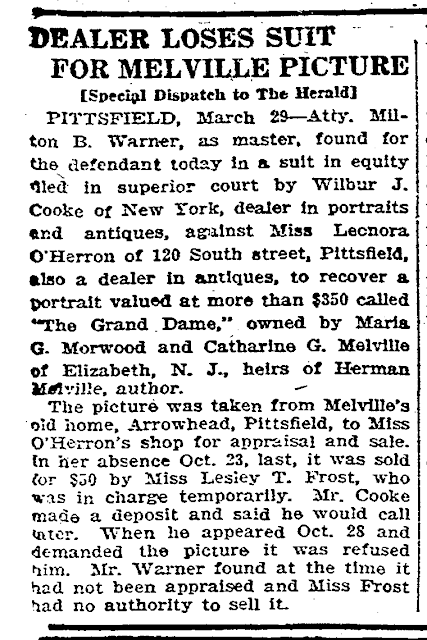
DEALER LOSES SUIT FOR MELVILLE'S PICTURE
[Special Dispatch to The Herald]

PITTSFIELD, March 29 -- Atty. Milton B. Warner, as master, found for the defendant today in a suit in equity filed in superior court by Wilbur J. Cooke of New York, dealer in portraits and antiques, against Miss Leonora O'Herron of 120 South street, Pittsfield, also a dealer in antiques, to recover a portrait valued at more than $350 called "The Grand Dame," owned by Maria G. Morewood and Catharine G. Melville of Elizabeth, N. J., heirs of Herman Melville, author.

The picture was taken from Melville's old home, Arrowhead, Pittsfield, to Miss O'Herron's shop for appraisal and sale. In her absence Oct. 23, last, it was sold for $50 by Miss Lesley T. Frost, who was in charge temporarily. Mr. Cooke made a deposit and said he would call later. When he appeared Oct. 28 and demanded the picture it was refused him. Mr. Warner found at the time it had not been appraised and Miss Frost had no authority to sell it. 

--Boston Herald, March 30, 1927.

A recap in the Berkshire Evening Eagle of March 2, 1933 stated that Allan Melville's daughters "had refused offers of $500" for the painting. Adjusting just for inflation that's $8,000 today, at least, irrespective of fluctuations in the market for rare art. Who was the woman portrayed as "The Grand Dame" in this unusual and pricey work? Berkshire journalists dubiously identified the subject as "the step mother of one of Herman Melville's wives." 

"As a matter of interest, Attorney Warner asked about the history of the portrait in question. Herman Melville, the author of "Moby Dick," who lived at Arrowhead, was twice married and the portrait depicts a stepmother of one of his wives. On account of its having always hung in the Melville, house, now owned by his nieces, Mrs. William Morewood and Miss Katherine Melville, it has a distinct Melville association, although not a portrait of a member of the Melville family."  -- The Berkshire County Eagle, December 10, 1926. 
"The painting was of the step mother of one of Herman Melville's wives and was taken from "Arrowhead," home of the famous writer of sea stories on Holmes road."
-- Berkshire County Eagle, April 6, 1927 

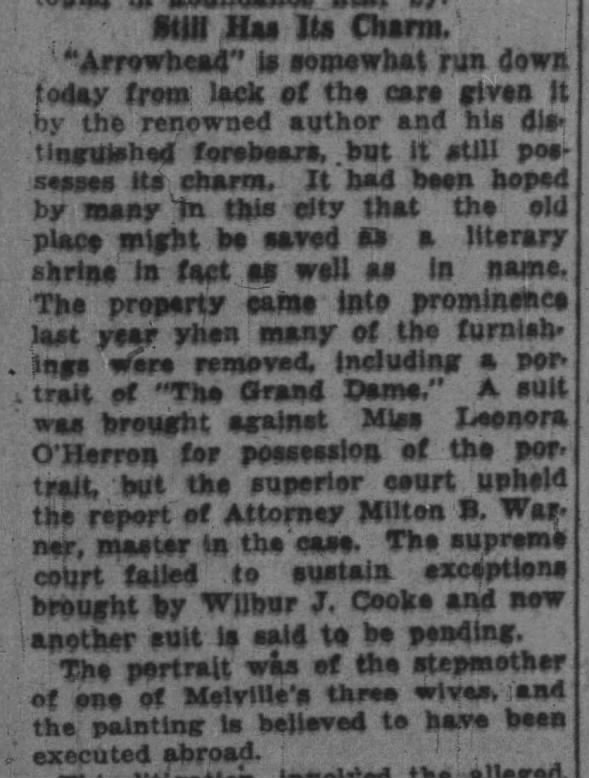
More generously, if not accurately or helpfully, a later report in the same newspaper gave Herman Melville three wives: 

"The portrait was of the stepmother of one of Melville's three wives, and the painting is believed to have been executed abroad."  -- Berkshire County Eagle, July 14, 1927.
14 Jul 1927, Thu The Berkshire Eagle (Pittsfield, Massachusetts) Newspapers.com
Not counting Fayaway in Typee

Fayaway

Melville had only one wife we know of, Elizabeth Shaw Melville aka "Lizzie." Her step-mother was Hope Savage Shaw. Whose portrait, if they owned one, presumably would have gone with Lizzie and Herman when they left Pittsfield. Instead of Melville's mother-in-law the second Mrs. Lemuel Shaw, a more likely family connection might be Catherine Van Schaick Gansevoort (1752 - 1830), Herman Melville's maternal grandmother. 

The Arrowhead Grand Dame was certainly NOT the portrait by Ezra Ames inherited by Peter Gansevoort Jr. and now owned by the Albany Institute of History & Art, according to the Smithsonian Catalog of American Portraits.
Mrs. Peter Gansevoort (Catherina Van Schaick)

However, companion portraits of Catherine Van Schaick Gansevoort and Peter Gansevoort were in fact donated in 1985 to the Berkshire County Historical Society. Formerly, as reported in the Berkshire Eagle on December 13, 1985, both portraits "hung at Arrowhead for a number of years." Maybe Herman's maternal grandmother Catherine was the mysterious and elusive Grand Dame.

Then again, misinformed newspaper accounts of the "Grand Dame" dispute in 1926-7 appear to confuse the famous author Herman Melville with his younger brother Allan Melville, who acquired the "Arrowhead" home in 1863 when Herman and family left Pittsfield MA and moved back to New York City. Mrs. Morewood and Miss Katherine Melville, owners of Arrowhead in 1927, were daughters of Allan and his first wife Sophia Eliza Thurston Melville. ALLAN Melville not Herman had two wives. Allan's second wife Jane Louise Dempsey Melville was the stepmother of Allan's daughters, Herman's nieces. The mother of their stepmother Jane was was Jane Ellis, wife of Peter Dempsey. Was Jane Ellis Dempsey the original Grand Dame

Again maybe, although in addition to the Melville family tie, other conditions in the newspaper descriptions require the portrait-sitter herself to have been a stepmother, ideally one with French connections to justify the aristocratic title and foreign origin ascribed to The Grand Dame,
"believed to have been executed abroad."
Here's another more promising angle. Besides Herman's younger brother Allan, another Melville with multiple wives was their uncle Thomas Melvill, Jr. The first wife of Major Thomas Melvill Jr was "Fanny" Fleury aka Françoise Raymonde Eulogue Marie des Doulouers "Fanny" Lamé-Fleury. Aka Françoise Lamé-Fleury. Call her Fanny. Thomas Jr. and Fanny got married in 1802, in Paris. As avowed in writing by Charlotte Hoadley (Herman Melville's niece), the Melville family steadfastly regarded this Fanny as "an adopted daughter of Madame Recamier" and held "that she was married to Thomas Melville from Madame Recamier's salon."


Voilà! Family tradition thus qualifies Madame Récamier as the stepmother of "one of Herman Thomas Melville's wives." In this view of the case, Berkshire commentators in 1926-7 wrongly assigned the first wife of Thomas Melville, Jr. to his famous nephew Herman. Let's say The Grand Dame depicted the celebrated French beauty and Salon hostess Juliette Récamier, That would explain the Frenchified title and supposedly "foreign" provenance of our controversial and much coveted painting.

Gros Jean Antoine Portrait of Mademoiselle Recamier

Copies of famous paintings of Madame Récamier by François Gérard and Jacques-Louis David are listed in a miscellaneous inventory made by Herman's wife Elizabeth Shaw Melville. From the memoranda of Elizabeth Shaw Melville, transcribed by Merton M. Sealts, Jr. in The Early Lives of Melville (University of Wisconsin Press, 1974) pages 167-177 at 176:

<Madam Recamier by Gerard-costume of Consulate-bare feet and neck on a Roman chair in a niche beneath a pillared arch-Same by David represents her leaning back on a rustic seat>

In a footnote Sealts points out that Elizabeth Melville's entry on images of "Madam Recamier" has been canceled in pencil. The crossed-out listing could mean these items were sold or bequeathed after Herman Melville's death in 1891, as John Bryant guesses in the first volume of Herman Melville: A Half Known Life (Wiley-Blackwell, 2021). Not that either of these items is THE Grand Dame, necessarily. They seem to be prints, whereas contemporary newspaper accounts specifically describe The Grand Dame as an oil painting. Nevertheless, the references to well-known paintings by Gerard and David in Elizabeth Melville's memoranda certainly attest to her familiarity with popular images of Madame Récamier. And her husband's, presumably.

What about Wilbur J. Cooke, brilliant mastermind of a notorious and doubtlessly profitable fake-antiques ring? Here are a few more facts in that matter... Formerly he lived in Philadelphia. There, as a young man, his impressive physique earned him work as an artist's model, according to one report that circulated widely after his first marriage. (More on that below.) Cooke was indeed his real name, although Boston authorities accused him of employing at least one alias, H. W. Welch or Welsh. Born William Wilbur James Cooke on October 21, 1884 to Maryette or Mariette Woodbeck Cooke (1847-1919) and Elias Henry Cooke (1845-1899). Cooke died of heart disease on December 8, 1955 in Middletown, New York. How he landed there may be the craziest part of the whole story. 

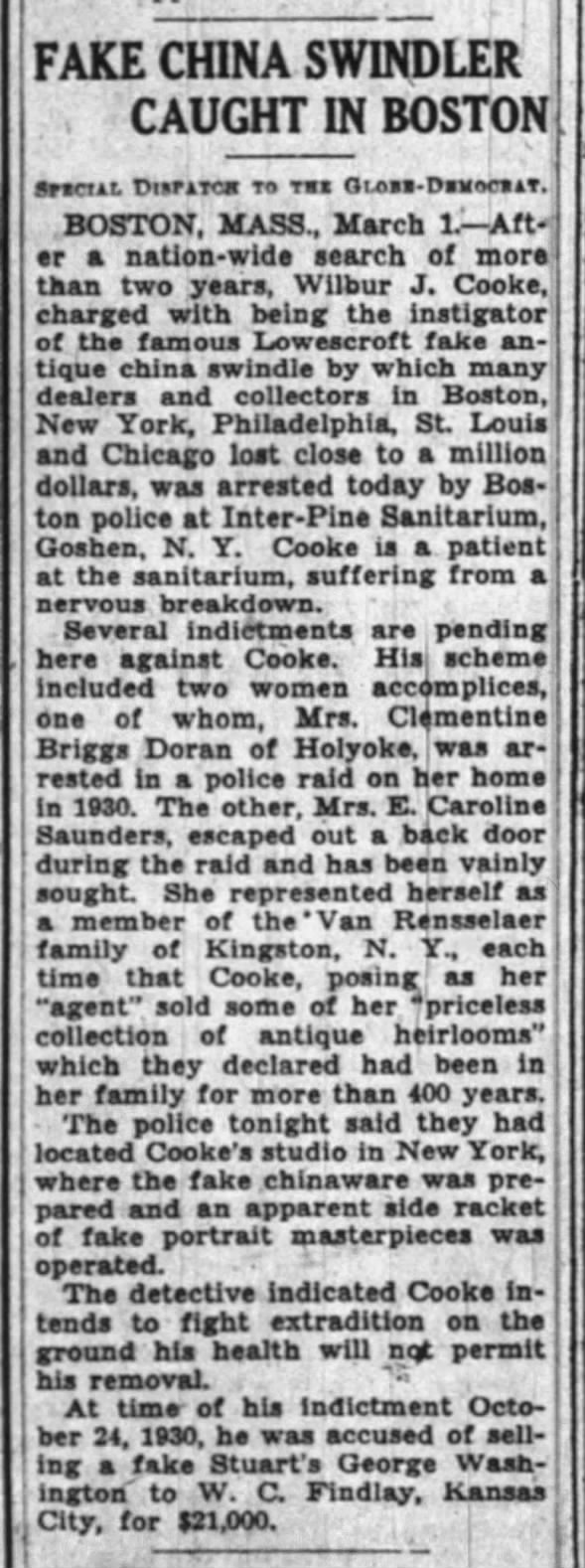
Boston cops doggedly looked for and, after years of searching, finally found Wilbur J. Cooke at Interpines sanitarium, a mental hospital in Goshen, New York. Soon as they learned of his whereabouts, the police issued a warrant for his arrest and extradition to Massachusetts. 
Because Supreme Court Justice Graham Witschief could find no evidence that gray-haired, dreamy-eyed Wilbur J. Cooke, alleged swindler and fugitive from Massachusetts' justice, is insane, he refused to grant appointment of a lunacy commission when application was made before him in a special term at Newburgh yesterday.

Cooke, who was brought into court on a writ of habeus corpus, was remanded to the Goshen County jail until next Friday, when his attorney, Charles A. White, hopes to present evidence to warrant the appointment of a commission.

Cooke has been a patient at Interpines Sanitarium in Goshen for a year, unknown to Massachusetts police, who have been on his trail.  -- Newburgh, NY Beacon News, March 11, 1933; found on fultonhistory.com

02 Mar 1933, Thu St. Louis Globe-Democrat (St. Louis, Missouri) Newspapers.com

Incredible as it seems, Cooke managed to avoid criminal charges and extradition to Massachusetts. 

GOSHEN -- Wilbur J. Cooke, arrested at Interpines here yesterday as a fugitive from justice at request of the Boston Police Department sat in a hospital cell in the county jail today attired in pajamas and a lounging robe and working a jig saw puzzle while all concerned awaited the next move....

 ... The prisoner has been talkative in jail and has seemed to prefer religion as a topic of conversation. Pajamas, a lounging robe, and slippers were brought to the jail by an attendant at the sanatorium.  -- Middletown Times Herald, March 3, 1933.

In the last hour, literally, an influential sister, Emma Cooke Chase of Monticello, helped persuade a judge to find him insane after all. Wilbur Cooke's official medical diagnosis, made by two sanitarium doctors (Frederick W. Seward Jr. and Clarence A. Porter), was dementia praecox, premature or "precocious madness." Instead of enduring a trial and serious prison time for larceny, he got legally committed to the State Homeopathic Hospital at Middletown, New York. 

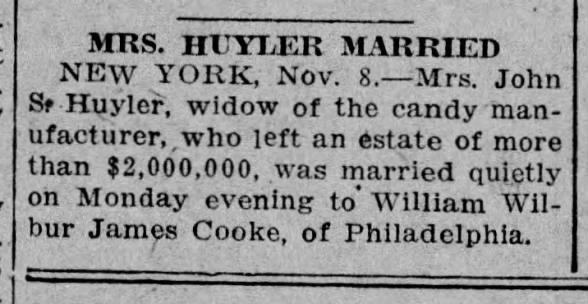
In yet another twist, it turned out that Wilbur J. Cooke's second wife was a very wealthy lady. 

09 Nov 1916, Thu Reading Times (Reading, Pennsylvania) Newspapers.com

The second wife of William Wilbur James Cooke died in late November 1933. Mrs. Rosa F. Huyler Cooke willed her estate to husband Wilbur and two sons from her previous marriage to candy maker John S. Huyler. Years later, a New York jury awarded a portion of Wilbur's inheritance, $50,000 plus $20,000 interest, to Clinton I. Nash, one of the Boston art collectors whom Cooke had defrauded (Middletown Times Herald, April 9, 1937). Wilbur still resided at the State Hospital in Middletown. 

04 Dec 1933, Mon Middletown Times Herald (Middletown, New York) Newspapers.com
In case you're wondering, Cooke had married suspiciously well the first time around, too. Born in 1842, Jane F. Levick Jackson, daughter of Quaker diarist and abolitionist Samuel J. Levick, was actually 68 when she rather unexpectedly married young and good-looking William W. J. Cooke, then described as "an artist's model, big, broad-shouldered, and 25" (Washington Post, October 19, 1910; reprinting an article in the Philadelphia North American in which Cooke's bride was alleged to be 77 years old). Jane L. Jackson Cooke died four years later in 1914; and two years after that Cooke wedded the former Mrs. John S. Huyler.

When Wilbur J. Cooke was first apprehended at Interpines in Goshen, NY the Berkshire Eagle eagerly rehearsed the great Pittsfield drama surrounding The Grand Dame, affirming by the way that the "picture" once "had belonged to the late Herman Melville."
Cooke is remembered in Pittsfield for his suit against Miss Leonora O'Herron, proprietor of an antique shop on South Street. In Miss O'Herron's absence, a portrait was sold, by mistake, to his agent by a volunteer assistant, Mrs. Leslie Frost Francis. She was unaware of the fact that the picture had been left by the owners who had refused offers of $500 for it.

The picture had belonged to the late Herman Melville, the author, and was owned by his heirs. Cooke's agents bought the picture for $50 and paid $5 down, getting a receipt but leaving the picture pending payment in full. When Miss O'Herron returned his deposit and refused to sell the picture, Cooke brought suit, the case being tried by attorney Milton B. Warner as master. Mrs. Doran was one of Cooke's witnesses at the trial. Cooke lost and appealed to the superior court, but the case was dropped before coming to trial.

The Morewood family in New York, owners of the picture, decided to keep it and still have it in their possession.  -- Berkshire Evening Eagle, March 2, 1933

Who got the Morewoods' Grand Dame and where is she now? 


Friday, August 2, 2019

Books autographed by Melville, listed in early Anderson catalogues


Auction catalogues of John Anderson, Jr. in the year 1900 (Numbers 4 and 14) offer two books at some time owned by Herman Melville: The Arts and Artists by James Elmes, 3 vols. (London, 1825); and Mysteries of Corpus Christi, with translations of sacramental Autos (Belshazzar's Feast and The Divine Philothea, plus the first scene of The Poison and the Antidote) from the Spanish of Pedro Calderón de la Barca by Denis Florence MacCarthy (Dublin, 1867). Each of these four volumes has the signature of Herman Melville, according to the catalogue descriptions transcribed below.

The 1867 MacCarthy translation is explicitly described as "From library of Herman Melville." As previously known, Melville owned and annotated Three Dramas of Calderón (Dublin, 1870), also translated by Denis F. MacCarthy. The 1870 volume of Calderón is Sealts Number 114, listed thus in The Online Catalog of Books and Documents Owned, Borrowed and Consulted by Herman Melville at the great Melville's Marginalia Online.

Lot 67 in the Anderson Catalogue of Books, etc. No. 4, For Sale by Auction on Friday, February 16, 1900 is the 1825 London edition of The Arts and Artists by James Elmes, in three volumes:


"67. ELMES (JAS.) The Arts and Artists: or, Anecdotes and Relics of the Schools of Painting, Sculpture and Architecture. Portraits and vignettes. 3 vols. 18mo, uncut. Lond. 1825
          Autograph of Herman Melville in each volume. Written with pencil."
<https://hdl.handle.net/2027/hvd.hnmsyh?urlappend=%3Bseq=72>
Links below are for general reference and further study. Harvard has multiple copies of each volume in the three-volume set of Elmes's The Arts and Artists, Google-digitized and accessible online courtesy of Hathi Trust Digital Library. Also available via Google Books:
Lot 323 in the Anderson Catalog of An interesting assortment of Books and Pamphlets No. 14, For Sale By Action over two days in 1900, April 11 (Lots 1-260) and April 12 (Lots 261-end), is Denis F. MacCarthy, Mysteries of Corpus Christi (Dublin, 1867):


"323. MYSTERIES OF CORPUS CHRISTI, from the Spanish, by Denis F. MacCarthy. 12mo. Dublin, 1867.  From library of Herman Melville and contains his autograph."
 <https://hdl.handle.net/2027/hvd.hnmsyh?urlappend=%3Bseq=302>
Harvard University has the 1867 translation by Denis Florence MacCarthy from the Spanish [of Calderón de la Barca], originally the gift of James Russell Lowell and now available online courtesy of Hathi Trust Digital Library; and the Internet Archive:


A different copy of the same title via Google Books:
For essential background, especially on John Anderson, Jr.:
  • Merton M. Sealts, Jr., Pursuing Melville, 1940-1980 (University of Wisconsin Press, 1982), especially Part II, "A Correspondence with Charles Olson," pages 106-107 and 144-147.
  • Oscar Wegelin, "Herman Melville as I Recall Him," The Colophon Vol. 1, New Series, No. 1 (Summer 1935), pages 21-24; reprinted in Steven Olsen-Smith, ed., Melville in His Own Time (University of Iowa Press, 2015), pages 148-151. 
Related posts:

Thursday, April 5, 2018

The Teniers of American poets

David Teniers II - A pastoral landscape with a herdsman playing a pipe near a waterfall

Alfred Billings Street, again. Charles Fenno Hoffman called Albany's forgotten poet Alfred B. Street "the Teniers of American poets" in the short lived Excelsior. In the same vein, reviewing the same 1845 volume The Poems of Alfred B. Street, Henry T. Tuckerman in the United States Magazine and Democratic Review praised his Albany friend as "a true Flemish painter." So then: two friendly critics of Alfred B. Street's 1845 Poems, both of whom would become friends of Melville's, compared Street and his authentic verse descriptions of nature to Flemish painters and their style of genre painting --thirty years before Melville likened Street's poem The Old Garden to
"a flower-and-fruit piece by some mellow old Fleming." --Herman Melville's Correspondence, ed. Lynn Horth (Evanston and Chicago: Northwestern University Press and The Newberrry Library, 1993), page 463.
Carstian Luyckx - Still Life Of A Basket Of Fruit, Flowers In A Gilt Vase, A Nautilus Shell And Other Objects On A Draped Table Near An Open Window


Hewet's Excelsior and New York Illustrated Times was conceived as an American version of the London Illustrated Times. Editor Charles Fenno Hoffman's generous (though qualified) estimation of Street's poetry was reprinted in the March 1846 Knickerbocker:
WE were about to indite a short review of our esteemed friend and correspondent's very beautiful volume, when the following notice of the same work, from the capable pen of Mr. C. F. Hoffman, in 'Excelsior,’ (a most gentlemanly journal, 'too early lost,') met our eye, and we at once decided that we could do nothing half so felicitous as to say 'ditto to Mr. BURKE,' and make the notice 'ours by adoption:'
Mr. STREET is the TENIERS of American poets. Perfect in his limited and peculiar range of art, as is LONGFELLOW in his more extended and higher sphere, STREET is the very daguerreotype of external nature. And yet his portraits are not mere mechanical copies of her features, so much feeling as well as truth is there in his microscopic delineations. He has not indeed the fervid minstrel power of WHITTIER ; the high meditative philosophy of BRYANT; the fine lyric inspiration of HALLECK; the beautiful and luminous sentiment of LONGFELLOW; nor is there the vivid creative power, the sparkling fancy and impassioned grace, which divided among some of our female poets, is as yet blended upon the page of neither sex, in our still nursing literature. Yet that characteristic still remains to him, without which all these others are as nothing; and which, possessed to the full degree in which it fills the soul of Street, makes him a true poet; namely, feeling—an intense feeling and appreciation of his subject; a devotion like that of a lover to his mistress; a love for nature unaffected, enthusiastic, unceasing; a love vigilant as a mother's for her offspring; reverential as that of a child for its parent. He watches her every look and feature, with no end save the tender delight of thus watching; he worships her every expression, with no motive save the gratification of his full feeling of homage. And if the issues of social life chance at times to blend with the accidents of his theme, the flow of inspiration from such sources is wholly subordinate to the natural tides of his song. With the pedantic or superficial reader, Street might still be left as the maker of mere descriptive verses, which had no merit save a kind of Chinese fidelity to purely physical realities; but he who, impelled by the true love of Nature, shall look more curiously into his song, will find STREET's poetry, like the face of the divinity herself, full of suggestiveness. As an instance of this, we may mention that we have before us an illustrated London publication, in which one of his poems (regarded by matter-of-fact people here as characteristically matter-of-fact,) has suggested to a spirited artist two of the most striking sketches that the season has produced."  --The Knickerbocker
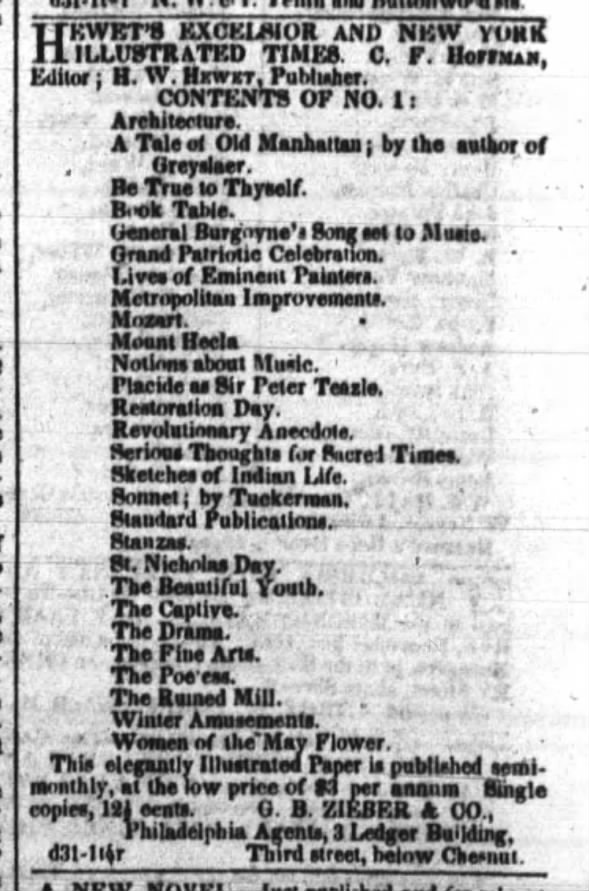
Below, contents of the first number of Hewet's Excelsior and New York Illustrated Times, as advertised in the Philadelphia Public Ledger on New Year's Eve, 1845:

· Wed, Dec 31, 1845 – Page 2 · Public Ledger (Philadelphia, Pennsylvania) · Newspapers.com


Related post:

Tuesday, November 28, 2017

Melville in Cleveland, 1858

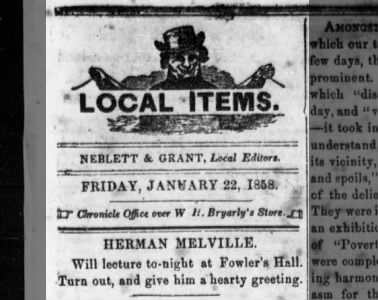
Herman Melville gave his lecture on Roman Statuary in Cleveland, Ohio on January 11, 1858. Melville sounded pleasantly intoxicating if not in fact intoxicated to one listener who noted his "boozy elocution" in a review published the following week in The Ohio Farmer. As for the substance of the talk on Statues in Rome, this remarkably perceptive Ohio reviewer liked what Melville said about art, but deplored his criticism of Christianity.

According to the masthead, Ohio Farmer was owned and edited by Thomas Brown. After his death in 1867, Brown was remembered as "a writer of no ordinary ability" in Appleton's Annual Cyclopaedia.

The Ohio Farmer - January 23, 1858
via GenealogyBank

HERMAN MELVILLE.


This gentleman, already well known to the readers of light literature, as the author of "Typee," "Omoo," "Moby Dick," &c., lectured before the Library Association last week, on "Roman Statuary."

The lecture, in point of style, was very good; superior, in that respect, to nine-tenths of the lectures usually delivered. There is a dreamy beauty about the utterances of the author, suggestive of the balmy atmosphere of the South Pacific. If we are not mistaken, there is a kind of hazy-lazy air common to both; at all events, as we sat and listened to the boozy elocution of the speaker, an intoxication, as of opium or profuse odors, "lapped us in Elysean pleasures."

We think the lecturer would have it so. It seemed to us as if the writer had never forgotten his imprisonment among the Pacific cannibals, and half regretted his extradition from that physical paradise. We would venture a bet that Mr. Melville, with all his admiration for the Medicean Venus, thinks Fayaway worth a score of cold unhabited marbles.

It seemed to us as if the writer had never recovered from his captivity. His affection for heathenism is profound and sincere. He speaks of the heathenism of Rome as if the world were little indebted to christianity; indeed, as if it had introduced in the place of the old Roman heroism, a sort of trusting pusillanimity.

This under-current of regret, or sorrow, or malice, at the introduction of christianity, seemed to pervade the whole lecture, and marred one's enjoyment of the fine observation and the deep sympathy manifest in every part of the performance. His beautiful sentiments, felicitous diction, and exquisite choice of terms were merely so many chaplets to adorn a corpse. Hung about heathen manners and heathen morals, they flung their beauty and fragrance over death and corruption.

So far as the lecture was confined to the limits of the title, it was masterly and without offense. The portraiture of character was very fine. We could have sat for hours witnessing this skillful and appreciative master of ceremonies taking the robes from the pictured pages of Tacitus and putting them upon the lifeless marbles of the Vatican, and there breathing into them the breath of life, till Rome became living Rome again; but we can not reverse the proverb and believe that a dead dog is better than a living lion. The carrion-feeding eagle is not nobler than the lion of the tribe of Judah.


In Melville as Lecturer (Harvard University Press, 1957), Merton M. Sealts, Jr. credits David Mead with the earliest mention of the Ohio Farmer review, citing Mead's Yankee Eloquence in the Middle West: The Ohio Lyceum, 1850-1870 (Michigan State College Press, 1951), pages 75-6 and 256. Mead quoted the Ohio Farmer on Melville's reportedly "boozy elocution," a phrase that Sealts omits in summarizing. George Kummer's 1936 article "Herman Melville and the Ohio Press" is available online courtesy of Ohio History Connection.

Reconstructed texts of "Statues in Rome" and Melville's other lectures are available in the Northwestern-Newberry edition of The Piazza Tales and Other Prose Pieces, 1839-1860.

Related posts:

Saturday, February 20, 2016

Notices of Redburn, White-Jacket, and Israel Potter in the Louisville Daily Courier, edited by Walter N. Haldeman

This one relates well I think to another melvilliana post about favorable notices in the Richmond Enquirer, showing the positive reception Melville received early on in southern newspapers.

For openers, here's a brief mention of the 1849 revised edition of Typee, from the Louisville Daily Courier, July 18, 1849; found at Newspapers.com
TYPEE: a peep at Polynesian life, during a four months’ residence in a valley of the Marquesas; the revised edition, with a sequel. By Herman Melville. New York: Harper & Brothers. 
There are few persons who read, who have not heard of this famous work. We do not remember a more successful book of the kind, within our day, than this proved to be. It took the literary world by surprise, and it is yet one of the most fascinating books in the language. 
These books may be found at the Bookstore of MORTON & GRISWOLD
Except for ads, I've not located any previous notice of Typee or Omoo. However, on August 3, 1847 the Courier published an excerpt from Omoo under the heading, "Fun at Sea."

Found on Newspapers.com

Likewise I'm still looking for a notice of Mardi (1849). Should one turn up it would have to be positive, since praise for Melville's fine writing continues in reviews of Redburn (1849) and White-Jacket (1850). [Update 05/30/2017: Found! Ecstatic as expected, the review of Mardi appeared May 1, 1849; see the later post on Haldeman's Review of Mardi in the Louisville Morning Courier.]

Jacob’s Dream, oil on canvas painting by Salvator Rosa, c. 1665
Salvator Rosa, Public domain, via Wikimedia Commons
There's nothing in the notice below about the plot of Redburn, which could mean the reviewer has not got 'round to reading it. Still, you have to love the comparison of Melville's books to paintings by acknowledged masters with such distinctive and contrasting styles. With White-Jacket unpublished and Moby-Dick unheard-of, one Kentuckian (call him Walter, for editor Walter Newman Haldeman) already dares to compare Melville with both Salvator Rosa and Raphael:
"His limnings have in them the wild grandeur of Salvator Rosa, blended with the grace and finish of Raphael."
Raphael - The Small Cowper Madonna - Google Art Project
Raphael via Wikimedia Commons
From the Louisville Daily Courier, December 6, 1849; found at Newspapers.com
Redburn: His First Voyage. Being the sailor boy confessions and reminiscences of the son of a gentleman, in the merchant service. By Herman Melville. New York: Harper & Brothers. 
Jean Paul Richter once said: The French have the empire of the land, the English of the sea, and the Germans of the air. Mr. Melville has wrested the literary empirage of the sea from England, and has placed himself as triumphantly on the tripod, as though he was fated for the work. He has drawn pictures of sea life, and of Polynesia that will live as long as language has a charm. Over his enchanted pages it is impossible to feel fatigue or satiety. His limnings have in them the wild grandeur of Salvator Rosa, blended with the grace and finish of Raphael.

Redburn is just such a set of sketches as one might expect to hear in listening to “forecastle yarns.” It is replete with vivacity and the most charming interest, and cannot fail to plant a new laurel in Mr. Melville’s chaplet.—Old Christopher North, with all his antipathies to America, cannot withhold his tribute of praise to Melville. He says: “After the pungent and admirable written narrative of that accomplished, able seaman, Herman Melville, few books of the same class but must appear flat and unprofitable. Omoo would have found readers at any time; and that although twenty publishers had combined with fifty authors to deluge the public with the Pacific ocean during the previous five years.”
The reading public will be delighted once more to meet this popular author on the field of his glory. --Louisville [Kentucky] Daily Courier (December 6, 1849)
Again, the Louisville Courier was edited by Walter N. Haldeman.

Walter-N.-Haldeman
Walter N. Haldeman (1821-1902) via Wikimedia Commons
Haldeman's notice of White-Jacket starts off with the same quote from Jean Paul Richter used previously in the notice of Redburn.
WHITE JACKET; or the world in a man-of-war. By HERMAN MELVILLE. 
Jean Paul Richter once said that Providence had given France the dominion of the land; England that of the sea, and the Germans that of the air. We are disposed to doubt England’s complete supremacy on the sea, for certainly her marine literature has nothing in it that can be compared to Melville’s extraordinary productions. He took the country by surprise, with his Typee, and through all his marvelous authorship of Omoo, Mardi, and Redburn, he has contrived to widen his reputation, and maintain his position. 
We are greatly deceived if this recent work, “White Jacket,” does not prove to be the most popular of Mr. Melville’s productions. 
It is filled to overflowing with all those striking merits that have made the author one of the celebrities of the times. In our judgment, WHITE JACKET is much the best of Mr. Melville’s works. A more entertaining companion for a journey, or in the family circle, we do not know.  --Louisville Daily Courier, April 11, 1850; found at Newspapers.com
I don't see any notice of Moby-Dick (1851) or Pierre (1852) in Haldeman's Louisville Courier, other than the standard advertisements. On July 8, 1854 the survey of Putnam's magazine includes favorable mention of "Israel Potter, a 4th of July story," which "is from the pen of Herman Melville, and is of course full of life and interest." In reviewing the book version of Israel Potter on March 22, 1855, Haldeman followed up with the most substantive and thoughtful comments on Melville yet printed in the Louisville Courier.

Found on Newspapers.com

New Books.

ISRAEL POTTER: His fifty Years Exile. By Herman Melville.—This story, originally published in Putnam’s Magazine, is now presented in book form. Like all of this authors productions, it is admirably written and full of interest. The story is of an American soldier and seaman, who was taken prisoner by the British and carried to England. He escaped from his vessel, and his subsequent adventures form the staple of the volume. Israel passes through various degrees of poverty and wealth, associates now with men of the highest distinction, and now, with his fluttering rags about him, begs for charity. Sometimes he is closeted with Dr. Franklin, or exchanges wit with Horne Tooke, and then he is found begging shelter in a country barn. Now he is a laborer in the King’s Garden, at Kew, and has a familiar talk with His Majesty, then he is standing in the cabin of Paul Jones’ ship, engaged in friendly chat with that redoubtable hero, and next he is moulding brick in an obscure country town; parading the streets crying “old chairs to mend,” or hiding in the sewers of London streets, a homeless beggar. Much of the interest of the volume depends on the characteristic sketches of the distinguished men referred to in its pages. Washington, Franklin, Ethan Allen, Paul Jones, Horne Tooke, George III, and many others are more or less strikingly daguerreotyped. The volume has claims far beyond the usual popular works of fiction of the day. It equals them in what is falsely called “interest,” that is, in the march of the story, and far surpasses them in beauty of style and execution. Indeed, it is almost offering an insult to this author, as well as to our readers, to institute a comparison between his well-written and tasteful volume and the clap-trap and coarseness of those books which a diseased state of sentiment has made popular. The work may be had of Mr. Ringgold, on Fourth street.  --Louisville Daily Courier, March 22, 1855; found at Newspapers.com
Related post:

Wednesday, February 25, 2015

"Can art, not life, make the ideal?" Herman Melville's lecture on Roman Statuary

Apollo of the Belvedere
Livioandronico2013, CC BY-SA 4.0  via Wikimedia Commons
More complete reconstructions of Melville's lecture on "Statues in Rome," edited from multiple newspaper sources, are available in Melville as Lecturer by Merton M. Sealts, Jr. and the Northwestern-Newberry Edition of Melville's Piazza Tales and Other Prose Pieces, 1839-1860. The "Statues in Rome" lecture is most widely accessible in the Random House / Modern Library edition of Melville's Tales, Poems, and Other Writings. However, no electronic version has been available online until now. Another Melvilliana exclusive!

Here then are three contemporary reports of Melville's 1857-8 lecture on Roman statuary from newspapers in Detroit, Boston, and Clarksville, Tennessee.

First and best is the report from Detroit, where Melville lectured on January 12, 1858. Text below is transcribed from the front-page article in the Detroit Free Press (January 14, 1858) which Sealts called
the fullest version of "Statues in Rome" published by any newspaper. --Melville as Lecturer, 36
Interesting that the Detroit reporter heard "Ardua" which might tell us how Melville pronounced "Padua."

Mr. Melville’s Lecture.

On Tuesday evening Mr. Herman Melville, of Pittsfield, Mass., lectured before the Young Men’s Society. He is well known to the literary world as the author of “Omoo,” “Typee,” and “Moby Dick,” books that made some sensation a few years ago from the graphic manner in which they described scenes and incidents among the far off islands of the Pacific. Mr. Melville has roamed around in this part of the world more than any other American author, and the incidents with which he has enlivened his books have been those which he has himself experienced. The subject of his present lecture was announced as “Roman Statuary.”

Mr. Melville said that among the higher emotions is a feeling for art, and this exists wherever there is beauty or grandeur. This feeling appeals to all men. Art strikes a chord in the lowest as well as in the highest; the rude and uncultivated feel its influence as well as the polite and polished. It is a spirit that pervades all classes; but the uncultivated never express the emotions which they feel, from the fear that they may use terms that shall be unscientific and unprofessional. There are many examples on record to show this, and not only this, but that the educated are very often more susceptible to this influence than the learned. There can be no doubt that Burns saw more poetry in a single daisy than Linnaeus in all the flora of which he treated. The speaker remarked that this must be his excuse; he pretended to be no critic or connoisseur in thus attempting to speak of the statuary at Rome, and he would relate merely his own impressions in reference to it.

As you enter Rome, upon its very threshold you meet with statuary. Here are the mute citizens who will be remembered when other things in the Imperial City are forgotten. Wherever you go in Rome, in is gardens, its walks, its public squares or its private grounds, statues may be seen. They abound on every side, but by far the greatest assemblage of them is to be found in the Vatican. These are all well known by repute; they have been often described in the traveler’s record and on the historic page; but the knowledge thus gained, however perfect the description may be, is poor and meagre when compared with that gained by personal acquaintance. Here are ancient personages, the worthies of the glorious days of the Empire and Republic. Histories and memoirs tell us of their achievements, whether on the field or in the forum, in public action or in the private walks of life; but here we find how they looked, and we learn them as we do living men. Demosthenes is better known by statuary than by history. The strong arm, the muscular form, the large sinews, all bespeak the thunderer of Athens who hurled his powerful denunciations at Philip of Macedon. Just so with the chiseled Titus; his short neck, broad shoulders and thick set person make him known and appreciated.

In the bust of Socrates we see a countenance more like that of a bacchanal or the debauchee of a carnival than of a sober and decorous philosopher. It reminds one much of the broad and rubicund phiz of an Irish comedian. It possesses in many respects the characteristics peculiar to the modern Hibernian.
Socrates Pio-Clementino Inv314
Bust of Socrates in the Vatican Museum
The head of Julius Caesar fancy would paint as robust, grand, and noble; something that is elevated and commanding. 
But the statue gives a countenance of a business-like cast that would well befit the president of the Erie Railroad. Just such a one has Seneca, whose philosophy would be christianity itself save its authenticity. It is iron-like and inflexible, and would be no disgrace to a Wall Street broker. That of Seneca’s pupil, Nero, at Naples, done in bronze, resembles that of one of our fast young men who drive spanking teams and abound on race-courses. The first view of Plato surprises one. Engaged in the deep researches of philosophy as he was, we certainly would expect no fastidiousness in his appearance, neither a carefully adjusted toga or pomatumed hair. Yet such is the fact, and this great transcendentalist has the sleek and smooth appearance of a modern Brummel.

This subject was illustrated by instances taken in modern times with which we are all acquainted because in this way we best obtain a true knowledge of the appearance of the statue. The aspect of the human countenance is the same in all ages. If five thousand ancient Romans were mingled with a crowd of moderns, it would be difficult to distinguish the one from the other unless it were by a difference in dress. The same features—the same aspects—belong to us as belonged to them. Their virtues were great and noble, and these virtues made them great and noble. They possessed a natural majesty that was not put on and taken off at pleasure, as was that of certain eastern monarchs when they put on or took off their garments of Tyrian dye—Christianity has disenchanted many of the vague old rumors in reference to the ancients. We can now easily compare them with the moderns. The appearance of the statues, however, is often deceptive, and a true knowledge of their character is lost unless they are closely scrutinized. A lady remarked in the lecturer’s presence that the statue of Tiberius did not look so bad as he was represented; it has more of a sad and  musing air. To some it would convey the impression of a man broken by great afflictions, of so pathetic a cast is it. Yet a close analysis brings out all his sinister features, and a close study of the statue will develop the monster portrayed by the historian.

The lecturer next spoke of the Apollo, the crowning glory of all, which stands alone in the Belvedere chapel of the Vatican. Every visitor rushes to the chapel to behold the statue, and, when he departs, his last glance is turned toward this loadstone. Its very presence is overawing. Milton’s description of Zephon makes the angel an exact counterpart of the Apollo.— In fact, the whole of that immortal poem, Paradise Lost, is but a great Vatican. Milton, when young, spent a year at Rome, and here he got many of those ideas from heathen personages which he afterwards appropriated to his celestials, just as the Pope’s artist converted the old heathen Parthenon into a Christian church. Lucifer and his angels cast down are taken from a group in a private palace at Ardua [Padua!]. This was sculptured out of one block by one of the later Italian artists. Three-score of the fallen lie wound together writhing and tortured, while, proud and sullen in the midst, is the nobler form of Satan.

Speaking of the Apollo reminds one of the Venus de Medici, although the one is at Rome and the other at Florence. She is no prude, but a child of nature, modest and unpretending. She is sculptured at the moment when, returning from the bath, she is surprised by an intrusion.

In a niche of the Vatican stands the Laocoon, the very semblance of a great and powerful man writhing with the inevitable destiny which he cannot throw off. Throes, and pangs, and struggles are given with a meaning that is not witheld.

The hideous monsters embrace him in mighty folds, and torture him with agonizing embraces. In all the ancient statues representing animals there is a marked resemblance with those described in the Book of Revelations. This class of Roman statuary and the pictures of the Apocalypse are nearly identical. But the ferocity in the appearance of this statuary is compensated by the pastoral nature of others. The quiet, gentle, and peaceful scenes of pastoral life are represented in some of the later of Roman statuary just as we find them described by that best of all pastoral poets, Wordsworth.

When standing within the Coliseum the solitude is great and vast, just such as one experiences when shut up in a vale of the Apennines, hemmed in by towering cliffs on every side.— But the imagination must build it as it was of old; it must be re-peopled with the terrific games of the gladiators, with the frantic leaps and dismal howls of the wild, bounding beasts, with the shrieks and cries of the excited spectators. Unless this is done, how can we appreciate the Gladiator? It was such a feeling of the artist that created it, and there must be such a feeling on the part of the visitor to view it and view it aright.

It is with varied feelings that one travels through the sepulchral vaults of the Vatican.— The statues are of various character: Hope faces Despair; Joy comes to the relief of Sorrow; Rachel weeps for her children and will not be comforted. Job rises above his afflictions and rejoices. The marbles alternate; some are of a joyous nature, followed by those that are of a sad and sombre character.

Just as a guide hurries one on through these scenes with his torch light, bringing out one statue in bold relief while a hundred or more are hidden in the gloom, so did the lecturer say it was necessary for him to do to keep within the limits of an hour.

If one stands a hundred feet in front of St.Peter’s and looks up, a vast and towering pile meets his view,—High, high above are the beetling crags and precipices of masonry, and yet higher still above all this is the dome. The mind is carried away with the very vastness. But throughout the Vatican it is different. The mind, instead of being bewildered within itself, is drawn out by the symmetry and beauty of the forms it beholds. These are of different and varied character. Remarkable, however, among all are the sculptured horses, riderless and rearing, seeming, like those of Elijah, to soar to heaven. The most of these were sculptured by the Greeks.— The horse was idealized by the ancient artist as majestic next to man, and they loved to sculpture them as they did heroes and gods. To the Greeks nature had no brute. Everything was a being with a soul, and the horse idealized the second order of animals just as man did the first.

Of the statues of large size much might be said, and that of Perseus at Florence would form a theme by itself. Prominent among the colossals, however, is that of Hercules.
Heracles Pio-Clementino Inv252

This statue is not of that quick, smart, energetic strength that we should suppose would appertain to the powerful Samson or the mighty Hercules; but rather of a character like that of the lazy ox, confident of his own strength, but loath to use it. No trifles would call it forth; it is reserved only for great occasions. To rightfully appreciate this, or, in fact, any other statue, one must consider where they came from and under what circumstances they were formed. In other respects they reveal their own history.

But Roman statuary is by no means confined to the Vatican, or even to Rome itself. The villas around are filled with it, and, in these quiet retreats, we catch some of the last and best glimpses of the art. Here are found many of those trophies which have challenged the admiration of the world; here, where once exhaled sweets like the airs of Verona, now comes the deadly malaria, repelling from those ancient myrtles and orange groves, like Lucretia Borgia who invites to a feast and then destroys. One of the finest of the statues to be found in these villas is the Minerva, a creature as purely and serenely sublime as it is possible for human hands to form.
Athena Albani
Here also, is found a bust of Aesop, the dwarfed and deformed, whose countenance is irradiated by a lambent gleam of irony like that we see in Goldsmith’s. Many of these villas were built long years ago by men of the heathen school, for the express purpose of preserving these ancient works of art. The villas which were to shield and protect them have now crumbled, while most of the statues which were to be thus preserved still live on.
Here the lecturer entered upon a discussion of the festive habits of the ancients. It was not unusual for them at their feasts to talk upon the subject of death and other like mournful themes. Such topics were not considered irrelevant to the occasion, and, instead of destroying the interest of the feast by their ill timed intrusion, they rather added to it a temperate zest.

In conclusion, said Mr. Melville, since we cannot mention all the different works, let us bring them together and speak of them as a whole. It will be noticed that statues, as a general thing, do not present the startling features and attitudes of men, but are rather of a tranquil, subdued air such as men have when under the influence of no passion. They appeal to that portion of our being which is highest and noblest. To some they are a complete house of philosophy; to others they appeal only to the tenderer feelings and affections. All who behold the Apollo confess its glory; yet we know not to whom to attribute the glory of creating it. The chiseling them shows the genius of the creator—the preserving them shows the bounty of the good and the policy of the wise.

These marbles, the works of the dreamers and idealists of old, live on, leading and pointing to good. They were formed by those who had yearnings for something better, and strove to attain it by embodiments in cold stone. We can ourselves judge with what success they have worked. How well in the Apollo is expressed the idea of the perfect man. Who could better it? Can art, not life, make the ideal? Here, in statuary, was the Utopia of the ancients expressed. The Vatican itself is the index of the ancient world, just as the Washington Patent Office is of the modern. But how is it possible to compare the one with the other, when things that are so totally unlike cannot be brought together? What comparison could be instituted between a locomotive and the Apollo? The moderns pride themselves upon their superiority, but the claim can be questioned. They did, indeed, invent the printing press, but all the best thoughts that it sends forth are from the ancients, whether it be law, physics or philosophy. The deeds of the ancients are noble, and so are their arts; and as the one is kept alive in the memory of man by the glowing words of their own historians and poets, so should the memory of the other be kept green in the minds of men by the careful preservation of their noble statuary.

“When the Colisseum falls, Rome shall fall,
And when Rome, the world.”
 --Detroit Free Press, January 14, 1858; found at the Detroit Free Press Archives. Many thanks to the Detroit Free Press and Michigan.com for permission to use here.
And here is another, earlier report of Melville's lecture on Roman statuary, this one from the Boston Daily Evening Traveller (Thursday, December 3, 1857). Found in the Newspaper Archives at GenealogyBank.

Mercantile Library Lectures.
Wednesday Evening, December 2.

The third lecture of the course before the Mercantile Library Association, was delivered last evening at the Tremont Temple, by Herman Melville, Esq., the author of “Omoo,” ”Typee,” &c. The audience was not so large as on the two previous evenings. “Statuary in Rome,” was the subject of the lecture.

Mr. Melville spoke in a clear and distinct voice. After a brief introduction, he proceeded directly to his subject. The statues in Rome, he believed, were peculiarly attractive to strangers, and the denizens of the city with whom they became best acquainted. They were scattered everywhere, and they gave to the present a better idea of the reality of the men of elder days. 
In the expressive marble, Demosthenes became a present existence; so in the statue of Titus, of whom we read a dim outline in Tacitus, stood mildly before us Titus himself, with his lineaments and strength of form. In Socrates’ face we saw a countenance like a comic masque. In Julius Caesar’s statue we beheld a practical, business-like expression. In that of Seneca, whose utterances so amazed one of the early fathers that he thought he must have corresponded with St. Paul, we saw a face more like that of a disappointed pawnbroker, pinched and grieved. In Nero’s statue, at Naples, we saw only a fast and pleasant young man, such as those we saw in our day. In Plato, that aristocratic transcendentalist, we beheld a smoothness and neatness in the hair, and a beard such as would have graced a Venetian exquisite.

Yet in all these we saw but the men of to-day, so that we might believe that if a hundred men of that age should be transplanted to this, we would perceive that humanity was the same to-day as ever,—in what went to make up the basis of human character. We might learn that then, as now, appearances were deceptive. “That Tiberias,” said a lady. “It does not look bad.” If he did, he would not be Tiberias. That arch dissembler wore a sad, intellectual look, in which only deep attention perceived the sinister lines. It was beautiful in its features. But all these things told us how true was the statue to the description of the man and his character. 
The Apollo, often drew the last glance of departing strangers, when bidding farewell to Rome, bearing as it did the appearance almost of divinity. It was a model for poets, and even Milton must have gleaned from these representations of the great men or the gods of ancient Rome high ideas of the grand in form and bearing. The Venus, in Florence, was beautiful, but it seemed, should a match be made between them, as if the divine was wedding one of the fair daughters of Eve. In the Venus the ideal and actual were blended, yet only representing nature in her perfection, a fair woman startled by some intrusion when leaving the bath. 
The Laocoon, and its kindred class of horrible conceptions, formed the next subject of discussion, and after them, in contrast, the gentle and pastoral statues. The existence of the latter proved that the Roman people were not entirely destitute of the gentler feelings. When he stood in the Coliseum, with its walls rising round him like a mountain range, the lecturer had felt as solitary as if in some deep green valley in the Apennines. Imagination restored the arches, and then taking the statue of the triumphant gladiator from the Louvre, and that of the dying gladiator from the Capitol, as a centre piece, there sprang up around him again the mighty crowds which once peopled that vast temple. And he had felt, from the knowledge of the greater statues which existed, a belief that there were some among that gladiatorial people who beheld with horror and sadness the cruel scenes which the Coliseum had beheld. 
The great square of the Vatican was next briefly described; then followed a vivid description of the statues on Mount Cavallo, in Rome, where the marble horses seemed to represent the fiery audaciousness of Roman power. The Moses, by Michael Angelo, appearing like a stern, bullying genius of druidical superstition; the Hercules rescued from the ruins of the baths of Caracalla—formed further subjects of comment. To understand the statues of the Vatican, it was necessary to visit often the scenes where they had stood, the Coliseum, which threw its shade like a mighty thunder cloud, the forum, the ruined temples, and remember all that had there taken place. 
After extended allusions to all the statues and structures which we have enumerated thus far, the lecturer considered the Roman villas in a very pleasing way, and spoke also of the statues to be found in connection with them. In conclusion, some comprehensive ideas in reference to statuary, and to the influence exercised by the marble forms created by the sculptor, were advanced, and in this connection the lecturer said that as instinct is below reason, so is science below art—a proposition which caused some little discussion in several groups of homeward-bound listeners, after the lecture was closed.

On the whole it was a most interesting lecture, though too long by one-fifth, covering an hour and a quarter. The next lecture will be by George W. Curtis of New York.
Roma-cordonata01

Our last item is a gem of sympathetic appreciation from the Clarksville [Tennessee] Chronicle, Friday, January 29, 1858. Accessible at the great Library of Congress site, Chronicling America.

HERMAN MELVILLE. —The Fifth Lecture to the Literary Association, was delivered on last Friday evening, by this distinguished author. With our small skill in criticism, we feel entirely unable to do justice to the production of so ripe a genius and so pure a taste. Indeed the subject was so faultless in conception and execution, that its subtle yet marvellous beauty escaped only the most appreciative sensibility and the most cultivated discernment. With that true instinct of genius, which turns aside from lofty and high sounding themes, Mr. Melville selected one of unpretending title, from which to educe noble and inexhaustible thought, and quiet, but none the less striking philosophy. His subject was "Statues in Rome;" and having been himself a wanderer in that grand old city, whose very name fires the imagination of the classic student with the magic of storied antiquity; he brought those mute forms of a distant age out of the dim and dreamy haze of fancy, into the bright and vivid light of reality. He had looked with no unthoughtful eye upon those glorious masterpieces of ancient genius from which the artists of a modern day have drawn all their inspiration. Unbiassed by the prepossessions of fancy, he traced in the marble features of those great warriors, philosophers, statesmen, and poets, whose names are now almost deified, the same lineaments of passion, and frailty, that blend in the noblest faces of our own day; and though thus stripping them of their divinity, made them dearer to us as men. The description of the ideal statuary of Rome, held us breathless by its wonderful nicety of appreciation, and subtlety of expression. Of all the tributes of genius to the Apollo, and Venus de Medici, those statues that "enchant the world," we never read one more worthy of their divine beauty. The expression of doubt, and dark groping of human speculation, in the ideal statuary of that age, when the old mythology was passing away, and men's minds had not yet reposed in the new faith, was finely portrayed. A most striking and beautiful thought was introduced, when speaking of the equestrian statues of Rome, and the expression of untamed docility, rather than conquered obedience which their artists have given to the horse, the lecturer deduced the enlarged humanity of that elder day, when man gave himself none of those upstart airs of superiority over the brute creation which he now assumes.
We do not remember in all our reading to have met with a more beautiful passage, than that in which Mr. Melville described his musings in the Coliseum, and the recurrence of his imagination far back to the day when its mighty walls enclosed such countless throngs to witness the gladiatorial combats, and the eye of fancy saw many in the vast assemblage who looked not coldly on the dying gladiator whose eyes looked far away to
——where his rude hut by the Danube lay,
There were his young barbarians all at play.
But we hung entranced upon the closing remarks of the lecturer, which vindicated these spiritual productions of the ancient mind from their alleged inferiority to the utilitarian inventions of the present age. Never before was the superiority of art over science, so triumphantly and eloquently sustained. But we will not add more of our feeble praise to a production which, if published, would elicit commendation from the highest critical sources.—
Some objected to Mr. Melville's subdued delivery; but if we rightly reflect, we will observe a striking congeniality between this quiet manner and those mute forms that stand still and silent amid the venerable ruins of "ancient Rome."
Those who appreciate the sublimity of Nature, only when the storm is loosed, and are insensible to the grandeur of her noontide silence, felt not the beauty of Mr. Melville's lecture. Those who prefer, what they term truth, and practicality and subjects of every day interest, who relish the strong meat that makes bone and muscle, above that "Nectar of the Gods" that sublimates a finer essence, tasted not of the divine chalice that the lecturer held to their lips. Mr. Melville goes from us, with the appreciation of many pure tastes, and the kindly feelings of many hearts that penetrated through the natural reserve of his character to the noble nature beneath. 

Related posts: