Showing posts with label Felix Darley. Show all posts

Wednesday, November 22, 2023

Santa's calling card


In December 1862 you could get the newest edition of A Visit from St.Nicholas with beautiful illustrations by Felix Octavius Carr Darley for 50 cents. "An elegante Christmas trifle for the entire household," as described by Manhattan publisher James G. Gregory in the New York Evening Post on December 22, 1862.

New York Evening Post - December 22, 1862
via Genealogy Bank
"A VISIT FROM ST. NICHOLAS." The famous poem, " 'Twas the Night Before Christmas," etc. Illustrated in tints, from drawings by DARLEY, with an illuminated cover. An elegante Christmas trifle for the entire household. Price 50 cents.
Darley's joke on the front cover is explained in the New York World notice of December 26th, the day after Christmas: "The title page is in richly illuminated letter, a carte de visite of Santa Claus having fallen on the first page." 
 
New York World - December 26, 1862
via Genealogy Bank
A VISIT FROM ST. NICHOLAS. Illustrated from drawings by F.O.C. DARLEY. James G. Gregory.
     This is an elegantly illustrated and printed quarto pamphlet edition of Clement C. Moore's famous Christmas song, " 'Twas the Night before Christmas." The title page is in richly illuminated letter, a carte de visite of Santa Claus having fallen on the first page. The drawings are all by Darley, and are in his happiest style.
In verse, the poet Clement Clarke Moore reported St. Nick's Visit, and now Darley the artist gives us the picture of his carte de visite. Look, Santa Claus left his calling card!
 
Related posts:

Saturday, July 3, 2021

Happy Independence Day!

Fourth of July drawing by F. O. C. Darley
NYPL Digital Collections 
Manuscripts and Archives Division, The New York Public Library. "Darley, Felix Octavius Carr (1822-1888)" The New York Public Library Digital Collections. 1848 - 1851. https://digitalcollections.nypl.org/items/cd0cf7b0-4465-0133-97f7-00505686a51c

Shown in detail above, an original drawing by the gifted and popular 19th century artist Felix Darley from the close of Darley's Fourth of July note to Evert A. Duyckinck. Darley's 1857 caricature represents a patriotic fellow-American celebrating Independence Day in the great American way, with his gun blazing, flag waving, and plenty of gin on hand. 

Transcribed below, the text of Darley's letter to Duyckinck from Claymont, Delaware on July 4, 1857:
Claymont July 4th
1857

My dear Duyckinck,

I send you by Express two more designs for the Poets of the 19th Century with a portion of the text which you sent me. I will send you the rest with the remaining drawings in a few days. One of them will be for Poe’s Raven and the other for Simms’ poem.

The glorious 4th is likely I fear to be a damp one—innumerable spit devils and other patriotic explosions of gunpowder will be nipped in the bud. I have occasionally a reminiscence of Brandywine in a distant pop from some juvenile cracker in the neighborhood which greatly assists my fancy being engaged at present on designs for Irving’s Washington.

Permit me to express in outline my true appreciation in common with my fellow countrymen of this great day in an elaborate illustration which I enclose and believe me

Yours ever
F. O. C. Darley

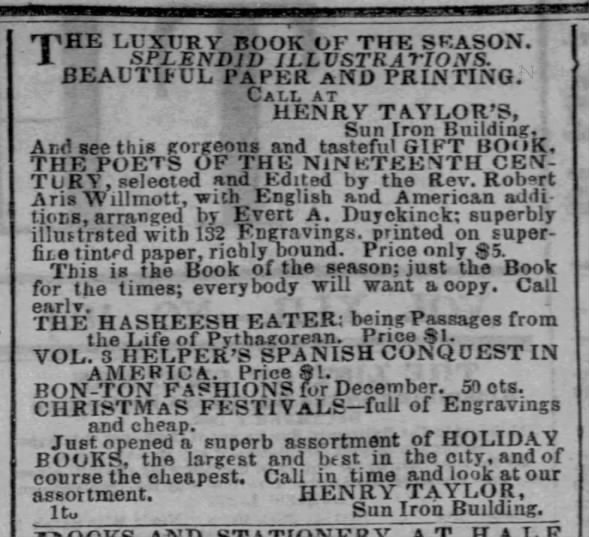
Evert Duyckinck edited the Americanized volume of Willmot's Poets of the Nineteenth Century, expanded with "liberal space" for "American authors, illustrated by American artists," published in 1858 by Harper & Brothers. Darley's illustration for Blessings on Children by William Gilmore Simms appears there on page 416; the one for Poe's The Raven on page 466. American additions included Clement C. Moore's A Visit from St Nicholas, also illustrated by Darley. With these treasures and more, the volume made a "gorgeous and tasteful GIFT BOOK" that was already available in bookstores by December 1857.

08 Dec 1857, Tue The Baltimore Sun (Baltimore, Maryland) Newspapers.com

F. O. C. Darley of course had many friends among the literati including Herman Melville. In the summer of 1853 Darley visited Melville at his Arrowhead farm near Pittsfield. With "a party of gentlemen" they explored the Dome of Taconic (Jay Leyda, The Melville Log Volume 1 page 478; and Hershel Parker, Herman Melville: A Biography Volume 2, 1851-1891 pages 173-4). On another Berkshire adventure, Darley and Maunsell B. Field joined Melville for dinner with Oliver Wendell Holmes. As Field remembered it, they did not get around to eating but Field "never chanced to hear better talking" as that between Holmes and Melville on "East India religions and mythologies."

And this reminds me of a little excursion which DARLEY, the artist, and myself once made together from Stockbridge. We started in a buggy to call upon MELVILLE, intending to go from there to Dr. HOLMES's, then to the hotel at Pittsfield to dine, and thence home. We found MELVILLE, whom I had always known as the most silent man of my acquaintance, sitting on the porch in front of his door. He took us to a particular spot on his place to show us some superb trees. He told me that he spent much time there patting them upon the back. When we were about to start for Dr. HOLMES's, we invited MELVILLE to accompany us, and he accepted. We found the poet-physician, to whom I was presented for the first time, at home, and he took us into a room at the back of his house, which overlooked the mountains. For some time the talk, in which all tried to participate, dragged, and I feared that our visit would only result in boring our host, if not ourselves. At length, somehow, the conversation drifted to East India religions and mythologies, and soon there arose a discussion between HOLMES and MELVILLE, which was conducted with the most amazing skill and brilliancy on both sides. It lasted for hours, and DARLEY and I had nothing to do but to listen. I never chanced to hear better talking in my life. It was so absorbing that we took no note of time, and the Doctor lost his dinner, as we lost ours. We took tea at Pittsfield, instead of dining there, and reached home late in the evening.

-- Memories of Many Men and of Some Women (New York, 1875) pages 201-202. 

In other great 4th of July news, it turns out I'm not the only one who quits singin' along every time they play a Springsteen song...


Tuesday, January 22, 2019

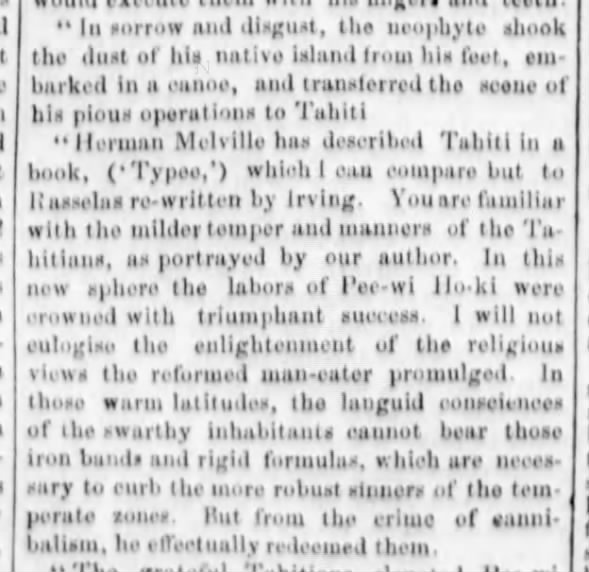
"Rasselas re-written by Irving": George M. Wharton aka Stahl on Typee

Sun, May 16, 1852 – 2 · The Daily Delta (New Orleans, Louisiana, United States of America) · Newspapers.com
Herman Melville has described Tahiti in a book, ('Typee,'), which I can compare but to Rasselas re-written by Irving. --"Pee-Wi Ho-Ki, The Tahitian Cannibal" in the New Orleans Daily Delta for May 16, 1852; reprinted in The New Orleans Sketch Book.
Later reprinted in William E. Burton's Cyclopedia of Wit and Humor, the same volume with Melville's short fiction, The Lightning-Rod Man. The New Orleans Sketch Book was illustrated by Herman Melville's friend Felix Octavius Carr Darley.


Typee is set on Nuku Hiva in the Marquesas; Omoo is the book of Melville's romanticized adventures in Tahiti.

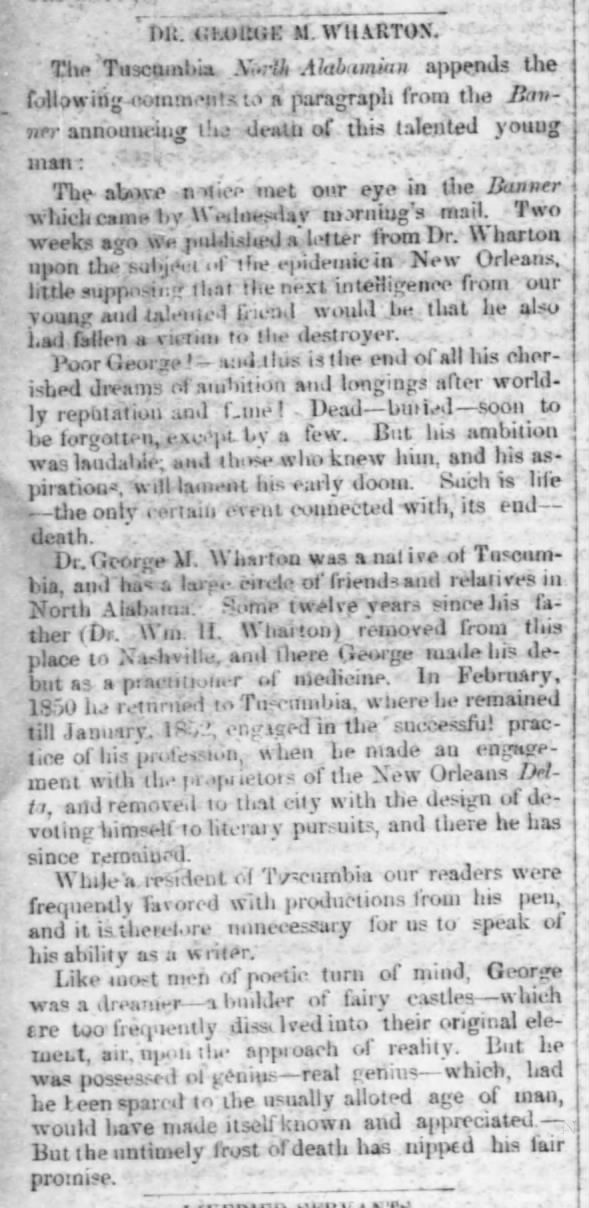
For more on Wharton, see Frederick Jonas Dreyfus, Life and Works of George Michael Wharton, M.D., (Pseudonym "Stahl"), 1825-1853 in Tennessee Historical Quarterly 6.4 (December  1947): 315-336. <https://www.jstor.org/stable/4262095>

Thu, Sep 8, 1853 – Page 2 · Nashville Union and American (Nashville, Davidson, Tennessee) · Newspapers.com

Tuesday, October 25, 2016

Clement C. Moore's "Visit from St Nicholas," 1824 reprinting in the Geneva Palladium

Reprinted from the Troy Sentinel where Moore's world-beloved "Visit" aka "The Night Before Christmas" was first published anonymously on December 23, 1823. On the image below from NYS Historic Newspapers, you can see that somebody later on has identified the author in three different places.

From the Geneva Palladium, January 21, 1824

(In case you're wondering, out here the Christmas season officially begins October 1st. As usual I'm behind already.) With so many early and numerous newspaper printings of "Visit," the New York native Herman Melville could easily have known Moore's poem by time it appeared in Charles Fenno Hoffman's 1837 anthology The New-York Book of Poetry. On Christmas Eve 1832, the Albany Evening Journal reprinted "Visit" under the heading CHRISTMAS EVE—ST NICHOLAS, in response to the following request by "Many Dutchmen":
"MR. EDITOR— The following lines were published many years ago, but most of your readers have probably forgotten them, and by republishing them, you will greatly oblige Many Dutchmen."
The Troy Daily Whig reprinted "Visit" without any editorial introduction on Christmas Eve, 1838. The 1838 printing resembles the version in Parley's Magazine for that year, italicizing the Irvingesque lines about St. Nick's "laying a finger aside of his nose" and ascending the chimney, and footnoting the 1838 painting by Robert Walter Weir.

Digressing a bit further, I suppose in Albany Herman Melville's maternal uncle Peter Gansevoort must have belonged to the St. Nicholas Society. Yes? Yes. At the anniversary banquet on December 6, 1831 we find PG raising his glass and making this admirably democratic toast to
"The Mechanics and Tradesmen of the city of Albany; a sound, intelligent, moral and patriotic portion of our fellow citizens. Their prosperity illustrates the truth, that industry is the real wealth of a community." --Albany Argus, December 13, 1831
Over the years, St. Nicholas Society members and guests regularly drank to the memory of Melville's grandfather General Peter Gansevoort: "A brave soldier and esteemed citizen" (Albany Argus, December 13, 1831); "soldier and patriot" (Argus, December 18, 1832); and "the hero of Fort Stanwix" (December 14, 1830 and December 16, 1834).  At the 1836 affair, Melville's old principal T. R. Beck toasted "Robert Southey, one of the few Englishmen that have done justice to Holland." In 1832 Beck had offered another literary toast to "James K. Paulding, the author of the Dutchman's Fireside" (Albany Argus, December 18, 1832).

But getting back to Moore's now classic poem: The illustrated 1862 book A Night Before Christmas features engravings by Nathaniel Orr which are made from drawings by Melville's friend Felix Octavius Carr Darley.

A Visit from St Nicholas by Clement Clarke Moore
via Project Gutenberg
 One of the best Melville anecdotes ever is the story Maunsell Bradhurst Field tells in Memories of Many Men and of Some Women, about the time when he and "Darley, the artist" visited Melville in Pittsfield. At dinner with Oliver Wendell Holmes, Field and Darley ended up bedazzled by the brilliant conversation of Melville and Holmes on "East India religions and mythologies." Field also tells of Melville's showing off his fine trees and talking about how much he likes "patting them upon the back."

Related posts:

Sunday, February 7, 2016

Melville in March 1866, socializing with The Wanderer's Club at the home of James Lorimer Graham, Jr.

Image Credit: Consulate General of the United States 
Note: this is the Wall Street broker JLG, NOT James Lorimer Graham, Jr. (1835-1876)

Monday evening, March 26, 1866 to be exact, according to the report published the next day in the New York Evening Post. The home address of James Lorimer Graham, Jr. (as listed in the 1867 Trow's New York City Directory) was his father's uncle's mansion at 21 Washington Square North.

UPDATE: Fold3 has the better source here, Trow's New York City Directory "For the Year Ending May 1, 1866." Now Trow's gives the address for James Lorimer Graham, jr. as "3 E. 17th." That's the address Bayard Taylor remembers in his 1876 obit. Most likely the March 26, 1866 gathering happened here, at 3 East Seventeenth Street. Also, James Lorimer Graham, Jr. is the NEPHEW of James Lorimer Graham. Graham, Jr.'s father is Nathan Burr Graham, as explained in the 1869 United States Insurance Gazette and Magazine of Useful Knowledge.

UPDATE #2:
If you thought the photo up top looks too late for the subject of our post, James Lorimer Graham, Jr. (1835-1876), you were right!  Naively I had thought the United States Consulate General would know one of their own in Florence, Italy. Alas, they and we had the wrong man. The sharp looking JLG above is of course the Wall Street broker, partner of S. F. Johnson and Charles W. Miller. 
S. F. JOHNSON & CO.. Bankers and Brokers, No. 18 Wall Street.— This well-known concern was founded originally in January, 1869, by Johnson & Day, who were succeeded by G wynne, Johnson & Day. and in 1879, Messrs. S. Fisher Johnson and Charles W. Miller formed a partnership under the present firm title. Both are thoroughly experienced men, and devote their close attention to the wants of their patrons. In 1892 Mr. James Lorimer Graham, who has been connected with the house ever since its inception, was admitted into the firm, with no change of title. They deal in all kinds of bonds, stocks, securities, etc., on commission only, for cash or on margin, and, as they are members of the New York Stock Exchange, all their transactions for patrons are governed by the strict rules controlling that honorable and reliable organization. They also do a general banking business.... --New York, 1894 Illustrated
So like the U. S. Consulate General in Florence, Italy, we're still in want of any photo of the real James Lorimer Graham, Jr. (1835-1876).

Well! Just the sort of enticements to draw out Melville as we know him in the second volume of Hershel Parker's biography: books, engravings, and heady talk with good fellows like Tuckerman, Duyckinck. and Darley. From the New York Evening Post, Tuesday, March 27, 1866; found in the online Newspaper Archives at Genealogy Bank.

New York Evening Post, Tuesday, March 27, 1866

The Wanderer's Club.

The members of the "Wanderer's Club," together with invited guests, were pleasantly entertained last evening at the residence of Mr. James Lorimer Graham, Jr. The gathering was of a social character, and allowed a free and agreeable interchange of thought among the guests. The many rare and curious books, old engravings, valuable autograph letters and articles of vertu, to be found in Mr. Graham's library, were a source of unfailing interest and enjoyment to every one present. Among the guests were Messrs. Bryant, Bancroft, Tuckerman, Herman Melville, Bayard Taylor, Ripley, Duyckinck, Stoddard, Savage, "Barry Gray," W. T. Blodgett, John Van Buren, Leutze, Kensett, Gifford, Bierstadt, Laing, H. P. Gray, Launt Thompson, Darley, Ehninger, Hunt, Key, Baron Osten Sacken, Gilman, and others.
First order of business will be to identify all concerned, if we can, starting in this post with the host: James Lorimer Graham, Jr. (1835-1876), familiarly known as "Lorrie" Graham. Below are links to the 1894 memorial and the catalog of his library, both published by the Century Association:

The Online Books Page has links to both items in the HathiTrust Digital Library.

Reading things like the passage below from the 1894 memorial, "Lorrie" Graham begins to look like a real-life model for Melville's imaginary Marquis de Grandvin:
One of the most distinguished of his literary friends, who is with us to-night, is reported, at a dinner of literary and kindred spirits not long ago, to have offered the following toast to the memory of Lorrie Graham:

"Here's to Graham! Let us keep his memory green; for when we poor fellows lived on hard tack all the week, we knew that there were always champagne and oysters for us at Graham's whenever we chose to go there."
In another passage from the 1894 memorial, Edmund Clarence Stedman recalled the dinner for Graham at Delmonico's on November 16, 1866 as a "unique and unforgettable" evening. The honorary "Supper" was
given to Lorimer Graham before his departure for Europe. This came off at Delmonico's, Fourteenth Street, on the 16th of November, 1866. From twenty to twenty-five gentlemen were there, nearly all of them Centurions, the Committee in charge being Messrs. William Bond, C. P. Cranch, Bayard Taylor, R. H. Stoddard, Launt Thompson, and the present speaker. In addition to the lyrics in hand, poems were also contributed by Cranch and Boker, but these were not so available for reproduction after the interval of twenty-eight years. Brief speeches in affectionate honor of Mr. Graham were made by the other guests. The evening was in some respects unique, and unforgetable.
The night before, J. Lorimer Graham had served as honorary President of one of the tables at the lavish banquet for Cyrus W. Field. Sponsored by the New York Chamber of Commerce, the Field affair took place in the great hall of the Metropolitan Hotel. The much more intimate dinner for Graham happened at Delmonico's, which provides the setting for At the Hostelry, one of Melville's Burgundy Club poems. Melville, however, is not named as one of the select twenty-five, most of whom belonged to the Century Club.

HathiTrust Digital Library has the 1963 re-issue by Russell & Russell of the 1922-24 Constable edition of Melville's works with The Marquis De Grandvin and Jack Gentian sketches in the thirteenth volume. Admittedly, there's no getting around the fact that Melville's Marquis de Grandvin is a Frenchman,
"a countryman of Lafayette and Frédéric Auguste Bartholdi."  --Herman Melville: A Biography, V2.833
But good lord! look what the American Consulate in Florence, Italy has to say about former U. S, Consul James Lorimer Graham, Jr. :
"During his sojourn abroad he became a proficient French scholar and retained his fluency and perfect accent all his life. As such, he was often mistaken for a Frenchman."  --U.S. Consulate - Florence
Likewise the Appleton's Encylcopedia entry offers a number of suggestive points of comparison with Melville's convivial de Grandvin, in particular his being "widely known through his taste for art and literature and his brilliant conversational talents." (Later note: the entry below is copied nearly verbatim from the obituary by Bayard Taylor in the New York Tribune, May 2, 1876.)

James Lorimer Graham

GRAHAM, James Lorimer, consul, born in New York City in January, 1835; died in Florence, Italy, 30 April, 1876. He was partly educated at Amiens, France, where, on account of his precocious literary talent, he was selected to deliver a poetical address of welcome to Lamartine when the latter visited the school in 1848. Mr. Graham lived for a time in Rio Janeiro, and, after returning to New York, was a passenger in the steamer '" San Francisco," which foundered in a gale off Cape Hatteras. His experience in this wreck injured his health and hastened his death. In 1856 he married and settled in New York, where he became widely known through his taste for art and literature and his brilliant conversational talents. As a member of the Century club, the Geographical society, and kindred institutions, he made the acquaintance of many artists and authors. He spent the years 1862-'3 in Europe, and after remaining in New York until 1866 again went abroad. Meantime he had been busily engaged in acquiring whatever curiosities he had found in his travels, until he had large collections of coins, autographs, drawings, and books. Some time after his return to Europe, Mr. Graham was appointed United States consul-general for Italy, and resided in Florence. When the capital was transferred to Rome, he preferred to accept the office of a simple consul rather than change his home. --Famous Americans - James Lorimer Graham
Graham's diplomatic service in Italy seems transferred in Melville's Burgundy Club material to Major Jack Gentian--a disciple of the Marquis de Grandvin whom Melville imagines as the appointed American consul in Naples.

Andrew M. Kavalecs writes informatively of Graham as "Fosterer of American-German Literary Relations" through his correspondence with Adolf Strodtmann.

A helpful biography by Jeffrey Begeal is available online at The Florin Website. The online biography lists a title by Mr. Begeal that would be lovely to have, if I could only find it:

  • Begeal, Jeffrey. James Lorimer Graham, Jr. c. 1832-1876. Biography of an American Savant. Villa de Bella Silva Press: Smithfield, NC. 2004.

How much of "Lorrie" Graham and the wonderful Wanderer's Club do we find memorialized in Melville's uncompleted writing about the Burgundy Club?

Related melvilliana post: