Showing posts with label Nathaniel Hawthorne. Show all posts

Wednesday, April 1, 2026

Amigo Mio! #8 in my open investigation, DRAGOONED: Writing, talking, and rewriting like Herman Melville in "Scenes Beyond the Western Border" (1851-1853)

Amigo mio! by Scott Norsworthy

Didn't you desert me on the eve of a snowstorm?

Read on Substack


Related posts on Substack

  • DRAGOONED #7: After Supper
    https://melvilliana.substack.com/p/after-supper
  • DRAGOONED #8: Amigo Mio!
    https://melvilliana.substack.com/p/amigo-mio 

Sunday, September 1, 2024

William Allen Butler's friendly notice of THE HOUSE OF THE SEVEN GABLES


As previously shown on Melvilliana, William Allen Butler (1825-1902) the Wall Street lawyer and genial satirist in prose and verse only served as an "occasional" New York correspondent for the Washington National Intelligencer in 1850-1 and most certainly did not write the long and largely favorable review of Moby-Dick, or the Whale attributed to him since 1953 in published Melville studies.

The real reviewer of Melville's "prose Epic on Whaling" in the regular "Notes on New Books" column of the National Intelligencer (December 16, 1851) was 
literary editor James C. Welling (1825-1894). 

Although William A. Butler never dreamed of writing the learned and perceptive review of Moby-Dick in the National Intelligencer, he probably deserves credit for another, more ordinary notice in the same newspaper: the friendly and favorable review of Hawthorne's The House of the Seven Gables that appeared on April 22, 1851 under the heading "New York Correspondence." 


Butler's first published letter to the National Intelligencer appeared on July 19, 1850 under the heading, "Cursory Notices of New Books, and Literary and Fine Art, in New York." Dropping Cursory, Butler or his editors gave subsequent letters the revised title, "Notices of New Books, Literature, and the Fine Arts in New York," shortened to "New Books, Literature, and the Fine Arts in New York" (Daily National Intelligencer, February 3, 1851), and then changed again to "Society, New Books, and the Fine Arts in New York" (February 11, 1851). Through February 1851, all of Butler's letters from New York were signed "Jacques du Monde," also Butler's pseudonym in verse contributions to the Literary World and other periodicals. 

The last letter from William Allen Butler to the National Intelligencer signed "Jacques du Monde" appeared on March 1, 1851, under the heading "New York Correspondence." A few more appeared after that under the same heading but without any signature. Several of these closely resembled the contributions from Butler aka "Jacques du Monde" in their contents and style of writing. The last anonymous contribution of "New York Correspondence" in the usual vein of William Allen Butler contains the glowing notice, transcribed below, of Hawthorne's most recent work The House of the Seven Gables. Extant notes to his old classmate and traveling companion George L. Duyckinck at NYPL provide documentary support for ascribing the Hawthorne notice to William Allen Butler.

One mention of Hawthorne occurs near the close of a letter to George L. Duyckinck dated April 3, 1851 and written at Willard's Hotel in Washington, D. C. where Butler had been staying with his wife Mary:

"The Scarlet Letter we have been reading. It is Hawthorne all over, & capital at that. I think it will do more for his reputation than anything else."

The clincher however is this short note dated April 14, 1851 wherein Butler asks Duyckinck to obtain for him a review copy of Hawthorne's latest work, doubtless meaning The House of the Seven Gables.

Citation: 

Manuscripts and Archives Division, The New York Public Library. "1843-1849" The New York Public Library Digital Collections. 1843 - 1849. https://digitalcollections.nypl.org/items/83e4c970-2731-0133-8a0e-58d385a7bbd0 

29 Wall St.
Ap. 14, 1851
Dear Duyckinck, 
Can you get me a copy of Hawthorne's Book? I will read & notice it incontinently. I believe I understood you that you had spoken to Fields about notices for the Intelligencer. If you can get it without any trouble please send it to the office & much oblige 
Yours Truly
Wm: Allen Butler 
By incontinently Butler meant "instantly," "immediately."

Evidently William Allen Butler got the book with the help of George L. Duyckinck and made good on his promise to "read & notice it" without delay. Five days after requesting a review copy, Butler worked a warm and generous treatment of Hawthorne's new book into his letter to the National Intelligencer dated April 19, 1851 and published there on April 22nd under the heading "New York Correspondence." Reprinted in the weekly edition of the same newspaper on April 26, 1851, this may have been the last of Butler's published contributions as an occasional correspondent of the Washington, D. C. National Intelligencer

This item is not recorded in Gary Scharnhorst's Nathaniel Hawthorne: An Annotated Bibliography of Comment and Criticism Before 1900 (The Scarecrow Press, Inc., 1988). 

Washington Weekly National Intelligencer
April 26, 1851 - via genealogybank.com

The House of the Seven Gables, a romance, by NATHANIEL HAWTHORNE. Boston. Ticknor, Reed & Fields.

A greater treat than this volume, fresh from the magic pen of HAWTHORNE and the dainty press of TICKNOR & CO., (a fit conjunction of author and publishers,) has not been given to the reading public for this long time. Mr. HAWTHORNE, after having occupied for a number of years the position of an occasional essayist, writing more from impulse than from any settled purposes or plans of authorship, and appealing necessarily to a limited class of readers, has emerged into a position far better suited to his breadth of genius, and taken his stand in the front rank of that class of writers of fiction with whom fiction is only the medium for the exhibition and analysis of human thought and passion. The Scarlet Letter, published about a year ago, was his first experiment in this new and enlarged sphere. It was a book which no man could read without acknowledging an unrivalled power in the author; a book of intense interest and pathos, not from any startling developments of plot or incident, but from its masterly painting of character and strange revelations of the human heart. It proved deservedly successful, and enlarged Hawthorne's sphere of readers and admirers from a New England to a national circumference. His present book is a pleasing authentication of the success of the former one, and will be eagerly sought after by all who have already made themselves familiar with the author.

The House of the Seven Gables is a New England story, true in all its details and descriptions as to its locale, and yet in its spirit and mode of treatment as far removed from the commonly received notion of New Englandism, and as dissimilar, as the castles of Niederwald are from the factories at Lowell. It is one of the peculiarities of our literature that in the midst and centre of the most practical and least romantic of communities, both in action and thought, we should find a writer like Hawthorne eliminating the elements of a purely imaginative tale from the life going on around him. He is thoroughly native in his taste in almost all his works, taking as their ground-work some local tradition of the old Puritan or Colonial times, and giving prominence to the characteristics and peculiarities of his immediate neighbors as the best material for his purpose. The House of the Seven Gables stands in a street of a Massachusetts town; its occupants are Miss Hepzibah Pyncheon, an old maid of veritable New England stamp, and Phoebe, her niece, and idealized "smart girl" such as one meets with, but entirely unidealized, all along  the valley of the Connecticut. The shadow of a curse has rested upon the old house, and pervaded its dark time-blackened interior, ever since the original Puritan proprietor built it over the spot of ground which he had wrested from the heirs of old Mathew Maule, who had been hung for witchcraft, and in one way or another has darkened the life of all its inmates. Miss Hepzibah Pyncheon is driven by her poverty to the sad extremity of keeping a shop in the once aristocratic mansion, and the story opens with the bitter experience of the worthy dame in this emergency. The old maid and her brother, a man whom an unjust sentence has kept thirty years in prison, and who comes home to the Pyncheon homestead a wreck and ruin, and his cousin, Judge Pyncheon, the respectable and moral wealthy citizen, but in reality the author of the convict's misfortunes, and his deadly enemy, are the principal characters, not forgetting a streak of sunlight, woven through the otherwise dark texture of the tale, in the person of Phoebe, a beautiful and complete character, who is the good genius of the story. The plot is simple, and the thread of the narrative even, its whole power lying in the marvellous chiaroscuro in which the characters are painted, and the subtle analysis presented thereby of thoughts and passions common to the race of man, of which the Pyncheons are only single embodiments and types. I can safely pronounce the House of the Seven Gables the most strikingly original romance of American authorship, viewed as a work of imaginative power, which has yet appeared.

Related posts

Wednesday, October 11, 2023

Mid-to-late May maybe

A closer look at the disputed date of Melville's most quotable letter to Nathaniel Hawthorne

Somebody said give me the data
Somebody said it must have been about dates
.
— Van Morrison, Dangerous

Some while back I rashly promised to re-examine Hershel Parker's re-dating of Herman Melville's long, luscious, endlessly anthologized "Dollars damn me" letter to Nathaniel Hawthorne, from June 1? 1851 to early May of that momentous year in the history of American Literature. It's also the "All my books are botches" letter; the "ruthless democracy" letter; the tell the Truth "and go to the Soup Societies" letter; the champagne-heaven letter; and more. Young Melville (only almost 32!) you remember was then busy at Arrowhead doing home renovations and farm-work, with his monster of a Whale book nearly finished but still in manuscript--unpublished, and not yet called Moby-Dick.

As first transcribed and printed by Julian Hawthorne in 1884, the letter in question is accessible via Google Books, here

https://books.google.com/books?id=2SlAAAAAYAAJ&pg=PA402&dq#v=onepage&q&f=false

and as collected in The Letters of Herman Melville, ed. Merrell R. Davis and William H. Gilman (New Haven: Yale University Press, 1960), here:

https://archive.org/details/in.ernet.dli.2015.84865/page/n165/mode/2up

Electronic text of the letter under consideration is conveniently accessible, still, at the evergreen Life and Works of Herman Melville website, here:

Whereabouts unknown. Sad to say, the actual letter is nowhere to be found. Vanished, alas! it is one of six missing epistles including all of Melville's other 1851 love letters to Hawthorne, so called. Although the physical document is lost, we never tire of quoting it. And truth to tell, non-specialists (which is to say, most normal people) never cared much about the date either way. Nevertheless, on general principles I'm inclined to agree with Parker's opinion in Melville Biography: An Inside Narrative (Northwestern University Press, 2012) at pages 239-40 that academic commentators, especially professed Melville experts, might reasonably be expected either to accept the verdict of an exceptionally careful and competent scholar, or explain why they don't.

Samuel Otter in Melville's Anatomies (University of California Press, 1999) and more recently Jennifer Greiman in Melville's Democracy: Radical Figuration and Political Form (Stanford University Press, 2023) offer both dates and leave them for their readers to reconcile, or not. Other Melville experts have embraced Parker's re-dating. For example, both Jonathan A. Cook in Neither Believer nor Infidel (Cornell University Press, 2023) page 19; and editor Mark Niemeyer in The Divine Magnet: Herman Melville's Letters to Nathaniel Hawthorne (Orison Books, 2016) positively affirm Parker's "early May 1851" as the likeliest time-frame of the letter in question. When the date makes little or no difference (which is almost always, to be honest), Melville critics may be excused from having to choose. As exemplified in A New Companion to Herman Melville edited by Wyn Kelley and Christopher Ohge (Wiley-Blackwell, 2022), it's perfectly fine to cite the Northwestern-Newberry edition of Melville's Correspondence and just give the page number on which your quoted passage appears. 

Until now, nobody has accepted Parker's dare:

"A critic or biographer is free to challenge my dating but only if he or she will work through the evidence." — Hershel Parker in Melville Biography: An Inside Narrative (Northwestern University Press, 2012) page 240.

For me the issue of dates resurfaced when I wanted to cite the letter under consideration in the first part of my Substack essay, All I want is a good listener. For that open investigation I was and am still keen to learn as much as possible about the period of late April and early May 1851 in Melville's life. I needed to quote and footnote Melville's undated letter to Hawthorne, but how? Checking back just now, I see my compromise in a couple of places was to favor Parker's revision while tacking on a question mark. Despite my inclination to trust Parker's judgment, I had to add the customary sign of uncertainty upon realizing that I did not very well understand the basis of his re-dating. Grasping that required that I obtain and transcribe Augusta Melville's letter of May 16, 1851 to her and Herman's brother Allan in New York City. Reason being, Parker repeatedly has cited Augusta's letter as crucial support for his re-dating of Herman's letter to Hawthorne from June 1? to early May 1851 in successive Norton Critical Editions of Moby-Dick, and elsewhere (see 3rd ed. page 566, footnote 2, for example).

After obtaining a copy of the letter and transcribing it in full

I had to admit that I still did not have a very good handle on Parker's case for early May. So I vowed to take a closer look and communicate the results of my investigation.

My Findings

Specifically in the matter of Parker's re-dating, and the indefiniteness of its acceptance, or non-acceptance, in subsequent Melville studies, where Parker has blamed the laziness and incompetence of "archivophobic" critics, I find understandable puzzlement. In my view, the problem with Parker's re-dating as presented in Volume 1 of his magnificent and commensurately flawed biography is that he skipped a step by thoroughly weaving the "early May" date into the narrative fabric of chapter 39 The Final Dash at The Whale without first providing a clear and persuasive rationale for the change. 

Indeed, Melville's best biographer never deigned to define "early May." What can "early May" mean, really? Not May 1st but maybe the 2nd? How about the 7th or 11th? As late as the 15th? Any day before the tail end of the month? On reflection, "early May" seems impractically vague, too loose perhaps to serve for a very useful construction of the evidence. Seems to me, its vagueness and consequent inutility might deter many a commentator from embracing Parker's revision. 

Then, too, merely acknowledging Parker's revised time-frame can be a tricky business in traditional academic settings, particularly in light of the wide and deserved esteem for Northwestern-Newberry editions as the gold standard of responsibly edited Melville texts. If you, being a highly trained and conscientious sort of English Major, decide to cite the famous "Dollars damn me" letter in print, then naturally you want to quote from and properly footnote the N-N volume of Melville's Correspondence, superbly edited in 1993 by Lynn Horth. The editorial headnote there begins with a long paragraph of reasons for placing Melville's letter "in late May or early June 1851." For clarity's sake (even if not required by a publisher's house style) you might as well use the tentative date provided in your source, including the editorial question mark that indicates uncertainty about both the month and day: 

"[1 June?] 1851"

Where "early May" came from

The wording of Parker's "early May" time-frame and its application to the letter formerly assigned to June 1? 1851 are carried over from The Melville Log (Harcourt, Brace and Company, 1951), edited by Jay Leyda. As shown below in the detail from Volume 1, page 410, Leyda confusingly introduced the first of several quotations from Melville's "June 1 (?)" letter to Hawthorne with the un-italicized label "Early May."


As laid out by Leyda in the documentary record for 1851, it almost looks as if "Early May" could be Melville's own statement of when he wrote the letter. It's not really that at all, of course. Rather, "Early May" here is Leyda's way of indicating approximately when Melville had stopped working on his yet unfinished Whale manuscript "some three weeks" before. Right or wrong, Parker's revised date of "early May" verbally reproduces the potentially misleading and perhaps unduly influential label that Jay Leyda editorially employed to introduce the same letter in The Melville Log.

🚩🚩🚩🚩

To my mind, Parker's assurance in Volume 1 (page 906) that "Hayford concurs in this redating" comes off as a red flag, signaling weakness. Are we hobbits now at the foot of Orthanc? (As the scene unfolds in Tolkien's book, I mean, not Peter Jackson's movie version.) If the wise ones agree, then all will be well. Careful, our wizard of a biographer has powers you do not guess. Beware of his voice! To break the spell, take this alleged agreement of Parker's legendary mentor Harrison Hayford for interesting hearsay, and keep looking for the evidence and reasoning.

As Parker has made clear, his "early May" revision hinges on evidence to be found in Augusta Melville's letter to her and Herman's brother Allan, written on May 16, 1851 from the "Manor House" in Albany NY. Lately transcribed in full on Melvilliana, here:

https://melvilliana.blogspot.com/2023/05/augusta-melville-letter-to-allan.html

The crucial passage appears near the end of Augusta's letter:

So you had a flying visit from Herman? When does he make the longer one? That book of his, will create a great interest, I think. It is very fine. By the way, have you seen Willis' Hurry-Graphs? Mr Sherman, says there is a capital portraiture of Wise in it? He has been visiting him. Next month, he expects a visit from another author, Mr Mitchell of the "Reveries of a Bachelor." Ask Sophia to read them, they are so interesting.

From somebody sometime, Augusta has learned that Herman recently paid "a flying visit" to Allan and Sophia at their home in New York City. Writing on May 16th, Augusta knows about this relatively brief trip and also about plans for "a longer one" in the near future. One or both of these visits could well be connected with Herman's "very fine" new book. Augusta's source of information about both events, the "flying visit" passed and "the longer one" to come, was unspecified.  In Volume 1 of Herman Melville: A Biography, 1819-1851 (page 840) Parker takes her source to be "the single letter she had received from Arrowhead." Although Augusta does not say how she knows about the "flying visit," she mentions getting the one letter from Arrowhead and complains of not having received a "promised" letter from Allan. When and how did her brother convey that promise? Possibly Augusta had Allan's and/or Sophia's latest communication (whatever the date) before her as she wrote. On the 16th of May Augusta had not heard from Allan in a fortnight = 2 weeks. Conceivably, Allan or his wife might have reported Herman's "flying visit" (either recent or imminent) in a letter from NYC forwarded to Augusta in Albany and dated, say, on or shortly before the first of May. 

Either way it was already the middle of May when Augusta wrote to Allan from Albany. Writing on the 16th, she knows all about the extensive renovations underway back at Arrowhead:

"They are all so busy there, that I suppose they dont feel as if they could spare the time to write often. The whole place will have been so much improved by the time of my return, that I expect hardly to recognize it. No doubt you have had letters since the date of mine & know just how far they have progressed."
 
Nothing in Augusta's letter to Allan suggests the home repairs and improvements might be nearing completion. The timing is important for trying to date the letter under consideration because Herman Melville told Hawthorne "some three weeks" had passed since he "left" the Whale to do manual labor around the farm. Setting aside for now the question of what exactly Herman meant by leaving the Whale (taking a break from writing? or, dropping off the completed portion of his manuscript for stereotyping in Manhattan?), the placement of Herman Melville's letter to Hawthorne in "early May" does not adequately account for the three-week interval of farmwork specified in the letter itself.

To some extent Parker seems to have conflated activities that did take place in early May 1851 with Herman Melville's writing of the letter to Hawthorne, "some three weeks" later. Without a doubt, exciting events in Melville's life were happening early in May. Besides his being occupied with home improvements and seasonal jobs around the farm, we have definite evidence (courtesy of Augusta Melville and the excerpts from her letter transcribed and first published by Hershel Parker) of Herman's "flying visit" to Allan in New York City. We already knew about Melville's acceptance of a huge loan from Tertullus D. Stewart, and his making arrangements for writing the last chapters of Moby-Dick in New York City while the finished ones were being proofed and stereotyped. For that job Melville hired Robert Craighead, a veteran Manhattan printer. At the time, Craighead conducted his printing business on the third story of the large four-story brick building at 112 Fulton street, located on the corner of Fulton and Dutch streets. Previously overlooked in Melville scholarship, the fact of the printer's office being situated ON THE THIRD STORY is the subject of another post on Melvilliana, here:

 https://melvilliana.blogspot.com/2023/10/robert-craigheads-third-story-rooms-on.html

Even accepting all of Parker's terms and calculations as set forth in Herman Melville: A Biography Volume 1, 1819-1851 on page 841, "early May" turns out to be the middle of May, at the earliest. Say Melville suspended work on his Whale on April 25th, the same day he wrote the Harpers asking for an advance; adding on the required interval of three weeks after that brings us to May 16--also, coincidentally, the date of Augusta's letter to Allan. 

If Melville had stopped writing on May 1st, he might have been writing Hawthorne around the 21st or 22nd, well into the third week of May. If by leaving the Whale Melville meant dropping off some completed portion of the manuscript at Robert Craighead's third-story printing office in Manhattan ("I was in New York for four-and-twenty hours the other day"), the probable date of his letter to Hawthorne could reasonably be advanced another week or two. That is, and still hypothetically, if Melville had made his initial "flying visit" around May 9th (a full week before Augusta mentioned it in her letter of the 16th), then adding three weeks of home repairs and farm chores would bring the date of Melville's writing all the way to May 30th--almost the end of the month, and pleasingly consistent with the time-frame of "late May or early June 1851" assigned in the excellent headnote to this letter in the 1993 Northwestern-Newberry edition of Herman Melville's Correspondence

As shown above, "Early May" was originally Jay Leyda's approximation of when Melville took a break from writing on the work-in-progress that became Moby-Dick. Having examined and transcribed Augusta's letter of May 16th to Allan in NYC, Parker made Leyda's "Early May" the date of Melville's letter to Hawthorne. As constructed in Parker's biographical treatment, two specific events referenced in Augusta's letter match up exactly with two specific statements in Melville's letter to Hawthorne. First, Parker has equated the "flying visit" by Herman in Augusta's letter with the day trip of 24 hours to which Herman alludes in his letter to Hawthorne

Another thing. I was in New York for four-and-twenty hours the other day, and saw a portrait of N. H. And I have seen and heard many flattering (in a publisher's point of view) allusions to the "Seven Gables." And I have seen "Tales," and "A New Volume" announced, by N. H. 
-- Nathaniel Hawthorne and His Wife page 405.

And second, the future "longer" visit to NYC in Augusta's letter lines up with Melville's scheme, as he revealed it to Hawthorne, for completing Moby Dick in Manhattan:

"In a week or so, I go to New York, to bury myself in a third-story room, and work and slave on my "Whale" while it is driving through the press. That is the only way I can finish it now, I am so pulled hither and thither by circumstances."

In Parker's reading (implied in the telling), Melville's stay of "four-and-twenty hours" in New York has to be the "flying visit" to Allan that Augusta mentioned in her letter of May 16, 1851. Having decided the "flying visit" and 24-hours in New York must reference one and the same event, Parker believed the purpose of that visit to be obvious in light of Melville's stated plan to finish the Whale in New York, and his subsequent letter to Hawthorne on June 29th, where he tells of his return with his new book "only half through the press":

The "Whale" is only half through the press; for, wearied with the long delay of the printers, and disgusted with the heat and dust of the babylonish brick-kiln of New York, I came back to the country to feel the grass -- and end the book reclining on it, if I may.

Melville's longer visit, as documented  in Jay Leyda's 1951 Melville Log, had extended into the middle of June, at least, as indicated by the return on June 14th of two works by William Scoresby to the New York Society Library: An Account of the Arctic Regions (Sealts Number 450); and Journal of a Voyage to the Northern Whale-Fishery (Sealts Number 451). Both of these important sources for Moby-Dick are duly listed in the catalog of books owned and borrowed at Melville's Marginalia Online

To recap: in Parker's view, Augusta's knowledge before May 16, 1851 that Herman has already made a "flying visit" to Allan and Sophia in NYC; and that Herman already plans on making a longer (and doubtless related) stay, means we need to put Melville in Manhattan, unfinished manuscript of his unpublished Whale book in hand, 3 or 4 weeks earlier than previous biographers did. In the telling, Parker takes the main purpose of both visits to be obviously connected with the job of printing and proofing "The Whale," the not-quite completed book his copyist Augusta regarded as "very fine" in manuscript. 

Parker allows for one and only one visit by Melville to NYC before "the longer one" that extended at least two weeks into June, maybe longer. The "flying visit" by Herman to Allan completed before May 16th = the recent (just "the other day") visit of 24 hours related to Hawthorne in the letter under consideration. As dramatized by Parker in the first volume of Herman Melville: A Biography on page 839, Melville's one "flying visit" to New York City becomes THE daytrip that launched Moby-Dick, as the harried but hopeful author

"arrived in Manhattan armed with Stewart's money and more obviously cumbered with a substantial portion of the manuscript."
Freshly funded by a $2050 loan from Tertullus D. Stewart on May 1st, Melville arranged with printer Robert Craighead for stereotyping of his new, not-quite completed book in manuscript. Working title: THE WHALE. In Melville Biography: An Inside Narrative (page 488) Parker explains that

"in his anger at the Harpers Melville decided to pay for the setting and plating of the book himself in the hope of selling the plates to another publisher for a better deal than the Harpers would give him. In early May, not later, as we had thought, Melville carried the bulk of the manuscript to town, and left it with Richard [Robert] Craighead, the man who had stereotyped Typee for Wiley and Putnam." 

No bidding war ensued, however. Melville did sign a contract with Harper & Brothers who formally agreed to publish Moby-Dick or The Whale from "plates in the possession of Robert Craighead."

Assuming that Augusta and Herman must be talking about one and the same trip to NYC, Parker turns Melville's "four-and-twenty hours" into a three-day affair, counting travel time. 

"Melville made an urgent trip to New York in early May--one day in the cars down, one day for business, one day in the cars for home... There he tested out Allan's new and inconvenient uptown house on Thirty-first Street for two nights, so as to have his one full day in the city." (V1.839)

Designed to allow Melville "one full day" in Manhattan, Parker's generous stipulation of "two nights" at Allan's house extends Herman's visit beyond the "four-and-twenty hours" mentioned in the letter to Hawthorne. Strictly regarded, any period of 24 hours should include just one night, not two or three. Travel by rail from Pittsfield to New York normally would have taken eight hours. Trains ran twice daily both ways, according to the expanded schedule "for the Summer of 1851" advertised in May by the Housatonic Railroad.

Pittsfield Sun - May 8, 1851
via Genealogy Bank
I worked out an alternative plan that would keep to Melville's stated boundary of "four-and-twenty hours," making his experience less pleasant, to be sure, but more like the "flying visit" to which Augusta alluded in her letter of May 16, 1851: 
 

Literal 24-hour itinerary

Take the morning train down, arriving in NYC at 4 p.m. Spend the evening and overnight with Allan. Catch up on family news at breakfast. Make your business calls in Manhattan the next morning and early afternoon; then return to Pittsfield by the evening train, departing at 3:55 p.m. 

Familiarity with both the morning and evening trains from New York City would seem to inform Melville's advice to Evert A. Duyckinck before his visit later that summer:

"If you will advise me of the day of your starting, I shall have our waggon at the Depot in time for you--as we are three miles from there. Mention whether you take the morning or afternoon train. I recommend, by all means, the morning train."  -- Letter of 28 July 1851 in N-N Correspondence, page 201.

Perhaps Melville did spend the extra night granted in Parker's biography. Who knows? All we really have to go on are references in two different letters to "a flying visit" and a 24-hour stay when Melville saw Hawthorne's portrait somewhere in NYC. My point in bringing up the issue is mainly to show the narrative pressure exerted in Parker's biography by his conflation of the two references. Melville had a great deal to accomplish if he was going to visit Allan and family, call on Evert Duyckinck, look for a printer who could stereotype his new book, hire Robert Craighead, all while carrying around the manuscript of Moby-Dick. No wonder Parker gave him another night in New York! Alternatively, the "flying visit" and "four-and-twenty hours" could be interpreted as documentary evidence of different day-trips, one early in May, the other some weeks later. Seems to me, the business of finding and arranging with Robert Craighead to get "The Whale" set in type and plated might well have required more than one "flying visit" to 112 Fulton Street.

Significantly, perhaps, Parker's construction finesses the problem of where and how Melville met with his old friend T. D. Stewart in order to borrow a ton of money. We know when, May 1st, and we know specific terms of the loan, $2050 for 5 years at 9% interest. But we don't know where exactly Melville signed for and received the borrowed funds. Parker hints that Stewart maybe came to Melville in Pittsfield on the basis of an earlier offer, communicated to Herman's mother (V1.824-5). However, the fact of Stewart's being at Allan's home in March raises the possiblility of Stewart's being there again in May, with Herman. Needing cash, Herman might have wanted to deal with TDS in the company of a good lawyer, namely his own loyal brother. Allan on more than one occasion served as intermediary in Herman's communications with New York publishers including Harper & Brothers. More specifically, as Parker reports, Allan Melville at some time endorsed and annotated the letter addressed to Herman in Pittsfield, declining his request for an advance. Late in April, Melville had been talking with Nathaniel Hawthorne of their going to New York--together, seemingly at their leisure. Once the Harpers refused to give him the advance he had requested, Melville had a more urgent financial reason to confer in person with his lawyer-brother and sometime literary agent.

However it played out in real life, the loan from Stewart closely followed the Harper's decision not to advance Herman any money on "The Whale." Perhaps Herman made a "flying visit" to NYC on or about the first of May 1851 to get paid, one way or another. In which case, physical delivery of the "Whale" manuscript might have required a separate, later visit to Robert Craighead. 


In my alternative construction, admittedly hypothetical, Herman Melville's "flying" and 24-hour visits reference two different trips to New York City; one around May 1st (to sign for the loan of $2050 from Tertullus D. Stewart) and one a week or two or three later (to hire Robert Craighead).


Even on Parker's own terms (accepting the presumed unity of Herman's "flying visit" in Augusta's letter with the 24-hour visit related in Herman's letter to Hawthorne) the "early May" date fails to accommodate the period of three weeks also specified in the letter under consideration.

Internal evidence in the text of Melville's letter to Hawthorne points to the merry month of May. For one thing, May is prime sowing time, and as Melville plainly stated, "I had my crops to get in,--corn and potatoes." Meaning, he had planted crops at some time in the past three weeks. And May is strongly indicated also in Melville's statement to Hawthorne that he had read about that "sad fellow" Ethan Brand "in the last 'Dollar Magazine.' " Here Melville refers specifically to the May 1851 issue of Holden's Dollar Magazine where he had read Hawthorne's short story "The Unpardonable Sin."  In this context Melville's adjective last probably means the "latest" or "most recent" issue of the magazine. Evidently then, at the time of his writing to Hawthorne in the letter under consideration, Melville has not yet seen or received the June number of the Dollar Magazine.

The relevance of seasonal planting and Melville's reading in Holden's Dollar Magazine was addressed in the previously cited headnote to the letter under consideration in the Northwestern-Newberry edition of Melville's Correspondence. One overlooked bit of support for a later rather than earlier date in May is provided by correspondences of tone and content in the next letter Melville wrote to Hawthorne, the one dated June 29th. 

Since you have been here, I have been building some shanties of houses (connected with the old one) and likewise some shanties of chapters and essays. I have been ploughing and sowing and raising and printing and praying, and now begin to come out upon a less bristling time, and to enjoy the calm prospect of things from a fair piazza at the north of the old farmhouse here. Not entirely yet, though, am I without something to be urgent with. The "Whale" is only half through the press; for, wearied with the long delays of the printers, and disgusted with the heat and dust of the Babylonish brick-kiln of New York, I came back to the country to feel the grass, and end the book reclining on it, if I may.

— as presented by Julian Hawthorne in Nathaniel Hawthorne and His Wife Volume 1 (Boston and New York, 1884) page 399.

Melville has been to New York and back, superintending the typesetting of his half-finished Whale-book. In spite of the intervening ordeal at Craighead's third-story printing office, Melville's jumble of news and excuses on June 29th sounds pretty much the same as in the previous letter, only now more poetically compressed into "ploughing and sowing and raising and printing and praying." As in the preceding letter, Melville holds the focus on himself and Hawthorne, exclusively. Neither missive contains any message or even greeting to Nathaniel's wife Sophia Hawthorne and their children. According to Parker, Melville would have heard about the birth of Rose Hawthorne on May 20, 1851 before he left for New York (Herman Melville: A Biography, V1.844), but Melville does not acknowledge this important event in either letter. 

By contrast, the letter prior to the one under consideration expressly acknowledges "Mrs. Hawthorne and the children." Its actual date might be a week later than the conjectural date of April 16, 1851 usually assigned--say Wednesday, April 23rd, closer to April 27th when Sophia Hawthorne mentioned to her sister Elizabeth "an extraordinary letter" they had received from Melville about Hawthorne's House of the Seven Gables; quoted in the Supplement to The Melville Log (Gordian Press reprint, 1969) on page 926. When viewed in its chronological place between letters to Hawthorne in late April and late June, Melville's "Dollars damn me" letter feels appreciably closer in focus, language, and subject matter to the letter of June 29th, further from the April letter with its flattering remarks on Hawthorne's latest book ostensibly copied from the "Pittsfield Secret Review."

 VERDICT

On the question of dating Herman Melville's undated "Dollars damn me" letter to Nathaniel Hawthorne, it would be a mistake to equate the date of Melville's writing it with the date of events that Melville says happened in the past. More particularly, you have to allow, as Hershel Parker did not sufficiently do, for three weeks of home improvements and farm chores AFTER he quit his Whale-book in progress. Then you have to guess not only when he "left" Moby Dick (April 25th? May 1st? later still?) but what exactly he meant by leaving it (taking a break from writing, or leaving the completed portion of his manuscript at 112 Fulton street in the third-floor printing office of newly hired typesetter Robert Craighead?). Even if, as Parker assumes, the "flying visit" to New York City that Augusta mentioned in her letter to Allan on May 16th was the same visit of 24 hours referenced by Herman as an event of just "the other day," we still don't know for sure how much time really had passed between that particular trip and Herman's undated letter to Hawthorne. Any way you game it out, Parker's "early May" time-frame lands you smack dab in the middle of the month. 

For the benefit of anyone wanting to pin a reasonable date on the 1851 letter formerly assigned to "June 1?" and re-dated in Parker's great biography to "early May," here are three evidence-based options:

  1. When you want to be definitely right and don't need to be too precise, just make it
    May 1851
    Grounds: the "last 'Dollar Magazine' " where HM read about Hawthorne's wretched hero Ethan Brand can only be the May issue, and Melville's last means "most recent."

  2. Leaning Hershel Parker's way on the probable unity of the "flying visit" Herman made before May 16th (referenced in Augusta's letter to Allan) and the "four-and-twenty hours" he passed in New York shortly before writing to Hawthorne, you'd best go with
    Mid May?

  3.  Desperadoes with a guiding "Go big or go home!" philosophy will run with
    Late May?
    Grounds: Melville's daytrip "the other day" to New York might not have been his first or only visit that month. Perhaps he had needed to "fly" there on May 1st to meet T. D. Stewart at Allan's house. Whatever happened in Manhattan, there was an awful lot going on at Arrowhead to account for before the letter in question was written, what with Melville's reading "Ethan Brand," planting corn and potatoes, and overseeing or hammering away on extensive renovations. Give the man another week to do the work he claims to have done. He also needed to prepare for another, longer trip to NYC "in a week or so." Stated purpose, to "work and slave" on his yet uncompleted book "while it is driving through the press." We have long known what he was going for, but still lack proof of his being there before the second week in June...


  4. Which kind of helps to explain why Jay Leyda in the good old Melville Log made it
    June 1 (?)
    Like Melville's RAZOR-BACK, the ratonale behind Leyda's conjectural date has eluded both hunters and philosophers. I know little more of it, nor does anybody else.


  5. Should you demand a more definite period than any day in May (option #1 above) yet struggle with commitment, please consider the advantages of my last and final offer:
    Mid to late May?
    conveniently and comprehensively including all the benefits of options #2 and #3 in one bundle.

One thing more before I hit the Publish button and turn up the volume for Ray Charles. Although Melville's super-quotable letter to Hawthorne bears no date, the year in which it was written, 1851, is certain--most obviously from Melville's reference to his "Whale" book in progress. May is almost as safe, also on the basis of interal evidence. Beyond that, the True Scholar (you know who you are) will honor and respect the question mark. 

 Related posts

Wednesday, September 27, 2023

Project MUSE - Herman Melville's Love Letters

My favorite sentence in this 2018 article by Jordan Alexander Stein is the one showing he had not read either volume of Hershel Parker's magnificent Herman Melville: A Biography. Published in 1996 and 2002 by Johns Hopkins University Press--also, ironically, the publisher of ELH where Stein's essay on "Herman Melville's Love Letters" appeared:

Project MUSE - Herman Melville's Love Letters

"Likewise, as patient an archival scholar as Hershel Parker concludes the first volume of his exhaustive Melville biography with the unverifiable assertion that the day on which Melville received Hawthorne's letter "was the happiest day of Melville's life." 

ELH  Volume 85, Number 1, Spring 2018 pages 122-3, citing "Hershel Parker, Herman Melville, A Biography: Volume 1, 1819–1851 (Baltimore: Johns Hopkins Univ. Press, 1996), 883."

Hahahaha 😂😂😂 

The cited page is the last in Volume 1 of Parker's biography. There Parker brings chapter 40, "Melville in Triumph," to a thrilling close with Melville's "farewell gift" of Moby-Dick to its dedicatee in what Parker has believably re-created as a private, self-funded "publication party" with Nathaniel Hawthorne as the "solitary guest" (page 879). 

Hawthorne had not even read the book, so there was no letter of praise yet for Melville to receive and get happy about.

For Parker's estimation of the lost letter from Hawthorne, and finely stated appreciation of Melville's ecstatic reply (with due attention to allusions and metaphors, the figurative as well as the literal sense of Melville's reported words) you only have to open Volume 2 and follow along for five pages or so, starting on page three. That is, Parker's extensive treatment of this particular "love letter" from Herman Melville appears right where you would expect it, early in the first chapter of the next volume. 

By saddling Melville's best biographer with an "unverifiable assertion" he never offered, Jordan Alexander Stein demonstrated convincingly (back in 2018) that he had not read either volume of Parker's work. What made Herman Melville "happiest" according to Parker was the inscribing and then physically giving of something truly great to his friend. Getting Hawthorne's letter afterward was wonderful, too, "joy-giving and exultation-breeding" as Melville told him. But the joy of bestowing Moby-Dick to the fellow-man he wrote it for surpassed even that, says Parker.

Monday, May 15, 2023

General and gentle readers

If Melville's lost "love letters" to Nathaniel Hawthorne should ever turn up (in manuscript, I mean, the actual, physical documents we only know because family members transcribed them for publication in the 19th century), I would first run for the one written on "a rainy morning" in May 1851 to confirm or disprove my hunch that Melville charged Hawthorne with disturbing the peace of "gentle" not "general" readers. I'm talking about that great "Dollars damn me" letter formerly and tentatively dated June1? but assigned to early May 1851 by Hershel Parker in the first volume of Herman Melville: A Biography (Johns Hopkins University Press, 1996) pages 840-841. 

In the 21st century Parker dared some prominent Melville critics either to accept or challenge his moving it ahead to early May; see Melville Biography: An Inside Narrative (Northwestern University Press, 2012) pages 239-240. Since then the bad influence of fact-averse "critics without information" has only gotten worse. In this particular case, however, the underlying problem was that Parker had never clearly or sufficiently explained his reasoning. Given the chance to nail it in the 2nd and 3rd Norton Critical Edition of Moby-Dick (page 566) he said it was "complicated" and mistakenly gave the wrong year ("May 16, 1850" instead of 1851) when footnoting the crucial letter from Augusta to Allan Melville that justified the earlier date. To make everybody happy (except Neo-Communists, obviously), I will belatedly attempt to do what Parker asked back in 2012, and re-scrutinize the evidence for his re-dating of the "dollars damn me" letter. To that end I hope to obtain a photocopy or scan of Augusta's letter, currently at Arrowhead. When/if successful I will transcribe what I can and report back. 

Update: done

https://melvilliana.blogspot.com/2023/05/augusta-melville-letter-to-allan.html

and done!

https://melvilliana.blogspot.com/2023/10/mid-to-late-may-maybe.html

Meanwhile, here is a possible emendation to mull over in the wonderful letter dated "[early May] 1851" in The Divine Magnet: Herman Melville's Letters to Nathaniel Hawthorne, edited by Mark Niemeyer (Orison Books, 2016). My proposed revision (also begun, like Melville's epistle, on a rainy morning in May): instead of " 'general readers' " make it " 'gentle readers' " but keep the phrase enclosed in quotation marks. 

Granted, the difference might not be so compelling or meaningful as the universally accepted correction of "revere" to "reverse." Observing how the world laughs at truth and truth tellers (mocked in our time as conspiracy theorists), Melville flipped (reversed not revered) the legendary laughter-test of Lord Shaftesbury, wherein truth reveals itself by withstanding ridicule. 

About a different subject, the disturbing effects of Hawthorne's darkest fictions on his audience, here is what Melville had to say as transcribed and first printed in 1884 by Julian Hawthorne:

By the way, in the last “ Dollar Magazine " I read “The Unpardonable Sin.” He was a sad fellow, that Ethan Brand. I have no doubt you are by this time responsible for many a shake and tremor of the tribe of “general readers.

--  Hawthorne and His Wife (Boston, 1884) page 404.

Melville found "Ethan Brand" in the May 1851 issue of  Holden's Dollar Magazine. The title character is one of Hawthorne's more devilish mad-scientist types, a psycho lime kiln operator who has abused others and made himself crazy in searching obsessively for "The Unpardonable Sin," instead of properly monitoring his own heart. With horror stories like that, Hawthorne stood accused by Melville of causing extreme discomfort in his readers. 

The extent to which the figurative shakes and tremors alleged by Melville are also supposed to indicate real mental and physical distress remains unclear, at least to me. For a visual image of the darkness that might impart "many a shake and tremor," literally or metaphorically, to any kind of reader, general or gentle, you have only to look at the frightening 1851 illustration,

"a frontispiece by Darley representing a wild figure with up-stretched arms, silhouetted against a mighty flame on the brow of a precipice."
--Katharine Lee Bates, Intro to The Snow Image and Other Twice-Told Tales (New York, 1899 and 1902).

Unchallenged before now, the expression "general readers" has been taken to mean ordinary or common, often with express or implied disparagement of skimmers as opposed to divers. The former stick to familiar but deceptive surfaces while the latter, eagle-eyed readers like you, me, and Melville, brave unknown and often unknowable depths of things. Already in Mardi (1849) William Charvat found symptoms of Melville's downright hostility "to the general reader, and to the world." 

Charvat, William. “Melville and the Common Reader.” Studies in Bibliography, vol. 12, 1959, pages 41–57 at page 49. JSTOR, http://www.jstor.org/stable/40371255.
Accessed 15 May 2023.

In Charvat's influential view the "tribe of general readers" means those "who would not tolerate the unpleasant truth" but might be tricked by disguised "profundities," artfully hidden "under a pleasant or sensational narrative surface" (page 52). 

With more attention to context, as Charlene Avallone pointed out in the late 1980's, Melville's expression "general readers" may be understood to designate readers of magazines.

Avallone, Charlene. “Calculations for Popularity: Melville’s Pierre and Holden’s Dollar Magazine.” Nineteenth-Century Literature, vol. 43, no. 1, 1988, pages 82–110. JSTOR, https://doi.org/10.2307/3044982. Accessed 15 May 2023.
 
Which is to say, most everyone. Although Avallone adopts the term general readers throughout, her excellent case for the familiarity of magazine readers with wildly sensational matter effectively undercuts Melville's reported claim that "the tribe of 'general readers' " would somehow have been distressed by provocative content in Hawthorne's magazine fictions. 
 
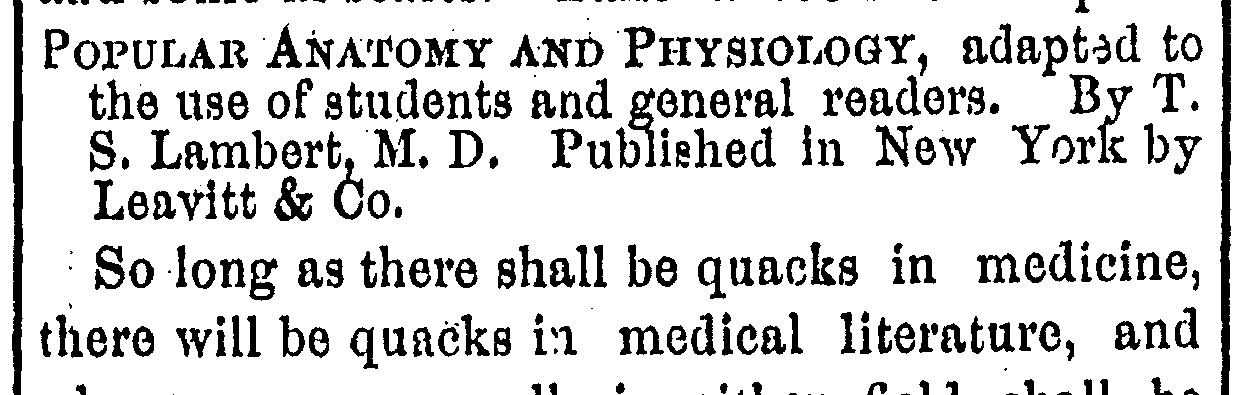
In usages at mid century, when Melville was writing to Hawthorne, the term general readers usually denotes readers either of periodical literature (magazines and newspapers) or works of non-fiction, for example textbooks of history and popular science, say Anatomy and Physiology. 
 
Springfield, Mass. Republican - April 28, 1851
Concerning the longer phrase "tribe of general readers," Melville's usage as transcribed by Julian Hawthorne in 1884 is the only one published in 19th century works accessible via Google Books and HathiTrust Digital Library. Zero hits before 1900 outside of Melville's letter to Hawthorne. 

 
On the other hand, searching in the same databases for "tribe of gentle readers" yields two results in British sources, each occurring in a piece of literary criticism. First, from the cutting review of The Spirit of Discovery, or, The Conquest of Ocean in the July 1805 number of The Edinburgh Review:

SOME years ago, Mr Bowles presented the public with a collection of sonnets and short poems. The reception it met with was not unfavourable, especially from that tribe of gentle readers to whom every running stream recals the memory of joys that are past, and every rustling leaf gives sad anticipation of coming sorrow.

 https://hdl.handle.net/2027/inu.30000093204141?urlappend=%3Bseq=325%3Bownerid=13510798895677775-329

And second, from "Canons of Criticism" by "L." in The Monthly Magazine for November 1827:
... Law, physic, divinity, and politics are precisely on the same footing; and so, too, are music, and painting, and coach-building, and tailoring (male and female), porter-brewing, and the manufacture of polonies and sausages. To betray these secrets would not only be treason to the craft, but would deprive the whole tribe of gentle readers of seven-eighths of their pleasure. What would they say to a Marplot who should come on the stage and tell the audience, “ these jewels are paste”—“this robe calico, and not silk”—and this terrible irruption nothing in the world but a pennyworth of gunpowder and nitrate of strontian?” I would never sit in the same boat (as Horace says) with such a man: so do not look for it at my hands.

https://hdl.handle.netn/2027/umn.31951000903300n?urlappend=%3Bseq=490%3Bownerid=13510798902549127-552

The first-listed instance of the phrase tribe of gentle readers in the Edinburgh Review for July 1805 is most interesting for negative criticism of the attempt at epic poetry by William L. Bowles, satirized by Byron as "harmonious Bowles" in English Bards and Scotch Reviewers. A footnote in many editions of Byron's poem directs readers to the April 1805 notice of Strangford's Camoëns in same volume with the essay on Bowles. One way or another, Melville could have encountered the sonnet loving "tribe of gentle readers" in Volume 6 of the Edinburgh Review and remembered it when writing to Hawthorne in May 1851.

As printed in 1884 the phrase "general readers" in Melville's letter is enclosed in quotation marks. Melville could be quoting magazine advertisements there, but the comprehensive sense of "general readers" would seem to render the quotation marks gratuitous. Arguably, the class of gentle readers might be regarded as narrower, more exclusive or refined, and therefore more deserving of quotation marks--whether used straightforwardly, or ironically employed as scare quotes

Hawthorne and his mosses - NYPL Digital Collections

In Hawthorne and His Mosses Melville put the word gentle in quotation marks when comparing Hawthorne to Edmund Spenser, author of The Faerie Queene:

"when Spencer was alive, he was thought of very much as Hawthorne is now,--was generally esteemed accounted just such a "gentle" harmless man.

Generally accounted by general readers, presumably. Melville's phrasing as printed in the Literary World on August 24, 1850 nicely anticipates his epistolary reference in May of the following year to "general readers." Even so, in "Hawthorne and His Mosses" the word gentle is what got the scare quotes. In similar fashion, perhaps, when inditing the May 1851 letter Melville might have conflated general and gentle readers--in his head, whichever word his hand finally wrote. Well! If Hawthorne can be generally regarded as "gentle," then I guess his readers can, too.

Related posts

Thursday, May 11, 2023

All I want is a good listener


New essay on Substack, excerpt below...

Inspired by recent encounters with Hawthorne, in particular by their heady and hearty barn-talk that March, Melville might have found a way to get the gist of their stimulating conversations into print. Echoes of Melville’s letters in the opening installment of “Scenes Beyond the Western Border” lead me to suspect it may be haunted by Hawthorne. At any rate, coincidence or no, the narrator of “Scenes Beyond the Western Border” talks to the reader like Melville talked in letters to Hawthorne. Here’s one example from the first of Melville’s Agatha letters to Hawthorne dated August 13, 1852.24

In this example, wording and structure of the Captain’s pledge to do most of the talking for his singular reader match the “and if / why I” construction in Melville's 1852 letter to Hawthorne (emphasis mine):

“… and if you are absolutely dumb, why I will sometimes answer for you.”

And if I thought I could do it well as you, why, I should not let you have it.”

https://archive.org/details/in.ernet.dli.2015.84865/page/n197/mode/2up

Introducing likely topics of conversation, the Captain sounds quite like Melville when promising a good time to his invited guest:

MELVILLE

“Hark— There is some excellent Montado Sherry awaiting you & some most potent Port. We will have mulled wine with wisdom, & buttered toast with story-telling & crack jokes & bottles from morning till night.”
Letter to Nathaniel Hawthorne, 29 January? 1851; emphasis mine.

CAPTAIN

We will talk on all subjects, from the shape of a horse-shoe to that of the slipper of the last favorite—say the 'divine Fanny,’ from great battles, or Napier's splendid pictures of such, down to the obscurest point of the squad drill—from buffalo bulls to elfin sprites.”
Scenes Beyond the Western Border, June 1851
25

These elaborate invites are similarly themed and structured. Each presents an inventory of delightful activities in store for the recipient, each inventory being divided in three main parts. Melville’s three groupings of promised events are separated by three ampersands; the Captain’s by the word from, used thrice. The invitation in each case extends to just one person: Melville to Hawthorne, the Captain to his Imaginary Friend the reader. The plural “We” brings together speaker and singular reader as joint enjoyers of good times ahead, chiefly to be spent in stimulating conversation....

https://open.substack.com/pub/melvilliana/p/all-i-want-is-a-good-listener?r=n51cr&utm_campaign=post&utm_medium=web

Saturday, April 1, 2023

Carpet-Bag Philosophy

Rural Traveler Resting under a Tree
Color engraving from a work by Howard Pyle via Bridgeman Images

Writing in April 1851, Herman Melville compared independent souls like his friend and then Berkshire neighbor Nathaniel Hawthorne to savvy travelers in Europe who pack light and may therefore cross all sorts of borders with enviable ease, carrying "nothing but a carpet-bag":

There is the grand truth about Nathaniel Hawthorne. He says NO! in thunder; but the Devil himself cannot make him say yes. For all men who say yes, lie; and all men who say no,— why, they are in the happy condition of judicious, unincumbered travellers in Europe; they cross the frontiers into Eternity with nothing but a carpet-bag, — that is to say, the Ego. Whereas those yes-gentry, they travel with heaps of baggage, and, damn them ! they will never get through the Custom House.
-- transcribed by Julian Hawthorne in Nathaniel Hawthorne and his Wife (Boston, 1884); this letter is tentatively dated April 16, 1851 in the Northwestern-Newberry edition of Melville's Correspondence, edited by Lynn Horth.

About the much-discussed "NO! in thunder" part, interested readers are invited to check out two previous Melvilliana posts

both cited in the fine 2019 essay by Jonathan A. Cook on religious motifs in the aforementioned letter and others from Melville to Hawthorne.

Cook, Jonathan A. “‘AN ENDLESS SERMON’: RELIGIOUS MOTIFS IN MELVILLE’S LETTERS TO HAWTHORNE.” Religion & Literature, vol. 51, no. 2, 2019, pp. 1–22. JSTOR, https://www.jstor.org/stable/27099109. Accessed 1 Apr. 2023.

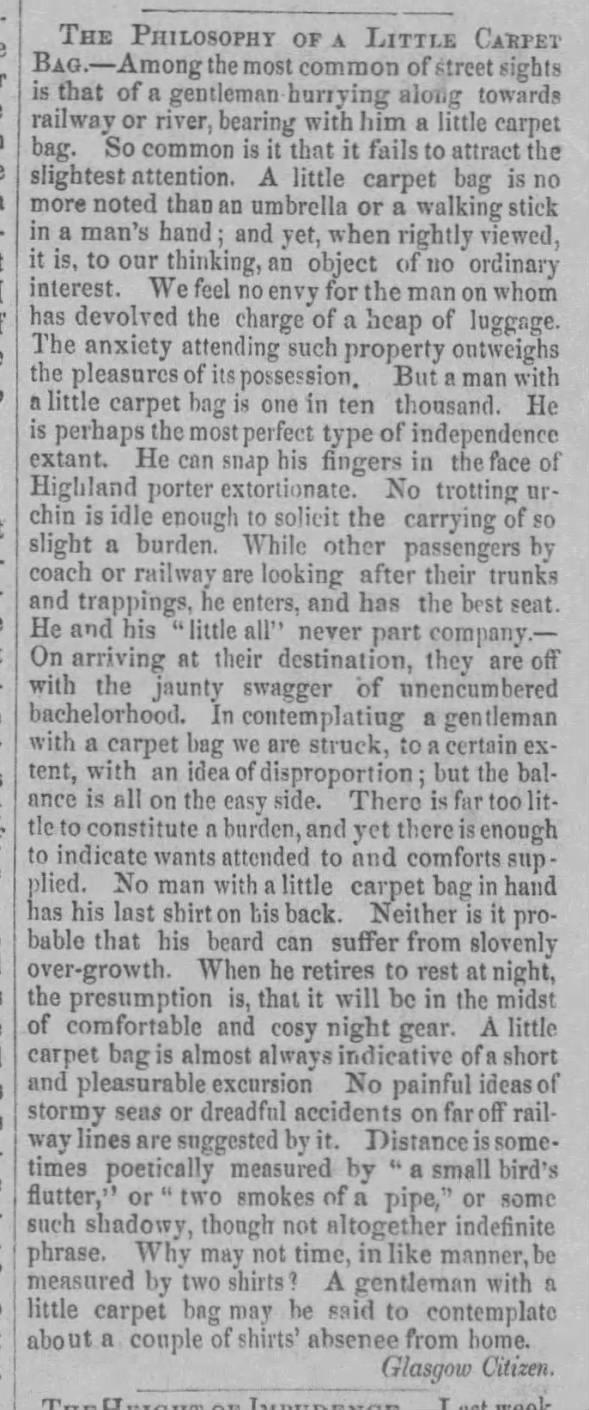
Here I want to highlight a breezy newspaper piece, frequently reprinted in 1846-1851, that similarly exalts the humble carpet-bag not only for its practical virtues but also as a figure of rare "independence" and "unencumbered bachelorhood." Originally titled "The Philosophy of a Little Carpet-Bag," the piece first appeared in the Glasgow, Scotland Citizen and was influentially reprinted in Chambers's Edinburgh Journal for Saturday, July 18, 1846

https://books.google.com/books?id=QbYCAAAAIAAJ&pg=RA2-PA48&dq#v=onepage&q&f=false

and Littell's Living Age Vol. 11 No. 126 on October 10, 1846. Google-digitized images from Volume 11 of Littell's Living Age in multiple libraries including Rutgers University are accessible online courtesy of HathiTrust Digital Library:

Echoing the anonymous Scot, perhaps accidentally, Melville praised the "unencumbered" mode of traveling light in Europe--only Melville spelled it "unincumbered" according to Hawthorne's son Julian. The same spelling occurs in Melville's Journals, ed. Howard C. Horsford with Lynn Horth (Northwestern University Press and The Newberry Library, 1989). In December 1849 Melville had decided "to travel into Germany entirely unincumbered" and therefore checked his luggage in Brussels:

"I left my carpet bag -- or rather portmanteau at the hotel."

With no carpet-bag Melville traveled even lighter than Ishmael, as John M. J. Gretchko points out in Chapter 2 of his comprehensive and beautifully illustrated study of Moby-Dick as "a tale told in the stars," Piercing the Perceptual Threshold of Herman Melville: Moving-Dick, A Heavenly Metaphor of Creativity (Falk and Bright Publishers, 2022). According to Fraser's Magazine, "three pieces" were usual for gentlemen traveling abroad: "portmanteau, hat-case, and carpet-bag." I imagined that Melville could not do without the customary carpet-bag, but Gretchko is right about Melville's ultra-light style of travel. In November 1849 Melville only packed one "little portmanteau," the piece he had "bought in London" specifically "for travelling on the Continent" (Journals, Northwestern-Newberry Edition, page 30). 

New York Evangelist- July 16, 1846 - page 4
via Genealogy Bank

American newspapers were quick to grab the Glasgow article on Carpet-Bag Philosophy. It ran in the New York Evangelist on July 16, 1846 under the compressed heading, "The Little Carpet-bag," with one added sentence of editorial introduction:

"There is some poetry, some prose, and no little philosophy, in the idea and conveniences of a little carpet-bag."

The same issue of the New York Evangelist contained a second negative review of Melville's first book Typee, largely excerpted from William Oland Bourne's hit piece in the Christian Parlor Magazine. "Typee: the Traducers of Mission" appeared on page 2 of the Evangelist for July 16, 1846; "The Little Carpet-bag" on page 4. 

New York Evangelist - July 16, 1846 - page 2

If he missed "Little Carpet-bag" there in the New York Evangelist, the author of Typee could have found it in a lot of other places, then or later.

American versions include reprintings in the Boston Evening Transcript on August 18 and December 14, 1846; Troy NY Daily Whig on August 21, 1846; and the Berkshire County Whig on September 30, 1847. A later run in New York periodicals happened a month or so before Melville's "nothing but a carpet-bag" letter to Hawthorne of April 16, 1851.

l
Philadelphia PA Sunday Dispatch - April 6, 1851
via Genealogy Bank

Later appearances of "THE PHILOSOPHY OF A LITTLE CARPET-BAG" in several NY papers (and elsewhere, under various titles including "Carpet Bag Philosophy" in the Philadelphia Sunday Dispatch for April 6, 1851) may be indebted to the reprinting on February 22, 1851 in the New York Literary World:

03 Apr 1851, Thu The Brattleboro' Eagle (Brattleboro, Vermont) Newspapers.com

"The Philosophy of a Little Carpet-Bag" is transcribed below from Chambers's Edinburgh Journal Volume 6 (July-December 1846); conveniently accessible online courtesy of HathiTrust Digital Library.

THE PHILOSOPHY OF A LITTLE CARPET-BAG.

Among the most common of street sights, is that of a gentleman hurrying along towards railway or river, bearing with him a little carpet-bag. So common it is, that it fails to attract the slightest attention. A little carpet-bag is no more noted than an umbrella or walking-stick in a man's hand; and yet, when rightly viewed, it is, to our thinking, an object of no ordinary interest. We feel no envy for the man on whom has devolved the charge of a heap of luggage. The anxiety attending such property outweighs the pleasure of its possession. But a man with a little carpet-bag is one in ten thousand. He is perhaps the most perfect type of independence extant. He can snap his fingers in the face of Highland porter extortionate. No trotting urchin is idle enough to solicit the carrying of so slight a burden. While other passengers, by coach or railway, are looking after their trunks and trappings, he enters, and has the best seat. He and his 'little all' never part company. On arriving at their destination, they are off with the jaunty swagger of unencumbered bachelorhood! In contemplating a gentleman with a carpet-bag, we are struck, to a certain extent, with an idea of disproportion; but the balance is all on the easy side. There is far too little to constitute a burden, and yet there is enough to indicate wants attended to, and comforts supplied. No man with a little carpet-bag in hand has his last shirt on his back. Neither is it probable that his beard can suffer from slovenly overgrowth. When he retires to rest at night, the presumption is, that it will be in the midst of comfortable and cozy night-gear. A little carpet-bag is almost always indicative of a short and pleasurable excursion. No painful ideas of stormy seas or dreadful accidents on far-off railway lines are suggested by it. Distance is sometimes poetically measured by 'a small bird's flutter,' or 'two smokes of a pipe,' or some such shadowy, though not altogether indefinite phrase. Why may not time, in like manner, be measured by two shirts? A gentleman with a little carpet-bag may be said to contemplate about a couple of shirts' absence from home. -- Glasgow Citizen.

-- Chambers's Edinburgh Journal for Saturday July 18, 1846.

The recycling of Carpet-Bag Philosophy in 1851 by American periodicals including the New York Literary World might explain why Melville had carpet-bags on his mind in that April 1851 letter to Hawthorne--and Moby-Dick, too. Melville did not finish writing his sixth book until summertime; the first American edition of Moby-Dick was available for sale in Albany bookstores by November 12, 1851.  

Chapter 2: The Carpet-Bag starts with the news of Ishmael's comically light packing for a whaling voyage of 3-4 years:

"I stuffed a shirt or two into my old carpet-bag, tucked it under my arm, and started for Cape Horn and the Pacific."

Coincidentally or deliberately, the title and contents humorously recall "The Philosophy of a Little Carpet-Bag," reprinted in The Literary World back on February 22, 1851. Making a virtue of necessity, Ishmael faithfully adhered to the Scottish Carpet-Bag Philosophy, acting as if he expected "a short and pleasurable excursion" with "no painful ideas of stormy seas or dreadful accidents."

Obviously, our antebellum carpet-bag and easy-going philosophy thereof are not for low-minded Carpet-baggers. Reader, would you like a bag for your carpet-bag? Here you go...

https://hdl.handle.net/2027/umn.31951000734920k?urlappend=%3Bseq=13%3Bownerid=13510798902438398-19

Turns out

THE PHILOSOPHY OF THE CARPET-BAG IS IN THE CARPET-BAG

for the week ending March 29, 1851.

 Related post: