
Original research and riffs on Herman Melville, authorship, and nineteenth-century American literature.
Tuesday, December 23, 2025


Sunday, December 14, 2025
Clement C. Moore, teaching Hebrew in 1822-1823
Clement C. Moore wrote "A Visit from St. Nicholas" in 1822, to entertain his children. 🎅🎄 As everyone knows the famous Christmas poem was first published anonymously on December 23, 1823 in the Troy NY Sentinel. Besides composing "'Twas the night before Christmas," what else… pic.twitter.com/TcBmnsTL8i
— Scott Norsworthy 🇺🇸 (@Melvilliana) December 14, 2025
Monday, December 30, 2024
Ten YUGE WINS for Melvilliana in 2024

Greetings from the Minnesota bank of beautiful Lake Pepin, otherwise known as the Mississippi River.
🏆 #1. As you probably heard by now, November of the present year 2024 came with a bang of a W = WIN for Melvilliana and the free world. I'm talking, obviously, about the exciting discovery of the long-lost Chilton copy of A Visit from St. Nicholas ("'Twas the night before Christmas....") in the handwriting of its author, Clement C. Moore. The very existence of this rare and valuable manuscript had been forgotten when I called attention, five years ago, to the facsimile reproduction of the first page in the January 1875 issue of St. Nicholas: A Monthly Magazine for Boys and Girls.
- https://melvilliana.blogspot.com/2024/08/james-c-welling-his-notes-on-new-books.html
- https://melvilliana.blogspot.com/2024/08/unabridged-wellings-review-of-moby-dick.html
- https://melvilliana.blogspot.com/2024/01/syndicated-in-cincinnati-and-beyond.html
- https://melvilliana.blogspot.com/2024/01/more-on-thorndike-rice-and-his-1885.html
- https://melvilliana.blogspot.com/2024/02/abridged-admiral-of-white-in-st-paul.html
- https://melvilliana.blogspot.com/2024/02/1885-check-endorsed-by-herman-melville.html
"famous statue, which is in the Tribune of the Uffizi Museum, in Florence, Italy."
The other name of the Knife-Grinder perfectly explains Melville's choice of words in the Life-Buoy chapter, when Ishmael depicts startled sailors as "transfixedly listening" and then compares them in that regard to the statue of a Roman slave known as THE LISTENING SLAVE.

"found more luxurious rest in the city of the Incas, whose wickedness has become a proverb,--"Corrupt as Lima,"--or among the orange groves around Rio Janeiro."Although widely regarded as an invented proverb, something Melville made up, the repeated expression "Corrupt as Lima" in Moby-Dick derives from one of Melville's earliest source-books, A Visit to the South Seas Volume 1 (New York: John P. Haven, 1831) by Charles S. Stewart:
"Lima is said to be the most corrupt city on the continent—so much so that along the whole coast, I am told, the name alone is a proverb of sin."

"... having a very great reverence for the good old Saint who so often made our hearts jump with joy when we were boys, we prevailed upon our friend Ingham to give us a sketch of him, just as he saw him one bright, frosty, moonlight night, as he was returning home late from a party of friends."
Tuesday, December 24, 2024
Author of THE NIGHT BEFORE CHRISTMAS glimpsed at Newport, 1855

"That mild, delicate-looking, elderly gentleman, benevolently gazing from his rocking chair, has rejoiced more children than PETER PARLEY; it is the venerable and benign author of The Night before Christmas, &c."
-- Henry Theodore Tuckerman writing "From Newport" to the New York Daily Times (August 6, 1855) over the pseudonym, CANONICUS.
 06 Aug 1855, Mon The New York Times (New York, New York) Newspapers.com

"If you see the N. Y. Times you may have noticed some letters from here signed 'Canonicus'--by your humble servant--but this is strictly inter nos, remember."
Manuscripts and Archives Division, The New York Public Library. "Letters to E.A. Duyckinck and G. Duyckinck" The New York Public Library Digital Collections. 1845 - 1861. https://digitalcollections.nypl.org/items/d8454190-efa3-0133-7e83-00505686a51c
Subsequently in the letter from Newport published in the New York Daily Times on August 15, 1855, the "old-fashioned courtesy" modeled by former newspaper editor Charles King (by then President of Columbia College) would prompt "Canonicus" to reminisce about
the palmy days of the New-York American, when CHARLIE HOFFMAN wrote letters from the West in its columns, and "Ianthe" impassioned poetry," and its editor was, indeed, a gentleman of the press.


- H. T. Tuckerman = KNICK in the Boston Evening Transcript
https://melvilliana.blogspot.com/2015/10/h-t-tuckerman-knick-in-boston-evening.html
- Tuckerman aka Knick on ISRAEL POTTER
https://melvilliana.blogspot.com/2019/07/tuckerman-aka-knick-on-israel-potter.html
- Tuckerman remembers the smiling face of dear old Clement Moore
https://melvilliana.blogspot.com/2017/06/henry-t-tuckerman-remembers-smiling.html
- Dr. Francis and Clement C. Moore
https://melvilliana.blogspot.com/2016/11/dr-francis-and-clement-c-moore.html
Monday, December 9, 2024
Chilton copy, found!
“There it is, the beginning of the modern Christmas” - read more about the story of this handwritten version of “A Visit From St. Nicholas” in the New York Times: https://t.co/a3jVI6bGz5
— Christie's Books (@ChristiesBKS) December 6, 2024
Sunday, December 8, 2024
Wednesday, November 17, 2021
Montreal Visit from St Nicholas, 1826
"A Visit from St. Nicholas" was reprinted in the Montreal Gazette on January 4, 1826, with a helpful preface explaining the American Santa Claus to Canadians.
Amongst the Dutch Americans, St. Nicholas, or, as he is familiarly called, Sainte Claus, is a Christmas visitor, highly esteemed by the juvenile branches of families, who never fail to court the attention of the Saint, by placing their stockings, to receive such donations as this free-hearted patron of good children may in his bounty be pleased to bestow. This innocent superstition is, however, not confined to the Dutch settlers--the children of their neighbours hold the cake-bestowing Saint in equal veneration. Nor is his fame unknown in these Provinces, although he is not often seen, his gingerbread visiting-cards afford his urchin votaries a certain evidence that, whilst they slept, he has paid his annual Christmas call. We leave it to antiquaries to determine his Saintship's origin; and whether the donations made in his name originated in the distribution of sweetmeats and cakes at the Vatican at Rome, on Christmas-eve, or is a remnant of some earlier superstition. Be that as it may, we present the following picture of his garb and equipage, as it has been sketched by an American poet, who was fortunate enough to obtain a glimpse of the jolly old elf.
This item is not listed in Nancy H. Marshall, The Night Before Christmas, A Descriptive Bibliography of Clement Clarke Moore's Immortal Poem (Oak Knoll Press, 2002). With interesting exceptions, the text of the still-anonymous poem mostly follows the first printing in the Troy Sentinel on December 23, 1823. Dunder remains Dunder, for example, but Blixem has been re-christened Blixen. Also, the whole roll of reindeer names has been metrically improved by rearranging commas and exclamation marks:
“Now, Dasher! now, Dancer! now Prancer and Vixen!
“On, Comet! on, Cupid! on, Dunder! and Blixen...."
Extending to Comet and company in the second line of the couplet, the revisions to punctuation marks around reindeer names in the Montreal Gazette are even more thorough than similar changes in the Charleston Mercury and other 1826 versions. For more on those, check out the earlier post
https://melvilliana.blogspot.com/2019/12/now-dasher-in-1826.html
Another interesting difference is the addition of "which" as a relative pronoun in the distinctive heroic simile that here in this early Canadian version begins
As dry leaves which before the wild hurricane fly.
The 1823 Troy Sentinel version did not supply any word between "leaves" and "before":
As dry leaves before the wild hurricane fly.
Adding "which" makes a regular anapest "which before" in the second metrical foot. In the same line as corrected or revised in the 1844 collection Poems by Clement C. Moore, "that" replaces "which":
Santa smokes like a chimney wherever he goes, obviously. But here the é with the acute accent, unique to the Montreal Gazette version, tells readers how to sayAs dry leaves that before the wild hurricane fly.
"the smoke it éncircled his head like a wreath"in the province of Quebec.
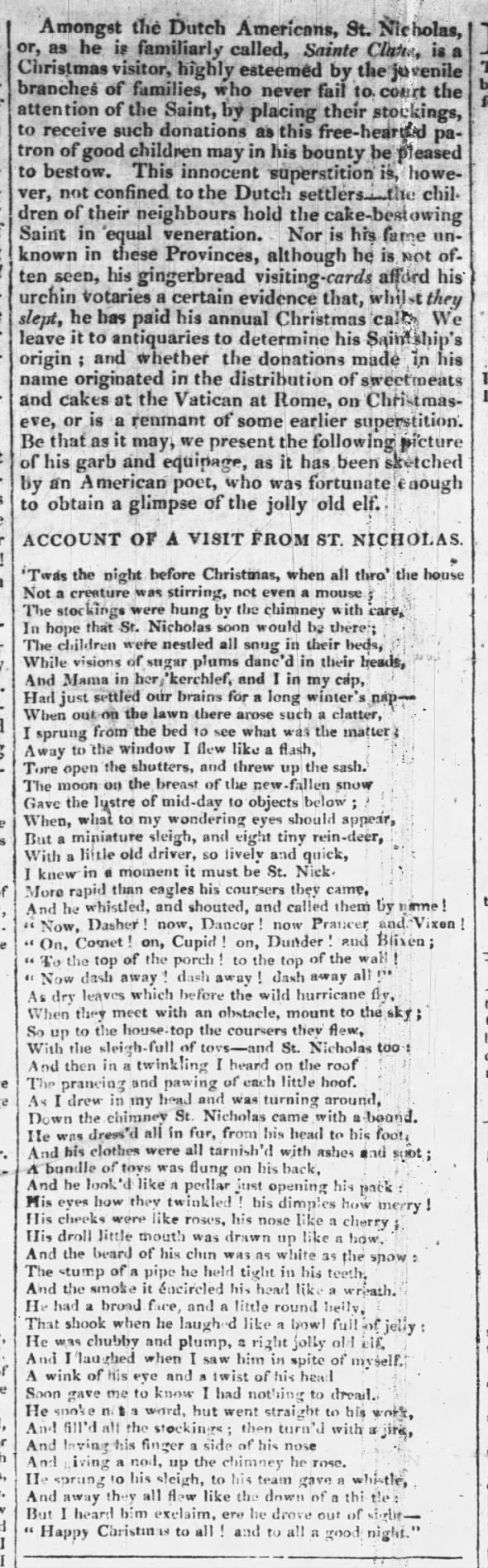 04 Jan 1826, Wed Montreal Gazette (Montreal, Quebec, Canada) Newspapers.com
ACCOUNT OF A VISIT FROM ST. NICHOLAS.
’Twas the night before Christmas, when all thro’ the house
Not a creature was stirring, not even a mouse;
The stockings were hung by the chimney with care,
In hope that St. Nicholas soon would be there;
The children were nestled all snug in their beds,
While visions of sugar plums danc’d in their heads,
And Mama in her ’kerchief, and I in my cap,
Had just settled our brains for a long winter’s nap—
When out on the lawn there arose such a clatter,
I sprung from the bed to see what was the matter;
Away to the window I flew like a flash,
Tore open the shutters, and threw up the sash.
The moon on the breast of the new-fallen snow
Gave the lustre of mid-day to objects below;
When, what to my wondering eyes should appear,
But a miniature sleigh, and eight tiny rein-deer,
With a little old driver, so lively and quick,
I knew in a moment it must be St. Nick.
More rapid than eagles his coursers they came,
And he whistled, and shouted, and called them by name!
“Now, Dasher! now, Dancer! now Prancer and Vixen!
“On, Comet! on, Cupid! on, Dunder! and Blixen;
“To the top of the porch! to the top of the wall!
“Now dash away! dash away! dash away all!”
As dry leaves which before the wild hurricane fly,
When they meet with an obstacle, mount to the sky;
So up to the house-top the coursers they flew,
With the sleigh full of toys—and St. Nicholas too:
And then in a twinkling I heard on the roof
The prancing and pawing of each little hoof.
As I drew in my head, and was turning around,
Down the chimney St. Nicholas came with a bound.
He was dress’d all in fur, from his head to his foot,
And his clothes were all tarnish’d with ashes and soot;
A bundle of toys was flung on his back,
And he look’d like a pedlar just opening his pack:
His eyes how they twinkled! his dimples how merry!
His cheeks were like roses, his nose like a cherry;
His droll little mouth was drawn up like a bow,
And the beard of his chin was as white as the snow;
The stump of a pipe he held tight in his teeth,
And the smoke it éncircled his head like a wreath.
He had a broad face, and a little round belly
That shook when he laughed like a bowl full of jelly:
He was chubby and plump, a right jolly old elf,
And I laughed when I saw him in spite of myself.
A wink of his eye and a twist of his head
Soon gave me to know I had nothing to dread.
He spoke not a word, but went straight to his work,
And fill’d all the stockings; then turn’d with a jirk,
And laying his finger a side of his nose
And giving a nod, up the chimney he rose.
He sprung to his sleigh, to his team gave a whistle,
And away they all flew like the down of a thistle:
But I heard him exclaim, ere he drove out of sight—
"Happy Christmas to all ! and to all a good night."
-- Montreal Gazette, January 4, 1826.
Friday, February 3, 2017
Response by MacDonald P. Jackson

Response to Scott Norsworthy
Norsworthy complains that while granting that the prima facie case for Moore’s authorship of the poem is strong I then proceed “as if none of it matters.” But unless you assume that the “external evidence” supporting Moore’s claim is conclusive and the long-standing belief among descendants of Henry Livingston that their ancestor was the true author must consequently be groundless, your only recourse in trying to get at the truth is to investigate internal evidence. Since my evaluation of the documentary evidence precludes this assumption, this is what I did. The results of the stylistic tests consistently classify “The Night Before Christmas” with Livingston’s verse, but because Norsworthy judges that the case for Moore’s authorship has already been proven by the external evidence (so that I address a “non-problem”), he dismisses “stylometric evidence” as leading to “error” and enjoins me to “please try again” till (somehow) I produce the result that he wants.
In Norsworthy’s opinion, I minimized “likely textual corruptions in the first, unauthorized newspaper printing.” He would evidently categorize among these supposed “corruptions” the naming of the last two reindeer as “Dunder and Blixem,” which Moore “corrected” in 1844 to “Donder and Blitzen”. The anonymous Troy Sentinel (23 December 1823) version printed:
“Now! Dasher, now! Dancer, now! Prancer, and Vixen.In Moore’s Poems (1844) this couplet reads:
“On! Comet, on! Cupid, on! Dunder and Blixem;
Now, Dasher! now, Dancer! now, Prancer and Vixen!If Norsworthy is right, then textual corruption (a) created “Dunder and Blixem,” a common variant at that time of the Dutch oath Donder en Bliksem (“Thunder and Lightning”) with which Livingston—who lived in Dutchess County and three of whose grandparents were Dutch—would have been well acquainted; (b) placed exclamation marks in an anomalous position characteristic of Livingston’s way with such punctuation, but not Moore’s; and, (c) while perfecting the first syllable of a poor rhyme into the exact “Vix”–“Blix,” produced a nasal “en”–“em” second syllable to the rhyme, accidentally bringing it into line with Livingston’s liking, not shared with Moore, for nasal rhyming. Yet my discussion of the “reindeer names” is said by Norsworthy to “amount to special pleading.” Isn’t it, rather, special pleading to pass off the Sentinel variants as “textual corruptions”?
On, Comet! on, Cupid! on Donder and Blitzen!
Norsworthy quotes my statement that, although the external evidence, taken at face value, favours Moore’s authorship of “The Night Before Christmas,” “no reader of poetry with any sense of literary style and value could compare Moore’s body of verse with Livingston’s without recognizing that ‘The Night Before Christmas’ is a conspicuous misfit within Moore’s canon and would be comfortably at home within Livingston’s.” He reduces this to “only an idiot would align ‘Night Before Christmas’ with the transparently awful poetry of Clement C. Moore,” and charges that Jackson “takes for granted the very thing he wants to test.” But “only an idiot” and “transparently awful” are Norsworthy’s words, not mine. So is his characterization of my “false premise”: “Moore’s poetry sucks.” The fact is that, although I don’t rate Moore’s poetry as highly as Norsworthy does, I recognize his competence and his ambitions. But I do find the bulk of his verse “dull” and less engaging than Livingston’s. I say that “The Night Before Christmas” seems a “misfit” within Moore’s canon but “would be comfortably at home within Livingston’s” and that it “is as uncharacteristic of Moore as it is characteristic of Livingston” because the kind of “verve, imagination, humor, whimsy, and sheer joyous inventiveness” displayed in this Christmas poem strikes me as present in Livingston’s body of verse but absent from Moore’s, which is dissimilar in tone. I agree with Norsworthy that although Moore’s poetic models are “the usual eighteenth-century” ones, in “To Southey,” under the influence of this “romantic,” he taps a true voice of feeling, Moore’s lines on the death of his wife in 1830, quoted by Norsworthy, being genuinely moving. I concede that, in the face of the grief expressed there, my “No doubt, Clement Clarke Moore loved his wife and children” seems unduly flippant. But “To Southey” is surely an utterly different type of poem from “The Night Before Christmas.”
Norsworthy’s account of Livingston’s verse is, in my view, misleading. He writes: “I’m here to tell you the Romantic revolution in literature missed him in Poughkeepsie.” But because Livingston’s autograph manuscripts of poems composed from 1791 till his death in 1828 perished in a fire (except those copied into his daughter Jane’s poetry book), most of his surviving poems belong to the period 1776–90. Wordsworth and Coleridge’s volume, Lyrical Ballads was published in 1798, Keats’s first volume of Poems in 1817, Shelley’s (Original Poetry) in 1810. Southey’s The Curse of Kehama, which Norsworthy cites as an influence on Moore, was published in 1810, and A Tale of Paraguay, also cited as a stimulus, in 1825. Given this chronology, it doesn’t make much sense to say that “the Romantic revolution in literature missed” Livingston. He didn’t, in any case, aspire to join a poetic mainstream. As I explain in my Chapter 2, his verse, akin to that of popular song-books, belongs rather to the tradition of the entertainer. He writes rebuses, acrostics, and his topical Carrier Addresses simply to amuse, and most other pieces to delight or console relatives and friends. “His is a folk art that often achieves something durable.”
But this is really a side-issue. More important is Norsworthy’s suggestion that my subjective belief that “The Night Before Christmas” is more characteristic of Livingston’s output than of Moore’s compromises my “scientific objectivity” in conducting computational tests. It is, however, perfectly normal and legitimate to have a theory and then objectively test it. If Moore wrote “The Night Before Christmas,” counts of features that distinguish most Moore poems from most Livingston poems ought usually to have associated “The Night Before Christmas” with Moore’s corpus, thus falsifying my subjectively based theory, but they consistently associate it with Livingston’s. Shortly I’ll answer Norsworthy’s specific charges of bias in my conducting of the statistical tests. But first there’s the matter of my alleged “tin ear.”
I drew attention to parallels in three of Livingston’s rebuses (and meant to mention four) with the lines in “The Night Before Christmas”:
The moon on the breast of the new fallen snow,I didn’t claim, as Norsworthy says I did, that the rebuses “replicate [my italics] the familiar couplet.” The difference between the puzzle-poems’ posing of their clue and the lyricism of the more famous lines is easily recognizable, and it is obvious enough that in the rebuses, but not in the Christmas poem, darkness is equated with “error.” But all four rebus couplets repeat the idea of light turning that darkness (of “midnight” in three cases) into day, and twice it is into the brightness of midday (“meridian,” “noon”):
Gave the lustre of mid-day to objects below.
The Goddess refulgent whose far-beaming rays
Can pour upon error meridian blase. (“Deity Rebus”)
That goddess refulgent whose ray through the gloom(Norsworthy understandably doesn’t quote this last example, because of my muddling of the titles of the rebuses.) Moreover the answer to each variation of the rebus clues is Thea or Theia, whom classicist Edith Hamilton glossed as “(shining), name sometimes given to the moon.” So, although the actual heavenly body is not specifically mentioned, it is by association part of the complex of ideas. For Norsworthy, “There’s literally no material thing whatsoever to be seen in any of Livingston’s three Rebus couplets, beyond metaphorical ray-beams from heaven and implied insight.” But to employ darkness, light, and noonday figuratively is not to dispel the images that naturally form in the reader’s mind. In the metaphorical language of poetry the “vehicle” is as present as the “tenor,” to employ the well-established terms. Further, “new fallen snow” in “The Night Before Christmas” couplet is a phrase used by Livingston (as “new fall’n snows”) but never by Moore, while Livingston links “snow” and “breast” in “snow-white breast.”
Of error’s dark midnight can light up a noon. (“Sages Rebus”)
Norsworthy points out that in none of his acknowledged poems does Livingston use “breast” figuratively, whereas Moore does so once in “some lofty mountain’s breast,” which is only four lines separate from a “snowy shower,” “The Water-Drinker” being concerned with water in its several manifestations. But Literature Online finds thirty-seven instances of “mountain’s breast” in the period 1750–1850 in poetry alone—it is a commonplace—but no example of “the snow’s breast” or “the breast of the snow,” whether new fallen or not. Norsworthy also cites Moore’s lines in “Charles Elphinstone,” “Surpris’d, I found the moon’s soft silvery ray / Spread like a mantle o’er the objects round” and makes some pertinent observations about Moore’s use of “objects,” “lustre” (twice), and (later) “brains,” “visions,” and “dread.” He also connects the Christmas poem’s “wondering eyes” with Moore’s “wond’ring ear” in “To the Nymphs of Mount Harmony”. But Literature Online yields 113 instances of “wondering eyes” in poetry of the period 1750–1850, and the phrase occurs in the balcony scene of Romeo and Juliet (2.2.29) and in the landmark Psalms and Hymns (1789, revised 1814), compiled by Livingston’s clergyman brother John Henry Livingston for the Reformed Dutch Church.
Norsworthy also notes that “Moore wrote a whole poem on new fallen snow: Lines / Written After a Snow-Storm. For his kids.” True, Moore does draw the attention of his children to the beauty of the snow, but he typically ends by remarking that even as they watch “The fairy scene soon fades away, / And mocks our raptur’d sight” and drawing the moral:
And let this fleeting vision teachIf this is Moore’s notion of writing “For his kids,” it is a far cry from that which inspired “The Night Before Christmas.”
A truth you soon must know—
That all the joys we here can reach
Are transient as the snow.
No doubt Norsworthy and I could continue to debate the respective merits of his parallels between “The Night Before Christmas” and Moore’s verse and mine between “The Night Before Christmas” and Livingston’s verse, with mine including the conjunction within five lines of the Livingston rhymes “belly”–“jelly” and “elf”–“-self” and the idiom in “right jolly” (the adjective appearing four times and the idiom “right [adjective]” once in Livingston’s verse, but neither appearing in Moore’s) and the conjunction of Livingston markers in the poem’s final line: the then extremely rare “Happy Christmas” rather than “Merry Christmas,” a chiasmic structure, and the seasonal wish “to all” (Who Wrote, 47–8). But attribution scholars have long ago learned from experience that merely collecting parallels that entail what Norsworthy calls “distinctive meanings and contexts” and that connect one favored candidate with a disputed work is apt to produce conflicting evidence. One scholar will compile a list associating a disputed text with Author A and another responds with a similar list associating the disputed text with Author B. I cited a few such links between “The Night Before Christmas” and Livingston to show up the inadequacy of Joe Nickell’s list of parallels between the poem and Moore, and searched instead for trigrams (three-word sequences) that it shares with only one of the two authors, because these can be precisely defined and the search can be comprehensive for both candidates. Though the data were sparse, the results tended to favour Livingston. Norsworthy thinks I should have included Moore’s “lustre of the day,” but this is a different three-word sequence from “lustre of mid-day” and so doesn’t qualify by the preset rules. If we include trigrams in the titles “From/from Saint/St. Nicholas,” as Norsworthy proposes, the tallies still slightly favour Livingston, given his smaller poetic corpus.
The main evidence for Livingston, however, resides in those high-frequency words and phoneme pairs despised by Norsworthy as “meaningless bits, inconsequential and perhaps random in their distribution.” Although I provided references to a survey by Patrick Juola of modern attribution techniques and to an influential study by John Burrows, Norsworthy seems not to appreciate that rates of high-frequency words have been shown to be among the best discriminators between authors—not just of early modern texts but of texts of all periods and genres. They form the framework on which sentences, with their “content” words (nouns, verbs, adjectives, adverbs) are built, and so their rates of use register authorial preferences in the deployment of grammar and syntax. And indeed I show that they are effective in distinguishing most poems by Livingston from most poems by Moore. So, as I also show, are “phoneme pairs”. A phoneme is a unit of significant sound in a specific language and phoneme pairs were defined as consisting of the last phoneme (in the phonetic system Arpabet) of one word and the first phoneme of the next word within a single verse line. The rates of occurrence of different phoneme pairs are good indicators of authorship, particularly of poetry, because they register a combination of (a) choices of words and (b) ways of putting them together. A poet’s preferences among them are governed by both sound and sense.
As a postscript to the above paragraph, it seems worth mentioning that a fair proportion of the words of “medium-high frequency” dealt with in my Chapter 17 happen to be meaningful “content” words—nouns, verbs, adjectives, or adverbs (see Who Wrote, page 183, Chapter 17, note 1).
Norsworthy makes several criticisms of my handling of the evidence of common words and phoneme pairs—evidence that consistently associates “The Night Before Christmas” with Livingston, not Moore. He implies that I discard the “very high-frequency word” “to” because its overall rate is closer to Moore’s mean than Livingston’s. But, as I explain, I eliminate it from the test described in Chapter 14 because the variability of usage of this word within each poet’s work means that a t-test reveals no statistically significant difference between their corpora, so that the word is unsuited to stand-alone testing. It turned out, however, to qualify (by a predetermined mathematical criterion) for use as one of the common words for which rates were recorded in Chapter 16, and was duly counted as a “Moore-favored word”. As I wrote, “Despite the context-sensitive character of many pronouns and verbs, they have been used effectively in dozens of authorship studies, along with other high-frequency words. Very common words that, unlike ‘that,’ are ineffective as stand-alone discriminators may have value as members of a substantial group of words, each with some discriminatory power.” So “I” and “is,“ which Norsworthy criticizes me for discarding from Chapter 14 on the grounds that “I” is apt to be “context-sensitive” and “is” is part of the “lexeme” “to be” with its various components, are duly employed in Chapter 16, where they turn out to qualify as “Livingston-favored words.” There has been no biased or arbitrary exclusion of any word that occurs at or above a stipulated rate of occurrence in Moore’s or Livingston’s body of verse.
Norsworthy pounces on my concession that rates of use of phoneme pairs beginning with the Arpabet sound AH are largely determined by rates of use of the definite and indefinite articles (“the” and “a”), and writes that “Livingston’s usual anapestic meter pumps up usage of just the things Professor Jackson has been trying to count” and “has to skew the usage of ‘the’ and ‘a’ and ‘and’.” Apart from the innuendo in “trying” (as though I hadn’t managed to count rates of occurrence at all), Norsworthy’s claim is that counts of the words that are used at the highest rates by either of the two poets and are used at rates at least 1.2 times greater by one of them are influenced by Livingston’s greater use than Moore’s of the anapestic meter employed in “The Night Before Christmas.” Yet at several points I discuss this possible confounding factor and show that, while it may have had some slight effect on some tests, it cannot account for the overall results. And I repeatedly discuss the results for Moore’s two anapestic pieces, “The Pig and the Rooster,” included in Poems (1844), and “From Saint Nicholas,” closely contemporary with Moore’s supposed composition of “The Night Before Christmas” in 1822, and later on the anapestic “Irish Valentine” and “For a Kiss,” written long afterwards in the period 1843–52. None of Moore’s anapestic pieces attains the percentage of articles among all words of “The Night Before Christmas” (11.439): “The Pig and the Rooster” 7.663, “From Saint Nicholas” 3.271, “For a Kiss” 8.087, “Irish Valentine” 9.322. Yet some poems by Livingston that are not in anapests surpass the percentage even of “The Night Before Christmas”: “Lo from the East” 11.905, “Parody on the Death of General Wolfe” 12.174, “To Miss” 12.500, “Queen of Love Rebus” 11.628. The increase in the use of the articles in poems of Moore’s old age has nothing to do with the meter: neither “Caroline’s Album” nor “Newport Beach,” in which the rates are highest, is in anapests.
Nor is my concession—after checking the efficacy of the various tests by applying them to those late manuscript poems by Moore that were deliberately held back for that purpose—that Moore uses rates of attributive adjectives more sparingly in his four anapestic pieces than in his other poems and “could conceivably have written a poem in anapests that was a sparing of adjectives as ‘The Night Before Christmas’” as damaging to my case as Norsworthy imagines (“With that concession, it’s all over but the crying.”). The well-established mathematical phenomenon known as “the regression effect” makes it probable that when discriminators developed from one set of data are applied to a new set there will be some slight loss of discriminatory power. Moreover, the initial treatment of attributive adjectives in Table 7.1 relied on blocks of at least 500 words, whereas the results for the additional poems, recorded in Table 18.1, was for individual poems, some much shorter than 500 words, so leading to greater random variation. Even so, none of Moore’s four anapestic pieces has a percentage of attributive adjectives per total words as low as for “The Night Before Christmas” (16.236): “Pig and Rooster” 39.4, “For Saint Nicholas” 36.0, “For a Kiss” 27.8, “Irish Valentine” 28.0. Yet, as I note, at least five individual pieces by Livingston have percentages ranging from 10.5 to 19.2 (Who Wrote, 98). The “scruples” with which Norsworthy kindly credits me are directed at assessing, from their performance on a new set of Moore poems (ones mainly about young folk and that Foster was criticized for ignoring), which tests are the most reliable. Definite and indefinite articles, and attributive adjectives, are judged to be of some efficacy but of less than more comprehensive counts.
The most important counter to Norsworthy’s suggestion that Livingston’s liking for anapests “pumps up usage of the things Professor Jackson has been trying to count”—trying successfully, one might add—is that it cannot possibly explain the figures for those most effective discriminators, “individual phoneme pairs,” “high frequency words,” and “common words,” tabulated in Chapters 12, 16, and 17, and processed in Figures 3 and 4 (Who Wrote, 132–3). If we divide the percentages of “Livingston-favored phoneme pairs” in Table 12.1 into those for anapestic tetrameter pieces and the rest, the mean for the anapestic pieces is slightly higher than for the other group, but a t-test shows that the difference is not statistically significant, but has a better than one in five probability of occurring by pure chance. A similar check of Table 16.2 (high-frequency words) shows the anapestic pieces having a lower mean percentage of “Livingston- favored words” (53.4708) than the other group (64.8487)—and this difference is statistically significant. Again, the percentages of “Livingston-favored words” in Table 17.1 is slightly lower for the anapestic pieces (61.7204) than for the others (63.2948), though statistically speaking the two groups are indistinguishable.
My Figures 3 and 4 present the most crucial evidence in pictorial form. They include not only the Moore poems used for the main investigation but also the twelve manuscript poems used for checking the tests. The graphs show the numbers of poems by Livingston and by Moore that fall within different ranges in their percentages of Livingston-favored phonemes (Figure 3) and Livingston-favored words (Figure 4). For Figure 4 all words that occur in the top 110 for either author and that qualify as used at an overall rate at least 1.2 times greater in one author than the other are included (combining data from Tables 16.2, 17.1, 18.1, 18.2, 18.5, and the counts of “that” for individual poems that lie behind the amalgamations of Table 14.1). Both Figure 3 and Figure 4 show “The Night Before Christmas” placed around the middle of the Livingston distribution and outside the range for Moore. Without making any comment on these results, Norsworthy notes that counts of various features show overlaps between Moore’s poems and Livingston’s and judges the method “Crazy!” But, although no one discriminator or set of discriminators can be expected to achieve perfect separation between all Moore’s poems and all Livingston’s, the overlaps are between different poems on different tests, so that no poem by Moore falls as consistently as does “The Night Before Christmas” within the Livingston range.
Norsworthy finds fault with the make-up of my corpus of Moore poems. I excluded from counts of various features three of his acknowledged verse translations, two from Italian and one from Greek. That seemed to me a reasonable precaution. Had I included them Norsworthy might have criticized me for using poems that were not of Moore’s free composition but were derived from languages other than English. Failure to exclude “The Mischievous Muse—Translated” was an oversight. Livingston’s retelling of stories that derive ultimately from Aesop or his few verse paraphrases of passages based on books of the Old Testament that were already in English seemed to belong to a different category. In any case, including Moore’s three excluded translations or excluding Livingston’s poems with a basis in the Bible would have had no significant effect on the overall results. Norsworthy also blames me for not making full use of “Biography of the Heart of Clement C. Moore”. As I explain, I was unable to obtain a copy, but consulted the long extract quoted by Moore’s biographer Samuel White Patterson, which is the source to which Norsworthy himself provides a link. I noted that several of my tests associated Patterson’s text strongly with Moore’s verse and differentiated it from Livingston’s (Who Wrote, page 183, Chapter 18, note 3). Norsworthy has since (5 January 2017, on his Melvilliana blog site) made available a transcript of the whole poem. Preliminary analysis affords results in line with those of the large Patterson sample. As for the massive “Charles Elphinstone,” one of the manuscript poems of 1843–52 that were held back for testing the tests and itself datable to 1851, what I said about that blank verse biographical epic was that, since it was so obviously remote in manner and matter from “The Night Before Christmas,” I wouldn’t attempt the onerous task of breaking it down into 500-word blocks (say) and calculating all the data for each block. But I did give overall figures for “Charles Elphinstone” on the various tests, and even some of the more important figures for its individual “parts”: these figures associated it unequivocally with Moore, not Livingston or “The Night Before Christmas.” Incidentally, I can’t see that the pun on the famous surname “Elphinstone” (Elfin Stone) that Norsworthy exhibits in order, presumably, to imply that Moore might have created an elfin St Nick would serve any function in the poem.
I’ll say something about two small matters. Norsworthy writes: “Professor Jackson means to dismiss Moore as a ‘moralist’ and ‘satirist’ but see here now, those labels equally apply to Livingston who lectures his sister Joanna to count her blessings and ‘Meekly attend the ways of higher heav’n!’ On her birthday!” There are a couple of things to say in reply. The first is that my calling Moore a ‘moralist’ and ‘satirist’ wasn’t intended as dismissal; rather, I was aiming to distinguish between the overall impressions made by Moore’s Poems (1844) and the surviving verse of Livingston. The second is to remind Norsworthy of his own admonition that one should read lines within their whole context. Livingston’s poem to his sister (seven years younger than he, but turning thirty-three) is full of affection and of his desire to share her griefs and joys and cheer her (since she may be apprehensive about getting older) by praising her, her husband, and her children. He ends with a stanza of benediction that uses much the same images and vocabulary as his blessing on his little niece Ann Duyckinck. “Meekly attend the ways of higher heav’n!” marks a rallying point, rather than the beginning of a moralizing lecture. I’m pretty confident that Norsworthy can appreciate as well as I can the difference in tone and essential message between this birthday poem and Moore’s “To a Young Lady on her Birthday’,” which seems calculated to make the young lady miserable by reminding her that her beauty will fade and death must ensue. Referring to Moore’s “A Trip to Saratoga,” Norsworthy writes: “The father-with-kids theme of the whole poem recalls the setting of ‘The Night Before Christmas.”’ But most readers will be struck by how completely different in spirit those two poems are. The father-narrator of “The Night Before Christmas” simply observes St Nick while the children sleep. The poem relates a magical encounter, so as to amuse and delight the young. When—the father Henry Mildmay having safely got his children back home from their trip to Saratoga—daughter Kate gives him a goodnight kiss, he responds with a twenty-line homily on the lessons to be learned from their escapade, hoping that she can “appreciate true worth” and view “worthless folly” “with due scorn.”
Finally, there are the much more important issues of the alleged source of “The Night Before Christmas” and the weight of the external evidence. Norsworthy judges the “influence of Washington Irving’s portrait of St. Nicholas in the 1812 and later editions of A History of New York” to be “clear and direct.” In Chapter 4 I explain why I think that it is not. In my view, belief that Irving’s History must have influenced the poem depends on having made a prior assumption about the poem’s date of composition. The points of resemblance between History and poem are not conclusive in themselves.
As for the external evidence, there can be no doubt that several people who knew Clement Clarke Moore thought of him as author of “The Night Before Christmas,” and Norsworthy has shown that Orville Holley, who in 1823 was editor of the Troy Sentinel, later claimed to have heard that Moore was the author of the poem within a few months of its first printing. But it is also the case that as soon as Livingston’s descendants became aware, around 1860, that the poem was being attributed to Moore they expressed indignation at what they considered a misattribution. In 1844 Moore had to enquire from the Troy Sentinel owner Norman Tuttle how the poem came to be printed in that newspaper, and in preparing copy for his Poems he relied on a Sentinel broadsheet reprint of 1830 that Tuttle sent him (Who Wrote, 173–4). No pre-publication autograph by Moore has ever surfaced. Both the Moore and the Livingston stories involve the poem’s having been delivered to the Sentinel by intermediaries. The Livingston notion of how a poem by Henry Livingston was misattributed is not inherently incredible. I discussed these matters, and the Odell connection, in Chapters 19–21. The copy of “The Night Before Christmas” in Mary Odell’s handwriting cannot have been based on anything sent to the family by Moore himself: its textual oddities—including the meaningless reindeer name “Blixen,” where Moore (Norsworthy assures us) wrote “Blitzen,” the transposition “pawing and prancing,” and the variant “was slung over”—demonstrate that (Who Wrote, 116–18).
Norsworthy has, however, made an important discovery, anticipated in his Melvilliana blog of 31 October 16, where he noted that on 25 December 1843 the Daily National Intelligencer (Washington, DC) published “A Visit from St. Nicholas” (“The Night Before Christmas”) as “written by JOSEPH WOOD, artist.” On 28 December the paper printed a letter from “C.” saying that this attribution was “a mistake” and that the poem was by Clement C. Moore and had been published as his “in the volume of American Poems edited by John Keese,” which is The Poets of America Illustrated by One of Her Painters (New York, 1840), item number 20 in Nancy H. Marshall’s bibliography. Then on 6 March the Daily National Intelligencer noted “the request addressed to us by the New York American to copy a note of Mr. CLEMENT C. MOORE concerning the authorship of the admired lines of his, describing the visit of St. Nicholas,” but pointed out that there was no need to do so, since the letter of 28 December had already made the correction. The editor of the Intelligencer added that he did not suspect the “unknown correspondent” who had attributed the poem to Joseph Wood of any intention to deceive but conjectured “that some friend of the late Mr. WOOD (who had many friends) finding among his papers, after his death, a copy of these lines in his hand-writing, took it for granted, in the absence of other information, that the authorship was his.” Interestingly, this proposed explanation of the mistake bears a close resemblance to that offered by Livingston’s descendants for what they consider the misattribution of the poem to Moore. They believe that a visitor to Moore’s house (probably Harriet Butler, who passed it on to Sarah Sackett), seeing Livingston’s poem there, wrongly assumed that it had been composed by Moore, the difference from the theory about the Wood case being that Moore was not dead and the handwriting is alleged to have been Livingston’s.
The significant point, though, is that the paragraph in the Daily National Intelligencer of 6 March 1844 “seems to mean,” as Norsworthy said in his 31 October blog,” that sometime before March 6, 1844, the New York American published a note from Clement C. Moore acknowledging his authorship of ‘A Visit from St. Nicholas.’” With admirable scholarly diligence, he has since established that this is indeed the meaning. He has tracked down a letter by Clement C. Moore (dated 27 February 1844) in the American of 1 March 1944, in which Moore quotes the Intelligencer’s correspondent’s attribution of “The Night Before Christmas” to Joseph Wood, and adds:
The above is printed immediately over some lines, describing a visit from St. Nicholas, which I wrote many years ago, I think somewhere between 1822 and 1824, not for publication, but to amuse my children. They, however, found their way, to my great surprise, in the Troy Sentinel: nor did I know, until lately, how they got there. When “The New York Book” was about to be published, I was applied to for some contribution to the work. Accordingly, I gave the publisher several pieces, among which was the “Visit from St. Nicholas.” It was printed under my name, and has frequently since been republished, in your paper among others, with my name attached to it.
Under these circumstances, I feel it incumbent on me not to remain silent, while so bold a claim, as the above quoted, is laid to my literary property, however small the intrinsic value of that property may be.
The New York Book was published in 1827.
Yours, truly and respectfully,In the face of this unequivocal statement, arguers for Livingston’s authorship must accuse Moore of an outright untruth, which is not an attractive prospect.
CLEMENT C. MOORE
There is, however, an intriguing proximity of dates. On 23 February 1844 Moore writes to Norman Tuttle enquiring about the provenance of the Troy Sentinel printing of “The Night Before Christmas” in 1823. On 26 February Tuttle replies that it came from Sarah Hackett, that he did not then know who the author was, but that he has “since been informed” that it was Moore. Moore then includes “The Night Before Christmas” (“A Visit from St. Nicholas”) among his collected Poems, with a preface dated March 1844, having in his letter dated 1 March in the New York American claimed the poem as his. It appears to be only after ascertaining from Tuttle that the Sentinel had received “The Night Before Christmas” from Sarah Hackett, who was not a poet, that Moore decided expressly and publicly to take credit as author.
Don Foster did not know of the New York American’s request to the Intelligencer, or of Moore’s letter in the American, but his interpretation of the other events was that after Moore received Tuttle’s letter, “The coast was clear. Twenty-one years after the first publication of “A Visit,” Henry Livingston, Mrs. Sackett, and Moore’s own wife were dead. Tuttle believed the hearsay that the poem was written by Professor Moore. Having no compelling grounds on which to exclude “A Visit from St. Nicholas” from his forthcoming edition of collected Poems, and no one who was likely to contradict him, Professor Moore followed the flow.” (Author Unknown, 271)
This is certainly to impute “bad faith” to Moore. Norsworthy avoids making any such accusation of the Livingston family by supposing that they were simply mistaken, having confused one of Henry Livingston’s Carrier Addresses with “The Night Before Christmas.” But the long Carrier Addresses, resumés of the year’s events, were aimed at adults. It’s hard to see how one of these public offerings—even one ending with New Year celebrations and the wish to all of a Happy New Year—could have been muddled in the memories of Livingston’s children with his private recital to them of a poem about a rosy-cheeked, white-bearded, round-bellied, elfin bearer of gifts transported in a miniature sleigh drawn by eight tiny reindeer, carried in a sack slung over his shoulder, and delivered by way of the chimney on Christmas Eve.
Norsworthy judges that, for Livingston, “the best piece of external evidence, poetical ‘visions of gaiety’ in pre-1823 family correspondence is pretty weak.” But it is not so weak as this formulation makes it seem. Livingston’s son Edwin wrote verse, and a surviving poem in the style of his father’s epistolary anapests and enclosed in a letter of 11 June 1821 to his brother Charles, contains the words “visions of,” “lustre,” “hoof,” and “to work” No poem among the many thousands in the extensive Literature Online database, with the single exception of “The Night Before Christmas,” contains these words (or the variant “to . . . [personal pronoun] work”) within some sixty lines of one another. This strikes me as better than “pretty weak” evidence that Edwin subconsciously echoed “The Night Before Christmas” a year and a half before Moore is supposed to have composed it. Norsworthy generously, and appropriately, expresses gratitude for Mary Van Deusen’s “fabulous Henry Livingston website,” but, because he is certain that “The Night Before Christmas” poses no authorship problem to solve, he doesn’t, in my view, take the Livingston claims, supported on that site by “witness letters,” seriously enough.
To return to Moore’s letter to the New York American, his date of 1827 for the New-York Book of Poetry is of course wrong: the anthology was published in 1837. That may well be the newspaper’s misprint, but another part of Moore’s statement is dubious. With reference to Hoffman’s inclusion of “The Night Before Christmas,” under Moore’s name, in the 1837 New-York Book of Poetry, Norsworthy commented in his review of my book that the appearance in the anthology of three other poems by Moore suggested that “he might have corresponded with Hoffman or another agent of the publisher, in advance of publication,” and, sure enough, in the American Moore says that having been “applied to for some contribution to the work,” he “gave the publisher several pieces,” including “Visit from St. Nicholas.” Yet what he “gave” can hardly, as his wording might lead one to suppose, have been an autograph copy of “The Night Before Christmas,” if, as Norsworthy implies elsewhere, his Poems text corrected “misprints” in the 1823 Troy Sentinel printing, since Hoffman in 1837 printed, for example,
“Now, Dasher! now, Dancer! now, Prancer! now Vixen!whereas Moore’s allegedly authentic text italicized all the reindeer names, reads “Prancer and Vixen!”, and, most significantly, presents the second line as “On, Comet! on, Cupid! on, Donder and Blitzen!” Hoffman’s second line corresponds to the original Sentinel line, except for his creation of a perfect rhyme by giving the last reindeer the meaningless name “Blixen.” Hoffman also perpetuates the rare Sentinel spelling “jirk” and reads “As leaves before,” where in Poems (1844) Moore has “As dry leaves before.”
On! Comet, on! Cupid, on! Donder and Blixen—
I confess to the misprints in my book that Norsworthy points out: “Bulmer” for “Bulwer” and “Halteraick” for “Hatteraick.” Mea culpa. This is a chance to correct a more serious one: in Table 14.1 (page 71), the last four entries under “Verse blocks by Livingston” (from 805 and 13.665 to 914 and 12.035) accidentally strayed there during the printing process from where they belong (and where they were placed in my original files) at the end of the two columns for Moore blocks. The means are correct once those entries are restored to the right positions.
At any rate, I am (sort of) grateful to Scott Norsworthy for his blog reaction to my book, and unreservedly grateful for his willingness to post my response. His remarks have been a valuable stimulus to the clarification of my argument and are a provocation to the undertaking of further research. In humanities scholarship, as in science, “you present your idea, you present your evidence, and we all take turns to try and pull them both apart,” as award-winning science-writer Ben Goldacre has said (in I Think You’ll Find It’s a Bit More Complicated Than That), adding: “This process of close critical appraisal” should be “actively welcomed” because “this is how we spiral in on the truth.” Encountering my book has prompted Nosworthy to unearth, as no other scholar had done, Moore’s letter to the New York American. His discovery, made well after I wrote my book, has strengthened the external evidence for Moore. Yet I still cannot reconcile the external evidence for Moore’s authorship of “The Night Before Christmas” with the internal evidence for Livingston’s. The Livingstonian position must be that cliché of the conclusion to scientific papers: “more research is needed.”
MacDonald P. Jackson
* * *
Some related posts on Melvilliana
- Champ Prevails, review of The Fight for "The Night"
https://melvilliana.blogspot.com/2023/12/champ-prevails-experts-foiled-truth.html
- Santa Claus in Morristown NJ, New Year's Eve 1834
https://melvilliana.blogspot.com/2025/02/santa-claus-in-morristown-new-jersey.html
- Attributions of "A Visit from St. Nicholas" to deceased portrait artist Joseph Wood and the late Rev. John W. Curtis. Two posthumous claims, both of them wrong, issued during the lifetime of Clement C. Moore; examined in this 2026 post on Substack, here:
https://melvilliana.substack.com/p/attributions-of-a-visit-from-st-nicholas
- Computer error, please try again
https://melvilliana.blogspot.com/2016/11/computer-error-please-try-again.html
- Jackson on Norsworthy on The Night Before Christmas
https://melvilliana.blogspot.com/2017/03/jackson-on-norsworthy-on-night-before.html
- Key witness letter by Livingston cousin
https://melvilliana.blogspot.com/2018/02/key-witness-letter-by-livingston-cousin.html
- How we know Clement C. Moore wrote The Night Before Christmas
https://melvilliana.blogspot.com/2017/05/how-we-know-that-clement-c-moore-wrote.html
- Eight great favorite expressions
https://melvilliana.blogspot.com/2017/04/eight-great-favorite-expressions-of.html
- Cadillacs and Ragged Fords
https://melvilliana.blogspot.com/2017/03/cadillacs-and-ragged-fords.html
- Dunder Donder Blixem Blixen etc
https://melvilliana.blogspot.com/2017/03/dunder-donder-blixem-blixen-dunder.html
- Lines written after a snowstorm, 1824 and 1844 versions
https://melvilliana.blogspot.com/2019/04/lines-written-after-snow-storm-by.html
- Pre-1844 attributions to Clement Moore
https://melvilliana.blogspot.com/2018/08/pre-1844-attributions-of-visit-from-st.html - That ripe scholar and rare man
https://melvilliana.blogspot.com/2017/12/that-ripe-scholar-and-rare-man.html - Clement C. Moore's published letter on his authorship of Visit
https://melvilliana.blogspot.com/2017/01/clement-c-moores-published-letter-on.html
- Biography of the heart of Clement C. Moore
https://melvilliana.blogspot.com/2017/01/biography-of-heart-of-clement-c-moore.html
- Clement C. Moore, My Reasons for Loving Him
https://melvilliana.blogspot.com/2017/12/clement-c-moore-my-reasons-for-loving.html
- Evert A. Duyckinck on Clement C. Moore: "one of the best of men" https://melvilliana.blogspot.com/2017/02/evert-duyckinck-on-clement-c-moore-one.html
Tuesday, January 24, 2017
Clement C. Moore's published letter on his authorship of "Visit from St. Nicholas"
From the New York American, March 1, 1844:
 |
| New York American - March 1, 1844 |
LINES TO ST. NICHOLAS.--The following note from our friend C. C. Moore, the author of those lines which every child among us delights to hear, about Christmas, and which parents with not less delight recite, brings to our notice, one of the boldest acts of plagiarism of which we have any recollection. We ask the National Intelligencer to have the goodness to insert Mr. Moore's note--and if possible to elucidate the mistake, if such it be, or fraud attempted in respect of such well known lines.
New York, Feb. 27, 1844
Dear Sir--My attention was, a few days ago, directed to the following communication, which appears in the National Intelligencer of the 25th of December last.
"Washington, Dec. 22d, 1843.
Gentlemen--
The enclosed lines were written by Joseph Wood, artist, for the National Intelligencer, and published in that paper in 1827 or 1828, as you may perceive from your files. By republishing them, as the composition of Mr. Wood you will gratify one who has now few sources of pleasure left. Perhaps you may comply with this request, if it be only for 'auld lang syne.'"
The above is printed immediately over some lines, describing a visit from St. Nicholas, which I wrote many years ago, I think somewhere between 1822 and 1824, not for publication, but to amuse my children. They, however, found their way, to my great surprise, in the Troy Sentinel: nor did I know, until lately, how they got there. When "The New York Book" was about to be published, I was applied to for some contribution to the work. Accordingly, I gave the publisher several pieces, among which was the "Visit from St. Nicholas." It was printed under my name, and has frequently since been republished, in your paper among others, with my name attached to it.
Under these circumstances, I feel it incumbent on me not to remain silent, while so bold a claim, as the above quoted, is laid to my literary property, however small the intrinsic value of that property may be.
The New York Book was published in 1827 [1837].
Yours, truly and respectfully,
CLEMENT C. MOORE
Chas. King, Esq.The "New York Book" to which Moore refers is of course the 1837 New-York Book of Poetry, edited by Moore's friend (and some years later, Herman Melville's friend) Charles Fenno Hoffman. On microfilm the date of publication that Moore gives for the New York Book appears to read "1827," a typo for 1837.
Some related posts
- National Intelligencer requested to correct mistaken attribution
http://melvilliana.blogspot.com/2016/10/national-intelligencer-requested-to.html
- How we know Clement C Moore wrote The Night Before Christmas
http://melvilliana.blogspot.com/2017/05/how-we-know-that-clement-c-moore-wrote.html
- Key witness letter by Livingston cousin
http://melvilliana.blogspot.com/2018/02/key-witness-letter-by-livingston-cousin.html
- Computer error, please try again
http://melvilliana.blogspot.com/2016/11/computer-error-please-try-again.html
- Eight great favorite expressions of Clement C. Moore
http://melvilliana.blogspot.com/2017/04/eight-great-favorite-expressions-of.html
- Dunder-Donder, Blixem-Blixen, Dunder Mifflin, Donder and Blitzen
http://melvilliana.blogspot.com/2017/03/dunder-donder-blixem-blixen-dunder.html
- Pre-1844 attributions to Clement C. Moore
https://melvilliana.blogspot.com/2018/08/pre-1844-attributions-of-visit-from-st.html
Tuesday, October 25, 2016
Clement C. Moore's "Visit from St Nicholas," 1824 reprinting in the Geneva Palladium
 |
| From the Geneva Palladium, January 21, 1824 |
"MR. EDITOR— The following lines were published many years ago, but most of your readers have probably forgotten them, and by republishing them, you will greatly oblige Many Dutchmen."The Troy Daily Whig reprinted "Visit" without any editorial introduction on Christmas Eve, 1838. The 1838 printing resembles the version in Parley's Magazine for that year, italicizing the Irvingesque lines about St. Nick's "laying a finger aside of his nose" and ascending the chimney, and footnoting the 1838 painting by Robert Walter Weir.
Digressing a bit further, I suppose in Albany Herman Melville's maternal uncle Peter Gansevoort must have belonged to the St. Nicholas Society. Yes? Yes. At the anniversary banquet on December 6, 1831 we find PG raising his glass and making this admirably democratic toast to
"The Mechanics and Tradesmen of the city of Albany; a sound, intelligent, moral and patriotic portion of our fellow citizens. Their prosperity illustrates the truth, that industry is the real wealth of a community." --Albany Argus, December 13, 1831Over the years, St. Nicholas Society members and guests regularly drank to the memory of Melville's grandfather General Peter Gansevoort: "A brave soldier and esteemed citizen" (Albany Argus, December 13, 1831); "soldier and patriot" (Argus, December 18, 1832); and "the hero of Fort Stanwix" (December 14, 1830 and December 16, 1834). At the 1836 affair, Melville's old principal T. R. Beck toasted "Robert Southey, one of the few Englishmen that have done justice to Holland." In 1832 Beck had offered another literary toast to "James K. Paulding, the author of the Dutchman's Fireside" (Albany Argus, December 18, 1832).
But getting back to Moore's now classic poem: The illustrated 1862 book A Night Before Christmas features engravings by Nathaniel Orr which are made from drawings by Melville's friend Felix Octavius Carr Darley.
 |
| A Visit from St Nicholas by Clement Clarke Moore via Project Gutenberg |
Related posts:
- Melville's Santa Claus
- Evert A. Duyckinck on Clement C. Moore
- High praise for Moore's Poems by William Alfred Jones in the Literary World
- Henry T. Tuckerman remembers Clement Moore
- Dr. Francis and Clement C. Moore
- National Intelligencer requested to correct mistaken attribution
- Moore's published letter on his authorship of A Visit from St Nicholas