Link above to groundbreaking work by Jessica Roberson on the life and poetry of Sophia Hyatt, presented in the Spring 2020 issue of Studies in Romanticism. Roberson's article is valuable for original archival finds and helpful readings, despite the oppressive and practically worthless ideology and jargon inherent in academic disability studies.
The most thorough critical study of Herman Melville's 1839 "Fragments from a Writing Desk" is still the one by William Henry Gilman in Melville's Early Life and Redburn (New York University Press, 1951) pages 108-122. While admitting the limitations of Melville's first known fictions as "distinctly amateurish compositions," Gilman argues that the two numbered newspaper "Fragments"
offer clues about his personality, outline his intellectual life, and foreshadow his later literary techniques. --Melville's Early Life, page 109
After close readings of each sketch Gilman concludes, in part:
It is lamentable that no other writings survive from Melville's early period to study for Byronic influences. But Melville's first compositions owe much to Byron, not only in direct and indirect references, but also in the extravagant expression, in the disposition to project one's self or one's dreams into one's literary creations, as Byron did in Childe Harold, and in the sting of disillusion with which the second "Fragment" ends.
In the final analysis Melville's first writings tell us a good deal about their enthusiastic but untutored author. In his twentieth year, despite the dismal days on which he had fallen, he could write with good humor and spontaneity, welling up out of an undeniable urge to self-expression. His attitude toward life is lusty and bumptious. The suggestions of romantic revolt against his refined and thoroughly proper background are strong. If his enthusiasms are somewhat youthful, they still evidence zest for the life of experience as well as for art and literature, both classical and modern. He could indulge in the wildest of romantic effusions, as in the first "Fragment," and much of the second. However, he could also subdue them with humor, ridicule, and disenchantment.
His literary style has the faults common to beginners--verbal and imaginative extravagance, self-consciousness, undue length. Yet in many ways his first works anticipate the style of his best period. He learned very early to fill out his story with a wealth of allusion, literary, historical, and artistic. The Second "Fragment" begins with an exclamation as do Typee and Mardi; its abruptness is repeated in Redburn, White-Jacket, and Moby-Dick. The suspense secured by deliberately delaying the ending and the dramatic climax itself are repeated in Typee and Mardi and worked out in Wagnerian form in Moby-Dick. Of profound significance is the fact that the "Fragment" tells the story of a frustrated quest. The pattern of this adolescent experiment with the marvelous is the essential pattern of Mardi, Moby-Dick, and Pierre. Here Melville's hero pursues the trivial end of sensuous perfection. At the very end he is suddenly disappointed. In the works of Melville's greatest period his characters wander over the entire globe and the infinite world of the mind and in the pursuit of ultimate beauty, or of power over nature and evil, or of truth and justice. All of them--Taji, Ahab, and Pierre--are the losers in their quests. The ending of the second "Fragment" shows that as early as his twentieth year Melville's mind had formulated, however crudely, the concept that pursuit of the ideal is foredoomed to disillusion and defeat.
-- William H.Gilman, Melville's Early Life, pages 119-120.
The best edited texts of Melville's two "Fragments from a Writing Desk" are printed with "Uncollected Pieces" in the scholarly edition of The Piazza Tales: And Other Prose Pieces, 1839-1860, edited by Harrison Hayford, Alma A. MacDougall, G. Thomas Tanselle and others (Northwestern University Press and The Newberry Library, 1987) on pages 191-204. "Fragments" originally appeared in two numbered installments, each published over the enigmatic signature "L. A. V." in the Lansingburgh NY Democratic Press, and Lansingburgh Advertiser for May 4 and 18, 1839. The pseudonymous author was then 19 years old. The joke at the sudden end of Fragment No. 2 is on the narrator who finds out to his horror that his Oriental dream girl is "DUMB AND DEAF!" physically unable to speak or hear. What an idiot! The narrator I mean, so devoted to his ideal of feminine perfection that he runs away from Real Love the instant he finds it.
Even with due allowance for the exuberance and stupidity of youth, the premise of the "atrocious anticlimax" (Gilman's apt tag, page 113) that finishes off Melville's second Fragment is hard to comprehend. His mystery-girl ain't nothing but fine fine fine. How is her being deaf-and-dumb a dealbreaker? Omnia vincit amor, all the poets say so. Muddy Waters said she moves me, man. Jimmy Reed said if you find true love in this wicked world, sign her to a contract. Chuck Berry said C'est la vie, you never can tell. Big Maybelle said why not take all of me. Obviously Melville never saw Marlee Matlin in Children of a Lesser God. Reject that sexy enchantress? Not hardly.
Explicating the "extraordinary dénouement" and abrupt ending of the second Fragment, Dorothee Metlitsky Finkelstein agrees with Gilman. Melville's Fragment 2
"has been appropriately called the first of his variations on the theme of a frustrated quest. The final anticlimax is the earliest demonstration of his irresistible impulse to prick the rosy bubble of romance and to reveal its terrible core of tragic reality." -- Finkelstein, Melville's Orienda (Yale University Press, 1961; reprinted Octagon Books, 1971) page 31.
Confronting the same essential puzzlement, Peter Norberg explains that the narrator's "asking to seal their love not with a kiss but with her voice shows he is more interested in a rhetorical exchange than an exchange of sexual favors" (page 76).
Norberg, Peter. "Congreve and Akenside: Two Poetic Allusions in Melville's "Fragments from a Writing Desk"." Leviathan, vol. 10 no. 3, 2008, p. 71-80. Project MUSEmuse.jhu.edu/article/492877.
Failure to communicate in Fragments 2 thus anticipates the predicaments of Bartleby, Babo, and Billy Budd. Invoking Lyotard and Fish, Norberg explains how the abortive conclusion highlights Melville's "persistent interest in moments of discursive disjunction—moments of
miscommunication, or non-communication that occur when one person
fails to recognize the conventions of discourse being spoken by
another" (page 72).
Discursive disjunction! So, not dreadful misogyny? No prospective violation of the Americans with Disabilities Act? Norberg would absolve teenage Melville of misogyny in No. 2 by emphasizing the extended satire on hyper-romanticism:
"the deliberate manner in which Melville directs readers’ attention back to the narrator’s overblown rhetoric makes his rhetorical posturing, not women, the butt of the joke."
Similarly excused as a literary device, the narrator's heartless rejection of a disabled woman after the big reveal. Call it a metaphor, rather than obvious ableism. The shocking silence of Inamorata figuratively represents
"the romantic movement’s failure to propose an alternative to the cultural order of things it ostensibly challenged" (page 76).
Maybe, but my own research, particularly my deep reading in National Lampoon, teaches me that premium adolescent humor revels in misogyny, along with gross outrageous satire of everything under the sun. Not excluding the most vulnerable of our fellow mortals with disabilities. Also, as a committed feminist I refuse to bar women from any exposé of posturing and butts, however academic or adolescent. No More Separate Spheres! Speaking of which, the contribution by Elizabeth Renker to that seminal volume offers probably the best analysis ever of the literary figurations in Melville's Fragments:
The virgin whiteness thematized in these sketches under the sign of the female is metonymically the whiteness of paper and is ultimately figured as a blankness or dumbness that terrifies the narrator/writer.... (pages 104-105)
In the confrontation with the dumb white face that concludes sketch 2, then, the writing debut of sketch 1 ultimately gives way to a terrifying scene of writing anxiety.” (pages 105-106)
Reprinted there from Renker's 1994 article in American Literature
Renker, Elizabeth. “Herman Melville, Wife Beating, and the Written Page.” American Literature, vol. 66, no. 1, 1994, pp. 123–150. JSTOR, www.jstor.org/stable/2927436.
and reprised in Strike Through the Mask (Johns Hopkins University Press, 1996), pages 59-60.
Renker's biography-based reading of Fragments has the added virtue of accounting for violence associated with women and scenes of writing in later texts like Pierre; or, The Ambiguities (1852) and The Tartarus of Maids (April 1855), even if you would acquit Melville on the unproven criminal charge of physically abusing his spouse.
Norberg footnoted Gilman but not Renker or Metlitsky Finkelstein. In due course, Norberg is now ignored along with Gilman, Renker, and Metlitsky Finkelstein in the recent Leviathan essay by Daniel Diez Couch and Michael Anthony Nicholson.
Couch, Daniel Diez and Michael Anthony Nicholson. "Silent Eloquence: Literary Extracts, the Aesthetics of Disability, and Melville’s “Fragments”." Leviathan, vol. 23 no. 1, 2021, p. 7-23. Project MUSE, doi:10.1353/lvn.2021.0001.
In this particular quaternity of academic neglect, the women get the worst of it. Renker, instead of receiving credit for her most original and provocative and directly relevant work, gets cited with the late Douglas Robillard for a minor and easily dismissible reference to "Fragments from a Writing Desk" in their introductory essay on Melville and Poetry in the October 2007 Leviathan. Amnesia has definite advantages here. You could not very well acknowledge Renker on Melville's "Fragments" in American Literature or No Separate Spheres! or Strike through the Mask and still claim that critics have dismissed it. Best forget her, and suppress the terrifying realization that Leviathan and The Melville Society are just nothing but cultural monuments to gender-based violence and misogyny, not to mention white supremacy. As predicted in another post, Melville is bound to be cancelled and soon.
Renker's dangerous take is bravely rescued by Michael D. Snediker, riffing on Fragment 2 in the preface of his latest book, Contingent Figure: Chronic Pain and Queer Embodiment (University of Minnesota Press, 2021). On Melville's alleged abuse of his wife, Snediker accepts the guilty verdict rendered by Renker as "well documented." Reverential and creepy invocations of Foucault, especially his refiguring of the Cheshire cat's disembodied grin, are not similarly qualified by any reference to the French philosopher's sexual abuse of children in Tunisia. Better-evidenced by eyewitness testimony which is more compelling than the documented rumor and hearsay in Melville's case. However, breaking news of Foucault's abuse of North African boys only emerged in March 2021, months too late for Snediker to have confronted it in Contingent Figure.
Snediker seems the rarest of postmodern theorists in that he has not forgotten how to read. Closely reading and re-reading Fragment 2 in the wake of Renker and the 2006 introductory essay by Samuel Otter to a special issue of Leviathan on Melville and Disability, Snediker frames the big critical question
“How, then, to cull from the invectively capitalized last words of Melville’s text some sense of his profound and provoking explorations of disability?
but realizes, as a reader, you don't. Melville's Inamorata is, after all, imaginary. A fictional character, and barely that in Snediker's view:
“Conceiving Inamorata as a woman treated like an object asks,
however, that we suspend our readerly disbelief regarding her elaborate textual flatness.” -- Michael D. Snediker, preface to Contingent Figure.
As Snediker suggests, the personality of Inamorata gets lost in the oriental opulence of her surroundings. The felt "flatness" of Melville's representation betrays her essence which is literary and thus unreal. Considering the skill with which Couch and Nicholson dissect Melville's first Fragment as a generic collection of literary "beauties," it is strange to find them ignoring literary antecedents of Inamorata in Byron's The Bride of Abydos, Moore's Lalla Rookh, and The Arabian Nights. Metlitsky Finkelstein surveyed those and more sixty years ago, discovering along the way
an American model for Melville's story which has not been previously noted. The subject of the deaf and dumb mistress is the theme of Amir Khan, a popular Oriental verse romance by a young American poet, Lucretia Maria Davidson, who died in 1825 at the age of sixteen....
Like the Inamorata of Melville's Fragment, Amreta, the heroine, is deaf and dumband is characterized by "long dark lashes" and an appropriately amorous name. The passionate ardor of Amir Khan meets no response in the beauteous damsel. But Amir Khan finally resorts to a ruse. With the help of a magic herb, he pretends to be dead and succeeds in evoking speech in his mistress. Unlike Melville's Fragment, the story ends happily.
... Miss Davidson was inspired by the Arabian Nights and even more by Thomas Moore, the Western prophet of Oriental romance. One cannot help feeling that Amir Khan may have given Melville a special impetus for his "hoax."
With Amir Khan before us, Inamorata looks a lot like Davidson's disabled heroine, Amreta. When Melville's narrator begs Inamorata,
Speak! Tell me, thou cruel! Does thy heart send forth vital fluid like my own? Am I loved,--even wildly, madly, as I love?
he echoes Amir Khan's plea to Amreta:
"Oh speak! Amreta--but one word! Let one soft sigh confess I'm heard."
Davidson's models were Melville's, too. As pointed out in a contemporary review, Davidson's poems
“are to be estimated by the age of the writer, and by the subjects of imitation before her—Byron and Moore; from whom all our young poets and poetesses have more or less made their sketches. And why not,—if the sketches be tolerable? " -- New York Spectator, June 2, 1829.
Peter A. Obuchowski takes Fragments as Melville's satire of Edgar Allan Poe and his ornate stylings, especially as manifested in the 1838 short story Ligeia.
In "Fragment 2," he continues the satire of the idealization of women in popular romantic fiction begun, and put in contrasting perspective, by "Fragment 1." The absurdly saccharine and lace-edged female portraits of "Fragment 1" evolve in "Fragment 2" into a mysterious lady who, much to the narrator-hero's chagrin, turns out to be deaf and dumb....
... The main joke of the piece centers on Poe's preoccupation with mysterious women of ethereal beauty and perfection. In "Fragment 2," the narrator's quest does not lead to a great transcending love that transports him to a vision of Poe's Other-World but to the hard reality (presented as black humor) that the loved one, very much of this earth, is deaf and dumb. The satire may cut deeper to suggest that her dress, surroundings, and general appearance disguise her defects, or even deeper to suggest ironically that if she is a supernatural emissary she can neither hear man's petitions nor speak any wisdom or comfort to him. But the general tone of the "Fragment" is light and humorous, and highly serious thematic interpretations probably should not be pushed too far.
Obuchowski, Peter A. "Melville's first short story: a parody of Poe." Studies in American Fiction, vol. 21, no. 1, 1993, p. 97+. Gale Academic OneFile, link.gale.com/apps/doc/A13926333/AONE?u=nypl&sid=AONE&xid=9008082d.
For Obuchowski, Melville's 1839 parody of Poe revealed a talent for literary satire that would be developed and exploited throughout Melville's career as a prose writer, most brilliantly in The Confidence-Man.
Obuchowski is out with the rest in 2021, but Couch and Nicholson, like Snediker, do recognize Samuel Otter for pointing the way forward in Melville's Anatomies (University of California Press, 1999) and the aforementioned essay on Melville and Disability. However, the existence of the 2006 effort in print further erodes their supposition of "scant scholarly attention." Introducing a special issue of Leviathan all about Melville and Disability, Otter anatomized and for the occasion literalized both Fragments with particular attention to No. 2. Flipping the script on the disillusioned narrator, Otter pointed out that "the fancies of Inamorata, too, are thwarted." When boy meets deaf girl, both are disappointed and "the final scene depicts a mutual shock."
Otter, Samuel. "Introduction: Melville and Disability." Leviathan, vol. 8 no. 1, 2006, p. 7-16. Project MUSEmuse.jhu.edu/article/492743.
Taking the hint, Couch and Nicholson extend Otter's argument by placing Melville's Inamorata at the moral and aesthetic center of Melville's Fragments (regarded as one story in two parts). Good! That is, if you can forgive and forget the silencing of Metlitsky Finkelstein and Renker, the disability angle looks promising and almost new with respect to Melville's Inamorata. In developing their case for a deaf female character as hero of creative expression and activism, Couch and Nicholson situate Fragments in the interesting and clearly relevant context of "emergent deaf American communities, institutions, and forms of expression." As they show, literary landmarks of deaf culture, overlooked in previous scholarship on Melville's Fragments, include "literary works by an array of deaf and hearing writers from James Nack and John R. Burnet to Washington Irving and Sarah Josepha Hale." Excellent!!! Especially interesting to me are the examples of Hale's 1828 story The Deaf Girl and Irving's narrative of The Little White Lady in The Crayon Miscellany (1835).
Fascinating in their own right, these two texts supply analogues and possible sources that might illuminate Melville's teenage treatment of deafness. The amazing and accomplished Sarah J. Hale was future editor of Godey's Lady's Magazine where "Deaf Girl" would be reprinted in October 1852, with the revised title "The Deaf Beauty." Her protagonist is Marianne Willis, a bright and beautiful young lady deceived by the romantic attentions of her callous suitor, Captain Hall of the U. S. Navy. Unfortunately, Marianne never rebounds from her disappointment: "She had worshipped truth-she found the world false—her spirit was not formed to endure it."
Hale's pathetic tale of Marianne Willis is an American fiction. Couch and Nicholson dump Irving's "Little White Lady" into the same category, fiction. Granted, with Irving it's good to be on your guard, otherwise you might mistake Diedrich Knickerbocker for a real person, and his famous book for a veritable History of New York. Another of Irving's pseudonyms is Geoffrey Crayon, putative author of The Sketch Book and The Crayon Miscellany. Nevertheless, when Irving in the literary guise of Geoffrey Crayon, Gent. presents the sketch of "The Little White Lady" as "a little tale of real life" (page 203), he's not lying. Irving's 1835 sketch of The Little White Lady is a true story about real people and events at Newstead Abbey in Nottinghamshire, England. Irving's first informant was Byron's former schoolfellow Thomas Wildman who had purchased the estate from Byron. In 1831, Colonel Wildman and his wife Louisa hosted Irving for several weeks at Newstead Abbey. From Thomas and Louisa Wildman and others, Irving learned all about the Byron-obsessed deaf lady who haunted the Abbey like a ghost, often habited (like Melville's Inamorata) in white.
Manuscript notes on Newstead Abbey are preserved in the Washington Irving Collection Accession 6256-a, Special Collections Department, University of Virginia Library. Transcripts (and some originals, apparently) of letters from the eccentric subject of Irving's sketch are now held there with Irving's Correspondence, as indicated in the online Finding Aid. Independent confirmation may be found in the manuscript autobiography of Mrs. Rebekah Heath (1797-1870), as reproduced in J. H. Beardsmore's History of Hucknall Torkard and transcribed on Nottinghamshire History:
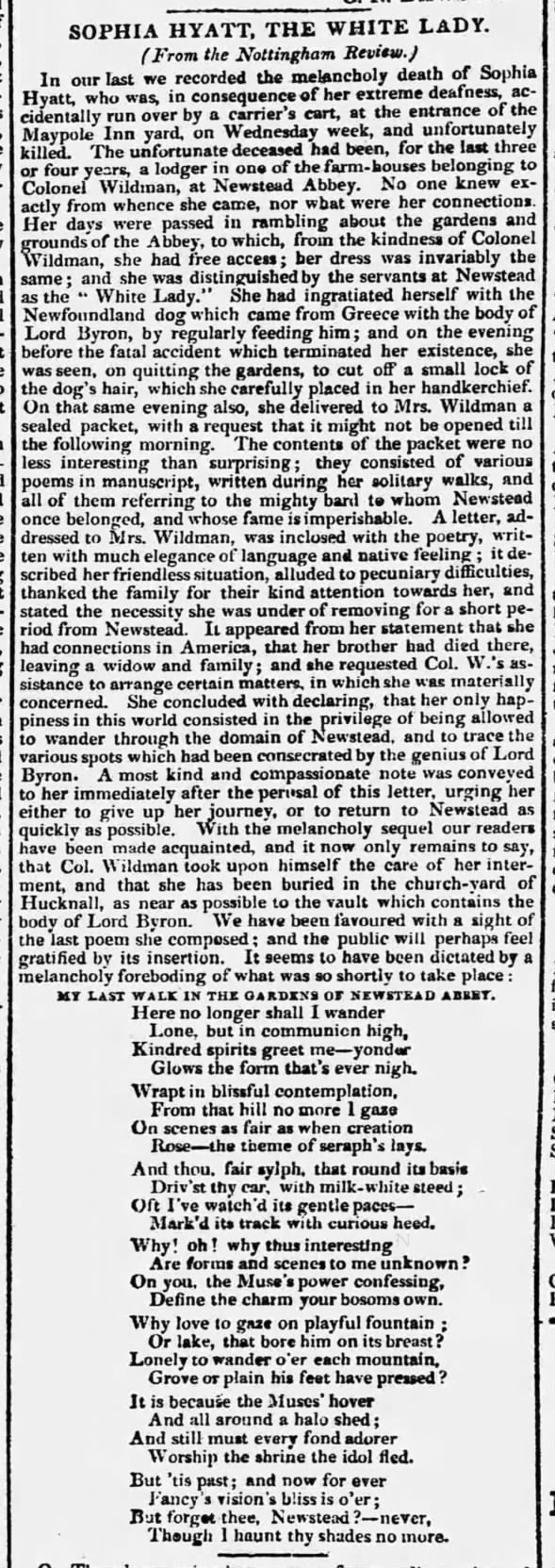
As described by Irving, locals at the farm house where the White Lady stayed courtesy of Colonel Wildman did not know the name of their troubled and troublesome guest. But Irving learned it eventually and does not leave her "nameless" as implied by Couch and Nicholson. In Irving's plain words, "Her name was Sophia Hyatt."
In 1825 the circumstances of Sophia Hyatt's difficult life, eccentric and intensely romantic personality, and accidental death were communicated in a newspaper article for the Nottingham Review. The richly detailed mortuary notice in the Nottingham Review circulated immediately and widely in British newspapers and journals.
In our time neo-racists masked as anti-racists like to project their own racist fantasies onto unoffending waitresses and truck drivers, cooks and clerks, farmers, merchants, and tradesmen, police officers and other emergency responders, schoolchildren and college students, mothers and fathers, sisters and brothers, friends and neighbors who build and grow and fix things for a living. The morally equivalent crime in disability studies must be ableism. When the victim of ableism is a woman, tack on an extra charge of anti-feminism. Unfortunately for Wokademia, between the Oriental fantasies of teenage Melville and varying psycho-sexual responses of sympathetic readers, there should be more than enough isms to go around. Like I said before in the post on Memory-holes in the Broadview Benito Cereno, Melville will have to be cancelled along with Dr. Seuss. Exile the White Whale to Mulberrry Street where he belongs! Obvious problem, you absolutely can't publish in Leviathan or patronize the Melville Society, once Melville has been exposed as the misogynist and ableist upholder of systemic racism and apologist for white-whale supremacy that he most certainly and demonstrably was.
Solution, re-imagine teenage Melville as the Greta Thunberg of disability rights advocacy:
"Melville's active, signing women serve as a rejoinder to Hale and Irving, whose objectifying fictions combine ableism and antifeminism." -- Couch and Nicholson on Melville and Disability, page 17.
Hahaha.
Objectifying fictions? Personally, I live for objectifying fictions.
Peeping from beneath the envious skirts of her mantle, and almost buried in the downy quishion on which it reposed, lay revealed the prettiest little foot you can imagine; cased in a satin slipper, which clung to the fairy-like member by means of a diamond clasp.
Talk about active signing. Baby, you know what I like. Do that sign with the downy quishion.
Sorry, all that peeping and hiding and clasping and clinging around Inamorata's pretty little foot, not to mention the feather cushion, made me dazed and confused. For a moment I forgot who's getting cancelled for composing objectifying fictions. NOT teenage Melville in Fragment 2 for turning Lucretia M. Davidson's deaf fairy princess into a monster of cosmic silence. PAY NO ATTENTION TO THE DOWNY QUISHION! Focus instead on politically incorrect stories about talented deaf women by Washington Irving and Sarah Josepha Hale, fatally flawed by ableism and antifeminism.
How can that be? Sarah J. Hale, blessed co-author of Mary Had a Little Lamb with Buddy Guy and Jimmie Vaughan's kid brother, a vicious ableist and antifeminist?
Mary had a little lamb, His fleece was black as coal.... -- Stevie Ray Vaughan
So they say: "Melville's active, signing women serve as a rejoinder to Hale and Irving, whose objectifying fictions combine ableism and antifeminism." Melville's fake deaf lady rights all wrongs, even those committed by real 19th century women. To clinch their case against Hale, Couch and Nicholson use the popular technique of lying with ellipses. This is also a favorite trick of media propagandists.
Melville's active, signing women serve as a rejoinder to Hale and Irving, whose objectifying fictions combine ableism and antifeminism: as Hale writes, "a beauty who cannot speak, is no more . . . than a statue" (226).
Great God! As presented in Leviathan, the severed quote makes Hale sound like the ultimate ice-queen, mean and evil enough to categorically deny human dignity to non-speaking persons. Case closed. Anybody who would cruelly marginalize disabled people by calling them statues could probably dash off five or six ableist fictions before breakfast. But that only happens in pseudo-reality. In the real world of verifiable facts, here's what Hale actually wrote:
But a beauty who cannot speak, is no more to our intellectual beaux than a statue. And yet, where is the great advantage in having the faculty of speech, if it be only employed in lisping nonsense?
Deleting the key phrase "to our intellectual beaux" dramatically changes the sense of Hale's words in their original context. For Hale's narrative purposes this is exposition, early on, establishing in a general way the ignoble motivations of--
Who? Uh, men. Young men if you want to be particular. Alright, highly educated (rather, over-educated or mis-educated, as Hale digressively dares to theorize) "intellectual" young men, "beaux" who idolize young women for their most superficial attributes. Important plot point for the romance underway, since Marianne's apparent suitor Captain Hall turns out to be one those beaux with bad intentions. Far from endorsing the sophomoric view of non-speaking persons as statues, Hale's narrator endows her deaf beauty with lively features, a "soul-beaming smile" and "laughing eyes." Marianne lacked for nothing:
"She was as happy as she seemed, as happy as she was innocent—she had never known a single sorrow, or privation." (Deaf Girl, page 227)
Marianne's caller the Navy officer is described as generous and gallant, but "thoughtless." The Captain admires her beauty and pities her misfortune, so regarded, of being unable to speak. However charming, he's no Romeo. Hale's Captain Hall is more like Austen's Willoughby, dashing but undependable suitor of Marianne Dashwood in Sense and Sensibility. Both Marianne's are deceived then eventually undeceived. True, Hall's Marianne Willis never recovers from her disappointment. That's melodrama for you. Pity her misfortune! Marianne Dashwood was just luckier, maybe, in catching Colonel Brandon. In reality, the heartless endorsement of ableism and antifeminism that Couch and Nicholson re-assign to Sarah J. Hale (by taking words out of her mouth) is according to Hale the normal view of over-educated young men. True enough. But you can't fault the co-creator of Mary Had a Little Lamb for that.
With mangled texts for their only evidence, Couch and Nicholson similarly convict Washington Irving of perpetrating an objectifying fiction titled "Little White Lady" in Crayon's Miscellany. In our time, even minor literary crimes, or sins, may have severe social and cultural penalties. The code-phrase "objectifying fiction" probably means the writer is done, de-platformed, exiled. Banished from the canon of American Literature. Canceled! like poor Bartleby's dead letters. (Dear Reader, beware. You could be next.) Normal use of conventional language is no excuse. For college professors turned inquisitors, it's bad enough that Irving described the physical and mental condition of his protagonist in negative terms of "defective organization" and "morbid sensibility." The clincher, "Irving's deaf female poet" incriminates herself by complaining of her social isolation.
Reality check: this is victim-blaming with a vengeance, by critics who can't distinguish fact from fiction. Irving quoted her own words, transcribing from real letters and real verses by a real person. Say her name:
Sophia Hyatt
In their reality-denying rebuke of Irving's "Little White Lady," privileged literary critics Daniel Diez Couch and Michael Anthony Nicholson combine ableism and antifeminism by reductively dismissing the traumatic lived experience and creative legacy of Sophia Hyatt, the accomplished deaf female poet, early disciple of Byron, and trailblazer of self-advocacy, as "objectifying fiction."
Sophia Hyatt, "The White Lady of Newstead" in real life and Gothic legend is the focus of a chapter by David Herbert in The Gothic Byron, ed. Peter Cochran (Cambridge Scholars Publishing, 2009) pages 159-164.
For more groundbreaking work on the real life and poems of Sophia Hyatt, and varied mediations thereof including Irving's in "The Little White Lady," see the recent article by Jessica Roberson, Remembrance and Remediation, in the Spring 2020 issue of Studies in Romanticism. Valuable for original archival finds and appreciative readings, despite the oppressive and practically worthless ideology and jargon inherent in academic disability studies. Roberson does not engage or cite Herbert's chapter in Gothic Byron.
Roberson, Jessica. "Remembrance and Remediation: Mediating Disability and Literary Tourism in the Romantic Archive." Studies in Romanticism, vol. 59, no. 1, 2020, p. 85+. Gale Academic OneFile, link.gale.com/apps/doc/A625498000/AONE?u=nypl&sid=AONE&xid=9fe2e60c. Accessed 11 May 2021.
2 + 2 = 4-fold exegesis for hardcore medievalists
1. Literal.
Melville's 1839 newspaper story "Fragments from a Writing Desk No. 2" is about the pursuit of a mysterious Lalla Rookhish enchantress who turns out to be deaf and dumb, stunning with silence her over-educated wooer who experiences something like what Lowell George of Little Feat called Teenage Nervous Breakdown. Academic criticism on Melville's adolescent Fragments abounds, for example in published studies by William H. Gilman, Dorothee Metlitsky Finkelstein, Peter A. Obuchowski, Elizabeth Renker, Samuel Otter, and Peter Norberg; now usefully and entertainingly augmented by Michael D. Snediker, and Daniel Diez Couch and Michael Anthony Nicholson.
2. Allegorical.
As first suggested by Gilman, the figure of Inamorata foreshadows Melville's later representations of the frustrated seeker's dream girl or fish or god or rock or brick-wall as awfully and fearfully silent. Presto! In Fragment 2, teenage Melville turns Amreta, the deaf fairy princess of Lucretia Maria Davidson's Amir Khan, into a monster of cosmic indifference.
3. Moral.
The recent contribution by Couch and Nicholson in Leviathan signals the upside-down state of academia, herein dubbed Wokademia, a clown show devoted mainly to constructions of pseudo-reality and accusing others of heretical thinking and doing. Academia is dead. Long live Wokademia! Until the Dragon comes for Melville and thee, which it inexorably will.
4. Anagogical - Spiritual.
When Life or Leviathan gives you lemons, make lemonade! Melvilliana refreshes with yet another exclusive, this time spiked with the recovered text of "To Insensibility," a long-lost poem by Sophia Hyatt.
Enjoy!
Years before Irving's account, supporting evidence of Hyatt's background and creative artistry was supplied by a letter from "E. B." to the editor of the London Morning Chronicle, printed there on October 6, 1825. Notice of Sophia Hyatt's death in the London Morning Chronicle (October 3, 1825) prompted this personal reminiscence of the "eccentric & romantic" deaf lady, followed by her original and before now unrecorded sonnet "To Insensibility." Who knew she was Irish?
Transcribed below, the letter to the editor signed "E. B." appeared in the Morning Chronicle on October 6, 1825; found on British Newspaper Archive <www.britishnewspaperarchive.co.uk>. Reprinted in the Baltimore Gazette and Daily Advertiser on January 5, 1826.
Mr. EDITOR, – The notice of the deceased Sophia Hyatt, “the White Lady,” which appeared in your Paper a few days since, having met my eye, I beg to inclose you a little piece from the pen of that unfortunate, but interesting female. It is now, perhaps, about 30 years since I met with her at the house of a lady in Hoxton. Miss Hyatt was a native of Ireland: she had received a liberal education, and was possessed of a small annuity. Her deafness and other bodily afflictions were occasioned by fits; and those afflictions, with the eccentric & romantic turn of mind that she possessed, rendered her an object of great interest to those to whom she happened to be known. Among such she distributed her poetical effusions: the sonnet to “Insensibility” is that with which she favoured me. From the kind attention paid to the unfortunate subject of this letter by the family of Colonel Wildman, I have some hope that the Poems committed to them by the deceased, will be suffered to meet the public eye.— And am, Sir, your humble servant,
E. B. Walworth, October 6.
TO INSENSIBILITY.
Thou foe profess’d to joy, grief, hope, despair, With all the ills that from those sources flow, Insensibility! Oh hear my pray’r, And give a bless’d oblivion to my woe.
What though, confess’d, joy brightens not thy mien, Nor pleasure sparkles in thy vacant eye, No pang can reach that bosom’s calm serene, Arm’d with thy shield, Insensibility!
What though the foe of ev’ry Muse divine; Nor where thou art can Fancy’s radiance beam; What is the Muses—Fancy’s bliss to thine? Thine—undisturb'd repose—theirs, a perturbed dream!
Come, then, thou truest, only friend to peace, Possess my soul, and bid its sorrows cease.
-- London Morning Chronicle, October 6, 1825; reprinted in the Baltimore, MD Gazette and Daily Advertiser, January 5, 1826.
In their reality-denying rebuke of Washington Irving's "Little White Lady," privileged literary critics Daniel Diez Couch and Michael Anthony Nicholson combine ableism and antifeminism by reductively dismissing the traumatic lived experience and creative legacy of Sophia Hyatt, the accomplished deaf female poet, early disciple of Byron, and trailblazer of self-advocacy, as "objectifying fiction."
-- Teenage Nervous Breakdown; or, Melville's deaf monster and the critics.
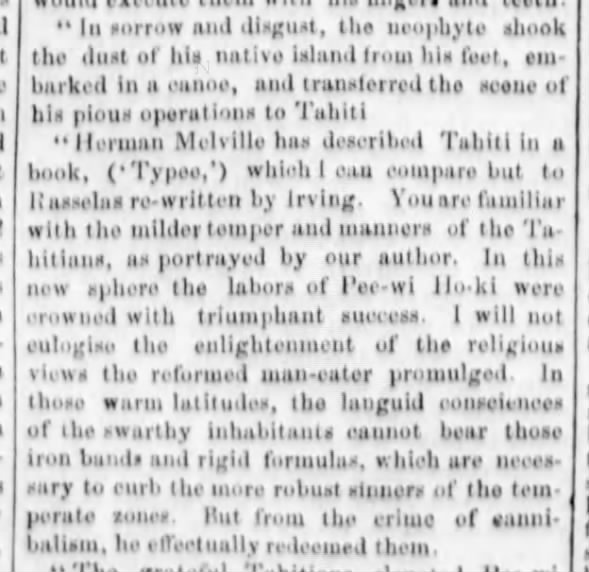
Herman Melville has described Tahiti in a book, ('Typee,'), which I can compare but to Rasselas re-written by Irving. --"Pee-Wi Ho-Ki, The Tahitian Cannibal" in the New Orleans Daily Delta for May 16, 1852; reprinted in The New Orleans Sketch Book.
Typee is set on Nuku Hiva in the Marquesas; Omoo is the book of Melville's romanticized adventures in Tahiti.
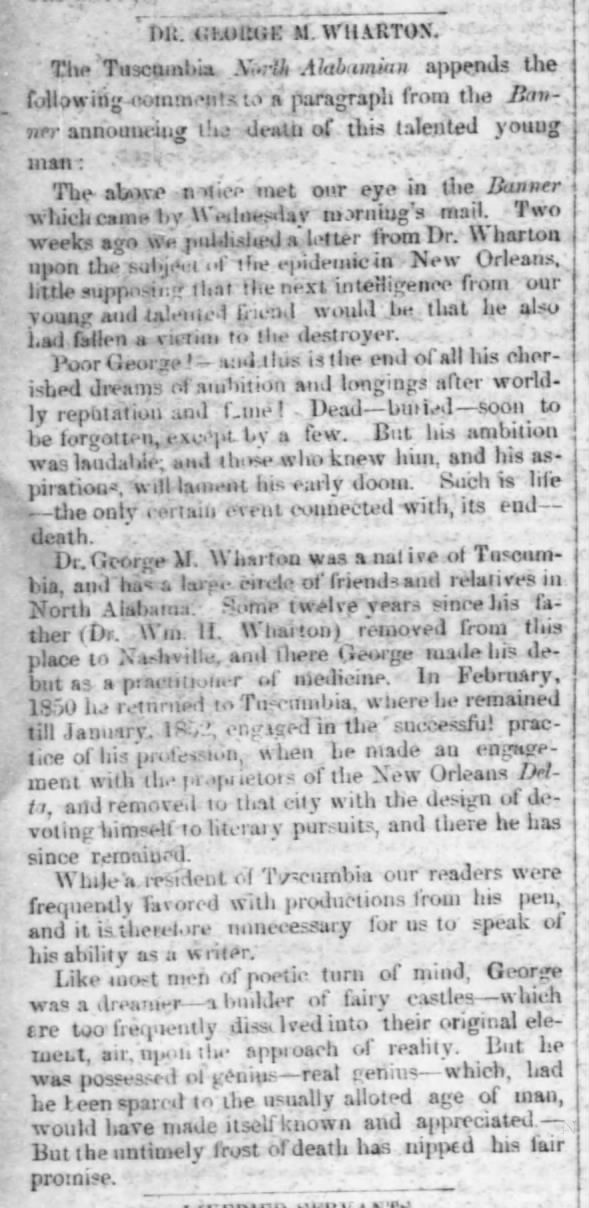
For more on Wharton, see Frederick Jonas Dreyfus, Life and Works of George Michael Wharton, M.D., (Pseudonym "Stahl"), 1825-1853 in Tennessee Historical Quarterly 6.4 (December 1947): 315-336. <https://www.jstor.org/stable/4262095>
Here's another mention of Herman Melville by "Fidelius," a New York correspondent of the Boston Evening Transcript. From the "Second Edition" of the Boston Evening Transcript, April 24, 1855; found in the online archives of Historical Newspapers at Genealogy Bank.
[Correspondence of the Transcript]
NEW YORK, April 23d, 1855.
Dear Transcript: Several of the principal hotels have raised their prices within a few days; and the discourse about New York expensiveness is revived. The sober fact is, that there is no city in the world where so much money is unsatisfactorily spent as here. I heard a gentleman fresh from Paris, say, the other day, that a parlor and bedroom, for a fortnight, at the Astor, cost him as much as four times the same amount of accommodation for his family at Maurice's. Strange that in a country where there is an abundance of space, an ample field to produce provisions, and few local monopolies, it costs so much to live in a most unsatisfactory manner!
Willis was in town a few days ago, with little trace of invalidism about him,--so much for keeping up a good heart, living in the country, and avoiding drugs!
…
At a dinner party last week, the conversation turned upon the fowl mania, recently developed in this country; one gentleman referred to the popular engravings of Shangai monstrosities, another to Burnham's book on the hen-fever, and a third to Melville's story in Harper, of "Cock-a-doodle;" "yes," observed another, better versed in cotton than literature, "the thing seems to be getting into books fast; I saw one advertised the other day, called 'Wolfert's Roost,' another Shanghai work, I suppose." The best of the joke was that Irving was at the table, and within ear-shot.
You will be glad to know that the accident which happened to Washington Irving last week is not so serious as at first reported. He remained unconscious only during a few moments after his fall, and now suffers only from the jar, having been able to correct his proof sheets, as usual, a day or two past. James Russell Lowell has been here, and looks all the better for his western trip. The National Magazine for May has some excellent wood cuts of statuary, an able article on "The Opium Trade in the East," and a timely one on Irving's last work; a "Sunbeam" is made to reveal its wonder-working power, and the "Pyramids" are described and pictured.... FIDELIUS
Boston Evening Transcript - April 24, 1855
Originating in correspondence of the Boston Evening Transcript, the anecdote of "fowl mania" and the merchant's gaffe at dinner with Washington Irving got to be a popular one in the spring of 1855. The "fowl mania" anecdote (including the reference to Melville's well-remembered story in the December 1853 issue of Harper's) was reprinted many times, for example:
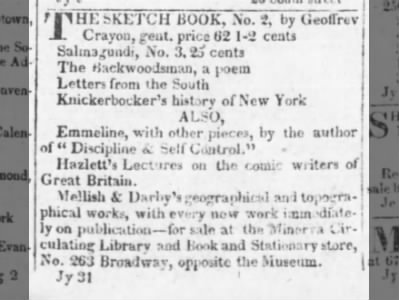
August 1, 1819 was a Sunday, so there was no Evening Post in New York City on the day Herman Melville was born. Ads on Saturday and Monday show what the Minerva Circulating Library and Book and Stationary store had for sale at 263 Broadway.
New York Evening Post - Monday, August 2, 1819
Topping the list, a new number of The Sketch Book by Washington Irving, writing as "Geoffrey Crayon." Still in England, Irving in 1819-1820 shipped his chapters or "numbers" of The Sketch Book to New York for publication in the United States. (Some were reprinted in the London Literary Gazette.)
Contents of Number One, published May 15, 1819:
The Author's Account of Himself
The Voyage
Roscoe
The Wife
Rip Van Winkle
Contents of Number Two, published in July 1819:
English Writers on America
Rural Life in England
The Broken Heart
The Art of Book Making
In his 1859 lecture on Travel, Melville approvingly paraphrased from Irving's chapter "The Voyage," first published in the year of Melville's birth:
One must not anticipate unalloyed pleasure. Pleasure, pain and profit are all to be received from travel. As Washington Irving has remarked, the sea-voyage, with its excitements, its discomforts, and its enforced self-discipline, is a good preparation for foreign travel. --Melville's Lecture on Travel
Everyone knows about Rip Van Winkle. Herman Melville would remake Irving's popular legend in "Rip Van Winkle's Lilac," part of the manuscript prose and poetry collection (posthumously published) titled Weeds and Wildings. Not so well known today is Irving's investigation into "The Art of Book Making." What Irving uncovered at the British Library and amusingly described was the practice by "predatory authors" of stealing material from old books to manufacture new ones.
Being now in possession of the secret, I sat down in a corner, and watched the process, of this book manufactory. I noticed one lean, bilious looking wight, who sought none but the most worm-eaten volumes, printed in black letter. He was evidently constructing some work of profound erudition, that would be purchased by every man who wished to be thought learned, placed upon a conspicuous shelf of his library, or laid open upon his table; but never read. I observed him, now and then, draw a large fragment of biscuit out of his pocket, and gnaw; whether it was his dinner, or whether he was endeavouring to keep off that exhaustion of the stomach, produced by much pondering over dry works, I leave to harder students than myself to determine.
There was one old getleman in bright coloured clothes, with a chirping, gossipping, expression of countenance, who had all the appearance of an author on good terms with his bookseller. After considering him attentively, I recognised in him a diligent getter up of miscellaneous works, that bustled off well with the trade. I was curious to see how he manufactured his wares. He made more stir and show of business than any of the others; dipping into various books, fluttering over the leaves of manuscripts, taking a morsel out of one, a morsel out of another, “line upon line, precept upon precept, here a little and there a little.” The contents of his book seemed to be as heterogeneous as those of the witches' cauldron in Macbeth. It was here a finger and there a thumb, toe of, frog and blind worm’s sting, with his own gossip poured in like “baboon's blood,” to make the medley “slab and good.
After all, thought I, may not this pilfering disposition be implanted in authors for wise purposes; may it not be the way in which providence has taken care that the seeds of knowledge and wisdom shall be preserved from age to age, in spite of the inevitable decay of the works in which they were first produced. We see that nature has wisely, though whimsically, provided for the conveyance of seeds from clime to clime, in the maws of certain birds; so that animals, which, in themselves, are little better than carrion, and apparently the lawless plunderers of the orchard and the cornfield, are, in fact, nature's carriers to disperse and perpetuate her blessings. In like manner, the beauties and fine thoughts of ancient and obsolete writers, are caught up by these flights of predatory authors, and cast forth, again to flourish and bear fruit in a remote and distant tract of time. Many of their works, also, undergo a kind of metempsychosis, and spring up under new forms. What was formerly a ponderous history, revives in the shape of a romance—an old legend changes into a modern play—and a sober philosophical treatise furnishes the body for a whole series of bouncing and sparkling essays. Thus it is in the clearing of our American woodlands; where we burn down a forest of stately pines, a progeny of dwarf oaks start up in their place; and we never see the prostrate trunk of a tree, mouldering into soil, but it gives birth to a whole tribe of fungi.
Let us not, then, lament over the decay and oblivion into which ancient writers descend; they do but submit to the great law of nature, which declares that all sublunary shapes of matter shall be limited in their duration, but which decrees also, that their elements shall never perish. Generation after generation, both in animal and vegetable life, passes away, but the vital principle is transmitted to their posterity, and the species continues to flourish. Thus, also, do authors beget authors, and having produced a numerous progeny, in a good old age they sleep with their fathers, that is to say, with the authors who preceded them—and from whom they had stolen.
Melville evidently meant that his new manuscript would look better and be much closer to finished than were the messy and insufficient pages of Typee. Omoo would not need significant rewriting, padding, expurgating or editorial fixing. Irving's sense of book-making as stealing remains in play, nevertheless. In Omoo Melville creatively adapted numerous scenes from William Ellis and other writers on the South Seas. Hendricks House editors Harrison Hayford and Walter Blair aptly call Melville's way with other people's words, "dramatizing." On occasion Melville dramatized "spectacularly" from his source in Polynesian Researches, as when he describes night fishing by torch-light in Chapter 70, Life at Loohooloo.
Two days after Herman Melville's birth, the Evening Post extensively reviewed the second number of Irving's Sketch Book.
"The literary ambition of Mr. I. aims simply at a flute accompaniment, in our national concert of authors, leaving to the more aspiring the management of louder instruments. We gladly perceive, that he never suffers himself to be allured from his natural character, by a pompous display of his subject, or by an attempt to plunge his readers into the unfathomable depths of learning and research...."
In closing, the reviewer (Henry Brevoort, so identified by Ralph M. Aderman in Critical Essays on Washington Irving) picks up on Irving's expose of authors and book-making, hoping that Irving will not imitate the practice he witnessed in the British Library, but carry on in his own modest and distinctively charming way.
We reverence the cause of true science; nor would we be understood to scoff at its unaffected votaries; but no one knows, who has not essayed the task, how cheaply an author may decorate his pages with the scattered fragments of learning, lying so invitingly at his mercy, in the multitudinous transactions and encyclopedias of our times. Our author has found out the art of book-making; he has traced to their fountain head, those muddy rills of knowledge that sometimes spread themselves even in America. It is not impossible, therefore, that in the future numbers of his work, he may avoid the labor of writing from the resources of his own mind, by compiling the present state of the Catholic question—the vast results of polar expeditions; or, peradventure, strike out some new geological hypothesis which shall reject the vulgar agency of fire or water. In such ambitious speculations, we fear, the admirers of his fine genius, might seek in vain for his sportive humor; his nice discrimination of character; his romantic associations of thought and language; his pure and affecting morality, and all the nameless graces of style, so appropriate to the captivating path of literature he has chosen to pursue.
--New York Evening Post, August 3, 1819
Evert Duyckinck was right on many levels when he wrote in his diary that Melville
"models his writing evidently a great deal on Washington Irving...." --Melville in His Own Time, edited by Steven Olsen-Smith
For further study...
In Melville and Repose, John Bryant devotes a whole chapter to The Example of Irving. There Bryant specifically discusses the influence of Salmagundi, and Knickerbocker's History of New York, both of which made the short list of works for sale at the Minerva Circulating Library, along with the new number of The Sketch Book.
Rarely mentioned in Melville criticism are the two works by Irving's good friend and literary collaborator James Kirke Paulding, sandwiched in the Minerva ad between Salmagundi No. 3 and Irving's History of New York. Below, links to some digitized volumes that are available online.
the wittiest book auctioneer of his day in New York --Evert A. Duyckinck on John Keese
Only a year before his death, Evert A. Duyckinck wrote a marvelous tribute to New York publisher, editor, and auctioneer-punster John Keese (1805-1856) titled "Keese-ana," published in The Magazine of American History Volume 1 for August 1877. Duyckink's piece was supplemented in the December 1877 issue by Keese's son, William Linn Keese.
On March 30, 1837 John Keese served as toast-master at the grand inaugural Bookseller's Dinner or "Festival" in New York City, honoring distinguished authors and, more generally, everybody who was anybody in the book trade. Publisher George Dearborn performed the duties of master of ceremonies. So then, Dearborn and Keese, two anthologists and early publishers of Clement C. Moore's "A Visit from St. Nicholas" officiated at the 1837 Bookseller's Festival. Also in attendance: Moore's close friends Charles King, Philip Hone, and John W. Francis--all of whom gave speeches before some 300 assembled guests. Irving, Paulding, Bryant, and Halleck were all there, along with other luminaries including Chancellor Kent, Albert Gallatin, Colonel John Trumbull, Columbia president William Alexander Duer and the professors of Columbia College. Here the enterprising co-host George Palmer Putnam first met Washington Irving, who glorified Halleck and warmly toasted:
Willis mailed in his pro-copyright toast to "The Republic of Letters—in which all who speak the same language are compatriots, and should reciprocate protection and kind feeling." Edgar A. Poe raised his glass to his closest colleagues: "The Monthlies of Gotham—Their distinguished Editors, and their vigorous Collaborateurs."
In his opening address, reprinted in the Evening Post and other New York newspapers, John Keese acknowledged substantial contributions by the book trade in the past, and challenged publishers to do even more for the cause of American letters:
"We desire still further to explore the mind where mental ore lies buried, to awaken slumbering genius, and to call into active exercise the dormant energy and shrinking talent of our young and much-loved land. Why sleeps the Muse of Drake's twin-brother bard? Why comes not he forth with fairy wand to silence the scribblers of the day? Who among us would not esteem it a high honor to be his publisher, and to issue his beautiful creations in a guise as beautiful as the taste of our best artisans can exhibit ?"
--John Keese, Wit and Littérateur
A few years later, Keese seemed to answer his own challenge by publishing the two-volume set, The Poets of America: Illustrated by One of Her Painters (1840-1842). However, the first volume would offer only the usual selections by Fitz-Greene Halleck ("Drake's twin-brother bard"): a lyric from "Fanny," "Alnwick Castle" and "Marco Bozzaris." A Visit from St. Nicholas also would grace Volume 1, attributed to "C. C. Moore" and illustrated with one drawing of St. Nicholas by another guest at the 1837 Bookseller's Dinner, John Gadsby Chapman. Another celebrity artist in attendance was Robert Walter Weir, who had just finished his own painting of St. Nicholas. The month before the Bookseller's Festival, Weir had offered his freshly painted St. Nicholas to Gulian Verplanck, rating it as "one of the best things I have done" (quoted in Lauretta Dimmick, Robert Weir's Saint Nicholas: A Knickerbocker Icon).
Keese recycled his 1837 speech at the 1850 Printer's Banquet and (probably) on similar occasions.
John Keese's son remembered Henry T. Tuckerman and Charles Fenno Hoffman as frequent visitors to their home "on the north side of Atlantic street." Like Duyckinck, Hoffman and Tuckerman later became good friends with Herman Melville.
"within the walls of that house, that evening and on many which followed, with and without the presence of the writer [Henry Morford], was gathered a literary circle which has rarely been equaled in America in numbers, and which has scarcely ever had its superior in the quality of persons composing it…" --John Keese, Wit and Littérateur
Other members of Keese's literary circle around 1839-40 according to Henry Morford were Seba Smith and his wife Elizabeth Oakes Smith, Robert Balmanno and Mary Balmanno, Frances Sargent Osgood, Emma C. Embury, William Gilmore Simms, Rufus Wilmot Griswold, William H. C. Hosmer, Richard Grant White, and Nathaniel Parker Willis.
Considering Keese's intimacy with Duyckinck, Hoffman, and Tuckerman, Melville had to know of him. As Luther Stearns Mansfield notes in Melville's Comic Articles on Zachary Taylor, Duyckinck named John Keese among other occasional contributors to Yankee Doodle. The most likely time for Melville and Keese to have met or socialized would have been in New York City between say 1847 and 1850, before Melville moved himself and family to Berkshire County, Massachusetts.
His deprecatory remark on the sacrifice of a copy of Bacon's Essays for twelve and a half cents was pathetic. “Really, that is too much pork for a shilling!" Selling, one evening, a book on German politics by Goetz, he hesitated over the catalogue, as if at the delicacy of the author’s name. “What is it?" asked one of the audience. “ Oh! something, I suppose, on the internal difficulties of the country." In a similar vein was his introduction of Gutzslaff's China with the observation, “This was the gentleman with a commotion in his bowels."
Sometimes his wit would be more pointed. “This," said he, holding up a volume of verse of a well known type, “is a book, by a poor and pious girl, of poor and pious poems." There was a heavy remainder of a certain volume, the “ Lives of the Shoemakers," which required all his ingenuity to dispose of. He would bring out a copy with the unfailing introduction, “This is the last copy. The book was awl the author wrote and was awl that his widow inherited from him, her sole reliance"—a jest which may have been stimulated by Shakespeare’s cobbler in Julius Caesar. Of some heavy folio, dragging at a feeble price, he would end his efforts—“ Going—going—cheap for a back-log!" Knocking down a “ Hand-book," he added, for the comfort of the purchaser, “You will see that it is pretty well fingered." “Damaged, you say, yes—a little wet on the outside—but you will find it dry enough within." On another occasion he parried this word "damaged" quite happily. A young son of a highly respectable Episcopal clergyman of this city, was a privileged attendant at the auction room. Keese offered a soiled or injured copy of the “Book of Common Prayer." “ Isn’t it damaged," exclaimed the youth; upon which Keese turned round to him slowly, and fixing his attention upon him with great gravity, in a tone of soberness and solemnity, addressed him, “ Has your father taught you to regard that as a damaged book ?"
--Keese-ana by Evert A. Duyckinck
Like Clement C. Moore's little "elf" with his "miniature sleigh" and "tiny reindeer," Herman Melville's Santa Claus is a fairy:
... a wight
More than mortal, with something of man,
Whisking about, an invisible spright,
Almoner blest of Oberon's clan. --Stockings in the Farm-house Chimney
Verbal echoes of Moore's A Visit from St. Nicholas aka "'The Night Before Christmas" in Melville's "Stockings" poem begin in the title with the stockings and chimney. The children are there, of course, only now they have names. (Two boys and two girls, same number and gender as the children Herman and Lizzie had when they lived in Pittsfield, on the farm called "Arrowhead.") Like the children in Moore's poem, Melville's wait "in hope." Moore said "In hopes," and Melville says "in hope" twice, managing through repetition to make them plural.
Melville's Santa gets his sleigh from Moore's St. Nick. And his elvish features, too, borrowed from Moore and amplified by Melville. That habit of "Whisking about" displayed by Melville's Santa imitates the "lively and quick" manner of Moore's St. Nick. Moore's Santa may be "chubby and plump" but he never waddles or dawdles. When Santa moves, he springs. Or flies. And Melville's Santa arrives in triple anapests (the delight / to believe / in a wight), the metrical dress of Moore's Santa.
Melville's invocation of Oberon makes explicit the implied associations in Moore's poem between Santa Claus and the fairy world, particularly as represented by Shakespeare in A Midsummer Night's Dream, and by Michael Drayton in Nymphidia. Drayton's fairy mythology surely influenced the naming of Santa's Reindeer. Associations with Oberon's fairy kingdom are unmistakable by the end of Moore's "Visit," when Santa flies up and away like the down of a thistle--just the stuff that cushions Queen Mab's chariot:
With thistle-down they shod it:
For all her maidens much did fear,
If OBERON had chanc'd to hear,
That MAB his queen should have been there,
He would not have abode it. --Nymphidia: The Court of Fairy
Please don't make me explicate the last stanza of Melville's "Stockings in the Farm-house Chimney." It's Christmas Eve!
Alright, after the kids fall asleep (hahahaha) maybe I'll whisper something like this: when Melville or his appointed speaker says "Stay, Truth, O stay," he or she really means it. Now turn off The Simpsons and go to bed or Santa will never get here.
Happy, believe, this Christmas Eve
Are Willie and Rob and Nellie and May—
Happy in hope! in hope to receive
These stockings well stuffed from Santa Claus' sleigh.
O the delight to believe in a wight
More than mortal, with something of man,
Whisking about, an invisible spright,
Almoner blest of Oberon's clan.
Stay, Truth, O stay in a long delay!
Why should these little ones find you out?
Let them forever with fable play,
Evermore hang the Stocking out! --Herman Melville
As mentioned in a previous melvilliana post, the drawings for the 1862 illustrated edition of Clement C. Moore's A Visit from St. Nicholas are by Herman Melville's
friend Felix Darley. Melville's Christmas Eve poem "Stockings" draws from one or another version of that delightful "Visit." Melville's other Santa poem, next as it should be in Weeds and Wildings, celebrates Christmas Day. "A Dutch Christmas Up the Hudson in the Time of Patroons," looks back to Moore's own source-text in The History of New York by Washington Irving, properly regarded as the genius of invented traditions. For historical background that illuminates Melville's "Dutch Christmas" poem like the Griswold Family Christmas Tree, get The Battle for Christmas by Stephen Nissenbaum. Historian Charles W. Jones made the essential point about the importance of Irving in his entertaining 1954 essay, available online via the St Nicholas Center:
Without Irving there would be no Santa Claus. The History contains no less than twenty-five allusions to him—many of them the most delightful flights of imagination in the volume. Here is the source of the legends about St. Nicholas in New Amsterdam—of the emigrant ship Goede Vrouw, like a Dutch matron as broad as she was long, with a figurehead of St. Nicholas at the prow. Here are the descriptions of festivities on St. Nicholas Day in the colony, and of the church dedicated to him. Here is the description of Santa Claus bringing gifts, parking his horse and wagon on the roof while he slides down the chimney. --Charles W. Jones on the Knickerbocker Santa Claus
And Patrick Browne summarizes Jones and reconsiders the Irving connection in his thoughtful St. Nicholas Day post of a few years back, Santa Claus was Made by Washington Irving.
Here's a pertinent sample of Irving's style and substance there:
The good old Dutch festivals, those periodical demonstrations of an overflowing heart and a thankful spirit, which are falling into sad disuse among my fellow-citizens, were faithfully observed in the mansion of Governor Stuyvesant. New year was truly a day of open-handed liberality, of jocund revelry, and warm-hearted congratulation—when the bosom seemed to swell with genial goodfellowship; and the plenteous table was attended with an unceremonious freedom, and honest broad-mouthed merriment, unknown in these days of degeneracy and refinement. Paas and Pinxter were scrupulously observed throughout his dominions; nor was the day of St. Nicholas suffered to pass by without making presents, hanging the stocking in the chimney, and complying with all its other ceremonies. --History of New York
Being well versed in his Irving, Melville knows and uses details from various works, most obviously the successive Christmas chapters that begin the second volume of The Sketch Book of Geoffrey Crayon. In 1876 these were combined in a separate volume titled Old Christmas, lavishly illustrated by Randolph Caldecott. So the hospitality of Melville's "Dutch Christmas" strongly resembles English hospitality as Irving imagined it at Bracebridge Hall. Melville fuses holiday trappings there, like indoor evergreens, roasted apples, turkey and ale, with situations and characters from elsewhere. The mistletoe "bush" that will lure "our Hans and Cousin Chris" after the dance is a notable enticement of Irving's chapter on Christmas Eve. As Irving explains in his footnote on "misletoe":
The misletoe is still hung up in farm houses and kitchens at Christmas; and the young men have the privilege of kissing the girls under it, plucking each time a berry from the bush. When the berries are all plucked, the privilege ceases. --Christmas Eve
Katrina, however, seems lifted from "The Legend of Sleepy Hollow," as Robert Ryan points out in the notes to his 1967 edition.
In the service of Melville's speaker (some prosperous Dutch farmer, if not the noble old Patroon himself) Santa rides out with mince-pie and pudding for all the prisoners in town (turns out there's only one), and for less fortunate neighbors or dependents. Not poor, we're told, and too proud to accept any gift condescendingly bestowed as charity. Melville's final line affirms the ideal of charity, or love, with a clear conscience. Possibly the poet has been reading in the Epistles of St. Paul:
"Now the end of the commandment is charity out of a pure heart, and of a good conscience, and of faith unfeigned. --1 Timothy 1:5
Considering the day (Christmas) and place (barn or stable), Melville comes close to homilizing on the Nativity with reflections on "the ox, ass, and Babe new-born." Melville we know read and commended Montalembert's Life of St. Elizabeth of Hungary. Did Melville's reading of French Catholics in translation include Prosper Guéranger on The Liturgical Year? Guéranger's paraphrase of Rabanus Maurus similarly links Christmas and conscience, alongside the appropriate references to ox, ass, and Babe in that order:
the pious Rabanus Maurus—who, in a Homily on the Nativity of our Lord, encourages sinners to come and take their place, side by side with the just, in the stable of Bethlehem, where even the ox and the ass recognise their Master in the Babe who lies there.
"I beseech you, dearly beloved Brethren, that you receive with fervent hearts the words our Lord speaks to you, through me, on this most sweet Feast, on which even infidels and sinners are touched with compunction; on which the wicked man is moved to mercy, the contrite heart hopes for pardon, the exile despairs not of returning to his country, and the sick man longs for his cure; on which is born the Lamb who taketh away the sins of the world, that is, Christ, our Saviour. On such a Birth Day, he that has a good conscience, rejoices more than usual; and he whose conscience is guilty, fears with a more useful fear...." --The Liturgical Year: Christmas
The most distinctively Melvillean touch in "Dutch Christmas" might be the speaker's concern for the well-being of other animals (excepting I guess the poor turkey) as his fellow creatures. Horses get extra oats, cows their favorite hay, birds the best crumbs. When Herman Melville lived at Arrowhead, he liked to watch his cow at breakfast, eating her pumpkins:
For the farmer-speaker of Melville's "Dutch Christmas," the fittingest place to go on Christmas
morning is the barn, to visit the cows and take in "their sweet
breath."
A Dutch Christmas Up the Hudson in the Time of Patroons
Over the ruddy hearth, lo, the green bough!
In house of the sickle and home of the plough,
Arbored sit and toast apples now!
Hi, there in barn! have done with the flail.
Worry not the wheat, nor winnow in the gale:
'Tis Christmas and holiday, turkey too and ale!
Creeping round the wainscot of old oak red,
The ground-pine, see — smell the sweet balsam shed!
Leave off, Katrina, to tarry there and scan:
The cream will take its time, girl, to rise in the pan.
Meanwhile here’s a knocking, and the caller it is Van —
Tuenis Van der Blumacher, your merry Christmas man.
Leafless the grove now where birds billed the kiss:
To-night when the fidler wipes his forehead, I wis,
And panting from the dance come our Hans and Cousin Chris,
Yon bush in the window will never be amiss!
But oats have ye heaped, men, for horses in stall?
And for each heifer young and the old mother-cow
Have ye raked down the hay from the aftermath-mow?
The Christmas let come to the creatures one and all!
Though the pedlar, peering in, doubtless deemed it but folly,
The yoke-cattle’s horns did I twine with green holly.
Good to breathe their sweet breath this blest Christmas morn,
Mindful of the ox, ass, and Babe new-born.
The snow drifts and drifts, and the frost it benumbs:
Elsie, pet, scatter to the snow-birds your crumbs.
Sleigh-bells a’ jingle! ’Tis Santa Claus: hail!
Villageward he goes thro’ the spooming of the snows;
Yea, hurrying to round his many errands to a close,
A mince-pie he’s taking to the one man in jail. —
What! drove right out between the gate-posts here?
Well, well, little Sharp-Eyes, blurred panes we must clear!
Our Santa Claus a clever way has and a free:
Gifts from him some will take who would never take from me.
For poor hereabouts there are none: — none so poor
But that pudding for an alms they would spurn from the door.
All the same to all in the world’s wide ways—
Happy harvest of the conscience on many Christmas Days. --Herman Melville
Melville put his two Santa Claus poems in the collection of poetry and prose titled "Weeds and Wildings." The great Houghton Library, Harvard University has the manuscript of Weeds and Wildings in their Herman Melville papers. In a wonderful present to Melville readers the world over, manuscript pages with Santa Claus poems in late stages of drafting are digitized and available online:
The forthcoming Northwestern-Newberry Edition of Melville's uncompleted writings doubtless will provide the best-edited texts of these poems ever. Meanwhile, available printed versions of Melville's Santa Claus poems in posthumously published editions of Weeds and Wildings include: