Did you hear of the _______? by Scott Norsworthy
A shared 5-gram in "Scenes Beyond the Western Border" and Herman Melville's "The Lightning-Rod Man"
Read on Substack

Original research and riffs on Herman Melville, authorship, and nineteenth-century American literature.

 |
| Hartford Evening Express - April 14, 1857 |
THE CONFIDENCE MAN: HIS MASQUERADE. By Herman Melville—Author of &c., &c., &c.— (we need not say what—everybody knows him.). Published by Dix, Edwards & Co.
A series of "rough and tumble" dashes at western life and American peculiarities generally, thrown off in the style of a man who would lead you to believe he isn't half trying: as an artist might take charcoal in his toes and show you how good a portrait he can sketch with his hands tied behind him and his eyes shut. Nevertheless Mr. Mellville is a good deal in earnest and makes a fascinating book—of course. The scene of operations is on a Mississippi steamboat, and the Confidence Man appears to be a sort of philosophical Christian swindler, making all kinds of experiments upon poor human nature with as little mercy as an entomologist pins beetles.
For sale by F. A. Brown.
***
 |
| A Mississippi River Landing via The New York Public Library Digital Collections |
This favorable notice of The Confidence Man: His Masquerade in the Cincinnati Daily Enquirer for April 10, 1857 is not reprinted or listed in Herman Melville: The Contemporary Reviews, edited by Brian Higgins and Hershel Parker (Cambridge University Press, 1995; paperback 2009). Contemporary Reviews on page 506 does give the negative evaluation that appeared the next year in the Cincinnati Daily Enquirer (February 3, 1858) trashing Melville's Confidence-Man as "one of the dullest and most dismally monotonous books we remember to have read." Although the editors of Contemporary Reviews do not indicate where they got it, the dismissive treatment of the Confidence-Man as the worst of Melville's increasingly bad books after Typee and Omoo, forms a kind of editorial preface to a longer review of Melville's 1858 lecture on Statues in Rome.
The earlier, more positive notice in the Cincinnati Enquirer commends the Confidence-Man as a "graphic" display of the social "amusement and fun" to be had when travelling by steamboat "on the Western Rivers." Found on newspapers.com and transcribed below.
 |
| Cincinnati Daily Enquirer - April 10, 1857 |
Book Notice.
THE CONFIDENCE MAN. By Herman Melville, author of "Omoo," "Typee," &c. New York: Dix, Edwards & Co. For sale by L. Danforth. Cincinnati: Rickey, Mallory & Webb.
Mr. Melville is known by the sketches of travel and adventure among the islands of the Pacific, to which he owes his earliest fame. In the work before us he has selected a home scene. The volume opens at St. Louis, and describes the incidents of a voyage down the Mississippi River. The author exhibits, with graphic accuracy, the peculiarities of some of those eccentric originals so often encountered on that frequent route of travel, with whom confinement on board the same steamer for days makes more or less of social intercourse a necessity, if it were not commonly, as in fact it is, a source of very great amusement and fun. The truth of this will be readily assented to by those who are familiar with steamboat travel on the Western Rivers, and none can finish the perusal of this volume without craving a practical relish of the entertainment it affords.

Very likely the change from mild praise to outright disdain for Melville's Confidence-Man in the pages of the Cincinnati Daily Enquirer from April 1857 to February 1858 reflects the change of editors during the same period of time.

When the first notice of the Confidence-Man appeared on April 10, 1857, Virginia born lawyer and journalist Alexander Walker (1819-1893) aka "Judge" Walker had been editing the Cincinnati Daily Enquirer for two years. Walker was already the author of Jackson and New Orleans (New York: J. C. Derby, 1856). During the Civil War, the New York Times ("Affairs in New Orleans," September 11, 1862) would grudgingly acknowledge the ardent secessionist and influential editor of the New Orleans Delta as "one of the ablest writers and literary men the Southwest has produced." At that time, after the capture of New Orleans, Walker was still in prison, being held with other civilian detainees at Fort Massachusetts on West Ship Island, Mississippi.
 |
| New Orleans Daily Picayune - January 25, 1893 |
Near the end of August 1857, the Cincinnati Enqurier was jointly acquired by Washington McLean and former owner-editor James John Faran (1808-1892). Faran served as mayor of Cincinnati in 1855-1857, when Walker was editor of the Enquirer.

 |
| A Man of the Sandwich Islands, with his Helmet © National Maritime Museum, Greenwich, London |
Disappointed with Kiana: A Tradition of Hawaii (1857) by James Jackson Jarves, one contemporary reviewer complained that "Romance plainly is not Mr. Jarves' forte" and wondered,
"Where is Melville?"
Surely the author of Typee, Omoo, and Mardi would have made a more entertaining story out of the same Polynesian material.
A newspaper clipping of the 1857 Kiana review was kept by the Melville family and eventually deposited at Harvard. I'm guessing it's still there:
Jay Leyda put it in The Melville Log Volume 2 on page [583]:

Cited in the back of Volume 2 as "clipping, HCL-M" = "Papers & library of the Melville family, Harvard College Library."
Leyda got the place (Boston) right, along with the correct month (September) and year (1857) of the newspaper clipping. For those who care about such things, I'm happy to supply the missing name and date of the newspaper in which this interesting query appeared. Transcribed below, from the Boston Daily Traveller of September 14, 1857:
 |
| Boston Daily Traveller - September 14, 1857 |
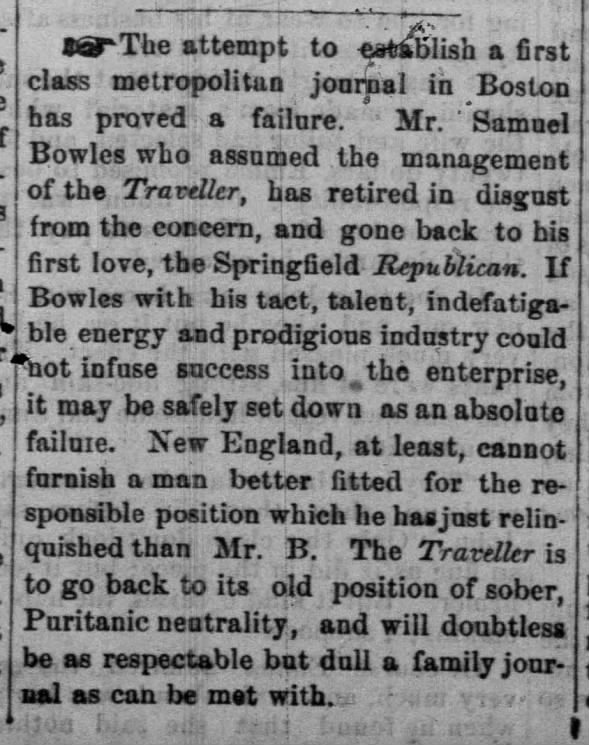
Where is Melville?
In the Boston Traveller Bowles or somebody wondered, "Where is Melville?" We might be able to answer the question, now that we know the date on which it appeared in print. Where WAS Herman Melville on September 14, 1857? Back home in Pittsfield, Mass., brainstorming lecture topics, as he revealed the next day in a letter to George W. Curtis:
-- I have been trying to scratch my brains for a Lecture. What is a good, earnest subject? "Daily progress of man towards a state of intellectual & moral perfection, as evidenced in history of 5th Avenue & 5 Points."Even better, brainstorming lecture topics and satirizing utopian schemes of famous communists after reading Robert Owen:
By the wondrous and, hitherto, mysterious organic construction of man and woman, the adults of the first generation that shall acquire a practical knowledge of their own powers to re-form the matured character of each individual, will be enabled, almost to re-create the character of succeeding generations; to re-create it by training each individual from birth, by a new and very superior arrangement of external circumstances, to have a sound physical constitution, to have superior dispositions, habits and manners, to have much valuable knowledge, and to make a daily progress towards physical, intellectual and moral perfection.
-- Robert Owen, The Book of the New Moral World (London, 1836) page 103.
 |
| Robert Owen, Esq. via NYPL Digital Collections |
"... I'm not unconvinced (as Melville would put it) that there is at least some intention to put the question to readers the question which is worse, a surplus of trust which is naivete, or a deficit of trust which is cynicism. And this dialectic goes unresolved ...."
Bravo!!!
This item is reprinted on page 498 in Herman Melville: The Contemporary Reviews, edited by Brian Higgins and Hershel Parker (Cambridge University Press, 1995; paperback 2009).
The Confidence Man His Masquerade By Herman Melville New York, Dix, Edwards & Co. For sale by M O Hall.
Mr Melville is a writer of no ordinary talent. His former works were read with an interest that sharpened the appetite for almost anything his pen might indite. Though the "Confidence Man" is a book exhibiting close observations of human nature and a judicious and careful estimate of human virtues and frailties, we cannot accord to it the interest possessed by his less pretentious stories. It differs materially in manner from his other books, and lacks in geniality. Its philosophy is of a character that perhaps calls for too much exertion to fully enjoy, and the agents used in presenting it are of a class that seem to forbid an acquaintance.--
However, many would regard the book more favorably, and undoubtedly award to it high praise.
-- Newburyport, Massachusetts Daily Herald, April 22, 1857; now accessible with newly added titles on NewspaperArchive.
Also available in Digital Archives of the Newburyport Public Library:
The Newburyport Daily Herald was then edited by George J. L. Colby and Joseph B. Morss. According to his obituary in the Boston Globe (December 1, 1890), Colby once was employed "in the Salem custom house with Nathaniel Hawthorne." The 1890 obit identifies Colby as "principal editorial writer" for the Daily Herald "down to 1869."
The Confidence-Man: His Masquerade. By HERMAN MELVILLE. New York: Dix, Edwards & Co. For sale by T. H. Pease.
Mr. Melville’s new book outdoes in strangeness and eccentricity even his own later stories, which have made people wonder, by the odd kind of metaphysical wildness which pervaded them. We can use no terms which will adequately characterize this his last production. It has evidently a moral, and yet this is so hidden by grotesque incidents and strange situations, that we cannot be sure that we have hit upon the right key to this metaphysico-romantic novel, in which there is no word of love, no heroine and a hero who appears and disappears in as many parts and characters, as the sole actor in a small theater. The conclusion seems to promise a continuance of the Masquerade, and we shall be glad to see it, for we are in a state of utter bewilderment as to the real faces under the masks of the present book. Yet, in spite of these drawbacks to the complete understanding of the book, we could not best [but] be charmed by its pure style and by the beauty of many of the thoughts. If its plan is poor, (which we cannot decide without further light,) its execution is sufficient to redeem it. The book may attract by its novelty, but we doubt if it adds anything to the reputation of the author of “Typee.”
This book, as well as the others published by Dix, Edwards & Co., is issued in that neat and elegant style which marks all the publications of this house.
The Harvard copy of Yale Literary Magazine volume 22 was Google-digitized in July 2018.
https://books.google.com/books?id=Irq-BwX2TfgC&pg=PA246&lpg=PA246&dq#v=onepage&q&f=false
EBSCO Cite:
“Literary Notices.” Yale Literary Magazine (New Haven, CT) 22, no. 6 (April 1857): 245–47. http://search.ebscohost.com.i.ezproxy.nypl.org/login.aspx?direct=true&db=lpn&AN=43393372&site=ehost-live.
Syracuse Daily Journal - Tuesday April 7, 1857
NEW PUBLICATIONS.
The Confidence Man: his masquerade. By HERMAN MELVILLE. New York: DIX, EDWARDS & CO.
We can hardly believe that this book proceeds from the same powerful pen that created "Omoo" and "Typee." It can only be regarded as an utter failure. Its characters are exaggerated and awkward, and their principal [motivation?] appears to be to utter stupid and vapid things. Its apparent aim is to burlesque some of the popular modes of dispensing charities at the present day--but even its travesty is pointless and absurd. MELVILLE must have been the victim of somnambulism, or of downright insanity, when he consented to the publication of so sorry a volume of trash. We fear that his previous reputation will suffer in consequence. The work is for sale by W. T. HAMILTON.
-- Syracuse NY Daily Journal for April 7, 1857; found on the great Fulton History site, Tom Tryniski's matchless archive of digitized pages from old newspapers of the past. Link below to support his amazing work on Fultonhistory.com :
Found among recently digitized images of historic newspapers on The British Newspaper Archive and transcribed by me below, a review of Herman Melville's The Confidence-Man in the London Weekly Dispatch for Sunday, 26 April 1857. Previously unrecorded in Melville scholarship I think--pages from the Weekly Dispatch and Sunday Dispatch were not available on the British Newspaper Archive before October 2020.
THE CONFIDENCE-MAN: HIS MASQUERADE. BY HERMAN MELVILLE.—Longman and Co., Paternoster-row.— This volume may come very properly under the denomination of Psychological fiction (or any quite as vague or definite, which ever the reader pleases), but it is, in structure and style, in manner, as in matter, as distinct from any of those former magnificent productions of Herman Melville's gifted pen as it is possible to conceive. We confess ourselves puzzled by it, while all the time, a clear analysis of social cant, sham assent to philanthropic dogmas and maxims, which we all ignore (more or less) when put to the test, and a demonstration that selfishness is substituted for confidence in daily and mutual intercourse are fully perceptible. His agent is a masquerader of many parts, assumptions and pretensions, each one more protean and elusive than the other, but each, and every one, harping upon "confidence," the test being, asking frankly for a hundred dollars upon the basis of an unquestioning "confidence" in the representations made. The deduction is, that there is no great reliance placed, or to be placed, in the frank virtue of " confidence " but which, in the form of the expressive platitude "No Trust" (in theory or in practice), is not quite so clear a fact as may be thought. Hospitals, innumerable schools, asylums, places of repentance, of reformation, homes of health, of sanity, &c., without number, have been built, and are supported through "confidence." What means "supported by voluntary subscriptions" but "confidence"? How is it that so many thousand begging-letter impostors live, and live well, but upon the "letter of credit" drawn upon "confidence"? We have not quite lost confidence in each other, bad as the world may be, and "backward as we all may be in going forward." Is it astonishing to the author that his agent should meet with so many rebuffs, that a little solid basis for this "confidence" (value 100 dollars) should be required? If we have got hold of his purpose at all (and we may very easily have failed from the eccentric adumbra veiling his "masquerade") he has not proved his point. If we have not we cannot understand him. Besides, what is glorious rhapsody, almost poetry, in "Moby Dick," for instance, is in this volume, "prose" — that is to say, "prosy"—and we regret to say it. Flashes of the man's strong and striking originality appear not unfrequently; but these cast only a lambent glare upon the misty moorland of his hidden meaning. He may mean that which we cannot solve; and the Œdipus is, therefore, to be found—will be found without question, and questionless with ease. It is a book to read, however queer and quaint, tedious, yet oracular; and, as a specimen of what is to be met with in its pages, take the following: —
[excerpt from The Confidence-Man chapter 19] "My name is Thomas Fry. Until my 23rd year, I went by the nickname of Happy Tom—happy—ha, ha! They called me Happy Tom, d'ye see? because I was so good-natured and laughing all the time, just as I am now—ha, ha!" Upon this, the herb-doctor would, perhaps, have run, but once more the hyæna clawed him. Presently, sobering down, he continued:— "Well, I was born in New York, and there I lived a steady, hard-working man, a cooper by trade. One evening I went to a political meeting in the Park — for you must know, I was in those days a great patriot. As bad luck would have it, there was trouble near, between a gentleman who had been drinking wine and a pavior who was sober. The pavior chewed tobacco, and the gentleman said it was beastly in him, and pushed him, wanting to have his place. The pavior chewed on, and pushed back. Well, the gentleman carried a sword-cane, and presently the pavior was down—skewered." "How was that?" "Why you see the pavior undertook something above his strength." "The other must have been a Samson then. 'Strong as a pavior,' is a proverb." "So it is, and the gentleman was in body a rather weakly man, but for all that, I say again, the pavior undertook something above his strength." "What are you talking about'? He tried to maintain his rights, didn't he ?" "Yes; but for all that, I say again, he undertook something above his strength." "I don't understand you. But go on." "Along with the gentleman, I, with other witnesses, was taken to the Tombs. There was an examination, and, to appear at the trial, the gentleman and witnesses all gave bail—I mean all but me." "And why didn't you?" "Could'nt get it." "Steady, hard-working cooper like you; what was the reason you could'nt get bail?" "Steady, hard-working cooper hadn't no friends. Well, souse I went into a wet cell, like a canal-boat splashing into the lock; locked up in pickle, d'ye see? against the time of the trial." "But what had you done?" "Why, I hadn't got any friends, I tell ye. A worse crime than murder, as yell see afore long." "Murder? Did the wounded man die?" "Died the third night." "Then the gentleman's bail didn't help him. Imprisoned now, wasn't he?" "Had too many friends. No, it was I that was imprisoned.— But I was going on: They let me walk about the corridor day by day but at night I must into lock. There the wet and the damp struck into my bones. They doctored me, but no use. When the trial came, I was boosted up and said my say." "And what was that?" "My say was that I saw the steel go in, and saw it sticking in." "And that hung the gentleman?" "Hung him with a gold chain! His friends called a meeting in the Park, and presented him with a gold watch and chain upon his acquittal." "Acquittal?" "Didn't I say he had friends?" There was a pause, broken at last by the herb-doctor's saying:— "Well, there is a bright side to everything. If this speak prosaically for justice, it speaks romantically for friendship? But go on, my fine fellow." "My say being said, they told me I might go. I said I could not without help. So the constables helped me, asking where would I go? I told them back to the 'Tombs.' I knew no other place. 'But where are your friends?' said they. 'I have none.' So they put me into a hand-barrow with an awning to it, and wheeled me down to the dock and on board a boat, and away to Blackwell's Island to the Corporation Hospital. There I got worse—got pretty much as you see me now. Couldn't cure me. After three years, I grew sick of lying in a grated iron bed alongside of groaning thieves and mouldering burglars. They gave me five silver dollars, and these crutches, and I hobbled off. I had an only brother who went to Indiana, years ago. I begged about, to make up a sum to go to him; got to Indiana at last, and they directed me to his grave. It was on a great plain, in a log churchyard with a stump fence, the old gray roots sticking all ways like moose-antlers. The bier, set over the grave, it being the last dug, was of green hickory; bark on, and green twigs sprouting from it. Some one had planted a bunch of violets on the mound, but it was a poor soil (always choose the poorest soils for grave-yards), and they were all dried to tinder. I was going to sit and rest myself on the bier, and think about my brother in heaven, but the bier broke down, the legs being only tacked. So, after driving some hogs out of the yard that were rooting there, I came away, and, not to make too long a story of it, here I am, drifting down stream like any other bit of wreck."Surveying Putnam's Monthly Magazine for July and August 1855, the same newspaper had noticed "a wild fiction called 'The Bell Tower'" in the August issue:
"... from the wild, fitful and deeply sculptured arabesque of the style (if we may be permitted so to designate it), we should at once point out Herman Melville as the author."
-- London Weekly Dispatch, 2 September 1855.
“Thank you for your frankness,” said Paul; “frank myself, I love to deal with a frank man. You, Doctor Franklin, are true and deep, and so you are frank.”
The sage sedately smiled, a queer incredulity just lurking in the corner of his mouth.
-- Israel Potter: His Fifty Years of Exile (1855); first printed in Putnam's Monthly Magazine - September 1854
Paul's genuine frankness contrasts with the more calculating and ambiguous behavior displayed by Benjamin Franklin. Hennig Cohen has noted how Melville's wordplay on the "frank" in Franklin looks forward to the ironic naming of Frank Goodman, the confidence-man's confidence man:
99.9-11 frankness . . . frank man . . . Franklin . . . frank
Paul Jones appears to be nothing if not frank, though Franklin, who appears at times to be less so, listens to his words with a lurking "incredulity" (99.12). Melville is once more turning to account the suggestiveness of a personal name. He is also anticipating the significant name, Frank Goodman, of The Confidence-Man (Chap. 29) who at times seems less than frank.
-- Annotations to Israel Potter: His Fifty Years of Exile, edited by Hennig Cohen (Fordham University Press, 1991) page 395.
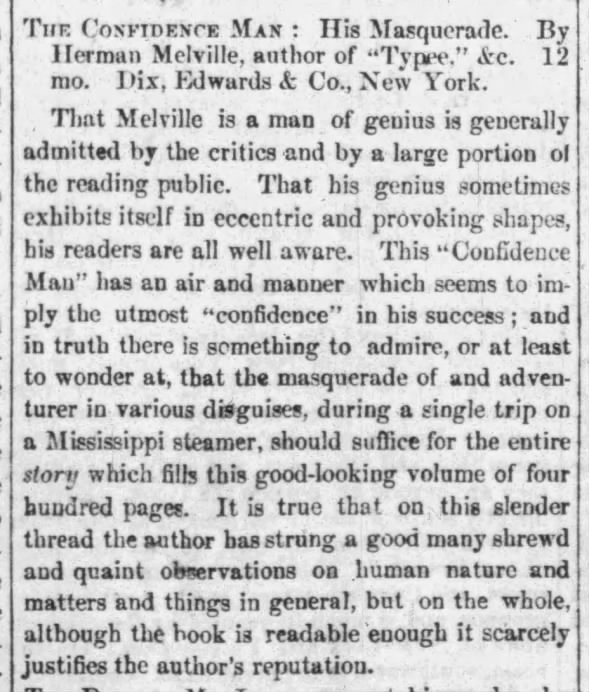 Thu, Apr 16, 1857 – 2 · Yonkers Examiner (Yonkers, New York) · Newspapers.com
THE CONFIDENCE-MAN: His Masquerade. By Herman Melville, author of "Typee," &c. 12 mo. Dix, Edwards & Co., New York.
That Melville is a man of genius is generally admitted by critics and by a large portion of the reading public. That his genius sometimes exhibits itself in eccentric and provoking shapes, his readers are all well aware. This "Confidence Man" has an air and manner which seems to imply the utmost "confidence" in his success; and in truth there is something to admire, or at least to wonder at, that the masquerade of and adventurer in various disguises, during a single trip on a Mississippi steamer, should suffice for the entire story which fills this good-looking volume of four hundred pages. It is true that on this slender thread the author has strung a good many shrewd and quaint observations on human nature and matters and things in general, but on the whole, although the book is readable enough it scarcely justifies the author's reputation.
Fifty years in Exile.
By Herman Melville, author of "Omoo," "Typee," etc. Complete in two volumes, paper cover, price $1.00; or in one volume, cloth, $1.25.
The Masquerade.
By Herman Melville, author "Typee," "Omoo," etc. Complete in two volumes, paper cover. Price $1.00; or in one vol., cloth, for $1.25.
https://books.google.com/books?id=xK8edm7GYA4C&pg=PT12&dq#v=onepage&q&f=false
The Enchanted Isles.
By Herman Melville, author of "Omoo," “Typee," etc. Complete in two volumes, paper cover. Price $1.00; or in one vol., cloth, for $1.25
Now Bildad, I am sorry to say, had the reputation of being an incorrigible old hunks, and in his sea-going days, a bitter, hard task-master. They told me in Nantucket, though it certainly seems a curious story, that when he sailed the old Categut whaleman, his crew, upon arriving home, were mostly all carried ashore to the hospital, sore exhausted and worn out. For a pious man, especially for a Quaker, he was certainly rather hard-hearted, to say the least. He never used to swear, though, at his men, they said; but somehow he got an inordinate quantity of cruel, unmitigated hard work out of them. When Bildad was a chief-mate, to have his drab-colored eye intently looking at you, made you feel completely nervous, till you could clutch something—a hammer or a marling-spike, and go to work like mad, at something or other, never mind what. Indolence and idleness perished from before him. His own person was the exact embodiment of his utilitarian character. On his long, gaunt body, he carried no spare flesh, no superfluous beard, his chin having a soft, economical nap to it, like the worn nap of his broad-brimmed hat.
--Moby-Dick Chapter 16: The ShipPittsfield's real Bildad also might have been hard to work for. Or maybe he was just unlucky in his reliance on rascally "boys," like Pitch in The Confidence-Man ("all boys are rascals"). No telling why, exactly, but in October 1838, a young apprentice named Henry ran away from Bildad Williams.
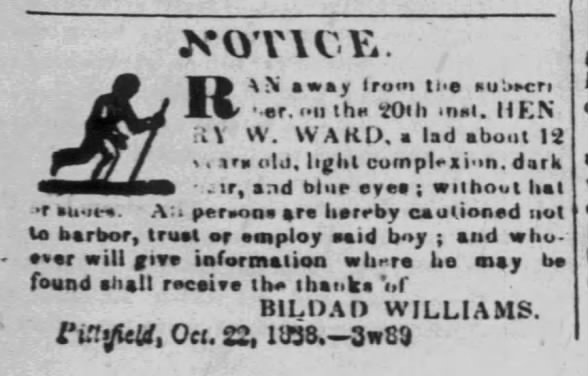 Thu, Nov 15, 1838 – 1 · The Pittsfield Sun (Pittsfield, Massachusetts) · Newspapers.com
RAN away from the subscriber, on the 20th inst, HENRY W. WARD, a lad about 12 years old, light complexion, dark hair, and blue eyes; without hat or shoes. All persons are hereby cautioned not to harbor, trust or employ said boy; and whosoever will give information where he may be found shall receive the thanks ofHenry W. Ward must have been returned to Bildad, for he ran away again two years later:
BILDAD WILLIAMS.
Pittsfield, Oct. 22, 1838.
 |
| Pittsfield Sun - February 4, 1841 via GenealogyBank |
The summer before Henry's second departure, in July 1840, a warrant had been issued against the estate of Bildad Williams, evidently in connection with bankruptcy proceedings.NOTICE.
RUN away from me on the 27th ult. a Boy by the name of HENRY W. WARD, 14 years old, stocky built, gray eyes, dark hair, and walks stooping. He wore away a light mixed roundabout, black vest with a red back, and moleskin pantaloons--all considerably worn. He also wore away a good hair seal cap, and a pair of good boots, and took some other articles of clothing. All persons are forbid harboring, trusting or employing said runaway; and whoever will give information where he may be found will confer a favor on
BILDAD WILLIAMS.
Pittsfield, Feb. 2, 1841.
 |
| Pittsfield, MA Sun - May 8, 1851 via GenealogyBank |
NOTICE is hereby given, that the subscriber has been duly appointed Administrator on the estate of BILDAD WILLIAMS, late of Pittsfield, in the County of Berkshire, deceased, and has taken upon himself that trust, by giving bond as the law directs. All persons having demands upon the estate of the said deceased, are requested to exhibit the same; and all persons indebted to said estate, are called upon to make payment toIn Robert's ad for the subsequent estate sale, remaining possessions of the deceased included "a large assortment of Household Furniture" along with "Comb Makers Tools and other articles."
ROBERT MELVILL, Adm'r.
May 6, 1851.
The official register of deaths in Pittsfield gives the occupation of Bildad Williams as "Comb Maker." So then, young Henry Ward the 1838 and 1841 runaway possibly had been employed by Bildad in the manufacture of combs. However, according to the United States Federal Census for 1850, Bildad Williams at that time worked as a "Grocer."
Pittsfield, MA Culturist and Gazette - May 14, 1851
via GenealogyBankTHE Subscriber will expose for sale at Public Auction on Saturday, the seventeenth day of May inst., at the residence of the late Bildad Williams, a large assortment of Household Furniture. Comb Makers Tools and other articles.
Notice.
ROB'T. MELVILLE, Administrator.
Pittsfield, May 13, 1851.
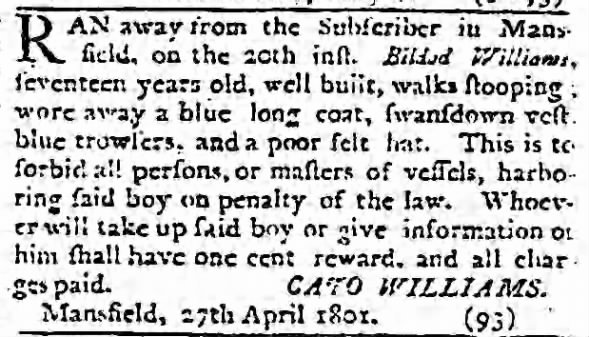 Cato Williams, Bildad Williams ran away, Mansfield Mon, May 11, 1801 – Page 4 · Hartford Courant (Hartford, Connecticut) · Newspapers.com
"RAN away from the Subscriber in Mansfield, on the 20th inst. Bildad Williams, seventeen years old, well built, walks stooping; wore away a blue long coat, swansdown vest, blue trowsers, and a poor felt hat. This is to forbid all persons, or masters of vessels, harboring said boy on penalty of the law. Whoever will take up said boy or give information of him shall have one cent reward, and all charges paid. CATO WILLIAMS. Mansfield, 27th April 1801."Robert Underhill, current President of the Historical Society of Clarendon Vermont, has identified Mansfield's Bildad Williams as the son of Cato Williams with his wife Lydia Williams. As reported by Underhill and others, this Cato Williams died in Westfield, MA in 1828. A Cato Williams is listed as the head of household in the 1820 U. S. Federal Census for Lenox in Berkshire County, Massachusetts. The Williams household of five was then comprised of four "Free Colored Persons" and one "Free White Person." Another researcher on Ancestry.com gives the father of Bildad Williams as Elisha Williams (1717-1784), who owned property in Mansfield, CT next to land sold for $215 in 1809 by Jesse Spafford to Lydia, Isham, and Bildad Williams. In 1817, Bildad sold his remaining share of the Mansfield property to Simeon Allen.
https://melvilliana.blogspot.com/2019/08/the-sea-1859-60-journal-for-sailors.htmlFrom The Boston Olive Branch, April 11, 1857:
THE CONFIDENCE MAN: His Masquerade. By Herman Melville, Author of "Piazza Tales," "Omoo," "Typee," &c. &c. New York: Dix, Edwards & Co.
All of Melville's works are characterized by originality; and "The Confidence Man" also abounds in passages of genuine humor, and healthful sarcasm. It is a capital book, well conceived, well written, and published in a handsome duodecimo volume of about four hundred pages. We cordially recommend it to the attention of our readers. A. Williams & Co. have it.
Citation:
“THE CONFIDENCE MAN: Masquerade.” Boston Olive Branch, vol. 22, no. 15, Apr. 1857, p. 003. EBSCOhost, search.ebscohost.com/login.aspx?direct=true&db=sdd&AN=66759556&site=ehost-live.Then edited by Erasmus Addison Norris, son of founder Thomas F. Norris. Patricia Okker in Our Sister Editors (University of Georgia Press, 1995; paperback 2008) credits Mary A. Denison as "Co-Editor" of the Boston Olive Branch. Mrs. Denison's tenure evidently resumed in 1856; she is listed as "assistant editor" in The Boston Directory for the Year 1852, when the paper was edited by Thomas F. Norris. From Arthur's Home Magazine, Volume 7 (February 1856) page 145:
MRS. MARY A. DENISON.
For the past year, this gifted lady has been residing at Florence, N. J., with her husband. But, she has recently removed to Boston, and is now permanently engaged as the sole editor of the Ladies' Enterprise, and assistant editor of the Olive Branch....
https://books.google.com/books?id=thVLAQAAMAAJ&lpg=PA145&pg=PA145&#v=onepage&q&f=falseBoston city directories confirm Mary A. Denison's role as Assistant Editor of the Olive Branch in 1856-7.


Manuscripts and Archives Division, The New York Public Library. "“Hawthorne and his mosses”" The New York Public Library Digital Collections. 1850.
http://digitalcollections.nypl.org/items/23ebb010-184f-0133-f66c-58d385a7bbd0Melville originally wrote:
"Nevertheless, it would argue too illy of my country were this maxim to hold good concerning Nathaniel Hawthorne...."In print the Literary World gave the standard form "ill" for Melville's "illy":
Changed to "ill" in LW...As an adverbial form "illy" was becoming ill regarded....Consulting OED the Northwestern-Newberry editors found usages before Melville's by Jefferson (1785), Southey (1795), Lowell (1848), and Irving (1849).
 |
| New York Commercial Advertiser - September 12, 1846 via GenealogyBank |
We commend to the writer in question, as a fault worthy of his censure, the increasing disposition to make new adverbs by the addition of ly where it is not wanted. In very many of the newspapers we find illy substituted for ill--the writers seeming to imagine that ill is always an adjective, and must be changed to illy where an adverb is required. It is not so. Ill and well are adverbs as well as adjectives--adverbs when used in connection with a verb, adjectives when used when with a noun. Nobody, as yet, says "welly done"--why, then, do we meet with "illy done"? "Well done" and "ill done" are the proper modes of expression. --New York Commercial Advertiser, September 12, 1846
As noted in the Northwestern-Newberry Edition of Israel Potter (page 247), duly cross-referenced in the NN Piazza Tales,
Four of the alterations consist of striking the "y" from "illy" ...Perhaps then Melville would also have wanted to revise the four instances of illy in The Confidence-Man (1857), were there any chance of getting out another edition after the failure of his original publisher, Dix, Edwards & Co.