Showing posts with label Hawaii. Show all posts

Sunday, May 28, 2023

Where is Melville?

A Man of the Sandwich Islands, with his Helmet
© National Maritime Museum, Greenwich, London

Disappointed with Kiana: A Tradition of Hawaii (1857) by James Jackson Jarves, one contemporary reviewer complained that "Romance plainly is not Mr. Jarves' forte" and wondered,

"Where is Melville?"

Surely the author of Typee, Omoo, and Mardi would have made a more entertaining story out of the same Polynesian material. 

A newspaper clipping of the 1857 Kiana review was kept by the Melville family and eventually deposited at Harvard. I'm guessing it's still there:

 Jay Leyda put it in The Melville Log Volume 2 on page [583]:

Cited in the back of Volume 2 as "clipping, HCL-M" = "Papers & library of the Melville family, Harvard College Library."

Leyda got the place (Boston) right, along with the correct month (September) and year (1857) of the newspaper clipping. For those who care about such things, I'm happy to supply the missing name and date of the newspaper in which this interesting query appeared. Transcribed below, from the Boston Daily Traveller of September 14, 1857:

Boston Daily Traveller - September 14, 1857
 
Mr. Jarves' well known books--Parisian and Italian Sights--led us to look with favor upon anything coming from his pen. We are sorry to be disappointed in KIANA, a Tradition of Hawaii, just published by Munroe & Co. Romance plainly is not Mr. Jarves' forte. He had a charming subject, susceptible of the highest style of treatment in this difficult province of fiction. There is a tradition among the people of the Sandwich Islands, that during the reign of Kiana, eighteen generations of kings previous to Kamehameha I., a white priest came among them with an idol and a new god, lived with them long, and dying, left a reputation for goodness that was green in the memories of the Hawaiians three centuries later. The date of this tradition synchronizes with that of the loss of two vessels sent by Cortez upon an exploring expedition to California. Mr. Jarves supposes the possible identity of the white strangers of Hawaii with the missing adventurers of Cortez, and from this fertile source derives the materials for his story. 
 
With such a beginning one might look for a romance equal to Mayo's Kaloolah or Melville's Omoo and Typee. The field is illimitable, the colors of every hue, and the license ample, only the skill of the romancer was wanting. It is a pity so good a piece of canvass should be spoiled. Where is Melville? Will he not leave the mazes of Pierre or the Ambiguities, and the eccentricities of the Confidence Man, and with some such charming tradition as this bring back the days and the delights of beautiful Fayaway, or take us voyaging to another Mardi. -- Boston Daily Traveller, September 14, 1857.
 
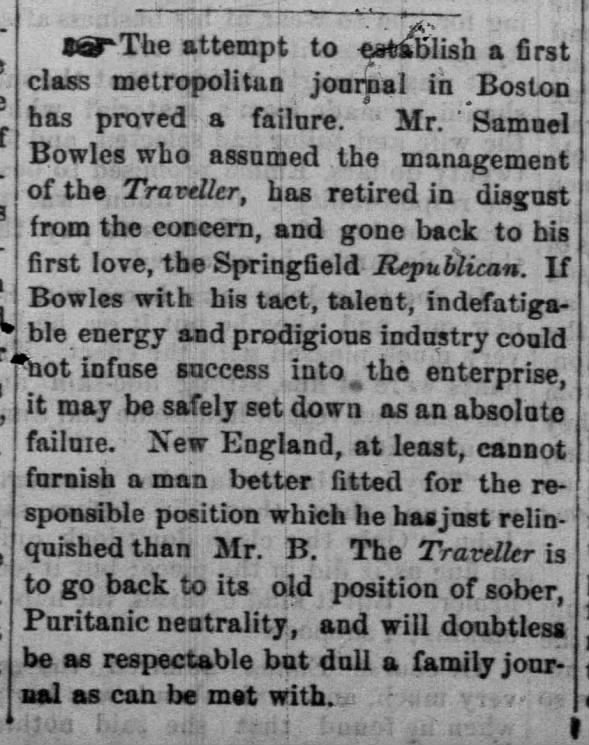
Emily Dickinson's friend Samuel Bowles of the Springfield, Mass. Republican had served as editor of the Boston Traveller since April 1857. In Springfield, Bowles was formerly assisted by Melville's "friendly critic" Josiah Gilbert Holland, so identified by Jay Leyda:
  • Leyda, Jay. “Another Friendly Critic for Melville.” The New England Quarterly, vol. 27, no. 2, 1954, pp. 243–49. JSTOR, https://doi.org/10.2307/362806. Accessed 28 May 2023.  
After a short tenure as editor of the Traveller, Bowles would reclaim his position as editor of the Springfield Republican.
 
The departure of Samuel Bowles as editor of the Traveller was announced on September 10th in the Boston Evening Transcript. Possibly the Kiana review on September 14, 1857 was one of the last literary pieces that Bowles contributed or supervised as editor of the Boston Traveller

Where is Melville?

In the Boston Traveller Bowles or somebody wondered, "Where is Melville?" We might be able to answer the question, now that we know the date on which it appeared in print. Where WAS Herman Melville on September 14, 1857? Back home in Pittsfield, Mass., brainstorming lecture topics, as he revealed the next day in a letter to George W. Curtis:

-- I have been trying to scratch my brains for a Lecture. What is a good, earnest subject? "Daily progress of man towards a state of intellectual & moral perfection, as evidenced in history of 5th Avenue & 5 Points."
Even better, brainstorming lecture topics and satirizing utopian schemes of famous communists after reading Robert Owen:
By the wondrous and, hitherto, mysterious organic construction of man and woman, the adults of the first generation that shall acquire a practical knowledge of their own powers to re-form the matured character of each individual, will be enabled, almost to re-create the character of succeeding generations; to re-create it by training each individual from birth, by a new and very superior arrangement of external circumstances, to have a sound physical constitution, to have superior dispositions, habits and manners, to have much valuable knowledge, and to make a daily progress towards physical, intellectual and moral perfection.

-- Robert Owen, The Book of the New Moral World (London, 1836) page 103.

Robert Owen, Esq. via NYPL Digital Collections
 
Melville's words and phrasing, specifically the stipulation of "daily progress" in the march "towards" a condition of "intellectual and moral perfection" are Robert Owen's in The Book of the New Moral World (London, 1836). "Subjects: Communism" as catalogued by HathiTrust Digital Library
 
As it turned out, the real lecture Melville composed on Statues in Rome was delivered in Boston on December 2, 1857 and reported the next evening in the Boston Evening Traveller. Traces of Melville's epistolary parody of Owen linger in his reference to the utopian "scheme of Fourier" that had yet to dissolve the need for a whole code of laws against criminal conduct. 

 Related posts:

Friday, May 21, 2021

Churchman notice of TYPEE

Theodore Hook via NYPL Digital Collections

Submitted by "F. M. H." (Fordyce Mitchell Hubbard?), this review of Typee: A Peep at Polynesian Life appeared on the front page of The Churchman for April 17, 1847. Then edited by Samuel Seabury (1801-1872), the Churchman was a weekly religious newspaper published on Saturdays in New York City by the Protestant Episcopal Church. The reviewer excerpts and comments on the Hawaiian material in Chapter 26 of Herman Melville's first book. Specifically, "F. M. H." condemns the immoral and abusive behavior of missionaries there as portrayed by Melville in two segments, "Story of a Missionary's Wife" and "Fashionable Equipages at Oahu." In the Churchman heading, the word Polynesian in Melville's subtitle is misspelled "Polneysian."
For the Churchman.

TYPEE: A PEEP AT POLNEYSIAN LIFE.


BY HERMAN MELVILLE.

This is a singular work and reminds one forcibly of the facetious Daly’s “Travels in the Interior of Africa,” the glossary of the latter work of certain words of the native dialect, bearing a marvellous affinity to sundry words in the former, given as the Typee tongue. The work purports to be the composition of a sailor who deserted from a whaler at Nukuheva, and who in running away reached the Typee country, (the natives of which are notorious cannibals,) instead of that of the Happars, their enemies, and a less barbarous people. The whole matter may be as purely inventive as Daly’s Africa, but the style is “vraisemblable,” and sufficiently dashing to make it attractive. It is an objectionable book for general reading, as the author omits no opportunity to cast a sneer at religion. Speaking of Honolulu, he makes the following bold charge against the Missionaries there established, and against one in particular; we extract from the work, pt 2 p. 251 and seq.— “The natives have been civilized into draught-horses and evangelized into beasts of burden. But so it is. They have been literally broken into the traces and are harnessed to the vehicles of their spiritual instructors like so many dumb brutes! Among a multitude of similar exhibitions that I saw, I shall never forget a robust, red-faced and very lady-like personage, a Missionary’s spouse, who day after day for months together, took her regular airings in a little go-cart, drawn by two of the Islanders, one an old grey-headed man and the other a roguish strapling, both being, with the exception of the fig-leaf, as naked as when they were born. Over a level piece of ground this pair of draught bipeds would go with a shambling unsightly trot, the youngster hanging back all the time like a knowing horse, while the old hack plodded on and did all the work.

Rattling along through the streets of the town in this stylish equipage, the lady looks about her as magnificently as any queen driven in state to her coronation. A sudden elevation and a sandy road, however, soon disturb her serenity. The small wheels become embedded in the loose soil,—the old stager stands tugging and sweating, while the young one frisks about and does nothing; not an inch does the chariot budge. Will the tender-hearted lady, who has left friends and home, for the good of the souls of the poor heathens, will she think a little about their bodies and get out and ease the wretched old man, until the ascent is mounted? Not she; she could not dream of it. To be sure, she used to think nothing of driving the cows to pasture on the old farm in New England; but times have changed since then. So she retains her seat and bawls out,— “Hookee! Hookee!” (pull, pull.) The old gentleman, frightened at the sound, labors away harder than ever; and the younger one makes a great show of straining himself, but takes care to keep one eye on his mistress, in order to know when to dodge out of harm’s way. At last the good lady loses all patience; “hookee! Hookee!” and rap goes the heavy handle of her huge fan over the naked skull of the old savage; while the young one shies to one side, and keeps beyond its range. “Hookee! Hookee!” again she cries— “Hookee tata kanuaka!” (pull strong, men,) but all in vain, and she is obliged in the end to dismount, and, sad necessity! actually to walk to the top of the hill.

At the town where this paragon of humility resides, is a spacious and elegant American Chapel, where divine service is regularly performed. Twice every sabbath towards the close of the exercises may be seen a score or two of little wagons ranged along the railing in the front of the edifice, with two squalid native footmen in the livery of nakedness standing by each, and waiting for the dismissal of the congregation to draw their superiors home. * * * * * * To read pathetic accounts of Missionary hardships and glowing descriptions of conversions, and baptisms taking place beneath palm trees, is one thing; and to go to the Sandwich Islands and see the Missionaries, dwelling in picturesque and prettily-furnished coral rock villas, whilst the miserable natives are committing all sorts of immorality around them, is quite another!”

There is no mention in the book of the name of the parties alluded to, and no particularizing of the Society by which they are delegated; but there can be but one opinion that the “husband” of the lady is a gangrened member of the Mission, and should be at once cut off! Can such things be? If there be truth in the charge, better were it a thousand times that the poor natives were left to themselves, than that they should be depressed below their common nature, under the assumption of christianity. Can it be a matter of astonishment, that scoffers abound, when such things exist under the sufferance and by the support of “a Church,” so called? Is it surprising that men hesitate to contribute to such purposes? There is—there must be a lack of judgment—a perversion of right feeling, that the appointments to such stations should be so misplaced.

Much as there is to object to in this work, if it be but the cause of uprooting this direful ill, it is welcome. That it may do evil, it is feared: but that it cannot fail to effect a certain good, there is no doubt.

F. M. H.
March 31, 1847.
Cite:
"F. M. H." “Typee: A Peep at Polneysian Life.” Churchman (New York, NY) 17, no. 7 (April 17, 1847): 26. http://search.ebscohost.com.i.ezproxy.nypl.org/login.aspx?direct=true&db=clp&AN=52063187&site=ehost-live.
The opening reference by "F. M. H." to the "facetious Daly" alludes to the comical friend of Gilbert Gurney in Theodore Hook's autobiographical Gurney Papers, originally serialized in Hook's New Monthly Magazine (1837-8). In the July 1837 installment, Gurney samples Daly's bogus journal of "Travels in the Interior of Africa" which includes a fictitious "vocabulary." Daly's fake "vocabulary" or glossary of common African words reminds the Churchman reviewer of Melville's questionable transcriptions and translations of Polynesian words in Typee.


Friday, March 12, 2021

Praise from whaling captains before Moby-Dick

via Images of Old Hawaiʻi

In a published letter to editor John N. Bradley of the Boston Daily Mail, correspondent  "J. G. S." reports from Lahaina, Maui that "this island is the great resort of whalers for supplies, although for repairs they have to go to Honolulu." The writer is James Gilchrist Swan--positively identified in the Daily Mail on November 21, 1849, about a month before Swan departed for San Francisco and the Pacific Ocean on the clipper ship Rob Roy

“... Mr. James G. Swan, will go out in the ship and will take charge of any goods than may be consigned to him. We have been acquainted with Mr. Swan for many years, and cheerfully recommend those of our friends desirous of shipping to California, that they cannot consign their goods to a better merchant or a better man. Mr. Swan will have facilities on his arrival at San Francisco, which will enable him to attend to any business entrusted to his care, in a prompt and efficient manner.

We have arranged with Mr. S. to correspond with the Mail, and our readers may expect ere long to see some interesting articles from his racy pen.

Like Herman Melville, James G. Swan is sharply critical of missionaries in Hawaii. Near the close of his long letter dated November 14, 1850, Swan registers high praise from whaling captains for Melville's first two books. Found on Genealogy Bank among digitized articles "added within 1 week":

Boston Daily Mail - January 27, 1851

Old Capt. Butler, a resident for many years on the island, and well known by every one who has ever traded in the Pacific, is spinning me a series of yarns which I am balling up for future use. If Melville had the material to work upon that Butler has, he could write a book that would eclipse all the books of adventures that have been written since the time old uncle Jonah went whaling and got into the hold of the wrong ship. By the way, the captains here are much pleased with Melvill's Omoo and Typee. Many of them recognise the characters he mentions, particularly Dr. Johnson at Tahiti, who is a drunken Englishman. Melville cannot have greater praise than he gets from the whaling captains.

-- Boston Daily Mail, January 27, 1851; from the "Interesting Letter from the Sandwich Islands" dated November 14, 1850 and signed "J. G. S."

Herman Melville, having just moved from New York City to the Arrowhead farm near Pittsfield MA, was resuming work on Moby-Dick when "J. G. S." aka James G. Swan prophetically imagined him writing a story of nautical adventure "that would eclipse all the books of adventures that have been written since the time old uncle Jonah went whaling." As Swan conceived it, Melville's best source for the greatest whaling book ever would be the real-life exploits of "Old Capt. Butler," then a "well-known" resident of Lahaina. 

Under the heading, "Death-scene of the Whale," part of Chapter 81 in Moby-Dick was excerpted in the Boston Daily Mail on November 24, 1851. 

If still living, Edmund R. Butler (aka Edward Butler?), one of the early Boston traders and longtime Lahaina resident would have been plenty old enough in 1850 to qualify as "Old Capt. Butler." Back in 1823, this Butler had been the hospitable host of Rev. Charles Samuel Stewart as recorded in Stewart's Journal of a Residence in the Sandwich Islands

http://imagesofoldhawaii.com/edmund-r-butler/

In late 1829 Edmund Butler served as sailing master or navigator on the brig Becket, joined with the Kamehameha on a fatal expedition to the New Hebrides islands for sandalwood. The Kamehameha was lost, and the Becket had to return after a month on Erromango, with further tragic consequences:
The company was speedily invaded by a mortal sickness, which carried off the captain [Manuia] and his kind monitor [Kaʻupena], and 180 more of their number, before they returned to Rutuma. There, twenty were left sick, and the Becket returned to Honolulu, August 3d, 1830, with only twelve natives and eight foreigners. Thus ended this disastrous expedition, a total failure, involving the loss of more than 400 lives.  --Hiram Bingham, A Residence of Twenty-one Years in the Sandwich Islands.

Sunday, November 12, 2017

Gansevoort Melville on Repeal, reported in the New York Freeman's Journal

via The New York Public Library Digital Collections
During the Repeal Year 1843, while Herman Melville was away in Tahiti and the Hawaiian Islands (after a month in the Marquesas, the year before), his older brother Gansevoort developed a reputation for exhilarating oratory in speeches on behalf of the Irish Repeal movement. A few fiery Repeal speeches by Gansevoort Melville are already available on Melvilliana, transcribed from reports in the New York Evening Post and other contemporary newspapers.
More words spoken by Gansevoort Melville may be found in pages of the New-York Freeman's Journal and Catholic Register, now accessible in digital archives of Historical Newspapers at GenealogyBank.

Gansevoort Melville's efforts in support of Daniel O'Connell and his movement to repeal the Act of Union with Great Britain actually began in May 1842, the year before the "Repeal Year." On May 23, 1842, Gansevoort spoke before a Monday-evening meeting of the "Young Men's Repeal Association," held at Washington Hall, corner of Broadway and Reade Street in New York City.

via The New York Public Library Digital Collections
According to the report in the New York Freeman's Journal and Catholic Register (June 4, 1842), "The assemblage was one of the very largest and most enthusiastic we have yet witnessed, while the attendance of a number of Ladies on the front seats added brilliancy and interest to the scene."
Gansevoort Melville, Esq. then came forward and addressed the meeting. He made a very happy speech, and was loudly cheered throughout. He related several anecdotes, one of the celebrated John Philpot Curran, who, on being near the Post-office, soon after the vote of the Irish Parliament that betrayed the country into the hands of England, was spoken to by an Irish lord, who had lent a helping hand to the dishonor, as follows:-- "What, Mr. Curran," said his lordship, "do they intend to do with that old house, (pointing to the Parliament House on College green)--for my part, I can't bear to look at it!" "You are in the right, my lord," replied the caustic wit, "for I never yet knew a murderer who was not afraid of a ghost" (cheers.) --Freeman's Journal, 4 June 1843
On December 30, 1842, Gansevoort spoke before the "Great Repeal Meeting" held at the Tabernacle (on Broadway at Fourth Street), following remarks by the meeting's organizer, Charles O'Conor.

via The New York Public Library Digital Collections
From the New York Freeman's Journal and Catholic Register, January 7, 1843:
GANSEVOORT MELVILLE, Esq., an American gentleman was next introduced to the meeting.

An engine, formerly without influence, has in modern times gained its just force, and now begins to be felt even by despots. Public opinion, the judgment of the intelligent and educated portion of mankind, is now, even in Britain of mighty force. The government with all its gold to corrupt, and its steel to subdue, still finds in public opinion a foe which threatens its existence, and paralyses half its powers, and will for the working of iniquity. I say this to the honor of Englishmen, for the enlightened and educated Briton is not less honest than the enlightened and educated of other nations. We live in an age of light and improvement. The tree of liberty has produced this fruit;--that tree beneath whose broad branches we all sit down in peace, in safety, in the enjoyment of every blessing allowed to man here below. Its young roots were fertilized by the blood of the French, the Polish, and the Irish patriot. It is making grateful return to their native climes. It is fostering those principles which require but a small capital to begin and they inevitably spread (applause.) Here, in this home of mental as well as physical freedom, where relieved from the necessity of watching the encroachments of any domestic tyrant, we may safely employ the sympathies of a noble nature in procuring similar blessings for less favored nations; here let us friends of Ireland plant the Auxiliary standard of Repeal, let us unite public opinion, let us generously contribute the sinews of war--and believe me it scarcely enters into the heart of the most sanguine to conceive how much may be accomplished for Ireland. (Great cheering.)

The United States of America is the only free nation; to us all eyes are turned. 'Tis we who guide public opinion. The old world may hesitate, doubt, may disbelieve; but it cannot counteract, and at last sullenly follows, our lead. Set this engine properly at work for Ireland, and O'Connell will do the rest. By uniting the confidence of all Ireland he achieved religious liberty; give him as an auxiliary the vast moral force of your co-operation and political emancipation is the sure result. If there was not one drop of Irish blood in this assemblage, gratitude and justice would demand our co-operation in the good cause. America owes at least her voice and the aid of her purse to Ireland; for Irish blood shed in our defence has dyed our whole frontier. (Applause.)

Let us then dissolve the sections and form the phalanx; let it be done to-night. He who loves truth and justice, especially if the warm blood of Erin courses through his veins, never stop upon the threshold of action to count the cost. Persuade his heart or convince his judgment and the battle is won if he be truly Irish. (Cheers.)

If any personal dissensions have existed, we will bury them at once. Let us have no one hereafter complaining that he has suffered wrong; if there be one who has any grievances let him endure them in silence. (Vehement cheers.) Let him bear them, if he will, for the good of the cause, and the friends of the cause will do him justice. I am therefore for an union for Ireland. We will lay its corner stone to-night; by our next meeting its whole basis will be formed and time will mature a glorious superstructure. We will invite our brethren throughout the country to unite with us, and if these counsels prevail, effects more extensive than any hitherto ever attempted, will be brought about.

We can procure the co-operation of friends of Ireland to a prodigious extent. There is Irish blood or sympathy for Ireland in almost every village in America; and whereever two or three can be found to sustain each other, they will unite at our call in the name of Liberty and Old Ireland. (Loud cheers.) They will give their aid and countenance. I would also suggest a general convention of delegates, or proxies from the society once a year steadily henceforward until the Union is repealed. If our first convention meets at Boston, the next year here, and so on southward--beginning at Boston, the cradle of American liberty; believe me, Ireland will be emancipated from colonial vassalage before a Convention shall have sat at New-Orleans, the field where British power was stricken down by the son of an Irish exile. (Tremendous cheering.)

He said--that he came there as one who took a deep interest in the success of that cause, which had brought them together united as one man. He was aware that the enemies of Repeal ask one continuous question, "What right have Americans to interfere in the concerns of a foreign and friendly power." This was the question and he was determined to give it an answer publicly (cheers.) An American citizen being a freeman has a right to do whatever he pleases, provided it is not wrong (cheers and laughter,) and until they can prove it to be wrong to extend our sympathies to the oppressed of all nations, they must admit our right to give all the assistance in our power to unhappy Ireland, which is in the grasp of the same tyrant from whom they had providentially escaped (loud cheers.) When we cast our eyes over the wide waste of waters, we behold a country whose climate is the most salubrious, and the fertility of whose soil has gained for her the name of "Green Erin." So far it is the work of God; but when we come to see what man has done for her, we recoil from the spectacle with horror. We find nine millions of a proverbially contented people in a state of ferment bordering upon distraction. A French writer of some eminence in describing the people of the united kingdoms of Great Britain says--that the English, fat, smooth, and well clothed, will quarrel about the manner in which their muffins are toasted; the Scotch will fret about their road to another world if they have nothing else to fret about, but the Irish were satisfied if they had enough of the poorest fare and that the cold winds of winter did not find too many ways of entrance through their worn garments. If this character be anything bordering upon the reality, what sort of evils must oppress them when they are all discontented (hear, hear.) We will assist them to shake off these evils, and by our aid and encouragement they will tame the British Lion, as we ourselves have done (cheers.) There are men who put on a stereotyped smile when asked to give their assistance in the cause of Ireland, and say in the mincing accents of a Broadway dandy, 'it is a bad job but we cannot help it.' (The speaker's tone and manner during this passage excited roars of laughter.)

Such men have no common sympathy with mankind and we should at once draw a line between us; nay, we should seek an earthquake to open the chasm between us, so that human ingenuity could not bring them among us again (cheers.) After assuring the meeting that the cause of Ireland had taken deep hold upon the minds of the American people from whom they would at all times receive sympathy and support, he retired amid loud and continued cheering.  --Freeman's Journal, 7 January 1843.
Gansevoort Melville made another speech during the first week of June 1843, dubbed "Repeal Week." Meetings during "Repeal Week" took place at Washington Hall, where Gansevoort spoke on Tuesday, June 6, 1843.
"Long before the hour appointed for the meeting, every avenue to the Room was crowded, and in about half an hour after the meeting was organized, it was next to impossible to effect an entrance; a thing never before known in Washington Hall."
The fullest account of Gansevoort Melville's Repeal speech at Washington Hall on Tuesday, June 6, 1843 appeared in the New-York Freeman's Journal and Catholic Register (June 10, 1843).  Other versions such as the one reprinted in the Sydney Morning Chronicle on November 29, 1843 (transcribed in the earlier Melvilliana post on another Repeal Speech by Gansevoort Melville) did not mention, for instance, that Gansevoort quoted from The Vicar of Wakefield. For another instance, only the Freeman's Journal reported Gansevoort Melville's allusion to British occupation of the Hawaiian or Sandwich Islands:
"Paper proclamations will do very well among her tens of millions of East Indian slaves. They'll do to bully the Chinese--or to rob a defenceless king like him of the Sandwich Islands of his hereditary dominions. [A tremendous shout of indignation burst from the meeting at this allusion to the recent infamous violation of the rights of a simple and defenceless people.] They'll do to cow the weak--to deceive the credulous. They may do every where else--but thank God they will not do in Ireland"
Gansevoort appealed to shared outrage in the U. S. over the actions of Lord George Paulet in effecting the "provisional cession" which lasted five months. Gansevoort's brother Herman Melville, who was just then living and working in Honolulu (and writing letters home--received, but now lost), would strongly defend Paulet in the Appendix to Typee. From the New York Freeman's Journal and Catholic Register of Saturday, June 10, 1843:
During a pause in the contributions, GANSEVOORT MELVILLE, Esq. Master in Chancery, addressed the meeting. The tumultuous welcome which hailed him when he rose having subsided, he commenced by alluding to the unanimity which now reigned among the repealers, old and young, of this great city. Glancing at the great Union meeting at the Tabernacle in December last at which the venerable Thomas O'Conor presided, and speaking of the O'Conors, father and son, in terms of well deserved praise, he drew a cheering augury from the stern and unalterable determination which now actuates the repealers of New York to bear their part in that sublime moral struggle which now attracts the gaze of the civilized world to Ireland. (Cheering.) Mr. M. proceeded to contrast, rapidly, the strong difference between the condition of the Repeal cause but 6 or 8 months ago, and its present glorious prospects--and after speaking of the late inspiring news from old Erin he referred to the contempt, abuse and ridicule which have been lavished upon all the prominent advocates of the cause, and especially upon its acknowledged leader, DANIEL O'CONNELL. (Loud cheering.) Here warming with the subject, he declared that the Irish Liberator heeded the calumnies which had been rained upon his devoted head no more than the stout traveller, intent upon reaching the end of his day's journey, does the hissing of so many geese or the cowardly yelpings of
"Mongrel, puppy, whelp and hound,
And cur of low degree."
(Laughter and cheers.) They hissed and howled and he persevered. He swerved not one moment from his line of duty, but strait as the arrow to its mark--as the eagle to his eyrie--as the soul of the saint to heaven--with virtuous resolve, concentrated energy and iron purpose he toiled and struggled on. He agitated--he agonized--and what is the result?

Our limits forbid us to follow the speaker here as he traced step by step the forward progress of the Repealers--the union and harmony and indomitable energy that characterize their every effort--the hitherto contemptuous indifference with which the English government have regarded Irish affairs, and their present talk of coercion. Wellington, Stanley and Peel passed successively under the speaker's scathing review, and the malignity of their opposition was vividly portrayed. An illustrative anecdote followed, which was received with roars of laughter and shouts of approval, and Mr. Melville proceeded to examine the question how the government of England are to redeem their promise of putting down Repeal. The speaker concluded his powerful remarks very nearly in the following language:

"How are the Tory government in England to put down Repeal? Is it by corruption and bribery? The wealth of the Indies could not buy their leader. "The queen of England is too poor to buy him." (Continued cheering.) Is it by paper proclamations? The idea is too absurd to deserve serious confutation. Paper proclamations will do very well among her tens of millions of East Indian slaves. They'll do to bully the Chinese--or to rob a defenceless king like him of the Sandwich Islands of his hereditary dominions. [A tremendous shout of indignation burst from the meeting at this allusion to the recent infamous violation of the rights of a simple and defenceless people.] They'll do to cow the weak--to deceive the credulous. They may do every where else--but thank God they will not do in Ireland. [Tremendous cheering.] How then are the Repealers to be put down? How is their onward progress to be stayed? As we have seen it cannot be done by bribery, by proclamations and by bullying--but it can be done and done only by giving to the Repealers all they ask--the absolute repeal of the accursed legislative union between Great Britain and Ireland. It can be done by yielding with a grace while there is yet time to yield gracefully. It can be done by granting to Ireland, the justice--the naked justice--that she asks--but this the Tory Ministry and the House of Lords say they cannot think of doing. They never will consent to what they facetiously term "the dismemberment of the British Empire." They will not stoop so far, they will not do so strange a thing as to accord Justice. They will not condescend to conciliate --and as the Dublin Nation says,--"THEY CANNOT CRUSH." (Immense cheering.) What then will Sir Robert Peel do? He has but one other resource and that is force--and this he dare not try. As honest Tom Steele said on the Dublin Corn Exchange, "Sir Robert Peel talks of civil war--let him try it if he dare." (Terrific cheering, waving of hats, handkerchiefs, &c.) If force be not used--the Repealers must triumph. If force be used it will add but another and an apt illustration of the old adage
"Quos deus vult perdere prius dementat."
Force!--Force! physical force! to put down a peaceful, sublime, moral, movement like this on the part of an arisen, awakened and united people for the recovery of their inherent and inalienable rights. The very heavens would cry out shame upon such conduct. But if England wills it--on her be the guilt. Let but one drop of Repealer's blood be shed by a British bayonet--and the accumulated and reiterated wrongs of seven hundred years will bring upon their authors a fitting, a self-induced and a righteous retribution.-- The volcano would burst--and the Saxon be swept from the face of the land. (Most vehement cheering.) The Repealers will rally under the standard of the green,--
"For the green--oh the green--is the color of the true
And we'll back it 'gainst the orange--(terrific shouts)
And we'll back it 'gainst the orange, and we'll raise it o'er the blue--
The color of our fatherland, alone should here be seen--
'Tis the color of our martyred dead, our own immortal green." (Prolonged cheering.)
If the Irish do rally, it will be because England forced them to do it. If England unsheaths her weapon to strike--the sword of Ireland must be drawn to defend. (Cheers.) Our ancestors here in America did not wait to be smitten. They saw the blow impending and in the language of a great orator, "Our forefathers went to war against a preamble. They drew their swords against the recital of an act of parliament." The sword of Ireland has slumbered long and peacefully. It has not seen the light since Limerick and Fontenoy--but it has not rusted. It is as keen, as bright and as true as ever--and if Ireland be compelled in self-defence to draw it--she'll throw away the scabbard--and the blade will leap into the free light and air of God--to blaze meteor-like in the van of a people's death-struggle for Freedom--never to be laid aside till IRELAND BE A NATION." Here, in the language of a daily paper, "the enthusiasm beggared description--the whole audience rose to their feet and the cheering for several minutes was perfectly astounding!"
On Wednesday, June 14, 1843, Gansevoort Melville addressed the "Mass Meeting in the Park" sponsored by the United Irish Repeal Association of New York. Back then "the Park" meant City Hall Park.
via The New York Public Library Digital Collections
Previous speakers that day were John McKeon, Auguste Davezac, and Thomas N. Carr. From the New York Freeman's Journal and Catholic Register, June 17, 1843:
GANSEVOORT MELVILLE, Esq., Master in Chancery, now rose, and was received with an enthusiastic applause which plainly evinced how welcome he was to that vast assemblage. He commenced by saying that it was nearly dark and quite late, and after the able efforts of the distinguished gentlemen who had preceded him, he thought the most sensible thing that he could do would be to move an adjournment. (Loud cries of no! no! from the whole meeting.) Shall I go on? (yes! yes!) or shall I not? (Vehement cries of go on! go on! go on!) Then I will go on. (Great cheering.) It is a most gratifying, a most heart cheering sight to behold so vast a multitude congregated together upon such an occasion, and for such an object. The occasion is important and the object elevated. The occasion is important, because this meeting embodies the public sentiment of this great city--the metropolis of the Western World--the pulsating artery of a continent (loud shouts of applause), and must convince the most sceptical that the voting masses here are Repealers, heart and hand. (Tremendous cheers, followed by three rounds of applause.) The object is elevated, for it is no less than the political emancipation of a people (cheers), the restoration of their rights to 8,000,000 of men--8,000,000 with whom we are connected by the closest and the dearest ties--(prodigious cheering)--ties that were cemented by blood upon the battle fields of our own Revolution. (Renewed cheering.) Aye, the bones of Irishmen who fell in our cause lie on every battle field from Bunker Hill to New Orleans, [quoting Daniel Webster:] "and there they will lie forever" (most enthusiastic cheering); and those ties thus formed and cemented have since become dearer and stronger with each succeeding year. (Loud cries of they have! they have!) Who was it that, when he affixed his signature to the noblest state paper that ever emanated from the human brain--the immortal Declaration of Independence--(vehement cheering) evinced his sincerity by putting in hazard a private fortune which was in itself a principality--causing a bystander to say, "There goes a million." It was the Irish signer--Charles Carroll of Carrollton. (A perfect whirlwind of applause.) Who was it that fell--gloriously fell--fell like a hero of the olden time, before the death-dealing battlements of Quebec? It was Montgomery--(terrific cheers)--and Montgomery was an Irishman. (Renewed cheering.) And yonder is his tomb--(here the speaker pointed to St. Paul's church)--and a proud one it is--proud not from its sculptured tablets and its storied marbles--but proud from its associations and ennobled by the heroic spirit whose name it bears. (A burst of applause.)
Such shrines as his are pilgrim shrines--
Shrines to no clime or creed confined;
The Delphian vales, the Palestines,
The Meccas of the mind. (Cheers.)
If Montgomery slept any other sleep than the sleep of death, the hoarse, ocean-like murmur of this mighty multitude would rouse him from his slumbers--would speak to his ear with the tone of an Archangel's trump, summoning him back to life (thunders of applause); and he would be here in our midst--and why? Because this mighty mass of humanity is assembled here to further the cause of Liberty in that green island from whence he was driven by oppression. (Reiterated cheers.) It is held upon the soil for which he poured out his heart's blood, and composed in part of the sons of those with whom he fought and for whom he bled and died. (Vehement and prolonged cheering.) Montgomery was a martyr on American soil to the great cause of human liberty (loud cheers), and remembering this and calling to mind similar instances--WE tell Sir Robert Peel, and we tell him in tones that will reach him, that if he carries into execution his threat of coercion and kindles the fires of civil war in Ireland--that America has gold to lavish--and blood to shed--and martyrs to offer up for the cause of human freedom there." (Universal bursts of applause, mingled with terrific shouts; the whole assemblage was aroused, and the sensation produced defies description.) We regret that want of space and time to write out our notes, will not permit us to follow the speaker as he proceeded from topic to topic, and point to point. We must content ourselves with his closing remarks, which we will give as literally as we can. He said in conclusion--That the cause of Ireland is one and identical with the cause of Freedom throughout the world. (Loud cheers.) And most emphatically is her cause OUR CAUSE. (Enthusiastic and prolonged cheering--cries of "that's the talk!") NOW WE--Irish Repealers and Friends of Ireland here assembled, under a full sense of the responsibility we incur, impelled by a love of right and unutterable scorn of wrong, and sustained by our moral convictions--here pledge ourselves, in the sight of both God and man--each to the other--all to each--and each to all--that come what may--darkness, defeat, despair or desolation--the sun-burst or the cloud--that we will never falter in the support we give her. (Here the speaker was broken in upon with one continuous, thundering shout, which was echoed and re-echoed again and again.) We will aid her, if need be, with our all. We will uphold her to the last. (Shouts of acclamation and waving of hats by the whole multitude.) We will be to old Ireland as true as the hilt to the blade--"as the dial to the sun." (Reiterated cheers.) Our position is taken, and we'll maintain it. Our determination is fixed, and we'll not abandon it. Our cause is glorious, and we'll not disgrace it. (Thunders of applause.) Justice to Ireland is our gathering cry--Justice to Ireland is our object--and Justice to Ireland WE MUST HAVE! Then let all
"Friends of Freedom close your ranks,
Foes of Freedom, FAUGH A BALLAGH!"
The cheering here was such as is seldom heard--overwhelming--terrific--the hearts of the whole immense multitude were in it--and it was long before it died away.

… GANSEVOORT MELVILLE, Esq., sprung to the stand and said--"Mr. Chairman, before you put the question allow me to propose nine cheers for IRELAND, O'CONNELL AND REPEAL;" scarcely were the words uttered when nine such cheers as only such a meeting could give, rent the air like so many thunder claps. As they rolled away through the Park, it seemed as if the stout old trees shook their sturdy branches to them as they passed.-- Certain are we that they never before hearkened to such a deafening acclamation, as that which full ten thousand throats sent up with stunning force for IRELAND, O'CONNELL AND REPEAL….
New York Freeman's Journal and Catholic Register - June 17, 1843
1 of 2
New York Freeman's Journal and Catholic Register - June 17, 1843
2 of 2
The New York Tribune gave a substantial account of the same Repeal gathering on June 14, 1843, without reporting a word that Gansevoort Melville said:
"The meeting was then briefly addressed by G. MELVILLE, Esq. and by Mr.BARBER, who spoke upon the general subject...."  --New York Tribune, June 15, 1843

Saturday, July 7, 2012

Two Gulicks

Brothers they were, missionary kids born in Hawaii.

Luther Halsey Gulick (1828-1891) returned (on a whale ship) to America for schooling, boarded by relatives in New York and New Jersey.  In 1846 he began a course of general studies with a teacher named Dr. Schnapps from Amboy, New Jersey, then in the fall of 1847 entered the New York College of Physicians and Surgeons.  When the American Board of Commissioners for Foreign Missions (ABCFM) met in Pittsfield, Massachusetts in 1849, LHG was there, already looking forward to evangelizing Polynesia.
Luther Halsey and Louisa Lewis Gulick
In 1850 he received his medical degree from New York University where he had transferred (to save expenses, according to the 1895 biography by his daughter Sarah Frances Gulick Jewett).  LHG got ordained as a minister in the Congregational Church ("whose relatively liberal theology appealed to him more than the conservative Old School Presbyterianism of his father," according to Clifford Putney) in 1851, was married in October of the same year, and by 1852 was sailing for his first mission post in Micronesia.

At Luther Halsey Gulick's ordination in 1851, Joseph P. Thompson (reformist pastor of the Broadway Tabernacle Church) preached on The Moral Unity of the Human Race.
Joseph Parrish Thompson

The printed edition of Thompson's sermon alludes to Melville and refers specifically to Melville's first two books.  Thompson shows his familiarity with Typee in particular.  Arguing the case for innate human depravity, Thompson finds a logical flaw in Melville's portrait of Edenic bliss:
However men may vary in the predominance of certain traits, some being fierce and warlike, and others gentle and peaceable, it may be affirmed without contradiction, that among all nations the worst passions of the soul are uniformly displayed when occasion calls them out. Even the dreamy author of "Typee" and "Omoo," while he is so enamored of the simple savage state of the South Sea Islanders as to wish that it might never be disturbed by civilization and missionslikening it to the innocence and blessedness of Paradiseyet naively informs us of the inveterate hostility between "Typee" and " Happar," of his own fears of treachery, of his well-grounded suspicions of cannibalism, and of the desperate risks by which he at length achieved his flight.  ("Moral Unity," 16)
A decade later, L. H. Gulick would complain, after visiting the Marquesas, that Melville's "well-written but debauched pages" accurately reflect the sordid influence of "foreign licentiousness": 
The Marquesas Islands were the earliest discovery of the civilized world in Polynesia proper; they were among the very earliest objects of Protestant Christian philanthropy; and they are the only Polynesian group yet unchristianized. During the long years of amelioration and advance which the other groups have enjoyed, the Marquesans have only been hardening under that horrible system of foreign licentiousness, the possibility of which is the great attraction there, one phase of which deposits its filthy ooze over the well-written but debauched pages of a Herman Melville. -- Missionary Herald Volume 58 (February 1862) page 64.
Luther Halsey's younger brother John T. Gulick (1832-1923) is the Gulick who in the company of Titus Munson Coan visited Melville at Arrowhead on April 20, 1859.
John Thomas Gulick
From John T. Gulick's journal, as published in the article by Mentor L. Williams, "Two Hawaiian-Americans Visit Herman Melville," New England Quarterly 23.1 (March 1950):
Wednesday morning we called on Herman Melville, author of Typee, etc.  We found him on a comfortable farm occupying a fine site about two miles south of Pittsfield.  From his north piazza he has a fine view of Greylock, while to the south lie the Berkshire hills with Washington peak in the centre.  He has a form of good proportions, is about 5 ft. 9" in height, stands erect and moves with firm and manly grace.  His conversation and manner, as well as the engravings on his walls, betray a little of the sailor.  His head is of moderate size with black hair, dark eyes, a smooth pleasant forehead and rough heavy beard and mustache.  His countenance is slightly flushed with whiskey drinking, but not without expression.  When in conversation his keen eyes glance from over his aquiline nose.  Though it was apparent that he possessed a mind of an aspiring, ambitious order, full of elastic energy and illumined with the rich colors of a poetic fancy, he was evidently a disappointed man, soured by criticism and disgusted with the civilized world and with Christendom in general and in particular.  The ancient dignity of Homeric times afforded the only state of humanity, individual or social, to which he could turn with any complacency.  What little there was of meaning in the religions of the present day had come down from Plato.  All our philosophy and all our art and poetry was either derived or imitated from the ancient Greeks.  Three of his children (the eldest about 10 or 12) were at home with him but his wife was absent with the youngest on a visit to Boston.  After a noon lunch he took us in his wagon to the village where he was expecting to meet his lady on the arrival of the next train.  Munson parted from me taking the car to Albany while I took passage by the evening train to Barrington.  (Mentor L. Williams, 98)
So which was it? "a little of the sailor" or "little of the sailor," as Jay Leyda's Melville Log and Hershel Parker's biography have it. But Leyda cites Williams and Williams, like Addison Gulick before him in Evolutionist and Missionary (Chicago, 1932), clearly reports "a little of the sailor," implying perhaps that Gulick saw engravings of nautical scenes.

More about JTG, from Clifford Putney's Legacy of the Gulicks, 1827-1964 (International Bulletin of Missionary Research, January 1, 2001):
Peter and Fanny Gulick's third child, John Thomas Gulick, was arguably their most accomplished. A future missionary scientist, he was born in Waimea, Kaui, on March 13, 1832. Nine years later he entered Punahou Academy, where he stayed until 1847. At that point, overwork and eye problems forced him to drop out. To recover his health, he was sent by his parents in 1848 to the temperate territory of Oregon. There he lived until the California Gold Rush of 1849 swept him into California, where he panned for gold, obtained some, and then lost it all to a thief.
With his gold gone, John Gulick moved to San Francisco, where he made enough money working as a stevedore to buy passage back to Hawaii in 1850. His income as a stevedore also enabled him to buy some Hawaiian land, the income from which helped his parents and siblings and provided for his own education and retirement. Hawaii not only made money for John; it also became a place of exploration for the scientifically minded young man, who took breaks from ranching to collect land snails in the valleys of Oahu. His snail collecting was interrupted in 1852, when he traveled with his brother Luther to the Micronesian island of Pohnpei [formerly Ponape].  There John became the first Westerner to make scientific drawings of the ruined city of Nan-Matal, the largest megalithic monument in Oceania.
After returning to Hawaii from Micronesia, John Gulick was converted to evolutionism by reading Charles Darwin's Voyage of the Beagle in the spring of 1853. Later that year he left Hawaii to undertake academic studies, first at New York University's preparatory school (1853-55); then at Williams College (1855-59). While at Williams, where his classmates included Washington Gladden, John read Darwin's Origin of the Species and paid a visit to Herman Melville, whose unflattering portrayal of missionaries in Typee had offended John.  As his visit to Melville showed, John Gulick cleaved to both evolutionary science and Christianity. His interest in the latter led to his enrollment at Union Theological Seminary in 1859. Two years later, severe eye strain forced him not only to leave Union but also to stay out of the Civil War. His plan at this juncture in his life was to collect shells in Colombia, but a revolution there persuaded him to sail on to Japan, which he reached in 1862. While in Japan, John lived near Yokohama, taught English, and took the first photographs ever taken in Tokyo. He also tried to convince the ABCFM to set up a mission in Japan, but that organization, its funds temporarily depleted by the Civil War, said no.  (Free Library)

Reunited in Micronesia in 1852, our two Gulicks wrote letters to various religious journals and societies about their experiences.  Reports of their activities along with geographical and anthropological observations may be found in contemporary issues of The Friend (December 17, 1852); The Missionary Herald and other publications.

Transmission of early reports from Micronesia by both Gulicks was significantly aided by New York physician James McCune Smith, who communicated their more scientific findings in a presentation before the American Geographical Society (then meeting at New York University in Washington Square) on June 14, 1853. 

More on that, in our next.