Showing posts with label Robert Melvill. Show all posts

Saturday, June 25, 2022

Melvilliana: Robert Melvill's 1850 "Report of the Committee on ...

Link below to a cool discovery first announced right here on Melvilliana, about that 1850 farm report usually attributed to Herman Melville. Most of it copied verbatim from the 1846 report for Middlesex county by Joseph T. Buckingham. So then, either Robert Melvill was a great plagiarist like his cousin Herman, or cousin Herman furnished Robert with a plagiarized report. If Melville had similarly aided Buckingham back in 1846, then in 1850 he might have found himself ghost-editing his own ghostwriting! 

https://melvilliana.blogspot.com/2016/09/robert-melvills-1850-report-of.html

Melvilliana: Robert Melvill's 1850 "Report of the Committee on ...: 1846! I got confused for a while about the year of the plagiarized report. 1846 is right, after all. The Society of Middlesex Husbandmen...

Related posts:

Saturday, July 18, 2020

Emerald attire revised

Sketches of Middlesex Husbandry - Boston Courier, October 13, 1846
As shown previously on Melvilliana, Robert Melvill's 1850 farm report, long attributed to his cousin Herman Melville, in fact borrowed extensively from Joseph T. Buckingham's 1846 report to the Society of Middlesex Husbandmen and Manufacturers. Joseph Tinker Buckhingham was editor of the Boston Courier where the original farm report first appeared on October 13, 1846 under the heading
Without knowing about the 1846 source, Jay Leyda in “White Elephant vs. White Whale,” Town and Country Volume 101 (August 1947) first made the case for Herman Melville's authorship of the 1850 report on Berkshire agriculture signed by Robert Melvill. But Robert's source-text had been printed over the signature of Joseph T. Buckingham in October 1846. In Berkshire County four years later, Robert Melvill signed a committee report that was deeply indebted to Buckingham's report on the progress of agriculture in Middlesex County. Bottom line, some Melvill or other in 1850 plagiarized from published writing attributed to Joseph T. Buckingham, editor of the Boston Courier. If Herman collaborated on the Berkshire report with Robert, then he was helping his  cousin plagiarize. Unless he had also ghost-written for Buckingham. In which case, Herman Melville in 1850 would have found himself ghost-revising his own ghostwriting.

In the 1850 Berkshire report, Robert or Herman Melville made interesting revisions to the 1846 source-text. Some of these revisions are documented in another post:
https://melvilliana.blogspot.com/2016/09/more-on-1846-middlesex-source-for.html
Here I want to highlight additional 1850 revisions including the substitution of "beautiful" for "emerald."

1846 SKETCHES OF MIDDLESEX HUSBANDRY

There is one other feature in the system of improvement, to which the committee refer with pleasure and approbation, viz., the construction of barns, with cellars for the making of manure. A descriptive detail of all that the committee observed during the week occupied in their examination would consume more time than they have at their disposal; but they cannot omit the opportunity now presented to impress upon the minds of all their brethren the importance of saving all the ingredients that enter into the composition of that substance which renovates exhausted soil, and restores to the earth the nutritious particles which have been extracted from it by successive crops, —enabling Nature to reinvest herself in her emerald attire, and to present to her votaries her annual tribute of ambrosial flowers and golden fruits. The philosopher and the naturalist—and the farmer should be both—may take pleasure in contemplating the benign process by which ingredients, the most offensive to the human senses, are converted into articles that gratify the most delicate taste and pamper the most luxurious appetite. --Boston Courier, October 13, 1846.

1850 ROBERT MELVILL, REPORT OF THE COMMITTEE ON AGRICULTURE

Another material improvement, which came under the notice of the committee, and to which they allude with pleasure and approbation, is the superior construction of barns, by which not only the comfort of domestic animals is much increased, but greater conveniences for their care, and for the accumulation of manure are attained.
A description of all that the committee noticed during their tour, would extend this report much beyond its proper limits, but they cannot omit this opportunity to impress upon the minds of all their agricultural brethren, the importance of saving every ingredient that can be made to enter into the composition of that substance which renovates exhausted lands, and returns to earth those particles which have been drawn from it by successive crops; thereby enabling Nature to reinvest herself in her beautiful attire, and to present to her admirers her annual tribute of Flowers and Fruits. The greatest pleasure may be taken by the philosopher and naturalist, (and the farmer should be both.) in contemplating the benign process by which ingredients the most offensive to the human senses, are converted into articles that gratify the most delicate taste, and pamper the most luxurious appetite. --Pittsfield Culturist and Gazette, October 9, 1850; reprinted in the Pittsfield Sun on October 10, 1850.
Robert Melvill's Report of the Committee on Agriculture
Pittsfield MA Culturist and Gazette - October 9, 1850

Emerald means green, plainly and conventionally. The association with attire is not uncommon, but it feels more poetic. Melville's poem The Cuban Pirate figures the hummingbird's brightly colored feathers as "gemmed attire" with the radiance and beauty of gemstones including emerald:
Buccaneer in gemmed attire—
Ruby, amber, emerald, jet— 
The 1850 revision modifies the quality of Nature's attire to make it less colorful and gem-like, but still lovely in a general way. In the same sentence, 1846 "votaries" become less zealously devoted "admirers" in revision. Deleted entirely in 1850 are two paradise-evoking adjectives, "ambrosial" and "golden." Pruning may have seemed especially desirable here since the main theme is the virtue of manure:

1846

... enabling Nature to reinvest herself in her emerald attire, and to present to her votaries her annual tribute of ambrosial flowers and golden fruits.

1850

... thereby enabling Nature to reinvest herself in her beautiful attire, and to present to her admirers her annual tribute of Flowers and Fruits. 
These 1850 changes to the 1846 source-text by Robert or Herman Melville effectively "tone down the green" by deleting the descriptors emerald, ambrosial, and golden. Taking out the word emerald in Nature's "emerald attire" obviously removes the greenest thing in the passage. The change from emerald to beautiful practically illustrates the painter's motto ("bless me, what am I doing, I must tone down the green here") in the prose story of Rip Van Winkle that leads to the poem Rip Van Winkle's Lilac in Weeds and Wildings. Melville's aesthetic there is wonderfully worked out by John Bryant in Toning Down the Green: Melville's Picturesque, a chapter in Savage Eye: Melville and the Visual Arts, edited by Christopher Sten (Kent State University Press, 1991) pages 145-161; see especially pages 158-160.

Melville's prose and verse takes on Rip Van Winkle in manuscript have been expertly edited on pages 107-115 in the 2017 Northwestern-Newberry Edition of Billy Budd, Sailor and Other Uncompleted Writings. Another printed version is accessible via Google Books in Volume 16 of The Works of Herman Melville.

Related posts:

Friday, July 17, 2020

Sketches of Middlesex Husbandry in Buckingham's Boston Courier

Joseph Tinker Buckingham (1779-1861)
via The New York Public Library Digital Collections
This post identifies a newspaper printing of the 1846 farm report that Robert Melvill borrowed for his signed 1850 report to the Berkshire Agricultural Society. As shown previously on Melvilliana, the 1850 farm report, attributed to Robert's cousin Herman Melville by Jay Leyda and editors of the 1987 Northwestern-Newberry Edition of The Piazza Tales and Other Prose Pieces, 1839-1860, reproduces many passages verbatim from Joseph T. Buckingham's 1846 report to the Society of Middlesex Husbandmen in Concord, Massachusetts.

Buckingham's Concord report was first published in the Boston Courier on October 13, 1846 under the heading, "Sketches of Middlesex Husbandry." The Courier published several of the editor's "Sketches" in September and October 1846, supplied after his tour of the county as a member of the examining committee:
It was the writer's privilege, a short time since, to be one of a committee of the Society, appointed to examine the Farms, Reclaimed Meadows, Fruit Trees and Orchards, and Compost Manure, which are offered for the Society's premiums; and it was also his privilege to be associated in the performance of this duty with two gentlemen, who had been practical farmers in the county for more than thirty years. This article, and some others which may follow under the same title, are the result of personal observation. 
-- Boston Courier, September 22, 1846. 
Earlier installments of Buckingham's "Sketches" appeared in the Boston Courier on September 22, 1846; and September 29, 1846. The September 22 article was reprinted from the Boston Courier in the Massachusetts Plowman and New England Journal of Agriculture on October 10, 1846. The September 29 article also appeared in the Worcester Palladium on October 21, 1846; and the Massachusetts Ploughman on November 7, 1846.

The editors of the Massachusetts Ploughman affirmed Buckingham's authorship:
We invite attention to the excellent "Sketches of Middlesex Husbandry," written by the editor of the Courier. The due credit was omitted in a small portion of our last week's edition: but it was corrected after a few of the first numbers were printed. 
-- Massachusetts Ploughman and New England Journal of Agriculture, Saturday, November 14, 1846.
Boston Courier - October 13, 1846 via GenealogyBank
So then, the colorful writing that Robert Melvill would incorporate in his 1850 report appeared in the Boston Courier on October 13, 1846. As Hershel Parker relates at pages 737-8 in Herman Melville: A Biography Volume 1, 1819-1851, Herman did accompany his cousin Robert for three days in July 1850 on a tour of farmland in southern Berkshire County. But if Herman Melville ghost-wrote his cousin's 1850 report to the Berkshire Agricultural Society, he must have ghost-revised Joseph T. Buckingham's 1846 report to the Middlesex Society of Husbandmen and Manufacturers. If Herman Melville wrote that, too, then helping his cousin Robert in 1850 would have required ghost-revising his own ghost-writing.

Buckhingham's report was reprinted from the Boston Courier in the Massachusetts Ploughman on October 31, 1846. And eventually included with the official Transactions of the Agricultural Societies of Massachusetts (Boston, 1846).

Related posts

Monday, July 13, 2020

Robert Melville obits

The DUBUQUE at the Winona, Minnesota landing
Image courtesy of Murphy Library Special Collections, University of Wisconsin-La Crosse
When Robert Melvill aka Robert Melville died in 1881, nobody in Davenport, Iowa knew or cared the "veteran steamboat man" was Herman Melville's first cousin.

Fri, Jul 22, 1881 – 6 · St. Louis Globe-Democrat (St. Louis, Missouri) · Newspapers.com

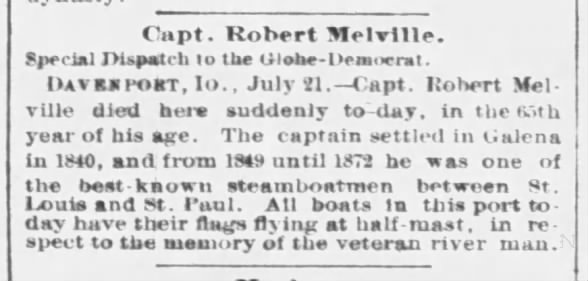
Capt. Robert Melville.

Special Dispatch to the Globe-Democrat. 
DAVENPORT, IO., July 21. --Capt. Robert Melville died here suddenly today, in the 65th year of his age. The captain settled in Galena in 1840, and from 1849 until 1872 he was one of the best-known steamboatmen between St. Louis and St. Paul. All boats in this port today have their flags flying at half-mast, in respect to the memory of the veteran river man.
Thu, Jul 21, 1881 – 1 · Quad-City Times (Davenport, Iowa) · Newspapers.com

THE HARBOR OF REST.

Death of Captain Robert Melville--His Brief Illness--His Long Career on the River--His Position as a Citizen and Business Man

The business community was surprised and shocked this morning to learn of the death of the veteran steamboat man and agent, Captain Robert Melville, which occurred at half past four o'clock. On Saturday last Capt. Melville was overcome with the heat while at work in his warehouse, and was taken home. There inflammation of the brain, which had a marked tendency to paralysis of that organ, set in, and he continued to sink until paralysis of the heart brought death to his relief. The deceased has been so long identified with the commerce of the upper Mississippi, and was so well known in one capacity and another as steamboatman, that his departure from the busy scenes of life deserves more than formal notice.
Robert Melville was born in Pittsfield, Mass., in June, 1817, and so he had but just entered his 65th year when he died. His parents came to Galena, Ill., early in the 30's--they had been there several years in 1839, when acquaintances now residing in Davenport met them there. The captain, the eldest of several brothers, remained in New England to finish his education, and so he did not come to Galena until in the early 40's   -- and then with the faithful wife who survives him. He entered upon a mercantile career soon after arriving at Galena, and became interested in steamboat traffic. Galena was then the largest business point in the northwest, with one exception possibly, on account of its lead mines and the commercial facilities afforded it by the Mississippi river--and before many years Mr. Melville became engaged in steamboating himself. He was book-keeper for a packet company at Galena, became first clerk of one of the steamers engaged in the Galena and St. Paul trade--and then for many years he spent the seasons of navigation on the Mississippi. He was clerk of the steamer New Boston, which plied in the Davenport and Fort Madison trade for a number of years, and then Captain of that steamer. During all this period his home was in Davenport. When that line hauled off he was appointed agent of the Northern Line at Dubuque, and then of the Galena, Dubuque & Minnesota packet company, remaining there several years. When Mr. Robert Prettyman died in 1873, Mr. Melville became his successor in the old steamboat agency here remaining such until the Northern and Northwestern Union lines were consolidated under the Davidson interest. After the latter event, Captain Melville became a produce and commission merchant, prosecuting the business until the day he was seized with the fatal disease. He engaged in the buying and shipment of potatoes and onions very extensively every fall season. Last spring he was appointed agent of the St. Louis and Dubuque line, in whose prosperity he took a deep interest. 
Besides his wife, his two sons, Robert, who is a resident of Davenport, but is away from home as a commercial traveler, and Julien, who is in California, are left. His mother and two brothers are also living, one of whom, George, is a wealthy resident of Galena, but in the East at present.

Capt. Mellville bore a high character as a man, and in business life. He was gentlemanly in demeanor and very kind hearted, while he was prompt and upright in business affairs. All who knew him respected him. His home was at 111 West Thirteenth street.

The arrangements for the funeral have not been completed, nor will they be until the elder son and the brother George are heard from. It is probable that the remains will be taken to Galena for interment. --Davenport, Iowa Quad City Times, July 21, 1881
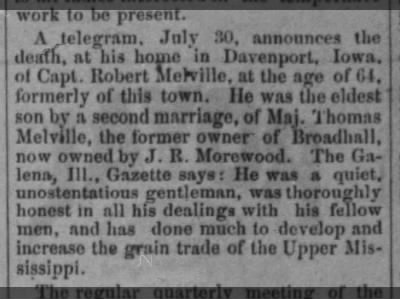
Thu, Aug 4, 1881 – 2 · The Berkshire County Eagle (Pittsfield, Massachusetts) · Newspapers.com
A telegram, July 30, announces the death, at his home in Davenport, Iowa, of Capt. Robert Melville, at the age of 64, formerly of this town. He was the eldest son by a second marriage, of Maj. Thomas Melville, the former owner of Broadhall, now owned by J. R. Morewood. The Galena, Ill., Gazette says: He was a quiet, unostentatious gentleman, was thoroughly honest in all his dealings with his fellow men, and has done much to develop and increase the grain trade of the Upper Mississippi. --Berkshire County Eagle, August 4, 1881.
Another obit in the Davenport, Iowa Gazette (July 22, 1881), incompletely accessible on Find-A-Grave, reports that Robert Melville's first occupation in Galena was "newspaper work."
Related posts:
Rock Island, IL Evening Argus - June 14, 1871

Tuesday, April 14, 2020

Pittsfield's Bildad

Robert Melvill aka Robert Melville was Herman Melville's first cousin. Herman's father Allan Melvill was the older brother of Robert's father Thomas Melvill, Jr. While Herman was living at Arrowhead in Pittsfield, Massachusetts and still working on Moby-Dick, his cousin Robert got appointed administrator for the estate of deceased Pittsfield resident Bildad Williams (1784-1851). Robert Melvill was a Pittsfield farmer. With his wife Susan, Robert ran the old Melvill mansion as a boarding house, until the property was sold to John Rowland Morewood. Later in 1851, some time after the Morewoods returned to Pittsfield from England, Robert moved to Galena, Illinois. Later he settled in Davenport, Iowa. I don't know how or why Herman's cousin Robert Melvill would have been involved in the settlement of Bildad's estate.

Bildad in the Bible is one of Job's three friends. In Moby-Dick, one of the Quaker owners of the whaleship Pequod is named Bildad. As Ishmael describes him in chapter 16 of Moby-Dick, the fictional Bildad is characteristically pious and parsimonious. At sea, Captain Bildad had been a notoriously demanding employer or "task-master":
Now Bildad, I am sorry to say, had the reputation of being an incorrigible old hunks, and in his sea-going days, a bitter, hard task-master. They told me in Nantucket, though it certainly seems a curious story, that when he sailed the old Categut whaleman, his crew, upon arriving home, were mostly all carried ashore to the hospital, sore exhausted and worn out. For a pious man, especially for a Quaker, he was certainly rather hard-hearted, to say the least. He never used to swear, though, at his men, they said; but somehow he got an inordinate quantity of cruel, unmitigated hard work out of them. When Bildad was a chief-mate, to have his drab-colored eye intently looking at you, made you feel completely nervous, till you could clutch something—a hammer or a marling-spike, and go to work like mad, at something or other, never mind what. Indolence and idleness perished from before him. His own person was the exact embodiment of his utilitarian character. On his long, gaunt body, he carried no spare flesh, no superfluous beard, his chin having a soft, economical nap to it, like the worn nap of his broad-brimmed hat. 
--Moby-Dick Chapter 16: The Ship 
Pittsfield's real Bildad also might have been hard to work for. Or maybe he was just unlucky in his reliance on rascally "boys," like Pitch in The Confidence-Man ("all boys are rascals"). No telling why, exactly, but in October 1838, a young apprentice named Henry ran away from Bildad Williams.
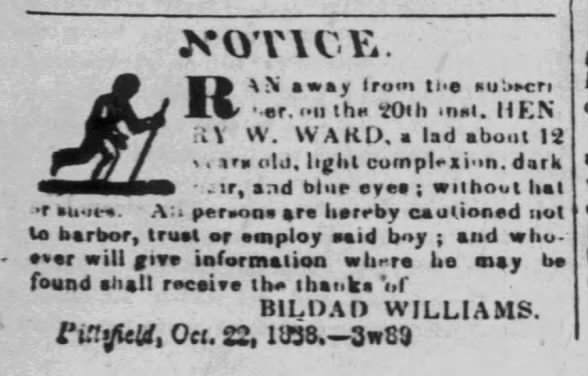
Thu, Nov 15, 1838 – 1 · The Pittsfield Sun (Pittsfield, Massachusetts) · Newspapers.com

NOTICE.

RAN away from the subscriber, on the 20th inst, HENRY W. WARD, a lad about 12 years old, light complexion, dark hair, and blue eyes; without hat or shoes. All persons are hereby cautioned not to harbor, trust or employ said boy; and whosoever will give information where he may be found shall receive the thanks of
BILDAD WILLIAMS.
Pittsfield, Oct. 22, 1838. 
Henry W. Ward must have been returned to Bildad, for he ran away again two years later:

Pittsfield Sun - February 4, 1841 via GenealogyBank

NOTICE.

RUN away from me on the 27th ult. a Boy by the name of HENRY W. WARD, 14 years old, stocky built, gray eyes, dark hair, and walks stooping. He wore away a light mixed roundabout, black vest with a red back, and moleskin pantaloons--all considerably worn. He also wore away a good hair seal cap, and a pair of good boots, and took some other articles of clothing. All persons are forbid harboring, trusting or employing said runaway; and whoever will give information where he may be found will confer a favor on
BILDAD WILLIAMS.
Pittsfield, Feb. 2, 1841.
The summer before Henry's second departure, in July 1840, a warrant had been issued against the estate of Bildad Williams, evidently in connection with bankruptcy proceedings.

After Bildad's death from "Disease of the kidneys" on April 27, 1851, Herman's cousin Robert Melvill was named Administrator of the estate.

Pittsfield, MA Sun - May 8, 1851
via GenealogyBank

Bildad Williams' Estate.

NOTICE is hereby given, that the subscriber has been duly appointed Administrator on the estate of BILDAD WILLIAMS, late of Pittsfield, in the County of Berkshire, deceased, and has taken upon himself that trust, by giving bond as the law directs. All persons having demands upon the estate of the said deceased, are requested to exhibit the same; and all persons indebted to said estate, are called upon to make payment to
ROBERT MELVILL, Adm'r.
May 6, 1851.
In Robert's ad for the subsequent estate sale, remaining possessions of the deceased included "a large assortment of Household Furniture" along with "Comb Makers Tools and other articles."
Pittsfield, MA Culturist and Gazette - May 14, 1851
via GenealogyBank


Notice.

THE Subscriber will expose for sale at Public Auction on Saturday, the seventeenth day of May inst., at the residence of the late Bildad Williams, a large assortment of Household Furniture. Comb Makers Tools and other articles.

ROB'T. MELVILLE, Administrator.
Pittsfield, May 13, 1851. 
The official register of deaths in Pittsfield gives the occupation of Bildad Williams as "Comb Maker." So then, young Henry Ward the 1838 and 1841 runaway possibly had been employed by Bildad in the manufacture of combs. However, according to the United States Federal Census for 1850, Bildad Williams at that time worked as a "Grocer."

Bildad's given age of 66 in the October 1850 census and April 1851 death register puts his birth year around 1784. In the category of "Sex and Condition" the death register indicates "Widower-Colored." According to the 1850 Census Bildad Williams lived alone, and owned Real Estate valued at $800.

Bildad's wife Juliana Williams died on June 28, 1846, age 65.

Pittsfield Bildad was born in Connecticut, according to census and death records accessible on Ancestry.com. At seventeen, a Bildad Williams ran away from Cato Williams (his uncle? or father?) in Mansfield, Connecticut.
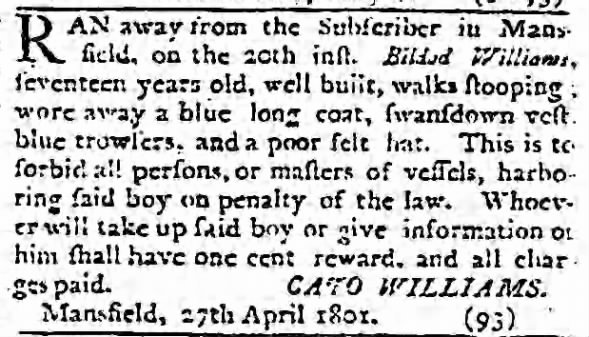
Cato Williams, Bildad Williams ran away, MansfieldCato Williams, Bildad Williams ran away, Mansfield Mon, May 11, 1801 – Page 4 · Hartford Courant (Hartford, Connecticut) · Newspapers.com
"RAN away from the Subscriber in Mansfield, on the 20th inst. Bildad Williams, seventeen years old, well built, walks stooping; wore away a blue long coat, swansdown vest, blue trowsers, and a poor felt hat. This is to forbid all persons, or masters of vessels, harboring said boy on penalty of the law. Whoever will take up said boy or give information of him shall have one cent reward, and all charges paid. CATO WILLIAMS. Mansfield, 27th April 1801." 
Robert Underhill, current President of the Historical Society of Clarendon Vermont, has identified Mansfield's Bildad Williams as the son of Cato Williams with his wife Lydia Williams. As reported by Underhill and others, this Cato Williams died in Westfield, MA in 1828. A Cato Williams is listed as the head of household in the 1820 U. S. Federal Census for Lenox in Berkshire County, Massachusetts. The Williams household of five was then comprised of four "Free Colored Persons" and one "Free White Person." Another researcher on Ancestry.com gives the father of Bildad Williams as Elisha Williams (1717-1784), who owned property in Mansfield, CT next to land sold for $215 in 1809 by Jesse Spafford to Lydia, Isham, and Bildad Williams. In 1817, Bildad sold his remaining share of the Mansfield property to Simeon Allen.

Originally in Windham County Connecticut. Mansfield was annexed to Tolland County in 1827. Tolland County, CT happens to be the stated birthplace of Melville's fictional cabin boy, Pip. In Moby-Dick, Melville's narrator Ishmael refers to Pip's "native Tolland county in Connecticut" (Chapter 93); and Pip relates a story about his father in "old Tolland county" (Chapter 99). The Black cabin boy Pip may be partly based on John Backus, Melville's shipmate on the whaler Acushnet. But the birthplace of Backus has not been established, leading some readers of Moby-Dick to wonder with the editors of the 1988 Northwestern-Newberry Edition, page 853, "what made him bring in Tolland County at all?"

This Mansfield, Connecticut Bildad was reportedly 17 in 1801, which would make his birth year 1784--identical with that of the "colored" widower Bildad Williams who died in Pittsfield at the age of 66 on April 27, 1851. The same Bildad whose estate, after his death, was sold at auction by Herman Melville's cousin Robert.

In spite of the published warning to "masters of vessels" by Cato Williams in May 1801, Mansfield's Bildad Williams actually did receive New England Seamen's Protection Certificate number 2209 in New London on September 19, 1801. Age 18;  height 5' 8"; complexion "Mulatto."

So Bildad Williams from Mansfield, Connecticut went to sea. Where he sailed is unknown--the earliest New London Crew Lists on the website of Mystic Seaport Museum, are from 1803. From New London, Bildad in 1801 would not have gone a-whaling. The first commercial whaling voyage from New London was by the Dauphin in 1805, according to Alexander Starbuck's History of the American Whale Fishery.

Moby-Dick fans may be interested in the relative scarcity of sailors named Bildad. Of Melville's two retired Quaker captains, Peleg bore the commoner name. The 30,988 total records in the Registers of Seamen's Protection Certificates contain more than thirty Pelegs, but just one Bildad.

Related post:

Thursday, April 2, 2020

George Doolittle and Doolittle's Express

For the record, in 1850 there was a man named Doolittle in Berkshire County, Massachusetts who operated an express service from Lee to Pittsfield via Lenox. In the postscript for The Melville Log, Jay Leyda mentions an elusive "cousin Doolittle, the Lenox expressman":
"And some relatives have been left total mysteries--for example, cousin Doolittle, the Lenox expressman."  --Jay Leyda, "The Endless Study." Postscript to The Melville Log (New York: Harcourt, Brace and Company, 1951) Volume 2, page 859.
Leyda seems to mean the "Mr. Doolittle" that Herman Melville called "my cousin" and implicated in the sad accident that injured one of Sarah Morewood's horses. Where Leyda got the phrase "Lenox expressman" is not clear to me, but the tag would certainly apply to George Doolittle, resident of Lee in Berkshire County, Massachusetts and owner-operator in 1850 of "Doolittle's Express."

Pittsfield Culturist and Gazette - June 12, 1850
via GenealogyBank

Doolittle's Express.

LEE via. Lenox to Pittsfield: every day Sundays excepted, in season for the trains of cars and Express Lines. All orders and errands entrusted to my care will receive prompt attention, with moderate charges.
GEORGE DOOLITTLE.
Lee, Feb. 1850. 
The reference to "cousin" Doolittle occurs in Melville's chatty letter of December 13, 1850 to Evert Duyckinck. The Melville Log partly transcribes this letter in Volume 1 on page 401 but omits the relevant passage about Doolittle and Mrs. Morewood's horses. As Melville relates, this "Mr. Doolittle" was on the railroad track in his sleigh and just missed colliding with an oncoming train. The train hit three horses belonging to Melville's then absent neighbor, Sarah Morewood. One of the three eventually died after suffering a broken leg in the accident. Melville's letter is reprinted on pages 172-175 in the 1993 Northwestern-Newberry Edition of Melville's Correspondence, edited by Lynn Horth. The same 1850 letter is accessible online via the Internet Archive in The Letters of Herman Melville, edited by Merrell R. Davis and William H. Gilman (Yale University Press, 1960) pages 115-118. Here is an image from the original document, now accessible courtesy of the New York Public Library Digital Collections:

Manuscripts and Archives Division, The New York Public Library. "1850-1851"
The New York Public Library Digital Collections 1850-1851.
http://digitalcollections.nypl.org/items/ae98a990-1793-0133-e826-58d385a7bbd0
... one of my neighbors has really met with a bad accident in the loss of a fine young colt. That neighbor is our friend Mrs Morewood. Mr Doolittle — my cousin — was crossing the R.R. track yesterday (where it runs thro the wooded part of the farm.) in his slay — sleigh I mean — and was followed by all three of Mrs Morewood’s horses (they running at large for the sake of the air & exercise). Well: just as Doolittle got on the track with his vehicle, along comes the Locomotive — whereupon Doolittle whips up like mad & steers clear; but the frightened horses following him, they scamper off full before the engine, which hitting them right & left, tumbles one into a ditch, pitches another into a snow-bank, & chases the luckless third so hard as to come into direct contact with him, & break his leg clean into two peices. — With his leg “in splints” that is done up by the surgeon, the poor colt now lies in his straw, & the prayers of all good Christians are earnestly solicited in his behalf. Certainly, considering the bounding spirit and full- blooded life in that colt— how it might for many a summer have sported in pastures of red clover & gone cantering merrily along the "Gulf Road” with a sprightly Mrs Morewood on his back, patting his neck & lovingly talking to him — considering all this, I say, I really think that a broken leg for him is not one jot less bad than it would be for me — tho’ I grant you, even as it is with him, he has one more leg than I have now. 
Davis and Gilman were unable to identify Doolittle beyond the surname:
In what way Mr. Doolittle of the following story was Melville's cousin remains a mystery, upon which neither genealogies, local histories, nor family reminiscences have yet thrown any light. 
<https://archive.org/details/in.ernet.dli.2015.84865/page/n155/mode/2up>
The Northwestern-Newberry Edition of Melville's Correspondence credits Hershel Parker with the identification of "Doolittle" as Robert Melvill. This explanation of "Doolittle" as a joking code-name for Herman's "hapless cousin" Robert previously appeared in Parker's article,"Moby-Dick and Domesticity," in Critical Essays on Herman Melville's Moby-Dick, ed. Brian Higgins and Hershel Parker (New York: G.K. Hall and Co., 1992) pages 545-562 at page 552. So identified in both volumes of Herman Melville: A Biography Volume 1, 1819-1851 page 798; and Volume 2, 1851-1891 page 626.

<https://books.google.com/books?id=OrTOQR4QyKIC&pg=PA798&lpg#v=onepage&q&f=false>

It would be good to learn the exact source of Jay Leyda's information about a "Lenox expressman" linked to "cousin Doolittle." Was it one of the 1850 ads in the Pittsfield Culturist and Gazette, shown and transcribed above?

No information has turned up yet about this George Doolittle's parents. Census and other records on Ancestry.com indicate that George Doolittle (1808-1894) lived most of his life in Berkshire County, Massachusetts. He was born in 1808 in Hancock; and died in Lee at the age of 86.

Pittsfield Sun - October 13, 1831
This George Doolittle married Electra Miller Doolittle (1805-1873), aka Electa or Eleeta, on October 6, 1831, as announced in the Pittsfield Sun on October 13, 1831. Their son James Henry Doolittle (1836-1881) was born in Dalton, Massachusetts.

George but not Electra Doolittle lived to enjoy the birth of Rolfe, their second grandson, on June 2, 1876. The next day, G. P. Putnam's Sons published Herman Melville's epic religious poem, Clarel: A Poem and Pilgrimage in the Holy Land. In Clarel, coincidentally, the most Melville-like pilgrim of all was named Rolfe.

Like his grandfather George, Rolfe Doolittle (1876-1940) found employment in Lee as an Expressman.

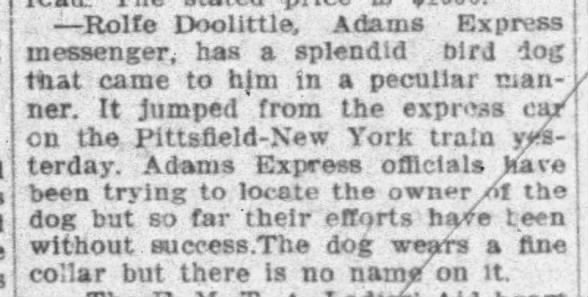
Thu, Feb 11, 1909 – 11 · The Berkshire Eagle (Pittsfield, Massachusetts) · Newspapers.com
— Rolfe Doolittle, Adams Express messenger, has a splendid bird dog that came to him in a peculiar manner. It jumped from the express car on the Pittsfield-New York train yesterday. Adams Express officials have been trying to locate the owner of the dog but so far their efforts have been without success. The dog wears a fine collar but there is no name on it.  --The Berkshire Eagle, February 11, 1909. 

Related posts

Thursday, September 8, 2016

More on the 1846 Middlesex source for Robert Melvill's 1850 farm report; with more parallels in Melville than Jay Leyda knew

Found on Newspapers.com

According to Jay Leyda and scholarly consensus up to now, Herman Melville probably ghostwrote the 1850 farm report of the Berkshire Agricultural Society that was signed by his cousin Robert as Chairman of the Committee on Agriculture and published October 9 and 10 in Pittsfield newspapers. The full 1850 report "On Agricultural Products" was also published in Transactions of the Agricultural Societies of Massachusetts over the signature of "ROBERT MELVILLE, Chairman." As shown in our last, however, Robert Melvill's 1850 report is adapted (that is, plagiarized) from the 1846 report "On Farms, &c." to the Society of Middlesex Husbandmen and Manufacturers, submitted after their annual Exhibition and Cattle Show at Concord.

Leyda in "White Elephant vs. White Whale" (Town and Country v.101 [August, 1947]: 68-9; 114-118) gave impressive parallels between the 1850 text and Melville's writings without knowing about the 1846 Middlesex source. Did Herman Melville write the 1846 farm report, too?

The longer, earlier composition features more verbal parallels to Melville's writings than Jay Leyda knew, or could have known about. Not that verbal parallels alone will ever finally establish authorship. Usually they don't, not without corroborative historical and biographical evidence. Leyda's 1947 attribution was admittedly conjectural, even backed by tangible evidence of Herman Melville's participation with his cousin Robert in July 1850 on a tour of Berkshire farms. (Melville's Marginalia Online has the volume of Field's History of Berkshire County with Herman's notes in the front about the trip with cousin Robert.) Still, Melville scholars have regarded Leyda's case as a pretty good one, strong enough to warrant inclusion of the 1850 "Report" among "Attributed Pieces" in the Northwestern-Newberry edition of Melville's Piazza Tales and Other Prose Pieces. To aid further study of authorship and other questions, I want to provide some more verbal parallels to Melville's known writings in deleted portions of Robert Melvill's main source, the 1846 farm report of the Middlesex Agricultural Society.

Robert Melvill's 1850 version omits most of the political language in the original 1846 report, in particular the language of class conflict, and metaphors that describe agricultural improvements as the result of radical democracy. One whole paragraph on the "levelling principle" was deleted in revision. This bit, for example, appears only in the 1846 version:
"the Committee must frankly pronounce their approbation of the prevalent democratic propensity, to produce a horizontal surface, by removing sandhills to elevate the adjoining bogs and marshes."
The "levelling" theme recurs in Melville. In White-Jacket Chapter 40 Melville similarly equated social levelling with natural levelling:
"how raise the valleys, without filling them up with the superfluous tops of hills?" 
Likewise Melville's Pierre juxtaposes democratic principles with natural ones. In America "the democratic element operates as a subtle acid," corrosively, and yet democratic institutions "seem to possess the divine virtue of a natural law" (Pierre; Or, The Ambiguities). And Pierre himself embodies the division between aristocratic and democratic politics:
"And if this seem but too fond and foolish in Pierre; and if you tell me that this sort of thing in him showed him no sterling Democrat, and that a truly noble man should never brag of any arm but his own; then I beg you to consider again that this Pierre was but a youngster as yet. And believe me you will pronounce Pierre a thoroughgoing Democrat in time; perhaps a little too Radical altogether to your fancy."  --Pierre; Or, The Ambiguities
In a humorous vein the Middlesex Society affirms "vested rights" as a principle of essential political liberty, using the term that Melville would employ in Mardi to describe a sailor's free will--which in a calm turns out to be only theoretical:
Even his undoubted vested rights, comprised in his glorious liberty of volition, become as naught.  --Mardi: And a Voyage Thither
For the Middlesex Society, the ideal of "vested rights" similarly gets overturned by practical considerations. Embracing the policy of removing invasive plants, the writer puns on our understanding of the word radical to mean getting at the root of something:
they witnessed, with unmingled delight, certain demonstrations of radicalism, in the uprooting of thorns and brambles, and an apparent determination to eradicate the dogwood and ivy, and all their relations.
Here are a dozen more verbal parallels to known writings by Herman Melville in the 1846 report of the Middlesex Agricultural Society, signed by Chairman (and Boston Courier editor) Joseph Tinker Buckingham. Half of them occur in Typee or Omoo.
1. SPACIOUS
1846: neat and spacious dwellings
1850: new and commodious dwellings

--Omoo Chapter 8: "spacious houses"
--Omoo, Chapter 81: "an edifice, by far the most spacious"

2. THRIFTY
1846: plantations of thrifty trees, luxuriantly laden with fruit
1850: plantations of thriving trees

--Omoo Chapter 52: "a thrifty growth of the sugar-cane, just ripening"; Typee Chapter 13 has "all manner of luxuriant fruits"

3. UNDISPUTED POSSESSION
1846: for aught we know to the contrary, had held undisputed possession thereof
1850: for ought that we know to the contrary, had a life estate thereof
"Such were our accommodations aboard of the Julia; but bad as they were, we had not the undisputed possession of them. Myriads of cockroaches, and regiments of rats disputed the place with us."  --Omoo, Chapter 10 - A Sea-Parlor Described, With Some of its Tenants:
4. INTERVAL OF SILENCE
"An interval of silence was at last broken by Babbalanja." --Mardi: and a Voyage Thither
"It was noon, when an interval of silence falls upon the docks." --Redburn Chapter 37

 5. WERE WONT TO
"they were wont to present themselves before the heir to the isle"  --Mardi: And a Voyage Thither
"those old astronomers were wont to mount to the apex"  --Moby Dick, The Mast-Head

6. RATHER INCLINE TO THE BELIEF
 "rather incline to the opinion" --Moby-Dick, The Cabin Table

7. UNSPEAKABLE DELIGHT
"to my unspeakable delight I perceived that some difference of opinion had arisen between them...." --Typee Chapter 33 - The Escape

8. FASTIDIOUSNESS
 "a degree of fastidiousness that seemed to me ill-timed"
--Typee Chapter 7

  9. BOREAS
"Cease, rude Boreas, blustering railer!"  --White-Jacket, Chapter 3 alluding to the famous song  "The Storm" by George Alexander Stevens.

10. AY
One piece of wall, thirty or forty rods in length, presents an upper surface of flat stones, on which the committee walked with as much ease and rapidity as they could on the surface of the ground,—ay, and with much greater facility than one can travel across some of the fields in our county, which the owners appear to think easy of cultivation. It afforded really a pleasant promenade.
"These islanders were heathens! savages! ay, cannibals!"  --Typee - The social Condition and general Character of the Typees

"fine dwelling-houses, several hotels, and barber-shops, ay, even billiard-rooms;"  --Omoo Chapter 49
11. THESE DEGENERATE DAYS
"but we are loth to believe that, in these degenerate days, any grievous malediction would follow the practice of eating abundantly of the fruit of our vineyards, gardens and orchards." --1846 report of the Middlesex Agricultural Society

"And as the great wrought nails, binding the clapboards, are unknown in these degenerate days, so are the huge bricks in the chimney walls."  --I and My Chimney
 12. PROMENADE
As garrulous guide to the party, Braid-Beard soon brought us nigh the great Morai of Maramma, the burial-place of the Pontifis, and a rural promenade, for certain idols there inhabiting.  --Mardi: And a Voyage Thither
For the context of walls, a better example of "promenade" occurs in Melville's 1849 Journal, where Melville describes his tour of Canterbury in the entry dated November 6th 1849:
"The old wall forms a fine promenade."  --Journals - Herman Melville, ed. Howard C. Horsford with Lynn Horth (Northwestern University Press, 1989) page 13.
Seven years later, Nathaniel Hawthorne recorded the same observation of Chester's city walls:
 "as interesting a promenade as can be found in England." --Hawthorne, quoted in the Northwestern-Newberry edition of Melville's Journals
Coincidentally, he wrote that after walking "round the wall" with his friend Herman Melville.
One more will make it a baker's dozen...
13. HASTY PUDDING (the dish and the poem by Joel Barlow)
One of our New-England poets has said, that "all his bones were made of Indian corn;" and we cannot doubt that it enters largely into the composition of our Yankee blood and muscle, and that its invigorating energies give strength and health to the sons, and beauty and loveliness to the wives and daughters of New England husbandmen. We compassionate the depravity of taste that cannot relish a jonny-cake, and despise the fastidiousness of appetite that cannot make a supper on hasty-pudding.
The staple food of the Irish emigrants was oatmeal and water, boiled into what is sometimes called mush; by the Dutch is known as supaan; by sailors burgoo; by the New Englanders hasty-pudding; in which hasty-pudding, by the way, the poet Barlow found the materials for a sort of epic. --Redburn Chapter 52, The Emigrants' Kitchen
Let's see. Where was Melville around that time? What was he doing in early October 1846?  The BIG news in Herman Melville's life was his engagement to Lizzie Shaw in Lansingburgh on the last day of August, 1846. After which, Lizzie evidently stayed in Lansingburgh for two months, until Sam Savage came from Boston at the end of October to get her. Then it was back to work, finishing up Omoo in New York City and looking for a job in the Custom House. Read all about it in the first volume of Herman Melville: A Biography. I don't suppose our lovebirds flew away to Concord, Massachusetts for the annual Cattle Show? Did they? Did Herman Melville around this time (in between Typee and Omoo) ever socialize with Boston Courier editor Joseph Tinker Buckingham? Let's keep a lookout, just in case...

Related posts:
  • Sketches of Middlesex Husbandry--Boston Courier printing of 1846 farm report
    https://melvilliana.blogspot.com/2020/07/sketches-of-middlesex-husbandry-in.html
As mentioned at the start, the 1850 report "On Agricultural Products" was also published in Transactions of the Agricultural Societies of Massachusetts over the signature of "ROBERT MELVILLE, Chairman." In case you missed it in the mess that followed, here's a link to that volume at Google Books:

Tuesday, September 6, 2016

Robert Melvill's 1850 "Report of the Committee on Agriculture," plagiarized from the Middlesex County Agricultural Society Report for 1846

Signed by Herman Melville's cousin Robert Melvill, the 1850 "Report of the Committee on Agriculture" appears with other "Attributed Pieces" in the Northwestern-Newberry edition of Meville's Piazza Tales and Other Prose Pieces, 1839-1860 (pages 449-451). The N-N copy text is the printing in the Pittsfield Culturist and Gazette (October 9, 1850). Below is the version printed in the Pittsfield Sun on Thursday, October 10, 1850; found in the online Newspaper Archives at Genealogy Bank.


Jay Leyda attributed the 1850 "Report" to Herman Melville in "White Elephant vs. White Whale," published in Town and Country Vol. 101 (August 1947): 8-9, 114-118. Herman Melville really did make an agricultural tour of Berkshire in 1850, as we know from surviving notations in his copy of David Dudley Field's History of the County of Berkshire. Amazing but true: you can read Melville's penciled notes in the Field volume at Melville's Marginalia Online.

The tone of Robert Melvill's 1850 "Report" sounds something like Herman Melville in a satirical vein. So does the borderline-irreverent biblical language, and so do the biblical allusions to Adam and Eve and to Noah and the Ark. Thus, Leyda makes a good case on circumstantial and internal evidence for Melville's help with the composition of Robert Melvill's agricultural report.
"Herman could not resist the opportunity to write an agricultural report to end all agricultural reports."  --Jay Leyda
Problem is, most of Robert Melvill's 1850 "Report" on crops in Berkshire is borrowed or adapted from the agricultural report of another Massachusetts county in another year: Middlesex County, 1846. Plagiarized, to be honest.

On October 7, 1846, a Wednesday, the Society of Middlesex Husbandmen and Manufacturers held their annual Exhibition and Cattle Show at Concord, Massachusetts. The day was very fine according to newspaper reports, unlike the drenching rain on Exhibition and Cattle Show day the year before ( October 1, 1845). The published farm report for 1846, signed by then Chairman Joseph T. Buckingham (founder and editor of the Boston Courier), looks back to and in some measure burlesques the relatively straightforward report of 1845, credited to Secretary Moses Prichard.

Robert Melvill's entire 1850 Berkshire "Report" closely follows (word-for-word in many places) the similarly formatted account of the 1846 Annual Exhibition and Cattle Show at Concord, as reported to the Society of Middlesex Husbandmen and Manufacturers and accessible online via Google Books in Transactions of the Agricultural Societies of Massachusetts (Boston, 1846).


Without question, the 1850 writer or writers plagiarized heavily from the 1846 committee report "On Farms, &c." to the Society of Middlesex Husbandmen and Manufacturers. Again, the annual Fair, Exhibition, Ploughing Match, and Cattle Show took place at Concord on October 7, 1846. As printed in the 1846 Transactions volume, the formal Middlesex account is signed by Joseph T. Buckingham as Chairman of the Middlesex Society. Presumably then, Buckingham or Abiel Heywood (then Secretary of the Society) or some other member of the Middlesex Society wrote the 1846 farm report. A correspondent ("R.") of the Lowell Courier wrote that "The farm report, by Mr. Buckingham, is quite long, and of course good. I did not happen to hear it" (Boston Daily Atlas, October 12, 1846; also reprinted in the Cambridge Chronicle, October 15, 1846).

On the other hand... In light of Herman's summer expedition with Robert Melvill in 1850, and the related marginalia in Herman's copy of Field's History of Berkshire, Melville scholars will want to examine the 1846 source. More work should be done I think to see if authorship of Robert Melvill's 1846 source can be established definitely. At several points the Middlesex Report "On Farms, &c." signed by Joseph T. Buckingham can be shown to satirize another published report credited to Moses Prichard. The comparatively serious and sober 1845 report on the Middlesex Cattle Show by Moses Prichard appears in the 1846 Abstract from the Returns of Agricultural Societies in Massachusetts on pages 37-45.

What would Jay Leyda say? Some of the 1846 bits that Robert Melvill and Co. left out of their 1850 "Report" sound even more like Herman Melville than parts that Leyda identified as elements of Herman's "satirical triumph." Goths and Vandals; "degenerate days"; Joel Barlow and Hasty Pudding. Even Indians!

In revision, Melvill or his collaborator removed the original figure of Indians as troublesome native creatures ("aboriginal tribes reptiles and insects"), deleting the words aboriginal and extirpate (a form of which Melville had used in Typee).

1846: 
they flatter themselves that they have as natural an aversion to war as the most enthusiastic members of the Peace Society, yet they cannot refrain from expressing their approbation of the industry and skill which had enabled the proprietors of these swamps to extirpate the aboriginal tribes of reptiles and insects, which, for aught we know to the contrary, had held undisputed possession thereof, from the day when Noah, with his family of creeping and flying things, emerged from the Ark.
1850:
and they profess to have as great an aversion to strife as the most enthusiastic members of the Peace Society; yet they cannot withhold their approbation of the determination manifested by the proprietors of these swamps, to exterminate the tribes of insects and reptiles, which, for ought that we know to the contrary, had a life estate thereof from generation to generation, since the day when Noah, with his numerous family, emerged from the Ark.
Also deleted in revision: the phrase "undisputed possession" which Melville had used in Omoo, Chapter 10 - A Sea-Parlor Described, With Some of its Tenants:
"Such were our accommodations aboard of the Julia; but bad as they were, we had not the undisputed possession of them. Myriads of cockroaches, and regiments of rats disputed the place with us." 
Transcribed below from the 1846 volume Abstract from the Returns of Agricultural Societies in Massachusetts - pages 45-51:

MIDDLESEX AGRICULTURAL SOCIETY.

In the return of the doings of the Society of Middlesex Husbandmen and Manufacturers, its Secretary, Abiel Heywood, of Concord, states, "That the Society on the 7th of October last, held its Annual Exhibition and Cattle Show at Concord. The large crowd of farmers present from all parts of the county, and the number, variety and beauty of the articles and products brought for exhibition and premium, showed the deep interest felt in the Society and its objects. There were more than twenty entries for the ploughing match, and it was well contested, though the previous drought had baked the earth so hard that the furrows were turned with great difficulty. The other departments of the exhibition were unusually full, and evidenced a high state of skill, industry and productiveness in the county, especially in that of fruits.

One of the most interesting features of the exhibition, was that of the stock imported by the Massachusetts Society for Promoting Agriculture. They attracted much attention, and showed the wisdom of that Society in their purchase, as, from the interest manifested in them, there can be no doubt of their being employed, to a large extent, in improving the breed of cattle throughout the county.

The Address was delivered by the Hon. John G. Palfrey.

On Farms, &c.

In prosecuting their examination of Farms, the Committee observed, with high satisfaction, the manifestations of the spirit of improvement, in every town to which they were called. Their attention was frequently attracted, as they passed from place to place, by many neat and spacious dwellings,—by new and well-filled barns,—by plantations of thrifty trees, luxuriantly laden with fruit,—by extensive fields of corn,—and by numerous reclaimed meadows. The contrast between the present appearance of these meadows and that which they exhibited a few years ago, must strike with admiration every beholder who has an eye susceptible of the attractions of beauty, and a mind capable of estimating the worth of useful improvement. 
Some of the meadows which were entered for a premium have been, within the knowledge of some of the members of the committee, mere swamps and quagmires, in which frogs, serpents, and turtles, had held a life estate from generation to generation. The only vegetable productions were alders and ferns, interspersed with bogs, and decorated here and there with a few cat-tails, on which a bob-o-link might be tempted to alight to enjoy a moment's interval of silence. From these same swamps, also, were wont to issue hordes of gnats and mosquitoes, like the Goths and Vandals of a former age, to war upon civilized humanity. Those once unsightly swamps are now covered with grass, and afford exuberant crops of hay, for the support of domestic animals. Although the Committee would be sorry to give occasion for a suspicion that they are deficient in the milk of human kindness, and they flatter themselves that they have as natural an aversion to war as the most enthusiastic members of the Peace Society, yet they cannot refrain from expressing their approbation of the industry and skill which had enabled the proprietors of these swamps to extirpate the aboriginal tribes of reptiles and insects, which, for aught we know to the contrary, had held undisputed possession thereof, from the day when Noah, with his family of creeping and flying things, emerged from the Ark. The Committee profess to be strict conservatives in principle, and have great regard for "vested rights;" yet they witnessed, with unmingled delight, certain demonstrations of radicalism, in the uprooting of thorns and brambles, and an apparent determination to eradicate the dogwood and ivy, and all their relations.
The Committee perceived, also, that the levelling principle pervaded the whole community of husbandmen, to an extent that is quite alarming to those who think it wrong to disturb the naturally undulating scenery of barren, gravelly knolls, and ponds of stagnant water, and who like the green mantle of the standing pool better than a meadow covered with a carpet of herd's grass and clover. We are not partial to a horizontal tariff; but, however unpleasantly the declaration may strike the minds of some of our aristocratic friends, the Committee must frankly pronounce their approbation of the prevalent democratic propensity, to produce a horizontal surface, by removing sandhills to elevate the adjoining bogs and marshes. It was pleasant, moreover, to see a reclaimed meadow of fifteen acres, marked out in squares almost as numerous as those on a chequer-board, by ditches, the mud from which had been converted to manure, and, being spread on dry and barren protuberances, had transformed them to cornfields and orchards.

The Committee witnessed, with unspeakable delight, the evidences of a growing taste for the cultivation of the various kinds of fruits adapted to the soil and climate, and the success which has followed the efforts to improve the qualities, and increase the quantity, of that sort of food which nourished our great progenitors in the garden of Eden. It is said, indeed, that the eating of an apple by that virtuous pair—our chaste grandparents—in Paradise, brought upon them the awful denunciation of an offended Deity, and entailed on all their posterity the curse, to eat bread in the sweat of their brow!—but we are loth to believe that, in these degenerate days, any grievous malediction would follow the practice of eating abundantly of the fruit of our vineyards, gardens and orchards. The committee rather incline to the belief, that a more free and constant use of the fruits adapted to our soil would be conducive to health, and, as far as physical nutriment can contribute to the improvement of the intellectual powers of man, that a diet of fruits is favorable to the refinement of taste, the improvement of the mind, the progress of moral culture, and the general melioration of the human character. While the committee have seen with pleasure the increasing disposition, among their brethren of the agricultural community, to cultivate the apple, the pear, the peach, and the plum, they regret that they have seen but few and feeble attempts to embellish the roads with forest trees. A few hours at the proper season, devoted to this object, would improve the scenery adjacent to a farmer's residence. Some one has said, that every one who plants a clump of trees adds a beauty-spot to the face of Nature. We hope that our successors, at no distant day, may have the privilege of recording the names of many, who will have shown their grateful affection, by adding these embellishments to the already beautiful countenance of our common parent.

In their progress through the county, the attention of the committee was frequently attracted by noble fields of Indian corn. We know of nothing which can render a farm more worthy of the society's premium, than a plentiful crop of this valuable grain. In the husbandman's provision for himself, his family, and his cattle, it is an indispensable article. One of our New-England poets has said, that "all his bones were made of Indian corn;" and we cannot doubt that it enters largely into the composition of our Yankee blood and muscle, and that its invigorating energies give strength and health to the sons, and beauty and loveliness to the wives and daughters of New England husbandmen. We compassionate the depravity of taste that cannot relish a jonny-cake, and despise the fastidiousness of appetite that cannot make a supper on hasty-pudding.

The spirit of improvement is signally displayed in many parts of the county, in the construction of stone walls. This is a branch of industry which is worthy of high commendation. The work of building a good wall is a laborious employment, and requires something more than an ordinary degree of physical power. But it is labor well expended. A farmer who gets his premises enclosed with a substantial fence of this description may defy his neighbor's cattle, however unruly; and if his division fences are of a like construction, his own animals will learn to be content in their appropriate enclosures, or at least will prefer feeding in the pasture where he places them, to the hazard of breaking their legs by leaping into his mowing lots and cornfields. The committee would hardly be justified if they neglected to notice, particularly, the walls on the farms of Messrs. A. Carleton and E. P. Spaulding, of Chelmsford, O. C. Rogers, of Woburn, and Stephen Howe, of Marlboro'. Portions of the walls on some of these farms were five feet in height, five feet broad at the foundation, and from three to four feet at the top. The improvement already made, and still in progress by Mr. Howe, excited the Committee's admiration. It is composed, in a great measure, of large masses of rock, removed from their native beds by immense labor, and not without the aid of gunpowder. One piece of wall, thirty or forty rods in length, presents an upper surface of flat stones, on which the committee walked with as much ease and rapidity as they could on the surface of the ground,—ay, and with much greater facility than one can travel across some of the fields in our county, which the owners appear to think easy of cultivation. It afforded really a pleasant promenade. But its beauty is perhaps the quality for which it should be least admired. Its strength, usefulness and durability, are its valuable characteristics. Such a wall may laugh in the face of Old Boreas, defy the attempts of frost to heave its foundation, and stand the tolerable shaking of a New-England earthquake without tottering.
There is one other feature in the system of improvement, to which the committee refer with pleasure and approbation, viz., the construction of barns, with cellars for the making of manure. A descriptive detail of all that the committee observed during the week occupied in their examination would consume more time than they have at their disposal; but they cannot omit the opportunity now presented to impress upon the minds of all their brethren the importance of saving all the ingredients that enter into the composition of that substance which renovates exhausted soil, and restores to the earth the nutritious particles which have been extracted from it by successive crops, —enabling Nature to reinvest herself in her emerald attire, and to present to her votaries her annual tribute of ambrosial flowers and golden fruits. The philosopher and the naturalist—and the farmer should be both—may take pleasure in contemplating the benign process by which ingredients, the most offensive to the human senses, are converted into articles that gratify the most delicate taste and pamper the most luxurious appetite.

In awarding the Society's premiums, the committee have endeavored to fulfil the supposed intentions of the Society; and it gives them pleasure to add, that, in no single instance, was there any difference of opinion. There were but three applications for premiums on farms, and the committee awarded—

To Stephen Howe, of Marlborough, the Society's first premium of $25 00.

To Amos Carleton, of Chelmsford, the second premium of $20 00.

There were eight applications for the premiums offered for reclaimed Bog Meadows. And here the Committee cannot stifle an expression of deep and sincere regret that they had not eight premiums instead of three, at their disposal. All the meadows submitted to their inspection exhibited undoubted evidences of industry and skill in their respective proprietors; and, though some had been reclaimed at greater cost of time and labor than others, yet none had undergone the change from worthless and unproductive fens to rich and valuable land, susceptible of exuberant production, without the exercise of patient and intelligent industry. Where all were so deserving, it was painful to make a selection; but the directions of the Society are imperative, and the Committee have awarded—

To Caleb Wetherbee, of Marlborough, the first premium of $20 00.

To E. A. and A. Lawrence, of Pepperell, the second premium of $12 00;—and

To Stephen Morse, of Marlborough, the third premium of $8 00.

The applicants for the Society's premiums for Compost Manure were only two. The Committee cheerfully award the first premium of $10 00 to Oliver C. Rogers, of Woburn.

There were five applicants for the premiums for Apple Orchards.

To Thomas S. Tuttle, of Littleton, is awarded the first premium of $15 00.

To Jonas Viles, of Waltham, the second premium of $12 00.

To Benjamin Wheeler, of Framingham, the third premium of $8 00.

There were also five applicants for two premiums offered for Peach Orchards.

To Galen Merriam, of West Newton, the Committee awarded the first premium of $10.00;—and

To Benjamin Wheeler, of Framingham, the second premium of $5 00.

Of the two premiums offered for Pear trees, the first, of $10 00, is awarded to Galen Merriam, of West Newton; the second, of $5 00, to Eliphalet Wheeler, of Framingham.

To Simon Whitney. of Framingham, is awarded the premium of $5 00 for the best and only Plum trees to which the attention of the Committee was requested.

The Committee cannot close their Report without remarking, that very few of the statements offered by the applicants present details of practice so ample as the Society requires and has a right to expect. Some of them were too meagre to afford much assistance to the Committee. It is hoped that, hereafter, more attention will be given to this subject, and that applicants for premiums will remember, that much of their own time, as well as the time of the Committee, will be saved, if they will prepare written statements, agreeably to the printed rules of the Society, previous to the official visit of the Committee.

JOS. T. BUCKINGHAM, Chairman.
--Abstract from the Returns of Agricultural Societies in Massachusetts - pages 45-51.
Compare to the mostly matter-of-fact account of the 1845 festivities by Moses Prichard in the 1846 Abstract from the Returns of Agricultural Societies in Massachusetts, also digitized and accessible via Google Books.

Good place to go for further research:
Related posts: