Showing posts with label Fayaway. Show all posts

Wednesday, January 24, 2024

Melville's "Athenian admirer" quoted in Cincinnati


On the day of Herman Melville's lecture on "Statues in Rome" (Tuesday, February 2, 1858) the Cincinnati Daily Commercial promoted it with a column mostly devoted to effusive praise for Melville's books, including Moby-Dick, by an unidentified "Athenian admirer." By "Athenian" I take the Cincinnati editor to mean a fellow newspaper editor, journalist, or correspondent from Athens, Ohio. The article was excerpted by Jay Leyda in The Melville Log, Volume 2, leaving out some good parts about Fayaway, Omoo, and Mardi. Found on NewspaperArchive and transcribed in full below, the original event teaser as it appeared in the Cincinnati Daily Commercial on February 2, 1858: 

Cincinnati Daily Commercial
February 2, 1858

"STATUES IN ROME." -- Herman Melville, "who," said an enthusiastic Athenian admirer of his beautiful writings-- "entranced the American public by the freshness and mellow style of his South Sea adventures in the coral islanded world; who made the name of Fayaway a synonyme for native grace; who roamed and sailed and laughed with Doctor Long Ghost of Omoo memory; who drew his moonlit, mystic picture of Mardi, through which as through a mist-like atmosphere float the forms of Yillah, the shadowy maiden, Yoomy the equally shadowy poet, Babbalanja the dreaming philosopher with his flexible cloud-wreath pipe, 'and others more'--very nomines umbra--shadows of a shade; who dazed us still more with the white gleam of Moby Dick, through whose five hundred weird pages 'all thoughts, all passions, feelings and delights,' chase each other 'like shadows o'er the plain'--and in whom we have the wildest and strangest mysticism, mingled with the frankest and freshest common sense and practical knowledge of the world and its ways, and the truest, most genuine American Democratic feeling"--will appear to-night before a Cincinnati audience to discourse in the lectorium (Smith & Nixon's Hall,) of the Young Men's Mercantile Library Association upon the Statuary of Rome. Mr. Melville's lectures are said to be admirably written, but none of our exchanges discourse upon the style of his delivery. If he would avoid the objection usually urged against our lecturers, he will speak distinctly, and with animation, that all may hear. The public is extremely desirous to see and hear Mr. Melville, and anticipate a rich literary repast this evening. 

https://newspaperarchive.com/cincinnati-daily-commercial-feb-02-1858-p-2/

In commending Moby-Dick the Athenian quotes from the opening stanza of Love by Samuel Taylor Coleridge, alternatively titled Love; or, Genevieve

All thoughts, all passions, all delights,
Whatever stirs this mortal frame,
All are but ministers of Love,
And feed his sacred flame.

and Psalm 39 Part 2 as given in a popular hymn by Isaac Watts: 

See the vain race of mortals move
Like shadows o'er the plain,
They rage and strive, desire and love,
But all their noise is vain. -- Psalms and Hymns of Dr. Watts

Sunday, May 28, 2023

Where is Melville?

A Man of the Sandwich Islands, with his Helmet
© National Maritime Museum, Greenwich, London

Disappointed with Kiana: A Tradition of Hawaii (1857) by James Jackson Jarves, one contemporary reviewer complained that "Romance plainly is not Mr. Jarves' forte" and wondered,

"Where is Melville?"

Surely the author of Typee, Omoo, and Mardi would have made a more entertaining story out of the same Polynesian material. 

A newspaper clipping of the 1857 Kiana review was kept by the Melville family and eventually deposited at Harvard. I'm guessing it's still there:

 Jay Leyda put it in The Melville Log Volume 2 on page [583]:

Cited in the back of Volume 2 as "clipping, HCL-M" = "Papers & library of the Melville family, Harvard College Library."

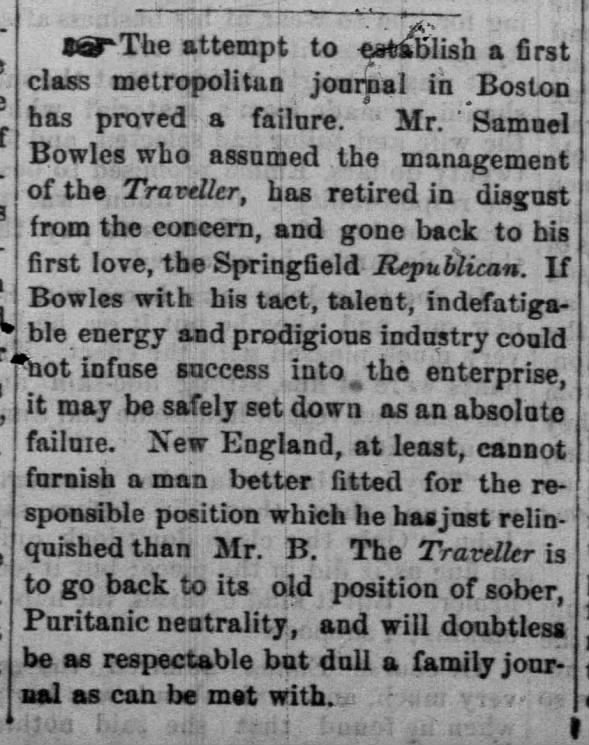
Leyda got the place (Boston) right, along with the correct month (September) and year (1857) of the newspaper clipping. For those who care about such things, I'm happy to supply the missing name and date of the newspaper in which this interesting query appeared. Transcribed below, from the Boston Daily Traveller of September 14, 1857:

Boston Daily Traveller - September 14, 1857
 
Mr. Jarves' well known books--Parisian and Italian Sights--led us to look with favor upon anything coming from his pen. We are sorry to be disappointed in KIANA, a Tradition of Hawaii, just published by Munroe & Co. Romance plainly is not Mr. Jarves' forte. He had a charming subject, susceptible of the highest style of treatment in this difficult province of fiction. There is a tradition among the people of the Sandwich Islands, that during the reign of Kiana, eighteen generations of kings previous to Kamehameha I., a white priest came among them with an idol and a new god, lived with them long, and dying, left a reputation for goodness that was green in the memories of the Hawaiians three centuries later. The date of this tradition synchronizes with that of the loss of two vessels sent by Cortez upon an exploring expedition to California. Mr. Jarves supposes the possible identity of the white strangers of Hawaii with the missing adventurers of Cortez, and from this fertile source derives the materials for his story. 
 
With such a beginning one might look for a romance equal to Mayo's Kaloolah or Melville's Omoo and Typee. The field is illimitable, the colors of every hue, and the license ample, only the skill of the romancer was wanting. It is a pity so good a piece of canvass should be spoiled. Where is Melville? Will he not leave the mazes of Pierre or the Ambiguities, and the eccentricities of the Confidence Man, and with some such charming tradition as this bring back the days and the delights of beautiful Fayaway, or take us voyaging to another Mardi. -- Boston Daily Traveller, September 14, 1857.
 
Emily Dickinson's friend Samuel Bowles of the Springfield, Mass. Republican had served as editor of the Boston Traveller since April 1857. In Springfield, Bowles was formerly assisted by Melville's "friendly critic" Josiah Gilbert Holland, so identified by Jay Leyda:
  • Leyda, Jay. “Another Friendly Critic for Melville.” The New England Quarterly, vol. 27, no. 2, 1954, pp. 243–49. JSTOR, https://doi.org/10.2307/362806. Accessed 28 May 2023.  
After a short tenure as editor of the Traveller, Bowles would reclaim his position as editor of the Springfield Republican.
 
The departure of Samuel Bowles as editor of the Traveller was announced on September 10th in the Boston Evening Transcript. Possibly the Kiana review on September 14, 1857 was one of the last literary pieces that Bowles contributed or supervised as editor of the Boston Traveller. 

Where is Melville?

In the Boston Traveller Bowles or somebody wondered, "Where is Melville?" We might be able to answer the question, now that we know the date on which it appeared in print. Where WAS Herman Melville on September 14, 1857? Back home in Pittsfield, Mass., brainstorming lecture topics, as he revealed the next day in a letter to George W. Curtis:

-- I have been trying to scratch my brains for a Lecture. What is a good, earnest subject? "Daily progress of man towards a state of intellectual & moral perfection, as evidenced in history of 5th Avenue & 5 Points."
Even better, brainstorming lecture topics and satirizing utopian schemes of famous communists after reading Robert Owen:
By the wondrous and, hitherto, mysterious organic construction of man and woman, the adults of the first generation that shall acquire a practical knowledge of their own powers to re-form the matured character of each individual, will be enabled, almost to re-create the character of succeeding generations; to re-create it by training each individual from birth, by a new and very superior arrangement of external circumstances, to have a sound physical constitution, to have superior dispositions, habits and manners, to have much valuable knowledge, and to make a daily progress towards physical, intellectual and moral perfection.

-- Robert Owen, The Book of the New Moral World (London, 1836) page 103.

Robert Owen, Esq. via NYPL Digital Collections
 
Melville's words and phrasing, specifically the stipulation of "daily progress" in the march "towards" a condition of "intellectual and moral perfection" are Robert Owen's in The Book of the New Moral World (London, 1836). "Subjects: Communism" as catalogued by HathiTrust Digital Library. 
 
As it turned out, the real lecture Melville composed on Statues in Rome was delivered in Boston on December 2, 1857 and reported the next evening in the Boston Evening Traveller. Traces of Melville's epistolary parody of Owen linger in his reference to the utopian "scheme of Fourier" that had yet to dissolve the need for a whole code of laws against criminal conduct. 

Related posts

Sunday, November 13, 2011

barbarous involation of a transcendental allegory


After further review the word involation looks like a typo or alternate spelling for involution, meaning the "action of involving or enfolding" and "state of being entangled" according to Webster's Complete Dictionary (New York: Harper & Brothers, 1846).

Another find at genealogybank.com which has a good run of the Picayune, with plenty of "New York Correspondence" from "R" and others. Mardi is a great book that will get some respect, one of these days. And we love "R" anyhow for saying "I know not his equal in English literature" after three two-and-a-half books.

The Daily Picayune (New Orleans, LA) August 18, 1849
From the New Orleans Daily Picayune, August 18, 1849
New York Correspondence.
[SPECIAL CORRESPONDENCE OF THE PICAYUNE.]
NEW YORK, August 7, 1849.
… I am glad to see the announcement of a new work in press by the Harpers, of the brilliant but erratic Herman Melville. It is entitled “Redburn, or the Sailor-Boy—Confessions and Reminiscences of a Gentleman’s Son.” Melville is at home on the deck of a vessel, and can tell as good a forecastle story as any tar that ever handled a marlin-spike. He made a blunder in “Mardi,” by winding up his jovial and flashing pictures of the sea in the barbarous involation of a transcendental allegory, in which all truth was intended to be shadowed forth on poetry, philosophy, politics, religion, love, literature, good eating, and what not; but he broke down dead before he got half through the work, and every reader I know of who has tried to finish it, has shared the same fate. But let Melville “fling away ambition” and content himself with spinning a regular yarn, I declare, I know not his equal in English literature. His “Typee” set half the young men in New York and Boston mad after the peerless vision of his Eve-like Fayaway, and if it had not been for the fear of being eaten alive, they would have gone off in a body to the spicy Eden groves of Nukaheva. “Rudburn,” [sic] I think, will beat “Typee,” as reality is often better than romance.

R.