Showing posts with label The Melville Log. Show all posts

Monday, May 6, 2024

Why "On Onota's Graceful Shore" can't be the poem Melville read aloud in August 1851

Jay Leyda, The Melville Log Vol. 1 (Harcourt, Brace and Company, 1951) page 420

A digitized version of J. E. A. Smith's "On Onota's Graceful Shore" in the 1896 volume Souvenir Verse and Story is accessible via the Library of Congress. Image 30 of Souvenir verse and story : memorial of fifty years | Library of Congress

Read it closely and see, "On Onota's Graceful Shore" can't have been the poem Melville recited in the rafters of a barn on August 7, 1851. How so? Because nothing about it fits the description of form (epic, long, taking up a "stout" manuscript), content (ultra patriotic "glorification of the United States" with "polite slanging of all other nations") and meter ("heroic measure" = iambic pentameter) that Evert Duyckinck gave in a letter to his wife. Duyckinck had seen and heard Melville's performance in the loft with a group of summer excursionists. In giving the details to his wife, Duyckinck provided a sample of the favorable commentary that Melville had delivered in the form of affirming interjections like "great," "glorious," and "By Jove that's tremendous." As Duyckinck also reported, the "flattered" poet was there, too, listening to Melville's reading and dramatic asides while sitting "thoughtful on a hay tuft."
Smith's poem is a ballad of only 88 lines in mostly iambic tetrameter, remembering local hero David Noble and his brave, selfless actions during the American Revolution. 

The long poem in "heroic measure" glorifying the United States that Herman Melville read from with enthusiasm in August 1851 was "Destiny." Recently composed by Melville's future brother-in-law John Chipman Hoadley. 

Destiny. A Poem By John C. Hoadley. 1851
Gansevoort-Lansing collection. Manuscripts and Archives Division.
The New York Public Library. Astor, Lenox, and Tilden Foundations.

Transcribed here from the manuscript in the Gansevoort-Lansing collection at NYPL:
Hoadley felt encouraged by "Melville's hearty praises" for his unpublished "national poem," as he wrote Evert Duyckinck from Pittsfield MA on September 9, 1851.


Manuscripts and Archives Division, The New York Public Library. "Hoadley, John Chipman (1818-1886)" The New York Public Library Digital Collections. 1851. https://digitalcollections.nypl.org/items/d9236f50-693b-0133-a932-00505686d14e

Once again, John C. Hoadley not Joseph Edward Adams Smith was the "flattered author" of the poem Herman Melville recited aloud in the loft of a Berkshire barn on August 7, 1851. With gusto, as evidenced in dramatic asides like "great," "glorious," and "By Jove that's tremendous!"

United States National Flag 1851-1858
via The New York State Military Museum

So what?

  1. So Jay Leyda ID'd the wrong guy and wrong poem in The Melville Log Vol. 1 (Harcourt, Brace and Company, 1951) page 420, as did Merton M. Sealts, Jr. in The Early Lives of Melville (The University of Wisconsin Press, 1974) pages 29-30; and Hershel Parker after them. (Nobody's perfect!)
  2. So prosody is a thing. And meter matters every now and then. Score it New Critics 1, Melville Biographers 0
  3. So Herman Melville the great American writer was a great American patriot as well. In his prime, finally done with writing THE WHALE, Melville extolled a glorification of the United States in epic verse composed by his fellow citizen and townsman, and future brother-in-law.
  4. So Melville openly practiced what he had preached in the guise of A Virginian Spending July in Vermont: "Let America, then, prize and cherish her writers; yea, let her glorify them."
  5. So Hoadley was the "thoughtful sensible man" (Duyckinck's impression before learning his name) who afterwards guided the group to Ashley Pond. That the poet turned out to be so competent a "pilot" on the trip there makes a lot more sense now. Besides being an ambitious versifier and soon-to-be suitor, John Chipman Hoadley was an engineer and local expert on the water-works committee. Considering his well-documented civic and professional interest in the acquisition of Ashley Pond aka Lake Ashley as a potential water supply for the village of Pittsfield, Massachusetts, it's safe to say that Hoadley knew the way to Ashley Pond better than anybody.
  6. So Melville came to know Hoadley even earlier than previously thought.
  7. So let's give J. E. A. Smith a break and Melville, too. Smith only ever intended his ballad "On Onota's Graceful Shore" for a humble tribute or "souvenir" to the memory of farmer-soldier David Noble and his gallant deeds. This and all the fugitive pieces collected in Souvenir Verse and Story (1896) were offered mainly as "mementos of the past." Melville's vocal bursts of approval ("Great" "Glorious" "By Jove that's tremendous") would have sounded pretty weird and disrespectful if uttered after any of the 88 tetrameters that comprise Smith's modest ballad. Confronting the inaptness of Melville's recorded comments when applied to such "dreary poetry" as "Onota's Graceful Shore," Hershel Parker not unreasonably figured Melville must have been joking. "Deftly managing not to let Smith gain an inkling that he was being satirized," as Parker has it in Melville: The Making of the Poet (Northwestern University Press, 2008) page 28; reprinted in his Historical Note for the 2009 Northwestern-Newberry Edition of Published Poems, edited by Robert C. Ryan, Harrison Hayford, Alma MacDougall Reising and G. Thomas Tanselle. Happily, however, the author of Mardi: and a Voyage Thither was not one to mock the work of Joseph Edward Adams Smith or any less gifted writer in front of gathered neighbors and friends. By contrast, Hoadley's national poem in manuscript presented a different order of composition--not a song but a symphony had been at least attempted. Whatever its artistic merit, the completion of any work that ambitious and patriotic deserved respect. Evidently Melville gave "Destiny" its due, and then some. His comments, however extravagant or over-the-top they may sound now, were supportive and sincerely made. That Hoadley felt encouraged by "Melville's hearty praises" we know for certain, as he testified in his letter to Duyckinck on September 9, 1851, little more than a month after Melville's dramatic reading in the barn loft. Jay Leyda did not miss much of importance in the Duyckinck family papers at NYPL, but apparently he never ran into Hoadley's letter in the Literary Correspondence of Evert A. and George L. Duyckinck. It's not down in the 1951 Melville Log (Harcourt, Brace and World) or the 1969 reprint by Gordian Press with additional material. Or any Log-based biography, yet.

Related posts:

Saturday, April 6, 2024

Doolittle "the Lenox expressman" in Leyda's postscript to THE MELVILLE LOG

Sunday, May 28, 2023

Where is Melville?

A Man of the Sandwich Islands, with his Helmet
© National Maritime Museum, Greenwich, London

Disappointed with Kiana: A Tradition of Hawaii (1857) by James Jackson Jarves, one contemporary reviewer complained that "Romance plainly is not Mr. Jarves' forte" and wondered,

"Where is Melville?"

Surely the author of Typee, Omoo, and Mardi would have made a more entertaining story out of the same Polynesian material. 

A newspaper clipping of the 1857 Kiana review was kept by the Melville family and eventually deposited at Harvard. I'm guessing it's still there:

 Jay Leyda put it in The Melville Log Volume 2 on page [583]:

Cited in the back of Volume 2 as "clipping, HCL-M" = "Papers & library of the Melville family, Harvard College Library."

Leyda got the place (Boston) right, along with the correct month (September) and year (1857) of the newspaper clipping. For those who care about such things, I'm happy to supply the missing name and date of the newspaper in which this interesting query appeared. Transcribed below, from the Boston Daily Traveller of September 14, 1857:

Boston Daily Traveller - September 14, 1857
 
Mr. Jarves' well known books--Parisian and Italian Sights--led us to look with favor upon anything coming from his pen. We are sorry to be disappointed in KIANA, a Tradition of Hawaii, just published by Munroe & Co. Romance plainly is not Mr. Jarves' forte. He had a charming subject, susceptible of the highest style of treatment in this difficult province of fiction. There is a tradition among the people of the Sandwich Islands, that during the reign of Kiana, eighteen generations of kings previous to Kamehameha I., a white priest came among them with an idol and a new god, lived with them long, and dying, left a reputation for goodness that was green in the memories of the Hawaiians three centuries later. The date of this tradition synchronizes with that of the loss of two vessels sent by Cortez upon an exploring expedition to California. Mr. Jarves supposes the possible identity of the white strangers of Hawaii with the missing adventurers of Cortez, and from this fertile source derives the materials for his story. 
 
With such a beginning one might look for a romance equal to Mayo's Kaloolah or Melville's Omoo and Typee. The field is illimitable, the colors of every hue, and the license ample, only the skill of the romancer was wanting. It is a pity so good a piece of canvass should be spoiled. Where is Melville? Will he not leave the mazes of Pierre or the Ambiguities, and the eccentricities of the Confidence Man, and with some such charming tradition as this bring back the days and the delights of beautiful Fayaway, or take us voyaging to another Mardi. -- Boston Daily Traveller, September 14, 1857.
 
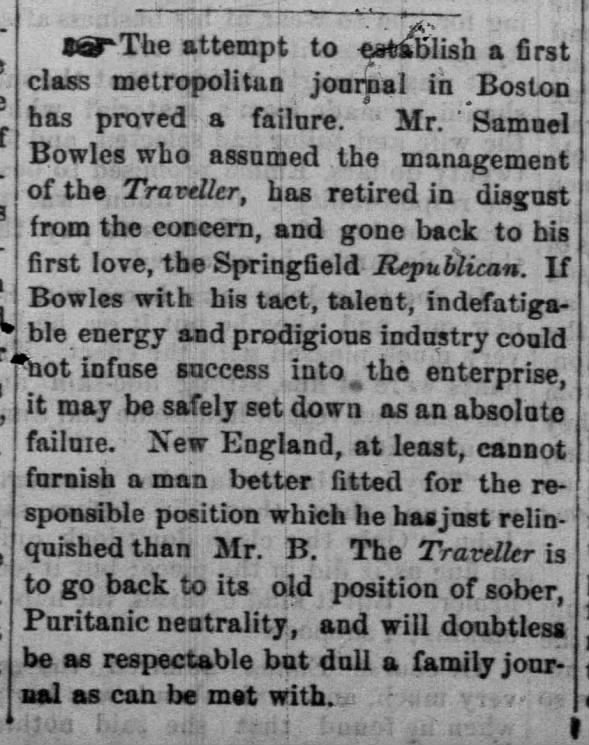
Emily Dickinson's friend Samuel Bowles of the Springfield, Mass. Republican had served as editor of the Boston Traveller since April 1857. In Springfield, Bowles was formerly assisted by Melville's "friendly critic" Josiah Gilbert Holland, so identified by Jay Leyda:
  • Leyda, Jay. “Another Friendly Critic for Melville.” The New England Quarterly, vol. 27, no. 2, 1954, pp. 243–49. JSTOR, https://doi.org/10.2307/362806. Accessed 28 May 2023.  
After a short tenure as editor of the Traveller, Bowles would reclaim his position as editor of the Springfield Republican.
 
The departure of Samuel Bowles as editor of the Traveller was announced on September 10th in the Boston Evening Transcript. Possibly the Kiana review on September 14, 1857 was one of the last literary pieces that Bowles contributed or supervised as editor of the Boston Traveller. 

Where is Melville?

In the Boston Traveller Bowles or somebody wondered, "Where is Melville?" We might be able to answer the question, now that we know the date on which it appeared in print. Where WAS Herman Melville on September 14, 1857? Back home in Pittsfield, Mass., brainstorming lecture topics, as he revealed the next day in a letter to George W. Curtis:

-- I have been trying to scratch my brains for a Lecture. What is a good, earnest subject? "Daily progress of man towards a state of intellectual & moral perfection, as evidenced in history of 5th Avenue & 5 Points."
Even better, brainstorming lecture topics and satirizing utopian schemes of famous communists after reading Robert Owen:
By the wondrous and, hitherto, mysterious organic construction of man and woman, the adults of the first generation that shall acquire a practical knowledge of their own powers to re-form the matured character of each individual, will be enabled, almost to re-create the character of succeeding generations; to re-create it by training each individual from birth, by a new and very superior arrangement of external circumstances, to have a sound physical constitution, to have superior dispositions, habits and manners, to have much valuable knowledge, and to make a daily progress towards physical, intellectual and moral perfection.

-- Robert Owen, The Book of the New Moral World (London, 1836) page 103.

Robert Owen, Esq. via NYPL Digital Collections
 
Melville's words and phrasing, specifically the stipulation of "daily progress" in the march "towards" a condition of "intellectual and moral perfection" are Robert Owen's in The Book of the New Moral World (London, 1836). "Subjects: Communism" as catalogued by HathiTrust Digital Library. 
 
As it turned out, the real lecture Melville composed on Statues in Rome was delivered in Boston on December 2, 1857 and reported the next evening in the Boston Evening Traveller. Traces of Melville's epistolary parody of Owen linger in his reference to the utopian "scheme of Fourier" that had yet to dissolve the need for a whole code of laws against criminal conduct. 

Related posts

Thursday, April 2, 2020

George Doolittle and Doolittle's Express

For the record, in 1850 there was a man named Doolittle in Berkshire County, Massachusetts who operated an express service from Lee to Pittsfield via Lenox. In the postscript for The Melville Log, Jay Leyda mentions an elusive "cousin Doolittle, the Lenox expressman":
"And some relatives have been left total mysteries--for example, cousin Doolittle, the Lenox expressman."  --Jay Leyda, "The Endless Study." Postscript to The Melville Log (New York: Harcourt, Brace and Company, 1951) Volume 2, page 859.
Leyda seems to mean the "Mr. Doolittle" that Herman Melville called "my cousin" and implicated in the sad accident that injured one of Sarah Morewood's horses. Where Leyda got the phrase "Lenox expressman" is not clear to me, but the tag would certainly apply to George Doolittle, resident of Lee in Berkshire County, Massachusetts and owner-operator in 1850 of "Doolittle's Express."

Pittsfield Culturist and Gazette - June 12, 1850
via GenealogyBank

Doolittle's Express.

LEE via. Lenox to Pittsfield: every day Sundays excepted, in season for the trains of cars and Express Lines. All orders and errands entrusted to my care will receive prompt attention, with moderate charges.
GEORGE DOOLITTLE.
Lee, Feb. 1850. 
The reference to "cousin" Doolittle occurs in Melville's chatty letter of December 13, 1850 to Evert Duyckinck. The Melville Log partly transcribes this letter in Volume 1 on page 401 but omits the relevant passage about Doolittle and Mrs. Morewood's horses. As Melville relates, this "Mr. Doolittle" was on the railroad track in his sleigh and just missed colliding with an oncoming train. The train hit three horses belonging to Melville's then absent neighbor, Sarah Morewood. One of the three eventually died after suffering a broken leg in the accident. Melville's letter is reprinted on pages 172-175 in the 1993 Northwestern-Newberry Edition of Melville's Correspondence, edited by Lynn Horth. The same 1850 letter is accessible online via the Internet Archive in The Letters of Herman Melville, edited by Merrell R. Davis and William H. Gilman (Yale University Press, 1960) pages 115-118. Here is an image from the original document, now accessible courtesy of the New York Public Library Digital Collections:

Manuscripts and Archives Division, The New York Public Library. "1850-1851"
The New York Public Library Digital Collections 1850-1851.
http://digitalcollections.nypl.org/items/ae98a990-1793-0133-e826-58d385a7bbd0
... one of my neighbors has really met with a bad accident in the loss of a fine young colt. That neighbor is our friend Mrs Morewood. Mr Doolittle — my cousin — was crossing the R.R. track yesterday (where it runs thro the wooded part of the farm.) in his slay — sleigh I mean — and was followed by all three of Mrs Morewood’s horses (they running at large for the sake of the air & exercise). Well: just as Doolittle got on the track with his vehicle, along comes the Locomotive — whereupon Doolittle whips up like mad & steers clear; but the frightened horses following him, they scamper off full before the engine, which hitting them right & left, tumbles one into a ditch, pitches another into a snow-bank, & chases the luckless third so hard as to come into direct contact with him, & break his leg clean into two peices. — With his leg “in splints” that is done up by the surgeon, the poor colt now lies in his straw, & the prayers of all good Christians are earnestly solicited in his behalf. Certainly, considering the bounding spirit and full- blooded life in that colt— how it might for many a summer have sported in pastures of red clover & gone cantering merrily along the "Gulf Road” with a sprightly Mrs Morewood on his back, patting his neck & lovingly talking to him — considering all this, I say, I really think that a broken leg for him is not one jot less bad than it would be for me — tho’ I grant you, even as it is with him, he has one more leg than I have now. 
Davis and Gilman were unable to identify Doolittle beyond the surname:
In what way Mr. Doolittle of the following story was Melville's cousin remains a mystery, upon which neither genealogies, local histories, nor family reminiscences have yet thrown any light. 
<https://archive.org/details/in.ernet.dli.2015.84865/page/n155/mode/2up>
The Northwestern-Newberry Edition of Melville's Correspondence credits Hershel Parker with the identification of "Doolittle" as Robert Melvill. This explanation of "Doolittle" as a joking code-name for Herman's "hapless cousin" Robert previously appeared in Parker's article,"Moby-Dick and Domesticity," in Critical Essays on Herman Melville's Moby-Dick, ed. Brian Higgins and Hershel Parker (New York: G.K. Hall and Co., 1992) pages 545-562 at page 552. So identified in both volumes of Herman Melville: A Biography Volume 1, 1819-1851 page 798; and Volume 2, 1851-1891 page 626.

<https://books.google.com/books?id=OrTOQR4QyKIC&pg=PA798&lpg#v=onepage&q&f=false>

It would be good to learn the exact source of Jay Leyda's information about a "Lenox expressman" linked to "cousin Doolittle." Was it one of the 1850 ads in the Pittsfield Culturist and Gazette, shown and transcribed above?

No information has turned up yet about this George Doolittle's parents. Census and other records on Ancestry.com indicate that George Doolittle (1808-1894) lived most of his life in Berkshire County, Massachusetts. He was born in 1808 in Hancock; and died in Lee at the age of 86.

Pittsfield Sun - October 13, 1831
This George Doolittle married Electra Miller Doolittle (1805-1873), aka Electa or Eleeta, on October 6, 1831, as announced in the Pittsfield Sun on October 13, 1831. Their son James Henry Doolittle (1836-1881) was born in Dalton, Massachusetts.

George but not Electra Doolittle lived to enjoy the birth of Rolfe, their second grandson, on June 2, 1876. The next day, G. P. Putnam's Sons published Herman Melville's epic religious poem, Clarel: A Poem and Pilgrimage in the Holy Land. In Clarel, coincidentally, the most Melville-like pilgrim of all was named Rolfe.

Like his grandfather George, Rolfe Doolittle (1876-1940) found employment in Lee as an Expressman.
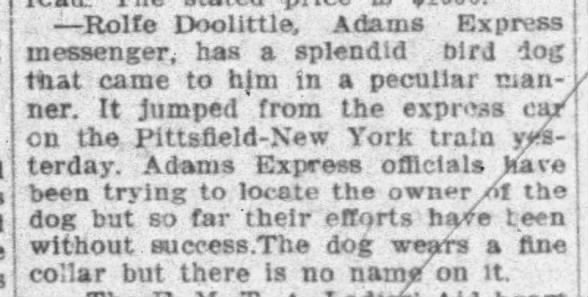
Thu, Feb 11, 1909 – 11 · The Berkshire Eagle (Pittsfield, Massachusetts) · Newspapers.com
— Rolfe Doolittle, Adams Express messenger, has a splendid bird dog that came to him in a peculiar manner. It jumped from the express car on the Pittsfield-New York train yesterday. Adams Express officials have been trying to locate the owner of the dog but so far their efforts have been without success. The dog wears a fine collar but there is no name on it.  --The Berkshire Eagle, February 11, 1909. 

Related posts