Robert Melvill aka
Robert Melville was Herman Melville's first cousin. Herman's father
Allan Melvill was the older brother of Robert's father
Thomas Melvill, Jr. While Herman was living at
Arrowhead in Pittsfield, Massachusetts and still working on
Moby-Dick, his cousin Robert got appointed administrator for the estate of deceased Pittsfield resident
Bildad Williams (1784-1851). Robert Melvill was a Pittsfield farmer. With his wife Susan, Robert ran the
old Melvill mansion as a boarding house, until the property was sold to John Rowland Morewood. Later in 1851, some time after the Morewoods returned to Pittsfield from England, Robert moved to Galena, Illinois. Later he settled in Davenport, Iowa. I don't know how or why Herman's cousin Robert Melvill would have been involved in the settlement of Bildad's estate.
Bildad in the Bible is one of Job's three friends. In
Moby-Dick, one of the Quaker owners of the whaleship
Pequod is named Bildad. As Ishmael describes him in
chapter 16 of Moby-Dick, the fictional Bildad is characteristically pious and parsimonious. At sea, Captain Bildad had been a notoriously demanding employer or "task-master":
Now Bildad, I am sorry to say, had the reputation of being an incorrigible old hunks, and in his sea-going days, a bitter, hard task-master. They told me in Nantucket, though it certainly seems a curious story, that when he sailed the old Categut whaleman, his crew, upon arriving home, were mostly all carried ashore to the hospital, sore exhausted and worn out. For a pious man, especially for a Quaker, he was certainly rather hard-hearted, to say the least. He never used to swear, though, at his men, they said; but somehow he got an inordinate quantity of cruel, unmitigated hard work out of them. When Bildad was a chief-mate, to have his drab-colored eye intently looking at you, made you feel completely nervous, till you could clutch something—a hammer or a marling-spike, and go to work like mad, at something or other, never mind what. Indolence and idleness perished from before him. His own person was the exact embodiment of his utilitarian character. On his long, gaunt body, he carried no spare flesh, no superfluous beard, his chin having a soft, economical nap to it, like the worn nap of his broad-brimmed hat.
--Moby-Dick Chapter 16: The Ship
Pittsfield's real Bildad also might have been hard to work for. Or maybe he was just unlucky in his reliance on rascally "boys," like
Pitch in The Confidence-Man ("all boys are rascals"). No telling why, exactly, but in October 1838, a young apprentice named Henry ran away from Bildad Williams.
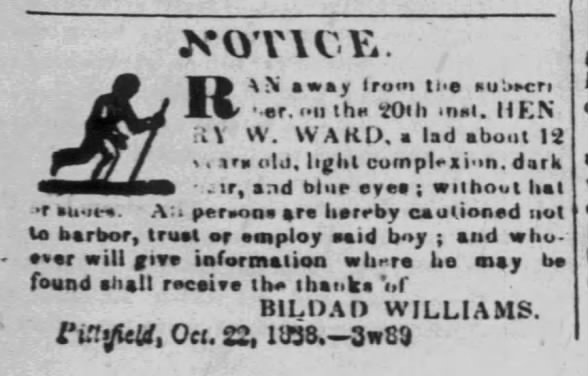 Thu, Nov 15, 1838 – 1 · The Pittsfield Sun (Pittsfield, Massachusetts) · Newspapers.com
NOTICE.
RAN away from the subscriber, on the 20th inst, HENRY W. WARD, a lad about 12 years old, light complexion, dark hair, and blue eyes; without hat or shoes. All persons are hereby cautioned not to harbor, trust or employ said boy; and whosoever will give information where he may be found shall receive the thanks of
BILDAD WILLIAMS.
Pittsfield, Oct. 22, 1838.
Henry W. Ward must have been returned to Bildad, for he ran away again two years later:
NOTICE.
RUN away from me on the 27th ult. a Boy by the name of HENRY W. WARD, 14 years old, stocky built, gray eyes, dark hair, and walks stooping. He wore away a light mixed roundabout, black vest with a red back, and moleskin pantaloons--all considerably worn. He also wore away a good hair seal cap, and a pair of good boots, and took some other articles of clothing. All persons are forbid harboring, trusting or employing said runaway; and whoever will give information where he may be found will confer a favor on
BILDAD WILLIAMS.
Pittsfield, Feb. 2, 1841.
The summer before Henry's second departure, in July 1840, a warrant had been issued against the estate of Bildad Williams, evidently in connection with bankruptcy proceedings.
After Bildad's death from "Disease of the kidneys" on April 27, 1851, Herman's cousin Robert Melvill was named Administrator of the estate.
Bildad Williams' Estate.
NOTICE is hereby given, that the subscriber has been duly appointed Administrator on the estate of BILDAD WILLIAMS, late of Pittsfield, in the County of Berkshire, deceased, and has taken upon himself that trust, by giving bond as the law directs. All persons having demands upon the estate of the said deceased, are requested to exhibit the same; and all persons indebted to said estate, are called upon to make payment to
ROBERT MELVILL, Adm'r.
May 6, 1851.
In Robert's ad for the subsequent estate sale, remaining possessions of the deceased included "a large assortment of Household Furniture" along with "
Comb Makers Tools and other articles."
 |
Pittsfield, MA Culturist and Gazette - May 14, 1851
via GenealogyBank |
Notice.
THE Subscriber will expose for sale at Public Auction on Saturday, the seventeenth day of May inst., at the residence of the late Bildad Williams, a large assortment of Household Furniture. Comb Makers Tools and other articles.
ROB'T. MELVILLE, Administrator.
Pittsfield, May 13, 1851.
The official register of deaths in Pittsfield gives the occupation of Bildad Williams as "Comb Maker." So then, young Henry Ward the 1838 and 1841 runaway possibly had been employed by Bildad in the manufacture of combs. However, according to the United States Federal Census for 1850, Bildad Williams at that time worked as a "Grocer."
Bildad's given age of 66 in the October 1850 census and April 1851 death register puts his birth year around 1784. In the category of "Sex and Condition" the death register indicates "Widower-Colored." According to the 1850 Census Bildad Williams lived alone, and owned Real Estate valued at $800.
Bildad's wife
Juliana Williams died on June 28, 1846, age 65.
Pittsfield Bildad was born in Connecticut, according to census and death records accessible on
Ancestry.com. At seventeen, a
Bildad Williams ran away from Cato Williams (his uncle? or father?) in Mansfield, Connecticut.
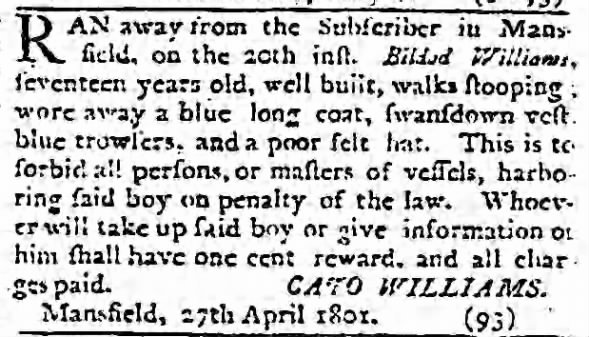 Cato Williams, Bildad Williams ran away, Mansfield Mon, May 11, 1801 – Page 4 · Hartford Courant (Hartford, Connecticut) · Newspapers.com
"RAN away from the Subscriber in Mansfield, on the 20th inst. Bildad Williams, seventeen years old, well built, walks stooping; wore away a blue long coat, swansdown vest, blue trowsers, and a poor felt hat. This is to forbid all persons, or masters of vessels, harboring said boy on penalty of the law. Whoever will take up said boy or give information of him shall have one cent reward, and all charges paid. CATO WILLIAMS. Mansfield, 27th April 1801."
Robert Underhill, current President of the
Historical Society of Clarendon Vermont, has identified Mansfield's Bildad Williams as the son of Cato Williams with his wife
Lydia Williams. As reported by Underhill and others, this Cato Williams died in Westfield, MA in 1828. A Cato Williams is listed as the head of household in the 1820 U. S. Federal Census for Lenox in Berkshire County, Massachusetts. The Williams household of five was then comprised of four "Free Colored Persons" and one "Free White Person." Another researcher on Ancestry.com gives the father of Bildad Williams as Elisha Williams (1717-1784), who owned property in Mansfield, CT next to land sold for $215 in 1809 by Jesse Spafford to Lydia, Isham, and Bildad Williams. In 1817, Bildad sold his remaining share of the Mansfield property to Simeon Allen.
Originally in Windham County Connecticut. Mansfield was
annexed to Tolland County in 1827. Tolland County, CT happens to be the stated birthplace of Melville's fictional cabin boy, Pip. In
Moby-Dick, Melville's narrator Ishmael refers to Pip's "native Tolland county in Connecticut" (
Chapter 93); and Pip relates a story about his father in "old Tolland county" (
Chapter 99). The
Black cabin boy Pip may be partly based on John Backus, Melville's shipmate on the
whaler Acushnet. But the birthplace of Backus has not been established, leading some readers of
Moby-Dick to wonder with the editors of the 1988
Northwestern-Newberry Edition, page 853, "what made him bring in Tolland County at all?"
This Mansfield, Connecticut Bildad was reportedly 17 in 1801, which would make his birth year 1784--identical with that of the "colored" widower Bildad Williams who died in Pittsfield at the age of 66 on April 27, 1851. The same Bildad whose estate, after his death, was sold at auction by Herman Melville's cousin Robert.
In spite of the published warning to "masters of vessels" by Cato Williams in May 1801, Mansfield's Bildad Williams actually did receive New England
Seamen's Protection Certificate number 2209 in New London on September 19, 1801. Age 18; height 5' 8"; complexion "Mulatto."
So Bildad Williams from Mansfield, Connecticut went to sea. Where he sailed is unknown--the earliest
New London Crew Lists on the website of Mystic Seaport Museum, are from 1803. From
New London, Bildad in 1801 would not have gone a-whaling. The first commercial whaling voyage from New London was by the
Dauphin in 1805, according to Alexander Starbuck's
History of the American Whale Fishery.
Moby-Dick fans may be interested in the relative scarcity of sailors named Bildad. Of Melville's two retired Quaker captains, Peleg bore the commoner name. The 30,988 total records in the
Registers of Seamen's Protection Certificates contain more than thirty Pelegs, but just one Bildad.
Related post: