Showing posts with label Bartleby. Show all posts

Thursday, October 16, 2025

Noticed in Nova Scotia, Melville's PIAZZA TALES

We have seldom or ever read the equal of this chapter [Benito Cereno] in point of profound cunning and deception....

Here's something new concerning the early reception of Herman Melville's short fiction in Canada. Published in the Liverpool, Nova Scotia Transcript on July 31, 1856, this favorable and unusually detailed Canadian review of The Piazza Tales is not collected in Herman Melville: The Contemporary Reviews, edited by Brian Higgins and Hershel Parker (Cambridge University Press, 1995; paperback 2009). As indicated on the masthead, the Liverpool Transcript was a weekly newspaper "devoted to moral, political and general intelligence and progress," then owned and edited by S. J. M. Allen.

Liverpool [Nova Scotia, Canada] Transcript
July 31, 1856 via Nova Scotia Archives

NEW PUBLICATIONS.


THE PIAZZA TALES. From the pen of Herman Melville, author of "Typee," "Omoo," etc. Dix & Edwards, New York. E. G. Fuller, Halifax.
The first chapter is devoted to pleasant reminiscences in favor of piazzas, and an "inland voyage to fairyland. A true voyage; but, take it all in all, interesting as if invented."

The second chapter consists of passages in the life of Bartleby, "who was a scrivener, the strangest I ever saw, or heard of," with some mention of the author, his employees, his business, chambers and general surroundings, as a means of better understanding the chief character of this chapter. It will be found interesting--very.

The third chapter introduces to our notice the captain of an American Sealer, who displays stirling qualities in the capture of a Spanish slaver at the island of St. Maria, Chili. The slaves having risen, murder their owner and some of the officers and crew of the ship, take full command of the vessel, place the captain and the remainder of the crew under strict watchful guards to navigate and work the vessel. The ringleader Babo with his right hand man Atuful [Atufal] act, in the presence of the American captain a most conspicuous part in all the powers of deception and mock submission to the behests of the captain, who is completely tho' reluctantly compelled at the risk of his life to assist in carrying out their designs, so as to appear as the despotic commander and sole owner of ship and cargo. The whole story with Benito Cerino's [Cereno's] protest is admirably written, deleneating certain characters with an unmistakable hand. We have seldom or ever read the equal of this chapter in point of profound cunning and deception. 
The fourth chapter gives a humorous memorandum of "The Lightning-Rod Man" endeavoring to sell, during a storm of rain accompanied with thunder and lightning, certain rods to attract the lightning and convey it from the building.

The fifth tale is divided into ten chapters and is romantically discriptive of the Encantadas or Enchanted Isles--Gallipagos, the land, its singular appearance--the rocks--the peaks of mountains, the queer birds, reptiles, tortoises, etc., which inhabit those sun burnt regions of the Equator. The lone widow and her rescue occupies the eighth chapter. In fact "the enchanted isles" is enchantingly written.

The last tale in this admirably written work is that of "The Bell-Tower, built by the mechanician, the unblest foundling, Baunadonna," [Bannadonna] in Italy three hundred feet in air will repay the reader for his pains.

Two weeks before the favorable notice of the Piazza Tales appeared in the Liverpool Transcript, the same Canadian newspaper dropped an odd reference to "the firm of Bartleby, Benito Cereno" into a notice of The Schoolfellow, a well-regarded magazine for children. 

Liverpool Transcript - July 14, 1856
The School-fellow's Magazine, for June, illustrated. This appears to be a commendable work for boys and girls, many of the best American writers being engaged upon it, among whom we may mention Bayard Taylor. It is from the firm of Bartleby, Benito Cereno. 
Agents for the above works, E. G. Fuller, Halifax.

At this time both the Schoolfellow and Putnam's Monthly Magazine were published in New York City by Dix, Edwards & Co. The same "firm" had just issued Melville's new volume The Piazza Tales which of course contained the Putnam's stories "Bartleby" and "Benito Cereno." Evidently the phrasing of this 1856 reference to "the firm of Bartleby, Benito Cereno" in some way points to Joshua Augustus Dix and Arthur T. Edwards as publishers of the Schoolfellow and Putnam's. Dix and Edwards were then "very young and very green" as Justin Martin has observed in Genius of Place: The Life of Frederick Law Olmsted (Da Capo Press, 2011) page 109. 


The Old Glory: costume sketches for Benito Cereno, 1976
via The New York Public Library Digital Collections

Friday, February 21, 2025

"Looking Back to Old New York City in Herman Melville’s “Bartleby”" by Shawn Thomson

"Looking Back to Old New York City in Herman Melville’s “Bartleby”" by Shawn Thomson: Though “Bartleby, the Scrivener” takes place in the three-block area in and around the lawyer’s Wall Street offices, the uptown attitudes toward city life of the suburbs inform the lawyer’s relationships to his urban or downtown space. Wall Street stands as a central feature of the island city’s history, taking its name from a physical wall built to protect the Dutch from the British and the Indians. As a result, Wall Street served to differentiate the suburban from the urban confines of the city. Through the position of the lawyer in the Master Chancery office on Wall Street and his esteem of Jacob Astor, Herman Melville examines how the lawyer’s view of the city as hierarchical shapes the lawyer’s disaffection from the lives of his idiosyncratic office copyists. But as Bartleby disrupts the customs at the Chancery, Melville alludes to Benjamin Franklin’s own work as a pressman in the Watts Printing House in London. Franklin’s and Bartleby’s labors represent the vast distance between the craft culture of eighteenth-century London and the industrial democracy of antebellum New York City. I argue that Melville criticizes the spatial divide of the city wherein the uptown (private) and downtown (public) faces of the lawyer never amalgamate into a singular conscience. In exploring contrasting accounts of workers trapped in the city, I examine how the lawyer forms a melancholic sympathy with Bartleby that pulls him into the Egyptian gloom of the city. When the lawyer visits Bartleby in the Tombs, he sees the stark and brutal Pharoah-like top-down power structure of the Whig city dissevered from its Whiggish time’s arrow of progress. 

Saturday, September 25, 2021

Bartleby in Burlington

From the Iowa State Gazette of December 7, 1853; found on NewspaperArchive:

Putnam's Monthly.

The December number of this valuable publication has been laid upon our table by a friend, and we are led to to the opinion after a hasty perusal of its contents, that its wide spread and rapidly increasing popularity, may be attributed to the superior reading matter contained in its pages. In this number is concluded "Bartleby, the Scrivener," which is a very interesting account of a strange being who occupied a corner in a Lawyer's office in the city of New York—and illustrates how strangely some strange men may live in the great city of Gotham. Bartleby always would "prefer not to"—and in this respect resembles some persons we know of not a thousand miles from here. "Wensley" is another interesting article concluded in this number, and to those who have read the former numbers the conclusion will be delightful. There are many other ably written and very interesting articles in this number, too numerous for us to name, but suffice for the present to say that this work is well worthy the liberal support of a reading people. It has not, like too many others, established its character with pictures, and only resorts to that fashion when science and art require an elegant illustration. When our January number arrives we will give it a more extensive review. --Burlington, Iowa State Gazette, December 7, 1853. 
The Iowa State Gazette was at this time a Democratic weekly newspaper, published every Wednesday. Since 1851 the State Gazette had been edited by Dr. Harvey, remembered as "an eminent citizen of Burlington" and "a man of intelligence and convictions" in one early History of Des Moines County, Iowa.

As ID'd by Frank Luther Mott, Edmund Quincy wrote the serial novel Wensley. Subtitled A Story Without A Moral, Quincy's "Wensley" originally appeared in Volume 2 of Putnam's Monthly Magazine, fourteen chapters in six installments: 

The book version of Wensley was published in 1854 by Ticknor and Fields.

Tuesday, October 8, 2019

Bartleby in Syracuse

via The Century Association Archives Foundation
From the Syracuse Evening Chronicle, November 21, 1853; found on Fultonhistory.com:

Syracuse, New York Evening Chronicle - November 21, 1853
"Bartleby the Scrivener, is a new story, which opens curiously and excites considerable interest."
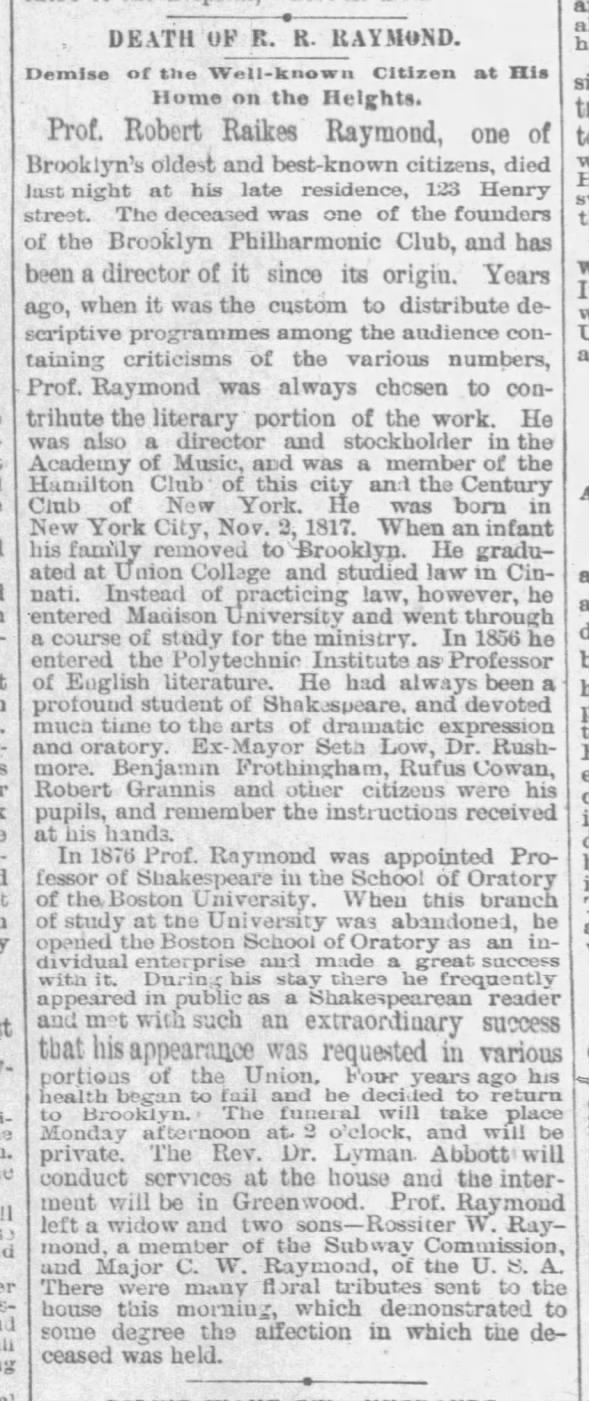
I'm guessing this late but favorable notice of Putnam's magazine for November 1853 is by editor Robert Raikes Raymond (1817-1888), who went on to become Professor of English at Brooklyn Collegiate and Polytechnic Institute.

The timelier notice of Putnam's for December 1853 (Syracuse Evening Chronicle, November 28, 1853) mentioned "Bartleby, the Scrivener" along with "Wensley" and "Reminiscences of an Ex-Jesuit" as "well-written sketches."

Here are links to Herman Melville's short fiction "Bartleby, The Scrivener" as it originally appeared in Putnam's Monthly Magazine, Vol. 2 (July-December 1853), via Google Books:
and again, courtesy of HathiTrust Digital Library:
Later included in The Piazza Tales (New York: Dix & Edwards, 1856), pages 31-107.

"Bartleby" appeared anonymously in Putnam's, and the Syracuse reviewer does not name Melville as the author. Earlier in 1853, the Evening Chronicle had favorably compared the narrative style of The History of an Adopted Child by Geraldine Endsor Jewsbury with the "verisimilitude and simplicity" of Typee.  There, however, the reviewer lamented the lack of those qualities in Melville's subsequent books, perhaps with Moby-Dick (1851) and Pierre (1852) in mind. From the Syracuse Evening Chronicle, February 22, 1853:
This little volume purports to be written to teach forbearance to those "grown-up aunts and elder sisters," who "are not fond of children." The story is interesting, and the style in which it is told partakes of that verisimilitude and simplicity of statement, which characterize the writings of De Foe, and the first work (and alas, only that) of our own writer Melville.-- "Our unrivalled corps of critics" round the editorial hearth pronounce it a book to be read at a single sitting, and read without skipping.  
On September 4, 1854, the Syracuse Evening Chronicle reprinted a long passage from Israel Potter, chapter 5 under the heading, "George the Third." Herman Melville had already been identified as the author of "Israel Potter" in the notice of the September 1854 Putnam's, published in the Evening Chronicle on August 23, 1854. The excerpt from Putnam's was introduced as
"A characteristic scene in which this famous monarch was an actor, is given in the interesting story of "Israel Potter, " now in course of publication in Putnam's Magazine."
-- Syracuse Evening Chronicle (Syracuse, New York), September 4, 1854.
Sat, Nov 17, 1888 – 1 · The Standard Union (Brooklyn, New York) · Newspapers.com

Tuesday, July 9, 2019

Literature on the Ohio


Manuscripts and Archives Division, The New York Public Library. "“Hawthorne and his mosses”"
The New York Public Library Digital Collections
. 1850.
http://digitalcollections.nypl.org/items/24fa15e0-184f-0133-8bf9-58d385a7bbd0
As reviewed in our last, Herman Melville either initiated or acquiesced to the un-naming of Mr. Cutlets, just a friend in the 1856 book version of Bartleby. Such changes are treated as dubious and occasionally dispensable "instances of toning down" in the 1987 Northwestern-Newberry edition of The Piazza Tales. More examples occur in the extant manuscript of "Hawthorne and His Mosses (copied by Melville's wife Elizabeth). Here is the unfiltered version of Melville's patriotic take-down of bardolatry as fundamentally un-American:
You must believe in Shakespeare or quit the country. But what sort of a belief is this for an American, a man who is bound to carry republican progressiveness into Literature, as well as into Life? Believe me, my friends, that Shakespeares are this day being born on the banks of the Ohio. And the day will come, when you shall say who reads a book by an Englishman?
The Northwestern-Newberry text keeps one instance of toning down in Melville's added qualifier, "that is a modern." Specifying "modern" makes the assertion more reasonable (since well-educated world-citizens must always read Chaucer and Milton, for example) but softens the parody of Sydney Smith's query, "who reads an American book?" The rawest version of the passage would omit three qualifying clauses--all added in revision, all printed in the Literary World on August 17, 1850.
  • "Shakespeare's inapproachability" instead of Shakespeare
  • "men not very much inferior to Shakesepare" instead of Shakespeare
  • "that is a modern" qualifying "Englishman"

Hawthorne and His Mosses
Literary World - August 17, 1850
https://books.google.com/books?id=VTsZAAAAYAAJ&pg=PA126&dq#v=onepage&q&f=false

Toned-down:
... men, not very much inferior to Shakespeare, are this day being born on the banks of the Ohio.
Amped-up:
Shakespeares are this day being born on the banks of the Ohio.
Cincinnati in 1841 via NYPL Digital Collections
The Miriam and Ira D. Wallach Division of Art, Prints and Photographs: Print Collection, The New York Public Library. "Cincinnati in 1841." The New York Public Library Digital Collections. 1841. http://digitalcollections.nypl.org/items/510d47d9-7c6d-a3d9-e040-e00a18064a99

Related post

Saturday, July 6, 2019

Un-named in revision

 Bartleby, this is a friend....
The 1856 book version of Bartleby makes a nameless "friend" of the "broad meat-like" grub-man, whom Melville originally called "Mr. Cutlets" in the December 1853 issue of Putnam's Monthly Magazine. In the magazine version, the narrator introduced the grub-man by name:
 "Bartleby, this is Mr. Cutlets; you will find him very useful to you."

After revision, Mr. Cutlets is just "a friend."
"Bartleby, this is a friend; you will find him very useful to you." --The Piazza Tales


Also deleted in revision, the invitation to dine privately with both Cutlets, Mr. and Mrs.
"May Mrs. Cutlets and I have the pleasure of your company to dinner, sir, in Mrs. Cutlets' private room?"
The un-naming of Mr. Cutlets and deletion of his dinner invitation have been noted before, of course. Dismissing the Cutlets business as "inappropriate slap-stick," Egbert S. Oliver in the 1948 Hendricks House edition of The Piazza Tales (page 230) gives its judicious "removal" as "one of the principal revisions that Melville made in this story in preparing it for book publication." The Cutlets are back in the text of the 1987 Northwestern-Newberry edition of The Piazza Tales and Other Prose Pieces, 1839-1860. As discussed there in the notes (page 579), the N-N editors reject this and other revisions as suspiciously inartful and un-Melvillean "instances of toning down."

For further study:

Wednesday, April 24, 2019

The Later Season in Harper's Bazar, June 1870

By George William Curtis?
Geo Wm Curtis
Brady-Handy photograph collection, Library of Congress, Prints and Photographs Division.
We know Herman Melville went to Washington in March 1861, seeking a diplomatic appointment. In May 1870 Melville was working six days a week in the New York Custom House--and getting his portrait painted by Joel Oriel Eaton, as Hershel Parker relates in Herman Melville: A Biography Vol. 2, 1851-1891 (Johns Hopkins University Press, 2002), pages 702-704. Though Melville never visited the U. S. capital that "garden month of May," he could have read about it in the June 25, 1870 issue of Harper's Bazar. In "The Later Season," if he did happen to see it, Melville the poet might have found hints for some of the floral prose and verse we find in the posthumously published collection, Weeds & Wildings, with a Rose or Two. And Clarel (1876), then Melville's work in progress.

In any case, George W. Curtis definitely liked to spice his own writing with allusive bits from Melville's. For example, references to Bartleby in Prue and I (and earlier, Sea from Shore in Putnam's for July 1854). Before 1895, Google Books and HathiTrust Digital Library give only two hits in searches for "infinite blueness": describing sky in "The Later Season," and sea in Moby-Dick, Chapter 134, The Chase — Second Day.

I'm not sure Melville or anybody could better this riff on roses:

Harper's Bazar - June 25, 1870
... But till boulevards and fountains come, and if they never come, every spring-time the roses will; will bud and bloom and hang their heavy heads—such roses as do not grow out of Paestum; roses that Sappho and that Hafiz Sang of, as the poets' dream; roses fit to crown Anacreon; deep red roses that seem to burn in the sun; delicate tea-roses with a petal like some perfect cheek; damask and blush and moss roses, the queenly Lamarque, the tiny, faultless Scotch, the pungent sweet-brier; roses that are almost black, so purply crimson is their richness; roses that are spotless white, all of them, without speck, long-stemmed, in generous clusters—and all making the air about them an intoxication of delicious odor. For one brief month it is politics and power set down in paradise; and sometimes as strangely out of place as the serpent there.
"The Later Season" is unsigned, as customary in Harper's Bazar:
The Harpers have an objection to crediting articles in their periodical publications to their authors, as is the custom with Fields, Osgood & Co., and it is a principle with them that the contributor should be subordinated to the publication. I cannot therefore furnish you with a full list of the writers for either the Bazar or Weekly, but most of them are persons already known to the public.  --Springfield Republican (Springfield, MA), April 6, 1870.
Here is the complete article, transcribed from Harper's Bazar for June 25, 1870:

THE LATER SEASON.


IT is a singular circumstance that nearly all the pleasure-seekers at the National Capital should make their resort thither in the chilly winter days, and never in the spring-time—the springtime, which there is something out of the land of dreams. In the winter the climate of the place is often, if not so keenly cold as the more northern climate, yet much more penetratingly so, with a disagreeable dampness in addition that brings about a hundred rheumatic aches and ails; and so high do the winds blow that, at the beginning of a storm, clouds of dust frequently rise to meet the clouds of snow that descend, already mud, upon your sleeve. But in the spring a delightful balm seems to fall upon the air and fill it; soft showers cool any fervent heat of the Sun, and keep the sod and sward as green as “freshly broken emeralds;” the sky seems to soar away in its infinite blueness with a life of its own; and the sunbeams pour over dome and obelisk and pillared lines of marble till they shine with dazzling lustre through their light screens of waving greenery, hardly developed into summer lushness yet, until one, experiencing an hour of all this, must needs declare the month of May in Washington to be all that ought to be demanded, either for the pride of the eye or the delight of the flesh. 
It is probable that the wintry throngs are drawn to Washington largely—outside of the purely political gathering—in view of the ball-room gayeties before Lent; but the gayeties after Easter are quite as attractive—if one did but know it. There is quite as much opportunity of admiring and of displaying lovely faces and toilettes, and many of the enjoyments are of a healthier order both for body and soul, requiring the rounds of no physician with his poison bottles to sting into one the life and strength thrown away in the reckless abandonment of midnight revel. 
For the tournaments of fashion during this later season, which follows with every long session of Congress, the reception of the President's wife presents a perfect Field of the Cloth of Gold, and all the rank and grace and beauty of the town, arrayed in purple and fine linen, adorn the scene—a scene more interesting and satisfying to behold than any of the winter receptions, as the thick velvets and silks, which give such sameness and heaviness to any large assembly, being discarded now, the lighter and airier fabrics are found floating round maid and matron, tissues capable of being transformed into various guises, each more delicate and exquisite than the other, and all giving the effect of works of art in their combinations of lace and net and flowers and jewelry, like cobwebs strung with dew, and all to be seen in rooms full of sunshine, whose open windows, letting in the outside fragrance, and songs of birds, and glimpses of charming landscape, add a lustre to every thing that neither the glow of wax-light nor the glare of gas can ever shadow forth; while, so long as the session lasts, as the corps of correspondents, the diplomats, and aids-de-camp linger, there are sure to be enough carpet knights to brighten or darken the picture according to its exigencies and their uniform. 
Then, between the receptions and the few evening parties prized now for their rarity, and always made rich and rare to compensate for their lateness, as the popular prejudice runs, there come the riding-parties to the Falls, where fine equestrianship may do its best, and last night's Sylph be to-day's Amazon; the moonlit boating where the Potomac narrows between steep and romantic banks of a sylvan wildness; picnics to Rock Creek, a region of fabulous beauty, where the woods abound in blossoms, the purple lupine and the pink azalea, and the great white dogwood boughs stretch away into the darkness like a press of moonbeams; and excursions down the river to Mount Vernon, among its blooming magnolias and rosy Judas-trees, where the great tomb stands open to irreverent eyes, and where, with their mementoes, with Eleanor Custis's harpsichord, and the wonderful mantle-piece of carved Siena marble, the quaint old rooms and their verandas invite the guest, and the garden shelters wandering lovers, who tread down the wild hyacinths in the grass, between its breast-high hedges of spicy box. All day, too, the halls of Congress are open, with the drama there growing livelier as the adjournment draws nearer; and every evening the drives are thronged with splendid equipages winding down the Fourteenth Street way, out by the Soldiers' Home, across the Long Bridge into Virginia, or up the Anacostia branch and the wild hill roads, where wide stretching views open between the forest trees at every turn, and where sometimes one sees, with its two rivers, one red and turbid, one shining like silver, the city lying far away, much of its outline gone, and the color of its baked brick and stone and marble mellowed in the distance, till through the quivering air and amidst all its embowering trees it looks only and exactly like a vision of ancient temples in the midst of gardens of flowers. 
Twice a week, too, the Marine Band blows out stirring music in the President's Grounds, and in the Capitol Park late in the afternoon; and it is a point of gentility for every one then to promenade in gala attire beneath the trees and over the shady slopes of the pleasant grounds till the music ceases in twilight; and many a long-delaying love affair, kindled beneath the winter lamps, culminates then as the stars come out and the perfumed wind casts down great shadows from the swinging branches overhead, and indulgent dowagers gossip on oblivious of decorum, dew, and mortal aches, since they have been there themselves. Finally, the festivities of this almost ideal spring season, where the world of fashion and the world of nature meet at their best, come to an end with Decoration day—the last day ere the spring brightens into the blaze of summer—a day that robs death of its terrors, and seems to carry one back to that primeval period when the old death-defying Egyptians made their festival with flowers, as we stand in that desolation of the dead on the heights of Arlington, and see the billows of graves stretching away to the horizon, wave after wave, crested with the line of white headstones, and every mound heaped with flowers that have been scattered to the tune of singing children's voices; while, below, the peaceful river floats out broadly, and far across its stream, over all the terraces whose turf was lately purple with violets, and above the tossing tree-tops that hide the arched and columned bases of its snowy splendor, the dome of the country's Capitol rises—a shining guardian of the slumbers of the dead. 
And meantime the squares, the triangles, the gardens of the city are all a miracle of verdure, of spotless deutzia and golden laburnum, honeysuckle and Cape jasmine; half the houses are draped in ivy and in grape-vines; the Smithsonian grounds surround their dark and castellated group of buildings in a wilderness of bloom and leaf; Lafayette Square and the Capitol Park are dense and shadowy; and even the market-sheds are picturesque at night with a hundred torches flaring in the wind over the heads of mules and donkeys, of vendors and higglers, piles of crisp salads and heaps of strawberries. And since the place is so beautiful now, with its enormous tent of sky, one is lost in imagining what it may become when all the great avenues have been boulevarded with double rows of trees, and, the old love of and belief in the town returning to the people the country over, each one in all the land shall have given pennies more or less to plant the place with fountains, and the Potomac itself shall pause upon its seaward flight to shoot a hundred crystal columns in the air, setting their changing, shimmering shapes amidst the sculptured colonnades and façades of Treasury and Patent and Post offices and their embosoming trees. But till boulevards and fountains come, and if they never come, every spring-time the roses will; will bud and bloom and hang their heavy heads—such roses as do not grow out of Paestum; roses that Sappho and that Hafiz Sang of, as the poets' dream; roses fit to crown Anacreon; deep red roses that seem to burn in the sun; delicate tea-roses with a petal like some perfect cheek; damask and blush and moss roses, the queenly Lamarque, the tiny, faultless Scotch, the pungent sweet-brier; roses that are almost black, so purply crimson is their richness; roses that are spotless white, all of them, without speck, long-stemmed, in generous clusters—and all making the air about them an intoxication of delicious odor. For one brief month it is politics and power set down in paradise; and sometimes as strangely out of place as the serpent there. But let who will make holiday in Washington for the sake of the garish early season of January, the wise one, whom chance has ever given a glimpse of the other, will wait for the later season there and the garden month of May.
The June 4, 1870 issue of Harper's Bazar (so, three weeks before publication of "The Later Season" in the same volume) contains one explicit reference to Melville and Moby-Dick in "Manners upon the Road: A Spring Travel," written by George William Curtis in the guise of "An Old Bachelor."

 
Some morning I throw open the blinds and put out my head to smell an apple blossom—for I am sure that 'twas only yesterday that what Herman Melville, in “Moby Dick,” would have called a perfumed whiteness lay lightly on all the orchards as we passed; and behold! instead of a lovely flower, here is a solid, straw-colored Porter apple.
The apple-blossom "whiteness" pictured by Curtis verbally evokes Melville's chapter on The Whiteness of the Whale. In Moby-Dick, however, "perfumed" only occurs once, in Chapter 29, Enter Ahab; to Him, Stubb. In a string of adjectives, "perfumed" there describes deliciously mild days at sea, compared to
"Persian sherbet, heaped up—flaked up, with rose-water snow."
Black Cherry Rose Water Sherbet via Olive to Eat
For further reading:
    In addition to "The Easy Chair" and the political editorials in the Weekly, Mr. Curtis is the author of the charming series of papers in Harper's Bazar entitled "Manners upon the Road," in which, under the signature of" An Old Bachelor," he treats principally social topics of current interest. These articles were commenced in the first number of the Bazar, in January, 1868, and were continued weekly until he was obliged, as stated above, temporarily to lay aside his pen. They exhibit the same traits of versatile thought, graces of style, and refined culture, which characterize the "Easy Chair." (322)
    • Richard Bridgman, Melville's Roses in Texas Studies in Literature and Language
      Vol. 8, No. 2 (Summer 1966), pp. 235-244. <https://www.jstor.org/stable/40753898>

    Sunday, November 20, 2016

    Allan Melville advertises for a law copyist

    Now my original business—that of a conveyancer and title hunter, and drawer-up of recondite documents of all sorts —was considerably increased by receiving the master’s office. There was now great work for scriveners. Not only must I push the clerks already with me, but I must have additional help. In answer to my advertisement, a motionless young man one morning, stood upon my office threshold, the door being open, for it was summer. I can see that figure now—pallidly neat, pitiably respectable, incurably forlorn! It was Bartleby.  --Bartleby, the Scrivener
    Like the lawyer-narrator of "Bartleby," the author's lawyer-brother Allan Melville once advertised for a scrivener. Allan Melville's want ad for "An experienced copyist" appeared in the New York Daily Tribune on October 12, 1847:

    New York Daily Tribune - October 12, 1847
    WANTED—An experienced copyist. Apply to ALLAN MELVILLE, 12 Wall-st.
    You can see the whole page three of the Tribune with Allan Melville's advertisement amidst similar notices in the online file of Historic American Newspapers at Chronicling America:
    Allan was a newlywed when he placed the ad for a law copyist--just married September 22, 1847 to Sophia Thurston. As Warren Broderick reports in his June 2011 Leviathan article on "Bartleby," Allan Melville, and the Court of Chancery," Allan had been appointed "Examiner" in the New York State Court of Chancery in May 1844, after older brother Gansevoort resigned. Court records show that Allan Melville was formally approved as "Solicitor" in the New York State Court of Chancery, First Circuit, on May 23, 1844. The timing of Allan Melville's Tribune ad for a law copyist backs up Warren Broderick's argument for the influence of Allan's professional experience on Melville's Wall Street story, and to the 1847 feel of its setting, "during the final months of the Court of Chancery's existence."
    “If not during 1844, the subject of Allan’s legal career would have surely come up in the autumn of 1847 when the newlyweds Herman and Lizzie secured a residence at 103 Fourth Avenue in New York City, thanks largely to Allan’s assistance…. Herman, Allan, and their new families resided together at the very time Allan would have lost his position in Chancery." --Warren Broderick on Bartleby, Allan Melville and Chancery

    Tuesday, September 6, 2016

    Discarded by the Public Library in Watertown: Piazza Tales, with marginal comment on Melville as "a great humbug"

    In this letter to Philip Hale as editor of the "As the World Wags" column, Boston reader "G. E." reports on his purchase of an ex-library copy of The Piazza Tales. From the Boston Herald, Friday, September 23, 1921; found in the online Newspaper Archives at Genealogy Bank. Note the spelling: Melvillians!


    Boston Herald - September 23, 1921


    BENIGHTED WATERTOWN.

    As the World Wags:

    It would be unkind, if not unjust, to deposit the whole blame at your doorstep: however, you’ll find enough there to stumble over, if you ever cross your threshold to face an angry mob of Melvillians! Your well-intentioned propaganda costs us dearly. Prices have gone up sky high.

    One bookseller in Boston can’t get the “Piazza Tales” for love or money. Another had a copy offered to him (first and apparently only edition) at $4.50. I politely declined. At last by the merest chance I obtained through him a copy marked “discarded”—mind you—by the Watertown public library; price $2. I’m not kicking. On the contrary, now that I have read the book, I’ll confess that it is worth those two iron men; and more.

    But I am moved to reflect on the fact that Watertown had no use for these stories, and upon this extraordinary thing: At the end of that wonderfully uncomfortably tale about the poor, demented Scrivener, once employed in the Dead Letter Office, one Watertown reader (perhaps the one that recommended the book for the dump-heap) has indulged in the following pencilled opinion: “This Herman Melville is a great humbug.” As one of the converted, I would urge you therefore, move on to Watertown, and smite the Waterstownsman with your ire.

    G. E.
    Boston

    Are booksellers able to procure for you Melville’s “Israel Potter,” The Confidence Man,” “Pierre, or the Ambiguities?” If so, at what price. A contributor to the Nation and Athenaeum of London states that the British Museum is without a copy of the “Piazza Tales.” These stories worked their strange spell on us when years ago we read them in Putnam’s Magazine, that monument to the fine taste of George William Curtis, the editor. Reading the tales again and again, we are at a loss to say which is the best. “The Bell Tower” has been reprinted in collections of short stories, yet we prefer “Bartleby” and “Benito Cereno,” the account of Capt. Amasa Delano’s surprising adventures. Whenever a thunderstorm comes along, we think of “The Lightning Rod Man” and loathe the critic who, years ago, characterized it as “grotesque verbiage.” He probably came from Watertown. Ed. [Philip Hale]
    In his reply, Hale references the June 11, 1921 issue of The Nation and The Athenaeum, where (after printing letters from Michael Sadleir and James Billson) the editor notes:
    We believe that the British Museum has no copy of "The Piazza Tales." Verb. sap.
    In 1881 The Watertown Free Public Library still boasted a first edition of The Piazza Tales.


    As shown in the previous melvilliana post Forty Years of Philip Hale and Melville, Hale had been promoting Melville in the pages of the Boston Herald since 1904, not long after he moved there from the Boston Journal--where he had talked nonstop about Melville in "Talk of the Day." Doubtless Hale and his Boston reader are too hard on Watertown, Mass. According to the Librarian's Report for 1907, more than 700 volumes, many "among the most used and most popular books" in the library, had to be discarded as "worn out by constant and increasing usage." Moby-Dick and Typee are listed as 1907 additions to the 1881 catalog.

    Monday, April 7, 2014

    Herman Melville, seven of his works, his wife, and and both lawyer brothers remembered in California, 1854


    Here are two items from the short-lived Daily Placer Times and Transcript of San Francisco, California. Both are available in the Newspaper Archives at GenealogyBank. Adding a few new errors along the way, the Times and Transcript took some delight in correcting the comically inept reporting of a rival paper.

    From the Daily Placer Times and Transcript, Thursday, November 16, 1854:
    THE RIP VAN WINKLE OF THE PRESS—The News, last evening treated its readers with the following astounding announcement:
    Among the arrivals by the Golden Gate, we notice that of S. Ross Browne, of Washington City, well known to literateurs as the author of “Typee, or a Voyage Thither,” “The Howadji, or Travels in Syria and Egypt,” “Two Years before the Mast,” etc., and will be recollected by old Californians as the official reporter of the Convention that drafted the existing constitution of our State. For the past two years Mr. B. has been engaged as chief clerk in one of the Departments at Washington. Of the object of his visit here at the present time we are not advised, but take the liberty to express the wish that he may be induced to give to the reading public his impressions of California as she presents herself to the tourist in 1854.
    The reliability of the news we had considered unimpeachable, but this out Herods all newsmonger’s gossip we ever met with. Mr. J. Ross Browne did not arrive by the Golden Gate, nor is he the author of any of the works mentioned above, and the object of his presence is well known. Mr. Browne has been in the country since July last, in his capacity of Government Fiscal Agent, examining the accounts of civil, naval, military, land and Indian office officials on the Pacific coast, and as such has visited Oregon, and nearly all the posts in our State. Mr. J. Ross Browne is well and favorably known as “Yusuf” in the literary world, and stands in the same niche of popular estimation as Mr. Herman Melville, the author of “Typee,” Mr. Curtis, the “Howardje,” and the Rev. Mr. Dana, the author of “Two Years Before the Mast.”
    However gratifying it may be to Mr. Browne to be classed as the source of such distinguished literary effort, we feel justified from his proverbial modesty, in setting our neighbor correct on this point. Mr. J. Ross Browne arrived in the Goltah from a visit to the Indian Reserve at Tejou, with the affairs of which we are gratified to learn he felt much pleased. That Mr. Browne will give the world his impressions of the American possessions on the Pacific we feel a certainty, and to none more able could such a task be committed.
    Below is the follow up article, also from the Daily Placer Times and Transcript, Friday, November 17, 1854:
    RIP VAN WINKLE IN SEARCH OF INFORMATION.—To relieve the “intense anxiety” expressed by the News, in regard to our remarks on the distinguished literary honors it bestowed on Mr. J. Ross Browne, and the queries it levels at us, we would state that Herman Melville is the bona fide baptismal and paternal appellation of a distinguished son of the State of New York, he having been born in Duchess county, of a staid and respectable Knickerbocker family. He is, we believe, the second of three brothers, all of whom have become men of note. Actuated by a roving disposition, after his collegiate education, he ran away from home and made a voyage in a whaler round the world, and on his return gave to the reading public his impressions of travel in “Typee” which, from its peculiar style, was accepted by the literary world as an ideal composition presented under an assumed name. His eldest brother, Gansevoort Melville, died in London whilst filling the position of Secretary of the U. S. Legation, under the Hon. Louis McClane, to which place he was appointed by President Tyler. His remaining brother is a lawyer of considerable repute as a chamber practitioner, whose “shingle” we have seen on the fan-light of No. 14 Wall street, New York. With both gentlemen we are happy to be acquainted. So far as regards Melville being a “nom de plume,” it is nowhere disputed that Mr. H. M. did write Typee, Omoo, Mardi, Redburn, White-Jacket and Bartleby the Scrivener; and moreover he is the author of the admired serial novel now in course of publication in Putnam’s Monthly, entitled “Israel Potter, or Fifty Years of Exile,” a national tale of the early days of our confederacy, written in an entirely different style from any of his previous works. Mr. M. now resides on his farm at Berkshire, Massachusetts, with his family, his wife having been a Boston belle, in company with G. P. R. James, Rev. H. Ward Beecher, and like kindred coterie, as neighbors.
    Mr. Curtis, the “Howadji,” is the author of those widely read satire known as the “Potiphar Papers,” and as such the public were made acquainted with his physiognomy by means of an admirably executed steel engraving, which adorned a late number of Putnam’s Monthly. He is also a newspaper man, being one of the New York Tribune’s host of contributors. Mr. Richard H. Dana, Jr., the author of “Two Years before the Mast,” is a lawyer of Boston, who has rendered himself conspicuous in the late slave case in that city.
    Having satisfied the News as to the gentleman, we need scarcely remark, that the error in spelling “Howadji,” and the prefixture of Rev. for Rich., were merely typographical errors, and would not, with others, have appeared but for an incidental omission of proof reading.
    About the typos, maybe so--but President Polk appointed Gansevoort Melville, not Tyler. Also the writer neglects to mention Herman Melville's younger brother Thomas, and does not know that Herman was born in New York City. And wait, what happened to Moby-Dick and Pierre?

    Still, the November 17th item provides a friendly and knowing treatment--and you gotta love the rare mention of Bartleby, the Scrivener by somebody who remembered 14 Wall Street.

    Monday, February 18, 2013

    links to Chatterton

    " .... there is a degree of heroism in his obstinacy." (Warton on Chatterton)
    Not to solve Bartleby but wow, Maryhelen C. Harmon makes a persuasive case for Thomas Chatterton (1752-1770) as the model of Melville's eternally mysterious and uncompliant scrivener.  As Harmon shows, Melville refashioned many suggestive passages and hints from extensive biographical materials in the two-volume work he had purchased in London in December 1849,  The Poetical Works of Thomas Chatterton. 
     

    Some links to aid further study 


    Maryhelen C. Harmon on Melville's "Borrowed Personage" 
    Sealts Number 137 entry at Melville's Marginalia Online

    Volume 1, The Poetical Works of Thomas Chatterton (1842 Cambridge edition at archive.org)

    Volume 2, The Poetical Works of Thomas Chatterton (1842 Cambridge edition at archive.org)

    Here are links to Herman Melville's short fiction "Bartleby, The Scrivener" as it originally appeared in Putnam's Monthly Magazine, Vol. 2 (July-December 1853), via Google Books:

    and again, courtesy of HathiTrust Digital Library:
    Later included in The Piazza Tales (New York: Dix & Edwards, 1856), pages 31-107.


    In one of the verse epigraphs to The Encantadas, Sketch Eighth, Melville adapted lines from Chattertons' minstrel song in Aella. Chatterton's and Melville's versions are presented for comparison here.

    Sunday, February 17, 2013

    Boy of Learning, Bard of Tropes

    That would be Bartleby, see:
    Bar / Bard
    T / Tropes
    Le / Learning
    By / Boy  
    Wouldn't that be wild if Melville grabbed Bartleby's name Anagram-Style from a line in
    "Chatterton's Will":
    For had I never known the antique lore,
    I ne'er had ventur'd from my peaceful shore,
    To be the wreck of promises and hopes,
    A Boy of Learning, and a Bard of Tropes  (The Poetical Works, vol 2)


    What got me looking into Boy-Bard or better, Bard-Boy Chatterton was the fine inspiring article by Maryhelen C. Harmon, "Melville's 'Borrowed Personage':  Bartleby and Thomas Chatterton" over at Bartleby, the Scrivener the University of Kansas site edited by Haskell Springer.  Originally published in ESQ: A Journal of the American Renaissance 33 (First Quarter 1987): 35-44.

    Harmon shows fascinating correspondences not only between Bartleby and Chatterton as inscrutable  scriveners but also between narrators, Melville's smooth Wall Street lawyer and Chatterton's annoyingly smug biographer.

    Yes Melville owned and marked The Poetical Works of Thomas Chatterton. Sealts Number 137 in the Catalog at Melville's Marginalia Online. Harmon makes a great connection, most provocative. I'm way behind but would be glad to know of any discussion anywhere that engages or develops or even comments on Harmon's argument.  Robert Sandberg is there already, good.

    Who else?