Showing posts with label J. E. A. Smith. Show all posts

Friday, May 10, 2024

Examples of polite slanging in Hoadley's "Destiny"

Writing to his wife from Pittsfield MA on August 8, 1851, Evert A. Duyckinck thus described the poem Herman Melville had recited "with emphasis" the day before to a group of summer excursionists, in the loft of a Berkshire barn:

Mrs M had a poet in the company and his poem too a stout MSS of heroic measure, a glorification of the United States in particular with a polite slanging of all other nations in general. The English lady in the straw was not particularly complimented as to her native country in sounding lines which H M read with emphasis (interrupting the flattered author who sat thoughtful on a hay tuft--with such phrases as "great glorious" "By Jove, that's tremendous" &c)--but perhaps the most noticeable incident was a gathering of the exiled fowls in a corner who cackled a series of noisy resolutions, levelled at the party. "Turn em out!" was the cry. The author impelled by the honor of his poem charged fearlessly, scattered the critics of the pit, clasping the most obstinate bodily and "rushing" her a rapid descent below." 
 
-- as transcribed by Steven Olsen-Smith in Melville in His Own Time (University of Iowa Press, 2015) at pages xvii and 57-58, from original letters of Evert A. Duyckinck to Margaret Panton Duyckinck in the Duyckinck family papers, Manuscripts and Archives Division, The New York Public Library, Astor, Lenox and Tilden Foundations. First published in Luther Stearns Mansfield, Glimpses of Herman Melville's Life in Pittsfield, 1850-1851: Some Unpublished Letters of Evert A. Duyckinck, American Literature Volume 9 (March 1937) pages 26-48 at 39-40. Accessible via JSTOR, https://doi.org/10.2307/2920071. Olsen-Smith corrected Mansfield's misreading "cuties of the pit" to "critics of the pit." 

Unnamed by Duyckinck, the "flattered" writer and doughty chicken wrangler must have been John Chipman Hoadley (1818-1886), the engineer-poet who in time would become Melville's brother-in-law and best of friends. Hoadley's patriotic epic in heroic measure ( = iambic pentameter) was titled "Destiny." All 648 lines of which, plus endnotes, survive in manuscript at NYPL. Citation:

Gansevoort-Lansing collection. Manuscripts and Archives Division. The New York Public Library. Astor, Lenox, and Tilden Foundations. 

"Destiny" is transcribed in full on Melvilliana, here  
In the first volume of The Melville Log (Harcourt, Brace and Company, 1951) at page 420, Jay Leyda mistakenly conflated the unnamed poet in Sarah Morewood's tow on August 7th with Joseph Edward Adams Smith (1822-1896), whom Evert Duyckinck did refer to in his next letter home (dated August 9, 1851) as "one Smith known as 'the mad poet'." The later reference concerned Smith's authorship of a recent article in the Boston Evening Transcript (August 7, 1851) titled "A Petit Fancy Dress Party in Berkshire." Signed "Miantonomah," the article reported on a recent masquerade hosted by the Morewoods at Broad Hall. Forwarding a clipping of Smith's pseudonymous newspaper account, Duyckinck was able to give his wife the inside scoop on who wrote it.

But Sarah Morewood enjoyed the company of more than one Pittsfield poet. In public, she and Hoadley had already been linked as lyricists. In September 1850 the formal dedication of the new Pittsfield Cemetery had featured the singing of "Original odes by John C. Hoadley, Mrs. Emily P. Dodge, and Mrs. J. R. Morewood," as duly documented by J. E. A. Smith himself in the second volume of his History of Pittsfield (1876) on page 605. And duly recorded by Leyda in the 1850 section of the Melville Log. In the 1851 section of the Log, however, perhaps exclusively focused on Duyckinck's recognition of J. E. A. Smith as the "mad poet'" of Pittsfield, Leyda seems to have reprinted the closest thing he could find in the way of patriotic verse by Smith, a stanza from the ballad "On Onota's Graceful Shore" as collected in the 1896 volume Souvenir Verse and Story. On closer inspection, however, none of the essential details that Duyckinck gave about the form and content of the poem Melville read aloud can fairly be said to describe Smith's poem. "On Onota's Graceful Shore" is a ballad of 11 stanzas, in all comprising 88 lines of iambic tetrameter. Duyckinck specified they were "sounding lines" of "heroic measure," meaning pentameter. As Duyckinck described it, the poem Melville read was a long one, with enough lines of verse to make a "stout" manuscript. Hoadley's "Destiny" has the requisite length (648 lines neatly written out in a bound volume of 53 pages); Smith's ballad does not. "On Onota's Graceful Shore" offers a modest, frequently wistful tribute to the memory of local hero David Noble and his courageous actions during the American Revolution. The scope in Smith's poem is decidedly regional and the overall tone, elegiac. Duyckinck specified a bolder and far more comprehensive theme, "glorification of the United States." 

Documentary evidence of "Melville's hearty praises" for Hoadley's ambitious "national poem" is provided in the letter from Pittsfield that Hoadley wrote on September 9, 1851 to Evert A. Duyckinck in New York City. Now in the Duyckinck family papers and accessible via The New York Public Library Digital Collections, Hoadley's 1851 letter to Duyckinck is not recorded in Jay Leyda's Melville Log or Hershel Parker's biography

Citation:

Manuscripts and Archives Division, The New York Public Library. "Hoadley, John Chipman (1818-1886)" The New York Public Library Digital Collections. 1851. https://digitalcollections.nypl.org/items/d9236f50-693b-0133-a932-00505686d14e

Besides being "a glorification of the United States," in the words of Evert Duyckinck, the poem that Melville read aloud in August 1851 also meted out "a polite slanging of all other nations." Below are some examples from Hoadley's national poem of what Duyckinck probably meant by "slanging" directed at other countries. Hoadley's "Destiny" has lots of slanging; Smith's ballad little to none--certainly none that would have bothered any of Melville's auditors. Evert Duyckinck thought "the English lady" in attendance had good reason to be offended by criticism of her native country in the patriotic verses Melville read aloud. While accurate in the case of "Destiny," Duyckinck's claim that England "was not particularly complimented" is not true of "On Onota's Graceful Shore," where "English barons" turned Crusaders are expressly exalted by Smith as models of gallantry for selling their lands to finance military expeditions to the Holy Land:
"To wrench from Moslem rule the sod
Where once the Savior's feet had trod."  -- J. E. A. Smith,  On Onota's Graceful Shore

Polite slanging of other nations in "Destiny"

ITALY, GREECE, HISPANIA, POLAND, HUNGARY


Who saith “My Country,” neath Italian skies,
Bids scenes of faded mouldering grandeur round him rise!
Who speaks the word among the Grecian isles,
Grey heaps of gorgeous ruins round him piles;
Who breathes the tone upon Hispania’s shore,
Evokes the ghosts of glories known no more!
Who dared to lisp the sound on Poland’s plains,
Would pour her life-blood through his ebbing veins;
Who called fair Hungary by the sacred name,
But furrowed fields of new-made graves could claim! --lines 39-48

ENGLAND

Gaunt, blue-lipped famine gnawing at her heart,
Her workhouse peopling faster than her mart,
The proud possessions of her princeliest Peers
The peaceful prey of plebian auctioneers,
The angile hate of Cambrian, Saxon, Celt,
Hardened in fires where hearts of stone would melt,
Her vast dominions bound by force alone
To the frail pillars of her crumbling throne.
Infatuate England sees a healthful blush
In wan consumptive’s grave-foretelling flush,
While pride and famine share her vaunted home,
And her vast Empire crumbles to its doom! -- lines 65-76

IRELAND

Ireland! thou paradox, ne’er understood!
Spendthrift of genius, prodigal of blood,
Lighting all histories with immortal deeds,
Propping all empires, championing all creeds;
Thou modern Hercules! thou faith of the engineer,
Who in thy name bids mountains disappear;
Pouring thy blood and sweat on every soil,
Thou Greek of glory, and thou Swiss of toil!
Mean E’en Meanwhile thy sword and spade enrich the earth,
Thou sitt’st a beggar, at a rayless hearth! --lines 431-440

FRANCE 

The Empire rises from the Consulate
And madly marches to its mournful fate;
And all her eddying revolutions reel
Like circling fires on pyrotechnist’s wheel.
While the vain torch that fain would linger there,
Rests, the burnt socket, or is blown in air!
Yet, gallant France! Until our tongues forget
To name [MS query: speak?] with love the name of La Fayette,
Thy weal must bid our warmest pulses start,
Nor e’en thy errors chill our grateful heart.
Believe, and hope! No longer fooled or fleeced
By purblind philosophe, or prating priest,
Attain the sacred mean, a reasoning faith,
In life to govern, to sustain in death. -- lines 101-114

GERMANY

When the staid German sings of Fatherland,
Behold a living chessboard’s living maze expand,
Where knight and castle, bishop, King and Queen,
No idle semblance, throng the chequered scene,
And the brown hind, in twofold column drawn,
Stands the true symbol of the patient pawn.
A common language, interest, and fate,
Bid the torn fragments bind form the blended state;
The narrow passions of ignoble lords,
Loose the silk tendrils of encircling cords.
The wants of commerce and the arts of peace,
Bid the harsh jangling of her rulers cease;
A base ambition, with its hireling hordes,
Beats the perverted ploughshares into swords.
So thick her ruined castles crown her crags,
So thick heraldic monsters crowd her flags,
So thick feudality’s uncouth remains
Strew with their fossil bones her fertile plains. 
Her wrinkled brow is seamed so thick with scars,
Ghastly memorials of unnatural wars;
So deep the roots of envious hate are set,
So well she treasures all she should forget,
That reason, interest, honor, plead strive in vain.
To weld the links of union’s golden chain!  --lines 121-144

RUSSIA

From the dark realms of winter’s frozen lair,
Clad in the furs that wrapped his brother bear,
With falchion gleaming o’er the west afar,
Stalks the grim subject of the iron Czar:
Chief of the races whose vainglorious name 
Stands in their language synonym of fame,
But taught by contact with a race more brave,
Sums all debasement in the name of slave.
Noble or serf, alike his monarch’s thrall,
The subject nothing, and the sovereign all,
The feeblest fraction of this unit state
Treads with the pride of conscious power elate,
For the red star that lights his country’s way,
Tracks flying empire o’er the path of day!
His armies vaster than the Persian hosts,
 Skilled in the arts that modern warfare boasts,
His coffers bursting with the precious ore
Dug from his mountains’ unexhausted store,
With no weak counsels, no divided will,
Terrific Russia stands sublimely still.
O’er Europe’s vales the avalanche impends,
A voice disturbs it, crashing it descends!
And in its track a buried Hungary shows
The fate of nations ‘neath its thundering snows.  -lines 145-168

Related posts:

Monday, May 6, 2024

Why "On Onota's Graceful Shore" can't be the poem Melville read aloud in August 1851

Jay Leyda, The Melville Log Vol. 1 (Harcourt, Brace and Company, 1951) page 420

A digitized version of J. E. A. Smith's "On Onota's Graceful Shore" in the 1896 volume Souvenir Verse and Story is accessible via the Library of Congress. Image 30 of Souvenir verse and story : memorial of fifty years | Library of Congress

Read it closely and see, "On Onota's Graceful Shore" can't have been the poem Melville recited in the rafters of a barn on August 7, 1851. How so? Because nothing about it fits the description of form (epic, long, taking up a "stout" manuscript), content (ultra patriotic "glorification of the United States" with "polite slanging of all other nations") and meter ("heroic measure" = iambic pentameter) that Evert Duyckinck gave in a letter to his wife. Duyckinck had seen and heard Melville's performance in the loft with a group of summer excursionists. In giving the details to his wife, Duyckinck provided a sample of the favorable commentary that Melville had delivered in the form of affirming interjections like "great," "glorious," and "By Jove that's tremendous." As Duyckinck also reported, the "flattered" poet was there, too, listening to Melville's reading and dramatic asides while sitting "thoughtful on a hay tuft."
Smith's poem is a ballad of only 88 lines in mostly iambic tetrameter, remembering local hero David Noble and his brave, selfless actions during the American Revolution. 

The long poem in "heroic measure" glorifying the United States that Herman Melville read from with enthusiasm in August 1851 was "Destiny." Recently composed by Melville's future brother-in-law John Chipman Hoadley. 

Destiny. A Poem By John C. Hoadley. 1851
Gansevoort-Lansing collection. Manuscripts and Archives Division.
The New York Public Library. Astor, Lenox, and Tilden Foundations.

Transcribed here from the manuscript in the Gansevoort-Lansing collection at NYPL:
Hoadley felt encouraged by "Melville's hearty praises" for his unpublished "national poem," as he wrote Evert Duyckinck from Pittsfield MA on September 9, 1851.


Manuscripts and Archives Division, The New York Public Library. "Hoadley, John Chipman (1818-1886)" The New York Public Library Digital Collections. 1851. https://digitalcollections.nypl.org/items/d9236f50-693b-0133-a932-00505686d14e

Once again, John C. Hoadley not Joseph Edward Adams Smith was the "flattered author" of the poem Herman Melville recited aloud in the loft of a Berkshire barn on August 7, 1851. With gusto, as evidenced in dramatic asides like "great," "glorious," and "By Jove that's tremendous!"

United States National Flag 1851-1858
via The New York State Military Museum

So what?

  1. So Jay Leyda ID'd the wrong guy and wrong poem in The Melville Log Vol. 1 (Harcourt, Brace and Company, 1951) page 420, as did Merton M. Sealts, Jr. in The Early Lives of Melville (The University of Wisconsin Press, 1974) pages 29-30; and Hershel Parker after them. (Nobody's perfect!)
  2. So prosody is a thing. And meter matters every now and then. Score it New Critics 1, Melville Biographers 0
  3. So Herman Melville the great American writer was a great American patriot as well. In his prime, finally done with writing THE WHALE, Melville extolled a glorification of the United States in epic verse composed by his fellow citizen and townsman, and future brother-in-law.
  4. So Melville openly practiced what he had preached in the guise of A Virginian Spending July in Vermont: "Let America, then, prize and cherish her writers; yea, let her glorify them."
  5. So Hoadley was the "thoughtful sensible man" (Duyckinck's impression before learning his name) who afterwards guided the group to Ashley Pond. That the poet turned out to be so competent a "pilot" on the trip there makes a lot more sense now. Besides being an ambitious versifier and soon-to-be suitor, John Chipman Hoadley was an engineer and local expert on the water-works committee. Considering his well-documented civic and professional interest in the acquisition of Ashley Pond aka Lake Ashley as a potential water supply for the village of Pittsfield, Massachusetts, it's safe to say that Hoadley knew the way to Ashley Pond better than anybody.
  6. So Melville came to know Hoadley even earlier than previously thought.
  7. So let's give J. E. A. Smith a break and Melville, too. Smith only ever intended his ballad "On Onota's Graceful Shore" for a humble tribute or "souvenir" to the memory of farmer-soldier David Noble and his gallant deeds. This and all the fugitive pieces collected in Souvenir Verse and Story (1896) were offered mainly as "mementos of the past." Melville's vocal bursts of approval ("Great" "Glorious" "By Jove that's tremendous") would have sounded pretty weird and disrespectful if uttered after any of the 88 tetrameters that comprise Smith's modest ballad. Confronting the inaptness of Melville's recorded comments when applied to such "dreary poetry" as "Onota's Graceful Shore," Hershel Parker not unreasonably figured Melville must have been joking. "Deftly managing not to let Smith gain an inkling that he was being satirized," as Parker has it in Melville: The Making of the Poet (Northwestern University Press, 2008) page 28; reprinted in his Historical Note for the 2009 Northwestern-Newberry Edition of Published Poems, edited by Robert C. Ryan, Harrison Hayford, Alma MacDougall Reising and G. Thomas Tanselle. Happily, however, the author of Mardi: and a Voyage Thither was not one to mock the work of Joseph Edward Adams Smith or any less gifted writer in front of gathered neighbors and friends. By contrast, Hoadley's national poem in manuscript presented a different order of composition--not a song but a symphony had been at least attempted. Whatever its artistic merit, the completion of any work that ambitious and patriotic deserved respect. Evidently Melville gave "Destiny" its due, and then some. His comments, however extravagant or over-the-top they may sound now, were supportive and sincerely made. That Hoadley felt encouraged by "Melville's hearty praises" we know for certain, as he testified in his letter to Duyckinck on September 9, 1851, little more than a month after Melville's dramatic reading in the barn loft. Jay Leyda did not miss much of importance in the Duyckinck family papers at NYPL, but apparently he never ran into Hoadley's letter in the Literary Correspondence of Evert A. and George L. Duyckinck. It's not down in the 1951 Melville Log (Harcourt, Brace and World) or the 1969 reprint by Gordian Press with additional material. Or any Log-based biography, yet.

Related posts:

Tuesday, December 21, 2021

Smoking and talking metaphysics

Dr. Theodore F. Wolfe
Cabinet Photo, Co. H, 11th NJ Civil War via Ancestorville 

This reminiscence by Theodore Frelinghuysen Wolfe is pretty well-known in Melville scholarship, or used to be. Jay Leyda gives an excerpt in the first volume of The Melville Log (Harcourt, Brace and Company, 1951) at page 407. Steven Olsen-Smith has the whole thing in Melville in His Own Time (University of Iowa Press, 2015) on pages 146-7. 

I'm posting it here now so I don't forget the bit about Hawthorne and Melville at Arrowhead in March 1851, "smoking and talking metaphysics in the barn." Nobody smokes anymore, obviously.

Farther away is a little farm-house, with a “huge, corpulent, old Harry VIII. of a chimney,” to which Hawthorne was a frequent visitor,—the “Arrow-Head” of Herman Melville.  "Godfrey Graylock” says the friendship between Hawthorne and Melville originated in their taking refuge together, during an electric shower, in a narrow cleft of Monument Mountain. They had been coy of each other on account of Melville's review of the “Scarlet Letter” in Duyckinck's Literary World, but during some hours of enforced intercourse and propinquity in very contracted quarters they discovered in each other a correlation of thought and feeling which made them fast friends for life. Thereafter Melville was often at the little red house, where the children knew him as “Mr. Omoo,” and less often Hawthorne came to chat with the racy romancer and philosopher by the great chimney.

Once he was accompanied by little Una—“Onion” he sometimes called her—and remained a whole week. This visit—certainly unique in the life of the shy Hawthorne—was the topic when, not so long agone, we last looked upon the living face of Melville in his city home. March weather prevented walks abroad, so the pair spent most of the week in smoking and talking metaphysics in the barn,—Hawthorne usually lounging upon a carpenter's bench. When he was leaving, he jocosely declared he would write a report of their psychological discussions for publication in a volume to be called “A Week on a Work-Bench in a Barn,” the title being a travesty upon that of Thoreau's then recent book, “A Week on Concord River,” etc. 
Sitting upon the north piazza, of “Piazza Tales,” at Arrow-Head, where Hawthorne and his friend lingered in summer days, we look away to Graylock and enjoy "the calm prospect of things from a fair piazza” which Melville so whimsically describes. At Arrow-Head, too, we find the astonishing chimney which suggested the essay, still occupying the centre of the house and leaving only the odd holes and corners" to Melville's nieces, who now inhabit the place in summer; the study where Hawthorne and Melville discussed the plot of the “White Whale” and other tales; the great fireplace, with its inscriptions from “I and my Chimney;” the window-view of Melville's “ October Mountain,”—beloved of Longfellow,—whose autumn glories inspired that superb word-picture and metaphysical sketch. 

-- Theodore F. Wolfe, Literary Shrines: The Haunts of Some Famous American Authors (Philadelphia: J. B. Lippincott, 1895) pages 191-192.


Sunday, July 11, 2021

Refresher on heroic measure

"Let America, then, prize and cherish her writers; yea, let her glorify them."
-- A Virginian Spending July in Vermont

While we wait around for scanned images of John Chipman Hoadley's manuscript poem "Destiny," now ordered from The New York Public Library, let me explain why I expect (before seeing any of it) to find that Hoadley composed the long unpublished work he called his "national poem" in iambic pentameter. What I don't know is if Hoadley developed his patriotic theme using rhymed couplets in the manner of Joel Barlow in The Vision of Columbus and The Columbiad and Richard Emmons in The Fredoniad, Americanizing British models by Dryden and Pope. My best guess is YES. But it would be wonderful to find Melville's future brother-in-law on a more daring and ambitious course, sounding off like Milton or Marlowe in mighty MAGA lines of blank verse. 

Rhymed elsewhere in the stanza or not, however arranged in couplets or triplets or quatrains, Hoadley's usual verse line in "Destiny" will contain five metrical feet, mostly iambs. The iamb as English majors recall without any help from Google consists of one unstressed syllable followed by a stressed one. Five iambs or iambuses = iambic pentameter. 
Manuscripts and Archives Division, The New York Public Library. "Hoadley, John Chipman (1818-1886)" The New York Public Library Digital Collections. 1851. https://digitalcollections.nypl.org/items/d9236f50-693b-0133-a932-00505686d14e
Cited above and transcribed in the Melvilliana post on Melville's hearty praises, John C. Hoadley's note of September 9, 1851 to Evert Duyckinck offers good evidence for supposing that Hoadley's pro-American "Destiny" (originally titled "The Union" and declaimed by the author on July 4, 1851 according to Jay Leyda in The Melville Log volume 1 page 416) is the versified "glorification of the United States" that Herman Melville read aloud in August 1851--with great gusto, and in the author's presence, according to Duyckinck. Previously unrecorded in Melville scholarship, this letter firmly links Hoadley to Duyckinck, Melville, and one or more of their Berkshire excursions during the previous month. Hoadley was already a prominent resident of Pittsfield, having moved there in 1848. Hoadley addressed Duyckinck formally as "Dear Sir," indicating a recent and not very close acquaintance. Hoadley thanked Duyckinck for sending him a copy of the Literary World with Duyckinck's account of a trip to Mt. Greylock. Hoadley regretted having to miss the Greylock outing, implying he had been invited as one of the group that included Duyckinck and Melville. Gratefully and casually, as something already known to Duyckinck, Hoadley acknowledged "Melville's hearty praises" for his unpublished "national poem." Since Hoadley had just unveiled his poem in Pittsfield, Mass. on the 4th of July 1851, that leaves only a month or two at most during which Herman Melville could have read it and responded so encouragingly. 


Here is the relevant passage from Duyckinck's letter to his wife dated August 8, 1851, describing how Melville entertained his audience of Berkshire excursionists with a dramatic reading of stirring patriotic verse. It happened in a barn during a summer shower. First, they had to kick out the chickens:
... The morning had been warm and the afternoon was showery, clouds and shadows being the moving scenery to the permanent stagery of the hills. We went on our way rejoicing till a dragging cloud bore down upon us when we turned to the shelter of a barn. Mr M[elville] spied out the loft and we boarded the rafters, dislodging the hens and were nestled here and there in the warm dry hay, the rain pattering its musical accompaniment on the roof. 
Mrs M [Sarah Morewood] had a poet in the company and his poem too a stout MSS of heroic measure, a glorification of the United States in particular with a polite slanging of all other nations in general. The English lady in the straw was not particularly complimented as to her native country in sounding lines which H M read with emphasis (interrupting the flattered author who sat thoughtful on a hay tuft--with such phrases as "great glorious" "By Jove that's tremendous" &c)--but perhaps the most noticeable incident was a gathering of the exiled fowls in a corner who cackled a series of noisy resolutions, levelled at the party. "Turn em out!" was the cry. The author impelled by the honor of his poem charged fearlessly, scattered the critics of the pit, clasping the most obstinate bodily and "rushing" her a rapid descent below." --as transcribed in Steven Olsen-Smith, Melville in His Own Time (University of Iowa Press, 2015) page 58.
About the poem that Melville read aloud in August 1851, certain defining features are revealed in the eye and ear-witness account that Evert A. Duyckinck gave his wife. As described by Duyckinck
  1. The poem was a long one, taking up "a stout MSS." The impressive size indicates a poem with hundreds of lines, maybe thousands.
  2. The poem was composed in iambic pentameter, as specified by Duyckinck's term "heroic measure." (More on that below.)
  3. The poem was extremely patriotic in theme, being "a glorification of the United States." The strong America-First argument of the poem involved "a polite slanging of all other nations in general." Despite whatever formal courtesies may be implied in Duyckinck's adjective "polite," the rhetorical "slanging" at Great Britain might well have offended one of Melville's listeners that showery afternoon in a Berkshire barn: Mrs. Pollack the "English lady in the straw" who according to Duyckinck "was not particularly complimented as to her native country." 
None of these qualities is shared by On Onota's Graceful Shore, the ballad by J. E. A. Smith that Leyda identified (wrongly) as the poem Melville honored by reading aloud, with dramatic "emphasis" and positive commentary. With only 11 stanzas, 88 lines in all, Smith's poem is too short. The subject is one particular Berkshire farmer-soldier and his heroic sacrifices as the American Revolution dawned--not the glory of these United States and Manifest Destiny. 

J. E. A. Smith, Souvenir Verse and Story
Springfield, Mass.: Clark W. Bryan Company, 1896

The meter of "Onota's Graceful Shore" is iambic but does not qualify as "heroic measure" since each line contains only four feet. According to standard 19th century textbooks of English grammar, the "heroic line" was understood to mean iambic pentameter, a line of verse "composed of five Iambuses." Iambic pentameter was considered the metrical form best "suited to solemn and sublime subjects" with "far more dignity" than other kinds of meter. 

§ 9. The Heroic line.
We now come to the eighth species of Iambic line. This is the heroic line composed of five Iambuses. This line is suited to solemn and sublime subjects, and it has far more dignity than any of the measures before mentioned. In long pieces it is frequently varied by the intermingling of secondary feet, but there are numerous in. stances of a succession of Iambuses through several lines.

It is employed in couplets, as in POPE's Essay on Man, PARNELL's Hermit, and GOLDSMITH's Deserted Village; it is employed in quatrains, as in GRAY's Elegy in a Country Churchyard; it is employed in the Spenserean stanza, as in the Faery Queen and Childe Harold; it is employed in blank verse, as in MILTON's Paradise Lost, THOMSON'S Seasons, ROGERS’ Italy, and COWPER's Task; lastly, it is employed in triplets, with an additional short line to complete the stanza. It is peculiarly suited to all subjects where dignity is required, and should never be employed when the subject is either trivial or gay. A specimen from GRAY's Elegy, showing the fitness of this measure for solemn subjects, will furnish the first example:
The curfew tolls, the knell of parting day,
   The lowing herd winds slowly o'er the lea,
The ploughman homeward plods his weary way
   And leaves the world to darkness and to me.

-- Erastus Everett, A System of English Versification (New York and Philadelphia, 1848) page 36.

Numerous editions of Lindley Murray's English Grammar uphold the definition of heroic measure as the conventional term for a line that specifically "consists of five Iambuses." 


5 The fifth species of English Iambic, consists of five Iambuses.
How lov'd, how valu'd once, avails thee not,
To whom related, or by whom begot,
A heap of dust alone remains of thee;
'Tis all thou art, and all the proud shall be. [Alexander Pope, Elegy to the Memory of an Unfortunate Lady
Be wise to-day, 'tis madness to defer:
Next day the fatal precedent will plead;
Thus on, till wisdom is pushed out of life. [Edward Young on procrastination, from Night Thoughts, Night 1]
This is called the Heroic measure. In its simplest form it consists of five Iambuses; but by the admission of other feet, as Trochees, Dactyls, Anapæsts, &c. it is capable of many varieties. Indeed, most of the English common measures may be varied in the same way, as well as by the different position of their pauses. 

Heroic Measure (Pentameter) is made up of five iambic feet. In its rhymed form it is the measure of Chaucer and Spenser, of Dryden and Pope, of Cowper, Campbell, and Byron; as, 
True ease in writing comes from art, not chance
As those move easiest who have learn'd to dance....
[Alexander Pope, An Essay on Criticism]
-- Charles William Bardeen, A System of Rhetoric (New York, 1884) page 639.
Unlike Smith's ballad, Hoadley's "Destiny" is a genuinely "stout" production taking up 53 manuscript sheets in the bound copy now held in the Gansevoort-Lansing collection of The New York Public Library. Both the original title "The Union" and the revised one, "Destiny," are consistent with a work devoted to glorifying the United States, as is Hoadley's own reference to his "national poem." How well the actual content matches Evert Duyckinck's description, including the "polite slanging" at other nations, remains to be seen. Likewise the number of feet or beats per line. "Onota's graceful shore" has only four. The one that Melville read and loved has five, if Duyckinck got the meter right. Obviously, I'm trusting that the veteran New York editor and literary critic knew heroic measure when he heard it. Confidence! Heroic measure means pentameter. Wherever you hear it, even in the rafters. 

Related posts

Thursday, July 1, 2021

Hoadley's national poem, cheered by Melville

Ashley Lake Loop Trail - Photo by Kimberly Kaigle
In the loft of a Berkshire barn one rainy afternoon in August 1851, Herman Melville entertained a group of fellow summer excursionists by reading somebody else's ultra-patriotic poem out loud, with enthusiasm:
interrupting the flattered author who sat thoughtful on a hay tuft—with such phrases as “great” “glorious” “by Jove that’s tremendous” &c. 
  --Evert A. Duyckinck, letter to his wife Margaret dated August 8, 1851; as quoted in Luther Stearns Mansfield, Glimpses of Herman Melville's Life in Pittsfield, American Literature (March 1937) pages 39-40.
Evert A. Duyckinck was there. The letter from Duyckinck giving the circumstances of Melville's performance the day before (Thursday, August 7th) is transcribed and conveniently available in Steven Olsen-Smith, Melville in His Own Time (University of Iowa Press, 2015) pages 57-8. In The Melville Log volume 1 (Harcourt, Brace and Company, 1951) pages 420-1), Jay Leyda identified the lucky poet as Joseph Edward Adams Smith and the poem as Smith's "On Onota's Graceful Shore," eventually published in Souvenir Verse and Story (Springfield, Mass., 1896). 

Somehow Leyda got the wrong poet and poem, as did Merton M. Sealts, Jr. after him and Hershel Parker after them--Sealts in The Early Lives of Melville (University of Wisconsin Press, 1974) pages 29-31; and Parker in the first volume of Herman Melville: A Biography Volume 1, 1819-1851 (Johns Hopkins University Press, 1996; paperback 2005) pages 855-6. On closer inspection, Smith's poem, subtitled "A Ballad of the Times that Tried Men's Souls," does not match up with any part of Duyckinck's eye and ear-witness description. "Onota's Graceful Shore" is a fairly short piece of eleven stanzas--octets, so 88 lines in all, by no means the stuff of a "stout" manuscript as Duyckinck described it. Smith's ballad is composed in sing-song couplets of rhyming iambic tetrameter, not what Duyckinck called "sounding lines" of more dignified pentameter to be expected of "heroic measure" or heroic verse in English; and it honors a particular Berkshire farmer-soldier named David Noble for decisive action as a militia leader, with no obvious aim or effect of exalting "the United States in particular with a polite slanging of all other nations in general." Instead of nationalist zeal, Smith's poem exhibits decidedly regional pride along with a kind of philosophical resignation over the absence of any tangible earthly reward for the local patriot's sacrifices:
"His memory on Onota's shore,
Only that, and nothing more!"  --Souvenir Verse and Story
Here below is more of the relevant passage from Duyckinck's letter to his wife as transcribed by Steven Olsen-Smith in the introduction to Melville in His Own Time:
Mrs M had a poet in the company and his poem too a stout MSS of heroic measure, a glorification of the United States in particular with a polite slanging of all other nations in general . . . which H M read with emphasis (interrupting the flattered author who sat thoughtful on a hay tuft--with such phrases as "great glorious" "By Jove, that's tremendous" &c)--but perhaps the most noticeable incident was a gathering of the exiled fowls in a corner who cackled a series of noisy resolutions, levelled at the party. "Turn em out!" was the cry. The author impelled by the honor of his poem charged fearlessly, scattered the critics of the pit, clasping the most obstinate bodily and "rushing" her a rapid descent below." (page xvii)
As a graduate student on a mission from Hershel Parker, Olsen-Smith re-examined the manuscript at NYPL and corrected one earlier misreading in the passage above. According to Duyckinck the unruly hens were really "critics of the pit" not "cuties of the pit" as Mansfield and Leyda erroneously had it. Duyckinck pictured those evicted chickens as noisy critics, jeering like the groundlings in Shakespeare's day. 

Leyda's misidentification of J. E. A. Smith in this case appears to have been influenced by Duyckinck's explicit reference to "one Smith known as 'the mad poet'" in another letter to his wife, dated August 9, 1851, enclosing Smith's pseudonymous newspaper article "A Petit Fancy Dress Party in Berkshire" (Boston Evening Transcript, August 7, 1851). (For the text of this later letter, see Melville in His Own Time, pages 58-60.) Signed "Miantonomah," the 1851 newspaper sketch by the "mad poet" J. E. A. Smith tattled about a recent masquerade hosted by the Morewoods at Broad Hall, one that Melville seems not to have attended.

But Evert Duyckinck did not name Smith or any poem title when telling his wife about Melville's energetic reading in the hayloft. Rather, as Duyckinck described him the "flattered author" turned out to be "a thoughtful sensible man" who afterward guided the party safely up steep mountain slopes to Ashley Pond aka "Washington Lake." Most likely the unnamed "Poet" in Sarah Morewood's train that rainy afternoon of August 7, 1851 was not "mad poet" Smith but Melville's future brother-in-law John C. Hoadley. Significantly, Hoadley had already been associated with Sarah Morewood in public readings of original verse around Pittsfield. As quoted from Smith's History of Pittsfield in Leyda's Melville Log page 394, the dedication of the new Pittsfield Cemetery on September 9, 1850 featured the choral performance of odes “by John C. Hoadley, Mrs. Emily P. Dodge and Mrs. J. R. Morewood." In Herman Melville: The Making of the Poet, Hershel Parker adds that “In 1851 Hoadley read his own poetry aloud in Pittsfield at the Fourth of July celebration (again with Melville’s neighbor, Sarah Morewood)." Same information appears in Parker's Historical Note for Herman Melville's Published Poems (Northwestern University Press, 2009) on page 347.

As the evidence of Hoadley's September 1851 letter to Duyckinck (transcribed below) suggests, Hoadley's patriotic "national poem" was probably the "stout" production "glorifying the United States" that Duyckinck had heard Melville read out loud in the hayloft on August 7, 1851--just over a month after Hoadley's own performance at the Independence Day festivities in Pittsfield. Length, meter, and content fairly disqualify Smith's poem "On Onota's Shore" from consideration. Duyckinck's description is far better fitted to Hoadley's poem, the one that Hoadley himself had recited in Pittsfield on July 4, 1851. In the Melville Log, Leyda reports the event, and also the original title of Hoadley's work: "The Union." Within editorial brackets Leyda reveals that Hoadley's 4th of July poem "The Union" was re-titled "Destiny."
For the holiday, John C. Hoadley pronounces a newly composed poem, "The Union" [later retitled "Destiny"] --The Melville Log Volume 1 - [416]

Leyda's source for this information, cited in volume 2 of the Melville Log, is a manuscript by Hoadley in the New York Public Library Gansevoort-Lansing collection. Looking specifically for Hoadley's 1851 poem "The Union," re-titled "Destiny" according to Jay Leyda, I have contacted NYPL to request more information about Hoadley manuscripts in the Gansevoort-Lansing collection, Box 351. If NYPL has Hoadley's poem THE UNION aka DESTINY and can provide scans, I hope to transcribe the text on Melvilliana.

Corroborative evidence for Melville's reading of John C. Hoadley's "Union" poem exists in the letter Hoadley wrote to Evert Duyckinck on September 9, 1851. I located this item years ago, as reported in the 2016 Melvilliana post

Back then I figured with Leyda and Sealts and Parker that Smith's "On Onota's Graceful Shore" must have been the poem Melville read aloud in August 1851. But after looking harder at Smith's poem, I see that can't be right. Hoadley's letter effectively documents his social and literary connections with Melville and Duyckinck just after the relevant Berkshire excursions of August 1851. Hoadley's confession of "a twinge of selfish regret that I could not be of your party" during one trip to Greylock implies that he was invited but for some reason had to miss the trip. He assumed Duyckinck had sent him the write-up of the Greylock adventure in the Literary World, another indication of their recent socializing. Hoadley then gives important details about the effort (evidently unsuccessful) to get his "national poem" published. The Harpers rejected it, so Hoadley asked them to pass it along to D. Appleton & Co. Apparently the manuscript of  Hoadley's "national poem" was stout enough on its own to make a printed book or pamphlet. Most explicitly, Hoadley reveals that "Melville's hearty praises" have given him "more hope than anything else." Herman Melville read Hoadley's "national poem" and loved it. 

Pittsfield, Sept. 9th. 1851.
E. A. Duyckinck Esq.

Dear Sir,

I received a copy of the Literary World a few days since, containing an interesting account of your excursion to Grey Lock, for which I suppose I have to thank your kindness. I read it with lively pleasure though not without a twinge of selfish regret that I could not be of your party.— "Can a man hold fire in his hand by thinking on the frosty Caucasus?”

The Harpers, to whom I had sent my national poem for publication, decline it, and advise me to send it to D. Appleton & Co. which I have accordingly requested the Messers H. to do.— I can not but desire to have it printed, but have not much hope of it. Melville’s hearty praises give me more hope than anything else.

I am, My Dear Sir,
Very Respectfully,
Yours &c. John C. Hoadley.

Citation: 

Manuscripts and Archives Division, The New York Public Library. "Hoadley, John Chipman (1818-1886)" The New York Public Library Digital Collections. 1851. https://digitalcollections.nypl.org/items/d9236f50-693b-0133-a932-00505686d14e
Hoadley refers to the account by Evert A. Duyckinck in the Literary World for August 30, 1851 headed "NOTES OF EXCURSIONS—NO. I / AN ASCENT OF MOUNT SADDLEBACK." The Greylock climb by Herman Melville with his Berkshire friends and visiting literati took place on Monday, August 11, 1851, during what Hershel Parker describes as "a second idyll in the Berkshires, fit to rank with that of the previous August" (Herman Melville: A Biography V1.855). Sarah Morewood also wrote of That Excursion to Greylock in a chapter she contributed to J. E. A. Smith's 1852 volume Taghconic

Like Sarah Morewood, Hoadley also contributed a chapter for Taghconic: Or, Letters and Legends about our Summer Home (Boston, 1852). Hoadley's sketch of Berry Pond takes the form of a letter dated March 22, 1852, signed "H." and evidently written to Smith from Lawrence, Massachusetts where Hoadley had relocated from Pittsfield. Smith aka Godfrey Greylock acknowledges Hoadley without naming him in a footnote to Chapter 6, "Berry Pond":
* I am indebted for this Chapter to the kindness of a much esteemed and very clever friend. -- Taghconic chapter 6, Berry Pond.
To wrap up for now, before the real fireworks start for our glorious 4th of July 2021 celebration, I would also note the particular fitness of Hoadley's role as "our pilot to the Ashley Pond" near the summit of Washington mountain, after the reading of his patriotic Union-Destiny verses in the barn. As related by Duyckinck, Hoadley first had to roust “a gathering of exiled fowls in a corner who cackled a series of noisy resolutions levelled at the party.”
The author impelled by the honor of his poem charged fearlessly, scattered the critics of the pit, clasping the most obstinate bodily and "rushing" her a rapid descent below. This was the ludicrous side. On the other, the Poet was a thoughtful sensible man and was our pilot to the Ashley Pond or Washington Lake which we reached at last after an endless ascent by the side of steep gorges, on the summit of the Hoosac, looking back to the distant sublimities of cloud & mountain of the Taghconic. -- Melville in His Own Time, page 58

The "Poet" turned "pilot" confidently guided Duyckinck and company to Ashley Pond, a location that Hoadley knew exceptionally well, for the best professional and civic reasons.

As an engineer and engaged citizen of Pittsfield, John C. Hoadley worked hard to bring good water to Pittsfield. Hoadley

was very active in all the efforts to acquire Ashley Lake for water supply and at a public meeting a vote was passed “thanking Messrs. McKay and Hoadley for their public spirited efforts in behalf of supplying the village with pure water."  -- Joseph Ward Lewis, quoting Smith's History of Pittsfield page 563 in "Berkshire Men of Worth," Berkshire County Eagle, September 18, 1935.
For Hoadley that work began the previous year with his formal report in September 1850 to the Pittsfield Library Association. Presumably the firm of McKay & Hoadley would have been of service in the manufacture and supply of necessary iron pipes. As the town expert, or one of them, Hoadley was assigned to the water-works committee. Coincidentally, the guided trip to Ashley Pond described by Duyckinck in August 1851 might have provided Hoadley with a great opportunity for obtaining another water sample. Regular samples were then being collected for testing by Hoadley's committee, expressly appointed "to make a thorough examination of the quantity and quality of the water of Lake Ashley."

23 Jan 1851, Thu The Pittsfield Sun (Pittsfield, Massachusetts) Newspapers.com
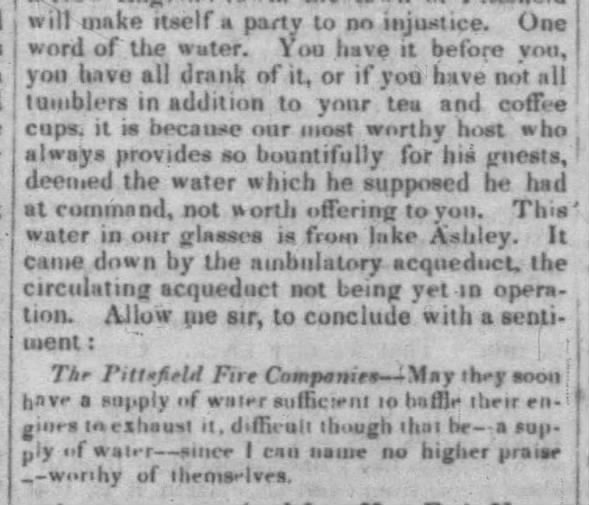
At the big Firemen's banquet or supper or levee on January 15, 1851, reportedly attended by 200 guests, Hoadley spoke at some length on "the great subject of water," specifically the merits of Ashley water:

“The great subject of water, which is exciting a great deal of interest in town just now, is one upon which we have all to form opinions that shall guide us in immediate action, and it is important that we should form wise opinions. About the excellence of the water of Lake Ashley, about its desirableness in our village, I think sir there can be but one opinion.  --Pittsfield Sun, January 23, 1851

Knowing Hoadley and his hobby, some in the audience could not have been too surprised by his closing revelation:

"This water in our glasses is from lake Ashley. It came down by the ambulatory aqueduct, the circulating aqueduct not being yet in operation.

23 Jan 1851, Thu The Pittsfield Sun (Pittsfield, Massachusetts) Newspapers.com
Concerning the obvious desirableness of pure drinking water from Ashley, Franklin E. Taylor concurred in this toast To the Pontoosuc Engine Company, No. 2:

"May we all soon have the Ashley Pon-too-suc (Pond-to-suck)."

Related posts:

Saturday, March 11, 2017

Herman Melville's sketch of his uncle, Thomas Melvill, Jr.

Much abridged, Herman Melville's reminiscence of Major Thomas Melvill, Jr. was published in The History of Pittsfield by Herman's friend and former neighbor J. E. A. Smith. Below I give Melville's complete sketch, with missing text supplied from the transcription by Merton Sealts, Jr. in his article on "Thomas Melvill, Jr., in The History of Pittsfield," Harvard Library Bulletin 35.2 (Spring 1987): 201-217. As Sealts reports, the manuscript copy (not in Melville's handwriting) is in the Gansevoort-Lansing collection, Manuscripts and Archives Division, The New York Public Library.

This image is from my personal copy of the 1987 article by Sealts in the Harvard Library Bulletin:

SKETCH OF MAJOR THOMAS MELVILLE JUNIOR
BY A NEPHEW

I have been asked to contribute to the History of Pittsfield some personal reminiscences of the late Major Thomas Melville Jr. long a resident of that Town.
As the request comes—and somewhat urgently—from a near relative I willingly comply though having known my uncle only in the latter and uneventful portion of his life my reccolections are somewhat meagre.
It may be well to begin with a brief recital of his career prior to his residence in Pittsfield.
He was born in Boston in the year 17— [1776] the eldest son of Major Thomas Melville of the Boston Tea Party and an officer of the Revolution, with whose cocked hat & small-clothes, worn to the end of his life, passed away probably the last vestige in New England of the old costume.
In early life at the age of seventeen some time towards the close of the last Century he sailed to France, and eventually became a banker in the Capitol. There he resided until about the year 18— [1811.] Consequently he was familiar with the stirring events which took place in that Country from the closing years of the Republic through the Consulate, and down to a period towards the collapse of the first Empire.
At that time when the part which France had taken in our War of Independence was still fresh in the minds of both Countries, no foreigners were so cordially welcomed into French society as the Americans.
Indeed the friendleness [friendliness] was if any thing, stronger on the French side than on ours, & for this reason, it may be, that the gratitude of the beneficiary seldom exactly comes up to the good will which the benefactor in some instances feels towards him. Under such auspices any young countryman of Washington, if possessed of the requisite manners found his way easy and delightful in the bright circles of the City on the Seine.
So fared it with my kinsman, as I have every reason to infer.
In certain departments the business of a European Banker makes it his interest to be hospitable. If his disposition coincide with his interest, his entertainments may be often extremely agreeable from the piquant mixture of the Company. The polite Bostonian's dinner in Paris lacked not as I have been told this quality, nor the zest of a very social nature in the host. Many distinguished countrymen did he from time to time entertain at his table, together with the Frenchmen of note invited to meet them. Among others, I have frequently heard him name Lafayette.
In the year 1800 my father Allan Melville, then quite young, made his first visit to Europe, and was for some month's the banker's guest. Though the brothers were never closely connected in business, they always retained a warm feeling for each other.
Of an enterprising & sanguine temper—too much so indeed—my uncle aside from his special vocation, engaged in various tempting ventures, incident to the wars then convulsing the Continent. Naturally he shared in many fluctuations.
I remember his telling me that upon one occasion, after prosperously closing in London some considerable affair, he held in his hands, before a cheery coal fire, the proceeds—negotiable bills, and for so large a sum, that he said to himself—holding them at arms length—"This much is sure—here it is—the future is uncertain—break off then, and get thee back to Boston Common." But a false friend—Hope by name (not one of the noted Amsterdam House) advised to the contrary.
Eventually such reverses overtook him, that recrossing the Ocean he returned to his father's roof. With him he brought—and to a strange land for them—his wife & two [four] young children: for as— I should have previously mentioned—he had married in Paris, the bride being a lady of Spanish extraction.
A miniature I have seen of her, presents a countenance of much beauty and of that kind which forcibly arrests the attention.
The War of 1812 breaking out about this time, he received an appointment as Commissary with the rank of Major, and was stationed at Pittsfield.
Thither were sent many prisoners from the Canadian frontier. These were lodged on grounds, then without the village, and known as "The Cantonment." 
 Subsequently he bought the Estate on the Lenox Road, now 1870 the property of Mr. John R. Morewood, a New York merchant.
The purchase was made of the occupant Mr. Elkanah Watson, a gentleman whose interesting life of travel & observation in an era of Historic importance, has been recorded in an entertaining volume by his son. 
The Estate was originally owned and the mansion & extensive offices built, at an early period by Mr. Henry Van Scha[a]ck a rich Mynheer & for those days an adventurous emigrant, from the adjoining river country of the old Patroons. 
Some of the large barns have been burned, others have decayed, and new buildings substituted therefor.

But the mansion still stands, though somewhat changed, and partly modernized externally. 
It is of goodly proportions, with ample hall, & staircase, carved wood-work & solid oaken timbers, hewn in Stockbridge.
These timbers as viewed from the cellar, remind one of the massive gun deck<s> beams of a line-of-battle ship. On this farm Major Melville interested himself largely in the raising of sheep and improvement of their breed, also in the introduction of some crops not previously known in the county. 
 He was the second President of the Berkshire Agricultural Society and had much to do with originating it.
Not far from this period his foreign wife paled and withered a transplanted flower.
His second bride an exemplary lady, was a ward of Gen. Dearborn of Roxbury Mass.
Ultimately he experienced new misfortunes; and living in the plainest way became a simple husbandman, though of broad acres, whereof many lay fallow, or in lake or pasture.
Near this period I first saw him. It was in 1831, I think, at evening, after a summer day's travel by stage from Albany. Well do I remember the meeting, upon that occasion, between him and my father. It was in the larch-shaded porch of the mansion looking off, under urn-shaped road-side elms, across meadows to South Mountain.
They embraced, and with the unaffectedness and warmth of boys—such boys as Van Dyke painted.
In 1836 [1833] circumstances made me for the greater portion of a year an inmate of my uncle's family, and an active assistant upon the farm. He was then grey, but not wrinkled; of a pleasing complexion; but little, if any, bowed in figure; and preserving evident traces of the prepossessing good looks of his youth.
His manners were mild & kindly, with a faded brocade of old French breeding which—contrasted with the surroundings at the time—impressed me as not a little interesting, nor wholly without a touch of pathos.
He never used the scythe, but I frequently raked with him in the hay-field. At the end of a swath, he would at times pause in the sun, and taking out his smooth-worn box of satin wood, gracefully help himself to a pinch of snuff, partly leaning on the slanted rake, and making some little remark, quite naturally, and yet with a look, which—as I now recall it—presents him in the shadowy aspect of a courtier of Louis XVI, reduced as a refugee, to humble employment in a region far from the gilded Versailles.
At that period on Sundays between services, the broad bar-room of the principal tavern of Pittsfield—long since removed—situated on the village square, was the convenient resort, (not for unsober purposes, since the decanters were inexorably closed) of many church attendants whose dwellings were at a distance. Here too dropped in the magnates of the village. Eminent among them was the late Edward A. Newton, well known as a man of fortune, who had travelled, and who lived with all things handsome about him, like the old English Squire in the play.
The exchange of salutations and pinches of Rappee, between this tall & stately gentleman, and my plainly clad but courtly kinsman, presented a picture upon which the indigenous farmers there assembled, gazed with eager interest, and a kind of homely awe. It afforded a peep into a world as unknown to them as the Vale of Cashmere to the Esquimaux Indian.
To the ensuing conversation, also, they listened with the look of steers astonished in the pasture at the camel of the menagerie passing by on the road. It is different now. Those primitive days, with whatever picturesqueness pertained thereto, are gone with the old Elm of the Green.
By the late October fire, on the great hearth of the capacious kitchen of the old farm-mansion I remember seeing the Major frequently sit, just before early bed time, gazing into the embers, his face plainly expressing to a sympathetic observer, that his heart—thawed to the core under the influence of the genial flame—carried him far away over the ocean to the gay Boulevards.

Suddenly under the accumulation of reminiscences, his eye would glisten, and become humid: and with a start he would check himself in his reverie, give an ultimate sigh; as much as to say, "Ah, well!" & end with an aromatic pinch of snuff. It was the French graft upon the New-England stock, which produced this autumnal apple; perhaps the mellower for the frost.
Let it not be inferred here from that the amiable side of my uncle's character partook of indolence. On the contrary he was of a very industrious and methodical turn of mind. Mighty folios of accounts, dating back to the days when he was commissary, with laborious diaries of the farm, remain monuments of his diligence.
By the hearth fire above mentioned, he often at my request, described some of those martial displays and spectacles of state which he had witnessed in Paris in the time of the first Napoleon. But I was too young & ignorant then, to derive the full benefit from his pictorial reccollections.  
Nor though he possessed so much information, and had a good understanding was his mind of that order which qualifies one for drawing the less obvious lessons from great historic events happening in one's own time, and under one's eyes. 
In 1837, though advanced in years, the Major yielding to strong inducements, and with a view of ultimate benefit to his children went to Galena in Illinois, there to occupy a responsible position in a mercantile house.
Eventually when circumstances permitted his family joined him.
In 1841 [1840] I visited my now venerable kinsman in his western home, and was anew struck by the contrast between the man and his environment.
He died at Galena in 184- [1845] not without the consolation of knowing that his venturous removal so late in life to what was then the remote West, had in part been already attended with many happy results to his family, the promise of which benefits had generously impelled the step.

But enough. He survives in my memory a cherished inmate—kindly and urbane—one to whom, for the manifestations of his heart, I owe unalloyed gratitude and—for the rest—pleasingly though strangely associated with Tuileries and Taghconics.
[--Herman Melville]