Showing posts with label Berkshire. Show all posts

Monday, May 6, 2024

Why "On Onota's Graceful Shore" can't be the poem Melville read aloud in August 1851

Jay Leyda, The Melville Log Vol. 1 (Harcourt, Brace and Company, 1951) page 420

A digitized version of J. E. A. Smith's "On Onota's Graceful Shore" in the 1896 volume Souvenir Verse and Story is accessible via the Library of Congress. Image 30 of Souvenir verse and story : memorial of fifty years | Library of Congress

Read it closely and see, "On Onota's Graceful Shore" can't have been the poem Melville recited in the rafters of a barn on August 7, 1851. How so? Because nothing about it fits the description of form (epic, long, taking up a "stout" manuscript), content (ultra patriotic "glorification of the United States" with "polite slanging of all other nations") and meter ("heroic measure" = iambic pentameter) that Evert Duyckinck gave in a letter to his wife. Duyckinck had seen and heard Melville's performance in the loft with a group of summer excursionists. In giving the details to his wife, Duyckinck provided a sample of the favorable commentary that Melville had delivered in the form of affirming interjections like "great," "glorious," and "By Jove that's tremendous." As Duyckinck also reported, the "flattered" poet was there, too, listening to Melville's reading and dramatic asides while sitting "thoughtful on a hay tuft."
Smith's poem is a ballad of only 88 lines in mostly iambic tetrameter, remembering local hero David Noble and his brave, selfless actions during the American Revolution. 

The long poem in "heroic measure" glorifying the United States that Herman Melville read from with enthusiasm in August 1851 was "Destiny." Recently composed by Melville's future brother-in-law John Chipman Hoadley. 

Destiny. A Poem By John C. Hoadley. 1851
Gansevoort-Lansing collection. Manuscripts and Archives Division.
The New York Public Library. Astor, Lenox, and Tilden Foundations.

Transcribed here from the manuscript in the Gansevoort-Lansing collection at NYPL:
Hoadley felt encouraged by "Melville's hearty praises" for his unpublished "national poem," as he wrote Evert Duyckinck from Pittsfield MA on September 9, 1851.


Manuscripts and Archives Division, The New York Public Library. "Hoadley, John Chipman (1818-1886)" The New York Public Library Digital Collections. 1851. https://digitalcollections.nypl.org/items/d9236f50-693b-0133-a932-00505686d14e

Once again, John C. Hoadley not Joseph Edward Adams Smith was the "flattered author" of the poem Herman Melville recited aloud in the loft of a Berkshire barn on August 7, 1851. With gusto, as evidenced in dramatic asides like "great," "glorious," and "By Jove that's tremendous!"

United States National Flag 1851-1858
via The New York State Military Museum

So what?

  1. So Jay Leyda ID'd the wrong guy and wrong poem in The Melville Log Vol. 1 (Harcourt, Brace and Company, 1951) page 420, as did Merton M. Sealts, Jr. in The Early Lives of Melville (The University of Wisconsin Press, 1974) pages 29-30; and Hershel Parker after them. (Nobody's perfect!)
  2. So prosody is a thing. And meter matters every now and then. Score it New Critics 1, Melville Biographers 0
  3. So Herman Melville the great American writer was a great American patriot as well. In his prime, finally done with writing THE WHALE, Melville extolled a glorification of the United States in epic verse composed by his fellow citizen and townsman, and future brother-in-law.
  4. So Melville openly practiced what he had preached in the guise of A Virginian Spending July in Vermont: "Let America, then, prize and cherish her writers; yea, let her glorify them."
  5. So Hoadley was the "thoughtful sensible man" (Duyckinck's impression before learning his name) who afterwards guided the group to Ashley Pond. That the poet turned out to be so competent a "pilot" on the trip there makes a lot more sense now. Besides being an ambitious versifier and soon-to-be suitor, John Chipman Hoadley was an engineer and local expert on the water-works committee. Considering his well-documented civic and professional interest in the acquisition of Ashley Pond aka Lake Ashley as a potential water supply for the village of Pittsfield, Massachusetts, it's safe to say that Hoadley knew the way to Ashley Pond better than anybody.
  6. So Melville came to know Hoadley even earlier than previously thought.
  7. So let's give J. E. A. Smith a break and Melville, too. Smith only ever intended his ballad "On Onota's Graceful Shore" for a humble tribute or "souvenir" to the memory of farmer-soldier David Noble and his gallant deeds. This and all the fugitive pieces collected in Souvenir Verse and Story (1896) were offered mainly as "mementos of the past." Melville's vocal bursts of approval ("Great" "Glorious" "By Jove that's tremendous") would have sounded pretty weird and disrespectful if uttered after any of the 88 tetrameters that comprise Smith's modest ballad. Confronting the inaptness of Melville's recorded comments when applied to such "dreary poetry" as "Onota's Graceful Shore," Hershel Parker not unreasonably figured Melville must have been joking. "Deftly managing not to let Smith gain an inkling that he was being satirized," as Parker has it in Melville: The Making of the Poet (Northwestern University Press, 2008) page 28; reprinted in his Historical Note for the 2009 Northwestern-Newberry Edition of Published Poems, edited by Robert C. Ryan, Harrison Hayford, Alma MacDougall Reising and G. Thomas Tanselle. Happily, however, the author of Mardi: and a Voyage Thither was not one to mock the work of Joseph Edward Adams Smith or any less gifted writer in front of gathered neighbors and friends. By contrast, Hoadley's national poem in manuscript presented a different order of composition--not a song but a symphony had been at least attempted. Whatever its artistic merit, the completion of any work that ambitious and patriotic deserved respect. Evidently Melville gave "Destiny" its due, and then some. His comments, however extravagant or over-the-top they may sound now, were supportive and sincerely made. That Hoadley felt encouraged by "Melville's hearty praises" we know for certain, as he testified in his letter to Duyckinck on September 9, 1851, little more than a month after Melville's dramatic reading in the barn loft. Jay Leyda did not miss much of importance in the Duyckinck family papers at NYPL, but apparently he never ran into Hoadley's letter in the Literary Correspondence of Evert A. and George L. Duyckinck. It's not down in the 1951 Melville Log (Harcourt, Brace and World) or the 1969 reprint by Gordian Press with additional material. Or any Log-based biography, yet.

Related posts:

Monday, May 15, 2023

General and gentle readers

If Melville's lost "love letters" to Nathaniel Hawthorne should ever turn up (in manuscript, I mean, the actual, physical documents we only know because family members transcribed them for publication in the 19th century), I would first run for the one written on "a rainy morning" in May 1851 to confirm or disprove my hunch that Melville charged Hawthorne with disturbing the peace of "gentle" not "general" readers. I'm talking about that great "Dollars damn me" letter formerly and tentatively dated June1? but assigned to early May 1851 by Hershel Parker in the first volume of Herman Melville: A Biography (Johns Hopkins University Press, 1996) pages 840-841. 

In the 21st century Parker dared some prominent Melville critics either to accept or challenge his moving it ahead to early May; see Melville Biography: An Inside Narrative (Northwestern University Press, 2012) pages 239-240. Since then the bad influence of fact-averse "critics without information" has only gotten worse. In this particular case, however, the underlying problem was that Parker had never clearly or sufficiently explained his reasoning. Given the chance to nail it in the 2nd and 3rd Norton Critical Edition of Moby-Dick (page 566) he said it was "complicated" and mistakenly gave the wrong year ("May 16, 1850" instead of 1851) when footnoting the crucial letter from Augusta to Allan Melville that justified the earlier date. To make everybody happy (except Neo-Communists, obviously), I will belatedly attempt to do what Parker asked back in 2012, and re-scrutinize the evidence for his re-dating of the "dollars damn me" letter. To that end I hope to obtain a photocopy or scan of Augusta's letter, currently at Arrowhead. When/if successful I will transcribe what I can and report back. 

Update: done

https://melvilliana.blogspot.com/2023/05/augusta-melville-letter-to-allan.html

and done!

https://melvilliana.blogspot.com/2023/10/mid-to-late-may-maybe.html

Meanwhile, here is a possible emendation to mull over in the wonderful letter dated "[early May] 1851" in The Divine Magnet: Herman Melville's Letters to Nathaniel Hawthorne, edited by Mark Niemeyer (Orison Books, 2016). My proposed revision (also begun, like Melville's epistle, on a rainy morning in May): instead of " 'general readers' " make it " 'gentle readers' " but keep the phrase enclosed in quotation marks. 

Granted, the difference might not be so compelling or meaningful as the universally accepted correction of "revere" to "reverse." Observing how the world laughs at truth and truth tellers (mocked in our time as conspiracy theorists), Melville flipped (reversed not revered) the legendary laughter-test of Lord Shaftesbury, wherein truth reveals itself by withstanding ridicule. 

About a different subject, the disturbing effects of Hawthorne's darkest fictions on his audience, here is what Melville had to say as transcribed and first printed in 1884 by Julian Hawthorne:

By the way, in the last “ Dollar Magazine " I read “The Unpardonable Sin.” He was a sad fellow, that Ethan Brand. I have no doubt you are by this time responsible for many a shake and tremor of the tribe of “general readers.

--  Hawthorne and His Wife (Boston, 1884) page 404.

Melville found "Ethan Brand" in the May 1851 issue of  Holden's Dollar Magazine. The title character is one of Hawthorne's more devilish mad-scientist types, a psycho lime kiln operator who has abused others and made himself crazy in searching obsessively for "The Unpardonable Sin," instead of properly monitoring his own heart. With horror stories like that, Hawthorne stood accused by Melville of causing extreme discomfort in his readers. 

The extent to which the figurative shakes and tremors alleged by Melville are also supposed to indicate real mental and physical distress remains unclear, at least to me. For a visual image of the darkness that might impart "many a shake and tremor," literally or metaphorically, to any kind of reader, general or gentle, you have only to look at the frightening 1851 illustration,

"a frontispiece by Darley representing a wild figure with up-stretched arms, silhouetted against a mighty flame on the brow of a precipice."
--Katharine Lee Bates, Intro to The Snow Image and Other Twice-Told Tales (New York, 1899 and 1902).

Unchallenged before now, the expression "general readers" has been taken to mean ordinary or common, often with express or implied disparagement of skimmers as opposed to divers. The former stick to familiar but deceptive surfaces while the latter, eagle-eyed readers like you, me, and Melville, brave unknown and often unknowable depths of things. Already in Mardi (1849) William Charvat found symptoms of Melville's downright hostility "to the general reader, and to the world." 

Charvat, William. “Melville and the Common Reader.” Studies in Bibliography, vol. 12, 1959, pages 41–57 at page 49. JSTOR, http://www.jstor.org/stable/40371255.
Accessed 15 May 2023.

In Charvat's influential view the "tribe of general readers" means those "who would not tolerate the unpleasant truth" but might be tricked by disguised "profundities," artfully hidden "under a pleasant or sensational narrative surface" (page 52). 

With more attention to context, as Charlene Avallone pointed out in the late 1980's, Melville's expression "general readers" may be understood to designate readers of magazines.

Avallone, Charlene. “Calculations for Popularity: Melville’s Pierre and Holden’s Dollar Magazine.” Nineteenth-Century Literature, vol. 43, no. 1, 1988, pages 82–110. JSTOR, https://doi.org/10.2307/3044982. Accessed 15 May 2023.
 
Which is to say, most everyone. Although Avallone adopts the term general readers throughout, her excellent case for the familiarity of magazine readers with wildly sensational matter effectively undercuts Melville's reported claim that "the tribe of 'general readers' " would somehow have been distressed by provocative content in Hawthorne's magazine fictions. 
 
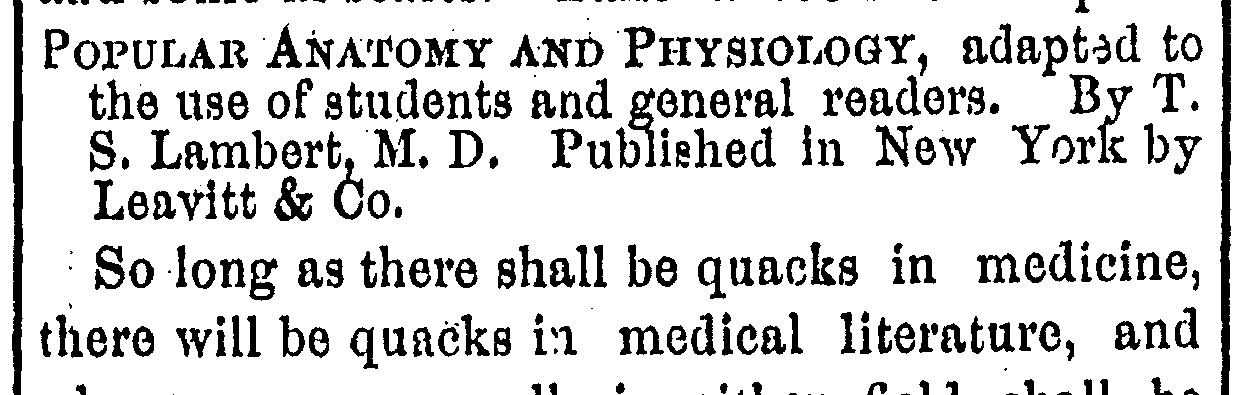
In usages at mid century, when Melville was writing to Hawthorne, the term general readers usually denotes readers either of periodical literature (magazines and newspapers) or works of non-fiction, for example textbooks of history and popular science, say Anatomy and Physiology. 
 
Springfield, Mass. Republican - April 28, 1851
Concerning the longer phrase "tribe of general readers," Melville's usage as transcribed by Julian Hawthorne in 1884 is the only one published in 19th century works accessible via Google Books and HathiTrust Digital Library. Zero hits before 1900 outside of Melville's letter to Hawthorne. 

 
On the other hand, searching in the same databases for "tribe of gentle readers" yields two results in British sources, each occurring in a piece of literary criticism. First, from the cutting review of The Spirit of Discovery, or, The Conquest of Ocean in the July 1805 number of The Edinburgh Review:

SOME years ago, Mr Bowles presented the public with a collection of sonnets and short poems. The reception it met with was not unfavourable, especially from that tribe of gentle readers to whom every running stream recals the memory of joys that are past, and every rustling leaf gives sad anticipation of coming sorrow.

 https://hdl.handle.net/2027/inu.30000093204141?urlappend=%3Bseq=325%3Bownerid=13510798895677775-329

And second, from "Canons of Criticism" by "L." in The Monthly Magazine for November 1827:
... Law, physic, divinity, and politics are precisely on the same footing; and so, too, are music, and painting, and coach-building, and tailoring (male and female), porter-brewing, and the manufacture of polonies and sausages. To betray these secrets would not only be treason to the craft, but would deprive the whole tribe of gentle readers of seven-eighths of their pleasure. What would they say to a Marplot who should come on the stage and tell the audience, “ these jewels are paste”—“this robe calico, and not silk”—and this terrible irruption nothing in the world but a pennyworth of gunpowder and nitrate of strontian?” I would never sit in the same boat (as Horace says) with such a man: so do not look for it at my hands.

https://hdl.handle.netn/2027/umn.31951000903300n?urlappend=%3Bseq=490%3Bownerid=13510798902549127-552

The first-listed instance of the phrase tribe of gentle readers in the Edinburgh Review for July 1805 is most interesting for negative criticism of the attempt at epic poetry by William L. Bowles, satirized by Byron as "harmonious Bowles" in English Bards and Scotch Reviewers. A footnote in many editions of Byron's poem directs readers to the April 1805 notice of Strangford's Camoëns in same volume with the essay on Bowles. One way or another, Melville could have encountered the sonnet loving "tribe of gentle readers" in Volume 6 of the Edinburgh Review and remembered it when writing to Hawthorne in May 1851.

As printed in 1884 the phrase "general readers" in Melville's letter is enclosed in quotation marks. Melville could be quoting magazine advertisements there, but the comprehensive sense of "general readers" would seem to render the quotation marks gratuitous. Arguably, the class of gentle readers might be regarded as narrower, more exclusive or refined, and therefore more deserving of quotation marks--whether used straightforwardly, or ironically employed as scare quotes

Hawthorne and his mosses - NYPL Digital Collections

In Hawthorne and His Mosses Melville put the word gentle in quotation marks when comparing Hawthorne to Edmund Spenser, author of The Faerie Queene:

"when Spencer was alive, he was thought of very much as Hawthorne is now,--was generally esteemed accounted just such a "gentle" harmless man.

Generally accounted by general readers, presumably. Melville's phrasing as printed in the Literary World on August 24, 1850 nicely anticipates his epistolary reference in May of the following year to "general readers." Even so, in "Hawthorne and His Mosses" the word gentle is what got the scare quotes. In similar fashion, perhaps, when inditing the May 1851 letter Melville might have conflated general and gentle readers--in his head, whichever word his hand finally wrote. Well! If Hawthorne can be generally regarded as "gentle," then I guess his readers can, too.

Related posts

Wednesday, August 11, 2021

Wordsworth's Prelude, anonymous Literary World review

An anonymous review of Wordsworth's poem The Prelude appeared in The Literary World on August 31, 1850, one week after the same journal printed the second part of Herman Melville's now famous review essay, Hawthorne and His Mosses. The copy of the Literary World volume 7 at Princeton University is Google-digitized and accessible courtesy of HathiTrust Digital Library

The unsigned 1850 review of The Prelude is wrongly attributed to Professor Henry Reed in Hershel Parker's Historical Note for the scholarly edition of Melville's Published Poems (Northwestern University Press and The Newberry Library, 2009) at page 409. More plausibly, in a 1981 essay on "Melville & the Berkshires," Parker credited Evert Duyckinck for the "predictable" August 31, 1850 review. There Parker called it
"a set of random quotations from various parts of the poem intermingled with pious, humbugging commonplaces."

-- Hershel Parker on Melville & The Berkshires: Emotion-Laden Terrain, "Reckless Sky-Assaulting Mood," and Encroaching Wordsworthianism in American Literature: The New England Heritage, ed. James Nagel and Richard Astro (Garland, 1981) pages 65-80 at page 68.

Considering Evert Duyckinck's editorial work on Melville's great Hawthorne essay, and the intensity of their summertime socializing in Berkshire, it would not be too surprising to find some trace of Melville's influence in the review of Wordsworth's The Prelude that appeared in The Literary World on the last day of August 1850. 

Anonymous review of The Prelude, page 167
 Literary World - August 31, 1850

Anonymous review of The Prelude, page 168
 Literary World - August 31, 1850

Henry Reed's "Second Paper" on Wordsworth appeared in the Literary World on September 14, 1850. "Second Paper" does mean there was a "First Paper" on Wordsworth, but the anonymous review of The Prelude on August 31, 1850 was not it. On June 8, 1850 the Literary World announced the first one this way:

A paper on Wordsworth from Prof. Henry Reed, communicating passages from the Poet's Correspondence, in our next.

As promised, Reed's first paper on Wordsworth appeared in the next issue of the Literary World on June 15, 1850. Both papers were submitted from Philadelphia and subscribed, HENRY REED.

https://hdl.handle.net/2027/njp.32101064475088?urlappend=%3Bseq=173

Passages in Advance / from Wordsworth's New Poem "The Prelude" were printed from the forthcoming Appleton's edition in The Literary World for August 10, 1850. These passages were selected and sent from Pittsfield by Evert A. Duyckinck when he was much with Melville, as revealed in Duyckinck's letter to Margaret Panton Duyckinck dated August 4, 1850:

My dear wife:

I dropped you a line yesterday in a parcel to the office which Melville says I must have been tempted to make up by the Yankee atmosphere. I have the proof sheet of Appleton's edition of Wordsworth's posthumous poem "The Prelude" with me to read & use at leisure in the paper. [Cornelius] Mathews told me that [Rufus W.] Griswold was about to publish a whole book of it in his next week's magazine, so I concluded that my next week's paper should have its share & made up a parcel by mail with the necessary directions at once. So you see that the Literary World can be edited at a distance of 160 miles--so that need be no obstacle to our settling here if you choose....  --as transcribed in Steven Olsen-Smith, Melville in His Own Time (University of Iowa Press, 2015) page 34.

The issue of the New York Literary World  with "Passages in Advance" mailed from Pittsfield also contains a review of  Aesop's Fables that Herman Melville might have written. 

Thursday, July 22, 2021

Definitely Destiny

Progress report... Today I received from the incomparable NYPL images of John C. Hoadley's manuscript poem "Destiny" in the

Gansevoort-Lansing Collection. Manuscripts and Archives Division. The New York Public Library. Astor, Lenox and Tilden Foundation.

Fortunately the handwriting is crystal clear and will be much easier to transcribe than Hoadley's honeymoon letter from Niagara Falls to Augusta Melville. Hoadley failed to get it published, but not for lack of neatness. Length, verse form, and content all match Evert Duyckinck's description of the patriotic poem that Herman Melville read aloud, with gusto, in August 1851.

  • "stout" in manuscript indicating many hundreds of lines? Check, 648 lines of verse.
  • composed in heroic measure, meaning "sounding lines" of mostly iambic pentameter? Check. In rhymed couplets, as guessed on Melvilliana.
  • glorification of the United States with polite slanging at other countries? Check and check! 
The early, methodical slanging at England and individually named nations of Europe and Asia really clinches it. Nothing close appears in J. E. A. Smith's 88 lines. It must be Hoadley's "Destiny" that Melville read aloud in a Berkshire barn, and not, as previously thought, Smith's ballad "On Onota's Graceful Shore."

After the last endnote on numbered page 53 there appears a brief, anonymous endorsement.

Hmmm. Only a sentence but I will ask for permission before giving it. Stay tuned!

Related posts:

Sunday, July 11, 2021

Refresher on heroic measure

"Let America, then, prize and cherish her writers; yea, let her glorify them."
-- A Virginian Spending July in Vermont

While we wait around for scanned images of John Chipman Hoadley's manuscript poem "Destiny," now ordered from The New York Public Library, let me explain why I expect (before seeing any of it) to find that Hoadley composed the long unpublished work he called his "national poem" in iambic pentameter. What I don't know is if Hoadley developed his patriotic theme using rhymed couplets in the manner of Joel Barlow in The Vision of Columbus and The Columbiad and Richard Emmons in The Fredoniad, Americanizing British models by Dryden and Pope. My best guess is YES. But it would be wonderful to find Melville's future brother-in-law on a more daring and ambitious course, sounding off like Milton or Marlowe in mighty MAGA lines of blank verse. 

Rhymed elsewhere in the stanza or not, however arranged in couplets or triplets or quatrains, Hoadley's usual verse line in "Destiny" will contain five metrical feet, mostly iambs. The iamb as English majors recall without any help from Google consists of one unstressed syllable followed by a stressed one. Five iambs or iambuses = iambic pentameter. 
Manuscripts and Archives Division, The New York Public Library. "Hoadley, John Chipman (1818-1886)" The New York Public Library Digital Collections. 1851. https://digitalcollections.nypl.org/items/d9236f50-693b-0133-a932-00505686d14e
Cited above and transcribed in the Melvilliana post on Melville's hearty praises, John C. Hoadley's note of September 9, 1851 to Evert Duyckinck offers good evidence for supposing that Hoadley's pro-American "Destiny" (originally titled "The Union" and declaimed by the author on July 4, 1851 according to Jay Leyda in The Melville Log volume 1 page 416) is the versified "glorification of the United States" that Herman Melville read aloud in August 1851--with great gusto, and in the author's presence, according to Duyckinck. Previously unrecorded in Melville scholarship, this letter firmly links Hoadley to Duyckinck, Melville, and one or more of their Berkshire excursions during the previous month. Hoadley was already a prominent resident of Pittsfield, having moved there in 1848. Hoadley addressed Duyckinck formally as "Dear Sir," indicating a recent and not very close acquaintance. Hoadley thanked Duyckinck for sending him a copy of the Literary World with Duyckinck's account of a trip to Mt. Greylock. Hoadley regretted having to miss the Greylock outing, implying he had been invited as one of the group that included Duyckinck and Melville. Gratefully and casually, as something already known to Duyckinck, Hoadley acknowledged "Melville's hearty praises" for his unpublished "national poem." Since Hoadley had just unveiled his poem in Pittsfield, Mass. on the 4th of July 1851, that leaves only a month or two at most during which Herman Melville could have read it and responded so encouragingly. 


Here is the relevant passage from Duyckinck's letter to his wife dated August 8, 1851, describing how Melville entertained his audience of Berkshire excursionists with a dramatic reading of stirring patriotic verse. It happened in a barn during a summer shower. First, they had to kick out the chickens:
... The morning had been warm and the afternoon was showery, clouds and shadows being the moving scenery to the permanent stagery of the hills. We went on our way rejoicing till a dragging cloud bore down upon us when we turned to the shelter of a barn. Mr M[elville] spied out the loft and we boarded the rafters, dislodging the hens and were nestled here and there in the warm dry hay, the rain pattering its musical accompaniment on the roof. 
Mrs M [Sarah Morewood] had a poet in the company and his poem too a stout MSS of heroic measure, a glorification of the United States in particular with a polite slanging of all other nations in general. The English lady in the straw was not particularly complimented as to her native country in sounding lines which H M read with emphasis (interrupting the flattered author who sat thoughtful on a hay tuft--with such phrases as "great glorious" "By Jove that's tremendous" &c)--but perhaps the most noticeable incident was a gathering of the exiled fowls in a corner who cackled a series of noisy resolutions, levelled at the party. "Turn em out!" was the cry. The author impelled by the honor of his poem charged fearlessly, scattered the critics of the pit, clasping the most obstinate bodily and "rushing" her a rapid descent below." --as transcribed in Steven Olsen-Smith, Melville in His Own Time (University of Iowa Press, 2015) page 58.
About the poem that Melville read aloud in August 1851, certain defining features are revealed in the eye and ear-witness account that Evert A. Duyckinck gave his wife. As described by Duyckinck
  1. The poem was a long one, taking up "a stout MSS." The impressive size indicates a poem with hundreds of lines, maybe thousands.
  2. The poem was composed in iambic pentameter, as specified by Duyckinck's term "heroic measure." (More on that below.)
  3. The poem was extremely patriotic in theme, being "a glorification of the United States." The strong America-First argument of the poem involved "a polite slanging of all other nations in general." Despite whatever formal courtesies may be implied in Duyckinck's adjective "polite," the rhetorical "slanging" at Great Britain might well have offended one of Melville's listeners that showery afternoon in a Berkshire barn: Mrs. Pollack the "English lady in the straw" who according to Duyckinck "was not particularly complimented as to her native country." 
None of these qualities is shared by On Onota's Graceful Shore, the ballad by J. E. A. Smith that Leyda identified (wrongly) as the poem Melville honored by reading aloud, with dramatic "emphasis" and positive commentary. With only 11 stanzas, 88 lines in all, Smith's poem is too short. The subject is one particular Berkshire farmer-soldier and his heroic sacrifices as the American Revolution dawned--not the glory of these United States and Manifest Destiny. 

J. E. A. Smith, Souvenir Verse and Story
Springfield, Mass.: Clark W. Bryan Company, 1896

The meter of "Onota's Graceful Shore" is iambic but does not qualify as "heroic measure" since each line contains only four feet. According to standard 19th century textbooks of English grammar, the "heroic line" was understood to mean iambic pentameter, a line of verse "composed of five Iambuses." Iambic pentameter was considered the metrical form best "suited to solemn and sublime subjects" with "far more dignity" than other kinds of meter. 

§ 9. The Heroic line.
We now come to the eighth species of Iambic line. This is the heroic line composed of five Iambuses. This line is suited to solemn and sublime subjects, and it has far more dignity than any of the measures before mentioned. In long pieces it is frequently varied by the intermingling of secondary feet, but there are numerous in. stances of a succession of Iambuses through several lines.

It is employed in couplets, as in POPE's Essay on Man, PARNELL's Hermit, and GOLDSMITH's Deserted Village; it is employed in quatrains, as in GRAY's Elegy in a Country Churchyard; it is employed in the Spenserean stanza, as in the Faery Queen and Childe Harold; it is employed in blank verse, as in MILTON's Paradise Lost, THOMSON'S Seasons, ROGERS’ Italy, and COWPER's Task; lastly, it is employed in triplets, with an additional short line to complete the stanza. It is peculiarly suited to all subjects where dignity is required, and should never be employed when the subject is either trivial or gay. A specimen from GRAY's Elegy, showing the fitness of this measure for solemn subjects, will furnish the first example:
The curfew tolls, the knell of parting day,
   The lowing herd winds slowly o'er the lea,
The ploughman homeward plods his weary way
   And leaves the world to darkness and to me.

-- Erastus Everett, A System of English Versification (New York and Philadelphia, 1848) page 36.

Numerous editions of Lindley Murray's English Grammar uphold the definition of heroic measure as the conventional term for a line that specifically "consists of five Iambuses." 


5 The fifth species of English Iambic, consists of five Iambuses.
How lov'd, how valu'd once, avails thee not,
To whom related, or by whom begot,
A heap of dust alone remains of thee;
'Tis all thou art, and all the proud shall be. [Alexander Pope, Elegy to the Memory of an Unfortunate Lady
Be wise to-day, 'tis madness to defer:
Next day the fatal precedent will plead;
Thus on, till wisdom is pushed out of life. [Edward Young on procrastination, from Night Thoughts, Night 1]
This is called the Heroic measure. In its simplest form it consists of five Iambuses; but by the admission of other feet, as Trochees, Dactyls, Anapæsts, &c. it is capable of many varieties. Indeed, most of the English common measures may be varied in the same way, as well as by the different position of their pauses. 

Heroic Measure (Pentameter) is made up of five iambic feet. In its rhymed form it is the measure of Chaucer and Spenser, of Dryden and Pope, of Cowper, Campbell, and Byron; as, 
True ease in writing comes from art, not chance
As those move easiest who have learn'd to dance....
[Alexander Pope, An Essay on Criticism]
-- Charles William Bardeen, A System of Rhetoric (New York, 1884) page 639.
Unlike Smith's ballad, Hoadley's "Destiny" is a genuinely "stout" production taking up 53 manuscript sheets in the bound copy now held in the Gansevoort-Lansing collection of The New York Public Library. Both the original title "The Union" and the revised one, "Destiny," are consistent with a work devoted to glorifying the United States, as is Hoadley's own reference to his "national poem." How well the actual content matches Evert Duyckinck's description, including the "polite slanging" at other nations, remains to be seen. Likewise the number of feet or beats per line. "Onota's graceful shore" has only four. The one that Melville read and loved has five, if Duyckinck got the meter right. Obviously, I'm trusting that the veteran New York editor and literary critic knew heroic measure when he heard it. Confidence! Heroic measure means pentameter. Wherever you hear it, even in the rafters. 

Related posts

Thursday, July 1, 2021

Hoadley's national poem, cheered by Melville

Ashley Lake Loop Trail - Photo by Kimberly Kaigle
In the loft of a Berkshire barn one rainy afternoon in August 1851, Herman Melville entertained a group of fellow summer excursionists by reading somebody else's ultra-patriotic poem out loud, with enthusiasm:
interrupting the flattered author who sat thoughtful on a hay tuft—with such phrases as “great” “glorious” “by Jove that’s tremendous” &c. 
  --Evert A. Duyckinck, letter to his wife Margaret dated August 8, 1851; as quoted in Luther Stearns Mansfield, Glimpses of Herman Melville's Life in Pittsfield, American Literature (March 1937) pages 39-40.
Evert A. Duyckinck was there. The letter from Duyckinck giving the circumstances of Melville's performance the day before (Thursday, August 7th) is transcribed and conveniently available in Steven Olsen-Smith, Melville in His Own Time (University of Iowa Press, 2015) pages 57-8. In The Melville Log volume 1 (Harcourt, Brace and Company, 1951) pages 420-1), Jay Leyda identified the lucky poet as Joseph Edward Adams Smith and the poem as Smith's "On Onota's Graceful Shore," eventually published in Souvenir Verse and Story (Springfield, Mass., 1896). 

Somehow Leyda got the wrong poet and poem, as did Merton M. Sealts, Jr. after him and Hershel Parker after them--Sealts in The Early Lives of Melville (University of Wisconsin Press, 1974) pages 29-31; and Parker in the first volume of Herman Melville: A Biography Volume 1, 1819-1851 (Johns Hopkins University Press, 1996; paperback 2005) pages 855-6. On closer inspection, Smith's poem, subtitled "A Ballad of the Times that Tried Men's Souls," does not match up with any part of Duyckinck's eye and ear-witness description. "Onota's Graceful Shore" is a fairly short piece of eleven stanzas--octets, so 88 lines in all, by no means the stuff of a "stout" manuscript as Duyckinck described it. Smith's ballad is composed in sing-song couplets of rhyming iambic tetrameter, not what Duyckinck called "sounding lines" of more dignified pentameter to be expected of "heroic measure" or heroic verse in English; and it honors a particular Berkshire farmer-soldier named David Noble for decisive action as a militia leader, with no obvious aim or effect of exalting "the United States in particular with a polite slanging of all other nations in general." Instead of nationalist zeal, Smith's poem exhibits decidedly regional pride along with a kind of philosophical resignation over the absence of any tangible earthly reward for the local patriot's sacrifices:
"His memory on Onota's shore,
Only that, and nothing more!"  --Souvenir Verse and Story
Here below is more of the relevant passage from Duyckinck's letter to his wife as transcribed by Steven Olsen-Smith in the introduction to Melville in His Own Time:
Mrs M had a poet in the company and his poem too a stout MSS of heroic measure, a glorification of the United States in particular with a polite slanging of all other nations in general . . . which H M read with emphasis (interrupting the flattered author who sat thoughtful on a hay tuft--with such phrases as "great glorious" "By Jove, that's tremendous" &c)--but perhaps the most noticeable incident was a gathering of the exiled fowls in a corner who cackled a series of noisy resolutions, levelled at the party. "Turn em out!" was the cry. The author impelled by the honor of his poem charged fearlessly, scattered the critics of the pit, clasping the most obstinate bodily and "rushing" her a rapid descent below." (page xvii)
As a graduate student on a mission from Hershel Parker, Olsen-Smith re-examined the manuscript at NYPL and corrected one earlier misreading in the passage above. According to Duyckinck the unruly hens were really "critics of the pit" not "cuties of the pit" as Mansfield and Leyda erroneously had it. Duyckinck pictured those evicted chickens as noisy critics, jeering like the groundlings in Shakespeare's day. 

Leyda's misidentification of J. E. A. Smith in this case appears to have been influenced by Duyckinck's explicit reference to "one Smith known as 'the mad poet'" in another letter to his wife, dated August 9, 1851, enclosing Smith's pseudonymous newspaper article "A Petit Fancy Dress Party in Berkshire" (Boston Evening Transcript, August 7, 1851). (For the text of this later letter, see Melville in His Own Time, pages 58-60.) Signed "Miantonomah," the 1851 newspaper sketch by the "mad poet" J. E. A. Smith tattled about a recent masquerade hosted by the Morewoods at Broad Hall, one that Melville seems not to have attended.

But Evert Duyckinck did not name Smith or any poem title when telling his wife about Melville's energetic reading in the hayloft. Rather, as Duyckinck described him the "flattered author" turned out to be "a thoughtful sensible man" who afterward guided the party safely up steep mountain slopes to Ashley Pond aka "Washington Lake." Most likely the unnamed "Poet" in Sarah Morewood's train that rainy afternoon of August 7, 1851 was not "mad poet" Smith but Melville's future brother-in-law John C. Hoadley. Significantly, Hoadley had already been associated with Sarah Morewood in public readings of original verse around Pittsfield. As quoted from Smith's History of Pittsfield in Leyda's Melville Log page 394, the dedication of the new Pittsfield Cemetery on September 9, 1850 featured the choral performance of odes “by John C. Hoadley, Mrs. Emily P. Dodge and Mrs. J. R. Morewood." In Herman Melville: The Making of the Poet, Hershel Parker adds that “In 1851 Hoadley read his own poetry aloud in Pittsfield at the Fourth of July celebration (again with Melville’s neighbor, Sarah Morewood)." Same information appears in Parker's Historical Note for Herman Melville's Published Poems (Northwestern University Press, 2009) on page 347.

As the evidence of Hoadley's September 1851 letter to Duyckinck (transcribed below) suggests, Hoadley's patriotic "national poem" was probably the "stout" production "glorifying the United States" that Duyckinck had heard Melville read out loud in the hayloft on August 7, 1851--just over a month after Hoadley's own performance at the Independence Day festivities in Pittsfield. Length, meter, and content fairly disqualify Smith's poem "On Onota's Shore" from consideration. Duyckinck's description is far better fitted to Hoadley's poem, the one that Hoadley himself had recited in Pittsfield on July 4, 1851. In the Melville Log, Leyda reports the event, and also the original title of Hoadley's work: "The Union." Within editorial brackets Leyda reveals that Hoadley's 4th of July poem "The Union" was re-titled "Destiny."
For the holiday, John C. Hoadley pronounces a newly composed poem, "The Union" [later retitled "Destiny"] --The Melville Log Volume 1 - [416]

Leyda's source for this information, cited in volume 2 of the Melville Log, is a manuscript by Hoadley in the New York Public Library Gansevoort-Lansing collection. Looking specifically for Hoadley's 1851 poem "The Union," re-titled "Destiny" according to Jay Leyda, I have contacted NYPL to request more information about Hoadley manuscripts in the Gansevoort-Lansing collection, Box 351. If NYPL has Hoadley's poem THE UNION aka DESTINY and can provide scans, I hope to transcribe the text on Melvilliana.

Corroborative evidence for Melville's reading of John C. Hoadley's "Union" poem exists in the letter Hoadley wrote to Evert Duyckinck on September 9, 1851. I located this item years ago, as reported in the 2016 Melvilliana post

Back then I figured with Leyda and Sealts and Parker that Smith's "On Onota's Graceful Shore" must have been the poem Melville read aloud in August 1851. But after looking harder at Smith's poem, I see that can't be right. Hoadley's letter effectively documents his social and literary connections with Melville and Duyckinck just after the relevant Berkshire excursions of August 1851. Hoadley's confession of "a twinge of selfish regret that I could not be of your party" during one trip to Greylock implies that he was invited but for some reason had to miss the trip. He assumed Duyckinck had sent him the write-up of the Greylock adventure in the Literary World, another indication of their recent socializing. Hoadley then gives important details about the effort (evidently unsuccessful) to get his "national poem" published. The Harpers rejected it, so Hoadley asked them to pass it along to D. Appleton & Co. Apparently the manuscript of  Hoadley's "national poem" was stout enough on its own to make a printed book or pamphlet. Most explicitly, Hoadley reveals that "Melville's hearty praises" have given him "more hope than anything else." Herman Melville read Hoadley's "national poem" and loved it. 

Pittsfield, Sept. 9th. 1851.
E. A. Duyckinck Esq.

Dear Sir,

I received a copy of the Literary World a few days since, containing an interesting account of your excursion to Grey Lock, for which I suppose I have to thank your kindness. I read it with lively pleasure though not without a twinge of selfish regret that I could not be of your party.— "Can a man hold fire in his hand by thinking on the frosty Caucasus?”

The Harpers, to whom I had sent my national poem for publication, decline it, and advise me to send it to D. Appleton & Co. which I have accordingly requested the Messers H. to do.— I can not but desire to have it printed, but have not much hope of it. Melville’s hearty praises give me more hope than anything else.

I am, My Dear Sir,
Very Respectfully,
Yours &c. John C. Hoadley.

Citation: 

Manuscripts and Archives Division, The New York Public Library. "Hoadley, John Chipman (1818-1886)" The New York Public Library Digital Collections. 1851. https://digitalcollections.nypl.org/items/d9236f50-693b-0133-a932-00505686d14e
Hoadley refers to the account by Evert A. Duyckinck in the Literary World for August 30, 1851 headed "NOTES OF EXCURSIONS—NO. I / AN ASCENT OF MOUNT SADDLEBACK." The Greylock climb by Herman Melville with his Berkshire friends and visiting literati took place on Monday, August 11, 1851, during what Hershel Parker describes as "a second idyll in the Berkshires, fit to rank with that of the previous August" (Herman Melville: A Biography V1.855). Sarah Morewood also wrote of That Excursion to Greylock in a chapter she contributed to J. E. A. Smith's 1852 volume Taghconic

Like Sarah Morewood, Hoadley also contributed a chapter for Taghconic: Or, Letters and Legends about our Summer Home (Boston, 1852). Hoadley's sketch of Berry Pond takes the form of a letter dated March 22, 1852, signed "H." and evidently written to Smith from Lawrence, Massachusetts where Hoadley had relocated from Pittsfield. Smith aka Godfrey Greylock acknowledges Hoadley without naming him in a footnote to Chapter 6, "Berry Pond":
* I am indebted for this Chapter to the kindness of a much esteemed and very clever friend. -- Taghconic chapter 6, Berry Pond.
To wrap up for now, before the real fireworks start for our glorious 4th of July 2021 celebration, I would also note the particular fitness of Hoadley's role as "our pilot to the Ashley Pond" near the summit of Washington mountain, after the reading of his patriotic Union-Destiny verses in the barn. As related by Duyckinck, Hoadley first had to roust “a gathering of exiled fowls in a corner who cackled a series of noisy resolutions levelled at the party.”
The author impelled by the honor of his poem charged fearlessly, scattered the critics of the pit, clasping the most obstinate bodily and "rushing" her a rapid descent below. This was the ludicrous side. On the other, the Poet was a thoughtful sensible man and was our pilot to the Ashley Pond or Washington Lake which we reached at last after an endless ascent by the side of steep gorges, on the summit of the Hoosac, looking back to the distant sublimities of cloud & mountain of the Taghconic. -- Melville in His Own Time, page 58

The "Poet" turned "pilot" confidently guided Duyckinck and company to Ashley Pond, a location that Hoadley knew exceptionally well, for the best professional and civic reasons.

As an engineer and engaged citizen of Pittsfield, John C. Hoadley worked hard to bring good water to Pittsfield. Hoadley

was very active in all the efforts to acquire Ashley Lake for water supply and at a public meeting a vote was passed “thanking Messrs. McKay and Hoadley for their public spirited efforts in behalf of supplying the village with pure water."  -- Joseph Ward Lewis, quoting Smith's History of Pittsfield page 563 in "Berkshire Men of Worth," Berkshire County Eagle, September 18, 1935.
For Hoadley that work began the previous year with his formal report in September 1850 to the Pittsfield Library Association. Presumably the firm of McKay & Hoadley would have been of service in the manufacture and supply of necessary iron pipes. As the town expert, or one of them, Hoadley was assigned to the water-works committee. Coincidentally, the guided trip to Ashley Pond described by Duyckinck in August 1851 might have provided Hoadley with a great opportunity for obtaining another water sample. Regular samples were then being collected for testing by Hoadley's committee, expressly appointed "to make a thorough examination of the quantity and quality of the water of Lake Ashley."
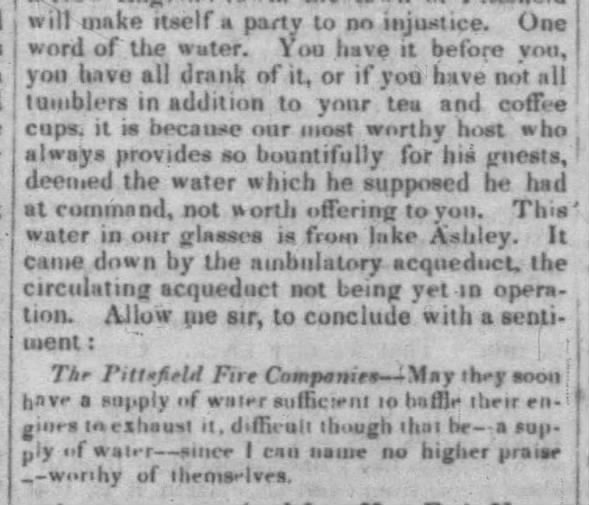
23 Jan 1851, Thu The Pittsfield Sun (Pittsfield, Massachusetts) Newspapers.com
At the big Firemen's banquet or supper or levee on January 15, 1851, reportedly attended by 200 guests, Hoadley spoke at some length on "the great subject of water," specifically the merits of Ashley water:

“The great subject of water, which is exciting a great deal of interest in town just now, is one upon which we have all to form opinions that shall guide us in immediate action, and it is important that we should form wise opinions. About the excellence of the water of Lake Ashley, about its desirableness in our village, I think sir there can be but one opinion.  --Pittsfield Sun, January 23, 1851

Knowing Hoadley and his hobby, some in the audience could not have been too surprised by his closing revelation:

"This water in our glasses is from lake Ashley. It came down by the ambulatory aqueduct, the circulating aqueduct not being yet in operation.

23 Jan 1851, Thu The Pittsfield Sun (Pittsfield, Massachusetts) Newspapers.com
Concerning the obvious desirableness of pure drinking water from Ashley, Franklin E. Taylor concurred in this toast To the Pontoosuc Engine Company, No. 2:

"May we all soon have the Ashley Pon-too-suc (Pond-to-suck)."

Related posts:

Friday, April 3, 2020

Black Snake not Quake

Greenleaf's New York Journal and Patriotic Register - March 21, 1795

This is about the name of Sarah Morewood's "fine young colt" who broke one of his legs on the railroad track, after colliding with a train. As Herman Melville reported to Evert Duyckinck on December 13, 1850, the injured limb of the "luckless" horse was broken "clean into two peices" and had to be professionally treated, "done up by the surgeon." Herman's sister Augusta Melville later gave the name of the horse along with the sad news of his death. Transcribed as "Black Quake" on page 172 in the 1993 Northwestern-Newberry Edition of Herman Melville's Correspondence, edited by Lynn Horth; and Hershel Parker, Herman Melville: A Biography, Volume 1, 1819-1851 (Johns Hopkins University Press, 1996) at pages 800 and 809. In Melville in Love (HarperCollins, 2016) Michael Shelden pictures Black Quake as "a rambunctious horse with a name that suggested the thudding force of its galloping speed."

Black Quake? or Black Snake?

Below is a detail from the letter of December 21, 1850 that Augusta wrote to Helen, now digitized and accessible online courtesy of The New York Public Library Digital Collections. Does other evidence exist for the name Black Quake? Here it looks to me like Black Snake. And farriers (that is, more than one horse doctor) not farmers.

"Poor Black Snake is dead. -- All the farriers could not save him. What will Mrs Morewood say."  
Enlarged:

Citation:
Manuscripts and Archives Division, The New York Public Library. "Letters sent, notebooks and keepsakes" The New York Public Library Digital Collections. 1841 - 1854. http://digitalcollections.nypl.org/items/752fe150-5889-0136-238d-3dcc24fb54fc
The second letter seems formed like the "n" in "not." The first letter looks close enough to Augusta's uppercase letter "S" elsewhere, for example in "Says Sophia"

<https://digitalcollections.nypl.org/items/76289b60-5889-0136-f362-3554d5606ebf>
and "Sam Savage."
<https://digitalcollections.nypl.org/items/77799750-5889-0136-d69f-5d9c6b561b38>
Was another horse (anywhere) ever named Black Quake? Horses named Black Snake may be found with circus animals, celebrated running horses, and registered Morgans. Barnum's Menagerie and Circus had a "black horse" named "Black Snake," one of a hundred and twenty horses sold at auction in 1854.

Mon, Oct 30, 1854 – Page 2 · Pittsburgh Daily Post (Pittsburgh, Pennsylvania) · Newspapers.com
Another black horse named "Black Snake" was a "Celebrated American Running Horse" = C. A. R. H., listed thus in the American Race-turf Register:

BLACK SNAKE, 
C. R. H. A high formed black horse, bred by Hugh Snelling, (a colored man,) residing in Granville County, State of N. C. foaled about the year 1788 —  
Got by the I. H. Obscurity, his dam the running mare Harlot, by the R. H. Old Bacchus 

As noted under "Addenda and Errata" at the end of the 1833 volume of the American Race-Turf Register quoted above:

"Page 116, pedigree of the C.A.R.H. Black Snake, the capital letter A should be inserted before the R. as above...."

Elsewhere "Black Snake" and son "Van Antwerp's Black Snake" are listed in The Morgan Horse and Register with Descendants of Sherman Morgan.


In the absence of evidence that any horse anywhere was ever called "Black Quake," I'm calling Sarah Morewood's unfortunate horse by his real name, Black Snake. 

Missiskoui Standard [Frelighsburg, Québec, Canada] - March 21, 1837

Related posts