Showing posts with label Melville's Marginalia. Show all posts

Wednesday, April 1, 2026

Amigo Mio! #8 in my open investigation, DRAGOONED: Writing, talking, and rewriting like Herman Melville in "Scenes Beyond the Western Border" (1851-1853)

Amigo mio! by Scott Norsworthy

Didn't you desert me on the eve of a snowstorm?

Read on Substack


Related posts on Substack

  • DRAGOONED #7: After Supper
    https://melvilliana.substack.com/p/after-supper
  • DRAGOONED #8: Amigo Mio!
    https://melvilliana.substack.com/p/amigo-mio 

Tuesday, October 28, 2025

Melville's "Dilletante" reader of Dante in PIERRE

Likely inspired by negative mentions of "literary Dilettanti" and "Dilletantism" in the preface to John Aitken Carlyle's prose translation of Dante's INFERNO 

Illustration of Dante's Inferno Canto 6 by Giovanni Stradano, 1587.
Stradanus aka Jan van der Straet, Public Domain, via Wikimedia Commons
In Book IX of Pierre; Or, The Ambiguities (1852) Herman Melville alludes to "horrible allegorical meanings" in Dante's Inferno as something beyond the ken of a nameless hypothetical reader, clueless but happy, whom Melville or his narrator labels "the Dilletante in Literature": 
"Fortunately for the felicity of the Dilletante in Literature, the horrible allegorical meanings of the Inferno, lie not on the surface...."
In a similar contrast between naive and knowing readers, the "deeper significances" of Hamlet are said to elude "all but the rarest adepts." Melville fans will recognize in this section of Pierre a version of the contrast in Hawthorne and His Mosses between the "superficial skimmer" and a more discerning "eagle-eyed reader." In the "Mosses" essay, as here in Pierre, the thing supposedly missed by insufficiently attentive readers concerns the problem of evil. The "mystery of iniquity" is a major theme of Melville's later writings, too, especially his epic religious poem Clarel and the uncompleted novella, Billy Budd. 

The terrible truth, as Melville understands it, is the presence of evil in the very fabric of creation, which makes sin and misery ineradicable as well as universal. In this view, only by way of the darkest visions and doctrines--of Original Sin as conceived by Calvinists, of the creator as malicious demiurge according to Gnostics, of the Hindu goddess Kali, consort of Shiva the destroyer--may the truth about the elemental nature of evil be apprehended.

Otherwise, with respect to Dante's Inferno one would think the literal content is bad enough. It's literally Hell. What could possibly be more disturbing or "horrible" than graphic depictions of torture inflicted forever on the lost souls of human beings in nine successively worse Circles of Hell? In the most horrifying scene of all (Dante's Inferno Cantos 32-23), the shade of traitor Count Ugolino gnaws on the back of his betrayer's skull while both souls are hemmed in the same ice-hole. You have to wonder what business a dilettante would have with Dante in the first place. 

Tracing the influence of Dante in Mardi and Pierre, Dennis Berthold in American Risorgimento: Herman Melville and the Cultural Politics of Italy (Ohio State University Press, 2009) finds in Pierre a satire of the naive hero's "literary pretensions" and, more broadly, of the 19th century "Dante revival" in America, "which undoubtedly had its share of dilettantes" (page 138). Here Berthold called attention to cultural resonances evoked by "the Dilletante in literature," but the focus in American Risorgimento on Henry F. Cary's verse translation as Melville's source-text did not allow for consideration of any more precise borrowing. No form of dilettante occurs anywhere in Cary's Dante. More context, including previously unidentified textual prompts for Melville's dismissive handling of the literary "Dilletante," may help to explicate the main idea of this interesting passage.

Henry A. Murray in the 1949 Hendricks House edition at page 198 printed "Dilettante," correcting Melville's nonstandard spelling "Dilletante." Dr. Murray made no further editorial comment, except to observe in a professional way how deep-seated hostilities against the world may be interpreted as psychological "projections" by either the author or his fictional hero, or both (Introduction, xciii). Ignoring the emended form "Dilettante" adopted by Murray and others before him (in, for example, the 1923 Constable edition) the 1971 Northwestern-Newberry volume edited by Harrison Hayford, Hershel Parker, and G. Thomas Tanselle retained Melville's spelling "Dilletante" as an acceptable variant. 

Dilettante means "An admirer or lover of the fine arts" according to Noah Webster, An American Dictionary of the English Language (Harper & Brothers, 1848) page 295. The word occurs infrequently in Melville's writings. In the second volume of Mardi: And a Voyage Thither, the antiquary "Oh-Oh" is comically depicted as a “dilettante in things old and marvelous.” Oh-Oh's name reflects his irrepressible enthusiasm for the arts, and artifacts. As representative dilettante, however, his passion for great rarities is that of a collector who is merely a collector, having little knowledge or even interest in their real meanings, or expressions of truth and beauty. Keeping in character, he overvalues numerous pieces of trashy ephemera, but lets Babbalanja have a priceless manuscript on how to achieve "A Happy Life" (by the Polynesian Seneca, hence loaded with stoic wisdom) for nothing. 

To much the same effect, Melville's 1857-8 lecture on "Statues in Rome" began by contrasting the "technical" expertise of "the dilettante" with deeper, more personal and penetrating responses to great works of art:
"True, the dilettante may employ his technical terms; but ignorance of these prevents not due feeling for Art, in any mind naturally alive to beauty or grandeur."  
-- quoted here from the reconstructed text by Merton M. Sealts, Jr. in The Piazza Tales, and Other Prose Pieces, edited by Harrison Hayford, Alma A. MacDougall, G. Thomas Tanselle, and others (Northwestern University Press, 1987) page 398. 
Dilettante here is employed in the sense of "acknowledged expert," rather than "amateur" or "dabbler." Alternatively, "professional critic or connoisseur" as reported in several 19th century newspapers. A couple of published reviews have Melville using the plural form, dilettanti, still meaning something like "Art experts." 

In Mardi, Melville's comic portrayal of Oh-Oh as "an extraordinary old antiquary" draws on negative associations of dilettante with superficiality, frivolity, and indifference to marks of deep, enduring value. In Pierre Book IX the hypothetical "Dilletante" has an equally shallow understanding of great world literature, according to the narrator. Likely prompts for Melville's invocation of the literary "Dilletante" in Pierre may be found in the preface to a book Melville definitely owned or had access to, Dante’s Divine Comedy: The Inferno. A literal prose translation (New York: Harper & Brothers, 1849) by Dr. John Aitken Carlyle, younger brother of Thomas Carlyle. Digital versions are accessible online courtesy of HathiTrust Digital Library; and also via the Internet Archive: 
John A. Carlyle’s prose translation of Dante’s Divine Comedy: The Inferno is Sealts Number 173a in the searchable “Catalog of Books and Documents Owned, Borrowed and Consulted by Herman Melville” at Melville’s Marginalia Online. As there noted, we know Melville read at least part of it because he quoted “John Carlyle‘s version” of Canto 3, line 26 (“And sounds of hands among them”) in one of his annotations to Henry Francis Cary’s verse translation (Sealts Number 174). If Melville's ironic slight of "the Dilletante in literature" in Pierre were at all inspired by mentions of "literary Dilettanti" and "dilettantism" in Carlyle's preface, then Melville must have had either the 1849 first edition (English, by Chapman and Hall in London? or American, by the Harpers in New York?) or the 1851 reissue of Dante's Divine Comedy: The Inferno. A literal prose translation by John A. Carlyle, M.D. As in Melville's usage "Dilletante," occurrences of "Dilettanti" and "Dilettantism" capitalize the initial "D" in both the English and American editions. However, only Harper & Brothers give the spelling "Dilletantism" (page xxii). The closer parallel to Melville's spelling of the base word "Dilletante" would seem to favor the American edition as the one Melville consulted. 

Here below are four passages from the preface to John A. Carlyle's prose translation that individually or collectively might have influenced Melville's conception of "the Dilletante in Literature." Each example features a form of the base word dilettante. 

  1. "In the year 1831, being called to Italy by other duties, I first studied the Divina Commedia, under guidance of the most noted literary Dilettanti of Rome and other places. I heard them read it with wondrous gestures and declamation, and talk of it in the usual superlatives." -- John A. Carlyle, Preface to Dante's Divine Comedy: The Inferno, page iv

  2. "During the seven years which followed, I often studied it again, at leisure hours, along with the other works of Dante; and got intimately acquainted with various Italians of different ranks, who, without making any pretensions to literature, or troubling themselves with conflicting commentaries, knew all the best passages, and would recite them in a plain, sober, quiet tone—now rapid, now slow, but always with real warmth—like people who felt the meaning, and were sure of its effect. To them the Divina Commedia had become a kind of Bible, and given expression and expansion to what was highest in their minds. The difference between them and the Dilettanti seemed infinite, and was all the more impressive from the gradual way in which it had been remarked." Carlyle, Preface, v

  3. "But to return. Having thus acquired a clearer idea of the Poem, and got fairly beneath the thick encumbrances of Dilettantism and other encumbrances, which hide its meaning, I began to be convinced that the quantity of commentary, necessary to make the substance and texture of it intelligible, might be compressed into a much smaller space than had been anticipated." Carlyle, Preface, vii


  4. It is impossible to mention all the other commentaries of the 18th century. That of Lombardi, which appeared in 1791, is such as could be written by the honest effort of a whole life, amid the "dark wood" of Dilletantism produced by a host of idle writers; and one feels a real respect for the worthy Friar, though at times he is surprisingly naïve, or perhaps dull.... Most of the old commentaries on Dante are written with a kind of large complacency, and genuine though long-winded enthusiasm, which makes them very interesting at first sight ; but on closer inspection, they are found to contain a surprising quantity of worn-out rubbish, and extremely little real information.

    Preface, "Comments and Translations" pages xxi - xxii. As noted above, only the American edition by Harper & Brothers gives the spelling "Dilletantism" here. London editions in the same place (page xxx) make it "Dilettantism." 
The context in John A. Carlyle's preface could hardly be more relevant to Book IX of Pierre. Dr. Carlyle's concern with the problem of rightly interpreting Dante is nearly identical with that of Melville, or Melville's narrator. To be sure, Carlyle's "Dilettanti" do not come across as mere amateurs or dabblers of the type often implicated in usages that rely on negative connotations of the term dilettante. Rather, as Carlyle describes them, "literary Dilettanti" for the most part are Dante Experts of high repute. Their deficiency lies in attending more to boring minutia than meaning. Or in their enthusiasm for comparatively superficial matters of form, technique, and special poetic effects. According to Carlyle, readers with a deeper appreciation of Dante have zero literary expertise or "pretensions to literature." Along with a shared seriousness, the best readers of Dante take the Divine Comedy for "a kind of Bible." Such readers unaffectedly treasure Dante's great work as an expression of the highest classical values of truth, goodness, and beauty. 

With Dr. Carlyle, Melville in full truth-seeking mode presumably would prefer the interpretations of grounded, reality-based readers on the lookout for meaning and wisdom, and hopefully believing in the promise of salvation. Unfortunately, no fine insights into the true meaning of Dante avail the tragic hero of Melville's novel. Poor Pierre! He can't avoid his fate, once challenged to do right by Isabel Banford, allegedly his half-sister. Melville (as Berthold points out) withholds from his fictional hero any hope or even knowledge of Dante's journey through Purgatory to Paradise. Crusading for justice to Isabel, Pierre will abandon the Beatrice he already has in Lucy Tartan, his blonde-haired and blue-eyed sweetheart. (Lucy rebounds and heroically rejoins Pierre in the second half of Melville's novel, too late to save Pierre, his fake wife Isabel, or herself.) Back in Book IX, for now betrothed to Lucy but stuck between Dante's Hell and Shakespeare's Hamlet, Pierre experiences a psychic meltdown that leaves him "dabbling in the vomit of his loathed identity." 

More extensive debts to Dante in Pierre have been examined by G. Giovanni

 Giovannini, G. “Melville’s Pierre and Dante’s Inferno.” PMLA, vol. 64, no. 1, 1949, pp. 70–78. JSTOR, https://doi.org/10.2307/459670. Accessed 28 Oct. 2025.  

Giovannini, G. “Melville and Dante.” PMLA, vol. 65, no. 2, 1950, pp. 329–329. JSTOR, https://doi.org/10.2307/45947.

and Nathalia Wright 

Wright, Nathalia. “Pierre: Herman Melville’s Inferno.” American Literature, vol. 32, no. 2, 1960, pp. 167–81. JSTOR, https://doi.org/10.2307/2922675. 

G. Giovanni most helpfully connects the problem of interpreting Dante's profounder "allegorical meanings," as raised by the narrator in Book IX, with the "melodramatic violence" displayed by Pierre when "trampling on the torn pages of the Inferno." As Giovanni shows, the hero's behavioral and mental health crisis is precipitated by his new awareness of evil, beginning with the sins of his own father lately disclosed through Isabel's claim of shared paternity. 

Pierre's frustration on the sudden discovery of moral disorder is here roughly equated with Hamlet's; its ultimate source is the universalization of his father's moral lapse through "the horrible allegorical meanings of the Inferno." Limited in his experiential knowledge of the world, Pierre finds the form and generic significance of his particular perception of evil in the Inferno allegorically construed as a picture of life itself. The Inferno initiates Pierre into "that darker though truer aspect of things. 
"Melville's Pierre and Dante's Inferno," pages 75-76
... These references to the Inferno in first half of the novel, from the time when Pierre first sees Isabel to his pretended marriage and departure with her for the city, are closely coordinated with Pierre's development towards a realization of the ubiquity and universality of evil. Melville conceives Pierre's development within the sequence of his confrontations of the Inferno, and sees the poem metaphorically as an index of a naive idealism resentful of the existence of evil."  
"Melville's Pierre and Dante's Inferno," page 77

The effect of reading Dante and Shakespeare on poor Pierre, augmenting his new personal knowledge of worldly wickedness, is well summarized by Giovanni:

"...The fragments from the poets bring into focus a reality larger than Pierre's particular experience and central to the tragedy: evil is an integral part of existence, and the attempt to eradicate it must lead to tragic failure." 
"Melville's Pierre and Dante's Inferno," page 76

In Herman Melville: A Biography Volume 2, 1851-1891 (Johns Hopkins University Press, 2002) at page 435, Hershel Parker made reference to the "variant rendering of a line by John Carlyle" that Melville inscribed in his volume of Cary's Dante. Parker added, "in this case there is no other evidence that he had further knowledge of Carlyle's translation." Now, more than twenty years on, I am glad to offer multiple mentions of "Dilettanti" and "Dilettantism" or (as spelled on page xxii in the American edition by Harper & Brothers) "Dilletantism" as pretty good evidence that Melville read attentively in John Aitken Carlyle's preface--some time before the Harpers brought out Pierre in the summer of 1852. 

Worcester MA Spy - August 5, 1852

Saturday, June 18, 2022

Ulysses in WHITE-JACKET

Ulysses defying the Cyclops
via The New York Public Library Digital Collections

In White-Jacket (1850) and the poem In a Bye-Canal, Melville refers to Homer's Odysseus as Ulysses. In choosing to call him Ulysses, Melville was guided by then-standard English translations of the Iliad and Odyssey. In his own copy of Chapman's Homer (Sealts number 277), a gift from George Duyckinck in 1858, Melville's annotation to The Iliads of Homer Book 3 (page 69, lines 230-232) reads

"Ulysses sat tall."

-- Melville's Marginalia Online  

In March 1849 Melville bought the three-volume set of Alexander Pope's Homer in the Harpers Classical Library (Sealts number 275c). Melville's set is lost, but that Odyssey was also all about Ulysses, as Pope makes clear in his plot summary: 

"Ulysses also, after innumerable troubles by sea and land, at last returned to safety in Ithaca, which is the subject of Homer's Odyssey." 

Thanks in part to influential verse translations in English (by William Cowper, too, along with Pope and Chapman) Melville and his contemporaries knew Odysseus, the ingenious hero of Greek story and myth, as Ulysses.

More generally, William Cullen Bryant explained his use of Latin-based names as best practice when translating Greek into English:

I make no apology for employing in my version the names Jupiter, Juno, Venus, and others of Latin origin, for Zeus, Here, Aphrodite, and other Greek names of the deities of whom Homer speaks. The names which I have adopted have been naturalized in our language for centuries, and some of them, as Mercury, Vulcan, and Dian, have even been provided with English terminations. I was translating from Greek into English, and I therefore translated the names of the gods, as well as the other parts of the poem.  -- Preface, The Iliad of Homer, translated into English blank verse (Boston, 1870).
Academicians howled, apparently, but the old poet stuck to his guns

"The names of Latin origin are naturalized; the others are aliens and strangers."

and Homer's hero remains Ulysses all through Bryant's translation of The Odyssey.

Early in White-Jacket (1850), Ulysses is named with other exemplary heroes of literature familiar to Jack Chase, Melville's great-hearted captain of the maintop: 

Jack had read all the verses of Byron, and all the romances of Scott. He talked of Rob Roy, Don Juan, and Pelham; Macbeth and Ulysses; but, above all things, was an ardent admirer of Camoens. Parts of the Lusiad, he could recite in the original. -- White-Jacket chapter 4, Jack Chase 

In this initial survey of Jack Chase's impressive reading, Ulysses ranks with other leading literary characters whom Jack Chase knows familiarly, well enough to talk about as fellow men. Melville biographer Leon Howard definitely grasped that Melville here meant to designate men as much or more than the titles of works in which they appear:

"... [Melville's Jack Chase] was a master of languages who could recite long passages from Camoëns' sailors' epic, The Lusiad, in the original Portuguese, and talk in English of Rob Roy and Don Juan, Macbeth and Ulysses, and Bulwer's Pelham." -- Herman Melville: A Biography (University of California Press, 1951) page 74.

Howard's careful paraphrase of the passage from chapter 4 of White-Jacket gives only The Lusiad in italics. "Ulysses" to Howard plainly denotes the hero of Homer's Odyssey. Confirmed by looking for "Homer" in the Index:

"Homer, Odysseus, 74."

Paraphrasing the same passage as Howard, John Bryant wrongly puts Macbeth in italics and Ulysses in quotes to reinforce his bad take through punctuation. 

Melville describes Jack Chase as having read all of Byron, Scott, and Camoens's Lusiad (which he recites in the original Portuguese) as well as Macbeth and "Ulysses." Chase's recital of the last work is impossible because Tennyson's 1842 "Ulysses" had only just been published." -- Herman Melville: A Half Known Life volume 2 (Wiley Blackwell, 2021) page 1057.

Fear not! If you made the same mistake by reading the name "Ulysses" as Melville's ineptly managed reference to Tennyson's poem Ulysses, just keep reading. Our matchless Jack will set you straight in chapter 65, A Man-of-War Race: 

How many great men have been sailors, White Jacket! They say Homer himself was once a tar, even as his hero, Ulysses, was both a sailor and a shipwright. I'll swear Shakespeare was once a captain of the forecastle. Do you mind the first scene in The Tempest, White Jacket?  


Ulysses is Homer's hero. According to Jack Chase anyway, who thus rescues Melville from the false charge of perpetrating an anachronism with an "impossible" reference to Tennyson's version of the archetypal wanderer.

Not that you absolutely have to stay with Homer. Sympathetic readers (for whom Ulysses lives) might freely associate Jack Chase's Homeric hero with Virgil's, or Dante's, or Shakespeare's or Tennyson's or Joyce's version of Ulysses. Unlikely as it sounds, I'm convinced that at least one reference to Ulysses in White-Jacket alludes to George Clooney. 


Friday, August 20, 2021

2 + 2 = 4, Melville's anti-communist math

Portrait of Nero. Marble, Roman artwork, 1st century CE.
Jastrow, Public domain, via Wikimedia Commons
Here's another reason why leftist academics in or out of The Melville Society must cancel Herman Melville. Call it historical necessity. Melville in his writings defies rebranding as a Marxist, Leninist, Maoist, or any kind of communist by refusing to believe in the perfectibility of human nature. By contrast, communists recognize no evil, no mystery of iniquity that history cannot fix through critical theory and ideologically correct action up to and including mass murder.

Against all experience, communists dream of creating the new man. For Melville, transformations that radical must be accomplished in another world. This one requires due allowance for the "power of blackness" that Melville discerned in short stories by Nathaniel Hawthorne:

Certain it is, however, that this great power of blackness in him derives its force from its appeals to that Calvinistic sense of Innate Depravity and Original Sin, from whose visitations, in some shape or other, no deeply thinking mind is always and wholly free. For, in certain moods, no man can weigh this world without throwing in something, somehow like Original Sin, to strike the uneven balance. --Hawthorne and His Mosses part 1, The Literary World August 17, 1850, page 126.

This is why leftist critics which is to say most academic commentators hate Melville's 1857-8 lecture on Statues in Rome. There Melville marveled over the recognizable features and traits of "ancient" humans as portrayed in busts of famous figures he saw in the Vatican museum. Socrates looked to Melville like an Irish comedian; Seneca like a Wall Street broker; Nero like "one of our fast young men who drive spanking teams and abound on race-courses." 

Staggering advances in science and technology had and have not altered human nature. To not see it today, you would have to cover human faces with masks and somehow keep them covered. Near the end of that same lecture on the statuary of Rome, Melville observed that socialist utopias require misplaced faith in the perfectibility of mankind.  "Or shall the scheme of Fourier supplant the code of Justinian? Only when the novels of Dickens shall silence the satires of Juvenal." Melville understood that Fourier's utopian Phalanstery of "liberated souls" could never dissolve away the problem of evil that necessitates compendious law codes, personified in Justinian. Fourier personifies the utopian dream of creating or evolving a new kind of human with a higher, more liberated consciousness. The point is not to discourage dreamers and idealists, except when they want to dismantle your constitutional republic with the idea of creating a new political society and new way of life for The New Socialist Man.

Melville's rhetorical question, “Can art, not life, make the Ideal?” has one right answer. Yes, Art can. Communism doesn't know how. 


Worst of all for the collapsing future of woke Melville studies, the author of Moby-Dick expressed the inherent depravity of human beings here in the real physical world as a mathematical certainty:

"As 2 & 2 made 4 in Noah's time, as now, so man figures ever."

-- Marginal comment by Herman Melville in his copy of Shakespeare's All's Well That Ends Well; accessible via Melville's Marginalia Online. 

 http://melvillesmarginalia.org/Share.aspx?DocumentID=26&PageID=19033

As transcribed on melvillesmarginalia.org the word figures is conjectural. Whatever you put there will not alter the essential claim. 


Immortalized in marble the face of Nero reminded Melville of a "fast" young sportsman, a sort of 19th century James Dean. To me he looks like a rising professional golfer. The more things change... 


Related posts:

Thursday, July 8, 2021

Project MUSE - A Second Update on Books Owned, Borrowed, and Consulted by Herman Melville

Project MUSE - A Second Update on Books Owned, Borrowed, and Consulted by Herman Melville 

Great article by Steven Olsen-Smith and Peter Norberg in the June 2021 issue of Leviathan. Links below are to cited posts on Melvilliana:

Friday, August 2, 2019

Books autographed by Melville, listed in early Anderson catalogues


Auction catalogues of John Anderson, Jr. in the year 1900 (Numbers 4 and 14) offer two books at some time owned by Herman Melville: The Arts and Artists by James Elmes, 3 vols. (London, 1825); and Mysteries of Corpus Christi, with translations of sacramental Autos (Belshazzar's Feast and The Divine Philothea, plus the first scene of The Poison and the Antidote) from the Spanish of Pedro Calderón de la Barca by Denis Florence MacCarthy (Dublin, 1867). Each of these four volumes has the signature of Herman Melville, according to the catalogue descriptions transcribed below.

The 1867 MacCarthy translation is explicitly described as "From library of Herman Melville." As previously known, Melville owned and annotated Three Dramas of Calderón (Dublin, 1870), also translated by Denis F. MacCarthy. The 1870 volume of Calderón is Sealts Number 114, listed thus in The Online Catalog of Books and Documents Owned, Borrowed and Consulted by Herman Melville at the great Melville's Marginalia Online.

Lot 67 in the Anderson Catalogue of Books, etc. No. 4, For Sale by Auction on Friday, February 16, 1900 is the 1825 London edition of The Arts and Artists by James Elmes, in three volumes:


"67. ELMES (JAS.) The Arts and Artists: or, Anecdotes and Relics of the Schools of Painting, Sculpture and Architecture. Portraits and vignettes. 3 vols. 18mo, uncut. Lond. 1825
          Autograph of Herman Melville in each volume. Written with pencil."
<https://hdl.handle.net/2027/hvd.hnmsyh?urlappend=%3Bseq=72>
Links below are for general reference and further study. Harvard has multiple copies of each volume in the three-volume set of Elmes's The Arts and Artists, Google-digitized and accessible online courtesy of Hathi Trust Digital Library. Also available via Google Books:
Lot 323 in the Anderson Catalog of An interesting assortment of Books and Pamphlets No. 14, For Sale By Action over two days in 1900, April 11 (Lots 1-260) and April 12 (Lots 261-end), is Denis F. MacCarthy, Mysteries of Corpus Christi (Dublin, 1867):


"323. MYSTERIES OF CORPUS CHRISTI, from the Spanish, by Denis F. MacCarthy. 12mo. Dublin, 1867.  From library of Herman Melville and contains his autograph."
 <https://hdl.handle.net/2027/hvd.hnmsyh?urlappend=%3Bseq=302>
Harvard University has the 1867 translation by Denis Florence MacCarthy from the Spanish [of Calderón de la Barca], originally the gift of James Russell Lowell and now available online courtesy of Hathi Trust Digital Library; and the Internet Archive:


A different copy of the same title via Google Books:
For essential background, especially on John Anderson, Jr.:
  • Merton M. Sealts, Jr., Pursuing Melville, 1940-1980 (University of Wisconsin Press, 1982), especially Part II, "A Correspondence with Charles Olson," pages 106-107 and 144-147.
  • Oscar Wegelin, "Herman Melville as I Recall Him," The Colophon Vol. 1, New Series, No. 1 (Summer 1935), pages 21-24; reprinted in Steven Olsen-Smith, ed., Melville in His Own Time (University of Iowa Press, 2015), pages 148-151. 
Related posts:

Monday, October 1, 2018

Hobbes's Leviathan, from the library of Herman Melville

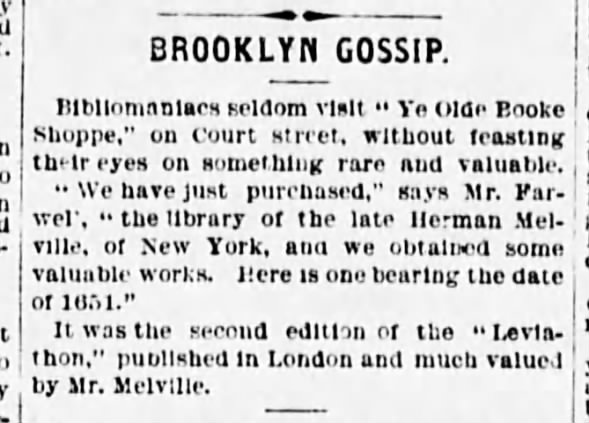
Early in 1892, as Merton M. Sealts, Jr. relates in Melville's Reading (University of Wisconsin Press, 1966) and Pursuing Melville, 1940-1980 (University of Wisconsin Press, 1982), Brooklyn bookman Alfred Francis Farnell (1835-1908) bought a lot of the late Herman Melville's books for $120. Among the most valuable was a rare 1651 edition of Hobbes's Leviathan, according  to this bit of "Brooklyn Gossip" in the New York Evening World for March 19, 1892. Found at GenealogyBank among items added "within 3 months."

New York Evening World - March 19, 1892
via GenealogyBank

BROOKLYN GOSSIP.

Bibliomaniacs seldom visit "Ye Olde Booke Shoppe," on Court street, without feasting their eyes on something rare and valuable.

"We have just purchased," says Mr. Farwell [A. F. Farnell], "the library of the late Herman Melville, of New York, and we obtained some valuable works. Here is one bearing the date of 1651."

It was the second edition of the "Leviathon," [Leviathan] published in London and much valued by Mr. Melville.
Obituary of Alfred F. Farnell in the Brooklyn Daily Standard Union, May 14, 1908:

ALFRED F. FARNELL.
Alfred Francis Farnell, bookseller, of 46 Court street, died Tuesday [May 12, 1908] of heart disease at his home, 96 Garfield place. Mr. Farnell established the Court street business known as A. F. Farnell & Sons in 1880. He was born in Yorkshire, England, June 5, 1835, and went to New Haven, Conn., in 1865, where for a number of years he conducted a circulating library. he is survived by two sons, Fred W. and Henry A., a daughter, Maude M., and a sister, Mrs. A. Blair, of Montgomery, Ala. Mr. Farnell was a member of the Second Unitarian Church, and the Rev. C. S. S. Dutton conducted funeral services this afternoon. Buried in Greenwood Cemetery.
Brooklyn Daily Standard Union - May 14, 1908
via Fulton History
The Leviathan by Thomas Hobbes is #358 in Melville's Sources (Northwestern University Press, 1987) by Mary K. Bercaw Edwards; not currently listed in "The Online Catalog of Books and Documents Owned, Borrowed and Consulted by Herman Melville" at Melville's Marginalia Online.

Below, another image of the "Brooklyn Gossip" item in the New York Evening World, via Newspapers.com

Sat, Mar 19, 1892 – Page 4 · The Evening World (New York, New York, New York, United States of America) · Newspapers.com

Related posts

Monday, August 1, 2016

Henry Russell in Melville's Albany

Henry Russell
Robert Street, 1796-1865, lithographer. Public domain, via Wikimedia Commons
English singer and composer Henry Russell (1813-1900) was the father of Herman Melville's friend W. Clark Russell, to whom Melville dedicated John Marr and other Sailors in 1888. You can find the electronic text with other of Melville's dedications here. In print, the Northwestern-Newberry edition of Melville's Published Poems has the edited text of Melville's dedication to W. Clark Russell. The facsimile edition of John Marr and Other Sailors, edited by Douglas Robillard, is published by the Kent State University Press.


In the dedication to John Marr Melville notes the fact of WCR's birth in New York City, but does not name his famous and flamboyant sire Henry Russell. Melville would have known of Henry Russell (he wrote the music for Woodman! Spare that Tree! and A Life on the Ocean Wave) from the popular singer's time in Albany, where another son was born in 1837. Russell had first gone to Canada around 1833-4, then made his way eventually from Toronto to Rochester, New York. Russell did not stay long. He continued to tour America in 1837-1841 and then returned to England.

In February 1837, Albany newspapers reported and welcomed the rumor of Russell's decision to become a permanent resident:
"We have great pleasure in announcing the arrival in this city of Mr. HENRY RUSSELL, the justly celebrated composer and vocalist. We understand it is his intention to become a resident, and to establish a musical institution amongst us, which shall be worthy of his reputation, and of the capital of the state.” --Albany Daily Advertiser (February 23, 1837), quoted approvingly in the Albany Argus, Friday, February 24, 1837.
The Albany Female Academy sponsored Russell, after Trustees
“resolved to appropriate the Chapel of their Academy, at such times as it may not be required for the ordinary exercises of the institution, to the use of a school, or ACADEMY OF MUSIC, and have guaranteed to Mr. Russell such compensation for his services as has induced him to determine to remain with us, in the full confidence that they will be sustained by their fellow citizens in this enterprize, and that they shall be suffered to sustain no pecuniary loss.”  --Albany Argus, February 1837
As announced in the Argus, Russell ("with whose rich melody our citizens are always charmed") gave a concert on the Fourth of July, 1837 "at the Female Academy, North pearl-street." Herman Melville's sister Augusta Melville was enrolled that year in the Second Department of the Albany Female Academy. Herman himself was in and out of Albany that year, working over the summer at his uncle's farm in Pittsfield, then teaching for a term in the Sikes District School. The proposed Academy of Music was never realized, as recalled in the Albany Evening Journal, December 23, 1837.

In September 1837 one reviewer in Albany criticized Russell for the "idle comic songs" in his repertoire.
Mr. RUSSELL’S Concert, last evening, went off admirably. The large hall of the Institute was filled with a highly fashionable audience. The interest produced by Mr. R’s singing is as fresh and exciting as when he first appeared among us. On this occasion, he was assisted by Professor ANDREWS and Mr. UNDERNER, whose Violin and Flute solos were delightfully executed. Mr. RUSSELL was himself in fine voice and gave several of his best pieces with the happiest effect. He is indeed a most gifted singer. Few melodists, like him, have the power, for a whole evening, to keep an audience entranced with emotion and delight.

But Mr. R., in our judgment, is acquiring one injurious habit. His comic songs are in bad taste. He destroys the effect and mars the beauty of his great powers, by descending from the touching sweetness of “The Old English Gentleman,” the rich, rolling melody of “The Bare Old Oak,” the thrilling interest of the “Wind of the Winter’s Night,” and above all, the sublimity of the “Sceptic’s Lament,” down to the light, vapid, senseless nothings which he too frequently introduces. These idle comic songs are unworthy of Mr. R.’s voice and powers. And besides, we can hear them better sung at the Theatres, the Circus and the Museum.
To mistake its forte, however, is one of the infirmities of genius. GARRICK, the soul of comedy, always had a passion for the tragic muse.— JOHN QUINCY ADAMS, the ablest prose writer in America, runs into the folly of perpetrating doggerels which all but disgrace him. Mr. RUSSELL, in the kindest manner, volunteered several songs last Evening, but they were all calculated to undervalue his genius. His admirers are from the intellectual classes, and cannot be interested with trifles and frivolity. They want the gold without the dross. --Albany Evening Journal, Wednesday, September 13, 1837
The closing aesthetic judgement of John Quincy Adams and his weakness for "perpetrating doggerels" sheds light on Melville's marginal comment in his Milton volume. Annotating Milton's reference to Caesar's abandoned tragedy of Ajax in the preface to Samson Agonistes, Melville wrote
 "J. Q. A. might have followed his example."  --Melville's Marginalia Online
As the unsigned review of Henry Russell's concert shows, JQA's "folly" of versifying was already a staple of cultural criticism in Melville's Albany by September 1837.

Thursday, January 7, 2016

Khadija in White-Jacket

In a previous post I guessed one of the erased words in Elizabeth Melville's set of Channing (volume 3, page 123) might be a form of "Khadija." Reading Dorothee Metlitsky Finkelstein on Melville's Orienda, I'm reminded that Melville actually names Khadija in White-Jacket (1850):
And, like that old exquisite, Mohammed, who so much loved to snuff perfumes and essences, and used to lounge out of the conservatories of Khadija, his wife, to give battle to the robust sons of Koriesh; even so this Rio land-breeze comes jaded with sweet-smelling savours, to wrestle with the wild Tartar breezes of the sea.

--Herman Melville, White-Jacket, chapter 65 - A Man-of-War Race
Something like my conjectural reading "Khadija" or "Kadija" could help explain two features of the "enigmatic word" as described by Dawn Coleman in Mahomet's Gospel and Other Revelations (p. 80):
  1. Professor Coleman's observation that "the first two letters are strangely muddy, a mishmash of marks" might reflect the annotator's uncertainty about the correct spelling of "Khadija"; and
  2. an erased capital letter "K" could account for the appearance of "an initial graph that may have been an 'f' or abortive capital."
Gibbon on Mahomet, as Dorothee Metlitsky showed, was definitely the source for Melville's remark on "the uncommon beauty of his person" with reference to the "upstart prophet" Foni in Mardi (1849). Gibbon, who casts Mahomet as the leader of "an infant congregation of Unitarians," also notes the unavoidably mundane character of his early efforts:
"The first and most arduous conquests of Mahomet were those of his wife, his servant, his pupil, and his friend; since he presented himself as a prophet to those who were most conversant with his infirmities as a man."  --History of the Decline and Fall of the Roman Empire, Volume 5
So whatever it really says, the erased annotation in volume 3 of Elizabeth Melville's set of Channing's Works need not be interpreted as a factually mistaken assumption of Mohammed's poverty. What connects Channing's Jesus to Gibbon's Mahomet is the grand ideal of Unitarianism, contrasted with experience of the most familiar, ordinary realities of domestic life.

Considering Melville's reference to Khadija by name in White-Jacket, I'm inclined to stick with my earlier conjecture:
Possibly then Dr. Channing's reference to the humble circumstances of Jesus might have led Melville to recall and somehow note the key role of early converts in Mahomet's own household. According to any number of popular histories in Melville's day Mahomet's grand revelation--his "Gospel" (or is it "Qur'an?") of God's Unity--was first embraced by improbably domestic disciples: Khadija. Zeid, Ali, and Abu Bekr.  --Mad, Zeid, or Khadija?
If you're wondering why it's so hard to say exactly what the annotator wrote, take a look at the digitized image of page 123 in volume 3 of the Works of William E. Channing at NYPL.


For a much better squint at some of the erased writing, check out the enhanced image at Melville's Marginalia Online.

Consulting the online Documentary Note for this set, I'm wondering now how Lemuel Shaw can be excluded from consideration as another possible annotator, in addition to Elizabeth Melville and her husband. Judge Shaw inscribed the set to his daughter--so obviously he owned the volumes first, who knows for how long. 

Daguerreotype of Lemuel Shaw
Museum of Fine Arts Boston, Public domain, via Wikimedia Commons

Related post

Thursday, November 12, 2015

Mad or Zeid, or Khadija?

Detail of erased annotation in Channing's Works, vol. 3
Enhanced image of the full page is at Melville's Marginalia Online
Bottom margin] erased pencil x and annotation: 
"Could not this [point] with still m[ore]  
force be applied to Mahomet?‒who after 
age forty [&] less probably [mad], first delivered 
his Gospel?"  --Melville's Marginalia Online
 <https://melvillesmarginalia.org/Share.aspx?DocumentID=76&PageID=26311>
Mad or Zeid? Zaid? Better yet (if that initial letter is a capital "K") how about Khadija? (alternatively, Kadija). Someday with improved technology we might find out for sure. Acknowledging that "technical methods of recovery are still in their infancy," Steven Olsen-Smith, General Editor of Melville's Marginalia Online, remains optimistic that
"The content of erasures in Melville’s marginalia, and the identities and motives behind it, will likely become clearer as technical means of recovery become more effective." 
Citation:
Olsen-Smith, Steven. "Recovering Melville’s Hand: An Inaugural Report on Digital Discovery and Analysis at Melville’s Marginalia Online." Leviathan, vol. 17 no. 2, 2015, p. 36-40. Project MUSE, https://dx.doi.org/10.1353/lvn.2015.0024.
While we're waiting on the right equipment... For essential background, popular biographies of the prophet Mahomet (an old spelling of "Muhammad") could be of some help in figuring out what Melville wrote in the erased, now partially recovered marginalia in the third volume of William Ellery Channing's Works. Melville's wife Elizabeth owned and also marked in the set of Channing's Works, given her by her father Lemuel Shaw. 

Dawn Coleman reports on the marginalia in the June 2015 Leviathan and her Critical Introduction at Melville's Marginalia Online. It's good to know especially about the one page in volume three with previously unknown annotations by Herman Melville, discovery of which was prompted by Professor Coleman's research on Melville and Unitarianism. To be honest my eyes aren't all that sharp and I have not examined the physical book. Even so, I'm pretty sure Melville did not write the oddly inapt comment (Mahomet another nobody, though not so crazy as Jesus?) as transcribed in Professor Coleman's Leviathan article and currently reported at Melville's Marginalia Online. But what of that? No job so lonely and hopeless and quintessentially Melvillean as squinting endlessly at ERASED scrawls.

Most useful and succinct is the account by Thomas Keightley, reviewed in the Dublin Literary Gazette and National Magazine and republished many times, for example in Lardner's Outlines of Universal History:
“In the 40th year of his age, Mohammed announced to his wife Khadijah, his slave Zeid, his pupil Ali, and his friend Aboo Beker, a direct commission from God to preach the doctrine of his Unity."
"Outlines of History" from LARDNER'S CABINET CYCLOPAEDIA is listed as number 164 in the 1837 Catalogue of Books in the Library of the Albany Young Men's Association.

The longer summary below is from the article on "Mohammed and his Religion" by J. Llewelyn Davies in the May 1880 issue of Frank Leslie's Sunday Magazine:
Those who first believed in him were those who knew him best. He gained adherents very slowly. The first was his faithful wife, now between fifty-five and sixty years of age. "So Khadijah believed," runs the tradition, "and attested the truth of that which came to him from God. Thus was the Lord minded to lighten the burden of His prophet; for he heard nothing that grieved him touching his rejection by the people, but he had recourse unto her, and she comforted, reassured and supported him." Two other members of his household followed Khadijah. One of these was Zeid, an Arab of a Christian tribe, who had been taken captive and become a slave of Khadijah. By her he had been given to Mohammed, and so great an affection grew up between the slave and the master that Mohammed gave Zeid his liberty and made him his adopted son, and Zeid refused the permission offered him to return to his father and his tribe. Then there was the youthful Ali, a person of great importance in the history of Islam. He was the son of Abu Talib, and had been taken by Mohammed to be brought up as his son, and was now some thirteen years of age. It is said that the old Abu Talib saw Mohammed and Ali praying together, and that in answer to some inquiry which he made, Mohammed commended to him the new faith as the religion of God and of His angels and of His prophets, the religion of Abraham. Abu Talib replied, "I am not able, my nephew, to separate from the religion and the customs of my forefathers, but I swear that, so long as I live, no one shall dare to trouble thee." Then turning to his son, the youthful Ali, he said, "Well, my son, he will not call thee to aught but that which 'is good: wherefore thou art free to cleave unto him." A fourth amongst the earliest believers was Abu Bekr. He was an intimate friend of Mohammed, wealthy and of high character, who became an adherent without the least hesitation, and continued to be a stanch supporter and most useful associate. Ali became afterward a son-in-law, and Abu Bekr a fatherin-law, to Mohammed, and they were both caliphs or successors of the Prophet. It is said that in the first three or four years a small group of thirty or forty converts were the fruits of Mohammed's preaching.
The tenets of the religion adopted by these converts were but few: that there was only one God, and that Mohammed was His prophet; that a paradise of bliss awaited the faithful, and a terrible hell the ungodly; and that the faithful ought to be just.... --Frank Leslie's Sunday Magazine
Here's Washington Irving from a section of his biography headed "Conversion of Zeid":
CHAPTER VII.

Mahomet inculcates his doctrines secretly and slowly Receives further revelations and command.—Announces it to his kindred.—Manner in which it was received.—Enthusiastic devotion of Ali.—Christian portents.

For a time Mahomet confided his revelations merely to his own household. One of the first to avow himself a believer, was his servant Zeid, an Arab of the tribe of Kalb. This youth had been captured in childhood by a freebooting party of Koreishites, and had come by purchase or lot into the possession of Mahomet. Several years afterwards his father, hearing of his being in Mecca, repaired thither and offered a considerable sum for his ransom. "If he chooses to go with thee," said Mahomet, "he shall go without ransom: but if he chooses to remain with me, why should I not keep him?" Zeid preferred to remain, having ever, he said, been treated more as a son than as a slave. Upon this, Mahomet publicly adopted him, and he had ever since remained with him in affectionate servitude. Now, on embracing the new faith, he was set entirely free, but it will be found that he continued through life that devoted attachment which Mahomet seems to have had the gift of inspiring in his followers and dependents.

The early steps of Mahomet in his prophetic career, were perilous and doubtful, and taken in secrecy. He had hostility to apprehend on every side; from his immediate kindred, the Koreishites of the line of Haschem, whose power and prosperity were identified with idolatry; and still more from the rival line of Abd Schems, who had long looked with envy and jealousy on the Haschemites, and would eagerly raise the cry of heresy and impiety to dispossess them of the guardianship of the Caaba. At the head of this rival branch of Koreish was Abu Sofian, the son of Harb, grandson of Omeya, and great-grandson of Abd Schems. He was an able and ambitious man, of great wealth and influence, and will be found one of the most persevering and powerful opponents of Mahomet.*

Under these adverse circumstances the new faith was propagated secretly and slowly, insomuch that for the first three years the number of converts did not exceed forty; these, too, for the most part, were young persons, strangers, and slaves...
... Nothing discouraged by the failure of his first attempt, Mahomet called a second meeting of the Haschemites at his own house, where, having regaled them with the flesh of a lamb, and given them milk to drink, he stood forth and announced, at full length, his revelations received from heaven, and the divine command to impart them to those of his immediate line.
 '' Oh children of Abd al Motalleb," cried he, with enthusiasm, "to you, of all men, has Allah vouchsafed these most precious gifts. In his name I offer you the blessings of this world, and endless joys hereafter. Who among you will share the burden of my offer. Who will be my brother: my lieutenant, my vizier?"
All remained silent; some wondering; others smiling with incredulity and derision. At length Ali, starting up with youthful zeal, offered himself to the service of the prophet, though modestly acknowledging his youth and physical weakness.* Mahomet threw his arms round the generous youth, and pressed him to his bosom. "Behold my brother, my vizier, my vicegerent," exclaimed he; "let all listen to his words, and obey him."

The outbreak of such a stripling as Ali, however, was answered by a scornful burst of laughter of the Koreishites; who taunted Abu Taleb, the father of the youthful proselyte, with having to bow down before his son, and yield him obedience.
* By an error of translators, Ali is made to accompany his offer of adhesion by an extravagant threat against all who should oppose Mahomet.  --Irving's Lives of Mahomet, vol 1 
Another popular treatment, this from Treasury of History:
Mahomet was in the 40th year of his age when he assumed the character of a prophet; he had been accustomed for several years, during the month of Ramadan, to withdraw from the world, and to secrete himself in a cave, three miles distant from Mecca: “conversation,” says Mr. Gibbon, “enriches the understanding, but solitude is the school of genius.” During the first three years, he made only fourteen proselytes, among which were his wife Khadijah; his servant, or rather slave, Zeid Ali, who afterwards married the prophet's favourite daughter Fatima, and was surnamed “the lion of God:” Abubekar, a man distinguished for his merit and his wealth; the rest consisted of respectable citizens of Mecca. The Koreishites, although the tribe from which he sprung, were the most violent opposers of the new religion. In the tenth year of his prophetic office his wife died; and the next year, his enemies having formed a design to cut him off, and he being seasonably apprized, fled by night to Medina on the 16th of July, 622, from which event the Hegira commenced: he was accompanied only by two or three followers, but he made a public entry into that city, and soon gained many proselytes, on which he assumed the regal and sacerdotal characters. As he increased in power, that moderation and humility, which had before distinguished his conduct, were gradually erased, and he became fierce and sanguinary; he began to avow a design of propagating his religion by the sword, to destroy the monuments of idolatry, and, without regarding the sanctity of days or months, to pursue the unbelieving nations of the earth. The Koran inculcates, in the most absolute sense, the tenets of faith and predestination....
Possibly then Dr. Channing's reference to the humble circumstances of Jesus might have led Melville to recall and somehow note the key role of early converts in Mahomet's own household. According to any number of popular histories in Melville's day Mahomet's grand revelation--his "Gospel" (or is it "Qur'an?") of God's Unity--was first embraced by improbably domestic disciples: Khadija, Zeid, Ali, and Abu Bekr.

Related post