Showing posts with label Elizabeth Shaw Melville. Show all posts

Wednesday, June 12, 2024

Helen Melville in Boston, November 1843

Mr. Macready as Macbeth
London, England: Published by M. & B. Skelt [between 1840 and 1850]
Folger Shakespeare Library - Digital Collections - Folger Imaging Department

While Herman Melville was at sea in 1841-1844, his sister Helen Melville enjoyed long visits with Judge Lemuel Shaw and family in Boston. Over time Helen became good friends with Shaw's daughter Elizabeth aka "Lizzie," Herman's future wife Elizabeth Knapp Shaw Melville. The New York Public Library has six of Helen's letters from Boston in the Augusta Melville papers. Not counting one from Lansingburgh dated October 10, 1841 with news about the grand time she and her brother Gansevoort had in Lenox, Berkshire County, Massachusetts partying with the Sedgwicks, Shaws, and Charles C. Ingham the portrait painter; and two from Lansingburgh on January 24 and 28, 1843. Lizzie in turn made multiple visits to the Melville family in Lansingburgh, New York. 

Helen Melville's six letters from Boston in the Augusta Melville papers at NYPL are dated

  • January 24, 1842
  • February 16, 1842
  • March 7, 1842
  • November 27, 1843
  • December 1, 1843
  • January 14, 1844
Below is my transcription of the 4-page letter Helen wrote Augusta from Boston on November 27, 1843. I chose this one for the unique reminiscence of "poor Herman" and his mimicry of the witches in Shakespeare's Macbeth; for the interesting allusions to Fanny Elssler (Helen spelled the Austrian surname "Ellsler") and her Boston disciple Fanny Jones; and to verify Helen's mentions of another "Miss Shaw" in the house, not her friend Lizzie. Also I wanted to double-check Helen's reference to the character of Ophelia after I found it given as "lonely Ophelia" by John Bryant in the second volume of Herman Melville: A Half Known Life (Wiley Blackwell, 2021) at page 1139. 


At first glance it might look like "lonely" but Helen's word can only be lovely. The third letter is "v." Giving due credit to the "enormously fat, red necked, red armed, and red faced" Mrs. Anderson as a "good actress" and believable Lady Macbeth, Helen viewed her matronly physical appearance as disqualifying for the role familiarly known as "lovely Ophelia." (Then again, Mrs. Anderson, daughter of manager William Pelby and actress-artist Rosalie French Pelby, would always be Ophelia since that was her first name!)

Helen and company saw Macready and Mrs. Ophelia Pelby Anderson in Macbeth, and Fanny Jones the ballet dancer, at the National Theatre, then located on the corner of Portland and Traverse streets in the West End. The Tremont Theatre where Fanny Jones used to perform had been sold to Boston Baptists and would be converted into a church known as Tremont Temple. The final dramatic performance at the Tremont Theatre had taken place in June 1843, as recalled in The Bostonian Volume 1 (Boston: 1894-5). 

Hershel Parker tells about Helen and her developing intimacy with the Shaw family in chapter 15 of Herman Melville: A Biography Volume 1, 1819-1851 (Johns Hopkins University Press, 1996). See page 302 for specific quotes and discussion of the letter transcribed herein. 

Comments and corrections are welcome any time! 

Citation

Manuscripts and Archives Division, The New York Public Library. "Melville (Griggs), Helen" The New York Public Library Digital Collections. 1835 - 1863. https://digitalcollections.nypl.org/items/92011730-5d32-0136-4373-099142fea98d

***
Boston, Nov. 27th 1843.

Dear Gus,

I received your letter duly, a day or two after it was written, and was delighted to hear from home, for it was so long since I had had tidings from our little village. Your first two pages were very interesting to me, and Lizzie too, for she wanted very much to know how our two cavaliers bore the intelligence of our sudden departure. As to writing Jeanie, I don't know what to think about it; ask Mama what she would advise me to do. 

Macready the tragedian is has been here for a fortnight. The first night he played "Macbeth", and Mrs. Shaw sent out and bought tickets for all the young folks of the house including Miss Shaw who was to matronise us, and George Nourse who was to be our escort. We went in great spirits, all the first people of the town were there and Macready's performance was admirable. I have not been to the theatre since Fanny Kemble performed in Albany, so it had all the charm of novelty added to its other attractions, and I passed a delightful evening. The next evening we went to a small party at Mrs Dow's, Lizzie's Aunt, had dancing, a pretty little supper, oysters, ice-cream, and West India fruits, some fine music, and though there were not more than fifteen of us, we never got home until nearly twelve o'clock.

The next day Lizzie was taken with a dreadful toothache, and we were obliged to decline an invitation for the evening, as I did not wish to go alone. On Saturday morning of the same week, Kate Minot called and invited and invited us to a small party there; but the weather was very stormy. Lizzie was confined to her chamber, Miss Shaw was at Cambridge and the Judge & his lady, could not go on account of the recent death of a cousin. So I wrote a little note to Kitty in the afternoon, setting forth my numerous reasons for changing my mind, and staid at home to comfort Lizzie. 

On Monday morning Miss Mary Bigolo [Bigelow] called to know if I would come and take tea with them very sociably. I went and passed a delightful evening. There were three other young ladies, all with  their fancy work, around the table. I like Mrs. Bigolo, better than her daughters; the eldest one is the picture of Kate Yates. I never saw two people so much alike not only in person, but in mind and manners & disposition, too from what I can see. 

The same morning I arrived a pretty note from Miss Catharine Scholl Scollay, inviting me to meet the family party there, on Thanksgiving evening. No one but the large family circle, and "she looked upon me as a member of the family." As the invitation was given nearly a fortnight beforehand, she must have been desirous that I should accept it. I have had another since from Madam Heyward and may have still another before the day comes. Am I not in request?

On Wednesday evening of last week, Lizzie & I attended a party at Mr. Wales in Winter Street, and the next morning as she was threatened with another siege of toothache, I prevailed upon her to have it taken out. I had some difficulty in persuading her to "screw her courage to the sticking place", but at last succeeded, and she has felt quite happy since. The same evening Judge Shaw & his wife went out to make a long call upon some friend, and Lizzie and I sat in her room, where she preferred remaining for fear of taking cold in the "aching void", which the dentist had left in her mouth: when I was summoned down stairs to receive a gentleman, in about ten minutes another entered, and then still another, until Mr. Dow (Lizzie's Uncle) a very agreeable man, and Lemuel, I had five gentleman to entertain, all alone, but I flatter myself I did the honours of the house, to the satisfaction of all. They all laughed a great deal the next day, at the "gentleman's levee", I had held. 

One of the gentlemen was the Mr. Curtis who had called with Guert, he came with Guert's compliments to appoint another day for our navy yard expedition. We had fixed upon one the week before, but Mrs. Shaw lost a cousin & her funeral came upon the same day & hour; I could not bear the idea of going, especially as Mrs. Shaw disapproved of Lizzie going at that time; so I sat down the day before, and wrote Guert a very cousinly epistle, setting forth my reason for postponing our appointment, and hoping it would make no difference to him. We went this morning, & have just returned, Lizzie & I escorted by Mr. Thornton & Lemuel Shaw, but the particulars must be reserved for the next letter, for as Lizzie said we had a "most felicitous time". Guert came over with a Man of War's boat, five pr of oars only think! & Mr. Curtis. And Guert was as kind and polite as possible. 

On Friday morning early, I received a sweet note from Mrs Charles P. Curtis, saying that they were going to procure tickets for the Theatre that evening, and would be happy to see me at dinner at 5 o'clock.  
Boston Daily Atlas - Friday, November 24, 1843
via genealogybank.com
I accepted the invitation, you may be sure very gladly, went about half past four, dined by candle light, and rode to the Theatre, saw Macready again and was as much delighted as the first time; he is a most splendid actor. Unfortunately, the Manager of the Theatre, will not allow Miss Cushman, a distinguished tragic actress who accompanies him, to support the female characters, for fear it should injure his own daughter Mrs. Anderson. She is rather a good actress, but is an enormously fat, red necked, red armed, and red faced matron, who does very well as the stately Lady Macbeth, but makes a ridiculous figure as the "gentle Desdemona" or "lovely Ophelia". Her neck is as fat and red as a pulpit cushion, and the last time we sat in the box next to the stage, I had a full view of her, and in the most exciting parts, her complexion became so pitiably suffused, that I could not bear to look at her. The witch scenes were admirably got up, and when dancing about the "cauldron of hell-broth," one of the horrid creatures, puts in some terrible contribution, and enjoins it "to make the gruel thick & slab", I could not help thinking of poor Herman, who made it a favorite quotation, and talked about the "pilot's thumb, wrecked as homeward he did come", "eye of newt, toe of frog", &c.

The Witches in Macbeth
Alexandre-Gabriel Decamps (1803-1860)
Image Credit: The Wallace Collection

Mrs Curtis is a very sweet woman, and her husband is so intelligent & agreeable, that I quite like to go there. Aunt Scollay is very kind to me, and so is Miss Catharine. They are a delightful family.

Macready has a companion, a Mr. Ryder of Drury Lane, London, who takes the second characters. As MacDuff in the last scene, he and Macready go through a fencing match, and the former runs the latter his sword most furiously--under the latters arm, and deals him his deathblow. It is a most thrilling affair, and I was glad when the curtain dropped and my wearied eyes had rest. In the box opposite to us sat the Minots & Miss Sedgwick, who had arrived that afternoon. After the play, "Fanny Jones", a famous danseuse, who was attached to the Tremont Theatre came out upon the stage, danced one of Fanny Ellsler's dances, and beautifully, too, she took lessons of the "divine Fanny", when she was here. And she is grace itself. "Though 'sooth to say", now that my curiosity has been gratified, I never desire to see another public dancer, for it is most certainly an unfeminine display and I blushed for my sex, when I saw her with petticoats so brief, that they scarcely covered her knees, performing all kind of impossible feats and capers, for the amusement of a pit crowded with men, and the boxes with gaping spectators. Now dear Gus, I must stop for I have promised Lizzie a small space, and all the rest of my news I must postpone until the next letter. Guert says he is going to Waterford in about a week and will take my commands. I received a long letter from Gansevoort last week, & answered it immediately as he desired. All our Aunts send love to Mama & the girls, and believe me dear Gus, with love to dear Mama and all at home your own loving and devoted sister

Helen.

 My dear Gus,

I can only add a few lines to Helens already lengthened epistle to inform you of the universal propriety & decorum with which she conducts herself, to the admiration of all beholders, except myself, and I laugh in my sleeve whenever mother holds her up as a pattern which I am to endeavor to imitate, for I think to myself it is easy enough to be a pattern when you have no temptation to do evil. Oh dear! Helen has not left me half room enough. With love to all believe me yours with Love, Lizzie. 

My letters are terribly egotistical, but I somehow cannot help it. Give my love to Mr. Peebles and the Knickerbackers, and Mrs. Ives. Tell dear Mother I will write to her next.

I have half a thousand calls to return to day, so excuse the haste with which this is written.

* * * 

Letter from Helen Melville to Augusta Melville - November 27, 1843 - page 3 of 4
via NYPL Digital Collections

Related posts:

  • Pantomime with mock pier mirrors seen by Helen Melville at the Boston Museum
    https://melvilliana.blogspot.com/2024/06/pantomime-with-mock-pier-mirrors-seen.html

Saturday, June 8, 2024

Charles Cromwell Ingham, "the portrait painter" Herman's sister Helen Melville met in Lenox

Ingham not Inman was "the portrait painter" Helen Melville met in September 1841, socializing with Lemuel Shaw and family in Lenox, Berkshire County MA. Her and Herman's brother Gansevoort was there too. I liked to imagine Herman somewhere Off Tahiti at the time, but in truth he would not really get there until 1842. In September 1841 when his sister Helen and brother Gansevoort were at Lenox enjoying the company of Sedgwicks, Shaws, and Charles Ingham the portrait painter, Herman was whaling away on the Acushnet, near the equator. Still broad upon the waters of the Pacific Ocean, with a month and more to pass before his ship would reach the Galápagos Islands. 

Charles Cromwell Ingham, ca. 1860.
Macbeth Gallery records, 1947-1948. Archives of American Art,
Smithsonian Institution

Herman's sister Helen Melville, writing from Lansingburgh, New York to Augusta Melville (then in Bath, a town in Steuben County, New York) on October 10, 1841:
"... Here is almost the end of my third page, and not a word has been said about my weeks visit to the East, the only thing that has broken in upon the monotony of my existence since the early Spring. We had a delightful time. Miss Sedgwick was staying there too, and then at ... hotel were all the Judges, (it being court week) all of ... most delightful companions. Judge Shaw & his dear lady wife, were most affectionate indeed to me. I could scarcely credit that persons comparatively strangers should take such a warm interest in Gan. & myself. Gan staid at the Hotel, but spent all his evenings with us, and made all together a most delightful coterie, what with the judges, judges ladies, Miss S. & Mr. Ingham the portrait painter, who was on a professional visit there. Mrs Shaw insists upon my making her a long visit this winter in Boston; both herself & husband gave me the most pressing & earnest invitations, & Mama says I may go, if there is any way for me to reach there short of Gan's taking me, which of course should not be thought of."

Citation

Manuscripts and Archives Division, The New York Public Library. "Melville (Griggs), Helen" The New York Public Library Digital Collections. 1835 - 1863. https://digitalcollections.nypl.org/items/5398c3b0-4711-0136-d653-7d8db716e78a

Detail


Helen Melville would have stayed and socialized with Charles Sedgwick and his wife Elizabeth Sedgwick, Helen's former teacher. I suppose "Miss Sedgwick" must be Catharine Maria Sedgwick the famous novelist who definitely was in Lenox at that time, September 1841. Charles Ingham had painted the portrait of C. M. Sedgwick many years before. 


Who then is "Miss S."? Melville biographers have a bit too readily identified her as Miss Elizabeth Knapp Shaw, Helen's future sister-in-law. Other candidates worth considering would be the aforementioned authoress Catharine Maria Sedgwick; or Helen's then-unmarried friend Kate aka "Kitty," Katharine Sedgwick Minot (daughter of Charles Sedgwick and Elizabeth Buckminster Dwight Sedgwick); or another, evidently older "Miss Shaw" in the Shaw household, mentioned twice in Helen's letter to Augusta from Boston dated November 27, 1843. 

Hershel Parker gives the fullest treatment of Helen Melville's 1841 interactions with the Shaw family in Herman Melville: A Biography Volume 1, 1819-1851 (Johns Hopkins University Press, 1996). Parker's excerpt from Helen's letter of October 10, 1841 to Augusta appears on page 301. As can be seen above in the image from Helen's letter in the Augusta Melville papers, now accessible via NYPL Digital Collections, Charles Ingham not Henry Inman was "the portrait painter" then making "a professional visit" to the Sedgwicks in Lenox. Attending closely to Helen's experience of Boston theatricals and tableaux vivants during her extended visits to Boston in 1842-3, John Bryant makes good use of Helen's later letters to Augusta in the second volume of Herman Melville: A Half Known Life (Wiley Blackwell, 2021) at pages 1135-1144. 

Related posts:

  • Pantomime with mock pier mirrors seen by Helen Melville at the Boston Museum
    https://melvilliana.blogspot.com/2024/06/pantomime-with-mock-pier-mirrors-seen.html

Tuesday, June 13, 2023

Melvilliana: Elizabeth S Melville, Happy 201st Birthday!!!

Links below to earlier posts on Melvilliana in honor of Herman's wife Elizabeth Shaw Melville, born his day 201 years ago on June 13, 1822:

Monday, June 13, 2022

Elizabeth Shaw Melville | History of American Women

Elizabeth Shaw Melville | History of American Women: Wife of Author Herman Melville Elizabeth Shaw Melville copied her husband’s works and edited his manuscripts when asked, before and after his death. She was devoted to the author, even when his behavior was erratic. Elizabeth Shaw was born June 13, 1822 in Boston, Massachusetts. She was the daughter of Elizabeth Knapp Shaw and Lemuel Shaw, Chief Justice of the Massachusetts Supreme Court and an old friend of the Melville family. It seems that everyone called her Lizzie. Her siblings were all boys, John Oakes, Lemuel and Samuel Savage Shaw. Herman Melville (1819-1891) was not only a novelist and a poet, he was also an adventurer. In 1841, he signed on the whaler Acushnet, on a three-year whaling voyage. He...Read Article

Two birthdays, one happy

Elizabeth Shaw Melville aka "Lizzie" was born on June 13, 1822, two hundred years ago today. In her handwriting, mostly, the 1850 manuscript of her husband's now famous endlessly-anthologized review essay Hawthorne and His Mosses is accessible online via NYPL Digital Collections.

Manuscripts and Archives Division, The New York Public Library. "“Hawthorne and his mosses”" New York Public Library Digital Collections. Accessed June 13, 2022. 
https://digitalcollections.nypl.org/items/23ebb010-184f-0133-f66c-58d385a7bbd0 

Happy Bicentennial Birthday, Elizabeth S. Melville!!!

Coincidentally, Herman Melville's devoted wife shared a birthday with cavalry officer Philip St. George Cooke, born in Loudoun County,Virginia on June 13, 1809.

Gen. Philip St. G. Cooke

Birthday musings below are from the July 1852 installment of Scenes Beyond the Western Border in the Southern Literary Messenger; reprinted in Scenes and Adventures in the Army (Philadelphia, 1857) pages 331-333. "I. F." in the magazine version stands for Imaginary Friend, the narrator's fictive travelling companion. Later in the series named "Frank," but only referred to as "Friend" in the revised book version. "C." designates the narrator, in 1845 a Captain of U. S. Dragoons. On his birthday the Captain describes the "melancholy" effects of scenery along the Oregon Trail, somewhere between Scotts Bluff in western Nebraska and Fort Laramie, Wyoming. The Captain is particularly impressed, and depressed, by the sight of blasted cottonwood trees.

Scenes Beyond the Western Border
Southern Literary Messenger - July 1852
June 13th.— Twenty-four miles to-day, over a desert! hills and river valley equally a desert! In this last, we have seen many large cotton-woods, seemingly the wrecks of a blasting tempest, mere limbless or distorted stems of trees; and others, the bleached and desolate drift of a flood.

We came over a lofty bluff almost overhanging the river, which commanded a view over vast and sternly sterile plains, breaking up at last into confused mountain spurs, and dim blue peaks beyond; but to this gloomy grandeur the river, far winding amid white sands and green islands, and the foot of many another precipitous bluff adorned with evergreens, lent an element of softening beauty.

I. F.  What oppresses you? You seem in mournful harmony with these silent wastes !

C. “ Behold those spectral ruins of trees, strangely white and gleaming in the starlight ! —they are melancholy. But no—it is a day that ever, since it first gave me unhappy life, leaves its influences upon me.”

I. F.  Such a mood should always be resisted. [1857: But better resist such a mood.] How do you succeed with your diary now? We are passing remarkable scenery; most wildly picturesque; and there is always some incident.

C. “What is written, may always chance to be printed, if not read: how charming then to the busy denizens of the world, whose very brains have received an artificial mould, to read such incident! Now if I could only introduce the word 'dollar,'—good heavens! it was never heard here before ! tis enough to disturb the ghosts of the grim old warriors, who, I dare say, have fallen here in defence of this narrow pass: fighting for what? at Ambition's call? not, I hope, of intriguing diplomatist—better for Love, or mere excitement sake.

"Whom then shall I address ? —the mock sentimentalist? and begin the day: 'Our slumbers this morning were gently and pleasantly dissolved by the cheerful martins, which sang a sweet reveille with the first blush of Aurora, at our uncurtained couches.' Or the statist? 'Not a sign of buffalo to-day; it were melancholy and easy to calculate how soon the Indians, deprived of this natural resource, and ignorant of agriculture'—but I should soon get too deep."

I. F. But this soil is devilish shallow.

C. “Few will follow me pleasantly or patiently through these solitudes, though sometimes 'pleasant places.' I care not at all, — but that I feel I may fail to awaken the sympathy of any, while, like an artist retouching with kindled affection his painted thought, I linger to answer the appeal of Wasted Beauty to so rare appreciation."

I. F. This profoundly silent Desert—like a world without life—awes and stills the senses : but the soul is excited to speculations on the origin, the history—if it have one—and the destiny of these boundless wastes.

C. “ Or surrounds itself with the airy creations of fantasy, —or, mournfully wanders back among the dim traces of joys and sorrows gone. I address not, then, the shallow or hurried worldling; but the friendly one, who in the calm intervals from worldly cares, grants me the aid of a quiet and thoughtful,—and if it may be,— a poetic mood !"

Scottsbluff and the old Oregon Trail, Nebraska
Library of Congress

Related posts

Saturday, June 13, 2020

Elizabeth S Melville, Happy 198th Birthday


Today is the birthday of Herman Melville's wife Elizabeth S. Melville aka Lizzie, born Elizabeth Knapp Shaw in Boston on June 13, 1822. Herman married the daughter of Lemuel Shaw on August 4, 1847. From "Boston As It Is" by "Falconbridge," Correspondence of the Philadelphia Saturday Courier, August 14, 1847:

Philadelphia Saturday Courier - August 14, 1847 via GenealogyBank
Herman Melville, the renowned author of those two lucky books, Typee and Omoo, was last week united to the daughter of old Chief Justice Shaw, of this city. That, I guess, will stop his whaling business and revels with the nymphs of the South Sea.... FALCONBRIDGE.
Falconbridge was a pseudonym of journalist Jonathan Falconbridge Kelly (1817-1855).

Here's a link to my 2009 letter in Leviathan on the significance of the melting mood in Melville's prose dedication "To Winnefred," usually read as addressing his wife.

Melville’s use of the melting mood offers no grounds for presumptively and exceptionally characterizing Melville’s wife as “imperceptive” of literary irony, and no grounds for excluding her from the class of “alert” readers…. Given her long experience with Melville’s development as poet, including her vital role in the collaborative effort (a failure, ultimately) in 1860 to publish “Poems by Herman Melville,” Elizabeth is unlikely to have misperceived Herman’s use of stock literary devices such as verbal or situational irony and metaphors of human mortality.
Footnote 4 cites Laurie Robertson-Lorant on the formal education of Elizabeth Shaw Melville in Melville and Women, edited by Elizabeth Schultz and Haskell Springer (Kent State University Press, 2006).

Thinking of Winnie-Lizzie as dedicatee reminds me that Hershel Parker gives her the last word in Herman Melville: A Biography Volume 2, 1851-1891 (Johns Hopkins University Press, 2002; paperback 2005).
Winnefred does not figure in "Copyright, 1892, by Elizabeth S. Melville": Rethinking the Field Formation of Melville Studies, the March 2019 Leviathan essay where Adam Fales and Jordan Alexander Stein offer a "wife-centric" model of authorship that pays welcome attention to Elizabeth's agency in securing the 1892 republication of Typee. And, more generally, in promoting her husband's literary legacy.

For further study of "To Winnefred", digital images from the manuscript of Weeds and Wildings are accessible via Houghton Library, Harvard University:
  • Persistent Link https://nrs.harvard.edu/urn-3:FHCL.HOUGH:16083258?n=151
  • Description Melville, Herman, 1819-1891. Unpublished poems : autograph manuscript, undated. Herman Melville papers, 1761-1964. MS Am 188 (369.1). Houghton Library, Harvard University, Cambridge, Mass. Folder 5. Weeds & wildings with a rose or two.
  • Page sheet 4 (seq. 151)
  • Repository Houghton Library
  • Institution Harvard University
  • Accessed 13 June 2020
In print, the best reading text of "To Winnefred" is available with the rest of "Weeds and Wildings" in the 2017 Northwestern-Newberry Edition of Billy Budd, Sailor and Other Uncompleted Writings. A printed text of "To Winnefred" also graces Volume 16 of The Works of Herman Melville (London: Constable, 1924), pages 303-4; digitized copies are accessible online courtesy of HathiTrust Digital Library. The 1924 Constable volume with "To Winnefred" via Google Books:

https://books.google.com/books?id=ZePQAAAAMAAJ&pg=PA303&lpg#v=onepage&q&f=false

Electronic text of Melville's Dedications including "To Winnefred" may still be found on the pioneering website melville.org.

Explicating Melville's published poem Bridegroom Dick, Juana Celia Djelal suggests the speaker's wife Joan may be based on Elizabeth Melville, the poet's "wife and transcriber of his writings." See Djelal on “Melville's Bridal Apostrophe: Rhetorical Conventions of the Connubium” in Melville Society Extracts 110 (1997) pages 1-5.

Related posts

Sunday, August 4, 2019

1817 book by Mary and P. B. Shelley, from the library of Herman Melville


Herman Melville died in September 1891. His widow Elizabeth and daughter "Bessie" moved to the Florence Apartments on June 7, 1892, as documented by John M. Gretchko in The Florence, Leviathan Volume 16, Number 1 (March 2014), pages 22-32 at 30. Before that, as Steven Olsen-Smith recounts, lots of volumes in Herman Melville's library
"were sold off to second-hand bookdealers in February, 1892, when Melville's widow, Elizabeth Shaw Melville, was preparing to vacate their residence of 28 years at 104 East 26th Street in Manhattan." -- A Fourth Supplementary Note to Melville's Reading (1988), Leviathan Volume 2, Issue 1 (March 2000), pages 105-111 at 106. 
In Melville's Reading (University of Wisconsin Press, 1966), Merton M. Sealts, Jr. reported that Francis Harper and his younger brother Lathrop C. Harper purchased an unknown number of unidentified books from Mrs. Melville (page 6 and page 122, note 13); reprinted in Sealts, Pursuing Melville, 1940-1980 (University of Wisconsin Press, 1982), page 35.

Here's one. Among "recent additions to the stock of Francis P. Harper" in May 1892 was the 1817 first edition of Mary Shelley's History of a Six Weeks' Tour, "from the library of Herman Melville, with his autograph in pencil." Listed in Harper's Catalogue of Standard and Out-of-Print Books No. 54 (May 1892), page 24:
476 Shelley, P. B. and Mary. History of a Six-Weeks' Tour through a Part of France, Switzerland, Germany and Holland, with letters, etc. 12mo, cloth, pp. 183. Lond., 1817. $6.00

First Edition, from the library of Herman Melville, with his autograph in pencil.
--Selected Catalogues, 1890-1895 via Google Books:
    <https://books.google.com/books?pg=RA5-PA24&dq=&id=X_k4AQAAMAAJ#v=onepage&q&f=false>
      Largely Mary Shelley's History of a six weeks' tour, the 1817 volume has a preface and two letters by her husband Percy Bysshe Shelley, and concludes with first printing of P B Shelley's poem Mont Blanc.
      The first edition of History of a Six Weeks' Tour is accessible online courtesy of The British Library; Hathi Trust Digital Library; and the Internet Archive:


      Related posts:

      Tuesday, July 9, 2019

      Literature on the Ohio


      Manuscripts and Archives Division, The New York Public Library. "“Hawthorne and his mosses”"
      The New York Public Library Digital Collections
      . 1850.
      http://digitalcollections.nypl.org/items/24fa15e0-184f-0133-8bf9-58d385a7bbd0
      As reviewed in our last, Herman Melville either initiated or acquiesced to the un-naming of Mr. Cutlets, just a friend in the 1856 book version of Bartleby. Such changes are treated as dubious and occasionally dispensable "instances of toning down" in the 1987 Northwestern-Newberry edition of The Piazza Tales. More examples occur in the extant manuscript of "Hawthorne and His Mosses (copied by Melville's wife Elizabeth). Here is the unfiltered version of Melville's patriotic take-down of bardolatry as fundamentally un-American:
      You must believe in Shakespeare or quit the country. But what sort of a belief is this for an American, a man who is bound to carry republican progressiveness into Literature, as well as into Life? Believe me, my friends, that Shakespeares are this day being born on the banks of the Ohio. And the day will come, when you shall say who reads a book by an Englishman?
      The Northwestern-Newberry text keeps one instance of toning down in Melville's added qualifier, "that is a modern." Specifying "modern" makes the assertion more reasonable (since well-educated world-citizens must always read Chaucer and Milton, for example) but softens the parody of Sydney Smith's query, "who reads an American book?" The rawest version of the passage would omit three qualifying clauses--all added in revision, all printed in the Literary World on August 17, 1850.
      • "Shakespeare's inapproachability" instead of Shakespeare
      • "men not very much inferior to Shakesepare" instead of Shakespeare
      • "that is a modern" qualifying "Englishman"

      Hawthorne and His Mosses
      Literary World - August 17, 1850
      https://books.google.com/books?id=VTsZAAAAYAAJ&pg=PA126&dq#v=onepage&q&f=false

      Toned-down:
      ... men, not very much inferior to Shakespeare, are this day being born on the banks of the Ohio.
      Amped-up:
      Shakespeares are this day being born on the banks of the Ohio.
      Cincinnati in 1841 via NYPL Digital Collections
      The Miriam and Ira D. Wallach Division of Art, Prints and Photographs: Print Collection, The New York Public Library. "Cincinnati in 1841." The New York Public Library Digital Collections. 1841. http://digitalcollections.nypl.org/items/510d47d9-7c6d-a3d9-e040-e00a18064a99

      Related post

      Saturday, January 27, 2018

      Another jokey birth announcement

      Here's one more like those identified in the earlier post on 1853 birth announcements.

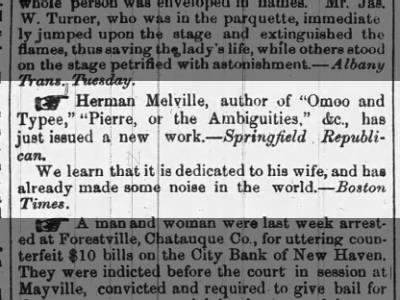
      Same year, same baby girl (Bessie Melville, born May 22nd) but involving different newspapers in Boston and Buffalo. The original Springfield notice has been abbreviated for the sake of another joke, contributed by the Boston Times and reprinted in the Buffalo Morning Express on June 2, 1853:


      Herman Melville, author of "Omoo and Typee," "Pierre, or the Ambiguities," &c., has just issued a new work.—Springfield Republican.

           We learn that it is dedicated to his wife, and has already made some noise in the world.—Boston Times. 
      Related post:

      Sunday, December 17, 2017

      Birth announcements, 1853

      More than one newspaper in western Massachusetts indulged in a joke about authorship as a kind of fatherhood when announcing the birth on May 22, 1853 of Herman Melville's daughter Elizabeth "Bessie" Melville. The first item below is one I had not seen before, from the Franklin Democrat (May 30, 1853) courtesy of Fulton History: 

      Franklin Democrat [Greenfield, Massachusetts] May 30, 1853

      BORN.

      ...
      In Pittsfield, 22d, a daughter to Herman Melville, the well-known author of several literary, not physiological works.
      Greenfield native Joseph Hussey Sprague edited and published the Franklin Democrat from 1852 to 1854.

      As reported by Jay Leyda in Another Friendly Critic for Melville, this earlier notice of Melville's "new work" in the Springfield Republican for May 28, 1853 (page 2):

      Springfield Republican - May 28, 1853
       refers to this birth announcement on the same page, different column:

      Springfield Republican - May 28, 1853
      Related posts:

      Friday, November 17, 2017

      Mrs. Herman Melville and daughters on Mount Washington in New Hampshire, 1878


      For one thing, the item below shows that in the summer of 1878, Herman Melville's wife and daughters made it to the White Mountains in New Hampshire. "Romeo" saw them, or saw their names in the register of visitors to the Tip-Top House, and counted them in his catalog of notable New Yorkers at Mount Washington:
      Among the New Yorkers who have recently visited the Tip Top House, may be mentioned the following: ... Mrs. Herman Melville and Misses Fannie and Bessie Melville.  --New York Evening Express, September 25, 1878
      New York Evening Express - September 25, 1878
      via Fulton History
      Herman also had been expected in New Hampshire that summer, according to family letters that Hershel Parker references in the second volume of Herman Melville: A Biography (Johns Hopkins University Press, 2002), on page 835. Herman Melville was then still a Custom House inspector. Possibly he made one "flying visit," as wealthier gentlemen did more frequently. Writing the year before from the Profile House, Franconia Notch, "Romeo" explained:
      Many New York gentlemen send their families here, and make them a flying visit every week or ten days. Distance offers no obstacle to this, and the New Yorker may breakfast in his own house in the morning and sup at the Profile House in the heart of the White Mountains. The trains leave New York at 8 o'clock A. M. and arrive here about the same hour P. M. It is a feat of railroad enterprise for which the public are indebted to the Boston, Concord and Montreal Company.  --New York Evening Express, letter from "Romeo" dated July 31, 1877.
      The New York Evening Express featured the correspondence of "Romeo" from the White Mountains and other popular resorts or "Watering Places" for many years. "Notes of Summer Travel / Letter from Cloud Land" signed "Romeo" and dated July 24, 1866 from Tip Top House, Mount Washington, appeared in the New York Evening Express on July 26, 1866.

      I'm reminded now the of the earlier post on "Melville" at Lake Memphremagog, about the puzzling mention of "Melville" by a correspondent of the New Orleans Times-Picayune named "Romeo."

      via Library of Congress
      Could this "Romeo" who named Mrs. Melville with Bessie and Fannie as 1878 visitors to the Tip Top House be the same "Romeo" who quoted "Melville" on the superior view from Owl's Head Mountain, back in 1859?

      Yes!

      Looking further into the online archive of Historical Newspaper Pages at Fulton History, I see that "Romeo" was indeed corresponding in the summer of 1859 with the New York Evening Express from Owls Head Mountain House, Lake Memphremagog.


      New York Evening Express - July 29, 1859
      "Romeo" in 1859 called himself a New Yorker, and traveled with New Yorkers to Lake Memphremagog, "the American Switzerland." Besides reporting to major southern newspapers in Virginia and Louisiana, as learned in the earlier post, he also corresponded with the New York Evening Express. As late as 1878, still writing for the Evening Express, Romeo thought to mention Herman Melville's wife and children among notable visitors to Mount Washington in New Hampshire.

      When "Romeo" quoted or paraphrased "Melville" back in 1859, maybe he did mean Herman Melville. Who else? At any rate, some Melville according to Romeo expressed this very Melvillean view of "the prospect" from atop Owl's Head Mountain:
      "... the prospect from the summit is even more pleasing than that from the summit of Mount Washington, or the Franconia Mountains." --Letter from "Romeo" dated August 22, 1859 from Owl's Head Mountain House, Lake Memphremagog, Vermont; published in the New Orleans Times-Picayune on September 1, 1859.
      As observed in the earlier post on Romeo's Melville, it sounds like something Herman Melville might have written down in a register for hotel guests or tourists.

      Sunday, September 11, 2016

      Digitized and available online from The New York Public Library: Herman Melville's 1860 memo with instructions (copied out by his wife Elizabeth) for publishing his completed book of Poems

      A previous post gave the text of Melville's 1860 memo from published transcriptions by a distinguished line of Melville scholars including Meade Minnigerode, Eleanor Melville Metcalf in Cycle and Epicycle, and Jay Leyda in The Melville Log. In print, Hershel Parker has reviewed the scholarship on Melville's detailed instructions for publication of his 1860 "Poems" in Melville Biography: An Inside Narrative. Now we can read Melville's long memo of May 22, 1860 in the neat handwriting of his wife Elizabeth Shaw Melville, courtesy of The New York Public Library.

      Herman Melville's 1860 "Memoranda for Allan" - 1 of 4; copied by Elizabeth Melville
      From The New York Public Library
      Herman Melville's 1860 "Memoranda for Allan" - 2 of 4; copied by Elizabeth Melville
      From The New York Public Library
      Herman Melville's 1860 "Memoranda for Allan" - 3 of 4; copied by Elizabeth Melville
      From The New York Public Library
      Herman Melville's 1860 "Memoranda for Allan" - 4 of 4; copied by Elizabeth Melville
      From The New York Public Library
      Melville's manuscript book of "Poems" was rejected by at least two different publishers, so Melville never got to enjoy "the publication of a first volume of verses" as he elaborately planned for it in 1860. But later versions of some verses are possibly to be found in Melville's 1891 volume Timoleon, Etc., especially in the section titled "Fruit of Travel Long Ago." In Melville: The Making of the Poet and the "Historical Note" for the Northwestern-Newberry edition of Melville's Published Poems, Hershel Parker suggests that earlier versions of Melville's surviving longer poems "Naples in the Time of Bomba" and "At the Hostelry" might also have graced the 1860 book of "Poems."

      Thursday, September 8, 2016

      More on the 1846 Middlesex source for Robert Melvill's 1850 farm report; with more parallels in Melville than Jay Leyda knew

      Found on Newspapers.com

      According to Jay Leyda and scholarly consensus up to now, Herman Melville probably ghostwrote the 1850 farm report of the Berkshire Agricultural Society that was signed by his cousin Robert as Chairman of the Committee on Agriculture and published October 9 and 10 in Pittsfield newspapers. The full 1850 report "On Agricultural Products" was also published in Transactions of the Agricultural Societies of Massachusetts over the signature of "ROBERT MELVILLE, Chairman." As shown in our last, however, Robert Melvill's 1850 report is adapted (that is, plagiarized) from the 1846 report "On Farms, &c." to the Society of Middlesex Husbandmen and Manufacturers, submitted after their annual Exhibition and Cattle Show at Concord.

      Leyda in "White Elephant vs. White Whale" (Town and Country v.101 [August, 1947]: 68-9; 114-118) gave impressive parallels between the 1850 text and Melville's writings without knowing about the 1846 Middlesex source. Did Herman Melville write the 1846 farm report, too?

      The longer, earlier composition features more verbal parallels to Melville's writings than Jay Leyda knew, or could have known about. Not that verbal parallels alone will ever finally establish authorship. Usually they don't, not without corroborative historical and biographical evidence. Leyda's 1947 attribution was admittedly conjectural, even backed by tangible evidence of Herman Melville's participation with his cousin Robert in July 1850 on a tour of Berkshire farms. (Melville's Marginalia Online has the volume of Field's History of Berkshire County with Herman's notes in the front about the trip with cousin Robert.) Still, Melville scholars have regarded Leyda's case as a pretty good one, strong enough to warrant inclusion of the 1850 "Report" among "Attributed Pieces" in the Northwestern-Newberry edition of Melville's Piazza Tales and Other Prose Pieces. To aid further study of authorship and other questions, I want to provide some more verbal parallels to Melville's known writings in deleted portions of Robert Melvill's main source, the 1846 farm report of the Middlesex Agricultural Society.

      Robert Melvill's 1850 version omits most of the political language in the original 1846 report, in particular the language of class conflict, and metaphors that describe agricultural improvements as the result of radical democracy. One whole paragraph on the "levelling principle" was deleted in revision. This bit, for example, appears only in the 1846 version:
      "the Committee must frankly pronounce their approbation of the prevalent democratic propensity, to produce a horizontal surface, by removing sandhills to elevate the adjoining bogs and marshes."
      The "levelling" theme recurs in Melville. In White-Jacket Chapter 40 Melville similarly equated social levelling with natural levelling:
      "how raise the valleys, without filling them up with the superfluous tops of hills?" 
      Likewise Melville's Pierre juxtaposes democratic principles with natural ones. In America "the democratic element operates as a subtle acid," corrosively, and yet democratic institutions "seem to possess the divine virtue of a natural law" (Pierre; Or, The Ambiguities). And Pierre himself embodies the division between aristocratic and democratic politics:
      "And if this seem but too fond and foolish in Pierre; and if you tell me that this sort of thing in him showed him no sterling Democrat, and that a truly noble man should never brag of any arm but his own; then I beg you to consider again that this Pierre was but a youngster as yet. And believe me you will pronounce Pierre a thoroughgoing Democrat in time; perhaps a little too Radical altogether to your fancy."  --Pierre; Or, The Ambiguities
      In a humorous vein the Middlesex Society affirms "vested rights" as a principle of essential political liberty, using the term that Melville would employ in Mardi to describe a sailor's free will--which in a calm turns out to be only theoretical:
      Even his undoubted vested rights, comprised in his glorious liberty of volition, become as naught.  --Mardi: And a Voyage Thither
      For the Middlesex Society, the ideal of "vested rights" similarly gets overturned by practical considerations. Embracing the policy of removing invasive plants, the writer puns on our understanding of the word radical to mean getting at the root of something:
      they witnessed, with unmingled delight, certain demonstrations of radicalism, in the uprooting of thorns and brambles, and an apparent determination to eradicate the dogwood and ivy, and all their relations.
      Here are a dozen more verbal parallels to known writings by Herman Melville in the 1846 report of the Middlesex Agricultural Society, signed by Chairman (and Boston Courier editor) Joseph Tinker Buckingham. Half of them occur in Typee or Omoo.
      1. SPACIOUS
      1846: neat and spacious dwellings
      1850: new and commodious dwellings

      --Omoo Chapter 8: "spacious houses"
      --Omoo, Chapter 81: "an edifice, by far the most spacious"

      2. THRIFTY
      1846: plantations of thrifty trees, luxuriantly laden with fruit
      1850: plantations of thriving trees

      --Omoo Chapter 52: "a thrifty growth of the sugar-cane, just ripening"; Typee Chapter 13 has "all manner of luxuriant fruits"

      3. UNDISPUTED POSSESSION
      1846: for aught we know to the contrary, had held undisputed possession thereof
      1850: for ought that we know to the contrary, had a life estate thereof
      "Such were our accommodations aboard of the Julia; but bad as they were, we had not the undisputed possession of them. Myriads of cockroaches, and regiments of rats disputed the place with us."  --Omoo, Chapter 10 - A Sea-Parlor Described, With Some of its Tenants:
      4. INTERVAL OF SILENCE
      "An interval of silence was at last broken by Babbalanja." --Mardi: and a Voyage Thither
      "It was noon, when an interval of silence falls upon the docks." --Redburn Chapter 37

       5. WERE WONT TO
      "they were wont to present themselves before the heir to the isle"  --Mardi: And a Voyage Thither
      "those old astronomers were wont to mount to the apex"  --Moby Dick, The Mast-Head

      6. RATHER INCLINE TO THE BELIEF
       "rather incline to the opinion" --Moby-Dick, The Cabin Table

      7. UNSPEAKABLE DELIGHT
      "to my unspeakable delight I perceived that some difference of opinion had arisen between them...." --Typee Chapter 33 - The Escape

      8. FASTIDIOUSNESS
       "a degree of fastidiousness that seemed to me ill-timed"
      --Typee Chapter 7

        9. BOREAS
      "Cease, rude Boreas, blustering railer!"  --White-Jacket, Chapter 3 alluding to the famous song  "The Storm" by George Alexander Stevens.

      10. AY
      One piece of wall, thirty or forty rods in length, presents an upper surface of flat stones, on which the committee walked with as much ease and rapidity as they could on the surface of the ground,—ay, and with much greater facility than one can travel across some of the fields in our county, which the owners appear to think easy of cultivation. It afforded really a pleasant promenade.
      "These islanders were heathens! savages! ay, cannibals!"  --Typee - The social Condition and general Character of the Typees

      "fine dwelling-houses, several hotels, and barber-shops, ay, even billiard-rooms;"  --Omoo Chapter 49
      11. THESE DEGENERATE DAYS
      "but we are loth to believe that, in these degenerate days, any grievous malediction would follow the practice of eating abundantly of the fruit of our vineyards, gardens and orchards." --1846 report of the Middlesex Agricultural Society

      "And as the great wrought nails, binding the clapboards, are unknown in these degenerate days, so are the huge bricks in the chimney walls."  --I and My Chimney
       12. PROMENADE
      As garrulous guide to the party, Braid-Beard soon brought us nigh the great Morai of Maramma, the burial-place of the Pontifis, and a rural promenade, for certain idols there inhabiting.  --Mardi: And a Voyage Thither
      For the context of walls, a better example of "promenade" occurs in Melville's 1849 Journal, where Melville describes his tour of Canterbury in the entry dated November 6th 1849:
      "The old wall forms a fine promenade."  --Journals - Herman Melville, ed. Howard C. Horsford with Lynn Horth (Northwestern University Press, 1989) page 13.
      Seven years later, Nathaniel Hawthorne recorded the same observation of Chester's city walls:
       "as interesting a promenade as can be found in England." --Hawthorne, quoted in the Northwestern-Newberry edition of Melville's Journals
      Coincidentally, he wrote that after walking "round the wall" with his friend Herman Melville.
      One more will make it a baker's dozen...
      13. HASTY PUDDING (the dish and the poem by Joel Barlow)
      One of our New-England poets has said, that "all his bones were made of Indian corn;" and we cannot doubt that it enters largely into the composition of our Yankee blood and muscle, and that its invigorating energies give strength and health to the sons, and beauty and loveliness to the wives and daughters of New England husbandmen. We compassionate the depravity of taste that cannot relish a jonny-cake, and despise the fastidiousness of appetite that cannot make a supper on hasty-pudding.
      The staple food of the Irish emigrants was oatmeal and water, boiled into what is sometimes called mush; by the Dutch is known as supaan; by sailors burgoo; by the New Englanders hasty-pudding; in which hasty-pudding, by the way, the poet Barlow found the materials for a sort of epic. --Redburn Chapter 52, The Emigrants' Kitchen
      Let's see. Where was Melville around that time? What was he doing in early October 1846?  The BIG news in Herman Melville's life was his engagement to Lizzie Shaw in Lansingburgh on the last day of August, 1846. After which, Lizzie evidently stayed in Lansingburgh for two months, until Sam Savage came from Boston at the end of October to get her. Then it was back to work, finishing up Omoo in New York City and looking for a job in the Custom House. Read all about it in the first volume of Herman Melville: A Biography. I don't suppose our lovebirds flew away to Concord, Massachusetts for the annual Cattle Show? Did they? Did Herman Melville around this time (in between Typee and Omoo) ever socialize with Boston Courier editor Joseph Tinker Buckingham? Let's keep a lookout, just in case...

      Related posts:
      • Sketches of Middlesex Husbandry--Boston Courier printing of 1846 farm report
        https://melvilliana.blogspot.com/2020/07/sketches-of-middlesex-husbandry-in.html
      As mentioned at the start, the 1850 report "On Agricultural Products" was also published in Transactions of the Agricultural Societies of Massachusetts over the signature of "ROBERT MELVILLE, Chairman." In case you missed it in the mess that followed, here's a link to that volume at Google Books: